
Thesis by
Anelia Angelova
In Partial Fulfillment of the Requirements
for the Degree of
Master of Science
California Institute of Technology
Pasadena,California
2004
c
2004
Anelia Angelova
Acknowledgements
I would like to thank my advisers Professor Pietro Perona and Professor Yaser
Abu-Mostafa for their help and support. This work would not have been possible without
them.
I would also like to thank my colleagues from the Vision Group and Learning
Systems Group at Caltech.
This work is supported by the National Science Foundation Research Center for
Neuromorphic Systems Engineering.
Abstract
Could a training example be detrimental to learning? Contrary to the common belief
that more training data is needed for better generalization,we show that the learning
algorithm might be better off when some training examples are discarded. In other
words,the quality of the examples matters.
We explore a general approach to identify examples that are troublesome for
learning with a given model and exclude them from the training set in order to
achieve better generalization. We term this process ’data pruning’. The method is
targeted as a pre-learning step in order to obtain better data to train on.
The approach consists in creating multiple semi-independent learners from the
dataset each of which is influenced differently by individual examples. The multiple
learners’ opinions about which example is difficult are arbitrated by an inference
mechanism. Although,without guarantees of optimality,data pruning is shown to
decrease the generalization error in experiments on real-life data. It is not assumed
that the data or the noise can be modeled or that additional training examples are
available.
Data pruning is applied for obtaining visual category data with little supervision.
In this setting the object data is contaminated with non-object examples. We show
that a mechanism for pruning noisy datasets prior to learning can be very successful
especially in the presence of large amount of contamination or when the algorithm is
sensitive to noise.
Our experiments demonstrate that data pruning can be worth while even if the
algorithm has regularization capabilities or mechanisms to cope with noise and has a
Contents
Acknowledgements iii
Abstract iv
1 Introduction 1
1.1 Learning and Generalization . . . 1
1.2 Difficult examples and outliers . . . 1
1.3 Data pruning overview . . . 2
1.3.1 What is data pruning? . . . 2
1.3.2 Overview of data pruning method . . . 2
2 Identifying noisy examples 4 2.1 Introduction . . . 4
2.1.1 What is a difficult example? . . . 4
2.1.2 How to deal with outliers? . . . 5
2.1.3 Why defining outliers is difficult? . . . 5
2.1.4 Motivation: Why study outliers? . . . 6
2.2 Robust statistics . . . 7
2.2.1 Accommodating outliers . . . 7
2.2.2 Eliminating outliers . . . 7
2.2.3 RANSAC . . . 8
2.3 Regularization methods . . . 9
2.3.1 Regularization with penalties . . . 10
2.3.3 Case study: Regularizing AdaBoost . . . 11
2.3.3.1 Applying penalties . . . 12
2.3.3.2 Introducing slack variables . . . 13
2.3.3.3 Modifying the cost function . . . 13
2.3.3.4 Removing examples . . . 13
2.4 Learning with queries . . . 14
2.4.1 Learning in the presence of classification noise . . . 14
2.4.2 Learning in the presence of malicious noise . . . 14
2.4.3 Active learning . . . 15
2.5 Outliers in a probabilistic setting . . . 15
2.6 Data valuation . . . 16
2.6.1 Exhaustive learning . . . 16
2.6.2 ρ-criterion . . . 16
3 Data pruning 18 3.1 Introduction . . . 18
3.2 Problem formulation . . . 19
3.3 The essence of data pruning problem . . . 20
3.3.1 When is data pruning necessary? . . . 20
3.3.2 Benefits of data pruning . . . 22
3.3.3 Difficult examples increase model complexity . . . 25
3.3.4 Regularization can benefit from data pruning . . . 28
3.3.5 Challenges for data pruning . . . 28
3.4 Data pruning . . . 31
3.4.1 Overview of the approach . . . 31
3.4.2 Multiple models and data subsets are needed . . . 31
3.4.3 Collecting multiple learners’ opinions . . . 32
3.4.4 Pruning the data . . . 33
3.4.4.1 Combining classifiers’ votes . . . 33
3.4.5 Why pruning the data? . . . 34
3.4.6 Experiments . . . 35
3.5 Discussion . . . 36
3.6 Conclusion . . . 38
4 Cleaning contaminated data 39 4.1 Introduction . . . 39
4.2 Experimental setup . . . 40
4.2.1 Training data . . . 40
4.2.2 Feature projections . . . 41
4.2.3 Learning algorithms . . . 42
4.3 Data pruning for visual data . . . 42
4.3.1 Generating semi-independent learners . . . 44
4.3.2 Data pruning results . . . 45
4.3.3 Pruning very noisy data . . . 51
4.4 Conclusion . . . 53
5 Conclusion 54
List of Figures
3.1 Average test errors when training on subsets of the data with increasing
difficulty of examples . . . 21
3.2 Training on subsets of the data may provide for decreasing the general-ization error . . . 23
3.3 Training on subsets of the data may provide for decreasing the general-ization error. Single run on the training data . . . 24
3.4 Inherent model complexity is increased by adding more difficult examples 26 3.5 Algorithms may share boundaries and therefore the difficult examples . 29 3.6 Definition of a difficult example depends on the model . . . 30
3.7 Data pruning results . . . 36
3.8 Data pruning results for UCI datasets . . . 37
4.1 Training data for face category . . . 41
4.2 Dictionary of filters . . . 43
4.3 Masks selecting sub-regions of the object . . . 43
4.4 Sub-regions for training multiple independent learners for face category 44 4.5 Data pruning results for contaminated face data . . . 46
4.6 Data pruning results for contaminated face data. Scatter plots . . . 47
4.7 Comparison between different pruning mechanisms and different basic learning algorithms . . . 48
4.8 Examples selected for elimination by bootstrapped learners . . . 49
4.9 Examples selected for elimination by region learners . . . 50
List of Tables
4.1 Average test error for learning on pruned and full face data,SVM
algo-rithm. Pruning based on bootstrapped learners . . . 47
4.2 Statistics on the identified wrongly labeled examples. Bootstrapped
learners. . . 51
Chapter 1
Introduction
1.1
Learning and Generalization
A learning task can be defined in the following way: given a set of training examples
S ={(x1, y1), ...,(xN, yN)} which supposedly come from an unknown target function
f : X → {−1; +1} , yi = f(xi), i = 1. . . , N find a function g, g : X → {−1; +1},
g ∈G={g}which agrees with the target functionf as well as possible. The learning
model G is a predefined set of hypotheses from which the target function is selected.
The purpose of learning machines is to be able to classify correctly unseen
exam-ples,not only the training ones. In other words,to generalize well rather than simply
memorize the training data. If the learning algorithm performs well on the training
data but poorly on unseen data,overfitting is said to occur.
1.2
Difficult examples and outliers
In real-life problems it is possible that the training data is contaminated by noise,
meaning yi = f(xi) is not satisfied for all of the examples. Those wrongly labeled
examples would be problematic for the learning process. An important task of a
learning algorithm is to be robust to noisy or mislabeled examples.
Troublesome examples may also be ones which are difficult in a sense that in order
to learn them the algorithm would be in contradiction with other training examples,
these hard examples may lead to the algorithm being unable to generalize well or
overfit.
In the presence of troublesome examples,the learning machine has to face a very
difficult task: it has to learn an unknown function using a finite number of examples
considering that some of the examples may be misleading or difficult in other ways.
We would like to explore if it is possible to find mechanisms to detect and eliminate
examples hard for learning and improve the generalization performance by doing so.
1.3
Data pruning overview
1.3.1
What is data pruning?
Suppose we are given a set of training examples and a selected learning model. The
task is to identify if there are examples in the training set such that by eliminating
them one may improve generalization performance.
Many methods deal with noisy examples by querying for more
data,accommo-dating the examples by reweighting or decreasing their influence by regularizing the
solution. We will study methods that fully eliminate those ’bad’ examples from
train-ing or,in other words,prune the traintrain-ing data.
The most challenging problem is how to define for a particular training data and
selected model which examples are worth removing so that to improve generalization
ability of the learner.
1.3.2
Overview of data pruning method
Our approach consists in learning diverse classifiers (learners) by randomizing the
training set and then combining their output to decide on difficult examples. We use
a bootstrapping method to select various semi-independent learners.
Each of the new learners would be capable of classifying the data comparably to
the learner on the full-sized training set. However,each one is trained on a different
semi-independent opinions with respect to the troublesome examples. Our intuition is that
most of the learners would agree on non-difficult examples. Furthermore,examples
which are forcing poor generalization performance would not influence all the learners.
So,combining the output of all the learners may help identify the troublesome training
examples. The classifiers’ opinions are combined using Bayesian reasoning to receive
a final decision of whether an example has to be eliminated.
We apply the data pruning method to learn to recognize face category from very
noisy datasets. As the target is visual category,multiple semi-independent learners
can be received by training on slightly overlapping regions containing parts of the
Chapter 2
Identifying noisy examples
In this chapter we give a notion of which example is difficult and show various ways
to deal with outliers,noisy or difficult examples in different areas of learning from
examples.
2.1
Introduction
2.1.1
What is a difficult example?
Formal definition of difficult examples is hard to give. Below we give informal
defini-tion of outliers or difficult examples. Difficult examples are those which obstruct the
learning process or mislead the learning algorithm or those which are impossible to
reconcile with the rest of the examples.
Defining difficult example cannot be done without the learning model or the
gen-erating distribution.
The reliability of an observation is dependent on the other
observations,i.e.,defin-ing difficult example should be done in the context of the remainobservations,i.e.,defin-ing data. The
rela-tive number of outliers with the same ’weirdness’ should be small,i.e.,the particular
properties of an outlier are not supported by many other examples.
Quite often in statistics the method advocated is through visual examination of
the data or the residuals after fitting a particular model. Further elimination of values
of a difficult example very subjective and prone to errors due to misspecified model.
As a summary,an outlier is discordant with the remaining data and with respect
to the model.
We would use interchangeably the terms outliers,difficult,adversary,noisy and
troublesome example. Alternative names common in the literature are discordant
observations,contaminants,surprising values.
2.1.2
How to deal with outliers?
Defining what a difficult example is and how to cope with it are two interconnected
problems.
Different approaches have been taken trying to be robust to outliers: discard them,
give different weights to more influential examples,average out multiple observations
so that to diminish the poor influence of outliers in some models or accommodate them
in a redesigned model. Discarding examples is suitable in the case of inherently wrong
observations. It can improve the accuracy of the mean. Reweighting is suggested
for heavy tailed distributions,for example,give weights according to the standard
deviation. Averaging out observations would reduce the variance.
In this work we will eliminate the outlying examples altogether.
2.1.3
Why defining outliers is difficult?
Outliers and difficult examples may come from various sources and may be realizations
of different phenomena. So,assuming a particular model for the noise might not be
always appropriate.
Difficult examples may be noisy e.g. coming from different than the assumed
distribution,or may be the result of wrong measurements.
In statistics an outlier can be defined from the generating distribution. Given the
distribution,an outlier is a value which deviates ’too much’. This,in the first place,
is not a clear-cut definition because it is not known what deviations are tolerable.
one.
An example may be a result of natural variation and the model should be able to
handle those without discarding them as outliers.
Furthermore,the learning algorithm may react in different ways to the presence
of outliers: some algorithms might be able to learn in the presence of noise,others
would be more severely influenced by adversary examples,resulting in poorer decision
boundary and worse generalization performance.
2.1.4
Motivation: Why study outliers?
The outliers themselves can be a main interest for practical purposes such as detection
of anomalies,interesting observations,etc.
The other side of the story is that outliers may just be measurements which are
wrong and subsequently would force the incorrect model parameters to be estimated
or the function selected may not generalize well because of overfitting with respect
to those difficult examples. In those cases the troublesome examples are again of
interest but to be considered for elimination.
An example which is too influential in the model can change the estimation of
the model. For example,outlying observations can result in a wrong estimate of the
mean of the population.
Moreover,in data analysis,identifying and studying outliers provides important
information as to how adequate the current model is and may suggest a revision of
the model and its assumptions.
As we have discussed so far,defining a difficult example is quite subjective. A
statistically objective method to identify and deal with outliers is still a topic of
research. In the following sections we review several methods to identify and cope
2.2
Robust statistics
Robust statistics is preoccupied with how to identify outliers or noisy observations,
eliminate their influence or fully discard them [5],[21]. We give some examples of
how robust estimation can be done.
2.2.1
Accommodating outliers
One straightforward approach is to reweight the observations according to their
in-fluence or the confidence we have in them and re-estimate the model parameters.
Alternative one is to use more robust cost functions. For example,the least
squares objective functioni(Xi−M)2 ,whereM denotes the fitted model for linear
regression,is notorious for being very sensitive to outliers. Huber [21] suggested to
use other cost functionsiρ(Xi−M) which are more robust to outlying observations,
for example ρ(t) =|t| [5].
Another approach is to modify the model so that it takes into consideration
out-lying observations.
2.2.2
Eliminating outliers
Various statistical tests have been created for particular cases of identifying one or
two outlying observations. Examples are removed one at a time and the model is
re-estimated. Students’ tests are used to decide if an observation is deviating too
much when not included in the estimation [43].
Robust estimation by examining residuals and removing examples can be done
for linear models with normal distributed noise Y = Xβ+e, var(e) = σ2I,where
X is a set of data points, Y are the responses and a linear model needs to be fit to
those points so that to minimize the least-squares error of the fit [43]. β contains
the parameters of the linear model and e is a vector of residual errors. The
least-squares estimate ˆY is computed as follows ˆY=X(XTX)−1XTY=HYˆ where Hˆ is
be removed. The influence of example Xi is determined by hii in the ’hat’ matrix.
Details are given below.
The residuals are defined as e=Y−Yˆ = [I−Hˆ]Y. The residual of an example
satisfies var(ei) = σ2(1−hii),i.e.,values of hii close to 0 mean that the example
would have a large deviation of the error estimation and suggests that it might be an
outlier. However,caution should be taken because this might not always be so: the
hii value should be considered in the context of the other hij in the ’hat’ matrix [43].
Another way to estimate the influence of examples is by perturbing the data and
examining again the residuals. Examples which result in major changes of the model
are considered influential [43].
Many estimators are created particularly to improve the robustness of the mean
or other statistics of the data but we would not examine them here.
The practice in robust statistics is to identify outliers for further investigation.
The actual elimination is done after human supervision. In this work we explore an
approach which would automatically identify and eliminate outlying examples.
Generally,in statistics,it is recommended that the samples be ’routinely
sub-jected’ to outlier detection procedures before estimating the model. This diagnostic
might help to validate the adequacy of the model,to guide the subsequent data
anal-ysis,to take into consideration examples which might need to be further investigated,
rejected or accommodated by the model [5].
2.2.3
RANSAC
The RANSAC (RANdom SAmple Consensus) algorithm [16] is used to learn model
parameters in the presence of large number of outliers. It randomly samples minimal
subsets of the data to estimate the model parameters and selects the model with
maximum agreement among the samples.
It is assumed that the target model is known and a fixed number of data points
algorithm proceeds by selecting multiple times (T trials) a random subset of m data
points,estimate the model parameters and rate the selected model correspondent to
how much it complies with the rest of the data. Out of the many attempts to fit a
model the one which fits the whole data best is selected. It relies on the fact that
in data containing a large amount of outliers (50% or more) the model parameters
selected using the outliers would be inconsistent with each other,while the correct
model parameters would be consistent throughout many trials. So,in order to
esti-mate them with high confidence a sufficient number of trials is needed.
RANSAC is often used in vision applications for example to fit geometric
primi-tives e.g. a line or a circle to a set of noisy points,to find point correspondences,or
to find a matrix for a transformation which best explains the evidence (usually very
noisy). A trivial example of using RANSAC is as follows: if we need to find a circle
which is consistent with a lot of noisy points,three points are sufficient to determine
the circle center at each trial,the most frequent center of circles is selected as the
best model.
The RANSAC algorithm requires the target model to be known and the number
of examples to estimate it uniquely should be small. In our task of data pruning
we are uncertain about both model complexity,and subset of data needed for
esti-mating learning. There is a large degree of freedom introduced by the model and its
complexity being unknown.
2.3
Regularization methods
Regularization methods are created to deal with problems which are ill-posed,namely,
the solution may not exist,is not unique or is unstable to small perturbations in the
initial data [39]. Generally,regularization methods apply penalty or restriction on the
class of admissible solutions so that the problem becomes a well-posed one. There
is a large body of work on regularization with applications in solving differential
equations,inverse problems,linear integral equations,etc.
Suppose the problem consists in minimizing a functional R(X) depending on the
training data. Regularization methods suggest to minimize R(X) +λΩ(X) instead,
where Ω(X) is a stabilizing functional or penalty. It may express desired properties
of the solution,for example,we can penalize for a function with large derivatives to
prefer a smoother (less oscillatory) function. The new target function is a trade-off,
controlled by the coefficient λ,between fitting the data and using too complex a
function.
There are other forms of regularization. Below,we discuss some of them. Without
trying to encompass all,we consider only cases which are relevant to learning and
more specifically to dealing with noisy examples or outliers.
2.3.1
Regularization with penalties
The most popular form of regularization is the weight decay for Neural Networks,
where the penalty is over the sum of squares of all parameters in the network,namely
its weights [6]. The regularizing functional penalizes large sum of weights in the
network which may lead to overly complex discrimination function: Ω = 12iw2i.
A heuristic with similar purposes is early stopping,in which smaller number of
iterations of the learning process (epochs) is preferred. It has a regularization effect
because more epochs are more likely to create more complex network and therefore
overfit the data [6].
Theoretical justification for preferring smaller sum of weights with weight decay
or early stopping in Neural Networks was given by Bartlett [3]. He showed that the
generalization ability of the Neural Network depends on the sum of weights of the
network. Thus networks with larger weights may be of large complexity,which would
increase the generalization error.
2.3.2
Introducing slack variables
We demonstrate the method of using slack variables for regularization with the so
of SVM classification for linearly separable data is to find a hyperplane y=w,x +b
which achieves maximum margin measured as w12,for both classes. The following
problem needs to be solved:
min 12w2 subj.to
yi(w,xi +b)≥1 i= 1, . . . , N
To cope with linear nonseparability,the kernel trick is applied and the dataset
is transformed to high dimensional space [36]. Still,even in high dimensional space,
the data may not be perfectly separable and some form of regularization is needed.
Cortes and Vapnik [14] suggest to introduce slack variables which allow some data
points to violate the decision boundary. This method has proved to be very successful
in practice.
min 12w2−CNi=1ξi subj.to
yi(w,xi +b)≥1−ξi, ξi ≥0 i= 1, . . . , N
2.3.3
Case study: Regularizing AdaBoost
Boosting algorithms and in particular AdaBoost [18] combine weak learners,learners
performing slightly better than random guessing,into a strong one. The crucial idea
of boosting is to give larger weights to examples wrong with respect to the current
weak learner. Thus examples which are generally difficult would get consistently
larger weights.
Boosting methods are of particular interest to us,because their internal mechanism
is to overemphasize difficult examples - a strategy opposite to outlier elimination or
de-emphasizing. Yet,in noisy cases,this strategy of AdaBoost has shown in experiments
to be suboptimal. Therefore some sort of regularization is needed.
Jiang [22] supported theoretically the claim by demonstrating that ’boosting
for-ever’ leads to suboptimal solutions and that a regularized version of boosting would
2.3.3.1 Applying penalties
The standard way of applying penalty to the cost function to be minimized can be
straightforwardly applied to AdaBoost.
Mason et al. [29] presented an interpretation of boosting methods as a gradient
descent over some cost function. By minimizing the cost function at each iteration,
the gradient descent algorithm selects a best hypothesis and a coefficient,which is
equivalent to modifying the weights over the examples in order to select the next best
hypothesis in the original boosting algorithm.
AdaBoost algorithm can be exactly retrieved from this framework with the
expo-nential cost function over the margin of an example,defined asγ(xi) =yi
T
t=1αtgt(xi)
G=
N
i=1
e−yiTt=1αtgt(xi)
where {xi, yi}Ni=1 is the training set of N examples and T is the number of
itera-tions.
R¨atsch et al. [33],[34] proposed to regularize AdaBoost by modifying the cost
func-tion at each iterafunc-tion through adding penalty for difficult examples. Their criterion
for a difficult example is the average weight of an example of all the iterations up
to the current one. The cost function to be minimized at iteration t0 by AdaBoost
becomes:
Gt0 =
N
i=1
e−yi(tt0=1αtgt(xi))−Cµ(xi)
whereµ(xi) = (
t0
t=1αtwt(xi))2 andwt(xi) is the weight of an example at iteration
t and C is a fixed constant. The rationale behind this type of regularization is that
examples which are hard would tend to be over-emphasized and therefore would have
large sum of weights throughout previous iterations. Therefore,the algorithm might
2.3.3.2 Introducing slack variables
Another way to regularize AdaBoost solution is to introduce slack variables [33],[34],
as with SVM. An approximation of AdaBoost,called LP-AdaBoost [20],is used. In
LP-AdaBoost the hypotheses are selected using AdaBoost and then linear
program-ming is used to find best combining coefficients in order to achieve maximum margin.
Grove and Schuurmans [20] showed experimentally that maximizing the minimum
margin gives a suboptimal solutions especially in noisy cases. Slack variables are
introduced in the optimization problem so that to allow the algorithm to give up on
some noisy examples (to allow for some difficult examples to violate the maximum
margin condition). The formulation of regularized version of LP-AdaBoost is:
max γ−CNi=1ξi subj.to
yi
T
t=1αtgt(xi)≥γ−ξi, ξi ≥0, i= 1, . . . , N
αt≥0,
T
t=1αt= 1, t= 1, . . . , T
where gt(x) are the hypotheses already found by AdaBoost and αt are the
coeffi-cients we are optimizing for and C is a fixed regularization constant.
2.3.3.3 Modifying the cost function
Mason et. al. [28] suggest that a cost function of special type is used,so that not
to emphasize too much examples which might be noisy. AdaBoost cost function is
exponential,i.e.,it would give exponentially large weights to misclassified examples.
Instead they propose optimizing over a family of less steep cost functions.
Manipu-lating the cost function so that it penalizes more difficult examples is again some sort
of regularization for a class of boosting techniques.
2.3.3.4 Removing examples
Regularization by removing examples for AdaBoost,termed ’example shaving’,has
been demonstrated by Merler et al. [30]. A level of difficulty of an example is
the entropy of the weight distribution throughout iterations for each example [11]. A
validation set is used to define which of the most difficult examples to be removed [30].
The usefulness of regularizing AdaBoost has been demonstrated experimentally
in noisy datasets [28],[33],[34]. The need for regularizing AdaBoost has been
theo-retically explained in [22].
2.4
Learning with queries
2.4.1
Learning in the presence of classification noise
Angluin and Laird [2] investigated learning in the presence of classification noise in
the context of learning with queries. In the classification noise scenario examples have
their labels flipped with a certain probability β,but are otherwise not changed,i.e.,
they are assumed to come from the target distribution. They showed that if the noise
can be modeled as independent source then the amount of noise tolerated can be
very large but strictly less than 50%. For this setting they give a sample complexity
bounds for effective learning in which the number of examples is polynomial in 1−12β,
where β is the noise level. That is,considerably more examples are needed to learn
the concept if the level of noise is large. They proved that learning in the presence
of noise is possible but the search for an optimal hypothesis for general problems is
polynomially intractable with their approach. For some classes of concepts efficient
algorithms exist which exploit the properties of the particular concept class.
2.4.2
Learning in the presence of malicious noise
Kearns and Li [23] consider an extension of learning with noise in which the noise is
not assumed to have nice properties and generally cannot be modeled. The adversary
creating the noise has ultimate powers such as changing examples’ labels,returning
examples from a wrong distribution,having access to the currently generated
learned examples. This model is called learning with malicious noise. For this model
significantly smaller amounts of noise can be tolerated. The authors give hardness
results for learning of arbitrary concepts in this model as well as constructive learning
algorithms for learning particular concept classes.
2.4.3
Active learning
The objective of active learning is to select particularly informative examples in order
to speed up training [25],[13].
In some sense active learning is also preoccupied with excluding examples from
the dataset,but there,the redundant examples are the ones to be ignored. Smaller
number of data points and considerably less computational resources are required in
active learning than in the standard learning scenario to achieve the same
generaliza-tion performance [41]. The assumpgeneraliza-tion of active learning is that the training data is
not noisy.
2.5
Outliers in a probabilistic setting
Finding and eliminating outliers can be cast in a probabilistic setting. A generative
probabilistic models are assumed for the two classes’ distributions. An appropriate
outlier model is selected. A new hidden variable is introduced for an example being
an outlier (and therefore need to be eliminated or ignored) and the problem can be
solved with maximum likelihood approach and the EM [17].
Although the method is very powerful its disadvantages come from the strong
assumptions made,namely the models of data distributions and outliers should be
known. Apart from that,more parameters for the generatve models need to be
estimated,i.e.,more training data would be necessary,which might not always be
2.6
Data valuation
The methods described above introduce mechanisms to cope with noisy situations,
usually by imposing penalty,by de-emphasizing (reweighting) noisy examples. The
most common case is trying to ignore them by overpowering the presence of noisy
examples by using more correct ones. Data valuation method,proposed by
Nichol-son [32],advocates removing examples from the training data and demonstrates it is
useful on several classification problems with noise.
Data valuation [32] consists in analyzing the training data prior to learning and
removing examples which might be adversary to learning. The examples are given a
ranking according to their agreement with the remaining data and examples which
disagree most are removed. Data valuation is created for the exhaustive learning
scenario.
2.6.1
Exhaustive learning
The exhaustive learning algorithm [37] returns hypotheses from the learning model
with a fixed prior distribution. Thus any hypothesis in the support of the prior
dis-tribution can be selected. That is,no actual learning is performed on the data. Note
the distinction from the standard learning scenario where only hypotheses which
per-form well with respect to the training data (for example minimize the empirical risk)
are selected. The distribution over hypotheses in the learning model in exhaustive
learning is independent (agnostic) of the training data.
Although the analysis of [32] is done for the exhaustive learning scenario [37],we
consider the data valuation method as a predecessor to our work.
2.6.2
ρ
-criterion
A primary task in data elimination is to define which examples are difficult for
learn-ing and therefore candidates for elimination. Nicholson [32] proposes a heuristic for
the overall error rate π in the exhaustive learning. As π is unknown it is
approxi-mated by the leave-one-out error,the error of the dataset excluding the example in
question.
ρxi =corrg(ei(g), eSi(g))) =
Eg(ei(g)eSi(g))−Eg(ei(g))Eg(eSi(g)) V ar(ei(g))V ar(eSi(g))
(2.1)
wherecorr is correlation of the error of the examplexi,denoted byei(g),with the
error of the remaining set,denoted byeSi(g),Si =S\xiandS ={(x1, y1), ...,(xN, yN)}
is the training set.
Furthermore,because the expected value of errors with respect to all hypotheses
inGcannot be computed analytically in most of the cases,(2.1) will be approximated
by randomly sampling hypotheses from the learning model.
Thus a ρ value (2.1) is assigned to each example showing how much it agrees
with the target function for this particular model. It gives information whether the
example is contradicting on average the rest of the examples with respect to all
possible hypotheses. The higher the correlation the more the example complies with
the remaining training set,i.e.,would not be expected to be troublesome in learning.
Examples with negative correlation ρ would be expected to be difficult using this
learning model. In practice Nicholson [32] has shown thatρneeds to be selected close
to -1 in order to avoid deterioration in performance,which is probably due to the
approximations in calculating ρ.
The author demonstrated that in noisy datasets removing examples from the
Chapter 3
Data pruning
3.1
Introduction
In the previous chapter we have reviewed several learning methods which have
mech-anisms to cope with noisy examples. Some of them apply a common penalty for all
examples (regularization methods),others identify those examples which influence
the model too much and reweigh them,assuming that the model is known and fixed
(robust statistics),others model the noise source as independent white noise [2] and
show that learning can be done,provided that sufficient examples are available.
Suc-cessful identification of outliers can be done for models which are fixed and have very
few parameters to estimate e.g. RANSAC [16]. In those cases a large amount of noise
can be tolerated.
In many real-life learning problems noise is often present,the number of examples
is insufficient and the model and its complexity are not known a priori. Our goal is
to look into those more realistic settings.
We are interested in binary classification tasks in which we are given a fixed
training set and a desired model for classification. In this setting we want to identify
examples which are troublesome for the learning process for this particular training
set and this particular model and which might potentially cause the model to overfit
and therefore deteriorate the generalization performance. We term data pruning the
process of eliminating examples which might be troublesome for learning.
the difficulties of solving it. We propose a way to identify and eliminate troublesome
examples and show experiments and promising results of data pruning on real-life
data.
In the next chapter we apply our method to the recognition of object categories
in which the training data is contaminated,namely,the data may have large amount
of wrongly labeled examples or examples which are otherwise difficult for the model
at hand.
3.2
Problem formulation
Data pruning may be defined as follows: given training data and a learning model,find
if there are training examples for which the learning and generalization performance
would be improved after removing those examples. The problem as we define it is
quite difficult to solve. Below,we examine the reasons why.
Eliminating the influence and detrimental effects of outliers is still an active area
of research in statistics. The main challenges come from the difficulty of modeling
outliers because their sources may be variable. In our case we do not assume a model
of the noise.
We are considering a binary classification problem which is ill-posed in the first
place even without any noisy examples. This is because the training data is finite
and a small change in the data,for example adding or removing a few examples,can
change the decision boundary. Apart from that the solution is not unique as the most
appropriate model and model complexity are not specified [36].
Straightforward approaches to solve the problem are to sort the examples in
in-creasing level of difficulty,difficult meaning closer to the decision boundary [11] or
level of disagreement [32] and eliminate sequentially most difficult ones. An
indepen-dent test set is used to iindepen-dentify which examples to be removed [30]. Although using
validation set can be very useful,in this case we feel that using additional data to
decide which examples to prune gives an unfair advantage of the pruned method with
set in order to choose their best parameters but we feel we cannot allow the algorithm
to decide on pruning an example or not using extra validation set.
A lot of research has been done in using unlabeled data alongside with labeled.
The major conclusion being that using unlabeled data in addition to labeled is quite
useful and handy when labeling is expensive. Those depend on the assumption that
they have some reliably labeled data to start the learning and estimation from [8]. In
our formulation we have to identify the correctly labeled examples.
And last but not least,the powerful probabilistic models can be applied very
successfully to solve fully unsupervised problems modulo some technical problems
with local minima and amount of data needed to estimate the parameters correctly.
Those methods rely on the strong assumption that the data comes from a particular
distribution which can be modeled. If the assumption is correct Bayesian methods
would give the optimal solution. Nevertheless,we believe we cannot generally assume
we know and can model the sources that generated the data and want to use the
available training data in less requiring discriminative models.
3.3
The essence of data pruning problem
In this section we try to understand the problem of identifying troublesome examples
and removing them from the data. We would give examples to get intuition of the
problem at hand.
3.3.1
When is data pruning necessary?
We give characteristic examples of datasets with and without difficult examples and
show where data pruning would be helpful. We show those characteristic behaviors
on real datasets,figure 3.1.
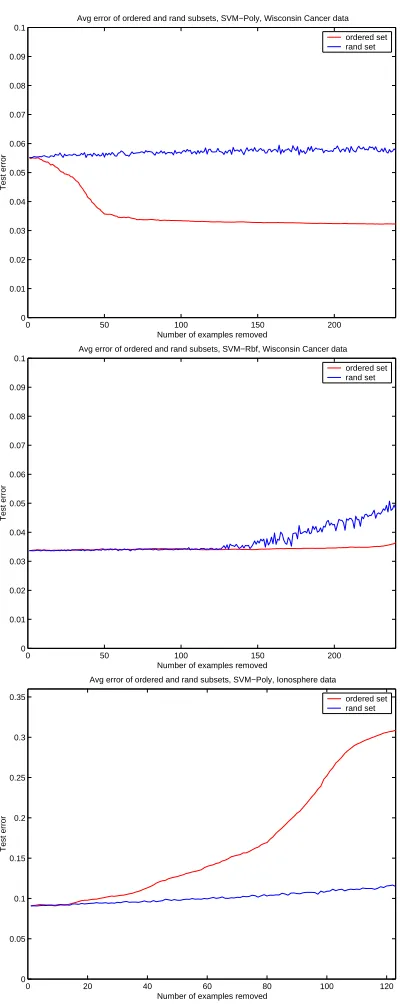
(1) There are examples adversary to learning present in the dataset,difficult
examples can mislead the algorithm and it creates a poor boundary or overfits. The
0 50 100 150 200 0 0.01 0.02 0.03 0.04 0.05 0.06 0.07 0.08 0.09 0.1
Avg error of ordered and rand subsets, SVM−Poly, Wisconsin Cancer data
Number of examples removed
Test error
ordered set rand set
0 50 100 150 200
0 0.01 0.02 0.03 0.04 0.05 0.06 0.07 0.08 0.09 0.1
Avg error of ordered and rand subsets, SVM−Rbf, Wisconsin Cancer data
Number of examples removed
Test error
ordered set rand set
0 20 40 60 80 100 120
0 0.05 0.1 0.15 0.2 0.25 0.3 0.35
Avg error of ordered and rand subsets, SVM−Poly, Ionosphere data
Number of examples removed
Test error
[image:30.595.225.425.68.571.2]ordered set rand set
(2) There are examples adversary to learning present in the dataset but the
al-gorithm has mechanisms to ignore noisy examples in its optimization (for example
SVM-SVC,Neural Networks). No matter that,the algorithm cannot always deal with
hard examples. In those cases adversary examples can lead to poorer generalization
performance,as in case (1).
(3) There are no examples adversary to learning in the dataset. Adding more
difficult examples improves the test error,the difficult examples are actually useful
for forming the proper boundary.
The plots of figure 3.1 show the three characteristic examples on real-life data
from UCI Repository [7] in which data pruning may or may not be useful. We should
note that the model in (1) has regularization capabilities but still cannot deal with all
difficult examples. Conversely,on the same training data,the model in (2) can deal
with difficult examples,which suggests that difficult examples are model dependent.
The ordering of examples used to generate these plots would be explained in the next
section.
The plots also give intuition that training on subsets of the data with
increas-ing difficulty gives a chance to improve the generalization performance compared to
training on the whole training data as is in case (1).
3.3.2
Benefits of data pruning
In this section we show that,given a learning model and a dataset,it is possible that
the algorithm would perform better if training on a subset rather than on the whole
set. One example has already been given in the previous section. To do that we need
to search for good subsets of the data. Finding the best subset of examples to train
on would need exponential number of subsets to be considered. Instead,we suggest to
define a measure of difficulty of an example and train on nested subsets of examples
of increasing complexity,hoping that if there are examples which are troublesome
the generalization error.
We propose to use the margin of an example as a criterion for how difficult it
is and order the examples in terms of margin. However,we do not know the exact
complexity of the model according to which to measure the margin of the examples.
So,we suggest to learn the model using various complexities: create nested classes
of increasing capacity as in Structural Risk Minimization (SRM) [40],measure the
margins of each example and average them with respect to all models to get a more
reliable margin estimate.
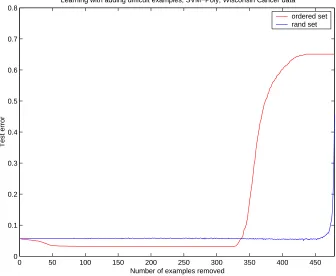
0 50 100 150 200 250 300 350 400 450 0
0.1 0.2 0.3 0.4 0.5 0.6 0.7 0.8
Learning with adding difficult examples, SVM−Poly, Wisconsin Cancer data
Number of examples removed
Test error
[image:32.595.157.493.257.533.2]ordered set rand set
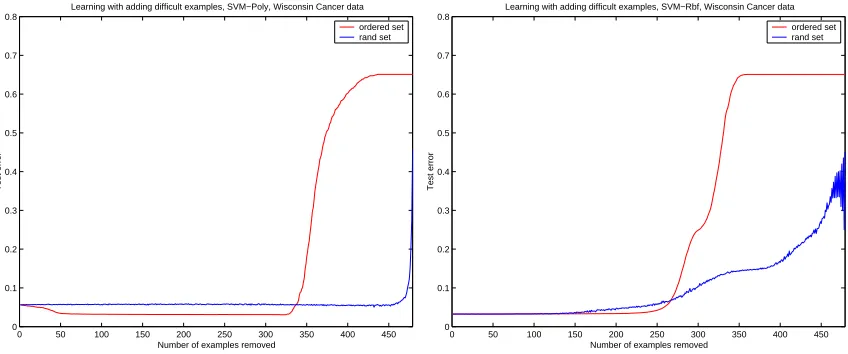
Figure 3.2: Training on subsets of the data of increasing complexity may provide for decreasing the generalization error. Learning algorithm is SVM. Wisconsin cancer data,0% noise.
This criterion is quite natural as the margin is a measure of confidence in
classi-fication in an algorithm [35]. It is also a universal quantity because the margin of an
examples can be measured no matter what learning algorithm we use.
An interesting observation is that from this heuristic measure of difficulty we can
20 40 60 80 100 120 140 160 0
0.2 0.4
SVM ordering
Test error: learning on ordered subsets with AdaBoost. Ionosphere data, 10% noise
ordered full
20 40 60 80 100 120 140 160
0 0.2 0.4
AB ordering
20 40 60 80 100 120 140 160
0 0.2 0.4
NN ordering
50 100 150 200 250
0 0.1 0.2 0.3
SVM ordering
Test error: learning on ordered subsets with SVM. Wisc cancer data, 0% noise
ordered full
50 100 150 200 250
0 0.1 0.2 0.3
AB ordering
50 100 150 200 250
0 0.1 0.2 0.3
[image:33.595.182.465.79.313.2]NN ordering
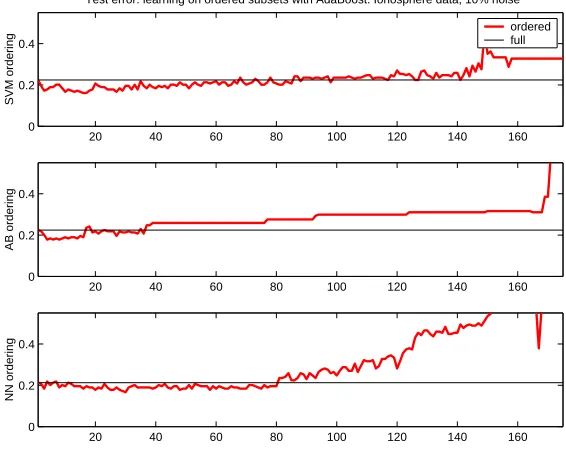
Figure 3.3: Training on subsets of the data may provide for decreasing the general-ization error. Each figure shows the test error for a single run of dataset ordered in terms of difficulty. Ordering criteria are computed using the average margin for SVM, AdaBoost and Neural Network models. Top: AdaBoost learning model,Ionosphere data,10% noise,Bottom: SVM learning model,Wisconsin cancer data,0% noise.
in AdaBoost. The authors used the criterion to impose regularization penalty.
error using such naive and heuristic way to order examples in terms of difficulty,
figures 3.2,3.3. The plots are generated by multiple randomized runs,so we can see
an estimate of the out-of-sample error,figure 3.2,and for only a single run figure 3.3 to
demonstrate that this phenomenon can be observed for a particular training dataset.
We note that this is not data pruning yet. We merely demonstrate that data
pruning has potential for some datasets which contain difficult examples. Note that
there are datasets in which none of the examples are useless or harmful,as shown on
figure 3.1.
In this paragraph we have seen that it is possible to improve the generalization
error if training on a (suitably chosen) subset of the training data,for the sole reason
that there are troublesome examples. In other words not only the size of the dataset
matters but the quality of the examples as well.
3.3.3
Difficult examples increase model complexity
To demonstrate this point we again order the examples in terms of difficulty as in the
previous section. We measure the observed complexity of the model after training
on nested subsets of the training data by adding more and more difficult examples.
As we noticed in the previous section we can observe better generalization error after
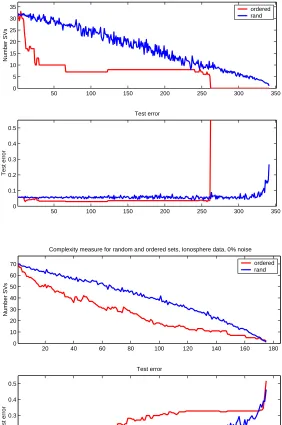
training without the most difficult examples. In figure 3.4 we can see what the reason
might be. We plot the number of Support Vectors as a measure of complexity for each
nested subset of ordered training examples,as well as for random subsets of the same
size. We can notice that for some datasets we observe unduly increase in the measures
of complexity. For example,adding the last 15 most difficult examples for Wisconsin
cancer data would significantly increase the number of support vectors used as well
as the generalization error,figure 3.4. Again this results give intuition why some
examples might be troublesome and causing overfitting. Alternative measure of the
complexity actually used by SVM can be defined by Rγ22 [4],whereγ is the margin and
R is the radius of the sphere which encompasses all the points. For Neural Networks
50 100 150 200 250 300 350 0 5 10 15 20 25 30 35
Complexity measure for random and ordered sets, Wisc. cancer data, 0% noise
Number SVs
ordered rand
50 100 150 200 250 300 350
0 0.1 0.2 0.3 0.4 0.5 Test error Test error
20 40 60 80 100 120 140 160 180
0 10 20 30 40 50 60 70
Complexity measure for random and ordered sets, Ionosphere data, 0% noise
Number SVs
ordered rand
20 40 60 80 100 120 140 160 180
[image:35.595.183.465.83.508.2]0 0.1 0.2 0.3 0.4 0.5 Test error Test error
Figure 3.4: Inherent model complexity is increased by adding more difficult examples. Top plot in each figure shows the number of Support Vectors for examples entering in increased complexity and for random set of the same size. Bottom plot shows correspondent test errors. Wisconsin cancer data (top) and Ionosphere data (bottom).
Many researchers working on generalization bounds [3],[26],[35],[38] have found
out that a better bound on the expected error might be estimated if some examples
the following theorem from [3] and [38] gives a trade-off between model complexity
and number of wrongly learned examples.
Theorem 3.3.1 Let F be a class of functions. With probability (w.p.) at least 1−δ
over m iid samples x from some fixed probability distribution P the following holds:
if f ∈ sgn(F) has margin at least γ on the examples x then the expected error of f
satisfies:
P(f(X)=Y)≤ m2(dln34em
d log2(578m) +ln
4
δ)
For any other f ∈sgn(F) (which may have errors on x) w.p. at least 1-δ:
P(f(X)=Y)≤Pγ
m(f(X)=Y) +
2
m(dln
34em
d log2(578m) +ln
4
δ)
where d = f atF(γ/16) and Pmγ(f(X) = Y) is the portion of examples with margin
less than γ.
A similar bound for combination of classifiers,for example AdaBoost,was given
by Schapire et al. [35]: w.p. at least 1-δ.
P(f(X)=Y)≤Pγ
m(f(X)=Y) +
c m(
dln2(m/d)
γ2 +ln(1δ)),
where d is the VC dimension of the base classifier.
The influence of difficult or impossible to learn examples can be diminished by
imposing a simpler model or rather a trade-off of the model complexity and fitting
the data well. This is again another form of regularization.
Unfortunately,for our example elimination tasks,those bounds are post factum,
meaning they estimate what the generalization error bound would be after the
algo-rithm has failed to learn some of the examples,or after certain margin is observed.
They are not constructive in the sense that they do not give ways to identify the
ex-amples which are troublesome so that the algorithm can benefit from ignoring them
before starting to learn on them. The bounds are loose and can be used for
gen-eral penalty in model selection [3],[27],but are not precise enough to estimate best
Generally,those bounds are useful because they state that it might be reasonable
that some examples be removed if their presence in the training data increases unduly
the expended model complexity. What is needed is to have a constructive way to find
out which are exactly the examples to be removed.
3.3.4
Regularization can benefit from data pruning
Regularization methods are a very successful way to ignore or decrease the influence of
some noisy examples. By penalizing overly complex models a trade-off between model
complexity and number of examples not learned by the algorithm can be achieved.
However,in the figures we have seen above,figure 3.2,we have a regularized
algorithm (SVM with slack variables,called SVC) which can still benefit from pruning
of some noisy examples. We can observe that there are subsets of the data which would
improve generalization error. Thus,there might be examples which are so difficult
that even though the algorithm has intrinsic mechanisms to cope with noise,they
might still influence it in an adversary way.
3.3.5
Challenges for data pruning
In this subsection we analyze important issues of what challenges and constraints we
have to face when dealing with noisy examples.
Model dependent or model independent definition of a difficult example
In most of the cases in practice,algorithms,provided that they are of comparable
power,would share discriminatory boundaries on the same data,so the difficult
ex-amples for one model would also be difficult for the other,see figure 3.5. So,criterions
for pruning which depend on other models would also give satisfactory results. See,
for example,figure 3.3,where criterions for ordering in terms of difficulty based on
Neural Networks,SVM and AdaBoost can be used for decreasing the error with a
different learning model,here SVM or AdaBoost. In general,however,the examples
to fit by another model. On figure 3.6 we show SVM model with different kernels on
the same dataset: SVM model with polynomial kernel would be influenced by some
examples and have larger test error if using the whole data while SVM with RBF
kernel can cope with those examples.
It seems a general criterion should depend on the learning model but if there are
particularly bad examples in the dataset they would be troublesome whatever model
is used,so,in practice a model different from the target learning model can be used
to do the pruning.
−20 −15 −10 −5 0 5 10 15 20 −20 −15 −10 −5 0 5 10 15 20
SVM classification: Training points,SVs are marked with diamond
−20 −15 −10 −5 0 5 10 15 20 −20 −15 −10 −5 0 5 10 15 20
[image:38.595.183.464.251.368.2]AdaBoost decision boundary, superimposed on the training set
Figure 3.5: Algorithms may share boundaries on the same datasets and therefore dif-ficult examples. Decision boundaries for Support Vector Machine (left) and AdaBoost (right) on the same data.
Definition of difficult examples depends on the whole data
As we discussed earlier,the definition of an outlier depends on the remaining
ex-amples and that a general penalty on the whole data may solve only partially the
problem. So,we believe we need to consider examples individually for elimination
but in the context of the rest of the data.
Training data is insufficient
Learning from examples is an ill-posed problem in the first place because of the
finiteness of the training data and the fact that it is not known what class of functions
the target belongs to. If the data is noisy then the problem is even less well defined.
With data pruning,we would like to investigate a more complicated problem,namely,
0 50 100 150 200 250 300 350 400 450 0 0.1 0.2 0.3 0.4 0.5 0.6 0.7 0.8
Learning with adding difficult examples, SVM−Poly, Wisconsin Cancer data
Number of examples removed
Test error
ordered set rand set
0 50 100 150 200 250 300 350 400 450 0 0.1 0.2 0.3 0.4 0.5 0.6 0.7 0.8
Learning with adding difficult examples, SVM−Rbf, Wisconsin Cancer data
Number of examples removed
Test error
[image:39.595.114.538.74.251.2]ordered set rand set
Figure 3.6: Definition of difficult example depends on the model. Test error for ordered and random sets for SVM with Polynomial kernel (left) and with RBF kernel (right) on the same data. The left plot is taken from fig. 3.2. It is given here for the sake of comparison with another learning model.
where we do not know if and how much noise is present.
In many of the cases coping with noisy examples is done by relying on large amount
of data: RANSAC [16],query with noise [2],[23],etc. We are not entitled to using
more examples than the ones given.
Model and model complexity is unknown
Unlike probabilistic approaches here we cannot model the data. We take
discrimi-native approach in which the general model is fixed but its complexity is unknown.
For example we may want to use Neural Networks but we have to select or learn
the topology of the network as well as some parameters on it. This gives additional
complications,because overly complex models would fit the training data perfectly,
i.e.,would overfit with respect to the difficult examples and would consequently have
poor generalization. Models which are too simple would not be learning the data well
3.4
Data pruning
3.4.1
Overview of the approach
Given the dataset and the learning model we want to find out if there are examples
in the training data such that the learning algorithm would give possibly better
generalization error when training without them.
Our approach consists in randomizing the data so that to select multiple classifiers
which are of comparable power to the target learner and are diverse enough to have
semi-independent classification. These classifiers would be affected in different ways
by the troublesome examples. Probabilistic inference with naive Bayes classifier is
done over the multiple classifiers’ opinions to decide which examples are troublesome.
3.4.2
Multiple models and data subsets are needed
Suppose the training data has troublesome examples and we knew the appropriate
model complexity. If the learning algorithm is applied to the whole data then it would
be influenced in an adversary way by these examples and would overfit or create a
poor discriminatory boundary. The trouble is that we do not know which examples
are actually causing the poor behavior. If we measure how well the examples do with
respect to the decision boundary it would not be correct because the algorithm may
have overfitted and learned those outlying examples very well. This problem is well
known in robust statistics [43].
One possible solution is to allow those troublesome examples to influence the
solutions in different ways,i.e.,have both large and small influence. This can be
achieved by some sort of randomization of the training data. The correspondent
learners created from randomizing the data would be diverse and would be influenced
in different ways by the troublesome examples. However,assuming that the outlying
examples are not the majority of the data,most of the learners would be consistent
with the target function. Thus the troublesome examples can be identified as the
3.4.3
Collecting multiple learners’ opinions
In the previous section we have argued that multiple diverse classifiers are needed to
be able to retrieve wrongly labeled or otherwise difficult examples.
One way to create multiple semi-independent classifiers is through
bootstrap-ping [15]. It is appropriate for smaller size datasets and for small number of input
dimensions. Other ways of creating diversity of classifiers are through selecting
dif-ferent subsets of input features or selecting slightly overlapping subsets of the data
or even through injecting noise in the training data [10].
In this section we would stick to bootstrapping as one possible approach. Using
learners from bootstrapped data does not guarantee diversity but bootstrapping data
does encourage it [9].
Why bootstrapping? It is known that the existence of outliers in the data can
have detrimental effect on the final bootstrapped classifier because some resampled
subsets may have higher contamination levels even than the initial set [1]. This
might be a problem for creating a robust estimate by using bootstrapping,but would
be an important observation for our goals. Namely,if some difficult examples would
influence some of the learners in an adversary way then using many other learners
which are not very badly influenced can identify this discrepancy.
Several explorations have shown that resampling with replicates gives an
imbal-ance in influence of certain random examples. The experiments of [12] show that
among multiple datasets created with bootstrapping there would be examples which
may not enter any resampled data as well as examples which would enter and influence
the committee multiple times. The important realization is that through
bootstrap-ping we can achieve an imbalance of influence of some random examples,but of course
we do not know which they would be. The authors of [12] as well as many others are
concerned with modifiying the bootstrapping sampling scheme so that to give equal
influence of each example. Conversely,we use bootstrapping to take advantage of the
imbalance of influence it gives. Our hope is that through multiple resamplings we
smaller extent the training set and therefore create classifiers which would be closer
or farther from the target.
Now,instead of aggregating the classifiers hoping to average out the poor effect
of outliers on some classifiers,as often done in learning with ensembles [9],[18],we
would apply inference machine to find out which examples have created discordant
classifications.
3.4.4
Pruning the data
So far we have retrieved multiple semi-independent learners which can classify the
data. The label and the confidence of classification of each learner,which we refer to
as a response of a classifier,can be used as opinion of which example is difficult and
its level of difficulty. The responses of the classifiers can be considered as projections
of the initial data.
Now we want to combine the classifiers responses or opinions of which example is
difficult in an appropriate way.
3.4.4.1 Combining classifiers’ votes
Instead of simple voting we suggest to use inference with probabilistic models to
determine the true label of an example. We are interested in finding the probability
p(y|X) of the label of an example y,given the data X. In fact the label would be
determined by the ratio PP((yy=1=0||XX)).
P(y=c|X)∝P(X|y=c)P(y=c) where c∈ {0,1}denotes a class label.
P(y=1|X) P(y=0|X) =
P(X|y=1)P(y=1) P(X|y=0)P(y=0)
The ratio is compared to 1 and if larger or equal then the estimated label of an
example is 1,otherwise 0.
The probabilities P(y = 1) and P(y = 0) are set to our prior belief of the data.
They can be set to 12 if the examples come in approximately equal proportions.
In both expressions P(X|y = 0) and P(X|y= 1) can be modeled and estimated
After estimating the new labels,the examples whose labels disagree with the
original ones are pruned.
3.4.4.2 Naive Bayes classification
A simplest way to model the data is to use Naive Bayes classifier and decompose the
data into several independent attributes. In our case the attributes are the projections
of the input data on several classifiers: P(X|y=c) =jJ=1P(Aj|y=c)
In order to use Naive Bayes,an assumption of the attributes being independent
is crucial. Quite often,however,the rule can be successfully applied even if the
attributes are not independent.
Note that we might have started with a probabilistic model in the beginning
to reason about which example is wrong. But this would require us to assume a
particular probabilistic model of both the data and the difficult examples which we
cannot do with enough generality.
3.4.5
Why pruning the data?
In the previous section we have estimated which examples create most disagreement
among classifiers and therefore are most difficult to learn. Those examples might come
from various sources. The simplest assumption is that there is an oracle which flips a
coin and with certain probability provides a wrong label. The examples are assumed
to come from the genuine distributions. This is the classification noise scenario of
Angluin and Laird [2]. In this case,the best way to proceed is to flip the labels of
the examples identified as noisy. However,in real-life dataset this is not a realistic
assumption: the examples may come from different distributions,may be result of
measurement errors,may have errors introduced in the data component not only in
the label.
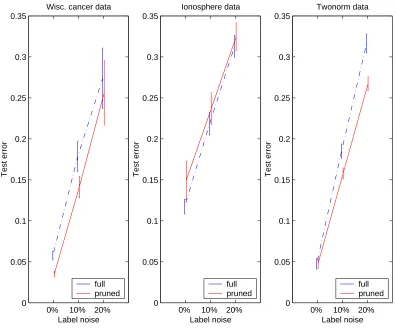
So,as we do not know the source of those troublesome examples,we suggest to
eliminate them from the data,i.e.,do data pruning. We consider it more dangerous


![Figure 4.3: Masks selecting sub-regions of the object [31]](https://thumb-us.123doks.com/thumbv2/123dok_us/8107081.235391/52.595.125.521.79.321/figure-masks-selecting-sub-regions-object.webp)
