A Comparative Study on
Partnership Dynamics among Immigrants and
Their Descendants
Tina Hannemann, Hill Kulu, Amparo González-Ferrer,
Ariane Pailhé, Leen Rahnu, Allan Puur
Changing families and sustainable societies:
Policy contexts and diversity over the life course and across generations
A project funded by European Union's Seventh Framework Programme under grant agreement no. 320116
© Copyright is held by the authors.
1
Acknowledgement: The research leading to these results has received funding from the European Union's Seventh Framework Programme (FP7/2007-2013) under grant agreement no. 320116 for the research project FamiliesAndSocieties.
Acknowledgement: The research leading to these results has received funding from the European Union's Seventh Framework Programme (FP7/2007-2013) under grant agreement no. 320116 for the research project FamiliesAndSocieties.
A Comparative Study on Partnership
Dynamics among Immigrants and
Their Descendants
Tina Hannemann1, Hill Kulu1, Amparo González-Ferrer2, Ariane Pailhé3,
Leen Rahnu4, Allan Puur4
Abstract:
This study investigates union formation and dissolution among immigrants and their descendants in four European countries with different migration histories and welfare state policies (United Kingdom, Estonia, France and Spain). While there is a growing body of literature on migrant families in Europe, there is little comparative research that has benefitted from the opportunities that the European context offers. We use pooled data from the four countries and apply an event history analysis. The analysis shows a significant variation in partnership trajectories across migrant groups in some countries (e.g., South Asians versus Caribbeans in the UK) and similar union trajectories for some migrant groups in different countries (e.g., South Asians in the UK and immigrants from Turkey in France). The descendants of immigrants exhibit partnership patterns that are similar to those of their parents’ generation. The country context also matters; specific patterns are observed for Spain and Estonia.
Keywords: Family, marriage, cohabitation, divorce, immigrants, the second generation, Europe, Poisson regression
Affiliation:
1) The University of Liverpool, United Kingdom
2
Contents
Introduction ... 3
The European context: migration and partnership dynamics ... 5
2.1 Migration ... 5
2.2 Union formation and dissolution in Europe ... 7
2.3 Explaining family behaviour among immigrants and ethnic minorities ... 8
Data and methods ... 12
2.1 Data ... 12
4. Methods ... 14
5. Results ... 17
6. Summary and conclusion ... 22
References ... 25
Tables and graphs ... 29
3
Introduction
In the past decades, European societies have experienced large-scale immigration flows and
the growing ethnic and cultural heterogeneity of their populations (Castles and Miller 2009).
Research has examined the various life domains of immigrants and ethnic minorities in
European countries, including their employment and education (Adsera and Chiswick 2007,
Kogan 2007, Rebhun 2010, Rendall et al. 2010), health and mortality (Sole-Auro and
Crimmins 2008, Wengler 2011, Hannemann 2012), residential and housing patterns (Musterd
2005, Arbaci 2008), legal status and citizenship (Seifert 1997, Bauböck 2003, Howard 2005),
and linguistic, cultural and religious diversity (Kulu and Tammaru 2004, Foner and Alba
2008, Gungor et al. 2011). The recent literature has also shown an increasing interest in the
study of family dynamics and patterns among immigrants and their descendants. One research
strand investigates the formation and stability of mixed marriages between natives and
immigrants (González-Ferrer 2006, Kalmijn and van Tubergen 2006, Dribe and Lundh 2012,
Milewski and Kulu 2014). Another strand examines fertility patterns among immigrants and
ethnic minorities (Andersson 2004, Toulemon 2004, Kulu and Milewski 2007, Milewski
2007, Goldscheider et al. 2011).
Drawing upon individual-level longitudinal data, recent research has improved our
understanding of partnership and the fertility patterns of immigrants and their descendants in
European countries. However, most studies have investigated immigrants in one or two
countries; there is a lack of truly comparative research on migrant families that researchers
have used to benefit from the opportunities that the European context offers. Those few recent
studies support that a decent comparison between immigrants and ethnic minorities from
several different countries can significantly advance our understanding of how institutional
and policy settings shape the family lives of immigrants and their descendants (Milewski
2011, Huschek et al. 2012).
This study investigates union formation and dissolution among immigrants and their
descendants in selected European countries. We will analyse longitudinal data from four
European countries with different immigration histories and welfare state setups and will
compare partnership dynamics of natives, immigrants and their descendants within countries
and across countries. The studied countries include the UK and France – the ‘old’
4
European country, which experienced large-scale immigration during the post-WWII period
due to the specific political and economic circumstances. All of the population subgroups will
be included in the same analysis, which allows a direct comparison of the partnership patterns
of the various native and migrant groups.
This study will investigate various partnership transitions, including formation and dissolution
of cohabitations and marriages, among immigrants and their descendants. Thus, this paper
moves beyond the ‘one-life-event-at-a-time’ approach and will provide a (nearly) complete
picture of the formation and dissolution of first unions among immigrants and their
descendants in four European countries. The study will provide us with much richer
information about the opportunities and constraints that migrants face than a conventional
analysis of only the first marriages of migrants would.
This study will also extend the scope of the topic by examining the family trajectories among
the descendants of immigrants, whose shares have significantly increased during the last
decades but whose fate is not as rosy as one might wish. Their educational qualifications often
remain below those of the majority population, and their labour market performance and
social mobility is poor (Fassmann 1997, Alba 2005, Meurs et al. 2006, Aparicio 2007,
Brinbaum and Cebolla-Boado 2007, Fibbi et al. 2007, Van Niekerk 2007, Kristen et al. 2008,
Aeberhardt et al. 2010).
Our comparative study will, thus, provide valuable information on the demographic behaviour
of important population subgroups in Europe and will improve our understanding of how
various factors (being descendants of the post-war ‘labour migrants’; institutional and policy
5
The European context: migration and partnership dynamics
2.1Migration
For a long time, Europe was a continent of emigration; many families and young people left
for overseas in the late 19th and early 20th centuries (Chesnais 1992). The intra-European
migration waves of the first half of the 20th century were mostly related to population
movements due to war activity, refugee situations and forced resettlements, although the
East-West labour migration, the movement of seasonal agricultural workers, played a role in the
1930s (Castles and Miller 2009). In the second half of the 20th century, European countries
largely experienced economic and policy-driven migration (Coleman 2006, Castles and Miller
2009).
The economic boom of the 1950s and 1960s in Western and Northern Europe attracted a large
number of labour migrants. Several countries actively recruited migrants; this was driven by
the increasing demand of workers in labour intensive sectors of industry and services (Salt
and Clout 1976, Seifert 1997). West Germany, France and the Netherlands, having coped
with the reconstruction of their industry and infrastructure, searched for a labour force to
satisfy the needs of the economic boom. The labour migrants originated mainly from
Southern Europe and regions that were adjacent to Europe (Turkey). Southern European
countries, including Italy, Spain and Greece, willingly sent labour migrants, partially to ease
the pressure of unemployment and large cohorts that were due to high pre-war fertility levels.
While early labour migrants were mainly young, single, short-term employed, educated and
male, the later labour streams shifted towards being rural and unskilled, with individuals
having a wide age range and including both sexes (Salt and Clout 1976). Eastern European
countries with communist regimes and planned economies showed specific migration
patterns. Migration streams between the East and the West were modest due to the severe
restrictions that were imposed on international migration by communist governments, with
the exceptions including migration between East and West Germany until 1961 and migration
from Yugoslavia (Fassmann and Münz 1994).
The country of origin for labour migrants varied across the continent, which reflected the
economic, demographic and also historical circumstances. Immigration from overseas had
6
Netherlands. Former territories and dominions had special agreements for immigration and
labour permissions. France received large numbers of immigrants from their former colonies
in the Maghreb region, the Netherlands received migrants from Indonesia and Surinam and
the UK provided free immigration for individuals from India, Pakistan and the Caribbean
region (Serow et al. 1990, Peach 1998). Migration from former colonies increased at the time
of and after the declaration of independence in the respective countries. Political and crisis
driven migration waves also occurred in Spain in the 1960s, mainly from old colonies in
South America. Those migration streams that were based on historic connections and
dependencies had a longer tradition than the new waves of labour migrants in the rest of
Europe. Additionally, both migration streams co-existed and were partially independent of
each other (Serow et al. 1990).
Labour migration in Europe, particularly in German-speaking countries, was largely planned
as a temporary measure to bridge periods of extreme labour scarcity (Seifert 1997). However,
many migrants became permanent residents after they had spent a few years in their country
of destination. Decreasing demands for foreign labour and increasing social concerns urged
many countries to change their immigration policies after the oil crisis in 1973. Thereafter, a
different immigrant stream caught momentum: the partners and other dependent relatives
followed the early labour migrants to the countries that had become their homes (Fassmann
and Münz 1994, Seifert 1997). While partners had arrived previously as additional labour
migrants, after the recruitment stop, they were categorised as family reunification migrants
(González-Ferrer 2006).
Family reunification and marriage migration were not the only processes that contributed to
European migration from the 1970s to the 1990s. Various conflicts across the globe increased
the number and geographical variety of individuals who were seeking asylum in Europe.
Some migration streams were directly related to the independence of former colonies, while
others were caused by civil wars. Refugees from former Yugoslavia, Iran, Iraq and certain
countries in South America and South East Asia arrived in Northern and Western European
countries (Collinson 1993).
Patterns of international migration from the former communist countries of Eastern Europe
differed from the patterns of migrants from the rest of Europe in several aspects, although
7
prohibited to the citizens of Eastern European countries, with a few exceptions (e.g.,
Yugoslavia). Interestingly, however, ‘labour migration’ that was driven by the needs of
centrally planned economies also existed within the Eastern Block. People from Vietnam,
Angola and Mozambique moved to Central European countries, particularly to Eastern
Germany, whereas Russians, Ukrainians and Belorussians moved in large numbers to the
Baltic states (particularly Estonia and Latvia), which had been annexed by the Soviet Union
during WWII and had experienced accelerated industrialisation during the post-war period
(Kulu 2003). Since the fall of communism, East-West migration has significantly increased,
both for economic reasons and for factors that are related to ethnic and linguistic connections
(Fassmann and Münz 1994). Within Eastern Europe, the dissolution of the former Soviet
Union triggered large-scale ethnic return migration that turned Russia into the biggest
‘immigration’ country in the mid-1990s (Coleman 2006).
In the 1990s, Southern European countries also became destinations of immigration. Greece,
Italy and particularly Spain, especially during the first half of the 2000s, received large
numbers of immigrants from North Africa, South East Europe and South America over the
past two decades. While economic and demographic factors were important factors behind
those migration streams, historical and linguistic ties also played an important role (Cebolla &
González-Ferrer 2008, Cebolla & González-Ferrer 2013).
2.2Union formation and dissolution in Europe
A shift towards earlier family formation and the prevalence of marital unions characterised
much of Europe in the 1950s (Lesthaeghe and Neels 2002). New trends, including the
postponement of marriages, increasing levels of divorce and remarriage and the rise of
non-marital unions, were observed since the late 1960s, first in Northern Europe and later in
Western and Southern Europe. These new features in partnership dynamics, especially the
increase in cohabitations, showed significant geographical variation in their onset and
magnitude. The Nordic countries, particularly Sweden, were the forerunners of these new
family forms, while the Central and West European countries, such as France, Switzerland
and Germany, followed these patterns after a time lag (Andersson and Philipov 2002, Sobotka
and Toulemon 2008). Britain, despite its ‘Northern’ location, adopted the new patterns of
union formation relatively late. However, the spread of new family forms was rapid over the
8
(Berrington and Diamond 2000, Ermisch and Francesconi 2000, Murphy 2000, Beaujouan
and Ní Bhrolcháin 2011).
In Southern Europe, the new family forms emerged only recently. For a long time, marriage
was the only socially accepted form of partnership; however, marriage was increasingly
postponed, and the age of first marriage increased beyond that of the Northern and Western
European countries. A few research studies show that religion may largely explain the
specific partnership patterns in Southern European countries, but other studies suggest that
economic factors and traditional family arrangements may have played a role (Reher 1998).
The patterns in Eastern Europe are diverse due to both the experience of socialism and the
‘North-South’ dimension. While younger marriage ages and relatively high divorce levels
were common in most Eastern European countries in the 1970s and 1980s, the spread of new
family forms significantly varied across countries (Hoem et al. 2010, Puur et al. 2012). A few
countries closely followed partnership formation and dissolution dynamics in Nordic
countries (e.g., Estonia and Latvia), whereas trends in other Eastern European countries were
similar to those in Southern European countries (e.g., Poland), which allowed researchers to
discuss ‘post-socialist Scandinavia’ and ‘post-socialist Italy’, accordingly.
2.3Explaining family behaviour among immigrants and ethnic minorities
International migration, inside and across the borders of Europe, combines populations that
have different fertility levels, partnership formation and dissolution patterns. There are several
approaches to explaining the possible differences in family behaviour between immigrants
and the native population. Two of the most established approaches – socialisation and the
adaptation hypothesis – include contrasting explanations for family behaviour among
migrants. The socialisation hypothesis argues that migrants will follow the family traditions
and values that were dominant in their childhood and, therefore, in their country of origin
(Andersson 2004, Kulu and Milewski 2007). If the family trajectories in the home and host
country vary significantly, those differences will also emerge in a comparison between
immigrants and the native population. The adaptation hypothesis, in contrast, states that over
time, migrants will adapt to the family norms and values that are dominant in the host country
(Hervitz 1985, Andersson and Scott 2005). Therefore, their family behaviour will gradually
9
A competing hypothesis to the above-discussed two is the selection hypothesis (Macisco et al.
1970, Hoem 1975), which argues that migrants are a select population group in the home
country due to their characteristics. For example, labour migration favours skills and
knowledge, which can be useful for the economy of the host countries. Furthermore, good
health is necessary in order to migrate over long distances and adapt to new environments.
For refugees, their political and religious background is often the main reason for emigration.
In sum, the selection hypothesis emphasises that the family trajectories of migrants do not
necessarily represent the dominant family patterns in their home country. Differences in
family behaviour between immigrants and the native population can, therefore, be the result
of individual characteristics rather than the result of the context of early socialisation (Trilla et
al. 2008).
All of the three hypotheses have been successfully used in various studies to explain the
presence or absence of differences in family trajectories between immigrants and natives in
European countries. Recent research has also included the descendants of post-war
immigrants or the second generation, whose share has increased in many European countries,
in the analysis (Sobotka 2008, Hernandez et al. 2009). The analysis of family trajectories of
the descendants of immigrants offers a new perspective when explaining the family dynamics
among ethnic minorities. If the descendants of immigrants mostly grew up under the
influences of the mainstream society, and socialisation was the main factor that shaped family
behaviour, one would observe similar trends for the second generation and the natives; in
contrast, the family behaviour of the descendants of immigrants would be similar to that of
their parents if they grew up under the influences of the minority subculture. If the factors of
both socialisation and adaptation were important, the descendants of immigrants would
exhibit family formation patterns that are in-between those of immigrants (their parents) and
the natives (their peers).
These approaches were mostly developed to explain the fertility behaviour of immigrants.
Due to the close connection between partnership formation, dissolution and fertility
behaviour, they are valid and equally valuable for the study of union formation and
dissolution among immigrants and their descendants (Rahnu et al. 2014).
Recent research has investigated differences in partnership behaviour between immigrants,
10
provides a discussion of the country-specific factors. There are two main reasons why the
differences between immigrants and natives may vary across countries. First, the origin and
composition of immigration streams may be important. Immigrants may come from countries
that have similar linguistic and cultural patterns or from those that have very different
patterns. For example, post-war immigrants from Southern European countries are more
likely to exhibit family patterns that are similar to natives in Western and Northern European
countries than those who arrived from Turkey or Northern Africa (Dribe and Lundh 2012).
Additionally, immigrants may be a select group of the home country population, as discussed
above. The family behaviour of immigrants from the same country is likely to significantly
differ based on their ethnic origin or language (e.g., Turkish versus Kurdish migrants from
Turkey) or whether or not individuals have mostly moved for employment related reasons or
as refugees (e.g., from the former Yugoslavia).
Second, contextual factors may account for the differences across countries. Each country will
provide a set of normative expectations and behaviours, which the newcomers (must) accept
as a ‘baseline level’ in the host country, and any adaptation to the mainstream society
suggests a convergence towards this baseline. For example, immigrants in Northern Europe
are more likely to cohabit prior to marriage or separate from unhappy partnerships than those
who live in Southern Europe. Various state policies may be factors that largely (but not only)
explain whether or not and how much convergence toward the baseline will take place among
immigrants and their descendants. The adaptation of immigrants and their descendants to the
dominant behavioural patterns is assumed to be faster and stronger in countries with inclusive
integration policies and/or with a wide range of policies that reduce differences between
population subgroups and promote equality in all of the spheres of society than in countries
with exclusionist integration policies (e.g., the ius soli versus ius sanguinis approach to
citizenship) or where market forces are expected to dominate people’s lives (e.g., social
democratic versus liberal welfare states) (Esping-Andersen 1990, Seifert 1997).
This study investigates first union formation and dissolution in four European countries: the
UK, France, Spain and Estonia. These countries represent both ‘old’ (UK and France) and ‘new’ (Spain) immigration countries; they differ in post-WWII political and economic
histories and vary by welfare state setup and policies. The countries that are included in the
study represent all of the major regions of Europe and, hence, a broad variety of societal and
11
the variation between migrant groups, as well as across the contexts of the receiving
12
Data and methods
2.1Data
The data for this study come from national surveys of the four countries; the data were first
prepared by each country’s project partner and then merged into one common database.
British data come from the Understanding Society study (UoS). This analysis uses
information from the first and second wave (2009/2011) of the UoS. Data for Estonia were
retrieved from the Estonian Generation and Gender Survey (2004/2005) (GGS) and the
Estonian Family and Fertility Survey (1994) (FFS), and these surveys cover the partnership
histories of individuals, as well as their demographic and socio-economic characteristics. Data
for French natives and immigrants were collected from the Trajectories and Origins survey
(2008), a joint project of the French National Institute of Demography (INED) and the French
National Statistical Office (INSEE). For Spain, the study uses data from the Fertility and
Values Survey that was conducted by the Centre for Sociological Research (2006).
This study analyses the partnership trajectories of women. With the focus being on first
partnership formation and dissolution among immigrants and their descendants, each country
provided data on natives and immigrant groups that were specific to the country. Given the
variety of migration histories, this resulted in a total of 26 immigrant groups, including their
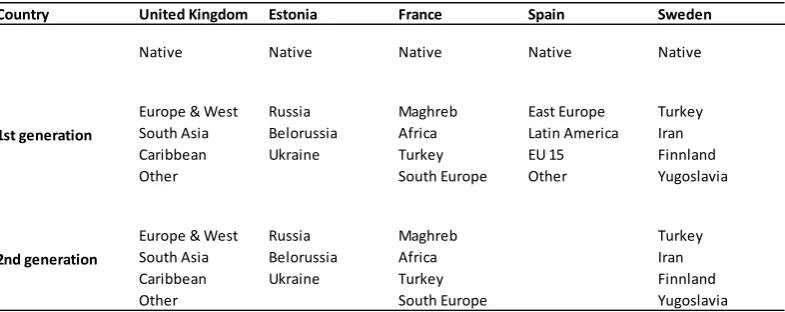
descendants (the second generation). There are four groups for the UK: the first group is
composed of individuals from Europe and other industrialised / Western countries (the U.S.,
Canada, Australia, and New Zealand). The second group consists of individuals from India,
Pakistan and Bangladesh (South Asia). Immigrants and their descendants from Caribbean
countries, mainly Jamaica, are the third group; individuals from other countries form the
fourth group (Other). For Estonia, this study investigates the partnership dynamics of natives
and immigrants who are mainly from the Slavic republics of the former Soviet Union (Russia,
Belorussia and Ukraine) and their descendants, which form approximately 90% of the ethnic
minorities of Estonia.
For France, with its long tradition of immigration, data on four immigration origins are
analysed: individuals from the Maghreb states, Sub-Saharan African countries, Turkey, and
Southern Europe. Immigrants and their descendants are distinguished for all of the groups;
13
partnership formation and dissolution. For Spain, in contrast, it is only possible to investigate
partnership dynamics among immigrants. The country has only recently experienced large
immigration streams; therefore, the number of descendants of immigrants who have reached
the age of partnership formation is still small. The analysis distinguishes between immigrants
from Eastern Europe, Latin America, the 15 countries in the EU and other countries. Table 1
summarises the countries and immigrant groups that are used in this study. Additional
information on immigrant groups is available from the case studies for each country (Kulu et
al. 2014).
14
4. Methods
For a comparative study of n countries regarding partnership formation and dissolution, an
option is to merge individual-level data from the countries and then fit a hazard regression
model (Hoem et al. 2010). However, this is often not possible due to the issues of data
confidentiality: individual-level data cannot be released to another country or research group
to conduct a comparative analysis. Fortunately, it is possible to overcome this obstacle by
using the count-data approach to compare partnership formation and dissolution rates across
countries and population subgroups. Researchers need to prepare an event-time (or
occurrence-exposure) table for each country, which is defined by a cross-classification over a
set of time intervals and covariate categories (Preston 2005). The data for each cell in such a
table include the total number of events, Ejk; the total time (normally person-years) at risk, Rjk;
and values of covariates, xjk, for time period j and category k. For each cell, the ratio of the
number of events to the risk-time is a crude hazard:
jk jk jk E R
(1)
where λjk is the hazard for category k in time period j. Let Ejk denote the number of first union
formations for group k in age group j. We treat Ejkas the realisation of a Poisson random
variable with the mean μjk:
jk jk jk R
(2)
The expected number of first unions is, thus, the product of the hazard of (first) union
formation and exposure time. We can present this model in a log-linear format:
jk jk
jk ln lnR
ln (3)
We then rearrange the equation to investigate the hazard of union formation:
jk Rjk
lnjkln (4)
Finally, we present a log-linear model for the hazard of partnership formation, which also
includes (additional) covariates:
jk j xk
ln (5)
where αj = ln λj measures the hazard of union formation by age (the ‘baseline’), x'k is a vector
of the covariates (migrant status and country combined, cohort and educational level) and β
15
In this paper, we analyse partnership formation and dissolution among immigrants and their
descendants in four European countries (the UK, Estonia, France and Spain) (Figure 1). For
partnership formation, an individual becomes under risk at age 16 and will be censored at age
45 or the last interview date, whichever comes first. For divorce and cohabitation outcomes
(marriage after cohabitation and separation from cohabitation), women are at risk from the
beginning of the relationship and censored after 20 years in the relationship, the death of their
partner or the last interview date, whichever occurred first. Table 2 presents an overview of
the union formation and dissolution events of interest, the risk period and the respective
censoring dates.
(Figure 1 about here)
(Table 2 about here)
The individual-level data were, thus, used to calculate aggregated exposure-occurrence tables
for each country, which were aggregated by different combinations of socio-demographic
variables; the country files were then merged into one common database and modelled by
using a Poisson regression model (5). The variables that were used to prepare
exposure-occurrence tables were as follows: migrant group (specific to country), birth cohort (1950-59,
1960-69, 1970-79, 1980-90), age group (16-19, 20-24, 25-29, 30-34, 35-39, 40+), union /
marriage duration in years (0-3, 3-6, 6-10, 10-15, 15+) and educational level (low, medium
and high, according to ISCED levels 0-2, 3-4 and 5-6). We, thus, investigated the hazard of
union formation and dissolution by migrant group when controlling for age (union formation)
or union duration (union dissolution), cohort and educational level. Table 3 provides the
number of events and person-months for each partnership transition in the four countries by
migrant group.
(Table 3 about here)
For the analysis of separation from cohabitation, only migrant groups from Estonia, France
and Spain are used. The reason for the exclusion of the UK data was because the analysis had
shown relatively high dissolution risks for all of the UK groups. It is possible that this was
due to a bias of cohabitation separation being found in the UK data. It was, thus, decided that
women from the UK would be excluded from the analysis of this transition. The UK was also
16
marital divorce because the data quality for that transition was good (Hannemann and Kulu
2014).
The sample size varies by countries and migrant groups. For that reason, all of the
calculations were first conducted with weights to adjust for the sample size of each country.
However, the results of the models with weights and those without them were very similar.
17
5. Results
The first transition to be analysed is union formation, including the events of direct marriage
and cohabitation. Native British women are the reference group in all of the comparisons.
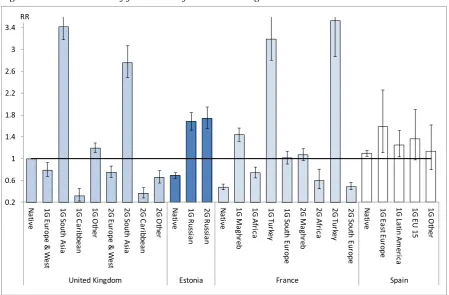
Figure 2 shows that native British women have a higher risk of first union formation than
most other groups. However, the highest union formation levels are observed for immigrants
from South Asia in the UK, those from Turkey in France and all of the population groups in
Estonia. There are also large differences between immigrant groups in their respective
countries, as well as between the countries. France and the UK both show similar patterns,
with certain immigrants exhibiting low risks of union formation and other immigrants
exhibiting high levels. All of the groups in Estonia have a high risk of union formation, with
immigrants and their descendants experiencing somewhat higher levels than natives
experience. Additional analysis showed that the elevated risks of union formation mainly
reflect the comparatively early entry into first unions that is characteristic of all of the groups,
whereas the difference between natives and immigrants stems from the lower proportion of
people who were never-partnered within the latter group (Rahnu et al. 2014). In Spain, in
contrast, all of the groups are below the benchmark of the native British women. Most
immigrants in Spain have a significantly higher risk of union formation than the native
Spanish women.
(Figure 2 about here)
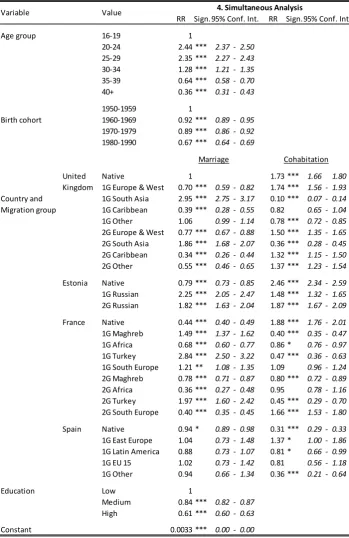
The models of union formation included the following control variables: age (baseline), birth
cohort and educational level. All of the covariates show the expected coefficient signs, with
the risk of union formation being highest for women in their twenties, older birth cohorts and
lower educational groups. Table 4 provides the details for the full models.
Next, we analyse the pathways of first union formation by distinguishing between
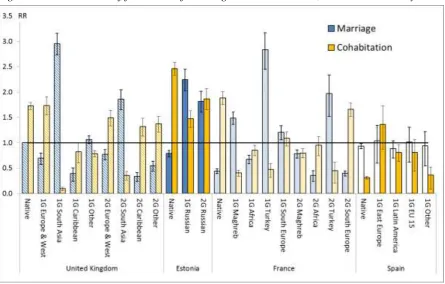
cohabitations and direct marriages. Native British women show a higher risk of cohabitation
than most of the other groups. Again, the highest risk of cohabitation is experienced by the
Estonian population, particularly the native Estonians. These results reflect the early onset and
wide acceptance of cohabitation in Estonia that are based on the trends in Scandinavia rather
18
The native French women also show a high risk of cohabitation that is significantly higher
than all of the immigrant groups in France, most of whom have low cohabitation levels. In
Spain, the opposite picture emerges, with Spanish native women exhibiting the lowest
cohabitation levels. Although all of the immigrant groups in Spain have a higher risk of
cohabitation than native Spanish women, their levels stay below those of the native British or
French women, as well as all of the groups in Estonia. Non-marital unions are still uncommon
in Spain. Even after the legalisation of divorce and a decrease in marriage rates over the last
decades, cohabitation has only very recently spread within the population. Immigrants in
Spain seem to import new partnership forms.
(Figure 3 about here)
The patterns of direct marriage in Figure 4 are the opposite of those in Figure 3. The distinct
groups are immigrants from South Asia in the UK and their descendants and people of
Turkish origin in France. While those four groups showed a low risk of cohabitation, they all
exhibited a high risk of marrying directly (without prior cohabitation), which underlines the
traditional pattern of union formation among those immigrant and ethnic minority groups. A
similar contrast between cohabitation and direct marriage is observed for Estonia. The native
Estonian women have a significantly higher risk of cohabiting than immigrants and their
descendants, whereas they have a relatively low propensity of marrying directly. A relatively
high risk for direct marriage is also observed for immigrants from the Maghreb states in
France and all of the groups in Spain. The native French women have a low risk of direct
marriage.
(Figure 4 about here)
The analysis of cohabitation and direct marriage reveals interesting patterns. However, a
direct comparison between the levels of competing transitions for each migrant group is only
achieved by a model that analyses both of the events simultaneously instead of using two
separate models for the analysis. Figure 5 shows the results of the simultaneous analysis, with
marriage levels of native British women being the baseline. The opposite patterns for women
of South Asian origin in the UK and Turkish women in France are striking in this direct
19
migrant groups, the comparison of the cohabitation and direct marriage levels is less
informative because the patterns significantly vary by birth cohort.
(Figure 5 about here)
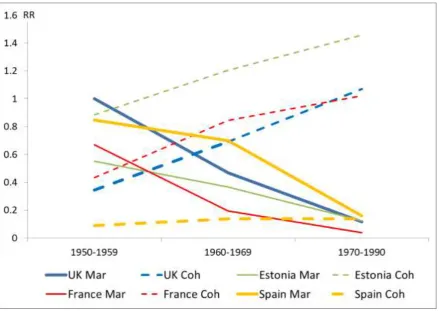
Figure 6 shows the risk of cohabitation (dashed lines) and direct marriage (solid lines) in the
four countries by cohort (for native population only). The reference point is the risk of direct
marriage in the UK for the birth cohort of 1950-59; the union formation levels for all of the
other groups (countries and cohorts) are measured relative to that baseline. We observe an
increase in cohabitation risks in all of the countries, with Estonia showing the highest
cohabitation levels and Spain exhibiting the lowest levels and increases. The trends in direct
marriage are similar across countries, with the highest levels being shown for the oldest
cohorts and the lowest risk being shown for the youngest cohorts, as expected. Unlike for
cohabitation, the levels of direct marriage exhibit a noticeable convergence across countries
for women born in the 1970s–1980s.
(Figure 6 about here)
These results suggest that birth cohort has a strong effect on the cohabitation and marriage
levels for all (or most) of the population subgroups. Therefore, the risk of cohabitation and
direct marriage was also calculated for migrant groups by birth cohort. For example, for the
oldest cohort of native British women, the risk of starting a first union by marrying is higher
than it is by cohabiting. In the subsequent cohorts, this trend reverses (the results are available
upon request). These findings support the importance of analysing union formation behaviour
over time.
Although direct marriage has lost its importance in most migrant groups in the four countries,
cohabitation often leads to marriages after a period of co-residence. Figure 7 shows the levels
of marriage formation for cohabitants across countries and immigrant groups (individual
records that include separation from cohabitation levels are censored). South Asian women in
the UK and Turkish women in France show a very high risk of marriage formation, although
the estimated risk levels have wide confidence intervals due to the small number of
cohabitants in these groups. Very high risks of cohabitation leading to marriage are also
20
traditional patterns are prevalent among these groups because the few individuals who cohabit
first marry thereafter (or soon after).
(Figure 7 about here)
Patterns of union formation vary across countries, migrant groups and cohorts. Hence,
differences across countries and between immigrants are also expected in union dissolution.
Next, this study analyses the separation from first cohabitation (individual records with
marriage being the outcome of cohabitation are censored) and marital divorce. The latter
analysis includes women who married directly, as well as women who entered cohabitation
first and then married the same partner.
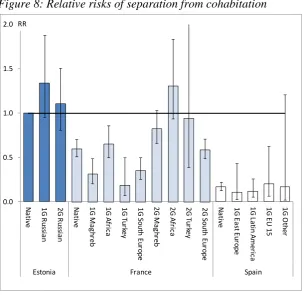
The analysis of separation from cohabitation is only conducted for three countries: Estonia,
France and Spain; the native women from Estonia are the reference group. All of the
population subgroups in Estonia have a high risk of separation (Figure 8). While native
French women and immigrants show a low risk of separation, the descendants of immigrants
in France seem to have somewhat higher separation levels, similar to the levels in Estonia,
although the sample is too small for most of the groups for final conclusions to be drawn.
Natives, immigrants and their descendants in Spain have a low risk of separation, which is not
surprising. Table 6 provides the details of the full models of cohabitation dissolution.
(Figure 8 about here)
The analysis of divorce largely supports the patterns that are observed for cohabitation
dissolution in the three countries. Additionally, we are again able to study patterns in the UK
in the comparative context. While women of South Asian origin have a low divorce risk,
which is expected, interestingly, those of Caribbean descent have relatively high divorce
levels, similar to those observed in Estonia, which is the country with the highest divorce
levels among the four (Figure 9). Divorce levels are also elevated for native British women
and those from other European countries and their descendants.
21
As the final step, the dissolution of the first (any) union (marriage or cohabitation) is
investigated. The analysis of union dissolution supports the previous results of the separate
analyses of cohabitation dissolution and of marital divorce. The highest divorce levels are
observed for natives and immigrants in Estonia and the descendants of Sub-Saharan African
immigrants in France, and the lowest levels are observed for natives and migrants in Spain
and immigrants from Turkey in France (Figure 10).
22
6. Summary and conclusion
This study analysed union formation and dissolution trajectories for immigrants, their
descendants and native women in four European countries. Pooling data from the UK, France,
Estonia and Spain allowed for a direct comparison between immigrants and natives in the
respective countries, as well as between the different countries. The results highlight the
following union formation and dissolution patterns for immigrants and their descendants.
First, the analysis showed a significant variation in union trajectories across migrant groups in
certain countries. We observed high rates of (direct) marriage and low levels of cohabitation
and union dissolution for women from South Asia in the UK and low rates of marriage and
high levels of cohabitation and union dissolution for Caribbean women. Similarly, contrasts
were also found for immigrants in France: women from Turkey exhibited traditional
partnership trajectories, whereas those from Sub-Saharan Africa showed the opposite patterns.
Second, immigrants from countries with traditional family trajectories showed strikingly
similar patterns of union formation and dissolution across countries. Turkish women in
France and South Asians in the UK exhibited very similar partnership trajectories. Those
similarities were persistent throughout the range of partnership transitions that were analysed
in this study. The results suggest that the factors of socialisation still play an important role in
the partnership behaviour of immigrants: immigrants normally bring their own traditions and
norms regarding family life, and these shape their family behaviour, although certain changes
are also expected, particularly based on the duration of stay in the destination country.
However, these changes (or adaptation) can only be detected when comparing the partnership
patterns for immigrants to those that are dominant in their countries of origin.
Third, we expected the descendants of immigrants to exhibit partnership patterns that were
between those of their parents’ generation and the respective natives. However, partnership
behaviour of the descendants of immigrants was strikingly similar to that of immigrants (and
different than natives), particularly in regard to the pathways to first union formation
(marriage versus cohabitation). Very similar partnership trajectories across generations were
observed for most of the migrant and ethnic minority populations: South Asians and
Caribbeans in the UK; women of Turkish, Sub-Saharan and Maghreb origin in France and the
population of Slavic origin in Estonia. The results suggest the presence of minority
23
the descendants of immigrants. However, the critical issue is whether the specific partnership
patterns are an indicator of cultural diversity or (also) of the poor economic and social
integration of these ethnic groups in their respective countries. Large group sizes with high
levels of residential and spatial segregation have certainly supported the specific patterns that
are observed for the second generation in all three of these countries. These factors have
facilitated daily social interaction between members of the same ethnic group and provided
access to a pool of potential co-ethnic partners; in Estonia, separate school systems and
languages have further hindered interaction between majority and minority populations.
Fourth, the analysis showed that the country context matters in regard to union formation and
dissolution. There was similarity between the partnership trajectories for immigrants in the
UK and France (i.e., comparable groups that behaved similarly), which can be explained by
their similar histories of colonisation, their long tradition of immigration and their similar
approaches to migration and integration policies. Additionally, both of the countries have
experienced similar changes in partnership dynamics over the past half century. Estonia and
Spain showed country-specific patterns throughout the analysed trajectories. Although the
partnership patterns of immigrants and their descendants were different than those of the
natives in Estonia, the differences were not always large when the patterns were compared to
other countries (or groups), except for the mode of union formation. The prevalence of
non-traditional family forms is characteristic of all of the population subgroups in Estonia, which
is ‘explained’ by the country’s communist past (early partnership formation and high divorce)
and cultural proximity to Scandinavia (high levels of cohabitation and also divorce). In Spain,
in contrast, both natives and immigrants exhibited relatively high (direct) marriage rates and
low cohabitation and divorce levels. Previous research has emphasised the role of religion in
explaining the specific partnership patterns in Spain, although economic factors (high youth
unemployment) may also play a role. Under the regime of Franco, in accordance with the
Catholic Church, divorce was illegal, and non-marital unions were not tolerated. Although
divorce and cohabitation have been legal for some time now, the spread of cohabitation and
union dissolution, which is observed in other European countries, is only recently gaining
momentum in Spain.
The findings of this study draw a complex picture of partnership trajectories in Europe, which
depend on a variety of factors. Partnership patterns are related to time periods, also the history
24
amount and type of immigrants in the country, as well as their chances of integration in the
host societies. This study provided an in-depth analysis of the formation and dissolution of
first unions for natives, immigrants and their descendants in four European countries. To our
best knowledge, this is the first study to provide an explicit comparison of both partnership
formation and dissolution across different migrant groups in a number of European countries.
Future research is needed to deepen our understanding of the complex links between
integration processes and the partnership and fertility patterns for immigrants and their
25
References
Adsera, A., & Chiswick, B. R. (2007). Are there gender and country of origin differences in immigrant labor market outcomes across European destinations? Journal of Population Economics, 20(3), 495-526.
Aeberhardt, R., Fougere, D., Pouget, J., & Rathelot, R. (2010). Wages and employment of French workers with African origin. Journal of Population Economics, 23(3), 881-905. Alba, R. (2005). Bright vs. blurred boundaries: Second-generation assimilation and exclusion
in France, Germany, and the United States. Ethnic and Racial Studies, 28(1), 20-49. Andersson, G. (2004). Childbearing after migration: Fertility patterns of foreign-born women
in Sweden. International Migration Review, 38(2), 747-774.
Andersson, G., & Philipov, D. (2002). Life-table representations of family dynamics in Sweden, Hungary, and 14 other FFS countries: A project of descriptions of demographic behavior. Demographic Research, 7(4), 67-144.
Andersson, G., & Scott, K. (2005). Labour-market status and first-time parenthood: The experience of immigrant women in Sweden, 1981-97. Population Studies, 59(1), 21-38. Aparicio, R. (2007). The integration of the second and 1.5 generations of Moroccan,
Dominican and Peruvian origin in Madrid and Barcelona. Journal of Ethnic and Migration Studies, 33(7), 1169-1193.
Arbaci, S. (2008). (Re)viewing ethnic residential segregation in Southern European cities: Housing and urban regimes as mechanisms of marginalisation. Housing Studies, 23(4), 589-613.
Bauböck, R. (2003). Towards a political theory of migrant transnationalism. International Migration Review, 37(3), 700-723.
Beaujouan, É., & Ní Bhrolcháin, M. (2011). Cohabitation and marriage in Britain since the 1970s. Population trends, 145(Autumn Issue), 35-59.
Berrington, A., & Diamond, I. (2000). Marriage or cohabitation: A competing risks analysis of first-partnership formation among the 1958 British birth cohort. Journal of the Royal Statistical Society. Series A (Statistics in Society), 163(2), 127-151.
Brinbaum, Y., & Cebolla-Boado, H. (2007). The school careers of ethnic minority youth in France: Success or disillusion? Ethnicities, 7(3), 445-474.
Castles, S., & Miller, M. J. (2009). The age of migration: International population movements in the modern world (Vol. Fourth Edition). New York: Guilford Press.
Cebolla-Boado, H., & González-Ferrer, A. (2008). La inmigración en España 2000–2007: Centro de Estudios Políticos y Constitucionales, Madrid.
Cebolla-Boado, H., & González-Ferrer, A. (2013). Cómo se ha gestionado la inmigración en España. In A. Editorial (Ed.). Madrid.
Chesnais, J.-C. (1992). The demographic transition: Stages, patterns, and economic implications. Oxford: Clarendon Press.
Coleman, D. (2006). Europe's demographic future: Determinants, dimensions, and challenges.
Population and Development Review, 32, 52-95.
Coleman, D. (2006). Immigration and ethnic change in low-fertility countries: A third demographic transition. Population and Development Review, 32(3), 401-446.
Collinson, S. (Ed.). (1993). Europe and international migration. London and New York: Pinter Publishers for Royal Institute of International Affairs, London.
26
1990-2005. European Journal of Population, 28(2), 139-158.
Ermisch, J., & Francesconi, M. (2000). Cohabitation in Great Britain: Not for long, but here to stay. Journal of the Royal Statistical Society. Series A (Statistics in Society), 163(2), 153-171.
Esping-Andersen, G. (1990). The three worlds of welfare capitalism. Cambridge: Polity. Fassmann, H. (1997). Is the Austrian labour market ethnically segmented? European Journal
of Population, 13(1), 17-32.
Fassmann, H., & Münz, R. (Eds.). (1994). European migration in the late twentieth century. Historical patterns, actual trends, and social implications. Laxenburg, Austria: International Institute for Applied Systems Analysis.
Fibbi, R., Lerch, M., & Wanner, P. (2007). Naturalisation and socio-economic characteristics of youth of immigrant descent in Switzerland. Journal of Ethnic and Migration Studies, 33(7), 1121-1144.
Foner, N., & Alba, R. (2008). Immigrant religion in the US and Western Europe: Bridge or barrier to inclusion? International Migration Review, 42(2), 360-392.
Frejka, T. (1996). Overview. In T. Frejka (Ed.), International migration in Central and Eastern Europe and the Commonwealth of Independent States (pp. 1-20). New York and Geneva: United Nations.
Goldscheider, F., Goldscheider, C., & Bernhardt, E. M. (2011). Creating egalitarian families among the adult children of Turkish- and Polish-origin immigrants in Sweden.
International Migration Review, 45(1), 68-88.
González-Ferrer, A. (2006). Who do immigrants marry? Partner choice among single immigrants in Germany. European Sociological Review, 22(2), 171-185.
Gungor, D., Fleischmann, F., & Phalet, K. (2011). Religious identification, beliefs, and practices among Turkish Belgian and Moroccan Belgian Muslims: Intergenerational continuity and acculturative change. Journal of Cross-Cultural Psychology, 42(8), 1356-1374.
Hannemann, T. (2012). It breaks a man’s heart: Socioeconomic differences in the onset of
cardiovascular disease in contemporary Sweden. Lund University, Lund Studies in Economic History 58.
Hernandez, D. J., Macartney, S., & Blanchard, V. L. (2009). Children in immigrant families in eight affluent societies: Their family, national, and international context. Florence, Italy: UNICEF Innocenti Research Centre.
Hervitz, H. M. (1985). Selectivity, adaptation, or disruption? A comparison of alternative hypotheses on the effects of migration on fertility: The case of Brazil. International Migration Review, 19(2), 293-317.
Hoem, J. M. (1975). Fertility and out-migration: reflections on research approaches in empirical investigations of the association between two demographic phenomena.
Working Paper, 1. Stockholm: Stockholm University, SUDA
Hoem, J. M., Gabrielli, G., Jasilioniene, A., Kostova, D., & Matysiak, A. (2010). Levels of recent union formation: Six European countries compared. Demographic Research, 22(9), 199-210.
Howard, M. M. (2005). Variation in dual citizenship policies in the countries of the EU.
International Migration Review, 39(3), 697-720.
27
Kalmijn, M., & van Tubergen, F. (2006). Ethnic intermarriage in the Netherlands: Confirmations and refutations of accepted insights. European Journal of Population, 22(4), 371-397.
Katus, K., Puur, A., & Sakkeus, L. (2008). Family formation in the Baltic countries: A transformation in the legacy of state socialism. Journal of Baltic Studies, 39(2), 123-156. Kogan, I. (2007). A study of immigrants' employment careers in West Germany using the
sequence analysis technique. Social Science Research, 36(2), 491-511.
Kristen, C., Reimer, D., & Kogan, I. (2008). Higher education entry of Turkish immigrant youth in Germany. International Journal of Comparative Sociology, 49(2-3), 127-151. Kulu, H. (2003). Post-war immigration to Estonia: a comparative perspective. In R. Ohliger,
K. Schönwälder & T. Triadafilopoulos (Eds.), European encounters, 1945–2000: Migrants, migration and European societies since 1945 (pp. 38–52). Aldershot: Ashgate. Kulu, H., & Hannemann, T. (2014). Report on the country-specific case studies on
partnership dynamics among immigrants and their descendants FamiliesAndSocieties. Changing families and sustainable societies: Policy contexts and diversity over the life course and across generations. 181 pp.
Kulu, H., & Milewski, N. (2007). Family change and migration in the life course: An introduction. Demographic Research, 17(19), 567-590.
Kulu, H., & Tammaru, T. (2004). Diverging views on integration in Estonia: Determinants of Estonian language skills among ethnic minorities. Journal of Baltic Studies, 35(4), 378-401.
Lesthaeghe, R. & Neels, K. (2002). From the first to the second demographic transition: An interpretation of the spatial continuity of demographic innovation in France, Belgium and Switzerland. European Journal of Population 18(4), 325-360.
Macisco, J. J., Bouvier, L. F., & Weller, R. H. (1970). Effect of labour force participation on relation between migration status and fertility in San-Juan, Puerto-Rico. Milbank Memorial Fund Quarterly-Health and Society, 48(1), 51-70.
Meurs, D., Pailhe, A., & Simon, P. (2006). The persistence of intergenerational inequalities linked to immigration: Labour market outcomes for immigrants and their descendants in France. Population, 61(5-6), 763-801.
Milewski, N. (2007). First child of immigrant workers and their descendants in West Germany: Interrelation of events, disruption, or adaptation? Demographic Research, 17(29), 859-895.
Milewski, N. (2011). Transition to a first birth among Turkish second-generation migrants in Western Europe. Advances in Life Course Research, 16(4), 178-189.
Milewski, N., & Kulu, H. (2014). Mixed Marriages in Germany: A High Risk of Divorce for Immigrant-Native Couples. European Journal of Population, 30(1), 89-113.
Murphy, M. (2000). The Evolution of Cohabitation in Britain, 1960-95. Population Studies, 54(1), 43-56.
Musterd, S. (2005). Social and ethnic segregation in Europe: Levels, causes, and effects.
Journal of Urban Affairs, 27(3), 331-348.
Peach, C. (1998). South Asian and Caribbean ethnic minority housing choice in Britain.
Urban Studies, 35(10), 1657-1680.
Preston, D. L. (2005). Poisson regression in epidemiology In P. Armitage & T. Colton T (Eds.), Encyclopedia of biostatistics volume 6 (pp. 4124-4127). New York: Wiley.
28
Transformation of partnership formation in Eastern Europe: The legacy of the past demographic divide. Journal of Comparative Family Studies, 43(3), 389-418.
Rebhun, U. (2010). Immigration, gender, and earnings in Israel. European Journal of Population, 26(1), 73-97.
Reher, D. (1998). Family ties in Western Europe: Persistent contrasts. Population and DevelopmentReview, 24, 203-234.
Rendall, M. S., Tsang, F., Rubin, J. K., Rabinovich, L., & Janta, B. (2010). Contrasting trajectories of labor-market integration between migrant women in Western and Southern Europe. European Journal of Population, 26(4), 383-410.
Salt, J., & Clout, H. (Eds.). (1976). Migration in post-war Europe: Geographical essays. London Oxford University Press.
Seifert, W. (1997). Admission policy, patterns of migration and integration: the German and French case compared. New Community, 23(4), 441-460.
Serow, W. J., Nam, C. B., Sly, D. F., & Weller, R. H. (Eds.). (1990). Handbook on international migration. New York: Greenwood Press.
Sobotka, T. (2008). The rising importance of migrants for childbearing in Europe.
Demographic Research, S7(9), 225-248.
Sobotka, T., & Toulemon, L. (2008). Changing family and partnership behaviour: Common trends and persistent diversity across Europe. Demographic Research, S7(6), 85-138. Sole-Auro, A., & Crimmins, E. M. (2008). Health of immigrants in European countries.
International Migration Review, 42(4), 861-876.
Toulemon, L. (2004). Fertility among immigrant women: New data, new approach.
Population and Societies, 400, 1–4.
Trilla, C. C., Esteve, A., & Domingo, A. (2008). Marriage patterns of the foreign-born population in a new country of immigration: The case of Spain. International Migration Review, 42(4), 877-902.
Van Niekerk, M. (2007). Second-generation Caribbeans in the Netherlands: Different migration histories, diverging trajectories. Journal of Ethnic and Migration Studies, 33(7), 1063-1081.
29
[image:30.595.76.469.152.308.2]Tables and graphs
[image:30.595.70.462.445.665.2]Table 1: Natives, immigrants and their descendants by country.
Table 2: Start and censoring time of union formation and dissolution.
Country United Kingdom Estonia France Spain Sweden
Native Native Native Native Native
Europe & West Russia Maghreb East Europe Turkey South Asia Belorussia Africa Latin America Iran Caribbean Ukraine Turkey EU 15 Finnland Other South Europe Other Yugoslavia
Europe & West Russia Maghreb Turkey South Asia Belorussia Africa Iran Caribbean Ukraine Turkey Finnland
Other South Europe Yugoslavia
2nd generation 1st generation
Transition Observation start End of observation\Censorship
Union formation 16th birthday Last interview date or age 45
Cohabitation 16th birthday Last interview date, marriage or age 45
Direct marriage 16th birthday Last interview date, cohabitation or age 45
Separation from cohabitation Cohabitation start Last interview date, after 20 years of cohabitation, marriage or death of partner
Marriage after cohabitation Cohabitation start Last interview date, after 20 years of cohabitation, separation or death of partner
Divorce from marriage
(direct and after cohabitation) Date of marriage
Last interview date, after 20 years of marriage or death of partner
Union separation (from cohabitation and marriage)
Union start (cohabitation or marriage)
30
Table 3: Number of events and person-months by union transition and migrant group
N % N % N % N % N % N % N % N %
Native 10800 34.81 1073566 29.20 6917 40.10 1073566 29.13 3883 27.97 1073566 28.03 3404 39.60 314647 36.72 1G Europe & West 557 1.80 65860 1.79 401 2.32 65860 1.79 156 1.12 65860 1.72 192 2.23 15121 1.76 1G South Asia 1003 3.23 90699 2.47 34 0.20 90699 2.46 969 6.98 90699 2.37 19 0.22 772 0.09 1G Caribbean 119 0.38 20931 0.57 85 0.49 20931 0.57 34 0.24 20931 0.55 36 0.42 3438 0.40 1G Other 1667 5.37 243611 6.63 721 4.18 243611 6.61 946 6.81 243611 6.36 362 4.21 26511 3.09 2G Europe & West 663 2.14 76610 2.08 445 2.58 76610 2.08 218 1.57 76610 2.00 192 2.23 21150 2.47 2G South Asia 460 1.48 63493 1.73 75 0.43 63493 1.72 385 2.77 63493 1.66 33 0.38 3408 0.40 2G Caribbean 292 0.94 47406 1.29 233 1.35 47406 1.29 59 0.42 47406 1.24 98 1.14 12289 1.43 2G Other 457 1.47 69002 1.88 327 1.90 69002 1.87 130 0.94 69002 1.80 130 1.51 15815 1.85 Estonia Native 3734 12.03 283786 7.72 2948 17.09 283786 7.70 786 5.66 283786 7.41 1572 18.29 90273 10.54 1G Russian 951 3.06 63484 1.73 445 2.58 63484 1.72 506 3.64 63484 1.66 275 3.20 6853 0.80 2G Russian 699 2.25 53254 1.45 369 2.14 53254 1.44 330 2.38 53254 1.39 246 2.86 8231 0.96 France Native 1534 4.94 165792 4.51 1160 6.72 166074 4.51 374 2.69 224958 5.87 583 6.78 83891 9.79 1G Maghreb 873 2.81 100455 2.73 189 1.10 105085 2.85 684 4.93 105351 2.75 131 1.52 8533 1.00 1G Africa 550 1.77 77220 2.10 289 1.68 78033 2.12 261 1.88 90452 2.36 152 1.77 17967 2.10 1G Turkey 308 0.99 22060 0.60 48 0.28 24362 0.66 260 1.87 22862 0.60 40 0.47 1468 0.17 1G South Europe 574 1.85 51554 1.40 252 1.46 51788 1.40 322 2.32 61319 1.60 168 1.95 15718 1.83 2G Maghreb 789 2.54 121111 3.29 366 2.12 122585 3.33 423 3.05 141998 3.71 167 1.94 27325 3.19 2G Africa 150 0.48 33450 0.91 103 0.60 33445 0.91 47 0.34 38828 1.01 32 0.37 6427 0.75 2G Turkey 114 0.37 14275 0.39 20 0.12 14265 0.39 94 0.68 15121 0.39 10 0.12 965 0.11 2G South Europe 993 3.20 119291 3.24 746 4.32 118989 3.23 246 1.77 159561 4.17 352 4.10 54991 6.42 Spain Native 3358 10.82 757041 20.59 896 5.19 757041 20.54 2564 18.47 754830 19.71 329 3.83 98340 11.48 1G East Europe 72 0.23 8744 0.24 41 0.24 8744 0.24 31 0.22 8695 0.23 21 0.24 4016 0.47 1G Latin America 206 0.66 35177 0.96 101 0.59 35177 0.95 109 0.79 35065 0.92 35 0.41 13886 1.62 1G EU 15 62 0.20 10555 0.29 28 0.16 10555 0.29 35 0.25 10546 0.28 11 0.13 3347 0.39 1G Other 43 0.14 8123 0.22 12 0.07 8123 0.22 31 0.22 8123 0.21 5 0.06 1460 0.17
Total 31028 100 3676551 100 17251 100 3685969 100 13883 100 3829413 100 8595 100 856841 100
Events Person-months
Direct marriage
Events Person-months
Marriage after cohabitation
United Kingdom
First union
Events Person-months
Cohabitation
31
Table 3: Number of events and person-months by union transition and migrant group (continuation)
N % N % N % N % N % N %
Native 2267 43.18 1157753 32.67 1G Europe & West 76 1.45 45500 1.28 1G South Asia 87 1.66 154764 4.37 1G Caribbean 27 0.51 10893 0.31 1G Other 276 5.26 180599 5.10 2G Europe & West 123 2.34 64398 1.82 2G South Asia 75 1.43 52975 1.50 2G Caribbean 64 1.22 21650 0.61 2G Other 71 1.35 31977 0.90
Estonia Native 381 29.84 90273 16.48 662 12.61 308492 8.71 1043 30.14 398765 16.82 1G Russian 37 2.90 6853 1.25 252 4.80 113029 3.19 289 8.35 119882 5.06 2G Russian 44 3.45 8231 1.50 173 3.30 66841 1.89 217 6.27 75072 3.17 France Native 276 21.61 123330 22.51 216 4.11 151107 4.26 492 14.22 274437 11.58 1G Maghreb 22 1.72 20163 3.68 154 2.93 122212 3.45 176 5.09 142375 6.01 1G Africa 66 5.17 25463 4.65 102 1.94 53268 1.50 168 4.85 78731 3.32 1G Turkey 4 0.31 6056 1.11 21 0.40 48175 1.36 25 0.72 54231 2.29 1G South Europe 40 3.13 34556 6.31 91 1.73 95860 2.71 131 3.79 130416 5.50 2G Maghreb 106 8.30 31137 5.68 122 2.32 55214 1.56 228 6.59 86351 3.64 2G Africa 39 3.05 5577 1.02 19 0.36 4697 0.13 58 1.68 10274 0.43 2G Turkey 5 0.39 865 0.16 13 0.25 6331 0.18 18 0.52 7196 0.30 2G South Europe 176 13.78 74357 13.57 122 2.32 82493 2.33 298 8.61 156851 6.62 Spain Native 68 5.32 98340 17.95 189 3.60 656851 18.54 257 7.43 755191 31.85 1G East Europe 2 0.16 4016 0.73 4 0.08 11546 0.33 6 0.17 15562 0.66 1G Latin America 7 0.55 13886 2.53 29 0.55 29345 0.83 36 1.04 43231 1.82 1G EU 15 3 0.23 3347 0.61 10 0.19 9734 0.27 13 0.38 13081 0.55 1G Other 1 0.08 1460 0.27 5 0.10 7689 0.22 6 0.17 9149 0.39
Total 1277 100 547911 100 5250 100 3543391 100 3461 100 2370794 100
Separation from cohabitation Divorce Union dissolution
United Kingdom
32
Figure 1: Partnership transitions analysed in this study
Figure 2: Relative risk of union formation (direct marriage and cohabitation)
Controlled for age, cohort and educational level
Individuals are at risk since age 16 and censored at age 45 or last interview date 0.2 0.4 0.6 0.8 1 1.2 1.4 1.6 N a tiv e 1G E ur op e & W es t 1G S ou th A sia 1 G C ar ib b ea n 1G O th er 2G E ur op e & W es t 2G S ou th A sia 2 G C a rib b e a n 2G O th er N a tiv e 1G R us sia n 2G R us sia n N a tiv e 1G M ag hr eb 1G A fr ic a 1 G T u rk ey 1G S ou th E ur op e 2G M ag hr eb 2G A fr ic a 2 G T u rk e y 2G S ou th E ur op e N a tiv e 1G E as t E ur op e 1 G L a tin A m e ric a 1G E U 1 5 1G O th er
United Kingdom Estonia France Spain
[image:33.595.77.522.347.632.2]