A Theoretical Basis of
Communication-Centred Concurrent
Programming
Marco Carbone
1
,
2
Kohei Honda
1
Nobuko Yoshida
2
Robin Milner
3
Gary Brown
4
Steve Ross-Talbot
4
Abstract.
This document presents two different paradigms of description of communication behaviour, one focussing on global message flows and another on end-point behaviours, as formal calculi based on session types. The global calculus originates from Choreography Description Language, a web service description language developed by W3C WS-CDL working group. The end-point calculus is a typedπ-calculus. The global calculus describes an interaction scenario from a vantage viewpoint; the endpoint calculus precisely identifies a local behaviour of each participant. After introducing the static and dynamic semantics of these two calculi, we explore a theory of endpoint projection which defines three principles for well-structured global description. The theory then defines a translation under the three principles which is sound and complete in the sense that all and only behaviours speci-fied in the global description are realised as communications among end-point processes. Throughout the theory, underlying type structures play a fundamental role.
Contents
Abstract. iii
Part 1. Introductory Examples 1
1. Introduction to Part 1 3
2. Describing Communication Behaviour (1) 5
3. Describing Communication Behaviour (2) 10
4. Describing Communication Behaviour (3) 15
5. Correspondence with CDL 23
Part 2. A Formal Theory of Structured Global Programming 25
6. Introduction to Part 2 27
7. Informal Preview 28
8. Global Calculus (1): Syntax 31
9. Global Calculus (2): Reduction 36
10. Global Calculus (3): Typing 41
11. End-Point Calculus (1): Syntax and Reduction 52
12. End-Point Calculus (2): Typing 58
13. Theory of End-Point Projection (1): Connectedness 66 14. Theory of End-Point Projection (2): Well-Threadedness 72 15. Theory of End-Point Projection (3): Coherence 83 16. Main Results: EPP Theorem and its Consequences 91
17. Extension and Applications 110
18. Related Work 114
Bibliography 117
Appendix 119
Appendix A. Subject Reduction for the global calculus type system 121
Appendix B. Subject Reduction for the end-point calculus type system 123
Part 1
1. Introduction to Part 1
This paper introduces two different ways of describing communication-centred software in the form of formal calculi and discusses their relationship. Two different frameworks of description, one centring on global message flows and another centring on local (end-point) behaviours, share the common feature,structured representation of communications. The global calculus originates from Choreography Description Language (CDL) [52], a web service description language developed by W3C’s WS-CDL Working Group. The local calculus is based on theπ-calculus [35], one of the representative calculi for communicating processes. We show any well-formed description (in a technical sense we shall make clear) in the global calculus has a precise representation in the local calculus.
Both calculi are based on a common notion of structured communication, calledsession. A session binds a series of communications between two parties into one, distinguishing them from communications belonging to other sessions. This is a standard practice in business protocols (where an instance of a protocol should be distinguished from another instance of the same or other proto-cols) and in distributed programming (where two interacting parties use multiple TCP connections for performing a unit of conversation). As we shall explore in the present paper, the notion of session can be cleanly integrated with such notions as branching, recursion (loop) and exceptions. We show, through examples taken from simple but non-trivial business protocols, how concise structured de-scription of non-trivial interactive behaviour is possible using sessions. From a practical viewpoint, a session gives us the following merits.
• It offers a clean way to describe a complex sequence of communications with rigorous operational semantics, allowing structured description of interactive behaviour.
• Session-based programs can use a simple, algorithmically efficient typing algorithm to check its conformance to expected interaction structures.
• Sessions offer a high-level abstraction for communication behaviour upon which further refined reasoning techniques, including type/transition/logic-based ones, can be built. The presentation in this paper focusses the first point, and gives a formal basis for the second point. A full discussion of the second point and exploration of the third point are left to a later version of this paper and in its sequels.
An engineering background of the present work is the explosive growth of the Internet and world-wide web which has given rise to, in the shape of de facto standards, an omnipresent naming scheme (URI/URL), an omnipresent communication protocols (HTTP/TCP/IP) and an omnipresent data format (XML). These three elements arguably offer the key infra-structural bases for application-level distributed programming. This engineering background makes it feasible and advantageous to develop applications which will be engaged in complex sequences of interactions among two or more parties. Another background is maturing of theories of processes centring on theπ-calculus and its types. Theπ-calculus and its theories of types are singular in that not only do they enable a study of diverse ways for structuring communication but also they allow fruitful and often surprising connec-tions to existing formalisms including process algebras (e.g. CSP and CCS), functional computation (e.g.λ-calculus), logics (Linear Logic) and objects (e.g. Java). We believe a combination of strong practical needs for interactional computation and rich theoretical foundations will lead to rich dia-logues between practice and theories. The present work is intended to offer some of the technical elements which may become useful in this dialogue.
Structure of the paper.In the rest of this paper, Sections 2, 3 and 4 are devoted to informal illustration of key technical elements through description of small but non-trivial use-cases in the global and local calculi. The description starts from a simple example and reaches a fairly complex one, illustrating the essence of each construct as well as the relationship between their respective global descriptions and the corresponding local ones. Section 5 comments on the correspondence and differences between our formal calculi and CDL. The second part (from Section 6 to Section 18) formally introduces two calculi (the global calculus in Sections 8, 9 and 10; and the endpoint calculus in Sections 11 and 12), then develops the theory of end-point projections for these calculi (in Sections 13, 14, 15 and 16), and concludes the paper with related works and further topics (in Section 18). The appendix offers further technical details.
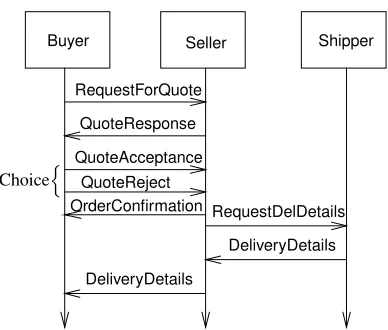
Buyer Seller Shipper
QuoteAcceptance Choicen
QuoteResponse RequestForQuote
QuoteReject
RequestDelDetails
DeliveryDetails
DeliveryDetails OrderConfirmation
FIGURE1. Graphical Representation of Simple Protocol .
2. Describing Communication Behaviour (1)
2.1. A Simple Business Protocol. In this section and the next, we show how small, but in-creasingly complex, business protocols can be accurately and concisely described in two small pro-gramming languages, one based on global message flows and another based on local, or end-point, behaviours. Along the way we also illustrate each construct of these mini programming languages (whose formal semantics is discussed in the second part of the paper).
Our starting point is a simple business protocol for purchasing a good among a buyer, a seller and a shipper, which we callSimple BSH Protocol. Informally the expected interaction is described as follows.
(1) First, Buyer asks Seller, through a specified channel, to offer a quote (we assume the good to buy is fixed).
(2) Then Seller replies with a quote.
(3) Buyer then answers with eitherQuoteAcceptanceorQuoteRejection. If the answer is
QuoteAcceptance, then Seller sends a confirmation to Buyer, and sends a channel of
Buyer to Shipper. Then Shipper sends the delivery details to Buyer, and the protocol terminates. If the answer isQuoteRejection, then the interaction terminates.
Figure 1 presents an UML sequence diagram of this protocol. Observe that, in Figure 1, many details are left unspecified: in real interaction, we need to specify, for example, the types of messages and the information exchanged in interaction, etc. While the protocol does not include practically important elements such as conditional and loops, its simplicity serves as a good starting point for introducing two formalisms.
2.2. Assumption on Underlying Communication Mechanisms. We first outline the basic assumptions common to both global and local formalisms. Below and henceforth we call the dramatis personae of a protocol (Buyer, Seller and Shipper in the present case),participants.
• We assume each participant either communicates through channels or change the content of variables local to it (two participants may have their own local variables with the same name but they are considered distinct).
[image:11.612.202.396.85.250.2](1) A sender participant sends a message and a receiver receives it, i.e. we only con-sider a point-to-point communication. A communication is always done through a
channel. The message in a communication consists of an operator name and, when there is a value passing, a value. The value will be assigned to a local variable at the receiver’s side upon the arrival of that message.
(2) Communication can be either anin-session communicationwhich belongs to a ses-sion, orsession initiation channelswhich establishes a session (which may be liked to establishing one or more fresh transport connections for a piece of conversation between two distributed peers). In a session initiation communication, one or more fresh session channels belonging to a session are declared, i.e. one session can use multiple channels.
(3) A channel can be either asession channelwhich belongs to a specific session or ansession-initiating channel which is used for initiation. For a session-initiating channel, we assume its sender and a receiver is pre-determined.
• We may or we may not demand:
(1) the order of messages from one participant to another through a specified channel is preserved.
(2) each communication is synchronous, i.e. a sender immediately knows the arrival of a message at a receiver.
(3) one party participating in a session can use a session-channel both for sending and receiving.
The last three assumptions which we leave undermined do affect a way to formalise protocols, as well as for understanding their formal properties. Nevertheless the existence or lack of these assumptions do not substantially affect the informal discussions in this and the next section.
2.3. Representing Communication (1): Initiating Session. Buyer’s session-initiating com-munication in Simple BSH Protocol is described in the global calculus as follows.
(1) Buyer→Seller:InitB2S(B2Sch).I
which says:
Buyer initiates a session with Seller by communication through a session-initiating channelINITB2S, declaring a fresh in-session channelB2Sch. Then
interaction moves toI.
Note “.” indicates sequencing, as in process calculi. A session initiation can specify more than one session channels as needed, as the following example shows.
(2) Buyer→Seller:InitB2S(B2Sch, S2Bch).I
which declares two (fresh) session channels, one from Buyer to Seller and another in the reverse direction.
In local description, the behaviour is split into two, one for Buyer and another for Seller, using the familiar notation from process algebras. For example (1) becomes:
(3) Buyer[InitB2S(B2Sch).P1], Seller[InitB2S(B2Sch).P2]
AboveBuyer[P]specifies a buyer’s behaviour, whileSeller[P]specifies a seller’s behaviour. The over-lined channel indicates it is used for output (this follows the tradition of CCS/π-calculus: in CSP, the same action is writtenInitB2S!(B2Sch).
Note the behaviour of each participant is described rather than their interaction. When these processes are combined, they engage in interaction as described in the scenario above.
2.4. Representing Communication (2): In-session Communication. An in-session commu-nication specifies an operator and, as needed, a message content. First we present interaction without communication of values.
(4) Buyer→Seller:B2SchhQuoteRequesti.I0
whereB2Schis an in-session channel. It says:
Buyer sends aQuoteRequest-message to Seller, then the interactionI0ensues.
The same behaviour can be written down in the local calculus as:
(5) B2SchhQuoteRequesti.P1, B2SchhQuoteRequesti.P2 An in-session communication may involve value passing, as follows.
(6) Seller→Buyer:S2BchhQuoteResponse,3,000,xi.I0
which says:
Seller sends aQuoteRespons-message with value3,000to Buyer; Buyer, upon reception, assigns the received value,3,000, to its local variable x.
This description can be translated into end-point behaviours as follows.
(7) S2BchhQuoteResponse,3,000i.P1, S2BchhQuoteResponse,yi.P2 which describes precisely the same communication behaviour.
2.5. Representing Branching. In various high-level protocols, we often find the situation where a sender invokes one of the options offered by a receiver. A method invocation in object-oriented languages is a simplest such example. In a global calculus, we may write an in-session communication which involves such a branching behaviour as follows.
(8)
{Buyer→Seller:B2SchhQuoteAccepti.I1}
+
{Buyer→Seller:B2SchhQuoteRejecti.I2} which reads:
Through an in-session channelB2Sch, Buyer selects one of the two options offered by Seller,QuoteAcceptandQuoteReject, and respectively proceeds
toI1andI2.
The same interaction can be written down in the local calculus as follows. First, Buyer’s side (the one who selects) becomes:
(9)
{B2SchhQuoteAccepti. .P1} ⊕
{B2SchhQuoteRejecti.P2}
Above⊕indicates this agent may either behave asB2SchhQuoteAccepti. .P1orB2SchhQuoteRejecti.P2, based on its own decision (this is so-calledinternal sum, whose nondeterminism comes from its in-ternal behaviour).
In turn, Seller’s side (which waits with two options) becomes:
(10)
{B2SchhQuoteAccepti.Q1}
+
{B2SchhQuoteRejecti.Q2}
Here+indicates this agent may either behave asB2SchhQuoteAccepti.Q1or asB2SchhQuoteRejecti.Q2 depending on what the interacting party communicates throughB2Sch(this is so-calledexternal sum,
whose nondeterminism comes from the behaviour of an external process). Note both branches start from input through the same channelB2Sch.
Buyer→Seller:InitB2S(B2Sch).
Buyer→Seller:B2SchhQuoteRequesti.
Seller→Buyer:B2SchhQuoteResponse,vquote,xquotei.
{ Buyer→Seller:B2SchhQuoteAccepti.
Seller→Buyer:B2SchhOrderConfirmationi.
Seller→Shipper:InitS2H(S2Hch).
Seller→Shipper:S2HchhRequestDeliveryDetailsi.
Shipper→Seller:S2HchhDeliveryDetails,vdetails,xdetailsi. Seller→Buyer:B2SchhDeliverDetails,xdetails,ydetailsi.0 }
+
{ Buyer→Seller:B2SchhQuoteRejecti.0 }
FIGURE2. Global Description of Simple Protocol
2.6. Global Description of Simple BSH Protocol. We can now present the whole of a global description of Simple BSH Protocol, in Figure 2. While its meaning should be clear from our fore-going illustration, we illustrate the key aspects of the description in the following.
• Buyer initiates a session by invoking Seller through the session-initiating channelINITB2S, declaring an in-session channelB2SCh. Next, Buyer sends another message to Seller with the operation name “QuoteRequest” and without carried values (this message may as well be combined with the first one in practice).
• Seller then sends (and Buyer receives) a reply “QuoteResponse” together with the quote valuevquote.vquoteis a variable local to Seller (its exact content is irrelevant here). This received value will then be stored inxquote, local to Buyer.
• In the next step, Buyer decides whether the quote is acceptable or not. Accordingly: (1) Buyer may sendQuoteAccept-message to Seller. Then Seller confirms the
pur-chase, and asks Shipper for details of a delivery; Shipper answers with the requested details (say a delivery date), which Buyer forwards to Seller. Upon reception of this message the protocol terminates (denoted by0, the inaction).
(2) Alternatively Buyer may sendQuoteReject-message to Seller, in which case the protocol terminates without any further interactions.
Remark.The description could have used more than one channels: for example, the Buyer-Seller interactions can useS2Bchin addition for communication from Seller to Buyer. The use of only
B2Schmay be considered as a way to describe “request-reply” mini-protocol inside a session, where an initial sender sends a request through a channel, and a receiver in turn replies leaving the involved channel implicit (which is a practice found in CDL, cf. [45]).
2.7. Local Description of Simple BSH Protocol. Figure 2 describes Simple BSH Protocol from a vantage viewpoint, having all participants and their interaction flows in one view. The same behaviour can be described focussing on behaviours of individual participants, as follows.
The description is now divided into (1) Buyer’s interactive behaviour, (2) Seller’s interactive be-haviour, and (3) Shipper’s interactive behaviour. We focus on Buyer’s behaviour. One can intuitively see two descriptions of the same protocol, a global version in Figure 2 and a local version in Figure 3, represent the same software behaviours — we can extract the former from the latter and vice versa. We shall later establish such compatibility as a formal result. However there is a basic difference in the nature of descriptions: A global description allows us to see how messages are exchanged
Buyer[ InitB2S(B2Sch).
B2SchhQuoteRequesti.
B2SchhQuoteResponse,xquotei. { B2SchhQuoteAccepti.
B2SchhOrderConfirmationi.
B2SchhDeliveryDetails,ydetailsi.0 }
⊕
{ B2SchhQuoteRejecti.0 } ]
Seller[ InitB2S(B2Sch).
B2SchhQuoteRequesti.
B2SchhQuoteResponse,vquotei. { B2SchhQuoteAccepti.
B2SchhOrderConfirmationi. InitS2H(S2Hch).
S2HchhDeliveryDetailsi.
S2HchhDeliveryDetails,xdetailsi.
B2SchhDeliveryDetails,xdetailsi.0 }
+
{ B2SchhQuoteRejecti.0 } ]
Shipper[ InitS2H(S2Hch).
S2HchhDeliveryDetailsi.
S2HchhDeliveryDetails,vdetailsi.0 ]
FIGURE3. Local Description of Simple Protocol
if xquote≤1000@Buyer then
{ Buyer→Seller:B2SchhQuoteAccepti.
Seller→Buyer:B2SchhOrderConfirmationi.
Seller→Shipper:InitS2H(S2Hch).
Seller→Shipper:S2HchhRequestDeliveryDetailsi.
Shipper→Seller:S2HchhDeliveryDetails,vdetails,xdetailsi.
Seller→Buyer:B2SchhDeliverDetails,xdetails,ydetailsi.0 } else
{ Buyer→Seller:B2SchhQuoteRejecti.0 }
FIGURE4. Global Description of Simple Protocol with Conditional
Buyer[ InitB2S(B2Sch).
B2SchhQuoteRequesti.
B2SchhQuoteResponse,xquotei. if xquote≤1000 then
{ B2SchhQuoteAccepti.
B2SchhOrderConfirmationi.
B2SchhDeliveryDetails,ydetailsi.0 } else
{ B2SchhQuoteRejecti.0 } ]
FIGURE5. Local Description of Simple Protocol with Conditional (Buyer)
3. Describing Communication Behaviour (2)
3.1. Conditional. In Simple BSH Protocol, we only specified that Buyer may choose either QuoteAcceptorQuoteRejectnondeterministically. Suppose we wish to refine the description so that Buyer would choose the former when the quote is bigger than a certain amount, otherwise if else. For this purpose we can use a conditional.
The description now specifies the “reason” why each branch is taken. Notice the condition in the conditional branch,x≤1000, is explicitlylocated: the description says this judgement takes place at
Buyer. The same scenario is described as follows using the end-point calculus. Other participants’
behaviours remain the same.
3.2. Recursion. Assume we wish to further refine the protocol with the following specification:
If the quote is too high, Buyer asks another quote until it receives a satisfactory quote.
Such behaviour is easily described using a loop or, more generally, recursion. In Figure 6, we show the global description of this enhanced protocol. There are only two additional lines: in the second line,rec X.indicates that, intuitively:
We name the following blockX. IfXoccurs inside that block, then we again recur to the top of the block.
In the last line, which is the second branch,Xrecurs again. Thus, at this point, the description recurs to a point immediately afterrec X(i.e. the third line). The significance of recursion is its
Buyer→Seller:InitB2S(B2Sch). rec X.
{ Buyer→Seller:B2SchhQuoteRequesti.
Seller→Buyer:B2SchhQuoteResponse,vquote,xquotei. if xquote≤1000@Buyer then
{ Buyer→Seller:B2SchhQuoteAccepti.
Seller→Buyer:B2SchhOrderConfirmationi.
Seller→Shipper:InitS2H(S2Hch).
Seller→Shipper:S2HchhRequestDeliveryDetailsi.
Shipper→Seller:S2HchhDeliveryDetails,vdetails,xdetailsi. Seller→Buyer:B2SchhDeliverDetails,xdetails,ydetailsi.0 } else
{ Buyer→Seller:B2SchhQuoteRejecti.X } }
FIGURE6. Global Description of Simple Protocol with Conditional and Recursion
expressiveness (it can easily express various forms of loops) and its theoretical tractability. In the description, it is assumed that the valuevquote will be updated appropriately by Seller, which is
omitted from the protocol description.
It is instructive to see how this recursion is translated into end-point behaviour. We present the local counterpart of Figure 6 in Figure 7 (we omit Shipper’s behaviour which does not change). Observe both Buyer and Seller use recursion, so that they can collaboratively be engaged in recur-sive interactions. No change is needed in Shipper’s local description, since it does not involve any recursion.
3.3. Timeout. Let’s consider refining Simple BSH protocol as follows:
If Buyer does not reply in 30 seconds after Seller presents a quote, then Seller will abort the transaction. Once Seller decides to do so, even if a confirmation message arrives from Buyer later, it is deemed invalid.
For describing this refined behaviour, we first should have a means to describe a timeout. We consider this mechanism consisting of (1) creating a timer with a timeout value; (2) starting a timer; and (3) exception is thrown when a time out occurs. This exception is alocal exception, in the sense that we consider our abstract notion of exceptions on the basis of the following infra-structural support:
All exceptions are caught and handled within a participant locally (a participant may interact with other parties as a result).
This is the standard, low-cost mechanism employed in many run-times such as those of Java and C++.
Let us see how this can be realised in concrete syntax. We first refine the global description in Figure 2. Some comments:
Buyer[ InitB2S(B2Sch). rec X.
{ B2SchhQuoteRequesti.
B2SchhQuoteResponse,xquotei. if xquote≤1000 then
{ B2SchhQuoteAccepti.
B2SchhOrderConfirmationi.
B2SchhDeliveryDetails,ydetailsi.0 } else
{ B2SchhQuoteRejecti.X } } ]
Seller[ InitB2S(B2Sch).
rec X.
{ B2SchhQuoteRequesti.
B2SchhQuoteResponse,vquotei. { B2SchhQuoteAccepti.
B2SchhOrderConfirmationi. InitS2H(S2Hch).
S2HchhDeliveryDetailsi.
S2HchhDeliveryDetails,xdetailsi.
B2SchhDeliveryDetails,xdetailsi.0 }
+
{ B2SchhQuoteRejecti.X } ]
FIGURE7. Local Description of Simple Protocol with Recursion (Buyer/Seller)
Buyer→Seller:InitB2S(B2Sch, S2Babort).
Buyer→Seller:B2SchhQuoteRequesti.
Seller→Buyer:B2SchhQuoteResponse,vquote,xquotei. lett=timer(30)@Sellerin {
{Buyer→Seller:B2SchhQuoteAcceptitimer(t).
Seller→Buyer:B2SchhOrderConfirmationi.
Seller→Buyer:B2SchhDeliverDetails,xdetails,ydetailsi.0 }
+
{Buyer→Seller:B2SchhQuoteRejectitimer(t).0 }
catch(timeout(t))
{Seller→Buyer:S2BaborthAborti.0 } }
FIGURE8. Global Description of Simple Protocol with Timeout
• In the fourth line, a timertwith timeout value 30 is initiated at Seller. This timer will be stopped if the input guard specifying that timer (Lines 6 and 10) receives a message (the two branches of a single choice have the same timer).
Seller[ InitB2S(B2Sch, S2Babort).
B2SchhQuoteRequesti.
B2SchhQuoteResponse,vquotei. lett=timer(30)in {
{ B2SchhQuoteAcceptitimer(t).
B2SchhOrderConfirmationi.
B2SchhDeliveryDetails,xdetailsi.0 }
+
{ B2SchhQuoteRejectitimer(t).0 } catch(timeout(t))
{ S2BaborthAbortiabort.0 } } ]
Buyer[ InitB2S(B2Sch, S2Babort).
{
B2SchhQuoteRequesti.
B2SchhQuoteResponse,xquotei. { B2SchhQuoteAccepti.
B2SchhOrderConfirmationi.
B2SchhDeliveryDetails,xdetailsi.0 }
⊕
{ B2SchhQuoteRejecti.0 }
par
{ S2BaborthAbortiabort.0 } ]
FIGURE9. Local Description of Simple Protocol with Timeout
• In the second line to the last, an exception handler is given, which says: when the timer fires,Sellerwill send an abort message toBuyer. It is omitted that, if Buyer’s message
arrives, Seller behaves as a sink, i.e. does nothing.
The same protocol can be described using the local formalism extended with timeout as follows. As before, in the exception branch, that Seller is assumed to behave as a sink to messages atB2Sch (i.e. B2SchhQuoteAccepti.0+B2SchhQuoteRejecti.0is omitted: it is possible it would behave non-trivially after it is in the abort mode). On the other hand, in Buyer’s behaviour, we useparwhich indicates parallel composition. This behaviour is the same as before except the reception at the abort channel is added on parallel.
3.4. Combining Conditional, Recursion and Timeout. As a conclusion to this section, we present the combination of all constructs we have introduced so far. Figure Figure 10 gives a global description of the following behaviour:
(1) First, Buyer asks Seller, through a specified channel, to offer a quote (we assume the good to buy is fixed).
(2) Then Seller replies with a quote.
(3) Buyer then answers with either “I will buy” (if the price is cheap) or “I will not buy” (if not) to Seller. S
(4) If the answer is “I will buy”, then Seller sends a confirmation to Buyer, and sends a channel of Buyer to Shipper. Then Shipper sends the delivery details to Buyer, and the protocol terminates.
Buyer→Seller:InitB2S(B2Sch). rec X.{
Buyer→Seller:B2SchhQuoteRequesti.
Seller→Buyer:B2SchhQuoteResponse,vquote,xquotei. lett=timer(30)@Sellerin{
if (xquote≤1000@Buyer) {
Buyer→Seller:B2SchhQuoteAcceptitimer(t).
Seller→Buyer:B2SchhOrderConfirmationi.
Seller→Shipper:InitS2H(S2Hch).
Seller→Shipper:S2HchhRequestDeliveryDetailsi.
Shipper→Seller:S2HchhDeliveryDetails,vdetails,xdetailsi.
Seller→Buyer:B2SchhDeliverDetails,xdetails,ydetailsi. 0
} else{
Buyer→Seller:B2SchhQuoteRejectitimer(t).X }
catch(timeout(t)){
Seller→Buyer:S2BaborthAborti.0 }
}
FIGURE10. Global Description of BSH Protocol with Conditional/Loop/Timeout
(6) If Buyer does not reply in time, Seller will abort the transaction. The local description is given in Figure 11.
Buyer[ InitB2S(B2Sch, S2Babort). {
rec X.
{ B2SchhQuoteRequesti.
B2SchhQuoteResponse,xquotei. if xquote≤1000 then
{ B2SchhQuoteAccepti.
B2SchhOrderConfirmationi.
B2SchhDeliveryDetails,ydetailsi.0 } else
{ B2SchhQuoteRejecti.X } } par
S2BaborthABORT,xaborti.0 }
]
Seller[ InitB2S(B2Sch).
rec X.
{ B2SchhQuoteRequesti.
B2SchhQuoteResponse,vquotei. lett=timer(30)in {
{ B2SchhQuoteAcceptitimer(t).
B2SchhOrderConfirmationi. InitS2H(S2Hch).
S2HchhDeliveryDetailsi.
S2HchhDeliveryDetails,xdetailsi.
B2SchhDeliveryDetails,xdetailsi.0 }
+
{ B2SchhQuoteRejectitimer.X } catch(timeout(t))
{ S2BaborthAbort,aborti.0 } }
]
Shipper[ InitS2H(S2Hch).
S2HchhDeliveryDetailsi.
S2HchhDeliveryDetails,vdetailsi.0 ]
FIGURE11. End-Point Description of BSH Protocol with Conditional/Loop/Timeout
4. Describing Communication Behaviour (3)
4.1. Criss-Crossing of Actions: Proactive Quoting (1). In this section we treat behaviours which involvecriss-crossing: between two participants, sayAandB, one message goes fromAtoB
and another fromBtoAin parallel, one of which often having a stronger priority. We use use-cases contributed by Gary Brown [13] and Nickolas Kavanztas [29].
Brown’s use-case is a (simplified form of) one of the typical interaction patterns in Investment Bank and other businesses. Its narrative description is extremely short, but the induced behaviour is non-trivial to describe. We assume two participants,AandB.
A→B:InitA2B(A2Bch).
A→B:A2BchhRequestQuotei.
B→A:A2BchhQuote,yquote,xquotei.
pquoteAccepted=ff@B. {
τA.A→B:A2BchhAcceptQuotei. pquoteAcceppted:=tt@B. 0 par
rec X.{
lett=timer(5)@Bin
when(expired(t)@B)
if(pquoteAccepted=ff@B) {B→A:A2BchhRefreshQuote,yquote,xquotei.X} }
FIGURE 12. A Proactive Quoting with a Criss-Cross (global)
(2) ThenBsends an initial quote toAas a response.
(3) ThenBwill enter a loop, sending pro-actively a new quote in a “RefreshQuote”-message every 5 seconds untilA’s “AcceptQuote”-message arrives atB.
Thus the “AcceptQuote”-message fromAis in a race condition with a “RefreshQuote”-message from
B. Once the quote is accepted,Bshould terminate its loop. We leave unspecified in the use-case how a quote is calculated, howAdecides to accept a quote, and howAnotifies which quoteAis agreeing on (refinements are easy).
The repeated actions at each time interval can be cleanly modelled using the predicate-based invocation mechanism [52], which is also useful for other purposes.
when(p@A){I} wherepis a predicate (an expression of a boolean type). It reads:
The interactionI does not start until the predicate pbecomes true: when it becomes so, thenIwill be engaged in.
Its precise semantics is either (1) whenever pbecomes true,Ishould start; or (2) whenpbecomes true,Ican start, but this “event” can be missed in which caseImay not start. The behaviour in (1) tends to become more deterministic, while (2) is realisable through busy-waiting without additional synchronisation mechanism.
We use this construct to describe the use-case. We first informally illustrate the underlying idea (suggested by [13]): after the initial quote has arrived atA, we consider there are two independent threads of interactions, in bothAandB.
• In one,Amay decide to send the “AcceptQuote”-message; whenBreceives it,Bwill set its local variablepquoteAcceptedto “truth” (which should be initially “false”).
• In another, A is always ready to receive “RefreshQuote”-message (with a new quote value); On the other hand,as far as the local variable pquoteAcceptedis false,Bwill
repeatedly send, at each 5 seconds, a fresh quote.
Note the variable pquoteAcceptedis used for communication between two threads inB. WhenB
ceases to send new quotes,Aalso cease to react to new quotes fromB, thus both reaching a quiescent state. The description in the global formalism (augmented with “when”-construct) follows.
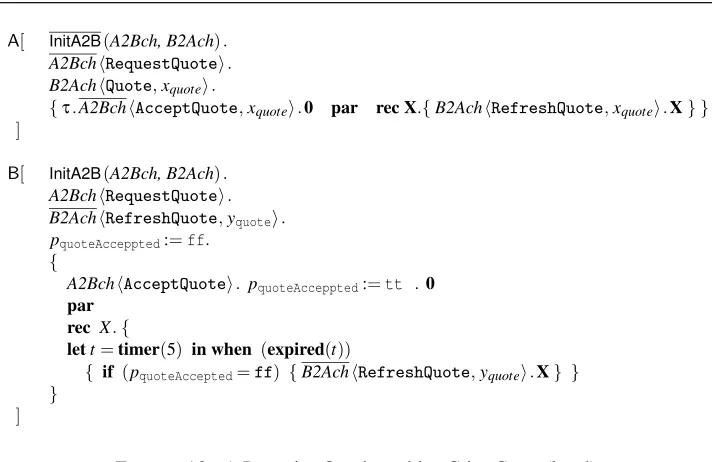
A[ InitA2B(A2Bch, B2Ach).
A2BchhRequestQuotei.
B2AchhQuote,xquotei.
{τ.A2BchhAcceptQuote,xquotei.0 par rec X.{B2AchhRefreshQuote,xquotei.X} }
]
B[ InitA2B(A2Bch, B2Ach).
A2BchhRequestQuotei.
B2AchhRefreshQuote,yquotei.
pquoteAcceppted:=ff. {
A2BchhAcceptQuotei.pquoteAcceppted:=tt .0 par
rec X.{
lett=timer(5) in when (expired(t))
{ if (pquoteAccepted=ff) {B2AchhRefreshQuote,yquotei.X} }
} ]
FIGURE13. A Proactive Quoting with a Criss-Cross (local)
Above, “τA” is the standardτ-action local toA, indicating passage of an unspecified duration of time.
Thus as a whole
τA.A→B:A2BchhAcceptQuotei.pquoteAcceppted:=tt@B.0,
indicates that the sending of “AcceptQuote” (with a quote value at the time) may take place after some duration of time, and whenBreceives this message,Bwill assign “truth” to its local variable
pquoteAcceppted. One may as well refine the above part as follows, using the “when” construct. when(satisfied)@A)
{A→B:A2BchhAcceptQuotei.pquoteAcceppted:=tt@B.0}
wheresatisfiedis an unspecified predicate local toA, indicating the satisfaction ofAw.r.t., say, the current quote value.
In the second thread,Bis engaged in a loop: the timertexpires at each 5 seconds and, when
expires(t)(which is a predicate rather than exception) becomes true, the body of “when” is
exe-cuted. IfpquoteAccepptedis false, it sends a quote and re-enters the loop: ifpquoteAccepptedis true, it terminates the loop. The interaction
B→A:A2BchhRefreshQuote,yquote,xquotei
not only indicatesBsends a “RefreshQuote”-message, but alsoAis ready to receive it and sets the communicated quote into its variablexquote.
The protocol description invites us to diverse forms of refinement. For example, we may con-sider the predicatesatisfiedis a boolean variable set afterAreceives a new quote (in the second thread). We leave exploration of such refinements to the reader.
Next we consider the local version of Figure 12, using the end-point counterpart of the “when”-construct. This is given in Figure 13. One may compare the presented behaviours with those in Figure 12. The “when” construct is used inB, with the same semantics as in the global calculus.
[image:23.612.128.484.65.296.2]A→B:InitA2B(A2Bch, B2Ach).
A→B:A2BchhRequestQuotei.
B→A:B2AchhQuote,quote,xQuotei. rec X.{
lett=timer(5)@B in
A→B:A2BchhAcceptQuoteitimer(t).0 catch(timeout(t))
B→A:B2AchhRefreshQuote,newQuote,xQuotei.X }
FIGURE 14. A Proactive Quoting with a Criss-Cross (global, with atomic interaction)
message. As noted before, we may as well refineA’s behaviour, for example in its transition to the quote acceptance state.
In the local description ofB, the first thread does not start from theτ-action (which isA’s local action) but starts from the reception of “QuoteAcceptance”-message fromA. The second thread is engaged with the timeout and loop using the “when” construct, using the variablepquoteAccepted.
The local descriptions of the proactive quoting protocol in Figure 13 are directly related with its global description in Figure 12 and vice versa, up to the treatment of criss-crossing. In particular, it is not hard to imagine how we can project the description in Figure 12 to the one in Figure 13 following a simple principle. A natural question is whether we can do thereversetranslation in a general way: can we integrate the local descriptions in Figure 13 to synthesize the global description in Figure 12? What would be the general principle involved in such projection? Part of this question will be answered in Part II of the present paper.
4.2. Criss-Crossing of Actions: Proactive Quoting (2). In this subsection, we present an alternative global description of the proactive quoting protocol. It is simple and understandable, even though the description is only sound under a strong assumption about the underlying communication on mechanism. The description follows.
The description in Figure 12 is terse and understandable. However its clarity has become possible only by assuming a significant condition on the underlying messaging semantics: each interaction is atomic. This assumption becomes essential inA→B:A2BchhAcceptQuotei, which needs be executed atomically: if not, it is possible thatAsends aAcceptQuote-message toB, but the time-out
inBis caught,BsendsRefreshQuotetoA, andAshould again sendsAcceptQuote-message again,
which is not the expected behaviour ofA. Rather it says thatA→B:A2BchhAcceptQuoteieither happens or not at all and moves to a timer, which is only realisable if this action is atomic. It may be costly to realise such atomicity in general. At the same time, the description may suggest atomicity of interaction can lead to terse specification of a complex behaviour.
Due to the assumption on atomicity and its interplay with timer, it is hard to devise local de-scriptions directly corresponding to Figure 14. Even if we stipulate the same atomicity assumption in local descriptions, it is hard to construct the projection ontoA: the problem is that the ’when’ loop withinAdoes not have an activity that it can observe to indicate thatBhas exited the loop. A possi-ble approach to this would be to model a guard condition forAto also include the ’quoteAccepted’ variable — but this guard condition would also have to include the aspect of duration, otherwise (as a result of the ’when’ blocking semantics) the guard atAwould simply block until the variable ’quoteAccepted’ was set to true, and it would not receive any of the quote refresh messages. Fur-ther, if both participants are required to use the same guard condition, then it also assumes they have synchronised clocks and evaluate the expressions at exactly the same time.
RBC→STC:InitR2S(R2Sch).
RBC→STC:R2SchhCreateOrderi.
STC→RBC:R2SchhOrderAcki. lett=timer(T)@RBCin
{STC→RBC:R2SchhPOCompleteditimer(t).0} catch timeout(t){
RBC→STC:S2RaborthAborti.{
STC→RBC:R2SaborthConfirmAborti.0 +
STC→RBC:R2SchhPOConfirmationi.0 }
FIGURE 15. A Global Description of T-Shirts Procurement
4.3. Criss-Crossing of Actions: A T-Shirts Procurement Protocol (1). Next we treat Ka-vanztas’s use-case [29], which describes a protocol for purchase orders between a really big corpo-ration (RBC) and a small T-shirts company (STC).
(1) RBC sends a purchase order (PO) to STC.
(2) STC acknowledges the PO and initiates a business process to handle the PO.
(3) After STC’s internal processes regarding the PO are completed, STC sends “PO-Completed” to RBC in order for RBC to complete its own business process.
(4) RBC can send a Cancel Order message to abort STC’s business process (which can criss-cross with a PO completed message), any time before RBC receives the PO Completed message from STC
(5) If Cancel Order arrives at STC before PO Completed is sent from STC, then STC aborts its business process and acknowledges this to RBC with PO Cancelled, in order for RBC to abort its own business process. Otherwise, if STC has already sent PO Completed, it ignores the Cancel Order because RBC has agreed it will honor POs when cancellations are not sent out within an agreed-upon time-frame.
(6) If RBC has already sent the Cancel Order message and then it receives the PO Completed message, then instead of aborting, RBC completes it.
Figure 15 presents a global description of this protocol.
Above, RBC first initialises a session channel R2Sch through InitR2S, then sends an order, which STC acknowledges. RBC then starts a timer, i.e. the longest time T it is willing to wait before the PO confirmation arrives. The timer is frozen upon the PO confirmation. Alternatively if the time-out occurs, it is handled by the catch part: RBC sends an abort message to STC, and either STC acknowledges it or its PO-confirmation arrives. Note we have made a timer explicit in this description: we later show a description which does not rely on the use of a timer.
An acute reader may observe that this description again assumes atomicity of communication, as in the previous subsection, in the sense that: the execution of an interactionA→B:chhOpimeans the two things at the same time:Asends a message andBhas received that message.
Next we give an end-point counterpart of the same description, in Figure 16.
In STC’s description, we use the following predicate-based exception mechanism. The syntax for this exception handling is:
try{P} catch(p){Q}
[image:25.612.130.427.73.241.2]RBC[ InitR2S(R2Sch).
R2SchhCreateOrderi.
S2RchhOrderAcki. lett=timer(T)in {
S2RchhPOCompleteditimer(t).0 }
catch timeout(t) { S2BaborthAbort,truei.
S2BaborthConfirmAborti.0
+
S2RchhPOCompletedi.0} ]
STC[ InitR2S(R2Sch).
R2SchhCreateOrderi.
xAbort:=false. S2RchhOrderAcki. try
{ τ.S2RchhPOCompletedi.0} catch(¬xAbort)
{S2BaborthConfirmAborti.0
+
S2RchhPOCompletedi.0} par
S2BaborthAbort,xaborti.0 ]
FIGURE16. A Local Description of T-Shirts Procurement
construct is feasibly implemented if the “catch” part is an exception such as timeout or explicitly thrown exceptions. However its implementation becomes more involved if, as here, a predicate is used for invocation since in that case a mechanism is necessary to watch the update of relevant variables. Note this construct is similar to the “when” construct: the same underlying mechanism can realise both. As an alternative, one may realise a similar behaviour using either a busy-waiting or a “sleep” construct, though these alternatives may not be faithful to intended semantics when we use arbitrary predicates for invocation.
We illustrate the behaviour of RBC and STC in this end-point description. First, RBC’s local behaviour is as follows.
• The first three actions (session init, order request and acknowledgement) are obviously implemented;
• RBC sets a timer and waits for T time-units to receive the PO confirmation from STC; • If the time-out is triggered, RBC will send an abort to STC, and then wait for the abort
confirmation or for the PO confirmation. The local behaviour of STC may be illustrated thus.
• As in the RBC part, the first three actions need no description, apart the fact that STC has a variable for checking whether RBC has requested an abort or not. This variable is initialised to false;
• At this point STC checks the abort variable, and if it is not true it decides to perform a tau action and then send the PO confirmation.
• if the abort variable is true it then confirms the abort;
• in parallel with the described thread, there is another thread which just waits for an abort message from RBC.
RBC→STC:InitR2S(R2Sch).
RBC→STC:R2SchhCreateOrderi.
STC→RBC:R2SchhOrderAcki. {
xAbortRequested@STC:=false. τSTC.
if¬xAbortRequested@STC{
STC→RBC:R2SchhPOConfirmationi.
xConfArrived@RBC:=true.0} else
STC→RBC:R2SaborthConfirmAborti.0 }
par {
xConfArrived@RBC:=false. τRBC.
if¬xConfArrived@RBC{
RBC→STC:S2RaborthAborti.
xAbortRequested:=true.0 } }
FIGURE 17. A Global Description of T-Shirts Procurement without Timer
Note the end-point description makes it explicit how timeout is done and how criss-crossing occurs in terms of two distributed end-point behaviours. We believe it faithfully realises the global behaviour described in Figure 15 under the assumption of atomicity of interactions: at the same time, one may observe that the given end-point description doesnotautomatically get extracted from the global description. In fact, as far as the initial protocol description goes, the local description arguably realises a correct behaviour even if we do not stipulate the atomicity assumption for communication actions (it is notable that CDL [52] does not stipulate such atomicity).
4.4. Criss-Crossing of Actions: A T-Shirts Procurement Protocol (2). The descriptions so far depend on the explicit use of timer and exception (timeout) which a timer engenders. However the nondeterminism and criss-crossing of message exchanges themselves may not be directly related with local use of timers. Indeed, a description of the overall exchange of interactions is possible without using timers, as we shall discuss below.
The protocol uses two (local) variables, AbortRequested at STC and ConfArrived at RBC, both initialised to be false. The timing of update of these variables is the key underlying idea of this protocol. The protocol description follows.
Let us offer an informal illustration of the protocol.
• At this stage the interactions are divided into the parallel composition of two behaviours. In one thread of interaction, we have:
(1) STC will, at some point, check AbortRequested is true (i.e. RBC’s abort request has arrived) or false (i.e. RBC’s abort request has not arrived).
(2) If AbortRequested is false, then STC will send a PO confirmation message. When RBC receives it, it will set its ConfArrived to be true, and STC moves to the com-pletion of PO processing.
(3) If AbortRequested is true, then STC will send a AbortConfirmed message. RBC receives it, and in both sites the PO process aborts.
In another thread of interaction, we have: (1) At some point RBC will check ConfArrived.
(2) If it is false (i.e. a PO confirmation has not arrived), then sends AbortRequest-message to STC.
(3) If it is true (i.e. a PO confirmation has arrived), then RBC moves to the completion of PO processing.
In Figure 17, τSTC (resp. τRBC) indicates aτ-action in STC (resp. in RBC), which may take an
unspecified amount of time. We can check that this protocol never moves to:
• The situation where STC sends a PO confirmation but an RBC aborts (since, for an RBC to abort, it needs to obtain AbortConfirm message from STC).
• The situation where RBC receives both a PO-confirmation and AbortConfirm (for the same reason).
Note however it is possible STC may receive, in one thread, AbortRequest message at timetbut, for some reason, this has not been propagated to anther thread in time, so that, at timet+t0, STC sends a PO-confirmation message to RBC. However this does not contradicts the initial specification (we also believe this is consistent with the standard business convention).
The end-point projection of this example is not to hard, which we leave to the reader. We also note Kavanztas [29] presents a different description in CDL using the “when” construct with distributed predicates.
4.5. Further Note. In this section we have explored various ways to describe two business protocols (though the presented ones are far from the only ways to describe them). The purpose of these formal representations of business protocols in the calculi is not only to analyse the behaviours of these protocols themselves and to reason about them, but also to understand the correspondence between various constructs and their expressiveness. By having a precise operational semantics, we can discuss diverse aspects of the constructs needed to represent a large class of communication behaviours with precision. Further analyses of these and other complex business protocols in these formalisms would be an important and stimulating future research topic.
feature CDL formalism session channels located at input no restriction
session initiation implicit explicit
general co-relation yes by adding “polyadic sync” typing by-name (informal) by-structure (formal)
type checking no yes
local exception none yes
repetition loop recursion
sequencing imperative prefix
predicate-based invocation yes by adding “when”
EPP implemented proved
global variable lookup yes no
global completion yes no
TABLE1. Correspondence and Differences
5. Correspondence with CDL
In this section, we briefly outline relationship between CDL and the global/local calculi we have used in the previous sections. The correspondence/differences are summarised in Table 1.
Some comments:
• Channels are one of the fundamental elements in communication-based languages as well as in security engineering, arising in diverse forms (such as sockets, remote object IDs, and URLs). Even though an informal global description may not mention channels (this is because the names of participants play the role of channels), they become essential when exception and channel passing are involved. In fact, in standard distributed programming, we may use multiple channels (often in the shape of transport connections) in one unit of conversation.
• CDL channels are located at the inputting side, representing the ports where the sender writes to. Formalisms are more general, using channels both for input and for output. • Concerning session initiation, this is done implicitly in CDL. In our calculi, we place the
explicit session initiation which makes the underlying operational and type structure more explicit and more amenable to analyses. This does not prevent us from using the calculus to represent practical business protocols since we may regard the session initiation and the subsequent action to be combined into a single message in implementation.
• Co-relation is one of the significant features of CDL. Co-relation can be considered as a way to collectively treat multiple sessions as one conversation unit. Though we have not been treated in this work, this feature can be cleanly represented in formal calculi. One method is to use the so-called polyadic synchronisation.
• CDL does not have a proper notion of type checking nor type inference. However it is equipped with such notions as relationship, roles and participants, whose specifications are related with each other through XML schemas. These constructs play an important role as part of documentation. These data will be usable as a basis of typing, using the so-called by-name approach (as found in Java).
• As we saw above, exception are indispensable for managing many interesting real applica-tion situaapplica-tions. One thing missing in WS-CDL would be the ability of handling excepapplica-tions locally, with a standard local scoping rule. This topic may deserve further consideration. • Repetition of instructions is usually dealt with while loops. In the calculus we use
recur-sion, another mechanism which can faithfully emulate the standard loop operation as well as many forms of recursive calls. They also enjoy many theoretical features. This does not mean it is better to replace loops with recursion: when a loop behaviour is intended, writing it with a loop often leads to a more understandable program.
• Sequencing of interactions can be treated in two different ways, i.e. the way it is done in CDL and the way it is done inπ-calculus. In CDL, a standard imperative language construct “;” is adopted. In our formalisms, we are using the simple prefixing opera-tor. Superficially, the latter construct is less powerful than the former, mainly because it assumes only very simple operations are allowed before the “.”. On the contrary, when using “;” we can combine complex expressions such as those combined by the parallel operator. Again there is a precise embedding of “;” into the prefixing in combination with other constructs, so we lose no generality in using “.” while allowing easier analysis. • CDL is equipped with the predicate-based invocation mechanism (for which we used
the constructwhen). This mechanism is powerful for various specifications, but it also demands a heavy implementation mechanism. Exploration of cases where this construct becomes indispensable would become important for understanding its status in structured concurrent programming.
• Various globalised features of CDL are incorporated because they often naturally arise in business protocols. Their semantic content however may not be precisely understood. Note globalised behaviour has to be, in effect, realised by interactions among distributed peers. Therefore, at least at the level of formalisms, the understanding of how a certain global construct may be realised by interactions is a prerequisite for their proper inclu-sion in formalisms. Precise appreciation of what high-level global abstraction would be suitable for describing communication-centred software behaviour, and how they relate to their local (communication-based) realisation, is an important topic for future study.
Part 2
6. Introduction to Part 2
Part II develops a theory ofend-point projection (EPP), which gives an exact condition and framework by which we can relate the global description of communication-centric software to its local description. The theory is intended to offer one of the central formal underpinnings of W3C’s web service choreography description language, WS-CDL [51]. The development of the theory has benefitted greatly from the dialogue between the invited scientists of W3C WS-CDL Working Group and WG’s members: in fact, without this dialogue, this theory may not have been developed, at least at this moment and in its current shape.
The presented theory may be considered as offering a formal substrate for designing, imple-menting and using distributed applications written in WS-CDL and related languages, by establish-ing principles by which applications’ global description and their local description are naturally and precisely related. In particular, the theory may be usable, in combination with results from other research threads, as a mathematical underpinning of various tools and infrastructural support for web services, including those for static and dynamic verification. One such effort is underway, using an open-source reference implementation of WS-CDL [40].
7. Informal Preview
7.1. What is end-point projection? End-point projection, or EPP for short, is a concept fre-quently discussed throughout the development of CDL in the W3C WS-CDL working group. Its basic idea is simple, and may be summarised as follows.
Let’s write down a communication-centred concurrent program (in this case a business protocol) globally, then project it to each end-point so that we can ob-tain a local description which realises the original global description through their interaction.
As a simple example, consider an interaction:
(11) Buyer→Seller:B2SchhQuoteAccept,100,xi.0
which is an interaction between a Buyer and a Seller, the former communicating it accepts the quote with price 100 pounds (or dollars or whatever currency you like). This simple global description is projected onto two end-point (local) descriptions:
(12) Buyer[B2Schh100i.0]
and
(13) Seller[B2Sch(x).0]
Here description of an “interaction” in (11) (in which both sending and receiving of information are one thing) is decomposed into its local communication actions (in which a sending action of (12) and a receiving action of (13) are separate). We can see that, if Buyer does the specified sending and Seller the receiving, then precisely the interaction as specified in (11) takes place. So we can regard (12) and (13) as how local agents should behave if we wish realise the global interaction as described in (11). As such, they can be regarded as local programs implementing original global description, or alternatively as local monitors which constrain the behaviour of each agent.
7.2. Why EPP matters. Why does EPP matter? First, without EPP, we do not have a clear idea how a global description can be executed, and, therefore, its computational meaning is not clear: a central idea of web services, or in general communication-centred programs and services, is that independently running1concurrent agents achieve their application goals through their communi-cation with each other. Thus a global description should be considered as describing behaviour of distributed communicating processes: the latter is the meaning of the former. In this sense, it is only when a uniform notion of EPP is given that the computational content of global descriptions is determined.
Second and relatedly, EPP is an essential basis for diverse engineering applications of global descriptions. Once we have a clear notion of EPP, it offers, for each end-point, what local behaviour a given global description specifies: if we wish to monitor whether an independently developed end-point program behaves in a way specified by a global description, then we can compare the former with the EPP of the latter. Or if we wish to develop a program referring to a given global description of their interactions, we can start from the EPP of the latter: and after developing a fully specified program, or even during the development, a programmer/designer working on each endpoint program can check whether it conforms to the original global description with respect to its communication behaviour (such validation, which we may callconformance validation, will be particularly useful in collaborative program development). Or we can even develop a global description language which can specify full algorithmic details specification at each-end point in which case the result of performaing an EPP on a detailed global specification onto all the end-points offers directly executable distributed programs whose behaviour is by definition conformant to the original global specification.
1Here “independence” indicates primarily about synchronisation boundaries, but it can also indicate protec-tion domain (security) boundaries.
Thirdly, EPP offer a central underpinning for the theoretical understanding of the structures of global description and their use. Indeed, EPP opens the essential conduit between theories of pro-cesses and web service engineering, by relating the global description to the equivalent description in the shape of communicating processes. The established connection enables application of alge-bras, logics and types of theories of process calculi in the present engineering context. It also (as our subsequent inquiries make clear) leads to a deep structural analysis of global descriptions. Web service engineering demands theoretical foundations because it is about interoperability among dis-parate agents inhabiting distinct protection domains (or, in a more wordily term, organisations with possibly conflicting interests and complex trust relationships). In such a context, different organ-isations need a clear shared understanding on how they are to interact with each other in a given business protocol. As an example, consider a business protocol which is about transaction of stocks and which need be bound by regulations. We need a clear criteria as to whether each end-point (organisation) is acting conforming to the protocol. In fact, conformance of the protocol itself to a regulation should initially be clarified, for which we need clear engineering understanding preferably backed up by a theoretical basis. We expect many key elements of theories of processes will offer critical engineering tools in this context.
7.3. Criteria for EPP. An ad-hoc EPP framework may not work: in fact, it never works. This is for simple reasons. First, we wish to implement EPP as an algorithm which can once and for all map a large class of global descriptions to their local counterparts. Thus we need a general way to relate global descriptions to local ones. Second, in relating global description to local description, we wish to avoid the situation where generated local description by different notions of EPP are not compatible with each other. This is especially true when a global description serves as areference descriptionof software infrastructure in an organisation or a social domain, used as a key reference for various business decisions, interoperability and infrastructural development (this is in fact one of the stated goals of WS-CDL [51]).
So we need a general framework for EPP, which can uniformly map a general class of global descriptions onto their end-point counterparts. But how can we know a given EPP is correctly pro-jecting a global description to a local description? An informal, but important, engineering criteria is that the resulting local descriptions haveintuitivelya clear and direct connection to the original global description. That is, a designer who specifies software behaviour by a global description should not have surprises when the real computation is realised by communications among projected local processes. From the viewpoint of interoperability, it is also important that we have a general and uniform scheme which can be applied to a large class of global descriptions (note that, assuming we use a public standard for global descriptions, if we have a sufficiently general and satisfactory EPP mapping, this gives us a firm basis for interoperability). Apart from these two informal criteria, the following three are natural formal criteria by which we can measure the effectiveness of an EPP scheme (which are in fact closely related to the two informal criteria we just noted).
• Mapping preserves types and other well-formedness conditions.
• The projected local description implements all behaviours expected from the original global description. Concretely, actions expected from a global description should be faithfully realised by communication among a collection of projected end-points. This property may be calledcompleteness of EPP.
• In the reverse direction, locally projected communicating processes should not exhibit observable behaviour not prescribed in global description, as far as its predefined interface goes.2Concretely, communications among projected peers should not go beyond actions stipulated in the original global description. This may be calledsoundness of EPP.
For these criteria (especially the latter two) to make sense in practice, we should have a precise way to say, among others, what course of actions (their kinds and structures) are stipulated in a global description, and what course of interactions (their kinds and structures) are expected from
a collection from local descriptions. To do so, we can follow the standard framework in process algebras [8, 22, 32, 35] and programming language semantics [20, 41, 53], defining formal syntax, well-formedness (type disciplines) and evolution of behaviour (dynamic semantics). By mathemati-cally defining these ideas, we can now formulate correctness criteria without ambiguity as well as a means to prove (or refute) whether a framework of an EPP satisfies the given criteria (of course the use of formal definitions of semantics of process languages go beyond its use in end-point projec-tions, including a reference for concrete implementation, a formal basis for developing diverse forms of verification technologies, and deeper inquiries into mathematical properties of these descriptive frameworks themselves, cf. [36]).
The aim of the rest of the present note is nothing but carrying out the program just outlined: formalising central notions of global/local languages in their distilled form; presenting formal criteria for correctness of EPP; and study a general framework of EPP including formal arguments for its correctness, including three natural descriptive principles under which the presented EPP results in sound and complete local descriptions. In particular we shall present:
• Formal definition of static and dynamic semantics of the global and local calculi, which distills respective descriptive paradigms/languages (static semantics specifies a type dis-cipline for description, dynamic semantics specifies how computation proceeds in a given description). Type disciplines in respective formalisms act as a basis of the whole techni-cal development in the paper.
• A theory of end-point projection, which maps a global description to local description, as well as offering a means to examine its properties. We first present three basic principles for global descriptions which defines a notion of “well-formedness” of description. Then we introduce a simple inductive algorithm which maps each well-formed global descrip-tion onto a collecdescrip-tion of local descripdescrip-tions (one for each end-point), and present formal arguments that this map is both sound and complete, with respect to static and dynamic semantics of respective formalisms.
The theoretical development focusses on key elements of global/local formalisms without such fea-tures as timeout and exception. We believe there are no unsurmountable technical obstacles to extend the present theory to these additional features.
8. Global Calculus (1): Syntax
In this section and the next, we introduce the syntax and dynamic/static semantics of the global calculus. Thedynamic semanticsspecifies an abstract notion of “computation” underlying a formal-ism. In the case of Turing Machine, this is a move of a head and read/write of each slot of a tape. In the case of theλ-calculus, this is an application of a lambda term to an argument and a subsequent substitution (for example,(λx.f x)3→ f3 indicates that, when the function(λx.f x)is applied to an argument 3, the result is another applicationf3). In the case of a global calculus, this is represented as a transition from a global description to another global description, carrying out each step of in-teraction (exchange of a message). Since each participant may own its own local variables, such transition can also involve collection of local variables of the participants involved.
From an engineering viewpoint, the dynamic semantics pins down a mathematical notion which designers, implementors and users can refer to when they wish to discuss about dynamic behaviour of description with rigour. For example, this would allow us to state with precision whether an implemented program conforms to the description or not. The dynamic semantics is defined using an intuitive notation,
(σ,I) → (σ0I)
which says a global descriptionIin a stateσ(which is the collection of all local states of the par-ticipants) will be changed intoI0in a new configurationσ0. This idea comes from the small-step
semantics given to imperative languages (cf.[41, 53]).
The description of interactions in the global calculus centres on a notion ofsession, in which two interacting parties first establish a private connection and do a series of interactions through that private connection, possibly interleaved with other sessions. More concretely, processes first exchange fresh session channels for a newly created session, then use them for interactions belonging to the session (this is equivalent to the more implicit framework where identity tokens in message content are used for signifying a session). This idea has a natural association with a simple type discipline, where we represent a structured sequence of interactions between two parties as an type. Here “types” mean syntactic annotation on descriptions of interactions: this annotation describes an abstract notion of interface of a service (or a shared service channel), and is inferred by typing rules for each description following its syntactic structure. For example, consider an interaction:
(14) Buyer→Seller:shRequestQuote,productName,xi.
Seller→Buyer:shReplyQuote,productPrice,yi
In (14), a Buyer requests a quote for a product, specifying the product name, through a session channels: then, through the same channel, a Seller replies with the quote value (one may consider
chto be a socket connection). This interaction atscan be abstracted by the following session type: (15) s↑RequestQuote(String).s↓ReplyQuote(Int)
The session type in (15) abstracts a sequence of actions performed atch, specifying the following abstract behaviour:
First sends (“↑”) a string with operation nameRequestQuote, then receives (“↓”) an integer with operation nameReplyQuote.
Note this abstraction is given from the Buyer’s viewpoint: we can equally present the abstraction for the Seller’s action:
(16) s↓RequestQuote(String).s↑ReplyQuote(Int)
which simply reverses the direction of information flows. Note that, in this way, there is a natural notion ofdualityassociated with session types.