2011
The diffusion of sustainability activism at an
American universtiy
Jo Ann Simpson Iowa State University
Follow this and additional works at:https://lib.dr.iastate.edu/etd
This Thesis is brought to you for free and open access by the Iowa State University Capstones, Theses and Dissertations at Iowa State University Digital Repository. It has been accepted for inclusion in Graduate Theses and Dissertations by an authorized administrator of Iowa State University Digital Repository. For more information, please [email protected].
Recommended Citation
Simpson, Jo Ann, "The diffusion of sustainability activism at an American universtiy" (2011).Graduate Theses and Dissertations. 10311.
by
Jo Ann Simpson
A thesis submitted to the graduate faculty
in partial fulfillment of the requirements for the degree of
MASTER OF SCIENCE
Major:Interdisciplinary Graduate Studies (Social Sciences)
Program of Study Committee: Stephen G. Sapp, Major Professor
Doug Gentile Alicia Cast
Iowa State University
Ames, Iowa
TABLE OF CONTENTS
LIST OF TABLES iii
ABSTRACT iv
CHAPTER 1. INTRODUCTION 1
Review of Previous Literature 3
Diffusion of Innovations Theory 9
CHAPTER 2. METHODS 20
Selection of Study Group 20
History of the SAG Council 21
The Interviews 23
Data Analysis 25
CHAPTER 3. RESULTS 28
Introduction 28
The Innovation-decision Process 31
Knowledge 31
Persuasion 44
Other Emerging Themes: Identity and Emotion 60
Decision, Confirmation, Implementation and Adopter Categories 64
Differences: Cohorts and Cultures 73
CHAPTER 4. DISCUSSION 77
Diffusion of Innovations Advantages 77
Diffusion of Innovations Gaps 82
Comparison with other Theories 83
APPENDIX A. INTERVIEW GUIDE 94
APPENDIX B. MAIN NODES, CHILD NODES AND TREE NODES 98
REFERENCES 100
ACKNOWLEDGEMENTS 103
List of Tables
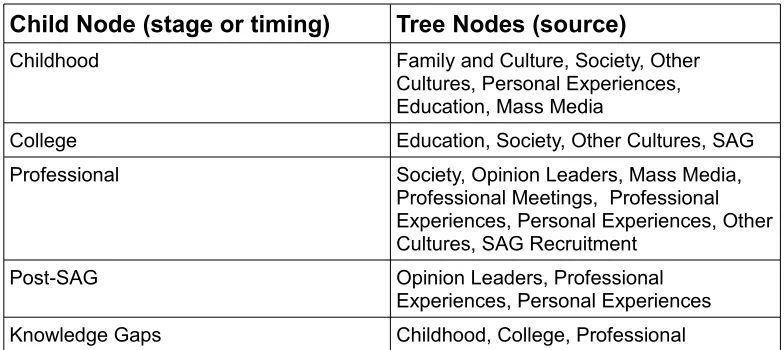
Table 1. Child and Tree Nodes for Knowledge 33
Abstract
This is a qualitative study of collective action at a large American
university. The project explores the motivations for civic engagement of
individuals. Eighteen respondents that had been involved with a Sustainability
and Greening (SAG) council were interviewed with a biographical in-depth
interview approach using an open-ended interview guide. Data was analyzed
deductively using Diffusion of Innovations theory as a guide. Categorizing
individuals according to Diffusion of Innovation adopter categories proved useful
in understanding motivations to engage. Results show that individuals went
through an innovation-decision process and were motivated by perceived
compatibility of the SAG council collective action with their prior knowledge and
current social context, relative advantages of the SAG as an innovation, and
most notably by opinion leader endorsements. The study contributes to
collective action research by showing how actors can be differentially motivated
over time and how engagement can be nurtured to meet our looming social
Chapter 1: Introduction
This project explores the emergence and success of an activist
organization organized for the purpose of improving sustainability. It uses a
qualitative approach to data collection and analysis to examine how, over the
past 8 years, a collective action group located at an American university has
evolved, received official recognition from the university administration, and
carried out its work. The research examines the factors that motivate individuals
to become involved in civic engagement. It explores the influences of
colleagues, friends, family, education, nature, life experiences and the media, on
motivation to engage. The project examines these factors within the context of
the diffusion of innovations perspective, wherein individuals are presumed to be
motivated to action by the combined effects of information, persuasion by opinion
leaders, and facilitation of efforts to organize and act.
At the dawn of the 21st century, Harvard public policy professor Robert D.
Putnam raised a warning about the erosion of civic engagement in American
society. His popular book, Bowling Alone , uses evidence from sociological studies and surveys that shows associational membership in America is stagnate
or in decline (Putnam 2000). Labor unions, church groups, fraternal and
veterans' associations and school service groups have lost participants.
Membership in professional associations has risen over the same time period,
but not as much as would be expected considering the growth of the white collar
involvement is most often characterized by simply writing a membership check
as a response to mass mailing campaigns. This drop off in participation in
organizations characterized by local involvement, dense networks of social
relationships and the requirement for mutual trust and reciprocity does not bode
well for the future of America, according to Putnam. By discovering the factors
responsible for motivating civic engagement, this research might help find ways
to reverse the decline in social capital described by Putnam and improve our
outlook for the future.
Many of the problems we face in the 21st century will require cooperation
within and among various groups; however, without the social capital created by
active group participation, we may not be able to muster the collective action that
will be needed to solve these problems. One of the most pressing problems we
are facing today is how to deal with the consequences of global climate change
that are most likely caused in part by human activity (IPCC 2007). The
consequences and sustainability of the increasingly popular American lifestyle
based on high energy consumption, cheap food produced with intensive inputs,
and massive amounts of waste is being called into question (e.g., Trainer 1997).
Emerging sustainability experts evaluate lifestyles and systems of production
according to what they call the triple bottom line: environmental, economic and
social sustainability. Improvement in any one of these areas without
consideration of the effects on the others will only exasperate our problems for
increasing call for social scientists to get more involved to help solve our looming
sustainability crisis (e.g. Vlek and Steg 2007). The ability to mobilize collective
action and renew the civic engagement that builds strong social capital will be
critical as we move forward.
Review of Previous Literature
Inquiries regarding collective action cover a broad range of topics,
including activities conducted by local citizen groups, spontaneous crowd
behavior, and large social movements (vanZomeren and Iyer 2009). These
actions have in common a desire to improve the status or power of a group
rather than that of one or a few individuals (Tajfel & Turner 1979; Wright, Taylor,
& Moghaddam 1990). The primary goal of collective action research has been to
predict or understand “when and why individuals will (or will not) engage in
collective action” ( Wright 2009: 860). Numerous theories have proposed
motivations for such engagement.
Conflict theories, such as those proposed by Marx and Engels (e.g.,
2002), focus on the conditions of inequality in society as determinants of social
action, but fail to explain why only a small percentage of actors affected by
inequality participate in social action (Stouffer, Suchman, DeVinney, Start &
Williams 1949). Relative Deprivation Theory (RDT) elaborates upon Marxian
approaches in positing that actors must perceive an inequality to pertain to an
1979). This perspective thereby locates the motivation in the perception of
individuals rather than the objective conditions of society. Social Identity Theory
(SIT) explores the relationships between individual identities and collective group
identities, how individuals use their social groups to enhance their self image and
how they assign positive attributes to the social groups to which they belong to
maintain their self esteem. Additionally, SIT highlights the importance of
perceived group boundaries, such as when low status groups develop an
in-group identity and label as the out-in-group those that maintain the inequality or
have what the in-group wants (Tajfel and Turner 1979). SI theorists posit that
action will be taken when the boundary between the two groups seems
impermeable, preventing the low status individual from simply joining the high
status group (Ellemers 1993), or when the boundary seems illegitimate (e.g.,
Mummendey et al. 1999) yet unstable (e.g., Wright et al. 1990), implying that
collective action could indeed bring about change. New Social Movement
Theory (NSM), originating in Europe, acknowledges that more recent collective
action such as environmentalism and anti-corporatism do not seem primarily
motivated by perceptions of deprivation and in-group/out-group identity
boundaries. Actors in these groups instead come more from middle class
backgrounds, create a politicized identity, and rather than trying to achieve
membership in the out-group seek to bring others of like mind into their group
(Wright 2009). Resource Mobilization Theory (RMT) turns the focus away from
actors have access to resources such as the media and organizational structures
(McCarthy and Zald 1977). NSM theories have assumed that the middle class is
resource savvy, with educational and work-related experiences that they can
bring to the collective action (e.g., Melucci 1980). NSM Theory and RMT see
actors as rational decision makers who weigh costs and benefits of personal
involvement and possible group success. The problem with this rational action
viewpoint is that the individual costs in collective action or civic engagement can
be high but the benefits often are made available to many. A rational person
therefore might be inclined to avoid collective action and let someone else pay
the cost, knowing that they will still gain the benefit. This inclination to let others
take the risks for one's benefit is known as the free rider problem of Olsen
(1968).
New directions in collective action research go beyond identifying actors
as intuitive economists motivated solely by inequality or the availability of
resources, to a wider exploration of the role of emotion and ideology, suggesting
that individuals may be motivated as ”intuitive theologians who are trying to
defend threatened moral convictions” (vanZomeren and Iyer 2009:654). This
perspective might explain why high-status groups engage in action to benefit the
disadvantaged. These directions explore new sources of identity, including
referents by the individual to opinion-based and superordinate groups that claim
that individuals are part of a larger identity. For example, the environmental
and therefore are vulnerable to the effects of pollution and global warming
(vanZomeren and Iyer 2009).
Overall, existing theories posit two general categories of motivating
predictors for collective action: structural and psychological. From a structural
perspective, social conditions of inequality motivate those who are marginalized
or threatened to rise up to bring about change. Marx and Engels (2002), for
example, claimed that the economic structure of capitalism would lead to
increasing inequality between workers and owners, resulting in a class-based
workers' revolution. Similarly, NSM theorists (see Beuchler 1995 for an
overview) focus on the structure of society, but emphasize the individual's
awareness of the ability to construct society and thereby question who will control
that construction (Touraine 1977). NSM theory argues, for example, that
increasing urbanization leads to a conflict between the need for commodification
and the need to maintain cultural identity (Castell 1977), thereby leading to a
division of modern society into a politico-economic realm governed by power and
money versus a personal life world governed by normative consensus
(Habermas 1975). The increasing pace of change in modern society further
problematizes this identity maintenance (Melucci 1988). NSM theory predicts
that new structural conditions will bring about conflict that leads to collective
action. This group of theories does not necessarily predict, however, which
actors will participate in these new social movements (Buechler 1995) because
non-action to action. Similarly, micro-level psychological predictors, such as
actors' perceptions of inequality, deprivation, identity, or perceptions regarding
available resources, do not explain how an individual actor with these
perceptions becomes engaged as part of a group.
Therefore, although there has been a long history of theorizing about
when and why collective action will take place, little is known about the process
by which an actor becomes motivated to action. Until we understand the “how”
of collective action for an individual, it will be difficult to find ways to nurture that
engagement when it is needed or mitigate it when it becomes inappropriately
destructive.
An approach that might be helpful in addressing this theoretical gap looks
at the role of social networks in predicting activist engagement. Stryker's notion
of identity salience (e.g., Stryker 2000), for example, suggests that the
relationship between participation and social network ties motivates individuals to
become engaged to fulfill needs for social attachment to others. Similarly,
McAdam and Paulsen (1993:647), propose that participation is based on the
intersection of four limiting factors: “the occurrence of a specific recruiting
attempt, the conceptualization of a tentative linkage between movement
participation and identity, support for that linkage from persons who normally
serve to sustain the identity in question, and the absence of strong opposition
from others on whom other salient identities depend.” McAdam and Paulsen
help register southern black voters had attitudes that supported civil rights, but
also were embedded in other organizations that support this identity and not
hindered by family or friends who supported other identities besides participants'
pro-civil rights identity.
In a similar line of inquiry, some collective action theorists propose that
Pierre Bourdieu's concept of habitus—the social information passed from one
generation to the next, allowing the reproduction of the structure of society—can
explain a growing tendency towards activism and civic engagement (Crossley
2003). Bourdieu claims that changes in society come at times of crisis, when the
knowledge embodied in the habitus no longer meets the needs arising in a field,
leading to a questioning and possible change of the accepted way of performing
social life. Crossly (2003) goes further to suggest that a “radical habitus” makes
reflection and questioning of the status quo a normal component of social
conduct, such that significant social change can occur at times other than in
crisis. In this manner, social networks are shown important in reproducing the
radical habitus. Note, for example, that middle class actors seem to continuously
question their own practice and the practice of society either through previous
participation in activism or by socialization within their family or schools. This
approach brings together the structural factors of the field, including the objective
conditions of society and the availability of resources in the form of various
Crossley acknowledges, however, that the habitus perspective fails to
address “how neophytes are induced into protest, and the fact that some protests
rely heavily on a neophyte base” (2003:53). This question seems relevant not
only to the collective action arena of protest, but also to other areas of activism,
including the general area of civic engagement (e.g., Putnam 2000).
In summary, although effective theoretical approaches have been
developed to address the macro-sociological issues of collective action, much
remains to be learned about the process by which an individual becomes
engaged in social activism, what one respondent in this study referred to as the
attitude-practice gap. Structural, psychological, cultural and network predictors
state that if certain conditions are present, collective action is likely to occur, but
these predictors do not tell us how specific individuals become engaged in
action.
Diffusion of Innovations Theory
Diffusion of Innovations (DoI) theory (Rogers 2003) has been used to
explain the processes by which individuals or organizations change their
behavior. For individuals, such as those involved with the Prairie Plains
University (PPU) greening effort, beginning to engage in social activism with a
group about the issue of sustainability can be viewed as a behavior change.
Additionally, diffusion studies have been used across a wide range of
health, modern technology such as the internet , and in many different cultures
(Rogers 2003). These two points make DoI theory ideally suited to help address
the gaps left by other collective action research related to the engagement
process for individuals, and to shed light on issues that cut across disciplinary
boundaries, such as collective action and our current sustainability problems,
which are also global in scope.
Academically located in the field of communication studies during his later
years, Everett Rogers spent his academic career developing a generalized
model of diffusion of innovations that has been employed in multi-disciplinary
research studies from the 1960's until the current day. While growing up in a rural
Iowa community, Rogers observed and questioned why some farmers lagged
behind in adopting new agricultural innovations. As a graduate student at Iowa
State University, he became engaged in diffusion research related to the
adoption of agricultural innovations. Iowa State was the site of Bryce Ryan and
Neil C. Gross' landmark study on the diffusion of hybrid seed corn (Ryan and
Gross 1943). While looking at diffusion studies in other unrelated areas, Rogers
became convinced that the diffusion of innovations was a “general process, not
bound by type of innovation studied, who the adopters were or by place or
culture....that it was a kind of universal process of social change” (Rogers 2003:
xvi). Rogers attributes the theoretical roots for his model to Gabriel Tarde's
diffusionist anthropologists whose work followed Tarde and Simmel, as well as
the work of Ryan and Gross (Rogers 2003).
Rogers' model lays out four key elements to consider when trying to
understand social change brought about by an innovation: the innovation, which may include an idea, practice, technology or combination of these; the
communication channels through which the innovation is diffused; the social setting in which the change takes place; and the idea that diffusion takes place over time and may have different motivations depending on when actors are involved (Rogers 2003). This conceptualization of diffusion includes all the
predictive factors suggested by theories of collective action discussed earlier.
Structural predictors of conflict theories, RDT, RMT, and NSM theories are taken
into account by examining the social context of the new idea. Context also
illuminates the role of culture and Bourdieu's habitus, including the notion of the
field and available capitals. Looking at communication channels allows an
examination of psychological factors such as the effects of previous
communication on perceptions, the role of socialization, and the role of the social
networks discussed by McAdam. Perhaps more importantly though, DoI theory
can help us understand how individuals become involved in collective action by
acknowledging that the involvement is a process that happens over the fourth
Diffusion theory states that actors go through an innovation-decision process of deciding whether to adopt or reject an innovation. At first they seek out knowledge about the innovation. At some point they will evaluate what they
have learned and become persuaded either positively or negatively about the
potential of the innovation to solve a problem. Then they will make a decision to
adopt or reject the innovation and proceed to implement that decision. Finally,
actors may confirm their decision or reverse it at a later time. The stages of the
innovation-decision process are often labeled as: Knowledge, Persuasion,
Decision, Implementation and Confirmation (Rogers 2003).
Another advantage of using DoI to study collective action and civic
engagement is that it acknowledges adopters or actors are not all the same.
Different actors become involved at different times and hence may be motivated
differentially. Empirical studies have shown that cumulative adoption rates for
an innovation tend to follow an S-shaped curve with small numbers of actors
adopting in the beginning, followed by increasing numbers which reach a critical
mass and then a small number of late adopters (Rogers 2003). Rogers
identifies five categories or ideal types of individuals according to when they
make the decision to adopt an innovation: innovators, early adopters, early
majority, late majority and laggards. These ideal types have been shown to have
differing characteristics. The founders of the PPU greening effort who are the
focus of this study can been viewed as innovators. Others respondents that
adopters or early majority. Knowing what characteristics are associated with the
different categories might help shed light on motivations.
The five adopter categories have been derived on the basis of
innovativeness, “the degree to which an individual or unit of adoption is relatively
earlier in adopting new ideas than other members of a social system” (Rogers
2003:280) . When plotting the numbers of actors who adopt an innovation at a
given time from first adoption, a normal curve results. The five ideal types with
their own unique characteristics are abstractions from empirical data that have
been separated by standard deviations from the mean time to adopt. Under this
abstraction, innovators comprise the first 2.5 % to adopt and tend to be
venturesome, willing and financially able to take risks, more inclined to interact
with a wide range of people and not especially respected by other members of
their local system. The next 13.5% are labeled early adopters. They are more integrated into their local system and often serve as opinion leaders for others.
They have earned this respect by being more deliberate and cautious about
adopting new ideas, such that they have a better reputation for being successful
than innovators. The early majority ideal type fall one standard deviation before the mean and are willing followers of opinion leaders in their group. On the other
side of the mean are the late majority. These actors wait to adopt an innovation until there is sufficient peer pressure or economic pressure to adopt. Laggards
are defined as the last 16% to adopt. While innovators and early adopters have
are relatively the same and do not justify two separate categories. Laggards are
the most isolated from others outside their system and can even be isolates in
their own system. They tend to resist change and value the way things have
been done in the past. Often a precarious economic situation causes them to be
very cautious in adopting new ideas or technology (Rogers 2003).
From over thirty years of studying the diffusion of innovations and the
specific topic of innovativeness, Rogers has come up with the following
generalizations about innovativeness (Rogers 2003). It tends to be positively
correlated with:
• years of formal education
• literacy
• social status
• upward social mobility
• larger-sized units
• greater empathy
• less dogmatism
• greater ability to deal with abstractions
• greater intelligence
• more favorable attitude towards change
• greater ability to cope with uncertainty and risk
• more favorable attitude towards science
• less fatalism and more self-efficacy
• higher aspirations for formal education
• higher status occupations
• more social participation
• more highly connected in interpersonal networks of their system
• being more cosmopolite
• more contact with change agents
• greater exposure to mass media channels
• more active information seeking
• greater knowledge of innovations
• higher degree of opinion leadership when system favors change
Additionally, DoI theory might help make sense of the diverse types of
collective action that social scientists study by viewing protests, boycotts, social
movement organization and civic engagement as different innovations.
Innovations provide possible solutions to problems, according to Rogers. An
actor's particular problem may determine what type of action he will be inclined
to try. Salient characteristics of an innovation have been identified as: the
its observability (Rogers 2003). Using an example of a cell phone, adoption
rates will be affected by how compatible the cell phone is with a potential
adopter's lifestyle, how complex it is for the user to get access to the device and
supporting infrastructure, the degree to which an adopter could try out the cell
phone without first having to make a large financial commitment and by how
readily he is able to observe the success or failure with which others around him
have adopted the innovation.
Because DoI sheds light on how individuals change their behavior in many
different contexts and emphasizes the characteristics of individual adopters and
innovations, as well as highlighting diffusion as a process that takes place over
time, one would expect to find diffusion theory used in collective action research.
This, however, does not seem generally the case. McAdam and Rucht (1993)
raise this point in their initial examination of cross-national diffusion of movement
ideas.
“The relevance of the diffusion literature to the study of movement emergence would seem to be obvious. At one level, social movements are nothing more than clusters of new cultural items- new cognitive frames, behavioral routines, organizational forms, tactical repertoires, and so on- subject to the same diffusion dynamics as in other fields. Yet the movement literature has been distinguished by the virtual absence of any explicit application of diffusion theory.” (1993:60).
Although McAdam and Rucht focus on diffusion between movements
rather than between individuals , they attempt to remedy the above lack by
mentioning the relevance of diffusion theory for both intra- and inter-movement
theoretical gaps left by RMT and NSM theories of collective action. In examining
the possible connections between the American and German New Left
movements of the 1960's, McAdam and Rucht uncover, through interviews and a
review of archival documents, that personal connections between American and
German leaders of the groups existed. Bringing in Strang and Meyer's (1993)
work on cross-national diffusion of policy, they begin with the notion of
institutional equivalency and attribution of similarity and the relative importance of
relational or non-relational links in accomplishing this. Strang and Meyer show
that the construction of similarity can take place without direct ties between
transmitters and adopters. McAdam and Rucht argue that for social movements,
however, identity is more complicated and is not made up of a single institutional
identity that can be separated from the identities of the individuals forming the
new group. They conclude that relational links such as personal contact and
non-relational links such as mass media operate in a complementary manner,
with personal links perhaps coming first, as they did when German students were
exposed to the American New Left while visiting or studying in the U.S., but not
disappearing as adopters seek out more information via the media (McAdam and
Rucht 1993). Directly interviewing Germans who were leaders of the New Left
there brought to light the diffusion between individuals across national borders,
but this was not explored further. There was no focus on diffusion from
innovation that are mentioned by Rogers that either encourage or hinder
adoption, or sources of knowledge and persuasion outside of the movements.
McAdam and Rucht's methodology of interviewing seemed key in
uncovering the diffusion that was taking place between actors on two sides of the
ocean. Searle-Chatterjee (1999) also found in-depth interviews valuable in
shedding light on why actors become involved in New Social Movements.
Investigating the view that New Social Movements are populated by middle
class workers from the white collar sector and that these actors participate
because of cultural factors such as education, politicized job choice, and
networks of like minded people (e.g., Melucci 1980), Searle-Chatterjee
conducted in-depth biographical interviews of environmental and feminist
activists and found that the origins of their activism came earlier in life.
“Familial socialization was important for both groups studied and particularly for the environmentalists. It was the intersection of familial
socialization with personal experience, or learning, of environmental degradation which led to action. For the feminists, it was contradictions in their socialization and as well as their material conditions of existence, which led to their activism” (Searle-Chatterjee 1999:277).
A 1967 study of young radicals (Keniston 1968) also used biographical
interview methodology to understand the origins of the engagement of a small
group of leaders in the National Office of Vietnam Summer, a group tasked with
organizing new recruits to oppose America's growing involvement in Vietnam.
Like Searle-Chatterjee, Keniston uncovered roots for activism in the earlier
more complex than either of the popular notions of his time: the radical-rebel
hypothesis which claimed that youth radicalism of the 60's was a kind of rebellion
against male, paternal and societal authority; and the red-diaper-baby hypothesis
which credited radical or left-wing families with influencing these young radicals
(Keniston 1968). Although interviewees talked about the liberal leanings and
involvement of parents, later experiences were also critical to their radicalization.
Demographically, Keniston noted that the leaders of Vietnam Summer that he
interviewed tended to “come from advantaged sectors of American society, to
have upper-middle-class , politically liberal and well educated parents, and to
attend prestigious colleges and universities.” (Keniston 1968:15) These results
were in agreement with other studies of radicals using different methods and in
different contexts (Keniston 1968) and also are not unlike the characteristics
that Rogers describes for innovativeness. Studies of radicals using more
statistical methods (see Peterson 1968 for an overview) reported psychological
characteristics also found by Keniston's qualitative research: “a questioning,
independent spirit, freedom to express underlying feelings and impulses,
orientation towards principle, outstanding academic performance and so on”
(Keniston 1968:15).
In conclusion, to address the research problem of declining civic
engagement highlighted by Putnam (2000) and my specific research question of
what has motivated participants of the PPU greening and sustainability effort to
literature on collective action points to a continuing, critically needed role for
social science researchers. Our looming societal problems of climate change,
the sustainability of our current western lifestyle and decline in civic engagement
that could produce socially transforming collective action to change the outlook
for the future is, in part, dependent on addressing gaps left by older theories of
collective action. As an interdisciplinary social sciences graduate student with a
focus on sociology, psychology and anthropology, I believe the literature on
Diffusion of Innovations theory and qualitative biographical interview
methodology point a possible way to address gaps left by other theories and help
synthesize approaches from several different disciplines. Because DoI theory
addresses macro-sociological factors in the social context, including
compatibility of the innovation with that context and possible changes in the
context as diffusion occurs, as well as the micro-psychological factors of
individual actors' problem identification, previous knowledge and social networks,
the theory may help bridge the macro-micro theoretical divide by at least
examining both levels. It is not expected that DoI theory will prove to be the
perfect theory for explaining motivations for collective action, but employing the
theory to set up a deductive study responds to McAdam and Rucht's call for a
Chapter 2: Methods
Selection of Study Group
To maintain the anonymity of the respondents, I have assigned
pseudonyms for the city and university where the study takes place, the name of
the group studied, the names of the surrounding communities mentioned by the
respondents, and the names of the respondents themselves. I will refer to the
university as Prairie Plains University (PPU) and the group studied as the
Sustainability and Greening (SAG) council. PPU is a large Mid-western
university in a city I will call Prairie City.
Approximately seven years ago I became aware of a greening effort
beginning at PPU. At the time, I was involved with my local Green Party and met
the founders of the precursor to the official SAG council through a networking
opportunity. I later worked for about a year with a woman who was involved with
the endeavor to form the SAG officially and I then considered studying the
group for my masters research. At that time I attended one of their meetings and
discussed a possible research study. Everyone involved at that time agreed
informally to participate. After that, I took a break from graduate school to pursue
other work. In 2010, I contacted the group again and discovered they had been
formally recognized by the PPU administration and gone through the process of
creating a mission statement, by-laws and had aided in the hiring of a full time
engaged and was attempting to bring about change at a large social institution, I
felt they would be an ideal case for studying collective action and its role in social
transformation. My interest is in the role of individuals in social transformation
and so it seemed useful to study these individuals to understand what motivated
them to join the group. It is important to note that this research study is focused
on individuals only and the diffusion of activism among individuals. I did not
study the role, efficacy or particular activities of the SAG group itself.
History of the SAG Council
Around 2002-2003, several professors on the PPU campus were getting
together to discuss environmental and green issues. There was already a long
standing effort on campus to do research and teaching in sustainable agriculture.
The College of Liberal Arts and Sciences wanted to explore what they could do
to promote interdisciplinary discussions about liberal arts and environmentalism ,
and so these professors collaborated to bring in relevant speakers for some
symposiums and later organized an open workshop led by anthropology
professor Brenda Payne from Shadeland University. Dr. Payne had started a
greening initiative at Shadeland called the Piedmont Project. At the PPU
workshop, she facilitated a discussion on what could be done to start a similar
program at PPU. After the workshop, a small group of faculty and staff continued
to meet and discuss how they could bring about changes at the university. At this
administration. It soon became apparent that to take much further action, the
group would need funding, which would require some kind of official status.
Everyone who attended the meetings was also working full time at the university.
They felt they did not have enough time to do all that was needed and realized
there was a need for a paid coordinator position of some kind.
When they approached the administration about getting support, there
was some resistance because of the term “greening” and it's association with the
Green political party. The administration also did not know how to recognize a
group made up of faculty, staff and students. University committees are usually
made up of only one group. The founders of the SAG were finally told they could
form as a council and that they should use the term sustainability in their name.
In January 2006, the group became officially recognized after drawing up a
mission statement, by-laws and requirements for membership. They continued
to submit proposals and job descriptions for a paid sustainability coordinator, but
it wasn't until 2008 that their proposals were no longer sent back for changes. At
this time, the PPU president came out with his own green initiative, which
included hiring a director of sustainability that would be administratively located in
the office of the president. Currently, the SAG council continues its work and
interfaces in various ways with the president's initiative and the director of
sustainability.
The structure of the group now has two levels. Anyone who receives
then officially has a steering committee of ten members chosen from designated
colleges and departments. These members can be faculty, staff or students and
serve two year terms. When there is an opening on the steering committee, a
university wide e-mail goes out asking those who are interested in serving on the
steering committee to submit a written application. New members are chosen
by the current steering committee members if there are more applications than
openings. For the remainder of this study, I will use the term SAG or SAG
council to refer to those on the steering committee, as these are the individuals
who are the focus of this study.
The Interviews
I interviewed 18 individuals who have participated at some time on or with
the SAG council steering committee. Initially, I contacted seven of the eight
original members who came together before the group received official
recognition. The eighth member has left PPU and I did not try to contact her.
One of the two co-founders has also left PPU, but I traveled to her new university
for an interview because I believed she was a key respondent. After
interviewing these seven, I interviewed three students who were involved in the
early days of the group, an individual who was the initial SAG contact in the PPU
administration and the newly hired sustainability director. Finally, I interviewed
five individuals who are currently on the SAG steering committee as well as a
with working with the SAG council since the beginning of the president's green
initiative.
I developed an open-ended interview guide to gather qualitative data on
the five stages of the innovation-decision process: Knowledge, Persuasion,
Decision, Implementation and Confirmation (see Interview Guide in Appendix A).
The Interview Guide, an Informed Consent Document, and a detailed plan for the
study were submitted to and approved by my Institutional Review Board. For
each of the three groups of respondents described, I sent out an introductory
e-mail or letter and asked if the respondents would be willing to participate. Every
respondent contacted was willing to be interviewed. I then arranged an interview
date and sent a copy of the Informed Consent Document to be reviewed before
the interview took place. All interviews were conducted during the summer of
2010. Each interview lasted approximately an hour, took place at the
respondent's office or a public space (the one out of state respondent was
interviewed at her home) and were recorded on digital recorder.
At the beginning of each interview I went over the Informed Consent
Document, had it signed, and gave a short introduction about my research and
the Diffusion of Innovations approach. I first asked each respondent to tell me
the story of how they became involved with the SAG council. I then followed up
with specific questions, but remained open to letting the respondent lead the
interview if some interesting topic came up. As other topics came up, I pursued
information about the innovation-decision stages became interspersed among
the answers to several questions. The overall goal of the interviews was to
gather information related to the innovation-decision process, but I also wanted
to be open to other themes that might emerge. I relied solely on the digital
recorder and did not take notes during the interviews, choosing instead to focus
on the interaction with the respondent. The interviewees all appeared open and
relaxed and most of the interviews went over the planned one hour time period.
Data Analysis
Post-interview, I listened to each digital recording several times and made
notes about the innovation-decision stages, which became the main Nodes of my
data. For several of the first interviews, I transcribed the complete interview. In
all the transcribing, I did not attempt to capture the verbal hesitations, repetitions
and fluency disruptions because this study does not focus on discourse or
communication style. For the remaining 12 interviews, I used my notes about
the interviews to identify important segments and statements to transcribe.
Whereas a completely transcribed interview might be 22 pages long, the
transcribed notes might wind up being only 12-15 pages long. I did all the
transcribing myself, and used computer software to slow down or speed up the
interview as needed.
As I completed an interview and its transcription, I began the qualitative
step in the data analysis was to color highlight phrases, sentences and
paragraphs of transcript that seemed to deal with each main Node: Knowledge,
Persuasion, Decision, Implementation and Confirmation. In this way, my study
uses a deductive approach by allowing Diffusion of Innovations theory to pre-set
the main themes/nodes rather than using the coding process to build up
emergent themes. For each respondent, this data was gathered and pulled out
of the original transcribed document and put in a new document for each
respondent titled: DoI Grouped Codes. After the first group of interviews, I began
to develop Child Nodes for the Knowledge, Persuasion and Implementation
Nodes. Statements in the Decision and Confirmation Nodes were fewer and
less complex and did not seem to need further breakdown. During this coding
process, I made several attempts to employ the Nvivo coding software, but found
that it did not save me time and did not give a visual output of the data that
seemed as useful as what I was developing on my own. Using the DoI Grouped
codes for each respondent, I coded and labeled the data with Child and Tree
Nodes. Here is an example for the Knowledge Node (See Appendix B for all
main Nodes, Child Nodes and Tree Nodes):
Main Node: Knowledge
One Child Node of Knowledge: Childhood
One Tree Node of Knowledge-Childhood: Childhood Family and Culture
I then grouped all these nodes into a document for each respondent titled:
Case Reference. It proved useful to print and assemble all these documents
the DoI Grouped Codes, and the Case Reference) into a case file for each
respondent. This allowed me to easily trace back coded statements to the
original location and context in the interview.
The final steps in my analysis included going back over all the assembled
nodes in each Case Reference to identify word or phrase codes for each node.
Statements were originally coded as Knowledge, Persuasion, Decision,
Implementation or Confirmation based on the fact that they were answers to
specific questions targeted at that Node. However, there was often information in
some other part of the interview or some diversion from the Interview Guide that
contained relevant statements for a particular Node and I included them in the
initial coding process. I wanted to make sure that I was justified in placing these
statements in their particular Nodes. Requiring that a word or phrase code be
found in each statement that had not been the answer to an Interview Guide
question for that Node, I then found it necessary to do some editing of my
Chapter 3: Results
Introduction
Diffusion of Innovations (DoI) theory defines an innovation as, “an idea,
practice or object that is perceived as new by an individual or other unit of
adoption” (Rogers 2003:12). Actors are presumed to advance through stages of
the innovation-decision process, which include 1) accessing knowledge, 2)
persuasion as influenced by characteristics of the innovation, the opinions of
referent others, and endorsements by opinion leaders, 3) decision to adopt or
reject the innovation, 4) implementation of the decision, and 5) confirmation of
the decision to adopt. Not all actors go through all the stages, and even if they
do, the stages may not happen in this order. For example, one might buy a new
object or technology without knowing anything about it, thus making an adoption
decision, and only later seeking out knowledge about how to use it and whether
or not others find it advantageous. In most cases, however, people seek out or
access knowledge and form an opinion before deciding to adopt.
In reporting the results of the 18 in-depth interviews, it is important to note
that it is not always easy to say when a respondent's statements qualify precisely
as Knowledge, Persuasion, Decision, Implementation, or Confirmation. For
example, some knowledge can be seen as persuasive, or sometimes a friend
imparts knowledge and persuasion at the same time. I do not claim that the
nodes; but, the coding does give a picture of a process over time and what has
been important to determining the “why” and “how” of collective action for these
individuals.
When analyzing the data for what pertained to the Knowledge stage of the
innovation-decision process, I looked for evidence of cognitive activities.
Cognitive learning theories suggest that when individuals encounter new ideas,
they attempt to relate them to things they already know or have been taught.
Constructionist theories highlight the importance of making sense of knowledge
through social interaction. I assumed that when considering an innovation,
potential adopters will engage in two types of cognitive behavior. They will
access prior knowledge which they think is relevant to the innovation and they
will seek out new information from others, all which they will incorporate into
cognitive mental maps that they believe are appropriate. In the interviews, I
probed for prior knowledge related to sustainability and collective action as well
as behavior that indicated respondents were seeking out knowledge through
classes, lectures, conversations,observations, the media and personal reflection.
For the Persuasion stage, I looked for activity in the affective domain, including
evaluation, emotions, and recommendations or advice from others. To be
considered a statement about the Decision stage, there had to be evidence of
some action taken, most usually, becoming involved with the SAG group in some
way. This was usually followed fairly quickly by Implementation which was
for evidence of Confirmation, I searched for positive evaluation statements about
what respondents had experienced in their participation with the SAG and
indications that they intended to continue their participation on or support of the
SAG council or some other related group.
Results show that around 2002-2003, Sylvia, a Prairie Plains University
(PPU) professor (all names of people, places and organizations have been given
pseudonyms) learned from a friend outside of PPU that a greening effort called
the Piedmont Project had been started at Shadeland University. An anthropology
professor at Shadeland perceived a need to address green issues at her
university and stepped up to organize interested members of the university
community to form a group. The Piedmont Project was definitely a combination
of a new idea- greening, and a new practice- organizing others to share ideas
and collaborate on ways to implement the greening idea at the university, hence,
a true innovation according to the definition. At Shadeland, it became a type of
civic engagement and collective action that was then considered for adoption by
individuals at PPU.
Besides being perceived as new, an innovation provides a possible way
for someone to solve a problem or fulfill a need. Identifying a problem or need
and the ways that collective action might reduce uncertainty about it for an
individual (Rogers 2003) helped analyze motivations. Many of the respondents
mentioned the problem of how to find others on the campus with similar
not have others to talk and work with on it, or they wanted to find others to
collaborate with on sustainability related research. Some also mentioned a need
to stay relevant in their jobs. They saw that sustainability was an emerging issue
and, as one respondent stated: “There is a real chance that if you do nothing,
you are going to get left behind. You are going to become a dinosaur.” Another
respondent saw the SAG group itself as a problem. He feared that the group
might be a bunch of tree huggers that would make his job more difficult. Two of
the respondents were looking for a career path in sustainability and had hopes
that they might find a relevant job at PPU. The three students interviewed were
more inclined to see the larger global problems of sustainability and were easily
recruited because of their interests in these issues. Finally, the three
administrators saw involvement as a way to deal with the ongoing problem of
fulfilling their jobs. Not every respondent had the same need or problem, but
seeing this collective action innovation as a way to address some need or
problem was common to all and seemed to prove a good starting point for
looking at motivations to begin the engagement.
The Innovation-decision Process
Knowledge
Based upon past knowledge and experiences, actors may actively limit or
increase their exposure to certain innovations. Their past, including their
relevant to their own situation (Rogers 2003). Due to the possible gate-keeping
role of knowledge then, I believed it was important to cast a large net when
looking for statements about knowledge in the interviews. Some of the code
words and phrases that alerted me to the possibility that respondents were
talking about knowledge include:
sense, awareness, taught, a sign, how society was, read, someone talked about, presented a paper, lectures, learn, the word sustainability, I see, courses,
discussions, done research, how people talk about it, at a time when, rational use, an understanding, thoughts, lessons, background, I grew up in, couldn't help but know, ideas emerged, looking at, thinking about, being a faculty member, cognitive dissonance
I also defined this collective action for sustainability innovation as having
two possible knowledge precursors: Knowledge about sustainability and it's
component ideas of environmentalism, conservation, economics and social
equity AND knowledge about civic engagement and activism.
Knowledge Gleaned at Various Stages of Life
During the analysis of knowledge statements by the respondents, I
developed four Child Nodes based on the stage of life or time period that the
knowledge was gleaned. Tree Nodes under each Child Node were used to
indicate the source of the knowledge. Table 1 shows the names of the Child
Nodes and Tree Nodes. (For more detail, see Appendix B) Altogether then,
Table 1. Child and Tree Nodes for Knowledge
Child Node (stage or timing) Tree Nodes (source)
Childhood Family and Culture, Society, Other
Cultures, Personal Experiences, Education, Mass Media
College Education, Society, Other Cultures, SAG
Professional Society, Opinion Leaders, Mass Media,
Professional Meetings, Professional Experiences, Personal Experiences, Other Cultures, SAG Recruitment
Post-SAG Opinion Leaders, Professional
Experiences, Personal Experiences
Knowledge Gaps Childhood, College, Professional
Overall, during childhood, respondents were exposed to knowledge about
the frugal or careful use of natural and economic resources from their families, or
from the non-American cultures they grew up in. Many of the respondents
indicated that personal experiences of spending time outdoors in nature, either
alone or with family, taught them about the environment. As I stated earlier, it is
somewhat difficult to separate out knowledge and persuasion elements here, but
these experiences stay in the back of the mind, ready to be recalled when one
needs to make decisions. Andrea, who has become involved in the SAG more
recently, described experiences that were typical:
Other respondents described experiences of gardening or being on the farm or
camping. When Andrea was struggling with her dissatisfaction as a practicing
architect, she joined a women's environmental book club. Here is the
explanation of the feelings that persuaded her based on the knowledge she had
through childhood experience:
“When I was in Chicago I was in my 30's. I was trying to figure out, here I am working in an architect's firm, I wasn't terribly happy. What made me happy as a child? Being outdoors, being in nature...those were memories that I connected with that were really strong, so I tried to follow that path.”
Several SAG members observed that there were messages from society
during their childhood about looming sustainability problems, including the 1970's
oil embargo, the first Earth Day and cycles of energy crises. Some remembered
mass media messages in the form of ads like Smokey Bear and preventing forest
fires; Give a Hoot, Don't Pollute; and the emotionally charged ad picturing a
Native American looking on at piles of trash as a tear rolled down his cheek. One
respondent mentioned seeing recycling practiced on the TV show, Blossom. Other TV programs, such as Wild Kingdom for an older respondent and Jacques Cousteau documentaries for a younger respondent, provided knowledge about
environmental topics.
Only one respondent, Parker, a college aged participant on the SAG,
mentioned learning about recycling from her formal childhood education,
however, when she tried to recycle at home, she met resistance from her
knowledge, most respondents replied something like Mike: “I got nothing.” Some
talked about experiences in school organizations as roots of engagement
knowledge, but I will cover that when discussing how-to knowledge in the section
below.
When coding for knowledge gained in college, an interesting co-hort split
showed up. Gary, a middle-aged architect, stated that during his architecture
classes during the 70's, they talked about orienting buildings for energy
efficiency and building a tighter envelope, but when he went back to school after
working in industry for 6 years, that was gone. All the other respondents in his
age cohort, except one (Shawn), claimed they were taught nothing in their
college classes that pertained to sustainability issues. For the three students
who participated on SAG while they were in college at PPU however, information
about environmental, climate change and social equity issues was pervasive.
These students also reported having numerous opportunities to learn about
engagement through participating in and leading clubs, councils, initiatives or
study groups. Two of the three students highlighted college travel classes as
being key to their knowledge base for sustainability activism. Overseas travel
during graduate school was also important for four mid-30's and early 40's aged
respondents as they got to see how people in Europe or Asia had learned to live
with limited resources.
For the 15 respondents who were not students during their participation on
meetings in the architecture industry proved an early source of information on
sustainability initiatives and activism. Other respondents gained knowledge from
traveling abroad as adults, much as students had during college travel classes.
Other respondents reported knowledge gaps professionally, which will be
covered in the later section on knowledge gaps.
After the initial workshop at PPU led by Shadeland professor Brenda
Payne, the SAG group disseminated knowledge about their group in several
ways. Posters had been put up about the workshop. Reena, who studied
campus sustainability for her masters thesis, learned about the SAG group from
this poster when she came to PPU looking for work. Co-founder Karen sent out
recruitment and informative e-mails across campus and set up a list-serve.
Co-founder Sylvia shared a lot of information about the group informally with her
friends in Prairie City and colleagues in other departments. Sylvia, Reena and
Mike also taught student seminars about sustainability topics and it was in these
classes that all three students learned about the SAG group. Because all the
respondents had some kind of prior knowledge base though, either from their
childhood family and culture or through college classes, the recruiting knowledge
piece by the SAG might have been what Rogers calls a “a cue to action” rather
than key knowledge. This cue resonated with things they already knew.
The Post-SAG Child Node emerged to cover knowledge gained by
respondents after they started to participate on the SAG. For one of the
unsought for from his work context. After the SAG grassroots formation and
before it was officially recognized by PPU, Matt, the administrator contacted by
the SAG group, was starting to hear about sustainability and what other
universities were doing when he attended professional meetings. State
government was also beginning to talk about and push initiatives. On a more
active note, SAG members, especially co-founder Karen, began seeking out
knowledge from many sources after the group coalesced. I will talk more about
this and other Knowledge Tree Nodes below, but to summarize results for the
Knowledge Child Nodes relating to stage of life or the “when” of the knowledge,
the age cohort with its overall social context seemed to determine what
respondents learned. This will be elaborated upon more in the section on cohort
differences.
Awareness, How-to and Principles Knowledge
Rogers mentions three types of knowledge that are relevant for the
diffusion of an innovation. An actor must have an awareness that an innovation
exists, he must access knowledge about how the innovation works and he must
have relevant underlying principles knowledge. An example of principles
knowledge would be knowing about germ theory and how it relates to the
innovation of boiling water to reduce disease (Roger 2003).
Many of the 18 respondents spoke extensively about two types of
awareness knowledge that acted as a lens through which they viewed specific
respondents was what they had learned from their families about living frugally,
not wasting things, not being excessive consumers and making due with what
they had. As one of the co-founders, Karen, stated, “I just grew up being
aware.” For Karen , this knowledge came from living abroad as the child of a
military parent where choices were limited at the PX and people moved and left
communal belongings for others to use. She and her siblings were raised by
domestic help while growing up in Europe and Central America and learned from
these people how to be careful with resources. Two respondents who were born
and grew up in other countries stated that living carefully with resources was part
of their culture. Other respondents mentioned the frugal culture of German or
Scandinavian grandparents and/or parents or grandparents who came out of the
Great Depression and passed on knowledge about how to make do and reuse
household items and building materials. Over and over again I heard that
sustainability, promoting and living sustainably, “just made sense”. When these
respondents were made aware of the SAG group then, they were open to it's
message and agenda because of their prior knowledge base.
To a lesser extent, respondents also mentioned being aware of family
members who were engaged in civic organizations. These respondents saw
their fathers serve on conservation boards, mothers supporting school activities
or advocating for women's rights, were themselves members of 4-H or FFA,
participated in science fairs and Youth in Government, or had a parent who ran
the community was something that adults did. Two of the student respondents
seemed hyper-aware of the role of community, which is related to the social pillar
of sustainability and a key knowledge piece for civic engagement. Gabe, through
a college study course in India, talks about how he learned the language of civil
society:
“we did this, it was called Free Tree University organized by an NGO... it was this really neat collection of artists and activists and farmers and even some
governmental officials and they organized...these two six week seminars. We are in the field visiting activists and NGO representatives and stop and go to visit farmers to see what was going on in areas, mostly in south India, but yes, it was an active civil society there, so that's where the language comes from.”
Glenn traces his awareness knowledge this way:
“I grew up on a family farm....I didn't see it as much before hand, but when I look back now I understand some of the things ...that go into sustainability and resilience is community, having community that is sustainable, the community aspect. My family is very close. That is something that kind of ran as a thread through my life of having good family connections and good community connections helps build a sustainable community.”
The second type of knowledge, how-to knowledge, again took two forms in
this study. Most of the respondents reported knowledge about how to reduce
waste, how to be frugal, how to design for energy efficiency, or how to take care
of the land, as being related to how to do sustainability, which they hoped the
university would do more of. Experience in student organizations, professional
societies, other university committees, political campaigns and work endeavors
provided how-to knowledge for doing the collective action work of the SAG,
including networking, laying groundwork, discussing ideas, and other activities
Results have less to say about the third type of knowledge, principles
knowledge. Andrea, an architecture professor, linked knowledge she gained in
graduate school about how systems work with her emerging awareness of
sustainability. What Gabe mentioned about how a civil society works could be
considered principles knowledge. Nancy, who worked in corporate agriculture
before coming to PPU for graduate school and employment, talked a lot about
how change happens. She had experienced “little change committees” in
corporate business, and at first she was skeptical about a “little” SAG change
committee's ability to bring about change at a large institution. Reena, whose
masters thesis was on campus sustainability initiatives, said that from her
research, she knew that it would take bottom up AND top down efforts to bring
about change. Shawn, one respondent who rejected the SAG for himself,
studied the evolution of organizations like the EPA and OSHEA in college and
focused heavily on the role of policy, perhaps reflecting a different view of the
principles of change and concluded that this principles knowledge did not
support the grassroots SAG. If these indeed can be considered principles
knowledge for collective action and civil engagement, they are less firm and
scientific than knowledge such as germ theory and are perhaps less a part of
factual knowledge and more tied up with persuasion.
Knowledge Gaps
As coding progressed for this study, I realized that people were talking
the analysis, I assigned these statements to a Knowledge Child Node called
Knowledge Gaps. It has three Tree Nodes: Childhood Knowledge Gaps,
College Knowledge Gaps and Professional Knowledge Gaps. An example of
some code words or phrases indicating knowledge gaps were: learned nothing
about, not helping people understand, not in the zeitgeist, gap, nothing
centralized, disconnect, didn't talk about, don't know.
Two respondents mentioned specific childhood knowledge gaps.
Co-founder Sylvia noted that even as a child she wondered why religion wasn't
talking about these things of how we treat the environment. Another respondent
noted that schools don't teach you “how messy human relations are”. Instead
they portray history as an orderly progression of dates, people and
accomplishments. And again, during the childhood stage, almost all the
respondents indicated they did not learn anything about sustainability at school.
Middle aged respondents noted that during college years in the 80's,
information about sustainability or energy awareness was missing. The three
younger respondents, although their college coursework did include topics
related to sustainability and community, felt that a knowledge piece about greed
was missing. “This idea of what is enough, I don't know how you teach it in a
college,” lamented one student. Another student felt that administrators don't
know how to take the long term view anymore and that we need to better
understand the social question of “why people like power”. A middle-aged