A Multi-Path Strategy for Hierarchical
Ensemble Classification
Esra’a Alshdaifat, Frans Coenen, and Keith Dures
University of Liverpool, Department of Computer Science, United Kingdom {esraa,coenen,dures}@liv.ac.uk.
Abstract. A solution to the multi-class classification problem is pro-posed founded on the concept of an ensemble of classifiers arranged in a hierarchical binary tree formation. An issue with this solution is that if a miss-classification occurs early on in the process (near the start of the hierarchy) there is no possibility of rectifying this error later on in the process. To address this issue a multi-path strategy is investigated based on the idea of using Classification Association Rule Miners at individual nodes. The conjectured advantage offered is that the confidence values associated with this form of classifier can be used to inform the proposed multi-path strategy. More specifically the confidence values are used to determine, at each node, whether one or two paths should be followed.
Keywords: Hierarchical classification, ensemble classification, multi-class classification, Classification Association Rule Mining
1
Introduction
Single-label classification (as opposed to multi-label classification) is concerned with learning of classifiers, using a set of training examples, where each example is associated with a single class labelctaken from a set of disjoint class labelsC. If|C|= 2 then we have a simple “binary” classification problem, if |C|>2 it is referred to as a “multi-class” classification problem. In the context of the work described in this paper the focus is on the multi-class single-label classification problem where each example is associated with exactly one element of the class label set C. For simplicity this problem is referred to here as the multi-class problem.
demonstrated that it is frequently the case that more accurate and effective clas-sification results can be produced when using ensemble techniques than when using a single model [17, 35, 25, 13]. With reference to the literature, two main mechanisms for arranging the “base classifiers” within an ensemble model can be identified: (i) concurrent (parallel) [23, 8, 9], or (ii) sequential (serial) [15, 27]. A more recent approach for arranging the base classifiers within an ensemble model involves the creation and utilisation of a hierarchy of classifiers [18, 10, 32, 4, 19, 24]. One of the most significant advantages of hierarchical classification is its structural flexibility; the ability to modify or adapt the model so as to fit a particular classification problem.
The work presented in this paper is directed at hierarchical ensemble clas-sification using a binary tree representation where nodes near the root of the tree hold classifiers designed to distinguish between groups of classes while the leaf nodes hold classifiers designed to distinguish between individual class labels. Thus classifiers nearer the root of the hierarchy conduct coarse-grain classifica-tion with respect to subsets of the available set of classes while classifiers near the leaves of the hierarchy conduct fine-grain classification. More specifically the work is concerned with the resolution of two issues associated with this form of ensemble classification. The first is how best to distribute (group) classes across the nodes in the hierarchy. The second is concerned with the operation of the hierarchy whereby, if a single-path strategy is adopted, a miss-classification early on in the process (near the root of the hierarchy) cannot be rectified later in the process (further down the hierarchy). Three alternative techniques are proposed in this paper to address the first issue: (i) k-means clustering, (ii) divisive hi-erarchical clustering, and (iii) data splitting. With respect to the second issue the novel idea presented in this paper is to utilise confidence values generated when using Classification Association Rule Mining (CARM) to inform a pro-posed multi-path strategy that, in certain circumstances, will cause more than one path to be followed through the hierarchy.
The rest of this paper is organised as follows. Section 2 gives a review of related work on multi-class classification. Section 3 describes the process for generating the proposed binary tree hierarchical ensemble classification model, while Section 4 describes its operation. Section 5 presents an evaluation of the proposed hierarchical classification mechanism as applied to a range of different data sets. Section 6 summarises the work and indicates some future research directions.
2
Literature Review
2.1 Using Stand-alone Classification Algorithms to Solve Multi-class Classification Problems
Some classification algorithms are specifically designed to handle binary classi-fication, for example support vector machines [31]. While other classification al-gorithms can be used with respect to any number of class labels; examples of the latter include: decision tree classifiers [26], Classification Association Rule Min-ing (CARM) [12], Neural Networks [34], k-Nearest Neighbors [6], and Bayesian classification [20]. Among these CARM algorithms are of interest with respect to the work described in this paper. The significance is that CARM incorporates the concept of confidence values which in turn, it is argued in this paper, can be use to determine the most appropriate paths through a hierarchical ensemble classification model. CARM integrates Association Rule Mining (ARM) and clas-sification. CARM algorithms works by applying an association rule mining style algorithm, such as Apriori [1] or FPgrowth [16], to produce classification rules from a training set of previously classified data [12] according to user predefined support (frequency)1 and confidence2 thresholds, where the focus is to
gener-ate association rules that have only a single class label in the consequent. The generated association rules are referred to as Classification Association Rules (CARs) [21], which collectively form the desired classifier. CARM algorithms can be categorised according to how the pruning of low confidence CARs is performed [12]: (i) two stage or (ii) integrated. In the two stage approach all CARs are generated in the first stage and pruned in the second stage. Exam-ples of this approach include Classification based on Multiple Association Rules (CMAR) [21], and Classification Based on Associations (CBA) [22]. Using inte-grated algorithms the classifier generation is accomplished in a single processing step encompassing both rule generation and pruning. Examples of this latter approach include Classification based on Predictive Association Rules (CPAR) [33] and Total From Partial Classification (TFPC) [12].
2.2 Using Binary Classifiers to Solve Multi-class Classification Problems
With the availability of many effective binary classification algorithms, the multi-class multi-classification problem can be addressed by utilising a “two-multi-class” multi- classi-fiers; whereby the multi-class problem is decomposed into a binary classification sub-problems addressed using individual binary classifiers. We can, from the literature, identify three commonly referenced methods of using binary classi-fiers to solve multi-class problems: (i) One-Versus-All (OVA) [28] (ii) All-Verses-All (AVA) [30] (iii) Error-Correcting-Output-Codes (ECOC) [14]. Among these ECOC has often been demonstrated to outperform “stand-alone” multi-class classification algorithms [14, 29].
1The support of a rule describes the number of instances in the training data for which the rule is found to apply [12].
2.3 Using Ensemble Classifiers to Solve Multi-class Classification Problems
The use of chains of binary classifiers can be viewed as a form of ensemble classifier. An ensemble classification model is a composite model comprised of a number of classifiers, typically referred to as “base classifiers” or “weak learners”, built in order to obtain a better combined global model with more effective clas-sification power than can be acquired from using a single (stand-alone) model. Ensemble methods can be differentiated depending on the relationships between classifiers forming the ensemble, two main types of ensemble can be identified: (i) concurrent ensembles, such as Bagging [23], and (ii) sequential ensembles, such as Boosting [15]. A more recent from of ensemble involves the creation of a hierarchy of classifiers [18, 10, 32, 4, 19, 24]. A common structure adopted for hi-erarchical classification is a binary tree constructed in either a bottom-up or top-down manner [18, 7]. The top-top-down model operates in a “divide-and-conquer” manner. The root node contains the entire class label set{c1, c2, ..., cn}. Starting
from the root, the set of class labels at each tree node is recursively divided, and a classifier is trained to discriminate between the two subsets [18]. The process continues until a set of leaf nodes is arrived at. In the bottom-up approach a merging procedure, similar to agglomerative hierarchical clustering, is adopted. At commencement records associate with each class represent the leaf nodes. Nodes separated by the closest “distance” are merged to generate a new node to be associated with a new meta-class [7], and so on until a root node representing the entire class set is arrived at. In this paper an alternative form of generating the desired hierarchies is proposed (see below).
3
Generation of the Hierarchical Model
In this section the generation of the suggested hierarchical model is described. As noted in the introduction to this paper the proposed hierarchical model adopts an ensemble approach founded on the idea of arranging the node classifiers using a binary tree structure. The nature of the classifiers held at each node can be of any form (in previous work the authors have experimented using decision tree and naive bayes classifiers [3, 2]), however, with respect to the work described in this paper (and for reasons that will become apparent later in this paper) classifiers generated using Classification Association Rule Mining (CARM) were used. The intuition behind using ensemble classifiers arranged in a hierarchi-cal form is that it could result in better classification accuracy due to: (i) the established observation that ensemble methods tend to improve classification performance [17, 35, 25, 13], and (ii) smaller subsets of class labels are handled at each hierarchy node thus better results might be produced.
divided intokpartitions (in our modelk= 2 was used because of the binary na-ture of our hierarchies). The divisive hierarchical clustering approach (top-down) was used to generate a hierarchical decomposition of the given input data. The process starts with all examples in one cluster, in each successive iteration, a cluster is divided into smaller clusters until a “best” cluster configuration is achieved (measured using cluster cohesion and separation measures). The data splitting technique comprises a simple “cut” of the data into two groups so that each contains a disjoint subset of the entire set of class labels. The idea behind the use of clustering algorithms is, at each level and branch of the hierarchy, to group the available class labels into two disjoint groups (clusters) so that the classes within each group share some similar characteristics. Note that, using clustering algorithms for dividing the input data, class labels are considered as a “common” attribute.
The process for generating a hierarchical ensemble binary tree is then as follows. Starting at the root of the hierarchy divide the input data into two groups using one of the proposed clustering or splitting approaches (in acknowl-edgement of the binary nature of our hierarchies, we refer to these groups as thelef tClassGroupand theRightClassGroup). Then learn a classifier to dis-tinguish between the two class-groups (in this paper we are using a CARM approach). The process continues recursively until we reach node classifiers that can associate single class labels with records.
4
Operation of the Hierarchical Ensemble Classification
Model
Section 3 above explained the process for generating the proposed hierarchi-cal model. After the model has been produced it is ready for usage. The most straightforward mechanism with which to classify a new record is to identify a single path leading through the hierarchy, as dictated by the node classifiers, until a leaf node associated with a single class label is arrived at. In this paper we refer to this as the“Most Confident Path” strategy as it operates by select-ing the branch associated with the highest confidence value at each node. The process is as follows. Starting at the root of the hierarchy, the node’s CARM classifier classifies the new record as belonging to either the lef tClassGroup or the RightClassGroup class. This classification then dictates which branch (left or right) that is followed next. The process proceeds in this manner until a single class label is identified (at a leaf node). This will then be the label to be associated with the record.
or two paths (due to the binary structure of our hierarchy) will be followed ac-cording to theσthreshold. If theConf value of the branch associated with the highest confidence is less thanσboth branches emanating from the node will be explored further, otherwise the branch with the highest associated Conf value will be selected.
A further issue that results when more than one path is followed through the hierarchy is that more than one final candidate class label may be arrived at, the question then is which class label to select? Two different approaches are suggested to determining the final resulting class label: (i) best confidence and (ii) best normalised accumulated confidence. Using the best confidence ap-proach the “individual” confidence values associated with the identified candi-date classes at the leaf nodes are used to select a final class label. When using the best normalised accumulated confidence approach the “normalised accu-mulated confidence” values associated with the paths that have been followed are used to select a final class label. Thus we have two variations of the mul-tiple class strategy: (i) mulmul-tiple path with best confidence class label selection (M ultiP athBestConf) and (ii) multiple path with best normalised accumulated class label selection (M ultiP athN ormalisedConf).
Starting with theM ultiP athBestConf approach, Algorithm 1 presents the suggested procedure. The algorithm is similar to the kind of algorithm that might be used to realise the single path strategy (not included in this paper) except with respect to the use of theσthreshold to decide whether to follow a single path or both paths emanating from a node. At the end of the algorithm a list L, which holds all the identified potential class labels with their associ-ated confidence values for the given case, is processed to select the class labelc with the highest confidence value. The procedure M ultiP athBestConf(R, N) is called recursively as the process progresses. On each recursion the CARM classifier held at the current node is used to produce a confidence value (line 8), with respect to R for the lef tClassGroupand therightClassGroup. We then follow one or two paths according the relative nature of the confidence values returned using the CARM classifier at the current node and the σ threshold. Whenever the size of a class group considered at a node is equal to one (lines 11 and 23), indicating that the group comprises a single class label, the class label and associated confidence value are added toL(lines 12 and 24). At the end of the process (line 35) L is processed to identify the class label with the highest associated confidence value.
With respect to the above it should be recalled that a classifier generated using a CARM algorithm comprises a set of CARs whereby the CARs are typ-ically ordered according to confidence value. CARs with the highest confidence are listed first. If two CARs have the same confidence usually the more general rule (that with the smallest antecedent) will appear first, with more specific rules appearing later3. Typically the classifier will also include a default rule to
be fired when no other rule fits the given example, which will return the most
Algorithm 1M ultiP athBestConf approach
1:INPUT
2:Ra new unseen record
3:N a pointer to the current node in the hierarchy (root node at start)
4:OUTPUT
5:cthe predicted class label of the input recordR
6:L the set of class labels, together with their associated confidence values, maintained as the procedure progresses, set to{}at start
7:START PROCEDUREM ultiP athBestConf(R, N)
8:C= Class label set forRwith the associated confidence values (Conf) generated using classifier held at nodeN(C={N.lef tClassGroup, N.rightClassGroup})
9:if ( (Conf(N.lef tClassGroup)> Conf(N.rightClassGroup) ) then 10: if (Conf(N.lef tClassGroup)> σ)then
11: if (|N.lef tClassGroup|== 1) then
12: Add class labelci(c∈N.lef tClassGroup) to class listLwithConfci
13: else
14: M ultiP athBestConf(R, N.lef tBranch)
15: end if
16: else
17: M ultiP athBestConf(R, N.lef tBranch)
18: M ultiP athBestConf(R, N.rightBranch)
19: end if 20:
21: else
22: if (Conf(N.rightClassGroup)> σ)then 23: if (|N.rightClassGroup|== 1) then
24: Add class labelci(c∈N.rightClassGroup) to class listLwithConfci
25: else
26: M ultiP athBestConf(R, N.rightBranch)
27: end if
28: else
29: M ultiP athBestConf(R, N.lef tBranch)
30: M ultiP athBestConf(R, N.rightBranch)
31: end if 32:
33: end if
34: END PROCEDUREM ultiP athBestConf(R, N)
35: ProcessLand select class labelcwith highest confidence
frequently occurring class label in the original training set. Given a new record to be classified, the first rule whose antecedent matches the record (or the default rule) is used to classify the record. However, our multi-path strategy requires that we have confidence values for both branches emanating from a node. Thus the CARM classifiers used were modified so that, where possible, the confidence values associated with both branches were returned by finding the first rule in the rule base with respect to both classes (where such rules existed).
Algorithm 2M ultiP athN ormalisedConf approach
1:INPUT
2:Ra new unseen record
3:N a pointer to the current node in the hierarchy (root node at start)
4:AccumConfthe Accumulated summation of the Confidence Value in the followed path (initially 0.0)
5:Conf CountConfidence counter keeping the number of confidence values in the followed path
6:OUTPUT
7:cthe predicted class label of the input recordR
8:L the set of class labels, together with their associated normalised accumulated confidence values, maintained as the procedure progresses, set to{}at start
9:START PROCEDUREM ultiP athN ormalisedConf(R, N, AccumConf, Conf Count)
10: C= Class label set forRwith the associated confidence values (Conf) generated using classifier held at nodeN(C={N.lef tClassGroup, N.rightClassGroup})
11: if (Conf(N.lef tClassGroup)> Conf(N.rightClassGroup) )then 12: lef tAccumConf=Conf(N.lef tClassGroup) +AccumConf 13: lef tConf Count=Conf Count+ 1
14: if (Conf(N.lef tClassGroup)> σ)then 15: if (|N.lef tClassGroup|== 1) then
16: lef tN ormalisedAccumConf=lef tAccumConf /lef tConf Count
17: Add class labelci(c∈N.lef tClassGroup) to class listLwith the 18: lef tN ormalisedAccumConf.
19: else
20: M ultiP athBestConf(R, N.lef tBranch, lef tAccumConf, lef tConf Count)
21: end if
22: else
23: if (Conf(N.rightClassGroup) != Null)then
24: rightAccumConf=Conf(N.rightClassGroup) +AccumConf 25: rightConf Count=Conf Count+ 1
26: else
27: rightAccumConf=AccumConf
28: end if
29: M ultiP athBestConf(R, N.rightBranch, rightAccumConf, rightConf Count)
30: M ultiP athBestConf(R, N.lef tBranch, lef tAccumConf, lef tConf Count)
31: end if 32: else
33: rightAccumConf=Conf(N.rightClassGroup) +AccumConf 34: rightConf Count=Conf Count+ 1
35: if (Conf(N.rightClassGroup)> σ)then 36: if (|N.rightClassGroup|== 1) then
37: rightN ormalisedAccumConf=rightAccumConf /rightConf Count
38: Add class labelci(c∈N.rightClassGroup) to class listLwith the 39: rightN ormalisedAccumConf.
40: else
41: M ultiP athBestConf(R, N.rightBranch, rightAccumConf, rightConf Count)
42: end if
43: else
44: if (Conf(N.lef tClassGroup) != Null)then
45: lef tAccumConf=Conf(N.lef tClassGroup) +AccumConf 46: lef tConf Count=Conf Count+ 1
47: else
48: lef tAccumConf=AccumConf
49: end if
50: M ultiP athBestConf(R, N.rightBranch, rightAccumConf, rightConf Count)
51: M ultiP athBestConf(R, N.lef tBranch, lef tAccumConf, lef tConf Count)
52: end if 53: end if
54: END PROCEDUREM ultiP athN ormalisedConf(R, N, AccumConf, Conf Count)
used:AccumConf andConf Count, where theAccumConf is used to store the summation of the confidence values for the path followed, while Conf Countis used to store the number of confidence values for the path followed (so that the fi-nal accumulated confidence can be normalised). More specifically, the normalised accumulated confidence value, which will be associated with each candidate class label, is calculated as:
N ormalisedAccumConf=AccumConf÷Conf count (1)
where 0≤N ormalisedConf ≤100.
As mentioned above our CARM classifiers were modified to return the con-fidence values associated with both class labels represented by each node. How-ever, in some cases it was not possible to identify both confidence values. In this case only the single identified confidence value was used when calculating theN ormalisedAccumulatedConf idence for a specific path (See Algorithm 2, Lines 23-27 and 44-48).
5
Experimental Evaluation
In this section we present an overview of the experimental set up used to eval-uate the proposed binary tree hierarchical ensemble classification model and the results obtained. Fourteen different data sets (with various numbers of class labels) taken from the UCI data repository [5] were used, pre-processed using LUCS-KDD-DN software [11]. Ten-fold Cross Validation (TCV) was adopted throughout. The evaluation measures used were average accuracy and average AUC (Area Under the receiver operating Curve). Both average accuracy and AUC results are presented here, but for simplicity we will discuss the results in terms of average accuracy.
The objectives of the evaluation were as follows:
1. To compare the operation of the three considered class grouping mechanisms: (i)k-means, (ii) divisive hierarchical clustering and (iii) data splitting. 2. To compare the use of the single and multiple path strategies for hierarchical
ensemble classification and the two proposed class label selection methods associated with the latter.
3. To compare the operation of the proposed binary tree hierarchical ensem-ble classification model with stand-alone classification and with alternative established ensemble methods (namely bagging).
Table 1.Average Accuracy for the fourteen evaluation datasets using the three dif-ferent proposed Hierarchical Ensemble Classification strategies.
Data set Classes
Single Path Multi. Path Strat. Multi. Path Strat. best
Stratrgy best Conf. Norm. Accum. Conf.
K-means DS HC K-means DS HC K-means DS HC
WaveForm 3 58.92 57.02 61.62 59.02 57.12 61.58 59.02 57.44 61.58 Wine 3 78.99 78.59 84.28 78.99 78.59 84.28 78.99 78.59 84.28
Nursery 5 84.41 86.81 53.07 82.53 86.81 53.12 80.28 86.81 53.06 Heart 5 53.76 52.39 53.35 53.76 52.39 53.35 53.76 52.39 53.35 PageBlocks 5 90.79 89.77 73.73 90.79 89.77 73.88 91.17 89.77 73.75 Dermatology 6 74.92 60.28 71.39 75.73 60.28 71.16 77.34 60.28 71.16 Glass 7 48.46 61.56 52.19 48.46 61.56 51.24 48.93 61.56 51.71 Zoo 7 88.00 85.00 85.00 88.00 85.00 85.00 88.00 85.00 85.00 Ecoli 8 65.15 66.57 52.17 64.55 66.57 51.86 64.85 66.57 52.17 Led 10 54.78 45.53 35.16 52.16 41.38 35.38 52.13 41.53 37.94 PenDigits 10 61.12 42.68 50.74 61.12 43.89 50.41 60.86 40.12 50.43 Soybean 15 79.01 88.97 57.36 79.01 88.43 56.82 79.01 88.43 56.83 ChessKRVK 18 32.99 28.13 22.50 32.16 26.58 22.48 31.06 27.28 22.20 LetRecog 26 29.58 33.12 21.54 29.17 29.13 21.67 27.87 27.39 21.57 Mean 64.35 62.60 55.29 63.96 61.96 55.16 63.81 61.65 55.36
Table 2.Average AUC for the fourteen evaluation datasets using the three different proposed Hierarchical Ensemble Classification strategies.
Data set Classes
Single Path Multi. Path Strat. Multi. Path Strat. best Stratrgy best Conf. Norm. Accum. Conf. K-means DS HC K-means DS HC K-means DS HC WaveForm 3 0.59 0.58 0.61 0.59 0.58 0.61 0.59 0.58 0.61
Wine 3 0.81 0.76 0.86 0.81 0.76 0.86 0.81 0.76 0.86
Nursery 5 0.43 0.43 0.27 0.42 0.43 0.27 0.40 0.43 0.27
Heart 5 0.24 0.20 0.23 0.24 0.20 0.23 0.24 0.20 0.23
PageBlocks 5 0.24 0.20 0.25 0.24 0.20 0.23 0.35 0.20 0.26 Dermatology 6 0.64 0.46 0.66 0.65 0.46 0.66 0.68 0.46 0.66
Glass 7 0.29 0.31 0.30 0.29 0.31 0.30 0.29 0.31 0.30
Zoo 7 0.52 0.49 0.49 0.52 0.49 0.49 0.52 0.49 0.49
Ecoli 8 0.28 0.20 0.21 0.28 0.20 0.20 0.28 0.20 0.21
Led 10 0.55 0.45 0.35 0.52 0.41 0.35 0.52 0.41 0.38
PenDigits 10 0.61 0.42 0.51 0.61 0.43 0.50 0.60 0.40 0.50 Soybean 15 0.76 0.89 0.52 0.76 0.89 0.52 0.76 0.89 0.52 ChessKRVK 18 0.18 0.14 0.11 0.17 0.13 0.11 0.17 0.13 0.11 LetRecog 26 0.30 0.33 0.22 0.29 0.29 0.22 0.28 0.27 0.22
[image:10.595.138.492.441.648.2]5.1 Comparison of Class grouping Mechanisms
As already noted, three techniques were considered for grouping classes at the nodes in the hierarchies: (i) k-means, (ii) data splitting and (iii) divisive hi-erarchical clustering, indicated by the column headings “K-means”, “DS” and “HC” respectively in Tables 1 and 2. Figure 1 shows a comparison between all the suggested strategies in terms of average accuracy. From the figure it can be observed that the best method for class distribution between nodes during the hierarchical model generation was k-means grouping, the second best was data splitting, while hierarchical clustering produced the worst results. Accord-ing to the results presented in Table 1, it can be seen that by usAccord-ing thek-means clustering algorithm to divide classes between nodes within the hierarchy, a best classification accuracy was obtained for seven of the fourteen datasets considered in the evaluation (Heart, Page Blocks, Dermatology, Zoo, Led, Pen Digits, Chess KRvK). While using data splitting produced a best classification accuracy with respect to five of the datasets (Nursery, Glass, Ecoli, Soybean, Letter Recogni-tion). Using Hierarchical clustering a best classification accuracy was obtained for only two of the datasets considered (Wine, Wave Form).
0.0 10.0 20.0 30.0 40.0 50.0 60.0 70.0 80.0 90.0 100.0
Av
er
age
Ac
cu
rac
y
Single-Path versus Multi-Path Strategies
Single-path
Multi-path Best Confidence
[image:11.595.171.449.355.521.2]Multi-path Best Normalised Confidence
Fig. 1.Comparison between Single-Path and Multi-Path strategies with respect to the different grouping mechanisms (in terms of average accuracy).
5.2 Comparison of Strategies
strategies. Figure 1 shows three sets of bar charts, one for each strategy, with respect to the mean accuracy values obtained. With reference to the figure it can be seen that the Single-path (the most confident path) strategy produced the best overall result (usingk-means grouping). Out of the two multi-path strategies the best confidence approach tended to produce the best performance.
Regarding the Multiple Path strategies a threshold of σ = 70.0 was used. A range of alternative σ values were evaluated and it was demonstrated that σ= 70.0 produced the best results.
[image:12.595.179.436.427.633.2]From the results presented in Table 1 it can be observed that for six datasets (Wine, Nursery, Heart, Glass, Zoo, and Ecoli) the same classification accuracy was obtained regardless of which strategy was adopted. For another six datasets (Wave Form, Led, Pen Digits, Soybean, Chess KRvK, and Letter Recognition) the single path strategy produced the best classification accuracy, although for one dataset (Pen Digits) the same result was produced as for the multi-path best confidence strategy. For two of the datasets (Page Blocks, and Dermatol-ogy) the multi-path normalised accumulated confidence strategy produced the best classification accuracy. The reason behind the weakness of the multi-path strategies is that, in some cases, it was not possible to identify both confidence values for a given node branches. Consequently the unknown confidence values affected the results of multi-path strategies tending it to less value than initially anticipated.
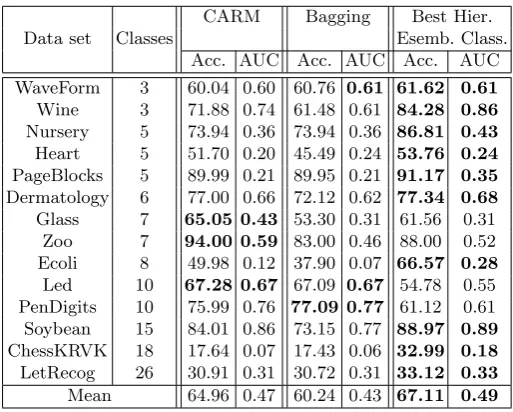
Table 3.Accuracy and AUC Comparison between “stand-alone” CARM, a conven-tional Bagging ensemble, and the best hierarchical ensemble classification strategy from Sub-setion 5.2
Data set Classes
CARM Bagging Best Hier. Esemb. Class. Acc. AUC Acc. AUC Acc. AUC WaveForm 3 60.04 0.60 60.76 0.61 61.62 0.61
Wine 3 71.88 0.74 61.48 0.61 84.28 0.86
Nursery 5 73.94 0.36 73.94 0.36 86.81 0.43
Heart 5 51.70 0.20 45.49 0.24 53.76 0.24
PageBlocks 5 89.99 0.21 89.95 0.21 91.17 0.35
Dermatology 6 77.00 0.66 72.12 0.62 77.34 0.68
Glass 7 65.05 0.43 53.30 0.31 61.56 0.31 Zoo 7 94.00 0.59 83.00 0.46 88.00 0.52 Ecoli 8 49.98 0.12 37.90 0.07 66.57 0.28
Led 10 67.28 0.67 67.09 0.67 54.78 0.55 PenDigits 10 75.99 0.76 77.09 0.77 61.12 0.61 Soybean 15 84.01 0.86 73.15 0.77 88.97 0.89
ChessKRVK 18 17.64 0.07 17.43 0.06 32.99 0.18
LetRecog 26 30.91 0.31 30.72 0.31 33.12 0.33
5.3 Comparison of Hierarchical Ensemble Classification with Conventional approaches
Table 3 presents the results obtained using a “stand alone” CARM and Bagging together with the best results from Tables 1 and 2. The proposed hierarchical ensemble classification was compared with CARM because we wanted to com-pare the operation of the proposed ensemble approach with the operation of the more traditional stand-alone form of classification; CARM was used for this purpose because the classifiers held at the individual nodes in our tree ensem-bles were also generated in this manner (clearly we could also have compared with alternative forms of stand alone classification). We compared with bagging because we also wanted to compare the operation of our hierarchical ensemble classification with an alternative form of ensemble. From Table 3 it can be seen that the proposed hierarchical techniques can significantly improve the classifi-cation accuracy with respect to ten of the fourteen datasets considered (Wave Form, Wine, Nursery, Heart, Page Blocks, Dermatology, Ecoli, Soybean, Chess KRvK, and Letter Recognition). In the remaining four cases, the stand-alone CARM classifier produced the best result for three of the datasets (Glass, Zoo, and Led), while the Bagging ensemble classifier produced the best result for only one dataset (Pen Digits).
6
Conclusion and Future Work
In this paper hierarchical classification using a binary tree structure, for solv-ing multi-class problems, has been considered. To generate such a hierarchical model three different techniques to distribute class labels between nodes within the hierarchy were proposed: (i)k-means, (ii) data splitting, and (iii) hierarchical clustering. CARM classifiers were used at each hierarchical node. By utilising the confidence values generated by CARM classifiers two approaches were proposed: (i) Single-Path, and (ii) Multi-Path. The later one coupled with two alterna-tives to determining the final resulting class label: Best Confidence and Best Normalised Accumulated Confidence. The conjecture here was that a criticism of hierarchical classification ensembles is that a miss-classification made early on in the hierarchy cannot be rectified later on and that this might hinder the effectiveness of the operation of such classifiers.
From the reported experimental results, presented in this paper, it was demon-strated that the proposed hierarchical classification model tends to perform bet-ter than stand-alone classifiers and other forms of ensemble classifier such as bagging, with respect to some datasets considered in the evaluation; especially data sets that featured a large number of class labels.
can not be always obtained. Consequently, in many cases, it was not possible to follow more than one path even if this might have been desirable.
With respect to future work the authors intend to investigate alternative forms of hierarchical ensembles using more sophisticated structures than the binary tree structures considered in this paper, such as Directed Acyclic Graph (DAG). The idea is that by using DAGs many paths can be followed because of the many possible combinations of class labels at each level.
References
1. Agrawal, R., Srikant, R.: Fast algorithms for mining association rules. In: VLDB94. pp. 487–499 (1994)
2. Alshdaifat, E., Coenen, F., Dures, K.: Hierarchical classification for solving multi-class problems: A new approach using naive bayesian multi-classification. In: Motoda, H., Wu, Z., Cao, L., Za¨ıane, O.R., Yao, M., Wang, W. (eds.) ADMA (1). Lecture Notes in Computer Science, vol. 8346, pp. 493–504. Springer (2013)
3. Alshdaifat, E., Coenen, F., Dures, K.: Hierarchical single label classification: An alternative approach. In: Bramer, M., Petridis, M. (eds.) SGAI Conf. pp. 39–52. Springer (2013)
4. Athimethphat, M., Lerteerawong, B.: Binary classification tree for multiclass clas-sification with observation-based clustering. In: Electrical Engineering/Electronics, Computer, Telecommunications and Information Technology (ECTI-CON), 2012 9th International Conference on. pp. 1–4 (2012)
5. Bache, K., Lichman, M.: UCI machine learning repository (2013), http:// archive.ics.uci.edu/ml
6. Bay, S.D.: Combining nearest neighbor classifiers through multiple feature subsets. In: Proc. 17th Intl. Conf. on Machine Learning. pp. 37–45. Morgan Kaufmann (1998)
7. Beygelzimer, A., Langford, J., Ravikumar, P.: Multiclass Classification with Filter Trees (Jun 2007), http://hunch.net/\~{}jl/projects/reductions/mc\_to\_b/ invertedTree.pdf
8. Breiman, L.: Bagging predictors. Machine Learning 24(2), 123–140 (1996) 9. Breiman, L.: Random forests. In: Machine Learning. pp. 5–32 (2001)
10. Chen, Y., Crawford, M.M., Ghosh, J.: Integrating support vector machines in a hierarchical output decomposition framework. In: In 2004 International Geosci. and Remote Sens. Symposium. pp. 949–953 (2004)
11. Coenen, F.: The LUCS-KDD discretised/normalised arm and carm data library (2003),http://www.csc.liv.ac.uk/~frans/KDD/Software/LUCS_KDD_DN
12. Coenen, F., Leng, P.: The effect of threshold values on association rule based classification accuracy. Journal of Data and Knowledge Engineering 60(2), pp345– 360 (2007)
13. Dietterich, T.G.: Ensemble methods in machine learning. In: Proceedings of the First International Workshop on Multiple Classifier Systems. pp. 1–15. MCS ’00, Springer-Verlag, London, UK, UK (2000),http://dl.acm.org/citation.cfm?id= 648054.743935
14. Dietterich, T.G., Bakiri, G.: Solving multiclass learning problems via error-correcting output codes. JAIR (1995)
16. Han, J., Pei, J., Yin, Y.: Mining frequent patterns without candidate generation. SIGMOD Rec. 29(2), 1–12 (May 2000), http://doi.acm.org/10.1145/335191. 335372
17. Jiawei, H., Micheline, K., Jian, P.: Data Mining: Concepts and Techniques. Morgan Kaufmann (2011)
18. Kumar, S., Ghosh, J., Crawford, M.M.: Hierarchical fusion of multiple classifiers for hyperspectral data analysis. Pattern Anal. Appl. 5(2), 210–220 (2002) 19. Lei, H., Govindaraju, V.: Half-against-half multi-class support vector machines. In:
Proc. of the 6th International Workshop on Multiple Classifier Systems, Seaside, CA, USA. Springer (2005)
20. Leonard, T., Hsu, J.S.: Bayesian Methods: An Analysis for Statisticians and Inter-disciplinary Researchers. CAMBRIDGE UNIVERSITY PRESS (2001)
21. Li, W., Han, J., Pei, J.: Cmar: Accurate and efficient classification based on mul-tiple class-association rules. In: Proceedings of the 2001 IEEE International Con-ference on Data Mining. pp. 369–376. ICDM ’01, IEEE Computer Society, Wash-ington, DC, USA (2001),http://dl.acm.org/citation.cfm?id=645496.657866 22. Liu, B., Hsu, W., Ma, Y.: Integrating classification and association rule mining.
In: Proc. KDD-98 conference (AAAI 1998). pp. 80–86 (1998)
23. Machov, K., Bark, F., Bednr, P.: A bagging method using decision trees in the role of base classifiers (2006)
24. Madzarov, G., Gjorgjevikj, D., Chorbev, I.: A multi-class svm classifier utilizing binary decision tree (2008)
25. Oza, N., Tumer, K.: Classifier ensembles: Select real-world applications. Informa-tion Fusion 9(1), 4–20 (Jan 2008),http://dx.doi.org/10.1016/j.inffus.2007. 07.002
26. Quinlan, J.R.: Induction of decision trees. Machine Learning 1(1), 81–106 (1986) 27. Quinlan, J.R.: C4.5: Programs for Machine Learning. Morgan Kaufmann (1993) 28. Rifkin, R.M., Klautau, A.: In defense of one-vs-all classification. Journal of Machine
Learning Research 5, 101–141 (2004)
29. Schapire, R.E.: Using output codes to boost multiclass learning problems. In: Ma-chine Learning: proceedings of the Fourteenth International Conference , 1997 (ICML-97) (1997)
30. Tax, D.M.J., Duin, R.P.W.: Using two-class classifiers for multiclass classification. In: ICPR (2). pp. 124–127 (2002)
31. Vapnik, V.N.: The Nature of Statistical Learning Theory. Statistics for Engineering and Information Science, Springer (2000)
32. Vural, V., Dy, J.G.: A hierarchical method for multi-class support vector machines. In: Proceedings of the twenty-first international conference on Machine learning. pp. 105–. ICML ’04, ACM, New York, NY, USA (2004),http://doi.acm.org/10. 1145/1015330.1015427
33. Yin, X., Han, J.: Cpar: Classification based on predictive association rules (2003) 34. Zhang, G.P.: Neural networks for classification: A survey. IEEE Transactions on Systems, Man, and Cybernetics-Part C: Applications and Reviews 30(4), pp451– 462 (2000)