Developing the market for
electricity system services…
while avoiding paying too much
Keith Bell
Scottish Power Professor of Smart Grids
at the University of Strathclyde
and a co-Director of the UK Energy Research Centre
What are electricity system services
and why do they matter?
• The electricity system is a single, complex, non-linear,
dynamic system
– When it goes wrong, it can go wrong very quickly and
in a very big way
– Much of the system is exposed and affected by the
weather
– Recovery from a major unreliability
event is much harder than from
regular events
• Energy balancing matters
• Energy markets not well suited to many
technical ‘just in case’ requirements
– Many ancillary services defined
North-East US blackout, August 2003Managing system frequency
• Different providers have different capabilities and costs
– One service buys time to access the next
• Almost all present day provision of response and reserve depends on stored energy
– Kinetic energy (inertia)
– Heat (high pressure steam)
– Potential energy (hydraulic head) – Chemical energy
• Most currently depends on fossil fuels
Enhanced Frequency Response Fast Reserve Contingency Balancing Reserve Capacity Market High Frequency response
Primary Frequency Response Secondary Frequency Response STOR
Managing power flows
Respect of network limits • Constrain off
generation in zones with excessive export
(accept bid)
• Constrain on generation in zones with excessive import (accept offer)
• Balance the constraint action
National Grid, Electricity Ten Year Statement 2012
Use constraint actions or build more network? • Location matters
Voltage control and reactive
compensation
Reactive compensation generally installed to
regulate voltage in the absence or credible absence of generation
• Location matters
Lots in London and the South-East Not much in Scotland
in 2012… but some being installed now
National Grid, Electricity Ten Year Statement 2012
Growing need
Black start
Peterhead CCGT 1180 MW
Drax Coal 2000 MW Fiddlers Ferry Coal 2000 MW
Cruachan Pumped Storage 440 MW
Summer 2016: NGET awarded 1-year black start contracts at cost of £113m • National Grid poor at forecasting? • Poor at negotiating?
• Or had no choice?
Large, schedulable, non-nuclear plant north of York
All other large, schedulable plant is south of this line
• Black start capability in the past has often cost around £20 million per year
• Had been forecast by National Grid to cost £34.7 million in 2016/17
http://www2.nationalgrid.com/UK/Industry-information/Electricity-transmission-operational-data/Report-explorer/Services-Reports/
Overall balancing costs – 2016-17
N atio na l G ri d M on thl y B al an ci ng S erv ices rep ort , M arch 20 17
Under which heading does the cost of
The changing nature of
generation
• Fossil fuelled plant
– Fuel a significant cost
• Low carbon generation
– Limited choice of location
– Limited ‘schedulability’
– More variability
– Higher capex, lower opex
– Competitive wholesale
markets hinge on short-run
marginal costs (SRMC)
• How to recover the long-run costs if income based on SRMC is small? → the ‘missing money problem’
• Less money based on energy, more on ‘services’
The need for flexibility
Enough schedulable plant will be needed that can ramp quickly enough
More starting and stopping of schedulable plant?
[image:9.720.67.654.145.440.2]How to ensure that new schedulable plant has the requisite dynamic capability?
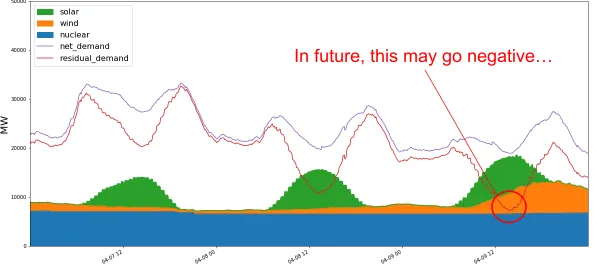
Figure courtesy of Graeme Hawker
Too much low carbon electricity?
[image:10.720.60.667.162.431.2]In future, this may go negative…
Figure courtesy of Graeme Hawker
Too much low carbon electricity?
Generation and weekly minimum demand
FT, April 10, 2018
• System Operator can’t see or control what’s going on in the distribution network
• Nuclear units lack flexibility
What reactive capability does
plant have?
Active power
Reactive power
Egeaet al, “Capability curves of a VSC-HVDC connected to a weak AC grid considering stability and power limits”, 2015
Synchronous generator Voltage source converter
There is inherent reactive power capability • You only need to limit active power if you
need the extremes of reactive capability
Effective utilisation of reactive power capability depends on coordination of voltage targets
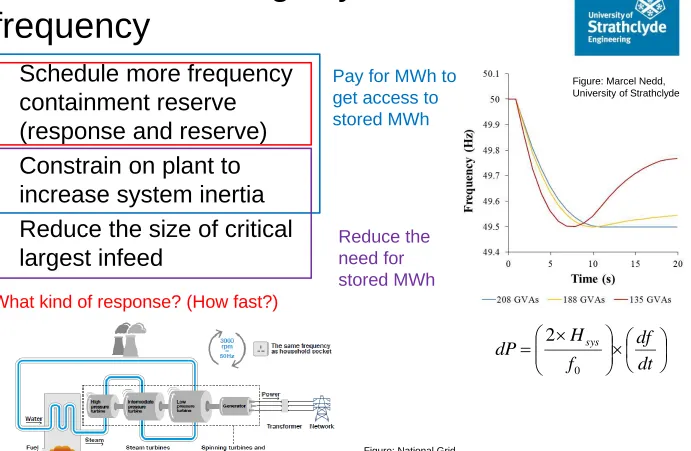
Services to manage system
frequency
• Schedule more frequency
containment reserve
(response and reserve)
• Constrain on plant to
increase system inertia
[image:13.720.29.720.60.511.2]• Reduce the size of critical
largest infeed
dt df f H dP sys 0 2 [image:13.720.490.706.127.443.2]Figure: Marcel Nedd, University of Strathclyde
Figure: National Grid,
System Operability Framework, 2016
Pay for MWh to get access to stored MWh
Industry developments
Avoiding rent and encouraging
investment
• Economic rent (according to Henry George, 1879, as reported by wikipedia): – “the part of the produce that accrues to the owners of land (or other
natural capabilities) by virtue of ownership”
– “the share of wealth given to landowners because they have an exclusive right to the use of those natural capabilities.”
• Why pay generators or owners of VSC for what is inherent?
– Synchronous machines can’t sell energy without providing inertia • Can you have a market in MVArh? The need for MVAr:
– varies by location and by time from generation to absorption – depends heavily on the demand for MW
• There is value in enhanced capability, e.g. in inertia, reactive power, ramping or short circuit power
– It can save on the need for network assets or balancing actions – It is reasonable for any investment in enhanced capability to be
Procuring services
• Different ancillary services currently procured separately
– Value of each revealed
• Only capacity and cost currently valued in the capacity market
– No consideration for location or dynamic capability
• What if a certain non-network service provider loses individual
service contracts but is cost-effective as a
package
?
– Align tender rounds for different services and decisions on
contracts?
– Should help generators, flexible demand and storage gain
confidence in accessing multiple income streams
• Take care that providers (a) are actually available when required and (b) do not get paid twice for the same action
Who pays? Who gets paid?
• Services from distributed resources increasingly important – Who buys and invokes the services?
– Potential for conflict between transmission and distribution needs
• Investment in new generation capacity
– How is investment in enhanced dynamic capability justified now if the capability isn’t needed for some years?
• Set statutory capability requirements?
• Leave it to a market that doesn’t exist yet?
Present day Future ‘maximal DSO’ model?
Actuation of and payment for balancing services