Studying Reflecting On Becoming: Some Philosophical Reference Points
(Developmental paper)
Abstract
We developed a systemic process framework for reflecting on becoming that we currently employ to study graduate students’ reflecting on becoming. We describe the process of reflecting on becoming as a systemic process of continuous self-making and discuss some philosophical reference points by building on process philosophy. We conclude that, in order to achieve understanding in a study following process philosophy, researchers need to liberate themselves from the predominantly normative and positivist approaches and embrace the notion of research indirection so as to immerse themselves in the phenomena unfolding around them, attending to their sensual as well as mental experiences.
Background
In the real world of business, poor choices could be costly from losing clients to ruining a reputation. For this reason, reflection on what worked well and what didn’t (and why) is crucial to practitioners. However, quick decisions often replace more time-consuming reflection even though it is reflection which is truly needed to gain genuine understanding and adopt more sophisticated self-monitoring behaviours to respond to uncertain and complex circumstances (Densten & Gray, 2001) in a short, often immediate, time frame. Yet, the workplace tends to offer little space or time for reflection (Gray, 2007; Yanow & Tsoukas, 2009) which exacerbates the dichotomy of need for reflection versus time to do so. The same holds true for management education, in general, and hospitality management education, in particular. Whilst in hospitality management schools, the trend goes towards projects with real world application (e.g. student business projects and internships), reflection on what it all means on a larger scale has not yet been adequately explored.
In an earlier piece (insert self-reference), we developed a systemic process framework for
reflecting on becoming. By means of this framework, students can reflect on who they are
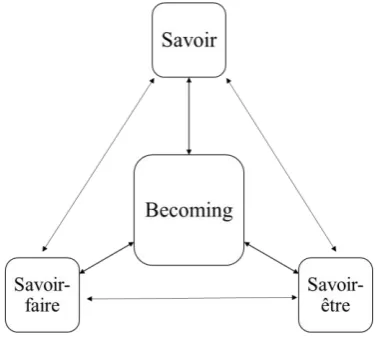
becoming and how this will affect their interpretation of past experiences (i.e. reflection-on-action), their actions in the present (i.e. reflection-in-reflection-on-action), and their future
activities/engagements (i.e. reflection-(be)for(e)-action), suggesting that the combination of theoretical knowledge (savoir), knowing how to do tasks (savoir-faire), and knowing how to
be (savoir-être) is the ideal combination for students to reflect on their becoming (Stierand &
Figure 1: Systemic Process Framework for Reflecting on Becoming
We focus on students enrolled in a full-time Executive MBA in Hospitality Administration, who are either hospitality professionals or career switchers. In order to conserve a written record of their critical reflections in becoming, we have decided to collect three different types of qualitative data through the use of three different types of methods: (1) in-depth interviews that can help us to understand becoming from the student’s perspective and may reveal insights into the how and why of the student’s perspective (see King, 2006); (2) reflective diaries that may provide us access to the students’ ongoing everyday behaviours in becoming (see Symon, 2006); and (3) a set of visual methods (e.g. drawing, creating collages, mind-mapping, and displayed image associations) that can help us, in co-creation with the students, to elicit their emotional responses about the process of becoming (see Buchanan & Bryman, 2009; Margolis & Pauwels, 2011; Robson, 2016; Vince & Warren, 2012).
To this end, we have conducted eleven in-depth interviews of approximately one hour in length each that, so far, have provided thick descriptions of the students’ interpretation of their changing savoir, savoir-faire, and savoir-être over time. In order to better understand such processes of becoming and their unfolding over time, we adopt process philosophy. Based on the belief that processes are actually primary to not only people’s becoming, but life at large, entities are seen as transient, ephemeral, and emergent, always changing over time. Entities and structures, regarded as the effects of processes, can sometimes appear stable, but in the sense of a ‘standing wave’ (see Rescher, 2000, p. 13), rather than a solid rock. Thus, according to process philosophy, “reality is deemed to be continuously in flux” (Chia, 1995, p. 579), an ontology which poses methodological problems, especially for PhD students who are often asked to defend their methodological choices against well-documented and ‘more traditional’ studies. The aim of this paper is to provide a first attempt towards a philosophical reference point for researchers interested in conducting empirical process research in
management and organization studies.
Process vs Substance Philosophy
postmodernism, but not in terms of “a cynical or nihilistic tendency in contemporary thought but as a subtle and complex attempt at reworking the metaphysical bases of modern
knowledge” (Chia, 2003, p. 114). Although this characteristic is not necessarily supported by all so-called postmodernists (Chia & Morgan, 1996), its anti-positivist nature makes it relevant for consideration by other philosophical stances which oppose positivism, such as variants of critical realist and interpretivist approaches.
Like so often in philosophy, the view under consideration is best understood by working out what it opposes. The difference between process and substance philosophy is primarily on the ontological level. Substance philosophy relies on a strong ‘ontology of being’ and is
characterised by the “uncritical use of common organizational terms such as ‘organizations’, ‘individuals’, ‘environment’, ‘structure’, and ‘culture’, etc.” (Chia, 1995, p. 579). These terms signify belief in the existence of entities (social or otherwise) that ‘are’, characterised by “discrete phenomenal ‘states’, static ‘attributes’, and sequential ‘events’” (ibid).
Consequently, management and organizational scholarship rooted in the substance view will focus on analysing structures, cultures, gender, ethics, etc.
In contrast, according to process philosophy, reality comprises “emergent relational
interactions and patternings that are recursively intimated in the fluxing and transforming of our life-worlds” (Chia, 1995, pp. 581-582). Therefore, process researchers attempt to analyse “the myriad of heterogeneous yet interlocking organizing micro-practices which collectively generate effects such as individuals, organizations and society” (Chia, 1995, p. 582). Process philosophy relies on a strong ‘ontology of becoming’ that is based on the belief that processes are primary, and, consequently, entities are transient, ephemeral, and emergent, and always changing over time.
Instead of choosing between substance and the process philosophy in the sense of one being right and the other wrong, it is possible to regard them as complementary viewpoints which can only be articulated with reference to one another (see logic of identity vs. logic of supplementarity in Derrida, 1967/1997). Prigogine (2004), for example, argues for a science that includes both being and becoming in its formulation of the laws of nature and even goes beyond these, suggesting that “we cannot have becoming without being, just as we cannot have light without darkness or music without silence” (ibid., p. 10). This ‘going beyond’ can be achieved by embracing chaos as a fundamental concept of reality. Chaos brings instability to the being aspect; instead of infinitely valid permanent laws of nature, we need to think in terms of probabilistic laws and have to learn how to cope with a spectrum of possibilities which suggests limited (numerous, but not infinite) possible alternatives of becoming that depend on our image of the future. Researchers must therefore be permitted to liberate themselves from the predominantly normative and positivist approaches of studying management and organizations (see Symon & Cassell, 2006), and to focus instead on managing and organizing, aiming to unearth the emerging nature of these practices that becomes amidst structure and chaos (see Clegg, Kornberger, & Rhodes, 2005).
Taoism of Ancient China (dating back at least to the fourth century BC). The Tao itself is a process, a ‘path’ to the way of becoming. The Tao is also holistic and active, which is in sharp contrast with the atomistic and largely passive view of dominant Western thought. Thus, process philosophy is primarily associated with Eastern thinking, but also exists in the Western tradition. In Ancient Greece, for example, Heraclitus of Ephesus (c. 535-475 BC), the Weeping Philosopher, proclaimed that, besides the unity of opposites, paradoxes, and the stress on the needless unconsciousness of humankind, change is actually the essence of the universe. He called this the Panta Rhei (everything flows) principle, expressing that no man ever steps in the same river twice. Heraclitus contemplated fire to be the primordial element from which everything else originated. For him, fire acquires a permanent quality. This permanence, however, is that of perpetual change, of process rather than substance (Russell, 1945, p. 46). In fact, for Heraclitus, fire was the metaphoric representation of perpetual change, not only as it is made of flames that are individually ephemeral, but because it also changes one substance to another one. It is obvious, therefore, from Heraclitus’ writings that he viewed process as more fundamental than substance. Thus, Plato (quoted by Russell, 1945, p. 45) explicitly ascribed a becoming ontology to Heraclitus, saying that Heraclitus believed that “nothing ever is, everything is becoming”.
Reflecting on Becoming: A Systemic Process of Continuous Self-Making
In the background section of our paper, we explain that in an earlier piece we developed a
systemic process framework for reflecting on becoming (insert self-reference), in which
students can reflect on a set of interrelated elements (savoir, savoir-faire, and savoir-être) that, we believe, are the cornerstones, for setting the process of becoming into motion. We label our framework systemic (see von Bertalanffy, 1969), because becoming depends on the emergent and continuous interrelations between the individual, others (e.g. real-life guests, mentors etc.), and the context. Thus, becoming is essentially a systemic process of continuous self-making (autopoiesis) (Maturana & Varela, 1979), describing the very foundations of the process view within the systems view. Whitehead’s (1929) early work served as the
philosophical basis of the systems view and the process view. Whitehead did not put
processes ahead of structures; rather, he acknowledged the importance of the entangled web of interrelationships of the various structures and thus contradicted the Kantian ‘Ding an sich’ (the thing in itself) principle, replacing it with ‘the thing in relation to all other things’. Yet, what is really fundamental to Whitehead’s work is his argument that the processes which make the fabric of reality form an entangled web of interrelationships, and, therefore, it is not sufficient to simply examine an individual process, but one must understand it in relation to all other processes. Thus, from a process philosophy, reality is un-representable (Chia, 1995, p. 579), yet we cannot escape our attempts to represent it. . As soon as we talk or write about something, we are creating representations, but representationalism goes hand in hand with substance philosophy and its idea of objectivity.
However, the idea of being able to research phenomena with a high degree of objectivity and low level of subjectivity, achieving if not a fully objective but at least an impartial
complex nature of the relationship between signs and referents, between the linguistic products we call ‘management knowledge’ and the acts of languaging which produce such ‘outputs’” (Chia & Morgan, 1996, p. 54). Secondly, although some degree of
depersonalisation can be achieved, it is not necessarily something we should aspire to. As Russell (1948, pp. 18-19) explains:
“It is true that education tries to depersonalise language, and with a certain measure of success… as your instruction proceeds, the world of words becomes more and more separated from the world of the senses; you acquire the art of using words correctly, as you might acquire the art of playing the fiddle; in the end you become such a virtuoso in the manipulation of phrases that you need hardly ever remember that words have meanings. You have then become
completely a public character, and even your inmost thoughts are suitable for the encyclopaedia. But you can no longer hope to be a poet, and if you try to be a lover you will find your depersonalised language not very successful in generating the desired emotions. You have sacrificed expression to communication, and what you can communicate turns out to be abstract and dry.”
Hence, the assumption of process philosophy that reality is un-representable implies the need for a radically different epistemological stance, which we will now partially discuss in the final section of the paper.
Discussion and Conclusion
soaking it up until we are saturated with its presence and enduring personal insights are attained.”
In conclusion, researchers interested in conducting process research have to learn to accept that such research cannot be entirely deliberate and planned. This makes process research particularly difficult for adoption in doctoral studies, where many supervisors are still looking for a well-structured plan, the steps of which are then rigorously followed throughout the research process. The more unusual the research project, the more likely it is that examiners and supervisors call on the ‘established’ set of expectations. This is not only inappropriate for research conducted within the realm of process philosophy, but, in fact, any research project! However, it is perhaps easier to argue for an emergent research process with a process mind-set, making it easier to accept that there is no plan set in stone; rather, at every point, one needs to decide about the next step. This would not only mean altering the direction of the research, but also that there is no direction of the research at such decision points; the direction emerges naturally as the researcher makes her/his choice.
Conducting research in such a fashion is, of course, in sharp contrast with “our academic temperament, our motivations and the overly deliberate nature of our method of inquiry” (Chia, Holt, & Yuan, 2013, p. 53) and suggests that the notion of phronēsis, that was understood within the realm of process philosophy, also needs to apply to the research conducted within this realm. On par with the concept of strategic indirection (Chia et al., 2013), we, therefore, need to call for research indirection. Therefore, process researchers need to learn how to engage in ‘ground-clearing’ or ‘de-signing’ by combining active
interrogation with contemplative listening (Chia & Morgan, 1996). Moreover, accepting the above outlined epistemological stance is incompatible with a hasty data collection and rushed analysis, so common in academia due to the pressure to publish at an ever-increasing rate. Admittedly, the research process will be longer, but the data collection and subsequent analysis will be richer. In order to achieve understanding in a study following process philosophy, researchers need to “estrange themselves from their symbolic universe of discourse” (Chia & Morgan, 1996, p. 55) to reach an intellectual quietness that enables them to immerse themselves in the phenomena unfolding around them and turn their attention to their sensual as well as mental experiences.
References
Buchanan, D., & Bryman, A. (2009). The Sage handbook of organizational research methods: Sage Publications Ltd.
Chia, R. (2003). Organization Theory as a Postmodern Science,. In H. Tsoukas & C. Knudsen (Eds.), The Oxford Handbook of Organization Theory: Meta-Theoretical Perspectives (pp. 113-140). Oxford: Oxford University Press.
Chia, R. C. H. (1995). From Modern to Postmodern Organizational Analysis. Organization
Studies, 16(4), 579-604. doi: 10.1177/017084069501600406
Chia, R. C. H., Holt, R., & Yuan, L. (2013). In Praise of Strategic Indirection: Towards a Non-instrumental Understanding of Phronèsis as Practical Wisdom. In M. J.
Chia, R. C. H., & Morgan, S. (1996). Educating the Philosopher-Manager: De-Signing the Times. Management Learning, 27(1), 37-64. doi: 10.1177/1350507696271004 Clegg, S., Kornberger, M., & Rhodes, C. (2005). Learning/becoming/organizing.
Organization, 12(2), 147-167.
Cunliffe, A. (2002). Reflexive Dialogical Practice in Management Learning. Management
Learning, 33(1), 35-61.
Densten, I. L., & Gray, J. H. (2001). Leadership development and reflection: what is the connection? International Journal of Educational Management, 15(3), 119-124. Derrida, J. (1967/1997). Of Grammatology, . Baltimore, MD: John Hopkins University Press. Gray, D. E. (2007). Facilitating management learning: Developing critical reflection through
reflective tools. Management Learning, 38(5), 495-517.
King, N. (2006). Using Interviews in Qualitative Research. In C. Cassell & G. Symon (Eds.),
Essential Guide to Qualitative Methods in Organizational Research (pp. 11-22).
London: Sage.
Margolis, E., & Pauwels, L. (Eds.). (2011). The Sage handbook of visual research methods. London: Sage.
Maturana, H. R., & Varela, F. J. (1979). Autopoiesis and Cognition: The Realization of the
Living. Dordrecht, Netherlands: Kluwer Academic Publishers.
Prigogine, I. (2004). Beyond being and becoming. New Perspectives Quarterly, 21(4), 5-12. Rescher, N. (2000). Process philosophy: A survey of basic issues: University of Pittsburgh
Press.
Robson, I. (2016). Management Learning as Collaborative Visual Encounter: Learning Lessons From Research and Practice. Management Teaching Review, 1(4), 278-286. Russell, B. A. (1945). History of Western Philosophy and Its Connection with Political and
Social Circumstances from the Earliest Times to the Present Day New York, NY:
Simon and Schuster.
Russell, B. A. (1948). Human Knowledge: Its Scope and Limits. London, UK: Routledge. Stierand, M., & Zizka, L. (2015). Reflecting on hospitality management education through a
practice lens. Quality Assurance in Education, 23(4), 353-363.
Symon, G. (2006). Qualitative Research Diaries. In C. Cassell & S. Sydnor (Eds.), Essential
Guide to Qualitative Methods in Organizational Research (pp. 98-113). London:
Sage.
Symon, G., & Cassell, C. (2006). Neglected perspectives in work and organizational
psychology. Journal of occupational and organizational psychology, 79(3), 307-314. doi: 10.1348/096317906X109676
Tsoukas, H., & Chia, R. C. H. (2011). Introduction: Why Philosophy Matters to Organization Theory. In H. Tsoukas & R. C. H. Chia (Eds.), Philosophy and Organization Theory (pp. 1-21). Bingley, UK: Emerald.
Velencei, J., Baracskai, Z., Dörfler, V., & Stierand, M. (2016). Supporting the Competent Practitioner: Trans-disciplinary Coaching with a Knowledge-Based Expert System.
International Journal of Management Science and Business Administration, 2(12),
20-27.
Vince, R., & Warren, S. (2012). Participatory Visual Methods. In Sage (Ed.), Qualitative
organizational research: Core methods and current challenges (pp. 275-295).
London.
von Bertalanffy, L. (1969). General System Theory: Foundations, Development, Applications (14th paperback ed.). New York, NY: George Braziller.
Whitehead, A. N. (1929). Process and Reality (paperback ed.). New York, NY: The Free Press.