JOURNAL OFVIROLOGY,
JUlY
1989. p. 2967-2976 Vol. 63. No.7 0022-538X/89/072967-10$02.00/0Copyright © 1989. American SocietyforMicrobiology
Identification
of a
Novel Constitutive Enhancer Element and an
Associated Binding Protein:
Implications for Human
Papillomavirus
Type
11
Enhancer
Regulation
MICHAEL T. CHIN, THOMAS R. BROKER, AND LOUISET. CHOW*
Deptim-t/nenit
ofBiocheinistry,
University ofRochesterScizoolof Medicinie
atnd Dentistry, Rochlester, Newt York 14642 Received 21 November 1988/Accepted 27 March 1989Thehumanpapillomavirus type 11 enhancer, when linked to the minimal simian virus 40 early promoter, hasbeendissectedinto two domains in monkey kidney CV-1 cells, one being constitutive (designated CEI) and the otherinducible by trans-actingE2proteinsencoded byhomologousandheterologouspapillomaviruses(H.
Hirochika, T. R. Broker, and L. T. Chow,J.Virol. 61:2599-2606, 1987; H. Hirochika, R. Hirochika, T. R. Broker, and L. T. Chow, Genes Dev. 2:54-67, 1988). We have demonstrated that the natural promoter
regulatedby this enhancer is located immediately upstream of the E6 open reading frame (the E6 promoter). We have mapped the cap site to nucleotide 99 by RNase protection. We further demonstrate a second constitutive enhancer element,CEII, which isrequiredfortranscription from the E6 promoter in the human
cervicalcarcinoma cell linesC-33Aand HeLa but not in CV-1 cells. By deletion mapping, we have localized this celltype-specificdomain to 71 basepairsby usingchloramphenicolacetyltransferaseassays. Deletion of either CEI or CEII dramatically decreased the constitutiveactivity of the enhancer and the E6 promoter, whereas
multimerization of either domain in the absence of the other could independently restore expression.
Furthermore, when eitherofthese elements wasdeleted, the full-length E2 protein of human papillomavirus
type 11 abolished the remaining basal E6 promoter activity, demonstrating for the first time that the
enhancer-activatingE2proteinof humanpapillomavirusescan alsofunction as a transcriptional repressor for the homologous E6 viralpromoter. The presence of multiplecopies ofeach element in tandem overcomes the
repressionby the E2protein.Theeffects of CEIIare at the levelof transcription,withoutchangingthecap site.
By gel shift assay, we have shown that a protein present in nuclear extracts of C-33A and HeLa cervical carcinoma cells binds to the newlyidentified constitutiveelement II. Thisprotein did not bind the simian virus
40enhancer, nor did it bind to the enhancerregion of many otherpapillomavirusestested. UV cross-linking experiments revealed major44-kilodalton and minor34-kilodalton proteins that boundspecifically to CEII.
These twoproteinsareeither related or bind to CEII with highcooperativity. Weconclude thattranscriptional
activities directed by the enhancer and E6 promoter reflect an intricate balance among viral and cellular factors. We present a model on the regulationof the E6 promoter by host and viraltranscription factors.
The papillomaviruses are a family of small,
double-stranded DNA viruses that cause epithelial hyperplastic diseases, both benign and malignant (for a review, see
reference 7). Their circulargenomes of 7.9 kilobasesare all
similarlyorganized into early and late open reading frames
(ORFs) encoded by the same DNA strand. Immediately
upstreamof the early ORFs isaregionseveral hundred base
pairs inlength called the upstream regulatory region (URR)
or the long control region. The URR contains a
transcrip-tional enhancer which is tranis activated by a protein
en-codedbythefull-length viralE2ORF (21,22,27, 41, 55, 59).
Oneofthepromotersmodulated by this enhancer islocated adjacenttotheenhancerjust upstreamofthe E6ORF and is referred to as the E6 promoter (9, 15, 25, 54, 58). The
URR-E6 promoteris important in regulatingthe expression of a number of viral genes, including the transformation
genes (the E6 and E5 ORFs) of the bovine papillomavirus
type 1 (BPV-1) (46, 61) and those ofhuman papillomavirus
type 16 (HPV-16) and HPV-18 (E6 andE7 ORFs) (3, 4, 30, 42, 56). In addition, the E6 promoter appears to direct the
synthesis ofa spliced transcript (12) whichexpresses
func-tionalE2protein, asdemonstrated bycDNArecovered viaa
retroviral vector (M. 0. Rotenberg, M. Schweitz, T. R.
*Correspondingauthor.
Broker, and L. T. Chow, submitted for publication),
sug-gestingthat the E2ORF might regulate its own expression.
The E2 gene product binds directly to the motif
ACCN6GGT(2,28, 36, 38). Deletion of this motif precludes
tr-ans
activation(24, 28, 54). Thismotif alone, butnot mutantversions of it, confers E2inducibility onthe simian virus40
(SV40) early promoter (26, 28).A proteinderived from the 3' end ofthe E2ORF, called E2-tr, sE2, or E2-C by different investigators, acts as a repressor of E2-dependent
tr-an1s
activation (9, 15, 33) by competitive binding to the
E2-responsive sequence (E2-RS) (9, 36).
Since viral transcriptional regulation occurs in vivo in a species-, tissue-, and differentiation-specific fashion (11), cellular factors are assumed also to play important roles. This isindeed thecase asdemonstrated inHPV-11, HPV-16,
and HPV-18 in that theenhancers also contain constitutive domains functional in the absence of E2 stimulation (9, 15, 22, 23, 28, 57, 58). Proteins derived from the E2ORFhave
been shown torepress such E2-independent activity. HPV-11 E2-C protein, for example, can act as a repressor of E2-independent activity, but only when the HPV-11 en-hancerislinkedto itsnatural promoter(9). In
chloramphen-icol acetyltransferase (CAT) assays, the
full-length
BPV-1E2 protein has a similar suppression effect on both the
HPV-18andHPV-11 enhancerslinkedtotheir
respective
E6promotersinthenaturalcontext, butnot totheheterologous 2967
on November 10, 2019 by guest
http://jvi.asm.org/
SV40 promoter (9, 59). Since binding sites for E2 or E2-C in HPV-18 and HPV-11 are adjacent to the E6 promoter TATA motif but are distant from the SV40 promoter in the CAT plasmids, these data suggest that the mechanism involves steric hindrance of the binding of a TATA recognition factor. One caveat to these studies, however, is that homologous E2 expression clones did not repress their natural enhancer-E6 promoter targets. On the contrary, the HPV-11 E2 protein has a slight but positive effect on the HPV-11 URR E6 promoter. This discrepancy could be due either to quantita-tive differences in E2 expression levels or to qualitaquantita-tive differences in the way that HPV and BPV E2 proteins interact with cellular factors to assemble transcriptional complexes (9) and is the subject of this investigation.
Clearly, the papillomavirus enhancers are analogous to those of SV40 and polyomavirus in that they consist of multiple functional domains (47). Some of the HPV enhancer domains appear to be cell type specific (15, 22, 23, 57), while others appear to be generally constitutive (28) or inducible by factors other than E2 (22, 23). The finestructure of many of these domains remains to be elucidated, and the identities of the cellular factors have yet to bedetermined. We present here further dissection of the HPV-11 enhancer anddescribe the identification of a novel, cell type-specific constitutive domain and an associated cellular DNA-binding protein. Our results suggestintricate interactions among cellular and viral transcription factors in association with their respective recognition sequences in the regulation of the viral pro-moter.
MATERIALS AND METHODS
Tissue culture, nuclear extracts, transfections, and CAT assays. C-33A cells were cultured and transfected as de-scribed elsewhere (9). Nuclear extracts were made by the method of Dignam et al. (17). Protein concentration was determined by the method of Bradford (6). CATassays were performed several times, each in duplicate, and were quan-titated by liquid scintillation counting after thin-layer chro-matography, as described previously (28). All assays were performed within the linear range.
Construction ofrecombinant clones. The CAT expression clones containing 5' deletion mutations of the HPV-11 URR E6 promoter were generated by isolating the SphI-OxaNI fragmentscontaining HPV-11 sequences from existing dele-tion clones (28) and cloning them in place of theSphI-OxaNI
fragment ofpUR23-3 (9). pUR23-0 (nucleotides
[nt]
7902 to99) was generated bydigesting pUR23-3 (nt 7072 to 99) with
BamHI and BstEII, treating the DNA with the Klenow
fragment of DNA polymerase I, and ligating at low DNA concentration. pUR23-N(5')1, N(5')5, and
pUR23-GT4R were generated by inserting the PstI-to-XbaI
frag-ments of pCAT-N(5')1, pCAT-N(5')5, and pCAT-GT4R, respectively, (28)between the PstI andXbaI sites of
pUR23-0. pUR23-38(1) and pUR23-38(6) were prepared by cloning
one and six copies, respectively, of the 38-base-pair (bp) synthetic oligonucleotide (5' TGCCAACAACACACCTGG
CGCCAGGGCGCGGTATTGCA 3') into the
Klenow-treated
Sall
site ofpUR23-0. The clone containing a single-base deletion, pUR23-38M, was discovered during sequenc-ing of several pUR23-38 isolates. Complementary synthetic oligonucleotides 5' TCGACTGCCAAGC 3' and 5' TCGAC GAAGCCAAAGC 3', homologous to distal element II(DEII)and the cytokeratin gene octamer,respectively, were
cloned as one and two copies in pCAT-A, the enhancer assay CAT expression plasmid (27). CAT plasmids
contain-ing the URRs of HPV-la, -6b, -7, -16, and -18 and BPV-1 have been described previously (27).
RNase protection. The RNase protection assay was per-formed as described elsewhere (37), with several modifica-tions. Briefly, an 864-nt antisense riboprobe containing HPV-11 URR sequences from nt 7450 to 99 and CAT sequencesfrom nt 1 to 251 was synthesized in the presence
of [32P]UTP with T7 polymerase from pBS3-1, a pBS+
plasmid (Stratagene) containing the 833-bp PstI-to-EcoRI fragment of deletion clone 3-1 (Fig. 1). The 32P-labeled riboprobe was thenhybridized with 50 jig of total RNA from transfectedcells in 80% formamide-40 mM piperazine-N,N'-bis(2-ethanesulfonic acid) (PIPES, pH 6.4)-400 mMNaCl-1 mM EDTA overnight at 55°C. The reaction mixtures were
diluted 13-fold and digested with 40 ,ug of RNase A per ml-2.2 jLg of RNase T1 per ml for 60 min at room tempera-ture in 0.3 M NaCl-10 mM Tris hydrochloride (pH 7.5)-5 mM EDTA. Samples were then phenol extracted twice, ethanol precipitated twice, and suspended in 5 jLl of 80% formamide-0.1% xylene cyanol-0.1% bromphenol blue. The samples were then heated to 68°C for 3 min and loaded onto 6% polyacrylamide sequencing gels.
Gel mobility shift DNA-binding assays. The restriction fragment containing a single copy ofconstitutive enhancer
element CEII from 23-N(5')1 was excised with appropriate flankingrestriction enzymes and was 3' end labeled with the Klenow fragment of Escherichia coli DNA polymerase I in the presence of
[a-32P]dCTP.
Alternatively, the 71-bp CEII was excised from 23-N(5')1 with BamHI and HindlIl and cloned into themultiple-cloning site of thevectorpBS+ and labeled by annealing the M13-sequencing primer (New En-gland BioLabs, Inc.) at 50°C and extending it with the Klenow fragment in the presence of 50 jiM each dATP,dGTP, and dTTP and 40 jiCi of [ot-32P]dCTP. The labeled
CEII was then excised with appropriate enzymes and
puri-fied. The low-ionic-strength gel shift assaywasperformed by
using a modification of published procedures of Fried and
Crothers (18) and Garner and Revzin (19). Specifically, 5 to 10jig of nuclear protein was preincubated in 25
[l
ofbinding buffer [25 mM HEPES (N-2-hydroxyethylpiperazine-N'-2-ethanesulfonic acid) (K+) (pH 7.8), 10 mMMgCI2,
225 mM KCl, 1 mMdithiothreitol, 1 mMEDTA, 50jig
ofpoly(dI-dC) perml] for 45 min at0°C. Labeled DNA (10,000 cpm,4fmol [250pg])
and unlabeled competitor DNA were then added simultaneously, and the reaction wasincubated for another 45 min at 0°C. The samples were then loaded onto 4% polyacrylamide gels equilibrated with 0.25x TBE (lx is 0.089 MTris-borate, 0.089 Mboric acid, 0.002MEDTA) and electrophoresed for 2 h at 300 V and 40C. Gels were then dried and autoradiographed. Experiments using labeled DNA containing the 38-bp segment in clone 23-38 wereperformed similarly.
UV-induced cross-linking. The restriction fragment
con-tainingCEII (nt 7677 to 7747) waslabeled in one strand with
[32P]dCTP along
its entire sequence bythe primer annealing method as described above, except that 5-bromodeoxyuri-dinewas substituted for dTTP. Binding reactions were also performed identically. Samples were then exposed to amedium-wave UV (301 nm) transilluminator (Ultra-violet Products) for 40min on ice at a distance of 3 cm. DNase1(15 U) was then added, and the samples were incubated for 30
min at 370C. Samples were then mixed with 30 jil of 2x
sodium dodecyl sulfate-polyacrylamide gel electrophoresis sample buffer and boiled for5 min, andelectrophoresis was
performed on 10% polyacrylamide-sodium dodecyl sulfate gels. Gels were then dried and autoradiographed.
on November 10, 2019 by guest
http://jvi.asm.org/
HPV-11 ENHANCER AND CELLULAR TRANSCRIPTION FACTOR 2969 RELATIVE
CAT ACTIVITY
-E2 +E2
144.1
160.7
133.0
129.4
31.7
31.8
30.3
23.8
23-N(5')1 30.7
23-N(5')5 106.9
21.8
24.9
150.2
151.1
150.5
142.1
2.2
1.7
0.9
1.0
2.9
45.5
1.1
12.7
STRUCTURE
7072 -
c9E
CE[R
EETATT
99.CE IICEfrE
ETETTATA_
IcEcEiiE_IE2IE TATAt CEll1 ECIIF
IE~ALTAL
779-
E7730I
El
I
ETTA779 [IQ E
99
_AA
FA
f
A-
E
7677
M
7747EAE
TATA7677(CEl
)7747
EAEATATA5x lll
7700 --i7737
IEME2
TATAI...
1(X)
7700|EEATATAI
993x...
IE4E4
TATAI7831(W)7769
IETA7TAI
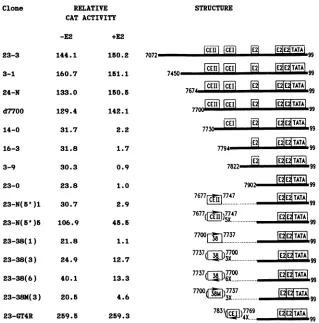
FIG. 1. RelativeCAT activity of deletionmutants of theHPV-11 URR E6 promoterlinkedtoapromoterless CATgene.Relative CAT
activitywasdefinedasthe ratio ofthepercentacetylatedchloramphenicoltothatobtained withextractsmadefrom cells cotransfected with
pUR23-0 and pRSE2-11 under thesameconditions. All numbersrepresenttheaverageoftwoor more independent experiments, each with
duplicate samples. The structure of each cloneis diagrammed at the right. The nucleotide positions shown differ from those previously
published (16) bytwoafter position7718becauseanadditionalGC dinucleotidewasfound in the DNA (S. C. Dollard, T.R.Broker, andL. T.
Chow, unpublished results).
RESULTS
Analysis ofenhancer domains in conjunction with the E6 promoter in human cervical carcinoma cells. By transient expression of the CAT gene from the minimal SV40 early
promoterin monkey CV-1 cells, we have previously
identi-fied twodomains of the HPV-11 enhancer in the URR, one
being E2 inducible and the otherconstitutive (28). We have
also demonstrated that, in the absence ofE2 proteins, the
HPV-11 URR E6 promoter is relatively inactive in CV-1 cells but is highly active in human cervical carcinoma cell lines C-33A and HeLa (9). To identifythe DNA sequences
necessaryfor constitutive activation ofthe E6 promoterin
these cell lines, we constructed a series of 5' deletion
mutantsof theHPV-11 URRE6promoterand assayedtheir abilitytoexpressthe CATreportergenein C-33A cells (Fig.
1). When the sequences were deleted to nt 7700 (clone d7700),noeffectwasobserved, butuponfurtherdeletionto
andbeyondnt7730(clone14-0),asharp dropinconstitutive
activity was observed. Onecopy of the mostactive consti-tutive domain identified in CV-1 cells (nt 7769 to 7831), whichwe now renameconstitutiveelement I(CEI),wasstill
present indeletion clone 14-0, demonstrating thatone copy
of CEI alone is not sufficient to confer full activity. These results suggested that a second constitutive domain existed
intheregionbetween nt7700 and 7769.Totest whether this
segment of the genome could alone confer activity, we
cloned a 71-bp sequence from nt 7677 to 7747 either as a monomer [clone 23-N(5')1l or as a pentamer [clone 23-N(5')5] intopUR23-0 (nt7902to99), aminimal E6promoter
clone that does not contain CEI. Clone 23-N(5')1 did not demonstrate enhanced expression. In contrast, clone
23-N(5')5, containing five copies of thissegment, ledtoapartial
restoration of constitutive activity. Identical results were
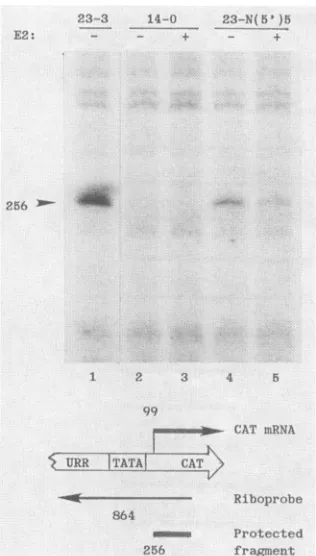
obtained in HeLa cells(data not shown). RNase protection analysisand primerextension demonstrated that this effect
occursat the level oftranscription, with initiation at nt 99
(Fig. 2,lanes1, 2,and4;datanotshown).Because therewas nobandof lowermolecular weight thatwasuniqueinanyof
thelanes, weinterpretthe resulttoindicate the absence ofa
cryptic promoter in CEII in clone 23-N(5')5. The message
levelforclone 14-0wasbelow the level of detection (lanes2 and 3). These results indicate that the 71-bp genomic
seg-ment contains a transcriptional regulatory element, which
wecall constitutive elementIIorCEII.CEI,whenplacedas
aninvertedtetramerin thevectorpUR23-0 (clone 23-GT4R),
also functionsasanenhancerelement,inagreementwithour
previous result obtained in CV-1 cells (28) (Fig. 1). We conclude, therefore, that the HPV-11 enhancer consists of three distinct, independent functional domains, two being
constitutive and the thirdE2 responsive.
Clone
23-3
3-1
24-N
d7700
14-0
16-3
3-9
23-0
23-38(1)
23-38(3)
23-38(6) 40.1 13.3
23-38M(3)
23-GT4R
20.5
259.5
4.6
259.3
VOL.63, 1989
7700(3)7737
3X-...I
on November 10, 2019 by guest
http://jvi.asm.org/
[image:3.612.140.459.80.403.2]2970 CHIN ET AL.
2I--3 14-U 23-N(S' (5
+. ... .
1:2: - - + _ 4.
24-N 23-38 2n3-38(M) 14--0
7674-99 7700-7737 7700-7737M 7730-99
0 50 200 (1 10 5( 20t 0 10 5(1 200 0 5 20(0)
b. ILJ 11 S
_ 8 X _L. - .
w m § NF - [i#i X
si #
i.W...i
W...W
l;-rW;
*;:. :Sg .:: ::
FVT;w
A i! t- t) iX F..
(; ii l eT^*zw
i; 1, >1 N1 2 4
99
E_ _ (CAr mryRNA
FURR
I.._.._ITATAI.... . _-....---.vCATRiboprobet
864
2h6 f'ragmenIIt
FIG. 2. RNase protection. An 864-nt 32P-labeled riboprobewas
synthesized asdescribed in Materials and Methods. RNase
protec-tion assays werecarried outwith total RNA recovered from cells
transfected with the indicated clones. The structures of the clones
are shown in Fig. 1, and the mRNA, the riboprobe, and the protectedfragmentarediagrammed below. The arrowhead pointsto
the256-base protected band. Thepresence(+)orabsence (-) of E2 protein isindicated.
The effect ofHPV-11 E2 protein. To investigate possible interactions among the full-length HPV-11 E2 protein and
cellularfactorsthat recognize CEI,CEII, andthe E6TATA
motif, the same series of CAT expressionclones containing
5' deletion mutations of the HPV-11 URR E6 promoteras
described above were cotransfected into C-33A cells with
theHPV-11E2expressionclone, pRSE2-11 (27) (Fig. 1). As
was shown previously, HPV-11 E2 protein had little effect on pUR23-3 containing the full-length URR E6 promoter
segment because of the high constitutive enhancer activity
andlowtrans-activational activity of HPV-11 E2 protein (9, 27). The E2protein had little effectontranscriptional
activ-ityofclonescontaining 5' deletionsupto nt7700. Unexpect-edly,whenthedeletions extendedtoandbeyondnt7730, the remaining basal activity was practically abolished by the presence of the HPV-11 E2 protein (Fig. 1). To the best of
our knowledge, this is the first reported example of a
full-length E2 protein suppressing its homologous E6
pro-moter. Thebasal activity ofclone 23-N(5')1, containingone
copy of the 71-bp segment, was also suppressed by the
HPV-11 E2 protein, whereas that of clone 23-N(5')5,
con-taining five copies of the 71-bp segment, was onlypartially
suppressed. Clone 23-GT4R, containingfourcopies of CEI,
was neither suppressed nor stimulated. Identical results
wereobtained in HeLa cells (data not shown). The
repres-sion by cotransfection with the E2-C protein expression vector was similar but quantitatively stronger in that the
full-length enhancer (clone 23-3) was also repressed, as
reported earlier (9; data not shown). RNase protection
FIG. 3. Gel mobility shift DNA-binding assay. The gel shows protein-DNA complexes formed with a labeled 103-bp fragment
containing the 71-bp CEll element (nt 7677 to 7747 plus flanking polylinker sequences)in thepresenceofunlabeled 24-N(lanesAto
C), pUR23-38(1) (lanesD toG),14-0(lanesL toN),orpUR23-38M (lanesHtoK)with thesingle-base-pairdeletion mutation shown in Fig.5. Thefold molar excess ofcompetitorDNA isindicatedabove each lane. Arrowheads point to the complex (top) and free DNA (bottom).
experiments demonstrated that the repression of clone 23-N(5')5 by the HPV-11 E2 protein was at the level of transcription from thesame capsiteatnt99(Fig. 2, lanes 4 and 5). These results suggest complex interactions among
the E2 proteins and cellular factors in the formation or
destabilization ofactive transcriptioncomplexes.
Identification of a nuclear factor that binds specifically to CEII. To identify cellular factors that interact withCEII,we
initially choseto prepare nuclear extracts from C-33A cells instead of HeLa cells, because C-33A cells havenoapparent endogenous HPV genomes (40, 62). In contrast, HeLa cells contain multiple copies of HPV-18 DNA integrated into the chromosome, from which the E6, E6*, and E7 mRNAs or
proteins areexpressed(48,49,51); thus, theinterpretation of the results obtained with HeLa cell extracts would be complicated. By using an end-labeled restriction fragment containing the 71-bp CEII element (nt 7677 to 7747), a
CEII-specific complexwasdetected in gel shift assays. The complex was eliminated by competition with a 50-fold
ex-cess of unlabeledplasmid 24-N (nt 7674 to99; Fig. 3, lanes A, B, andC). This clone exhibited high endogenous enhanc-er-promoter activity not repressed by the HPV-11 E2 pro-tein, properties by which CEII was defined (Fig. 1). The unlabeled clone 14-0 (nt 7730 to99) failedtocompete(Fig. 3, lanesL, M, and N). Since this clone lackstheCEII element and has greatly reduced constitutive activity which is re-pressedby HPV-11 E2protein,weconcluded that the factor detected by gel shift analysis binds specifically to CEII. To define further thebinding site, additional cloneswereused as
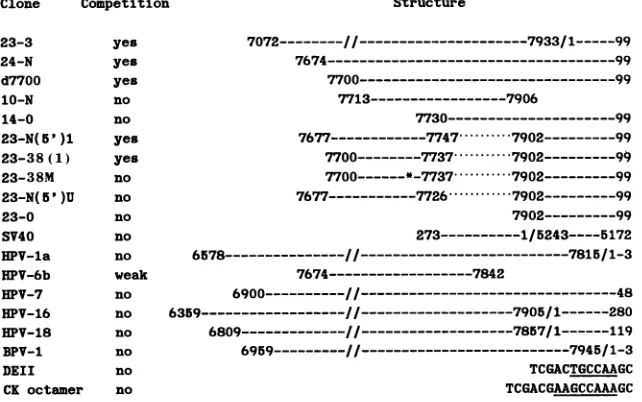
competitors. The5' deletion clone 10-N(nt 7713to7906) did
notcompetefor complexformation,nordid 3'deletion clone 23-N(5')U (nt 7677 to 7726 and 7902 to99) (Fig. 4). On the basis of theseresults,38-bpcomplementaryoligonucleotides
(5' TGCCAACAACACACCTGGCGCCAGGGCGCGGTA
TTGCA3') spanning nt7700to 7737 were synthesized and cloned upstream of the HPV-11 minimal E6 promoter (nt 7902 to99) in CATplasmid 23-0. The resultingclone(23-38)
wastested ingel shift assays. Asjudged from the position of J. VIROL.
on November 10, 2019 by guest
http://jvi.asm.org/
[image:4.612.105.263.78.356.2] [image:4.612.358.527.80.255.2]HPV-11 ENHANCER AND CELLULAR TRANSCRIPTION FACTOR 2971
Clone Competition
23-3
24-N
d7700 10-N 14-0
23-N(5' )1
23-38 (1)
23-38M 23-N(5' )U
23-0 SV40 HPV-la HPV-6b HPV-7 HPV-16 HPV-18 BPV-1 DEII CK octamer
yes yes yes no yes
yes
no no no no no
weak
no no no no no no
Structure
/II/ 7933/1---99
7677---7747. 7902---99
7700---7737. 7902---99
7700--- -7737. 7902---99
7677---7726. 7902---99
7902---99
273---1/5243----5172
---.--11_--- --- ---7a1h/I 6809---//---7857/1---119
TCGACTGCCAAGC TCGACGAAGCCAAAGC
FIG. 4. Effect ofunlabeled clones onspecificprotein binding to CEII. The relevant structures of variousCATexpression clones and their abilitytocompete for specific binding to the CEII element at 200-fold molar excess is indicated.Thedeletion of an adenine residue at position 7732(*) is shown.
DElI
andCK octamerweresynthetic oligonucleotidescloned inone and twocopies each in the pCAT-A vector. The relevant sequences areunderlined.the complex in the gel, the same specific complex formed with CEII using the labeled 71-bp fragment was eliminated
by competitionwith a50-fold molar excess of this unlabeled
38-bp synthetic oligonucleotide (Fig. 3, lanes D through G). pUR23-38M, which containedadeletion of a single adenine residue within the TATTGC sequence at the 3' end of the
syntheticoligonucleotide, did not compete, even at 200-fold
molar excess (Fig. 3, lanes H through K). Gel shift experi-mentsusing labeled DNA containing only the 38-bp segment
gave identical results when specific [23-3 and 23-38(1)] or
nonspecific (14-0 and 23-38M) competitor DNAs were
added. These datasuggestthat thefragment spanning
nucle-otides 7677 to 7747 which exhibits enhancer activity when
multimerized contains a transcription factor-binding site
located within the region defined by the synthetic
oligonu-cleotide (between nt 7700 and 7737). Clones containing the
38-bp synthetic oligonucleotide were also tested in CAT
assays. Theoligonucleotide did not stimulate CAT activity when present as a monomer [clone 23-38(1)] in the forward
orientation. Although sixcopies in the inverted orientation
[clone 23-38(6)] stimulated E2-independent activity only
slightly, the transcriptional repression by E2 was partially
blocked (Fig. 1), as was seen with the clonecontaining five
copies of the 71-bpfragment [clone 23-N(5')5]. At present,
we are not certain as to why the enhancer activity of the
38-bp fragmentinthe absence of the E2 protein is lower than
that ofthe 71-bp element (discussed further below). Three
copies ofthe 38M mutantin theforward orientation didnot
stimulate E2-independent activity, and its activity was
re-pressedto a greater extent(two- tothreefold) than by either
threeorsixcopies ofthe38-bpwild-type sequence (Fig. 1). Theresidual activityisprobablyduetothe sequenceGTTT
GCAT, created by the adenine deletion that matches in
sevenofeight positionstheSV40 octamer sequence CTTTG CAT. A factor that binds this sequence is known to be present in HeLa cells (60).
To determine whether the cellular protein specific for CEII isimportantfor other viral systems, weperformed gel mobility shiftcompetitionexperiments, usingtheregulatory
regionsof the viruses shown in Fig.4. The SV40
enhancer-earlypromoterand the URRsofBPV-1, HPV-1, andHPV-7
and ofthe genital papillomaviruses HPV-16 orHPV-18 did
notcompeteforbinding ofthisCEII-specificfactor(Fig.4), indicating that it probably does notplayadirect role intheir
regulation. HPV-6b competed for binding with an
approxi-mately 10-fold lower affinity (Fig. 4; data not shown). In
HPV-6b,thecorresponding regionhas bothdivergent
nucle-otidesand a19-bpinsertion(Fig. 5). Thesefindings indicate
that the regulation of the genital HPVs by cellular factors may be less similar than expected. In addition, a clone
containing the synthetic oligonucleotide 5' TCGACTGC
CAAGC 3' (nt 7700 to 7705), a half site for CTF/NF-1, did
not compete, either. These results indicate that this CEII factor isdistinct fromthose that bindtothebroad-host-range
SV40 virus, such as Spl, AP-1, AP-2, AP-3, AP-4, and
C/EBP,andthat it isdistinct from CTF/NF-1(summarizedin
reference 60), lendingcredence to our hypothesis that this factor is different from any that has previously been de-scribed.Since someregulatoryproteinssuchasC/EBPhave been shown to bind to two unrelated sequences (34), we
addressed the possibility that this factor may be related to
onethatmight
recognize
aconsensusmotif, 5'AANCCAAA3', found upstream of several cytokeratin genes (5). We
performedcompetition experiments, usingclonescontaining
oneor twocopies of the synthetic oligonucleotide 5'TCGA
CGAAGCCAAAGC3'. No
competition
wasdetectedat200-to400-fold molar excess(Fig. 4).
Estimation of the CEII factor molecular weight by UV
cross-linking. To determine the molecular
weight
of thisCEII-specific
factor,the71-bp CEIIDNA was labeled with[32P]dCTP
in the presence of5-bromodeoxyuridine, as de-scribed in Materials and Methods. The CEII factor was found to bind to5-bromodeoxyuridine-substituted
DNAwith no apparent lossofaffinityorspecificity,asdetermined bygelshift assays (datanotshown). After the crude nuclear lysates were incubated with the labeled DNA, cross-linked
complexes were generated by UV irradiation. The
com-plexes were then treated with DNase I and run on sodium
dodecyl
sulfate-polyacrylamide gels.
Amajor
broad band ofapproximately 44kilodaltons
(kDa)
anda minor band of 34VOL.63, 1989
on November 10, 2019 by guest
http://jvi.asm.org/
[image:5.612.143.464.80.281.2]C/EBP NF-1 CK
CEI 5' ACAATGTTGTGGATTGCAGCCAAAGGTTAAAAGCATTTTTGGCTTCTAAGCTGAACATTTTTGT 3'
7769 7831
10-N 23-N(5')U
DEII DEII m
CEII 5' ACATATTGCCCTGCCAAGTATCTTGCCAACAACACACCTGGCGCCAGGGCI
7677 7700
GCGGTATTGCATGACTAATGT 3' 7737 7747
38
bp-+ DEII + DEII + + + + + ++
HPV6b 5' ACACATTGCCCTGCCAAGTATCCTGCCAACCACACACCTGGCGCCAGGGTGCGGTATTGCCTTACTCATAA 3'
7633 7722
/DEII
TTGCTTGCCAAGTGCATCA
FIG. 5. Sequencesandnotable features of CEI andCEIl.CEl wasdefinedby Hirochikaetal.(28). CEII isdefinedbythe experiments described in Fig. 1,2, and3.Thefirstand last positionsof both segments in the HPV-11 DNAareindicated. The direction of deletionand theends of deletion mutations inCEIIthat did notcompete forfactorbindingingel shiftassays (r*)are indicated. Thenucleotidedeleted in clone 23-38M (*)which didnotcompetefor factorbinding (Fig. 3and 4) is shown. Sequences withatwofold symmetry(--*)and the 38-bp segmentofCEII that binds amajornuclearproteinof 44 kDa and aminornuclearproteinof 34 kDa(--.)areshown. Thehomologous regionofHPV-6b (nt 7633 to7722), with divergent nucleotides(+) and the siteofa19-bpinsertion,is shown. Thedivergent nucleotideswere
confirmed by DNA sequence determination in the particular clone used forcompetition. Homology to recognition sequences ofknown transcription factorsis over- andunderlined. CK, Consensus(inthe invertedorientation)to anoctamerfoundin the upstreamregion ofsome
cytokeratingenes; DEII, a consensus element found upstreamofthe ratalbumin gene. kDa were visualized (Fig. 6). The proteins represented by
both bands were reduced at equal rates when unlabeled
competitorDNAcontaining onecopyof the38-bpsequence
wasaddedtotheincubation mixture prior to UV irradiation. Neither was affected when the competitor DNA used was
clone38M, which also failed to compete in the gel shift assay
(Fig. 3). Proteins ofidenticalsize andbindingcharacteristics
were detected in HeLa extracts (data not shown). The 34-kDa band could arise from proteolytic cleavage of the 44-kDaprotein during theisolation ofthe cross-linked
com-plex, because only one specific DNA-protein complex was
detectedin gel shift assays whencompetitor DNAsspanning
Clone
23-a38( 1)
23-"I30M
Excess 0 it) 50 200 10 5t 200)
20t0K
10-97K -b8K>
29K
18K
FIG. 6. UVcross-linking ofCEII factor to its cognate sequence. TheCElI factorwasbound to a[32P]dCTP-labeled103-bp fragment containing CEII in the presence of unlabeled pUR23-38(1) or pUR23-38M. After UV cross-linking and DNase I treatment, the protein was run on a 10% sodium dodecyl sulfate-polyacrylamide gel, dried, andautoradiographed.The foldmolar excess of compet-itor DNA is indicated above each lane. Molecular weights (in thousands)aregivenon the left.
different regions of the 71-bp fragmentwere used. Alterna-tively, they may be two distinct proteins that form a het-erodimeror are highly cooperative in their bindingto their
target sequences.
DISCUSSION
We have shown that the HPV-11 enhancer-E6 promoter
has a second constitutive domain localized to a 71-bp seg-ment (nt 7677 to 7747), designated CEII, in addition tothe constitutive domain (designated CEI) and the E2-inducible domain previously identified in monkey CV-1 cells when the minimal SV40 early promoter is employed (28). Both CEI andCEIIarerequired forhighE2-independent E6 promoter
activity in cervical carcinoma cell lines C-33A and HeLa, but only CEI is also active in CV-1 cells (28; this study). Furthermore, we have shown, for the first time, that the
HPV-11 E2 protein represses the homologous E6 promoter in the absence of one or both of the constitutive domains. Multiple copies ofCEII not only restore partially the
con-stitutive enhancer-E6 promoter activity, but also partially
overcomethe suppression of the E6 promoterby the HPV-11 E2 protein. RNase protection demonstrates that CEII in multiple copies increasestranscription from the E6 cap site at nt99, verifying that it is a genuinetranscriptional regula-tory element and does not contain a cryptic promoter. Furthermore, E2 repression resulted in the reduction or
elimination of mRNA initiation from the cap site(Fig. 2). We have demonstrated that an approximately 44-kDa nuclear protein in C-33A cells binds specifically to CEII (Fig. 6). Since CEII contains little homology to any of the known transcriptional factor recognition sequences, we believe that the 44-kDa protein represents a novel transcriptional regu-latory protein.
Asshown in Fig.5 and asdescribed previously (28), CEI contains sequence motifs homologous to those that bind C/EBP (34) and CTF/NF-I (29). Inaddition, we note thatit contains the motif 5' TTTGGCTT 3', found in the kerati-nocyte-dependent enhancer of HPV-16 (15) and in the URRs of all the othergenital HPVs thathave been sequenced (13,
_____ < ---!fi::f.!..!
M: :...
:m
.... .: ::: zlA
43K ),,,
on November 10, 2019 by guest
http://jvi.asm.org/
[image:6.612.150.480.75.235.2] [image:6.612.99.272.477.657.2]HPV-11 ENHANCER AND CELLULAR TRANSCRIPTION FACTOR 2973 14, 49). This motif is effectively identical to the consensus
sequence 5' AANCCAAA 3' located upstream of a number of human and bovine cytokeratin genes (5), although there is no evidence that it alone functions as an enhancer in these genes, nor did it stimulate CAT activity in C-33A when present in multiple copies (data not shown). It is possible that the presence of several different enhancer motifs within this CEI domain contributed to its activity in cells as diverse as CV-1 and C-33A.
In contrast, CEII (Fig. 5) contains very little sequence homology to any of the known transcription factor-binding sites (summarized in reference 60). There are two copies of the sequence TGCCAA, which has been found in the reverse orientation in the distal element II (DEII) of the rat albumin promoter and was shown to bind an NF-1-like factor (8). Multiple copies of a consensus motif, YGCCAA, have been noted in the URRs of many HPVs, including HPV-11 (32). However, the cloned synthetic oligonucleotide 5' TCGAC TGCCAAGC 3' failed to compete in the gel shift assays (Fig. 4), nor did multiple copies stimulate CAT expression (data not shown). There are also two copies of the sequence TATTGC, which is part of a 19-bp insertion in the URR of HPV-6vc, relative to HPV-6b. This particular HPV-6 isolate is reported to have a more active enhancer than HPV-6b (44). The TATTGC sequence might be critical for CEII activity, because clone 38M, in which the A residue has been deleted from this sequence, can no longer compete for specific protein binding (Fig. 3, 4, and 6). The only other notable feature is a 12-bp palindrome (5' CCTGGCGC CAGG 3') in the center. None of these elements
can,
however, independently account for the binding activity of this segment, because the deletion mutation (clone 10-N), which affected neither the 12-bp palindrome nor the TAT TGC sequence, nonetheless abolished the ability of the clone to compete in the gel shift experiment. The deletion muta-tions 23-N(5')U and 23-38M, in which the palindrome and the TGCCAA sequence were intact, did not compete, either (Fig. 4). Thus it appears that the recognition sequence for this factor constitutes the major portion of the 38-bp segment and is at least 25 to 30 bases in length. The reason that the 38-bp synthetic oligonucleotide multimer in the reverse orientation functions in overcoming E2 repression and in DNA-binding assays but only weakly in enhancer stimula-tion (Fig. 1; data not shown) may reflect the fact that the recognition sequence constitutes most of the oligonucleo-tide, and therefore the close positioning of tandem binding sites may prevent occupancy by multiple CEII proteins required for high activity. The CEII element may function better in the sense configuration and therefore may be a transcriptional regulatory element but not a classical en-hancer element. Alternatively, factors notdetected in our gel shift assay may bind outside the 38-bp sequence and aug-ment the activity of the 44-kDa factor. Because CEII is active in C-33A (Fig. 1 and 2), HeLa (data not shown), and SCC-25, a cell line derived from a squamous cell carcinoma of the tongue (ATCC CRL1628), but not in CV-1 (28) or HepG2, a human hepatoblastoma cell line (ATCC HB8065) (S. C. Dollard, T. R. Broker, and L. T. Chow, unpublished results), we believe that this domain is one of the determi-nants of HPV-11 epithelial cell type specificity.Our earlier studies have shown that the E2 proteins encoded by different papillomaviruses trans activate the URR-E6 promoter or the URR SV40 early promoter by binding to the E2-RS in the HPV URR (9, 27, 28). In contrast, the protein derived from thecarboxyl-terminal half of the HPV-11 E2 ORF negatively regulates the
E2-depen-A:
HIGH
CELLULAR FACTORS
B: LOW
E2
C: HIGH
E2 OR E2-C
ICEII FACTOR
i E2
RNA
POLYMERASE
OCEI
FACTOR
* TATA FACTOR
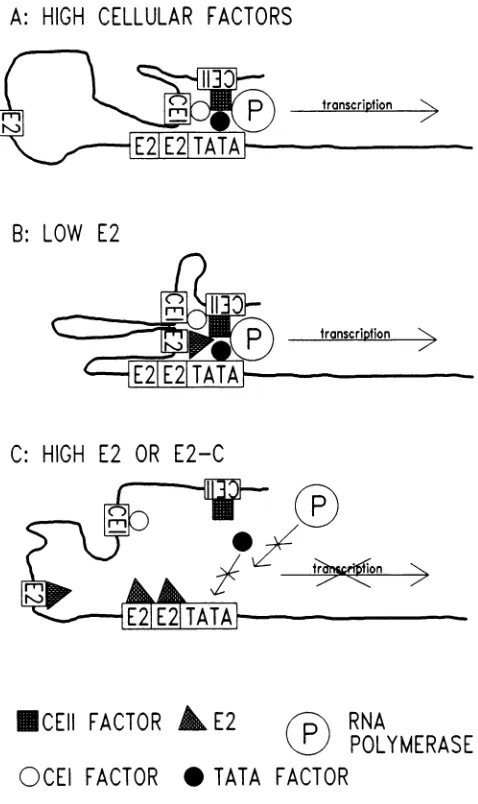
FIG. 7. Amodel forenhancer and E6 promoter regulation. dent activitiesfrom these promoters and the
E2-independent
activity of the URR-E6 promoter (9). We havepostulated
that the E2-C repression of theE2-independent
activity
isa result of steric interference with the association ofaTATA motif-binding factor. This current study has demonstrated that the HPV-11 E2protein can alsofunction as arepressor when factors for CEI or CEII are absent. On the basis of these data, we propose a model for thetranscriptional
regulation of the E6 promoter inHPVstrophicfor thegenital
and oral mucosa, all of which have similarproximity
oftheE2-RS elements to the E6 TATA motif
(Fig.
7). We suggest that the constitutive activity of the HPV-11 enhancer in C-33A arisesbyaloopingmechanism(reviewed
in reference 43) and that CEI and CEII factors can facilitate thebinding
of the TATA factor, as has been
proposed
for adenovirus major latetranscriptionfactor andpseudorabies
virus imme-diate-earlyprotein (1, 45). Theresulting complex
wouldthenrecruit RNA polymerase II and lead to
transcription.
Wepropose that E2 activates
transcription by
binding
to anE2-RS element and
promoting
the formation of a stabletranscriptional complex, when the cellularfactorsare lowin
abundance. Of the four E2-RS elements in the HPV-11
URR,
the second copy near nt7900alone is sufficient for E2 transVOL. 63. 1989
on November 10, 2019 by guest
http://jvi.asm.org/
[image:7.612.314.553.77.479.2]activation when the constitutive domain is present (28). As has been observed for the bacteriophage 434 repressor (31) and for the E2 protein of BPV-1 (39), we surmise that
variations in the central 4 nt of the different E2-RS elements confer differential affinity for the HPV-11 E2 protein. When the E2 protein is synthesized in small amounts, our model predicts that it would bind to the site near nt7900 (ACCG GTTTCGGT), resulting intranscription stimulation fromthe
E6 promoter togive rise to, amongothers, the polycistronic message containing E6, E7, E2, and E5 ORFs, from which functional E2 protein is made (12; Rotenbergetal.,
submit-ted).Astheconcentration ofE2increases,it would also bind
tothe sites adjacent to the E6 promoter (ACCGAAAAGGT,
orACCGTTTTCGGT in thereverseorientation), preventing
the putative TATA factor from binding, as has been
pro-posed for E2-C on the basis of the observation that the
DNase I footprints of E2 and E2-C overlap the E6 TATA motif (9, 28). Thus E2 would suppress the E6 promoterand, indoing so, would repress its own synthesis, aswellasthat of the transformationproteins. Our dataare consistentwith
this hypothesis, and further experimentation in the area of site-directed mutagenesis and in vitro transcription using
purifiedfactors is needed to test this method.
Although our data do not reveal whether E2 proteins
merely recruit cellular factors orare themselves part ofthe
complex, thefollowingargumentsfavor the latterviewpoint,
as depicted in Fig. 7. The amphipathic helix of the GAL4
protein has been demonstrated to be important for the activation of the GAL] gene in Saccharomyces cerevisiae
cells (20) and is thought to interact directly with RNA polymerase (summarized in reference 52). We have
exam-ined the sequences of the E2 proteins of all the papilloma-viruses and found that each contains an amphipathic alpha helix withanacidicfaceatthe aminoterminus. Because the
amino-terminal domain is required for trans activation but
not repression (9, 15, 27, 33), it is probable that the E2
proteinsare partofthetranscription complex.
The biological significance of these various levels of
HPV-11 enhancer regulation is best understood ifone
con-siders that all virusesaremolecularparasites. Activation by cellularfactors in theappropriatetissuefacilitatesthe initial
as well as subsequent viral gene expression. Onset of E2
synthesiswould thenincreasetranscriptionof viral genesto
allow the establishment of infection. Further increases in the levelsof E2 orE2-C would then result inattenuationof viral gene expression, preventing premature killing of the host cells before viral reproduction is accomplished. This
auto-regulation could, however, be overcome when the host
factors for CEI and CEII or other cis elements yet to be
identified are abundant, for instance, when the cells
differ-entiatewhilemigrating upwardin theepithelium. The
auto-regulation ofE2expression would alsoexplain the
observa-tion that in cervical carcinoma cell lines and in a few carcinomasexamined, the integrated HPV DNAs are always
interruptednearthejunction of theEl and E2 ORFs (10, 35,
50), dissociating both E2- and E2-C-coding regions from
theirrespective promoters (11, 53). The loss of both
repres-sorswould then allow constitutive overexpression of the E6 and E7 transformation genes from the E6 promoter (3, 48, 56), eventually leading to cellular transformation. This
hy-pothesis has previously been proposed on the basis of the
observationthat the BPV-1 E2 protein can suppress the E6
promoterof the genital HPVs(9, 59). We have now shown that HPV-11 E2proteincanindeedfunction asarepressorof
itshomologousE6 promoter, thussubstantiating the
hypoth-esis.Inconclusion,wehavedemonstrated thatthe
transcrip-tional activity from the HPV enhancer-E6 promoter is
de-pendentonthedelicate balanceamongpositiveandnegative
regulatoryinfluencesexertedbythehostand the virus itself.
ACKNOWLEDGMENTS
This research was supported by Public Health Service grant CA36200 from the National Institutes of Health. M.T.C. is the recipient of Public Health ServiceMedical Scientist Training Pro-gram grantGM07356fromthe NationalInstitutesofHealth anda
Marchof Dimes Predoctoral Fellowship.
WethankHirohikoHirochika forconstructingthreeofthe URR deletion clones used inthisstudyandMelissa Colbert and Meirav Chovav for useful discussionsonRNaseprotectionand UV
cross-linking,respectively.
LITERATURECITED
1. Abmayr, S. M., J. L.Workman, and R.G. Roeder. 1988. The pseudorabies immediate early proteinstimulates in vitro
tran-scription by facilitating TFIID:promoter interactions. Genes Dev.2:542-553.
2. Androphy,E.J.,D.R. Lowy, andJ. T.Schiller. 1987. Bovine papillomavirus E2 trans-activatinggene product bindsto spe-cificsites inpapillomavirus DNA. Nature(London)325:70-73. 3. Banks, L.,and L. Crawford. 1988. Analysis ofhuman
papillo-mavirus type 16 polypeptides in transformed primary cells. Virology 165:326-328.
4. Bedell,M.A.,K. H.Jones,and L. A.Laimins.1987. The E6-E7 regionof human papillomavirus type 18 is sufficient for
trans-formationofNIH 3T3 andRat-1cells. J. Virol. 61:3635-3640. 5. Blessing, M.,H.Zentgraf,andJ.L.Jorcano.1987.Differentially
expressed bovinecytokeratin genes. Analysis of gene linkage
and evolutionary conservation of 5'-upstream sequences. EMBO J. 6:567-575.
6. Bradford, M. M. 1976. A rapid and sensitive method for the quantitation of microgram quantitites of protein utilizing the principleofprotein-dyebinding.Anal. Biochem. 72:248-254. 7. Broker, T.R., and M. Botchan. 1986. Papillomaviruses:
retro-spectivesandprospectives. Cancer Cells4:17-36.
8. Cereghini,S.,M.Raymondjean,A.G.Carranca,P.Herbomel, and M. Yaniv. 1987. Factors involved in control of tissue-specific expressionof albumin gene. Cell50:627-638.
9. Chin,M.T.,R. Hirochika,H. Hirochika,T. R.Broker,and L.
T.Chow. 1988.Regulationofthehumanpapillomavirustype 11 enhancer andE6promoterbyactivatingandrepressing proteins
from the E2 open readingframe: functional and biochemical studies. J. Virol. 62:2994-3002.
10. Choo, K.-B., H.-H. Lee, C.-C. Pan, S.-M. Wu, L.-N. Liew, W,-F. Cheung,andS.-H.Han. 1988.Sequence duplicationand internal deletion in theintegratedhumanpapillomavirustype 16 genome cloned from a cervical carcinoma. J. Virol. 62:1659-1666.
11. Chow, L. T., H. Hirochika, M. Nasseri, M. H. Stoler, S. M.
Wolinsky, M. T. Chin, R. Hirochika, D. S. Arvan, and T. R.
Broker.1987. Humanpapillomavirusgeneexpression.Cancer Cells5:55-72.
12. Chow, L.T., M. Nasseri, S. M. Wolinsky,and T. R. Broker.
1987. Human papillomavirus types 6 and 11 mRNAs from genital condylomataacuminata.J. Virol.61:2581-2588. 13. Cole, S. T., and 0. Danos. 1987. Nucleotide sequence and
comparative analysis of the human papillomavirus type 18 genome. Phylogenyofpapillomavirusesandrepeatedstructure
of the E6 and E7 geneproducts.J. Mol. Biol. 193:599-608.
14. Cole,S.T.,and R. E.Streeck. 1986.Genomeorganizationand nucleotide sequenceofhumanpapillomavirustype33,whichis associated with cervicalcancer. J.Virol. 58:991-995.
15. Cripe, T. P., T. H. Haugen, J. P. Turk, F. Tabatabai, P. G. SchmidIII,M.Durst,L.Gissmann,A.Roman,and L. P. Turek.
1987.Transcriptional regulationof the humanpapillomavirus-16 E6-E7promoterbyakeratinocyte-dependent enhancer,andby
viral E2 trans-activator and repressor geneproducts: implica-tions forcervicalcarcinogenesis. EMBO J. 6:3745-3753.
on November 10, 2019 by guest
http://jvi.asm.org/
HPV-11 ENHANCER AND CELLULAR TRANSCRIPTION FACTOR 2975 16. Dartmann, K., E. Schwarz, L. Gissmann, and H. zur Hausen.
1986. The nucleotide sequence and genome organization of human papilloma virus type 11. Virology 151:124-130.
17. Dignam, J. D., R. M. Lebovitz, and R. G. Roeder. 1983.
Accurate transcription initiation by RNA polymerase Il in a soluble extract from isolated mammalian nuclei. Nucleic Acids Res. 11:1475-1489.
18. Fried, M., and D. M.Crothers. 1981. Equilibria and kinetics of lac repressor-operator interactions by polyacrylamide gel elec-trophoresis. Nucleic Acids Res.9:6505-6525.
19. Garner, M. M., and A. Revzin. 1981. A gel electrophoresis method forquantifying the binding of proteins to specific DNA regions. Applications to components of the E. coli lactose operon regulatory system. Nucleic Acids Res. 9:3047-3060. 20. Giniger, E., and M. Ptashne. 1987. Transcription in yeast
activated by a putative amphipathic alpha helix linked to a DNA binding unit. Nature (London) 330:670-672.
21. Giri, I., and M. Yaniv. 1988. Study of the E2 gene product of the cottontailrabbit papillomavirus reveals a common mechanism of transactivation among papillomaviruses. J. Virol. 62:1573-1581.
22. Gius, D.,S. Grossman, M. A. Bedell, and L. A. Laimins. 1988.
Inducible and constitutive enhancer domains in the noncoding region of humanpapillomavirus type 18. J. Virol. 62:665-672. 23. Gloss, B., H. U. Bernard, K.Seedorf, and G. Klock. 1987. The
upsteam regulatory region of the human papilloma virus-16 containsanE2 protein-independent enhancer which is specific for cervical carcinoma cells and regulated by glucocorticoid hormones. EMBO J. 6:3735-3743.
24. Harrison, S. M., K. L. Gearing, S. Y. Kim, A. J. Kingsman, and
S. M.Kingsman. 1987. Multiple cis-active elements in the long control regionof bovinepapillomavirus type-I (BPV-1). Nucleic Acids Res. 15:10267-10284.
25. Haugen, T. H., T. P. Cripe, G. D. Ginder, M. Karin, and L. P.
Turek. 1987. Trans-activation of an upstream early gene pro-moterof bovine papilloma virus-1 by a product of the viral E2 gene. EMBO J. 6:145-152.
26. Hawley-Nelson, P., E. J. Androphy, D. R. Lowy, and J. T.
Schiller. 1988. The specific DNA recognition sequence of the bovinepapillomavirus E2 protein is an E2-dependent enhancer. EMBO J. 7:525-531.
27. Hirochika, H., T. R. Broker, and L. T. Chow. 1987. Enhancers andtrans-acting E2transcriptional factors of papillomaviruses. J. Virol. 61:2599-2606.
28. Hirochika, H., R. Hirochika, T. R. Broker, and L. T. Chow.
1988. Functional mapping of the human papillomavirus type 11 transcriptionalenhancer and its interaction with the trans-acting E2proteins. Genes Dev.2:54-67.
29. Jones,K. A., J. T.Kadonaga,P. J.Rosenfeld,T. J. Kelly, and R.
Tjian. 1987. A cellular DNA-binding protein that activates eukaryotic transcription and DNA replication. Cell 48:79-89. 30. Kanda, T., S.Watanabe, and K. Yoshiike. 1988.Immortalization
ofprimary rat cells by human papillomavirus type 16 subge-nomic DNA fragments controlled by the SV40 promoter. Virol-ogy 165:321-325.
31. Koudelka, G. B., S. C.Harrison, and M. Ptashne. 1987. Effect of non-contacted bases on the affinity of 434 operator for 434 repressor and Cro. Nature (London)326:886-888.
32. Krubke, J.,J. Kraus, H.Delius, L.Chow, T. Broker, T. Iftner, and H. Pfister. 1987. Geneticrelationship among human papil-lomaviruses associated with benign and malignant tumors of patients with epidermodysplasia verruciformis. J. Gen. Virol. 68:3091-3103.
33. Lambert, P. F., B. A. Spalholz, and P. M. Howley. 1987. A
transcriptional repressor encoded by BPV-1 shares a common carboxy-terminal domain with the E2 transactivator. Cell 50: 69-78.
34. Landschulz, W.H., P. F. Johnson, E. Y. Adashi, B. J. Graves, andS. L. McKnight. 1988. Isolation ofa recombinant copy of thegeneencoding C/EBP. Genes Dev.2:786-800.
35. Matsukura, T., T. Kanda, A. Furuno, H. Yoshikawa, T.
Kawana, and K. Yoshiike. 1986. Cloning of monomeric human papillomavirus type16DNAintegratedwithin cell DNA froma
cervical carcinoma. J. Virol. 58:979-982.
36. McBride, A. A., R. Schlegel, and P. M. Howley. 1988. The carboxy-terminal domain shared by the bovine papillomavirus E2 transactivator and repressor proteins contains a specific DNA binding activity. EMBOJ. 7:533-539.
37. Melton, D. A., P. A. Krieg, M. R. Rebagliati, T. Maniatis, K.
Zinn, and M. R. Green. 1984. Efficient in litro synthesis of biologically active RNA and RNA hybridization probes from plasmids containing a bacteriophage SP6 promoter. Nucleic Acids Res. 12:7035-7056.
38. Moskaluk, C., and D. Bastia. 1988. DNA bending is induced in anenhancer by the DNA-binding domain of the bovine papillo-mavirus E2 protein. Proc. Natl. Acad. Sci. USA 85:1826-1830. 39. Moskaluk, C., and D. Bastia. 1988. Interaction of the bovine papillomavirus type 1 E2 transcriptional control protein with the viral enhancer: purification of the DNA-binding domain and analysis of its contact points with DNA. J. Virol. 62:1925-1931. 40. Pater, M. M., and A. Pater. 1985. Human papillomavirus types 16 and 18 sequences in carcinoma cell lines of the cervix. Virology 145:313-318.
41. Phelps, W. C., and P. M. Howley. 1987.Transcriptional trans-activation by the human papillomavirus type 16 E2 gene prod-uct. J. Virol.61:1630-1638.
42. Phelps, W. C., C. L. Yee, K. Munger, and P. M. Howley. 1988. The human papillomavirus type 16 E7 gene encodes transacti-vation and transformation functions similar to those of adeno-virus ElA. Cell 53:539-547.
43. Ptashne, M. 1986. Gene regulation by proteins acting nearby and at adistance. Nature(London) 322:697-701.
44. Rando, R. F., W. D.Lancaster, P. Han, and C. Lopez. 1986. The noncoding region of HPV-6vc contains two distinct transcrip-tional enhancing elements. Virology 155:545-556.
45. Sawadogo, M., and R. G. Roeder. 1985. Interaction of a gene-specific transcription factor with the adenovirus major late promoter upstream of the TATA box region. Cell43:163-175. 46. Schiller, J. T., W. C. Vass, K. H. Vousden, and D. R. Lowy.
1986. The E5 open reading frame of bovine papillomavirus type 1encodes a transforming gene. J. Virol. 57:1-6.
47. Schirm, S., J. Jiricny, and W. Schaffner. 1987. The SV40 enhancer can bedissected into multiplesegments, each with a different cell type specificity. Genes Dev. 1:65-74.
48. Schneider-Gadicke, A., and E. Schwarz. 1986. Different human cervicalcarcinoma cell lines show similar transcription patterns of human papillomavirus type 18 early genes. EMBO J. 5: 2285-2292.
49. Schwarz, E., M. Durst, C. Demankowski, 0. Lattermann, R. Zech, E.Wolfsperger, S. Suhai, and H. zur Hausen. 1983. DNA sequence and genomeorganization of genital human papilloma-virus type 6b. EMBO J.2:2341-2348.
50. Schwarz, E., U. K. Freese, L.Gissmann, W. Mayer, B. Roggen-buck, A. Stremlau, and H. zur Hausen. 1985. Structure and transcription of human papillomavirus sequences in cervical carcinoma cells. Nature (London) 314:111-114.
51. Seedorf, K., T. Oltersdorf, G. Krammer, and W. Rowekamp. 1987. Identification of early proteins of the human papilloma viruses type 16 (HPV 16) and type 18 (HPV 18) in cervical carcinoma cells. EMBO J. 6:139-144.
52. Sigler, P. B. 1988. Acid blobs and negative noodles. Nature (London) 333:210-212.
53. Smotkin, D., and F.0.Wettstein. 1986.Transcription of human papillomavirus type 16 earlygenes in a cervical cancer and a cancer-derived cell line and identification of the E7 protein. Proc. Natl. Acad. Sci. USA83:4680-4684.
54. Spalholz, B. A., P.F. Lambert, C. L. Yee, and P. M. Howley. 1987. Bovine papillomavirus transcriptional regulation: localiza-tion of theE2-responsive elements of the long controlregion.J. Virol. 61:2128-2137.
55. Spalholz, B. A., Y. C. Yang, and P. M. Howley. 1985.
Transac-tivation of a bovine papilloma virus transcriptional regulatory element bythe E2 gene product. Cell 42:183-191.
56. Storey, A., D. Pim, A. Murray, K. Osborn, L. Banks, and L.
Crawford. 1988. Comparisonof the in vitro transforming
activ-itiesof humanpapillomavirus types. EMBO J. 7:1815-1820.
VOL. 63, 1989
on November 10, 2019 by guest
http://jvi.asm.org/
57. Swift, F. V., K. Bhat, H. B. Younghusband, and H. Hamada.
1987. Characterization ofacell type-specificenhancerfound in
the human papilloma virus type 18 genome. EMBO J. 6:
1339-1344.
58. Thierry, F., J. M. Heard, K. Dartmann, and M. Yaniv. 1987. Characterization ofa transcriptionalpromoterof human papil-lomavirus 18 and modulation of itsexpression by simian virus40
andadenovirus early antigens. J.Virol. 61:134-142.
59. Thierry, F., and M. Yaniv. 1987. The BPV1-E2 trans-acting proteincanbeeitheranactivatororarepressorofthe HPV 18
regulatory region. EMBO J. 6:3391-3397.
60. Wingender, E. 1988. Compilation of transcription regulating proteins. Nucleic Acids Res.16:1879-1902.
61. Yang, Y.-C., H. Okayama, and P. M. Howley. 1985. Bovine papillomavirus contains multiple transforming genes. Proc.
Natl. Acad. Sci. USA82:1030-1034.
62. Yee, C., I. Krishnan-Hewlett, C. C. Baker, R. Schlegel, and
P. M. Howley. 1985. Presenceand expression of human papil-lomavirus sequences in human cervical carcinoma cell lines.
Am. J. Pathol. 119:361-366.