City, University of London Institutional Repository
Citation
: Wang, J., Otgaar, H., Howe, M. L. ORCID: 0000-0002-5747-5571 and Zhou, C.
(2018). A Self-Reference False Memory Effect in the DRM Paradigm: Evidence from Eastern
and Western Samples. Memory and Cognition, doi: 10.3758/s13421-018-0851-3
This is the published version of the paper.
This version of the publication may differ from the final published
version.
Permanent repository link:
http://openaccess.city.ac.uk/20206/
Link to published version
: http://dx.doi.org/10.3758/s13421-018-0851-3
Copyright and reuse:
City Research Online aims to make research
outputs of City, University of London available to a wider audience.
Copyright and Moral Rights remain with the author(s) and/or copyright
holders. URLs from City Research Online may be freely distributed and
linked to.
City Research Online:
http://openaccess.city.ac.uk/
[email protected]
A self-reference false memory effect in the DRM paradigm: Evidence
from Eastern and Western samples
Jianqin Wang1
&Henry Otgaar1,2&Mark L. Howe1,2&Chu Zhou3
#The Author(s) 2018
Abstract
It is well established that processing information in relation to oneself (i.e., self-referencing) leads to better memory for that information than processing that same information in relation to others (i.e., other-referencing). However, it is unknown whether self-referencing also leads to more false memories than other-referencing does. In the current two experiments with European and East Asian samples, we presented participants the Deese–Roediger–McDermott lists together with their own name or other people’s name (i.e.,BTrump^in Experiment1andBLi Ming^in Experiment2). We found consistent results across the two experiments; that is, in the self-reference condition, participants had higher true and false memory rates compared with those in the other-reference condition. Moreover, we found that self-referencing did not exhibit superior mnemonic advantage in terms of net accuracy compared with other-referencing and neutral conditions. These findings are discussed in terms of theoretical frameworks such as spreading activation theories and the fuzzy-trace theory. We propose that our results reflect the adaptive nature of memory in the sense that cognitive processes that increase mnemonic efficiency may also increase susceptibility to associative false memories.
Keywords Self-reference . False memory . Net accuracy . Spreading activation . Fuzzy-trace theory
The self plays an important role in memory (Conway,2005; Howe,2014; Klein,2012). It is well established that informa-tion is better remembered when it is processed in relainforma-tion to the self than when it is processed in relation to other sources (Symons & Johnson,1997). For instance, judging words for their personal relevance (BDoes this word describe you?^) produces superior memory recall than does other-referencing (BDoes this word describe Henry?^) or semantic encoding (BDoes this word mean the same as XXX?; Kuiper & Rogers,1979; Rogers, Kuiper, & Kirker,1977). The superior mnemonic effect for items encoded with respect to the self has
been termed as the self-reference effect (SRE) and has re-ceived considerable empirical support. For instance, SRE has been found in various age groups (from children to old people; Cunningham, Brebner, Quinn, & Turk, 2014; Gutchess, Kensinger, Yoon, & Schacter,2007) as well as in different cultures (Zhu, Zhang, Fan, & Han,2007).
One of the proposed mechanisms underlying SRE is rela-tional processing or organizarela-tional processing (Klein,2012; Klein & Loftus1988; Symons & Johnson,1997). Relational processing refers to the encoding of associations among items in a list leading participants to think about the shared concept or label (Klein, 2012; Klein & Loftus,1988). For example, when participants see the wordssoundandpiano, the items can be organized as concepts related to Bmusic.^ Another example would be items sharing the same category, such as dogandhorsethat can be both processed under the category
Banimal.^Klein & Loftus, (1998) manipulated the relatedness among items within a list and found that for weakly related lists, category sorting (i.e., relational processing) produced equivalent recall as self-referenced processing, suggesting re-lational processing is one of the mechanisms underlying SRE. In line with this, Sui and Humphreys (2015) have recently proposed that self-reference increases the binding among dif-ferent forms of information in memory. For instance, evidence Electronic supplementary materialThe online version of this article
(https://doi.org/10.3758/s13421-018-0851-3) contains supplementary material, which is available to authorized users.
* Jianqin Wang
1
Department of Clinical Psychological Science, Faculty of Psychology and Neuroscience, Maastricht University, PO Box 616, 6200, MD Maastricht, The Netherlands
2
City, University of London, London, UK 3 Fudan University, Shanghai, China
shows that people not only remember the self-referenced stim-uli better than other-referenced stimstim-uli but also remember the stimuli–self associations (e.g., an apple paired with one’s own face) better than the stimuli–other associations (e.g., a cup paired with other people’s face; Cunningham et al., 2014). Leshikar and Duarte (2014) reported that both young and old adults exhibited better relational memories for object– scene bindings (e.g., saxophone–beach) in the self-reference rather than the other-reference condition. According to Sui and Humphreys, the self acts like a form ofBassociative glue^ in a memory network, and when self-representations are acti-vated, they strengthen the binding among different stimuli in relation to the self-representation, thus increasing retention for experienced stimuli. Taken together, research so far has dem-onstrated that relational processing among the list items or the binding among stimuli may account for the mnemonic supe-riority of self-referenced processing.
Interestingly, according to spreading activation theories of false memory (e.g., activation association theory [AAT]: Howe, Wimmer, Gagnon, & Plumpton,2009; activation/ monitoring theory [AMT]: Roediger, Balota, & Watson, 2001a), relational processing or binding between items may also contribute to the creation of false memories. False mem-ories refer to memory for details or events that were not expe-rienced. The Deese–Roediger–McDermott paradigm (DRM; Deese,1959; Roediger & McDermott,1995) is a typical ex-perimental paradigm used to study false memories. Here, par-ticipants study lists of associated words (e.g.,sound, piano, sing, radio, band, melody, horn, concert, instrument), and during memory tests, participants oftentimes falsely recall or recognize the presence of a nonpresented critical lure (i.e., music) that is associated with the list items. Studies with the DRM paradigm show that increasing the associative strength of a studied list (i.e., increasing relational processing) results in higher levels of false memories (Gallo & Roediger,2002; Howe et al.,2009; for results showing that the associative strength of a studied list is not the source of false-memory effects, see Cann, McRae, & Katz,2011). Following this line of reasoning, enhancing relational processing using self-referencing should not only make people better remember what has been presented but should also enhance the suscep-tibility to the DRM memory illusion compared with other-referencing conditions. The current experiments were con-ducted to examine this idea.
Spreading activation theories (e.g., Howe et al.,2009) sug-gest that related concepts, such as the DRM list items, are embedded within an associative network and that the presence of an item (e.g., the wordpiano) activates a corresponding concept (see also Otgaar, Muris, Howe, & Merckelbach, 2017). Most importantly, according to these theories, activa-tion will automatically spread toBnearby^ related concepts (e.g.,music) and the level of activation determines the rate of recall/recognition (Anderson,1983). The activation of
related but nonpresented concepts leads to false recollections of nonpresented critical lures. As Fig. 1 shows, based on mechanisms of false memory and SRE, when the DRM list items are processed in relation to the self, the self may strengthen the relatedness among the items as well as the activation spreading to the critical lures, thus evoking more false memories of the critical lures than when processing in-formation related to others.
In addition to spreading activation theories, another theo-retical account, fuzzy-trace theory (FTT; Brainerd & Reyna, 2002; Brainerd, Reyna, & Ceci,2008a), also predicts that the self may increase false memory. According to FTT, when encoding an item, verbatim traces and gist traces of the item are stored in memory. Verbatim traces are item-specific fea-tures (e.g., unique spelling of a studied word) that distinguish one item from another. Gist traces are memory representations of semantic and relational information (Brainerd & Reyna, 2005). Brainerd, Yang, Reyna, Howe, and Mills (2008b) showed that relations between studied items and critical lures are mostly semantic in the DRM paradigm. When a DRM list including dog, cat, horse, andpig is presented, participants may extract a gist such asanimalthat semantically relates to all items (i.e., all items belong toanimal). Hence, participants may confuseanimalwith presented items and falsely recog-nize it as presented since it shares gist (i.e., meanings, with presented items). Thus, gist processing supports false memory according to FTT (Brainerd & Reyna,2002).
Of relevance here is that when self-reference facilitates the semanticrelatedness among DRM items, it actually facilitates gist extraction according to FTT. Because gist traces support false memory of critical lures, self-referencing may increase false memory rates compared with other-referencing. FTT elaborates the mechanism of how relational processing
Fig. 1 Hypothetical associative memory network when the self is
[image:3.595.306.544.492.639.2]impacts false memory from a different perspective than asso-ciative theories. That is, FTT proposes that relational process-ing benefits false memory via encouragprocess-ing gist processprocess-ing, whereas associative theories propose that relational processing facilitates false memory via strengthening associations and activations. Nonetheless, both theoretical approaches predict that self-reference would increase false memory through in-creasing relational processing.
Indeed, there is some evidence suggesting that self-reference may be related to false memories. Rogers, Rogers, and Kuiper (1979) found that false alarms for personal adjec-tives increased as the degree of self-reference increased. Rosa and Gutchess (2013) replicated this effect and extended this effect to old adults (see also Rosa, Deason, Budson, & Gutchess,2015). They asked participants to rate adjectives (e.g., cultured, sensible) for self-descriptiveness on a 9-point scale and later measured their memories for the adjectives and some adjective lures. The authors found that high self-descriptiveness words led to higher false alarms than low self-descriptiveness words did. One limitation with the afore-mentioned research is that they did not compare the false alarms between the self-reference and other-reference condi-tions, but only examined the relationship between the degree of self-reference and false alarms. Furthermore, previous stud-ies did not use a well-established false memory paradigm (e.g., the DRM paradigm) known to elicit false memories that might be caused by similar mechanisms as the SRE. Choosing such a paradigm would enable us to test the mechanisms un-derlying SRE and false memories.
To date, no study has compared the false memories of self-reference versus other-self-reference conditions, and no study has examined the relationship between true and false memories (i.e., net accuracy) generated from self-referential processing. Net accuracy measures the overall memory accuracy, which is the ratio of true memories to true memories plus false memo-ries (Brainerd et al.,2008a). Because relational processing may amplify both true memories and false memories, it is unknown whether self-referencing would increase or even de-crease the net accuracy (i.e., true memory to true memory plus false memory) relative to other-referencing. However, since self-referencing has been demonstrated to be a superior mem-ory encoding strategy in previous literature, one would expect that self-referencing should increase the overall memory ac-curacy or net acac-curacy. The present study aimed to examine self-referenced false and true memories as well as net accuracy in the DRM paradigm.
The current experiments
We presented participants with DRM lists appearing together with either their own name (self-referenced condition) or some other people’s name (i.e., Trump; other-referenced condition).
During the study phase, participants were asked to remember the words shown to them as well as with which source (self or other) the words appeared together. After a filler task, they were asked to recognize the words as presented or not in the recognition phase. Based on previous research (e.g., Rogers et al.,1979; Rosa & Gutchess,2013) as well as relational pro-cessing mechanism of SRE, we predicted that the self-referenced condition would result in higher false recognition rates of the critical lures than the other-referenced condition. We also predicted that self-referencing would lead to the highest true recognition rate of the studied items (i.e., the SRE).
Importantly, previous research has shown that self-reference can increase memory for perceptual details of the studied items (Hamami, Serbun, & Gutchess,2011; Leshikar, Dulas, & Duarte, 2015; Serbun, Shih, & Gutchess,2011). Serbun et al. (2011) asked participants to encode objects in relation to self or other and found that self-referenced objects were remembered with more visual details. Leshikar et al. (2015) used the remember/know (R/K) procedure to measure recollection and familiarity of self-referential memories. Recollection and familiarity are two subtypes of recognition memory which can be calculated from R/K responses. Recollection indicates remembering episodic details, while familiarity refers to the feeling of recognizing an item but the specific details (Yonelinas,2002). Leshikar et al. (2015) found that the self-referencing condition exhibited better rec-ollection of studied items than semantic encoding (i.e., pro-cessing the meaning of presented words). They also found m o r e p h e n o m e n o l o g i c a l d e t a i l s o n t h e M e m o r y Characteristic Questionnaire (MCQ) measurements. It is un-known whether self-referencing would also increase the phe-nomenology of false memories. It might be that self-referencing impacts familiarity of falsely recalled items, as Rosa and Gutchess (2013) suggested. However, it is also pos-sible that self-referencing impacts true and false memories in a similar way by increasing recollection, as they share the same activation network. We used the R/K judgment procedure (Yonelinas,2002; Yonelinas & Jacoby,1995) in the recogni-tion phase to examine the recollecrecogni-tion and familiarity of crit-ical lures in self-reference versus other-reference conditions.
Experiment 1
Method
Participants
participants from Maastricht University, The Netherlands, were tested. The sample consisted of eight males and 31 fe-males (Mage= 21.6,SD= 2.29, range: 18–31 years). All par-ticipants were fluent in English. The experiment was approved by the ethical board of Faculty of Psychology and Neuroscience, Maastricht University.
Materials
Eighteen DRM word lists with 12 words per list were used. The lists have been used in previous work as well (e.g., Howe, Garner, & Patel,2013). DRM lists were pseudorandomly assigned to the self-reference (six lists, mean BAS = 0.26, SD= .13), other-reference (six lists, Mean BAS = 0.26,SD = .12), and control conditions (six lists, mean BAS = 0.26,SD = .10), with the backward association strength (BAS) matched across three conditions,F(2, 16) = 0.006,p= .995. Besides controlling the BAS across conditions, we switched the lists in the self-reference and other-reference conditions for half of the participants (n= 19) to eliminate any list effects. The recog-nition list included 18 critical lures (one critical lure per list), 36 studied items, and 36 unrelated new items. The studied items were from the third and 10th position of each list.
Design and procedure
The experiment used a 3 (reference: self vs. other vs. neutral) × 2 (memory type: true vs. false) within-subjects design. All participants were tested individually in a quiet and isolated room. The experiment was programmed using Visual Basic.
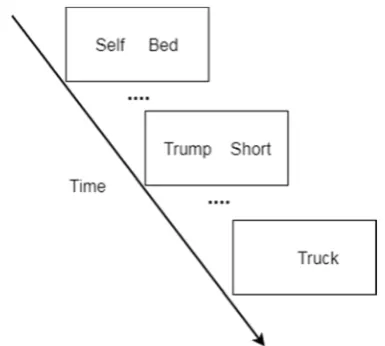
In the study phase, participants first were asked to fill in some information including their own name (the name that they were most frequently referred to). Then the DRM words appeared one by one together with either their own name (self-reference condition) or the nameBTrump^ (other-reference condition), or the DRM words appeared alone (neutral condi-tion).BTrump^was used in the other-reference condition as it was a very familiar name due to the American election at the time of our data collection. Participants were asked to remem-ber the words and to which source they appeared together with (self, Trump, or alone). The DRM words were shown list by list, and the items within a list appeared with the same source (see Fig.2). All lists were presented in English as our previous work showed that samples from Maastricht University did not differ from native English speakers in terms of DRM false recognition rates (Wang, Otgaar, Howe, Smeets, & Merckelbach,2017). The experiment was separated in six blocks with each block containing three BAS matched lists (a self-referenced list, an other-referenced list, and a control list). The sequence of the lists within a block was randomized. After the study phase, participants performed a filler task (playing theBBejeweled^game) for around 5 min. Then, their memories were tested using a recognition task. Words were
shown at the center of the screen, and participants responded by clicking the BRemember,^ BKnow,^ or BNew^ button. Participants received the following R/K instructions adapted from previous research (see Yonelinas, 2002; Yonelinas & Jacoby,1995):
BIn the next task, words will be shown at the center of the screen. Some words were presented in the previous phase and some were not. Your task is to decide whether the words are old (i.e., presented words) or new (i.e., not presented).
If it is a new word, click theBNew^button. If it is an old word: When you clearly remember that the item was presented (i.e., you can recall specific information such as size, font, etc.), click theBRemember^button; when you know the item was presented but you cannot recall specific details, click theBKnow^button.^Three exam-ple words were presented first to help participants un-derstand the instructions.
Results and discussion
Recognition rates
BRemember^andBKnow^responses were combined together when calculating the overallBold^recognition response rate. False memory was defined as falsely recognizing a critical lure as old. The mean false alarm rate of unrelated items was 19.66% (95% CI [14%, 25%]), and it was statistically lower than false recognition rates of critical lures in any condition (ps < .001), showing a typical false memory effect.
A 3 (reference: self vs. other vs. neutral) × 2 (memory type: true vs. false) repeated-measures ANOVA was conducted on
Fig. 2 Illustration of one block in the study phase (BSelf^stands for
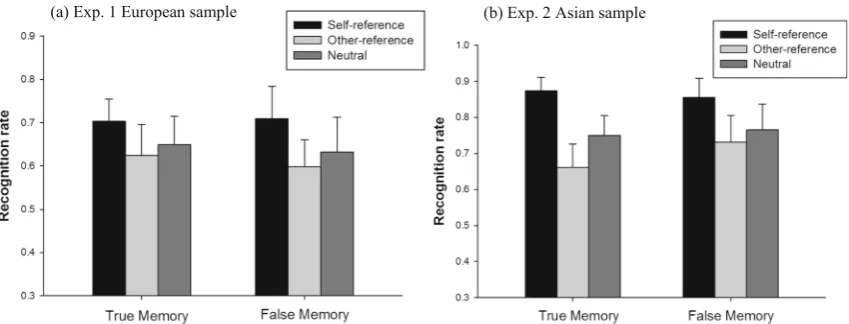
[image:5.595.328.521.51.224.2]recognition rates. We found a statistically significant main effect of reference,F(2, 76) = 6.77, p = .002, partial η2= 0.15. Pair-wise comparisons with Bonferroni corrections indi-cated that the self-reference condition had higher true and false recognition rates than the other-reference condition did (p < .001), and the neutral condition did not differ from the other-reference condition (p> .80). There was no statistically significant main effect of memory type,F(2, 76) = 0.22,p= .65, indicating equivalent level of true memories and false memories were recognized. No statistically significant inter-action effect between reference and memory type was found, F(2, 76) = 0.21,p= .81, suggesting that the SRE is similar for both true and false memories (see Figure3a). The raw recog-nition rates in each condition were presented in the Supplementary Materials.
We were specifically interested in comparing the effect sizes of SRE in false memories and true memories, respective-ly. The result showed that false recognition rates in the self-reference condition were significantly higher than in the other-reference condition,t(38) = 3.68,p= .001, Cohen’sd= 0.60. The self-reference condition also had significantly higher false recognition rates than the neutral condition using a one-tailed t test,t(38) = 1.92,p= .03, Cohen’sd= 0.31. A paired-samples t test showed significantly higher true memory rates in the self-reference condition than in the other-reference condition as well,t(38) = 2.02,p= .05, Cohen’sd= 0.33.
Net accuracy
Net accuracy was calculated as the ratio of true recognition to true recognition plus false recognition (Brainerd et al.,2008a). We conducted a repeated-measures ANOVA to compare net accuracy in the self-reference, other-reference, and neutral conditions. No significant main effect was found on the refer-ence variable,F(2, 76) = 0.10,p = .91. Net accuracy of the self-reference processing (M= 0.51, 95% CI [0.47, 0.54]) did not differ from that of the other-reference processing (M =
0.50, 95% CI [0.46, 0.55]) or the neutral condition (M = 0.51, 95% CI [0.48, 0.55]). The results suggest that self-referencing did not increase the overall accuracy of memory compared with other-referencing and the neutral conditions in the DRM paradigm.
Recollection and familiarity of SR false memory
Recollection is the rate of Bremember^ responses, whereas familiarity is calculated as the rate of^knowing^ responses divided by 1 minus the rate of remember responses (Knowing rate/(1 − recollection rate); Yonelinas, 2002; Yonelinas & Jacoby, 1995). We conducted repeated-measures ANOVAs to compare recollection of critical lures in different reference conditions. As Table1shows, we found that different reference conditions led to statistically different recollection rates for critical lures,F(2, 76) = 7.24,p= .001, partialη2= 0.16. Follow-up Bonferroni contrasts showed that in the self-reference condition, critical lures received statisti-cally higher recollection scores than in the other-reference condition,t(38) = 3.55,p= .001, Cohen’sd= 0.58, and neutral conditions,t(38) = 2.97,p = .005, Cohen’sd=0.48. For fa-miliarity, all conditions had equal levels of fafa-miliarity, F(2, 76) = 1.75,p= .18. Thus, processing information related to oneself mainly increased false recollections relative to the condition in which information was related to others.
Recollection and familiarity of SR true memory
We conducted the same repeated-measures ANOVAs on rec-ollection and familiarity of true memories. We found a statis-tical difference in recollection scores for presented items among the reference conditions, F(2, 76) = 4.97,p = .009, partialη2= 0.12, while familiarity was not significantly im-pacted by reference,F(2, 76) = 0.65,p= .52. Paired-samplest tests showed that in the self-reference condition, presented items had statistically higher recollection scores than in the
(a) Exp. 1 European sample (b) Exp. 2 Asian sample
Fig. 3 True and false recognition rates in self-reference, other-reference, and neutral conditions in (a) Experiment1(European sample;n= 39) and (b)
[image:6.595.86.511.529.691.2]other-referenced condition,t(38) = 2.07,p= .045, Cohen’sd= 0.33, and the neutral condition,t(38) = 3.20,p= .003, Cohen’s d= 0.51. The latter two did not differ from each other,t(38) = 0.75,p= .46. The results were consistent with previous studies which found that self-reference increased recollections of true memories (Leshikar et al.,2015).
In Experiment1, we showed that in line with our hy-pothesis, relating information to oneself increased both true and false memories compared with relating informa-tion to others. Moreover, we found that self-reference spe-cifically increased recollection scores of studied items and critical lures. These may be explained by our hypothetical mechanism of the SRE in the associative memory network (see Fig.1). Because the self facilitates the relational pro-cessing or the binding of DRM list items (Klein,2012; Sui & Humphreys,2015), on the one hand, facilitated related-ness increases the phenomenological level of activated rec-ollection of the studied items, as demonstrated by our re-sults and also previous SRE research (e.g., Leshikar et al., 2015; Serbun et al.,2011). On the other hand, the increased activation may automatically spread to critical lures (e.g., AAT; Howe et al.,2009), and increase the activation level of critical lures as well. As a result, the highest proportion of critical lures that were falsely remembered was in the self-reference condition.
Besides relational processing, the other mechanism that may mediate SRE is item-specific processing (or elaboration; Klein,2012). Item-specific processing refers to encoding specific information of an item (Hunt & Einstein, 1981; Klein & Loftus, 1988). For example, forsoundand piano,soundcan be encoded as something people hear, while pianois an object. However, item-specific processing distin-guishes different items, and it has been found to reduce false memories (e.g., Arndt & Reder, 2003; Israel & Schacter, 1997; McCabe, Presmanes, Robertson, & Smith,2004). For instance, when DRM items within a list were presented in different fonts, false memories were reduced compared with when DRM items were presented in the same font (Arndt & Reder,2003). Our results showing that self-referencing in-creased false memories seemed not to support item-specific processing as the dominant processing in the current para-digm. Moreover, if item-specific processing is the main mech-anism of SRE here, one would expect it to increase net
accuracy as it should increase true memory but decrease false memory, which was not the case in our results.
Surprisingly, we found that net accuracy of self-referencing did not differ significantly from other-referencing and neutral conditions, suggesting self-referencing does not increase the overall memory accuracy in a paradigm where relational pro-cessing would lead to associative memory illusions. The re-sults showed that self-referencing increased true and false memories to the same extent compared with the other condi-tions, leading to no statistical difference between conditions. These results indicate that relational processing is the domi-nant processing in SRE with the DRM paradigm. Relational processing results in an increase of activation of both studied items and critical lures that share the same memory network. Thus, Experiment1shows that processing information in relation to the self elevates trueandfalse memory levels. One limitation with the current sample is that most participants were female. One may also wonder that the difference be-tween the self-reference condition and the neutral condition on false recognition rates reached only one-tail significance. However, we had predicted a one directional effect; that is, self-reference increases false memory relative to the other conditions, and our prediction was supported by the results. Moreover, this will not hinder our conclusion on SRE as SRE here is based on self-referencing versus other-referencing comparisons. Another interesting observation was that net ac-curacy was not affected by self-referencing. To examine the reliability of this finding, we reanalyzed data from another sample in Experiment 2, to test whether similar findings would be found even under a different cultural background. Specifically, in Experiment2, a similar approach was used in an Asian sample, and there was a neutral reference (a color square) in the neutral condition.
Experiment 2
[image:7.595.52.543.72.156.2]Self-representation is impacted by cultural context. For in-stance, Westerners normally value the self as independent and less connected to others while East Asians are more likely to value the relationship between the self and others (Markus & Kitayama,1991). Zhu et al. (2007) found that processing information in relation to one’s mother activated similar neural
Table 1 Recollection and familiarity of critical lures and studied items in different reference conditions (means with 95% CIs)
Reference Critical lures Studied items
Recollection Familiarity Recollection Familiarity
Self-reference 0.49 [0.40, 0.57] 0.44 [0.34, 0.55] 0.48 [0.41, 0.56] 0.42 [0.34, 0.49]
Other-reference 0.35 [0.28, 0.43] 0.36 [0.27, 0.44] 0.39 [0.32, 0.47] 0.40 [0.32, 047]
correlates as self-referenced processing in Asian participants but not in Western subjects, suggesting culture shapes neural correlates of self-representational cognitive processes. Other research found that Eastern Asians tend to focus more on the relationships and contexts when processing pictures such as a lion standing in a desert background, while Westerners focus more on the objects such as the lion (Goh et al.,2007; Nisbett & Masuda,2003). Data from East Asian participants were analyzed in Experiment2to explore whether there was any cultural difference in self-referenced true and false memories as well as net accuracy in the DRM paradigm. Since East Asians pay more attention to relationships with others, pro-cessing information in relation to others may already show a high level of relational processing. We predicted that East Asians might not exhibit a self-reference false memory effect as strong as Europeans, and thus net accuracy (i.e., true mem-ory to true memmem-ory plus false memmem-ory) should be larger in East Asians.
Method
Participants
Twenty-nine participants from Fudan University, China were tested.1The East Asian sample consisted of 13 males and 16 females (Mage = 21.2, SD= 2.06, range: 19–26 years). All Chinese participants were native Mandarin speakers. The sample was part of a study in China (Zhou, Wang, & Zhou, 2014).2We reanalyzed the data with new analyses to test our hypotheses, and we conducted cultural comparisons across data from the East Asian and European samples. These anal-yses have not been reported before.
Materials
Fifteen Chinese DRM lists were translated and adapted from Stadler, Roediger, and McDermott (1999). The BAS of each list was measured with a Chinese population in a pilot study b a s e d o n t h e p r o c e d u r e s i n R o e d i g e r, Wa t s o n , McDermott, and Gallo (2001b). Participants were first given the Chinese words and were asked to write down the first word it brought to mind for each word. Then the connection strength between each study word (e.g.,garage, drive, road, Mercedes) and its corresponding critical lure (e.g., car) was measured as the probability it elicited the critical lure. BAS was the average probability that the studied items elicited the critical lure. Hence, some DRM lists used in the East Asian sample were different from that of the European sample.
Fifteen lists were pseudorandomly assigned to the self-reference (five lists; mean BAS = 0.19, SD = .04), other-reference (five lists; mean BAS = 0.20, SD= .04), and the neutral condition (five lists; mean BAS = 0.20,SD= .03), with BAS matched in the three conditions,F(2, 12) = 0.09,p= .91. The recognition list contained 15 critical lures (one per list), 45 studied items (three items per list), and 20 unrelated items. The studied items were from the first, sixth, and 10th position of each list.
Design and procedure
The experiment used a 3 (reference: self vs. other vs. neutral) × 2 (memory type: true vs. false) within-subjects design. The procedure of Experiment2was identical as in Experiment1, except for the following differences. First, in the East Asian sample of Experiment 2, the nameBLi Ming^ (a frequently used name in Chinese textbooks) was used in the Bother^ condition. Second, in the neutral condition of Experiment 2, a red square appeared together with DRM words. Thus, the DRM words appeared together with either their own name or the nameBLi Ming^ or a red square in the study phase. Other steps in the procedure were exactly the same as in Experiment 1.
Results and discussion
Recognition rates
The mean false recognition rate of unrelated items was 8.45% (95% CI [4%, 13%]), which was statistically lower than that of critical lures in any condition (ps < .001). We conducted a 3 (reference: self vs. other vs. neutral) × 2 (memory type: true vs. false) repeated-measures ANOVA on true and false recog-nition rates. The results were similar to those in Experiment1. The main effect of reference was statistically significant,F(2, 56) = 25.45,p< .001, partialη2= 0.48. Bonferroni compar-isons showed that self-reference led to higher true and false recognition rates than both the other-reference (p< .001) and neutral conditions (p< .001). The main effect of memory type was not significant,F(2, 56) = 0.93,p = .34. No significant interaction between reference and memory type was found, either,F(2, 56) = 1.88,p= .16.
Results showed that the self-reference false memory effect was revealed in Experiment2 as well. Specifically, the self-reference condition had significantly higher false memories than the other-reference condition did, t(28) = 3.19, p = .004, Cohen’s d = 0.61, and the neutral condition, t(28) = 2.45,p= .02, Cohen’sd= 0.46. The other-reference condition did not differ from the neutral condition in false recognition rates,t(28) = 0.96,p= .35. A typical SRE of true memories was also found. A paired-samples ttest showed significant higher true memory rates in the self-reference condition than 1Post hoc power analysis indicated that the power of Experiment 2 was 0.87
with sample sizen= 29.
2We achieved part of the data in this work, which is written in Chinese, to
in the other-reference condition, t(28) = 7.23, p < .001, Cohen’sd= 1.46.
Net accuracy
Net accuracy was calculated for the self-reference, other-ref-erence, and neutral conditions. Repeated-measures ANOVA showed that there was no significant effect of reference on net accuracy,F(2, 56) = 2.12,p= .13. Self-referencing (M= 0.51, 95% CI [0.49, 0.53]) resulted in similar memory net accuracy as in the other-referencing (M= 0.48, 95% CI [0.45, 0.50]) and neutral (M= 0.50, 95% CI [0.47, 0.53]) conditions. In an East Asian sample, it was also found that self-referencing did not improve the overall memory accuracy with the DRM paradigm.
Experiment2 found comparable results in an East Asian sample as with a European sample in Experiment1. Besides the difference in sample population, Experiment2used differ-ent DRM lists and a differdiffer-ent other-referenced name. However we still found that self-referencing increased false memories than other-referencing did and also replicated the results that self-referencing did not impact net accuracy of memory.
Joint analyses on false memory
To explore whether the magnitude of the SR false memory effect differed statistically in European and East Asian sam-ples, we combined data of the two samples and treated the sample as a between-subjects variable. A 2 (sample: European vs. East Asian) × 2 (reference: self vs. other) repeated-measures ANOVA was conducted on false recogni-tion rates, where sample was between-subjects and reference was within-subjects. No statistical interaction between sample and reference was found,F(1, 66) = 0.07,p= .79, suggesting sample did not interact with the SR false memory effect. There was a main effect of reference, F(2, 66) = 23.50,p < .001, partialη2= 0.26. That is, in both the European and East Asian samples, self-referencing (M= 0.78, 95% CI [0.73, 0.83]) led to higher false memory rates than did other-referencing (M= 0.66, 95% CI [0.62, 0.71];p< .001, Cohen’sd= 0.59). There was also a main effect of sample. East Asian participants (M= 0.79, 95% CI [0.73, 0.86]) had statistically more false memo-ries than European participants did (M= 0.65, 95% CI [0.60, 0.71]),F(1, 66) = 11.57,p= .001, partialη2= 0.15.
Joint analyses on net accuracy
A 2 (sample: European vs. East Asian) × 2 (reference: self vs. other) repeated-measures ANOVA on net accuracy was con-ducted. No statistical interaction effect between sample and reference was found,F(1, 66) = 0.75,p= .39. There was no main effect of sample,F(1, 66) = 0.59,p= .44, indicating no net accuracy differences in European (M = 0.51, 95% CI
[0.48, 0.53]) and East Asian samples (M = 0.49, 95% CI [0.46, 0.52]). No main effect of reference was found, either, F(1, 66) = 0.99, p = .32, suggesting self-referencing (M = 0.51, 95% CI [0.49, 0.53]) did not impact net accuracy com-pared with other-referencing (M= 0.49, 95% CI [0.46, 0.52]) across our two samples. Although East Asian participants had different self-referenced true and false memory rates relative to the European sample, self-referencing had a very similar effect on net accuracy in the two samples.
Contrary to our prediction, there was no cultural difference in self-referenced false memories and net accuracies. To note, there are some differences in the experimental materials be-tween the samples, so one needs to be cautious when interpreting the joint analyses. One difference is that the Chinese DRM lists were different from lists used in the European sample. The names used in the other-reference con-ditions of the two samples were also different, which was due to cultural difference, but maybe in future research the names can be more strictly comparable. Another difference is the number of items in the recognition test. Although the propor-tions of critical lure in the recognition test were comparable (20% vs. 19% in European and East Asian samples), the dif-ferent number of studied items per list might impact the re-sults. Nevertheless, the SR false memory effect is based on within-subject comparisons between self-reference and other-reference conditions. Those differences should not have im-pacted the main message of the current study.
General discussion
The current study examined whether processing information in relation to oneself (i.e., self-referencing) increased false memories compared with processing information in relation to others (i.e., other-referencing). In two experiments with Eastern and Western samples, we found consistent results that self-referencing enhanced both false recognition rates of crit-ical lures and true recognition rates of studied items in the DRM paradigm. Specifically, self-referencing impacted recol-lection but not familiarity of studied items and critical lures. In addition, we found that self-referencing did not increase the net accuracy compared with other-referencing and neutral conditions. The current findings support the theoretical view that false memories are not malfunctions of cognitive process-es (e.g., Howe,2011; Schacter,2012), but that true and false memories may originate from similar memory mechanisms such as spreading activation and gist processing.
whole memory network (Anderson,1983; Howe et al.,2009). When participants process the DRM words in relation to themselves, DRM items that share the same theme (i.e., crit-ical lure) are more strongly linked to each other than when D R M w o r d s a r e p r o c e s s e d i n r e l a t i o n t o o t h e r s . Consequentially, memories for DRM words are better retained under self-referencing and theoretically, activation levels of DRM items in an associative memory network is increased by self-referencing since activation level determines memory rates (Anderson,1983). Thus, more activation can be spread to related but nonpresented critical lures in a memory network, and hence memory rates for critical lures are higher in the self-reference condition. In short, self-referencing increases bind-ing among concepts in a memory network, which leads to more activation spreading along the network to critical lures and this in turn increases false memory rates.
The SRE on both true and false memories supports fuzzy-trace theory as well. Previous research has shown that self-referencing improves relational processing (e.g., semantic re-lations) of studied items (Klein,2012). According to FTT, semantic relations are represented as gist traces in memory (Brainerd & Reyna,2005). Thus, self-referencing may boost gist processing of studied lists. Gist traces support not only correct recognition of studied items but also false recognition of nonpresented but meaning-consistent critical lures (Reyna, Corbin, Weldon, & Brainerd, 2016). As a result, self-referencing can increase both true recognition of studied items and false recognition of critical lures.
Based on the activation theories and FTT, we propose that cognitive processes/factors that increase mnemonic efficiency (by increasing relational binding among memory nodes or gist extraction of stimuli) may increase susceptibility to associa-tive false memories. The following evidence supports the above proposition. First, our results here have already demon-strated that self-referencing as a superior mnemonic process-ing leads to high levels of false memories. Second, research has found that deeper processing of the information (e.g., de-fining an item), which is known to enhance true memories, produces more false memories than shallow processing does (e.g., counting the letters of a word; Rhodes & Anastasi,2000; Thapar & McDermott,2001). Third, survival processing (e.g., rating items’relevance for a survival scenario) has been found to boost true memories (Nairne & Pandeirada,2008; Nairne, Thompson, & Pandeirada, 2007); however, it has also been found to increase susceptibility to memory illusions (Howe & Derbish,2010; Otgaar & Smeets,2010). Fourth, individuals with highly superior autobiographical memories, who can ac-curately remember everyday details since midchildhood, are found to be more susceptible to suggestive false memories than are normally remembering adults (Patihis et al.,2013).
Other evidence has come from the development of relation-al binding and development of frelation-alse memories. The ability of binding among stimuli develops with age. Research has found
that people’s ability to bind isolated parts of pictures improves from childhood to adulthood (Sluzenski, Newcombe, & Kovacs,2006). Lee, Wendelken, Bunge, and Ghetti (2016) have found that item–item and item–time bindings improve gradually from 8 years of age to adulthood. Interestingly, there is a similar developmental pattern (i.e., the development re-versal) of false memory formation from children to adults. That is, children exhibit fewer false memories generated from associative lists such as DRM lists than adults do (e.g., Brainerd et al., 2008a; Howe et al., 2009; Otgaar, Howe, Brackmann, & Smeets,2016). More intriguingly, older adults exhibit the phenomenon of hyperbinding, in which they make too many associations (Campbell, Hasher, & Thomas,2010), creating more associative false memories than young adults do (Devitt & Schacter,2016; Schacter, Koutstaal, & Norman, 1997). Similarly, as predicted by FTT, gist sensitivity in-creases with age, and thus false memory inin-creases with age (Brainerd et al.,2008a). Taken together, from a developmental perspective, binding ability and gist extraction ability increase with age from childhood until later adulthood, and suscepti-bility to associative false memories increases correspondingly. Relational binding is obviously significant for human memory since it allows individuals to bind features of an ex-perience into an integrated episodic memory (Eichenbaum & Cohen, 2004), and so are self-referencing, deep processing, and survival processing functional for human memory. However, those cognitive functions inevitably lead to unwant-ed false memories under certain circumstances. Thus, false memories reflect the adaptive nature of memory in the sense that they originate from efficient functioning of the memory system instead of being malfunctions of the memory system (see also Howe, 2011; Howe & Derbish,2010; Schacter, 2012).
In conclusion, we found a self-reference false memory ef-fect that processing information in relation to oneself led to more false memories than processing information in relation to others (e.g., Trump). The SR false memory effect was stable across Western and Eastern population samples, with identical effect sizes, Cohen’s d around 0.6. What’s more, self-referencing did not increase memory net accuracy across two samples. Based on spreading activation theories of mem-ory, we propose that cognitive processes/factors that increase mnemonic efficiency may increase susceptibility to associa-tive false memories, which reflects the adapassocia-tive nature of memory.
Acknowledgements This study has been supported by a fellowship from
China Scholarship Council (CSC) to Jianqin Wang (201406100057).
Open access All materials and data can be accessed athttps://osf.io/ snej6/.
Open AccessThis article is distributed under the terms of the Creative C o m m o n s A t t r i b u t i o n 4 . 0 I n t e r n a t i o n a l L i c e n s e ( h t t p : / / creativecommons.org/licenses/by/4.0/), which permits unrestricted use, distribution, and reproduction in any medium, provided you give appro-priate credit to the original author(s) and the source, provide a link to the Creative Commons license, and indicate if changes were made.
References
Anderson, J. R. (1983). A spreading activation theory of memory.
Journal of Verbal Learning and Verbal Behavior, 22, 261–295. Arndt, J., & Reder, L. M. (2003). The effect of distinctive visual
infor-mation on false recognition.Journal of Memory and Language, 48, 1–15.
Brainerd, C. J., & Reyna, V. F. (2002). Fuzzy-trace theory and false memory.Current Directions in Psychological Science, 11, 164-169. Brainerd, C. J., & Reyna, V. F. (2005). The science of false memory.
Oxford: Oxford University Press.
Brainerd, C. J., Reyna, V. F., & Ceci, S. J. (2008a). Developmental re-versals in false memory: A review of data and theory.Psychological Bulletin, 134, 343–382.
Brainerd, C. J., Reyna, V. F., & Kneer, R. (1995). False-recognition re-versal: When similarity is distinctive. Journal of Memory and Language, 34, 157–185.
Brainerd, C. J., Yang, Y., Reyna, V. F., Howe, M. L., & Mills, B. A. (2008b). Semantic processing inBassociative^ false memory.
Psychonomic Bulletin & Review, 15, 1035–1053.
Campbell, K. L., Hasher, L., & Thomas, R. C. (2010). Hyper-binding: A unique age effect.Psychological Science, 21, 399–405.
Cann, D. R., McRae, K., & Katz, A. N. (2011). False recall in the Deese– Roediger–McDermott paradigm: The roles of gist and associative strength.The Quarterly Journal of Experimental Psychology, 64, 1515–1542.
Conway, M. A. (2005). Memory and the self.Journal of Memory and Language, 53, 594–628.
Cunningham, S. J., Brebner, J. L., Quinn, F., & Turk, D. J. (2014). The self-reference effect on memory in early childhood. Child Development, 85,808–823.
Deese, J. (1959). On the prediction of occurrence of particular verbal intrusions in immediate recall. Journal of Experimental Psychology, 58, 17–22.
Devitt, A. L., & Schacter, D. L. (2016). False memories with age: Neural and cognitive underpinnings.Neuropsychologia, 91, 346–359. Eichenbaum, H., & Cohen, N. J. (2004). From conditioning to conscious
recollection: Memory systems of the brain.New York: Oxford University Press.
Faul, F., Erdfelder, E., Lang, A.-G., & Buchner, A. (2007). G*Power 3: A flexible statistical power analysis program for the social, behavioral, and biomedical sciences.Behavior Research Methods, 39,175–191. Gallo, D. A., & Roediger, H. L. (2002). Variability among word lists in eliciting memory illusions: Evidence for associative activation and monitoring.Journal of Memory and Language, 47, 469–497. Goh, J. O., Chee, M. W., Tan, J. C., Venkatraman, V., Hebrank, A.,
Leshikar, E. D.,…Park, D. C. (2007). Age and culture modulate object processing and object–scene binding in the ventral visual area.Cognitive, Affective, & Behavioral Neuroscience, 7, 44–52. Gutchess, A. H., Kensinger, E. A., Yoon, C., & Schacter, D. L. (2007).
Ageing and the self-reference effect in memory.Memory, 15, 822– 837.
Hamami, A., Serbun, S. J., & Gutchess, A. H. (2011). Self-referencing enhances memory specificity with age.Psychology and Aging, 26, 636–646.
Howe, M. L. (2005). Children (but not adults) can inhibit false memories.
Psychological Science, 16, 927–931.
Howe, M. L. (2006). Developmentally invariant dissociations in chil-dren’s true and false memories: Not all relatedness is created equal.
Child Development, 77, 1112–1123.
Howe, M. L. (2011). The adaptive nature of memory and its illusions.
Current Directions in Psychological Science, 20, 312–315. Howe, M. L., & Derbish, M. H. (2010). On the susceptibility of adaptive
memory to false memory illusions.Cognition, 115, 252–267. Howe, M. L., Wimmer, M. C., Gagnon, N., & Plumpton, S. (2009). An
associative activation theory of children’s and adults’memory illu-sions.Journal of Memory and Language,60, 229–251.
Howe, M. L., Garner, S. R., & Patel, M. (2013). Positive consequences of false memories.Behavioral sciences & the law, 31, 652–665. Howe, M. L. (2014). The co-emergence of the self and autobiographical
memory. In P. J. Bauer and R. Fivush (Eds.), Wiley Handbook on the Development of Children’s Memory: Volume II (pp. 545–567). West Sussex, UK: Wiley.
Hunt, R. R., & Einstein, G. O. (1981). Relational and item-specific infor-mation in memory.Journal of Verbal Learning and Verbal Behavior, 20, 497–514.
Israel, L., & Schacter, D. L. (1997). Pictorial encoding reduces false recognition of semantic associates.Psychonomic Bulletin & Review, 4, 577–581.
Klein, S. B. (2012). Self, memory, and the self-reference effect: An ex-amination of conceptual and methodological issues.Personality and Social Psychology Review, 16, 283–300.
Klein, S. B., & Loftus, J. (1988). The nature of self-referent encoding: The contributions of elaborative and organizational processes.
Journal of Personality and Social Psychology, 55, 5–11.
Kuiper, N. A., & Rogers, T. B. (1979). Encoding of personal information: Self–other differences. Journal of Personality and Social Psychology, 37, 499–514.
Lee, J. K., Wendelken, C., Bunge, S. A., & Ghetti, S. (2016). A time and place for everything: Developmental differences in the building blocks of episodic memory.Child Development, 87, 194–210. Leshikar, E. D., & Duarte, A. (2014). Medial prefrontal cortex supports
source memory for self-referenced materials in young and older adults.Cognitive, Affective, & Behavioral Neuroscience, 14, 236– 252.
Markus, H. R., & Kitayama, S. (1991). Culture and the self: Implications for cognition, emotion, and motivation,Psychological Review, 98, 224.
Mccabe, D. P., Presmanes, A. G., Robertson, C. L., & Smith, A. D. (2004). Item-specific processing reduces false memories.
Psychonomic Bulletin & Review, 11, 1074–1079.
Nairne, J. S., & Pandeirada, J. N. (2008). Adaptive memory: Remembering with a stone-age brain.Current Directions in Psychological Science, 17, 239–243.
Nairne, J. S., Thompson, S. R., & Pandeirada, J. N. S. (2007). Adaptive memory: Survival processing enhances retention. Journal of Experimental Psychology: Learning, Memory, and Cognition, 33, 263–273.
Nisbett, R. E., & Masuda, T. (2003). Culture and point of view.
Proceedings of the National Academy of Sciences, 100, 11163– 11170.
Otgaar, H., Howe, M. L., Brackmann, N., & Smeets, T. (2016). The malleability of developmental trends in neutral and negative mem-ory illusions.Journal of Experimental Psychology: General, 145, 31–55.
Otgaar, H., Muris, P., Howe, M. L., & Merckelbach, H. (2017). What drives false memories in psychopathology? A case for associative activationClinical Psychological Science, 5,1048–1069. Otgaar, H., & Smeets, T. (2010). Adaptive memory: Survival processing
increases both true and false memory in adults and children.Journal of Experimental Psychology: Learning, Memory, and Cognition, 36, 1010–1016.
Patihis, L., Frenda, S. J., LePort, A. K., Petersen, N., Nichols, R. M., Stark, C. E.,…Loftus, E. F. (2013). False memories in highly superior autobiographical memory individuals.Proceedings of the National Academy of Sciences, 110, 20947–20952.
Reyna, V. F., Corbin, J. C., Weldon, R. B., & Brainerd, C. J. (2016). How fuzzy-trace theory predicts true and false memories for words, sentences, and narratives,Journal of Applied Research in Memory and Cognition, 5, 1–9.
Rhodes, M. G., & Anastasi, J. S. (2000). The effects of a levels-of-processing manipulation on false recall.Psychonomic Bulletin & Review, 7, 158–162.
Roediger, H. L., Balota, D., & Watson, J. (2001a). Spreading activation and arousal of false memories. In H. Roediger, J. Nairne, & A. Surprenant (Eds.), The nature of remembering: Essays in honor of Robert G. Crowder. Science conference series (pp. 95–115). Washington, DC: American Psychological Association.
Roediger, H. L., & McDermott, K.B. (1995). Creating false memories: Remembering words not presented in lists.Journal of Experimental Psychology: Learning, Memory and Cognition,21, 803–814. Roediger, H. L., Watson, J. M., McDermott, K. B., & Gallo, D. A.
(2001b). Factors that determine false recall: A multiple regression analysis.Psychonomic Bulletin & Review, 8, 385–407.
Rogers, T. B., Kuiper, N. A., & Kirker, W. S. (1977). Self-reference and the encoding of personal information.Journal of Personality and Social Psychology, 35, 677–688.
Rogers, T. B., Rogers, P. J., & Kuiper, N. A. (1979). Evidence for the self as a cognitive prototype: TheBfalse alarms effect^.Personality and Social Psychology Bulletin, 5, 53–56.
Rosa, N. M., Deason, R. G., Budson, A. E., & Gutchess, A. H. (2015). Self-referencing and false memory in mild cognitive impairment due to Alzheimer’s disease.Neuropsychology, 29, 799–805.
Rosa, N. M., & Gutchess, A. H. (2013). False memory in aging resulting from self-referential processing.Journals of Gerontology Series B: Psychological Sciences and Social Sciences, 68,882–892. Schacter, D. L. (2012). Adaptive constructive processes and the future of
memory.American Psychologist, 67, 603–613.
Schacter, D. L., Koutstaal, W., & Norman, K. A. (1997). False memories and aging.Trends in Cognitive Sciences, 1, 229–236.
Serbun, S. J., Shih, J. Y., & Gutchess, A. H. (2011). Memory for details with self-referencing.Memory, 19, 1004–1014.
Sluzenski, J., Newcombe, N. S., & Kovacs, S. L. (2006). Binding, rela-tional memory, and recall of naturalistic events: A developmental perspective.Journal of Experimental Psychology: Learning Memory and Cognition, 32, 89–100.
Stadler, M. A., Roediger, H. L., & McDermott, K. B. (1999). Norms for word lists that create false memories.Memory & Cognition, 27, 494–500.
Sui, J., & Humphreys, G. W. (2015). The integrative self: How self-reference integrates perception and memory.Trends in Cognitive Sciences, 19, 719–728.
Symons, C. S., & Johnson, B. T. (1997). The self-reference effect in memory: A meta-analysis.Psychological Bulletin, 121, 371–394. Thapar, A., & McDermott, K. B. (2001). False recall and false recognition
induced by presentation of associated words: Effects of retention interval and level of processing.Memory & Cognition, 29, 424–432. Wang, J., Otgaar, H., Howe, M. L., Smeets, T., & Merckelbach, H. (2017). Undermining belief in false memories leads to less efficient problem-solving.Memory,25,910–921.
Yonelinas, A. P. (2002). The nature of recollection and familiarity: A review of 30 years of research.Journal of Memory and Language, 46, 441–517.
Yonelinas, A. P., & Jacoby, L. L. (1995). The relation between remem-bering and knowing as bases for recognition: Effects of size congru-ency.Journal of Memory and Language, 34,622–643.
Zhou, C., Wang, J., & Zhou, W. (2014). The self-reference effect in false memory: A robust facilitation of self.Journal of Psychological Science, 5, 1079–1083. (In Chinese)