City, University of London Institutional Repository
Citation
: Wei, Y., Chang, L., Liu, B., Hu, J., Wang, Y., Li, Y., Wang, Z., Meng, H., Liu, T.,
Sun, T. ORCID: 0000-0003-3861-8933 and Grattan, K. T. V. ORCID: 0000-0003-2250-3832 (2018). Laser methane sensor and its field application in coal mine safety. Journal of Physics : Conference Series, 1065, 252022.. doi: 10.1088/1742-6596/1065/25/252022This is the published version of the paper.
This version of the publication may differ from the final published
version.
Permanent repository link:
http://openaccess.city.ac.uk/21001/Link to published version
: http://dx.doi.org/10.1088/1742-6596/1065/25/252022
Copyright and reuse:
City Research Online aims to make research
outputs of City, University of London available to a wider audience.
Copyright and Moral Rights remain with the author(s) and/or copyright
holders. URLs from City Research Online may be freely distributed and
linked to.
City Research Online: http://openaccess.city.ac.uk/ [email protected]
PAPER • OPEN ACCESS
Laser methane sensor and its field application in coal mine safety
To cite this article: Yubin Wei et al 2018 J. Phys.: Conf. Ser. 1065 252022
View the article online for updates and enhancements.
Content from this work may be used under the terms of theCreative Commons Attribution 3.0 licence. Any further distribution of this work must maintain attribution to the author(s) and the title of the work, journal citation and DOI.
Published under licence by IOP Publishing Ltd
XXII World Congress of the International Measurement Confederation (IMEKO 2018) IOP Conf. Series: Journal of Physics: Conf. Series 1065 (2018) 252022
IOP Publishing doi:10.1088/1742-6596/1065/25/252022
1
Laser methane sensor and its field application in coal mine
safety
Yubin Wei 1,2, Lin Chang2,Bao Liu5, Jie Hu 3,Yin Wang 1,Yanfang Li 1, Zhaowei
Wang 1, Hui Meng 3, Tongyu Liu 1,3, Tong Sun4 and Kenneth T V Grattan4
1 Qilu University of Technology (Shandong Academy of Sciences) Laser Research Institute, Jinan, Shandong, China
2 Mining Products Safety Approval and Certification Center (MA Center), No.5 Qingniangou Rd, Hepingli, Beijing, 100013, China
3 Shandong Micro-sensor Photonics Limited, Jinan, China, 250014
4 School of Mathematics, Computer Science and Engineering, City, University of London, London, EC1V 0HB, United Kingdom
5Dongying Yatong Petrochemical Co., Ltd
E-mail: [email protected]
Abstract. Based on the principle of laser absorption spectroscopy, a laser methane sensor for mine use has been developed. The design of the sensor system is discussed and its practical application for methane detection in coal mines is considered. A control system coupled to the sensor has been developed and the results obtained show the high quality of the performance of the laser methane sensor over the traditional catalytic combustion sensor and infrared sensor in many performance aspects, such as large range, high precision and low power consumption
1. Introduction
Enhancing the safety of its coal mines is of particular importance to China and the economy. In the process of coal production, methane gas is produced and disasters due to methane ignition occur frequently, resulting in deaths and destruction in the mine. To tackle this problem, better methane gas monitoring is important content in the prevention of further accidents. At present, the main means of safety monitoring is methane gas detection using catalytic methods and non-dispersive infrared absorption sensors. The traditional catalytic methane sensor has the problem that the device is easily ‘poisoned’ by other interfering species and needs frequent calibration and maintenance and there are various phenomena which can lead to false alarms. Infrared sensors can achieve the full measurement range needed, but the measurement accuracy is susceptible to humidity effects. Based on the principle of near-infrared diode laser absorption spectroscopy, the laser-based methane sensor can eliminate the cross interference of water vapor and other interfering gases with the characteristics of the narrow laser spectrum, and thus can achieve high measurement accuracy, which is suitable for the harsh environment of coal mines[1-4]. However testing and evaluating such a system in actual coal mines for longer periods of evaluation is important and this has been done in the work reported here.
2. Basic principles of the monitoring system
According to the Lambert-Beer law, when a beam of parallel light with intensity I0() passes
through a gas cell filled with the gas under test, and provided that the spectrum of the light source encompasses one or more of the absorption lines of the gas, the relationship between the transmitted light intensity I(), the incident intensity I0(), and the gas concentration C can be given by [6-7].
I()=I0()exp[−()CL]=I0()exp[−PS(T)()CL]. (1) where () is the absorption coefficient of the gas; L[cm] is the length of the gas absorbing light and
] )[
(T cm−2atm−1
S is the intensity of the characteristic spectral line of the gas. This represents the
2
absorption intensity of the spectral lines which is related to temperature, while P[atm] is the total
pressure of the gas, C is the volume concentration of the gas and ()[cm] is a line-shape function, which represents the shape of the absorption spectral lines which is associated with temperature, total pressure, and the proportional composition of the gas. With a knowledge of parameters such as pressure, line intensity, the length of the gas absorbing light path were known, the final gas concentration could then be obtained[6]. The overall sensor system can be visualized as being divided into the laser control system, the optical fiber optical path, the gas chamber, the photoelectric detection circuit and the data acquisition and processing system.
In this paper, a 1653nm laser was chosen as the light source as it was conveniently available and its output covered the spectral region of interest. By scanning the spectrum of the semiconductor laser used with the output wavelength corresponding to the methane gas absorption, applying a zigzag scanning current to the laser and dividing the laser light beam with a 1 x 2 coupler, the signal from the gas can be detected. Before use in the mine, the sensor was calibrated with known percentages of methane gas, as shown in Figure 3, and the linear relationship between the measured gas concentration determined from the spectral measurements and the actual gas percentages when the test cell was filled is seen. Recognizing that there is potentially a temperature effect, the calibration was done under different temperature conditions for a fixed gas concentration and the results seen in Figure 4 show a relatively small fluctuation in the output as a result of the temperature change (up to a maximum of 45ºC which is the highest temperature experienced in the mine).
3. Field tests and evaluation
[image:4.595.349.509.227.354.2]In 2017, the laser methane sensor was installed as part of the KJ95 gas safety monitoring system in Xinglongzhuang coal mine of Yanzhou Mining Group in Shandong province of China.
Figure 1 Schematic diagram of the laser methane
sensor system used
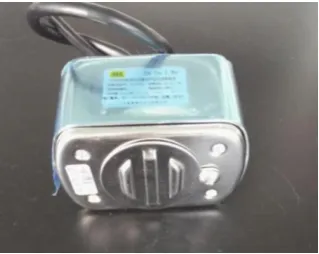
Figure 2 Photograph of the laser
[image:4.595.72.313.237.375.2]XXII World Congress of the International Measurement Confederation (IMEKO 2018) IOP Conf. Series: Journal of Physics: Conf. Series 1065 (2018) 252022
IOP Publishing doi:10.1088/1742-6596/1065/25/252022
3
This was the first commercial application of the sensor in the coal field, to enhance coal mine safety. The sensor was installed according to the Chinese Coal Mine Safety Regulations and the ‘Coal mine safety monitoring system and testing instruments management standard, AQ1029-2007’ standard, as illustrated in Figure 5 below. The sensor is installed in the T1 position (shown circled in the figure) as this is the position in the mine where there is an almost saturated humidity level and a high dust concentration – the installed sensor is shown in Figure 6.
The real-time data obtained by the sensor are shown in Figure 7. The yellow line shown in Figure 7 is the measurement data from the laser methane sensor, showing a smooth profile while the green line shows the output from the catalytic sensor, installed in the same position. This shows that due to the influence of the high humidity and the presence of dust, the sensor does not work consistently.
Figure 3 Calibration of the system using different
standard gas percentages Figure 4 temperature showing negligible effect Measured gas concentration v
Figure 5 Illustration of the sensor installation map Figure 6 Laser methane sensor
installed in a mine T1
T2
T3 T4
[image:5.595.68.339.240.408.2]T4
[image:5.595.378.531.247.384.2] [image:5.595.100.482.502.625.2]4
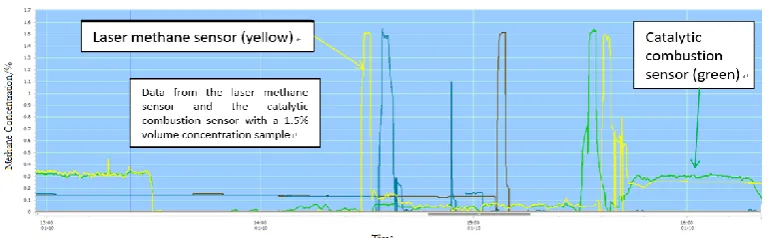
Figure 8 Data from the laser and the catalytic sensors with a 1.5% methane sample
In order to verify the long-term stability and accuracy of the sensor output,a standard gas sample (1.5% volume concentration methane gas) was used to evaluate the sensor performance every seven days, where Figure 8 shows one of the test data sets. There is no obvious change in the performance of the laser-based sensor which gives a better performance than the catalytic combustion sensor which needs to be re-calibrated (with the standard gas sample every seven days). By contrast, the laser methane sensor has been operating for >6 years in several different coal mines without recalibration being needed. Therefore, in coal mine safety monitoring, the traditional catalytic methane sensor and infrared methane sensor can gradually be replaced by the laser methane sensor as it offers better performance in the long term.
4. Conclusion
A laser methane sensor based on laser absorption spectroscopy has been developed and a report of its performance reported in this paper. As a result of its good performance, the laser methane sensor has begun to be put into commercial operation in several coal mines in China. The actual testing data from the laser sensor in these harsh environmental conditions in-the-field show its good performance.
5. Acknowledgments
This work was supported by the Natural Science Foundation of Shandong Province (No. ZR2016QZ006); the Science and Technology Development Plan of Shandong Province (No.2017GSF20117); the National Key Research and Development Plan of China (No:2017YFC0804403). The support of the Royal Academy of Engineering and the George Daniels Educational Trust is greatly appreciated.
References
[1] Sun Jiping. “Coal mine safety production monitoring and communication technology,” Journal of China coal society, 35 (11): 1925-1929 (2010).
[2] Yuan Liang, Xue Junhua,”Chinese coal mine gas control theory and technology,” The annual meeting of the association of Coal Industry Sustainable Development Symposium in Anhui Province, (2010).
[3] Wang Rulin, “Modern research methods and directions of mine gas sensors,”Automation of coal mines, (1): 16-18 (1998).
[4] Non dispersive infrared methane sensor for coal mine. Beijing: China Coal Industry Press, (2009) [5] Rothman LS et al “The HITRAN 2008 molecular spectroscopic database,”. J. Quant. Spectrosc.
Radiat, 110 (9-10), 533-572, (2009).
[6] Li Ning, "Research on gas detection and 2D distribution reconstruction by tunable diode laser absorption spectroscopy technique," Zhejiang University, (2008).