https://doi.org/10.1007/s00163-019-00323-7
ORIGINAL PAPER
A novel systematic method to evaluate computer‑supported
collaborative design technologies
R. Brisco1 · R. I. Whitfield1 · H. Grierson1
Received: 21 December 2018 / Revised: 6 September 2019 / Accepted: 7 September 2019 © The Author(s) 2019
Abstract
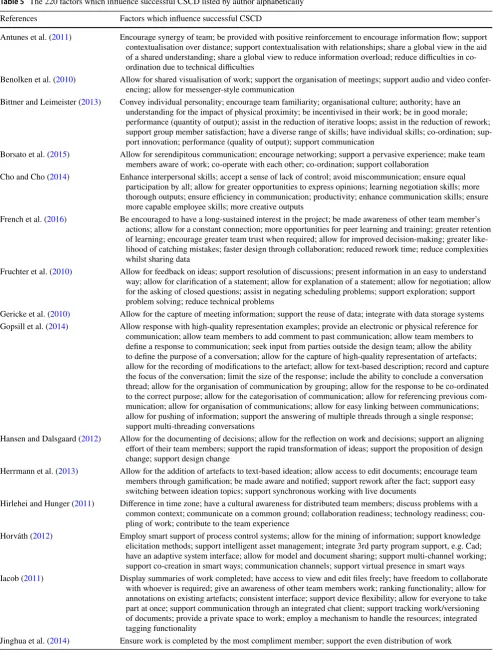
Selection of suitable computer-supported collaborative design (CSCD) technologies is crucial to facilitate successful pro-jects. This paper presents the first systematic method for engineering design teams to evaluate and select the most suitable CSCD technologies comparing technology functionality and project requirements established in peer-reviewed literature. The paper first presents 220 factors that influence successful CSCD. These factors were then systematically mapped and categorised to create CSCD requirement statements. The novel evaluation and selection method incorporates these require-ment staterequire-ments within a matrix and develops a discourse analysis text processing algorithm with data from collaborative projects to automate the population of how technologies impact the success of CSCD in engineering design teams. This method was validated using data collected across 3 years of a student global design project. The impact of this method is the potential to change the way engineering design teams consider the technology they use and how the selection of appropriate tools impacts the success of their CSCD projects. The development of the CSCD evaluation matrix is the first of its kind enabling a systematic and justifiable comparison and technology selection, with the aim of best supporting the engineering designers collaborative design activity.
Keywords Computer-supported collaborative design (CSCD) · Engineering design · Computer-aided engineering and design · Collaboration · Educational tools
1 Introduction
Computer-supported collaborative design (CSCD) is the application of technologies to support a design process involving several parties and usually in distributed loca-tions. Technologies which support CSCD and the technol-ogy functionalities which facilitate collaborative design are essential for distributed design in digital or mixed environ-ments. These technologies provide innovative methods of communication, co-operation and co-ordination within an engineering design context with the potential to foster greater collaboration for internal teams, external
collabora-tors and across boundaries (Hicks 2013; Sarka et al. 2014).
In an increasingly globalised world, CSCD is essential to
support the increasingly complex product design process
(Brisco et al. 2018a).
Technologies which support CSCD come in the form of software or a web application depending on the required features and functionality offered to users. The definition of CSCD can be extended to include hardware which makes CSCD functionality possible through innovative interfaces, e.g. cave automatic virtual environment (CAVE), virtual reality and augmented reality technologies and
telepres-ence robotics (Ahram et al. 2011). Commercial
technolo-gies which support CSCD tend to focus on a certain type of media, functionality or subject to differentiate themselves from their competitors. Technologies might include every-day communication methods such as e-mail, video
confer-encing and messaging (Shen et al. 2015) or specialist
tech-nologies such as digital whiteboards, groupware systems
and knowledge management systems (Hsu 2013; Borsato
et al. 2015; Shen et al. 2015). These technologies have been
adopted by the more general consumer with free technolo-gies offering functionalities such as document versioning
* R. Brisco
control, social networking, and electronic co-ordination
sys-tems (Brisco et al. 2016).
Engineering design teams can utilise CSCD technology functionality using, for example, a multi-threaded conversa-tion for the tasks of commenting and replying, or tagging team members for increased awareness and liking posts to
show agreement (Gopsill 2014). This functionality has the
potential to improve teamwork and change the way engineers
work in the future (Zhao and Rosson 2009). A change is
beginning to be seen in the way small businesses and stu-dents use this technology for design project communication
and decision-making (Gopsill 2014). Many technologies
which support CSCD also support social communication in addition to professional (project related) communication which is beneficial for successful engineering design teams.
Törlind and Larsson (2002) stated: “The highly informal,
accidental, spontaneous communication that characterizes everyday work has an impact on a design that sometimes is even greater than that of formal communication”. This has
been referred to as the watercooler moment in organisations
which offer workers an opportunity to socialise and discuss work informally.
To fully support CSCD, a range of functionalities is required. These are often featured within different technolo-gies, and consequently to fully support CSCD, a range of
dif-ferent technologies are required (Mamo et al. 2015). Issues
arise when technologies have overlapping functionalities offering a choice of communication method. This can lead to confusion in the project progress and future direction, and
social tension between team members (Brisco et al. 2017).
To minimise these effects, it is necessary to carefully select technologies that support the requirements of the design pro-ject and the individual team members.
Methods for technology identification, evaluation and selection exist typically reported in computing journals detailing computer systems selection or in business manage-ment journals detailing the decision process in the technol-ogy management process. The process tends to be holistic in
nature (Sivunen and Valo 2006; Shea et al. 2011; Bohemia
2013) guided by recommendations and sometimes guided
by a framework (Chan et al. 2000) derived from previous
experiences which may or may not be relevant. This can lead to inappropriate technologies being selected which do not offer the functionality to support CSCD projects. Technol-ogy selection also crosses over with the requirements of the project or task, and the team members (Gibson and Cohen
2004). This makes the selection process unique to each
prob-lem requiring specialist knowledge of the entire system. A gap in this research has been that selection methods focus on the requirements of the technology functionality and not of the individual team members, then requiring team members to be trained on the use of technologies.
Technology selection is important for both business and socio-technical interests. Appropriate technology selection has been demonstrated to improve both technology capac-ity and technology management capaccapac-ity which in turn
increases innovation performance (Hao et al. 2007).
Tork-keli and Tuominen (2002) reflected, “A company can waste
its competitive advantage by investing in wrong alternatives at the wrong time or by investing too much in the right ones. It is more and more difficult to clarify the right technology alternatives because the number of technologies is increas-ing, and technologies are becoming more and more com-plex”. Since 2002, this observation has become increasingly prevalent and the number of technologies which can support CSCD has increased enormously requiring assistance in the best technology selection. Socially technology has the abil-ity “to provide a more collaborative method of
communica-tion” (Gopsill 2014) by bringing people together in virtual
environments where the alternative would be too expensive or time-consuming. However, this is not to say technology can and should replace face-to-face co-located working as
this cannot be proven for all contexts (Hatem et al. 2012).
It is important to select the right technologies. When done correctly, a successful selection of technology has the poten-tial to minimise risks resulting in great benefits to businesses
(Rassias and Kirytopoulos 2014). The use of technology can
either provide benefits for a company or could impose
barri-ers if improperly conceived. Cross (2014) surmised, “… they
(companies) may dive into using it (technologies) without forethought or proper risk assessment. On the other end of the spectrum, it may be treated as bleeding edge technology that is largely untried, untested, and/or poses a substantial threat”. In these cases, the response of large companies is to largely block access rather than to understand the poten-tial benefits and devise ways to utilise this in a safe way. There is also the issues of protecting interests as part of using technology such as assets, copyrighted materials and
other intellectual property (Cross 2014). This is especially
important when selecting technologies for new product development teams as security features may not be suitable for collaboration.
Categorisation of the factors that influence successful collaboration has been well published in the literature over
the years. Mattessich and Monsey (1992) first published a
consolidated list of requirements for successful co-located collaboration based on the literature of the time. Some of the factors in this list are still relevant to co-located studies
today, whilst others are not (McDonnell 2012; Fain et al.
2013; O’Riordan 2014).
Efforts to create similar lists for digital collaboration have been made including cross-cultural influencing factors based on the literature from 1977 to 2005 (Markus et al.
2007), risk management guidelines for distributed software
study data from 1995 to 2002 (van Grinsven and de Vreede
2002), collaborative product development factors based on
case studies analysis and survey results around 2007
(Elfv-ing 2007), collaborative product development characteristics
for an agile product development system based on
learn-ing from collaboration with industry (Reich et al. 1999),
key factors for successful collaboration in the integration of CAD/CAE environments based on case studies between two universities and an industry partner in 2006 (Maier et al.
2009), and many o the same efforts have been achieved in
related concepts such as communication (Maier et al. 2006),
co-ordination (Duffy 2002) and co-operation (Hosnedl et al.
2008). These lists of requirements stemming from each of
these studies differ due to differences between the contexts, differences with the data sources, and differences between the periods of investigation, as a result of changes to design practice or technological capabilities.
However, contextually relevant recommendations may provide additional insight when developed over shorter periods of time such as iterations from year to year. Such
attempts use case study data (Horváth 2012; Gopsill 2014;
Borsato et al. 2015) from an individual source which should
not be generalised or the teachings may be misinterpreted. If generalised, the outcomes may not be applicable. In addi-tion, no one has attempted to conduct a systematic literature mapping of existing published work to build a larger picture of the factors which influence the success of CSCD projects.
There have been many decision-making frameworks developed towards the task of selecting technology over time
(Yap and Souder 1993; Gibson and Cohen 2004; Sivunen
and Valo 2006; Nicholas and Steyn 2017). Most require an
in-depth knowledge of the technology application to be able to utilise successfully across a range of factors. Often the individual or team who are in the position to make the
deci-sion does not have this knowledge (Sivunen and Valo 2006).
When this is the case it can result in substandard technolo-gies being selected that do not meet the requirements of the work and additional technologies or protocols to satisfy the
requirements (Sclater 2008). Within student projects,
nologies are often chosen based on the popularity of a tech-nology within a team, and not based on its merits to support design activities or the overall design process (Brisco et al.
2017). When the wrong types of technologies are selected,
it can result in conflict between team members (Hinds and
Bailey 2003) and inefficient working (Brown 2000).
Germani et al. (2012) describe a method to benchmark
co-design tools based on systems architecture. A QFD-based method is detailed and tested with small and medium enter-prise (SME) partners and case studies. The method is suc-cessful in identifying collaborative dimensions which sup-port the SME projects and creating a structured approach to understand collaborative tasks and functionalities through case studies. The outcome of this was the development of
software which can fully support the collaborative
dimen-sions according to the author. This method does not contrib-ute towards the use of existing software to meet collaborative requirements which are typical in smaller start-up
compa-nies and student projects as examples (Ferro 2015; Brisco
et al. 2018b). In addition, the SME case studies used to form
the collaborative dimensions can only be applied to SME projects and not a wider range of potential CSCD projects which a wider literature search would bring.
The motivation behind this research was an observation of a change in student behaviour. This change was reflected with the use of social software and technologies in student
engineering design teams (Gopsill et al. 2015; Mamo et al.
2015; Pektaş 2015) and as an emerging trend within industry
(Margaryan et al. 2014; Sarka et al. 2014). This is a result
of increased awareness amongst students of the disruptive technologies available, whereas educators have knowledge of previous successful projects using technology to impart
to students (Brisco et al. 2018b). Currently, there is no
for-mal method to combine these two factors. If students were empowered with the relevant knowledge, a method to make informed decisions based on the available technologies, and the factors which influence successful CSCD, then they would be able to make decisions to the benefit of their col-laborative and technological requirements.
This highlights the importance of the method presented within this paper to be agile and updatable with respect to current popular technology use. In 2010, the proliferation of Web 2.0 websites and web services reached maturity as
identified by Conole and Alevizou (2010), “We have seen a
continual evolution of technologies and how they are used […] and we are only beginning to develop an understand-ing of what the trajectory of this co-evolution will be”. This coincides with a change in social behaviour driven by the spread of social websites. In 2010, Facebook reached its position as one of the top five websites by user traffic in the
US (Metrix 2010; Post 2014). This encouraged the spawn
of other social network sites and a trend towards mobile social network sites with the proliferation of smartphones
over feature phones in the US in 2010 (Butler 2010).
2 Approach overview
The aim of this research was to develop a method to allow those involved in CSCD projects to evaluate and select suit-able technologies based on the existing knowledge of the requirements of successful CSCD. A four-phase process was
created as illustrated in Fig. 1.
In this paper, Sect. 3 addresses Fig. 1—Step 1 the
crea-tion of the CSCD evaluacrea-tion matrix, identificacrea-tion of known and missing knowledge required and selection of the known
identifies the missing knowledge through a systematic lit-erature mapping, extraction of factors which influence suc-cessful CSCD, categorisation of these factors and validation
through workshops. Section 5 (Step 3) addresses the use of
these factors for the purpose of the CSCD evaluation matrix by creating CSCD requirement statements and validation
through a survey of experts. Section 6 (Step 4) pulls all the
knowledge found and generated together into a complete CSCD evaluation matrix and discusses the creation of an automated text processing method requiring the input of three researchers to create dictionaries and coding to
auto-evaluate reports and diaries of CSCD projects. Section 7
dis-cusses the results of using the matrix to evaluate and develop
a global design class, and Sect. 8 discusses the potential of
the CSCD evaluation matrix in greater details.
3 Creating the CSCD evaluation matrix
The CSCD evaluation matrix was developed to enable the selection of the most suitable technology to support a CSCD project. The CSCD evaluation matrix allows the technolo-gies which support CSCD to be profiled and then compared against CSCD requirements. This is achieved through the identification of functionalities of each individual technol-ogy and evidence that the functionality helps achieve the requirement. The method would also enable a discourse analysis technique to be utilised to automate the population of matrix cells.
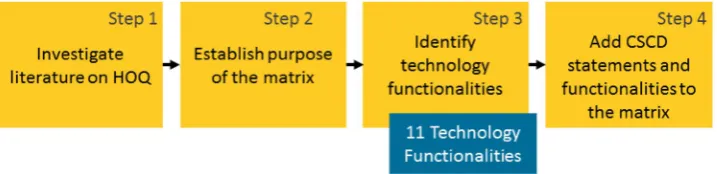
A summary of the methodology used in this section is
displayed in Fig. 2. An investigation was made into House of
Quality (HoQ) literature (Step 1), the purpose of the CSCD evaluation matrix was established and relevant HoQ litera-ture extracted (Step 2), a taxonomy of technology function-alities was found to complete the knowledge requirements of the CSCD evaluation matrix (Step 3) and the CSCD require-ment staterequire-ments were added to the completed CSCD evalu-ation matrix (Step 4).
The CSCD evaluation matrix was initially inspired by the HoQ matrix from Quality Function Deployment knowledge
(Germani et al. 2012). This approach was selected for HoQ’s
suitability for a competitor and product comparison analy-sis. There are structural similarities between the HoQ and the CSCD matrix, and the inputs, outputs and data process-ing were analogous. As the needs of the evaluation matrix developed, certain parts of the HoQ matrix were adapted, for example, there is no need to compare the CSCD require-ments against each other, or for perception measurerequire-ments towards the aim of this paper.
In the HoQ, customer requirements are compared against technical requirements. Both these aspects need to be repre-sented within the new CSCD evaluation matrix. Customer requirements, in this case, are translated to CSCD require-ments, and technical requirements are translated to technol-ogy functionality. In addition, there is also a need to define the technology and its available functionalities. This
hierar-chy is displayed in Fig. 3. Technologies afford functionalities
which satisfy requirements.
Technical requirements are satisfied by the functional abilities of a product. In this case, the functional abilities are
•Create CSCD evaluation matrix based on House of Quality principles •Identify requirements of the matrix
•Identify taxonomy of technology functionalities
1. Create a CSCD evaluation matrix to enable evaluation of technologies for successful CSCD
•Conduct a systematic literature mapping of research in the field •Extract factors which influence successful CSCD from papers •Categorise the literature with input from students and academics in
workshops
2. Identify the factors which influence successful CSCD
•Use the categories to derive statements
•Check statements with survey of experts in the field
3. Derive CSCD requirements
•Collect data from Global Design Project class on students use of technology
•Develop text processing method to evaluate data •Create semantic dictionaries
•Validate the dictionaries through intercoder reliability check •Link data to the CSCD evaluation matrix to display technology use in
the Global Design Project class and reveal outcomes for class development
4. Evaluate the CSCD evaluation matrix using real project data
Fig. 1 Process adopted to create CSCD evaluation method
[image:4.595.53.290.52.368.2] [image:4.595.187.546.627.714.2]already established as the functionalities of the technology, which can be used analogously with the technical require-ments of the HoQ. To identify what the technology func-tionalities are, a taxonomy of the funcfunc-tionalities of CSCD technology was required. This was identified and selected
from Mittleman et al. (2015), where the core competencies
of collaboration technology were appropriately listed. The core competencies are generic descriptions for the function-alities which are available on technologies which support CSCD and this term is used synonymously with
technol-ogy functionality. Mittleman et al. (2015) split these into
three high-level categories: jointly authored pages (shared editors, group dynamic tools, conversation tools, polling tools), streaming media (desktop/application sharing, audio conferencing, video conferencing), and information access tools (shared file repositories, social tagging systems, search engines, syndication tools). The core competencies were extracted, and descriptions inserted into the CSCD evalu-ation matrix.
CSCD requirements represent the conditions necessary to support successful CSCD projects. This has been inves-tigated sporadically in the past through case studies, but no unified or co-ordinated effort to systematically define using published research a complete list of requirements has been made. The requirements are unknown and need to be found to complete the matrix.
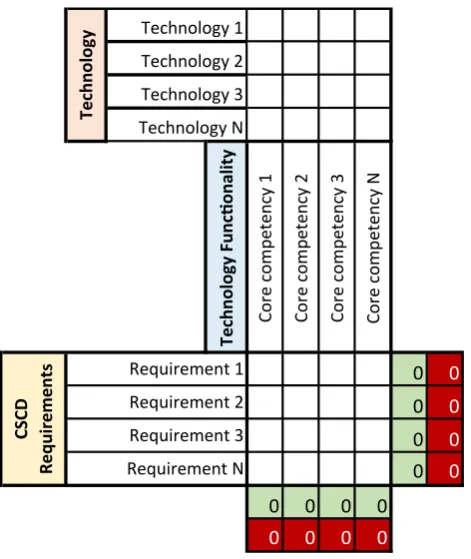
To compare technology to functionality, and then func-tionality against CSCD requirement statements, two matri-ces were created which were linked through the functionali-ties of the technology. This formed the layout of the CSCD
evaluation matrix (Fig. 4), the technology matrix allows
a comparison of technology with functionality, whilst the requirements matrix compares functionality with CSCD requirement statements.
An automated method to populate the matrix was con-ceived to determine which technologies offered which func-tionalities, and subsequently how the CSCD requirements
were satisfied and are discussed in Sect. 6. This method
utilises existing data from a CSCD project and through a discourse analysis analyses the text and sorts into categories linked to the cells within the CSCD matrix. This enables the automated profiling of technologies for comparison or as a representation of a team’s CSCD abilities.
4 Identifying CSCD success factors
4.1 Methodology for identifying CSCD success factors
The procedure for identifying the factors which influence successful CSCD is described within this section and
illus-trated in Fig. 5. These factors were collected from the
litera-ture using a systematic literalitera-ture mapping. The list reflects the state-of-the-art of factors which influence success in CSCD projects.
The research question was established (Step 1) to focus the mapping, followed by a search procedure (Step 2) to guide a systematic approach for paper search and mapping. An iterative approach of identifying relevant search engines (Step 3), creating the search string (Step 4), and conduct-ing the search (Step 5) was conducted until the papers that were consecutively collected met the research question. The literature search was conducted (Step 6), and papers down-loaded (Step 7). Exclusions were implemented to ensure only relevant papers were included in the systematic litera-ture mapping (Step 8). Papers which fealitera-tured statements of successful CSCD were identified through a review of the papers (Step 9), and the findings were extracted from the papers including the context of the paper (Step 10).
CSCD Requirements Technology
Functionality Technologies
Fig. 3 Summary of the CSCD evaluation matrix logic in comparison
Technology Funconalit
y
Core competency
1
Core competency
2
Core competency
3
Core competency
N
0 0
0 0
0 0
0 0
0 0 0 0
0 0 0 0
CSCD
Requirements
Requirement 1 Requirement 2 Requirement 3 Requirement N
Technolog
y Technology 1 Technology 2 Technology 3 Technology N
[image:5.595.309.545.54.334.2] [image:5.595.54.287.58.138.2]4.1.1 Establishing the research question
The research question was created to focus the study on answering one single question and to ensure the exclusion criteria were fair and consistent. The research question established for the systematic literature mapping was “What are the factors which contribute towards successful CSCD in engineering design teams?”
4.1.2 Search procedure
There are many types of search possible to collect and utilise the literature. The type of search used for this project was a
systematic literature mapping (Grant and Booth 2009). The
reason this was chosen was first to systematically collect literature based on search terms and second to allow the collected literature to be mapped which enables the future objective of categorisations of successful CSCD factors. In comparison, a typical systematic literature review is more suited to the examination of the recent and current literature.
Guidelines adapted from Moher et al. (2009) on Preferred
Reporting Items for Systematic reviews and Meta-Analyses (PRISMA) were used to ensure a systematic collection and recording of literature. PRISMA was developed for conduct-ing systematic reviews in the medical field but has the flex-ibility to ensure a systematic process for all potential fields
including engineering design research (Hay et al. 2017). The
PRISMA guidelines were adapted to remove the meta-anal-ysis stage as this is not required for a systematic literature
mapping. All other sections including protocol search, eli-gibility, identification of information sources, search, data processing and exclusions, and synthesis of results were retained.
4.1.3 Identification of relevant search engines
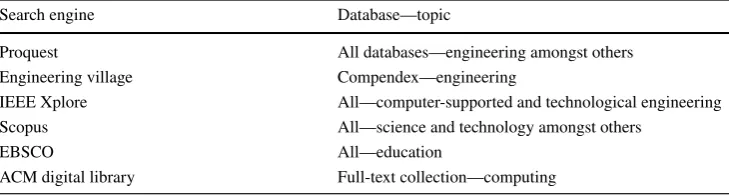
The literature search was conducted using academic search engines in the fields of engineering, technology,
comput-ing and education as seen in Table 1. The search was
con-ducted in June 2017 and spanned published journal articles, conference papers and books between 2010 and 2017. The reason to limit the systematic literature search to research published in 2010 and onwards is related to the motivation of this work as an observable change in student behaviour. Students demonstrated the ability to conduct global design projects using social media tools and a preference towards them. The example within this paper to demonstrate the method including the CSCD requirements and completed CSCD matrix reflect this decision as they are applied to the Global Design Project class. 2010 was chosen due to the popularity of social network sites, proliferation of Web 2.0
technologies and mobile device sales as detailed in Sect. 1.
Literature outside these dates was excluded to ensure fac-tors which influence successful CSCD were based on the use of recent technology with the current functionality and to reduce the number of papers which theorise on how CSCD features and functionalities might be used.
Fig. 5 CSCD success factor identification procedure
Table 1 Search engines and
their relevance to this study Search engine Database—topic
Proquest All databases—engineering amongst others
Engineering village Compendex—engineering
IEEE Xplore All—computer-supported and technological engineering
Scopus All—science and technology amongst others
EBSCO All—education
[image:6.595.182.546.55.197.2] [image:6.595.179.544.618.716.2]Google scholar was not used as it does not have the required Boolean search functionality. ISI Web of Knowl-edge was not included as it did not identify any papers not already identified.
4.1.4 Creation of search string
The search terms were created during a preliminary search
as seen within Steps 3–5 of Fig. 5. Terms were collected and
tested iteratively over approximately 1 month until relevant papers were consistently collected.
Towards the objective of identifying factors which
influence successful CSCD in engineering design teams, the systematic literature mapping was split into three
cat-egories. These were to identify synonyms of factors which
influence, successful CSCD and engineering design teams within categories. These categories became technology, field
and domain as represented in Table 2. Factors which
influ-ence refers to a technology’s stimulus, then technology was
established as a search category. Successful CSCD refers to
the field of collaborative design and this was established as
a search category. Finally, engineering design teams refers
to the research domain of interest and this was included as
a search category. Synonyms of these were tested using
the academic search engines (Sect. 4.1.3) and added to
the search string if papers were returned which met the objective.
Whilst the field and domain categories would identify all
papers on the theories within the research area, the
technol-ogy category was included to meet the motivation of the
work in a change in students’ behaviour towards using social software.
A paper was considered relevant to the study if it could satisfy a search term in each of the three categories within the body of the text, title, keywords or abstract. The Boolean terms N/1 and W/1 were used to find words near other words in a specific order and words near other words irrespective
of order. Searches for engineering N/1 design would return
papers containing the phrase engineering design and design
engineering or with a variable such as design manufacture engineering. Searches for computer W/1 supported would
only return searches within that order, e.g. computer-
sup-ported or computer software supported. Names of software were not included in the search terms as this study does not focus on specific software but focuses on the functionality of technologies which support CSCD. In addition, during a preliminary systematic literature mapping, these terms did not result with any additional relevant papers.
These categories defined the scope of the investigation,
for example, a search for collaborative design AND
engi-neering design AND social software would identify papers
related to the goal of understanding how social software
can support engineering designers to conduct collaborative
design activities.
4.1.5 Exclusion criteria
Three stages of exclusion were performed in line with PRISMA guidelines:
1. Non-accessible, non-English papers, non-peer-reviewed and all duplicate papers were excluded for practical reasons. To achieve this on search engines themselves, English language and accessibility were given as search criteria on each academic search engine and manu-ally reviewed for each paper. A duplicate search was conducted automatically by Mendeley and manually reviewed.
2. Data collected before 2010 were excluded. This was implemented to ensure factors which influence suc-cessful CSCD were based on modern technological use with current competencies. This ensured papers pub-lished post-2010 only utilised data from 2010 onwards. This was manually reviewed in each paper using
Covi-dence (Cochrane 2017), a technology for systematically
reviewing papers. These criteria removed many theories of CSCD systems which are now inaccurate or outdated compared to modern implementations of the software. 3. Any papers that did not explicitly report factors which
influence successful CSCD on the use of CSCD tech-nologies by engineering design teams were excluded. Explicit statements were reporting on the benefits of
Table 2 Search terms and
categories Technology Field Domain
Computer W/1 Supported “Collaborative Design” Engineering N/1 Design
Social W/1 Network “Design Teamwork” “Product Design”
Social W/1 Software Cooperative Design “Industrial Design”
Mobile W/1 Device AND AND “Design Studies”
Mobile W/1 Phone Smart W/1 Phone Tablet W/1 Computer
CSCD technology use, overcoming barriers to CSCD technology use, requirements of CSCD technology use, or opportunities towards better CSCD technology use. This was manually identified, checked and tagged in Covidence.
4.2 Results of identifying CSCD success factors
The systematic literature mapping revealed 517 papers which meet the search criteria and exclusion criteria 1
(Sect. 4.1.5). Exclusion criteria 2 and 3 aided the reduction
of papers to meet the research question. Exclusion criterion 2 reduced the number of relevant papers from 517 to 234. Exclusion criterion 3 further reduced the number of papers from 234 to 27.
Within these 27 papers, the factors that influence suc-cessful CSCD by engineering design teams were identified. The relatively small number of papers reflects the lack of reporting of successes in this area despite the widespread use of CSCD technologies. Factors which influence successful CSCD were extracted from distinct statements on the use of CSCD technologies by engineering design teams in these papers during exclusion criteria 3. For example, in Gopsill
et al. (2013) a table is presented with the requirements of
technology to support teams using social media. This table was extracted and added with other findings to a table list-ing all factors from the systematic literature mapplist-ing which
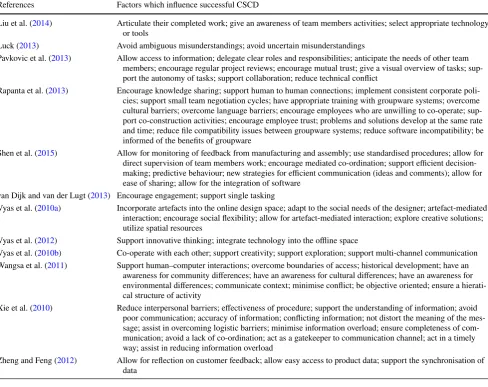
influence successful CSCD and is reported in Table 5 in
“Appendix”.
The systematic literature mapping has revealed that no single paper included a complete list of CSCD factors and 220 factors exist in total. Many authors have chosen to focus on specific areas, picking and choosing outcomes, rather than revealing a complete list of the factors which
influ-ence successful CSCD. For example, Gericke et al. (2010)
focussed on data storage and reuse factors, whereas Vyas
et al. (2010b) focussed on supporting design activities such
as creativity and innovation factors. Other authors such as
Xie et al. (2010) presented a range of outcomes which could
be categorised as a human to human factors and technologi-cal factors. This investigation has revealed a list of CSCD success factors from peer-reviewed and state-of-the-art pub-lished research. However, it is important to identify if further CSCD requirements exist which are not known or reported in the literature.
Once the factors that influence successful CSCD were identified, they contributed towards the technology evalu-ation and selection process. This was achieved by catego-rising the factors to look for similarities across published research and to create CSCD requirements which simplify the success factors into declarations of successful CSCD.
5 Establishing CSCD requirements
5.1 Methodology for establishing CSCD requirements
The list of 220 CSCD factors was verified using experts and those experienced in CSCD to assess the completeness of the list. Factors were then categorised and converted into require-ment staterequire-ments to simplify the analysis within the CSCD evaluation matrix. Finally, these requirement statements were validated with expert opinions. The process of transforming the CSCD factors into requirements for success is illustrated
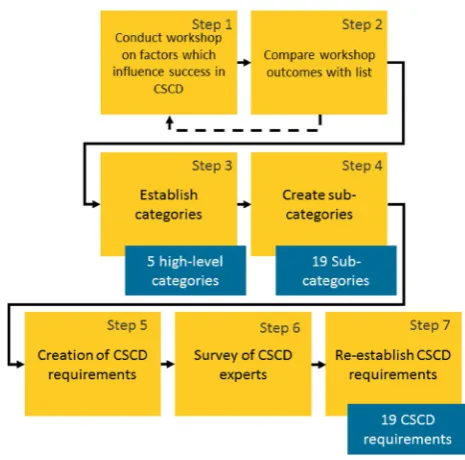
in Fig. 6.
Workshops were conducted to investigate the completeness of the list of factors which influence the success of CSCD (Step 1) and the factors were checked iteratively (Step 2). On comple-tion, the 220 factors were categorised into five high-level catego-ries (Step 3) and 19 sub-categocatego-ries (Step 4) and sub-categocatego-ries were redefined (Step 4). The 19 CSCD requirement statements were created to represent the factors within each of the 19 sub-categories (Step 5). A survey was created and distributed to discover if experts agreed with the 19 CSCD requirement state-ments (Step 6). Finally, the sub-categories were re-established based on the opinions of experts from survey feedback (Step 7).
5.1.1 Verifying the list of factors which influence CSCD success
The 220 factors were verified through a series of seven workshops to identify any factors which influence success
[image:8.595.306.539.463.693.2]in CSCD projects not captured through the systematic lit-erature mapping.
Three workshops were held with representatives from academia and industry at the 18th International Conference on Engineering and Product Design Education (E&PDE 2016) with 12 participants, the 21st International Conference on Engineering Design (ICED’17) with 22 participants and at the 15th International Design Conference (Design 2018) with 21 participants. These workshops had a common theme
on collaborative design and asked: “What are the challenges
in supporting successful collaborative design?” Findings on the use of technology were extracted and compared with the 220 factors.
Four workshops were held with students experienced in CSCD during The Global Design Project (GDP) in 2016 with 18 participants, and in 2017 with 26 participants, and during the Global Studio class in 2016 with 26 participants and 2017 with 28 participants. The student workshops were all on the topic of technology use in global CSCD pro-jects and asked students to reflect on successful collabora-tive practices. Example outcomes from the workshops are reported in. GDP students were all final year master students within the department of design manufacture and engineer-ing management at the University of Strathclyde. Students of the Global Studio class were all undergraduates within the design school at Loughborough University. The workshops asked participants to share their knowledge on CSCD top-ics, discuss success in collaboration and current and future barriers to collaboration, and how these barriers might be overcome through research. The knowledge collected from these workshops was used to iteratively develop the cod-ing scheme until 19 distinct sub-categories emerged. All outcomes from the workshops were collated and compared to the list of 220 factors to ensure no factors were missing from the list.
Following the workshops and comparing the outcomes with the list of 220 factors, there were no additional factors which could be added to the list to make it more complete. This demonstrated the success of the systematic literature mapping method in collecting the factors.
One major outcome from the workshops was an aware-ness that experts wished to discuss the differences and defi-nition of co-ordination, co-operation and collaboration and that many did not have a definition of each. Many academics argued that co-ordination is inherent to co-operation and collaboration and so perhaps it is a sub-category of both. Students and academics argued that co-operation and col-laboration are not distinct enough and so they should be contained under the same category or a joint category.
It has been well discussed in the literature that collabora-tion is more complex than co-operacollabora-tion in that it involves shared risk of failure and opportunities for shared success
(Adams 2015). Collaboration is mutually beneficial and
requires a common goal somewhere in the process towards a shared outcome, whereas co-operation only requires the sharing of knowledge and resources towards a shared
activ-ity (Kvan 2000). Success is not defined by the outcomes
of the project, but by the relationship and how well it was
managed (Brewer 2015). Perhaps this insight from the
work-shops explains why there has not been a list of factors which influence the success of CSCD presented before and why the creation of a CSCD evaluation matrix has not previously been possible.
5.1.2 Creating CSCD requirements through categorisation
Each of the 220 factors which influence successful CSCD was assigned a category, and then a sub-category was derived. The categories were based on those reported by
Mattessich and Monsey (1992): communication channels,
collaborative environment, process and structure, team member characteristics, and resource management.
Sub-categories were iteratively created using a coding scheme based on benefits of CSCD technology use, over-coming barriers to CSCD technology use, requirements of CSCD technology use, or opportunities towards better CSCD technology use. NVivo 11 was used to create this coding scheme and code each factor.
The 5 categories and 19 sub-categories which emerged from the categorisation activity are described as follows:
Communication channels refer to the many ways in which a team can communicate and how they can be supported through technology use. The three areas identified in the literature which influence engineering design teamwork are
• artefacts, the use of digital representations of physical
objects and digital work,
• feedback, on previous work to influence future
develop-ment, and
• social, including networking to reduce interpersonal
bar-riers.
The collaborative environment refers to how collabora-tion is supported within an organisacollabora-tion, team or group. The two areas identified in the literature which influence engi-neering design teamwork are
• access to information, how and where the knowledge and
data can be accessed for transparency and ease of use, and
• corporate structure, for clear hierarchy and procedures.
• decision-making, the ability to share opinions and make informed decisions,
• knowledge capture, techniques and technologies to create
comprehensive data stores, and
• productivity, to support readiness with the right skills at
the right time.
The team member characteristics of a design team have influence over ensuring the right team members are involved with the project. The five areas identified in the literature which influence engineering design teamwork are
• commonality, consideration of differences in language,
culture, social and time zones,
• motivation, of critical team members to ensure sustained
interest in a project,
• shared understanding, of the problems, concepts and
techniques,
• team co-operation, awareness of work and contribution
towards co-construction activities, and
• trust, of the quality and completeness of the work of
oth-ers.
Resource management refers to knowledge and skill assignments towards a common goal. The five areas iden-tified in the literature which influence engineering design teamwork are
• competency, ensuring the best team member completes
the appropriate work,
• co-ordination, of work, and team members time
effi-ciently,
• innovation, promoting techniques for creativity and
exploration,
• knowledge management, of all stakeholders and
aware-ness of the whole life of the product,
• managing the sharing of data refers to how information
can be sent to others, where it is hosted and the mecha-nism to send it, and
• communication refers to the different communication
methods available through technology. Whether a con-versation is synchronous or asynchronous communica-tion to suit the message context and other factors such as multi-threaded conversations and multi-channel com-munication.
The categorised factors were subsequently summarised into statements which represent CSCD requirements. A total of 19 statements were created, one for each sub-category. An issue arose during the creation of the statements that
some factors inferred the same outcomes such as avoid
mis-communication (Cho and Cho 2014) and avoid uncertain misunderstandings (Luck 2013). In these instances, they
were included in the same requirements as they related to
the same context. Another example is discuss problems with
a common context (Hirlehei and Hunger 2011) and Com-municate context (Wangsa et al. 2011). In this example, the
requirement became R2. Encourage a shared
understand-ing by defining and framing conversations within a
com-mon context which makes it easy to understand information,
clarify meaning and reduce miscommunications. The full list
of CSCD requirements was created as follows. CSCD technology:
R1. Supports complexity managing the sharing of data
through integration with data storage systems, reduced file compatibility issues and synchronous live docu-ment working with automated tracking and versioning to enable co-creation of documents.
R2. Encourages a shared understanding by defining and
framing conversations within a common context which makes it easy to understand information, clarify mean-ing and reduce miscommunications.
R3. Encourages co-operation by enabling increased
aware-ness and connectivity to encourage equal participation, support design activities by anticipating needs and opportunities for peer learning.
R4. Supports knowledge management through the
organisa-tion of informaorganisa-tion and communicaorganisa-tion, the ability to easily search and retrieve knowledge, and autonomy in the distribution of knowledge.
R5. Allows for feedback from stakeholders to support
reflection on past communication and concepts dependent on the context, knowledge, experience and competency of the stakeholders.
R6. Allows for social communication which encourages
team synergy, knowledge sharing and serendipitous communication by supporting networking and build-ing interpersonal skills.
R7. Supports knowledge capture through the recording of
information, decisions and artefacts to document the design process and contribute to decision-making and reuse of knowledge.
R8. Supports communication through synchronous and
asynchronous multi-threaded and multi-channel soft-ware for prompt discussion in a way which supports the context of the message.
R9. Enables team members to overcome boundaries of
access to easily view and edit files when required.
R10. Encourages the building of trust to support conflict
resolution through increased accuracy, clarity and transparency of communication between team mem-bers.
R11. Supports co-ordination through a shared space for
mecha-nisms for scheduling meetings and to support the even distribution of work.
R12. Allows for artefact-mediated communication which are
high-quality digital representations of physical work and ideas.
R13. Reduces the barriers of physical proximity, language
and time zones, and enable a greater awareness of cul-ture and the global community.
R14. Supports decision-making through concept ranking
functionality, increased opportunities to develop nego-tiation skills and express opinions.
R15. Allows for greater productivity through fast objective
focused communication, organisation of work and a greater quantity of output to promote collaboration readiness, reflection and reduced rework time.
R16. Encourages innovative thinking through agile systems
to support exploration, creativity and quality of out-puts.
R17. Encourages the development of greater competency
through increased accessibility of team and non-team skills and experience, reduction of unnecessary infor-mation and supporting the completeness of messages.
R18. Encourages motivation through mechanisms of social
incentivisation, positive reinforcement, gamification or
encouraging moral decisions to ensure long-sustained interest in the project and if implemented correctly can help avoid conflict and support conflict resolution.
R19. Integrates with company structure through the
imple-mentation of procedures, policies and agreements to ensure clear roles and responsibilities, reducing the sense of lack of control and optimising team negotia-tion cycles.
5.1.3 Validating CSCD requirements
To verify the CSCD requirements, a survey was sent to 94 experts in CSCD. These experts were identified as nota-ble authors through the systematic literature mapping. 24 experts responded to the request by completing the survey. The survey asked if the expert agreed with each of the CSCD requirements (agree, disagree in full, or disagree in part) and in addition, how important the requirement was towards success in CSCD (high, medium or low importance) so that
they could be ranked from most to least important. Figure 7
is an example of the first question asked and all others follow the same format.
The survey was e-mailed to experts with a link and
instructions on how to complete the survey. Tables 3 and 4
display the results of the questionnaire.
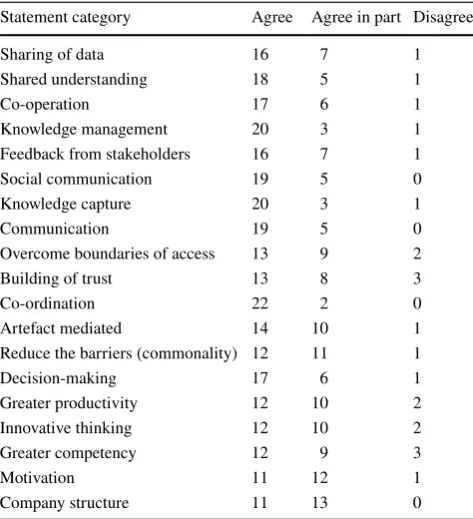
Most experts agreed with the CSCD requirements either
in full or in part as displayed in Table 3. Where disagreement
in full or in part was selected, the comments were used to understand why there was disagreement and how the state-ment might be changed to better represent the views of the experts. One main change suggested by the experts was that the requirements should not focus on the positive outcomes.
Instead, they should say that CSCD could have these
out-comes. The technology category was also split representing the management of shared data, and communication.
Experts ranked the CSCD requirements in order of
importance as displayed in Table 4. One prominent
com-ment was that although some lower ranked statecom-ment catego-ries are very important for collaboration, they are perhaps less important for computer-supported collaboration. This could be because barriers are overcome using technology or more fully supported making the topic of the statement less important.
6 Automatic population of the CSCD
evaluation matrix
The 19 CSCD requirements were included in the CSCD evaluation matrix with the 11 technology functionalities as
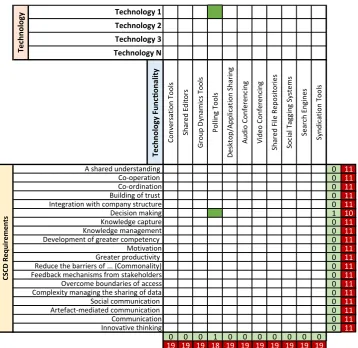
illustrated in Fig. 8. The CSCD evaluation matrix supports
an assessment of how well an individual technology satis-fies successful CSCD, how multiple technologies compare against each other, and how a combination of technolo-gies can satisfy an organisation’s CSCD requirements by profiling.
A binary code is used to populate the matrix: if a tech-nology functionality satisfies a CSCD requirement an entry is marked 1, or if they are not related, marked 0. The rows and columns are summated to establish the suitability of the functionality towards the CSCD requirements. The summa-tion of the 1s in the rows and columns provides an indicasumma-tion of requirement or functionality fulfilment and is presented in the green summary box. A summation of the 0s in the red summary box represents that lack of requirement or functionality fulfilment for any given technology. A larger score signifies that the functionality has satisfied the CSCD requirements to a greater extent and that little changes are required to fully satisfy the factors for successful CSCD. Where a low score exists, there are opportunities for alterna-tive or a combination of technologies or techniques to satisfy the CSCD requirements.
Two technologies can be evaluated by comparing the cells (the profile) or the total scores for requirement or functionality fulfilment. A team’s technology (summary of all technologies used) can be profiled by including multiple technologies.
Table 3 Expert assessment of the developed CSCD requirements
Statement category Agree Agree in part Disagree
Sharing of data 16 7 1
Shared understanding 18 5 1
Co-operation 17 6 1
Knowledge management 20 3 1
Feedback from stakeholders 16 7 1
Social communication 19 5 0
Knowledge capture 20 3 1
Communication 19 5 0
Overcome boundaries of access 13 9 2
Building of trust 13 8 3
Co-ordination 22 2 0
Artefact mediated 14 10 1
Reduce the barriers (commonality) 12 11 1
Decision-making 17 6 1
Greater productivity 12 10 2
Innovative thinking 12 10 2
Greater competency 12 9 3
Motivation 11 12 1
Company structure 11 13 0
Table 4 Expert opinion on importance of CSCD statement
Statement category Low Med High Rank
Sharing of data 0 5 19 67
Shared understanding 0 7 17 65
Co-operation 1 5 18 65
Knowledge management 0 7 17 65
Feedback from
stake-holders 2 4 18 64
Social communication 1 6 17 64
Knowledge capture 0 8 16 64
Communication 0 9 15 63
Overcome boundaries of
access 2 6 16 62
Building of trust 0 10 14 62
Co-ordination 0 10 14 62
Artefact mediated 3 6 16 61
Reduce the barriers
(commonality) 0 11 13 61
Decision-making 0 11 13 61
Greater productivity 0 11 13 61
Innovative thinking 3 6 15 60
Greater competency 3 9 12 57
Motivation 4 10 10 54
[image:12.595.51.288.70.330.2] [image:12.595.51.289.371.661.2]The CSCD evaluation matrix contains up to 209 relation-ships when featuring only one technology, which requires significant comprehension and background knowledge to populate. To complete this manually would be a consider-able task completed by multiple people experienced in the technology to reach consensus. An automated population method was developed using a discourse analysis method to take reported information on technology use and filter it to populate the CSCD evaluation matrix. This offers a systematic way of populating the CSCD evaluation matrix.
Figure 8 illustrates the population of the CSCD evaluation
matrix where Technology 1 contains polling tool function-ality which satisfies the CSCD requirement of
decision-making (Fig. 9).
6.1 Systematic population of the CSCD evaluation matrix
The input data used to populate the matrix included student reports, and diaries on the use of technology to meet CSCD requirements and was collected from a GDP class over a 3-year period with 34 students in 2015, 45 in 2016, and 25 in 2017. The sample size for this study is 104. The reports were created by the students reflecting on the successes and failures of their projects. A diary was kept by the author on the action’s teams were taking and quotes from students on their technology use.
An automated text analysis system was created to popu-late the matrix using this data. The text analyses had to inter-pret the words of the given text and code it appropriately into
Fig. 8 CSCD evaluation matrix X
Technology Funconalit
y
Conversation Tools Shared Editors Group Dynamics Tools
Polling Tools
Desktop/Application Sharing
Audio Conferencing Video Conferencing Shared File Repositories Social Tagging Systems
Search Engines Syndication Tools
0 11 0 11 0 11 0 11 0 11
X 1 10
0 11 0 11 0 11 0 11 0 11 0 11 0 11 0 11 0 11 0 11 0 11 0 11 0 11
0 0 0 1 0 0 0 0 0 0 0
19 19 19 18 19 19 19 19 19 19 19 Greater productivity
Artefact-mediated communication Communication Reduce the barriers of ... (Commonality)
Technolog
y Technology 1
Technology 2 Technology 3 Technology N
Feedback mechanisms from stakeholders Overcome boundaries of access Complexity managing the sharing of data Social communication
CSCD Requirements
Innovative thinking A shared understanding Co-operation Co-ordination Building of trust Integration with company structure
Decision making Knowledge capture Knowledge management Development of greater competency
Motivation
[image:13.595.187.546.53.401.2] [image:13.595.186.546.653.715.2]categories. These categories related to the technology, the functionality of the technology, or the CSCD requirement. Semantic dictionaries were created for each category and sub-category and allow for the categorisation of sentences based on the words which build them. All possible syno-nyms were collected from student reports and included in the dictionaries.
When checking the data, the word or words which con-tributed to the coding of the sentences were extracted. These extracted words were used to create semantic dictionaries for each category. 19 dictionaries were created for CSCD requirements, 11 for technology functionalities, and 7 for technologies used during the GDP. These technologies were social network site, messenger, video conferencing, cloud document storage, project management groupware, e-mail and collaborative document editor. The completed
dictionaries are contained within Table 7 in “Appendix”. A
sentence discussing the benefits of Facebook® in supporting
communication through conversation would be categorised in technology as “SNS”; in functionality as “conversation tool”; and in CSCD requirement as “communication”.
289 data points were collected. Data were split for coding (35%) and for testing (65%). Due to the controlled nature of the project and the limited nomenclature of the data, 35% was a sufficient coding sample. Whilst conducting a verifica-tion of the final 65% of the data, only two words were found across the 36 categories, in addition to approximately 486 found from the 35% coding data. Data coding was completed by three experienced CSCD practitioners to create semantic dictionaries. Three academics was the minimum required to achieve a representative consensus on decisions where disa-greements may occur, i.e. if a disagreement occurred then one other person would be able to resolve it. In addition, three data points were required to identify that a connection is true and confidence is on trend. Academics took sentences involving the use of technology to support collaboration and
identified three parts of these sentences: the technology used,
the functionality available and the CSCD requirement
satis-fied. These three parts of the sentence correspond with the
elements of data required to populate the CSCD evaluation matrix i.e. technology, technology functionality and CSCD requirements. Each academic created their own semantic dictionary based on the categories and the results from the sample data were compared between researcher, known as intercoder reliability.
For example, one GDP team member stated “Video con-ferencing facilitated design activities to send and receive
documents”. This was coded as Videoconferencing in
tech-nology, group dynamics tools in technology functionality,
and complexity managing the sharing of data in CSCD requirements. The evaluation was subjective and clarified the need for an intercoder method.
To satisfy the intercoder method used, disagreements were resolved by the third member of the coding team. In instances of a difference of opinion by all three, a discussion of the factors was held. The coding team agreed on 87% of the checked data in the first instance. Through discus-sion, the remaining 13% was agreed upon. Disagreements were due to differences in the interpretation of the data. For
example, the use of slack® for multi-channel
communica-tion enabling sub-team communicacommunica-tion was reported. This
was coded by one academic as a conversation tool and by
another as a social tagging system. Both can be applied as
slack® is being used for conversations, but communications
are being tagged to enable sub-team syndication. Through discussion, the decision was made to code this as tagging which enables multi-channel communication and was the intent of the sentence in its original context.
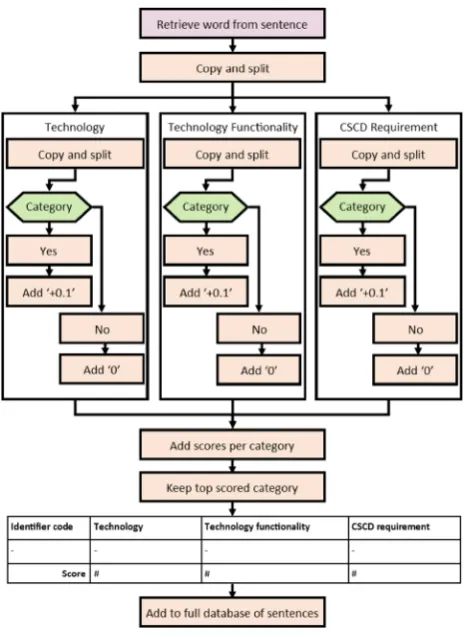
Following the creation of the semantic dictionaries, the dictionaries were included in an automated text processing method using the RapidMiner Studio software. Text process-ing enabled the sentences reserved for testprocess-ing from student reports to be automatically filtered into a category based on the semantic dictionaries. Sentences which were filtered were awarded a score of + 0.1 based on the number of simi-lar words also in the category. A value of 0.1 was selected to make significance calculations simple and follow gen-eral practice. The score acts as an automatically generated confidence indicator if the sentence could be categorised multiple ways and the top score is automatically progressed to the data output.
For example, the word messenger could refer to
Facebook® Messenger coded as a social network site, or
WhatsApp® referring to messenger applications or the
inbuilt messenger technology in video conference tech-nologies. In most cases, the word will refer to messenger technology and not social network sites or video conference. This can be confirmed by looking at other words in the sen-tence such as app, chat, instant and voice, amounts others included in the semantic dictionary. Where multiple words are detected, the confidence score increases.
Figure 10 illustrates the process of parsing a data set from
The output from RapidMiner Studio is a spreadsheet of all data points, their categories and their confidence scores. This spreadsheet is used to populate the matrix which was automated in excel. Where the data point has two or more categories it can populate a cell in the matrix. For example, the categories of communication and communication tools are linked and the data show examples of this, then the cell connecting both categories would be filled.
7 Results
The use of the CSCD evaluation matrix populated by the GDP data has revealed insights into the class that could help with the development of this class and demonstrates its value. The insights are discussed based on the populated
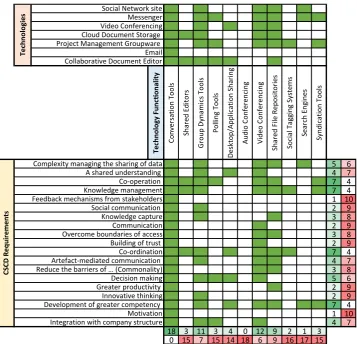
CSCD evaluation matrix presented in Fig. 11.
The CSCD evaluation matrix was automatically popu-lated with the output from RapidMiner Studio illustrating the relationships between the success factors and technology functionality. The nodes within the CSCD evaluation matrix provide a numerical indication of the confidence of the rela-tionship between the two aspects. This illustrates the extent to which the functionality of the technology used within the
GDP addressed the CSCD requirements. The CSCD evalu-ation matrix provides insight into both project managers and computer scientists regarding the barriers in the collabora-tive process. The CSCD evaluation matrix also supports the identification of whether new or additional technology is required to fill gaps in the CSCD requirements. Within a newly formed team, the CSCD evaluation matrix could be used to select and build a toolkit of integrated technology that meets the CSCD requirements of the team, the project, and the processes.
In Fig. 11, it is visually demonstrated that there are gaps
in the requirements of building trust, motivating team mem-bers, greater productivity, reducing barriers and feedback mechanisms. A team would then investigate why these requirements are not being fulfilled with additional tech-nologies which encourage these practices.
Technology that supported conversation contributed towards almost all requirements relating to the success of the teams. This was expected as without conversation it would be difficult to perform any collaborative task. All technologies that were used within the GDP had some form of conversation tool. This is the only column which is fully populated which demonstrates the importance of conversa-tion in all aspects of CSCD.
Mamo et al. (2015) posited that four areas of technology
functionality would be most populated: conversation tools, video conferencing, group dynamic tools and shared file repositories. It was, therefore, expected that these function-alities would satisfy the requirements for success in CSCD fully. The CSCD evaluation matrix has revealed this to be true for conversation and the remaining three are more popu-lated. The reason for this is due to the factors which influ-ence CSCD which the technologies satisfy.
Group dynamic tools supported many requirements for successful CSCD which were unexpected. For example, company structure was not expected to be related to any requirement, but in reviewing the populated matrix, com-pany structure relates to enabling all members of a team, no matter their position, the ability to contribute to discussion and decisions. Competency was not expected to be a con-tributor to group dynamic tools either as competency reflects a human’s ability to perform a task and not a computer’s ability. But in reviewing the populated matrix, competency relates to the functionalities that technologies offer enabling tasks to be completed in a simplified way. This relates to the availability of team members for a task and their suitability. Technology can support this by offering co-ordination and profiling functionalities.
Social communication was not expected to arise in group dynamic tools as the functionality typically refers to project work and professional communication. However, within design engineering, innovative thinking outcomes can arise from social interaction contributing to new ideas.
[image:15.595.54.289.55.374.2]There were no data relating to knowledge capture with the functionality of video conferencing. This could be because the knowledge capture of video conferencing technologies is difficult to implement. Typically, video conferences can be recorded but this does not enable easy summaries to work from and if summaries are created in a text form this requires manual work. Transcriptions could be one alternative with text search, but none of the technologies used within the GDP offered this ability. This could be an opportunity for improving success in CSCD for design engineering if the technology used enables simple capture of work in a usable format. This demonstrates the abilities of the CSCD evalua-tion matrix to display why factors for success in CSCD were not met and clearly displays how they could be met in future technology development.
Syndication tools such as notification systems are often linked with building trust between team members (Carroll
et al. 2003; O’Riordan 2014). Within the GDP data, this was
not observed. The CSCD evaluation matrix indicates that this functionality is more linked with management in being able to co-ordinate people.
It is important to note that this method and its results cannot be generalised to all engineering projects using this
data. The data used is from an educational environment and deals with distributed engineering design. Many of the tech-nologies considered have search functionality; however, the use of search was not reported in the GDP data. In addi-tion, audio conferencing was not utilised within the GDP in favour of the use of video conferencing, however, the use of audio conferencing may be preferable in other projects. What can be inferred from this is a trend within the GDP that there is an expectation for functionalities such as search and subsequent a lack of reporting on its use. The results can be considered complete in terms of the use of technology within the GDP 2015–2017. And for examples outside this context further data collection would be possible.
8 Discussion
This method fills a gap within the GDP and the wider engi-neering design community where there is a lack of knowl-edge on CSCD tools to help teams select suitable technolo-gies. To fill this gap in knowledge, the steps are taken for creating a matrix and identifying factors which influence success in CSCD, and an automated evaluation method has
Fig. 11 Success in CSCD matrix with data populated from
GDP class
#
#
4
4
#
4
#
1
2 #
1
Technology Funconality
Conversation Tools Shared Editors Group Dynamics Tools
Polling Tools
Desktop/Application Sharing
Audio Conferencing Video Conferencing Shared File Repositories Social Tagging Systems
Search Engines Syndication Tools
6 0 3 0 0 0 3 15 0 1 0 5 6
3 0 3 0 2 0 1 0 0 0 0 4 7
11 1 5 1 0 0 1 2 0 0 3 7 4
17 2 1 0 0 0 11 19 1 0 3 7 4
8 0 0 0 0 0 0 0 0 0 0 1 10
4 0 6 0 0 0 0 0 0 0 0 2 9
2 0 1 0 0 0 0 4 0 0 0 3 8
14 0 0 0 0 0 1 0 0 0 0 2 9
2 0 0 0 0 0 2 1 0 0 0 3 8
6 0 0 0 0 0 1 0 0 0 0 2 9
7 1 3 0 1 0 4 3 2 0 0 7 4
5 0 3 0 0 0 1 1 0 0 0 4 7
5 0 0 0 0 0 2 1 0 0 0 3 8
2 0 3 4 1 0 1 0 0 0 0 5 6
1 0 0 0 0 0 0 1 0 0 0 2 9
2 0 1 0 0 0 0 0 0 0 0 2 9
17 0 6 0 1 0 9 4 0 1 1 7 4
2 0 0 0 0 0 0 0 0 0 0 1 10
7 0 1 1 0 0 2 0 0 0 0 4 7
18 3 11 3 4 0 12 9 2 1 3
0 15 7 15 14 18 6 9 16 17 15
Integration with company structure
CSCD Requirements
Technologie
s Social Network siteMessenger Video Conferencing Cloud Document Storage Project Management Groupware Email Collaborative Document Editor
Knowledge capture Communication Overcome boundaries of access Building of trust
Co-ordination Artefact-mediated communication Reduce the barriers of … (Commonality)
Decision making Greater productivity Innovative thinking Development of greater competency Complexity managing the sharing of data
A shared understanding Co-operation Knowledge management Feedback mechanisms from stakeholders Social communication
[image:16.595.187.545.54.398.2]