Superfluid helium-4 hydrodynamics with discrete topological
defects
Demosthenes Kivotides
University of Strathclyde Glasgow
(Dated: September 16, 2018)
Abstract
PROLOGUE
FINITE TEMPERATURE DYNAMICS OF DISCRETE TOPOLOGICAL DEFECTS
Our analysis of superfluid vortex dynamics (SFVD) assumes that the latter can be de-scribed within the normal-fluid’s hydrodynamic framework. Under typical experimental conditions, this is the case for T > 0.8 K. For smaller (yet finite) temperatures a kinetic theory that takes into account quasiparticle interactions (a quantum version of the Boltz-mann equation) needs to be employed. For ultra-low temperatures, in the limit T → 0 K, ballistic quasiparticles could be modelled by the simpler Vlasov equation. In FTST, vortex pointsXv(t) comprising a superfluid vortex tangleLmove under the influence of three forces (a) inertial force fi, (b) Magnus forcefM, and (c) mutual-friction forcefmf that corresponds to its interaction with the ambient normal-fluid flow. In FTST, the small vortex mass values allow one to neglect fi in comparison with the other forces, so fM+fmf = 0. We start our analysis by observing the dissipative nature of the Hall-Vinen force [21], a key component of fmf. This force resembles the drag force on an object moving in a classical fluid, i.e., the Stokes force. Indeed, due to the very small vortex core size (which scatters the normal-fluid quasiparticles), the latter are expected to comprise a creeping flow around the vortices. A second key observation is that a superfluid vortex appears (locally) to the flow similar to a
cylindrical rod with circular cross-section. By combining these two observations with low Reynolds number hydrodynamics [22, 23], we can apply to SFVD a known solution of the latter regarding the resistance force on an elongated cylinder (in SFVD a vortex segment) with radiusR and lengthL. This force iscontainedin the plane defined by the cylinder axis and the velocity vvn of the cylinder/vortex relative to the normal-fluid (vvn ≡ X˙v −Vn, where ˙Xv is the vortex velocity (Xv is the vortex position in the superfluid vortex tangle), and Vn (referred to as V∞n in theory of suspensions) is the asymptoticnormal-fluid velocity at the vortex position). V∞n is a coarse-grained (possibly turbulent) Navier-Stokes velocity that does not resolve the microscopic(creeping) flow field around the vortex. In SFVD, the cylinder axis is parallel to the tangent vector along the vortex contour, R is equal to the vortex core parameter α0, and L is a characteristic vortex dynamical length-scale, which
in numerical calculations would be the discretization length δℓ along vortices. Core radius
α0 has a mild variation with temperature around the value α0 ≈ 10− 8
drag forces per unit length: one normal to the vvn direction, and another parallel to it: fD = D⊥X′v ×(X′v ×vvn) +DkX′v(X′v ·vvn), where the values of D⊥ and Dk are given by creeping flow analysis: D⊥ = 8πρnν/(ln(ξ/α0) + 0.5) and Dk = 4πρnν/(ln(ξ/α0)−0.72).
X′v is the unit tangent vector at vortex position Xv, and ν is the kinematic viscosity of the normal-fluid. Adding the Iordanskii force [24–26] to fmf and the Magnus force, we obtain the following SFVD
X′v×[ρsκ( ˙Xv−Vs) +D⊥X′v×vvn+ρnκvvn] =−DkX′v(X′v·vvn),
whereκ is the quantum of circulation, andρn and ρs are, correspondingly, the normal-fluid and superfluid mass densities. This equation can only be satisfied if both of its sides are equal to zero, i.e., X′
v·vvn = 0, and
ρsκ( ˙Xv−Vs) +D⊥X′v×vvn+ρnκvvn=λX′v,
for a real numberλ to be determined. Solving the last equation in terms of ˙Xv, employing the decompositionvvn = (vvn·X′v)X′v−Xv′×(X′v×vvn), and using the conditionX′v·vvn = 0 above, we obtain
˙
Xv =Vs−(D⊥/ρsκ)X′v×vvn−(ρn/ρs)vvn+ (λ/ρsκ)X′v.
Next, employing the decomposition Vs = (Vs ·X′v)Xv′ −X′v ×(X′v × Vs), multiplying both sides with X′v, and demanding that there is no vortex velocity along the tangent, i.e.,
˙
Xv·X′v = 0, we obtain the following equation forλ: Vs·X′v+λ/(ρsκ) = 0. With this value, the SFVD equation reads
˙
Xv =−X′v×(Xv′ ×Vs)−(D⊥/ρsκ)X′v×vvn+ (ρn/ρs)X′v×(X′v×vvn).
Next, we define the coefficientsa =D⊥/ρsκ and b=ρn/ρs, and we rewrite the equation in the form ˙Xv+A×X˙v =B, whereA =aX′v/(1 +b), and B= [−X′v×(X′v×Vs) +aX′v× Vn−bX′v ×(X′v×Vn)]/(1 +b). The solution of this equation is [27]
˙
Xv = [B−A×B+ (A·B)A]/(1 +A·A)].
After straightforward vector algebra, the solution can be written as
˙
where α =−[b(1 +b) +a2
]/[(1 +b)2
+a2
], and β =a/[(1 +b)2
+a2
]. Notably, α < 0 and
β > 0, hence, the double vector product term contributes to the vortex velocity a part of the component of Vn−Vs that is not along the direction of the vortex tangent, whilst the single vector product term results in the growth of a vortex ring’s radius wheneverVn−Vs points along the direction of Vs.
Coupling the new SFVD with the Navier-Stokes equation for the normal-fluid [15–19] forms a fully predictive FTST model, bringing superfluid research on par with other areas of hydrodynamics. Hence, we add the conservation of mass in the incompressible normal-fluid ∇ ·Vn = 0, and the conservation of its momentum
∂Vn(x, t)
∂t +∇
p
ρn+ρs
+Vn·Vn 2
−Vn×(∇ ×Vn)−
ν∇2Vn−κ
Z
L
d|XL|[X′L×(Vn−X˙L)]δ
3
(x−XL)−
νc
Z
L
d|XL|{X′L×[X′L×(Vn−X˙L)]}δ
3
(x−XL) = 0,
wherepis the isotropic part of the normal-fluid pressure tensor,µ=νρn is the normal-fluid dynamic viscosity, and XL is a position on the superfluid vortex tangle L. Notably, the inertial force acts like a potential force added to the pressure (third term), but also as a nonlinear lift force on vorticity (fourth term or Lamb force), that acts as a generator of turbulence complexity. Although the Lamb force appears to indicate the key role of inertial force on turbulence, one has to be cautious: this term is nonzero only because the viscous stress tensor creates vorticity in the fluid. Turbulence involves a quality of motion initially generated by viscous forces and only subsequently shaped by inertial force. Similarly, al-though strong small scale strain is a key turbulence feature, it cannot be a feature of any vorticity free inviscid flows. The new form of the mutual-friction coefficientD⊥ allows us to define a coupling viscosity νc ≡D⊥/ρn, with νc/ν = 8π/(ln(ξ/α0) + 0.5). Next we address
VORTEX RING PROPAGATING IN A QUIESCENT NORMAL-FLUID
In order to calibrate the new model, we compare its predictions with a standard computa-tion of a superfluid vortex ring propagating in a quiescent normal-fluid [28]. The numerical methods employed in the calculation are described in [15, 29, 30], which should be consulted for detailed information on the methods and their original sources. The calculation is set within a cubic domain of sizelb = 0.1 cm, at T = 1.3 K. The initial normal-fluid velocity is zero. The boundary conditions are periodic. The superfluid ring radius is R = 0.25lb, and its initial position is on the centre of the box. On top of the truncation errors of the numer-ical analysis (as discussed in [15, 29, 30]), the algorithmic calculations introduce round-off errors, since they employ finite precision arithmetic [31] within the set of floating point numbers F−2,102253 ,1023, where 2 indicates binary arithmetic, and 53 the precision (significant
binary digits). Hence, the distance between 1 and the next larger floating point number is
ǫm = 0.222×10−
15
. The numbers −1022 and 1023 are the powers of 2 that correspond to the smallest and largest numbers that the algorithm arithmetic can represent. In base-10 arithmetic, these numbers are approximately 2.2×10−308
and 1.8×10308
correspondingly. The algorithms employ the round to nearest even rounding mode. The numerical grid for the normal-fluid is made of 1283
grid points. The discretization element along the quantized rings is equal to normal-fluid grid size. The typical time step is 4.365×10⁻⁵
s.
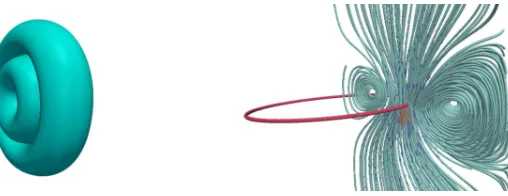
The results indicate that the new SFVD reproduce two key features: (a) a “double vortex tube”normal-fluid structure (Fig. 1, left) that is induced via mutual-friction excitation, due to the velocity difference between the vortex and normal-fluid velocities, and (b) the char-acteristic normal-fluid velocity streamlines (Fig. 1, right) generated by a jet-like structure that originates on the vortex contour, as the mutual-friction force “pushes” the normal-fluid there. As in the original calculation, the Reynolds number induced in the normal-fluid is very smallRe≈0.284×10⁻¹
FIG. 1. Superfluid vortex moving in a quiescent fluid. The normal-flow field predicted by the new model is similar to that in earlier works [28]. Right: Isocontours of mutual-friction induced normal-fluid vorticity at
t= 0.436×10⁻¹
s. A dissipative (Re≈0.284×10⁻¹
) two vortex tube struc-ture appears. One hundred isocontours spanning the whole range of normal vorticity-magnitude values [ωn= (0.103×10⁻¹−0.370×10²) s−1] are shown. Left: Normal-fluid velocity streamlines for the same structure. A mutual-friction induced jet at the superfluid vortex position creates two recirculating normal-flow areas adjacent to the superfluid ring contour.
connection between superfluid theory and classical low Reynolds number hydrodynamics.
EFFECTS OF A NORMAL-VORTICITY HOPF-LINK ON THE STRUCTURE OF SUPERFLUID TURBULENCE
investi-gate the effect of (reconnection induced) topology change in the normal-fluid on superfluid vortices. We set a calculation within a cubic domain of size lb = 0.1 cm, at T = 1.3 K. The normal-fluid initial conditions are two vortex tubes in a Hopf-link configuration with Reynolds number Re= Γ/ν = 1000. The individual ring radius Rl= 0.125lb (based on the centreline), and the tube radius isRt= 0.2Rl. The superfluid initial condition is a randomly positioned collection of vortex rings. Two cases were studied: (a) the superfluid rings have diameters similar to the diameters of the normal-fluid rings, and (b) the superfluid rings have an order of magnitude smaller diameter. The boundary conditions are periodic. As mentioned above, the numerical methods are discussed elsewhere [15, 29, 30]. The finite arithmetic precision characteristics of the computations have also been explicated above. The numerical grid for the normal-fluid is made of 1283
grid points. The discretization element along the quantized rings is equal to normal-fluid grid size. The typical time step is 0.122×10⁻⁵
s.
THE PURE NORMAL-FLUID HOPF-LINK
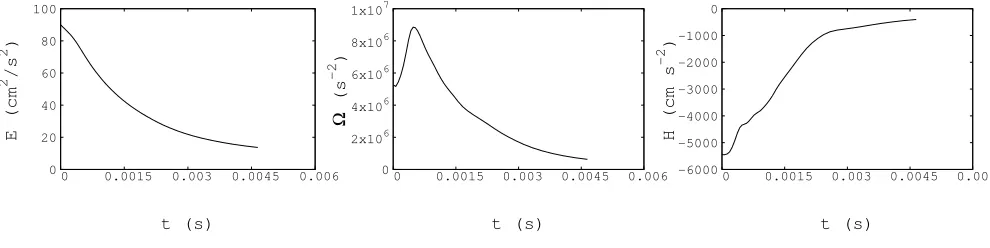
For reference, we include here the evolution of a pure normal-fluid link (Fig. 2). This is well studied in classical fluid dynamics [32–34], and it depicts a dissipative (Fig. 3, left) process via which the original flow helicity (a signature of the topological entanglement of the two tubes [35]) is destroyed (Fig. 3, middle) as a result of intervortex interactions (Fig. 2, middle). Another key physics process is the enstrophy amplification due to vortex stretching during the (relatively) high Reynolds number vortex-tube interactions (Fig. 3, middle). The vorticity isosurface graphic at t = 0.5870×10⁻³
s (Fig. 2) corresponds to (approximately) the peak in the enstrophy graph.
INTERACTIONS BETWEEN RINGS OF SIMILAR SIZE
FIG. 2. Pure normal-fluid link. Left: Initial configuration (t = 0). Center: Vorticity anti-alignment process during link evolution (t= 0.3088×10⁻³
s). Right: Later stages of the same process (t= 0.5870×10⁻³
s). In all cases, vorticity isosurfaces at level |ω|= 37000 s−1, where ω is the flow vorticity, are shown. The chosen value corresponds to 30% of the (global in time)
maximum vorticity magnitude. The local variations of tube radii are indicative of vortex stretching intensity. 0 20 40 60 80 100
0 0.0015 0.003 0.0045 0.006
E (cm 2 /s 2 ) t (s) 0 2x10⁶ 4x10⁶ 6x10⁶ 8x10⁶ 1x10⁷
0 0.0015 0.003 0.0045 0.006
Ω (s -2 ) t (s) -6000 -5000 -4000 -3000 -2000 -1000 0
0 0.0015 0.003 0.0045 0.006
H (cm s
-2
)
[image:10.595.74.569.319.443.2]t (s)
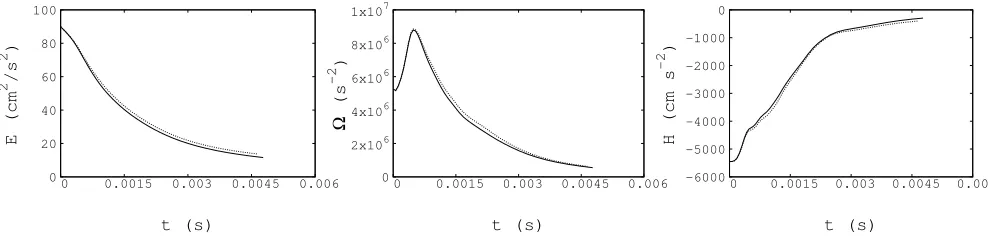
FIG. 3. Pure normal-fluid link. Left: Flow energy E = (1/2V)R
dV V·V versus time. Center: Flow enstrophy Ω = (1/2V)R
dV ω·ω versus time. Right: Flow helicity H = (1/2V)R dV ω·V
versus time. V is the volume of the computational box, V is the flow velocity, and ω =∇ ×V
the flow vorticity.
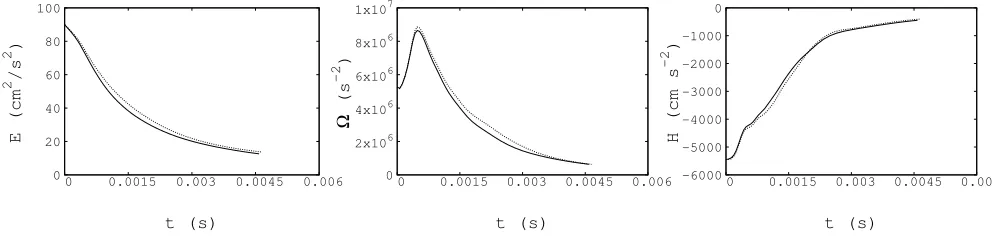
the maximum enstrophy value is observed. In other words, the production of superfluid vorticity dampens intense normal-fluid vortical structures. The later time enstrophy levels that match the pure normal-fluid result are due to generation of normal-fluid enstrophy via mutual-friction excitation at the newly created superfluid ring locations. There is no significant effect on the rate of unlinking of the initial structure (as monitored by the rate of absolute helicity value reduction).
0 20 40 60 80 100
0 0.0015 0.003 0.0045 0.006
E (cm 2 /s 2 ) t (s) 0 2x10⁶ 4x10⁶ 6x10⁶ 8x10⁶ 1x10⁷
0 0.0015 0.003 0.0045 0.006
Ω (s -2 ) t (s) -6000 -5000 -4000 -3000 -2000 -1000 0
0 0.0015 0.003 0.0045 0.006
H (cm s
-2
)
[image:11.595.72.569.72.193.2]t (s)
FIG. 4. Normal-fluid Hopf-link interacting with superfluid vortices of similar diameters. Left: Flow energy E = (1/2V)R
dV V·V versus time. Center: Flow enstrophy Ω = (1/2V)R
dV ω·ω
versus time. Right: Flow helicity H = (1/2V)R
dV ω·V versus time. V is the volume of the
computational box, Vis the flow velocity, andω=∇ ×Vthe flow vorticity. For comparison, the
dotted lines indicate the corresponding pure normal-fluid results.
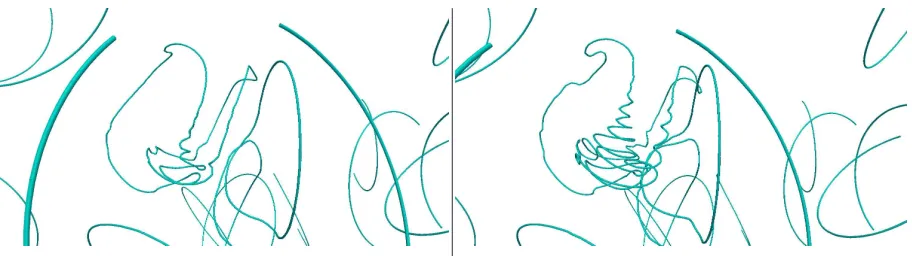
correlated with intense normal-fluid vorticity locations (the former are located in the neigh-bourhood of the latter), the formed superfluid structures do not mimic the morphology of the normal-fluid structures, and perform very different motions. This is due to the disparity between normal-fluid and superfluid vortex circulations (that cause the vortices to move with very different self-induced velocities), as well as to the mathematical form and strength of their coupling. The solution indicates a transfer of energy from the normal-fluid to the superfluid in the form of variable-radius, spiral-wave excitations along the superfluid vortex contours. This process is also observed in fully developed FTST solutions [15, 16]. The spiral structures result from the expansion of small-amplitude wiggles that appear on the vortices. The wiggle-formation sites are not correlated with intense normal-fluid vorticity sites. Instead, they are locations where, sufficiently high,axial(i.e., parallel to the superfluid vortex contours) normal-fluid velocities cause the line vortices to become unstable (Fig. 6). The observed instabilities appear similar to the Ostermeier-Glaberson instability [36], that also involves axial normal-fluid flow, and was studied in the context of rotating superfluid flows employing the coarse-grained, Hall two-fluid equations. To illustrate this instability, we have performed a test computation with a uniform normal-fluid velocity of magnitude
Vn = 150 cm s−
1
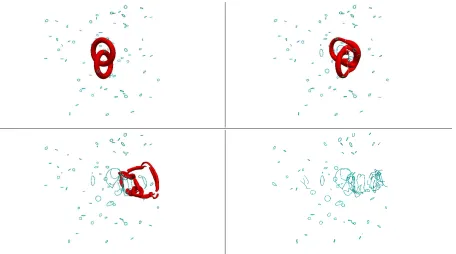
FIG. 5. fluid Hopf-link interacting with superfluid vortices of similar diameters. Normal-fluid vorticity isosurfaces (|ω| = 37000 s−1) and superfluid vorticity configurations. Top left:
t = 1.229×10⁻⁴
s. Significant normal-tube interactions take place without any accompanying important effects on the superfluid tangle. Top right: t = 3.085×10⁻⁴
s (before the enstrophy peak). Mutual friction excites superfluid-vortex contour wiggles. Bottom left: t= 5.915×10⁻⁴
s (after the enstrophy peak). The superfluid gains energy via wiggle growth processes. Bottom right: t = 2.650×10⁻³
s. There is no normal vorticity isosurface at the prescribed value. In the vortex tangle, some vortices keep growing, whilst other develop wiggle instabilities. The local variations of normal-tube radii are indicative of vortex stretching intensity.
with line vortices, and the instability appears under very different amounts of numerical damping of the Biot-Savart singularity. Moreover, in a second test computation with much smaller normal-fluid velocity Vn = 1 cm s−
1
, the ring remained stable, without any signs of wiggle formation.
[image:12.595.76.536.66.323.2]FIG. 6. Normal-fluid Hopf-link interacting with superfluid vortices of similar diameters: mecha-nism of energy transfer from the normal-fluid to the superfluid. Left: t= 4.794×10⁻⁴
s (before the enstrophy peak). Small amplitude wiggles are excited via axial-flow instability on the super-fluid vortex at the centre, by normal-super-fluid velocity pointing (locally) along the vortex direction. Right: t= 5.915×10⁻⁴
[image:13.595.90.481.341.429.2]s (after the enstrophy peak). As energy pours from the normal-fluid to the superfluid, the wiggles grow to form a (variable radius) spiral.
FIG. 7. Superfluid vortex ring moving in a normal-fluid crossflow. Left: Superfluid-vortex ring and sample normal-flow streamlines (t= 0). Center: Initiation of wiggle excitation along the ring-contour parts that are parallel with the normal-flow streamlines (t= 1.928×10⁻⁴
s). Right: The wiggles have grown to become spirals that resemble similar structures in the Hopf-link solution (t = 3.842×10⁻⁴
s). It is intriguing that this is an instability caused by the normal-fluid via mutual-friction forcing on a superfluid vortex, whilst reference [20] indicates an instability caused by the superfluid via mutual-friction forcing on a normal-fluid tube.
INTERACTIONS BETWEEN RINGS OF DISPARATE SIZES
0 20 40 60 80 100
0 0.0015 0.003 0.0045 0.006
E (cm 2 /s 2 ) t (s) 0 2x10⁶ 4x10⁶ 6x10⁶ 8x10⁶ 1x10⁷
0 0.0015 0.003 0.0045 0.006
Ω (s -2 ) t (s) -6000 -5000 -4000 -3000 -2000 -1000 0
0 0.0015 0.003 0.0045 0.006
H (cm s
-2
)
[image:14.595.74.568.71.193.2]t (s)
FIG. 8. Normal-fluid Hopf-link interacting with superfluid vortices of much smaller diameters. Left: Flow energyE= (1/2V)R
dVV·Vversus time. Center: Flow enstrophy Ω = (1/2V)R
dV ω·
ω versus time. Right: Flow helicity H = (1/2V)R dV ω·V versus time. V is the volume of the
computational box, Vis the flow velocity, andω=∇ ×Vthe flow vorticity. For comparison, the
dotted lines indicate the corresponding pure normal-fluid results.
quantities is expected to be small. Indeed, only mild variations of the pure normal-fluid solution are observed. Since, after the enstrophy peak, the FTST case enstrophy values are slightly smaller than the corresponding pure normal-fluid values, and the same is true for the energy, we can infer that the reduction in the normal-fluid energy levels is due to a transfer of energy to the superfluid. This is the case, because, the enstrophy dynamics are qualitatively similar to the energy dissipation-rate dynamics, hence since the FTST case dissipation-rate is smaller, only energy transfer could explain the reduction of the energy levels in the FTST case.
FIG. 9. Normal-fluid Hopf-link interacting with superfluid vortices of much smaller diameters. Normal-fluid vorticity isosurfaces (|ω|= 33000 s−1) and superfluid vorticity configurations. Top
left: t = 0. Top right: t = 3.088×10⁻⁴
s (before the enstrophy peak). Some rings have expanded to normal-tube size. Bottom left: t = 1.068×10⁻³
s (after the enstrophy peak). As the normal-fluid structure evolves, the superfluid gains energy via ring expansion. Bottom right:
t= 2.831×10⁻³
s; there is no normal vorticity isosurface at the prescribed value. We observe a tangle of superfluid vortices that trail, the now dissolved, normal-fluid link. Some of the newly augmented rings undergo a similar instability process with the corresponding one of the large rings in the other solution. The local variations of normal tube radii are indicative of vortex stretching intensity.
κ
2λln(
λ
EPILOGUE
In superfluid helium-4, the order parameter depicts the material flow of an inviscid fluid, and its topological defects correspond to line vortices in this fluid. The helium-4 atoms that are not described by the order parameter obey normal-fluid hydrodynamics that correspond to the conservation laws of the system. A complete, fully predictive model of normal-fluid hydrodynamics taking into account its coupling with the topological defects of the order pa-rameter has been proposed. It is intriguing, that the normal-fluid becomes aware of the order parameter only via its interaction with topological defects in the latter. Our model exploits another intriguing aspect (brought forward by the pioneering experiments of Hall and Vinen [38, 39]): the topological defects appear as obstacles in the normal-flow. Due to the small topological defect sizes, the flow around them can only be a creeping flow, hence, taking into account the linear character of the defects, our model is based on low Reynolds number hy-drodynamics around cylindrical objects. When the new defect dynamics is coupled with the Navier-Stokes equations for the normal-fluid, it becomes evident that the coupling between fluid and defects is characterized by two parameters with kinematic viscosity dimensions: the quantum of circulation κ in the Iordanskii force term, and a renormalized normal-fluid viscosityνc in the Hall-Vinen type force term. The nature of the coupling constants reflects the physics of the corresponding couplings: the Iordanskii force is a consequence of the wave-function dynamics of the normal-fluid at the pre second-quantization level. Indeed, since κ=h/m, where his Planck’s constant and m is the mass of helium-4 atoms, κpoints directly to quantum mechanical effects. On the other hand, the nature of the Hall-Vinen force is very different: the force involves point (quasi)particles that are scattered by the cores of the defects that appear to them as obstacles. This (far from obvious) defect-flow interaction physics is a foundation pillar of our SFVD. So the Iordanskii force is a quantum mechanical force that hints at the fundamental wave-nature of matter and, hence at Planck’s constant, whilst the Hall-Vinen force is a (quantum) statistical mechanical force that hints at thermal physics and, hence at fluid viscosity.
to the superfluid: (1) an expansion to large sizes of superfluid vortex rings with much smaller diameter than the diameter of the normal-fluid tubes that make up the vortex link. A key observation here is that the superfluid rings do not grow to larger than the normal-fluid tube sizes, (2) a superfluid vortex ring instability due to axial-flow along the vortex contours that excites small amplitude wiggles that subsequently evolve into variable-radius spiral-waves along the vortices. Consistent with the fact that the initially small rings do not expand to larger than the normal-ring sizes, the initially large rings (with diameters similar with the diameters of the Hopf-link tubes) do not receive energy by increasing their size, but only via instability-induced, spiral-wave excitation.
Although the sites of superfluid vorticity generation are always in the neighbourhood of intense normal-fluid vorticity events, the superfluid vortices do not mimic the normal-fluid vorticity structure, and perform very different motions.
ACKNOWLEDGEMENTS
I am very grateful to Tony Leonard for valuable discussions, and Marco Ghiani for help with the graphics.
[1] M. Schlosshauer, Decoherence: And the Quantum-To-Classical Transition, Berlin: Springer (2010).
[2] A. Wasserman, Thermal Physics: Concepts and Practice, Cambridge: Cambridge University Press (2011).
[3] J. Casalderrey-Solana, H. Liu, D. Mateos, K. Rajagopal, U. A. Wiedemann, Gauge/String Duality, Hot QCD and Heavy Ion Collisions, Cambridge: Cambridge University Press (2014). [4] D. Forster,Hydrodynamic Fluctuations, Broken Symmetry, And Correlation Functions, Boca
Raton: CRC Press (1995).
[5] O. Wiese, D. Marenduzzo, O. Henrich, Microfluidic flow of cholesteric liquid crystals, Soft Matter12, 9223, (2016).
[6] O. Henrich, K. Stratford, D. Marenduzzo, P.V. Coveney, M.E. Cates, Confined cubic blue phases under shear, J. Phys.: Condens. Mat.24, 284127 (2012).
[7] S.K. Nemirovskii, Quantum turbulence: Theoretical and numerical problems, Physics Reports 524, 85-202 (2013).
[8] C.F. Barenghi, R.J. Donnelly (eds.), Quantized Vortex Dynamics and Superfluid Turbulence, Berlin: Springer (2010).
[9] R.J. Donnelly, Quantized Vortices in Helium II, Cambridge: Cambridge University Press (2008).
[10] P.A. Davidson,turbulence, Oxford: Oxford University Press (2004).
[11] A. Tsinober,An Informal Introduction to Turbulence, Kluwer Academic Publishers (2001). [12] L. Biferale, D. Khomenko, V. Lvov, A. Pomyalov, I. Procaccia, G. Sahoo, Turbulent statistics
and intermittency enhancement in coflowing superfluid He-4, Phys. Rev. Fluids 3, 024605 (2018).
[13] K.W. Schwarz, Three-dimensional vortex dynamics in superfluid 4
[14] D. Jou, M.S. Mongiovi, M. Sciacca, Hydrodynamic equations of anisotropic, polarized and inhomogeneous superfluid vortex tangles, Physica D 240, 249 (2011).
[15] D. Kivotides, Energy spectra of finite temperature superfluid helium-4 turbulence, Phys. Flu-ids 26, 105105 (2014).
[16] D. Kivotides, Spreading of superfluid vorticity clouds in normal-fluid turbulence, J. Fluid Mech. 668, 58 (2011).
[17] D. Kivotides, Decay of finite temperature superfluid helium-4 turbulence, J. Low Temp. Phys. 181, 68 (2015).
[18] D. Kivotides, Interactions between normal-fluid and superfluid vortex rings in helium-4, EPL 112, 36005 (2015).
[19] S.K. Nemirovskii, Energy spectrum of the 3D Velocity Field, Induced by Vortex Tangle, J. Low Temp. Phys. 171, 504 (2013).
[20] D. Kivotides, Mutual-friction induced instability of normal-fluid vortex tubes in superfluid helium-4, Phys. Lett. A 382, 1481 (2018).
[21] C.F. Barenghi, R.J. Donnelly, W.F. Vinen, Friction on quantized vortices in Helium II. A Review, J. Low Temp. Phys. 52, 189 (1983).
[22] E. Guyon, J.-P. Hulin, L. Petit, C.D. Mitescu, Physical Hydrodynamics, Oxford: Oxford University Press (2015).
[23] P. Oswald, Rheophysics: The Deformation and Flow of Matter, Cambridge: Cambridge Uni-versity Press (2009).
[24] G. E. Volovik, Three nondissipative forces on a moving vortex line in superfluids and super-conductors, Pis’ma v ZhETF 62, 58 (1995).
[25] G. E. Volovik, Vortex versus spinning string: Iordanskii force and gravitational Aharonov-Bohm effect, Pis’ma v ZhETF 67, 841 (1998).
[26] L. Thompson, P.C.E. Stamp, Quantum dynamics of a Bose superfluid vortex, Phys. Rev. Lett. 108 184501 (2012).
[27] O. C. Idowu, D. Kivotides, C. F. Barenghi, D. C. Samuels, Equation for Self-Consistent Superfluid Vortex Line Dynamics J. Low Temp. Phys. 120, 269 (2000).
[29] D. Kivotides, Relaxation of superfluid vortex bundles via energy transfer to the normal fluid, Phys. Rev. B 76, 054503 (2007).
[30] D. Kivotides, Interactions between vortex tubes and magnetic-flux rings at high kinetic and magnetic Reynolds numbers, Phys. Rev. Fluids3, 033701 (2018).
[31] W. Tucker, Validated Numerics: A Short Introduction to Rigorous Computations, Princeton: Princeton University Press (2011).
[32] H. Aref, I. Zawadzki, Linking of vortex lines, Nature354, 50 (1991).
[33] D. Kivotides, A. Leonard, Computational model of vortex reconnection, Europhys. Lett. 63, 354 (2003).
[34] M. Brady, A. Leonard, D. I. Pullin, Regularized Vortex Sheet Evolution in Three Dimensions, J. Comp. Phys.146, 520 (1998).
[35] V. Arnold, B. Khesin,Topological Methods in Hydrodynamics, Berlin: Springer (1998). [36] R.M. Ostermeier, W.I. Glaberson, Instability of vortex lines in the presence of axial normal
fluid flow, J. Low Temp. Phys. 21, 191 (1975).
[37] D.C. Samuels, D. Kivotides, A damping length scale for superfluid turbulence, Phys. Rev. Lett. 83, 5306 (1999).
[38] W.F. Vinen, Mutual friction in a heat current in liquid helium II. II. Experiments on transient effects, Proc. R. Soc. London, Ser. A240, 128 (1957).
[39] W.F. Vinen, Mutual friction in a heat current in liquid helium II. III. Theory of the mutual friction, Proc. R. Soc. London, Ser. A 242, 493 (1957).
[40] A.I. Golov, P.M. Walmsley, P.A. Tompsett, Charged Tangles of Quantized Vortices in Super-fluid 4He, J. Low Temp. Phys. 161, 509 (2010).
[41] B. Mastracci, W. Guo, An exploration of thermal counterflow in He II using particle tracking velocimetry, Phys. Rev. Fluids 3, 063304 (2018).