City, University of London Institutional Repository
Citation:
Lorenzi, M. (2017). X-ray computed microtomography applications for complex
geometries and multiphase flow. (Unpublished Doctoral thesis, City, University of London)
This is the accepted version of the paper.
This version of the publication may differ from the final published
version.
Permanent repository link:
http://openaccess.city.ac.uk/19794/
Link to published version:
Copyright and reuse: City Research Online aims to make research
outputs of City, University of London available to a wider audience.
Copyright and Moral Rights remain with the author(s) and/or copyright
holders. URLs from City Research Online may be freely distributed and
linked to.
City Research Online:
http://openaccess.city.ac.uk/
[email protected]
X-ray computed microtomography applications for
complex geometries and multiphase flow
B.Eng. Massimo Lorenzi
A thesis submitted for the fulfilment of the requirements of City,
University of London for the degree of Doctor of Philosophy
CITY, UNIVERSITY OF LONDON
School of Mathematics, Computer Science & Engineering
TABLE
OF
CONTENTS
List of illustrations ... 5
List of tables ... 19
Acknowledgments ... 21
Declaration to the University Librarian ... 23
Thesis abstract ... 25
Thesis introduction ... 27
Chapter 1 - Description of microCT technique and equipment ... 31
1.1 Interaction of X-rays with matter. ... 31
1.2 How Computed Tomography works ... 39
1.3 Description of the Unibg microCT ... 46
1.4 Capability of microCT to measure geometries ... 53
1.5 Assessing volumetric reconstruction accuracy ... 54
1.6 Scale calibration ... 64
1.7 Beam hardening correction for metal parts. ... 65
1.8 Software used for tomographic reconstruction ... 69
Chapter 2 - Applications to complex geometries (thermal-fluid dynamics) ... 71
2.1 Introduction ... 71
2.2 Literature review on drop shape analysis ... 71
2.3 Drop on Teflon ... 74
2.4 Drop on record ... 80
2.5 Drop on GDL (Gas Diffusion Layer)... 89
Chapter 3 - Applications to complex geometries (real injectors + test rig model) ... 97
3.1 Injector internal geometry reconstruction ... 97
3.2 Cavitation induced erosion detection. ... 111
Chapter 4 - Applications to multiphase flow – cavitation ... 115
4.1 Introduction ... 115
4.3 Void fraction measurement uncertainty ... 128
4.4 Experimental results ... 134
Conclusions ... 151
Recommendations for future work ... 153
LIST OF ILLUSTRATIONS
Figure 1-1 (Top) localization of X-ray wavelengths and energies, distinguished as soft and hard X-rays, in
the electromagnetic spectrum; (Bottom - from left to right) application of X-rays to determine the
arrangement of atoms in the crystalline solids, breast cancer screening radiography, head and neck
computed tomography scan, airport security baggage scanning for safety reasons. [38] ... 32
Figure 1-2 Schematic section view of a transmission target X-ray source. From left to right we can find the
filament cathode (in red), the produced beam of electrons (in green), the alignment unit and focusing
electronic lenses (in orange), the electron target (in grey), the output window (in purple) and the mitted
X-ray beam (in yellow). ... 32
Figure 1-3 Visualization of the production of X-rays through the interaction of electrons with target atoms.
Electrons numbered 1 to 4 hit the target from left producing X-rays of energy proportional to the intensity
of their interaction with the nucleus and its electrons. Image inspired by an illustration present in [37]... 32
Figure 1-4 Image of the electrons travelling inside the target material produced with software “CASINO”
[39]. ... 33
Figure 1-5 Tungsten (W) target spectrum simulated with Spektr software [40]. ... 33
Figure 1-6 Contribution of each X-ray attenuation mechanism calculated for Beryllium and X-rays energies
between 5 keV and 160 keV with software XMuDat [41] based on tabulated values of [42]... 36
Figure 1-7 Representation of the interaction between an incoming monochromatic X-ray radiation and a
homogenous object material. ... 36
Figure 1-8 X-ray CMOS detector simplified layout. From left to right: incoming X-ray radiation, protection
plate (grey), scintillator layer (yellow), fibre optic plate (blue), photodiode (green), CMOS sensor (purple)
and electronic readout circuitry (orange). ... 39
Figure 1-9 Conversion probability of Caesium iodide phosphor doped with Thallium based on incoming
X-ray energies form 0 to 120 keV. Source: redrawn from [43]. ... 39
Figure 1-10 Image from (Gdh-commonswiki) First prototype of computed tomography scanner produced
by Sir Godfrey Newbold Hounsfield and Allan MacLeod Cormack. In the left image Sir. Hounsfield is
pictured with his first commercially available CAT, in the right picture the CAT prototype is visible with a
sample brain as object to be scanned. ... 41
Figure 1-11 Layout of sample tomographic acquisition. From left to right we have the X-ray source,
represented with a pointwise emission, the rotary stage with the cubic object to be scanned positioned on a
sustaining cylindrical sample holder, the detector where the transmitted radiation is acquired and sampled
to be saved in a 2D image file, the stack of acquired radiographies, one for each positional step, ready to be
processed for reconstruction ... 41
Figure 1-12 Illustration of the object shape and position guess through projections observation: the volume
projections shown on the right it is clearly impossible to guess the correct shape and position of the two
objects even though each projection furnish partial data about the desired information. ... 41
Figure 1-13 Schematic view of the circular cone beam tomography with mid-plane highlighted. Image from
[45] ... 42
Figure 1-14 Graphical visualization of the rotation axis of the selected volume to be reconstructed. ... 42
Figure 1-15 (from top left to bottom right) original projection image without corrections; dark, gain and
defect image to be used for projection correction; image corrected with the previous three correction
images; legitimized and normalized image; cosine weighted image; ramp filtered image; smoothed image;
horizontal and vertical slices resulting from the reconstructed injection channel ... 44
Figure 1-16 Sinogram of the proposed sample reconstruction of a cylinder and a parallelepiped. (Right)
three sample projections are displayed corresponding to angle 0°, 90° and 135°. (Middle) line profiles of
the same detector line extracted for all the three projections. (Right) complete sinogram from 0° to 360° of
the analysed line before image logarithmisation and filtration. ... 44
Figure 1-17 Left: unfiltered sinogram (top) and simplified back projection of a point (bottom) showing the
image blurring that would results by the back-projection process if the images weren’t high-pass filtered.
Right: same sinogram image ramp filtered to enhance high frequencies (top) and same back projection of
a point with filtered sinogram. It is clear the necessity of the filter enhancing high frequencies. ... 45
Figure 1-18 Back projection process: each projection line is back projected on the projection plane, which
represents an horizontal cross section plane of the reconstructed volume, to reconstruct by summation the
shape and material property value of the scanned object. ... 45
Figure 1-19 Outside view of the X-ray machine with door open; control electrical cabinet on the right side
of the picture. ... 47
Figure 1-20 Close-up view of the inside of the cabinet with (from right to left) X-ray source, rotary stage
and X-ray detector displayed. ... 47
Figure 1-21 Coordinate system of the microCT machine. ... 47
Figure 1-22 Emission axis alignment process: one radiography at each specific distance from the X-ray
source is acquired and processed to obtain the emission centre as perceived by the detector. Based on this
information the overall emission axis can be calculated and corrected moving the detector if not linear. . 48
Figure 1-23 Left – colour coded radiography of the non -aligned X-ray source: the X-ray intensity is not
symmetric with respect to the detectors’ centre point. Right – same colour coded radiography of the same
X-ray source after alignment: X-rays intensity symmetry is evident. ... 48
Figure 1-24 (left) schematic view of microCT setup evidencing distances of interest for magnification
calculation; (right) penumbra phenomenon illustrated: (right-top) a perfect nominally pointwise X-ray
source projects a single X-ray emission cone creating a sharp single image of the object on the detector
panel, while (right - bottom) an X-ray source with non-negligible dimension produces a penumbra effect
only for the first face of the cube object and for just one side (worst case) of the emitting area, side 1, the
same happens symmetrically for emission point 2. ... 50
Figure 1-25 Air bearing rotary stage produced by Aerotech utilized to rotate the sample during radiographies acquisitions. ... 50
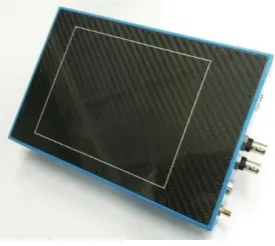
Figure 1-26 X-ray detector utilized to acquire X-ray images during tomographies. The front surface shows the carbon fibre window that seals and protects the active scintillator area. On the side the BNC trigger in and trigger out connectors are visible. On the same size the power supply connector and the Ethernet cable plug are present. ... 51
Figure 1-27 Modulation transfer function as communicated by the detector producer ... 52
Figure 1-28 Linearity of the detector over its full range scale. ... 52
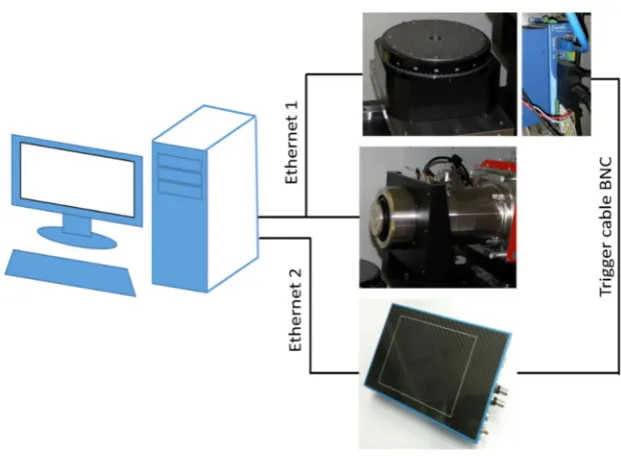
Figure 1-29 Illustration of the control equipment layout of the tomography machine. ... 53
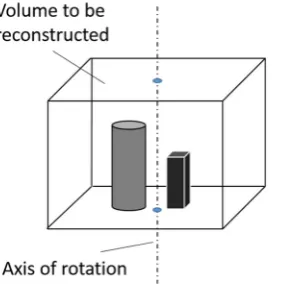
Figure 1-30 (Left) nano-bar phantom positioned near to a match for scale comparison. (right) enlarged view of the middle section of the phantom cylinder revealing the inside with the two chips positioned axially (chip1) and perpendicularly (chip2). Source: image courtesy of QRM GmbH (with own overlays) ... 56
Figure 1-31 : (left) layout of the full engraved area of the two silicon chips contained in the phantom. (right) zoom of the central part of the engraved area showing line and point patterns with width from 10 to 1 µm. Source: image courtesy of QRM GmbH ... 56
Figure 1-32 (left) Slanted edge present on the QRD phantom. (right) indication of the portion of the slanted edge utilized for the calculation of reconstruction resolution. ... 56
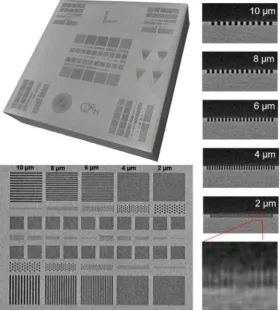
Figure 1-33 (top-left) 3D rendering of the reconstructed volume of the vertical chip of the QRM phantom. (bottom-left) Zoom of the central area of the phantom where it is clearly visible the possibility to distinguish lines of 4 µm with the nominal tomography resolution set at 2.19 µm.(right) from top to bottom cross cut of the 10-8-6-4-2 µm lines to show engraved lines distinguishability down to 4 µm, while the 2 µm apart lines are not clearly identifiable. ... 57
Figure 1-34 Plot of the Modulation Transfer Function (MTF) for the area selected on the reconstructed phantom slice. ... 57
Figure 1-35 Zoom of the plot of the Modulation Transfer Function (MTF) for the right hand side of the modulation transfer function of the edge with indication of the function values for 10% transmission. .. 58
Figure 1-36 Plot of the Edge Spread Function (ESF) for the area selected on the reconstructed phantom slice. ... 58
Figure 1-37 Plot of the Line Spread Function (LSF) for the area selected on the reconstructed phantom slice. ... 58
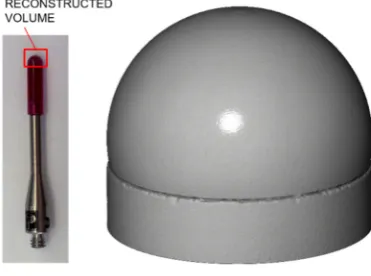
Figure 1-39 (left) picture of 2 mm Renishaw stylus with (right) its rendered reconstruction form CT data.
... 59
Figure 1-40 (left) in red reconstructed stl surface points selected for the fitting operation. (right) in green
nominal fitted sphere overlaid to the original reconstructed stl surface shown in grey. ... 60
Figure 1-41 Table of deviation from nominal sphere of mesh reconstructed from microCT data considering
a 3 sigma Gaussian fitting of original sphere surface points. ... 60
Figure 1-42 Table of deviation from nominal sphere of mesh reconstructed from microCT data considering
all available points of original sphere surface. ... 61
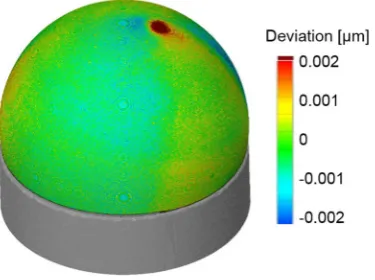
Figure 1-43 Deviation of sphere surface created with all available points to show pole artefact. As it can be
seen the mesh deviation points that increase by three times the surface deviation from nominal spherical
geometry are concentrated near the tomography rotation axis (dark brown in the figure). ... 61
Figure 1-44 (left) in red stl surface cylinder points selected for the calculation of the fitting nominal
cylinder. (right) in green nominal cylinder created form the selected pints overlaid to the original stl surface
shown in grey. ... 61
Figure 1-45 Table of deviation from nominal cylinder of mesh reconstructed from microCT data
considering 3-sigma points of original surface. ... 62
Figure 1-46 (left) overall and zoomed picture of 0.3 mm Renishaw stylus and (right) its rendered
reconstruction from CT data. ... 62
Figure 1-47 (left) in red selected surface point to fit nominal geometry (right) nominal sphere (in green)
created with the fitting operation overlaid to the original mesh (grey). ... 63
Figure 1-48 Table of deviation from nominal sphere of mesh reconstructed from microCT data considering
3-sigma points of original surface. ... 63
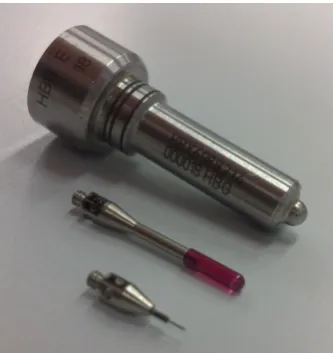
Figure 1-49 (From top to bottom) picture of the diesel injector tip that will be the object of geometrical
reconstruction within this thesis, and the 2 mm and 0.3 mm Renishaw styli to visualize the scale between
the three objects. ... 63
Figure 1-50 (right) schematic section view of the reference scaling phantom created with the two Renishaw
styli: the outer plexiglass container has been cut to reveal the layout of the two styli. (left) picture of the
real sample produced and utilized... 64
Figure 1-51 (left) stl surface of the two styli reconstructed from the single CT dataset. (right) in green
3-sigma fitting spheres utilized to calculate the distance between the centres, the line connecting the two
centres is highlighted as “reference distance”. ... 65
Figure 1-52 (left) axially perpendicular slice of a sample metal cylinder showing beam artefact in the form
of degrading greyscale values in the direction going from the outer border to the cylinder centre. (right)
plot of greyscale values vs. diameter position of the yellow line over imposed to the cylinder section present
Figure 1-53 (left) axially perpendicular slice of a Diesel injector tip reconstructed with microCT showing
streaks artefacts produced by injection holes, yellow arrows highlight modification of calculated attenuation
value which is visible for areas inside the injector material and outside (air). (centre) plot of greyscale values
indicated by the line in the left image, blue arrows show lower attenuation due to beam hardening streaks.
(right) same slice after beam hardening correction application,... 66
Figure 1-54 Unfiltered (grey line) versus filtered (blue) spectrum. ... 66
Figure 1-55 (left) radiography of the step wedge created with a tack of metal foil of 0.4 mm thickness and
(right) grayscale values plot of the yellow line through its length. ... 67
Figure 1-56 (left) radiography of Diesel injector tip without needle with yellow line over imposed to the
area utilized for the calculation of the self-wedge map. (right) Illustration of the thicknesses calculation for
the object of interest. ... 68
Figure 1-57 (left) plot of the greyscale value of the radiography indicated by the yellow line showing
detected material attenuation through material thickness. (right) table of radiography greyscale values vs
position to be used to correlated greyscale valued with calculated thicknesses. ... 68
Figure 1-58 (left) same axially perpendicular slice of the sample metal cylinder showing beam artefact
correction result. (right) plot of greyscale values vs diameter position of the yellow line over imposed to
the cylinder section present in the left image revealing grey values homogeneity improvement due to
applied correction. ... 69
Figure 2-1 a) A diagram that shows the contact angle and interphase-energy between 3 phases (gas, liquid,
solid). b) drop triple line highlighted in red. Images from a) [68] b) own. ... 72
Figure 2-2 Section view of the ideally axisymmetric drop visualizing the two radii utilized by the
Laplace-Young equation. ... 73
Figure 2-3 A droplet resting on a solid surface and surrounded by a gas forms a characteristic contact angle
θ. If the solid surface is rough, and the liquid is in intimate contact with the solid asperities, the droplet is
in the Wenzel state. If the liquid rests on the tops of the asperities, it is in the Cassie-Baxter state. Image
from [78] ... 73
Figure 2-4 Drop of distilled water of almost 5 mm diameter gently deposed on a Teflon surface. ... 76
Figure 2-5 Level with a resolution of 50 micrometre per meter utilized for the drop on Teflon. ... 76
Figure 2-6 a) Drop of distilled water on Teflon cylinder (picture taken with a discarded cylinder. b) Sample
radiography of the surface with deposed drop. ... 76
Figure 2-7 Visualization of the drop on Teflon positioned in front of the X-ray source for scanning purposes.
The partially anti-evaporation cap and beneath water pool is visible... 76
Figure 2-8 a) superposition of reference drop radiographies (before and after tomographic acquisition in
the same position). b) zoomed view of the drop contours showing the still present evaporation effect. ... 77
Figure 2-9 Overlay of drop radiography before and after tomographic scan without anti-evaporation cap.
Figure 2-10 Top-left – reconstructed volume section showing attenuation coefficient difference between
drop and Teflon. Bottom-left – coloured render with transparency of the reconstructed drop-surface volume.
Right – solid 3D render of the reconstructed volume. ... 78
Figure 2-11 top left – stl drop surface visualized in green with radial sections shown in black. top right –
visualization of only the radial sections contours (36 of the 120 used). Bottom left and right – top and
bottom view of the drop-surface stl clearly showing the non-circular footprint of the drop. ... 79
Figure 2-12 Reprinted with permissions from [79]. 3D rendering of the fitted profiles coloured to represent
experimental-fitted profiles deviation. Colour from blue (0%) to red (3.85%) is proportional to the
dimensionless error ∆R/Rmax ... 79 Figure 2-13 a) – b) Reprinted with permissions from [79]. Graphical visualizations of the triple line
trajectory and contact angle measurement comparison between experimental and fitted datasets. a) xy plane
localized comparison of drop-surface points: green circles represent experimental points while black circles
represent fitted data, the maximum distance between analogous points is 72 µm b) contact angle
measurements: green dots represent positions where experimental and fitted contact angle measurements
are in good agreement, 192 points of the original 240, while red triangles represent point with bad
agreement... 79
Figure 2-14 top-left – sample drop deposed on the record surface. Top-right schematic section of the record
profile to highlight characteristic geometrical measures (p = 320 µm; h = 92 µm; w = 136 µm). bottom-left,
bottom-right: side view of a sample surface-drop couple. ... 81
Figure 2-15 Picture of a small drop of Glycerol on top of the needle utilized to place it on the patterned
surface. ... 82
Figure 2-16 Left – section of drop reconstructed volume before application of radiation filtering: the two
yellow arrows highlight the position of the artefact caused by the beam hardening showing in the section
as a wide horizontal line of pixels with non-correct grey level values. The image has been smoothed to try
to minimize via software the detected defect in the first instance. Right – section of a comparable drop
reconstructed volume produced after the introduction of the aluminium filter, it can be noted that the beam
hardening is diminished. ... 82
Figure 2-17 left – angled side view of the reconstructed vinyl record surface showing the groves sides
irregularities that produce music when hit by a turntable needle. The yellow arrow highlights the
tomography rotation axis artefact. Right – top view of the same record surface. ... 83
Figure 2-18 Two side views (top-middle) and a three-quarter view (bottom) of the biggest drop no.5
artificially positioned near to the smallest one no.2 to highlight the difference of drops volume. ... 83
Figure 2-19 Top left – rendering of drop 1 tomographic reconstruction. Top right – conversion of
reconstructed drop-surface volume in STL format after separate identification of drop and surface volume.
Bottom left – in yellow recognized footprint of the drop. Bottom right – visualization of the only drop
Figure 2-20 1st row-left – drop and surface stl surfaces ¾ view. 1st row, right - only drop stl surface displayed
in red with numbered sections (black lines) produced by planes perpendicular to the grooves. 2nd row-left:
semi-transparent drop visualization to reveal contours of drop surface sections 1 to 4. 2nd row right –
orthogonal view of section 1 (blue) and 4 (red) to reveal the pinning behaviour change: section 1 is
characterized by strong left-right side symmetry, while section 4, corresponding to the central section of
the drop, is highly non-symmetric since the left side of the drop overspills the edge of the groove while the
right side doesn’t. 3rd and 4th row: orthogonal display of section 1 to 4 with indication of left-right drop
contact angle with difference highlighting the non-symmetric behaviour of the drop-surface pinning ... 85
Figure 2-21 1st row left: drop and surface stl surfaces ¾ view. 1st row right: only drop stl surface displayed
in red with numbered sections (black lines) produced by planes parallel to the grooves. 2nd row-left:
semi-transparent drop visualization to reveal contours of drop surface sections 1 to 4. 2nd row right – orthogonal
view of section 1 (blue) and 4 (red) to reveal the symmetry in the pinning behaviour. 3rd and 4th row:
orthogonal display of section 1 to 4 with indication of left-right drop contact angle with difference
highlighting the symmetric behaviour of the drop-surface pinning. ... 86
Figure 2-22 Visualization of 3D drop base area extraction (yellow) and its projection on surface parallel
plane to calculate the 2D footprint of the drop. ... 88
Figure 2-23 top row: 3D drops footprints on the record surface. Bottom row: 2D projection of the only
drops footprints. ... 88
Figure 2-24 black line presents nominal surface Wenzel roughness ratio calculated utilizing the nominal
geometry of the record surface, while the single points present the experimental results for the 4 drops of
interest. I can be noted that the latter are in good agreement with the theoretical corresponding value.
However, the experimental points referring to drop n.2 and n.3, which have very similar volume, are quite
distant one form the other, this can be explained with the different way of covering the surface edges of the
two drops, which is not represented by the single nominal value. Image from [85] ... 88
Figure 2-25 left – 6 x 7 mm size GDL carbon cloth utilized for the tomographic reconstruction presented;
single carbon fibres can have a diameter range between 5 and 10 µm. right – same piece of carbon cloth
with a drop of distilled water deposed. ... 91
Figure 2-26 Top – 3/4 view of the GDL reconstructed volume, yellow section at sides represents recognized
fibre volume: as it can be seen, inside strands, single carbon fibres are merged in one bigger volume. Bottom
– higher zoom top view of a small portion of the GDL to further highlight the visibility of some of the
carbon fibres protruding from the strands. ... 91
Figure 2-27 Grayscale rendering of thresholding window utilized to determine the only drop volume. It is
clearly visible that under the drop, the GDL volume is partially visualized meaning that it will be recognized
as drop volume after thresholding operation. ... 91
Figure 2-28 Left - rendering of the tomographic results of GDL with DROP (top) and only GDL (bottom)
Figure 2-29 Left (top) – side view of the drop volume after thresholding and GDL subtraction. Left (bottom)
tilted view of the same drop volume. Right – bottom view of the drop volume showing regularly spaced
grooves, determined by the warp and weft surface of the GDL cloth ... 93
Figure 2-30 Top row left: rendering of the reconstructed drop volume. Top row right: visualization of the
portion of the drop surface which is inside the GDL. Bottom row, from right to left: visualization of the
drop sections as the section plane considered enters the GDL cloth. The remaining drop volume calculated
after each section drop volume cut is: 0.951 mm3, 0.294 mm3 and 0.026 mm3. ... 93
Figure 2-31 Top-left: in blue 3D rendering of the drop surface with radial sections overlapped in black and
red, 18 items in total, one section each 10°. Top-right – visualization of the only drop profiles to reveal the
complexity of drop surface footprint. Bottom-left: orthogonal view of red single drop profile present in the
previous images. Bottom-right: B-spline drop contour profiling and contact angle measurement of red drop
profile presented in the previous images. ... 93
Figure 2-32 From top left to bottom right – tilted view of drop surface sectioned by 6 planes parallel to the
GDL surface to show how the drop adapts to the detected surface defect. The sectioning planes are the same
utilized in the previous figure. ... 94
Figure 2-33 From top left to bottom right – top view of drop surface sectioned by 6 planes parallel to the
GDL surface to show how the drop adapts to the detected surface defect. ... 95
Figure 2-34 Visualization of tomographic reconstruction slices highlighting drop pinning in more than one
position. The full slice is visible in the left while in the right the zoomed view of the area where the pinning
occurs is zoomed to ease details detectability. ... 95
Figure 3-1 Top left: closeup view of injector nozzle placed inside the microCT machine ready to be scanned.
The nozzle has been disassembled from the body and the needle has been removed to place the nozzle on
top of the sample holder. Top right: complete view of injector nozzle inside the microCT machine. The
nozzle distance from the X-ray source allows a magnification which produces a tomography with a 4 µm
resolution. ... 98
Figure 3-2 Left – CAD drawing of the top mounting sample holder. The only tolerance indicated is the h7
for the base diameter since this must tightly match the diameter of the hollow rotary stage central hole. The
tolerance for the top hole where the nozzle sits is not indicated since the nozzle outside shape is conical.
... 98
Figure 3-3 Top left – radiography of the nozzle produced with the reported settings. Top right – false
coloured radiographic image showing in false colours the intensity of the radiation received by the X-ray
detector. Bottom row – schematic view of the tomography set-up to identify the position of the metal filter
utilized to filter the incoming radiation. ... 100
Figure 3-4 Left column, top and middle – nozzle reconstructed slices (horizontal and vertical) without beam
hardening correction applied - Right columns, top and middle - same nozzle slices presented in the left part
of the figure but with beam hardening correction applied. Bottom, left – histogram of the reconstructed
in the reconstructed volume. Bottom, right – histogram of the reconstructed volume with beam hardening
correction applied, showing two main peaks corresponding to air (peak no.2) and nozzle metal material
(peak no.4). Peak no. 2 is still present highlighting that not all the beam hardening artefact has been
cancelled out by the correction. ... 100
Figure 3-5 Top – thresholding of non-beam hardening corrected nozzle slice: yellow line represents the
nozzle area recognized contour. The injection holes’ exit is not reconstructed correctly since the pixel value
in this position have a higher grayscale value which assigns them to the nozzle material instead that to air
as supposed. Bottom – same slice with beam hardening correction; the brighter pixel values of the outer
border have been corrected permitting detection of the hole geometry. ... 101
Figure 3-6 Top, left – histogram of the nozzle tomography showing selected threshold value corresponding
to the min histogram value between material peaks. Top, right – same histogram presented in the left image
but with air and nozzle histogram values assigned colour coded. Bottom – nozzle slice colour coded using
threshold value. ... 101
Figure 3-7 3D rendering, drawing and picture of DIN bushing utilised for the dimensional checks. ... 103
Figure 3-8 Measurement of the DIN guide bushing with the Mitutoyo micrometre. ... 103
Figure 3-9 Left – 3D rendering of the DIN guide bushing sub-volume reconstructed by microCT. Middle –
picture of the real part with reconstructed sub-volume identified by the black square. Right – stl
reconstructed surface of inner and outer cylinders utilized for the diameter size calculations: “D” indicates
the inner diameter while “d” indicates the outer diameter size. ... 103
Figure 3-10 Top left – nominal CAD design geometry for the internal volume of the studied nozzle. Top
right – reconstructed geometry produced by microCT data. Bottom – over position of CAD and CT
geometries with the CT surface colour coded to reflect surface to surface distance. ... 104
Figure 3-11 Top left – tilted bottom view of the reconstructed nozzle geometry with highlight of the position
of the defect detected. Top right – zoomed view of the same geometry presented in the left to better reveal
the defect. Bottom left – defect presented with deviation colouring exceeding used scale. Bottom right –
picture of the defect produced after cutting the injector in half to reveal the inside. ... 105
Figure 3-12 Left column – zoomed pictures of the nozzle to locate the nozzle part that will be in the
reconstructed volume at the three level of resolution. Right column – radiographies from the tomographic
datasets at the three chosen resolution levels. ... 105
Figure 3-13 Left – 60-degree sector cutting operation inside microEDM machine, the nozzle is being cut
by the metal wire which constitutes the eroding electrode; the actual erosion point is visible on the tip of
the nozzle as a blue point representing the electrode spark position. Right – 60-degree nozzle tip sector after
erosion placed on a fingertip. ... 107
Figure 3-14 Left column – from top to bottom 3D renderings of the reconstructed volumes with three
different reconstruction resolutions (4.665 µm, 1.950 µm, 0.927 µm). Right column – from top to bottom
Figure 3-15 Top left – 3D rendering of nozzle tip with geometry section visualized. Top right – orthogonal
view of channel cross section with numbers indicating the measured dimensions. Bottom left – cross cut
view of the nominal CAD geometry. Bottom right – close up of inlet rounding of the nominal CAD channel
geometry. ... 108
Figure 3-16 Plot of inlet/exit up/down rounding radii (mean values). Tomographic resolution of points is
colour coded as per the legend presented in the right part of the image. ... 109
Figure 3-17 Left - Inlet and exit diameters (mean values) for the different tomographic resolution utilised.
Bottom, right – mean channel length value for the three tomographic resolution ... 110
Figure 3-18 Top left - SEM image of the full nozzle tip. Top right – SEM measurement of the EXIT
diameter of one injection hole. Bottom left – Tilted view of the same injection hole exit to reveal channel
roughness caused by microEDM machining. The darker region with a ring shape around the channel exit
has not been studied further. Bottom right – zoomed view of exit edge of channel. ... 111
Figure 3-19 Left – external view of 3D CAD model. Centre – section view of CAD model showing internal
injection channel position and geometry. Right – zoomed orthogonal view of only injection channel with
needle added visualizing flow path and asymmetric needle utilised... 112
Figure 3-20 Left column from top to bottom – surface geometry of injection channel after running-in
reconstructed with microCT; nominal injection channel cylinder; microCT geometry coloured to represent
geometrical deviation of reconstructed surface from nominal cylindrical feature. ... 112
Figure 3-21 Shadowgraphy of injection channel showing cavitation as dark area; the flow direction is from
left to right and the injection channel is displayed horizontally. Images from top to bottom display three
testing conditions with increasing cavitation presence. ... 114
Figure 3-22 From top to bottom orthogonal views of the 4 sides of the injection channel presenting
geometrical deviation of channel geometry reconstructed after usage versus same channel geometry
acquired before usage. ... 114
Figure 4-1 Left – 3D CAD image of the test rig as available for the high-speed visualizations. Right, top –
Picture of the same rig assembled and utilized: the area surrounded by the red dashed line highlights the rig
horizontally mounted on the optical table. Right, bottom – close up CAD and picture of the test chamber,
the CAD image presents the hypothetical rotation axis mentioned. ... 117
Figure 4-2 Left - 3D CAD image of the test rig as designed and produced for the X-ray tomographic
reconstructions. Centre – Picture of the test rig placed inside the microCT machine. Right, top – middle
cross section of the test chamber CAD to reveal the inside, the rotation axis or the rig is coincident with the
injection channel one. Right, bottom, picture of the new test chamber. ... 117
Figure 4-3 Left – Fem analysis of the PEEK test chamber model produced to assess geometrical
deformation induced by maximum pressures (100 bar upstream the injection channel and 20 bar
downstream). Centre – X-ray radiography of composite materials analysed for X-ray penetrability. Right –
Figure 4-4 Top-left – Section of 3D CAD model showing inner injection channel geometry, sealing O-rings
and fixing clamps position. Top-right: 2D CAD drawing of the sample model presenting a section of it
showing its design dimensions. Bottom – 2D CAD drawing of the non-symmetric needle. ... 120
Figure 4-5 Left – microCT customized test rig parts description and localization. Right – Layout of the
hydraulic circuit utilised to provide pressurized fluid for the experiment and to monitor interesting
experimental conditions. ... 121
Figure 4-6 Left, top – Peek disk with the 3 mm non-through hole in the middle. Left, bottom – same Peek
disk in front of the X-ray source, the back disk of the same dimensions on top of the Peek disk, the brighter
one, is carbon fibre reinforced Peek material which was not selected due to its lower X-ray transparency.
Right – radiography, mean of one hundred radiographies, of only the hole area with a drop of diesel inside,
numbers present the projected attenuation through the sample as perceived by the detector. ... 123
Figure 4-7 Left – 3D tomographic reconstruction of the central part of the sample, sectioned with a middle
plane to reveal the inside. Here a drop of diesel is present. Right – orthogonal view of section presenting
reconstructed values for air and diesel to assess the possibility to differentiate liquid diesel and diesel
vapour, which was considered for simplicity of equal attenuation as air. ... 123
Figure 4-8 Plot of simulated Tungsten (W) target emission spectrum determined by an X-ray source voltage
of 130 kV. Plot produced with software Spektr 3.0 [40]. Characteristic peaks are indicated by text and added
blue lines. ... 126
Figure 4-9 Simulated plot generated with Spektr presenting the X-ray spectrum produced by an X-ray
source voltage of 60 kV. The absence of the higher Tungsten characteristic peaks is evident, while the lower
energies peaks are filtered out by the detector lower energy detection threshold. ... 126
Figure 4-10 Left – Simulated X-ray spectra for an X-ray source voltage set of 60 kV, red line presents
generated spectrum as exiting from the X-ray source while blue line presents same spectrum after filtration.
Right – zoomed view of the filtered spectrum to better show its quasi Gaussian shape and resulting mean
energy. ... 126
Figure 4-11 Left – Cross section of visualization test chamber with square recollecting volume. Right –
Cross section of microCT test chamber with conical and afterwards cylindrical recollecting volume. ... 127
Figure 4-12 Shadowgraphy set-up presenting the components mentioned in the text: light source, focussing
lenses, test chamber model and high-speed camera. ... 128
Figure 4-13 Left- schematic view of test injection channel. Right – from top to bottom three shadowgraphy
images are obtained with same needle lift equal to 1 mm in different conditions... 128
Figure 4-14 (top-left) projection of empty channel and (top-right) projection of channel full of Diesel.
(Bottom-left) reconstructed slice of empty channel showing attenuation difference, by means of different
grayscale values, between surrounding PEEK material and void channel. (Bottom-right) reconstructed slice
of channel full of Diesel liquid. ... 130
Figure 4-15 (left) axially cut 3D representation of the injection channel of interest with cavitation
the axis revealed. (right) Same slice of the reconstructed volume shown flat to reveal ring artefacts and
shape of cavitation which is also circular in shape. ... 130
Figure 4-16 (top left) sample slice of liquid reference dataset. (top right) sample slice of air reference
dataset. (middle -left) sample slice of 10 percent void dataset before calibration: the probability density
function plot of the values inside the channel border, indicated in the image by a yellow circle, is visible on
the right of the image. (bottom left) Same sample slice of 10 percent void dataset after calibration and only
visual contrast enhancement. ... 131
Figure 4-17 Illustration of the mixing procedure followed to create 10 to 90 percent void fraction reference
datasets for scale linearity check. The projections have been mixed interlacing them in order to obtain an
even effect of the modification proposed, better simulating cavitation presence and absence behaviour.
... 131
Figure 4-18 Void fraction calibration scale with 1-sigma bars ... 133
Figure 4-19 Void fraction calibration scale with 3-sigma bars ... 133
Figure 4-20 Visual representation of the created calibration scale: it can be noted that vapour fractions
which are farther from the reference calibration dataset with 0 and 1 void fraction present more uncertainty.
... 134
Figure 4-21 Top: high speed shadowgraphy picture of experimental conditions of experiment no.2. Middle:
and bottom: Calculated mean and standard deviation images. ... 136
Figure 4-22 Top – Vertical plane integration of the calculated void fractions multiplied by pixel dimension
to retrieve a void fraction thickness in the direction perpendicular to the integration plane. Middle -overlay
of the shadowgraphy mean image displayed in Figure 4-21 with the contour of the area presenting more
than 25 µm of vapour thickness in the previous image. Bottom – same overlay presented before but with
the standard deviation image instead of the mean image. All images refer to experiment no. 2. ... 136
Figure 4-23 Top-left: 3D rendering of the injection channel volume reconstructed by microCT with liquid
fraction rendered transparent. Top-right: Front view of the channel entrance. Bottom cross cut view of the
injection channel with shadows to reveal three dimensionalities of the cavitation structures. All images refer
to experiment no.2. ... 137
Figure 4-24 Top: shadowgraphy picture revealing the string like vortex between the needle tip and the
channel entrance. Middle: standard deviation image revealing the localization of the string like vortexes.
Bottom: cross cut view of microCT reconstructed volume presenting cavitation structures which may be
connected to the presence of string like vortexes detected by the shadowgraphy images. All images refer to
experiment no. 2. ... 138
Figure 4-25 (1 of 2) Top: cross cut view of the MicroCT injection channel reconstructed volume presenting
a red line every 600 µm. Following numbered images: sections perpendicular to the channel axis produced
in the positions located by the previously mentioned red lines. All images refer to experiment no.2. ... 140
Figure 4-27 Single shot sample shadowgraphy pictures for all experiments ... 145
Figure 4-28 Calculated mean image for each experimental shadowgraphy dataset. ... 146
Figure 4-29 Calculated standard deviation from the mean image for each experimental shadowgraphy dataset... 147
Figure 4-30 3D rendering, front channel view and axial sections for experiment no. 3... 148
Figure 4-31 3D rendering, front channel view and axial sections for experiment no. 4... 149
Figure 4-32 3D rendering, front channel view and axial sections for experiment no. 5... 150
LIST OF TABLES
Table 6-1 Specification of the utilized glycerol. ... 80
Table 6-2 Table summarizing the characteristics of the drops ... 82
Table 7-1 Extended description of the names utilized in Figure 7-14 ... 108
Table 7-2 Average value and correlated standard deviation for measurements of injection channels features
introduced in Figure 7-15. ... 109
Table 8-1 Range of experimental conditions. ... 121
Table 8-2 Diesel physical and chemical properties (as specified by the producer). ... 122
Table 8-3 Table of mean and variance values calculated for the non-calibrated and calibrated 10 percent
void case (100 slices). ... 130
Table 8-4 Statistical values calculated for the experimental data after fitting with normal distribution. . 132
ACKNOWLEDGMENTS
Firstly, I would like to thank Prof. Manolis Gavaises for starting and making all this research adventure
possible through trust and financial support. Secondly, Prof. Maurizio Santini for failing at the beginning
to convince me not to embark in such an adventure, having therefore to host me in his laboratory and
granting me access to his equipment for all the coming research period, and more. Thirdly, to a true
experimental researcher, Dr. Nicholas Mitroglou, for showing me true passion for research.
In addition, I want to thank my wife, born under the stars of hope, love and strength, she uses all her qualities
with me every day, and my two sons, Leonardo and Nicola, true shining stars came to planet earth during
DECLARATION TO THE UNIVERSITY LIBRARIAN
I hereby declare that the work presented in this thesis is my own and was developed in a joint effort with
other members of the research group of fluid dynamics of City, University of London, led by Prof. Manolis
Gavaises, and the research group of thermodynamics, laboratory of microtomography, of the University of
Bergamo, led by Prof. Maurizio Santini.
I grant powers of discretion to the University Librarian to allow this thesis to be copied in whole or in part
without further reference to me.
This permission covers only single copies made for study purposes, subject to normal conditions of
acknowledgement.
London, 24/12/2017 Faithfully,
__________________________
THESIS ABSTRACT
In all fields, fundamental and applied research seek to produce experimental measurements without causing interferences to the process being observed. This capability is of paramount importance, since small perturbations of the phenomenon can alter it to the point of producing biased or even incorrect results. X-ray techniques, based on synchrotron or laboratory X-X-ray sources, have attracted the attention of the research and industrial R&D community thanks to their characteristic of having little to no detectable influence on the subject under study. Moreover, if declined as tomography, this technique can provide localized full volume information at the micrometre scale, from which arbitrary shaped geometries and material densities can be deduced.
During this thesis an X-ray microtomography instrument, based on a laboratory X-ray source, has been exploited to gain three main objectives.
The first one is the analysis of how a liquid drop, of water or glycol, adapts its shape to reach an equilibrium state when gently deposed on a flat or patterned surface. So far this has been done using 2D techniques but introducing the knowledge of the third dimension and being able to see the drop shape even in not optically accessible locations, opens new possibilities to better understand the physics that regulate it.
The second one is the reconstruction of the internal geometries of automotive diesel injectors with high resolution to detect and highlight differences between nominal and real geometries, key information to produce more realistic CFD simulations of the flow inside production grade injectors geometries. A scaled -up model made of PEEK was also studied, producing successive tomographies, to detect small geometrical changes induced by part usage, giving an in-depth view of the locations more prone to be damaged by cavitation flow.
THESIS INTRODUCTION
The present research has been conceived to advance the knowledge of possible usage of micro computed
tomography (microCT) to study complex geometries and multiphase flows. The custom build equipment
utilised for this scope was already designed and in use before the start of the present research, however
applicability of X-ray tomography and of the mentioned instrument to the study of the following research
subjects was desired to be assessed.
1. Analysis of liquid-surface interaction.
Knowledge of how a liquid drop wets its resting surface is used to predict performances of processes driven
by this characteristic in many engineering fields such as:
-
heat exchangers [1]-
lubrication of moving parts [2]-
gas and crude oil extraction from soil [3]or study how chemical and mechanical artificial modification of surfaces can produce desired surface
characteristics:
-
functional surface coatings [4]-
functional surface patterning [5]-[7]Traditionally the understanding of such an interaction was obtained studying the solid-liquid characteristic
contact angle, which implies the measurement of the angle between the drop profile and the surface, to
deduce the hydrophobic or hydrophilic behaviour of the surface with regards to the used liquid. Techniques
such as the telescope-goniometer, the captive bubble method, the tilting plate, the Wilhelmy balance, the
pendant drop [8], the immersed plate [9] and the sessile drop method [10] are used.
However, techniques as the reported ones, which are based on the optical acquisition and analysis of drop
side views, suffer from drawbacks due to optical lenses aberration, which causes image blurriness and
distortion, need of high illumination, which can induce liquid evaporation, and light diffraction at drop
surface contact line which produces non-usable pictures. Another drawback of traditional techniques is
their impossibility to measure the proposed contact angle for patterned or irregular surfaces where the point
of contact between the liquid and the drop is not directly visible.
For regularly patterned surfaces, more modern techniques such as reflection interference contrast
microscopy [11], [12] or laser scanning confocal microscopy [13] can produce contact angle measurements
but they need transparent surfaces patterned with specific parallel grooves through which they are able to
directly visualize the drop-surface contact line.
This research work aims at assessing the possibility to use microCT for the determination of the liquid-drop
To obtain the stated scope, new dedicated experimental set-ups will be created to test microCT technique
to analyze liquid-surface interaction in the case of surfaces that are:
-
flat-
regularly patterned-
random shaped.Obtained results with the new proposed method, that was conceived by the research group after the advice
of Prof. G.E. Cossali and B. Weigand, will be compared to similar analysis produced with more traditional
techniques where possible.
This research subject will be developed in:
Chapter 2: Applications to complex geometries – (thermal-fluid dynamics).
2. Micrometric scale reconstructions of diesel injectors internal geometries for accurate CFD
simulations.
The fuel injection process is very actively studied in the will of controlling engine performances, reduce
pollutant emission and improve engine’s durability [14].
Traditionally CFD simulations have been paired with direct experimental tests to gather the necessary data
to improve the design of fuel injectors. However, producing experimental data consumes time and materials
which could be partially spared if CFD simulation trustworthy could be improved [15], [16].
Traditionally simulation is performed using as boundary domains CAD reconstructions of nominal injectors
internal geometries, however this is known to be inaccurate, especially for simulation of flows with
cavitation presence, due to differences that are always present between nominal geometries and real
geometries which can be accounted to production tolerances. Moreover, modern injection geometries
characterised by injection holes with diameters in the order of 150-200 µm pose severe technological
difficulties in their production which can threaten even more production stability of key geometrical
characteristics [17], [18] In the will of knowing the true internal geometry of injection nozzles without the
will to use destructive testing, techniques such as silicon moulding [19], [20] and direct tactile
measurements [21] have been utilised. However, silicon moulding poses significant difficulties in
extracting the mould for complex geometries and its intrinsic elasticity raises doubts on its possibility to
accurately copy the objects’ true dimensions, while direct tactile measurement has the necessity to directly
access to the point of measurement. The most promising non-destructive high resolution technique to
retrieve the nozzle internal geometry is X-ray tomography which is able to reconstruct its full 3D volume
with micrometric resolution, in the range of 3-10 µm, implying the usage of synchrotron X-ray sources
[22], [23] or laboratory X-ray sources [24]. This research work aims at testing the possibility to use the
available new custom laboratory micro-focus X-ray source to reconstruct with a resolution as high as 1 µm
the internal geometry of production grade diesel injectors with injection holes of 150-200 µm diameter and
non-cylindrical holes so to be able to create in the future a dataset of real injector geometries that can be
To obtain the stated scope, tests will be first performed to define a specific acquisition set up for automotive
diesel injectors and a dedicated reconstruction procedure to reduce the influence of known X-ray
microtomography artefacts [25]. Then reconstructions of internal nozzle geometries with resolutions
increasing to as much as 1 µm will be performed and compared to similar information obtained with
traditional measuring methods (SEM images and direct tactile instruments) to test the capabilities of the
available microtomographic machine.
This research subject will be developed in:
Chapter 3: Applications to complex geometries (real injectors + test rig model)
3. Quantitative measurement of void fraction distribution inside fuel injection channel.
Diesel flowing inside injectors nozzles is prone to cavitate due to localized de-pressurization of liquid
imposed by nominal operating conditions, small orifice dimensions and sharp flow path deviations [26].
Cavitation can be beneficial, it can improve spray atomization [27], [28], or detrimental, reduces discharge
coefficient, modifies spray angle and liquid length penetration, promotes localized nozzle erosion [14].
Traditionally visualization techniques such as shadowgraphy, Schlieren and interferometry have been
employed to study cavitation in transparent nozzle replicas, made of plastic or even quartz material,
presenting transparent injection channels with direct optical access.
Used nozzle dimensions can vary from real ones to enlarged ones, scaled up 10x to 15x, to improve sample
production feasibility and ease experimental conditions through the reduction of injection pressures. Results
produced employing enlarged models replicate with a good degree of confidence results observable for real
size nozzles thanks to the dimensionless similarity that can be imposed to the flow selecting equal cavitation
(C.N.) and Reynolds numbers [29]-[31].
However, the opacity of cavitation structures to visible light doesn’t allow gathering shape and density
information about their core, particularly in case of strong cavitation, imposing the selection of an
alternative technique to obtain the desired knowledge. X-ray can be used to penetrate opaque materials
thanks to their characteristic wavelengths, permitting to retrieve sample density information leveraging the
well-established relation between sample X-ray absorption and its density.
X-ray radiography and tomography are the two main techniques that can be used to see through even dense
cavitation structures, collecting information about the density of their structures. In case of radiography,
density information will represent the summed up projected sample density along the X-ray path: this
technique has been recently used employing a laboratory X-ray source to study two dimensional cavitating
flows obtaining a two-dimensional map void fraction values [32]. In case X-ray tomography is employed,
the sample density information will be three dimensionally localized.
Synchrotron X-ray sources have been utilised to study cavitation inside injection nozzles [33], [34],
however, due to the limited access to this kind of equipment and the small time slot that can be allocated
for a single research, first attempts to use purposely designed laboratory X-ray sources instead of
synchrotron light sources are being made such as [35]. This latter work has inspired the work presented in
This research work aims at using X-ray tomography to produce three-dimensional quantitative void fraction
values distribution maps through experimental data acquisition and analysis which can be used to advance
knowledge of cavitation structures dependence on flow properties and injection geometry.
To obtain the stated scope the following steps will be performed:
-
Design of a test rig chamber specifically tailored to produce experimental data applying X-ray tomographic technique with interchangeable sample injection geometries. The first samplegeometry will be designed taking inspiration by the geometry presented in [36].
-
Acquire experimental data to characterize different flow conditions.-
Analyse the obtained experimental data to quantitatively measure the mean flow density in the full 3D volume of the injection channel determining localized void fractions values.This research subject will be developed in:
Chapter 4: Applications to multiphase flow – cavitation.
The first chapter of this thesis (Chapter 1- Description of microCT technique and equipment) will introduce X-ray tomographic technique and the utilised instrument to present the techniques and method along with
1
DESCRIPTION OF MICROCT TECHNIQUE
AND EQUIPMENT
1.1 INTERACTION OF X-RAYS WITH MATTER.
Electromagnetic radiation with a wavelength between 0.01 and 10 nanometres is termed X-rays. The name
to this kind of photons was implicitly given by Wilhelm Conrad Röentgen who accidentally discovered
them in 1896: not knowing the nature of the radiation he was detecting, he decided to call it simply “X”,
which stands for unknown. Figure 1-1 shows the position of the X-ray radiation in the electromagnetic
spectrum and the vast number of applications permitted by its usage. Different X-rays wavelengths
correspond to different photon energies, that can go from around 1 keV (kilo electron Volt) to 10 MeV [37].
For laboratory X-ray sources like the one used for this thesis, the production process of X-rays starts in the
X-ray source where in a vacuum chamber a heated metallic filament produces free electrons by thermionic
effect. The produced electrons are then captured and accelerated in the direction of a metallic target from
the presence of a voltage differential, in the order of tenths to hundreds of kilovolts, between the heated
filament, which represents the electronically negatively charged cathode of the electronic circuit, and a thin
metallic plate which represents the anode. During the travel between the cathode and the anode, the electron
beam is focused by a single, or sometimes double, stage of electronic lenses: this equipment reduces the
dimension of the cross section of the beam by focusing it on a very small area of a metallic target, of the
order of micrometres in diameter as shown in Figure 1-2. The interaction of the electron beam with the
target atoms produces X-rays through energy conversion. When the negative charge of an electron interacts
with the positive charge of the atom’s nucleus due to their vicinity, its speed is reduced, resulting mainly
in the bending effect on its trajectory. This speed reduction, which is called Bremsstrahlung effect, meaning
“breaking” in German language, is proportional to the distance between the electron trajectory and the
atom’s nucleus position. As it is represented in Figure 1-3 by the case of electrons 2-3-4, different
interaction distances make the electron lose different quantities of energy which are converted in X-rays of
corresponding wavelengths. The Bremsstrahlung effect can produce X-rays of any energy up to the
maximum energy of the electrons of the electron beam, value which is controlled by the X-ray source
voltage set. Besides the mentioned breaking effect, X-rays are also produced by incoming electrons
impinging directly on the atom’s electrons: their collision can cause the atom’s electron to be ejected and
substituted by an electron coming from an outer shell. The jump of the atom’s electron from a higher
energy orbital to a lower energy one, forces the electron to lose energy which is converted in an X-ray of a
specific wavelength. Since the energy released by this kind of interaction is peculiar to the energies of the
orbitals of the target material, it is called characteristic radiation, case of electron 1 in the image above.
It must be however underlined that only around 1% of the electrons’ energy is transformed in X-rays, the
remaining 99% is destined to heat up the target, creating important target heat dissipation problems due to
the high energy density. To have an idea of how much strongly electrons’ trajectories are diverted due to
Figure 1-1 (Top) localization of X-ray wavelengths and energies, distinguished as soft and hard X-rays, in the electromagnetic
spectrum; (Bottom - from left to right) application of X-rays to determine the arrangement of atoms in the crystalline solids,
breast cancer screening radiography, head and neck computed tomography scan, airport security baggage scanning for safety
reasons. [38]
Figure 1-2 Schematic section view of a transmission target X-ray source. From left to right we can find the filament cathode
(in red), the produced beam of electrons (in green), the alignment unit and focusing electronic lenses (in orange), the electron
target (in grey), the output window (in purple) and the mitted X-ray beam (in yellow).
Figure 1-3 Visualization of the production of X-rays through the interaction of electrons with target atoms. Electrons
numbered 1 to 4 hit the target from left producing X-rays of energy proportional to the intensity of their interaction with the
Figure 1-4 Image of the electrons travelling inside the target material produced with software “CASINO” [39].
Figure 1-5 Tungsten (W) target spectrum simulated with Spektr software [40].
Figure 1-4 depicts a side view of the trajectories of 1,000 electrons, simulating an electron beam of 1
micrometre diameter, produced by a nominal X-ray source set at 120 keV, hitting a metal target plate of 5
x 5 micrometre and 2 micrometre thickness made of tungsten (W). The plate is represented in grey with
50% transparency to let the inner trajectories of the electrons to be seen; the false colour of the trajectories
represents the decreasing of the electrons energies as it is lost while interacting with the target and being
diverted.The Bremsstrahlung effect produces X-rays of many different wavelengths that constitute the
continuous part of the emitted X-ray spectrum, the other part is given by the characteristic radiation
mentioned before. Figure 1-5 represents a simulated spectrum of X-rays produced by a tungsten (W)
metallic target when hit by an electron beam produced by an X-ray source set at a voltage between cathode
and anode of 120 kV: the characteristic radiation is visible as peaks at 59.31 keV and 67.23 keV over
imposed to the continuous radiation produced by the Bremsstrahlung effect. In the same image, it is evident
electron, in the case of a complete electron stop. The most of X-rays produced have an energy of about 1/3
of the maximum electron energy and for the proposed sample spectrum the mean photon energy can be
calculated to be 55.73 keV.
In the case of a transmission target like the one described, which is only two micrometres thick, a window
made of a low X-ray attenuating material such as Beryllium (Be) is necessary to contrast the mechanical
forces applied by the presence of the high vacuum inside the ionizing chamber of the X-ray source and to
filter the secondary electrons ejected from the target atom shells. The produced X-rays pass through this
material before reaching open air and be available for use.
The quantity of X-rays that reaches the object is governed by the inverse square law, since the target
material area where the rays are produced can be in the first instance considered as a pointwise source, with
divergent X-rays emission and, similarly to light, linear propagation.
The initial intensity (I0), as well as fluence, of the X-rays diminishes while moving away from the electron
target following the inverse square law:
=
Equation 1-1
Where represents the intensity of the beam at a distance from the source.
When the X-rays produced meet an object along their path, target window as previously said and air
included, they can interact with it with a probability that depends on:
- X-rays initial energy.
- Material’s atomic number.
- Material’s density.
- Travelled distance inside the material (material thickness).
The result of the X-rays travel through the object can be either an absorption, a trajectory deviation
(scattering), or a non-interaction.
In the energy range produced by laboratory sources, such as the one used for this thesis, from 5 keV to 160
keV, the X-ray interaction mechanisms are the:
- Photoelectric effect
The X-ray photon transfers its total energy to a shell electron of the object material, mainly of the inner
shells, ejecting it and forcing another atom’s electron of an outer shell to fill the void, releasing energy as
electromagnetic radiation of a specific wavelength with unknown direction. The ejected electron is called
photoelectron and can contribute to further ionization processes.
The photoelectric effect is more present when the energy of the incoming X-rays is near to the binding
energy of the atom’s electron to be ejected.
Equation 1-2
Where is the target material atomic number, its density and the energy of the incoming electrons. As it can be seen, even a small difference in material atomic number , causes the effect to increase by a large amount.
- Compton effect (incoherent/inelastic scattering)
X-ray photons transfers only partially their energy to a shell electron of the object material, mainly of the
outer shells, ejecting it. The photon on the other hand lose part of its energy and deviates its trajectory from
the original one. The ejected electron can further ionize electrons of other atoms. The decreased energy of
the photon causes also the wavelength of the radiation to become longer, changing its material penetrability.
The Compton scattering effect is more presents for atoms with high electron density and therefore for high
material density objects, while it reduces with incoming radiation energy.
This kind of attenuation effect does not depend on the target material atomic number.
- Rayleigh effect (coherent/elastic/Thomson/classic scattering)
X-ray photons trajectories are deviated by the presence of the target material atoms, considered, but with
no loss of energy since the interaction between the photon and the atom is not strong enough to reach the
minimum energy necessary to eject an atom’s electron. This scattering effect is dependent on the atomic
number of the target material as follows:
Equation 1-3
Figure 1-6 presents the contribution of each attenuation mechanism described to the total X-rays attenuation
for the energies of interest of laboratory X-ray sources. On the x-axis X-ray energies between 5 keV and
160 keV are displayed, while the y-axis presents the mass attenuation coefficient tabulated for the specific
material selected, Beryllium.
The presented interaction mechanisms produce an attenuation of the incoming X-rays intensity which is
exponential and proportional to the thickness of the passed through material as represented by Figure 1-7.
If we consider the simplest case of a monochromatic radiation and an object made of a homogenous
material, the following formula describes the attenuation of X-rays:
d = − d
Figure 1-6 Contribution of each X-ray attenuation mechanism calculated for Beryllium and X-rays energies between 5 keV
and 160 keV with software XMuDat [41] based on tabulated values of [42]
Figure 1-7 Representation of the interaction between an incoming monochromatic X-ray radiation and a homogenous object
material.
Where is the number of incoming photons, is the linear attenuation coefficient, and x is the thickness of the passed through material. X-rays that are not attenuated continue to travel on their initial trajectory
after passing through the object material. The solution of the proposed differential equation (2) is:
= 0
Equation 1-5
Which is more commonly used in the following form where the number of photons is referred to as X-ray
intensity:
=
![Figure 1-4 Image of the electrons travelling inside the target material produced with software “CASINO” [39]](https://thumb-us.123doks.com/thumbv2/123dok_us/1417917.94571/34.595.184.470.52.301/figure-image-electrons-travelling-material-produced-software-casino.webp)