City, University of London Institutional Repository
Citation
:
Idrees, F., Rajarajan, M., Conti, M., Chen, T. & Rahulamathavan, Y. (2017). PIndroid: A novel Android malware detection system using ensemble learning methods. Computers and Security, 68, pp. 36-46. doi: 10.1016/j.cose.2017.03.011This is the accepted version of the paper.
This version of the publication may differ from the final published
version.
Permanent repository link:
http://openaccess.city.ac.uk/17316/Link to published version
:
http://dx.doi.org/10.1016/j.cose.2017.03.011Copyright and reuse:
City Research Online aims to make research
outputs of City, University of London available to a wider audience.
Copyright and Moral Rights remain with the author(s) and/or copyright
holders. URLs from City Research Online may be freely distributed and
linked to.
PIndroid: A novel Android malware detection
system using ensemble learning methods
Fauzia Idreesa,∗, Muttukrishnan Rajarajana, Mauro Contib, Thomas M. Chena, Yogachandran Rahulamathavanc
aSchool of Mathematics & Engineering, City University London, EC1V 0HB, UK bDepartment of Mathematics, University of Padua, 35122 Padova, Italy cInstitute for Digital Technologies, Loughborough University London, UK
Abstract
The extensive use of smartphones has been a major driving force be-hind a drastic increase of malware attacks. Covert techniques used by the malware make them hard to detect with signature based methods. In this pa-per, we present PIndroid—a novelPermissions and Intents based framework for identifying Android malware apps. To the best of our knowledge, PIn-droid is the first solution that uses a combination of permissions and intents supplemented with Ensemble methods for accurate malware detection. The proposed approach, when applied to 1,745 real world applications, provides 99.8% accuracy (which is best reported to date). Empirical results suggest that the proposed framework is effective in detection of malware apps.
Keywords: Malware classification, Permissions, Intents, Ensemble methods, Colluding applications
1. Introduction
In past few years, smartphones have transformed from simple mobile phones into mobile computers, making them suitable for personal and busi-ness activities. Smartphones have become the major target for mobile mal-ware due to increased reliance on them for daily activities such as storing private data, financial transactions, emailing, socializing and online shop-ping.
∗Corresponding Author
Android being the most widely used platform for smartphones is under constant attacks. Existing anti-virus solutions are not capable of eliminat-ing the exponentially increaseliminat-ing malware threats due to their reliance on signature-based detection. Moreover, resource constrained smartphones are unsuited for continuous malware scanning. There is a need to have an efficient method capable of overcoming the current challenges of outdated signatures, code obfuscation and resource constraints.
Permissions are used to guard against misuse of system resources and user data, however, some of Android's features like intents can break this
shield. A lot of research has been done on permissions; however, intent is an under investigated area (in malware detection), providing opportunity for the evolving malware threats.
We propose a malware detection approach which classifies apps against certain combinations of permissions and intents which are unique to malware apps. These combinations form an efficient detection pattern to differenti-ate between malware and benign apps with a granularity to classify malware families. We evaluate the efficacy of proposed approach by applying machine learning algorithms. A comparative study of classifiers is carried out against different performance measures to select the most accurate and efficient clas-sifier. We apply the ensemble methods to optimize the results.
Contributions. The main contributions presented in this paper are:
1. To the best of our knowledge, this is the first work that combines in-tents and permissions for collaborative malware detection. This work combines permissions and intents of applications to generate a dis-tinguishing matrix that is used for efficient and accurate detection of malware and its associated families. Our method is capable of achieving 99% detection accuracy by combining permissions and intents.
2. We propose a new approach using ensemble methods to optimize the classification results. Our results show a detection accuracy of 99.8% by connecting multiple classifiers laterally with a meta-classifier. 3. We apply statistical significance test to investigate the correlation
be-tween permissions and intents. We found statistical evidence of a strong correlation between permissions and intents which could be exploited to detect malware applications.
the analysis carried out on permissions and intents. Section 5 presents the proposed framework; Section 6 describes the model evaluation, experimental settings, and results. Section 7 concludes the paper.
2. Related Work
There is a plethora of research work on Android security covering vul-nerability assessments, malware analysis and detection. Faruki et al (2015) present an overview on the current malware trends. Malware analysis lever-age static, dynamic and hybrid methods. In static malware analysis, prop-erties of apps are extracted by analysing different static features without running the code. In dynamic analysis, the runtime profiles of apps are gen-erated by monitoring and collecting the memory consumption, CPU usage, battery usage and network traffic statistics (Shabtai et al.,2012) and (Crow-droid, 2011). Here, we provide an overview of related works in this area.
2.1. Static malware analysis on Android platform
Different static features such as permissions, API calls, Inter-process com-munication (IPC), code semantics, intents, hardware, components and devel-oper ID have been used for malware detection. However, permissions, API calls, and IPC have attracted more attention from the researchers. There are a few works in which different features have been combined for mal-ware detection. Here, we discuss the relevant works which use permissions, ICC/intents or hybrid features.
2.1.1. Permission analysis
Most of these methods aim to provide help to app developers and security analysts. These methods may be used as add-ons with malware detection solutions.
2.1.2. Inter-Component Communication / Intents analysis
ICC and intents have not been explored the way permissions have been investigated. Most of the existing ICC based studies focus on finding the ICC related vulnerabilities. Enck et al. (2009) investigated the IPC frame-work and interaction of system components. ComDroid (2011) detects the ICC related vulnerabilities. Kantola et al. (2012) suggested improvement in ComDroid by segregating the communication messages into inter and intra-applications groups so that the risk of inter-application attacks may be re-duced. Maji et al.(2012) characterized Android components and their inter-action. They investigated risks associated with misconfigured intents. CHEX (2012) examined vulnerable public component interfaces of apps. Avancini et al. (2013) generated test scenarios to demonstrate the ICC vulnerabili-ties. DroidSafe (2015) performs information flow analysis to investigate the communication exploits. Gallingani et al.(2015) investigated intents related vulnerabilities and demonstrated how they may be exploited to insert the malicious data. Their experiments found 29 out of a total of 64 investigated apps as vulnerable to intent related attacks. All of these works focus on find-ing communication vulnerabilities, and none of them used ICC and intents for malware detection.
2.1.3. Malware analysis with hybrid features
meth-ods for malware detection. It uses around 490,000 features extracted from the manifest files and disassembled codes. Its high-dimensional feature set includes permissions, intents, API calls, network statistics, components, file operations, phone events, app developer IDs, package serial numbers and bundles of other features. It uses linear classifier to detect malware apps and assigns malicious score on a scale of 0 to 10, with 0 being benign and 10 being malicious.
3. Background on Permissions and Intents
Android uses permissions and intents to protect user data and device resources. Android has 117 permissions and 227 intents in version 4.4, API level 19 - an API level is an integer value which identifies the application's
compatibility with the Android versions. The earliest Android version: API level 1, contains only 76 permissions and 124 intents. Google adds new permissions and intents into every upcoming versions. This trend is depicted in Table 1, where monotonic increment in permission and intents against the API levels is obvious. The increased number of permissions and intents has not only added new features but also opened the doors for malware. In this section, we present a high-level overview of Android permissions and intents.
3.1. Permissions
Permissions play a pivotal role in Android security. It controls access to the sensitive system resources, user data, and device functionalities. Permis-sions invoke API calls related to different functionalities. A complete set of permissions is declared in app’s manifest file and at the onset of installation. User is prompted to approve the complete set of requested permissions as a pre-requisite of app installation. There is no option to choose among the requested set of permissions. Once the access is granted, the permissions remain valid till the time the app is either un-installed or updated. User can only check the permissions of apps but cannot delete or change them. A feature to change the permissions was added in Android 4.2 but was later removed through an update to avoid app crash if user disables the required permission(s).
granted to apps without user's intervention as these are not considered
harm-ful. Dangerous permissions need user's approval due to associated risk of
privacy leaks and access to sensitive API calls. Signature permissions are granted only to the apps, signed with the same certificate which defines the permission. Signature or system permissions are granted to either the pre-installed apps or those signed with the device manufacturer certificate. These permissions are unobtainable by third party apps.
3.2. Intents
Intent is the basic communication mechanism used to exchange the inter-and intra-app messages. An intent conveys the intention of the app to per-form some action. It specifies the label for a component, its category and action to be performed.
Intents are of two types: Explicit and Implicit. Explicit intent specifies the component exclusively by the class name. These are generally used by apps to start their own components. Implicit intent does not specify the component by name. It states the required action only; system selects the app that has the component to handle the stated action. With explicit intent, the system launches the specified component immediately while with implicit intents, system looks for the appropriate component by comparing the intent filters. If there is any match between the intent and intent filter, the component of that app is launched. In case of multiple matching intent filters, users are sent with a dialogue box to select the appYang et al.(2014). Intents facilitate apps with same user ID to use each other’s functionalities without separately declaring the permissions for them. This helps apps to gain extra privileges by augmenting the permissions.
4. Analysis of Permissions and Intents
A total of 1300 malware and 445 benign apps are analysed which are col-lected from well known sources such as Google Playstore1, Contagiodump2,
1Google Play, Web: https://play.google.com/store?hl=en
2Contagio Mobile: mobile malware mini dump, Web:
Genome3, Virus Total4, theZoo5, MalShare6, and VirusShare7. Table 2
de-picts the details of malware samples collected from each source. These sources contain the datasets of already known malware samples. Maliciousness of these samples is also confirmed with VirusTotal service integrated with ten detection engines. We labelled the app as malware, if it was detected as malicious at least by two of the engines. Cryptographic hashes (SHA-1) of files were also checked with a tool: HashTab8 to ascertain the uniqueness of
samples. Details of known malware families, their malicious activities and number of analysed apps from each families are shown in Table 3.
To validate our method, we also downloaded 445 benign apps from known app stores such as Google Play, AppBrain9, F-Droid10, Getjar11, Aptoid12,
and Mobango13. The benign apps are selected from different categories such as social, news, entertainment, finance, education, games, sports, music, and audio, telephony, messaging, shopping, banking, and weather to learn the normal behaviour of benign apps. Table 4 depicts the details of categories of benign apps, number of analysed apps from each category and the corre-sponding app stores.
Our investigation of Android security framework and analysis of benign and malware samples resulted in interesting finding: identification of key permissions and intents used for malware attacks and propagation. We also establish that certain permissions and intents which are frequently used by malware apps are seldom used by benign apps. Malware families use a par-ticular set of permissions and intents targeting specific capabilities and re-sources. Almost all the malware samples belonging to that particular family use a unique set of permissions and intents.
3Android Malware Genome Project, Web: http://www.malgenomeproject.org/
4VirusTotal for Android, Web:
https://www.virustotal.com/en/documentation/mobile-applications/
5theZoo aka Malware DB, Web: http://ytisf.github.io/theZoo/ 6MalShare project, Web: http://malshare.com/about.php 7Web: https://virusshare.com/
8HashTab, Web: http://implbits.com/products/hashtab/ 9Web: http://www.appbrain.com/
4.1. Permission usage by Applications
In this section, we present our findings on how the malware applications use permissions differently from benign apps. We also discuss how this dis-tinct usage pattern may be exploited to detect malware apps. There are 58 permissions out of 145 were frequently used by the malware and benign apps, whereas remaining 87 are rarely used. In order to visualize the usage pattern of permissions in malware and benign apps, we chose the top 24 per-missions and plotted there usage percentages among the malware and benign applications in Fig. 1. Although, some of the permissions are used by both the malware and benign apps, there remain a noticeable distinguishing usage pattern as shown in Fig. 1. Based on the usage pattern of permissions, we split the permissions into two groups: Normal permissions and Dangerous permissions.
The dangerous permissions are those permissions that are frequently used by malware apps and have more risk to access and exploit different sensitive resources and private data. Examples of frequently used permissions by benign apps are: Full Network access, Create/Add/remove/user accounts, Delete/Modify USB contents and Read/write/modify contacts. Malware apps usually use permissions: Read phone status/ID, Access Network state, Send SMS/MMS, Receive boot complete, Receive SMS, Delete/Modify USB contents, and your location. There are a few malware-friendly permissions, which are seldom used by the benign ones, e.g., Access Network state, Re-ceive boot complete, Restart packages, Mount/Unmount File system, Set wallpapers, Read/write history bookmarks of browser and Write APN set-tings.
to 6 permissions. Some permissions used by the most and least popular apps as well as the most and least harmful apps are shown in Fig. 2.
4.2. Intent usage by Applications
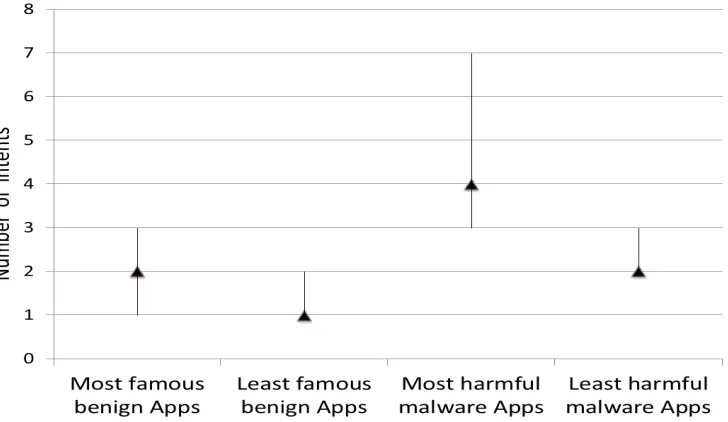
There are 35 intents out of 227 in Android version 4.4, which are fre-quently used by apps. The most popular benign apps usually use on average 1 to 4 intents and the least popular use 1 to 2. Similarly, the most harmful apps use a minimum of 5 and maximum of 8. Least harmful malware apps use at least 2 or 3 intents. Fig. 3shows the overall trend of intents usage popular and harmful apps. Benign apps use onlyACTION MAIN, CATEGORY LAUNCHER and CATEGORY DEFAULT intents whereas malware apps usually use more in-tents to gain extra capabilities. Mostly malware apps use BOOT COMPLETED, ACTION CALL, ACTION BATTERY LOW, SMS RECEIVEand NEW OUTGOING CALL.
Malware apps are seen to use a few of the normal permissions and intents while they use a significant number of dangerous permissions and intents. Benign apps show a similar trend of using only normal permissions and in-tents. These findings suggest that permissions and intents play a central role in accessing, controlling and sharing of sensitive data and resources. These features may be exploited to detect and mitigate the malicious attacks.
4.3. Correlation between permissions and intents
Correlation is a technique to measure the strength of association between two variables. Different correlation coefficient methods are used to measure degree of correlation. The most common is the Pearson correlation coefficient (r). It is calculated by dividing the covariance of two variables with product of their standard deviations. Pearson’s correlation coefficient has a value between -1 (perfect negative correlation) and 1 (perfect positive correlation). Suppose we have n malware applications, each application is using X dangerous permissions written as xi = {x1, x2,..., xn} and Y dangerous
in-tents such that yi = {y1, y2,..., yn}, then the Pearson correlation coefficient
(r) can be calculated using equation (1).
rxy =
nP
xiyi−PxiPyi
p
nP
xi2−(Pxi)2
p
nP
yi2−(Pyi)2
. (1)
For the first set, the correlation coefficient (r) equals 0.74, indicating a strong relationship between dangerous permissions and dangerous intents for the significance level: p<0.001. For the other set, the correlation coefficient (r) equals to 0.94, indicating a very strong correlation between dangerous permissions and intents in the case of samples belonging to the same mal-ware family. The strong correlation between the dangerous permissions and intents supports our conjecture about the association between permissions and intents to carry out the malicious activity.
The Pearson correlation coefficients of 0.74 for different malware families and 0.94 for same malware family confirm the positive correlation between permissions and intents. However, we need to perform a significance test to decide whether or not there is any evidence which supports or contradicts the presence of a linear correlation in the whole population of malware apps. We use the hypothesis testing, for which we test the null hypothesis,H0, and
alternate hypothesis, H1 as
H0 : malware and benign applications use
the same set of permissions and intents, H1 : malware and benign applications don0t use
the same set of permissions and intents.
For hypothesis testing, we use the Mann-Whitney U−test with the p-value of 0.05. We calculate U1 and U2 values for both the permissions and
intents respectively using equations 2 and 3, respectively. In following equa-tions, R1 and R2 are the sums of ranks for permissions and intents,
respec-tively, and n1 and n2 are the sample sizes for both the variables.
U1 =R1−
n1(n1+ 1)
2 ; (2)
U2 =R2−
n2(n2+ 1)
2 . (3)
malware family(n1= 20, n2= 19, p=0.05, critical value = 119), the smallest
U value obtained is 87 which is less than the critical value of 119, we would reject the null hypothesis for the malware apps belonging to same family. For a large sample of apps belonging to different malware families(n1= n2= 200,
p=0.05, Z-critical value = 1.64), we calculate z-score with Z test. We obtain z-score of 13.0594 which is greater than Z-critical value hence suggesting the rejection of null hypothesis H0. We have very strong statistical evidence to
accept the alternate hypothesis H1, which suggests that the malware and
benign apps use a different set of permissions and intents. This conjecture is further verified with normal distribution testing and classification analysis using different machine learning algorithms.
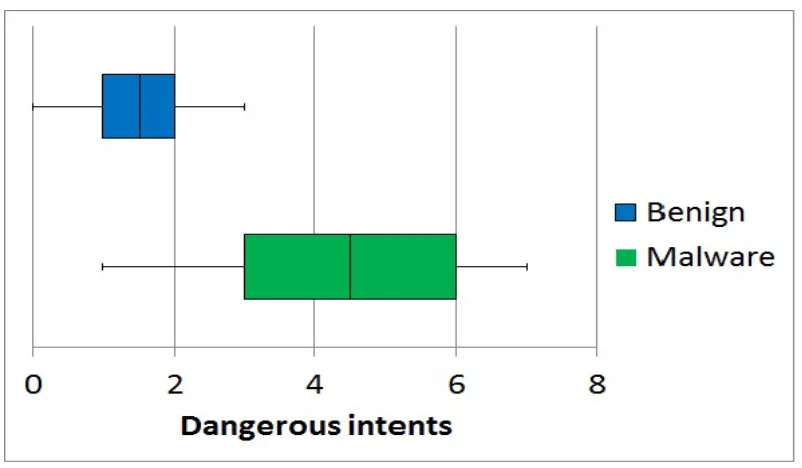
The normal distribution is important for statistical inference point of view Cohen et al.(1992). We use box plots to test whether the sample distribution is normal. The box plots of permissions and intents related to benign and malware apps are shown in Figures 4 and 5, respectively. The distribution appears to be approximately normal, with the upper whiskers longer than the Q1 to median distance and the box containing middle 50% of the data almost tightly grouped in the center of distribution.
5. Malware Classification
We describe how the data is represented and then present a detailed description of our proposed system.
5.1. Data Representation
Our dataset consists of n applications from K classes with m features. Let C = {1, 2,..., K} are the set of indices of the classes, A = {1, 2,..., n}
the set of indices of the applications and F = {1, 2,.., m} the set of indices of the features. Also, let ak, k ∈ C and ak ⊆ A be the set of indices of
applications belonging to class k. Additionally, let fj, j ∈ F be the domain
of the jth feature. Let ith application, such that i ∈ A is represented as (ci, fi ) = (ci, fi,1, fi,2,..., fi,m) ∈ C x F1 x...x Fm, where ci is the class of application i such that C ∈ {malware , normal} and (fi,1, fi,2,..., fi,m) is
the number of permissions and intents used by ith applications, and fi,m ∈
follows:
IG(Fi, C) =P
f∈(0,1)
P
c∈(mal,nor)P(Fi =f;C =c).log2
P(Fi=f;C=c
P(Fi=f)P(C=c)
; (4)
Given that
P(Fi =f;C=c) =P(Fi =f).P(C=c|Fi =f), (5)
Equation (4) can be simplified as
IG(Fi, C) =Pf∈(0,1) P
c∈(mal,nor)P(Fi=f).P(C =c|Fi=f).log2 P(C=c
|Fi=f)
P(C=c)
. (6) Using equation (6), the features with highest IG are selected to train the model.
5.2. Probability Estimation
The probability of an application belonging to a particular class is calcu-lated using Bayesian theorem:
P(C =c|F =f) = P(C =c) Qm
i=1P(Fi =fi|C =c)
P
j∈(0,1)P(C =cj)
Qm
i=1P(Fi =fi|C =cj)
; (7)
An app is classified as malware if
P(C =malware|F =f)> P(C =normal|F =f). (8)
5.3. System Description
The pre-processor stage processes the extracted data to generate the vec-tor dataset in an ARFF file format. The generated dataset is randomized using unsupervised instance randomization filter for better accuracy and sent to the classifier stage. The classifier stage takes each monitored vector as in-put and classifies the data set using trained classifier. Six machine learning classifiers: Nave Bayesian, Decision Tree, Decision Table, Random Forest, Sequential Minimal Optimization and Multi Lateral Perceptron (MLP) are used for classification. Their performances are also compared in terms of different performance metrics. Finally, the reporter stage generates notifica-tions for the user based on the classifier results.
6. Evaluation
6.1. Experimental Setting
The experiments are carried out on an Intel Core i7-3520 M CPU @ 2.90 GHz, 2901 MHz machine with 8GB RAM. Each of the classifiers are evaluated with two methods: 10-fold cross-validation and 80% split. In 10-fold cross-validation, the data set is divided into ten subsets, and the holdout method is repeated ten times. In each round, one subset is taken as test set and the remaining nine subsets are combined to form the training set. Errors of all the ten rounds are averaged out to obtain a final output. This method ensures that each instance is included at least once in the test set and nine times in the training set. The final model is the average of all ten iterations. The second method we use is 80% split, which uses 80:20 ratio (80% of a dataset for training and 20% for testing). This method is efficient but less accurate than the 10-fold method. In this section, we only report the results from 10-fold method.
6.2. Performance Comparison of different Classifiers
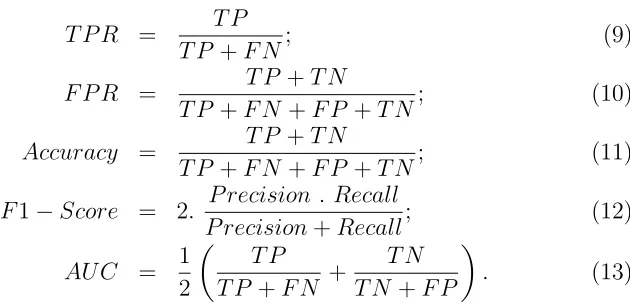
T P R = T P
T P +F N; (9)
F P R = T P +T N
T P +F N+F P +T N; (10)
Accuracy = T P +T N
T P +F N+F P +T N; (11)
F1−Score = 2. P recision . Recall
P recision+Recall; (12)
AU C = 1 2
T P T P +F N +
T N T N +F P
. (13)
Table 6 lists the TPR, FPR, Precision, F1-score, recall, AUC and model build-up time. All the analysed classifiers perform well with an accuracy of 0.90 or more. However, MLP and Decision table dominate with an accuracy of 0.99. In terms of time, Nave Bayesian, Decision Tree and Decision Table are more efficient than MLP and Random forest. Overall, Decision Table gives the best results.
6.3. Optimization with Ensemble methods
Ensemble methods combine results from multiple machine learning algo-rithms to improve the predictive performance Dietterich et al. (2000). It is not necessary that the performance of ensemble learning be better than the individual classifiers. The stacked performance depends on the selection of classifiers and methods used to combine the output predictions Saso et al. (2004).
We apply three ensemble methods: Boosting, bagging, and stacking to further improve the detection accuracy. Stacking gives the better results as compared to boosting and bagging. In stacking, multiple algorithms are trained individually with the training dataset and the outputs from the clas-sifiers are sent to a meta-classifier which is trained to combine the results to makes a final prediction. Decision Table, MLP, and Decision Tree classifiers are applied in first stage and their results are combined using three schemes: an average of probabilities, a product of probabilities and majority voting.
[image:15.612.183.498.146.298.2]class has greater probability such that,
M alware, if Pavg 3
X
k=1
Classmalware < Pavg 3
X
k=1
Classbenign; (14)
Benign, if Pavg 3
X
k=1
Classmalware > Pavg 3
X
k=1
Classbenign. (15)
Product of probabilities. Product of probabilities is taken from each of the classifiers and highest probability of class is assigned as:
M alware, if Pavg 3
Y
k=1
Classmalware < Pavg 3
Y
k=1
Classbenign; (16)
Benign, if Pavg 3
Y
k=1
Classmalware > Pavg 3
Y
k=1
Classbenign. (17)
Majority vote. The final result is decided based on the results obtained from the majority of the results.
Results of ensemble classification are depicted in Table 7. The product of probabilities method yields the best results.
6.4. Comparison with related approaches
classification. Although, they used the largest dataset of 129013 apps, it con-sists only 4.5% of malware samples thereby may not be able to learn malware patterns. It used many features opposed to our work which uses only two most effective features. It achieved 94% malware detection rate with 1% false positive rate whereas our approach achieved 99.8% detection accuracy with 0.06 false positive rate. Drebin requires extensive processing for extraction and execution of a large number of features from the manifest file and app code, it takes more time to analyse the app and therefore is less efficient than our method. It takes on average 10 seconds to analyse an app, whereas our approach takes less than 1 second. Its use of a large number of features may also result in more false alarms as the efficiency and accuracy of feature based detection approaches highly depend on the selection of more relevant and less number of features.
DroidMat(2012) analyses some features from the manifest file and smali files of disassembled codes. The extracted features include permissions, com-ponents deployments, intent messages and API calls. It applies K-means algorithm for clustering and Singular Value Decomposition (SVD) method for low-rank approximation. The minimized clusters are processed with a kNN algorithm for classification into malware or benign apps. It achieves an accuracy of 97.6% with no reported false positive rate. They analysed 1738 apps consisting of 1500 benign and only 238 malware samples. Malware sam-ples are only 13% of total dataset, which is a non-representative data set for capturing the malware usage patterns. The accuracy is less than our method and the processing time is higher as it needs to perform the execution of smali files and manifest files. Since Smali files are much larger than manifest files, the overall cost of methods which analyse smali files forgoes higher. This holds true for both of above solutions: Drebin and DroidMAT.
of features and regular updating requirement of the database to maintain the detection performance. Since, both the analyses are done off-device; the mobile app is just to provide an interface to upload the apk to the analy-sis server. The static and dynamic analyses of an app take several minutes depending on the size of smali files. This approach is less efficient and less accurate than our approach.
We further compare the detection rate of PIndroid on the unlabelled set of 100 apps against these approaches. The results are shown in Table 8. PInDroid significantly outperforms the other approaches with TPR of 0.98 and FPR of 0.1. The other approaches provide a detection rate between 0.90 to 0.93 with FPR between 0.7 to 1. Detection performance of compared approaches as Roc curve is shown in Fig. 7. These approaches are less efficient than our approach in analysing the apps due to their dual processing time. PIndroid gives good results due to the use of most relevant feature set to model the malicious behaviour.
7. Conclusion
Android security framework relies on permissions and intents to control the access to vital hardware and software resources. These two features have never been used in tandem for malware detection. This work proposes a novel malware detection method based on these two vital security features. We use statistical and machine learning methods to validate the conjecture. Our results demonstrate the potential of this approach, where PinDroid out-performs related approaches and detects malware apps accurately with very low false positive rate.
References
Adrienne Porter Felt, Erika Chin, Steve Hanna, Dawn Song and David Wag-ner. Android permissions demystified. Computer and communications security, International Conference, pp 627–638, ACM, 2011.
Amiya K Maji, Fahad Arshad, Saurabh Bagchi, Jan S Rellermeyer. An empirical study of the robustness of inter-component communication in Android. InDependable Systems and Networks (DSN), International Con-ference, pp 1–12, IEEE, 2012.
Andrea Avancini and Mariano Ceccato. Security testing of the communica-tion among Android applicacommunica-tions. In Proceedings of the 8th International Workshop on Automation of Software Test, pp 57–63, IEEE, 2013.
Asaf Shabtai, Uri Kanonov, Yuval Elovici, Chanan Glezer, and Yael Weiss. andromaly: a behavioral malware detection framework for Android de-vices.Journal of Intelligent Information Systems, 38(1): pp 161–190, 2012.
Bhaskar Pratim Sarma, Ninghui Li, Chris Gates, Rahul Potharaju, Cristina Nita-Rotaru, and Ian Molloy. Android permissions: a perspective combin-ing risks and benefits. In17th ACM symposium on Access Control Models and Technologies, pp 13–22, ACM, 2012.
Chao Yang, Zhaoyan Xu, Guofei Gu, Vinod Yegneswaran, and Phillip Porras. Droidminer: Automated mining and characterization of fine-grained mali-cious behaviors in Android applications. InComputer Security-ESORICS, pp 163–182, Springer, 2014.
Daniel Arp, Michael Spreitzenbarth, Malte Hubner, Hugo Gascon and Kon-rad Rieck. DREBIN: Effective and Explainable Detection of Android Mal-ware in Your Pocket. NDSS, 2014.
Daniele Gallingani, Rigel Gjomemo, VN Venkatakrishnan and Stefano Zanero. Practical Exploit Generation for Intent Message Vulnerabilities in Android. Proceedings of the 5th ACM Conference on Data and Appli-cation Security and Privacy, pp 155–157, ACM, 2015.
and its application to Android. Computer and communications security, 17th ACM Conference on, pp 73–84, ACM, 2010.
David Kantola, Erika Chin, Warren He, and David Wagner. Reducing attack surfaces for intra-application communication in Android. In Proceedings of the second ACM workshop on Security and privacy in smartphones and mobile devices, pp 69–80, ACM, 2012.
Dimitris Geneiatakis, Igor Nai Fovino, Ioannis Kounelis, and Paquale Stir-paro. A permission verification approach for Android mobile applications. Computers & Security, 49: pp 192–205, 2015.
Dong-Jie Wu, Ching-Hao Mao, Te-En Wei, Hahn-Ming Lee, and Kuo-Ping Wu. Droidmat: Android malware detection through manifest and api calls tracing. In Information Security, Seventh Asia Joint Conference on, pp 62–69, IEEE, 2012.
Dragos Sbˆırlea, Michael G Burke, Salvatore Guarnieri, Marco Pistoia, and Vivek Sarkar. Automatic detection of inter-application permission leaks in Android applications. IBM Journal of Research and Development, 57(6): pp 10–1, 2013.
Dzeroski Saso and Zenko Bernard. Is combining Classifiers with Stacking better than selecting the best one. Machine Learning, 9:(54), pp 255–273, 2004.
Erika Chin, Adrienne Porter Felt, Kate Greenwood, and David Wagner. An-alyzing inter-application communication in Android. InProceedings of the 9th international conference on Mobile systems, applications, and services, pp 239–252, ACM, 2011.
Hao Peng, Chris Gates, Bhaskar Sarma, Ninghui Li, Yuan Qi, Rahul Potharaju, Cristina Nita-Rotaru and Ian Molloy. Using probabilistic gen-erative models for ranking risks of Android apps. Computer and commu-nications security, Conference proceedings on, pp 241–252, ACM, 2012.
Iker Burguera, Urko Zurutuza, and Simin Nadjm-Tehrani. Crowdroid: behavior-based malware detection system for Android. In Proceedings of the 1st ACM workshop on Security and privacy in smartphones and mobile devices, pp 15–26. ACM, 2011.
Hyunjae Kang, Jae-wook Jang, Aziz Mohaisen, and Huy Kang Kim. De-tecting and classifying Android malware using static analysis along with creator information.International Journal of Distributed Sensor Networks, pp 1–9, 2015.
Jacob Cohen. A power primer. Psychological bulletin, 112(1): pp 155, 1992.
Kabakus Abdullah Talha, Dogru Ibrahim Alper and Cetin Aydin. APK Auditor: Permission-based Android malware detection system. Digital Investigations, Elsevier Journal on, PP(13): pp 1–14, Elsevier, 2015.
Kathy Wain Yee Au, Yi Fan Zhou, Zhen Huang and David Lie. Pscout: analyzing the Android permission specification. Proceedings of conference on Computer and communications security, pp 217–228, ACM, 2012.
Long Lu, Zhichun Li, Zhenyu Wu, Wenke Lee and Guofei Jiang. Chex: statically vetting Android apps for component hijacking vulnerabilities. Proceedings of conference on Computer and communications security, pp 229–240, ACM, 2012.
Lucas Davi, Alexandra Dmitrienko, Ahmad-Reza Sadeghi, and Marcel Winandy. Privilege escalation attacks on Android. In Information Se-curity, pp 346–360, Springer, 2011.
Martina Lindorfer, Matthias Neugschwandtner and Christian Platzer. MAR-VIN: Efficient and Comprehensive Mobile App Classification Through Static and Dynamic Analysis. Computer Software and Applications, 39th Annual Conference, pp 422–433, IEEE, 2015.
Michael I Gordon, Deokhwan Kim, Jeff H Perkins, Limei Gilham, Nguyen Nguyen and Martin C Rinard. Information Flow Analysis of Android Applications in DroidSafe. pp 1–16, NDSS, 2015.
malware penetration and defenses. Communications Surveys & Tutorials, 17(2): pp 998–1022, IEEE, 2014.
Thomas G Dietterich. Ensemble methods in machine learning. In Multiple classifier systems, pp 1–15, Springer, 2000.
Timothy Vidas and Nicolas Christin. Evading Android runtime analysis via sandbox detection. In Proceedings of the 9th ACM symposium on Information, computer and communications security, pp 447–458, ACM, 2014.
William Enck, Machigar Ongtang and Patrick McDaniel. On lightweight mobile phone application certification. Computer and communications se-curity, pp 235–245, ACM, 2009.
William Enck, Machigar Ongtang, and Patrick McDaniel. Understanding Android security. IEEE security & privacy, (1): pp 50–57, IEEE, 2009.
Figure 2: Number of permissions used by malware and benign applications
[image:24.612.121.485.415.626.2]Figure 4: Box-plots for dangerous permissions
[image:25.612.109.510.408.642.2]Figure 6: Diagram of proposed system
[image:26.612.173.465.446.603.2]Table 1: Number of permissions and intents in API levels
API Level
No of Permissions
No of Intents
23
135
252
22
124
243
21
123
238
20
118
227
19
117
227
18
106
221
17
103
214
16
103
203
15
99
201
14
99
191
13
97
180
12
96
180
11
96
176
10
96
167
9
95
167
8
92
167
7
88
161
6
88
158
5
88
158
4
87
146
3
83
136
2
78
124
Table 2: Sources of Malware samples
Source No of Malware samples used
Contagio 60
Drebin 100
Genome 1000
VirusTotal 70
theZoo 20
MalShare 25 VirusShare 25
Table 3: Number of malware samples collected from different sources
Malware family No of samples analyzed Malware type
Basebridge 11 Botnet, Information stealing DroidKungFu 11 Botnet, Information stealing DroidKungFu 10 Botnet, Information stealing, Backdoor FakeDolphin 4 Adware
Locker 2 Ransomware
VDLoader 3 Backdoor, Information stealing
FakeBank 5 Trojan Banker, Money stealing, Information stealing GinMaster 7 Information stealing, Backdoor
Boxer 2 Sends SMS JIFake 3 Sends SMS SNDApps 1 Information stealing OpFake 4 Sends SMS FakeInst 3 Installer FakePlayer 3 Sends SMS
BgServ 7 Botnet, Information stealing, Botnet, Trojan Installer, backdoor Plankton 7 Money stealing, Botnet, Information stealing, Backdoor, Trojan installer Geinimi 9 Botnet, Information stealing, Root access
AnserverBot 13 Information stealing PjApps 9 Botnet, backdoor GoldDream 10 Trojan, Information stealing DroidSheep 7 Session hijacker
CopyCat 4 Adware
DroidDream 10 Information stealing, Adware
DroidKungFu 11 Botnet, Information stealing, Root access Keji 4 Information stealing, Trojan Installer HolyBible 5 Adware, Backdoor
Obad 2 Botnet, Information stealing, Botnet, Trojan Installer, backdoor, SMS sending, Location Nickispbby 5 Spying, Information stealing
RuFraud 3 SMS sending Jsmshider 3 Information stealing
[image:28.612.115.500.376.646.2]Table 4: Categories of benign apps
Category
No of samples used
Apps Market
Social Media
11
Google Play store
4
Google Play store
Education
10
Google Play store
Banking
4
Google Play store
Entertainment
15
Google Play store
Sports
8
Google Play store
Shopping
6
Google Play store
Finance
6
Google Play store
News
8
Google Play store
Weather
8
Google Play store
Games
15
Google Play store
Medical
10
Google Play store
Fitness
11
Google Play store
Media
11
Google Play store
Casual
15
Google Play store
Music
15
Google Play store
Books
5
Google Play store
Travel
5
Google Play store
Lifestyle
15
Google Play store
Simulation
7
Google Play store
Transportation
4
Google Play store
Misc
15
AppBrain
Misc
10
F-Droid
Misc
10
Getjar
Misc
15
Aptoid
Table 5: Confusion Matrix
Actual Class Classified as Malware Classified as Benign
Malware TP FN
[image:30.612.106.505.279.376.2]Benign FP TN
Table 6: Comparison of Classification Algorithms
Algorithm TPR FPR Precision F1Score Recall AUC Time
MLP 0.993 0.006 0.995 0.995 0.995 0.996 1.18
Decision Table 0.993 0.006 0.995 0.996 0.996 0.996 0.23
Decision Tree 0.992 0.011 0.993 0.992 0.993 0.992 0.01
Nave Bayesian 0.982 0.012 0.989 0.988 0.989 0.997 0.01
Random Forest 0.982 0.007 0.985 0.985 0.985 0.989 0.43
[image:30.612.113.503.448.505.2]SMO 0.952 0.033 0.956 0.956 0.956 0.978 0.24
Table 7: Comparison of Ensemble results
Method TPR FPR Precision F1Score Recall AUC
Average Probability 0.972 0.012 0.975 0.975 0.975 0.982 Product Probability 0.998 0.011 0.998 0.997 0.997 0.998
[image:30.612.170.440.576.651.2]Majority Vote 0.982 0.021 0.986 0.986 0.986 0.989
Table 8: Comparison with related approaches
Method TPR FPR Average Time (sec)
PIndroid 0.984 0.1 1
Drebin 0.932 0.9 10
Marvin 0.918 0.7 9