City, University of London Institutional Repository
Citation:
Endress, A. (2019). Duplications and domain-generality. Psychological Bulletin,This is the accepted version of the paper.
This version of the publication may differ from the final published
version.
Permanent repository link:
http://openaccess.city.ac.uk/id/eprint/22855/Link to published version:
Copyright and reuse: City Research Online aims to make research
outputs of City, University of London available to a wider audience.
Copyright and Moral Rights remain with the author(s) and/or copyright
holders. URLs from City Research Online may be freely distributed and
linked to.
Duplications and domain-generality
Ansgar D. Endress City, University of London
Abstract
While specialized, adaptive behavioral traits are ubiquitous in the animal
kingdom, at least in humans, there are considerable debates on whether the mind is primarily characterized by various special-purpose, domain-specific
mechanisms, or by a few general-purpose, domain-general mechanisms. Drawing from research on artificial language learning, associative learning, serial learning, executive control and formal linguistics, I argue that neither domain-specificity nor domain-generality provide satisfactory descriptions when considering how cognitive mechanisms are implemented. I suggest that some cognitive
mechanisms are “domain-bound” – they are available in multiple domains (and thus not specific), but not in other domains (and thus not
domain-general). Hence, these computations can be performed in many domains but not in others, can be recruited simultaneously by multiple domains, and, across domains, individual abilities with a given computation are relatively uncorrelated. Domain-bound mechanisms have a straightforward evolutionary interpretation:
Analogously to the evolution of molecular and morphological structures, cognitive mechanisms can become duplicated over evolution, with independent copies in different domains. This and previous evidence for the importance of duplications for our cognitive abilities call for a revision of the concept domain-generality, suggesting that, in many cases, mechanisms traditionally seen as domain-general might really reflect a collection of local copies of specialized mechanisms.
Duplications and domain specificity
Karl Marx and Adam Smith might differ in their political philosophies, but they agree on one thing: division of labor leads to greater efficiency. Does such a division of labor also exist in the brain? Are there “domain-specific”
computational mechanisms that are constrained to operate in only one domain (e.g., face processing) and others in other domains (e.g., language)? Are there “domain-general” mechanisms that can operate in all domains alike? For
example, are there domain-specific mechanisms involved in language acquisition (Chomsky, 1980; Fodor, 1983; Lenneberg, 1967), or does language acquisition rely on computational mechanisms available in essentially any domain (Aslin & Newport, 2012; McClelland, Rumelhart, & Group, 1986; Seidenberg, 1997)?
Here, I propose a new view on such questions, whereby cognitive
mechanisms can become duplicated over the course of evolution (see also Barrett, 2012; Chakraborty & Jarvis, 2015; Endress, Nespor, & Mehler, 2009; Kaas, 1989; Marcus, 2004; Markram et al., 2004; Samuels, 2000; Shukla, 2005; Sperber, 1994, for related proposals). This allows independent copies of a mechanism to be available in multiple domains, without being fully domain-general. I will first provide several case studies that seem to require duplication accounts of some sort. For example, humans and other animals can detect identity-relations (e.g., noticing that the last syllable is repeated in a sequence such as dubaba). While identity-relations seem to be detected by a specialized mechanism, this
However, even in the domain of language, identity-relations can be computed for only some classes of items but not for others, an unexpected result if the identity-detector were truly domain-general. However, if cognitive mechanisms can become duplicated over evolution, the mechanism detecting identity-relations might be what Endress, Nespor, et al. (2009) called “domain-bound:” There might be distinct and independent instances of the mechanism detecting
identity-relations for language, vision, olfaction and so on. (Hereafter, I will use the term identity-detector to refer to an instance of the mechanism detecting identity-relations.) Further, I will argue that each of these domains may have several independent identity-detectors and that identity-detection might possibly occur through fairly simple circuit motifs. If so, these identity-detectors would allow identity-relations to be detected in various domains; each of the individual identity-detectors, in contrast, is domain-specific.1
Following the discussion of identity-relations, I will turn to other case studies from statistical learning to executive function, and suggest that the situation is similar in these cases: mechanisms that are usually considered domain-general might reflect a set of independent, local mechanisms.
1. What is a domain?
The definition of a domain is critical for the following discussion, and helps illustrating some confusion in the literature. From an informational point of view, a domain is a distinct class of information. This class of information is
1
recurrent and ecologically relevant in an organism’s mental life. As a result, the organism has evolved mechanisms that process this kind of information (see Hirschfeld & Gelman, 1994, for a similar definition), though these mechanisms might come to process different kinds of information than what they evolved to process (Dehaene & Cohen, 2007; Gould & Vrba, 1982; Sperber, 1994). For example, given that faces are a critical source of information in social species, they constitute a recurrent class of information, which might have led to the evolution of mechanisms that deal with this class of information (Bonatti, Frot, Zangl, & Mehler, 2002; Kanwisher, McDermott, & Chun, 1997; Reid et al., 2017; Sugita, 2008; van den Hurk, Van Baelen, & Op de Beeck, 2017, but see e.g., Gauthier, Skudlarski, Gore, & Anderson, 2000; Gauthier, Tarr, Anderson,
Skudlarski, & Gore, 1999). Under this view, mechanisms that are domain-general can apply to all domains alike, and mechanisms that are domain-specific process information only in a single domain.
However, there are a number of problems with this definition. First, it leads to a confusion between the computations a mechanism implements, and the implementations themselves (Marr & Nishihara, 1992). For example, some computations we perform on faces might be identical to those we perform on xylophones (e.g., we might encode the relative spatial positions of object parts for either class of stimuli). These computations might well be implemented in distinct brain areas, and might thus be independent. Given the information-based
definition above, these computations would thus count as domain-general
xylophones (see also Nozari & Novick, 2017, for further arguments based on monitoring in speech perception and production that we need to distinguish notions of domain-generality based on (i) the similarity of the information that is processed and (ii) the brain regions that are activated by the corresponding processes). As a result, domains cannot be defined exclusively based on the type of information that is processed. A viable definition of a domain needs to take into consideration how the information is processed in terms of the underlying implementations.
Second, the definition of a domain above is not fine-grained enough to account for the hierarchical structure of processing. For example, language is clearly a domain, but so is phonology, and, within phonology, prosody. Given that, when we process prosodic information, it comes packaged with phonological as well as linguistic information, a pure information-based definition of domains cannot account for this hierarchical domain structure. To be sure, this is not an inherent problem of an information-based definition of a domain. However, given that the kinds of domains that populate discussions of domain-specificity tend to be fairly broad (e.g., language, face processing, Theory of Mind,…), the kinds of domains that are usually discussed do not reflect the hierarchical structure of processing.
To avoid such problems, I opt for a definition that integrates the
“domain” refers to a set of implementations of computational mechanisms that process a certain, ecologically recurring class of information, and that, together, fulfill an ultimate function in our interactions with the environment. Examples might include face recognition, object recognition, music or language. A domain is a set of implementations of processing mechanisms that specifically operate on the kind of information from which the domain takes its name.
For example, if face recognition is a domain, its constituent mechanisms
specifically process face-related information. Even if we process relative spatial positions of object parts for both faces and xylophones, the xylophone-related instantiation of this mechanism would not be part of the face-domain. Further, some processes operate on different kinds of information; for example, face and xylophone processing both rely on early visual information processing. These shared processes are not part of the domain of face recognition, because they are not specifically involved in face processing.
This notion is similar to Fodorian modules (Fodor, 1983; see also Hirschfeld & Gelman, 1994) except that it is defined in terms of functions and processes rather than in terms of content, and that it is agnostic with respect to the degree of automaticity of a given process (see Sperber, 1994, for a similar view).
Importantly, this definition is hierarchical. Just as every goal can (but need not) have goals, any (ultimate) function can (but need not) have
presumably have sub-domains on their own. At least at the genetic level, such a hierarchical modular organization might be crucial to the evolvability of
organisms (Nothwang, 2016). Further, if the output of modules generally serves as the input to other modules, such hierarchical processing also increases the flexibility of cognitive operations (Sperber, 1994).2
2. Duplication in evolution
2.1. The importance of duplication in evolution
The proposal below relies on the duplication of cognitive mechanisms. Before presenting my (cognitive) case studies, I will thus briefly outline the role of duplications in evolution. The importance of the duplication of genes, whole genomes and morphological structures has long been recognized in evolutionary biology (Allman & Kaas, 1971; Chakraborty & Jarvis, 2015; Hurley, Hale, & Prince, 2005; Innan & Kondrashov, 2010; Kaas, 1989; Magadum, Banerjee, Murugan, Gangapur, & Ravikesavan, 2013; Ohno, 1970; Taylor & Raes, 2004; J. Zhang, 2003). Innan & Kondrashov (2010) argued that “hardly any aspect of genome evolution or function is not somehow linked to gene duplications, which occur in all kinds of life forms and have taken place since before the last universal common ancestor.” For example, in catarrhines (old-world monkeys and apes),
2
trichromatic color vision evolved from dichromatic color vision by duplication of an opsin (Jacobs, 2009; Surridge, Osorio, & Mundy, 2003), and mammalian sound localization circuits for high frequencies might be duplicates of earlier circuits (Nothwang, 2016). In fact, just since humans split from chimpanzees, up to 1,800 gene duplications took place in the human lineage (Taylor & Raes, 2004; J. Zhang, 2003).
Such results raise the possibility that duplications are important for the evolution of cognitive abilities as well, and in some form or another, different authors have made similar proposals (Barrett, 2012; Chakraborty & Jarvis, 2015; Endress, Nespor, et al., 2009; Kaas, 1989; Marcus, 2004; Shukla, 2005; Sperber, 1994). For example, Pinker (1998) argued that
“evolutionary change often works by copying body parts and tinkering with the copy. […] A similar process may have given us our language of
thought. Suppose ancestral circuits for reasoning about space and force
were copied, the copy’s connections to the eyes and muscles were severed,
and references to the physical world were bleached out. The circuits could
serve as a scaffolding whose slots are filled with symbols for more
abstract concerns like states, possessions, ideas, and desires. The circuits
would retain their computational abilities […]. When the new, abstract
domain has a logical structure that mirrors objects in motion […], the old
circuits can do useful inferential work” (p. 355/356).
involved in song learning might be duplicates of earlier motor regions, and at least some parrot species and humans might have yet another duplicate (Chakraborty & Jarvis, 2015; Chakraborty et al., 2015). Closer to home, Belyk and Brown (2017) proposed that duplicated brain areas might be important for the evolution of human speech control as well. They noted that humans have two rather than one laryngeal motor areas in each hemisphere and proposed that the more dorsal area evolved either as a duplicate of the (ancestral) ventral laryngeal motor area (and a subsequent migration of the duplicate to its current location) or as a duplicate of a non-vocal motor area (and a subsequent change in the connectivity pattern of the duplicate).
There are also computational reasons for believing that duplicated neural circuits might be used across domains. In machine learning, it has been shown that classification performance in an artificial neural network improves by using connectivity patterns from a network trained on a classification problem in a
different domain (Caruana, 1997; Donahue et al., 2014). As neural circuits are tuned by evolution, duplicated neural circuit might also be computationally effective in a different domain, though they likely require fine-tuning.
2.2. Functional integration of duplicated structures
share basic circuit types, with some neurons receiving sensory input, others providing output to the brain stem, and still others act as relay between input and output neurons. These basic circuits are conserved due to a conserved network of transcription factors, but can end up in structures that differ vastly across taxa such as the mammalian neocortex and the avian dorsal ventricular ridge. They can also have strikingly different morphology: in the mammalian neocortex,
excitatory cells tend to be pyramidal while they have stellate shape in the pallium in birds. Briscoe and Ragsdale (2018) sum up this situation as follows:
“The core circuits of the pallium [in mammals, birds and other reptiles] are conserved, but pallial architectures and the spatiotemporal regulation
of cell type specification are not. These latter levels of biological
organization can shift over evolutionary time, so long as sensory
information gets to the pallium, gets integrated, and elicits an appropriate
output. Some transcription factor molecules, such as the hypothesized
input cell determinants, exhibit a conserved correlation with defined
neuronal cell types across species.”
stochastically enables expression of only one of the opsins.3 As a result, some cones express the ancestral copy, and others the duplicate.
Another route that leads to (presumably) functional duplicates is the duplication of entire brain pathways. In fact, if entire brain circuits are duplicated by duplicating transcription factors that control both the number and the
placement of these circuits within the brain (Chakraborty & Jarvis, 2015; Chakraborty et al., 2015), the resulting duplicates would be expected to be functionally integrated.4
2.3. Duplication versus exaptation
It should be noted that the idea of duplication is related to but different from the concept of exaptation (Gould & Vrba, 1982). An exapted trait is co-opted for a new function that is different from the one (if any) for which it has been selected. A classic example involves the evolution of bird feathers. Early birds had probably only limited flight abilities. However, even non-avian dinosaurs were covered in feathers, suggesting that feathers evolved for other
3
In Howler monkeys, the control region was duplicated as well. 4
Functionally duplicated structures do not even always require duplicated genes. Trichromacy provides an example for this possibility as well. In primates, the gene for one opsin resides on an autosomal (i.e., non-sex) chromosome, while the gene for the opsin that is duplicated in old-world monkeys resides on the X chromosome. Critically, this latter opsin is polymorphic. As a result, in females whose X chromosomes differ (i.e., who are heterozygous), cones can express the opsin from the non-sex chromosome, or either of the two alleles from the X
purposes such as thermal insulation or display (Brusatte, O’Connor, & Jarvis, 2015). As a result, by the time birds evolved from dinosaurs, early birds were likely feathered. Feathers thus were not selected for flight in birds, and are rather an exaptation for flight (Brusatte et al., 2015; Gould & Vrba, 1982).
Exaptation has also been proposed for cognitive abilities, such as the recycling of originally visual brain areas for reading (Dehaene & Cohen, 2007), of mechanism tracking the number of items for symbolic mathematics (Dehaene & Cohen, 2007; Halberda, Mazzocco, & Feigenson, 2008), or of serial memory mechanisms for language acquisition and use (Endress, Nespor, et al., 2009; Fischer-Baum, Charny, & McCloskey, 2011). For example, the “Visual Word Form Area,” a region in the left lateral occipitotemporal sulcus, is specifically activated when reading visual words (Dehaene & Cohen, 2007); this region might have been exapted for reading in humans either because, in non-human primates, it has a pattern of connectivity that makes it particular conducive for processing visual symbols or because it might be involved in the analysis of visual shapes (Hannagan, Amedi, Cohen, Dehaene-Lambertz, & Dehaene, 2015).
In contrast to exapted traits, duplicated traits first become duplicated. Then, they might retain their original function (or a sub-function thereof), or acquire novel functions either through adaptation or exaptation (though, in the case of gene duplications, it is debated to what extent both copies of the duplicated gene retain a function; M. Lynch & Force, 2000).
2.4. The conglomerate analogy of duplicated structures
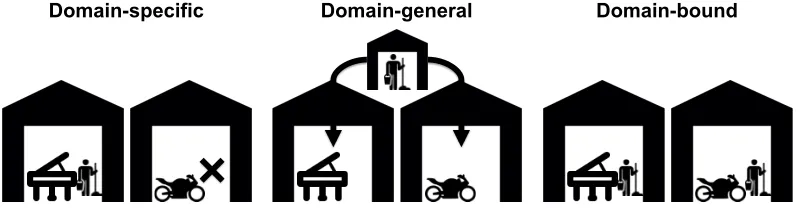
brain is like a company that manufactures different products in different factories (e.g., motorcycles in a motorcycle factor, and pianos in a piano factory); these factories correspond to domains or modules. However, each factory requires some common functions such as cleaners. If the cleaners are “domain-specific,” they exist only in one of the factories, with no cleaners in the other factories. If the cleaners are “domain-general,” they are located outside of the factories (e.g., at the level of the parent company or with a contractor), and enter the factories only to perform their services. Lastly, if the cleaners are domain-bound, each factory has its own cleaners. In contrast, an exaptation would be the equivalent of the factory workers using, say, a shovel to clean the factories; the shovel-wielding workers might be domain-general, domain-specific or domain-bound.
In addition to existing only in a single factory, there is a second way in which cleaners can be domain-specific. All factories might use independent cleaners, but the cleaners might operate differently in different factories. For example, they might use mops in some factories and vacuum cleaners in others. In other words, while their function is identical across factories, the implementation
of this function differs. In evolutionary terms, such a situation might arise when the mechanisms evolved independently in different domains (e.g., through a form of within-species convergent evolution), and, across species, similar functions are sometimes implemented using different computational principles (e.g., auditory source localization in mammals vs. barn owls; Grothe, 2018).5
5
Below, I will provide evidence from behavioral studies that, I argue, are best explained if cognitive mechanisms can become duplicated. I will mostly focus on descriptions at the psychological level, simply because we don’t know how the relevant mechanisms are implemented at the neuronal level, let alone how they evolved. However, I will also review some biologically realistic models that might account for some of the case studies below, and argue that these
duplicated mechanisms might reflect potentially simple circuits that might well be found in many brain regions.
according to the definition above), but rather be located at the level of the parent company; critically, however, the parent company would send the cleaners only into a sub-set of its factories. Psychologically speaking, this might correspond to a domain-general set of processes with top-down connections to only certain domains, either because some domains are not “connected” to these domain-general processes to begin with, or because the connections were lost due to pruning (see Section 7 below). Second, and relatedly, some lower-level processes might have bottom-up connections to some domains, but not others. For example, even if they represent different domains, face processing and visual object processing both require visual input; in contrast, visual bottom-up input is less important for, say, music processing.
In contrast to the first two possibilities, only a subset of the factories might have cleaners even when the cleaners are part of the corresponding domain. This might arise either because, initially, all factories have domain-bound cleaners but then some factories lose them, or because, initially, no factory has cleaners, but some factories develop cleaners from the personnel they already have. Both possibilities are psychologically attested. First, there is evidence, both at the synaptic (Huttenlocher & Dabholkar, 1997) and at the behavioral level (Hannon & Trehub, 2005; Pascalis, de Haan, & Nelson, 2002; Polka & Werker, 1994; Werker & Tees, 1984) that certain abilities that are present early in life are lost in the absence of relevant experience (see Section 7). Alternatively, in its initial stage, none of the factories might have cleaners, but all have employees who have the potential and tools to be clearers; in some factories, these employees might thus become specialized for cleaning, similar to how certain brain regions become specialized for reading when provided with relevant experience such as schooling (Dehaene et al., 2010; Saygin et al., 2016 and Section 7).
Domain-specific Domain-general Domain-bound
Figure 1: Illustration of the concepts domain-specificity, domain-generality
and domain-boundedness, using the analogy of a company with factories that
manufacture different products (e.g., a motorcycle factory and a piano
factory). All factories require cleaners. (Left) “Domain-specific” cleaners
exist only in one of the factories, but not in the other one. (Middle)
“Domain-general” cleaners are located outside of the factories (e.g., at the level of the parent company or with a contractor), and enter the factories only to clean
them. (Right) If the cleaners are domain-bound, each factory has its own
cleaners. Using a shovel to clean the factories would be the equivalent of an
exaptation.
3. The case of identity-relations
seven-month-olds notice that the last two syllables are identical, and extend this identity-relation to new items. Specifically, Marcus, Vijayan, Rao, and Vishton (1999) familiarized seven-months-old infants with syllable sequences such as
ledidi, wijeje and so on (where the last two syllables were repeated, hereafter called an ABB pattern). Following this a familiarization, infants were more familiar with novel sequences with novel syllables that shared the identity-pattern (e.g., bapopo) compared to novel syllable sequences that had a different pattern (e.g., babapo; hereafter called an AAB pattern). They similarly learned AAB patterns. Infants thus learned an open-ended regularity based on identity-patterns.
3.1. How are identity-relations computed?
According to Marcus et al. (1999), infants learned abstract relationships among variables. For example, if the three syllables in a triplet are represented by three variables X, Y, and Z, the ABB pattern corresponds to the algebraic relation
Y=Z. In contrast, based on simulations with artificial neural networks, different authors proposed that infants do not need to represent open-ended regularities when learning such patterns, and might just exploit statistical regularities of various sorts (e.g., Altmann, 2002; Christiansen & Curtin, 1999; McClelland & Plaut, 1999; Seidenberg & Elman, 1999; see (Alhama & Zuidema, 2019), for a recent review)
showed that learners relying on general algebraic relations between variables should learn both types of structures equally well, and that the statistical models of Marcus et al.'s (1999) data (e.g., Altmann, 2002; Christiansen & Curtin, 1999; McClelland & Plaut, 1999; Seidenberg & Elman, 1999) either predict that both types of structures should be learned equally easily, or that the non-identity-patterns should be easier to learn (depending on the specific models).
In contrast to both classes of models, participants were much better at learning patterns than non-patterns, suggesting that identity-patterns might be detected by a specialized mechanism. Further results showed that Bayesian general-purpose learners (Frank & Tenenbaum, 2011) do not explain the learning of identity-relations either (Endress, 2013). If one adopts the very assumptions that allow Bayesian learners to account for Endress, Dehaene-Lambertz and Mehler's (2007) and other data, one ends up with predictions that are either empirically refuted or highly implausible at best (see Endress, 2013, 2014, for discussion). Identity-patterns thus seem to be processed by some sort of specialized repetition-detector.
Identity-relations play an important role in many languages. For example, Semitic languages such as Arabic and Hebrew have constraints governing which consonants can occur together in a word. These constraints are based on identity-relations among these consonants (e.g., Berent & Shimron, 1997; Frisch,
85% of the world’s languages (Rubino, 2013).
Despite their importance for language, identity-relations can be perceived in many non-linguistic domains, and by many non-linguistic animals. Humans can compute identity matches for speech syllables, tones and visual objects (Dawson & Gerken, 2009; Endress et al., 2007; Marcus, Fernandes, & Johnson, 2007; Marcus et al., 1999; Saffran, Pollak, Seibel, & Shkolnik, 2007), and are sensitive to the identity-relations from birth (Antell, Caron, & Myers, 1985; Gervain, Berent, & Werker, 2012; Gervain, Macagno, Cogoi, Peña, & Mehler, 2008), though such patterns might be easier to recognize with speech material (Marcus et al., 2007). Bees can compute identity-relations for colors, gratings and odors (Giurfa, Zhang, Jenett, Menzel, & Srinivasan, 2001). Rats and various non-human primate species as well as various bird species can compute such relations for speech and non-speech stimuli (de la Mora & Toro, 2013; Hauser & Glynn, 2009; Murphy, Mondragon, & Murphy, 2008; Neiworth, 2013; Pepperberg, 1987; Smirnova, Zorina, Obozova, & Wasserman, 2015; Yamazaki, Suzuki, Inada, Iriki, & Okanoya, 2012; but see Spierings & ten Cate, 2016; van Heijningen, Chen, van Laatum, van der Hulst, & Ten Cate, 2013, for evidence that these relations are not equally salient to all species), and ducklings and chicks even imprint to abstract identity-relations (Martinho & Kacelnik, 2016; Versace, Spierings, Caffini, Ten Cate, & Vallortigara, 2017, but see Hupé, 2017; Langbein & Puppe, 2017).
adults and infants appear to readily learn identity-relations with vowels but not consonants, and seem unable to learn identity-patterns carried by syntactic categories.
3.2. Are identity-relations really domain-general? The case from language 3.2.1. The case of vowels and consonants
Adult speakers are better at detecting identity-patterns on vowels than on consonants, to the extent that they fail to detect the patterns on consonants (Toro, Bonatti, Nespor, & Mehler, 2008). In these experiments, participants were familiarized with a sequence of words in which either the vowels or the
consonants conformed to an identity-pattern (e.g., words like tapena and bodako, where the first and the last vowel were identical, or words like banubE and tineto, where the first and the last consonant were identical). Participants learned the identity-pattern over vowels but not over consonants (Toro, Bonatti, et al., 2008), even when the salience of the vowels was much reduced (Toro, Shukla, Nespor, & Endress, 2008). Similar results have been observed with human infants (Hochmann, Benavides-Varela, Nespor, & Mehler, 2011; Pons & Toro, 2010).
In contrast, rats learn identity-relations equally well on vowels and on consonants (de la Mora & Toro, 2013), suggesting that consonants do not have an intrinsic acoustic property that makes learning identity-relations particularly difficult.
identity-patterns requires rule-like generalizations, they might plausibly be linked to grammar, and thus show a vowel advantage (but see the next section for evidence that identity-patterns might not be linked to grammatical processes). Irrespective of whether this interpretation is correct, these results show that learning identity-relations is much easier for some classes of linguistic stimuli than others, a result that is problematic for a fully domain-general identity-detector.
3.2.2. The case of syntactic categories
While identity-relations can be learned over a variety of stimuli, adult speakers seem unable to learn them over syntactic categories (Endress & Hauser, 2009). Specifically, participants were familiarized with word triplets conforming to either an AAB pattern (noun-noun-verb triplets such as town-leg-choose and verb-verb-noun triplets such as choose-speak-leg) or an ABB pattern (noun-verb-verb or (noun-verb-verb-(noun-verb-verb-noun). Following this, they were presented with AAB or ABB test triplets made from new words, and had to decide which one was like the familiarization items. Surprisingly, participants failed to discriminate between “correct” and “incorrect” patterns.
In a desperate attempt to make participants learn these patterns, Endress and Hauser (2009) primed them on nouns and verbs by having participants first categorize words into nouns and verbs; results showed that they performed at ceiling. Then they told them to watch out for a pattern of nouns and verbs, and finally familiarized them with the triplets. Even under these conditions, most participants failed to notice the patterns.
building blocks for learning the patterns are in place. For example, participants readily access the categories. They perform at ceiling when categorizing words, and learn other sequential regularities about the categories (e.g., whether triplets start or end with nouns). Further, participants learn identity-relations over non-syntactic categories: When semantic categories were used (e.g., animals and clothes), or phonological categories, listeners readily learned the
identity-relations. Nor is the failure due to ambiguities between nouns and verbs specific to English (i.e., that a verb like “run” can be used as a noun as well): Hungarian speakers (where such ambiguities do not exist) show the same pattern of failure.
It turned out that participants could learn the identity-relations over syntactic categories only when the resulting sentences had a syntactic
interpretation in terms of subjects, objects and so on. For example, when noun-noun-verb (e.g., baby-water-juggle) and adjective-adjective-noun (e.g., clever-fragile-water) triplets were used for the AAB pattern, participants readily learned the corresponding pattern. While the adjective-adjective-noun order corresponds to a legal English construction, participants also learned such syntactically when they did not conform to English word order. For example, they readily learned ABB patterns such verb-noun-noun or noun-adjective-adjective. In contrast, when the triplets had no obvious syntactic interpretation (as in the AAB patterns verb-verb-noun and adjective-adjective-verb, and the ABB patterns noun-verb-verb and verb-adjective-adjective), participants failed as before.
that is at odds with views that such relations are computed by domain-general mechanisms. Still, they can be computed in variety of domains, including tones, odors, visual stimuli and linguistic items, a result that is problematic if they were domain-specific.
3.2.3. Are there multiple identity-detectors?
One explanation for these puzzling results involves independent identity-detectors for visual, olfactive and tonal stimuli; within the language faculty, there might be independent identity-detectors for vowels, syllables, semantic categories and so on, but not for syntactic categories. If so, identity-relations can be detected in all domains that have an identity-detector, but not in domains that lack such a mechanism.
Within the domain of language, some support for the idea that the mind is equipped with multiple, independent identity-detectors comes from formal linguistics, where a very similar idea has been proposed to explain the admissible patterns of consonant repetitions in Semitic languages. Specifically, two identical consonants can occur at the end of a word root, but not at its beginning (Berent & Shimron, 1997; Frisch et al., 2004; McCarthy, 1979). The traditional explanation involves two independent computations of identity-relations, one at the
final syllable. Such theories thus assume that there are independent mechanisms sensitive to identity-relations at the morphological and at the phonological level.
Identity-relations might thus be computed by what we called “domain-bound” mechanisms (Endress, Nespor, et al., 2009), consisting of independent copies of mechanisms in different domains with similar computational functions; these copies might have arisen through duplication over evolution.
This view is also made plausible by the observation that identity-relations might be detected using fairly simple neuronal circuits.6 For example, Endress (under review) proposed a simple disinhibition-based circuit that might act as an identity detector. This idea is based on the growing evidence for the importance of “disinhibitory” circuits (where inhibitory neurons are inhibited by other neurons) in a variety of brain regions and taxa (Chevalier & Deniau, 1990; Goddard, Mysore, Bryant, Huguenard, & Knudsen, 2014; Hangya, Pi, Kvitsiani, Ranade, & Kepecs, 2014; Koyama et al., 2016; Koyama & Pujala, 2018; Lee, Kruglikov, Huang, Fishell, & Rudy, 2013; Mysore & Knudsen, 2012; Pfeffer, Xue, He, Huang, & Scanziani, 2013; Pi et al., 2013; Xu, Jeong, Tremblay, & Rudy, 2013), and in a variety of behaviorally important functions, including attention (van Der Velde & de Kamps, 2001; S. Zhang et al., 2014), gain control (Fu et al., 2014), discriminations of stimulus strength (Machens, Romo, & Brody, 2005; Miller &
6
Wang, 2006), categorization (Goddard et al., 2014; Kusunoki, Sigala, Nili, Gaffan, & Duncan, 2010; Mysore & Knudsen, 2012), behavioral response
selection (Jovanic et al., 2016; Zhao et al., 2019), associative learning (Letzkus et al., 2011), plasticity (Fu, Kaneko, Tang, Alvarez-Buylla, & Stryker, 2015) and social behavior (Marlin, Mitre, D’amour, Chao, & Froemke, 2015; Owen et al., 2013).
Endress’ (under review) model acts as a feature detector for identical relations. When this circuit is (sequentially or simultaneously) presented with two different items, these items are filtered out through inhibition. In contrast, when two identical items are presented, either sequentially one after another or simultaneously in the same display, the repetition of the items leads to a suppression of the inhibitory filtering. As a result, the repeated items can be propagated for further processing. While there is no direct experimental support for this model yet, it still suggests that simple and ubiquitous circuits might act as identity-detectors.
3.3. Are duplicates hierarchically organized?
The view that the mechanisms detecting identity-relations exist in
repeated object. If each of these hierarchical levels has its own identity-detector, cross-modal generalizations might be possible (see also Sperber, 1994, for the
proposal that the output of modules might be the input of other modules). In line with this view, seven-month-olds can learn hierarchical identity-patterns over identity-patterns (Kovács & Endress, 2014; see also Basirat, Dehaene, & Dehaene-Lambertz, 2014, for related results). For example, when exposed to triplets of syllable triplets such as dubadulomomozavuvu, infants appear to notice that the last two words have identical identity-patterns.
While it is an open question to what extent duplicate cognitive
mechanisms are hierarchically organized, this view would fit well with proposals that novel cognitive functions can arise from the duplication of entire brain pathways (Chakraborty & Jarvis, 2015; Kaas, 1989). If a brain pathway becomes duplicated, its underlying computational functions become duplicated as well. Subsequently, individual computational functions (e.g., the detection of identity-relations) can be lost independently in different duplicates, either over evolution or, as I will argue below, over development.
4. Is associative learning domain-general?
If there is a mechanism that is a strong contender to be domain-general, it is presumably associative learning. Associative learning exists in many domains, including vision, olfaction, audition and motor behavior. If we hear, see or feel two objects frequently occurring together, we form associations between them (e.g., Aslin, Saffran, & Newport, 1998; C. M. Conway & Christiansen, 2005; Endress, 2010; Fiser & Aslin, 2002; Saffran, Aslin, & Newport, 1996; Saffran, Johnson, Aslin, & Newport, 1999; Browne, Jungé, & Scholl, 2005; Turk-Browne & Scholl, 2009). Similar abilities have been observed in many non-human species, including rats, cotton-top tamarins and Zebra finches (Chen & Ten Cate, 2015; Hauser, Newport, & Aslin, 2001; Toro & Trobalón, 2005). It thus seems plausible that these computations reflect species- and domain-general mechanisms.
However, such results are open to at least two interpretations. On the one hand, associative learning might reflect a single, central and domain-general mechanism that resides at a single location in the brain and that operates on all stimuli among which associations need to be formed. On the other hand,
associative learning might be domain-bound: different domains might have their own, independent associative machinery. If so, associative learning should also be available in a variety of domains, in the absence of domain-general machinery.
largely uncorrelated. I will also discuss a possible neural mechanism of associative learning that supports the domain-bound view as well.
4.1. The case of taste aversion
Animals can associate tastes with visceral sickness and external events such as sounds or light flashes with pain; however, they cannot (or only with great difficulty) associate taste with pain or external events with sickness (Garcia, Hankins, & Rusiniak, 1974, 1976; Garcia & Koelling, 1966). If rats ingest a flavor and then become sick, a single exposure to the flavor is sufficient for the animals to learn to avoid the taste. Likewise, rats readily learn that a sound predicts a shock, but learning is generally more gradual and slower than in the taste aversion case (though, in certain situations, faster learning is possible as well; see e.g., Domjan, 1983). However, animals fail to learn associations between tastes and electroshocks, and between sounds and sickness.
From an evolutionary viewpoint, this pattern of associations seems sensible: Visceral sickness typically results from ingesting toxins, which makes association between tastes and sickness adaptive. Further, one-shot learning would prevent repeated exposure to the toxins. Conversely, physical pain (e.g., from shocks in the experiments, but of course there is no shortage of more ecological ways in which animals can get hurt) is typically caused by external events, making associations between external events and physical pain adaptive. These and many similar results (e.g., Seligman, 1970) suggest that even
presents certain specializations.7 In fact, at least in drosophila, preferential associations can be evolved in just 40 generations (Dunlap & Stephens, 2014).
In line with this view, some apparently closely related forms of associative learning have different properties even with respect to fundamental principles of reinforcement learning such as blocking and overshadowing.8 For example, associative learning of locations shows phenomena such as blocking and
7
In the 1970s and 1980s, there have been numerous attempts to find alternative accounts for these results that (1) do not involve adaptive specializations, and (2) fit within general learning theory (see e.g. Domjan, 1983, 2015, for a review of sometimes somewhat complex alternative proposals, and evidence that contradicts at least some of these proposals). One such
counterargument relies on earlier experience: maybe rats have learned that tastes are more predictive of sickness than sounds, and vice versa. Critically, however, the preferential associations have been observed in 1 and 5 day-old rats (Gemberling & Domjan, 1982; Gemberling, Domjan, & Amsel, 1980), suggesting a rather limited role of experience. Other developmental studies also reveal the exquisite tuning of preferential associations to the environmental niche that rat pups occupy, and are problematic for most proposals that do not consider preferential associations to be adaptive specializations. For example, before the age of 21-22 days, infant rats are monophagous, and drink only their mothers’ milk. They can certainly acquire taste aversions at this age, but if the taste is presented in a suckling context, no taste aversion develops; in contrast, older infants (who also eat non-milk foods) develop taste aversion in a suckling context as well (Martin & Alberts, 1979). Critically, associations between tactile stimuli (e.g., air puffs) and electric shocks are not blocked in a suckling context (Alberts & Gubernick, 1984). The most striking aspect of these data comes from pups for whom weaning is delayed by preventing them from exposure to non-milk foods. Specifically, in 26-day-old pups, suckling usually does not block taste aversion, but, when weaning is delayed, a suckling context prevents taste aversion in these older pups as well. In contrast, just four hours of experience with (non-toxic) solid food is sufficient to prevent blocking of taste aversion – irrespective of whether this experience is given two days prior to taste aversion training, or two days afterwards
(Gubernick & Alberts, 1984). To my knowledge, no theory has been developed that explains these dissociations between classical conditioning and taste aversion learning that does not appeal to adaptive specializations.
8
overshadowing when learning occurs with respect to landmarks, but not with respect to boundaries (Doeller & Burgess, 2008): Reward associations with boundaries overshadow associations with landmarks but not vice-versa. Likewise, reward associations with distinct landmarks block each other while associations with boundaries show no blocking. Further, these types of learning rely on different neural substrates (Doeller, King, & Burgess, 2008).
Other cases against the domain-general view involve preferential associations even within the domain of language. For example, associative
learning works better over consonants than over vowels (Bonatti, Peña, Nespor, & Mehler, 2005), although the reasons are debated (Bonatti, Peña, Nespor, &
Mehler, 2007; Keidel, Jenison, Kluender, & Seidenberg, 2007)
It thus appears that associative learning is not a unitary, domain-general mechanism. Rather, independent associative learning abilities might exist in a variety of domains, perhaps with slightly different properties, which would suggest that they might have been duplicated.
4.2. The case of cross-domain correlations
Further evidence that associative learning might not be a unitary ability comes from Siegelman and Frost's (2015) experiments. They administered a battery of statistical learning tasks, and concluded that they did not reflect a unitary ability (see Frost, Armstrong, Siegelman, & Christiansen, 2015, for a different take on these results from that advocated here).9 Specifically, they
9
administered five statistical learning tasks to the same (human adult) participants that differed in whether participants had to compute statistical relations among adjacent syllables, among adjacent non-linguistic sounds, among non-adjacent consonants, or among adjacent visual shapes; they also performed a serial reaction time task. Surprisingly, performance in these different tasks was virtually
uncorrelated. This would be unexpected under a domain-general view. After all, if statistical learning reflects a unitary, domain-general mechanism, individuals who are good statistical learners in one domain should also be good statistical learners in another domain. It thus appears that there is no single, overall mechanism that computes associations; rather, associations seem to be computed by more
localized mechanisms.
A lack of correlation between statistical learning performance in different tasks does not even require the use of stimuli in different domains. For example, Tompson, Kahn, Falk, Vettel and Bassett (2019) asked participants to learn the statistical structure of a set of fractal pictures. Critically, they told participants either that the fractals represented persons (e.g., avatars on a social media platform) or rock formations as seen through a microscope. Surprisingly, performance in the social condition, where participants thought they were
learning information about people, was uncorrelated with performance in the rock condition, suggesting again that separable statistical learning mechanisms operate in different domains.
reflects long-term potentiation (LTP) at the neuronal level (see M. A. Lynch, 2004, for a discussion of this possibility, but see Gallistel, 201710). Given that LTP has been observed in different cell types within different brain regions, albeit with slightly different properties (Malenka & Bear, 2004), statistical learning should occur in different brain regions as well, again with globally similar, but slightly different properties, and, crucially, in the absence of a unitary statistical processor. Rather, all brain regions would have their own associative machinery because they have the machinery required for LTP. Hence, there is no a priori expectation either that all associations are equally easy to compute.11
The situation might be similar with respect to identity-relations: different brain regions might have their own “identity-detectors”, with slightly different properties each. As a result, such mechanisms are neither domain-general nor specific, but rather consist of a collection of localized and domain-specific copies of the same mechanism. We have called this situation “domain-bound” (Endress, Nespor, et al., 2009). Such a situation might arise if key mechanisms are duplicated over evolution, and potentially acquire domain- and species-specific properties; as mentioned above, this possibility is made plausible
10
Gallistel (2017) argues that associative learning might not rely on LTM, and might rather rely on intracellular processes. While Gallistel (2017) makes a strong case, for the current purposes, I just assume that associative learning relies on some widely available mechanism, and use LTM as a label for it.
11
by the observation that, as in the case of associative learning, identity-detection might be implemented by fairly simple circuits.
5. Is a sensitivity to sequence-edges domain-general?
Humans, and other animals, are sensitive to the items that occur at sequence edges (i.e., in the first and last position; below edges refer to sequence edges and not visual edges). This sensitivity is probably due to a mechanism of serial memory that encodes the positions of items in sequences relative to the first and last item. For example, in sequences like ABCD, this mechanism retains that A came first, that D came last, and that B and C had some position relative to the first and last one (for reviews, see e.g. Fischer-Baum et al., 2011; Fischer-Baum & McCloskey, 2015; Henson, 1998).
Such regularities are extensively used in language. For example, affixes (e.g., the English –ed past-tense) tend to occur at word edges, while infixes (e.g., fun-fucking-tastic; McCarthy, 1982) are relatively rare. Further, there are many other linguistic processes that rely on edges, from stress assignment to the coordination of different linguistic hierarchies (see Endress, Nespor, et al., 2009, for a review).
In humans, learning of such affixation-like regularities has been demonstrated for syllable sequences, visual action sequences and non-verbal vocalizations (Endress, Carden, Versace, & Hauser, 2010; Endress & Hauser, 2011; Endress & Mehler, 2009; Endress & Wood, 2011; Marchetto & Bonatti, 2013), though a sensitivity to edges is also important for other aspects of
2011), and the representation of written words (Fischer-Baum et al., 2011; Fischer-Baum, McCloskey, & Rapp, 2010).
As with identity-relations, a sensitivity to sequence-edges is found in many non-human animals, including chimpanzees, cotton-top tamarins, and Zebra finches (Chen, Jansen, & Ten Cate, 2016; Endress, Cahill, Block, Watumull, & Hauser, 2009; Endress et al., 2010). Both cotton-top tamarins and Zebra finches can even learn language-like affixation patterns (Chen et al., 2016; Endress, Cahill, et al., 2009). As a result, a sensitivity to edges is clearly not domain- or species-specific.
However, the patterns found in the world’s languages suggest that the sensitivity to edges is not domain-general either. Various theories from formal linguistics assume independent copies of edge-based codes for different linguistic constituents (see Endress, Nespor, et al., 2009, for a review), and these codes account for numerous linguistic regularities (McCarthy & Prince, 1993).
Phontactic constraints are a case in point. Such constraints determine the permissible phoneme sequences in a language. For example, English words cannot start with the sound at the end of “sing,” and cannot end with the sound at the onset of “hat,” while other languages have different constraints. Many
(Wetzels & Mascaró, 2001). Further, the constraints that can be learned at the edges of words are different from those that can be learned at syllable edges that are not word-edges (Endress & Mehler, 2010). If humans did not have access to multiple and independent representations of edges, such results would be difficult to explain.
Another example for the importance for multiple, independent edge representations comes from alignment theories (McCarthy & Prince, 1993;
Nespor & Vogel, 1986). For example, the English plural [s] is a morpheme (in the morphosyntactic hierarchy), but not a syllable (in the prosodic hierarchy).
However, even though the two hierarchies are not isomorphic, the right edge of the [s] morpheme is aligned with the syllable comprising the plural [s].
Alignment of edges of different linguistic constituents can explain a variety of linguistic regularities, from syllabification to morphology and the coordination of different hierarchies (McCarthy & Prince, 1993; Nespor & Vogel, 1986). Critically, however, different edges can only be aligned if each linguistic constituent has its own edges to begin with. In the terminology used here, this would mean that each linguistic constituent has its own, domain-bound sensitivity to edges.
There is some indirect evidence for this possibility from brain imaging experiments. Specifically, different English grammatical affixes (i.e., the plural and the third person –s) activate different brain regions (Longe, Randall,
roles. For example, different brain activations for the inflection of nouns and verbs might not reflect the affixation-pattern per se, but rather the interpretative processes associated with their respective grammatical functions.
Be that as it might, the data reviewed above make it at least plausible that independent sensitivities to edges might exist in different domains. Further, as in the case of the ubiquitous machinery for associative learning, this view is also supported by the observation that circuits that are sensitive to onsets and offsets have been observed in various brain areas.
In the visual modality, ganglion cells responding to onsets and offsets of signals have been reported since Hartline (1938; see also Nelson & Kolb, 2003). In the auditory modality, neurons that respond to sound onsets and offsets are found throughout the auditory hierarchy (see He, 2001, and references therein). Onset and offset responses seem to rely on different inputs, as they are tuned to different frequencies and have a different balance of excitation and inhibition, though the latter might be a consequence of the former (Scholl, Gao, & Wehr, 2010). However, the kinds of edges that are relevant for linguistic alignment theories are often abstract, with few perceptual cues. To be sensitive to such edges, the edges must be computed at more abstract levels as well. As a result, it is an important question for further research whether the neural mechanisms that are used to compute perceptual sequence edges can also be used to compute more abstract edges. However, it is at least plausible that these mechanisms might reflect simple circuits that are duplicated profusely.
6. Are cognitive control mechanisms domain-general?
and executive control mechanisms. These mechanisms include working memory, inhibition, and cognitive flexibility (Diamond, 2013). Many of these mechanisms have widespread effects on our mental life and, in some cases, on our non-mental life as well. For example, resistance to temptation in preschoolers (e.g., in the marshmallow test) famously predicts outcomes in variety of domains, from social functioning to academic performance (Mischel, Shoda, & Rodriguez, 1989).
However, as in the other case studies above, such results are open to two interpretations. One the one hand, the mind might feature unitary and domain-general control mechanisms. On the other hand, the control mechanisms might be domain-bound as well, with independent control mechanisms in different
domains.
I will now review evidence that is problematic for the domain-general view for two key executive functions: Working Memory (WM) and Inhibition. With respect to WM, different studies suggests that it might not be entirely unitary. With respect to inhibition, performance on different inhibitory tasks is sometimes uncorrelated, some animals might have a domain-specific inhibitory system, and some recent neurobiologically realistic models support the domain-bound view.
6.1. The case of Working Memory (WM)
capacity limit of three or four items because we cannot attend to more than three or four items simultaneously. Likewise, other authors proposed that what
determines WM is Executive Attention (Braver, 2012; Engle, 2002; M. J. Kane, Bleckley, Conway, & Engle, 2001; Michael J. Kane & Engle, 2003; Michael J. Kane, Poole, Tuholski, & Engle, 2006), such that WM scores predict outcomes from IQ (A. R. Conway, Kane, & Engle, 2003) to educational achievement
(Alloway & Alloway, 2010; Gathercole, Pickering, Knight, & Stegmann, 2004) to the frequency of mind wandering (Michael J. Kane et al., 2007). In other words, our WM limitations are really limitations of attention or executive function (see, among many others, Braver, 2012; A. R. Conway et al., 2003; Cowan, 1995; Engle, 2002).
If control functions such as executive function or attention were domain-general, one would thus expect WM to be domain-general as well. This, however, does not appear to be the case. In fact, there is substantial evidence that WM is at least in part domain-specific (Baddeley, 1996; Cowan, Saults, & Blume, 2014; Fougnie, Zughni, Godwin, & Marois, 2015; Wong, Peterson, & Thompson, 2008; Wood, 2008, 2009). For example, verbal WM is famously independent of WM in other domains (Baddeley, 1996, 2003).
As a result, if the mechanisms at the root of WM are control mechanisms such attention and executive control (e.g., A. R. Conway et al., 2003; Cowan, 1995; Engle, 2002, but see Banta Lavenex, Boujon, Ndarugendamwo, & Lavenex, 2015; Carroll et al., 2010; Endress & Potter, 2014; Endress & Szabó, 2017;
domain-specific attentional or executive functions. 6.2. The case of inhibition
Inhibition is a second Executive Function that does not appear to be fully domain-general. The term inhibition can refer to at least three potentially
separable aspects: prepotent response inhibition, resistance to distractor
interference, and resistance to proactive interference (Diamond, 2013; Friedman
& Miyake, 2004). However, these aspects are not necessarily fully independent (see Friedman & Miyake, 2004, and below). Inhibition can have wide-ranging consequences in different domains. For example, resistance to temptation in preschoolers (e.g., in the marshmallow test) famously predicts outcomes in variety of domains, from social functioning to academic performance (Mischel et al., 1989). More generally, Diamond (2013) reviews data suggesting that
executive control functions are impaired in mental disorders from addictions to schizophrenia and predict outcomes from physical health to school and job success to marital harmony. At first sight such results seem difficult to explain if executive function were not domain-general.
However, in other cases, inhibitory abilities seem much more linked to specific domains, suggesting that inhibitory abilities are at least partially domain-bound and that independent inhibitory abilities exist in different domains. In this
resistance to prepotent responses as a case study. I then argue that recent neurobiological models of inhibition support a domain-bound view, and end by discussing how the far-ranging consequences of inhibitory abilities can be explained under a domain-bound view.
6.2.1. Correlations across distractor resistance tasks
As in the case of Statistical Learning, evidence from cross-tasks
correlations suggests that inhibitory abilities are at least partially independent. For example, Shilling, Chetwynd and Rabbitt (2002) used four Stroop-like tasks, and measured correlations in performance.12
While performance in each task was consistent across blocks in a given participant, performance across tasks was uncorrelated (see also Bjorklund & Kipp, 1996, for a review of studies suggesting that inhibitory abilities are at least partially independent, though cross-task correlations might be observed when the tasks are extremely similar; Shilling, Chetwynd and Rabbitt, 2002).
Likewise, Cipolotti et al. (2016) tested frontal patients on a Stroop task, and on the Hayling Sentence Completion test, where participants have to complete a sentence fragment with an unrelated word. For example, a correct
12
completion of the fragment “London is a very busy…” would be an unrelated
word such as “…banana”; in contrast, a continuation with a related word such as “… city” would be an incorrect response. Cipolotti et al. (2016) found that, after controlling for fluid intelligence, performance on the two tasks was uncorrelated. Further, patients with left-lateralized lesions were impaired on the Stroop task, but much less impaired on the sentence completion task, while patients with right-lateralized lesions showed the opposite pattern.
Similar results have been found with dogs (Brucks, Marshall-Pescini, Wallis, Huber, & Range, 2017): Performance on tests of inhibitory control do not seem to correlate with each other, suggesting that the underlying mechanisms are at least partially dissociable.
Together, results such as Shilling et al.'s (2002), Cipolotti et al.'s (2016) and Brucks et al.'s (2017) thus echo the statistical learning results by Siegelman and Frost (2015), who showed that statistical learning abilities are largely uncorrelated across domains. As mentioned above, such results are difficult to reconcile with a purely domain-general view. After all, if inhibition (or statistical learning) were domain-general, individuals who are good at one inhibitory task should also be good at another inhibitory task. As a result, there appear to be at least partially independent inhibitory abilities.
6.2.2. How do domain-bound inhibitory mechanisms evolve?
Cleaner wrasse are a case in point because, in the wild, they face a marshmallow test of sorts in feeding contexts. They are fish who feed on
ectoparasites carried by “client” fish. However, they prefer to eat the client fish’s mucus (Grutter & Bshary, 2003). As client fish punish cleaners who feed on their mucus (Bshary & Grutter, 2002; Bshary & Schäffer, 2002), cleaner wrasse have to inhibit their tendency to feed on client mucus to avoid punishment.
Danisman, Bshary, and Bergmüller (2010) asked whether this led to better domain-general inhibition in a reverse reward contingency task. In this task, subjects have to choose the smaller of two rewards to obtain the larger one. This task has been used as a test of inhibitory function in many species and is typically difficult even for primates (Addessi & Rossi, 2011; Boysen & Berntson, 1995; Murray, Kralik, & Wise, 2005; Vlamings, Uher, & Call, 2006; see Shifferman, 2009, for a review). If the requirement for inhibition during foraging led to an improvement in domain-general inhibition, cleaner wrasse should perform well on the reverse-contingency task.
In contrast to this prediction, most cleaner fish simply failed on this task. While there are probably many differences between inhibition in a feeding context and the task demands of a reverse contingency task, these results are at least compatible with the interpretation that cleaner fish did not develop better general inhibitory abilities, and that some animals might have domain-specific copies of inhibitory control mechanisms due to their feeding ecology.13
13
6.2.3. How are inhibitory mechanisms related?
The results discussed so far do not imply that different inhibitory tasks
have nothing in common. For example, and as mentioned above, Friedman and Miyake (2004; see also Miyake et al., 2000) separated inhibitory mechanisms into three distinct complexes – prepotent response inhibition, resistance to distractor interference, and resistance to proactive interference. Participants then completed three tasks tapping into each of these complexes, as well as a number of other tasks.14 As Shilling et al. (2002), Friedman and Miyake (2004) found that correlations across tasks were fairly low. However, using structural equation modeling, they found that the tasks testing prepotent response inhibition and resistance to distractor interferences correlated with a common latent variable. Further, the tasks testing resistance to proactive interference correlated with a different latent variable. A very similar conclusion has been reached in dogs (Brucks et al., 2017): As mentioned above, performance on tests of inhibitory control did not seem to correlate with each other. However, the tasks mapped onto
notably for resisting temptation and self-regulation and that this inhibitory female advantage did not translate to an overall inhibitory advantage outside of the social domains. However, Bjorklund and Kipp's (1996) review was based on experiments with children whose focus were not
necessarily gender-differences. In young adults, evidence for such a female advantage is mixed (e.g., Cross, Copping, & Campbell, 2011; Silverman, 2003a, 2003b), and might depend on the stage of the menstrual cycle (Hosseini-Kamkar & Morton, 2014). As a result, the evidence for such gender-differences appears strongest in populations that do not yet reproduce sexually, and might also be due to maturational differences between boys and girls.
14
three common factors (albeit different ones from those found in humans), namely persistency, compulsivity and decision speed.
Friedman and Miyake (2017) thus suggested that the common prepotent response and distractor inhibition variable might reflect goal maintenance. However, although both of Cipolotti et al.'s (2016) inhibition tasks might well map onto this variable, they involved dissociable brain mechanisms, suggesting that the question of how different inhibitory tasks are related is still an open one.
6.2.4. Neurobiological models of inhibition
The results reviewed so far suggest that inhibitory abilities are partially independent and dissociable. I thus suggest that they are domain-bound and might reflect duplicates of an inhibitory circuit. This possibility is consistent with some recent neurobiological models of inhibition. It has long been observed that frontal regions are activated by a variety of tasks, and might thus implement domain-general mechanisms (e.g., Duncan & Owen, 2000; Fedorenko, Duncan, & Kanwisher, 2013), leading some investigators to call these regions the “multi-demand cortex” (MDC; e.g., Duncan, 2010). However, this common activation in the MDC might reflect the requirement to dynamically track task- and goal-relevant aspects of the task (e.g., Duncan, 2010). Critically, recent models suggest that this might occur through a distributed set of duplicated (or at least similar) circuit mechanisms. Specifically, if the MDC tracks task- and goal-relevant representations, it might provide top-down amplification of these representations. In contrast, (inhibitory) control might occur in local circuits through local
representations that do not receive such amplification (e.g., Egner & Hirsch,
2005; Erika-Florence, Leech, & Hampshire, 2014; Hampshire & Sharp, 2015; see also Banich & Depue, 2015; Munakata et al., 2011, for related proposals). If so, even cognitive control might be implemented through potentially duplicated mechanisms that might be as simple as lateral inhibition.15
This view also provides a rather straightforward account of apparently domain-specific control abilities. Species and domains with domain-specific control abilities might simply have an additional way to maintain goal-relevant representations. For example, in cleaner fish, detecting a live client fish might lead to amplification of the relevant behavioral responses (feeding on
ectoparasites rather than mucus), making these responses more likely to win in
local competitive interactions among possible behavioral responses. Further, even
though inhibition has the connotation of being effortful and related to self-control, this amplification might be fairly automatic and stimulus-driven: salient stimuli might simply activate (and thus amplify) salient goals. If this speculation is correct, inhibition might fundamentally rely on duplicated, inhibitory circuits across the brain.
This view would also be consistent with proposals that the mind contains multiple “allocation mechanisms” that route information to the appropriate processing mechanisms (Barrett, 2005; Samuels, 2000, 2012). For example, Barrett (2005) proposed that information gets routed in analogy to the
15
key mechanism of enzymatic reactions. Enzymes are molecules that chemically modify other molecules (their substrates). When an enzyme and a substrate molecule encounter each other (through random diffusion of the molecules), they can “recognize” each other because the substrate has certain features that allow it to attach to the enzyme, similarly to how a key fits only into specific locks.
Mutatis mutandis, the mind might analyze information by an array of feature
detectors; if a piece of information matches the features, it then gets routed to the appropriate processing mechanisms. If such a processing mechanism happens to exert top-down control, it might provide a domain-bound control mechanism.
6.3. Are Executive Control functions fully domain-bound? The possible role of hierarchical structure
The data reviewed so far suggests that at least some inhibitory functions are domain-bound, with independent inhibitory mechanisms in different domains. These mechanisms might thus have evolved through duplication. However, inhibitory functions also have wide-ranging consequences in our mental and physical lives (Diamond, 2013; Mischel et al., 1989). How can we reconcile these results?
certain prefrontal regions can exert widespread suppression over broad brain regions (Banich & Depue, 2015; Munakata et al., 2011).
In other words, I propose that, among the (domain-bound and duplicated) goal maintenance mechanisms we posses, some might exist at the top level of the processing hierarchy, which, in turn, might enable them to exert far ranging influences.
7. Alternative explanations
I have reviewed a variety of results that seem to call for duplicated cognitive mechanisms. These results are of four types. First, some mechanisms are available in many domains, but not in others. Second, such mechanisms perform the same computations in multiple domains simultaneously. Third, performance on tasks that appear to reflect very similar computations is
uncorrelated across domains. Fourth, there are biologically plausible candidate implementations that are fairly simple, and might exist widely in the brain. I will now discuss two alternative solutions to the first two observations (though they do not address the remaining observations). Specifically, the putatively duplicated mechanisms might really reflect single central mechanisms. However, these central mechanisms might not be “connected” to some domains, and might support multiplexing so that they can deal with multiple regularities
simultaneously.