City, University of London Institutional Repository
Citation
: Bryson, A., Forth, J. ORCID: 0000-0001-7963-2817 and Stokes, L. (2017). How
much performance pay is there in the public sector and what are its effects?. HumanResource Management Journal, 27(4), pp. 581-597. doi: 10.1111/1748-8583.12153
This is the accepted version of the paper.
This version of the publication may differ from the final published
version.
Permanent repository link:
http://openaccess.city.ac.uk/id/eprint/20904/Link to published version
: http://dx.doi.org/10.1111/1748-8583.12153
Copyright and reuse:
City Research Online aims to make research
outputs of City, University of London available to a wider audience.
Copyright and Moral Rights remain with the author(s) and/or copyright
holders. URLs from City Research Online may be freely distributed and
linked to.
City Research Online: http://openaccess.city.ac.uk/ [email protected]
Full Title: How Much Performance Pay is there in the Public Sector and What Are Its Effects?
Running Title: Performance Pay in the Public Sector
March 2017
Authors
Professor Alex Bryson (corresponding author): [email protected]; UCL Department of Social Science, Institute of Education, 20 Bedford Way, London, WC1H 0AL
Mr John Forth: [email protected]; National Institute of Economic and Social Research, 2 Dean Street, London, SW1P3HE
Ms Lucy Stokes: [email protected]; National Institute of Economic and Social Research, 2 Dean Street, London, SW1P3HE
Abstract
Theory suggests performance pay (PP) can align employees’ interests with those of the employer, attract high-ability workers and incentivise effort, but that it may be less effective in the public sector. However, empirical evidence on its incidence and effects is largely confined to the private sector. We find half the 20 percentage point gap in PP incidence in Britain between the public and private sectors is accounted for by differences in occupational composition. The gap falls to 8 percentage points when “matching” employees in both sectors on their demographic and job characteristics. PP is linked to positive job attitudes among private sector employees, but not among observationally equivalent private sector employees. Furthermore, PP is negatively correlated with workplace performance in the public sector. These findings raise important questions about public policies promoting PP in the public sector.
Key words
public sector; performance pay; workplace performance; organisational commitment; intrinsic job satisfaction.
Funding
This work is funded by the Economic and Social Research Council, Grant Reference ES/I035846/1.
Acknowledgements
1.
Introduction
Performance pay (PP) is well-established in the private sector in Britain and elsewhere
(European Foundation, 2007). It is an important component in many employees'
compensation, not just those at the top end of the wage distribution (). It is used to align the
interests of employers (principals) and employees (agents), particularly where monitoring
effort is costly, and is used both to attract highly able employees (Lemieux et al., 2009) and
incentivise effort (Lazear, 1986; Prendergast, 1999). However, traditionally PP has been less
prevalent in the public sector (Prentice et al., 2007). This is despite the fact that using PP to
improve public sector efficiency has been an important component in governments' public
service modernisation agenda for some time, irrespective of their political persuasion
(Burgess and Ratto, 2003). More broadly, incentivising public servants through PP is viewed
as complementary to the target-setting ethos espoused in New Public Management (NPM) in
many developed countries (Bach et al., 2009; Barzelay, 2001).
Performance-based contracts have been used to deliver public services through private sector
and third sector providers for some years (Rolfe et al., 1996), and public services across the
developed world are increasingly judged as "successes" or "failures" according to whether
they hit targets such as waiting times for hospitals and student performance in schools. In
Britain there are renewed efforts on the part of government to promote PP across broad
swathes of the public sector. For instance, in September 2013 pay progression based on
performance was rolled out to all teachers in England and Wales for the first time, at the same
time that the mandatory pay scale began to be dismantled (STRB, 2013).
Despite policy interest in the use and value of PP in the public sector the issue has attracted
the public sector in the UK, but shed some light on the issue of PP in the public sector in
other countries (Prentice et al., 2007; Ray et al., 2014). There appears to have been little
additional research since then.
We review this literature and contribute to it by considering why PP is less common in the
public sector, what its implications are for employees’ job attitudes and the performance of
the public sector, and what the implications of more PP might be for the delivery of public
services. In doing so we draw on a variety of theoretical perspectives. First, using
principal-agent theory, we argue that jobs in the public sector have attributes that militate against the
use of PP. Second, we suggest that worker preferences are heterogeneous across the public
and private sectors such that workers in the public sector may be less inclined to sort into PP
jobs and, conditional on being in a PP job, will be less responsive to PP than their private
sector counterparts. Third, we suggest public sector employers rely on career incentives to
elicit worker effort, as opposed to more short-term incentives like PP. Fourth, we argue
unions use their relative strength in the public sector to block widespread use of PP in favour
of a fixed rate for the job. Fifth, we argue that organisational benefits of PP will be less
evident in the public sector than in the private sector because it is unable to “work” via
improvements in job attitudes.
We exploit nationally-representative linked employer-employee data for Britain from the
2011 Workplace Employment Relations Survey (WERS) to examine the incidence and
correlates of PP in the private and public sectors. Using theoretical insights from the
approaches noted above we test hypotheses as to why we might expect less use of PP in the
public sector compared to the private sector and consider the implications of PP for
The remainder of the paper is structured as follows. In Section Two we discuss the literature
to date and hypothesise why it is that PP appears less common in the public sector, and why
we might expect PP to have different effects on employees in the public sector compared to
the private sector, and why its effects on workplace performance may be less evident in the
public sector. Section Three introduces the data used in the study and the key measures used
in the analysis before presenting our estimation strategy. Section Four presents our results.
Section Five summarises the findings and discusses their implications, the limitations of the
study and future research avenues before concluding with some remarks on the wider
implications of the study.
2.
Literature and Hypotheses
In this section we review the literature on differences in the relative incidence of PP in the public and
private sectors, and the effects of PP on job attitudes and workplace performance, identifying
hypotheses that are testable with our data.
2.1
Explaining the incidence of performance pay in the public and private
sectors
PP is far more prevalent in the private sector than it is in the public sector. A number of potential
explanations have been proferred in the literature. Most adopt a principal-agent framework in which
the employer, as the principal, considers the costs and benefits of incentivising employees (the agent)
using incentive pay as opposed to a standard fixed pay contract in order to align the interests of
principals and agents in a scenario where monitoring employee effort is costly (Lazear, 2000). In this
context, whether it is sensible for an employer to pay for performance depends, in part, on the nature
costly and where the occupation entails a single task producing easy-to-measure outputs. These
conditions are less common in the public sector because output is often hard to measure due to the
complexity of the public sector “good” or the need to achieve multiple objectives (multi-tasking)
(Burgess and Ratto, 2003; Prentice et al., 2007; Burgess et al., 2010).
In our data, described in Section Three, we do not directly observe the degree to which individuals
undertake multi-tasking jobs, nor the difficulties the employer faces in measuring output. Instead we
observe the (three-digit) occupations they perform. We conceive of occupations as bundles of tasks
which capture some of the heterogeneity in the nature of work (although there is much
within-occupation variance in the nature of work which we are not capturing). Other research (Bryson and
Forth, forthcoming), and the analysis reported below, indicates that only a sub-set of occupations exist
in both sectors. It is therefore conceivable that differences in the occupations performed in the two
sectors, and thus the mix of tasks performed by workers in those sectors, will affect the incidence of
PP. Thus, conditioning on the sectoral mix in occupations will reduce the PP gap between the public
and private sectors that arises from differences in the nature of work tasks performed in the two
sectors. We therefore test the following hypothesis:
Hypothesis One: The PP incidence "gap" between the public and private sectors will narrow when
one compares public and private sector employees in the same occupations.
Heterogeneous employee preferences across the two sectors may also affect employees’ desire for PP.
For example, because public sector jobs are typically more protected, they tend to attract workers who
are relatively more risk averse (Pfeifer, 2011) and, as such, less willing to accept PP (Alesina et al.,
2001). If the employer has to pay a risk premium to compensate more risk averse workers for the
potential risks of income variability associated with PP, this will raise the costs of PP relative to fixed
in our data. However, these (to us) unobserved characteristics may be correlated with those traits we
do observe such that we capture some of this selection, at least in part. Thus, for instance, there is a
large literature on gender and risk preferences, such that matching on gender partially captures this
aspect of worker selection into the public sector (Dohmen and Falk, 2011). This leads us to our
second hypothesis:
Hypothesis Two: The PP incidence "gap" between the public and private sectors will narrow when
one compares observationally equivalent employees in the two sectors
A third potential reason for the PP “gap” between public and private sector employees relates to the
strength of trade unions in the public sector. In Britain, unionisation rates are much higher in the
public sector than they are in the private sector, whether measured in terms of union recognition for
pay bargaining or the percentage of employees covered or in membership (van Wanrooy et al., 2013).
In bargaining for better terms and conditions for union-covered workers, unions have traditionally
argued for a "rate-for-the-job", that is, a standardised wage for a job, thus limiting employers' ability
to permit wages to vary with worker performance (Gittleman and Pierce, 2013; O'Halloran, 2013). To
the extent that union strength helps unions achieve their bargaining objectives, we expect them to
limit the use of PP in the public sector relative to the private sector, leading to our third hypothesis:
Hypothesis Three: The PP incidence gap between the public and private sectors will narrow when
differences in unionisation across the sectors are accounted for.
As noted above, employers use PP to incentivise worker effort (by rewarding workers for at least
some of their additional output) and to attract more able workers by offering them the opportunity to
earn a wage that better reflects their actual productivity. Using PP to attract more able employees
may be profitable for the employer even in the absence of incentive effects. In both cases, however,
the underlying assumption is that employees respond well to financial incentives. This appears to be
the case among private sector employees. For instance, PP is associated with greater job satisfaction
in the private sector (Bryson et al., 2016).1 PP also engenders greater organisational commitment
(OC) among private sector employees, either as part of a reciprocal exchange between employer and
employees (Bryson and Freeman, 2014), or simply because PP permits the more able employees who
seek it out to earn more from the output their efforts produce. However, public sector employers have
traditionally relied upon a good total reward package, including pensions, to attract high calibre
candidates (Danzer and Dolton, 2012) and have used career incentives based on promotion
opportunities, rather than PP, to incentivise workers (Prendergast, 1999).
We can conceive of workers as heterogeneous in their tastes for particular jobs and working
environments. Besley and Ghatak (2005) draw a distinction between profit-oriented and
mission-oriented production. The latter, which entails the production of collective goods, characterises much
of the public sector and attracts worker types who wish to pursue goals because they perceive intrinsic
benefits from doing so, as opposed to simply maximising income from their activities. The
implication is that those attracted by mission-oriented work, such as that in the public sector, attach
greater value to intrinsic job rewards, such as a sense of achievement, than they might do to extrinsic
rewards such as pay. This makes them particularly responsive to ‘intrinsic’ rewards such that PP may
not be required for them to perform well (Besley and Ghatak, 2005). Indeed, pecuniary incentives
may even be counter-productive where they reduce public servants' intrinsic job satisfaction (Burgess
and Metcalfe, 2000). We therefore test the following two related hypotheses:
Hypothesis Four (a): PP is positively associated with intrinsic job satisfaction in the private sector,
whereas the association is non-significant or negative in the public sector.
Hypothesis Four (b): PP is positively associated with organisational commitment in the private
sector, whereas the association is non-significant or negative in the public sector.
Those advocating more extensive use of PP in the public sector start from the premise that doing so
will be beneficial in terms of improvements in public service provision, either because it will assist in
attracting high quality workers to the public sector, or because it will incentivise worker effort. Either
way, if PP is currently below its optimal level in the public sector, one would expect public sector
workplaces with PP to have higher productivity levels than "like" public sector workplaces without
PP. In their review of the literature Prentice et al (2007) find tentative evidence that PP schemes do
bring benefits in the public sector, but some of the effects have been limited by the design of schemes
and "gaming", while many studies are based on non-representative studies. However, since then some
studies have emerged to suggest that PP can positively affect workplace and organisational
performance in the public sector. Burgess et al. (2010) show the introduction of team-based PP
improved task allocation in HM Customs and Excise, resulting in improved team performance.
Imberman (2015), in his review of PP effectiveness for teacher performance around the world, finds
PP can improve teacher performance, but that effects depend on the design of the PP scheme. We
revisit this issue by looking at performance outcomes for the representative workplace data described
in Section Three. To our knowledge ours is the only study that seeks to establish the relationship
between PP and performance in the public sector using nationally representative data. In the light of
the existing limited evidence regarding PP and public sector performance the fifth and final
Hypothesis Five: Public sector workplaces with PP will have higher reported performance than
similar public sector workplaces without PP.
3.
Methods
In this section we introduce our data, present the key measures used in our analyses, and describe our
estimation strategy.
3.1
Data
We analyse linked employer-employee data from the Workplace Employment Relations Survey 2011
(WERS). Appropriately weighted, it is a nationally representative survey of workplaces in Britain
with 5 or more employees covering all sectors of the economy except agriculture and mining (van
Wanrooy et al., 2013). The analysis exploits two elements of the survey. The first is the management
interview, conducted face-to-face with the most senior workplace manager responsible for employee
relations. Interviews were conducted in 2,680 workplaces between March 2011 and June 2012 with a
response rate of 46%. The second element is the survey of employees, distributed in workplaces
where a management interview was obtained. Self-completion questionnaires were distributed to a
simple random sample of 25 employees (or all employees in workplaces with 5-24 employees) in the
2,170 workplaces where management permitted it. Of the 40,513 questionnaires distributed, 21,981
(54%) usable ones were returned.2 Weights are provided with the survey data to correct for the sample
design and any observable non-response biases.
To identify the occupational overlap in the public and private sectors we use the 2011 and 2012
Quarterly Labour Force Survey. For each Unit Group of the 2010 Standard Occupational
Classification we identify the proportion of all employees in each four-digit occupation who report
that they are employed in the public sector, excluding any occupations for which this proportion is
outside a specified range.
3.2
Measures
Performance pay: these measures are taken from the employee and employer questionnaires.
Employees are asked "Which of the following do you receive in your job here...Payments based on
your individual performance or output; payments based on the overall performance of a group or a
team; payments based on the overall performance of your workplace or organisation (eg.
profit-sharing scheme)". They are instructed to tick all that apply.3 We can therefore distinguish between
employees' receipt of PP arising from individual, team and organisational performance. These types
of performance pay have different implications for the way employees are paid, such that studies
which are unable to make these distinctions may be conflating types of performance pay scheme, or
else capturing just one of them, making it difficult to interpret results or to compare results across
studies.4 In establishing the link between PP and workplace performance we characterise public sector
workplaces according to the employer’s definition of whether there is any PP use at the workplace.
We derive a dummy variable from a series of questions managers are asked regarding the incidence of
various PP schemes at the workplace: "Do any employees in this workplace get paid by results or
receive merit pay; profit-related payments or profit-related bonuses; operate any of the employee
share schemes listed on this card for any of the employees at this workplace?"5
3 The question also includes the following aspects of compensation: basic fixed/salary wage; extra payments for additional hours of work or overtime; contributions to a pension scheme.
4 For a discussion of various types of performance pay schemes and analyses pointing to differences in the correlates of different types of scheme see Bryson et al. (2013).
Work attitudes
: We follow White and Bryson (2013: 393-395) in the construction of two
dependent variables. The scale for intrinsic job satisfaction (IJS) combines 5-point Likert
scales from "very satisfied" (5 points) to "very dissatisfied" (1 point) for four job facets,
namely "sense of achievement you get from your work", "the scope for using your own
initiative", "the amount of influence you have over your job", and "the work itself". The
scale for organisational commitment (OC) combines 5-point Likert scales from "strongly
agree" (5 points) to "strongly disagree" (1 point) on three items, namely "I share many of the
values of my organisation", "I feel loyal to my organisation" and "I am proud to tell people
who I work for". They have scale reliability coefficients (Cronbach Alphas) of 0.87 and 0.85
respectively. Both scales are converted into z-scores based on the whole sample (public and
private sector employees) with a mean of zero and standard deviation of one so we can
compare the quantitative effect of PP across the two outcomes.
Workplace performance
: this is measured using the manager’s subjective assessment on three
separate measures.
6We follow Bryson et al. (forthcoming) in the construction of the
dependent variable. It is an additive scale combining managers' responses to three questions:
"Compared to other workplaces in the same industry how would you assess your
workplace's...financial performance; labour productivity; quality of product or service".
Responses are recorded on a 5-point Likert scale from "a lot better than average" to "a lot
below average". The "a lot below average" and "below average" codes are collapsed and
scales scored from 0 to 3 where 3="a lot above average". Summing them gives a scale of 0
(‘below average’ performance on all three items) to 9 (performance ‘a lot better than average’
on all 3 items).
Among public sector workplaces (the focus for our subsequent analysis), the
pairwise correlations between the three measures vary between 0.35 (financial performance
and product/service quality) and 0.52 (financial performance and labour productivity). Factor
analysis identifies a single factor with an eigen value of 1.25, and the alpha reliability
coefficient for the composite performance scale is 0.72.
Public sector
: Workers are often not well informed about the public sector status of their
employer (see Office for National Statistics, 2010: 6), leading to measurement error when
distinguishing public and private sector employees. WERS relies on the managerial
respondent to identify the status of the workplace, thus minimising this measurement error
problem (Blanchflower and Bryson, 2010).
3.3
Estimation Strategy
To establish what role occupational differences make to PP incidence in the public and
private sectors we focus on employees in similar or identical occupations using different
matching methods. We then assess the role of other worker traits on the PP “gap” in the two
sectors using propensity score matching (PSM), described in more detail below, to compare
PP incidence in the two sectors among employees who are observationally equivalent. We
then use PSM again to compare PP employees with observationally equivalent fixed pay
employees within the public and private sectors to estimate the association between PP and
employee job attitudes in each sector. Finally we use PSM to compare PP with
observationally equivalent non-PP workplaces within the public sector to establish the effect
of PP on workplace performance in the public sector.
To see how much of the PP “gap” is accounted for by occupational differences across sectors
(Hypothesis One) we run employee-level analyses on the sub-set of employees in occupations
that appear in both the public and private sectors in the Labour Force Survey. We thus focus
data set who work in these ‘cross-sectoral’ occupations and use these to estimate the
incidence of PP in the public and private sectors. We vary the exclusion criterion in order to
check the sensitivity of the PP incidence estimates to our choice of upper and lower bounds.
Our second approach is to "hard match" employees across sectors on their four-digit
occupation. This entails identifying the occupations undertaken by the public sector
employees in WERS and matching them to private sector employees from the same
occupation. This ensures that we obtain sub-samples of private and public sector employees
with identical occupational profiles.
Our third approach is to match employees according to their propensity to be a public sector
employee, conditional on their observable characteristics. This is known as propensity score
matching (PSM). We run a probit estimator on all employees in WERS to generate an
estimated propensity for being a public sector employee that lies between zero and one. The
observable traits we use to match on are gender, age, education, region, industry and
occupation. The resulting propensity score is used to match public and private sector
employees, reweighting private sector employees such that they approximate the public
sector employees in the distribution of their observable characteristics, not just their
occupation. Where the estimated propensity score for public sector employees is too distant
from any of the scores in the private sector those public sector employees are omitted from
the matched sample. The assumption is that, having reweighted the private sector employees
so that their observable traits appear similar to those in the public sector, the outcome - in this
case receiving PP - that public sector employees would have received had they been in the
private sector is independent of their status as a public sector employee. In this way we
the two sectors having accounted for a range of key differences between the workers who
enter the two sectors, and attribute the residual difference in the prevalence of PP to being in
the public sector. Since the matching estimator conditions on worker demographic traits as
well as occupation this allows us to test Hypothesis Two, namely that some of the PP
differential across sectors is due to the characteristics of employees in the two sectors. We
return to the details of how we perform the PSM below.
To establish the extent to which unionisation accounts for lower PP incidence in the public
sector (Hypothesis Three) we compare PP incidence among employees in the PSM-matched
sample, but this time we add employees' union coverage into the probit generating the
propensity scores. In this way we ensure that the public/private sector comparison accounts
for differences in union coverage across the sectors, thus approximating a counterfactual
world in which unionisation is no different across the two sectors.
We assess the PP effect on two job attitudes (Hypothesis Four) - organisational commitment
(OC) and intrinsic job satisfaction (IJS) - in the two sectors by comparing differentials in the
IJS and OC of employees who receive PP and their matched equivalents who do not receive
PP. We do this separately for the public and private sectors.
Hypothesis Five is that public sector workplaces will perform better in the presence of PP.
First we compare workplace performance among public sector workplaces with and without
PP. Then we rerun the comparison using a matching estimator which re-weights the non-PP
public sector workplaces such that they appear similar on their observable characteristics to
the public sector workplaces using PP. The covariates in the matching estimator were sector,
recognition of a trade union for pay bargaining, and largest non-managerial occupational
group at the workplace. We then recover the mean differences in workplace performance
from this matching exercise. This provides an estimate of the PP effect on public sector
workplace performance for those who have PP (known in the literature as the average
treatment effect on the treated, ATT). However, an additional interesting parameter for
policy purposes is the effect that PP would have on the performance of those public sector
workplaces that are currently without PP. This is the average treatment effect on the
non-treated (ATNT): it captures the effect PP would have on workplace performance among the
sample of public sector workplaces that do not use it currently. Recovering this effect is
relatively straightfoward: it entails running the probit estimator for the probability of PP for
public sector workplaces, then using these probabilitites to identify from among the PP
workplaces the matched comparators to the public sector workplaces without PP.
4.
Results
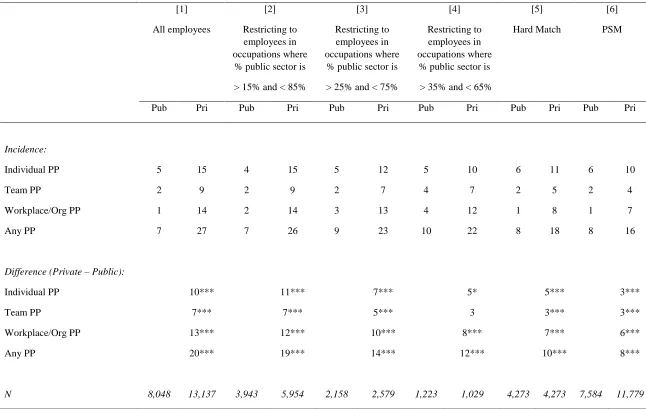
[INSERT TABLE ONE]
Almost one-quarter (23 per cent) of employees say they are paid for performance but the incidence of
PP is four-times higher in the private sector than the public sector (27 per cent compared with 7 per
cent) and it is higher whether performance is assessed at individual, group/team or
workplace/organisation level.7 The raw gap in PP incidence between employees in the public and
private sectors is 20 percentage points (see the first pair of columns in Table 1, comparison 1).
However, this falls to 14 percentage points when we confine the comparison to employees in those
occupations where at least 25 per cent of all employees nationally are in the public sector and at least
25 per cent are in the private sector (comparison 3). The gap falls still further to 10 percentage points
(comparison 5) - half the raw gap - when we "hard match" on occupation by focusing attention only
on public sector employees in occupations for whom there is a private sector occupational match in
WERS. In fact, the public-private differential in PP roughly halves whether performance is measured
at the individual (10 to 5 percentage points), team (7 to 3 percentage points) or
workplace/organisation level (13 to 7 percentage points). Occupational matching therefore accounts
for a sizeable part of the PP differential across the two sectors, a finding which is consistent with
Hypothesis One. That is, the gap in incidence of PP between the private and public sectors narrows
when comparing employees in the same occupation.
In the final pair of columns in Table 1 (comparison 6) we present the PP differentials having used
propensity score matching to obtain counterfactual employees in the private sector for those in the
public sector. The matching was undertaken using a kernel estimator with bandwidth 0.6. 920
respondents in 5 occupations were dropped because there was no variance in public sector status
within their 3-digit occupation. Three additional public sector employees were too distant from the
private sector employees to find a match so they have been dropped from the analysis. The final
matching estimates are therefore based on 7,587 public sector employees and 11,779 private sector
employees. The advantage of this approach is that we match on a wider set of covariates than simply
occupation. Observable features of public sector employees other than their occupation account for
some of the PP gap between them and private sector employees, so that the gap falls still further,
consistent with Hypothesis Two. Nevertheless, a sizeable difference in PP receipt remains even
among employees matched using propensity scores. Specifically, the incidence of PP among private
sector employees is still twice as high as among public sector employees (16 per cent versus 8 per
cent), giving an absolute differential of 8 percentage points (compared with a raw differential of 20
percentage points). Differences in the incidence of all forms of PP among employees in the public and
private sectors are statistically significant at a 1 per cent confidence level.
Our third hypothesis is that higher levels of union coverage in the public sector act as a break on PP
such that, if we compare employees in the two sectors with similar levels of union coverage, this will
account for some of the PP gap. To establish whether this is the case we incorporate employees'
union status in the propensity score estimate. This makes no difference to the PP gap between public
sector employees and their matched comparators: the PP gap is identical to that reported in the final
column of Table 1. This is the case whether we use an employee’s self-reported union membership
status or the workplace manager’s report of whether that employee’s occupation at the workplace has
pay determined by collective bargaining with a recognised trade union.
Further investigation reveals that the bivariate association between PP and unionisation is negative in
the private sector: entered into a linear regression estimating the probability of PP receipt, union
coverage has a coefficient of -0.068 (t-statistic 2.13). With the introduction of controls8, the
coefficient falls to -0.029 and becomes statistically non-significant (t-stat=1.13). If one replaces union
coverage with union membership, the raw correlation is negative (coefficient of -0.056, t-stat=2.28),
and becomes positive but non-significant with controls (coefficient 0.009, t-stat 0.43). In the public
sector coverage is positively correlated with PP receipt (coefficient 0.032, t-stat=2.43) but this
becomes non-sigificant once controls are introduced (coefficient 0.011, t-stat=0.81). Although there is
a positive and statistically significant association between union membership and PP in the public
sector with individual control variables (coefficient 0.025, t-stat=2.72) this becomes non-significant in
the presence of workplace fixed effects (coefficient 0.000, t-stat=0.05) indicating that the correlation
is driven by fixed unobservable differences between public sector workplaces with and without union
members. There is therefore no empirical support for Hypothesis Three.
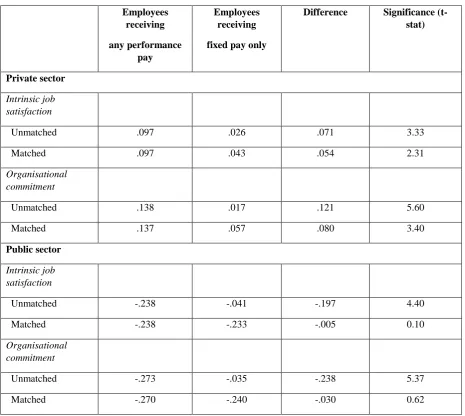
Our fourth hypothesis is that PP will be positively associated with IJS and OC in the private sector,
whereas the association is likely to be non-significant or negative in the public sector. In the private
sector, a simple comparison indicates that employees receiving PP have higher IJS and higher OC
than those on fixed pay contracts (Table 2, data reported in rows 1 and 3). The IJS differential falls
by around one-quarter (compare data reported in rows 1 and 2 in column 3) and the OC differential
falls by around one-third (compare data reported in rows 3 and 4 in column 3) having matched PP
employees with observationally similar fixed pay employees using propensity score matching, but the
differentials remain sizeable and statistically significant.9 The situation in the public sector is very
different. As shown in data rows 5 and 7 of column 3, in the unmatched samples IJS and OC are
significantly lower for those on PP compared to fixed pay employees. But the differential falls
markedly and becomes statistically non-significant when comparing PP employees with their matched
counterparts (data rows 6 and 8 in column 3). These results are consistent with Hypothesis Four: the
IJS and OC of private sector employees rises with PP, but in the public sector it has no such effect.
[INSERT TABLE TWO]
Hypothesis Five maintains that public sector workplaces with PP will perform better than those
without PP. Using propensity score matching to identify the effect of PP on performance, we recover
two different treatment parameters.10 The first is the effect of PP on performance for those workplaces
with PP (average treatment-on-the-treated, ATT). The second is the effect that PP would have on
public sector workplaces that, currently, do not use PP (average treatment-on-the-non-treated, ATNT).
Results are presented in Table 3.
[INSERT TABLE THREE]
A comparison of the mean performance of public sector PP and non-PP workplaces indicates that the
performance of PP workplaces is poorer than that of non-PP workplaces, a difference that is
statistically significant at a 94 per cent confidence level (row 1, Table 3). Matching reveals that the
performance of the non-PP workplaces is depressed by their observable characteristics such that,
accounting for these observable differences, the performance differential widens to -0.331 (row 2).
Furthermore, when we estimate the effect that PP would have on those public sector workplaces
where it is currently absent, we find the negative effect on workplace performance is larger at -0.459.
5.
Discussion and Conclusions
Despite the current policy interest in the use and value of PP in the public sector, there is relatively
little large-scale, quantitative evidence on its prevalence or correlates among public sector workers.
There is also little evidence regarding the effects of PP in the public sector. We contribute to the
literature using a nationally representative survey of workplaces and their employees to examine the
reasons for the lower incidence of PP in the public sector relative to the private sector in Britain, and
to investigate the association between PP and employee attitudes to their jobs, on the one hand, and
the association between PP and workplace performance on the other. In doing so we use matching
techniques which, to our knowledge, have not been used in this literature before. We have seven new
findings.
First, for the first time using nationally representative workplace data for Britain, we confirm that
there is a substantial “gap” in the incidence of PP between employees in the private and public
sectors. Of course, the nature of public services means public sector employees and workplaces are
less likely to have financial participation (share ownership and profit-sharing). But the lower
incidence of PP in the British public sector is apparent across all types of PP.
Second, the nature of public sector jobs accounts for a sizeable part of the "gap" in PP between the
two sectors, reducing it by about half from 20 to 10 percentage points, confirming hypothesis one.
This halving of the gap is apparent all types of PP (individual, team and workplace/organisation
based).
Third, accounting for differences in the composition of the workforce in the two sectors accounts for a
small additional part of the “gap”, confirming hypothesis two. When matching employees in similar
occupations and with similar observable traits, those in the public sector were about 8 percentage
points less likely to be in receipt of PP than their private sector counterparts.
Fourth, union coverage is not a break on the use of PP in either the public or the private sector. Thus,
contrary to hypothesis three, stronger unionisation in the public sector plays no role in the PP “gap”
Fifth, a substantial PP “gap” remains having accounted for the occupational and worker composition
of the two sectors.
Sixth, in accordance with hypotheses 4a and 4b, PP has a positive effect on intrinsic job satisfaction
and organisational commitment among private sector employees but it has no significant effect on
public sector employees.
Seventh, contrary to hypothesis five, public sector workplaces using PP perform more poorly than
their matched counterparts who do not use PP. Furthermore, our estimates of the average
treatment-on-the-non-treated indicate that PP would adversely affect workplace performance in public sector
workplaces that do not use it currently.
The study has implications for the analysis and understanding of human resource management and
employment relations in the public sector. Using matching techniques that are not commonly used in
this literature we are able to demonstrate that heterogeneity in the jobs and workers across the public
and private sectors can account for something like half the PP “gap” between the two sectors. Most of
this is driven by the different occupations that exist in the two sectors, a finding that is consistent with
principal-agent theories regarding the difficulties of implementing PP in scenarios where monitoring
output is costly (Lemieux et al., 2009). The remaining “gap” might be viewed as the “pure” public
sector effect, one that is to be expected based on existing theory which points to special features of
public sector agencies, such as difficulties measuring outputs and the multiplicity of principals
(taxpayers, government, etc.) with conflicting interests which limit the value of PP (Dixit, 2002).
Dixit (2002: 697) points out that “sometimes these special characteristics explain why these agencies
It is often asserted that trade unions limit the incidence of some forms of PP, particularly in the public
sector where they are strongest, because PP militates against union goals such as paying a
rate-for-the-job (Freeman, 1982; Gregg and Machin, 1989; Burgess and Metcalfe, 2000). We find no
evidence to support this contention. Although there is clear evidence of union effects on wage levels
in the public sector (Blanchflower and Bryson, 2010) this does not extend to the nature and incidence
of PP. To the extent that PP is less evident in the public sector, this is not due to union constraints on
managerial power to implement PP.
The absence of PP effects on workplace performance in the public sector contrasts markedly with a
wealth of evidence indicating that it positively affects performance in private sector organisations (eg.
Lazear, 2000). One reason why human resource management practices such as PP can improve
workplace performance is that they can engender IJS and OC (White and Bryson, 2013, review the
literature and evidence on the links between HRM and IJS and OC). More generally, Bryson et al.
(forthcoming) find improvements in worker wellbeing are associated with improvements in private
sector workplace performance. However, we only find a positive association between PP and IJS and
OC among private sector employees, and no association (or a weakly negative effect) among public
sector employees, suggesting this channel by which PP may affect workplace performance could
operate, but only in the private sector. These findings are consistent with the literature (Besley and
Ghatak, 2005; Prentice et al., 2007) that suggests public sector workers may differ in their motivations
from workers in the profit-oriented sector.
PP may affect workplace performance, even in the absence of associations with IJS and OC, where it
incentivises effort, or where it leads to improvements in the allocation of resources. Recent
evaluations have shown that PP can increase output in the public sector through both these
if they are, the benefits are offset by the costs, such that no general effect on workplace performance
is discernible.
There are limitations to the study which could be addressed in future work. First, we lack data on
aspects of employees’ jobs that might have given us a better indication of whether some of the factors
militating against PP use are, in fact, at work. We do not have good indicators for monitoring costs,
nor the degree to which employees are multi-tasking. Instead we use detailed occupational
classifications to characterise differences in jobs. These may capture some of the job features which
are salient in the principal-agent literature (eg. Holmstrom and Milgrom, 1991) regarding the use of
PP, but there will be within-occupation variance in these features which our analysis is unable to
detect. Nor do we directly observe workers’ preferences, such as those relating to risk-taking, which
the literature identifies as important in terms of worker sorting across the public and private sectors,
and across PP and fixed pay jobs. Instead, we must rely on matching employees according to the
features we observe in the data. We do not know how strongly these features are correlated with the
factors deemed salient in the literature, so it may be that we have under-estimated the degree to which
worker heterogeneity affects the PP “gap” between the public and private sectors. Unobserved
worker heterogeneity may also affect our estimates of the relationship between PP and employees’
IJS and OC in the public and private sectors. If we think some of these unobserved worker traits are
fixed over time it would be possible to net them out of analyses using panel data on workers using
individual fixed effects estimates.
A further limitation of the study is that we cannot definitively state that the relationship between PP
and public sector workplace performance is causal. This is because, although we are able to match
workplaces on observable characteristics, we cannot discount the possibility that our estimates are
research may endeavour to overcome this where there is a natural experiment leading to an exogenous
change in the incidence of PP, for instance.
Notwithstanding the study’s limitations, it provides robust evidence suggesting there are features of
public sector employment that mean it is difficult to motivate employees and improve workplace
performance through financial incentives of this type. Our estimates of the likely impact of PP on
performance in those public sector workplaces where it is currently absent suggest that the benefits of
policies promoting the extension of PP in the public sector are likely to be limited or non-existent.
This raises important questions about the future of public sector service provision in Britain and,
potentially, elsewhere, given policy interest in encouraging the use of PP, especially among
professional employees such as teachers where employers have traditionally relied on career-based
References
Alesina, A., Danninger, S. and Rostagno, M. (2001) “Redistribution through public employment: the
case of Italy”. IMF Staff Papers, Vol. 48(3), pp. 447‐473
Bach, S. and Givan, R. K. and Bryson, A. (2009) "The Public Sector in Transition", Chapter 13 in
Brown, W., Bryson, A., Forth, J.. and Whitfield, K. (eds.) The Evolution of the Modern
British Workplace, Cambridge University Press
Barth, E., Bratsberg, B., Haegeland, T. and Raaum, O. (2012) "Performance Pay, Union Bargaining
and Within-firm Wage Inequality", Oxford Bulletin of Economics and Statistics, 74, 3:
327-362
Barzelay, M. (2001) The New Public Management: Improving Research and Policy Dialogue,
Berkeley: University of California Press
Bell, B. and Van Reenen, J. (2014) "Bankers and their Bonuses", The Economic Journal, 124, 574:
F1-F21
Besley, T. and Ghatak, M. (2005) "Competition and Incentives with Motivated Agents", American
Economic Review, 95(3): 616-636
Blanchflower, D. G. and Bryson, A. (2010) ‘The Wage Impact of Trade Unions in the UK Public and
Private Sectors’, Economica, Vol.77, Issue 305, pp.92-109
Böckerman, P., Bryson, A. and Ilmakunnas, P. (2013) 'Does High Involvement Management Lead to
Higher Pay?', Journal of the Royal Statistical Society Series A, 176, 4: 861-885
Bryan, M. and Bryson, A. (2016) "Has Performance Pay Increased Wage Inequality in Britain?",
Labour Economics, 41: 149-161
Bryson, A., Clark, A. E., Freeman, R.B., and Green, C. P. (2016) "Share Capitalism and Worker
Bryson, A., Dorsett, R. and Purdon, S. (2002) The use of propensity score matching in the evaluation
of active labour market policies, Department for Work and Pensions Working Paper No.4
Bryson, A. and Forth, J. (Forthcoming) “Wage Growth in Pay Review Body Occupations”, Office for
Manpower Economics
Bryson, A., Forth, J. and Stokes, L. (Forthcoming) "Does Worker Wellbeing Affect Workplace
Performance?", Human Relations
Bryson, A. and Freeman, R. (2010) ‘How does shared capitalism affect economic performance in the
UK?’, Chapter 6 in D. Kruse, R. Freeman and J. Blasi (eds.) Shared Capitalism at Work:
Employee Ownership, Profit and Gain Sharing, and Broad-based Stock Options, pp. 201-224,
University of Chicago Press
Bryson, A. and Freeman, R. B. (2014) "Employee Stock Purchase Plans: Gift or Incentive?", IZA
Discussion Paper No. 8537
Bryson, A., Freeman, R., Lucifora, C., Pellizzari, M and Perotin, V. (2013) "Paying for Performance:
Incentive Pay Schemes and Employees' Financial Participation", in T. Boeri, C. Lucifora and
K. J. Murphy (eds.) Executive Remuneration and Employee Performance-related Pay: A
Transatlantic Perspective, Oxford University Press
Burgess, S. and Metcalfe, P. (2000) "The Use of Incentive Schemes in the Public and Private Sectors:
Evidence from British Establishments", CMPO Working Paper Series No. 00/15
Burgess, S., Propper, C., Ratto, M., von Hinke Kessler Scholder, S. and Tominey, E. (2010) "Smarter
Task Assignment or Greater Effort: The Impact of Incentives on Team Performance", The
Economic Journal, 120, 547: 968-989
Burgess, S. and Ratto, M. (2003) "The Role of Incentives in the Public Sector: Issues and Evidence",
Coleman, T. (2010) “Do financial incentives for delivering health promotion counselling work?
Analysis of smoking cessation activities stimulated by the quality and outcomes framework”
BMC Public Health, 10, 167-172
Cornelissen, T., Heywood, J. and Jirhahn, U. (2010) "Performance Pay, Risk Attitudes and Job
Satisfaction", Labour Economics, 18, 2: 229-239
Danzer, Alexander M and Dolton, Peter J (2012) "Total reward and pensions in the UK in the public
and private sectors", Labour Economics, 19 (4). pp. 584-594
Dixit, A. (2002) “Incentives and Organizations in the Public Sector: An Interpretative Review”,
Journal of Human Resources, 37:4, 696-727
Dohmen, T. and Falk, A. (2011) "Performance pay and multidimensional sorting: Productivity,
Preferences and Gender", American Economic Review, 101(2): 556-90
European Foundation for the Improvement of Living and Working Conditions,(2007) Fourth
European Working Conditions Survey, Eurofound, Dublin
Forth, J., Bryson, A. and Stokes, L. (2016) "Are Firms Paying More For Performance?", International
Journal of Manpower, 37(2): 323-343.
Forth, J., and McNabb, R. (2008) “Workplace performance: a comparison of subjective and objective
measures in the 2004 Workplace Employment Relations Survey”, Industrial Relations
Journal, 39(2), 104–123
Freeman, R. (1982), “Union Wage Policies and Wage Dispersion within Establishments”, Industrial
and Labor Relations Review, 36:1, pp.3-21
Gittleman, M. and Pierce, B. (2013) "How Prevalent is Performance-Related Pay in the United States?
Current Incidence and Recent Trends", National Institute Economic Review, 226: R4-R16
Green, C.P and Heywood, J.S. (2008) “Does performance pay increase job satisfaction?”, Economica,
Gregg, P. A. and Machin, S. J. (1989) “Unions and the incidence of performance linked pay schemes
in Britain”, International Journal of Industrial Organization, vol. 6(1), pages 91‐107
Holmstrom, B. and Milgrom, P. (1991) “Multi-task Principal-Agent Analyses: Incentive Contracts,
Asset Ownership and Job Design”, Journal of Law, Economics and Organization, 7: 24-52
Imberman, S. A. (2015) “How effective are financial incentives for teachers?”, IZA World of Labor,
158
Lazear, E. (1986), “Salaries and piece rates”, Journal of Business, 59: 3, 405-31
Lazear, E. (2000) "Performance Pay and Productivity", American Economic Review, 90, 1346-1361
Lemieux, T., MacLeod, W. B., Parent, D. (2009) "Performance Pay and Wage Inequality" Quarterly
Journal of Economics, 124 (1): 1–49
O'Halloran, P. (2013) "Union coverage, membership and performance-related pay: are piece rates
different?", National Institute Economic Review No. 226: R30-R41
Office for National Statistics (2009) Summary Quality Report for the Annual Survey of Hours and
Earnings, Newport: ONS
Office for National Statistics (2010) Public Sector Employment: Quality and Methodology
Information, Newport: ONS.
Pendleton, A., Whitfield, K. and Bryson, A. (2009) ‘The changing use of contingent pay in the
modern British workplace’, Chapter 11 in W. Brown, A. Bryson, A., Forth, J. and K.
Whitfield (eds.) The Evolution of the Modern Workplace, pp. 256-284, Cambridge University
Press
Pfeifer, C. (2011) “Risk Aversion and Sorting into Public Sector Employment”, German Economic
Review, 12: 85–99
Prendergast, C. (1999) ‘The provision of incentives in firms’ Journal of Economic Literature, 37, 1: 7
Prentice, G., Burgess, S. and Propper, C. (2007) Performance pay in the public sector: A review of the
issues and evidence, Office of Manpower Economics, London
Ray, K., Foley, B., Tiffany, T., Walne, D. and Bajorek, Z. (2014) A review of the evidence on the
impact, effectiveness and value for money of performance-related pay in the public sector,
The Work Foundation
Rolfe, H., Bryson, A. and Metcalf, H. (1996) The Effectiveness of TECs in Achieving Jobs and
Qualifications for Disadvantaged Groups, Department for Education and Employment
Research Studies RS4, HMSO, London
Rosen, S. (1990) ‘Contracts and the market for executives’, NBER Working Paper No. 3542
School Teachers Review Body (2013): Twenty-Second Report – 2013 (download:
https://www.gov.uk/government/uploads/system/uploads/attachment_data/file/208618/School
_Teachers_Review_Body_-_22nd_report.pdf)
van Wanrooy, B., Bewley, H., Bryson, A., Forth, J., Freeth, S., Stokes, L. and Wood, S. (2013)
Employment Relations in the Shadow of Recession: Findings from the 2011 Workplace
Employment Relations Study, Palgrave Macmillan
White, M. and Bryson, A. (2013) 'Positive Employee Attitudes: How Much Human Resource
Management Do You Need?', Human Relations, 66, 3: 385-406
Wu, N., Hoque, K., Bacon, N. and Llusar, J. C. B. (2015) “High-performance work systems and
workplace performance in small, medium-sized and large firms”, Human Resource
Table 1: Incidence of PP Among "Matched" Occupations and Employees, cell percentages
[1] [2] [3] [4] [5] [6]
All employees Restricting to employees in occupations where
% public sector is
> 15% and < 85%
Restricting to employees in occupations where
% public sector is
> 25% and < 75%
Restricting to employees in occupations where
% public sector is
> 35% and < 65%
Hard Match PSM
Pub Pri Pub Pri Pub Pri Pub Pri Pub Pri Pub Pri
Incidence:
Individual PP 5 15 4 15 5 12 5 10 6 11 6 10
Team PP 2 9 2 9 2 7 4 7 2 5 2 4
Workplace/Org PP 1 14 2 14 3 13 4 12 1 8 1 7
Any PP 7 27 7 26 9 23 10 22 8 18 8 16
Difference (Private – Public):
Individual PP 10*** 11*** 7*** 5* 5*** 3***
Team PP 7*** 7*** 5*** 3 3*** 3***
Workplace/Org PP 13*** 12*** 10*** 8*** 7*** 6***
Any PP 20*** 19*** 14*** 12*** 10*** 8***
N unit groups 280 348 127 129 71 71 36 36 265 265 85 85
Mean of SOC_pub% 59 18 46 31 47 38 50 48 39 39 39 39
Notes: (1) In comparisons 2-4, we omit small numbers of employees belonging to occupations for which the QLFS estimate for SOC_pub% has a coefficient of variation of 20% or more (the publication threshold for QLFS estimates). In comparison 2, we omit 65 employees from 11 occupations. In comparison 3, we omit 18 employees from 5 occupations. In comparison 4, we omit 6 employees from 2 occupations.
(2) The Hotelling t-test indicated that, after matching, we could not reject the hypothesis that there was no significant difference in the mean values for the matching covariates between public and private sector employees (p>f=0.996). The pseudo-rsquared for the probit estimating public sector employment was 0.25 in the unmatched sample, falling to 0.00 in the matched sample, indicating that the propensity score reweighting balanced the covariates between public and private sector employees such that they were observationally equivalent.
(3) Key to statistical significance: * p<0.10, && p<0.05, *** p<0.01.
Table 2: Effects of PP on intrinsic job satisfaction and organisational commitment in the public and private sectors Employees receiving any performance pay Employees receiving
fixed pay only
Difference Significance (t-stat)
Private sector
Intrinsic job satisfaction
Unmatched .097 .026 .071 3.33
Matched .097 .043 .054 2.31
Organisational commitment
Unmatched .138 .017 .121 5.60
Matched .137 .057 .080 3.40
Public sector
Intrinsic job satisfaction
Unmatched -.238 -.041 -.197 4.40
Matched -.238 -.233 -.005 0.10
Organisational commitment
Unmatched -.273 -.035 -.238 5.37
Matched -.270 -.240 -.030 0.62
Notes:
(1) In both sectors the Hotelling t-test indicated that, after matching, we could not reject the hypothesis that there was no significant difference in the mean values for the matching covariates between PP and fixed pay employees. In the private sector the pseudo-rsquared for the probit estimating receipt of PP was 0.12 in the unmatched sample, falling to 0.00 in the matched sample, indicating that the propensity score reweighting balanced the covariates between PP and fixed pay employees employees such that they were observationally equivalent. The same was true for the public sector where the pseudo-rsquared was 0.12 in the unmatched sample and 0.01 in the matched sample.
Base: all employees in workplaces with five or more employees.
Workplaces with any performance
pay
Workplaces with
no performance pay
Difference Significance (t-stat)
Additive Workplace Performance Scale
Unmatched 4.714 5.008 -.295 1.93
Matched, ATT 4.723 5.053 -.331 1.80
Matched, ATNT 4.569 5.029 -.459 -
Notes:
(1) Although the Hotelling t-test indicated that significant differences between the matched and comparator samples remained in the mean scores for matching the pseudo-rsquared for the probit estimating receipt of PP fell from 0.152 (p>chi2 0.000) in the unmatched sample to a statistically non-significant 0.006 (p>chi2 1.000) in the matched sample, indicating that the propensity score reweighting balanced the covariates between PP and fixed pay workplaces such that they were observationally equivalent.