City, University of London Institutional Repository
Citation:
Yates, J. (2017). A meta-theoretical framework for career practitioners. The Indian Journal of Career and Livelihood Planning, 5(1), pp. 15-25.This is the accepted version of the paper.
This version of the publication may differ from the final published
version.
Permanent repository link:
http://openaccess.city.ac.uk/16722/Link to published version:
Copyright and reuse: City Research Online aims to make research
outputs of City, University of London available to a wider audience.
Copyright and Moral Rights remain with the author(s) and/or copyright
holders. URLs from City Research Online may be freely distributed and
linked to.
City Research Online: http://openaccess.city.ac.uk/ [email protected]
A meta-theoretical framework for career practitioners
Julia Yates
Abstract
Over the last decades the academic community has produced an impressive array of innovative theories and ground breaking evidence within the sphere of career development. The publications have extended the limits of our understanding and give invaluable guidance for effective, evidence-based career practice. But the bridge between research and practice is not always as well trodden as we might hope: for many practitioners, the task of synthesising these disparate theoretical and empirical literatures may be insurmountable. This paper presents a new model, a meta-model, which incorporates the concepts lying at the heart of the key ideas which have emerged in recent years. Drawing from over 50 theories and approaches, this model offers an overarching framework which sets out how the concepts within the different theories interact, overlap and complement each other. The model is intended as a tool which practitioners and students can use to help them to make sense of the theoretical landscape, and as a framework which could allow them to bring together the many theories to underpin their practice.
Introduction
The changed and changing nature of the world of work requires a new conceptualisation of career and numerous theories have emerged over the past 20 years which share some assumptions and philosophies. The research which has been conducted extends the boundaries of our understanding, but the smorgasbord of theories which has emerged is not easy to understand. The challenge for career practitioners is to make sense of the vast range of theories, to work out how they fit together, how they overlap, and how they differ; to identify which terms are synonymous, which theories address the same aspect of career development and ultimately, to work out how the theories can be of value to their clients.
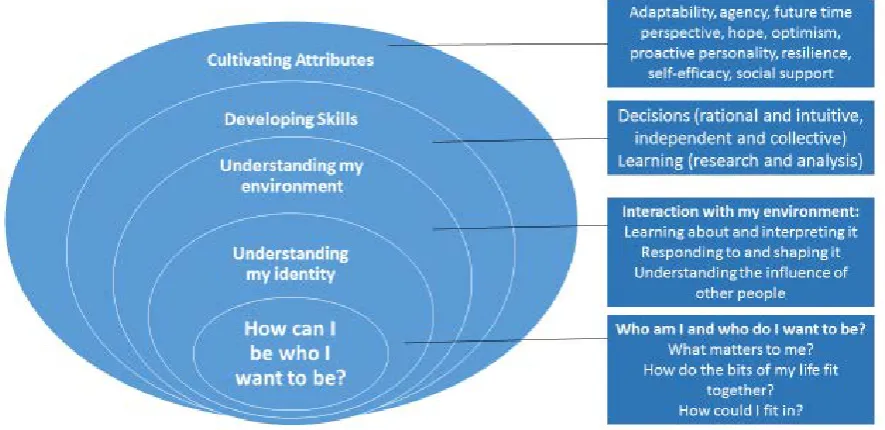
In this paper I present a model which describes and integrates the key aspects of current thinking within career theory and which could provide a starting point for a structured approach to career practice. The model is neither normative (how people ought to engage with their careers) nor descriptive (how people actually engage with their careers) but aims to describe the assumptions, implicit or explicit, which underpin the theories and ideas within current career thinking. The model is presented in Figure 1 and the rest of the paper explains the five elements of the model. The elements are described discretely but in practice they interweave and develop concurrently rather than sequentially.
referenced throughout but there are many career theories which have not been incorporated. I hope that this paper will provide a starting point for a dialogue and that if key elements have been omitted or misinterpreted, that these can subsequently be incorporated or the model modified. This is not the first integrative framework to have been proposed. Many career theories
1. Overarching question
How can I be who I want to be?
At the heart of the model lies the fundamental aim of career practice. The core goal for practitioners is to support individuals as they work out ‘How can I be who I want to be?’ (Blustein, 2013; Maslow, 1943; Tinsley, 2000).
This is a broad question and does not specify ‘career’ or other similar terms. Contemporary theories such as Life Design (Savickas, 2012), the Psychology of Working (Blustein 2013), The Kaleidoscope model (Maniero & Sullivan, 2005) and the Life-span Life-space approach (Super, 1980) acknowledge that the answer to this overarching question might not include a career or a job, although career theories tend to be predicated on the assumption that a career or job could lead to
self-actualisation, or could enable self-actualisation in another arena, for example by providing the necessary funds, or by enabling the individual to serve society (Arulmani, 2011).
Implicit in this overarching question too, is a refusal to make a clear distinction between work and life. This echoes the ‘holistic’ philosophy seen in Life Design (Savickas, 2012) and narrative
approaches (Cochran, 1997) and is conceptualised in spiritual career theories in the notion of unity (Bloch, 2004). The blending of work and non-work identities has also been explored in occupational literature (Ramarajan & Reid, 2013). Congruence here too is important. The value or relevance of congruence varies depending on the particular factors which are being measured (Tinsley, 2000), and evidence suggests that a person-environment fit which is based on an identity match (rather than the career interests which are central to Holland’s 1997 trait and factor theory) has a significant impact on job satisfaction (Perdue, Reardon & Peterson, 2007; Verquer, Beehr & Wagner, 2003).
2.
Understanding my identity
Who am I and who do I want to be?What matters to me?
How do the bits of my life fit together? How could I fit in?
Underpinning much current career thinking is the notion of identity. This has been central to career theories in the form of the self-concept since it was introduced to the field by Super in 1963. The overarching question for career thinking, identified above is ‘How can I be who I want to be?’, and in order to answer this, people need to develop a clear sense of their current and their desired
identities.
The first aspect ‘What matters to me?’ concerns meaning, and explores values (Brown, 1996; Colozzi, 2003) and purpose (Dik & Duffy, 2009; Seligman, 1998). The second question addresses the different aspects of life and encourages individuals to conceptualise their lives and futures
thinking. Racial identity theory (Helms, 1990) and the impact of racial salience (Helms & Piper, 1990) provide frameworks to help understand the influence of race and ethnicity. Theories of career relating to individual difference could be incorporated here, such as theories of personality (Myers-Briggs & Myers, 1995) and career interests (Holland, 1997), or theories which combine interests, abilities and personality such as Ackerman and Beier, (2003).
The invitation to consider the different aspects of life allows the individual to address possible tensions or synergies between the different aspects of their lives. An individual could reflect on how to combine their roles as, for example, mother and worker (Hewlett, 2002), or how to marry their own wishes with those of their community (Arulmani, 2007). Here too the individual might be encouraged to think about the role they might want or need work to play in their lives, whether it is a way to live (Blustein, 2013), a route to life fulfilment (Dik & Duffy, 2009) or a way to contribute to their community (Arulmani, 2011).
Our social identity (Tajfel & Turner, 2004), is the part of our identity that derives from our similarity to others. It includes the attributes and experiences that are shared with others in a group and is a reflection of how we see ourselves within society and how we imagine society sees us. The question identified here is ‘How could I fit in?’, which invites people to consider their own identities in terms of the groups they might align themselves with (Schneider, 1987). Career theories which address the issue of social identity include career identity (Ibarra & Barbulescu, 2010; Meijers, 1998), life design (Savickas, 2012), possible selves (Ibarra, 1999; Strauss, Griffin & Parker, 2012) and role identity theories (Ng & Feldman, 2007; Stryker & Burke, 2000). Cultural identity is one aspect of social identity, and this is explored in the application of cultural and cross-cultural psychologies to career theory (Stead, 2004). The developmental-contextual approach (Vondracek, Lerner & Schulenberg, 1986) explores the influence of socioeconomic and cultural factors. For those making career decisions within a collectivist culture, the notion of personal identity is bound up with the idea of group identity (Hofstede, 1980). An exploration of the central question ‘How can I be who I want to be?’ will incorporate consideration of group identity as well as individual identity (Leong, 1996), and career decisions may be based on the goals of the family or culture more than the implementation of the self-concept (Patton and McMahon, 2014).
3.
Understanding my environment
Interaction with my environment:Learning about and interpreting it Responding to and shaping it
Understanding the influence of other people
The second arena which individuals need to understand is their environment, acknowledged as fluid, interwoven and constructed. The first task for individuals is to learn about and interpret their
and an appreciation of fluid nature of the environment and the impact and opportunities presented by chance events (Bloch, 2005; Pryor & Bright, 2003).
The second aspect highlights the dynamic nature of the relationship between the individual and the environment, focusing on the ways in which the environment influences the individual (Blustein, Schultheiss & Flum, 2004; Law, 1981) and in which the individual can influence the environment (Dawis & Loftquist, 1984; Wrzesniewski & Dutton, 2001). This interaction between the individual and the environment is core to complexity theories (for example Goerner, 1994) and Hodkinson and Sparkes’ (1997), careership theory too situates the interaction between the individual and their environment at the heart of career decision making.
Particularly influential within our environments are other people. Traditional approaches have advocated the value of independent thinking and decisions (Gati, 1986; Holland 1997) but more contemporary career theories acknowledge the inevitability of the influence of others and the benefits it can confer. Theories focus on a range of different kinds of relationships including family and friends (Agarwala, 2008; Schultheiss, 2003), role models (Gibson, 2004) and parents (Sawitri and Creed, 2016).
4.
Developing skills
Learning
research and analysis
Decisions
rational and intuitive, independent and collective
In order to negotiate their career development, individuals need to know how to learn. Theories can incorporate the skills to research (gather information) and analyse (make sense of the information). These theories can be applied to both one’s self (for example Kelly’s Personal Construct Theory, 2003) and to the environment (for example Law’s career learning theory, 1996) and include the notion of social learning (Bandura, 1977; Krumboltz & Nichols, 1990). The Blueprint framework (see Hooley, Watts, Sultana & Neary, 2013) drawing heavily on Bloom’s taxonomy of learning (Bloom, 1976) provides a learner-centred framework for career development, incorporating many key aspects of learning.
Domene and Dutka, 2010) and a cultural one (Chao and Tseng, 2002), so the notion of collective is incorporate here alongside independent decision making.
5.
Developing attributes: characteristics which can help me to reach
my goals if I cultivate them
Adaptability, agency, future time perspective, hope, optimism, proactive personality, resilience, self-efficacy, social support.
At this final level the personal attributes which can support an individual to identify and attain their identity and career goals are set out. Self-efficacy (Tang, Fouad & Smith, 1999; Taylor & Betz, 1983), optimism (Creed, Patton & Bartrun, 2002; Garcia, Restubog, Bordia & Roxas, 2015), social support (Hirschi, Niles & Akos, 2011;), hope (Diemer & Blustein, 2007; Hirschi, 2014), future time perspective (Atanásio, Paixão, & da Silva, 2013), resilience (Bimrose and Hearne, 2012) and adaptability
(Goodman, 1994; Savickas, 1997) have all been shown to have a positive impact on career outcomes, including career decidedness, motivation and job search. Agency is a core pillar of many of the theories and is linked to motivation and satisfaction (Chen, 2015; Deci & Ryan, 2011).
Conclusion
Career theories hold the promise of more effective career practice which can provide better support to a wider range of clients. Our collective understanding of career development and career decision making, however, has pushed forward in so many directions, at so many levels, and influenced by so many different theoretical approaches that as a body of work, it has become too vast and
amorphous to be easily grasped or translated into practice. This paper presents a meta-theoretical model of career theories. My aim is to offer something which captures the latest understanding of the arena in a way which is both comprehensive and comprehensible, and which can offer
References
Ackerman, P. L., & Beier, M. E. (2003). Intelligence, personality, and interests in the career choice process. Journal of Career Assessment, 11(2), 205-218.
Agarwala, T. (2008). Factors influencing career choice of management students in India. Career Development International, 13(4), 362-376.
Arulmani, G. (2007). Counselling psychology in India: At the confluence of two traditions. Applied Psychology, 56(1), 69-82.
Arulmani, G. (2011). Receive in order to give: Eastern cultural values and their relevance to
contemporary career counselling contexts. Occasional Paper: Faculty of Education, Canterbury Christ Church University, 16-22.
Atanásio, P., Paixão, M. P., & da Silva, J. T. (2013). The influence of future time perspective in career decision-making: the mediating role of work hope. In V. Ortuno and P. Cordeiro (Eds) International
studies in time perspective, (pp 183 – 191) Coimbra: Coimbra University Press.
Bandura, A. (1977) Social learning theory. New York: General Learning Press
Barnett, R. C., & Hyde, J. S. (2001). Women, men, work, and family. American psychologist, 56(10), 781.
Bimrose, J., & Hearne, L. (2012). Resilience and career adaptability: Qualitative studies of adult career counseling. Journal of Vocational Behavior, 81(3), 338-344.
Bloch, D. P. (2004). Spirituality, complexity, and career counseling. Professional School Counseling, 343-350.
Bloch, D. P. (2005). Complexity, chaos, and nonlinear dynamics: A new perspective on career development theory. The career development quarterly, 53(3), 194-207.
Bloom, B. S. (1976). Human characteristics and school learning. McGraw-Hill.
Blustein, D. L. (2001). Extending the reach of vocational psychology: Toward an inclusive and integrative psychology of working. Journal of Vocational Behavior, 59(2), 171-182.
Blustein, D. (2013). The psychology of working: A new perspective for career development,
counseling, and public policy. Hove: Routledge.
Brosseau, D. C., Domene, J. F., & Dutka, T. W. (2010). The Importance of Partner Involvement in Determining Career Decision-Making Difficulties. Canadian Journal of Career Development 9(2) 35-41
Brown, D. (1996). Brown’s values-based, holistic model of career and life-role choices and satisfaction. Career choice and development, 3, 327-338.
Chao, R., & Tseng, V. (2002). Parenting of Asians. Handbook of parenting, 4, 59-93.
Chen, C. P. (2003). Integrating perspectives in career development theory and practice. The Career Development Quarterly, 51(3), 203-216.
Chen, C. C. (2015). Career Human Agency Theory. In Exploring New Horizons in Career Counselling (pp. 77-97). SensePublishers.
Chudzikowski, K., & Mayrhofer, W. (2011). In search of the blue flower? Grand social theories and career research: The case of Bourdieu’s theory of practice. Human Relations, 64(1), 19-36.
Cochran, L. (1997). Career counseling: A narrative approach. Sage Publications.
Colozzi, E. A. (2003). Depth-Oriented Values Extraction. The Career Development Quarterly, 52(2), 180-189.
Creed, P. A., Patton, W., & Bartrum, D. (2002). Multidimensional properties of the LOT-R: Effects of optimism and pessimism on career and well-being related variables in adolescents.
Journal of Career Assessment, 10(1), 37-52.
Dawis, R. V., & Lofquist, L. H. (1984). A psychological theory of work adjustment: An
individual-differences model and its applications. University of Minnesota Press.
Deci, E. L., & Ryan, R. M. (2011). Self-determination theory. Handbook of theories of social
psychology, 1, 416-433.
Diemer, M.A. and Blustein, D.L. (2007) Vocational Hope and vocational identity: urban adolescents’ career development Journal of Career Assessment 15, 98 – 188
Dijksterhuis, A., Bos, M.W., Nordgren, L.F. and van Baaren, R.B. (2006) On making the right choice: The deliberation-without-attention effect. Science, 311, 1005 - 1007.
Dik, B. J., & Duffy, R. D. (2009). Calling and vocation at work definitions and prospects for research and practice. The Counseling Psychologist, 37(3), 424-450.
Ferreira, M.B., Garcia-Marques, L., Sherman, S.J. and Sherman, J.W. (2006) Automatic and Controlled Components of Judgment and Decision Making. Attitudes and Social Cognition 91, 5, 797–813.
Garcia, P. R. J. M., Restubog, S. L. D., Bordia, P., Bordia, S., & Roxas, R. E. O. (2015). Career optimism: The roles of contextual support and career decision-making self-efficacy. Journal of Vocational
Behavior, 88, 10-18.
Gati, I. (1986) Making Career Decisions – a sequential elimination approach Journal of Counseling Psychology, 33, 408 – 471
Gedro, J. (2007). Conducting research on LGBT issues: Leading the field all over again!. Human Resource Development Quarterly, 18(2), 153-158.
Gibson, D. E. (2004). Role models in career development: New directions for theory and research.
Journal of Vocational Behavior, 65(1), 134-156.
Goerner, S. J. (1994). Chaos and the evolving ecological universe. Langhorne, PA: Gordon & Breach.
Goodman, J. (1994). Career adaptability in adults: A construct whose time has come. Career Development Quarterly, 43(1), 74–85.
Gottfredson, L. S. (2002). Gottfredson’s theory of circumscription, compromise, and self-creation.
Career choice and development, 4, 85-148.
Greenbank, P. (2014). Career decision-making: ‘I don’t think twice, but it’ll be all right’. Research in
Post-Compulsory Education, 19(2), 177-193.
Helms, J. E. (1990). Black and White racial identity: Theory, research, and practice. Greenwood Press.
Helms, J. E., & Piper, R. E. (1994). Implications of racial identity theory for vocational psychology.
Journal of Vocational Behavior, 44(2), 124-138.
Heppner, M. J. and Scott, A.B. (2004) From whence we came: the role of social class in our families of origin The Couseling Psychologist 32 (4), 596 – 602
Hewlett, S. A. (2002). Executive women and the myth of having it all. Harvard business review, 80(4), 66-73.
Hirschi, A. (2014). Hope as a resource for self-directed career management: Investigating mediating effects on proactive career behaviors and life and job satisfaction. Journal of Happiness Studies, 15(6), 1495-1512.
Hirschi, A., Niles, S.G. and Akos, P. (2011) Engagement in adolescent career preparation: social support, personality and the development of choice decidedness and congruence. Journal of
Hodkinson, P., & Sparkes, A. C. (1997). Careership: a sociological theory of career decision making. British journal of Sociology of Education, 18(1), 29-44.
Hofstede, G. (1980). Culture and organizations. International Studies of Management & Organization, 10(4), 15-41.
Holland, J. (1997) Making vocational choices: A theory of vocational personalities and work
environments (3rd ed) Odessa FL: Psychological Assessment Resources
Hooley, T., Watts, A. G., Sultana, R. G., & Neary, S. (2013). The ‘Blueprint’ framework for career management skills: a critical exploration. British Journal of Guidance & Counselling, 41(2), 117-131.
Ibarra, H. (1999). Provisional selves: Experimenting with image and identity in professional adaptation. Administrative Science Quarterly, 44(4), 764-791.
Ibarra, H. and Barbulescu, R. (2010) Identity as narrative: prevalence, effectiveness and
consequences of narrative identity work in macro work role transitions Academy of Management
Review, 35, 135 - 154
Kelly, G. (2003). The Psychology of Personal Constructs: Volume Two: Clinical Diagnosis and Psychotherapy. Oxon: Routledge.
Kidd, J. M. (1998). Emotion: An absent presence in career theory. Journal of vocational behavior,
52(3), 275-288.
Krieshok, T. S., Black, M. D., & McKay, R. A. (2009). Career decision making: The limits of rationality and the abundance of non-conscious processes. Journal of Vocational Behavior, 75(3), 275-290.
Krumboltz, J. D., & Nichols, C. W. (1990). Integrating the social learning theory of career decision making. Career counseling: Contemporary topics in vocational psychology, 159-192.
Law, B. (1981). Community interaction: a ‘mid-range’ focus for theories of career development in young adults. British Journal of Guidance and Counselling, 9(2), 142-158.
Law, B. (1996). A career learning theory. In A.G. Watts, B. Law, J. Killeen, J. Kidd, &
R. Hawthorn (Eds.), Rethinking careers education and guidance: Theory, policy and practice
(pp. 46-72). London/New York: Routledge
Lent, R. W., Brown, S. D., & Hackett, G. (2002). Social cognitive career theory. Career choice and
development, 4, 255-311.
Mainiero, L. A., & Sullivan, S. E. (2005). Kaleidoscope careers: An alternate explanation for the “opt-out “revolution. The Academy of Management Executive, 19(1), 106-123.
Maslow, A. H. (1943). A theory of human motivation. Psychological review, 50(4), 370.
Meijers, F. (1998) The development of a career identity International Journal for the Advancement of
Counselling, 20 191 - 207
Myers-Briggs, I., & Myers, P. B. (1995). Gifts differing: Understanding personality type. Davies-Black Publishing.
Ng, T. W., & Feldman, D. C. (2007). The school-to-work transition: A role identity perspective. Journal
of Vocational Behavior, 71(1), 114-134.
Parsons, F. (1909). Choosing a vocation. Boston: Houghton Mifflin.
Patton, W., & McMahon, M. (2014). Career development and systems theory: Connecting theory and
practice (Vol. 2). Springer
Perdue, S. V., Reardon, R. C., & Peterson, G. W. (2007). Person—environment congruence, self-efficacy, and environmental identity in relation to job satisfaction: a career decision theory perspective. Journal of Employment Counseling, 44(1), 29-39.
Pryor, R. G., & Bright, J. (2003). The chaos theory of careers. Australian Journal of Career
Development, 12(3), 12-20.
Ramarajan, L., & Reid, E. (2013). Shattering the myth of separate worlds: Negotiating nonwork identities at work. Academy of Management Review, 38(4), 621-644.
Roberts, K. (2009). Opportunity structures then and now. Journal of education and work, 22(5), 355-368.
Savickas, M. L. (1997). Career adaptability: An integrative construct for life-span, life-space theory.
Career Development Quarterly, 45(3), 247–259.
Savickas, M. L. (2001). Toward a comprehensive theory of career development: Dispositions, concerns, and narratives. Contemporary models in vocational psychology: A volume in honor of Samuel H. Osipow, 295-320.
Savickas, M. L. (2012). Life design: A paradigm for career intervention in the 21st century. Journal of
Counseling & Development, 90(1), 13-19.
Schneider, B. (1987). The people make the place. Personnel psychology, 40(3), 437-453.
Schultheiss, D. E. P. (2003). A relational approach to counseling: Theoretical integration and practical application. Journal of Counseling and Development 81(3), 301.
Seligman, M. (1998). What is the good life. APA monitor, 29(10), 2.
Singh, R., & Greenhaus, J. H. (2004). The relation between career decision-making strategies and person–job fit: A study of job changers. Journal of Vocational Behavior, 64(1), 198-221.
Stead, G. B. (2004). Culture and career psychology: A social constructionist perspective. Journal of Vocational Behavior, 64(3), 389-406.
Strauss, K., Griffin, M. A., & Parker, S. K. (2012). Future work selves: how salient hoped-for identities motivate proactive career behaviors. Journal of Applied Psychology, 97(3), 580.
Stryker, S., & Burke, P. J. (2000). The past, present, and future of an identity theory. Social
psychology quarterly, 284-297.
Super, D. E. (1963). Self-concepts in vocational development. Career development: Self-concept
theory, 1-16.
Super, D. E. (1980). A life-span, life-space approach to career development. Journal of vocational behavior, 16(3), 282-298.
Tajfel, H., & Turner, J. C. (2004). The Social Identity Theory of Intergroup Behavior in Jost, John T. (Ed); Sidanius, Jim (Ed). Political psychology: Key readings., (pp. 276-293). New York, NY, US: Psychology Press
Tang, M., Fouad, N. A., & Smith, P. L. (1999). Asian Americans' career choices: A path model to examine factors influencing their career choices. Journal of Vocational Behavior, 54(1), 142-157.
Taylor, K. M., & Betz, N. E. (1983). Applications of self-efficacy theory to the understanding and treatment of career indecision. Journal of Vocational Behavior, 22(1), 63-81.
Tinsley, H. E. (2000). The congruence myth: An analysis of the efficacy of the person–environment fit model. Journal of vocational behavior, 56(2), 147-179.
Verquer, M. L., Beehr, T. A., & Wagner, S. H. (2003). A meta-analysis of relations between person– organization fit and work attitudes. Journal of vocational behavior, 63(3), 473-489.
Wrzesniewski, A., & Dutton, J. E. (2001). Crafting a job: Revisioning employees as active crafters of their work. Academy of Management Review, 26(2), 179-201.