Int. J. Electrochem. Sci., 9 (2014) 2816 - 2823
International Journal of
ELECTROCHEMICAL
SCIENCE
www.electrochemsci.orgPotentiometric Sensor Platform Based on a Carbon Black
Modified Electrodes
Beata Paczosa-Bator*, Leszek Cabaj, Magdalena Raś, Bogusław Baś, Robert Piech
AGH-UST University of Science and Technology, Faculty of Material Science and Ceramics, Mickiewicza 30, PL-30059 Cracow, Poland
*
E-mail: [email protected]
Received: 15 January 2014 / Accepted: 6 February 2014 / Published: 23 March 2014
Potentiometric sensor platform based on a carbon black modified ion-selective electrodes with a very stable potential signal is presented. The ion-selective electrodes were obtained basing on the addition of the Printex XE2-B carbon black as an intermediate layer between the ionophore-doped solvent polymeric membrane and the electrical conductor. The analytical parameters of new sensor platform were evaluated by the determining of sodium, potassium, chlorate and nitrate ions. The electrodes presented Nernstian slopes, a very good reproducibility of the standard potential values and a small potential drift. The proposed sensor platform was successfully applied in sodium, potassium, chlorate and nitrate ion determination in water samples and validated by comparison with different analytical methods.
Keywords: Potentiometric sensor platform; Carbon black; High signal stability, Multi-electrode
system
1. INTRODUCTION
An Ion-Selective Electrodes (ISEs) produce a potential that is related to the activity of an ions in the presence of others [1]. Thus, they can be used as analytical tools for direct measurement ion content in complex samples in clinical chemistry, neurophysiological laboratories [2] and in environmental analysis [3].
setup includes a high-input impedance voltmeters, two electrodes (selective for each analyte of interest and reference one), and various reagents used to adjust the ionic strength and pH if necessary. And thirdly, the simple and fast procedure is employed during potentiometric measurements and there are few matrix modifications needed to conduct these analyses. Additionally, in many instances potentiometric measurements can be made without interference from the chemical or physical properties of the sample (i.e. color, turbidity) [5].
Nowadays ISEs are faced with increasing demands such as simplicity in design or miniaturization. The last aspect is very important and several studies have been done to achieve a small sensor maintaining it’s the most important advantages such as their sensitivity, selectivity or potential stability. Huge step in simplification of ISEs was excluding of internal layer solution from theirs build. That gave chance to create small sensors, effective as their larger prototypes [6,7]. To improve analytical parameters, such as sensitivity, selectivity or long term potential stability of that kind of sensors many materials such as conducting polymers [8], carbon based materials [9-17] or ion nanoparticles [18, 19] have been studied as intermediate layers between ion selective membrane and electric conductor.
In order to determinate amount of several ions in sample it has been necessary to perform a number of measurements using sensors selective for only one kind of ion. That resulted in extended time of measurements and in higher costs of total analysis. Condensation of few ISEs in one multisensor body gave researches chance to simultaneously measure potentiometric response of few sensors of the same type in smaller amount of sample in steady-state measurements [20-21] or in flow-through [22-23].
In our study we propose to use carbon black as an intermediate layer in potentiometric complex multielectrode system consisting of electrodes containing potassium, sodium, chloride and nitrate selective membrane (with built-in reference electrode). These modificated sensors have shown great improve in parameters in comparison with non-modified sensors especially in long term potential stability and absence of water layer between ISM and conductor thanks to hydrophobic character of carbon. This new multielectrode system make it possible to obtain information about concentration of more than one ion in analyzed sample, which greatly shortens the time and lower the costs of analysis.
2. EXPERIMENTAL SECTION
2.1 Reagent and materials
the selectophore reagents obtained from Fluka. All other chemicals were of analytical-reagent grade. Distilled and deionized water was used to prepare the aqueous solutions.
2.2 Electrode Preparation
The sensor platform consisting of the four Au rods placed in Translux D 180 epoxy resin body (Au area = 0.03 cm2) were first polished with 0.3 μm alumina powder, rinsed with water, and finally cleaned ultrasonically with water and methanol.
In order to obtain the CB-XE-modified Au electrodes (Au/CB-XE), the drop casting method was used (Scheme 1). The mixture containing 5 mg of CB-XE dispersed in 1 mL of THF was sonicated for ≈1−1.5 h and then placed on the top of the Au electrodes. After that, Au/CB-XE electrodes were left to dry for 48 h.
In the next step, solid contact layers (Au/CB-XE) were subsequently coated with 30 μL of a ISM mixture containing: 1% (w/w), valinomycin, 0.25% (w/w) KTpClPB, 65.75% (w/w) o-NPOE, and 33% (w/w) PVC in the case of K+-ISM; 2.9% (w/w) Sodium Ionophore IV, 0.4 (w/w) KTpClPB, 65.6 % (w/w) (BBPA), 2.1 % (w/w) TEHP, 29 % (w/w) PVC in the case of Na+-ISM; 1.1 % (w/w) Nitrate ionophore V, 0.7 % (w/w) (TDMACl), 65 % (w/w) o-NPOE, 33.2 % (w/w) PVC in the case of NO3--ISM and 1.9 % (w/w) Chloride ionophore III, 1.1 % (w/w) TDMACl, 64 % (w/w) o-NPOE,
33.0 % (w/w) PVC in the case of Cl--ISM.
All the membrane electrodes were left to dry for 48 h at room temperature. Afterward, the potassium, sodium, chloride and nitrate-selective electrodes were conditioned for 48 h in water solution of mix 10-3 M NaCl and 10-3 M KNO3. The conditioning step was also repeated before every
measurement. Three identical sensor platform with ion-selective electrodes were prepared and examined.
Scheme 1. A schematic illustration of the sensor platform and a carbon black modified electrodes
2.2 Instrumentation
Potentiometric Measurements. The potentials were measured using a 16-channel mV-meter (Lawson Labs, Inc., Malvern, PA). The reference electrode was an Ag/AgCl electrode with 3 M KCl solution in a bridge cell.
3. RESULTS AND DISCUSSION
The response times of the potentiometric sensor platform electrodes for the progressive addition of different amounts of potassium, sodium, chloride and nitrate ions in the concentration range from 10−7 to 10−1 M are shown in Figure 1. Even at a low concentration, the response time was very short (4-6 s).
-100 -75 -50 -25 0 25 50 75 100 125 150 175 200
0 10 20 30 40 50 60 70 80
EMF (mV) time (min) 125 150 175 200 225 250 275 300 325 350 375 400 425 CB-XE/Cl
--ISM CB-XE/Na+
-ISM 10-7 10-6 10-5 10-4 10-3 10-2 10-1
10-7 10-6 10-5
10-4 10-3 10-2 10-1 -50 -25 0 25 50 75 100 125 150 175 200 225 250 275 300 325 350 CB-XE/NO3
--ISM CB-XE/K+
-ISM
EMF
(mV)
time (min)
0 10 20 30 40 50 60 70 80
[image:4.596.72.522.315.473.2]0 25 50 75 100 125 150 175 200 225 250 275 300 325 350 375 400 10-1 10-2 10-3 10-4 10-5 10-6 10-7 10-7 10-1 10-2 10-3 10-4 10-5 10-7 10-6
Figure 1. The potentiometric response of the studied electrodes vs. time determined in the (a) KCl and
(b) KNO3 solutions.
-9 -8 -7 -6 -5 -4 -3 -2 -1 0
-100 -75 -50 -25 0 25 50 75 100 125 150 175 200 EMF (mV)
log aNa+
-9 -8 -7 -6 -5 -4 -3 -2 -1 0
125 150 175 200 225 250 275 300 325 350 375 400 425 CB-XE/Cl --ISM CB-XE/Na+ -ISM
log aCl
--9 -8 -7 -6 -5 -4 -3 -2 -1 0
-50 -25 0 25 50 75 100 125 150 175 200 225 250 275 300 325 350
CB-XE/NO3
--ISM
CB-XE/K+ -ISM
EMF
(mV)
log aK+
-9 -8 -7 -6 -5 -4 -3 -2 -1 0
0 25 50 75 100 125 150 175 200 225 250 275 300 325 350 375 400
log aNO
-3
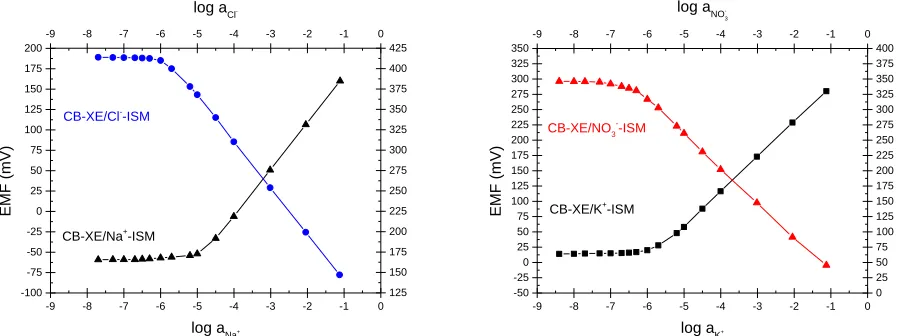
Figure 2. The EMF dependence on (a) Na+ and Cl- activities for Au/CB-XE/Na+-ISM and
Au/CB-XE/Cl--ISM respectively and (b) K+ and NO3- activities for Au/CB-XE/K+-ISM and
Au/CB-XE/NO3--ISM respectively after 72 h of the conditioning in the solution of mix 10-3 M NaCl
[image:4.596.73.525.534.702.2]
The calibration curve slope values measured for the multi-electrode potentiometric sensor with CB-XE used as an intermediate layer are close to the Nernstian value. Figure 2 shows the exemplary EMF vs recorded for the Au/CB-XE/Na+-ISM, Au/CB-XE/Cl--ISM, Au/CB-XE/K+-ISM and Au/CB-XE/NO3--ISM electrodes. The plots were obtained by the recording of the
EMF after storing the electrodes in the solution of mix 10-3 M NaCl and 10-3 M KNO3, respectively,
for 48 h. The slopes calculated from the linear range of the calibration plots are listed in the Table 1. The detection limit calculated as the intersection of the two slope lines is 8·10-7, 9·10-6, 9·10-7
and 3·10-7
M for the Au/CB-XE/K+-ISM, Au/CB-XE/Na+-ISM, Au/CB-XE/Cl--ISM and Au/CB-XE/NO3--ISM electrodes, respectively (Table 1).
The fabricated electrodes show a very stable response over time. Even after a long conditioning time in 0.01 M solution with the main ions (6−7 weeks), the electrodes still showed a linear response in the same range of the main ion activity. The potential drift of the Au/CB-XE/K+-ISM, Au/CB-XE/Na+-ISM, Au/CB-XE/Cl--ISM and Au/CB-XE/NO3--ISM electrodes over 172 h was only 11.2±1.4,
16.2±1.4, 19.1±1.6 and 8.1±1.0 µV/h.
The comparison of the potentiometric parameters of the proposed potentiometric sensor platform (PSP) with commercial available system (Multiple Ion Probes, Aptisens [24]) and multi-sensor flow cell (MSFC) [23] are presented in the Table 1.
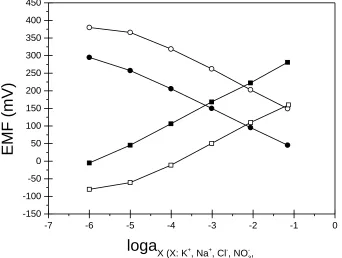
The potentiometric response of PSP electrodes recorded in the solution of mix NaCl and KNO3
in the concentration range of main ion 10-6 - 10-1 M are presented in the Figure 3.
-7 -6 -5 -4 -3 -2 -1 0 -150
-100 -50 0 50 100 150 200 250 300 350 400 450
EMF (mV)
[image:5.596.114.456.442.700.2]loga
X (X: K+, Na+, Cl-, NO -3,Figure 3. The EMF dependence on () K+, () Na+, () Cl-, () NO3- activities for Au/CB-XE/Na+
-ISM and Au/CB-XE/Cl--ISM, Au/CB-XE/K+-ISM and Au/CB-XE/NO3--ISM electrodes
Table 1. Comparison of the potentiometric parameters of the proposed potentiometric sensor platform
(PSP) with commercial available system (Multiple Ion Probes, Aptisens [24]) and multi-sensor flow cell (MSFC) [23].
Parameter Electrode type Potassium Sodium Chloride Nitrate
S (mV/decade) PSP 59.21±0.09 57.10±0.15 -57.02±0.12 -59.08±0.08
Aptisens 54±5 54±5 -54±5 -58±5
MSFC 48.7±0.6 - -46.5±0.8 -49.5±0.7
Linear Range (ppm)
PSP 0.078-3900 0.46-2299 0.107-3545 0.062-6200
Aptisens 0.3-39000 2-2500 1.5-35000 0.6-60000
MSFC 0.391-391 - 0.71-7100 0.62-620
Detection Limit (mol/l)
PSP 8·10-7 9·10-6 9·10-7 3·10-7
Aptisens - - - -
MSFC 1·10-6 - 1·10-6 1·10-6
Response time (s)
PSP 5 6 6 4
Aptisens <20 <20 <20 <30
MSFC 3-5 - 3-5 3-5
The potentiometric selectivity coefficients of all studied electrodes were obtained with the separate solution method according to the traditional procedure [26] (n = 3) using chloride salts of different cations (in the case of potassium and sodium-selective electrodes) and sodium salts of different anions (for chloride and nitrate selective electrodes). The potentiometric selectivity coefficient values for the sodium potassium, chloride and nitrate electrodes are presented in Table 2.
Table 2. Potentiometric selectivity coefficients of the proposed potentiometric sensor platform based
on Au/CB-XE/Na+-ISM, Au/CB-XE/Cl--ISM, Au/CB-XE/K+-ISM and Au/CB-XE/NO3--ISM
electrodes.
X: CB-XE/K+ -ISM
CB-XE/Na+-ISM Y: CB-XE/NO3--ISM CB-XE/Cl--ISM
Na+ -4.6±0.2 - Cl- -3.4±0.2 -
K+ - -3.1±0.1 NO3- - -6.6±0.2
Li+ -4.4±0.2 -3.2±0.1 HCO3- - -4.7±0.2
NH4+ -2.1±0.3 -3.2±0.3 acetate -4.1±0.2 -6.2±0.2
Mg2+ -6.5±0.2 -4.4±0.2 NO2- -1.9±0.1 -
[image:6.596.57.539.516.755.2]
3.2. Sample analysis
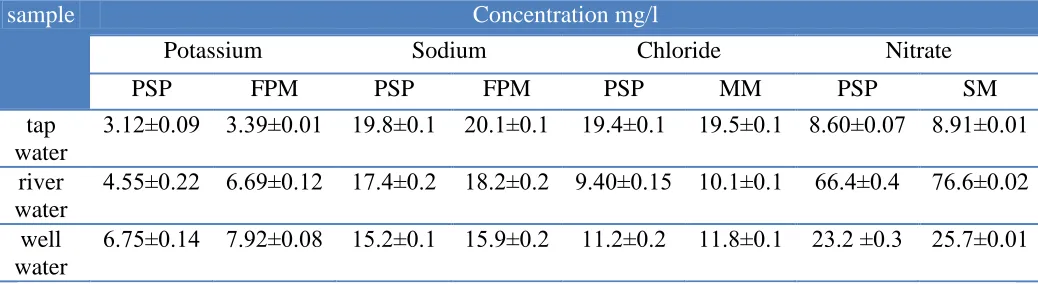
The potentiometric sensor platform (PSP) with ion-selective membranes was used for estimation of sodium, potassium, chloride and nitrate ion content in rain water, tap water, and Wisła River samples. In the potentiometric experimental work calibration curve method as a choice method was used. The results are shown in Table 3 and presented as the average value obtained with 3 measurements. Tap water was collected in our laboratory. The ion concentrations in water were measured as soon as collected. As ionic strength adjuster the Mg(SO4)2 was used.
The Mohr's method (MM) as a standard of chloride, the spectrophotometric method (SP) of nitrate and the flame photometry method (FPM) of potassium and sodium determination were the control methods for the determination of chloride, nitrate, potassium and sodium in water.
[image:7.596.40.559.355.497.2]The determined concentration of ions in the samples is presented in the Table 3. The obtained results are in good agreement.
Table 3. Concentrations of potassium, sodium, chloride and nitrate obtained for samples: tap, well and
river water.
sample Concentration mg/l
Potassium Sodium Chloride Nitrate
PSP FPM PSP FPM PSP MM PSP SM
tap water
3.12±0.09 3.39±0.01 19.8±0.1 20.1±0.1 19.4±0.1 19.5±0.1 8.60±0.07 8.91±0.01 river
water
4.55±0.22 6.69±0.12 17.4±0.2 18.2±0.2 9.40±0.15 10.1±0.1 66.4±0.4 76.6±0.02 well
water
6.75±0.14 7.92±0.08 15.2±0.1 15.9±0.2 11.2±0.2 11.8±0.1 23.2 ±0.3 25.7±0.01
4. CONCLUSION
A simple potentiometric sensor platform is a universal tool for ion content determination in the aqueous samples. The application of different ion selective membranes on metallic conductors placed in the same body allowed to obtain information about activity of many ions at the same time.
This new muli-sensor was prepared in course of a simple drop casting procedure and provided a good Nernstian response to potassium, sodium, chloride and nitrate. The obtained detection limits of 8·10-7
M K+, 9·10-6 M Na+, 9·10-7 M Cl-, 3·10-7 M NO3- are better than the values measured for the
commercial available system. A very stable long-time potential and short response time were achieved by using a carbon black layer between electronic conductors and ion-selective membranes.
ACKNOWLEDGEMENTS
This work was supported by NCBiR (No.LIDER/31/7/L-2/10/NCBiR/2011).
References
1. K. Cammann, Working with ion-selective electrodes: chemical laboratory practice, Springer-Verlag, New York (1979).
2. G.G. Rumpf, L.F. J. Dürselen, H.W. Bühler, W. Simon, Contemporary Electroanalytical Chemistry, 305-310, Springer Science Business Media, LLC, New York (1990).
3. R. De Marco, G. Clarke, B. Pejcic, Electroanalysis, 19 (2007) 1987.
4. A. Radu, T. Radu, C. Mcgraw, P. Dillingham, S. Anastasova-Ivanova and D. Diamond, J. Serb. Chem. Soc. 78 (2013) 1729.
5. M.E. Meyerhoff and W.N. Opdycke, Advances in Clinical Chemistry 25 (1986) 1. 6. A. Matusevich, M. Pietrzak, E. Malinowska, Sens. Actu. B 168 (2012) 62.
7. J.E. Zachara, R. Toczyłowska, R. Pokrop, M. Zagórska, A. Dybko, W. Wróblewski, Sens. Actu. B 101 (2004) 207.
8. A. Cadogan, Z. Gao, A. Lewenstam, A. Ivaska, D. Diamond, Anal. Chem. 64 (1992) 2496.
9. Z. Mousavi, A. Teter, A. Lewenstam, M. Maj-Zurawska, A. Ivaska, J. Bobacka, Electroanalysis 23 (2011) 1352.
10.M. Fouskaki, N. Chaniotakis, Analyst 133 (2008) 1072.
11.C. Lai, M.A. Fierke, A. Stein, P. Bühlmann, Anal. Chem. 79 (2007) 4621. 12.G.A. Crespo, S. Macho, F.X. Rius, Anal. Chem. 80 (2008) 1316.
13.J. Zhu, Y. Qin, Y. Zhang, Electrochem. Commun. 11 (2009) 1684.
14.F. Li, J. Ye, M. Zhou, S. Gan, Q. Zhang, D. Han, L. Niu, Analyst 137 (2012) 618. 15.B. Paczosa-Bator, Talanta, 96 (2012) 424.
16.B. Paczosa-Bator, R. Piech, L. Cabaj, Electrochim. Acta 85 (2012) 104.
17.B. Paczosa-Bator, L. Cabaj, R. Piech, K. Skupień, Anal. Chem 85 (2013) 10255. 18.B. Paczosa-Bator, L. Cabaj, R. Piech, K. Skupień, Analyst 22 (2012) 5272.
19.W. Janrungroatsakul, C. Lertvachirapaiboon, W. Ngeontae, W. Aeungmaitrepirom, O. Chailapakul, S. Ekgasit, T. Tuntulani, Analyst 138 (2013) 6786.
20.S. Anastasova-Ivanova, U. Mattinen, A. Radu, J. Bobacka, A. Lewenstam, J. Migdalski, M. Danielewski, D. Diamond, Sens. Actu. B 146 (2010) 199.
21.T. Błaż, B. Baś, J. Kupis, J. Migdalski, A. Lewenstam, Electrochem. Commun. 34 (2013) 181. 22.F.J. Saez de Viteri, D. Diamond, Analyst 11 (1994) 749.
23.P.W. Alexander, T. Dimitrakopoulos, D.B. Hibbert, Electroanalysis 10 (1998) 707.
24.Degussa/Evonik, Germany - Pigmentrusse/pigment blacks, Technische Daten Europa/Technical Data Europe, Degussa AG, Advanced Fillers & Pigments, 2006.
25.Aprisens USA, 2014 (http://www.aptisens.com/multi-ion-probes/ ) 26.E. Bakker, E. Pretsch, P. Bühlmann, Anal. Chem. 72 (2000) 1127.
![Table 1. Comparison of the potentiometric parameters of the proposed potentiometric sensor platform (PSP) with commercial available system (Multiple Ion Probes, Aptisens [24]) and multi-sensor flow cell (MSFC) [23]](https://thumb-us.123doks.com/thumbv2/123dok_us/1897573.147657/6.596.57.539.516.755/comparison-potentiometric-parameters-potentiometric-commercial-available-multiple-aptisens.webp)