,' . \
I I I
MATING AND VEGETATIVE INCOMPATIBILITY IN THE CELLULAR SLIME MOULD
DICTYOSTELIUM DISCOIDEUM
by
GILLIAN ELAINE ROBSON
A thesis submitted to the Austr~lian National University for the degree of Master of Science
September, 1978
The work reported in this thesis is my own except for the experiments involving the American wild isolates (Chapter 2) which were performed in collabo.ration with Dr. K. Williams.
I ·'
I• II
Ii ,I
i i'I
' '
:: I
•
I ,,
' 11
I
•
I
ll I~
Ii
ACKNOWLEDGEMENTS
Foremost I would like to thank my supervisor Dr Keith
Williams for his inspiring enthusiasm and for his special PZAM! that havemade working hours so much fun.
I am most grateful to Professor W. Hayes for allowing me to undertake a masters degree whilst employed in his department .
Many thanks to Liz Smith, Dennis Welker and Paul Fisher for their attentive and helpful criticisms of my thesis.
I am indebted to Professor K.B. Raper for his gift of D. discoideum wild isolates.
Thanks go to the Genetics Department for providing such an entertaining environment.
To Lyn Johnson I offer sincere thanks for her excellent job of typing this manuscript.
I would also like to thank Mary Williams for her care and good friendship.
Finally, special thanks go to Paul Whitington for his
assistance with the photography and for his calming influence
~
:1
ii
,,
i
iiI
,;1,
i
'
'I
11
-'
II
11
II
Dr. Who to companion Follow me! I've got a better idea.
Companion Why? What is your idea?
Dr. Who I don't know. That's the trouble with good ideas. They only
1
:11
I:
Ii
I I! II Ii
'
'
•
ABSTRACT
A quantitative technique for constructing sexual cysts
(macrocys ts) , in D. discoidcum is described. This technique was used
to show that macrocysts can be formed with a single zygote ahd that sex
hormone activity in D. discoideum is more complex than the simple one
way system previously proposed.
Mat.i11g in D. discoideum was shown to be controlled
by 2
alleles at a single -locus (matA and mata). A system of vegetative
incompatibility has been discovered in D. discoideum and was also shown to be controlled by only the mating-type locus. Amoebae of opposite mating-type (matA· and mata) will form macrocysts but not parasexual
(vegetative) diploids, whereas amoebae of the same mating-type (matA + matA or mata + mata) will form parasexual diploids but not macrocysts.
This phenomenon was examined in a series of sexual and parasexual .crosses
between independent wild isolates of either mating-type and tester
strains of NC4 (matA) and Vl2 (mata) origin. This finding was further
supported by genetic analysis of three rare parasexual diploids
("illegitimat,e" diploids) which were formed between amoebae of opposite
mating-type . These diploids were shown to be homozygous for vegetative
in~ompatibility and mating-type.
Th0 l i t0rc1tur0 on vcqctc1tj.vc i.ncomrc1.tjbi lity 1n the fungi, .
.
cra~;[;<'.1 , l:.
rcvicwcct. Ways of overcoming vegetative incompatibility are discussed
and sugges ions are made towards constructing a system in which sexual
t111d pur,1~;c~xu<1l (_Jc11clic ,'1n.:1Jysis cc111 be performed u~dng strains derived
from S j ll g 1 e W i ] d j ~; 0 ] a l C •
,I II I I It ., ~:
,.
11 1,Thesis Title
Statement
Acknowledgements
Abstract
Table of Contents
GENERAL INTRODUCTION
CHAPTER 1 QUANTITATIVE ANALYSIS OF MACROCYST FORMATION
1.1. 1. 2.
1. 3.
INTRODUCTION
MATERIALS AND METHODS 1.2.A
1.2.B
1.2.C
RES UL'l'S
1. 3.A
Materials
Maintenance of Stocks
( i)
(ii)
Bacteria
D. discoideum
'Quantitative-techniqu~' of macrocyst formation
Quantitative analysis of macrocyst formation in D. discoideum
( i)
(ii)
(iii)
Characterisation of macrocysts
Effect of amoebal growth conditions on macrocy.st formation.
( a) The effect on macrocyst production of using
different growth media prior to macrocyst
formation.
(b) The effect on macrocyst vroduction of growth
in the light vs the dark prior to macrocyst form. ... l tion.
'l'hc significance of Lile y_uantitalivc- tcchnique in nC't-rrminjnq the rC'L1ti.vC' jmrorta.ncc of _!ll_?-1.tl\ and
mc1ta strains on macrocyst formation.
1. 4. DISCUSSION
1.4.A Quantitative analysis of macrocyst formation
( i)
( i i )
Are the progeny of one macrocyst the product of one meiosis?
7\ fitlCJ<J('ril-('cl jmprovcm('nt to the
quantitative-technique.
. 1.4.B The role of sex hormone activity in D. discoideum
CHAPTER 2 VEGETATIVE INCOMPATIBILITY AT THE MATING-TYPE LOCUS IN D. D1SC01DEUM
2.1.
2.2
INTRODUCTION
2.1.A Mating-type systems in the lower eukaryotes 2.1.B Vegetative incompatibility
MATERIALS AND METHODS
2.2 .A ·2. 2.B
2.2.C
2.2 .D
2.2.E
2. 2.F
2.2.G
Materials
Maintenance of Stocks
Macrocyst formation
( i)
(ii)
Quantitative-technique Toothpick-technique Parasexual diploid formation
( i)
(ii)
Co-aggregation of amoebae (a) Washed cell technique (b) Multi-well pick technique Parasexual diploid selection
( u.) Complcrncn ting ts technique (b) Ts dominant cobalt technique llaploidisation of parasexual diploids
( i )
(ii)
Selection of haploid segregants using recessive drug resistance mutations
Scl ccl:.ion of haploid segregants using ben late (20 wg/mD - SM-agar
Chromosome staining
Photography
l'i
i!
1: I 1, ,1 2. 3. 2. 4. RESULTS2.3.A
2.3.B
2. 3.C
2. 3. D
2.3.E
2.3.F
2.3.G
2.3.H
2.3 .I
2.3.J
Mating competence of independent wild isolates of
o·
.
discoideurnParaseuxal diploid formation between independent wild
isolates of
o:
discoideum and tester strains of eithermating-type
( i)
(ii)
( iii)
Heterothallic wild isolates
Homothallic and bisexual wild isolates
Asexual wild isolates
Illegitimate diploid formation in D. discoideum
Analysis of illegitimate diploid DU260 by characterisation
of haploid segregants
( i)
( i i)
(iii)
Mating-type analysis of haploid segregants
Parasexual diploid formation between haploid segregants of DU260 and tester strains of each mating- type
Analysis of crossing-over in linkage group II of DU260
Analysis of DP72 by characterisation of haploid
segregants
( i)
(ii)
Mating-type analysis of haploid segregants
Parasexual diploid formation between haploid segregants
of DP72 and tester strains of each mating-type ,
Analysis of DU454 by characterisation of haploid segregants
( i)
(ii)
Mating-type analysis of haploid segregants
Parasexual diploid formation between haploid segregants
of DU454 and tester strains of each mating-type
Further attempts to find both mating-type alleles in illegitimate diploids of D. discoideurn
Genetic background problems in {llegitimate diploids
Relationship of parasexual diploid formation to the mating-type locus · in D. discoideurn
Can vegetative incompatibility be overcome by transferring
cytophagic cells to conditions selective for parasexual
diploids?
DISCUSSION
2.4.A General approach
2. 4.B Genetic background differences in D. discoideurn
It
" 1,
"'
L
11' I r,, I,
2.4.C 2.4.D 2.4.E 2.4.F2.4.G
2.4.H
( i)
( ii)
( j ii)
Effects of genetic background differences on
growth and differentiation in haploid segregants of DP72 and DU260.
Effects of genetic background differences on mating competence in haploid segregants of DU260
Progress in overcoming genetic background differences
Regulation of mating in D. discoideum - the number of alleles at the mating-type locus
Page
47
48
48
49
Characterisation of vegetative incompatibility in D. discoideum 51 by an investigation of independent wild isolates
l•'urthcr evidcnc concerning the relutionshjp of vegetutivc incompatibility to the mating-type locus in D. discoideum using genetically characterised strains
( i)
(ii)
(iii)
(iv)
Haploid segregants of illegitimate diploids express only one mating-type allele
Haploid segregants of illegitimate diploids express only one vegetative incomputibility allele
Significance of forming illegitimate diploids that have identity at both the vegetative incompatibility locus and the mating-type locus
Evidence that a cross-over event in DU260 provisionally maps the mating-type lo~us
A search for the physiological cause of vegetative incompatibility ( i) (ii) (iii) Plasmogamy Karyogamy
Cell division of the diploid
( a)
(b)
Cell cycle block
Unstable diploids
Attempts to overcome vegetative incompatibility and thus provide a system in which sexual and parasexual genetics
can be used in crosses between the same strains
( i) (ii) ( iii) (iv) ( V) ( vi)
Identity at the mating-type locus via a cross-over event
Transfer of the zygote to a growth environment
Selection of a 'mutator-type' mutation to control inter-conversion of mating-type alleles
Deletion of one mating-type allele
Isolation of modifier genes to suppress vegetative incompatibility
Selection of mutations at the mating-type locus itself
Speculations on evolutionary advancement of incompatibility systems 52 52 53 53 54 55 55 56
57
57
57
5858 .
II j
!
Ii II 11 :,"
·,I
l
I ' I, ,, I I~ :, I., I' ~' I• I'
iAPPENDIX A ISOLATION OF AUSTRALIAN CELLULAR SLIME MOULDS
1.
2 .
3.
4.
INTRODUCTION
MATERIALS AND METHODS
2.A 2.B
RESULTS 3. l\
3.B
3.C
3.D
Materials
Method of isolating and storing cellular slime moulds
A seasonal survey of the Brindabella Range, A.C.T.
A comprehensive survey of a transect in the New England
NaLlo11al Park., N.S.W.
An examination of cellular slime moulds from several sites
on Lizard Island, Queensl and
Strains with interesting features
DISCUSSION
APPENDIX B STRAINS, MEDIA AND CHEMICALS
1. STRAINS
1. l\ Nomenclature
2.
3 . CHEMICALS
il
I
I
I! Ii
',
11
u
I,
1,
I•
,.
'
11
1,
,.
1
GENERAL INTRODUCTION
The cellular slime mould Dictyostelium discoideum has become a
popular organism for studies of differentiation because of its well
dcfiilcd, ycl::. !=-;i.mpJc , etscxuo.l cycle of development (f:i.g . 1.). The short
life-span and naked amoeboid state have made this lower eukaryote
amenable to biochemical studies (Loomis, 1975). However, the sequence
of biochemical events underlying developmental processes must always
begin at the gene. A workable parasexual cycle has already provided a
good foundiltion for genetic analysis in D. discoideum (Fig. 2), but
sexual genetic analysis is not yet possible on a routine basis
(Jacobson & Lodish, 1975). Access to both parasexual and sexual genetic
analysis in D. discoideum would make this organism an even more attractive
model system for the study of basic problems in cell biology.
D. discoideum has a haploid chromosome number-of seven (Brody &
Williams, 1974; Robson & Williams, 1977) and in the wild is
predominantly a haploid organism. However, rare diploids are spontaneously
formed at low frequency and in the laboratory can be selected and
maintained indefinitely as stable diploid cultures (Loomis, 1969; Katz
& Sussman, 1972; Welker & Deering, 1976; Newell et al., 1977; Williams,
1978) . In a diploid population, haploids arise spontaneously at a low
frequency (Brody & Williams, 1974) and these can be purified using
selective methods (Katz & Sussman, 1972; Williams et al., 1974a).
Alternatively haploidisation can be induced using the fungicide ben late
(Williams & Barrand, 1978) . This conversion from haploid to diploid and
back again, plus mitotic crossing-over, represents a complete parasexual
cycle (Fig. 2) (Pontecorvo, 1956). Since the haploid and diploid phases
of the parasexual cycle of D. discoideum are both stable and can proceed
through the whole 6.scxual life cycle (Pig . 1), the allclism of mutations
/
G
Sexual
rowth
St
/
(Fig. 3)
;)
r
Orvot·<_}
_
~
'on
le.
1ratory
cycle
1n
:?7{\
/
'
2
ctic
cells
3 ~
.ions
2ntiate
mnined
aper,
s,
pores
Fig
.
l
Asexual life cycle of Dictyostelium discoideum
\
'7"'-c
-00
.-.-
...
__..
0
0
0-(f) ?
.-
-0 Q).- C
0
0
--
~
0:t. ·;
Asexual cycle /
{Fig. 1)
0
-0 0..- h 0
-,
3
a
-+0
:,
I
karyogamy
mitosis (mitotic
crossing-over
-10-
3
}
[image:13.820.16.803.19.1060.2]Mitotic crossing-over is a rare event (10-3 to 10-4 in D. discoideurn,
Mosses et al., 1975) and therefore in the parasexual cycle genetic
markers on the same linkage group are rarely recombin_ed. Since
chromosomes assort randomly during haploidisation of the diploid,
mutations can be readily assigned to a linkage group (Pontecorvo &
Kafer , 19 S 8 ) . In other organ·isms meiotic crossing-over is a frequent
event so that during the sexual cycle genetic marke·rs on the same
cllromof-jOm · cJrc frequently recombined. This fct1ture of meiosis enables
genetic markers on the same chromosome to be readily assigned positions
with resp ct to each other and to the centromere (e.g. in the fungi;
Kafer , 1977). Hence with an integrated system of parasexual and sexual
genetics , mutations could be readily mapped and the genetic regulation
of biochemical events controlling morphogenesis .or other fundamental
processes of cell bioloyy could be greatly facilitated.
The par asexual sys tern of D. discoideu_rn has been established
using the wild isolate NC4. Since this strain is now well marked
genetically i t would be advantageous to construct the sexual genetic
system around it. There are other advantages in working with only one
basic isolate as illustrated in the fungi (Kafer, 1977). Problems,
such as inconsistent map distances , have been encountered in sexual
analysis of the heterothallic fungus Neurospora crassa through working
with strains of different origin (Fincham & Day, 1971). Strain NC4 is
a hcterothallic strain of D. discoidcum and therefore requires a partner
of opposite mating-type (2.1.) before a sexual reaction will proceed
(l'ig. 3) . ~t this stage we arc faced with the possibility of establishing
a scxu 1 system between the well marked strain NC4 and another, perhaps
unrelated , strcJin of opposite mating-type . In view of the problems
associat d with basinq a sexual system on crosses between different wild
0 0 C I I 0
'
~ 0 ~ µ ~'
,i i i,i
'
'
w .. ' I l I I I''
I0 : i
rupture of tertiary
rupture of primary . / and secondary wall
mitotic division of proamoebae
pro-amoebae
subdivision of
multinucleate plasmodium
several mitotic divisions
protoplasm swells to the I i m it i n g s e c o n d a ry w a 11
C 0
-
0 C E...
Q.) 0)-
"' >-u 0 "-u 0 ~®
I \
@)
..
®@®
Growth of haploid amoebae of both mating-types
_
....
____ _
dormancy
(30-90 days)
l@)
@)
Starvation of amoebae(dark, moist, low phosphate) ... 0 .., 3 a
-0 :J\
after 5hrs\
binucleate cytophagic
ce II
aggregate of amoebae
2.4-30hrs
I
loose primary wall
phogocytosis of neighbouring cells by cytophagic cell
- primary wall
secondary wall
/ meiosis
4 - 14 days
_,,__,..,.___,,_ homogeneous protoplasm
tertiary wall secondary wa 11 primary wa II
past attempts to cross strain NC4 sexually with a strain of opposite
mating-type but of different origin (V12) have presented problems. The
sexual cyst (macrocyst) can be germinated at only low frequency and
after a long dormant period (Nickerson & Raper, 1973b; Wallace, 1977).
Poor macrocyst germination may be, in part, a result of the genetic
background 'differences between matA and mata strains .
One way of minimising the genetic differences between opposite
mating-type strains may be.to isolate two new strains on the same day
and from the same soil sample. Such strains would almost certainly
be closely related. For this reason attempts were made to isolate
Australian D. discoideurn (see Appendix A) .
Another way to obtain strains of similar background ('isogenic')
for use in sexual genetic analysis is to physiologically manipulate
NC4 and Vl2 themselves . As a result of recent reports of sex hormone
activity in D. discoideum (O 'Day & Lewis , 1975 & 1977; MacHac &
,Bonner, 1975) i t was thought that meiosis could be induced in 'isogenic'
strains of the same mating type (e.g. derivatives of NC4) by
application of sex hormone. Indeed, genetic evidence has shown that
'selfing' can be ind~ced in heterothallic strains of Neurospora by
application of sex hormone (Vigfusson & Cano, 1974). Such an approach
in D. discoideurn is discussed in Chapter 1.
Eventually i t became apparent that a third approach using
'
parasexual genetics offered the most potential for obtaining isogenic
strains of opposite mating-type. It was reasoned that if parasexual
diploids could be constructed between NC4 and Vl2, the mating~type
locus could be mapped using par asexual gene tics. Dy manipulating the
segregatio11 of the diploid, one could then construct an NC4 haploid of
Vl2 m.J.ting-Lypc. 'l'his aI:Jproach is described in Chu.pter 2 and a way of
integrating sexual and parasexual genetic analysis based on the well
CHAPTER 1 QUANTITATIVE ANALYSIS OF MACROCYST FORMATION
1.1 INTRODUCTION
Conditions favouring macrocyst formation in thG cellular slime
moulds were first established for 'self-crossing ' (i.e. homothallic)
strains of Dictyostelium mucoroides and Dictyostelium minutum
(Blaskovics & Raper, 1957). Erdos et al. (1972) reported presumptive
evidence for meiosis in the developing macrocyst of a homothallic strain
of Polysphondylium violaceum. A search for mating-types (Clark et al.,
1973; Erdos et al., 1973b) has since then shown that many strains and
species of dictyostelid slime moulds are heterothallic. Therefore the
macrocyst is now known as the sexual structure of cellular slime moulds
and is commonly formed between amoebae of opposite mating-type.
Before any method for increasing the frequency of macrocyst
germination can be explored, the process of macrocyst formation must be
understood. To this end i t would be desirable to establish a quantitative
technique for making macrocysts. Various modifications to three basic
methods for making macrocysts are currently used in other laboratories.
Two of these involve growing strains of opposite mating-type together in
the dark, on 0.1% LP-agar pre-spread with bacteria: One is a wet method
(i:e. agar plates flooded with water Nickerson & Raper, 1973a) and ,
the other a dry method (Polysphondylium pallidum forms macrocysts more
frequently when the plates are not flooded : Francis, 1975). The amoebae
arc left to eat the bacteria, starve and develop into macrocysts without
being perturbed. A third method involves growing the amoebae in liquid
culture , wasl1ing the amoebae by centrifugation, suspending them in
saline and shaking on a reciprocal shaker (Filosa & Dengler, 1972).
formation. In this chapter, I describe attempts to establish a
quantitative technique of macrocyst formation in D. discoideurn following
upon the earlier study by Powell (1974) in this laboratory. With such
a technique i t may be possible to answer such questions as 'Are all
cells capable of zygote formation? ' 'How many zygotes are required to
make one m~crocyst?' and 'What role if any do sex hormones (O'Day &
Lewis , 1975 & 1977; MacHac & Bonner, 1975) play in D. discoideurn? '
l.2 Ml\TERJT\LS 1\ND METHODS
1. 2.A Materials
All media and chemicals are described in Appendix B.
1.2.B Maintenance of stocks
( i) Bacteria
Klebsiella aerogenes is used as a food source for growth of
· 0 0
D. discoideurn. It is grown for 2 days at 21 C and then stored at 4 C
clonally on SM-agar or in bulk supply as mass plates on SM-agar.
K. aerogenes is scraped from a mass plate (stored in the cold for less
than 3 weeks) into S.S . and 0.1 ml aliquots are used as inocula for
nutrient agar plates.
(ii) D. discoideurn
All strains are described in Appendix B.
Current stocks of D. discoideurn are maintained as streak clones
0
at 21±1 Con SM-agar, prespread with K. aerogenes; they are restreaked
weekly. The stocks are stored in opaque plastic boxes loosely covered
with aluminium foil in a lighted room ( :. semi-light). For long term
storage of D. discoideurn, -3 x 10⁸ - 109 clonally derived spores are
suspended in approximately 0.2 ml of normal horse serum (CSL Australia)
and then dried on to washed, dry-sterilised , silica gel (6-20 mesh).
- 0 .
for several years.
1.2.C 'Quantitative-technique ' of macrocyst formation
Amoebae of the strains to be crossed were grown separately on ' '
either L.l?-ayar or SM-agar together
with
K. acrogenes, ancJwere
incubated
in the dark (petri plates were wrapped in a double layer of aluminium foil) or in the light (unwrapped petri-plates were placed upside down about 2 feet beneath a daylight fluorescent light). The plates were inoculated with the required number of amoebae ( 1011 - 4 x 10
5
depending on the strain) to produce ' clearing ' pl ates in 48±lhr. Plates are said to be 'clearing ' when the amoebae have almost completely eaten the
available bacteria but are not yet aggregation competent.
The 'clearing ' amoebae were harvested from the agar by dis-lodging them with a sterile b~nt glass rod spreader into 20 ml ice cold sterile distilled water. They wer~ washed 3 times by centrifugation
(Sorvall SS34 head) at l .SK for
2
minutes in sterile distilled water. The final pellet was resuspended at 5 x 10⁷ amoebae/ml in steriledistilled water. The amoebal density was determined by haemacytometer
counts.
Clear plastic, flat bottomed, Linbro tissue culture dishes (FB-16-24-TC) were prepared in advance with sterile 20mM CaCl2 (final concentration in 1 ml). The washed amoebae were added to the wells at the required concentration; either 5 x 10⁶ amoebae of each strain per well (e.g. Table 8 - Chapter 2) or a series of dilutions ranging from
5 x 10⁶ to 5 x 101 amoebae of each strain (e.g. Table 1 - Chapter 1).
,i
II
r,
r, r,
Ii
i•
11
j
I• I
.,
i
The culture dishes were wrapped in a double layer of foil
and incubated, without shaking, at 21±1°C. After 7 days of incubation,
the dishes were unwrapped and the number of macrocysts were counted
using an Olympus CK inverted microscope at 40 x magnification.
1. 3 RESULTS
1. 3. A Quantitative analysis of macrocyst formation in D. discoideum
( i) Characterisation of macrocysts
A macrocyst is a spherical structure with a loose multi-layered
primary wall, a more compact rigid secondary wall ,and a triple layered
pliable tertiary wall (Erdos et al., 19.72) . In this work rnacrocysts
of
·
D. discoideum have been classified as either fully developed (in whichall three walls are clearly visible) or poorly developed (in which only
the primary or primary and secondary walls are visible); they vary in
size from 20µ - 80µ (Fig.4). The poorly developed macrocysts include
both immature macrocysts that have the potential to become fully developed,
and under-developed macrocysts that never proceed past the development of
the secondary wall. The number of under-developed macrocysts produced
after 7 days in a cross varies from 0% to 95% of the total number of
macrocysts present , depending to some extent on the strain used. For example in tests performed in 2.3.A, homothallic strain AC4 consistently
formed about 90% fully developed macrocysts, whereas homothallic strain
Za- 3a, when 'selfed', consistently formed less than 10% fully developed macrocysts. lleterothallic crosses invariably fall between these two
extremes. No attempt has been made to determine why poorly developed
macrocysts are so commonly formed.
(ii) Effect of amoebal growth conditions on macrocyst formation
The 'quantitative-technique ' (1.2.C> separates macrocyst
formation into two stages : growth of amoebae and incubation of amoebae
•
•
. ~ .. '
•
-.
-
•
•
"
•..
.
•.,
·-#
;
,
.
..~
.
\,•
•
.
;
.
.
~
,f
'
.
-Poorly developed macrocysts include both immature rnacrocysts (irn)
~
and underdeveloped rnacrocysts (ud) . Fully developed rnacrocysts (fd)
arc also shown: M~crocysts were formed between strains WS582 & HU299.
1i
Ii I
II
ti I•
I
I
I
1,
i
1,
II
quantify macrocyst formation, Powell (1974) established that incubation of amoebae in the dark in 20mM CaCl2 resulted in good macrocyst production.
These incubation conditions have been used in all of the studies reported
here.
I have investigated the effect of different growth conditions
on subr;c<1ucn t macrocys t formation. In four
cxpcrjmcnts
I crossed strains of opposj l:.c m.Jl.in9-l:.ypc, TS12 (matl\l) a.nd Vl2 (mu.ta2), in various pairwisecornul11u.Liu11s Lo dcLcu11l11c Llw c.Cfccl of 11<:JllL
vu
u~rk or ofdifferent
growth media on mu.crocyst formation.
( a) The eff~ct on macrocyst production of using different growth media prior to macrocyst formation
Amoebae of TS12 (matAl) and Vl2 (mata2) were grown separately in
the dark on either SM-agar or LP-agar. SM-agar is the rich nutrient medium normally used for maintenance of stocks (1.2.B{ii)). LP-agar is
a low nutrient medium which is unbuffered and therefore low in phosphate.
Amoebae were harvested separately and incubated together in the dark i n
20mM CaC12 {1. 2.C). The effect of prior growth medium on macrocyst
production is shown in Fig. S. Qualitatively all four experiments gave
the ~;,trnc' rcsitl t-s ,rncl these wc~r.<' consi st0nt wj t-:h the findings of Nickerson &
Raper (1973a); i.e. a medium low in phosphate (LP) favours macrocyst production. Quantitatively there was considerable variation from one experiment to the next (see error bars : Fig. S) .
(b)
'l'hc
effect on mc1crocyst production of growth in the lightv~~ Lho clt1rk prior Lo m<lcrocyst formc-1tion
- - - -- - -- - -- --~._
__
___
----200
II)
'
-
II)'
160
'
',, r
>,..
u
0
'-'
u
0 I
'
'
E
120
'
'
Q)
'
'-::::> ...
'
-
0'
'
E
\80
-
\0 \
\
'-Q)
\
..0 \
E
AO
\ \:::::>
',,_J
z
d~
0
7
.
0
6
.
0
5.04
.
0
3.02.0
1.0
log cell number
Fig. 5 The effect on macrocyst production of using different growth
media prior ko macrocyst formation .
•
Amoebae were pregrown in the dark on LP-agar. A Amoebae were pregrown in the dark on SM- agar.· - - - - Strain TS12 constant at
s
X 106 amoebae; strain Vl2diluted from
s
X 106 amoebae tos
X 101 amoebae .Struin Vl2 constant at S x 106 amoebae ;
)
strain TS12
200
II)
-
II) >,..u
0
....
160
u
0
E
C1)
....
:::,
120
-
0E
-
0....
80
Q)
..0
E
:::,
z
40
0
7
.
0
Fig. 6
6
.
0
5.04.0
3.0 2.01
.
0
log cell number
The effect on macrocyst production of growth in the light
vs the dark prior to macrocyst formation .
e
DK TS12/DKV12.• DK 'l'Sl2/LTV17.
0
~T TS12/LTV120 LT 'I'Sl2/DKVJ2
l 11 ;1 I I nf t IH'li<' rxpcr i rnc'1ll·!; t·J10 ,,1110l'b,-1e~ we're CJrow11 on LP-,1.qc1r .
DK represents yrowth of amoebae ir1 the dark; LT represents
CJ row l ll
or
,1.111ocbcJ.c i..11 tlic l i qll t .- --Slrc1.i11 'l'Sl2 co11stc111L ,lt '.) x lOG cJ.moebae; slraln Vl2
d j l u L c~d
r
rom ~i x 10 r. , u11ocuac Lo S x 10 1 umocuc:ic.- - -- S .rL1 L11 V 12 cons La11 t ul 5 x 10 h dmocbac ; s trcJ.in TS12
I
I•
,,
,,
I
i'i
I
iI
Ii
,,
,,
,,
,,
II Ii I
,,
II I
I
I
,,
I•
f
Nickerson & Raper (1973a) and Erdos et al., (1976) i.e . growth of
amoebae in the dark favours macrocyst production.
By performing this experiment quantitatively, the effect of
light was shown to be partially dependent upon the relative concentration
of each strain. For instance when 5 x 10⁶ TS12 amoebae were combined
with 5 x 10⁶ Vl2 amoebae , the macrocyst production was high regardless
of whether the amoebae were grown in the light or the dark. However,
6
~1en 5 x 10 ilmocbnc of one strain (TS12 or V12) grown in the light were
combined with 5 x 10⁵ amoebae of the other strain, there were almost
no macrocysts formed regardless qf whether the diluted strain was grown
in the light or the dark (Fig. 6) .
(iii) The significance of the quantitative-technique in determining
the relative importance of matl\ and mata strains on macrocyst
formation
By varying the concentration of one strain in relation to the
other (c .q. as described in Table 1) information can be obtained of a
kind not c1vailc1hJe using a qualitative approach. From Fig . 5 alone i t
has been shown that within the environmental conditions tested (i.e.
growth in the dark on either SM-agar or LP-agar), a constant supply of
excess TS12 amoebae favoured macrocyst formation more so than a constant
supply of excess Vl2 amoebae . This effect was shown to be related to
the matjng-type of the strain rather than to the strain itself in a
s er ics of cxpcr imcn Ls ou tl incd in Table 2. The conclu~., ion from thcs c
experim nts is th.:i.t the matl\l strain plays an importu.nt role in macrocyst forma ion and that when excess matl\l amoebae (5 x 10⁶) are available, any
individual mata2 amoeba can form a macrocyst. The reverse is not true
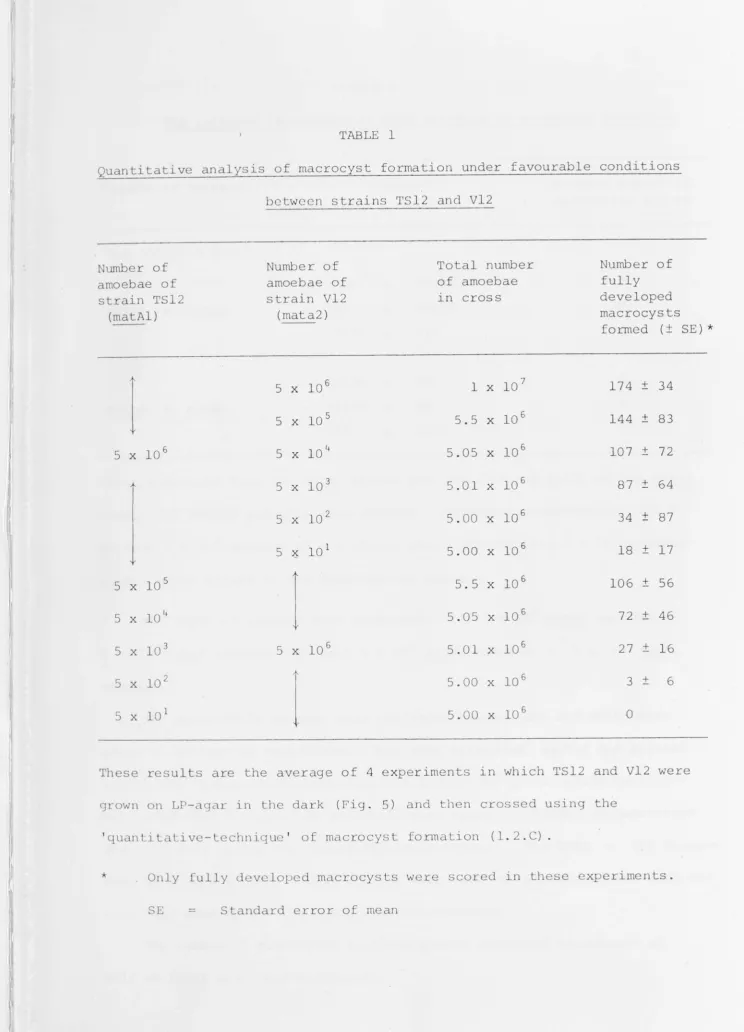
( see Tab 1 c 2 ) . In fact no macrocysts were formed until about 100 matl\l amoeb e were added to a large excess (5 x 10⁶) of mata2 amoebae (Table 1).
between strains TS12 and Vl2
Number of amoebae of
strain TS12 (matAl)
I
5 X 10⁶
5 X 10⁵
5 X 10⁴
5 X 10³
5 X 10²
5 X 101
Number of amoebae of strain Vl2
(mata2)
5 X 10⁶
5 X 10⁵
5 X 10⁴
5 X 10³
5 X 10 2
5 ~ 101
I
5 X 10⁶
I
Total number of amoebae in cross
l X 107
5.5 X 10⁶
5.05 X 10⁶
5.01 X 10⁶
5.00 X 10⁶
5.00 X 10⁶
5. 5 X 10⁶
5.05 X 10⁶
5.01 X 10⁶
5.00 X 10⁶
5.00 X 10⁶
Number of fully developed macrocysts
formed (
±
SE)*
174 + 34 144 + 83
107 ± 72 87 + 64 34 + 87 18 + 17
106 + 56
72 + 46
27 + 16
3 + 6
0
These resul.ts are the average of 4 experiments in which TS12 and Vl2 were grown on LP-agar in the dark (Fig . 5) and then crossed using the
'quantitative-technique' of macrocyst formation (1.2.C).
[image:26.809.39.784.26.1059.2]Numbers of amoebae
5 X 10⁶ 5 X 10 l
matAl x mata2
mata2 x matAl
Crosses*
HUl
X9
X
X
TS12 x
NP158 X
NP158 X
Vl2 X
NP158
NP158
Vl2
HUl
X9
TS12
Average number of macrocysts formed
7
20
24
0
0
0
Strains derived from the matAl strain NC4 (HUl , X9 and TS12) or the mata2
strain Vl2 (NP158 and V12) were crossed ('quantitative-technique ' 1.2.C)
so that 5 x 10⁶ amoebae of one strain were combined with 5 x 101 amoebae
of the other strain in the combinations shown.
* Two types of crosses were performed: ( i) 5 ~ 10 6 mat Al amoebae +
5 x 101 mata2 amoebae OR · (ii) 5 x 10⁶ mata2 amoebae + 5 x 101 matAl
amoebae.
The HUl x NP158 crosses were performed twice . HUl and NP158 were
grown on SM-agar in semi- light. They were harvested, washed and diluted as for the 'quantitative- technique ' (1.2.C). The X9 x NP158 crosses were performed 3 times . X9 and NP158 were grown on SM-agar in semi-light
and then used as for the 'quantitative- technique ' . The TS12 x Vl2 crosses
were performed 4 times . TS12 and Vl2 were grown on LP-agar in the dark and were then used as for the 'quantitative-technique'.
The nwnber of macrocysts includes poorly developed macrocysts as
is apparent from experiments in which amoebae of matAl or mata2 were each
grown under different environmental conditions (e.g . in the light vs the
dark) . The key experiments illustrating this point are shown in Fig. 6.
Consider the experiments where excess amoebae of the mata2 strain, Vl2,
were combined ·with dilutions of the matAl strain, TS12 . When both strains
were grown in the light (~~~~~-o~~~~~-) almost no macrocysts were
formed. However, when Vl2 was grown in the dark and TS12 in the light
a high number of macrocysts were formed. This
shows that the dark grown mata2 strain is contributing to macrocyst
formation .
Thus , both the matAl strain and the mata2 strain play anactive
1.4 DISCUSSION
1. 4.A Quantitative analysis of macrocyst formation
By quantifying rnacrocyst formation in D. discoideum, I have
souyht to increase the understanding of macrocyst formation beyond the limitations of qualitative studies. The 'quantitative-technique'
described herein (1. 2.C), separates the growth phase of amoebae from the
phase of macrocyst development. (The amoebae of each strain are grown
separately before they are combined for macrocyst development). Therefore
one can examine separately the effect on macrocyst production of altering the growth conditions of amoebae or the environmental conditions of
macrocyst development. In this Chapter, I describe experiments in which
only the growth phase was varied . Qualitatively my results support
previous reports in. which LP-agar and the absence of light were shown to
favour macrocyst production (Nickerson & Raper, 1973a; Erdos et al., 1976).
-The reports of Nickers·on & Raper (1973a) and Erdos ct al. (1976) did not
distinguish between the growth of amoebae vs. macrocyst development.
Powell (]974) show~d that the absence of light and phosphate were
essential during macrocyst development. My results show that a low
phosphate medium and darknes s arc also critical during the growth of
amoebae prior to macrocyst development.
( i) Are the progeny of one macrocyst the product of one meiosis?
l\t germination, over one hundred amoebae can emerge from a
single macrocys t (Wallace, 19 77) . Therefore a macro cyst could co0ceivably have more than one meiosis. Either a single zygote could divide
mitotically prior to mitosis (thus producing in effect several zygotes) or scv0 r ,1 l zyqo t-c~, could he tr c1.prcd i n th c r., a.me mac rocys · at th c tj me of its formation . For reasons outlined in 2.4.D and 2.4.F(iii), mitotic
unlikely. Wallace (1977) has presented genetic evidence that in some
circumstances more than one zygote is present in macrocysts of
D. discoidewn. However , since he formed macrocysts after growing high
numbers of amoebae of each ma ting- type tog_ether, i t was to be expected
that, by chance, some macrocysts would include more than one zygote. I
have shown that by mixing SO mata2 amoebae with excess matAl amoebae,
an average of 18 fully developed macrocysts were formed (Table 1) .
Assuming a random distribution of the SO mata2 amoebae i t is unlikely
that more than one zygote would be included in any macrocyst. This is
an important advantage for future sexual genetic anal ysis in D. discoideum,
since i t means that we have the potential to analyse the products of
a single meiosis.
(ii) A suggested improvement to the quantitative-technique
A maJor problem with the 'quantitative- technique' of macrocyst
formation was the high degree of quantitative variation from one
experiment to the next, even when environmental parameters were controlled
(Figs. S & 6) . It is possible to exclude cell viability as a cause of
the fluctuation, since in all of the four experiments reported in Fig.6,
the cell viability was consistently high. The greatest variable factor
of the quantitative technique was the growth stage of the amoebae when
harvested. The growth of amoebae was not uniform on a clearing plate
and varied depending on how well the amoebae had been spread on to the
agar . Therefore i t is possible that the high degree of quantitative
variation encountered in these experiments was due to differences of
amoebal ' age ' .
A change of approach is needed. It is suggested that amoebae
be grown in liquid culture in the future so that a synchronous population
of amoebae can be harvested at a precise stage of amoebal growth or
1.4.B The role of sex hormone activity in D. discoideum
From the experiments described in this Chapter certain
conclusions can be made about the mechanisms involved in macrocyst
formo io11. I!: war; nl1ow11 in J. . 3.7\(ii i) tl1at Uw ml tl\l P.trn.i.n is
ctctively involved in macrocyst formation (when excess mata2 amoebae
were available , no rnacrocys ts were formed un L:il abouL 100 matl\.l amod..>c.1e
were prese11t). This result indicated that a system of recognition was
operating between the amoebae of opposite mating-type clurlng. macrocyst
formation. Since the mata2 strain also played an active role during
rnacrocyst formation (1 . 3.A(i i i) )_, any recognition system operating
between the two strains must be a feedback system rather than a s i mple
one way recognition system. This is contrary to current reports in the
literature in which a simple one way system of sex hormone activity in
D. discoideum has been proposed (O' Day & Lewis , 1975 & 1977; MacHac &
Bonner, 1975) . These authors described a system in which NC4 was the
secreter of hormone and Vl2 the responder. However, recent attempts
to repeat the findings of O' Day & Lewis (1975) using the same isolates
and techniques have been unsuccessful (Wallace, 1977).
tn early experiments I attempted to demonstrate a one way
system of sex hormone activity by adding supernatant from washed
amoebae of one ~train back to amoebae of a strain of opposite
mating-type . This approach was also unsuccessful . However, in view of my
evidence for a more complex system of recognition, the failure of these
experiments is perhaps understandable. It is helpful to note ·that
similar problems were encountered during initial attempts to demonstrate
sex hormone activity 1 n the fungi . Banbury (195~) was unable to induce
zyCJophorc' producti.011 1 n the Phycomycctc , Mucor mucedo by exposing the
lllYCl l i111n 01 Olll' ~;l ,o1i11 lo .:1. 1iJ l ri:1lC' 01 LllC ol Ji0r , Il0WCV('1, when cl
I
I
'
,1
j
l
:i
I
strain , zygophores were produced. Hence, Banbury (1954) indicated the
requirement for two sequential steps in the initial sexual expression
of Mucor mucedo. Sequential feedback systems have now been shown to
initiate and regulate sexual interaction in many different fungi
(e .g. the most thoroughly researched are Ascobolus , Achlya, Mucor and
and Neurospora: Machlis, 1966; Raper, 1967; Barksdale, 1969;
.vigfusson & Cano, 1974) . Therefore i t is possible that by searching
for a sequential system of sex hormone activity in D. discoideum, a
more reproducible system will be demonstrated .
Defore sex hormones can be used to induce 'selfing' between
strains derived from the same basic isolate (General Introduction) i t
will be necessary firstly to develop a more reliable technique for
quantitative analysis and secondly to establish the balance of hormones
CHAPTER 2 VEGETATIVE INCOMPATIBILITY AT THE MATING-TYPE LOCUS
IND. DISCOIDEUM
2.1. INTRODUCTION
Attempts to form parasexual diploids between strains of
opposite mating-type in D. discoideum have generally been unsuccessful
(Williams unpublished). Only one such diplojd, DP72 , has been ·reported
in the l i terature (Mosses et al ., 1975) . This lack of
opposite mating-type diploids suggests that a system of 'self'
'not-self' incompatibility is operating in D. dis,coideum as i t does in a wide
range of organisms from fungi through to man (2.4.H). It was therefore
I /
considered likely that an attempt to construct isogenic strains of
opposite mating-type using a parascxual genetic approach (General
Introduction) would present problems.
The literature on incompatibility systems in the lower eukaryotes
has been examined in the hope of exposing the nature of these problems.
There are two w,ell documented systems of incompatibility operating in the
lower eukaryotes : sexual and asexual. To avoid confusio~, the former
will be r~ferred to in the context of mating and mating-types, and the
latter will be referred to as vegetative incompatibility.
2.1.A Mating-type systems in the lower eukaryotes
In the fungi and other lower eukaryotes, mating is controlled by
mating-type genes , which operate regardless of whether or not there are
any morphological sex structures (Raper, 1964; Bergman , et al. 1969;
Carlile 1973). Het erothaJlism, in which successful mating occurs only
between strains of different mating-type, is a common system
of sexual r eproduction for those organisms . 1Iomothal l ism, in which mating
through-out the lower eukaryotes (Carlile, 1973) .
The genetic basis of mating has been well documented in the
fungi . It ranges in complexity from a simple one l ocus- 2 allele system
Lo J lliCJllly c~volv<.'c1 l..wo C1.cl:.or-nmllt c1llclic ;1ynlcm (c .q. 'lwo muting
L:ypc ,ill c'lc"'!; at ,1 si119lc Jocus, in L:hc Phyc·omycctcs .:rnd
l\s comycc Les : for yencral reviews sec Wlliteliousc , 1949 ; Haper , 1966;
Finchum & Day, 1971; Esser & Blaich , 1973. I\ number of alleles at
Lwo dLJ ic.tcttl curnplcx loci, 111 L11c U<.1.sldlornyccll~S :
1971; Papazian , 1951) . In the Myxomycetes (acellular slime moulds)
two amoebae fuse to form a plasmodium, the first step in the sexual
cycle . This is governed by a one locus-multiple allele mating system
(i.e . a number of alleles at a single locus; e.g. in Physarum: Henney
& Henney, 1968; Dee , 1966; and in Didymium iridis : Collins, 1963).
Few details of mating in'the cellular slime moulds are yet known.
Mating-types were first recognised in the cellular slime moulds by
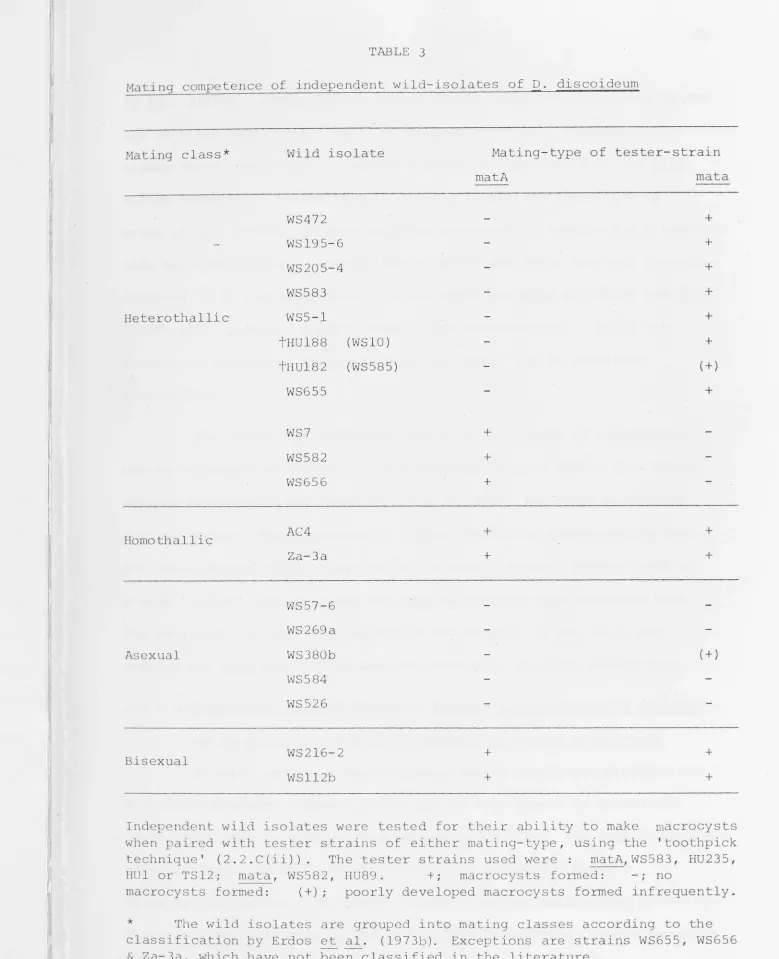
Clark et al . (1973) and Erdos et al. (1973b) and since then the
mating-type systems of a number of species have been examined. It has been
shown, however, that in the eight species examined for mating competence
(macrocyst formation) , both heterothallism and homothallism are found.
Two mating-types have been defined in Polysphondylium pallidum (Francis,
1975; Eisenberg & Francis , 1977) , although non-mating and homothallic
strains were also reported (Eisenberg & Francis, 1977) . Clark (1974)
violucoum were tested for mu.crocyst formation , that P. violaccum has two
syngens cu.ch wi.th two muting-types . She reports some overlap of the two
<Jl"<H1p:, liowovt r, .:11\Ci ~;o it- i :; po;;:,:il>l' th,1l: t·hl'rc urc in [,1cL only two
mt1LirnJ-lYL>C'....i tn ll.1is ~.;pcc;jc~~ - 'l'en of L:.lic forl:.y-llinc strc.1ills tested in
T11 c1 r;tucly on m,1tinq jn
are four mating-types expressed. Of the forty isolates tested, seventeen
expressed one or another of the proposed four mating types, sixteen
produced no macrocysts in any of the tests performed and seven of the
isolates gave inconsistent mating reactions. No homothallic strains
have been reported for D. giganteum. A report on mating in Dictyostelium.
purpureum (Clark et al. 1973), indicates that of the eight isolates tested,
four express one of two mating-types and four are apparently asexual.
Dictyosteliurn rosarium expresses three mating-types (Chang, 1976) and
only homothallic strains of Dictyostelium mucoroides and Dictyosteliurn
minutum have so far been reported (Clark et al. 1973; Nickerson & Raper,
1973a). Of particular importance to this thesis are the mating reactions
in the cellular slime mould Dictyostelium discoideurn. Erdos et al. (1973b)
and Clark et al. (1973) define a system with two mating-types in this
species , although both groups also describe some apparently asexual
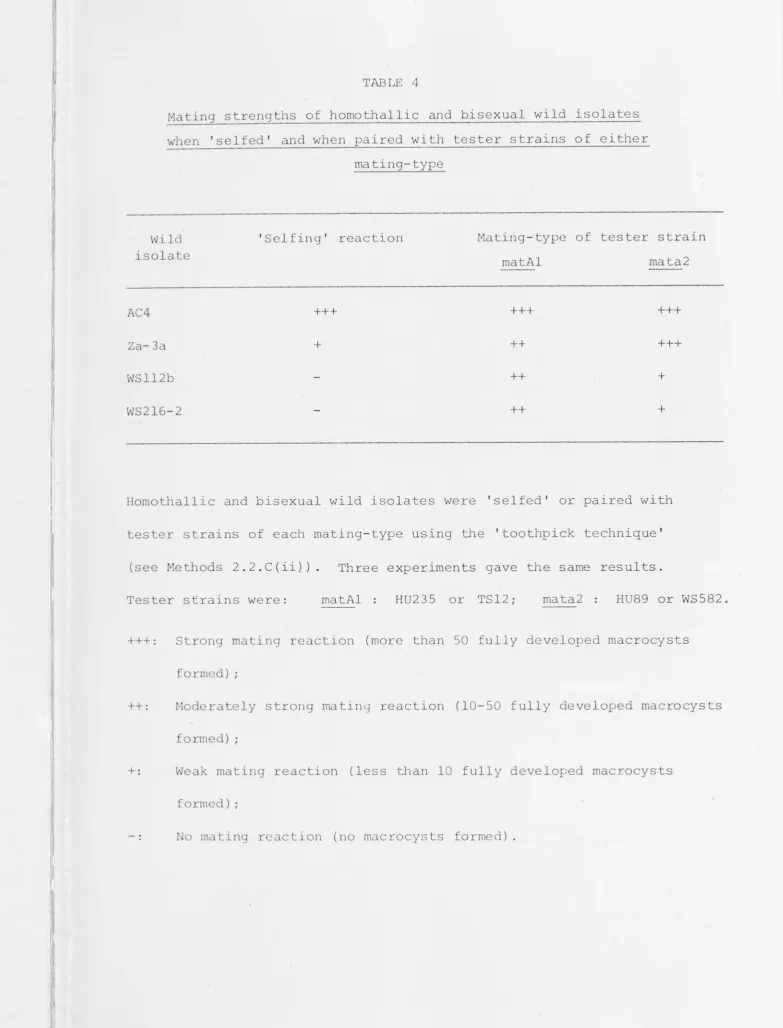
strains . In addition, Erdos et al. ( 197 3ti describ,e one homothallic
strain (selfer) and two bisexual strains (i.e. non selfing, but
successfully make macrocysts when paired with strains of each mating-type).
Erdos et al. (1973N and Wallace (1977) suggest that these bisexual strains
are expressing a third mating-type allele in D. discoideurn.
While the lit~rature on mating in the cellular slime moulds is,
as yet, essentially restricted to the discovery of mating-types, i t is
plausible that many of the species operate on a simple one ~ocus-2 allele
genetic basis. In particular the evidence for a one locus-2 allele mating
system in D. discoideum is quite strong, since most isolates express one
of two mating-types . Strains which do not fit this simple scheme (e.g.
asexual, homothallic and bisexual strains) are re-examined here. The
evidence for a third mating-type allele (Erdos et al., 1973b; Wallace,
2.1.B Vegetative Incompatibility
In the fungi, vegetative fusion in the form of hyphal anastomosis,
results in heterokaryon formation. Failure to form stable heterokaryons
is a common phenomenon , but details of the genetic control are in general
unknown (Carlile, 1973). An exception is found in the
Ascomycstcs,Aspergillus and Neurospora in which extensive studies on
vegetative incompcitibility reveal that stable hetcrokaryon formation
<l<'])('nd:; 1qic?11 i<l<'tll i ly .it: .-1 11111nbcr or cli ffcr('11t llr1! 0rokoryon
incompc1tibili y (hct) loci (Garnjobst & Wilson , 1956; Jinks & Grindle,
J9G3; l<wrn1 f:., Riipcr , ]0()7; Mylyk , 1075).
In N. crassa one of the het loci is shown to be coincident with
or very closely linked to the mating-type locus , which is a single locus
with 2 alleles (Newmeyer, 1970) . Hence strains of opposite
matirig-type , that are identical at all other het loci , will stil l not make stable
heterokaryons .
A similar system of intra-specific somatic fusion has also been
reported for the Myxomycetes . Stable plasmodial fusion only occurs
between plasmodia with identical ' f ' factor~ (Carlile, 1973). As in
N. cra~;scJ. t.h vcyetutivc incomp.:1tibi.lity system of the Myxomycctcs is polygenic (e .g. in Phys arum polycephalum and Didymium iridis: see Carlile, 1973; Clark & Collins , 1973;
Clark , 1977) .
Physarum cinereurn: see
CyLotoxic reactions have been observed to occur in both N. crassa and the Myxomyceles as a result of vegetative incompatibility. Such
reactions are often lethal and generally follow after plasmogamy (Garnjobst
& Wilson, 1956; Clark & Collins, 1973) . Pre-plasrnogamy blocks to
stable heterokaryon formation have not been ruled out as alternative
Systems of vegetative incompatibility .have not been reported
for any of the cellular slime moulds, even though vegetative fusion
of amoebae (the first step in parasexual diploid formation) is
extensively used for parasexual genetic analysis of D. discoideum.
However, the studies on D. discoideurn have almost exclusively employed
parasexual diploid formation in strains derived from a single wild
isolate (NC4).
Parascxuality is not well documented in the heterothallic fungi,
even though i t may be prevalent (Van Tuyl, 1977') . Only in the homothallic
species Aspergillus nidulans and specie~ lacking a sexual cycle (e.g.
Penicillium chrysogenum and Aspergillus niger) has i t been described in
any detail (Pontecorvo, 1956; Fincham & Day, 1971). While N. crassa has
a similar mating system to the cellular slime mould, D. discoideum, i t has
110 s l:c.t..!Jlc d Lplo.icl pl1c:isc ( l'crkins 0,1 Ua.rry, 1Sl77) a.ncJ so a. complete pa.rasexual
cycle involving diploid formation and haploidisation via aneuploidy has
not been described. For these reasons , direct parallels concerning
vegetative incompatibility in parasexual systems cannot be made between
the fungi and D. discoideum. However, in the light of the studies on
control of heterokaryosis in N. crassa i t is perhaps likely that
parasexual diploid formation in D. discoideurn is controlled by a system
of vegetative incompatibility. This chapter describes a detailed
investigation of the genetic control on parasexual diploid formation
in D. discoideurn and looks for possible links between -vegetative
incompatibility (i.e. failure to form vegetative diploids between two
2. 2. MATERIALS AND METHODS
2.2.A Materials
All media and chemicals are described in Appendix B.
2. 2.B Maintenance of s tocks
All strains are described in Appendix B. Details of strain
maintenance are described in 1.2.B.
2.2.C
( i) Quantitative technique
See 1.2.C.
(ii) . Toothpick technique
'l'his tcchniq_ue was used for routine ma L:.ing- type L:.cs ts. One ml
of sterile 20mM CaCl2 was dispensed into each of 24 flat bottomed clear
plastic wells (capacity -3.2ml) of a sterile Linbro FB-16-24TC
multi-'.vell dish. Amoebae of two strains , one of known mating-type , were picked
into each well from stock streak clones on SM-agar using a sterilised
conically pointed wooden toothpick. In 'selfing ' experiments, only one
strain was picked into each well. For good macrocyst production large
picks of cells were required (approximately 106 tC? 2xl06 amoebae per pick).
The multi-well dish was swirled briefly and gently before covering with
foil for dark incubation. The dish was not shaken during incubation
0
and was stored at 21±1 C for seven days . The multi-well dish was then
un-wrapped and scored for macrocysts, using an Olympus CK inverted microscope
at 40 x ma~nification. Several attempts to use the 96 well Linbro tissue
culture dish FB-96-TC or Falcon 3040 with lid 3041 (0 .1ml 20mM CaCl2 per
well) prov d unsuccessful since macrocysts were ·rarely formed even in
mating-type tests between sexually competent strains . Each well in these
dishes has a capacity of only 0 .35ml and so perhaps the failure was
2. 2.D Parasexual diploid formation
( i) Co-aggregation of amoebae
Vegetative amoebae of the same mating-type, taken from clearing
plates and co-aggregated on filters (Loomis, 1969) or in liquid (Williams
unpublished) for less than 2 hours, form parasexual diploids at a
frequency of approximately 10-7 • However, when they are co-aggregated
for more than 15 hours, the frequency of parasexual diploid formation
plateaus at approximately 10-s (Williams unpublished). Therefore, to
increase the frequency of parasexual diploid formation, the amoebae to
be crossed were always co-aggregated.
(a) Washed cell technique
This technique is a quantitative technique for parasexual
diploid formation (Williams et al., 1974b). Linbro FB-16-24-TC
multi-well dishes were prepared in advance with sterile incubation solutions:
distilled H20, 20mM K/K phosphate pH7.5, 20mM K/K phosphate pH6.5,
20mM CaCl2 . 21I20, 30% Bonners salt solution (30% S.S.) and 20mM KCl
(final concentration in 1 ml). The strains to be crossed were harvested
in sterile distilled water , from ' semi-light' grown clearing SM-agar
plates as for the 'quantitative-technique' of macrocyst production (1.2.C)
and diluted to a concentration of 5 x 10⁷ amoebae per ml. 5 x 10⁶ amoebae of each of the two strains to be ·crossed were added to each well and the
7
volume adjusted to 1 ml (i.e. 10 amoebae per ml final concentration). 'l'he l ·~.:;~;u-.. cullurc d_ish wtJ.s ~:;l1u.kc11 c1.t 2LL1 C 0 011 cin orbj tc1.l shc1.kcr at 150 cycles per minute for 17-18 hours . The shaken .suspensions of amoebae
were transferred, using sterile pastcur pipettes, into sterile test tubes
u.11d whirlimixec1. The sti:1rving amoebae often c:i.ggre9c::ttc into 'balls'
characl:.cristic of the st.rain (Powell, 1974) ancl whirlimixing is generally
suspension of K. aerogenes were plated on to SM-agar using a sterile bent glass rod spreader.
(b) Multi-well pick technique
This technique is
used for rout.inc pc1.rascxual diploid formation(Williams & Newell , 1976). 0.1 ml of sterile 20mM CaCl2 was dispensed into each of 96 flat bottomed clear plastic wells (capacity -0.35ml) of a sterile Linbro tissue culture dish FB-96-TC. Experiments using this 96 well tissue culture dish gnvc good results c1nd so i t was used in preference to the tissue culture dish Falcon FB- 16- 24TC in which only
twenty four crosses can be performed per dish .
Amoebae of the strains to be crossed were picked using .a sterile
toothpick from the growing edge of streak clonal plates and swirled into the designated well . Small picks were used (about 5 x 10⁵ amoebae per pick)-. The multi-well dish was shaken at 150 cycles/min at 21±1°c on an orbital shaker for 17- i·s hours . The contents of each well were
sucked up and down several times using a 100µ1 Oxford sampler with sterile tip to disaggregate the amoebae. The entire contents of the well were then plated onto either SM-agar or SM-agar containing cobal tous chloride (2 .2.D(ii)) .
(ii) Parascxual divloid selection
Parasexual diploid formation is a rare event (about 10-5 in
co-aggregated amoebae of the same mating-type) and so techniques have been
dt'V<'i(l11<'d l<> :;<:l<'<'l ivc,Jy kil I th<' p,1r<·11l.1l l1,1J_>loi<I:;, wl1il~;l t1.lluwinq L.lH·
K ( l l: z £,;, s l l ~; ! ; 111 d 11 ' I () 7 2 ; V l C J. k C r N f) CC' r in g '
Newell cl:. al ., l'J/"/; Willjc.tms, l<J7H). Two sclcct.ivc L:echnlques
h<1vc~ b' '11 w-;cJ i.11 l !1 i.~; s tudy ,111d arc referred to as U1c 'comvlcmcnting ts
( a) Complementing ts technique
This technique can only be used between strains each carrying
recessive complementing growth temperature sensitive (ts) mutations.
After incubation, the co-aggregated amoebae (2.2.D(i)) were transferred
to a growth environment (SM-agar spread with K. aerogenes) at the restrictive
temperature , 26 .8±0.3°c.
The diploids were heterozygous at both ts loci and therefore grew
at 26 .8° (Loomis , 1969; Williams et al., 1974b). If the ts mutations in
the parental haploids are at all leaky they can cause problems of leaky
growth at the restrictive temperature. However, diploids are usually
'punchy ' whereas leaky growth is diffuse and therefore diploids can be
easily distinguished in most cases . Since diploids have a larger spore
size than haploids (Sussman & Sussman , 1962; Sinha & Ashworth, 1969;
Katz & Sussman, 1972), 'punchy ' haploids caused by reversion of the ts
mutation were excluded by examining the spore size of all colonies that
grew at the restrictive temperature.. All diploids were then checked for
parental markers (e.g. spore shape, fruiting body pigment, drug markers)
to exclude rare isogenic diploids. Diploids het~rozygous for parental
markers were purified by clonal passage at the permissive temperature on
SM-agar and dried on to silica gel for storage (1.2.B(ii)).
(b) Ts dominant cobalt technique
The 'complementing ts technique' has the disadvantage that both
parental haploids must carry recessive, non allelic , ts mutations . The
'ts dominant cobalt technique ' p~ovides a means of selecting parasexual
diploids in which only one parental haploid has to be genetically marked
(Williams , 1978) . This enabled selection of parasexual diploids between
genetically marked haploids and unmarked wild isolates (2.3.B).