REPUBLIC OF
RWANDA
Ministry of Finance and Economic Planning
EUROPEAN
COMMISSION
Delegation of the European Commission
JOINT ANNUAL REPORT 2002
RWANDA
Table of Contents
1 EXECUTIVE SUMMARY... 1
2 RWANDA’S POLICY AGENDA... 2
2.1 NATIONAL UNITY,RECONCILIATION AND GOOD GOVERNANCE... 2
2.2 POVERTY REDUCTION... 2
3 UPDATE OF THE POLITICAL, ECONOMIC AND SOCIAL SITUATION... 3
3.1 POVERTY INDICATORS... 3
3.2 POLITICAL UPDATE... 4
3.2.1 Political Transition ... 4
3.2.2 National Unity and Reconciliation... 4
3.2.3 Regional politics, integration and conflict prevention... 5
3.3 ECONOMIC UPDATE... 5
3.3.1 Structural Reform Programmes ... 5
3.3.2 Domestic Economic Performance : Growth, Fiscal and Monetary... 5
3.3.3 External Balance, Trade and Debt... 5
3.4 SOCIAL PROFILE... 6
3.4.1 Education ... 6
3.4.2 Health... 6
4 OVERVIEW OF PAST AND ONGOING CO-OPERATION ... 8
4.1 INSTRUMENTS OF EU/RWANDA PAST COOPERATION ... 8
4.2 EVALUATION OF THE EU/RWANDA2002 COOPERATION ... 8
4.2.1 Focal Sector: Urgent Rehabilitation... 8
4.2.2 Focal Sector: Infrastructures... 11
4.2.3 Focal Sector : Agriculture and Rural Development ... 12
4.2.4 Macroeconomic Support ... 13
4.2.5 Governance, Justice, Legally constituted Statet... 14
4.2.6 Social, Education, Health... 16
4.3 EVALUATION OF IMPACT IN 2002... 16
5. PROGRAMMING PERSPECTIVE FOR THE FUTURE ... 17
5.1 EDF9NATIONAL INDICATIVE PROGRAMME... 17
5.1.1 Focal Sectors : ... 17
5.1.2 Non-focal programme : 12 M€ ... 18
5.2 CONSISTENCY WITH OTHER POLICIES AND INSTRUMENTS OF THE EC ... 18
5.2.1 European Investment Bank... 18
5.2.2 Regional Co-opération Planning ... 18
5.2.3 FLEX/STABEX ... 18
5.2.4 Community Budget Lines ... 19
5.3 CONSISTENCY WITH OTHER DONORS... 19
6. OPERATIONAL REVIEW 2003 ... 20
6.1 ACCELERATION OF USE OF PAST EDFBALANCES... 20
6.2 DEFINITION OF INDICATORS... 20
6.2.1 Government PRSP Monitoring System ... 21
6.2.2 Long Term Impact Indicators... 21
6.2.3 Rural Development Indicators ... 21
6.3 DIALOGUE WITH NON-STATE ACTORS... 22
7. CONCLUSIONS ... 23
7.1 ECONOMIC,SOCIAL, AND POLITICAL SITUATION... 23
7.2 RESULTS OF EC COOPERATION IN 2002... 23
7.3 PROSPECTS FOR THE FUTURE... 24
ANNEX 1 – RESUME DU PRS-PR... 25
ANNEX 2 – DETAILED FINANCIAL INFORMATION ... 28
ANNEX 3 – UPDATED INTERVENTION FRAMEWORK ... 30
ANNEX 4 - UPDATED SCHEDULE OF ACTIVITIES... 35
ANNEX 5 – INDICATIVE TIMETABLE FOR COMMITMENTS AND DISBURSEMENTS... 36
Acronyms AEP Alimentation en Eau Potable (réseau d') AT Assistance Technique (TA)
AfDB African Development Bank (BAD)
AIDS Acquired Immunodeficiency Syndrome (SIDA) ANT Assemblée Nationale de Transition
APER Accord de Partenariat Economique Régional BAD Banque Africaine de Developpement (AfDB) BEI Banque Europeene d’Investissement (EIB) BNR Banque Nationale du Rwanda
BSPR Budget Support for Poverty Reduction CBI Cross Border Initiative
CDC Comités de Développement Communautaire/Community Development Committees CDF Conmunity Development Fund (FDC)
CDMT Cadre des Dépenses Budgétaires à Moyen Terme (MTEF) CE Commission Européenne
CEEAC Communauté Economique des Etats d'Afrique Centrale CEGL Communauté Economique des Grands Lacs
CHK Central Hospital of Kigali
CNDH Commission Nationale des Droits de l'Homme
CNUR Commission Nationale pour l'Unité et la Réconciliation COMESA Common Market of Eastern and Southern Africa CSP Cooperation Strategy Paper
CUNR Commission d'Unité Nationale et de Réconciliation (NURC) CWIQ Core Welfare Indicators Questionnaire
DAO Dossier d’Appel d’Offres DHS Demographic and Health Survey EIB European Investment Bank (BEI)
ECHO European Commission Humanitarian Office EDF European Development Fund (FED)
EICV Enquéte Integrale sur les Conditions de Vie de Menages (Integrated Household Survey) EMIS Education Management Information System
ESSP Education Sector Strategy Paper
FARAP Financial Accountability Review and Action Plan FARG Fonds d'Aide aux Rescapés du Génocide
FBCF Formation Brute de Capital Fixe
FDC Fonds de Développement Communautaire FED Fonds Européen de Développement (EDF) FER Fonds d'Entretien Routier
FMI Fonds Monetaire International (IMF) FPR Fonds Patriotique Rwandais
FRPC Facilité pour la Réduction de la Pauvreté et pour la Croissance (PRGF) FRW Franc Rwandais
Gacaca Tribunal Populaire traditionnel (jugera les personnes accusées de génocide) GDP Gross Domestic Product (PIB)
HIMO Haut Intensite de Main d’Oeuvre HIPC Highly Indebted Poor Country (PPTE) HIS Health Information System
HIV Human Immunodeficiency Virus (VIH)
ICTR International Criminal Tribunal for Rwanda (TPI) IDA International Development Association IFAD International Fund for Agricultural Development IMF International Monetary Fund (FMI)
INP Indicative National Programme (PIN) MDTF Multilateral Debt Trust Fund
M€ Million d'Euros
MINECOFIN Ministry of Finance and Economic Planning MINEDUC Ministry of Education
MINISANTE Ministry of Health
NGO Non-Governmental Organisation (ONG) NHRC National Human Rights Commission NPRP National Poverty Reduction Programme NPV Net Present Value
NURC National Unity and Reconciliation Commission
OBK Organisation pour l'Amélioration et le Développement du Bassin de la Kagera OMC Organisation Mondiale du Commerce (WTO)
ON Ordonnateur National
ONG Organisation Non-Gouvernmental (NGO)
ORPI Office Rwandais de Promotion des Investissements (RIPA) PDRR Programme de Démobilisation, Réintégration, Réinstallation PFM Public Financial Management
PIB Produit Intérieur Brut (GDP) PIN Programme Indicatif National (INP) PMIP Poverty Monitoring and Information Plan PNB Produit National Brut (GNP)
PPGE Programme Prioritaire de Génération d'Emplois PPTE Pays Pauvre Très Endetté
PRGF Poverty Reduction and Growth Facility PRS Poverty Reduction Strategy
PRSP Poverty Reduction Strategy Paper
PRS-PR Poverty Reduction Strategy Progress Report RES Rural Economy Strategy
RIFF Régional Intégration Facilitation Forum
SAP Structural Adjustment Programme (Appui budgétaire/Budget support) SIBET Systeme du budget de l’etat
SPA Strategic Partnership with Africa
SPPMD Strategic Planning and Poverty Monitoring Department (MINECOFIN) STABEX Stabilisation of Export Earnings
SWAp Sector Wide Approach TA Technical Assistance
TPI Tribunal Pénal International (Arusha) (ICTR) UNDAF United Nations Development Assistance Framework VAT Value Added Tax
WTO World Trade Organisation (OMC)
Average Exchange Rate - Euro / Ecu Vs Rwandan Francs Source: BNR
Year 1996 1997 1998 1999 2000 2001 2002
1
EXECUTIVE SUMMARY
Despite an impressive economic and social recovery since the 1994 genocide, Rwanda remains one of the poorest countries in the world, with a GDP per capita less than $220 in 2002, and with 60.3 percent of the population living below the poverty line. The Government remains committed to poverty reduction and national unity, reconciliation and good governance. Impressive progress towards these two key objectives was made in 2002, including through excellent macro-economic performance, increased budgetary allocations to priority programmes, and the holding of local elections. However, 2002 was for the most part a preparation year: the Poverty Reduction Strategy Paper (PRSP) was finalised after two years of consultations, the draft constitution was prepared for a referendum in 2003 (marking the end of the transition period and to be followed by presidential and parliamentary elections), and training and awareness campaigns were conducted for the gacaca process. As a result, 2003 and 2004 will be exceptionally busy years for the Government as a new political (democratic) and policy (poverty reduction) regime is fully launched.
In terms of EC-Rwanda co-operation, 2002 was also a year of preparation. In terms of the 6th, 7th and 8th EDFs, preparations were made to use up the outstanding balances, largely through large-scale infrastructure projects. Calls for tenders for several of these (Kigali-Kayonza road, Gitarama-Butare-Akanyaru road, Kigali airport rehabilitation, Kigali urban roads, and Bugesera water supply) were issued in late 2002, and construction is expected to start in 2003. In total, these five projects are expected to result in the disbursement of around €75 million in 2003 and subsequent years. In addition, progress was made in preparing a programme for the use of the €20 million of funds available under STABEX, to be implemented between 2003 and 2005.
In terms of the 9th EDF, the Cooperation Strategy Paper (CSP) and National Indicative Programme (NIP) were prepared based on the PRSP and on extensive consultations. For both focal sectors (rural development and macroeconomic support), financing agreements and first disbursements are expected in 2003. In terms of rural development, the EC and Government started a policy-level dialogue on the definition of a broad but detailed strategy. For both focal sectors, there is a perception that the available resources are insufficient and that Rwanda has been perversely penalised for the genocide and consequent recovery efforts. There is also frustration at the perceived lack of access to Envelope B funds earmarked for Rwanda in the absence of a natural disaster.
Some progress in terms of implementation was also made in 2002. In total, around €45 million was disbursed. This includes €26 million of budget support (from the 8th EDF), although this was between 6-12 months later than expected. Construction of small-medium scale infrastructure continued, particularly in the education, health and social sectors. Implementation of 8th EDF support to justice, human rights and rule of law started and is expected to accelerate in 2003. Technical assistance was put in place in several key ministries. The results of this implementation were seen through the progress of national unity and reconciliation (particularly through Gacaca), and through signs of improvements in outcome indicators in education and health. Further, macroeconomic support contributed to Rwanda’s excellent macroeconomic performance in 2003.
2
RWANDA’S POLICY AGENDA
The policy agenda of the Government of Rwanda consists of two key interrelated elements : Firstly, at a political level, as a continued response to the genocide, there is a focus on national unity, reconciliation and the reconstruction of an effective state and good governance in general. Secondly, at a socio-economic level, there is a focus on the reduction of poverty, through the implementation of the Poverty Reduction Strategy Paper (PRSP). The PRSP also plays a crucial role in national unity, as poverty is a major obstacle to national reconciliation.
2.1 NATIONAL UNITY,RECONCILIATION AND GOOD GOVERNANCE
The first priority of the Government of Rwanda is the creation of a new national identity in order to foster national unity and reconciliation and to ensure that the genocide never recurs. To this end, in 2002, various activities were undertaken, including the preparations for Gacaca proceedings, the introduction of a new national anthem and flag. In addition, preparations were made for the end of the transition period in 2003, involving the referendum on the constitution and elections for the national assembly and the president. The decentralisation process also continued in 2002, as a critical process for redesigning governance in Rwanda.
2.2 POVERTY REDUCTION
Rwanda’s poverty reduction agenda was defined in the PRSP, finalised in June 2002. This document will be the framework for action for all stakeholders in Rwanda, and provides a clear statement of policy direction and prioritisation. The PRSP was prepared through a participatory process between 2000 and 2002, and as a result there is strong ownership of the PRSP at all levels of society, particularly within Government. Strong leadership was provided by MINECOFIN through the National Poverty Reduction Programme (NPRP, now the Strategic Planning and Poverty Monitoring Department – SPPMD). The consultation process included grassroots involvement through the Participatory Poverty Assessment (PPA)
The PRSP identifies six broad priority areas (in order of importance):
• Rural Development and Agricultural Transformation
• Human Development – including education, health, science and technology
• Economic Infrastructure – including roads, communication and energy
• Governance – including security, reconciliation, human rights, justice, decentralisation.
• Private Sector Development – including investment promotion and privatisation.
• Institutional Capacity Building
It is intended that sector strategies will be prepared in order to translate the PRSP into more detailed strategies and to bring all stakeholders in a sector together in planning their activities.
In future years, it is intended that the annual PRS Progress Review forms the basis of all reviews of performance and progress in poverty reduction, including the EC’s Annual Report1.
3
UPDATE OF THE POLITICAL, ECONOMIC AND SOCIAL
SITUATION
23.1 POVERTY INDICATORS
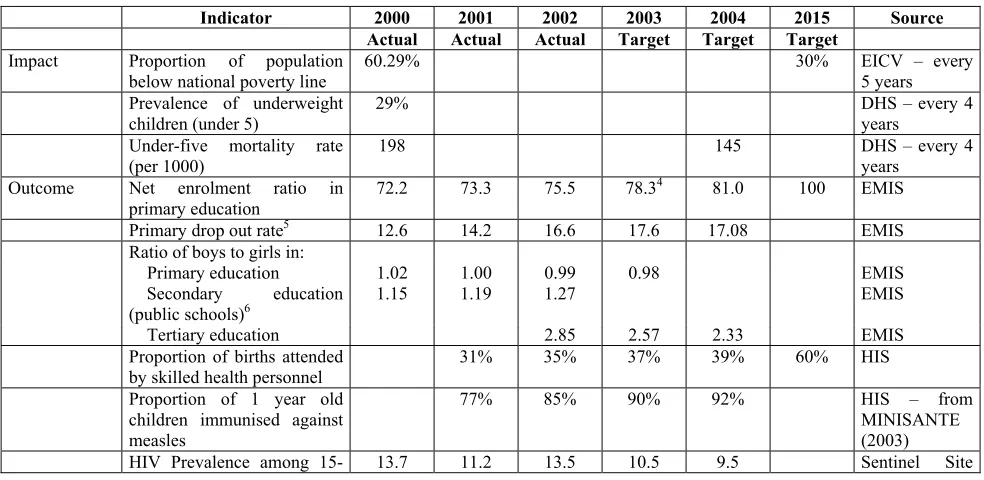
Table 1 below presents basic poverty and macro-economic indicators. As can be seen, there are a number of gaps where data is not available. For the three impact indicators, this is due to the periodicity of relevant surveys (the Household Living Conditions Survey – EICV – takes place every 5 years; and the Demographic and Health Survey – DHS – takes place every 4 years). For the outcome targets, the lack of some data is in part due to the absence of a single data source. With the advent of the annual PRS Review, this problem should be rectified.
[image:8.595.64.556.403.643.2]Except for macro-economic indicators (where targets are set within the framework of the PRGF), reliable annual targets have not been set. Those in the table should be treated as indicative targets only. However, Rwanda remains committed to meeting the Millenium Development Goals. The quality of data is generally high, particularly from the larger surveys (EICV, DHS, CWIQ). The quality of management information systems in the health and education sectors (HIS and EMIS) are steadily improving with substantial technical assistance, and data is available on an annual basis. Macroeconomic data is generally reliable and is verified by the IMF.
Table 1 – Indicators of Poverty levels and other Macro Economics3
Indicator 2000 2001 2002 2003 2004 2015 Source
Actual Actual Actual Target Target Target Impact Proportion of population
below national poverty line
60.29% 30% EICV – every
5 years Prevalence of underweight
children (under 5)
29% DHS – every 4
years Under-five mortality rate
(per 1000) 198 145 DHS – every 4 years
Outcome Net enrolment ratio in
primary education 72.2 73.3 75.5 78.3
4 81.0 100 EMIS
Primary drop out rate5 12.6 14.2 16.6 17.6 17.08 EMIS
Ratio of boys to girls in:
Primary education 1.02 1.00 0.99 0.98 EMIS
Secondary education
(public schools)6 1.15 1.19 1.27 EMIS
Tertiary education 2.85 2.57 2.33 EMIS
Proportion of births attended by skilled health personnel
31% 35% 37% 39% 60% HIS
Proportion of 1 year old children immunised against measles
77% 85% 90% 92% HIS – from
MINISANTE (2003)
HIV Prevalence among 15- 13.7 11.2 13.5 10.5 9.5 Sentinel Site
1 This Annual Report where possible uses data and information from the Government’s PRS Progress Review for
2002, produced in July 2003.
2 This section is based on the PRSP (2002) and the Poverty Reduction Strategy Progress Report (PRS-PR)
3 All figures and targets are taken from the Government’s PRSP, PRS-PR, sectoral strategy processes or PRGF
documentation.
4 Estimate
5 Figures on primary completion rate are not available, and data on survival rate is currently unreliable, so primary
drop out rate has been substituted as a measure of efficiency and quality. In future years, improved data on completion rate and survival rate will be available
Indicator 2000 2001 2002 2003 2004 2015 Source Actual Actual Actual Target Target Target
49 year old pregnant women survey
Proportion of population with sustainable access to an improved water source
20% CWIQ
Macro-economic
GDP Growth Rate 6.0% 6.7% 9.4% 3.2% 6.2% 7-8% IMF
Inflation (annual average) 3.9% 3.4% 2.0% 4.5% 3.0% CPI/IMF Current account of the
balance of payments (as % GDP)
-5.0% -5.9% -7.3% -10.4% -11.0% GoR
Exchange rate (RWF per € annual average)
358.2 396.8 449.7 BNR
Fiscal balance (as % GDP) -2.7% -4.2% -4.4% -1.1% IMF
NPV Debt:Export ratio 192 256 150 MINECOFIN
Public
Expenditure Total expenditure as % GDP 18.7% 20.9% 23.2% 24.6% 21.8% IMF Domestic revenue as % GDP 9.7% 11.4% 12.3% 13.4% 13.6% IMF Priority expenditure as %
GDP 4.0% 5.3% 6.1% 6.3% 6.6% GoR
Military expenditure as %
GDP 3.4% 3.3% 2.9% 2.6% 2.4% GoR
3.2 POLITICAL UPDATE
3.2.1 Political Transition
In 2002, the Transitional Government of National Unity and the Transitional National Assembly continued to exercise executive and legislative power in Rwanda. However, 2002 also saw the acceleration of the transition process towards multiparty democracy, which is expected to end in 2003. In particular, the Constitutional Commission prepared a final draft constitution (to be subject to a referendum in 2003). The draft constitution enshrines the principles of multi-party democracy, national unity and reconciliation, human rights and the rule of law. It also foresees the democratic election of a President and National Assembly in 2003.
Decentralisation plays a central role in the democratic transition and in the implementation of the PRSP. The decentralisation process started with local level elections (at cell, sector and district level) between 1999 and 2002. The community development policy, including fiscal decentralisation at a district level, began in 2002, particularly through the Community Development Fund (CDF).
3.2.2 National Unity and Reconciliation
National unity and reconciliation remains at the top of the Government’s agenda. Three national commissions were created in 1999 to oversee this process: the National Unity and Reconciliation Commission (NURC); the Demobilisation and Reintegration Commission (DRC); and the National Human Rights Commission (NHRC). The EC has provided support to all of these commissions, either directly or through budgetary support.
3.2.3 Regional politics, integration and conflict prevention.
In 2002, Rwanda withdrew its troops from the Democratic Republic of the Congo as part of the ongoing Congolese peace process. Rwanda has continued to be engaged in various discussions aimed at preventing further conflict in the region.
3.3 ECONOMIC UPDATE
3.3.1 Structural Reform Programmes
The Government of Rwanda and the IMF agreed a Poverty Reduction and Growth Facility (PRGF) in July 2002. Since then, the Government has remained largely on track with the PRGF Programme. In addition, in October 2002, the Government agreed an Institutional Reform Credit with the World Bank worth $85 million, focussed on supporting privatisation, public financial management reform, and financial sector reform.
Rwanda continued to make good progress in establishing a modern public financial management system. The Medium Term Expenditure Framework (MTEF) approach was further strengthened and linked to the PRSP. The computerised budget execution system (SIBET) was extended to all line ministries and provinces. New guidelines were issued and implemented in order to reduce extra-budgetary and off-budget expenditure. The new Public Accounts Department in MINECOFIN was strengthened (with EC support), with the intention of producing Rwanda’s first consolidated public accounts since 1979 in 2003. The Office of the Auditor General conducted audits of 34 public sector entities.
3.3.2 Domestic Economic Performance : Growth, Fiscal and Monetary
In 2002, economic growth was relatively high at 9.4 percent (Table 1). The two major growth engines in 2002 were agriculture (led by food production thanks to excellent weather conditions) and construction. Food supply to city-dwellers by local farmers boosted rural incomes, so that agricultural performance spilled over to other sectors of the economy, notably through demand addressed to local manufacturers. The performance of export crops, the focus of EC programmes in the agricultural sector, was also impressive (recording 5.3 percent growth in production).
In general fiscal performance was good: revenue performance continued to improve (increasing to 12.3 percent GDP in 2002) as a result of the introduction of VAT and improved administration and collection. Expenditure performance was generally good: regular domestic expenditure was within PRGF programmed levels, spending on PRS priority areas exceeded the programme, and military expenditure continued to decline in real terms. However, unanticipated expenditure on military withdrawals caused aggregate fiscal targets to be missed.
From a monetary perspective, 2002 was a mixed year. Expansion of net credit to government in the first 3 quarters of the year (due to late disbursements of EC and World Bank budget support and unanticipated expenditure) and excessive lending by a weak banking sector led to Government missing its broad money targets, a gradual picking up of inflation and (together with the deteriorating current account situation), a 13 percent depreciation of the exchange rate. In the last quarter, donor inflows brought net credit to government back into targeted range, and the BNR intervened to mop up excess liquidity, resulting in increased nominal interest rates.
3.3.3 External Balance, Trade and Debt
This situation reinforces the urgent need for the agricultural strategies supported by the EC, aimed at improving the quality of coffee and tea production (and thereby increasing and stabilising prices), and increasing commercialisation of agriculture, including diversification into value-added activities such as agri-business. These strategies are beginning to reap dividends, for example through the export of limited quantities of high quality “fair trade” coffee to Europe.
Rwanda is a member of various regional trade and integration groupings, most notably COMESA and the Regional Integration Facilitation Forum (RIFF). Under COMESA and RIFF agreements and IMF and World Bank structural adjustment programmes, trade liberalisation has accelerated, with reductions in import duties for other COMESA members and the elimination of non-tariff barriers. Whilst this has opened up new opportunities in regional trade and increased competition, it has also required a restructuring of Rwandan industries in order to compete. Furthermore, due to the small domestic market and prohibitive transport costs, Rwandan enterprises are at a disadvantage in the regional market.
Rwanda’s stock of external debt amounted to US$1.22 billion at the end of 2001. In December 2000, Rwanda reached HIPC Decision Point, replacing the MDTF mechanism with the enhanced HIPC mechanism of interim debt relief. Rwanda aims to reach HIPC Completion Point in September 2003. However, despite HIPC debt relief, it is unlikely that Rwanda will attain debt sustainability as the HIPC Decision Point document was prepared on the basis of higher than trend export earnings and interest rates. In order to achieve debt sustainability, it has been calculated that Rwanda requires around US$137 million additional debt relief.
3.4 SOCIAL PROFILE
Poverty in Rwanda expanded from 48% before the genocide to 78% in 1994. It has since fallen to 60% (in 2001). Poverty remains largely a rural phenomenon, and the economy continues to rely on agriculture.
3.4.1 Education
Planning in the education sector made significant progress in 2002, with the preparation of the ESSP (Education Sector Strategic Plan) and the development of a Sector Wide Approach (SWAp). Resource allocations to the education sector have increased from 17 percent of the recurrent budget in 1998 to 25 percent in 2002. As Table 1 shows, trends in primary education show an improvement in access (net primary enrolment) and equity (ratio of boys to girls). However, these improvements have come at the cost of declining quality of tuition (as reflected in an increasing primary drop out rate). However, it is expected that quality outcome indicators will in future years show improvement, as resources are increasingly channeled towards primary education (partly as a result of EC Budgetary Support), and are showing results in terms of inputs and outputs. For example, the pupil:qualified teacher ratio decreased from 82 in 2001 to 72.6 in 2002.
3.4.2 Health
In particular, there was some success in 2002 in developing the “mutuelles” (community based health insurance schemes) to reduce the burden of financial risk implied by relatively high health costs.
Strong progress was made in 2002 in HIV/AIDS awareness and voluntary counselling and testing (VCT). HIV/AIDS interventions are supported by a growing number of donors (such as UNAIDS, UNICEF, WHO, World Bank, USAID, Global Fund) and are coordinated by the National Commission for HIV/AIDS (CNLS). Some progress has been made by the CNLS and its partners in coordinating the activities of the various donors around a coherent strategic plan.
Table 1 shows some improvement in the proportion of births attended by qualified personnel and in the immunisation rate. Sector planning and performance monitoring in the health sector is at an earlier stage than in education, although limited progress was made in 2002 (for example through the introduction of a comprehensive database of all health projects). This situation will be improved in future years with the improvement of the health information management system with EC support.
3.4.3 Gender Equality
4
OVERVIEW OF PAST AND ONGOING CO-OPERATION
4.1 INSTRUMENTS OF PAST COOPÉRATION EU/RWANDA
The programmes approved in the aftermath of the events of 1994 drew their financing from a restructuring of the remainders of the 6th EDF and a recasting of the 7th EDF. During this post conflict period, the majority of project co-operation was through two rehabilitation pro-grammes with multiple components adding up to €114m. These propro-grammes were designed to make the transition from emergency assistance towards sustainable development assistance, targeting mainly transport (roads, airport) and social (health, education, justice) infrastructure, and technical assistance for the restarting of public services.
Decentralised actions such as micro-projects and employment generation were also set up and have continued through 8th EDF funding. Three 8th EDF projects, respectively support for MINECOFIN (€7m), for the 3rd general census (€7m) and for human rights and national rec-onciliation (€7.2m) were started in 2001. Parallel to this project approach, two structural ad-justment programmes in the form of budgetary support were introduced, the second of which (>€59m) is still being implemented.
4.2 EVALUATION OF THE 2002EU/RWANDA COOPERATION
4.2.1 Focal sector: Urgent Rehabilitation works
The first rehabilitation programme was essential for rebuilding various public infrastructures devastated during the genocide. This programme was prepared in a situation of absolute urgency and as a result the allocation of the budget to each aspect was sometimes too approximate. Flexibility in reallocating the budget between the different aspects has therefore been essential in matching resources to evolving needs. The programme is almost entirely committed (see Table 2); only the "road works”, "health and education infrastructure" and "implementation" components have funds that remain to be committed, and calls for tender for these remaining resources are currently in process.
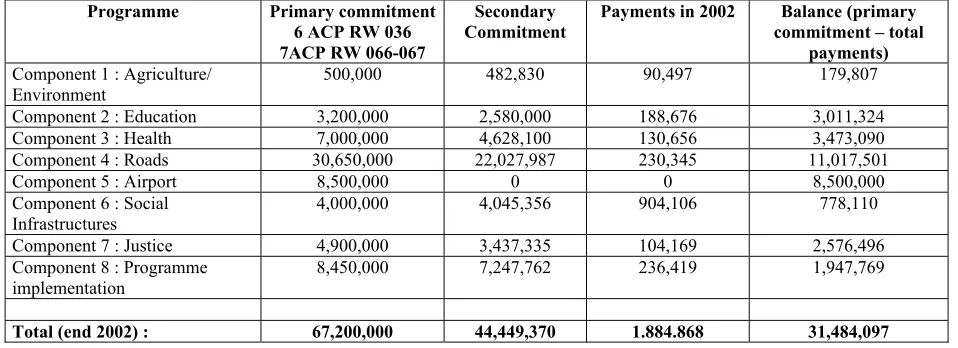
The second programme (see Table 3), constitutes a turning point between the emergency rehabilitation phase and the development phase. This programme, financed through the 6th and 7th EDF, will be completed committed after the calls for tenders launched in November 2002 and the beginning of work envisaged in 2003 for two major projects: the Gitarama-Butare-Akanyaru road and the 2nd phase of rehabilitation of the airport, co-financed with the EIB.
Insofar as most of the interventions described relate to public infrastructure, with a focus on social sectors like education, health and justice (so essential in the Rwandan context), in both rural and urban environments, all layers of society are, to differing degrees, benefiting from these programmes. In addition, through contracting local firms to take part in the construction of this infrastructure, the programme has helped to re-launch the private sector.
Despite the provision of technical assistance to the principal ministry concerned (public works) by the rehabilitation programmes, institutional capacities remain very limited. Targeted support planned for this ministry under the 8th EDF will therefore be welcome.
First Immediate Rehabilitation Action Programme
The majority of the balances are for the “Health-Education Infrastructure”, and “Road works” components. Despite the low level of expenditure, preparations were made in 2002 to ensure that expenditure accelerates in 2003 and 2004.
In terms of health and education infrastructure, the supply of equipment and rebuilding of the radiology unit in Kigali Central Hospital were completed in 2002. In this same component, two studies and two calls for tenders were launched for the construction of an “Ingando” centre (“post-genocide” re-socialisation for released prisoners and refugees returning to the country) in Ruhengeri; and the construction of a hostel adapted for the improvement of the operation of the hospital and of the nursing school (rehabilitated in 2001) in Nyagatare. Work on both sites will start during the 1st half of 2003.
In terms of support to the environment and national parks, €0.25m was provided in the form of support to GTZ for the rehabilitation of surveillance and tourist tracks, the purchase of equipment, and the training of guards and managers. These activities will finish during the 1st half of 2003.
Concerning the road sector, the Kigali-Gatuna axis (towards Uganda, part of the northern corridor), rehabilitation work was completed despite numerous difficulties including the weakness of the study and of monitoring, and the bankruptcy of a local company. In this same component, preparations for the construction of 12 km of peri-urban roads in disadvantaged districts of Kigali were completed in 2002 and a call for tenders has been launched.
[image:14.595.62.551.484.647.2]During 2002, several contracts were cancelled with associated payments of guarantees. This will be continued in 2003. In addition, 3 tenders pertaining to imports of petroleum products remain awaiting resolution of their respective disputes. A expert is expected to come on mission at the beginning of 2003 to accelerate the amicable settlement of these disputes. The potentially de-committed will be reallocated to the road component.
Table 2: « First Immediate Rehabilitation Action Programme ; C.F. 5460/RW » Financial Summary
Programme Primary
commitment ACP RW 057
Secondary
Commitment Payments in 2002 commitment – total Balance (primary payments) Component 1 : Human Rights
Observation 4,136,760 4,136,760 0 0
Component 2 : Airport (1st phase) 2,750,000 2,627,004 101,860 258,289
Component 3 : Road works 6,500,000 3,481,000 71,762 3,477,202
Component 4 : Health-Education-Infrastructures
11,782,474 9,548,309 251,752 2,309,435
Component 5 : Environment & parks 1,800,000 1,724,325 165,603 199,789
Component 6 : PSI 14,928,269 14,928,269 0 1,311,267
Component 7 : Programme implementation
4,902,497 4,349,086 282,715 1,024,950
Total (end 2002) : 46,800,000 40,794,753 873,692 8,580,935
Activities of the Second Rehabilitation Programme (C.F. 5713/RW)
Concerning the "education" infrastructure component, 5 secondary schools are being rehabilitated and extended. Work by local firms (€2.5min total) began in October 2002 and will finish at the second half of 2003. In the "health" component, two supply contracts (ambulances and other vehicles for MINISANTE and radiophone systems for rural health centres) were finalised in 2002. In terms of infrastructure, preparations were made for the rehabilitation and extension of rural health centres in Kibungo, Umutara and Gisenyi provinces (€1,5m total). Work will start in 2003.
Concerning large transport infrastructure projects, international tender documents for the Gitarama-Butare-Akanyaru road were published in November 2002. This project will be financed by the remaining share (€8.6m) of the road component of the 2nd rehabilitation programme and by the regional financing agreement (6342/REG; €9.2m). Work will start in 2003. The tender documents for airport project (€8.5m for the civil engineering) co-financed by the EIB (€11m for navigation, energy equipment) were published in November 2002 with work due to begin in 2003.
The activities under the social infrastructure component (reinforcement of decentralised structures, TA, micro-projects managed by local communities) are being finalised. Certain management problems however were identified and the necessary remedial measures have been taken.
In terms of the justice component, in addition to two important buildings that have already been completed (Supreme Court; €1.4m and Prosecutor General €0.8m), the programme was focussed on rural areas through the rehabilitation and/or rebuilding of 30 canton courts in the provinces of Gisenyi, Ruhengeri and Gitarama (€1.5m in total). Work started in October 2002 and is expected to be completed in mid-2003. A further activity of about €0.5m is expected to be added to this component for the installation of a large courtroom in the Supreme Court with a view to making it compatible for possible transfers organised by the ICTR which usually sits in Arusha.
[image:15.595.62.541.581.755.2]The healthy competition resulting from local calls for tender have resulted in significant balances in the education, health and justice infrastructure components.. These funds will supplement the road component where additional costs could appear. In addition the acceleration in works in the education, justice and health components, and the start-up of major road and airport works will lead to significantly higher disbursements in 2003 and 2004.
Table 3 : « Second Rehabilitation Programme : C.F. 5713/RW » Financial Summary
Programme Primary commitment 6 ACP RW 036 7ACP RW 066-067
Secondary Commitment
Payments in 2002 Balance (primary commitment – total
payments) Component 1 : Agriculture/
Environment
500,000 482,830 90,497 179,807
Component 2 : Education 3,200,000 2,580,000 188,676 3,011,324
Component 3 : Health 7,000,000 4,628,100 130,656 3,473,090
Component 4 : Roads 30,650,000 22,027,987 230,345 11,017,501
Component 5 : Airport 8,500,000 0 0 8,500,000
Component 6 : Social Infrastructures
4,000,000 4,045,356 904,106 778,110
Component 7 : Justice 4,900,000 3,437,335 104,169 2,576,496
Component 8 : Programme implementation
8,450,000 7,247,762 236,419 1,947,769
4.2.2 Focal sector: Infrastructures
2002 was a landmark year for the major infrastructure projects, and the effects of this will be felt as work begins in 2003. In the Rwandan context, important works like those envisaged (Gitarama-Akanyaru; €17m, airport €8.5m, Kigali-Kayonza €25m, Bugesera piped water scheme €15m) will have a very substantial impact on employment and local subcontracting firms.
Concerning the 6th and 7th EDF (+ 8th NIP), numerous infrastructure related activities have been mentioned above (section 4.2.1), which includes rehabilitation not directly linked to conflict damage
For the 8th EDF (NIP), 2002 was mainly dedicated to the preparation of the major projects with few disbursements. The transport sector support project (including the Kigali-Kayonza road) could not be submitted to the EDF Committee before the adoption by the Government of an acceptable policy in the field of road transport; which was completed in August 2002. Nevertheless, the technical study for the rehabilitation of the Kigali-Kayonza road was carried out through a separate project (€0.4m total). The international call for tenders for the Kigali-Kayonza road (64 km; €25m+ €1,5m surveillance) and other urban roads (11 km) was launched in November 2002 (simultaneously to the Gitarama-Akanyaru road and the airport) with a suspensive clause because the Financing Agreement was not available at the end of 2002 despite a positive opinion of the EDF Committee in October 2002.
In the field of the drinking-water supply, a project (treatment plant and distribution network in a rural environment; €15m) in the region of Bugesera (south-east) was prepared (including a technical study and the tender documents). As soon as the Financing Agreement is approved, an international call for tenders will be launched in 2003.
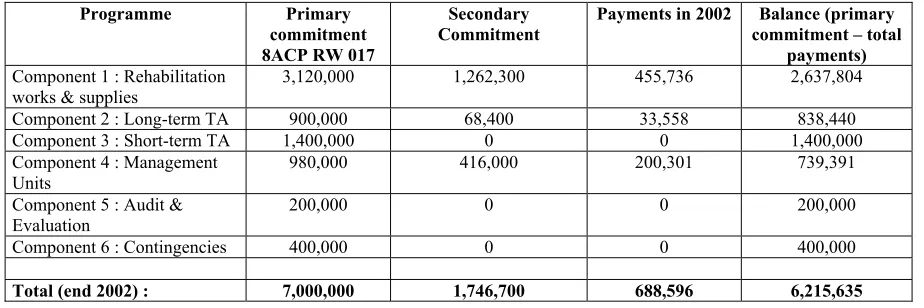
[image:16.595.62.524.635.789.2]Under the “Technical and logistical support to the Ministry of Finance and Economic Planning” project, a budget of €3.12m is reserved for the rehabilitation of buildings and various supplies. Within this framework, the calls for necessary tenders were launched and “ex-MINIPLAN” buildings are in the process of rehabilitation and several supply contracts have been established. The work will be completed mid-2003. In addition, an architectural study for the extension of the main Ministry of Finance building, financed through the 1st rehabilitation programme and carried out by a local office, was not completely satisfactory. A regional architectural competition is proposed to compensate for the weaknesses in the initial study. A call for tenders will be launched during 2003 for this work, but initial estimates suggest that the cost will exceed resources remaining in the infrastructure component. This shortfall may be covered by transfers from other components which have been under-utilised (e.g. short term TA). Amendments to the Financing Agreement will therefore be necessary.
Table 4 – Technical and Logistical Support to MINECOFIN: Financial Summary
Programme Primary
commitment 8ACP RW 017
Secondary Commitment
Payments in 2002 Balance (primary commitment – total
payments) Component 1 : Rehabilitation
works & supplies
3,120,000 1,262,300 455,736 2,637,804
Component 2 : Long-term TA 900,000 68,400 33,558 838,440
Component 3 : Short-term TA 1,400,000 0 0 1,400,000
Component 4 : Management Units
980,000 416,000 200,301 739,391
Component 5 : Audit & Evaluation
200,000 0 0 200,000
Component 6 : Contingencies 400,000 0 0 400,000
4.2.3 Focal sector : Agriculture and Rural Development
EC support to the sector in 2002 was on two levels. Firstly, the follow up of ongoing programmes and projects in the framework of decentralisation process, rural development, forestry and food security. Secondly, the setting up of constructive and solid technical and political dialogue with all stakeholders interested in rural development (GoR, donors and civil society) in order to build up a coherent Rural Economy Strategy (RES). The RES will be the implementing strategy for the PRSP sector of concentration, addressing multiple factors that affect the living conditions of rural populations. It will act as the basis for future interventions in the rural economy by Government and the EC (through the 9th EDF), and will be a coordination tool between EC initiatives and other donors, notably EU member states. A multiministerial Task Force in charge of RES formulation has been put in place by the Government.
Implementation of ongoing programmes and projects, in 2002, in the following areas:
Programmes and Projects in the Framework of Decentralisation: Microprojects and Employment Generation (PPGE)
The programmed activities are centred around the financing and execution of microprojects in rural areas, supporting mainly rural income generating activites, community service and social and commercial infrastructure. These are linked to education, agriculture and employment generation in urban areas for the poorest of the poor and for demobilised people.
The programmes had a strong beneficial influence on the ongoing decentralisation process, through which a significant part of the future 9th EDF rural development envelope will be implemented. They have been implemented efficiently, with around 70 percent of funds financing physical works and capacity building to local authorities and community groups.
Food security programmes: SISA and UGM
The EC’s food security budget line (under the coordination of the Food Security Unit) has been used to support MINAGRI’s sector information system (SISA) and to support the relaunch of economic activities at the grassroot level (through Unité Gestion des Modules – UGM) . By collecting and analysing agricultural data (prices, production, weather etc.), SISA is crucial for monitoring food security and rural development. It will also form the basis for a future multisector monitoring system as part of the overall PRS monitoring system. The UGM programme has been supporting the development of SMEs in rural and urban areas for the relaunch of economic activities at grassroot level through the private sector and the HIMO (labour intensive public works) approach.
Agro-forestry
In 2002, the EC continued its support to the National Institute for Agricultural Sciences and Forestry (ISAR),through the Second Rehabilitation Programme (see 4.2.1), providing technical assistance to the administration and to the community on agricutural and forest management and developing scientific research in the field of agro-forestry management at regional level.
STABEX
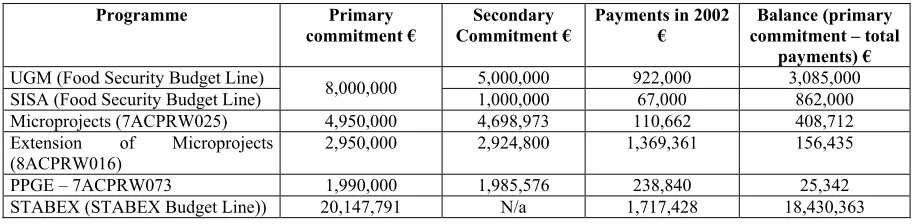
[image:18.595.63.524.179.291.2]In 2002, Rwanda began to use the €20 million set aside for STABEX activities. This was largely related to preparation activities (including the identification of TA), as the main programmes under STABEX are expected to start in 2003. These programmes will include infrastructure for coffee, tea and pyrethrum (washing stations, roads, electrification) and support to agricultural diversification.
Table 5 – Agriculture and Rural Development Financial Summary
Programme Primary commitment €
Secondary Commitment €
Payments in 2002 €
Balance (primary commitment – total
payments) € UGM (Food Security Budget Line) 5,000,000 922,000 3,085,000
SISA (Food Security Budget Line) 8,000,000 1,000,000 67,000 862,000
Microprojects (7ACPRW025) 4,950,000 4,698,973 110,662 408,712
Extension of Microprojects
(8ACPRW016) 2,950,000 2,924,800 1,369,361 156,435
PPGE – 7ACPRW073 1,990,000 1,985,576 238,840 25,342
STABEX (STABEX Budget Line)) 20,147,791 N/a 1,717,428 18,430,363
4.2.4 Macroeconomic Support
Budget support continued to be implemented in 2002 through the second Structural Adjustment Programme (SAP II)7. This programme is focussed on the health, education and justice sectors, through policy conditionality and quasi-targeted support8. Results in these sectors are outlined in the respective sections below. In terms of macroeconomic support, SAP II enabled Rwanda to keep on track with the implementation of the Poverty Reduction and Growth Facility (PRGF) programme with the IMF (see section 3.3) and to maintain macroeconomic stability. Finally, public financial management continued to improve (see section 3.3.1), partly as a result of EC support.
Table 6 – Budgetary Support Financial Summary
Programme Primary
commitment (€) Commitment (€) Secondary Payments in 2002 (€) commitment – total Balance (primary payments) (€)
SAP I 24,576,757 24,576,757 24,755 0
SAP II 59,620,000 59,439,295 26,072,007 10,048,116
Of which : Budget Support 58,420,000 58,420,000 25,900,000 9,150,000 TA etc. 1,200,000 1,019,295 172,007 898,116
Three main disbursements of budgetary support were made in 2002 (summarised in table 7): €3.17 million in July (CBI tranche linked to trade liberalisation), €8 million in August (Justice sector tranche linked to the Gacaca process), and €16.35 million in December (variable tranche linked to performance in macro-economics, public financial management, health and education). However, disbursement of the tranches was 6-12 months later than anticipated and in the latter case, the transfer of funds into Government’s spending account did not occur until early January, 2003. As a result, Government’s budget implementation was undermined by unpredictable cashflow and a number of its mid-year PRGF benchmarks (both fiscal and monetary) were missed. Further, Government accumulated arrears at the end of the year in anticipation of disbursement, thereby missing the benchmark on accumulation of new arrears.
7 SAP I was completed in 2002, with the last payment for the Justice Public Expenditure Review, which was
completed in 2001.
8 SAP II resources must be spent only on eligible budget lines, mainly under health, education and justice. Thus,
[image:18.595.68.529.468.546.2]These delays and their negative impact were the result of design flaws in SAP II, notably the lack of clarity and excessive number of conditions for disbursement9, and capacity shortages in Government and the Delegation. It is anticipated that these problems will be reduced in 2003 as a result of better design of the new programme of budgetary support, technical assistance to MINECOFIN (see below) and improvements in the staffing of the Delegation.
SAF II also involves significant technical assistance and capacity building components. In 2002, a medium term contract (totalling €961,000) was signed for technical assistance to the Ministry of Finance and Economic Planning (MINECOFIN). Implementation in 2002 consisted of two technical assistants (supporting the macroeconomics and budget departments of MINECOFIN) and capacity building measures (supporting MINECOFIN’s capacity building plan). This support has resulted in improved internal macroeconomic analysis and more effective negotiations with key budget support donors (notably the IMF).
Limited progress was also made in 2002 in preparing the next programme of budgetary support under the 9th EDF. As a result of staffing problems at the Delegation, this programme is not expected to start until end-2003, rather than mid-2003 as originally intended. In order to ensure adequate support to the 2003 Budget and to improve Rwanda’s debt sustainability, an additional tranche will be added to SAP II. By helping to reduce debt and encouraging the PRS Progress Review process (the completion of the first PRS-PR will be the condition for the tranche), the additional tranche will ensure that the conditions for budget support are further enhanced for the new programme. Furthermore, the new programme (Programme Pluri-annuel d’appui à la réduction de la pauvreté - PPARP) will be designed to improve predictability by streamlining conditionality, aligning support to the national PRS and budget cycles, enhancing coordination with other budgetary support donors and fixing tranche timing at the beginning of the year. The new programme will also have increased focus on variable tranches and the development of reliable indicators and targets. However, the size of the new programme has caused concern as the availability of resources (€50 million over 3 years) is significantly below the €25 million per year received in the recent past, at a time when Rwanda’s poverty reduction expenditure needs have been clearly defined in the PRSP, and when transitional expenditure is peaking. It has therefore been suggested that ways are found to increase resources allocated to budget support by accessing funds in Envelope B of the NIP.
4.2.5 Gouvernance, Justice, Legally Constituted State
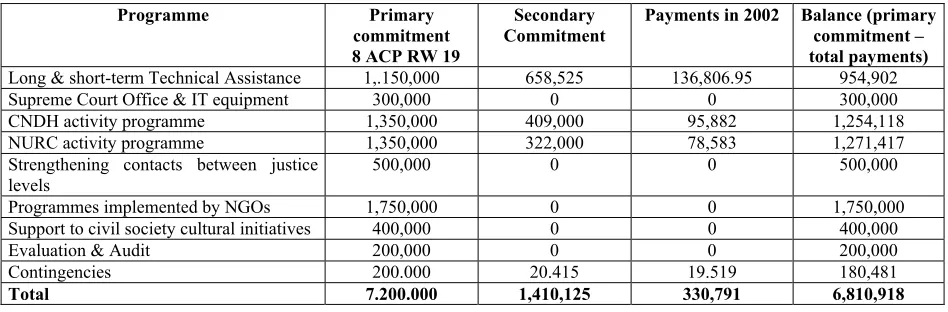
The "Support for the Rule of Law, National Reconciliation and Human Rights” project was launched in 2001, and the implementation of the first activities started in 2002. The project is divided into various components (see Table 7). As regards the management of the project, a Project Management Unit was created, and €202,374 was used for the operation of the PMU (including wages, TA and training) and support for MINIJUST and the National Human Rights Commission (CNDH) (including training and TA).
As regards to the National Human Rights Commission, a work programme was signed which covers the period from 15 September 2002 to 14 September 2003. The programme has as objectives the strengthening of the logistical capacity and the equipment of the provincial offices of the CNDH, the strengthening of the organisational capacity of the agents of the CNDH; and the communication of the results of the monitoring carried out by the CNDH. The support of the European Commission allowed the launching of the activities of the CNDH and their monitoring of "gacaca".
A work programme for the National Unity and Reconciliation Commission (NURC) was signed in 2002. Several problems were encountered in the implementation of the programme, in particular low capacity within the NURC. Nevertheless the support of the European Commission enabled the NURC to work for national reconciliation, thus opening the possibility of a transition towards democratic institutions, and allowed the preparation of the Gacaca jurisdictions aiming to consider the crimes perpetrated during the genocide.
Table 7 : « Support to the Legally Constituted State Project
Programme Primary
commitment 8 ACP RW 19
Secondary Commitment
Payments in 2002 Balance (primary commitment – total payments) Long & short-term Technical Assistance 1,.150,000 658,525 136,806.95 954,902 Supreme Court Office & IT equipment 300,000 0 0 300,000
CNDH activity programme 1,350,000 409,000 95,882 1,254,118
NURC activity programme 1,350,000 322,000 78,583 1,271,417
Strengthening contacts between justice levels
500,000 0 0 500,000
Programmes implemented by NGOs 1,750,000 0 0 1,750,000
Support to civil society cultural initiatives 400,000 0 0 400,000
Evaluation & Audit 200,000 0 0 200,000
Contingencies 200.000 20.415 19.519 180,481
Total 7.200.000 1,410,125 330,791 6,810,918
The "Support to the 3rd general census of population and habitat” project covers the period from mid-2001 to mid-2005. Preparatory activities consisting mainly of purchases of equipment (computer system and vehicles) and installation of the buildings of the National Census Service (SNR) were financed through bilateral funds from the UK and Netherlands. The financial contribution of the state in the process is estimated at €1m.
Table 8 – 3rd General Census of Population and Habitat
Programme Primary
com-mitment 8ACP RW 018
Secondary Commit-ment
Payments in 2002 Balance (primary commitment – total
payments)
Technical Assistance 2.200.000 1.023.264 425.225 1.774.775
Operating costs, personnel
loca-tion, supplies, training 4.210.000 4.067.655 3.076.207 808.435
Evaluation 120.000 0 0 120.000
Audit 90.000 0 0 90.000
Contingencies 380.000 0 0 380.000
Total (end 2002) : 7,000,000 5.090.929 3.501.433 3.173.210
In addition to public awareness campaigns, training of the enumerators (> 13.000 agents) pro-ceeded as planned and the general census took place from 16 to 30 August 2002. Post census surveys were carried out at the end of September 2002 to verify the results of the census. Data entry and analysis started in November 2002 and will continue to October 2003. The resulting databases will be used to give demographic information and to carry out analyses on various topics of a socio-economic nature.
[image:20.595.68.531.458.578.2]4.2.6 Social, Education, Health
In terms of infrastructure relating to the social sectors, the reader is referred to section 4.2. concerning the two rehabilitation programmes each containing components relating to health and education infrastructure. 8th EDF budgetary support (see 4.2.4) was also targeted at the health, education and justice sectors. In addition, a supporting institutional programme in MINISANTE and certain districts was prepared in 2002. The implementation of this programme will start in 2002 in coordination with Belgian cooperation.
As regards decentralised actions, various projects (Priority Job Creation; social infrastructure; microprojects) have been used to develop participatory approaches to addressing the needs of the most disadvantaged, both in rural and urban environments, through temporary employment, training and a framework enabling these people to be better prepared at the end of the project to fend for themselves (Also to refer to item 4.2.3). The merging of these various projects is planned for 2003 to give better consistency and more impact for the recipients.
4.3 EVALUATION OF IMPACT IN 2002
Co-operation between the Government and the EC is broad and exceeds a simple analysis of financial figures. The quality and high-level of bilateral relations has enabled certain advances in the fields of governance, rule of law, decentralisation, and the formulation of the PRSP. The preparation of the PRSP and of the programme to be supported under Cotonou went forward in parallel during 2002, and there is a solid complementarity between the two. Work was also ini-tiated in the framework of the SPA in order to reduce as far as possible the transactional costs associated with budget support by aligning budget support programmes with national PRS and budget cycles.
5.
PROGRAMMING PERSPECTIVE FOR THE FUTURE
5.1EDF9NATIONAL INDICATIVE PROGRAMME
The EU-Rwanda cooperation strategy and national indicative programme for 2003-7 was prepared in 2002, and signed in March 2003. The implementation of this strategy will be financed by a number of means, including:
9th EDF – Envelope A (€124m) will cover development activities foreseen in the strategic framework: €62m for rural development as the sector of concentration, €50m for macroeconomic support, and €12m for other programmes including good governance, support to the private sector and civil society, regional integration and demobilisation.
9th EDF – Envelope B (€62m) will be available for additional support in case of natural disasters, additional debt relief and loss of export earnings.
The Rwandan authorities have been disappointed by the levels of support offered under
Cotonou, feeling that they have been penalised for the genocide of 1994 and the subsequent emphasis on expenditure of emergency rather than programme funds. Thus at the very time they have particular needs they find that the funds available for commitment are lower than they expected. This attitude puts a particular colour on discussion of Part B of the programme in that Rwanda does not qualify for Envelope B funding by existing EC criteria, despite its ur-gent need for increased resources, particularly through macroeconomic support or through other priority activity in the rural economy.
In view of the progress made in 2002 in terms of preparation for a solid PRSP to be imple-mented and the need for there to be corresponding support from the present programme, one result of the present annual operational review might be to make available for immediate pro-gramming a significant proportion of the sums currently frozen as Part B allocations.
Investment facility: This instrument is the principal source of long-term financing of the Cotonou Agreement. It is directed towards the promotion of the private sector and towards the development of economic infrastructure. The interventions of the EIB will be able to be done in the form of loans, in the form of acquisition of a holding or by the provision of guarantees.
Commission budget lines: These can be used for specific actions according to the procedures applicable to each budget line concerned and subject to availability of resources.
5.1.1 Concentration Sectors :
Rural development: 62 M€
The improvement of the economic, institutional and social environment as well as diversification and increases in monetary incomes in rural areas, constitute the specific objectives of the Government's programme. The idea is to pass gradually from a subsistence system to agriculture directed towards the internal and external market and to generate dynamics of diversification of economic activities in rural areas. To achieve these goals, it is necessary to contribute to the opening-up of rural, urban and peri-urban areas to trade without neglecting health and hygiene issues.
information system, and opening-up of the rural road network and extension of drinking water schemes.
The focus will be on decentralised mechanisms of financing, particularly through the financing of Ubudehe as it is an instrument particularly adapted to the participation and planning from the bottom-up. Concerning the road network, it is also envisaged to finance the rehabilitation of the Gisenyi-Ruhengeri road as this has particular importance for the rural economy.
Within this framework the Delegation and the Government have agreed to draft a “Rural Economy Strategy” which will provide a framework for donor support. The operational mechanism for the preparation of this strategy is in the process of being established.
Macroeconomic support: 50 M€
This support will take the form of support to the Government’s economic reform programme, whose objective is the reduction of poverty and the promotion of national reconciliation. The specific objectives are: equitable access and improvements in the quality of basic social services; and the consolidation of progress in public financial management.
5.1.2 Non-focal programmes : 12 M€
An amount of 12 M€ is reserved for the following actions: • Strengthening Government’s capacities;
• Support to regional integration efforts and integration of Rwanda into the world economy, including preparations for negotiations within COMESA and the WTO, and for the EPA;
• Support for civil society;
Contribution to demobilisation and reintegration of ex-combatants.
5.2CONSISTENCY WITH OTHER EC POLICIES AND INSTRUMENTS
5.2.1 European Investment Bank
The EIB is ready to study options for new operations in Rwanda using the resources available under the Cotonou Investment Facility. Efforts will be taken to ensure that this is in line with the spirit of the indicative programme, and that the Government continues its economic and financial reforms. The EIB’s actions would largely be focussed on the promotion of the private sector, recognised as a priority in the PRSP and the 9th EDF NIP signed in March 2003. The EIB’s activities can also relate to the development of economic infrastructure, the local finan-cial sector and community assistance. In terms of direct support to Small and Medium scale enterprises, the EIB will take measures to extend the activities undertaken through the last global loan made available to three Rwandan banks.
5.2.2 Regional Co-operation Planning
Rwanda has decided that it is under COMESA that EU regional cooperation with Rwanda should be coordinated. The programming process is well advanced with the signature of a re-gional programme in November 2002. Since Rwanda depends to a large extent on tax revenues on imports, the immediate impact of joining COMESA is negative for public revenue. It is hoped that the economic activity induced by access to regional markets will eventually more than offset this loss.
5.2.3 FLEX/STABEX
in particular as regards export products such as coffee and tea. A reorientation towards in-creased quality instead of quantity will be ensured through a revision of the current mutual Framework of Obligations.
5.2.4 Community Budget Lines
The future indicative programme is harmonised with most used EC budget lines in Rwanda: food security, support of human rights, and cofinancing with NGOs. There is currently no risk of contradiction between approaches.
5.3CONSISTENCY WITH OTHER DONORS
The European Commission has played an active role in the alignment of donor support for Rwanda. Within the European Union, there has been an increasing harmonisation of approach, from general issues such as forming a common view on the PRSP, to more specific issues such as seeking to align the salaries paid to project staff.
Amongst budget supporting donors, the Commission has led the Strategic Partnership for Africa engagement with Rwanda. Much work remains to be done for donors including Bretton Woods institutions to align their approach behind the national budget cycle and the PRSP. Nonetheless, there was significant progress in 2002, with a multi-donor SPA mission to examine these issues, and increasing cooperation between the Commission and other donors so that there be common adoption of indicators, and a common approach to public expenditure management concerns.
The government, following the last donor conference in 2002, identified a certain number of clusters matching the issues covered by the PRSP. The European Commission was invited to take a lead with respect to two of them, in both cases in collaboration with the World Bank. In the case of the rural economy, this commitment has taken us far. The Commission is supporting the development of a rural economy strategy to fill out the PRSP which is relatively light in this critical field. Activity in the field of infrastructure has accelerated, but there has been less progress in developing common strategy, though we may signal the adoption by the government, following EC support, of a roads maintenance strategy which is to be the basis of a broader transport strategy, still under discussion.
6.
OPERATIONAL REVIEW 2003
6.1ACCELERATION OF USE OF PAST EDFBALANCES
The Commission has attached particular importance to the clear out of non performing activities so that there is a truly dynamic programme where decisions are followed in quick order by secondary commitments and expenditure. In order to review the situation, meetings have been organised, and Rwanda took part in that for Central Africa in Libreville in February 2003.
The insufficience of staff in the Commssion delegation was identified as having been the greatest constraint in 2002, while the efficiency of NAO services has also been seen as a bottleneck. The time of response of AIDCO to certain requests for action had also a braking effect on the programme, particular in infrastructure where delays at one point provoked particular criticism.
Nonetheless, with respect to the reduction of nonperforming outstanding commitments, performance has been very solid. With the exception of some old and recalcitrant commitments which predate the genocide, all contracts and projects which should be closed have so been. Only 6% of outstanding credits (RAL) were found to be non-performing, and most of this amount should be cleared in 2003.
Naturally the rehabilitation programmes, by their very nature, provide for a longer period for implementation than is customary with projects. Here too, the exercise of mopping up of uncommitted funds and of funds made available for recommitment by recent closures, has advanced well.
The flexibility and speed of the rehabilitation programmes has contributed very positively to cooperation in Rwanda – the range of activities supported greatly exceeds that which would have been possible had ordinary project primary commitments been relied on.
It was not necessary in 2002 to look beyond the programmes for the effective use of funds within the programmes : in 2003, there will of course be the possibility to transfer remaining funds to 9th EDF programmes should that appear to be their most effective and rapid use. of funds.
Rehabilitation programmes have a particular and positive role to play in countries recovering from conflict. The Rwanda experience is a success story, for a project approach could not have offered the flexibility necessary to delegation and administration to respond to the wide variety of needs which have been met through the rehabilitation programmes.
6.2DEFINITION OF INDICATORS
The measurement of results, based on impact and outcome indicators, is increasingly important in the EC’s approach to development aid. At the same time, the Government of Rwanda is establishing a poverty monitoring system and is increasingly linking policy-making to results. As a result, the EC is increasingly involved in supporting the Government’s monitoring system and is committed to working within that emerging system.
However, it should be recognised that the choice and quality of indicators will continue to improve as capacity to select indicators and set rational targets is increased. The indicators outlined in this document are therefore likely to change in future years.
6.2.1 Government PRSP Monitoring System
Since the finalisation of the Rwandan PRSP, excellent progress has been made in establishing a coherent poverty monitoring system under the strong leadership of MINECOFIN. In particular, the concept of results-based policy making and budgeting is gradually becoming entrenched. Further, a programme of regular surveys and studies together with capacity building measures for the monitoring system (the Poverty Monitoring and Information Plan – PMIP) will be developed in 2003. This will include the creation of a modern and independent Bureau of Statistics.
However, progress on establishing the monitoring system is constrained by Government’s general lack of capacity. In order to respond to this capacity constraint, the EC will set aside funds for capacity building for monitoring outcomes in key sectors (public financial management, health, education, agriculture and rural development, transport) through programmes to be designed in 2003 (particularly budgetary support and the rural economy strategy). Secondly, the EC will continue to work through Government monitoring systems rather than creating parallel systems. Thirdly, the EC recognises the dynamism of the process, and Government will continue to refine indicators, develop rational target setting, and improve data collection and analysis.
6.2.2 Long Term Impact Indicators
The Intervention Framework includes 6 long term impact indicators. These are all consistent with the PRSP and the Millenium Development Goals and will be updated through Government’s monitoring system. However, they are only measurable every 5-10 years (with the exception of the economic growth rate), with the next data for most indicators (poverty headcount, maternal mortality, infant mortality) expected to be available after 2006.
6.2.3 Rural Development Indicators
The Intervention Framework contains a number of rural development indicators, covering issues of the recapitalisation of the rural economy, decentralisation, rural transport and water and sanitation. Updated data for some of these indicators is available for 2002 and is shown in Annex 3. However, rural development indicators are not well defined and limited in scope (focussed on production statistics rather than policy outcome indicators). It is intended over the course of 2003 to develop better indicators agreed to by all stakeholders in the context of the preparation of the Rural Economy Strategy (RES). This will also require support to the institutions that collect and analyse the data needed for the chosen indicators.
6.2.4 Macroeconomic support
The performance of macroeconomic support is to be monitored through indicators for public financial management (PFM), health and education. The monitoring of indicators in these sectors is generally further advanced than in other sectors. A refined list of performance indicators for health and education was agreed in 2003 through the PRS Review process. A sub-set of this list will be used in the design of the 9th EDF budget support programme10, which will include variable tranches linked to performance. However, rational target setting in both the education and health sectors is not yet well developed. Progress will be made in 2003, for example through the setting of education sector targets linked to the Education Sector Strategic Plan (ESSP) and resource availability.