Int. J. Electrochem. Sci., 10 (2015) 8041 - 8057
International Journal of
ELECTROCHEMICAL
SCIENCE
www.electrochemsci.org
Design and Construction of New Potentiometric Sensors for
Determination of Copper(II) Ion Based on Copper Oxide
Nanoparticles
Tamer Awad Ali1,*, Gehad G. Mohamed2, Ahmed R. Othman2
1
Egyptian Petroleum Research Institute (EPRI), 11727, Cairo, Egypt.
2
Chemistry Department, Faculty of Science, Cairo University, 12613, Giza, Egypt.
*
E-mail: [email protected]
Received: 25 April 2015 / Accepted: 27 June 2015 / Published: 28 August 2015
New chemically modified carbon paste (CPEs) and screen-printed electrodes (SPEs) were fabricated incorborating copper oxide nanoparticles (CuO NPs) as a neutral ionophore and explored as Cu(II) selective electrodes. The electrodes were found to display Nernstian response over Cu(II) concentration of 5.3×10⁻⁷ to 1×10⁻² and 6.1×10⁻⁸ to 1×10⁻² mol L-1. The detection limits were found to be 5.3×10⁻⁷ and 6.1×10⁻⁸ mol L-1 for modified carbon paste (MCPEs; electrodes I and II) and screen-printed electrodes (MSPEs; electrodes III and IV), respectively. The MCPEs with dibutylphthalate (DBP) (electrode I) and tricresylphosphate (TCP) (electrode II) as plasticizers were found to have slope values of 29.65±0.30 and 28.99±0.60 mV decade-1, respectively. Also, the MSPEs with DBP (electrode III) and TCP (electrode IV) plasticizers showed Nernstian slopes of 30.01±0.20 and 29.35±0.40 mV decade-1
, respectively. The electrodes have fast response time (8, 10, 5 and 7s for electrodes I, II, III and IV, respectively) and good selectivity with respect to different interfering ions. The fabricated electrodes were satisfactory applied to determine Cu(II) ion in pure solutions and different real spiked water samples using the proposed potentiometric method. The results obtained applying MCPEs and MSPEs agree well with the inductively coupled plasma atomic emission spectrometry (ICP-AES).
Keywords: Copper determination; Copper oxide nanoparticles ionophore; Modified screen-printed electrodes; Modified carbon paste electrodes.
1. INTRODUCTION
permissible limit above which they are toxic [4,5] and even hazardous. Industrial wastes metal ions such as lead, zinc, nickel aluminium and copper are common because they are consumed in many industrial processes such as mine, metal finishing, electroplating, brewery, pharmaceuticals and batteries manufacture [6-8]. For industrial purposes, copper is classified as the third amount of quantities consumed after iron and aluminum. This can be attributed to resistance to corrosion, malleability, its high ductility and thermal conductivity. During the last years, the selective determination and monitoring of heavy metal ions had great importance worldwide due to growing health and environmental problems [9,10]. In comparison with other heavy metals, pollution caused by copper is a fundamental aspect, as it has widespread occurrence in environmental samples [11]. The increase in copper concentration in the environment can be attributed to its wide use in domestic, agricultural and industrial purposes [12,13]. Copper is an essential element present in biological function of organisms [14,15] where exposure to small quantities of it or its deficiency may be harmful to health development. However, excessive dosage and long-term exposure may cause imbalance in cellular processes. Copper accumulation results in Wilson’s disease, while its deficiency results in anemia [16,17]. Therefore, it is of great importance to monitor copper levels in industrial, biological, environmental and medical samples; hence, its determination in such samples is thus fundamental point.
Many methods are described for determination of Cu(II) at low concentration level. These methofs included atomic absorption spectrometry (AAS) [18-20], cold vapour AAS or flame atomic absorption spectrometry–electrothermal atomization (AAS-ETA) [21], inductively coupled plasma-optical emission spectroscopy (ICP-OES) [22-24], anodic stripping voltammetry [25-27], chromatography [28-30], gravimetric detection [31] or photometry [32,33] etc. Although, these methods provide accurate results but they have many drawbacks as they are not very convenient for analysis of environmental samples as they require sample pre-treatment and sufficient infrastructure backup.
Over the past two decades, there is rapid development in potentiometry due to the development in fabrication of new ion-selective electrodes [34-40]. Many scientists showed an interest in the synthesis of molecular carriers which provided the following properties of possessing lipophilic character, electrical neutrality, capability to selectively and reversibly bind metal ions and allow their permeation through the membrane electrodes over the other ions [41]. Copper is found to have a great importance in industry [2,3] and in many biological systems [42,43], and hence an urgent need for monitoring of Cu(II) in different industrial, medicinal and environmental samples enforced many scientists for constructing a copper-selective sensor for its potentiometric determination. Variety of potential ion-carriers have been utilized in the fabrication of low-cost, very sensitive and simple, copper(II)-selective membrane electrodes for rapid detection of copper.
ion over many interfering ions. The fabricated modified electrodes are successfully applied for the determination of copper(II) in real spiked water samples.
2. EXPERIMENTAL
2.1. Apparatus
Potential measurements were carried out using a Jenway 3505 pH-meter. Double-junction Calomel electrode was used as reference electrode. pH measurements were performed using a Thermo Orion, model Orion 3 stars, USA. All glasswares used in this study were washed carefully prior to analysis and left to dry in the oven before their use.
2.2. Reagents
Reagents used in this study were of analytical grade trade. Bidistilled water was used for solutions preparation. Copper(II) nitrate [Cu(NO3)2.3H2O], sodium tetraphenylborate (NaTPB),
dioctylsebacate (DOS), dibutylphthalate (DBP), dioctylphthalate (DOP), o-nitrophenyloctylether (o-NPOE) and tricresylphosphate (TCP) were supplied from Merck, Fluka, Merck, Merck, Sigma, Fluka and Alfa-Aesar, respectively. CuO nanoparticles (CuO NPs) were prepared according to the previously published method [44]. Graphite powder (synthetic 1–2 μm, used for the fabrication of different electrodes) was purchased from Aldrich. Ethanol, ethylene glycol, hydrochloric acid and sodium hydroxide were supplied from Merck, Sigma, BDH and BDH, respectively. Chloride salts of zinc, manganese, cadmium, magnesium, aluminium, potassium, barium, lead, iron, lithium, sodium and strontium in addition to silver nitrate were tested as interfering cations to check the selectivity of the fabricated electrodes. Also, bromide, iodide and chloride anions are used as interfering ions.
2.2.1. Samples
Water samples used in this study included formation water (Gemsa Petroleum Company (sample1) and Amry deep (9) Western Desert, Agiba Petroleum Company (sample2), Egypt), tap water (sample 3), river water (sample 4, Cairo, Egypt) and sea water (Alexandria in Mediterranean Sea area, (sample 5) and red sea (sample 6), Egypt).
2.3. Procedures
2.3 1. Preparation of modified carbon paste electrodes (MCPEs)
paste is filled in electrode body and kept in distillated water for 24 h before use [45-47]. To get a fresh shiny new surface, the stainless-steel screw was gently pushed forward and the new carbon-paste surface was polished with filter paper.
2.3.2. Preparation of the modified screen-printed electrodes (MSPEs)
MSPEs were prepared as previously described by the authors [45,48-52] using a manual screen printer. An array of 12 electrodes was printed by forcing the prepared conductive ink on flexible X-ray film to penetrate through the mesh of a screen stencil and the process of printing was completed as previously described by the authors [45,48-52]. The homemade printing ink was prepared by thoroughly mixing the cyclohexanone-acetone mixture 1:1, as a solvent for the binding material with 1.25 mg polyvinyl chloride, 0.75 mg of the carbon powder and 450 mg of TCP. Then, 5-12.5 mg of [CuO NPs] ionophore was added to the previous mixture with stirring for 15 min. The ink was sonicated and applied for printing of the modified CPEs and SPEs electrodes. The influence of the plasticizer type on the electrode performances has been studied using TCP, DOS, DOP, DBP and o-NPOE. The MSPEs were stored in a dry state at room temperature.
2.3.3. Equilibration of electrode and potential measurements
The fabricated modified carbon paste and screen printed electrodes were conditioned by soaking in 10-3 mol L-1 Cu(II) solution for 10 min before their use. The electrode potential has been measured at room temperature by varying the concentration of Cu(II) ion from 1.0 × 10⁻⁸ to 1.0 × 10⁻² mol L-1 in test solution while stirring at a constant rate. The potential was recorded after stabilization to ±0.1 mV. The calibration graphs were constructed by plotting the recorded potential as a function of -log [Cu(II)]. The resulting graphs were used for subsequent determination of the concentration of unknown copper ions in different water samples.
2.3.4. Preparation of water samples
Analysis of water samples, taken from different locations as given in the experimental part, for determination of Cu(II) content was carried out. Water samples were filtered and Cu(II) content was determined with the proposed modified carbon paste and screen printed electrodes using the direct calibration method.
2.4. Synthesis of CuO nanoparticles
The sol–gel method was described for the synthesis of CuO nanoparticles [44]. A precursor solution was prepared using ethanol (>99.9%) and deionized (DI) water as solvents (1:1). Then, copper nitrate [Cu(NO3)2⋅3H2O] was added followed by citric acid and ethylene glycol as polymerization and
homogeneous mixture was maintained under reflux at 100–110 ºC for 4 h. After vaporizing the excess solvents, a wet gel was attained. Finally, the black powder was calcined at 600 ºC for 1 h and then milled [44].
3. RESULTS AND DISCUSSION
3.1. Composition and characteristics of the electrodes
The selectivity, linearity and sensitivity of a given ionophore significantly depend on nature of plasticizer, the paste composition and additives used [41–52]. In order to achieve this task, four modified CPE and SPE were fabricated containing 5, 7.5, 10 and 12.5 mg CuO NPs ionophore, while the other constituents have been remained unchanged. The potential of the modified CPEs and SPEs prepared using different paste of the ionophore as a function of copper ion free concentration was measured and the potential response plots are shown in Fig. 1. The potentiometric calibration was carried out for each electrode and the resulting Nernstian slopes were found to be 23.60±0.50, 23.77±0.90, 29.65±0.30 and 27.70±1.00 mV decade-1
Figure 1. Effect of ionophore contents on the performance of (a) MCPEs (b) MSPEs sensors.
The detection limits were determined conventionally from the intersection of the two extrapolated segments of the calibration graph. The MCPEs and MSPEs sensors were found to have detection limit of 5.3 ×10⁻⁷ and 6.0 ×10⁻⁸ mol L-1 of Cu(II) activity, respectively. This value gives the advantages of these modified electrodes fabricated in this study over than the other Cu(II) ion selective electrodes reported previously.
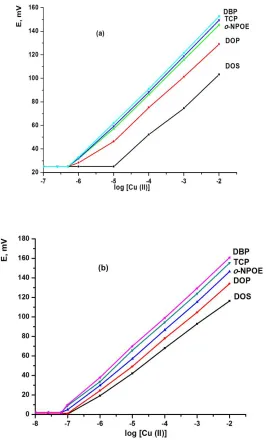
3.2. Effect of plasticizer
[image:6.596.160.430.94.297.2]
and TCP plasticizers, respectively) and two MSPEs (electrodes III and IV using DBP and TCP plasticizers, respectively).
3.3. Response time
The practical response time of the MCPEs and MSPEs electrodes were studied by changing the Cu(II) concentration over the range from 1.0×10⁻⁷ to 1.0×10⁻² mol L-1. Figure (3) showed the measured potential readings versus time traces. As can be seen, over the entire concentration range the paste electrodes reach their equilibrium responses in a very short time. It is clear from the data given in Fig. 3 that, the response time is found to be 8, 10, 5 and 7 s for modified electrodes I, II, III and IV, respectively. This can accounted probably to the fast exchange kinetics of adsorption–desorption of Cu(II) ions with the ionophore at the test solution–paste interface.
[image:7.596.164.430.298.738.2]
Figure 3. Dynamic response time of Cu(II) ion sensors of MCPEs [(a) electrode (I) and (b) electrode (II)] and MSPEs [(c) electrode (III) and (d) electrode (IV)]
3.4. Effect of pH
[image:9.596.166.412.85.272.2][image:10.596.162.415.78.709.2]
3.5. Effect of temperature of the test solution
This study aims to determine the isothermal coefficient (dE/dt) of the modified carbon paste and screen printed electrodes. Calibration graphs (electrode potential (Eelec) versus p[Cu(II)]) were
constructed at different temperatures (20-60 C) from which the standard electrode potentials (E) were obtained as the intercepts at p[Cu(II)] = 0 and plotted versus (t−25), where t was the temperature of the test solution in C (Fig. 5). Straight-line plot is obtained according to Antropov’s equation [2, 3, 36, 54]:
E = E (25) + (dE/dt)(t-25)
Figure 5. Effect of temperature on the performance of MCPEs [(a) electrode (I) and (b) electrode (II)] and MSPEs [(c) electrode (III) and (d) electrode (IV)].
3.6. Potentiometric selectivity
The potentiometric selectivity coefficients, KpotA,B is the most important characteristic
parameter of any ion-selective electrode which measures its relative response for the primary ion in the presence of other ions present in the solution. The selectivity coefficients were determined by applying matched potential method (MPM) [24, 55]. Accordingly, the change in potential was measured when the activity of the primary ion aA increases to aʹA, When the interfering ion of activity aB is added to the
primary ion solution of activity aA and the same change in potential occurs [30], KpotA,B is then
[image:12.596.177.434.88.556.2]
KA, Bpot =
aA a B = a'A aB aA
-The values of aA and aʹA for Cu(II) were taken as 1.0 × 10⁻³ and 5.0 × 10⁻³ mol L-1 at pH 4.0.
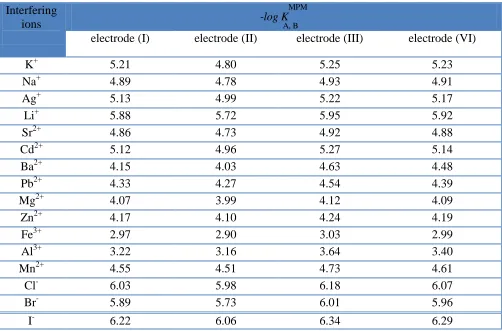
The selectivity coefficients values calculated using the proposed Cu(II) ion-selective electrodes (I-IV) are listed in Table 1. The selectivity coefficient pattern clearly indicates that the electrodes (I-IV) showed moderate selective for Cu(II) ion over the other interfering cations.
Table 1. Selectivity coefficients of various ions using MCPEs (electrodes I and II) and MSPEs (electrodes III and VI).
Interfering
ions -log K
MPM
A, B
electrode (I) electrode (II) electrode (III) electrode (VI)
K+ 5.21 4.80 5.25 5.23
Na+ 4.89 4.78 4.93 4.91
Ag+ 5.13 4.99 5.22 5.17
Li+ 5.88 5.72 5.95 5.92
Sr2+ 4.86 4.73 4.92 4.88
Cd2+ 5.12 4.96 5.27 5.14
Ba2+ 4.15 4.03 4.63 4.48
Pb2+ 4.33 4.27 4.54 4.39
Mg2+ 4.07 3.99 4.12 4.09
Zn2+ 4.17 4.10 4.24 4.19
Fe3+ 2.97 2.90 3.03 2.99
Al3+ 3.22 3.16 3.64 3.40
Mn2+ 4.55 4.51 4.73 4.61
Cl- 6.03 5.98 6.18 6.07
Br- 5.89 5.73 6.01 5.96
I- 6.22 6.06 6.34 6.29
3.7. Analytical applications
[image:13.596.49.551.243.574.2][image:14.596.22.575.258.471.2]
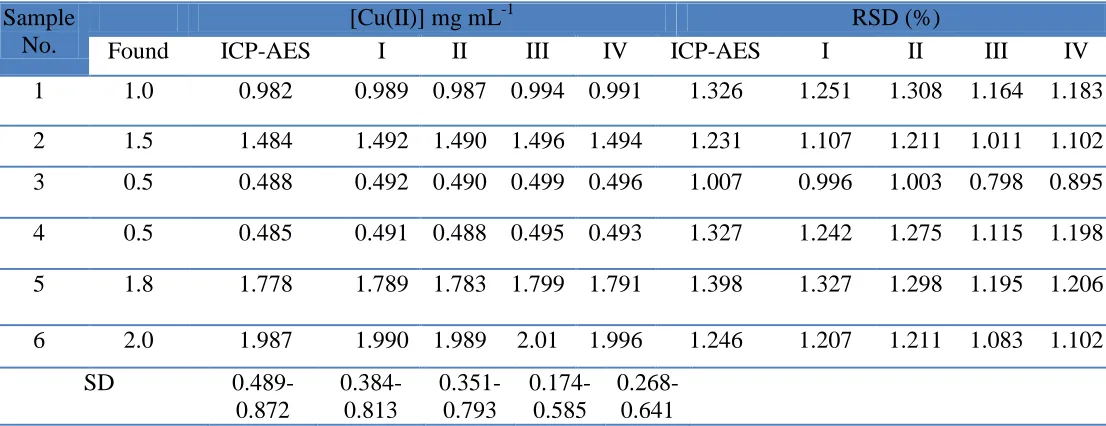
AES) method [55]. The data given in Table 2 clearly indicated satisfactory agreement between the Cu(II) ion contents in different real water samples determined by the proposed potentiometric electrodes (I, II, III and IV) and the ICP-AES recommended method. The values of standard deviation and relative standard deviation are low if compared with the ICP-AES method reflected the high accuracy and precision of the proposed potentiometric method. Also, the portable system proposed in the present study can be used for sample field analysis of Cu(II) ion without the need for transferring to the laboratory.
Table 2. Potentiometric determination of Cu(II) in real spiked water samples using MCPEs (electrodes I and II) and MSPEs (electrodes III and IV).
Sample No.
[Cu(II)] mg mL-1 RSD (%)
Found ICP-AES I II III IV ICP-AES I II III IV
1 1.0 0.982 0.989 0.987 0.994 0.991 1.326 1.251 1.308 1.164 1.183 2 1.5 1.484 1.492 1.490 1.496 1.494 1.231 1.107 1.211 1.011 1.102 3 0.5 0.488 0.492 0.490 0.499 0.496 1.007 0.996 1.003 0.798 0.895 4 0.5 0.485 0.491 0.488 0.495 0.493 1.327 1.242 1.275 1.115 1.198 5 1.8 1.778 1.789 1.783 1.799 1.791 1.398 1.327 1.298 1.195 1.206 6 2.0 1.987 1.990 1.989 2.01 1.996 1.246 1.207 1.211 1.083 1.102
SD 0.489-
0.872 0.384- 0.813 0.351- 0.793 0.174- 0.585 0.268- 0.641
3.8. Comparison study
Data reported in Table 3 give comparison between several reported MCPE and Cu(II)-MSPE electrodes with those of the proposed modified electrodes (I-IV) with respect to pH, linear range, slope, detection limit and response time [2,3,38,40,53,56]. It is noteworthy that these parameters applying the proposed electrodes are considerably improved with respect to those of the previously reported Cu(II)-selective electrodes (Table 3).
Table 3. Comparative study between the Cu(II)-MCPEs (I and II) and Cu(II)-MSPEs (III and VI) characteristics with some of the previously reported Cu(II)-ISEs.
References Slope
(mV decade-1)
Response time (s)
pH Life time (months)
Linear range (mol L-1)
DL (mol L-1)
Proposed electrode (I)
29.65 8 2.0 – 9.0 3 5.3 × 10⁻⁷ – 1 × 10⁻² 5.3 × 10⁻⁷ Proposed electrode
(II)
[image:14.596.15.580.668.771.2]
Proposed electrode (III)
30.01 5 2.0 – 9.0 6 6.1 × 10⁻⁸ – 1.0 × 10⁻² 6.1 × 10⁻⁸ Proposed electrode
(VI)
29.35 7 3.0 - 8.0 5 6.1 × 10⁻⁸ – 1.0 × 10⁻² 6.1 × 10⁻⁸
[2] 29.94 6 3.0 – 8 4 1 × 10⁻⁷ – 1 × 10⁻² 1 × 10⁻⁷
[3] 29.45 8 3.8 – 5 3 1 × 10− 6 - 1.0 × 10⁻² 1 × 10⁻⁶
[38] 29.34 <10 2 – 5 1 6.0 × 10⁻⁸ – 1.0 × 10⁻¹ 4.0 × 10⁻⁸
[40] 29.4 8 2.8 - 7.9 4 6.3 × 10⁻⁶ - 1.0 × 10⁻¹ 6.3 × 10⁻⁶
[53] 25.9 <15 4.5 - 7 < 1 3.1 × 10⁻⁶ – 1.0 × 10⁻² 2.1 × 10 -6
[56] 26.2 2–18 - - 1.0 × 10⁻⁵ – 1.0 × 10⁻² 2.5 × 10⁻⁶
4. CONCLUSIONS
Determination of Cu(II) ion is important task as the result of its pollution effect. Therefore, this study describes a simple potentiometric method for the determination of Cu(II) ion. The electrodes (I-IV) have good selectivity, good Nernstian behavior over wide concentration range and fast response time. A wide linear range of concentration from 2.6×10⁻⁷ to 1.0×10⁻² and 1.4×10⁻⁷ to 1.0×10⁻² mol L-1, low detection limit of 2.6×10⁻⁷ and 1.4×10⁻⁷ mol L-1 and fast response time of 7 and 6s for electrodes (I, II, III and IV), respectively, were reported in this study. The electrodes were successfully applied for the potentiometric determination of Cu(II) ion in pure and in different real spiked water samples.
References
1. L. Järup, Brit. Med. J. 68 (2003) 167.
2. T.A. Ali, A.M. Eldidamony, G.G. Mohamed, D.M. Elatfy, Int. J. Electrochem. Sci. 9 (2014) 2420. 3. T.A. Ali, G.G. Mohamed, M.M.I. El-Dessouky, S.M. Abou El-Ella, R.T.F. Mohamed, J. Solution
Chem. 42 (2013) 1336.
4. K. Furukawa, A. Ramesh, Z. Zhou, Z. Weinberg, T. Vallery, W.C. Winkler, R.R. Breaker, Mol. cell 57 (2015) 1088.
5. N. Khan, K.Y. Ryu, J.Y. Choi, E.Y. Nho, G. Habte, H. Choi, M.H. Kim, K.S. Park, K.S. Kim, Food Chem. 169 (2015) 464.
6. M. Ahmaruzzaman, Adv. Colloid Interface Sci. 166 (2011) 36.
7. T.Y.M.A. El-Hariri, A.S. Mousa, T.F. Moustafa, S. Farouk, Egyptian J. Petrol. 21 (2012) 71. 8. M.M. El-Tokhi, Y.M. Mostafa, Petrol. Sci. Technol. 19 (2001) 481.
9. A.T. Vijayashakthivel, T.N. Srikantha Dath, B. Ravisankar, Appl. Mech. Mater., 2014, p. 410. 10.N.U. Amin, T. Ahmad, RSC Advances 5 (2015) 14322.
11.V. Kumar, A.K. Sinha, P.P. Rodrigues, V.K. Mubiana, R. Blust, G. De Boeck, Sci. Total Environ. 523 (2015) 1.
12.S.R. Smith, Environ. Int. 35 (2009) 142.
14.M. Cakic, Z. Mitic, G. Nikolic, I. Savic, I.M. Savic, Expert. Opin. Drug Discov. 8 (2013) 1253. 15.H. Fones, G.M. Preston, Fems Microbiol. Rev. 37 (2013) 495.
16.S.G. Boaru, U. Merle, R. Uerlings, A. Zimmermann, S. Weiskirchen, A. Matusch, W. Stremmel, R. Weiskirchen, BMC Neurosci. 15 (2014).
17.S.M. Lin, J.B. Liang, K.H. Chien, Y.H. Chen, J.T. Chen, D.W. Lu, C.T. Horng, Life Sci. J. 11 (2014) 256.
18.D.J. Halls, G.S. Fell, P.M. Dunbar, Clin. Chim. Acta 114 (1981) 21.
19.M.H. Mashhadizadeh, M. Pesteh, M. Talakesh, I. Sheikhshoaie, M.M. Ardakani, M.A. Karimi, Spectrochim. Acta B 63 (2008) 885.
20.H. Zhang, J. Zhu, Y. Wu, Y. Wu, Wei sheng yan jiu = Journal of hygiene research 27 (1998) 137. 21.N. Goudarzi, M. Arab Chamjangali, E. Vatankhahan, A.H. Amin, J. Anal. Chem. 69 (2014) 1061. 22.S. Webb, J. Bartos, R. Boles, E. Hasty, E. Thuotte, N.J. Thiex, J. AOAC Int. 97 (2014) 700. 23.M.S. Wheal, T.O. Fowles, L.T. Palmer, Anal. Methods 3 (2011) 2854.
24.T.A. Ali, G.G. Mohamed, Sens. Actuator B-Chem. 202 (2014) 699.
25.B.B. Prasad, R. Singh, D. Lakshmi, Int. J. Environ. Pollut. 27 (2006) 179. 26.T. Tanaka, M. Ishii, Bunseki Kagaku 50 (2001) 559.
27.T.A. Ali, G.G. Mohamed, A.H. Farag, Int. J. Electrochem. Sci 10 (2015) 564. 28.P.W. Alexander, P.R. Haddad, M. Trojanowicz, Chromatographia 20 (1985) 179.
29.P.J. Fordham, J. Chamot-Rooke, E. Giudice, J. Tortajada, J.P. Morizur, J. Mass Spectrom. 34 (1999) 1007.
30.T.A. Ali, A.L. Saber, G.G. Mohamed, T.M. Bawazeer, Int. J. Electrochem. Sci. 9 (2014) 4932. 31.R. Nie, X. Chang, Q. He, Z. Hu, Z. Li, J. Hazard. Mater. 169 (2009) 203.
32.E.S. Dipietro, M.M. Bashor, P.E. Stroud, B.J. Smarr, B.J. Burgess, W.E. Turner, J.W. Neese, Sci. Total Environ. 74 (1988) 249.
33.M. Salman, E.S.S. Abdel-Hameed, S.A. Bazaid, M.G. Al-Shamrani, Der Pharma Chemica 6 (2014) 149.
34.T.A. Ali, R.F. Aglan, G.G. Mohamed, M.A. Mourad, Int. J. Electrochem. Sci. 9 (2014) 1812. 35.M. Andac, F. Coldur, S. Bilir, A. Birinci, S. Demir, H. Uzun, Can. J. Chem. 92 (2014) 324. 36.T.A. Ali, E.M.S. Azzam, M.A. Hegazy, A.F.M. El-Farargy, A.A. Abd-elaal, J. Ind. Eng. Chem. 20
(2014) 3320.
37.T.A. Ali, A.M. Eldidamony, G.G. Mohamed, M.A. Abdel-Rahman, Int. J. Electrochem. Sci. 9 (2014) 4158.
38.M. Ghaedi, M. Montazerozohori, R. Sahraei, J. Ind. Eng. Chem. 19 (2013) 1356. 39.T.A. Ali, A.A. Farag, G.G. Mohamed, J. Ind. Eng. Chem. 20 (2014) 2394.
40.V.K. Gupta, A.K. Jain, G. Maheshwari, H. Lang, Z. Ishtaiwi, Sens. Actuator B-Chem. 117 (2006) 99.
41.T.A. Ali, G.G. Mohamed, J. AOAC Int. 98 (2015) 116.
42.T.A. Ali, M. Soliman, G.G. Mohamed, A. Farag, M.K. Samah, Int. J. Electrochem. Sci. 10 (2015) 3192.
43.Tamer Awad Ali, G.G. Mohamed, M. M. Omar, Veronia N. Abdrabou, Int. J. Electrochem. Sci. 10 (2015) 2439.
44.R. Etefagh, E. Azhir, N. Shahtahmasebi, Sci. Iran. 20 (2013) 1055.
45.G.G. Mohamed, M.F. El-Shahat, A.M. Al-Sabagh, M.A. Migahed, T.A. Ali, Analyst 136 (2011) 1488.
46.T.A. Ali, G.G. Mohamed, M.M.I. El-Dessouky, S.M. Abou El Ella, R.T.F. Mohamed, Int. J. Electrochem. Sci. 8 (2013) 1469.
47.E.Y.Z. Frag, T.A. Ali, G.G. Mohamed, Y.H.H. Awad, Int. J. Electrochem. Sci. 7 (2012) 4443. 48.E. Khaled, G.G. Mohamed, T. Awad, Sens. Actuator B-Chem. 135 (2008) 74.
50.G.G. Mohamed, T.A. Ali, M.F. El-Shahat, M.A. Migahed, A.M. Al-Sabagh, Drug Test. Anal. 4 (2012) 1009.
51.G.G. Mohamed, T.A. Ali, M.F. El-Shahat, A.M. Al-Sabagh, M.A. Migahed, E. Khaled, Anal. Chim. Acta 673 (2010) 79.
52.T.A. Ali, G.G. Mohamed, E.M.S. Azzam, A.A. Abd-Elaal, Sens. Actuator B-Chem. 191 (2014) 192. 53.S.S.M. Hassan, E.M. Elnemma, A.H.K. Mohamed, Talanta 66 (2005) 1034.
54.L. I. Antropov, Theoretical Electrochemistry, Mir Publisher, Moscow, 1977. 55.T.A. Ali, G.G. Mohamed, Sens. Actuator B-Chem. 216 (2015) 542.
56.M. Jesús Gismera, M. Antonia Mendiola, J. Rodriguez Procopio, M. Teresa Sevilla, Anal. Chim. Acta 385 (1999) 143.

![Figure 3. Dynamic response time of Cu(II) ion sensors of MCPEs [(a) electrode (I) and (b) electrode (II)] and MSPEs [(c) electrode (III) and (d) electrode (IV)]](https://thumb-us.123doks.com/thumbv2/123dok_us/1890973.146717/9.596.166.412.85.272/figure-dynamic-response-sensors-electrode-electrode-electrode-electrode.webp)
![Figure 4. Effect of pH on the performance characteristics of MCPEs [(a) electrode (I) and (b) electrode (II)] and MSPEs [(c) electrode (III) and (d) electrode (IV)]](https://thumb-us.123doks.com/thumbv2/123dok_us/1890973.146717/10.596.162.415.78.709/figure-effect-performance-characteristics-electrode-electrode-electrode-electrode.webp)
![Figure 5. Effect of temperature on the performance of MCPEs [(a) electrode (I) and (b) electrode (II)] and MSPEs [(c) electrode (III) and (d) electrode (IV)]](https://thumb-us.123doks.com/thumbv2/123dok_us/1890973.146717/12.596.177.434.88.556/figure-effect-temperature-performance-electrode-electrode-electrode-electrode.webp)