Int. J. Electrochem. Sci., 8 (2013) 12252 - 12263
International Journal of
ELECTROCHEMICAL
SCIENCE
www.electrochemsci.orgDFT Calculation for Elastic Constants of Tetragonal Structure
of Crystalline Solids with WIEN2k Code: A New Package
(
Tetra-elastic
)
A. H. Reshak1,2,* , Morteza Jamal3
1
Institute of Complex systems, FFPW, CENAKVA, University of South Bohemia in CB, Nove Hrady 37333, Czech Republic
2
Center of Excellence Geopolymer and Green Technology, School of Material Engineering, University Malaysia Perlis, 01007 Kangar, Perlis, Malaysia
3
Physics Group, Science Department, Islamic Azad University, Islamshahr Branch, P.O. Box 33135-369, Islamshahr, Tehran, Iran.
*
E-mail: [email protected]
Received: 20 July 2013 / Accepted: 14 August 2013 / Published: 25 September 2013
Tetra-elastic is a new package for calculating the elastic constants of tetragonal structure. It is compatible with the highly accurate all electron full potential linearized augmented plane wave plus local orbital [FP-(L)APW+lo] method as implemented in WIEN2k code. The package is released recently; the package and the user guide are available on (http://www.wien2k.at/reg_user/unsupported/). In this paper we provide detail description of the formalism of calculating the elastic constants of tetragonal structure. To testify the accuracy of the Tetra-elastic package several tetragonal structure compounds were used. The results show that the calculated elastic constants using Tetra-elastic exhibit better agreement with the available experimental data than the previous theoretical results used different methods. In this package the second-order derivative E
of polynomial fit E E
of energy vs strains at zero strain
0
is used to calculate the tetragonal elastic constants.Keywords: Elastic constants; Tetra-elastic; tetragonal structure: FPLAPW; DFT
1. INTRODUCTION
One of the most accurate theoretical techniques is the ab initio DFT technique [1,2] which allows the structure to be efficiently optimized [3] and hence to obtained the elastic properties. It is well known that the elastic properties provide valuable information about the binding characteristic between adjacent atomic planes. Anisotropic characters of binding and structural stability are usually defined by the elastic constants Cij. These constants have been often related to the shear modulus and Young’s modulus, which are frequently measured for polycrystalline materials when investigating their hardness. The elastic moduli require knowledge of the derivative of the energy as a function of the lattice strain [4].
Recent developments in the theoretical calculation of the elastic properties within one of the highly accurate all electron full potential linearized augmented plane wave plus local orbital package [5] is very attractive technique because many other mechanical properties such as bulk modulus, shear modulus, young’s modulus, etc, can be derived from elastic constants. We should emphasize that the elastic constants determine the response of the materials to the external forces, as typified by bulk modulus, Young’s modulus, shear modulus and Poission’s ratio which play crucial rule in determining the strength of the materials. The elastic properties define how a material that undergoes stress deforms and then recovers and returns to its original shape after stress ceases. The elastic constants of solids provide a link between the mechanical and dynamical behaviors of crystals and give important information concerning the nature of the forces operating in solids. These constants can be also predicting the structural stability of materials.
Based on our experiences in writing packages for calculating the elastic constants for different structures, namely cubic, hexagonal and orthorhombic [6-8]. In this work we have addressed ourselves to write a new package for calculating the elastic properties of the tetragonal structures by using second-order derivative within WIEN2k code. In order to testify our new Tetra-elastic package, several tetragonal structure compounds whose elastic constants are known experimentally and theoretically were used. We found that the Tetra-elastic give very accurate results which is in good agreement with the experimental data than the previous calculations.
2. THEORETICAL BACKGROUND
Theoretically the elastic constants are defined by means of a Taylor expansion of the total energy E
V, for the system, with respect to a small strain
of the lattice. If we consider the bravais lattice vectors of tetragonal crystal structure as a matrix form
R the distortion of the lattice
R is expressed by multiplying R with a symmetric xy yx distortion matrix i.e.
RRD
, which is written as,
2 / 1 2 / 2
/
2 / 1
2 /
2 / 2
/ 1
zz zy
zx
yz yy yx
xz xy
xx
D
And in Voiget notation (It is often convenient to change to the Voigt notation in order to reduce the number of indices. The Voigt notation replaces xx1, yy2, zz3, zy(and yz)4, xz(and
zx)5, xy(and yx)6
2 / 1 2 / 2 / 2 / 1 2 / 2 / 2 / 1 3 4 5 4 2 6 5 6 1 D
we express the energy of the strained system by means of a Taylor expansion in the distortion parameters,
6 1 6 1 3 6 1 0 0 2 1 0 , , i i j i j i i ii C O
V V
E V
E
The linear terms vanish if the strain causes no changes in the volume of the crystal. Otherwise,
i
are related to the strain on the crystal and Cij are elastic constants and V0 is the volume of unstrained tetragonal system and we use it to evaluate the elastic constants.
To obtain elastic constants of tetragonal structure we have used the method obtained in Ref [9]. In this method elastic constants were calculated by applying small strains to the unstrained lattice.
There are six independent elastic constants for a tetragonal symmetry, called C11, C12, C13, C33,
C44, and C66. Since we have six independent elastic constants, we need six different strains to
determine these elastic constants. The six distortions used in the Tetra-elastic Package are described below. The first three distortions are written as
1 0 0 0 1 0 0 0 1 1 D
2 2 1 1 0 0 0 1 0 0 0 1 D and 1 0 0 0 1 0 0 0 1 3 DThese three distortions change the lattice parameter in the a and c directions. The symmetry of the strained lattice is therefore still tetragonal, however the volume of the distortion lattice changes by using D1 and D3 and the energy for these distortions can be obtained as
2
3
1211 0 0,0
, EV V C C O
V
E
2
3
0 0,0
, E V V C O
V
E zz
13 33
12
11 C 2C 4C
C
Czz
33 2 3
0 0
2 0
,
, E V V C O
V E
The second three type of distortions are volume conserved orthorhombic (D4 and D6) and
monoclinic (D5) distortions and written as
1 0 0 0 1 1 0 0 0 1 1 2 1 2 1 4 D 2 5 1 1 0 0 1 D and
1 0 0 0 1 0 1 2 1 2 2 1 26
D
and the energy for these distortions can be obtained as
2
4
1211 0 0,0
, EV V C C O
V
E
2
4
440 0,0 4
, E V V C O
V
E
and
2
4
660 0,0 2
, E V V C O
V
E
respectively.
3. DETAILS OF CALCULATIONS AND STRUCTURAL ASPECTS
calculates the tetragonal elastic constants. The Tetra-elastic package is compatible with the highly accurate all electron full-potential linearized augmented plane wave plus local orbital [FP-(L)APW+lo] method to solve the Kohn Sham DFT equations within the framework of the WIEN2K code [5]. The exchange and correlation potential was described by the generalized gradient approximation (GGA-PBE) formulated by Perdew et al [11]. In the [FP-(L)APW+lo] method, the unit cell volume is partitioned into the non-overlapping atomic spheres around each atom and the remaining interstitial area and two different sets of basis functions are used in these regions.
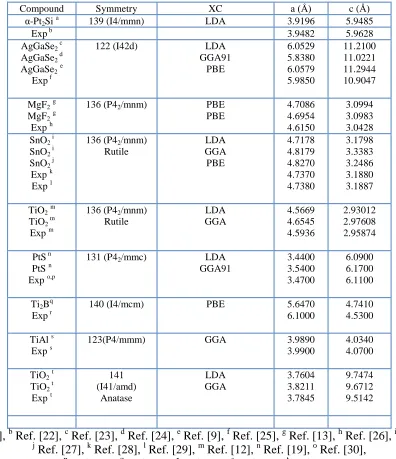
Table 1. The lattice constants obtained from different methods of calculations using different exchange correlation (XC) potentials in comparison with the available values.
Compound Symmetry XC a (Å) c (Å)
α-Pt2Si a 139 (I4/mmn) LDA 3.9196 5.9485
Exp b 3.9482 5.9628
AgGaSe2 c
AgGaSe2 d
AgGaSe2e
Exp f
122 (I42d) LDA
GGA91 PBE 6.0529 5.8380 6.0579 5.9850 11.2100 11.0221 11.2944 10.9047
MgF2g
MgF2g
Exp h
136 (P42/mnm) PBE
PBE 4.7086 4.6954 4.6150 3.0994 3.0983 3.0428 SnO2 i
SnO2 i
SnO2 j
Exp k Exp l
136 (P42/mnm)
Rutile LDA GGA PBE 4.7178 4.8179 4.8270 4.7370 4.7380 3.1798 3.3383 3.2486 3.1880 3.1887
TiO2m
TiO2 m
Exp m
136 (P42/mnm)
Rutile LDA GGA 4.5669 4.6545 4.5936 2.93012 2.97608 2.95874
PtS n PtS n Exp o,p
131 (P42/mmc) LDA
GGA91 3.4400 3.5400 3.4700 6.0900 6.1700 6.1100
Ti2Bq
Exp r
140 (I4/mcm) PBE 5.6470
6.1000
4.7410 4.5300
TiAl s Exp s
123(P4/mmm) GGA 3.9890
3.9900
4.0340 4.0700
TiO2t
TiO2 t
Exp t
141 (I41/amd) Anatase LDA GGA 3.7604 3.8211 3.7845 9.7474 9.6712 9.5142 a
Ref. [18], b Ref. [22], c Ref. [23], d Ref. [24], e Ref. [9], f Ref. [25], g Ref. [13], h Ref. [26], i Ref. [12],
j
Ref. [27], k Ref. [28], l Ref. [29], m Ref. [12], n Ref. [19], o Ref. [30],
p
[image:5.596.99.495.257.716.2]
In the atomic spheres, wave functions are expanded into atomic orbitals while in the interstitial region a plane-wave basis set is used. Charge density and potential are expanded into lattice harmonics and Fourier series in the atomic spheres and interstitial regions, respectively. In order to get the total energy convergence the plane-wave expansion cutoff was Kmax=7/Rmt ( Kmax=8/Rmt ) where Rmt is the
smallest atomic muffin-tin sphere in the unit-cell and the maximum angular momentum of the atomic orbital basis functions was set to lmax=8 ( 9 ), respectively. Since tetragonal compounds have internal
coordinates, our calculations were optimized by minimization of the forces (1 mRy/au) acting on the atoms. To testify the accuracy of the newly released Tetra-elastic package several tetragonal structure compounds having different space group were used.
In Table 1, we have listed the cell parameters and the space groups of nine tetragonal structure compounds which were used in this work.
4. RESULTS AND DISCUSSION
Table 2. The calculated elastic constants in unit of (GPa) for AgGaSe2 in comparison with
experimental data and the previous theoretical results using different methods, lattice constants and exchange correlation (xc) potentials.
AgGaSe2a AgGaSe2b AgGaSe2c AgGaSe2 AgGaSe2d AgGaSe2e
Method NPP UPP FPLAPW FPLAPW Exp Exp
XC LDA GGA PBE PBE
a (Å) 5.9340 6.0579 6.0579
c (Å) 10.6693 11.2944 11.2944
C11 92 86.4 74.95 70.95 89.8 80.1
C12 60 55.2 41.03 42.3 65.7 51.6
C13 56 52.9 43.03 41.2 45.1 52.6
C33 70 72.4 59.57 58.46 58.0 70.7
C44 26 20.3 30.10 23.66 21.7 21.2
C66 17 25.3 21.62 24.39 13.3 24.7
UPP : Ultrasoft pseudopotentials NPP : Norm-conserving pseudopotentials
a
Ref. [16], b Ref. [17], c Ref. [9] , d Ref. [14] , e Ref. [15], This work (Bold)
The tetragonal symmetry possesses six independent elastic constants, namely; C11, C12, C13 , 33
C , C44, and C66. In the Tables 2-9, we have listed the calculated elastic constants of nine tetragonal structure compounds using the newly released Tetra-elastic package.
experimentally and theoretically to testified the accuracy of the Tetra-elastic package in comparison with the previously reported theoretical and experimental data. The calculated elastic constants of TiO2(Rutile) [12], MgF2 [13], and SnO2(Rutile) [12] presented in Table 3, 4 , and 5 show that our
[image:7.596.75.521.238.416.2]calculated elastic constants show better agreement with the experimental data then the previous theoretical calculations.
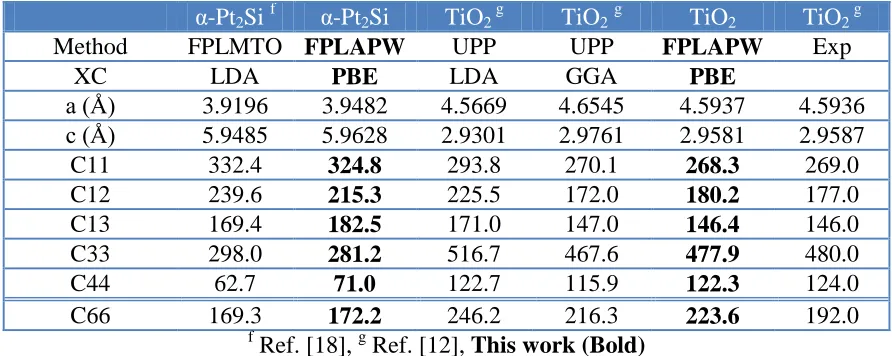
Table 3. The calculated elastic constants in unit of (GPa) for α-Pt2Si and TiO2 (Rutile) in comparison
with experimental data and the previous theoretical results using different methods, lattice constants and different exchange correlation (xc) potentials.
α-Pt2Si f α-Pt2Si TiO2 g TiO2g TiO2 TiO2 g
Method FPLMTO FPLAPW UPP UPP FPLAPW Exp
XC LDA PBE LDA GGA PBE
a (Å) 3.9196 3.9482 4.5669 4.6545 4.5937 4.5936
c (Å) 5.9485 5.9628 2.9301 2.9761 2.9581 2.9587
C11 332.4 324.8 293.8 270.1 268.3 269.0
C12 239.6 215.3 225.5 172.0 180.2 177.0
C13 169.4 182.5 171.0 147.0 146.4 146.0
C33 298.0 281.2 516.7 467.6 477.9 480.0
C44 62.7 71.0 122.7 115.9 122.3 124.0
C66 169.3 172.2 246.2 216.3 223.6 192.0
f
[image:7.596.130.466.490.709.2]Ref. [18], g Ref. [12], This work (Bold)
Table 4. The calculated elastic constants in unit of (GPa) for MgF2 in comparison with the previous
theoretical results using different methods, lattice constants and same exchange correlation (xc) potentials.
MgF2 h MgF2 h MgF2 MgF2 i
Method FPLAPW PAW FPLAPW Exp
XC PBE PBE PBE
a (Å) 4.7086 4.6954 4.7086
c (Å) 3.0994 3.0983 3.0994
C11 130.0 127 128.3 123.7
C12 78.2 80.1 79.2 73.2
C13 54.7 57.3 61.9 53.6
C33 185.0 187.7 196.3 177.0
C44 50.5 50.8 51.2 55.2
C66 83.0 87.2 87.7 97.8
PAW : Projector augmented wave
h
Ref. [13], i Ref. [33], This work (Bold)
Table 2 presents the current results of the elastic constants of AgGaSe2 compound in
methods and different exchange correlation potentials [9,16,17]. Our calculated C12 and C66 are agreed
with neutron measurements while C13 and C33 agree with ultrasonic measurements. Meanwhile one can
see that our calculated C12, C66, C13 and C33 are in good agreement with previously reported FPLAPW
results [9].
Table 3 presents the current results of the elastic constants of α-Pt2Si [18] and TiO2 (Rutile)
[12] in comparison with experimental data and the previous theoretical results using different methods, different lattice constants and different exchange correlation potentials. One can see that our results for TiO2 exhibit better agreements with the experimental data [12] than the previous calculations [12].
Meanwhile, Table 3 shows there is reasonable agreement between our calculated elastic constants of α-Pt2Si-FPLAPW-PBE and the previously calculated elastic constants for α-Pt2Si-FPLMTO-LDA.
Our calculated elastic constants of MgF2 (FPLAPW-PBE) in comparison with the previous
calculations using FPLAPW-PBE/PAW-PBE [13] are listed in Table 4. We noticed that there is fairly good agreement between our results and FPLAPW-PBE/PAW-PBE results. We should emphasize that our MgF2-FPLAPW-PBE results agree with MgF2-FPLAPW-PBE/PAW-PBE results in the matter of
ordering the elastic constants, and the superposition of elastic constants obtained from our results agree well with FPLAPW-PBE/PAW-PBE results.
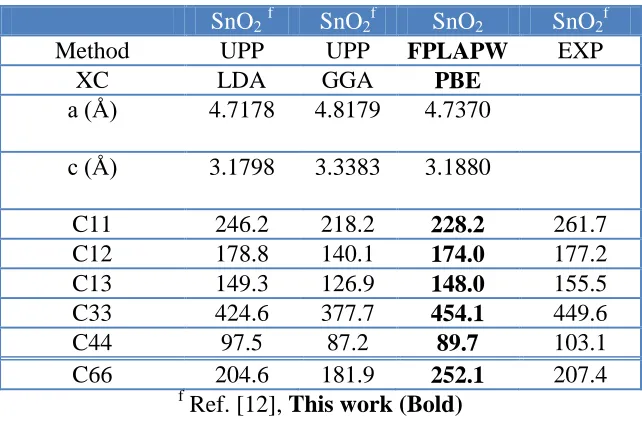
Table 5. The calculated elastic constants in unit of (GPa) for SnO2 in comparison with the previous
theoretical results using different method, lattice constants and different exchange correlation (xc) potentials.
SnO2f SnO2f SnO2 SnO2f
Method UPP UPP FPLAPW EXP
XC LDA GGA PBE
a (Å) 4.7178 4.8179 4.7370 c (Å) 3.1798 3.3383 3.1880
C11 246.2 218.2 228.2 261.7
C12 178.8 140.1 174.0 177.2
C13 149.3 126.9 148.0 155.5
C33 424.6 377.7 454.1 449.6
C44 97.5 87.2 89.7 103.1
C66 204.6 181.9 252.1 207.4
f
Ref. [12], This work (Bold)
Table 5 presents our calculated elastic constants of SnO2 (SnO2-FPLAPW-PBE) in comparison
with the previous theoretical results using different method, different lattice constants and different exchange correlation potentials. One can see our results show better agreement with experimental values [12] and previous SnO2-UPP-LDA calculations [12] than the previous SnO2-UPP-GGA
[image:8.596.138.459.423.635.2]
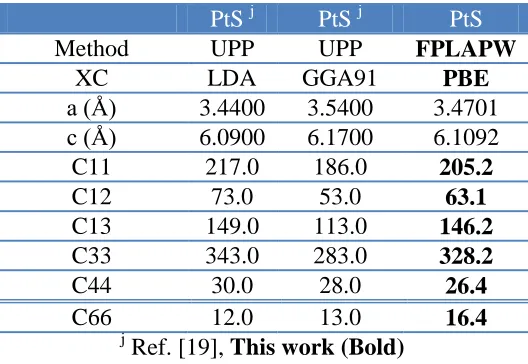
In Table 6, the results of PtS [19] using UPP-GGA and UPP-LDA are compared with our FPLAPW-PBE. We should emphasize that our results show better agreement with the UPP-LDA data than the UPP-GGA calculations.
Table 6. The calculated elastic constants in unit of (GPa) for PtS in comparison with the previous theoretical results using different methods, lattice constants and exchange correlation (xc) potentials.
PtS j PtS j PtS
Method UPP UPP FPLAPW
XC LDA GGA91 PBE
a (Å) 3.4400 3.5400 3.4701 c (Å) 6.0900 6.1700 6.1092
C11 217.0 186.0 205.2
C12 73.0 53.0 63.1
C13 149.0 113.0 146.2
C33 343.0 283.0 328.2
C44 30.0 28.0 26.4
C66 12.0 13.0 16.4
j
Ref. [19], This work (Bold)
Table 7. The calculated elastic constants in unit of (GPa) for Ti2B and TiAl in comparison with the
previous theoretical results using different methods, and same lattice constants, and exchange correlation (xc) potentials
Ti2B k Ti2B TiAl l TiAl TiAl l
Method PAW FPLAPW UPP FPLAPW EXP
XC PBE PBE GGA PBE
a (Å) 5.6470 5.6470 3.9890 3.9900 3.9900 c (Å) 4.7410 4.7410 4.0340 4.0700 4.0700
C11 321.0 291.1 170.0 177.7 183.0
C12 100.0 93.2 79.0 62.8 74.0
C13 94.0 126.5 78.0 65.1 74.0
C33 299.0 271.3 177.0 179.3 178.0
C44 105.0 114.0 113.0 79.81 105.0
C66 100.0 71.6 73.0 79.0 78.0
k
Ref. [20], l Ref. [21], This work (Bold)
Table 7 presents the current calculated elastic constants for Ti2B [20] in comparison with the
[image:9.596.167.431.203.385.2]
exchange correlation potentials are presented in Table 7. It is clear that our FPLAPW-PBE calculation using the experimental lattice constants show better agreement with the experimental data than that the UPP-GGA results.
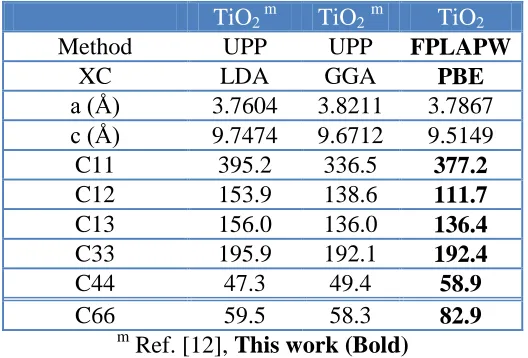
In Table 8 the calculated elastic constants for TiO2 (Anatase) [12] are presented in comparison
[image:10.596.167.431.323.502.2]with the previous theoretical results using different method, different lattice constants and different exchange correlation potentials. It is clear that the three different methods predict different values and since there are no experimental data are available to be compared with our and previous theoretical results, so based on our results which show good agreement with the experimental data (see Tables 3-5) hence, we consider the present results are more accurate, hoping that our present work will stimulate some more works on this material. Future experimental works will testify our calculated results.
Table 8. The calculated elastic constants in unit of (GPa) for TiO2 (Anatase) in comparison with the
previous theoretical results using different method, lattice constants and different exchange correlation (xc) potentials.
TiO2 m TiO2m TiO2
Method UPP UPP FPLAPW
XC LDA GGA PBE
a (Å) 3.7604 3.8211 3.7867 c (Å) 9.7474 9.6712 9.5149
C11 395.2 336.5 377.2
C12 153.9 138.6 111.7
C13 156.0 136.0 136.4
C33 195.9 192.1 192.4
C44 47.3 49.4 58.9
C66 59.5 58.3 82.9
m
Ref. [12], This work (Bold)
5. CONCLUSION
data (see Tables 3-5) hence, we consider the present results are more accurate, hoping that our present work will stimulate some more works on this material. Future experimental works will testify our calculated results.
ACKNOWLEDGEMENTS
This work was supported from the institutional research concept of the project CENAKVA (No. CZ.1.05/2.1.00/01.0024). The School of Materials Engineering, University Malaysia Perlis (UniMAP), Perlis, Malaysia.
References
1. S. Gao, Computer Physics Communications, 153 (2003) 190. 2. K. Schwarz, Journal of Solid State Chemistry, 176 (2003) 319.
3. B. B. Karki, L. Stixrude, S. J. Clark, M. C. Warren, G. J. Ackland, J. Crain, American Mineralogist, 82 (1997) 635.
4. Y. Benmimoun, A. Bouhemadou, R. Khenata, A.H. Reshak, B. Amrani, M. Ameri, and H. Baltache, Eur. Phys. J. B 61 (2008) 165.
5. P. Blaha , K. Schwarz, G. K. H. Madsen, D. Kvasnicka and J. Luitz, WIEN2K, “an Augmented Plane Wave + Local orbitals program for calculating crystal properties”, Karlheinz Schwarz, Techn. Universitat, Wien, Austria, (2001), ISBN 3-9501031-1-2.
6. Cubic-elastichttp://www.wien2k.at/reg_user/unsupported/ 7. Hex-elastichttp://www.wien2k.at/reg_user/unsupported/ 8. Ortho-elastic http://www.wien2k.at/reg_user/unsupported/
9. T. Ouahrani, A. Otero-de-la-Roza, A. H. Reshak, R. Khenata, H. I. Faraoun, B. Amrani, M. Mebrouki, V. Luana, Physica B, 405 (2010) 3658.
10.Tetra-elastichttp://www.wien2k.at/reg_user/unsupported/
11.J. P. Perdew, S. Burke, M. Ernzerhof, Phys. Rev. Lett., 77 (1996) 3865. 12.H. Yao, L. Ouyang, and W. Ching, J. Am. Ceram. Soc., 90 [10] (2007) 3194. 13.R. Golesorkhtabar, P. Pavone, J. Spitaler, P. Puschnig, C. Draxl , Computer Physics
Communications, 184 (2013) 1861.
14.D. Eimerl, J. Marion, E. K. Graham, H. A. McKinstry, S. Haussuhl, IEEE J.Quantum Electron.QE-27 (1991) 142.
15.R. Fouret, P. Derollez, A. Laamyem, B. Hennion, J.Gonale, J. Phys.: Condens. Matter, 9 (1997) 6579.
16.B. B. Karki, S. J. Clark, M. C. Warren, H. C. Husueh, G. J. Ackland, J. Crain, J. Phys.: Condens. Matter, 9 (1997) 375.
17.J. Łazewski, H. Neumann, K. Parlinski, J. Appl. Phys., 93 (2003) 3789.
18.O. Beckstein, J. E. Klepeis, G. L. W. Hart, and O. Pankratov , Phys. Rev. B, 64(2001) 155110 . 19.A. Marmier, P. S. Ntoahae, P. E. Ngoepe, D. G. Pettifor, and S. C. Parker, Phys. Rev. B, 81 (2010)
172102 .
20.Y. Hai-Yan, W. Qun, C. Shao-Mei, G. Ping, Trans. Nonferrous Met. Soc. China, 21 (2011) 1627. 21.R. Sot, K. J. Kurzydłowski, Materials Science-Poland, 23 (2005) No. 3.
22.R. P. Ram and S. Bhan, Z. Metallkde., 69 (1978) 524.
23.S. Chen, X.G. Gong, S.-H.Wei, Phys. Rev. B, 75 (2007) 205209.
24.A. Chahed, O. Benhelal, S. Laksari, B. Abbar, B. Bouhafs, N. Amrane, Physica B, 367 (2005) 142. 25.J. L. Shay, J. H. Wernik, Ternery Chalcopyrite Semiconductors: Growth, Electronic Properties
26.G. Vidal-Valat, J. P. Vidal, C. M. E. Zeyen, K. KurkiSuonio, Acta Crystallogr. Sect. B, 35 (1979) 1584.
27.İ. Erdem, H. Hüseyin Kart, T. Cagin, Archives of Materials Science and Engineering, 45/2 (2010) 108.
28.N. M. A. Hadia, S. V. Ryabtsev, E. P. Domashevskaya, P.V. Seredin, The European Physical Journal Applied Physics, 48/1 (2009) 10603.
29.A.A. Bolzan, C. Fong, B.J. Kennedy, C.J. Howard, Acta Crystallographica B, 53 (1997) 373. 30.F. Grønvold, H. Haraldsen, and A. Kjekshus, Acta Chem. Scand., 14 (1960) 1879.
31.R. Collins et al., Inorg. Chem., 18 (1979) 727.
32.P. MOHN, J Phys C: Solid State Phys, 21 (1988) 2841.
33.H. R. Cutler, J. J. Gibson, K. A. McCarthy, Sol. State Comm., 6 (1968) 431.