T H E C A S E OF N I U E
T r e v o r D o n a ld P a r e M a th e s o n
A thesis sub m itted for the degree of
Doctor of Philosophy
a t the A ustralian National University
to any other university or tertiary institution.
This study seeks to understand and explain the aid-dependent condition of Niue, how it arrived at t h a t condition, and w h at are the implications of t h a t condition for aid policy makers in Niue and elsewhere. The study uses contributions to the literature on small island economies which a ttrib u te s the present economic state of small island countries to the forces of colonialism and peripheralism. Many development agencies have subsequently argued small island countries should receive high levels of aid.
In order to test the validity of this theory to Niue, the record of economic develop m ent since 1900 is reconstructed. Public sector accounts, trad e statistics, development project records, employment d a ta , migration statistics, and information on natural and e xtraneous events are collated and graphed to d e m o n s tra te im p o rta n t trends. Although it is not possible to investigate the relationships statistically, the pattern s are seen to be closely related.
The d a ta reveal t h a t relatively high levels of aid have had few positive effects in term s of increasing productivity. Niue has developed an overwhelming dependence on im po rts for consumption, a large and dom inant public service coincident with a high and c o n sta n t rate of emigration resulting in partial depopulation. These findings sup port the theory espoused in the small island economies literature.
A major weakness of the theory, however, is its preoccupation with the macro economy and neglect of the micro-economy. In a bid to overcome some of the lim ita tions of the m acro-approach, a detailed case study is made of the 284 member com m unity of M utalau village. The study shows t h a t income distribution is heavily skewed in favour of governm ent salaried employees who head a three tier social structure. A comparison of socioeconomic indicators, access to public services and labour arran ge m ents confirms t h a t substantial differences exist between the three tiers. A case study of three families draws links between aid and emigration.
The s ta n d a rd Niuean spelling has been used th rou gh ou t the text, rath e r th a n the a lternative spelling proposed by J.M . McEwen (1970) in his N iu e Dictionary. McEwen a tte m p te d to popularise the use of s for t if the latte r was followed by an e or i, and the
ng for n because this is how the letters are pronounced in conversation. According to the late Leslie Rex, Niue’s foremost expert of the Niuean language, the m ajority of Niueans rejected M cEwen’s a tt e m p t s a t sta nd a rdisa tion because they were satisfied with the old style of spelling (L. Rex, pers. comm. April 1983). The official orthography retains the / and n, thus it is Avatele not Avasele, and m a g a fa o a not m anga fao a. The Niuean language does not alter the form of the noun in the plural, and this usage has been followed.
aho tapu f a n a u akoako
Ekalesia fagota fa i aoga fa k a ta u koloa fale
fale fo n o fale fu a k a u fale pope fale tapu fia f ia fo n o patu fu a k a u fu a ta hi f iu l u honge h u k i teliga ika
ka ina
ko e tohi tapu kolo leoleo leveki lupe maaga maga faoa
W hite Sunday or Children’s Day a pastor or minister of a church the M utalau church (formerly LMS) reef gathering for shellfish and seaweed teacher
storekeeper or shopkeeper house or building
Niue G overnm ent building
old person’s h ou se/pensioner’s house Rom an Catholic church building church building (any denomination) communal feast and celebration collective meeting of the village patu
elderly, older person village youth
haircuttin g ritual famine
feast associated with a h airc u t/e arp ierc e ritual fish
home or household the Bible
digging stick
constable or policeman caretaker
pigeon village
n om aea O k ala na palagi palau patu patu f i f i n e patu ik i peka puaka si m al a talo tapu tia ko no tipolo toa tua f a tu fo n o u f i u m u uga vahega vailahi vao vine
a Niuean stranger (from ano th er village) Auckland
European plough or disc
married man or the male head of a household female head of a household
elected king of the island
fruit b a t or ’flying fox’ (Pteropus to n g a n u s)
pig
ku m ara or sweet p o ta to (Ipomoea b atatas) taro (Colocasia esculenta)
sacred
deacon in the E k alesia
lime (C itru s a u r a n ti f o li a) warrior
coastal land/region Island Councillor yam (Dioscorea a la ta)
earth oven
coconut crab (Birgus latro) church choir
theology student bush land/region
A B B R E V I A T I O N S
C PI Consumer Price Index
D P O Development Planning Office
EEZ 200 mile m aritim e exclusive economic zone
G D P Gross Domestic Product
G N P Gross National P roduct
HH Household
J W J e h o v a h ’s Witness Church
LDS Church of L atter Day Saints (Mormon Church)
LMS London Missionary Society
ME M u talau E kalesia Church
NDB Niue Development Board
N D P Niue National Development Plan, 1980-1985 N PS(C) Niue Public Service (Commission)
N Z F A R N e w Zealand Foreign A f f a i r s Review N Z P P New Zealand P a rlia m en ta ry Papers
ODA Overseas Development Assistance
P 1M Pa cific Islan ds M o n th ly
SDA Church of Seventh Day Adventists
SPC South Pacific Commission
S P E C South Pacific Bureau for Economic Co-operation
SSJ South Seas Journals of the LMS
SSL South Seas Letters of the LMS
T T N Tohi Tala N iue
UN United Nations Organisation
U N CTA D United Nations Conference on T ra d e and Development U N D A T United Nations Development Advisory Team
UNDP United Nations Development Program
U N IT A R United Nations Institute for T raining and Research USP University of the South Pacific
Currency
A C K N O W L E D G E M E N T S
In the prep aratio n of this thesis, I have depended heavily on the assistance of many individuals and organisations. W ithout this assistance the study would have been impossible.
A p o stgrad u ate research scholarship from the D e p a rtm en t of Human Geography, Research School of Pacific Studies of the A ustralian National University (A.N.U.) per m itted the research to be undertaken. It was my very good fortune to have had the project supervised by Dr B ryant Allen and Professor Harold Brookfield, who were al ways a t hand with insightful comm ents, valuable advice, and c o nstan t warnings to "keep it simple” and ” to the po int” . 1 m ust also th an k Professor R. G erard W ard, my advisor, who helped initiate the study and obliged with information and suggestions.
Fieldwork was made possible by a generous grant from the A.N.U., a small g rant from the Pacific Islands Polynesian Education Foundation (Wellington) and by facilities made available in the field by the G overnm ent of Niue. To Sir Robert Rex, Premier of Niue, and to Mr Terry C ha pm a n , Secretary to G overnm ent, 1 am indebted for complete access to official records and statistical d a ta . I am deeply conscious of a d ebt of g ratitu d e to the members of the Development Planning Office for aid d a ta , encourage m ent and friendship. The Secretary of Lands, Justice and Survey, Mr Sol Kalauni, the P ostm aster, Mr F.K . Ikim otu, the Deputy Director of Agriculture, Mr Brad Punu, the Chief of Police, Mr Satini Tohovaka, and the Acting-M anager of the Niue Development Board (NDB), Mr Kenrick Viviani, all gave generously of their tim e and knowledge.
Of the many others in Niue whose assistance is acknowledged, mention m ust be made of Mr Leo P ita of the NDB who kindly assisted with the analysis of NDB records, Mr D avida T aufitu of the Niue Housing A u tho rity who supplied d a ta on housing loans and Mr H ekem ata Palalagi who provided details of pensions.
To the Village Council of M utalau, I am deeply obliged for permission to carry out field studies in their com m unity. Not w ith o u t reason, the Niuean people are cautious of investigations m ade by foreign researchers, and the generosity of the M utalau villagers in giving freely of their time and knowledge will never be forgotten.
Reverend Iki Lapana, Sam T utogia, Tongakilo Isaako and Hafe Vilitam a will alw ays be affectionately remembered for their hospitality and kindness. Vihekula Hekesi, Sionefakatala, Seautau T a p a tu e to a , Pilitasi T o im a ta and Koukouiki M akaea willingly p articipated in d a ta gathering and I am proud they considered me among their best of friends. T hanks are also due to the M utalau W o m e n ’s F C W and the Pine Boys.
Several organisations in New Zealand provided valuable assistance. The Ministry of Foreign Affairs provided aid d a ta and access to w ritten material. The Ministry of Agriculture and Fisheries, the National Archives and the Alexander Turnbull Library as sisted with library searches. I also benefited from discussions with many individuals from academic and commercial environm ents b u t it is impossible to identify the specific contribution of each of them.
I am indebted to Lio Pancino for drawing the maps and other cartographic advice, Carol McKenzie and Norm a Chin for typing some final drafts, the appendices, bibliog raphy and tables; and all other members of the D e p a rtm en t of Human Geography for their friendly assistance and constructive comm ents. Yvonne Pittelkow gave valuable statistical advice, particularly in relation to inequality measures.
T a b le o f C o n t e n t s
A B S T R A C T iii
G L O S S A R Y v
A B B R E V IA T IO N S v ii
A C K N O W L E D G E M E N T S v iii
P A R T I A ID A N D S M A L L IS L A N D C O U N T R I E S 1
C H A P T E R 1. T H E P R O B L E M 2
1.1 O R G A N I S A T I O N O F T H IS S T U D Y 6
1.2 O R G A N IS A T IO N O F T H E S IS 8
C H A P T E R 2. S M A L L IS L A N D E C O N O M IE S 10
2.1 H O W S M A L L IS S M A L L ? 11
2.1.1 N a tio n a l in c o m e ' 12
2 .1.2 L a n d a r e a 13
2 .1.3 P o p u la tio n 14
2.2 P R O B L E M S A N D C H A R A C T E R I S T I C S 15
2.2.1 T r a d e o p e n n e s s a n d d e p e n d e n c e 15
2.2.2 D ise c o n o m ie s o f s m a ll scale 18
2.2.3 R e m o te n e s s 20
2.2 .4 C o n c e n tr a tio n p h e n o m e n o n 23
2.2 .5 N a t u r a l a n d m a n -m a d e h a z a r d s 26
2 .2 .6 M a n p o w e r a n d sk ills 27
2.3 F O R E I G N A ID A N D S M A L L IS L A N D C O U N T R IE S 28
2.3.1 H ig h r e la tiv e lev els o f a id 31
2.3.2 I n te r n a l c o n se q u e n c e s 34
2.4 O V E R V IE W 35
C H A P T E R 3. T H E C A S E O F N I U E 36
3.1 C O L O N IA L A N D P O S T -C O L O N IA L E X P E R I E N C E S 36
3.1.1 C o lo n ia lism 36
3.1.2 D e c o lo n is a tio n 37
3.1.3 S e lf-g o v e rn m e n t 37
3.2 E C O N O M IC C H A R A C T E R I S T I C S 38
3.2.1 N a tio n a l in c o m e 38
3.2.2 T r a d e o p e n n e s s a n d d e p e n d e n c e 39
3.2.3 D ise c o n o m ie s o f s m a ll scale 40
3.2 .4 R e m o te n e s s 41
3.2.5 C o n c e n tr a tio n p h e n o m e n o n 43
3 .2 .6 M a n p o w e r a n d sk ills 43
3.2.7 In v is ib le tr a d e 45
3.3 T H E P H Y S I C A L E N V I R O N M E N T 48
3.3.1 G eology a n d to p o g r a p h y 49
3.3 .3 C lim a te 50
3.3 .4 M in e r a l re s o u rc e s 55
3.3 .5 V e g e ta tio n a n d fo re s t re s o u r c e s 56
3 .3 .6 M a r in e r e s o u rc e s 57
3.3.7 T e r r e s t r ia l f a u n a 58
3.4 C O N C L U S IO N S 58
P A R T I I T H E E V O L U T IO N O F D E P E N D E N C E 60
C H A P T E R 4. D E P E N D E N C E U N D E R C O L O N IA L IS M : 1901-1973 61 4.1 T H E M A J O R M A C R O - E C O N O M I C T R E N D S 61
4.1.1 T h e e x p o r t- im p o r t r e c o r d 61
4 .1.2 P u b lic fin a n c e tr e n d s 66
4.2 A C C O U N T I N G F O R T H E T R E N D S 68
4.2.1 P o litic a l c h a n g e in w o rld a n d N iu e : th e 1940s 68 4.2.2 N ew Z e a la n d fin a n c ia l c o n t r i b u ti o n s 69
4.3 C O N C U R R E N T T R E N D S 72
4 .3.1 P u b lic se rv ic e e m p lo y m e n t 74
4 .3.2 D e v e lo p m e n t p r o je c ts 76
4 .3.3 P o s t- w a r m ig r a tio n 81
4.4 N A T U R A L A N D E X T R A N E O U S E V E N T S 84
4.5 C O N C L U S IO N S 86
C H A P T E R 5. D E P E N D E N C E 1974-1982: A S P I R A T I O N S , E X P E C - 87 T A T I O N S , O U T C O M E S A N D R E A C T I O N S
5.1 A S P I R A T I O N S A N D E X P E C T A T I O N S 87
5.1.1 A s p ir a tio n s 87
5.1.2 E x p e c ta tio n s 90
5.2 T H E O U T C O M E S 92
5.2.1 C o m m o d ity tr a d e 92
5.2.2 M ig r a tio n 95
5.2.3 P e r s o n a l r e m itta n c e s 97
5.2.4 P u b lic s e rv ic e e m p lo y m e n t 98
5.2.5 A id 102
5.3 P E R C E P T I O N S A N D R E A C T I O N S 107
5.3.1 A c o n c e rn a b o u t a id 107
5.3.2 P e r c e p tio n s o f m ig r a tio n 111
5.3.3 C o m m e n ts on tr a d e 113
5.4 T H E ” M I R A B ” C O N C E P T 114
5.5 C O N C L U S IO N S 115
P A R T I I I T H E H U M A N F A C E O F D E P E N D E N C E 116 C H A P T E R 6. IN E Q U A L IT Y A N D A N E W S O C IA L O R D E R 118
6.1 S T U D Y S E T T I N G 118
6.1.1 M u ta l a u v illa g e 118
6.1.2 V illa g e p ro file 122
6.2 C H A N G IN G O C C U P A T I O N S A N D S O U R C E S O F G R O S S 126 IN C O M E
6.2.1 M u ta l a u , 1951 126
6.2.2 M u ta l a u , 1971 129
6.2.3 M u ta l a u , 1982-1983 130
6.3 IN C O M E D I S T R I B U T I O N A N D E Q U I T Y 133
6.3.1 A d u lt p a t t e r n s 133
6 .3 .3 T h e e x t e n t o f i n e q u a l i t y in 1982 138
6 .4 N E W S O C I A L O R D E R 142
6 .4 .1 N o n - w a g e h o u s e h o l d s 144
6 .4 .2 W a g e h o u s e h o l d s 144
6 .4 .3 S a l a r y h o u s e h o l d s 146
6 .5 C O N C L U S I O N 146
C H A P T E R 7. I N T E R - G R O U P D I F F E R E N C E S 147
7.1 H O U S E H O L D C H A R A C T E R I S T I C S 147
7.2 T A N G I B L E A S S E T S 148
7 .2 .1 W a t e r s u p p l y a n d t o i l e t f a c i l i t i e s 149 7 .2 .2 T e n u r e o f p r i v a t e d w e l l i n g s 150
7 .2 .3 M e a n s o f c o o k i n g 151
7 .2 .4 C o n s u m e r d u r a b l e s a n d t r a n s p o r t a t i o n 152 7.2 .5 F a r m i m p l e m e n t s a n d l a b o u r s a v i n g t e c h n i q u e s 153
7 .2 .6 F i s h i n g e q u i p m e n t 155
7 .2 .7 S u m m a r y o f s t a t i s t i c a l d i f f e r e n c e s 156
7.3 D O N A T I O N S A N D I N V E S T M E N T S 156
7 .3.1 C h u r c h d o n a t i o n s 157
7.3 .2 E a r p i e r c i n g a n d h a i r c u t t i n g r i t u a l s 159 7.4 P A R T I C I P A T I O N I N C A S H C R O P P I N G A N D C H U R C H 164
A C T I V I T I E S
7 .4 .1 C a s h c r o p p i n g 164
7 .4 .2 C h u r c h a f f i l i a t i o n a n d a t t e n d a n c e 165
7.5 A C C E S S T O G O V E R N M E N T S E R V I C E S 166
7 .5.1 I n s t i t u t i o n a l c r e d i t s o u r c e s 167
7 .5 .2 E l e c t r i c i t y s u p p l y 169
7 .5 .3 M e m b e r s h i p in lo c a l o r g a n i s a t i o n s 170
7.6 A T T I T U D E S A N D A S P I R A T I O N S 171
7.6.1 S e c u r i t y o f e m p l o y m e n t 171
7 .6 .2 T h e c h i l d r e n ’s f u t u r e 173
7 .6 .3 R e d u c i n g m i g r a t i o n 174
7 .6 .4 A r e a c t i o n t o f o r e i g n a i d 175
C H A P T E R 8. H O U S E H O L D S O C I O E C O N O M I C A N D L A B O U R 176 A C T I V I T I E S
8.1 H O U S E H O L D C H A R A C T E R I S T I C S 177
8.2 P A T T E R N S I N C A S H F L O W 177
8.3 S O U R C E S O F G R O S S I N C O M E 178
8.4 E X P E N D I T U R E S 181
8.4.1 H a i r c u t a n d e a r p i e r c e i n v e s t m e n t s 183
8 .5 N E T I N C O M E 185
8 .6 C R E D I T P R A C T I C E S 186
8 .7 G I F T E X C H A N G E S 186
8 .8 L A B O U R A N D T I M E A L L O C A T I O N 188
8.8.1 P r o d u c t i v e w o r k 188
8.8 .2 N o n - p r o d u c t i v e w o r k 195
8 .8 .3 P a i d e m p l o y m e n t 196
8.8 .4 C h i l d r e n ’s w o r k p a t t e r n s 196
8.9 C O N C L U S I O N 198
C H A P T E R 9. A I D , M I G R A T I O N A N D T H E F A M I L Y 199
9 .1 T H E F A M I L I E S 199
9 .1 .1 S p a t i a l d i s t r i b u t i o n 200
9.2 P A T T E R N O F M I G R A T I O N 205 9.3 A ID AS A F A C T O R I N F A M I L Y M I G R A T I O N 207 9.3.1 P e r m a n e n t g o v e r n m e n t e m p l o y m e n t 207
9.3.2 R e l a ti v e in c o m es 214
9.3.3 D e v e l o p m e n t p r o je c ts 218
9.3.4 N e w Z e a la n d c itiz e n s h ip 222
9.3.5 A ccess to l a n d / l a n d r i g h t s 223
9.4 A ID A N D F A M I L Y M I G R A T I O N I N R E T R O S P E C T 223
9.4.1 F a m i l y m i g r a n t s 224
9.4.2 P e r s o n a l r e m i t t a n c e s 227
9.4.3 R e t u r n e th o s 229
9.4.4 T h e fa m ily n o n - m i g r a n t s 233
9.4.5 T h e case o f t h e r e t u r n m i g r a n t , T a u 236
9.5 C O N C L U S I O N S 237
P A R T I V ’T IS Y O U R S T O J U D G E 238
C H A P T E R 10. S U M M A R Y A N D C O N C L U S I O N S 239
10.1 S E L F - S U P P O R T V E R S U S A I D D E P E N D E N C E 241
10.2 P O L I C Y I M P L I C A T I O N S 242
A p p e n d i x 3. E S T I M A T I N G P E R S O N A L R E M I T T A N C E F L O W S 246 A p p e n d i x 4. C O N S U M E R / R E T A I L P R I C E I N D I C E S 252
A p p e n d i x 5. E X C H A N G E R A T E S 261
A p p e n d i x 6. F I E L D W O R K C E N S U S , I N C O M E A N D 263 S O C I O E C O N O M I C S C H E D U L E S
A p p e n d i x 9. F I E L D W O R K Q U E S T I O N N A I R E - N I U E A N S IN N E W 273 Z E A L A N D , 1983
L i s t o f F i g u r e s
F i g u r e 1-1: F i g u r e 1-2:
F i g u r e 2-1:
F i g u r e 2-2:
F i g u r e 3-1: F i g u r e 4-1:
F i g u r e 4-2: F i g u r e 4-3: F i g u r e 4-4:
F i g u r e 4-5:
F i g u r e 4-6:
F i g u r e 4-7:
F i g u r e 4-8:
F i g u r e 4-9:
F i g u r e 5-1:
F i g u r e 5-2:
F i g u r e 5-3:
F i g u r e 6-1: F i g u r e 6-2: F i g u r e 6-3: F i g u r e 6-4:
F i g u r e 6-5:
F i g u r e 6-6:
F i g u r e 6-7:
F i g u r e 6-8: F i g u r e 6-9:
F i g u r e 6-1 0
M a p o f N i u e I s l a n d .
R e s e a r c h m e t h o d o l o g y f o r h o u s e h o l d a n d v i l l a g e lev e l s t u d y in M u t a l a u , 1983.
P o p u l a t i o n d e f i n i t i o n s o f s m a l l s t a t e s a n d m i c r o s t a t e s s in c e 1 960.
S c a t t e r g r a m o f O D A p e r c a p i t a c o m p a r e d w i t h t o t a l p o p u l a t i o n in P a c i f i c i s l a n d c o u n t r i e s , 1980.
N i u e r a i n f a l l r e c o r d , 1 9 0 6 -1 9 8 2 .
N i u e : e x p o r t s a n d i m p o r t s , 1 9 0 7 -1 9 7 3 ( c o n s t a n t 1965 v a l u e s ) .
S h i f t s in e x p o r t c o m m o d i t i e s , 1 9 2 7 -1 9 5 7 . K u m a r a e x p o r t s , 1 9 3 0 -1 9 7 2 .
N i u e : r e v e n u e s a n d e x p e n d i t u r e s , 1 9 0 7 -1 9 7 3 ( c o n s t a n t 1965 v a l u e s ) .
N e w Z e a l a n d f i n a n c i a l c o n t r i b u t i o n s t o N i u e , 1 93 0 -1 9 7 3 ( c o n s t a n t 1965 v a l u e s ) .
I l l u s t r a t e d e ff e c ts o f r e p e a t e d d i s c i n g o n s h a l l o w soils o f N i u e .
N i u e : n e t m i g r a t i o n (e x c e s s o f d e p a r t u r e s o v e r a r r i v a l s ) , 1 9 5 1 -1 9 7 3 .
N i u e : c o m m o d i t y t r a d e , n a t u r a l h a z a r d s a n d e x t r a n e o u s e v e n t s .
N i u e : p u b l i c s e c t o r a c c o u n t s , n a t u r a l h a z a r d s a n d e x t r a n e o u s e v e n t s .
N i u e : e x p o r t s a n d i m p o r t s , 1 9 0 7 -1 9 8 2 ( c o n s t a n t 1965 v a l u e s ) .
N i u e : n e t m i g r a t i o n (e x c e s s o f d e p a r t u r e s o v e r a r r i v a l s ) , 1 9 5 1 -1 9 8 2 .
N e w Z e a l a n d f i n a n c i a l a s s i s t a n c e t o N i u e , 1 93 0 -1 9 8 2 ( c o s t a n t 1965 v a l u e s ) .
M u t a l a u d i s t r i c t .
M u t a l a u v i l l a g e - s t r u c t u r a l f e a t u r e s , 1983. V i l l a g e s h i f t s , 1 8 4 6 -1 9 8 3 .
M u t a l a u n e t m i g r a t i o n ( e x c e s s o f d e p a r t u r e s o v e r a r r i v a l s ) , 1 9 5 4 -1 9 8 3 .
P e r c e n t a g e d i s t r i b u t i o n o f g r o s s i n c o m e s b y s o u r c e , M u t a l a u , 1982.
D i s t r i b u t i o n o f a d u l t i n c o m e s in M u t a l a u in 1 97 1, 1976, 1981 a n d 1982.
M u t a l a u h o u s e h o l d p e r c a p i t a i n c o m e d i s t r i b u t i o n in 1 9 7 6 , 1981 a n d 1982 a t c o n s t a n t 19 76 v a l u e s .
H o u s e h o l d u p w a r d m o b i l i t y , 1 9 7 6 -1 9 8 2
L o r e n z c u r v e s a n d G i n i c o e f f ic i e n t s o f t o t a l h o u s e h o l d i n c o m e b y s o c ia l g r o u p s , M u t a l a u , 1982.
L o r e n z c u r v e s a n d G i n i c o e f f ic i e n t s o f t o t a l h o u s e h o l d a n d p e r c a p i t a h o u s e h o l d i n c o m e , M u t a l a u , 1982.
F i g u r e 6-11:
F i g u r e 7-1:
F i g u r e 9-1:
F i g u r e 9-2:
S c a t t e r g r a m o f h o u s e h o l d g r o s s i n c o m e c o m p a r e d w i t h h o u s e h o l d siz e in M u t a l a u , 1982.
G r o s s i n v e s t m e n t s a t s a m p l e M u t a l a u h a i r c u t a n d e a r p i e r c e r i t u a l s , 1 9 6 9 -1 9 8 3 .
G e n e a l o g i c a l c h a r t o f t h r e e M u t a l a u f a m i l i e s s h o w i n g d o m i c i l e s in 1983 a n d b i r t h d a t e s .
I l l u s t r a t i v e g e n e a l o g i c a l c h a r t o f t h r e e M u t a l a u
m a g a f a o a .
143
160
2 0 1
L ist o f T a b le s
T a b l e 1-1: C h a r a c t e r i s t i c s o f N i u e , 1945 a n d 1982 4 T a b l e 2-1: N a t i o n a l i n c o m e , l a n d a n d s e a a r e a s in P a c i f i c i s l a n d 13
c o u n t r i e s a n d t e r r i t o r i e s *
T a b l e 2-2: I n d e p e n d e n t a n d s e l f - g o v e r n i n g P a c i f i c i s l a n d c o u n t r i e s 15 b y p o p u l a t i o n in 1981
T a b l e 2-3: T r a d e o p e n n e s s in P a c i f i c i s l a n d c o u n t r i e s a n d t e r - 17 r i t o r i e s , 1980
T a b l e 2-4: G e o g r a p h i c c o n c e n t r a t i o n o f t r a d e in P a c i f i c i s l a n d 18 s t a t e s , 1982
T a b l e 2-5: C o n c e n t r a t i o n o f v i s i b l e e x p o r t s , 1976 22 T a b l e 2-6: T h e " c o n c e n t r a t i o n p h e n o m e n o n ” in P a c i f i c i s l a n d 23
s t a t e s , 1982
T a b l e 2-7: I n d e x o f e x p o r t f l u c t u a t i o n , 1 9 6 5 -1 9 7 7 25 T a b l e 2-8: P a c i f i c i s l a n d c o u n t r i e s a n d d e p e n d e n c e o n o f fic ia l 28
d e v e l o p m e n t a s s i s t a n c e ( O D A ) , 1980
T a b l e 2-9: N u m b e r o f s t a t e s r e a c h i n g i n d e p e n d e n c e b e t w e e n 1943 32 a n d 1981
T a b l e 2-10: O D A c o n c e n t r a t i o n in P a c i f i c i s l a n d e c o n o m i e s , 1 9 8 0 33 T a b l e 3-1: T r a d e r e l a t i o n s h i p s b e t w e e n N i u e - N e w Z e a l a n d , N i u e - 40
F i ji : 1 9 8 1 -1 9 82
T a b l e 3-2: S o m e c h a r a c t e r i s t i c s o f m a j o r e p i d e m i c s i n N i u e : 42 1 9 4 3 -1 9 8 3
T a b l e 3-3: R e t u r n o f s h i p p i n g a t t h e P o r t o f A lo fi: 1945 a n d 198 2 43 T a b l e 3-4: S u m m a r y o f N i u e e x p o r t s ( F O B ) , 1 9 8 1 -1 9 8 2 44 T a b l e 3-5: M o n e y o r d e r s i s s u e d a n d p a i d b y t h e N i u e P o s t O ffic e , 46
1 9 7 3 -1 9 8 1 ( $ ’00 0)
T a b l e 3-6: T h e b i - d i r e c t i o n a l p a t t e r n a n d c h a n n e l s o f p e r s o n a l 47 r e m i t t a n c e s to a n d f r o m M u t a l a u , 1982
T a b l e 3-7: N i u e p o s t a g e s t a m p s a l e s , 1 9 7 8 -1 9 8 2 48 T a b l e 3-8: T h e i n c i d e n c e o f h u r r i c a n e h a z a r d in N i u e , 1 8 6 9 -1 9 8 4 52
T a b l e 3-9: N i u e f o r e s t r e s o u r c e s 56
T a b l e 4-1: P e r c e n t a g e b r e a k d o w n o f N e w Z e a l a n d s u b s i d i e s b y 71 p u r p o s e , 1 9 3 0 -1 9 3 4
T a b l e 4-2: B r e a k d o w n b y p u r p o s e o f N e w Z e a l a n d g r a n t s - i n - a i d t o 73 N i u e , 1 9 68 -6 9 t o 1 9 7 3 - 7 4 ( % )
T a b l e 4-3: P u b l i c s e r v i c e e m p l o y m e n t , 1 9 5 2 -1 9 7 3 75 T a b l e 4-4: E s t i m a t e d p e r c a p i t a i n c o m e s o f N i u e a n s : 19 7 1 , 1 9 7 3 -7 4 76
( C o n s t a n t 1965 v a l u e s ) .
T a b l e 4-5: I m m e d i a t e d e s t i n a t i o n o f N i u e H i g h S c h o o l l e a v e r s , 83 1 9 6 8 -1 9 7 3 (% )
T a b l e 5-1: P r o p o s e d e x p o r t t a r g e t s f r o m 1976 f o r w a r d t o 1983 ($) 88 T a b l e 5-2: P r o d u c t i o n o f p r i m a r y p r o d u c t s , 1 9 7 4 -1 9 8 2 ( t o n n e s ) 94 T a b l e 5-3: N i u e : p o p u l a t i o n g r o w t h , 1 9 7 4 -1 9 8 4 95 T a b l e 5-4: M o n e y o r d e r a n d b a n k r e m i t t a n c e s t o N i u e , 1 9 7 4 -1 9 8 2 97
( $ )
T a b le 5-6: T a b l e 5-7:
T a b le 5-8:
T a b le 5-9: T a b l e 5-10: T a b le 5-11: T a b le 5-12:
T a b le 6-1: T a b le 6-2: T a b le 6-3:
T a b le 6-4:
T a b le 6-5:
T a b le 6-6: T a b le 6-7: T a b le 6-8: T a b le 6-9:
T a b le 6 -10: T a b le 6-11:
T a b le 6-12:
T a b le 6-13: T a b le 7-1: T a b le 7-2:
T a b le 7-3:
T a b le 7-4:
T a b le 7-5:
T a b le 7-6:
T a b le 7-7:
T a b le 7-8:
T a b le 7-9:
T a b le 7-10:
T a b le 7-11:
T a b le 7-12: T a b l e 7-13:
T a b le 7-14:
N iu e e m p l o y m e n t , 1 9 7 4 -1 9 8 3
P e r c e n t a g e s o f N iu e p u b lic s e rv ic e e m p lo y e e s in p r o d u c t iv e a n d n o n - p r o d u c t i v e s e c t o r s , 19 8 0 -1 9 8 3
I m m e d i a t e d e s t i n a t i o n o f N iu e H ig h S c h o o l le a v e rs : 1 9 7 4 -1 9 8 2 (% )
F lo w s o f a id t o N iu e b y s o u r c e , 1 9 7 4 -1 9 8 2 ( $ ’0 0 0 ) a N e w Z e a la n d a id t o N iu e , 1 9 7 4 -1 9 8 3 ($)
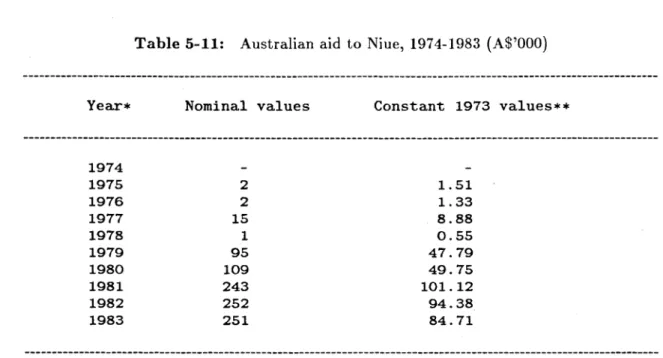
A u s t r a l i a n a id t o N iu e , 1 9 7 4 -1 9 8 3 ( A $ ’000)
M u l t i l a t e r a l flo w s o f a id t o N iu e b y s o u r c e , 1 97 4 -1 9 8 2 ( U S $ ’0 0 0 )
I n t e r c e n s a l d e c lin e o f t h e M u t a l a u p o p u l a t i o n , 19 5 6 -1 9 8 4 C h a r a c t e r i s t i c s o f s t u d y v illa g e , M u t a l a u , 1983
P e r c e n t a g e d i s t r i b u t i o n o f in c o m e s b y in c o m e g r o u p s in M u t a l a u a n d N i u e , 1976*
p e r c e n t a g e d i s t r i b u t i o n o f e m p l o y m e n t b y o c c u p a tio n s in M u t a l a u a n d N i u e , 1976*
T h e w e e k ly p a t t e r n o f a c t i v i t i e s in M u t a l a u , 1951 a n d 1983
S o u r c e s o f g r o s s in c o m e o f M u t a l a u a n s , 1 9 7 1 1
S o u r c e s o f g r o s s in c o m e o f M u t a l a u h o u s e h o ld s , 1982 C r o p s a le g r o s s in c o m e s o f M u t a l a u h o u s e h o ld s , 1982 M e a n a n d s t a n d a r d d e v ia t io n h o u s e h o ld in c o m e b y s o c ia l g r o u p s , M u t a l a u , 1982
G in i c o e ff ic ie n ts b y s o c ia l g r o u p s , M u t a l a u , 1982
I n t e r n a t i o n a l c o m p a r is o n s o f in c o m e d i s t r i b u t i o n b y p o p u l a t i o n s h a r e s a n d G in i c o e ffic ie n ts
S m a ll i s l a n d c o u n t r y c o m p a r is o n s o f in c o m e d i s t r i b u tio n b y p o p u l a t i o n s h a r e s a n d G in i c o e ffic ie n ts
U n m a r r i e d m o t h e r s b y a g e a n d r e s id e n c e o f o ffs p r in g H o u s e h o ld c h a r a c t e r i s t i c s , M u t a l a u , 1983
H o u s e h o ld w a t e r s u p p ly a n d to il e t f a c ilitie s , b y s o c ia l g r o u p s , 1983 ( % )
H o u s e h o ld m e a n s o f c o o k in g a n d t e n u r e o f p r i v a t e d w e llin g s , b y s o c ia l g o r u p s , 1983 ( %)
C o n s u m e r d u r a b l e s o w n e d , b y p e r c e n ta g e s o f s o c ia l g r o u p s , 1983
R a t i o o f v e h ic le s p e r h o u s e h o ld f o r t r a n s p o r t v e h ic le s o w n e d b y M u t a l a u h o u s e h o ld s , b y s o c ia l g r o u p s , 1983 R a t i o o f i m p l e m e n ts p e r h o u s e h o ld fo r f a r m i m p le m e n ts o w n e d b y M u t a l a u h o u s e h o ld s b y s o c ia l g r o u p , 1983 H o u s e h o ld s u s in g a g r i c u l t u r a l l a b o u r s a v in g te c h n iq u e s b y p e r c e n ta g e o f m a j o r s o c ia l g r o u p s , M u t a l a u , 1983 F i s h in g i m p l e m e n ts o w n e d a n d p a r t - o w n e d , b y p e r c e n t a g e o f s o c ia l g r o u p s , 1983
C h i - s q u a r e v a lu e s ( ^ 2) fo r t h r e e - g r o u p a n d t w o - g r o u p c o m p a r is o n s a m o n g t h r e e s o c ia l g r o u p s , M u t a l a u , 1983
H o u s e h o ld d o n a ti o n s to t h e M u t a l a u Ekal es ia ( M E ) , 1983
W h i t e S u n d a y d o n a ti o n s a s a p e r c e n ta g e o f h o u s e h o ld g r o s s in c o m e , 1983
I n v e s t m e n t s a t t h r e e e a r p i e r c in g s , 1 9 8 3 1
S o m e e x a m p le s o f t h e r a n g e a n d s c a le o f fo o d s p r e p a r e d f o r M u t a l a u h a i r c u t s a n d e a r p i e r c e s 1
M a j o r i n v e s t m e n t s b y s a la r y h o u s e h o ld s w i t h h a i r c u t a n d e a r p i e r c e r e v e n u e
T a b le 7-15: P e r c a p i t a l in c o m e s f r o m c a s h c r o p p i n g b y s o c ia l g r o u p , 1 98 2 ($)
T a b le 7-16: C h u r c h a f f ilia tio n s a n d a t t e n d a n c e , 1983
T a b l e 7-17: C r e d i t s o u rc e s a p p r o a c h e d b y M u t a l a u h o u s e h o ld s o v e r t h e p a s t fiv e y e a r s , 1 9 7 8 -1 9 8 3 (% )*
T a b l e 7-18: M u t a l a u h o u s e h o ld s w i t h H A L S lo a n s , 1983
T a b l e 7-19: M u t a l a u h o u s e h o ld a p p li c a t i o n s fo r G B L S lo a n s , 1 9 7 9 -1 9 8 3
T a b l e 7-20:
T a b le 8-1: T a b l e 8-2:
T a b l e 8-3:
T a b le 8-4: T a b l e 8-5:
T a b le 8-6:
T a b le 8-7:
T a b l e 8-8:
T a b le 8-9:
T a b le 8-10:
' A v e r a g e h o u s e h o ld d o m e s tic e le c tr i c i t y c o n s u m p t i o n , F e b r u a r y 1 9 8 3 1
B i o g r a p h i c a l d a t a o f t h e fiv e h o u s e h o ld s , M u t a l a u , 1983 M o n t h l y c a s h in c o m e o f t h e S o lo m o n a a n d Z e k a r ia h o u s e h o ld s , 1982
R e a l p r ic e s p a id in M u t a l a u t o p r i m a r y p r o d u c e r s b y c e n ts p e r k i lo g r a m , 1 9 7 8 -1 9 8 2 ( c o n s t a n t 1978 p r ic e s ) S o u r c e s o f g r o s s in c o m e o f fiv e M u t a l a u h o u s e h o ld s , 1982 S o u r c e s o f g ro s s in c o m e o f t h r e e M u t a l a u h o u s e h o ld s , A p r i l, 1983
R e l a t i v e i m p o r t a n c e o f e x p e n d i t u r e c a te g o r ie s in t h r e e M u t a l a u h o u s e h o ld s , A p r i l 1983
I n v e s t m e n t s in h a i r c u t s a n d e a r p i e r c e s b y t h e S o lo m o n a a n d Z e k a r i a h o u s e h o ld s , 1982
N e t in c o m e s a n d c a s h o n h a n d o f t h r e e h o u s e h o ld s , A p r i l, 1983
M o n e t a r y a n d o t h e r g ifts g iv e n a n d r e c e iv e d b y t h r e e M u t a l a u h o u s e h o ld s , A p r i l, 1983
S o m e c h a r a c t e r i s t i c s o f t h r e e p r i n c i p a l f e m a le i n f o r m a n t s
T a b le 8-11: T a b l e 8-12:
T a b l e 8-13: T a b l e 9-1:
T a b l e 9-2:
T a b l e 9-3: T a b l e 9-4:
T a b l e 9-5:
T a b l e 9-6:
T a b l e 9-7:
T a b l e 9-8:
T a b l e 9-9:
T a b l e 9-10:
T a b l e 3-1:
T a b l e 3-2: T a b l e 4-1:
S u m m a r y o f w o r k p a t t e r n s o f six i n f o r m a n t s , 1 9 8 3 1 G a r d e n a c t i v i t i e s o f fiv e f e m a le e m p lo y e e s a n d tw o f e m a le n o n - w a g e w o r k e r s , 1 9 8 3 d
C h i l d r e n ’s w o r k h a b i t s , 1983
P r o p o r t i o n o f ’f a m ily m e m b e r s ’ liv in g in M u t a l a u a n d liv in g o v e r s e a s , S e p t e m b e r 1983
T h e s e t t l e m e n t c o n c e n t r a t i o n o f u s u a ll y r e s i d e n t P o l y n e s i a n i m m i g r a n t s in N e w Z e a la n d , 1981 (% )
O r d e r o f f a m i l y m i g r a t i o n f r o m N i u e
O r d e r o f f a m i l y m i g r a t i o n b y o c c u p a t i o n a t t i m e o f d e p a r t u r e
G o v e r n m e n t s a l a r y a n d w a g e e m p l o y m e n t , 1 9 5 2 -1 9 6 9 ( N i u e a n s o n l y )
O r d e r o f f a m i l y m i g r a t i o n b y h i g h e s t le v e l o f s c h o o l i n g r e a c h e d in N i u e ( a n d y e a r le ft s c h o o l)
O r d e r o f f a m ily m i g r a t i o n b y e s t i m a t e d r e a l m o n t h l y in c o m e a t t im e o f d e p a r t u r e ( c o n s t a n t 196 5 v a lu e s )
I n d i c a t i o n o f r e l a t i v e m o n t h l y in c o m e s o f 20 M u t a l a u m e n , 1 9 5 9 -1 9 6 3
A p p r o x i m a t e i n c o m e s a n d h o u s i n g l o a n r e p a y m e n t s , 1960
I n c o m e s a n d o c c u p a t io n s b e fo r e m i g r a t i n g a n d in 19 8 3 o f M u t a l a u f a m ily m e m b e r s
F lo w s o f f o o d s tu f fs a n d o t h e r r e m i t t a n c e s f r o m M u t a l a u t o o v e r s e a s m i g r a n t s , 1982
E s t i m a t i n g t h e v a l u e o f f o o d r e m i t t a n c e s f r o m M u t a l a u . C o n s u m e r s ’ p r i c e i n d e x (a ll g r o u p s ) l o n g - t e r m l i n k e d s e r i e s . B a s e : C a l e n d a r y e a r 1965 ( = 1 0 0 0 ).
T a b l e 4-2: N e w Z e a l a n d a n d N i u e C P I s , 1 9 7 1 -1 9 8 2 254
T a b l e 4-3: N i u e T r a d e : 1 9 0 2 - 1 9 8 2 255
T a b l e 4-4: N i u e e x p o r t c o m m o d i t i e s : n o m i n a l v a l u e s 257 T a b l e 4-5: N i u e lo c a l r e v e n u e a n d e x p e n d i t u r e , a n d N e w Z e a l a n d 259
f i n a n c i a l c o n t r i b u t i o n s : 1 9 0 6 -1 9 7 3
A ID A N D SMALL I S L A N D C O U N T R I E S
111 fares t h e [is]land, to h a s te n in g ills a prey, W here w e a lth a c c u m u la te s , an d men decay...
A tim e t h e re was, ere [Niue’s] griefs began, W hen every rood of g ro u n d m a in ta in e d its m an; F o r him light la b o u r s p re a d her wholesom e store, J u s t g ave w h a t life re q u ired , b u t gave no more: His best c o m p a n io n s, innocence a n d health; A nd his best riches, innocence of w ealth. B u t tim e s are altered ; t r a d e ’s unfeeling tra in U rs u r p t h e land a n d dispossess t h e swain; Along t h e lawn, w here s c a tt e r e d h a m le ts rose, Unwieldy w e a lth a n d c u m b ro u s p o m p repose...
Ye friends to t r u t h , ye s t a t e s m e n w ho survey T h e rich m a n ’s jo y s increase, th e p o o r ’s decay, ’T is y o u rs to ju d g e , how w ide th e lim its s t a n d B etw een a splendid and a h a p p y [is]land.
C H A P T E R 1
T H E P R O B L E M
Niue has no claims upon the w orld’s a tte n tio n either by reason of exceptional beauty, commercial im portance, strategic significance or political upheaval. It is an ordinary upraised coral island which lies a t latitude 19 degrees south and 170 degrees west in the central South Pacific Ocean (Figure 1.1). This least populated of all the w orld’s small island countries - it had a resident population of only 2,887 in October 1984 - has in the last decade been th ru s t into a sta te of prominence by the am ount of aid it receives and the num ber of em igrants it loses. Niue is repeatedly cited as having the largest per capita aid allocation in the world (Fisk, 1978; Pollard, 1978; Hooper, 1982; U N C TA D , 1983a),* yet its residents have been em igrating to New Zealand at such a high rate t h a t there is the real th re a t t h a t Niue may become depopulated by the* year 2000. Although a popular joke a b ou t Niue includes the words ” Will the last person to leave please tu rn off the lights!” (Green, 1980), the Niueans do not regard their situation as a laughing m atte r. On the contrary, as exemplified by the recent remarks of a prominent Niuean politician (P I M, October 1984, 55(10):6l), the Niueans are extremely concerned abou t their plight and wonder ” w hat has happened?” to their small island country.
This was not alwrays the case. F orty years ago Niue was a relatively prosperous and self-reliant small island territory . As the statistics for 1945 in Table 1.1 indicate, Niue had a relatively stable commodity trade balance. Exports, primarily bananas, copra and handicrafts, were alm ost equal in value to im ports. In 1945 there was a small tra d e surplus. Economic assistance from the island’s colonial m etropolitan power, New Zealand, was limited to a small subsidy of approxim ately NZ$8 per head (adjusted to con stant 1965 values). The population was increasing slowly at an annual rate of 0.41 per cent, and according to M c A rth ur (1956) and Bedford et al., (1979), emigration was a t a low point. However, Niue did have health problems as the crude death rate of 23.62 per 1000 indicates.
The village com m unities were relatively homogeneous units or, a t most, two tier societies made up of persons active in either subsistence or paid employment. A small
MUTALAU HIKUTAVAKE
NAMUKULU.
TUAPi
LAKEPA
19*00 S --19* 0 0 S
ALOFI NORTH L a io c n a J lli
UKU ALOFi
TAMAKAUTOGA
AVATELE. HAKUPU Fl|4 Is. ^
N lu a
Island
VAJEA
— ' Major road
TUAPA VI Mage LaiomaJili Locality
C o c o n u t C re a m F acto ry Aiofl Port
N tue High S chool
N E W ZE A L A N D
NOB P roceeding facto ry Airport
T a b le 1-1: C h a r a c t e r i s t i c s of Niue, 1915 a n d 1982
C h a r a c t e r i s t i c s 1 9 4 5 19 8 2
D e m o g r a p h ic in d ic a to r s
T o t a l p o p u l a t i o n 4 , 2 5 3 3 , 1 5 5
N i u e a n p o p u l a t i o n ( e t h n i c ) 4 , 2 3 0 2 , 8 0 0
A n n u a l g r o w t h r a t e of l a s t
i n t e r c e n s a l p e r i o d (/J)a 0 . 4 1 - 3 . 5
N i u e a n p o p u l a t i o n i n N Z ( e t h n i c ) 2 2 5 8 , 1 2 1 b
E c o n o m ic in d ic a to r s [ c o n s t a n t 1 9 6 5 v a l u e s , $NZ]
V a l u e of e x p o r t s 1 2 5 , 3 9 6 1 1 6 , 2 5 2
V a l u e of i m p o r t s 1 1 4 , 7 7 4 6 2 1 , 1 7 4
B a l a n c e of t r a d e 1 0 , 6 2 2 - 5 0 4 , 9 2 2
P e r c a p i t a b a l a n c e of t r a d e 2 . 5 0 - 1 6 0 . 0 4
F in a n c ia l A s s is ta n c e
T o t a l a s s i s t a n c e 3 3 , 0 0 0 1 , 2 2 3 , 9 2 3
P e r c a p i t a a s s i s t a n c e 7 . 7 6 3 8 7 . 9 3
A i d as a V. of t o t a l r e v e n u e s 3 5 75
S o c ia l in d ic a to r s
C r u d e d e a t h r a t e p e r 1 0 0 0 c 2 3 . 6 2 6 . 6 6
I n f a n t d e a t h r a t e p e r 1 0 0 0 d 1 1 8 . 7 0 0 . 0 0
P r o p o r t i o n i n f u l l - t i m e
p a i d e m p l o y m e n t (/£) 3 2 9
Notes: a 1936-1945 and 1979-1981; k F ig u re refers to 1981;
c T h e r a tio of registered d e a t h s of som e specified y ea r to the t o t a l p o p u la tio n m u ltip lied by 1000;
^ T h e r a tio of registered d e a th s of in fa n ts d u rin g a year to t h e live b irth s registered d u rin g t h e sa m e y ea r m u ltip lied by 1000.
Sources: N Z P P 1946 A-3:20-23; B ak k er (1979) an d A n n u a l A b stra ct o f S t a t i s t i c s
1982.
g ro u p of e d u c a te d villagers w ere em ployed by th e local a d m i n i s tr a t i o n as clerks, hea lth w orke rs an d teac h ers. Less t h a n 3 per ce nt of th e p o p u la tio n w orked full-tim e in paid e m p lo y m e n t. T h e m a jo rity of villagers were sm allh o ld e r fa rm e rs ea rning relatively small incom es of betw een one a n d tw o p o u n d s sterlin g per m o n t h .^ N iueans lived by a
custom ary egalitarian ethic, partly because the m ajority did not have a significant a m o u n t of money to spend, the range of imported foods and goods in the local stores was limited to a few staples (Langley, 1953), and every household, including the paid employees’ households, was relatively self-sufficient in subsistence foods (Sewell, 1951; Gerlach, 1953). In addition, almost everyone on the island belonged to the one and only church, the London Missionary Society (LMS).
The con trast with a self-governing Niue in 1982 is striking. Despite self-government and relatively large allocations of aid, Niue is socially unstable and manifestly less self-sufficient today th an it was 40 years ago (Table 1.1). The Niue Governm ent has become one of the w orld’s most aid dependent adm inistrations. It literally owes its survival to budgetary support and development aid, mostly from New Zealand. G ra n ts from aid donors provide 75 per cent of the total government revenues, or alm ost $390 per person in co n sta n t 1965 dollars. These grants have enabled the Governm ent to establish and m aintain an impressive social infrastructure, and to offer paid employment to a large proportion of the population. Stand ard s of health, education and housing have been greatly improved. The crude death rate, for example, is one third the rate of 1945, while there were no registered deaths of infants in either 1981 or 1982 as against an infant d eath rate of almost 119 per 1000 in 1945 (Table 1.1). All village households occupy hurricane-resistant houses and have access to a running w ater supply and electricity. As the island’s principal employer, the Government provides over 80 per cent of total rem uneration and cash c rop /ha nd ic raft receipts. It employs 45 per cent of the economically active wmrking population (15-59 years) and sup po rts the elderly (60 years and older) with pensions. The Government also controls all the major assets on the island, including the only hotel, the local newspaper: Tohi Tala N iu e: (T T N) the radio station , the lim e/passio n fruit/p aw paw processing factory and the airline ticketing franchise. In addition, relatively large investments of development aid and paid labour have been allocated to developing cash crop production, primarily passionfruit and limes, and cattle rearing under coconuts. There are four government farms and eight development blocks covering a total area of about 600 hectares.
These efforts, though impressive, have not increased the island’s exports or strengthened its self-sufficiency. Instead, exports have fallen in value while imports have increased sixfold (Table 1.1). T hu s Niue’s exports earn less than 20 per cent of the value of imports. Almost a third of these im ports are foodstuffs.
Zealand has created a Niuean society there which outnum bers the island population by alm ost three-to-one (Table 1.1). Between M arch 1979 and September 1981, Niue had an annual negative growth rate of -3.5 per cent. Fears of depopulation have increased with the latest statistics which show an annual negative growth rate between September 1981 and October 1984 of -4.3 per cent (D e p a rtm e n t of Economic Development, 1985:6). In some villages more than half the aid-built houses are unoccupied and large areas of derelict passionfruit and lime plantings are evident th rou gh ou t the island.
Three key areas of inquiry have emerged from the initial discussion. First, the decline in Niue’s ability to support itself, the implications for village people, and the possibility th at aid may have contributed, either directly or indirectly, to the decline, is the main problem investigated in this study. Secondly, it also seeks to understand whether Niue’s situation is unique, or w hether it is also experienced or likely to be experienced by other small island countries. Finally it is hoped the d a ta and discussion generated in this investigation will provide the G overnm ent of Niue and aid policy makers elsewhere, with an improved understand ing of the effects relatively high levels of aid can have on the economy and in h ab ita n ts of a remote, small island country.
1.1 O R G A N I S A T I O N OF THI S S T U D Y
The approach in this study is from the general to the particular. Beginning with the situation at the national level, an a tt e m p t is made to ascertain w hat has happened to Niue since the turn of the century, and why it has happened. The focus is then narrowed to consider the effects of cum ulative change on a single village community, M u talau village in the northeast corner of the island. M utalau was chosen as the site for a village study for totally subjective reasons. I had a Cook Island born cousin who was the wife of a Niuean resident in M utalau. They volunteered to be my hosts on Niue for the whole of the fieldwork period, seven and a half m onths, from 6 Ja n uary 1983 until 17 August 1983. My cousin’s husband represented the youth (f u a t a) of the village on the M utalau Village Council. Before arriving in Niue, I received permission from the Council to undertake research in M utalau. P artly because of constraints on my fieldwork budget and time, only one village was chosen for study. It was also believed t h a t an intensive study of one comm unity would provide more detailed and meaningful d a ta , than would a general study of two or more communities. Although each of Niue’s 14 villages has its own characteristics, the differences are not significant. M utalau therefore represents the ” average” Niue village com m unity.
T otal village survey
Total Daily
hous e hol d survey record keepi ng st udy famili esCase Case illustrationsof individuals
□ □
□ □
□ □
H H - ho useho Id, SHH - s a l a r y h o u s e h o l d , W H H - w a g e h o u s e h o l d , IM H H = non- wage ho us e ho l d
F ig u r e 1-2: Research methodology for household and village level study in Nlutalau, 1983.
As the large majority of villagers were bilingual, most interviews and discussions were held in English. None the less it was necessary to communicate in the vernacular with the elderly (f u a k a u) and the younger children. Although not a proficient speaker of the Niuean language, I had sufficient knowledge of Niuean to feel comfortable in general conversation with these people. Some interviews, especially those with case study families and senior governm ent officials were tape recorded with the permission of interviewees, however, the m ajority of interviews were not taped.
In May, d a ta was gathered for the national and village levels utilising the very good statistical records of the various government d epartm ents, and villagers were interviewed to g ather specific information a bout donations to the church and a t the life-cycle events of haircuttings and earpiercings. During June I started the case studies of selected village households and three M utalau families. Most of July was spent collating aid d a ta from various sources in the Development Planning Office ( D P O ),3 interviewing government officials and carrying out case illustrations of M utalau individuals. A search for relevant material in the Niue Archives which are housed in the Niue Government building (fale fono) was also undertaken.
In mid-August I left Niue for New Zealand. Over the next two m onths I held detailed interviews with absentee members of the three families whom I had selected in June. I also held discussions with New Zealand aid officials, academics, former a d m in istra to rs of Niue, and business people with interests in Niue. A second search of the archives and libraries was also completed.
1.2 O R G A N I S A T I O N OF T H E S I S
This thesis consists of four parts, including a total of ten chapters. P a r t I sets out the aims and objectives of the study, the theoretical background and the s tu d y ’s setting.
C hap ter 1 briefly describes the salient socio-economic characteristics of the contem porary Niue situation, states the problem to be investigated, and outlines the conduct of research.
C h apter 2 reviews the contributions to the literature on small island economies to see w h a t it has to offer to investigate how Niue got the way it is today.
Accepting the directions offered by the contributors to the small island economies literature, C hap ter 3 compares and con trasts Niue’s situation with other small island countries.
P a r t II examines the evolution of the aid dependent condition in Niue since 1900.
C hapter 4 concentrates on the colonial period (1901-1973) and analyses the p a tte rn s of public sector accounts, trad e statistics, development project records, employment and migration d a ta . It also includes an investigation of the effects of natural hazards and other extraneous events on these macro-economic patterns.
C hapter 5 carries forward the discussion of the formation of economic dependence from the colonial period into the first decade of self-government of the post-colonial period (1974-1983).
Shifting from the macro to the micro level, P a r t III assesses the impact of the cumulative changes on M u talau village, including d a ta from M utalau absentees in New Zealand.
C h ap ter 6 examines changes to the sources and distribution of gross cash incomes in the study village over the last decade. R ather th an finding a homogeneous and relatively egalitarian com m unity, three broad socio-economic groups are uncovered.
Detailed profiles of the three groups are drawn in C h ap ter 7. By comparing various socio-economic indicators and access to public services, the chapter points out whether significant differences other th an income differences do exist between the three groups. The qualitative aspects of the survey are included in a section on a ttitu d e s and aspirations.
C h ap ter 8 complements earlier chapters by describing the life situations of five selected households, particularly in term s of income, expenses, credit practices and labour allocation; and their adaption to changes in the village.
C h a p te r 9 expands on the topic of social and economic differences in the study village by analysing the migration p a tte rn s of 32 ad u lt members of three M utalau families over a th irty year period (1950-1980). Only two family members chose to remain on Niue, while a third was a return migrant.
C H A P T E R 2
SMALL I S L A N D E C O N O M I E S
The purpose of this chapter is to examine the literature on small island economies in an a tte m p t to create a framework within which the contem porary aid-dependent condition of Niue can be better understood. The chapter considers the relevant literature to define small islands and reviews the economic and other characteristics of small island countries. The final pa rt of the chap ter investigates the level and significance of foreign aid flows to small island countries.
The key words in this chapter are ’small’ and 'island'. The position of ’small’ countries in international economic systems has been a subject of considerable study, particularly since the Second World W ar when the colonial empires contracted (Robinson, 1960; Benedict, 1967a; Lloyd, 1968; Khalaf, 1971; UN ITAR, 1971; Selwyn, 1975; Dobozi, 1981). By comparison international concern regarding developing ’island’ countries did not materialise in a serious way until the mid-1960s when a small number of researchers (Demas, 1965; de Sm ith, 1970) and international institutions led by UN CTA D (1973; 1974) began a search for a prescription for those groups of countries t h a t had "specific problems which are not generally shared with other developing countries" (U N C TA D , 1983a:l). They began to separate out small island countries as a special case (Selwyn, 1974; 1978).
The literature on small island economies is extensive, although it is heavily biased on the side of theory (Lewis, 1976; SPE C , 1978, 1980; Dommen, 1980b, 1980c, 1982a, 1982b; Shand, 1980a; Jalan, 1982a; Cohen, 1983; Doumenge, 1983; Legarda, 1984; Towle, 1984). Smallness of population, land area and national income a p a rt, small island economies dem onstrate the following characteristics:
1. Highly open and dependent on foreign trade and shipping, b u t restricted num ber of exports and im port suppliers.
2. Diseconomies of small scale, translated through factor indivisibilities into higher unit costs of infrastructure, investment, production and tra n s p o rt. 3. Functionally and spatially remote.
4. Narrow production bases, often one or two prim ary products or industries, mainly producing for export, but small total o u tp u t, price takers and vulnerable to global m arket fluctuations.
6. A narrow range of local skills and specific difficulty in m atching local skills with jobs.
7. High dependence on invisible trade receipts including foreign aid, remittances and tourism, and on external in stitutions for tertiary education, banking or security.
Collectively the characteristics can be best summarised as an economic dependence in which external circumstances and decisions have a far greater impact on the internal system than do internal circumstances and decisions.
In assessing small island economies the question t h a t m ust be posed is whether they face a particular set of problems t h a t are different from other small non-island economies. Much of the literature skirts these issues, but where the questions are addressed (e.g. Alexander, 1980; Brookfield, 1980a; Selwyn, 1980; Shaw, 1982) more often th a n not the answer in each case is t h a t there are no significant differences. It is pointed out t h a t smallness, remoteness, dependence, peripherality, the decline in self-reliance, insufficient economic diversification, and weak bargaining position vis-a-vis
foreign investors, aid donors and tra n s p o rt operators are all faced by small, remote, continental countries and even by peripheral regions of larger countries. Brookfield (1980a), for example, concludes t h a t one has to reject any notion th a t small islands, as m an-environm ent systems, are microcosms of the conditions in the world or continents as a whole. R ather, they are representative of those parts of the world t h a t have been rendered peripheral by spatial struc tura l forces within the larger world system.
These propositions are acceptable, none the less there is some justification in distinguishing small island states from small continental states. There are three reasons. First, unlike continental small states, island s ta te s are relatively more remote. Second, they are surrounded by w ater which specifies and limits the n a tu re of external tra n sp o rt links. This is particularly im p o rta n t considering the extensive changes which have taken place in international tra n s p o rt technology during this century. Third, island archipelagos have no internal land tra n s p o rt option to link the parts of the country, and are restricted again to sea and air tra n sp o rt. Island states have specific problems which are not generally shared with other small continental states.
Before considering in greater detail the characteristics of small island countries, it is necessary to examine the definition of a ’sm a ll’ country. Most of the examples are taken from the Pacific where even ’large’ island countries are ’sm all’ by world standards.
2.1 H O W SM A LL IS SM ALL?
sm all economies h av e used a r b i t r a r y cu t-o ff p o in ts on a range of c r ite ria to distinguish sm all from large countries. T h e use of d iffe rent defin itio n s has c reated confusion and difficulties in te s tin g t h e v a lidity of p ro p o sitio n s a b o u t d e v e lo p m e n t in these economies. T h is lack of a g r e e m e n t raises q u estio n s a b o u t t h e g ro u p in g of sm all economies. This section therefore considers t h e m e rits of a ra n g e of c r it e r i a found in t h e lite ra tu re .
T h e r e are m an y c rite ria for j u d g in g t h e size of a c o u n try or an economy b u t only th re e c r ite ria h ave been co nsistently em ployed in t h e lite ra tu re : n a tio n a l incom e - either gross dom estic p ro d u c t ( G D P ) or gross n a tio n a l p ro d u c t ( G N P ) , land a r e a and p o p u la tio n .
2.1.1 N a t io n a l in c o m e
T h e m o st com m only s t a t e d reason for g r o u p in g sm all c o u n trie s to g e th e r is the p re m ise t h a t th e size of a c o u n t r y ’s econom y has consequences for its economic d e v e lo p m e n t. M any of th e early definitions of sm all econom ies were couched in t e rm s of a m acro eco n o m ic variable, such as G D P (Lloyd, 1968) a n d G N P (de Vries, 1973). In the pioneering edited volum e of R obinson (1960), for exa m ple , economic size was m easu red by ’per c a p it a in co m e’, ’m a rk e t size’ a n d ’a n a t i o n ’s p u rc h asin g p o w e r’.
M ore recently, single economic v aria b le s h av e largely fallen from favour. The reasons for th is are t h a t m any m a cro eco n o m ic d a t a a re u n a v a ila b le for a large n u m b e r of sm aller co u n trie s a n d te rrito rie s. M o re o v er, u n c e r t a i n t y s u r r o u n d in g th e a p p r o p r i a t e ness a n d e s tim a tio n of m acroeconom ic v a ria b le s for sm aller economies has grown, p a rtic u la rly a m o n g non-econom ists.
E s t i m a te s of n a tio n a l incom e for th e sm all island econom ies of th e Pacific islands show t h a t it is im possible to o b ta in for all c o u n trie s a n d terr ito r ie s a com m on m acro eco n o m ic v aria b le (T a b le 2.1). Som e sm all s t a t e s provide G D P figures, oth ers G N P figures, a n d N a u ru does n o t publish n a tio n a l incom e figures a t all, though e s t i m a t e s are a v a ila b le from o t h e r sources. T h e n a tio n a l incom e d a t a t e n d to be in c o m p a tib le because of deficiencies in d a t a collection, different m e th o d s of e s tim a tio n , differing degrees of m o n e tisa tio n a n d differing p eriods of collection. M oreover, in m any cases t h e n a tio n a l incom e figures do not a d e q u a t e l y reflect t h e relative w e a lth of the Pacific island c o u n trie s, because n o n -m o n e ta ry econom ic a c tiv ity , which plays such an i m p o r t a n t p a r t in th e ir to t a l econom ies, is b o t h u n d e r e s t im a te d a n d und erv alu ed .
T a b l e 2-1: N a tio n al incom e, l a n d an d sea a r e a s in Pacific island c o u n trie s an d territories*
Island state National income
Total Per capita
(SAmillion) (SA)
Year
Spatial dimensions Land area Sea area Land/sea
(sq.km) (’OOOsq.km) ratio
Papua New Guinea 2,182.7a 712 1981 462,243 3,120 7
Fiji 1,097.5b 1,698 1981 18,272 1,290 71
French Polynesia* 9 3 1 .8a 6,292 1980 3,265 5,030 1,541
New Caledonia* 837.8a 5,879 1981 19,103 1,740 91
Guam* 396.0d 4,125 1976 541 218 403
Solomon Islands 128.5b 547 1981 27,556 1,340 49
Western Samoa 113.0d 723 1980 2,935 120 41
American Samoa* 1 1 1 .5C 3,442 1980 197 390 1,980
Trust T e r r . P a c .I s .* 93.7C 705 1978- 79 -
-Vanuatu 76.7a 639 1981 11,880 680 57
Tonga 5 1 .8b 526 1981- 82 699 700 1,001
Kiribati 23.0a 384 1981 690 3,550 5,145
Cook Islands 17.4d 983 1980 240 1,830 7,625
Wallis and Futuna*
8 ‘7d 805 1980 255 300 1,176
Tuvalu 3.6d 478 1980 26 900 34,615
Niue 3.3d 957 1980 259 390 1,506
Tokelau* 0 . 8d 478 1980 10 290 29,000
Nauru - - - 21 320 15,238
Pitcairn* 5 800 160,000
Notes: a G D P a t m a r k e t prices, bG D P a t fa c to r cost, c G D P , d G N P , te r r it o r y . Source: S o u th Pacific C om m ission (1984).
2.1.2 L a n d a r e a
Land or surface area should be tre a te d cautiously as a measure of economic smallness. The trend tow ards measuring size by the e x te n t of arable land is promising though agreement m ust be reached on w hat is arable. There are also questions abo ut the extent of EEZs. Few countries have defined the spatial limits of their EEZs, while some countries, notably the United States, still refuse to acknowledge the legality of EEZs.
2.1.3 P o p u la t io n
Population has become the most frequently cited criterion of smallness not only because of dissatisfaction with other criteria, but also because population d a ta are comparatively widely available and relatively accurate for most small island countries and territories.
Population also allows the investigation of the various implications of smallness, irrespective of a c o u n tr y ’s stage of development. More im po rtan tly , population as a measure does not exclude com parative analysis of more developed or less remote small countries. The unwillingness of many a u th o rs to consider so-called ’a b n o rm a l’ small states such as Singapore, Luxembourg and Hong Kong in their investigations has been cited by critics as a m ajor Haw in small s ta te theory (Keohane, 1969; Väyrynen, 1971; Baehr, 1975; A m strup, 1976; Plischke, 1978).
Population therefore is the best m easure of smallness, a conclusion also reached by de Smith (1970) and Selwyn (1978). Moreover, Lloyd and Sundrum (1982) have shown t h a t since a high correlation exists between population and all other measures of size, it may be sufficient to classify countries by population size alone.
D e fin in g ’s m a ll’. A wide and a rb itra ry range of population sizes have been used to define small states (Figure 2.1). The cut off point used to define small s ta te s has fallen from 15 million in the 1950s to, five million in the 1980s. This trend has been largely influenced by a rise in the num ber of independent and self-governing smaller states. According to the 1983 World B a n k A tla s there are 101 sta te s in the modern world with populations under five million.
It is possible to sub-categorise small s ta te s on the basis of decreasing scale (Kohr, 1976; Plischke, 1977; J a la n , 1982b). Thus of the 101 small states listed by the World Bank in 1983, 62 had populations of under one million. These very small countries may be classed as mini or m icrostates.