Faculty of Mechanical and Manufacturing Engineering
Technology
INTEGRATED OVERALL PERFORMANCE EFFECTIVENESS
(OPE) AND SIMULATION FOR FLEXIBILITY ENHANCEMENT
DURING CHANGEOVER IN PRODUCTION ASSEMBLY PROCESS
Kua Ning Way
Bachelor of Manufacturing Engineering Technology (Process and Technology) with Honours
UNIVERSITI TEKNIKAL MALAYSIA MELAKA
BORANG PENGESAHAN STATUS LAPORAN PROJEK SARJANA MUDA
TAJUK: Integrated Overall Performance Effectiveness (OPE) and Simulation for Flexibility Enhancement during Changeover in Production Assembly Process
SESI PENGAJIAN: 2018/19 Semester 1
Saya KUA NING WAY
mengaku membenarkan Laporan PSM ini disimpan di Perpustakaan Universiti Teknikal Malaysia Melaka (UTeM) dengan syarat-syarat kegunaan seperti berikut:
1. Laporan PSM adalah hak milik Universiti Teknikal Malaysia Melaka dan penulis.
2. Perpustakaan Universiti Teknikal Malaysia Melaka dibenarkan membuat salinan untuk tujuan pengajian sahaja dengan izin penulis.
3. Perpustakaan dibenarkan membuat salinan laporan PSM ini sebagai bahan pertukaran antara institusi pengajian tinggi.
4. **Sila tandakan ( )
SULIT
TERHAD
TIDAK TERHAD
(Mengandungi maklumat yang berdarjah keselamatan atau kepentingan Malaysia sebagaimana yang termaktub dalam AKTA RAHSIA RASMI 1972)
(Mengandungi maklumat TERHAD yang telah ditentukan oleh organisasi/badan di mana penyelidikan dijalankan)
Disahkan oleh:
Cop Rasmi:
Tarikh: _______________________
** Jika Laporan PSM ini SULIT atau TERHAD, sila lampirkan surat daripada pihak berkuasa/organisasi berkenaan dengan menyatakan sekali sebab dan tempoh laporan PSM ini perlu dikelaskan sebagai SULIT atau TERHAD.
Alamat Tetap: 136, Jalan Besar, 18400 Temangan, Kelantan.
DECLARATION
I declare that this thesis entitled “Integrated Overall Performance Effectiveness (OPE) and Simulation for Flexibility Enhancement during Changeover in Production Assembly Process” is the result of my own research except as cited in the references. The thesis has not been accepted for any degree and is not concurrently submitted in candidature of any other degree.
Signature : ……….
Author‟s Name : ……….
APPROVAL
This report is submitted to the Faculty of Mechanical and Manufacturing Engineering Technology of UTeM as a partial fulfillment of the requirements for the degree of Bachelor of Manufacturing Engineering Technology (Process and Technology) with Honours. The member of the supervisory is as follow:
Signature : ……….
Supervisor Name : ……….
DEDICATION
i ABSTRACT
ii ABSTRAK
Kini, industri perkilangan telah melangkah ke revolusi Industri 4.0. Paradigma baru ini membawa kepada permintaan pasaran yang kompleks di mana semua pengeluar perlu bersaing untuk kekal dalam pasaran global. Untuk menangani permintaan pasaran yang dinamik, syarikat yang mengeluarkan pelbagai produk perlu lebih fleksibel dalam operasi pengeluaran mereka untuk memenuhi permintaan pasaran. Oleh demikian, syarikat perlu meningkatkan prestasi dan mengurangkan masa semasa ‘changeover’ untuk mengeluarkan produk pada masa yang ditetapkan. Kajian ini bertujuan untuk meningkatkan produktiviti keseluruhan sistem pengeluaran dengan mengurangkan masa ‘changeover’ dengan menggunakan Overall Performance Effective (OPE). Untuk itu, kajian dijalankan di Likom,
sebuah industri pengeluaran pemasangan elektronik dan mekanikal. Selepas OPE
iii ACKNOWLEDGEMENT
iv TABLE OF CONTENTS
Page DECLARATION
APPROVAL DEDICATION
ABSTRACT i
ABSTRAK ii
ACKNOWLEDGEMENTS iii
TABLE OF CONTENTS iv
LIST OF TABLES vii
LIST OF FIGURES viii
LIST OF APPENDICES x
LIST OF ABBREVIATIONS xi
CHAPTER
1. INTRODUCTION
1.0 Introduction 1
1.1 Background 2
1.2 Problem Statement 3
1.3 Objectives 4
1.4 Project Scope 4
1.5 Expected Result 5
2. LITERATURE REVIEW
2.0 Introduction 6
2.1 Industry 4.0 6
2.1.1 Cybersecurity 8
2.1.2 Augmented Reality 8
2.1.3 Big Data 8
2.1.4 Autonomous Robots 9
2.1.5 Additive Manufacturing “3D Printing” 9
2.1.6 Simulation “digital twin” 9
2.1.7 System Integration 10
2.1.8 Cloud Computing 10
2.1.9 Internet of Things 10
2.1.10 Selection of 9 technology in industry 4.0 11
2.2 Productivity 11
2.2.1 Importance of Productivity Improvement 11 2.2.2 Factor affecting the Productivity Improvement 12
2.2.3 Productivity as Improvement Driver 12
2.2.3.1 Production Pace 13
2.2.3.2 Production Part Cost 13
2.2.4 Productivity improvement Technique 14
2.2.4.1 Method Study 15
2.2.4.2 Work Measurement 15
2.3 Flexibility 16
2.3.1 Flexible Manufacturing System (FMS) 16
v
2.3.1.2 Changeover 19
2.3.1.3 Setup Time 21
2.3.2 Lean Manufacturing System 22
2.3.2.1 Overall Performance Effectiveness (OPE) 23
2.3.2.2 Brainstorming tools 26
2.3.3 Effect on Manufacturing Productivity 26
2.4 Assembly process 27
2.4.1 Manual Assembly 27
2.4.2 Automated Assembly 27
2.4.3 Robotic Assembly 27
2.5 Simulation 28
2.5.1 Purpose of Simulation 28
2.5.2 Simulation as Tool 29
2.5.3 Advantage and Disadvantage of Simulation 29
2.5.4 ARENA 30
2.6 Decision Support System (DSS) 32
3. METHODOLOGY
3.0 Introduction 33
3.1 Overall Project Planning 33
3.1.1 Overall Project Planning Flow Chart 34
3.2 Overview of Project 35
3.3 Research Methodology 38
3.3.1 Define Problem Formulation 38
3.3.2 Define Objectives 38
3.3.3 Focus of Project 39
3.3.4 Information Collection 39
3.3.5 Model Conceptualization 39
3.3.6 Quantitative and Qualitative Analysis 40
3.3.7 Overall Performance Effectiveness (OPE) Measurement 41
3.3.7.1 Study Current Setup 41
3.3.7.2 Categorize Setup Activities 42
3.3.7.3 Evaluate Setup Activities 42
3.3.7.4 Identify Improvement Opportunities 42
3.3.8 Model Translation 43
3.3.9 Verification 43
3.3.10 Validation 43
3.3.11 Experimental Design 44
3.3.12 Simulation Run and Analysis 44
3.3.13 More Run? 44
3.3.14 Decision Making 44
3.3.15 Documentation and Reporting 45
4. RESULT AND DISCUSSION
4.0 Introduction 46
4.1 Company Background 46
4.1.1 Product Background 47
4.2 Industrial Case Study 47
4.2.1 Layout of the Production Line 48
vi
4.2.3 Time study of Big Rack Production 56
4.2.4 Time study of Mini Cassette Production 58 4.3 Measurement of Overall Performance Effectiveness (OPE) in Setup
Improvement 60
4.3.1 Study Current Setup Process 60
4.3.2 Categorization of Setup Activities 64
4.3.3 Evaluation of the Setup Activities 68
4.3.4 Identification of the Improvement Opportunities 71
4.4 Comparison of Result 75
4.5 Arena Modelling 78
4.5.1 Verification of the model 79
4.5.2 Validation of the Model 79
4.5.3 Measure Output and Effectiveness of OPE 81 4.6 Variability of the Result for Decision Making 83
4.7 Discussion 85
4.7.1 OPE as a Lean Tool to Improve Flexibility 85 4.7.2 Simulation as a Decision Support System (DSS) 86 4.8 Overview of the Improvement in Changeover Setup Activities 87 5. CONCLUSION AND RECOMMENDATION
5.0 Introduction 89
5.1 Project Summary 89
5.2 Findings 90
5.3 Further Recommendation 90
5.4 Conclusions 91
REFERENCES 92
vii LIST OF TABLES
TABLE TITLE PAGE
2.1 Factors affecting the productivity 12
2.2 OPE Benchmark 24
2.3 Advantage and disadvantage of simulation 29
2.4 Comparison between simulation software 31
4.1 Big rack and mini cassette assembly process 49
4.2 Time study of the big rack production 56
4.3 Time study of the mini cassette production 58
4.4 Changeover operation analysis 65
4.5 Brainstorming analysis 73
4.6 Data on the setup process before and after improvement 75 4.7 Time study on the setup process before and after improvement 76 4.8 Comparison between ARENA output and real time system 80
4.9 Output of the production 82
4.10 The variability configurations for the proposed scenarios
compared to the current setup by using ARENA 83
viii LIST OF FIGURES
FIGURE TITLE PAGE
2.1 Revolution of the industry 7
2.2 9 pillars of technologies in Industry 4.0 7
2.3 Work study technique to improve productivity 14
2.4 Basic procedure of work measurement 15
2.5 Phases in changeover 20
2.6 Loss of production 20
2.7 Setup time vs implementation time 22
2.8 Benchmark of the OEE (OPE) range 25
2.9 Setup time reduction 25
2.10 Fishbone diagram 26
2.11 Application Software Distribution 30
3.1 Overall project planning flow 34
3.2 Process flow of the project 35
3.3 Setup improvement methodology 41
4.1 Likom 47
4.2 Production line layout 48
4.3 Standard time for each workstation of big rack 57
4.4 Standard time for each workstation of mini cassette 59
ix
4.6 Front grille 61
4.7 Lead wire 61
4.8 Vane 61
4.9 Particular plate 62
4.10 Jig table and connector 62
4.11 Intake grille 63
4.12 Intake grille assembly condition 63
4.13 Total setup time of current production big rack to mini cassette 67
4.14 Relationship between time study and OPE 70
4.15 Fishbone diagram 72
4.16 Setup time of activities before and after improvement 76
4.17 Result of OPE 77
4.18 Arena logic model 78
4.19 Output of the modelling 79
4.20 Setup time and output before OPE is applied 81
4.21 Setup time and output after OPE is applied 81
x LIST OF APPENDICES
APPENDIX TITLE PAGE
1 Project Gantt Chart for Final Year Project I 98
2 Project Gantt Chart for Final Year Project II 99
xi LIST OF ABBREVIATION
FMS - Flexible Manufacturing System OPE - Overall Performance Effectiveness SMED - Single Minutes Exchange Die CMS - Contract Manufacturing Service
3D - 3 Dimensional
CPS - Cyber Physical System IoT - Internet of Thing
OT - Operational Technology IT - Information Technology CNC - Computer Numerical Control
NC - Numerical Control
TQM - Total Quality Management JIT - Just-In-Time
OEE - Overall Effectiveness Equipment NVAN - Non-value added but necessary
VA - Value added
NVA - Non-value added
ICT - Information and Communication Technologies WIP - Work in Progress
1 CHAPTER 1
INTRODUCTION
1.0 Introduction
Todays, the manufacturing industry has come to revolution of Industrial 4.0. This new paradigm has leads the complex market demand, all manufacturers needed to compete in the global market place. In global competition, advancement of technology, unpredictable and diversity customer demand are the factor that made the market competitive. Increasing numbers of demand, manufacturing industries have to compete for shorter product life cycles and high degrees of flexibility (Chryssolouris, 2013). Customer demands with low volume but high variety are often highly volatile because of the growing dynamics of today’s market. Company is necessary to improve their changeover setup time or setup performance to provide quick response to customer demand which is low-volume
production for a high variety of product. The importance of short changeover times has
always been critical across all over industries (Ferradas and Salonitis, 2013). This is because setup reduction can significantly affect production time to increase production
throughput. As the market became more and more complex, companies have to be more
flexible in their operation to fulfil the demand of the market. To survive in such an increasingly competitive world, there is a need of continuous improvement in industry.
2 Performance Effectiveness (OPE). OPE is a measurement used to show the effectiveness of the setup process improvement. This paper presents how the productivity can be improve by flexibility approach which is the improvement in changeover setup time. This approach will be validated by using ARENA and provide Decision Support System (DSS) to the company. In the wave of Industry 4.0, simulation can aid the company to make a decision without the need to change the existing production line.
1.1 Background
In order to improve the productivity and flexibility in a manufacturing process, a specified element in the system must be determined to figure out the main problem in the production. To make the manufacturing flexible to the demand uncertainty, FMS came into existence. The main advantage of an FMS is its high flexibility in managing manufacturing resources to manufacture a new product. Production of small batches of products is the best application of FMS rather than a mass production. Applying FMS also required the aid of Lean manufacturing to eliminate the waste. Lean is widely used as a method for eliminating the waste in the production to improve productivity. There is lots of lean tools are introduced for the purpose of different type of waste reduction.
In the previous study, Shahrul et al. (2014) argued that Single Minutes Exchange Die (SMED) introduced in 1950 by Shigeo Shingo to boost the productivity by improving the setup operations. SMED could be a setup reduction concept in a continuous improvement method that helps companies dramatically reduce their changeover times. The integration of SMED and predetermined time system results in a better improvement of setup operations based on the setup activities. Moreira and Pais (2011) proposed that SMED is an excellent concept for improving setup operations in the mould-making
3 improvement and to enhance the flexibility in setup process by reducing waste operation. These previous study verified that SMED is capable of improving setup activities in various industries.
Setup improvement can be measured through other measurement such as process capability analysis, setup cost, and distance travelled by operators during the changeover process. However, none of the works on setup reduction focused on improving setup operation from the perspective of performance effectiveness. This method can differentiate the issues, problems, and potentials to improve the setup process in a short time.
1.2 Problem Statement
Likom CMS Sdn Bhd is a multi-product company with fully integrated Contract Manufacturing Service (CMS) provider of IT related electronic and mechanical assemblies. In this project, the field will be focuses on mechanical assemblies where it offers the assembly process of mini cassette and big rack. They also manufacture metal and plastic components as well as assemblies.
Increasing in the demand of customer of mini cassette and big rack which is low volume but variety type of part number product reveals that Likom must be flexible in production. They need to produce the product simultaneously to fulfil the demand of the customer. Hence, rapid changeover in the production is necessary for the multi-product companies like Likom. The ability to affect quick changeover in the production line, from one product to new product, is a key prerequisite to enhance the flexibility, cycle time reduction and responsive manufacture.
4 they need to ask for advice from the production team leader. Hence, production team leader needs to wrap up this situation and took some time to handle it. This problem occurred twice in three times observations. Activities in the changeover such as finding the correct part and excessive movement cause additional cost to Likom through resource, energy and time losses.
1.3 Objectives
The purpose of this study is as follow:
i. Apply Overall Performance Effectiveness (OPE) to enhance the flexibility during changeover process.
ii. Improve productivity through the reduction in changeover setup time. iii. Measure the output and effectiveness of OPE by using ARENA simulation.
1.4 Project Scope
5 1.5 Expected Result
6 CHAPTER 2
LITERATURE REVIEW
2.0 Introduction
This chapter will discuss related information on research gap about industry 4.0 (simulation), productivity, flexibility (OPE), changeover setup time and Decision Support System (DSS). These 5 terms are highly related to each other. Technology in industry 4.0 and smart factory play an important role so as to increase productivity and improve flexibility.
2.1 Industry 4.0
7 Figure 2.1: Revolution of the industry (Jackson, 2019)
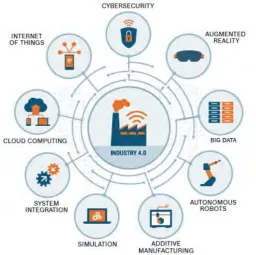
Henning et al. (2013) stated that Industry 4.0 as the current industry toward automation and data exchange in manufacturing technologies toward smart industries. Industry 4.0 is the view of the industrial production of the future which consisted of 9 technologies that are aiming to transform the current industrial production to automated world.
[image:23.595.193.450.474.729.2]8 2.1.1 Cybersecurity
Ideally, the industry 4.0 requires a completely interconnected reality, but this same characteristic uncovers and unexpected vulnerability (ESA, 2017). This is because according to Cleverism (2017), with the increased connectivity in manufacturing, the risk of cyber threats and cyber attacks grow as well. It is therefore crucial for companies operating in industry 4.0 to focus on protection of computer systems from damage to information hardware or software and from disruption of the services provided (Booth Welsh, 2018).
2.1.2 Augmented Reality
Augmented reality is defined as a technology which combines real and virtual imagery, interactive in real time and registers the virtual imagery with the real world system. This can help in fast decision-making and for improving work processes (The Hive, 2018). The technology use to perform augmented reality such as mobile phone or tablets will provide more flexibility, adaptability, improvement and competitiveness of the human factor and continuous improvement (Cleverism, 2017).
2.1.3 Big Data