White Rose Research Online URL for this paper: http://eprints.whiterose.ac.uk/132563/
Version: Accepted Version Article:
Berrios, R., Totterdell, P. orcid.org/0000-0002-5335-2611 and Kellett, S. (2018) Silver linings in the face of temptations: how mixed emotions promote self-control efforts in response to goal conflict. Motivation and Emotion. pp. 1-11. ISSN 0146-7239
https://doi.org/10.1007/s11031-018-9707-1
[email protected] https://eprints.whiterose.ac.uk/ Reuse
Items deposited in White Rose Research Online are protected by copyright, with all rights reserved unless indicated otherwise. They may be downloaded and/or printed for private study, or other acts as permitted by national copyright laws. The publisher or other rights holders may allow further reproduction and re-use of the full text version. This is indicated by the licence information on the White Rose Research Online record for the item.
Takedown
If you consider content in White Rose Research Online to be in breach of UK law, please notify us by
Berrios, R., Totterdell, P., & Kellett, S. (2018). Silver linings in the face of temptations: How mixed emotions promote self-control efforts in response to goal conflict. Motivation and Emotion. doi:10.1007/s11031-018-9707-1
Abstract
Choosing between conflicting goals is a frequent yet difficult problem, especially when temptations are involved because self-control effort is required to overcome them. This
study investigated whether experiencing mixed emotions in response to goal conflict can facilitate the necessary self-control effort needed to resist temptations. A sample of 73 individuals participated in an intensive longitudinal study, completing several
measures 4 times a day during ten consecutive days, producing over 2,500 observations. Results derived from using multilevel structural equation modeling confirmed that
mixed emotions mediated the relationship between perceived goal conflict and
intentions to resist temptations, over and above the influence of single positive emotions or negative emotions, and trait levels of self-control. Implication of these findings for
collaboration and the impact of mixed emotions in more general social dilemmas are explored.
Silver linings in the face of temptations: How mixed emotions promote self-control efforts in response to goal conflict
Most people face an uphill struggle to achieve their long-term goals, in both
work life (Latham, Stajkovic, & Locke, 2010) and personal life (e.g., Norcross, Ratzin, & Payne, 1989). In part, this happens because people tend to privilege short-term goals in spite of more relevant, meaningful long-term goals, which leads to repeated
self-control failures (Baumeister & Heatherton, 1996). Self-self-control failures have been associated with several negative outcomes, including poor performance and unethical
behavior at work (Ariely & Wertenbroch, 2002; Gino, Schweitzer, Mead, & Ariely, 2011). This study investigates whether experiencing a mixture of emotions can contribute to a more efficacious response to goal conflict decisions that involve
temptation.
Research has previously established that certain cognitive strategies can positively influence people’s ability to resist temptations and favor long-lasting goals.
For example, high cognitive load can reduce the influence of short-term goals on
behavior (Van Dillen, Papies, & Hofmann, 2013). Similarly, the capacity to consciously
inhibit impulsive responses or direct attentional control toward long-term goals can facilitate impulsive control (Hofman, Friese, & Roefs, 2009). Contrasting with these
previous cognitive-based approaches, recent theory has focused on control as part of an emotion process in which emotion alerts individuals of the need to self-control and energizes its execution (Inzlicht, Bartholow, & Hirsh, 2015; Inzlicht, Legault, & Teper,
2014).
The present research adopts an emotion-driven conception of self-control to suggest that mixed emotions, in particular, positively influence people’s efforts to resist
co-activation of emotions of opposite valence, such as feeling happiness and sadness
(Larsen & McGraw, 2011; Larsen, McGraw, & Cacioppo, 2001; Schimmack, 2001). Some authors have also studied mixed emotions as an individual difference, in which
some individuals are more prone to experience positive and negative emotions
simultaneously (Rafaeli, Rogers, & Revelle, 2007; Wilt, Funkhouser, & Revelle, 2011).
Different theoretical models of mixed emotions have suggested that
experiencing mixed emotions facilitates the integration of complex information in a given moment (Cacioppo, Larsen, Smith, & Bernston, 2004; Oatley & Johnson-Laird,
1996; Zautra, 2003). This assertion is consistent with recent research showing that individuals experiencing mixed emotions when making predictions about weather or general knowledge were more accurate compared to people experiencing positive or
negative emotions alone (Rees, Rothman, Lehavy, & Sanchez-Burks, 2013). Evidence has shown that mixed emotions arise from goal conflicts (Berrios, Totterdell, & Kellett,
2015a; Berrios, Totterdell, & Kellett, 2017), and managing temptations has been in turn conceptualized as a form of goal conflict resolution (Mischel, 1974; Mischel et al., 1989). Thus, it is postulated that mixed emotions may promote self-control efforts
during conflict resolution by allowing consideration of differently valenced information.
Goal conflict and self-control
Researchers have construed self-control dilemmas as conflicts between two motives or goals ever since the classic studies of willpower (Mischel, 1974; Mischel et al., 1989). Scholer and Higgins (2010) argued that although goal conflict observed
during self-control dilemmas often corresponds to one high-order, meaningful goal (e.g., lose weight) colliding with a low-order temptation (e.g., eat chocolate), other
with a valued immediate goal such as getting home in time to eat dinner with the
children. In accordance with this account, Fujita (2011) defined a dual-motive
conceptualization of self-control that involves the prioritization of long-term goals over
proximal competing motivations, rather than the effortful inhibition of impulses.
Recent interpretations of self-control dilemmas have understood that the critical feature when facing temptations is managing and addressing the inherent conflict with
other goals (Hofmann & Van Dillen, 2012; Mysreth & Fishbach, 2009; Scholer & Higgins, 2010). Critically, the two-stage model of self-control (Myrseth & Fishbach,
2009) argues that the first stage involved in successfully regulating behavior is the identification of goal conflict. Conflict identification further depends on whether individuals see their desires as a potential impediment to the achievement of other
goals, in which case it becomes a temptation (Myrseth & Fishbach, 2009). Perceiving a desire, such as wanting a rest, is not tempting in isolation from another goal; whereas
perceiving it as impeding a work goal involves conflict identification and increases the probability of displaying self-control strategies and pursuit of the work goal (Fishbach & Converse, 2011). Hofmann and colleagues (Hofmann, Baumeister, Förster, & Vohs,
2012) have found that the perception of goal conflict is a signal that recruits self-control resources (i.e., resistance), which in turn, helps individuals to prevent self-indulgence in
the presence of immediate desires.
Goal conflict, mixed emotions and self-control
Previous research has shown that mixed emotions are elicited following the
perception of goal conflict (Berrios et al., 2015a; Berrios et al., 2017). For example, in one study Berrios and colleagues (2015a, Study 2) asked a group of participants to
whereas another group recalled an event where personal goals facilitated each other
(e.g., trying to lose weight, while wanting some salad). Results showed that participants recalling conflicting goals reported greater levels of mixed emotions, compared to
people recalling facilitating goals. Other studies have revealed that mixed emotions are commonly experienced during social dilemmas, which represent a form of goal conflict (Schniter, Sheremeta, & Shields, 2015).
Given that previous research has shown that perception of goal conflict is also a key step for exerting effective self-control efforts (Hofmann & Van Dillen, 2012), the
question therefore arises as to what role mixed emotions might play in self-control efforts. Theory and empirical research converge in suggesting that the processing of complex information, such as conflicting motives or social dilemmas, demands
particular emotional responses exceeding common characterization of affect between positive and negative emotions (Berrios et al., 2015a, 2017; Scniter et al., 2015).
Therefore, investigating whether mixed emotions can help people to deliver more efficacious decisions in response to goal conflict that involves temptation represents a relevant question in the study of the relationship between goal-directed behavior and
emotions.
When goal conflict occurs, a decision is required to choose between the
alternative courses of action that would achieve the competing goals. People often consult their emotions when deciding about which course of action to pursue because emotions motivate individuals to follow actions that will attain desired ends or avoid
undesirable ones (Frijda, 1988; Schwarz & Clore, 2003; Zeelenberg et al., 2008). The influence of affective experiences on decisions seems to largely depend on the
decision (Forgas, 1995). Conflicting goals represent complex events which demand
elaboration of multiple stimuli at once and are therefore amenable to affective influence.
If affective experiences carry useful information that assist individual’s decision-making (Schwarz & Clore, 1983; Schwarz & Clore, 2003), and mixed emotions arise from goal conflict (Berrios et al., 2015a; Berrios et al., 2017), it is plausible that mixed emotions may provide information that helps individuals exert
self-control to resist temptations.
The idea that emotion-related constructs may be related to self-control is not
new, although the evidence is inconsistent. For example, some studies have shown that the negatively valenced emotions of pride and guilt predict self-control efforts
(Hofmann & Fisher, 2012), and that negative self-conscious emotions (e.g., regret,
shame) are associated with higher levels of actual resistance in response to delayed-cost
dilemmas (e.g., eating something tasty but unhealthy; Giner-Sorolla, 2001). Other
authors have shown that positive affect improves self-control (Aspinwall, 1998;
Raghunathan & Trope, 2002); whilst Wegener and Petty (1994, 2001) found that
positive affect undermines self-control.
Attempts to reconcile these discrepancies have suggested that emotions provide a signal to adopt or reject an accessible goal depending on whether they are associated
with a high or low order goal (Fishbach & Labroo, 2007). Thus, positive affect should promote self-control when high-order goals are accessible (e.g., try to have a healthier
life-style), but not when low-order goals are accessible (e.g., try to choose salad instead
of a burger). Other approaches have suggested that people actively down-regulate the pleasant emotions elicited in the presence of temptations to reduce the impact of the
2014) suggests that the distress arising from goal conflict signals the presence of
temptation and initiates efforts to reduce the unpleasant feeling.
Contrasting with the aforementioned approaches, we suggest that it may be the experience of mixed positive and negative emotions –rather than whether they are
positive or negative or regulated– that is critical in explaining the influence of emotions on self-control efforts. Preliminary evidence that mixed emotions may be involved
during the resolution of self-control dilemmas has emerged from the field of consumer behavior. Research has shown that purchasing unwanted items can elicit mixed
emotions (Mukhopadhyay & Johar, 2007), and that impulsive and prudent consumers experience mixed emotions after engaging in self-indulgent behavior (eating a chocolate cookie; Ramanathan & Williams, 2007). However, this research has only shown that
mixed emotions can result from yielding to temptations, but until now research has not investigated how mixed emotions may be involved in promoting self-control efforts.
The present research
The current research sought to determine whether mixed emotions play a role in self-control. Mixed emotions are seen as an affective experience that is elicited by the
presence of conflicting goals (Berrios et al., 2015a, 2017), and as such may signal the need for self-control. One circumstance in which self-control is required in response to
goal conflict occurs when an immediate desire is identified as conflicting with an active valued goal and therefore becomes a temptation. Taking into account previous
conceptualizations relating goal conflict identification and self-control (Fishbach &
Converse, 2011; Fujita, 2011; Hofmann et al., 2012; Hofmann & Van Dillen, 2012; Myrseth & Fishbach, 2009), we hypothesized that (H1) mixed emotions will mediate
Most of the theoretical frameworks anticipating an association between
goal-conflict and self-control suggest the influence of goal goal-conflict perception on self-control
during episodes involving self-control dilemmas (Fishbach & Converse, 2011; Fujita,
2011; Hofmann et al., 2012; Hofmann & Van Dillen, 2012; Myrseth & Fishbach, 2009).
Moreover, current evidence linking goal-conflict and mixed emotions has been based on
the experience of mixed emotions in-the-moment (e.g., Berrios et al., 2015a).
Consequently we expect H1 to apply to occasions on which goal conflict and mixed
emotions are experienced, rather than to individual differences in their experience.
This hypothesis was therefore studied using an experience sampling design
involving 73 participants who completed measures of goal conflict, mixed emotions, and self-control effort four times a day for 10 consecutive days. Both the procedure and analysis implemented are further explained in the following section.
Method Participants
Seventy three undergraduate and postgraduate students (58 female, Mage = 20.5
years; SD = 3.6 years) took part in the study. Participants were recruited from a list of student volunteers in exchange for £10 ($14) in cash, and from an online research
participation system in exchange for course credits. Potential volunteers were informed that the study aimed to understand how people manage their desires and personal goals,
Measures
Baseline questionnaire measures
Participants completed a questionnaire containing a number of validated scales
during an orientation meeting.
Psychological well-being scale (PWB; Ryff, 1989). This scale measured the extent to which individuals perceived their lives to be meaningful, worthwhile, in
balance with their needs, and as having positive relations with other people. The PWB operationalizes psychological well-being along six dimensions: autonomy (e.g., “Being
happy with myself is more important to me than having others approve of me”),
environmental mastery (e.g., “In general, I feel I am in charge of the situation in which
I live”), personal growth (e.g., “In my view, people of every age are able to continue
growing and developing”), positive relations with others (e.g., “I feel like I get a lot out
of my friendships”), purpose in life (e.g., “I have a sense of direction and purpose in
life”), and self-acceptance (e.g., “In general, I feel confident and positive about
myself”). Each dimension was assessed using 9-items. All of the items were measured
on a 6-point Likert-format scale ranging from strongly disagree (1) to strongly agree
(6). Overall, the subscales had good internal reliability indices (autonomy: M = 3.92; SD = 0.70; = 0.77; environmental mastery: M = 4.20; SD = 0.75; = 0.83; personal
growth: M = 4.89; SD = 0.58; = 0.77; positive relations: M = 4.56; SD = 0.79; = 0.82; purpose in life: M = 4.59; SD = 0.73; = 0.79; self-acceptance: M = 4.19; SD = 0.90; = 0.86), as did the overall psychological well-being construct which included all
of the items (M = 4.39; SD = 0.55; = 0.93).
broad range of self-control dilemmas (e.g., impulse control, control over thoughts).
Participants evaluated the extent to which each of the 13-items reflected how they typically are (e.g., “I wish I had more self-discipline”; M = 3.12; SD = 0.53; = 0.82). All of the items were measured on a 5-point Likert-format scale ranging from not at all (1) to very much (5).
Experience sampling measures
Desires (temptations). Participants were asked to indicate whether they had experienced a desire over the last 30 minutes (Yes/No format). A desire was defined as
an immediate need or impulse that emerges suddenly in the mind and is not related to current activities. Following the recommendations of Hofmann et al. (2012),
participants who indicated experiencing a desire were provided with a list including 10 desire domains: eating, taking substances – such as coffee, sexual desire, use of media –
such as Facebook, spending, social contact, leisure, hygiene/maintenance – such as sports, study/work, and sleep. Participants could choose up to three desires on every occasion (using a Yes/No format) and then had to rate the strength of the chosen desires on a scale ranging from not at all (1) to irresistible (5). Participants were also asked to
indicate the extent to which they tried to resist this/these desire/s, using a single item
(“How much have you tried to resist this/these desire/s?”) on a scale ranging from not
at all (1) to very much (6). Resistance was measured after measuring mixed emotions.
Conflicting goals scale. This scale was based on Emmons and King’s (1988) instrumentality matrix. The scale comprised three items which evaluated the extent to
which recent activity/activities (or desire/s) over the last 30-minutes had been in conflict with an important goal (e.g., “[this/these desire/s (activity/ies)] had harmful effects over
a goal you've been trying to achieve”; “[this/these desire/s (activity/ies)] have been
(activity/ies)] have been in conflict with a goal important for you”;M = 2.22; SD =
1.08). All of the items were measured on a 5-point Likert-format scale ranging from not at all (1) to very much (5). The longitudinal reliability of this scale (using the coefficient
omega; Shrout & Lane, 2012) was very good ( = 0.83).
Participants who reported a degree of goal conflict greater than 1 on the goal conflict scale were asked to indicate the type of goal or goals (if more than one) that
were in conflict with the desire/s (or activity/activities, if no desire was reported). Following the recommendations of Hofmann et al. (2012), they chose up to three goals (in a Yes/No format) from a list of seven goal categories: health – such as healthy eating,
abstinence/restraint – such as not drinking, achievement – such as academic achievements, social – such as moral integrity, time use – such as reducing
procrastination, relaxation – such as reducing stress, and energizing – such as trying to
wake yourself up. After they chose the relevant goal/s from the list, participants rated
the importance of the chosen goal/s using a scale ranging from not at all important (1) to very important (5).
Subjective measure of mixed emotions. On each occasion participants
completed a subjective measure of mixed emotions (Berrios et al., 2015a). This measure included four items designed to measure the extent to which participants had
experienced mixed emotions over the last 30-minutes (e.g., “I experienced contrasting
emotions (positive and negative emotions)”; M = 2.59; SD = 0.98). All of the items
were measured on a 5-point Likert-format scale ranging from not at all (1) to very much
(5). The longitudinal reliability was very good ( = 0.81).
Affect. Finally, participants completed a short measure of state positive and
pleased, enjoyment; M = 2.76; SD = 1.15) and five negative affect adjectives (NA;
depressed, unhappy, frustrated, angry, and worried; M = 1.77; SD = .89) at the very moment that they were completing the scale. Each dimension showed good longitudinal
reliability (PA: = 0.87; NA: = 0.79, respectively). All of the items were measured on a 6-point Likert-format scale ranging from not at all (1) to extremely (6).
Procedure
Participants attended an orientation meeting where they were informed about the aims of the study. All participants consented to participate in the study and completed
the set of baseline questionnaires previously described. Participants also received oral and written instructions about the specific details of the study, including the procedures that they would need to follow during the study, and what to do in case of problems or
queries. The meaning of desires and goals was explained to prevent potential
misunderstandings derived from idiosyncratic interpretations of these concepts. These
explanations were accompanied by some examples to ensure understanding of the concepts. Participants were asked to start the experience sampling period on the first Monday following the day of the meeting. They received a unique identification number
which they provided each time they completed a questionnaire
Experience sampling protocol. Participants used their own cell phones during
the experience sampling period of ten consecutive days. Every day, they received four text messages during a time interval of ten waking hours. This number of messages per day is consistent with recent experience sampling studies investigating goal conflict in
the context of self-control efforts (Hofmann et al., 2012). Following the
recommendations of Hektner et al. (2007), this time interval was divided into four
criterion that there had to be at least 1 hour in-between texts. Each text message
contained a web-link which took participants to an online questionnaire.
When participants accessed the online questionnaire, they were asked to indicate
whether they had experienced a desire over the last 30 minutes. If so, they completed
the desires measure. If not, they evaluated the degree of importance of the activities that
they had performed over the last 30-minutes using three items (e.g., “…something that
benefits you or others in the long run”), on a scale ranging from not at all (1) to very
much (6). This was done to equate the length of the questionnaire regardless of whether
or not participants had experienced a desire.
Participants then completed the conflicting goals scale. If they had reported a
desire, the scale was phrased to ask about conflict between their immediate desires and
a relevant goal; whereas if they did not report a desire, the scale was phrased to ask
about conflict between their current goals. Next, participants completed the subjective
measure of mixed emotions. At this point, those participants who had reported
experiencing a desire indicated the extent to which they tried to resist the desire/s.
Those participants who had reported a degree of goal conflict greater than 1 on the goal
conflict scale were then asked to report on the content and importance of the goals.
Finally, participants completed the state affect measure. On average, participants took 7
minutes to complete each experience sampling questionnaire.
Response details. If a participant left a questionnaire unanswered or started the questionnaire (entered his/her unique number) but did not complete any question until
the next text was sent, the response was marked as missing. Responses were coded as valid when the participant completed the majority of the questionnaire within the
questionnaires were completed per participant, the participant was invited to extend
his/her participation for up to one day if s/he completed less than 30% of the questionnaires throughout the study. In order to obtain a satisfactory response rate
throughout the study, the participants received text messages every day after the last time block ended (between 20:00 and 21:00 hours) to remind them to keep completing the questionnaires.
On average, participants completed 90% of the questionnaires embedded in the text messages sent every day. The remaining 10% of the questionnaires were either not
responded to at all or remained uncompleted. Response rates for individual participants varied between 60% and 100% of the total number of questionnaires expected for each day. Overall, participants provided a total of 2,619 observations. This constitutes
adequate power for an intensive longitudinal study (Bolger, Stadler, & Laurenceau, 2012).
Data analysis
The mediation analysis was conducted using Multilevel Structural Equation Modelling (MSEM; Preacher, Zhang, & Zyphur, 2011; Preacher, Zyphur & Zhang,
2010). A mediational model using MSEM was preferred because it allows unbiased estimation of indirect effects, preventing conflation resulting from using hierarchical
data where both level-1 and level-2 effects are present. In this model, separate level-2 and level-1 models of the hypothesized model were estimated as latent variables to account for measurement errors, preventing conflation between level-2 and level-1
components of the main effects. Separating and estimating direct and indirect effects for each level, reduces biases that result when alternative approaches are used (i.e., MLM
al., 2011; Preacher et al., 2010). These analyses were conducted using Mplus 8 (Muthén
& Muthén, 2012).
We implemented a sensitivity analysis using Mplus (Muthén, 2011),
incorporating relevant covariates in the model. We followed Imai et al.’ (2010a, b) to
conduct the sensitivity analysis. Although sensitivity analysis cannot currently be
combined within the MSEM framework separating the level-1 and level-2 effects, it
provides an additional commensuration of the potential biases present when testing a
mediation. Further details are provided in the corresponding results section.
Results
To assess whether fluctuations in mixed emotions experience mediated the relationship between goal conflict and efforts to resist temptations, a multilevel
structural equation model (MSEM) using maximum likelihood was specified, including goal conflict (GC) and mixed emotions (ME) as predictors of efforts to resist
temptations (RT). In this analysis, the between components were separated from the within components by creating random intercepts and slopes for each association (i.e.,
GC RT; GC ME; ME RT) using the observed scores of each variable. The
model also involved the estimation of separate residual variances for each component at both levels. Thus, the estimation of the lower-level mediation parameters was calculated
as follows: the paths GC RT, GC ME,ME RT equaled the estimates of the means of the corresponding slopes; the indirect effect equaled the multiplicative term between the paths aw and bw plus the covariance between the slopes of ab and bb.
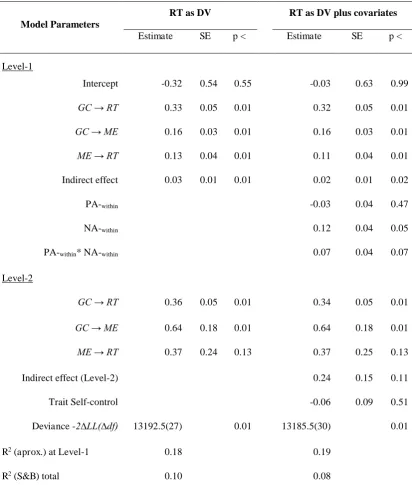
Findings using this mediational model demonstrated that occasions where higher goal conflict was perceived were associated with greater efforts to resist temptations,
cw= 0.33, SE = 0.05, p < 0.01 [95%CI: 0.26 / 0.41]. The results showed that occasions
with greater levels of mixed emotions, aw = 0.16, SE = 0.03, p < .01 [95%CI: 0.12 /
0.20], and showed that stronger experiences of mixed emotions were positively associated with greater efforts to resist temptations, bw = 0.13, SE = 0.04, p < 0.01
[95%CI: 0.07 / 0.20]. More importantly, the effect of goal conflict on effort to resist temptation was mediated by the experience of mixed emotions because the indirect effect of goal conflict on effort to resist temptation via mixed emotions was significant,
c’w = 0.03, SE = 0.01, p < 0.01 [95%CI: 0.01 / 0.05], with an 8% mediated effect. The fit of the mediation model was good, with a deviance significantly better than the null
model, -2∆LL = 112.7 (2), p < 0.01. These results indicated that the elicitation of mixed emotions in response to goal conflict was a proximal predictor of self-control efforts, which supported hypothesis 1.
Trait self-control and affect variables were introduced into the previous model as control variables; the interaction between PA and NA was also included in the model to
examine the possibility that it is the interaction between positive and negative affect
what drives the influence on self-control efforts. As shown in Table 2 (column labelled as “RT as DV”), the results revealed a non-significant effect of trait self-control on
efforts to resist temptations (p = 0.51). This model also incorporated within-person centered versions of positive affect (PA) and negative affect (NA) at level-1 to examine
the influence of occasions when participants experienced greater PA or NA on efforts to resist temptations. Results demonstrated that PA did not predict greater efforts to resist temptations on a given occasion (p = 0.47), whereas occasions when participants
experienced higher levels of NA positively predicted greater efforts to resist
temptations, = 0.09, SE = 0.04, p < 0.05 [95%CI: 0.01 / 0.16]; the interaction between
0.05 [95%CI: 0.01 / 0.04], as well as the effect of mixed emotions on efforts to resist
temptations, bw= 0.11, SE = 0.04, p < 0.01 [95%CI: 0.05 / 0.18]. As shown in Table 2,
the fit of the mediational model including the three additional variables was good and
the entire model explained R2 = 0.19 of the variance at level-1. In order to facilitate the visualization of the entire model (i.e., including the mediation and controlling
variables), a summary is shown in Figure 1, incorporating all of the main effects tested.
Given that the analytical framework allows us to disentangle mediation
occurring both at level-1 and at level-2, we tested whether a model involving the same
variables used in the previous model but at level-2 (i.e., as individual differences
variables) would account for the same mediation effect of mixed emotions on the
relationship between goal-conflict perception and self-control efforts. Results in this
regard do not support a mediation. Although, it was found that average levels of goal
conflict identification was associated with individual differences in self-control efforts,
= 0.34 SE = 0.05, p < 0.01 [95%CI: 0.27 / 0.42], and that average levels of mixed
emotions were associated to self-control efforts, too, = 0.64 SE = 0.18, p < 0.01
[95%CI: 0.34 / 0.94], the indirect effect at the between-level of analysis was not
statistically significantly different from zero, = 0.14 SE = 0.15, p = 0.11 [95%CI:
-0.10 / 0.49].
Sensitivity Analysis
We tested residual correlations between the mediator mixed emotions and the
dependent variable, self-control efforts, within a range between -0.7 and 0.7, to observe
the robustness of the indirect and direct effects (see Figure 2). In this analysis we
included as covariates PA, NA and the interaction term between both. We also included
as covariates trait levels of self-control, age and gender. Mixed emotions, in turn, were
we controlled for all potential alternative contributions that may explain the influence of
mixed emotions on self-control efforts. Bootstrap estimation based on 10,000
resamples, and within-person variables were used, to identify the hypothesized
mediation model at level-1.
The sample correlation of the residuals between mixed emotions and self-control
efforts for this model was = 0.09, [95%CI: 0.04 / 0.14]. At = 0 the indirect effect
was equal 0.02, p < 0.01 [95%CI: 0.01 / 0.03], whereas the direct effect = 0.34, p < 0.01
[95%CI: 0.28 / 0.40]. At = 0.4 (the lower threshold of the confidence intervals) the
indirect effect was equal 0.01, p < 0.05 [95%CI: 0.001 / 0.023], whereas the direct
effect = 0.34, p < 0.01 [95%CI: 0.29 / 0.40]. And finally at = 0.14 (the upper
threshold) the indirect effect was equal -0.01, p > 0.05 [95%CI: -0.02 / 0.001], missing
the indirect effect.
A broader interpretation can be observed in Figure 2, where different values of
rho and the corresponding indirect effect are depicted. Thus, if the hypothetical
correlation of the residuals between mixed emotions and self-control is negative, the
indirect effect remains robust; whereas the unknown needs to be lower than 0.05 to
result in a statistically significant indirect effect. Given that the true sample value for
= 0.09, it is likely that the mediation effect of mixed emotions on the association
between goal conflict and self-control efforts may be trustworthy, although weak,
considering that it only covers the lower limit of the defined confidence interval.
Discussion
The present study investigated whether experiencing mixed emotions contributes
to greater self-control effort responding for goal conflict decisions that involve
emotions are a meaningful affective response in the face of temptations that may
effectively facilitate self-control efforts.
This is the first study to attempt to reconcile divergent evidence on the role of
affective experiences in self-control by introducing the contribution of mixed emotions.
Previous research has focused on the interaction between positive emotions and
individual’s goal hierarchy to explain discrepancies in the data linking positive
emotions and self-control (Fishbach & Labroo, 2007). Other authors have suggested
that negative emotions drive efforts to resist temptations (InzInzlicht & Legault, 2014).
In this exploratory study we suggested that one potential path to reconcile these
divergent approaches is to consider the influence of mixed emotions on self-control
efforts. We did so by observing that a well-established set of theory and data suggesting
that goal conflict instigates efforts to resist temptations (Fishbach & Converse, 2011;
Fujita, 2011; Hofmann et al., 2012; Hofmann & Van Dillen, 2012; Myrseth & Fishbach,
2009) parallels recent studies indicating that goal conflict gives rise to mixed emotions
(Berrios et al., 2015a, 2017; Scniter et al., 2015). We therefore considered it pertinent to
explore the possibility that mixed emotions may be a meaningful mediator of the
association between goal conflict and self-control efforts.
Furthermore, this study found that goal conflict is associated with efforts to
resist temptations. As already mentioned, this is consistent with recent theory and
research indicating that the identification of goal conflict is a necessary step in exerting
self-control (Fishbach et al., 2003; Hofmann et al., 2012; Mysreth & Fishbach, 2009),
including efforts to resist temptations (Carver & Scheier, 1982; Hofmann et al., 2012).
Results also showed that mixed emotions were associated with greater efforts to resist
temptations, and that mixed emotions mediated the relationship between goal conflict
In accordance with theories suggesting that self-control is driven by affective
impetus (Hofmann & Fisher, 2012; Inzlicht et al., 2015; Inzlicht & Legault, 2014; Inzlicht et al., 2014), the present study demonstrated that a proximal predictor of efforts
to resist temptations was the experience of mixed emotions elicited from the experience of goal conflict. The findings also demonstrated that the mediating effect of mixed emotions on the relationship between goal conflict and efforts to resist temptations
remained significant even after including state-positive affect, state-negative affect, and
trait-levels of self-control. A sensitivity analysis also showed that the indirect effect of
mixed emotions on the relationship between goal conflict and self-control efforts is
partially robust, which suggest that, within certain boundaries, alternative confounders
may not overturn the influence of mixed emotions on self-control efforts. Still, given the
exploratory nature of this study, further research is needed to appropriately account for
the effect of mixed emotions on self-control efforts.
These findings are relevant for two reasons. First, previous studies have
attempted to specify whether positive or negative emotions undermine or facilitate self-control efforts, but results have been inconsistent (Aspinwall, 1998; Hofmann & Fisher,
2012; Raghunathan & Trope, 2002; Wegener & Petty, 1994, 2001). Our results show a mediational effect of mixed emotions in the relationship between goal conflict and
efforts to resist temptations, which offers a plausible alternative interpretation of previous inconsistent findings and provides evidence for an unexplored path in understanding the relationship between emotions and self-control efforts. The present
findings suggest that one potential explanation for the inconsistency observed in previous research linking emotions and self-control efforts is that neither positive
individuals to balance the trade-offs of competing goals. Second, these results were
observed over and above levels of state-positive affect and state-negative affect, suggesting the unique contribution of mixed emotions in the goal regulation process.
Future research
Alongside previous theory linking mixed emotions with integration of incongruent streams of information (Cacioppo, Larsen, Smith, & Bernston, 2004;
Oatley & Johnson-Laird, 1996), present findings also suggest that mixed emotions may allow people to balance the benefits and drawbacks of multiple courses of actions,
which may explain the influence of mixed emotions on self-control efforts. The
consideration of alternative options may help people prioritise meaningful goals, which in turn, motivates attempts to resist temptations. Future studies should more directly
investigate whether mixed emotions actually help people to ponder multiple incompatible options, from which people can prioritize relevant courses of action.
The evidence concerning the role of complex emotional experiences instigating greater efforts of self-control in the context of conflicting goals, suggests a novel research avenue to examine how people can balance multiple demands and deal with
personal dilemmas. For example, in a recent theorization on ambivalence in organizations, Asforth and colleagues (2014) suggested that variables, such as role
conflicts (e.g., work-family conflicts) and multiple membership (e.g., balancing personal and others’ needs within a group), foster increasing levels of organizational
complexity and dynamism. Ashforth and colleagues (2014) further suggest that individuals’ responses to ambivalence at work can vary greatly, including avoidance,
domination, compromise and holism. Holism is suggested as the response which better
people implement holism at work is via experiencing greater levels of mixed emotions.
In this sense, holism may be understood as a form of self-regulation at work, where people balance between multiple courses of action during conflict.
This idea is consistent with previous research linking the experience of mixed emotions with increasing levels of judgment accuracy (Rees et al., 2013), which is closely related to the idea that holism is a form of exercising wisdom (Ashforth, Rogers,
Pratt, & Pradies, 2014). Thus, future research should investigate whether the experience of mixed emotions during conflict enables more adaptive decisions.
Second, future studies will need an experimental design to appropriately
demonstrate the mediational role of mixed emotion in the relationship between goal
conflict and self-control efforts. Specific guidelines as suggested by Preacher (2015)
may be useful to clarify the genuine contribution of mixed emotion to self-control. For
example, a blockage design could be implemented where goal conflict can be
manipulated, and the mixed emotions are measured, but adding a manipulation of mixed
emotions (presence versus absence) before observing the effect on self-control.
Finally, the findings may illuminate further strategies to enhance collaboration
between individuals. Previous research on self-control has shown that perceptions of conflict between selfish and pro-social motivations strengthen collaborative behaviors
(Martisson, Myrseth, & Wollbrant, 2012, 2014). Thus, future research should
investigate whether mixed emotions can also mediate the relationship between social dilemmas and collaboration.
Limitations
This study did not investigate whether efforts to resist temptations actually
whether mixed emotions influence actual restraint or self-indulgence. The evidence was
limited to efforts to resist temptations. One possibility is that mixed emotions do not directly influence self-control success or failure, but rather they determine the degree of
goal-commitment and goal-progress when conflict is detected.
Second, testing a mediational model on experience sampling data required some assumptions concerning causality which may not hold (Stone-Romero & Roposo,
2008). In particular, temporal precedence was not supported because all the variables in the mediation analysis were measured at the same time. In order to partially correct this
problem, the independent variable and mediator concerned experiences that had occurred within the last 30-minutes, whereas the dependent variable concerned current experience at the moment of completion.
Finally, the characteristics of the sample, as well as the limited number of categories of goal and desires, constrain the extent to which these findings can be
generalised. The sample mainly consisted of undergraduate and postgraduate students, whose goals and desires reflect the academic nature of their activities. Although there are reasons to believe that similar concerns could be observed at work as they were for
study in the current context. For example, the most common self-control dilemma was the conflict between achievement-related goals and leisure.
Conclusion
To conclude, the present research suggests that mixed emotions help people to display greater self-control efforts in response to goal conflict involving temptation.
self-control, suggesting that mixed emotions may help people maintain or find what is
personally meaningful in the face of a self-control dilemma.
Compliance with Ethical Standards
This research is supported by The National Fund for Scientific and Technological Development - FONDECYT - research grant number 11171158 and by Proyecto Basal
USACH USA1498_BR011127.
Ethical approval: All procedures performed in studies involving human participants
were in accordance with the ethical standards of the institutional and/or national
research committee and with the 1964 Helsinki declaration and its later amendments or comparable ethical standards.
References
Ashforth, B. E., Rogers, K. M., Pratt, M. G., & Pradies, C. (2014). Ambivalence in organizations: A multilevel approach. Organization Science, 25(5), 1453-1478.
Aspinwall, L. G. (1998). Rethinking the role of positive affect in self-regulation. Motivation and Emotion, 22(1), 1-32.
Baumeister, R. F. (2002). Yielding to temptation: Self control failure, impulsive
purchasing, and consumer behavior. Journal of Consumer Research, 28(4), 670-676.
Berrios, R., Totterdell, P., & Kellet, S. (2015a). Investigating goal conflict as a source
of mixed emotions. Cognition & Emotion, 29(4), 755-763.
Berrios, R., Totterdell, P., & Kellet, S. (2015b). Eliciting mixed emotions: a
meta-analysis comparing models, types, and measures. Frontiers in Psychology,6:428. Berrios, R., Totterdell, P., Kellet, S. (2018). When feeling mixed can be meaningful:
The effects of mixed emotions on eudaimonic well-being. Journal of Happiness
Studies, 19(3), 841-861.
Bolger, N., Stadler, G., & Laurenceau, J. (2012). Power analysis for intensive
longitudinal Studies. In M. R. Mehl & T. S. Conner (Eds.), Handbook of research methods for studying daily life (pp. 285-301). New York: Guilford Press.
Cacioppo, J. T., Larsen, J. T., Smith, N. K., & Berntson, G. G. (2004). The affect system: What lurks below the surface of feelings? In A. Manstead, N. Frijda,
Carver, C. S., & Scheier, M. F. (1982). Control theory: A useful conceptual framework for personality–social, clinical, and health psychology. Psychological Bulletin,
92(1), 111-135.
Emmons, R. A., & King, L. A. (1988). Conflict among personal strivings: immediate and long-term implications for psychological and physical well-being. Journal of Personality and Social Psychology, 54(6), 1040.
Ersner-Hershfield, H., Mikels, J. A., Sullivan, S. J., & Carstensen, L. L. (2008). Poignancy: Mixed emotional experience in the face of meaningful endings.
Journal of Personality and Social Psychology, 94(1), 158-167.
Fishbach, A., & Converse, B. A. (2011). Identifying and Battling Temptations. In K. D. Vohs & R. F. Baumeister (Eds.), Handbook of Self-Regulation (Second Edition;
pp. 244-260). New York, USA: Guilford Press.
Fishbach, A., & Labroo, A. A. (2007). Be better or be merry: How mood affects
self-control. Journal of Personality and Social Psychology, 93(2), 158-173. Forgas, J. P. (1995). Mood and judgment: the affect infusion model (AIM).
Psychological Bulletin, 117(1), 39-66.
Fujita, K. (2011). On conceptualizing self-control as more than the effortful inhibition of impulses. Personality and Social Psychology Review, 15(4), 352-366.
Giner-Sorolla, R. (2001). Guilty pleasures and grim necessities: Affective attitudes in dilemmas of self-control. Journal of Personality and Social Psychology, 80(2), 206-221.
Hektner, J. M., Schmidt, J. A., & Csikszentmihalyi, M. (2007). Experience sampling method: Measuring the quality of everyday life. Thousand Oaks, California:
Hofmann, W., Baumeister, R. F., Förster, G., & Vohs, K. D. (2012). Everyday
temptations: An experience sampling study of desire, conflict, and self-control. Journal of Personality and Social Psychology, 102(6), 1318-1335.
Hofmann, W., & Fisher, R. (2012). How Guilt and Pride Shape Subsequent Self-Control. Social Psychological and Personality Science, 3(6), 682-690. Hofmann, W., Friese, M., & Roefs, A. (2009). Three ways to resist temptation: The
independent contributions of executive attention, inhibitory control, and affect regulation to the impulse control of eating behavior. Journal of Experimental Social Psychology, 45(2), 431–435.
Hofmann, W., & Van Dillen, L. (2012). Desire: The new hot spot in Self-control research. Current Directions in Psychological Science, 21(5), 317-322.
Imai, K., Keele, L., & Tingley, D. (2010a). A general approach to causal mediation analysis. Psychological Methods, 15(4), 309.
Imai, K., Keele, L., & Yamamoto, T. (2010b). Identification, inference and sensitivity analysis for causal mediation effects. Statistical Science, 51-71.
Inzlicht, M., Bartholow, B. D., & Hirsh, J. B. (2015). Emotional foundations of
cognitive control. Trends in Cognitive Sciences, 19(3), 126-132.
Inzlicht, M., & Legault, L. (2014). No pain, no gain: How distress underlies effective
self-control (and unites diverse social psychological phenomena). In J. P. Forgas & E. Harmon-Jones (Eds.). Motivation and its regulation: the control within (pp. 115-132). New York, NY; USA: American Psychology Press.
Inzlicht, M., Legault, L., & Teper, R. (2014). Exploring the Mechanisms of Self-Control Improvement. Current Directions in Psychological Science, 23(4), 302-307.
Larsen, J. T., McGraw, A. P., & Cacioppo, J. T. (2001). Can people feel happy and sad
at the same time? Journal of Personality and Social Psychology, 81(4), 684-696. Metcalfe, J., & Mischel, W. (1999). A hot/cool-system analysis of delay of gratification:
Dynamics of willpower. Psychological Review, 106(1), 3-19.
Martinsson, P., Myrseth, K. O. R., & Wollbrant, C. (2012). Reconciling pro-social vs. selfish behavior: On the role of self-control. Judgment and Decision Making,
7(3), 304-315.
Martinsson, P., Myrseth, K. O. R., & Wollbrant, C. (2014). Social dilemmas: When
self-control benefits cooperation. Journal of Economic Psychology, 45, 213-236. Mukhopadhyay, A., & Johar, G. V. (2007). Tempted or not? The effect of recent
purchase history on responses to affective advertising. Journal of Consumer
Research, 33(4), 445-453.
Muthén, B. (2011). Applications of causally defined direct and indirect effects in
mediation analysis using SEM in Mplus. Submitted for publication.
Muthén, L. K., & Muthén, B. O. (1998-2012). Mplus User's Guide. Seventh Edition. Los Angeles, CA: Muthén & Muthén.
Myrseth, K. O. R., & Fishbach, A. (2009). Self-control a function of knowing when and how to exercise restraint. Current Directions in Psychological Science, 18(4),
247-252.
Oatley, K., & Johnson-Laird, P. N. (1996). The communicative theory of emotions: Empirical tests, mental models, and implications for social interaction. In
Martin, L. & Tesser, A. (Eds.) Striving and Feeling: Interaction among goals, affect, and se;f-regulation (pp. 363-393). Mahwah, New Jersey: Lawrence
Preacher, K. J. (2015). Advances in mediation analysis: A survey and synthesis of new
developments. Annual Review of Psychology, 66:825-852.
Preacher, K. J., Zhang, Z., & Zyphur, M. J. (2011). Alternative methods for assessing
mediation in multilevel data: The advantages of multilevel SEM. Structural Equation modeling, 18(2), 161-182.
Preacher, K. J., Zyphur, M. J., & Zhang, Z. (2010). A general multilevel SEM
framework for assessing multilevel mediation. Psychological Methods, 15(3), Rafaeli, E., Rogers, G. M., & Revelle, W. (2007). Affective synchrony: Individual
differences in mixed emotions. Personality and Social Psychology Bulletin, 33(7), 915-932.
Raghunathan, R., & Trope, Y. (2002). Walking the tightrope between feeling good and
being accurate: mood as a resource in processing persuasive messages. Journal of Personality and Social Psychology, 83(3), 510.
Ramanathan, S., & Williams, P. (2007). Immediate and delayed emotional
consequences of indulgence: The moderating influence of personality type on mixed emotions. Journal of Consumer Research, 34(2), 212-223.
Rees, L., Rothman, N. B., Lehavy, R., & Sanchez-Burks, J. (2013). The ambivalent mind can be a wise mind: Emotional ambivalence increases judgment accuracy.
Journal of Experimental Social Psychology, 49(3), 360-367.
Rothman, N., & Melwani, S. (2016). Feeling mixed, Ambivalent and in Flux: the social functions of emotional complexity for leaders. Academy of Management Review,
ahead of print.
Ryff, C. D. (1989). Happiness is everything, or is it? Explorations on the meaning of
Schimmack, U. (2001). Pleasure, displeasure, and mixed feelings: Are semantic
opposites mutually exclusive? Cognition & Emotion, 15(1), 81-97.
Schniter, E., Sheremeta, R. M., & Shields, T. W. (2015). Conflicted emotions following
trust-based interaction. Journal of Economic Psychology, 51, 48-65. Scholer, A., & Higgins, E. (2010). Conflict and control at different levels of
self-regulation. In Hassin, R. Ochsner, K. & Trope, Y. (Eds.) Self-control in society,
mind, and brain (312-334), NY, USA: Oxford University Press.
Shrout, P. E., & Lane, S. P. (2012). Psychometrics. In M. R. Mehl & T. S. Conner
(Eds.), Handbook of research methods for studying daily life (pp. 302-320). New York: Guilford Press.
Stone-Romero, E. F., & Roposa, P. J. (2008). The relative validity of inferences about
mediation as a function of research design characteristics. Organizational Research Methods, 11(2), 326-352.
Tangney, J. P., Baumeister, R. F., & Boone, A. L. (2004). High self control predicts
good adjustment, less pathology, better grades, and interpersonal success. Journal of Personality, 72(2), 271-324.
Tice, D. M., Bratslavsky, E., & Baumeister, R. F. (2001). Emotional distress regulation takes precedence over impulse control: if you feel bad, do it!. Journal of
personality and social psychology, 80(1), 53-67.
Van Dillen, L. F., Papies, E. K., & Hofmann, W. (2013). Turning a blind eye to temptation: how cognitive load can facilitate self-regulation. Journal of
Personality and Social Psychology, 104(3), 427-443.
Wegener, D. T., & Petty, R. E. (1994). Mood management across affective states: the hedonic contingency hypothesis. Journal of Personality and Social Psychology,
Wegener, D. T., & Petty, R. E. (2001). Understanding effects of mood through the
elaboration likelihood and flexible correction models. Theories of mood and cognition: A user’s guidebook, 177-210.
Table 1. Model of the mediating effect of mixed emotions in the relationship between
conflicting goals and self-control efforts.
Model Parameters
RT as DV RT as DV plus covariates
Estimate SE p < Estimate SE p <
Level-1
Intercept -0.32 0.54 0.55 -0.03 0.63 0.99
GC RT 0.33 0.05 0.01 0.32 0.05 0.01
GC ME 0.16 0.03 0.01 0.16 0.03 0.01
ME RT 0.13 0.04 0.01 0.11 0.04 0.01
Indirect effect 0.03 0.01 0.01 0.02 0.01 0.02
PA-within -0.03 0.04 0.47
NA-within 0.12 0.04 0.05
PA-within* NA-within 0.07 0.04 0.07
Level-2
GC RT 0.36 0.05 0.01 0.34 0.05 0.01
GC ME 0.64 0.18 0.01 0.64 0.18 0.01
ME RT 0.37 0.24 0.13 0.37 0.25 0.13
Indirect effect (Level-2) 0.24 0.15 0.11
Trait Self-control -0.06 0.09 0.51
Deviance -2∆LL(∆df) 13192.5(27) 0.01 13185.5(30) 0.01
R2 (aprox.) at Level-1 0.18 0.19
R2 (S&B) total 0.10 0.08
FIGURE CAPTIONS
Figure 1. Mediational model including trait self-control (SC) at Level-2 and PA and NA at
level-1 as competing predictors. Squares indicate an observed variable whereas circles indicate
latent constructs. Subscript “j” indicates a variable measured at level-2, whereas subscript “ij”
indicates a variable measured at level-1. Dotted lines indicate no statistically significant effects.
Figure 2. Sensitivity analysis of the indirect effect of mixed emotions on the relationship
between goal conflict and self-control efforts. The dotted lines represent the 95% confidence
interval for the mediation effects at each value of . The solid line represents the estimated
GCij
MEij
RTij
Level-2
Level-1
b
w= .11
SCj
PAij NAij