Rochester Institute of Technology
RIT Scholar Works
Theses
Thesis/Dissertation Collections
2-22-2005
Art and authenticity
Akihiko Miyoshi
Follow this and additional works at:
http://scholarworks.rit.edu/theses
This Thesis is brought to you for free and open access by the Thesis/Dissertation Collections at RIT Scholar Works. It has been accepted for inclusion in Theses by an authorized administrator of RIT Scholar Works. For more information, please [email protected].
Recommended Citation
ART AND AUTHENTICITY
BY
AKIHIKO MIYOSHI
THESIS
Submitted in Partial Fulfillment of the Requirements for the Degree of
Master of Fine Arts in Imaging Arts
Rochester Institute of Technology
J. Weiss
Jeff Weiss, Chair
Jessica Lieberman
Jessica Lieberman, Committee Advisor
Alexander Miokovic
Alexander Miokovic, Committee Advisor
Elliott Rubenstein
Elliott Rubenstein, Committee Advisor
February 22, 2005
Date
Date
Date
~
7
Thesis/Dissertation Author Permission Statement
Title of thesis or dissertation: _---'-A-'-R.=-:,._..LA..:..:N'-'-'t>"'---LA..>.;v~Th.J...I..Lt:~N_~]iL.!.\-=::L.Ln.L'f~ _ _ _ _ _ _ _
Name of author:
AK, \-\
'Ko
Yl\'(oSH I
nAstER Of E
h.IE M16
Degree: Program: College:
I understand that I must submit a print copy of my thesis or dissertation to the RIT Archives, per current RIT guidelines for the completion of my degree. I hereby grant to the Rochester Institute of Technology and its agents the non-exclusive license to archive and make accessible my thesis or dissertation in whole or in part in all forms of media in perpetuity. I retain all other ownership rights to the copyright of the thesis or dissertation. I also retain the right to use in future works (such as articles or books) all or part of this thesis or dissertation.
Print Reproduction Permission Granted:
I,
d-KI
H
t1<0
H l'ruSH ,
,
hereby grant permission to the Rochester Institute Technology to reproduce my print thesis or dissertation in whole or in part. Any reproduction will not be for commercial use or profit.Signature of Author:
Akihiko Miyoshi
Date:3/1( IDS
Print Reproduction Permission Denied:
I, , hereby deny permission to the RIT Library of the Rochester Institute of Technology to reproduce my print thesis or dissertation in whole or in part.
Signature of Author: _ _ _ _ _ _ _ _ _ _ _ _ _ _ _ _ _ _ Date: _ _ _ _ _
Inclusion in the RIT Digital Media Library Electronic Thesis &
Dissertation (ETD) Archive
I, , additionally grant to the Rochester Institute of Technology Digital Media Library (RIT DML) the non-exclusive license to archive and provide electronic access to my thesis or dissertation in whole or in part in all forms of media in perpetuity.
I understand that my work, in addition to its bibliographic record and abstract, will be available to the world-wide community of scholars and researchers through the RIT DML. I retain all other ownership rights to the copyright of the thesis or dissertation. I also retain the right to use in future works (such as articles or books) all or part of this thesis or dissertation. I am aware that the Rochester Institute of Technology does not require registration of copyright for ETDs.
I hereby certify that, if appropriate, I have obtained and attached written permission statements from the owners of each third party copyrighted matter to be included in my thesis or dissertation. I certify that the version I submitted is the same as that approved by my committee.
ACKNOWLEDGMENTS
I am greatly indebted to JeffWeiss, my thesis chair for introducing me to the ideas of
contemporaryart. He was always there to challenge me, confuse me, push me, inform me,
guide me, support me, and ask the questions that needed tobe asked. Most ofall, I would
like to thankhim for his friendship and for sharing his enthusiasm.
Iwishtoexpressmygratitudeto mycommitteemembers, JessicaLieberman, Alexander
Miokovic, andElliott Rubenstein fortheirsupport and advice. Their assistance and advice
was invaluable. Jessica, with her humorand immense knowledge directedme toinvestigate
new ideas. Alex gaveme support throughout the art makingprocess, andhis experience as
curatorwasextremely helpfulwhenputting my MFAshow up. Elliott,always unpredictable
andwithgreat intuition, kept me onmy toesand allowed meto discoverthings in mywork
that I did not see for myself.
I would also like to thank Willie Osterman for his support and friendship throughout
my studies at RIT. Heartfelt thanks goes toall my colleagues and friends at RIT.
ART
AND AUTHENTICITYBY
AKIHIKO MIYOSHI
ABSTRACT
My MFA thesis show, After the Last Picture Show, depicted my inquiry into what
pictures and images are today. Inthis thesis, starting from the formalist tradition offine
art photography, I deconstruct photography into elementsbasedon theclassicaldichotomy
of form and content and discuss how the photographic image has dislodged itself from its
material base. Subsequently, I question the objectiveof art in an age in which images are
information, and in which information is instantly exchanged. I use authenticity as the
guiding light in my art and attempt to confront the doubts that linger in our
simulation-based society.
Further, Istartaninquiryintothe relationshipbetweenthecomputerandart. Iattempt
toprovide an observation ofthecomputer intermsofitselfas opposedto themorefrequent
approach ofanalyzing it as a medium to simulate exisitingtools. I argue that the essence
ofthe computer is abstract, and I describethe conflict betweenthis abstract nature ofthe
computer and the physicality that art demands.
TABLE OF CONTENTS
1 After Photography 1
1.1 Auraand Objectness 2
1.2 Objectness ofPhotographs 5
1.3 Photographs asInformation 7
1.4 Doubts within Photography 8
1.5 From Photography 11
1.6 Authenticity 12
1.7 The Banal 15
2 The Relationship Between Computers and Art 18
2.1 The Dilemmaofthe Computer 20
2.2 TheAbstract and its Physicality 22
2.3 IntersectionofMedia 25
2.4 ExpansionofInterfaces 27
3 Conclusion: Art and Authenticity 29
LIST OF FIGURES
1 Ode to the Pictorialists, Mixed Media, 2004 11
2 Woman, Oil andAcrylic on Canvas, 40x54 in, 2004 16
3 Still Life, Oil on Canvas, 40x52 in, 2004 16
4 Landscape, Acrylic on Canvas, 40x58 in, 2004 17
5 Pictures, Mixed Media, 2004 17
6 Reading the New York Times, Aug 13. 2003, 2003, Inkjet Print, 2003 ... 26
7 Detail: Reading the New York Times, Aug 13. 2003, 2003, Inkjet Print, 2003 26
8 Detail: Reading the New York Times, Aug 13. 2003, 2003, Inkjet Print, 2003 27
1 After
Photography
IrememberthetimewhentheCanadianphotographerEdBurtenskyvisitedRITandtalked
to us graduate students. Heshowed us his work, which he brought rolledup inside atube.
His photographs were large or medium in scale, shot with a large format camera, and his
images were in color, veryformal with rigid composition, and ofindustrial landscapes.
Something
hit me while he took therolledprints from the tube. In mymind, I thought,"They arealljust posters."
For me, posters by themselves were not art objects. Theywere
somethingonewouldput on awalltemporarily, andtheneventuallythrowaway. Hetreated
them as though they were posters too, presumably because they were just test prints for
him. As he talked about his work, he generouslythrew around the 40 by 60 inch prints on
the table.
If photographs were to be churned out infinitely on an inkjet printer, even the highly
formal, modernistkindofphotographsBurtenskywasmaking,therewasnothing inherently
significantthatseparatedthemfromposters. Itseemedtomethat thesuperficial practice of
limited editioningofphotographs wastheonlythingthat wasmaking hiswork anart object
rather thana poster. Onthat occasion, I intuitivelysensed theabsurdity ofthe practice of
limited editioning, and foresaw its witheringrelevance. Ifone was infact lookingat a mere
poster, where was theart? Werewesupposed to appreciatepictures ofindustriallandscape
as art? Or were we toobserve thetonality and sharpness ofthe inkjet prints and celebrate
the advances in technology?
Matthew Barney, in hisextravagant show at the Guggenheim in 2003,perhaps uninten
tionallymakesit veryclearthatphotographsarejustposters. BarneyfilledtheGuggenheim
with objects, most of them artifacts from his film series Cremaster. The show reminded
me of an exhibition I saw somewhere that showed artifacts, costumes, and sets from the
movie Star Wars. On the walls ofthe Guggenheimwere photographs encased in Barney's
signature waxy looking frames. The photographs depicted the subjects of his films, pro
fessionally lit and staged, just like promotional posters for a Hollywood movie. Whatever
the artwork was (was it his sculptures or was it his 8 hour long films?), it was very clear
that thephotographswere not artworks by itself. The pictures by themselvesdid not make
much sense. One wouldnot contemplate theprint qualityor examine the sharpness ofthe
photographs, and more to the point, the photographs really wouldn't exist if not for his
other works of art.
I realized that photographs are inherently no different from posters. They are not art
objects in themselves: the function of each is to transmit information that exists outside
ofthe photograph. Once my mind was changed, I could not turn back. I could no longer
make sense ofthe formalist tradition of photography. What was this about? Why is this
any good? Whatdoes it mean to begood anyway? Is formalist photographybasedon such
dubious grounds that it cannot be redeemed? I wondered.
1.1 Aura and Objectness
At that time, I was interested in what emanated from awork of art. Therewas something
captivating about a work of art that Ifeltinstinctively. Itwasalmost magical, andI always
thought this was what Walter Benjamin called the "aura."1 According to Benjamin, aura
is the unique presence ofa work ofart tethered to itsown history.
Reproducing
a work ofart detaches theobject fromtradition (history), and hence it jeopardizesits uniqueness. He
characterized what withers in the age of mechanical reproduction as the aura of the work
of art.
'Walter Benjamin, "TheWork ofArt in the Age ofMechanical Reproduction,"
But his arguments conflicted with my instincts. For me, it didnot matter ifthe work of
art was made by afamous artist hundreds ofyears ago or if it was made by ananonymous
person a few minutes ago. A work ofart was magical regardless ofits history. For some
things, it really did not matteriftheywere reproduced orifthey were the originals. When
you feelit, you feelit, and it is immediate.
I realized what I felt in a work of art was not necessarily aura, but perhaps presence,
or "objectness". Thenotion ofobjectness originates fromthe ideas ofthe Minimalists and
relates to more contemporaryartists such as Robert Irwin and James Turrel, where works
ofart became something to be experienced.
The difference between aura and objectness, for the purpose of this discussion, is as
follows. Aura is something that a piece of work accumulates during its existence: for
example, through writings referring to the piece or by trading hands and gaining value.
Hence, the aura of an artwork is always delayed. It requires knowledge outside of the
object's presence. The Mona Lisa would not have any aura for those who know nothing
about the history of western art or Leonardo Da Vinci. On the other hand, objectness is
theatrical and immediate. To experience a work's objectness, one need not know anything
about the object and its history need not be revealed. Objectness cannot be accumulated
or simulated, it iswhat it is and only exists withinits own presence.
Photographs or even posters can obtain aura, for example, a collectible poster. But
not many posters do. In a culture where images are mass produced, and where we are
constantly exposedto new pictures, I thinkit is difficult ifnot impossible for a photograph
toaccumulate aura. Onecouldsaytheauraofphotographyhas dispersedtoa pointwhereit
is unperceivable today. I usedto think theaura ofphotographywas exhausted or depleted.
actually acquire aura. Wejust consume photographs one after another without digesting
them. By the time somebody writes about a photograph, it is already so yesterday.
When we disregard aura from the art object, what remains is the thing itself. As aura
implieshistoricism, artwork without auraisvoid ofitspast and liberated from its future. In
this presenceofobjectness,someart workshave animmediate effect ontheviewer. Youget
it. It does not matter who made it, nor does it matter whetherit has any history. As the
Minimalist sculptorDonald Juddrightlypoints out: "A workneeds onlyto beinteresting."
For me, this is where the magic seems to happen. Granted that the idea of interesting
is cultural and is an acquired taste and hence, an art object cannot be purely void of
relationship to our past or even our present culture. Objectness in the post-Minimalist,
postmodernist age is not something that requires absolute purity. The thing itselfcan be
a sum of various parts but still can be felt as a single entity. Contemporary viewers may
have the abilityor theliteracy torecognize thewholeness within the crossfireoffragments.
Theworks of artists such asTaraDonovanorFred Tomasellishowobsessive and meticulous
formalism, yet seem to be experienced as immediate wholes, and we are not burdened or
overwhelmed by their parts.
This distinction between aura and objectness left me to consider, interrogate, and ex
periment with objectness in thecontext oftheformalist tradition of photography. Here lay
a problem: I had concluded that photographs were posters. Unfortunately, posters did not
conveyobjectness to me. Postersand photographs did not have animmediate effectonme,
1.2 Objectness ofPhotographs
Iremember atimewhenthephotographicprint was gorgeous andwithout anypresentation
such as mats or frames, an object in itself. It was when I spent hours and hours in the
darkroom printing silver-gelatin prints using fiber-based paper. The blackest black on the
fiber-based photo paper I used was so deep, it had the look of polished metal. Especially
when the fiber-based paper was wet, the whites glowed, and the darks absorbed so much
light they seemed to have infinite depth.
It was then that I went to see Eugene Smith's prints from his Pittsburgh days at the
Carnegie Museum ofArt. I did not go to see the images, I went to see the prints. Dark
and pitch black areas dominatedthe framein his prints. It was almost asthough a slab of
metal was hangingfrom the wall, orthe steel mills ofPittsburgh he depictedwere actually
brought to thegallery walls. These were certainlynot posters. They were objects and they
had presence. This was where my attraction toobjectness originated.
Why then did my change of perception occur? What has changed since my encounter
with Eugene Smith'sprintsthat made me conclude that photographs were posters without
objectness?
In short, I began to understand and appreciate everything that is relevant to the dis
course ofphotography and art from the 1950s up until today. I learnt ofModernism cham
pioned by the critic Clement Greenberg. I read about Minimalism and postmodernism. I
looked at theworks ofCindy Sherman, Richard Prince, JohnBaldessari, Robert Smithson,
VitoAcconci, Richard Long, andEd Ruscha. Iwasintriguedby CharlesRay. Iexperienced
a Gerhardt Richter painting. I felt a Fred Tomaselli piece. Chuck Close's daguerreotypes
book.2
I got Tom Friedman. I contemplated a Julie Mehretu piece. I went to an Olafur
Eliasson show. And in real-time, digital photography happened. As Chrissie lies, curator
ofthe WhitneyMuseum ofAmerican Art said with regardsto the 2004 WhitneyBiennial:3
[A shift in our perception occurred] through being overexposed to technology,
particularly regarding the photographic image, which has become completely
dislodged from its material form. It is becoming what video was to us in the
'60s
-completelyimmaterial,takeapicturefromyourcell phone and e-mailitto
someone, and nowthat photography has no materialsubstance, the materiality
inherent in painting and drawing is reasserting itselfwith aforce, because with
thesemediathereisacertainkindof control overtheimage, whichis impossible
with something dematerialized and fluid.
Her statement pinpointed what I felt towards photography. Our culture shifted my
perceptionof photographs: theywere now more about informationortransmissionofinfor
mation, andphotographyhas nothing todowithpaperanymore. How canit? Photographs
are now bits and bytes that can be transferred with a click ofa mouse. How much ofthe
photographic image that is recorded ends up as a physicalobject today? Think about all
the family photos taken on a digital camera, or photos takenon security cams, web cams,
traffic cams that record the world 24/7. What do these images have to do with paper?
Photographs are no longer objects, they are information. No wonder they do not convey
objectness.
2Lawrence Weschler, Seeing is Forgetting the Name of the Thing One Sees, (Berkeley andLosAngeles,
California: UniversityofCaliforniaPress, 1982).
3Tim Griffin, "OutofthePast,"
1.3 Photographs as Information
The photographic image in digital form can now be considered independent of any par
ticular media. It can be printed on paper, or even on canvas, or shown on a computer
display. Photographs on the web can be viewed by various types of displays of different
sizes and color depths. They can be linked and passed along. And the essence of this
form of photography is now about what it depicts, not how it depicts. This illuminates
the enduringessenceofphotography, as arecord, adocument, or as information. Similarly,
photographs-as-posters are symbolic manifestations as well as literal ones, as posters func
tion as messengers of information. As Max Bense once said, photography is more about
transmission ofinformation than anythingelse.
The acknowledgment that photography is about information and has no material sub
stance led me to the inevitable question: how do I engage with photography as an artist?
Do I focus on the content of the images or do I pursue objectness in itself, independent
from photography? This is the classicaldichotomy offormversus content: does form take
precedence over content, or is it the other way around? While I was open to the idea of
pursuing conceptually interesting, content-orientedwork, themagic that Iwasattracted to
was based on objectness. Further, I resisted focusing solelyon the content ofthe artwork,
as it implied an uncertainviewing experience.
When we make a special effort to go see a picture in a museum or gallery in this
image saturated society, we have a certain purpose or expectation. Ifan image were pure
information or purely about its content, we would not need to go to the image, we could
summonthe contentto ourselves,becausecontent istransferable. Hence,wego tomuseums
and galleries instead of downloading information
(content)
on a computer to experiencesomethingthat cannotbetransferred. If not, wemight as well read ratherthantoexperience
aJeff Wallsor AndreasGurskypieceonamonitor orinabook. Ortomakethepoint more
clear, think of readinga Donald Judd piece, or a James Turrel piece. That might be fine.
But as an artist, and more specifically, as anobject maker, I resist that idea.
Objectness cannotbe transferredordealt withlike information. Itnever losesauthority
over our experience. We do not doubt objectness. Thus, objectness is essential to the
experience of art and that was what I was attracted to: the experience of art through
objectness.
1.4 Doubts within
Photography
Photography with regards to objectness is problematic, to say the least. With a sense of
despair, I cameto think the pursuit of such a goal was superficial.
Often times, the only reason aphotograph looks good is because ofthe plexiglass and
the frames which house it. (This is not to deny that photographs can be interesting.
Making conceptually interesting photographs is a separate issue.) Once you get into the
habit of looking past the plexiglass and the frame, a photograph is just a poster. That
is why nobody shows photographs without a slick presentation method, unless they are
about the idea embedded in the picture. This observation is supported by the countless
unsuccessfulphotography showsthat saturate galleries withlightboxesandother desperate
display gimmicks. What happens in this situation is that the works all start to look like
Donald Judd pieces on the wall. The slick object on the wall takes precedence over the
image andbecomes a Minimalist sculpture. Andone is left to wonder, why have the image
at all? Why notjust present the object asiswithout thepostersbehindit? (And youcan't
see the posters with the reflections onthe plexiglass anyway.)
be unwritten rules that many followin this context:
Photographs should be as large as possible. As I have heard numerous times from
photographers, ifyou can't make it better, make it bigger.
Photographs shouldemit light. For example, use of a lightbox.
The more offthe wall photographs are, the better. Photographs should float or be
encasedin frames with depth.
The pinnacle of the pursuit of objectness in formalist photography may be Andreas
Gursky. His works are more sculptures thanphotographs. His photographs are largerthan
most walls. They can be shown only in institutions such as the Museum of Modern Art.
When one stands in front of his photographic objects, one is overwhelmed by their sheer
presence. One can readthe contents ofhis images and talk about commerce, industrializa
tion, architecture, and so on, but I think this is secondary to his work. Ironically, so many
ofhis works aredisseminated as athumbnailsizedimages (via theInternet or in print) and
rarely do we have the opportunity to experience them as objects: thus, the interpretation
ofhis work mistakenly focuses on the content ofthe image. This work may be the last of
its kind, as he has pushed scale to such a limit that the relationship between the viewer
and the object/photographs would become fundamentally different ifthe objects were to
be any larger. That is, he may have created theend offormalist photography ofthis kind,
or at least the prototype.
I findthisphenomenonamusing, asitparallels thedialoguebetweenmodernistpainting
and Minimalist objects (or Literalists in terms of Michael Fried)4
decades ago. In Fried's
view, thedevelopmentof modernist paintingscametoa pointwhereitwas not clear whether
they were to be experienced as paintings or as objects, which he found frustrating and
hostile to the arts. He found it imperative for paintings to "defeat or suspend
[their]
ownobjecthood"
to prevent themfrom being experienced "as nothing more than objects." By
contrast, Icelebrate thesituationthatFrieddescribed as art "degenerating," wherethereal
distinctions between the arts have crumbled due to the pursuit of theatricality. I believe
paintingscanbe seenasobjects anddiscussedas objects. AndIsee a similar situation with
regards to photography.
Formalist fine-art photography has finally come to a point (albeit a few decades after
painting) where it should not be seen merely as photography anymore. Photographs beg
to be seen as objects, but they never confess to being objects for fear of not being seen as
photographs. Photographers want people to talk about their images and not about their
objects. And this is the problemforme. Onecannot have adialogue about something that
hides its true nature ordesire. Ifone does not acknowledge the objectness ofphotographs,
one will always beforced back into the realm ofimages, and the photographs will stagnate
because the relationship betweenthe imageand the object willbe irreconcilable. And this
disharmonious tension leads tothe suspicionthat photographs are superficially object-like.
This superficiality bothers me. The sense that theseworks ofart do not want to admit
that they are objects leaves me uncomfortable because it reminds me of the practice of
limited editioning of prints. Limited editioning of prints is a superficial act that turns
photographs into unique objects, and perhaps art. It was something that photography
gave up as already meaningless to confront in our capitalist society. Limited editioning of
photographs has very little to do with the image but more with the market. Similarly, the
scale factor of photographs is more a function of market than of artistic merit. They are
superficial acts. If photographs were superficially large and object-like, then what is one
Figure 1: Odeto the Pictorialists, Mixed Media, 2004
supposed to make ofthe experience one haswhen viewing these works? Is it possible that
the experience might be haunted withsuperficiality?
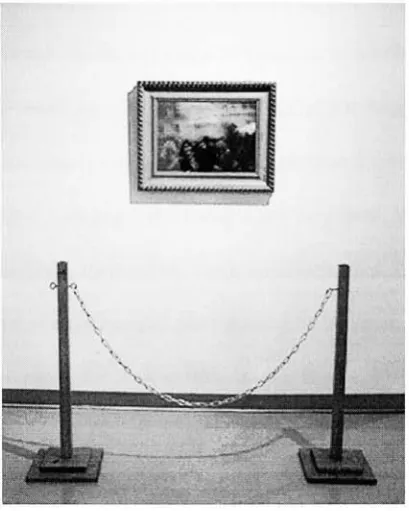
The piece in my 2004 MFA exhibition, Ode to the Pictorialists (Figure 1), is a direct
response to this departure from the innocent and naive view of photography. It is both a
relic and a declarationofmy position with regards to art and photography.
1.5 From Photography
My doubts regardingphotography led me to two conclusions:
Auraand objectness needtobeseparatedfromphotographsand art objectsingeneral.
The essence of photography is about information, and objectness in photography is
more or less manufactured and superficial.
[image:21.534.165.370.44.300.2]I realize that aura and objectness are two separate entities and that aura is perhaps a
soontobeoutmoded idea inadayand ageinwhichimages inparticular areconsumedat an
incredible speed. Speed works against the idea ofaura which demands contemplation. As
discussedearlier, whatinterests me isa more immediateand direct effect awork ofart has
through objectness. Further, photographs today have very little to do with their material
form and it is more convenient to consider them as information rather than as objects. I
consider the current trend ofmonumental photographs tobe more or lessdriven by market
forcesand not for choices made fortheir artisticmerit. Hence, I regardthe current pursuit
ofobjectness in photography as superficial. As the quote below suggests, the object form
that the photographic imagetakes becomes indiscriminate.
Digital broke the link that always chained photographs to the visible world,
obscuringtheinherently fictivequalities of photography. Without that link, the
imaginative trafficbetweenphotographs andmediumslikepaintinganddrawing
is more promiscuous.5
Ifphotographs, especially digitalphotographs, dislodgedthemselves fromtheir material
form, there is no reason for the photographic image
(content)
not to end up as a painting(form). For that matter, it could end up as any other conceivable form: sound, sculpture,
light, or text. In my case, I decidedthat it should end upas a painting.
1.6
Authenticity
Recalling the discussion about objectness, people go to see art objects to experience some
thing that cannot be disputed, especially because so many things,
including photographs,
are subject to doubt. A photograph of a Gerhard Richter painting is worlds apart from
'March 7,2004,Photosynthesisby ChristopherKnight, LA Times
an actual Gerhard Richter painting. And this, in an age when everything is a copy or a
simulation, is why we go to museums and galleries. Perhaps objectness is the only thing
that cannot be simulated in our current art practices. Even though we might celebrate
the simulated world or thestate ofthe hyperreal,6 don'twe still long for something realor
authentic? Don't we somehow appreciate a handwritten letter more than an e-mail even
though the content may be equivalent?
As long as the sophisticated viewer is able to decode the simulated as a simulation,
he/she will have chronic desire for the authentic experience. For the sophisticated viewer,
there is guilt or doubt that cannot be redeemed byanything less than the authentic. For
example, I would guessmany art historians orart historyprofessors would haveadilemma
with regards to talking about a work of art they had never seen in person before. This
comes from the apprehension that allthe reproduced images inthe world, and allthe text
or supplemental material about the piece, will never amount to experiencing the work of
art first hand. This exemplifies the essence of ourrelationship with the work of art. There
is always doubt in what is simulated or copied, or something that is not it, because one
cannot claim authenticity over the experience, and this doubt about its authenticity often
leads to guilt in accepting or propagating the simulated experience. Doubt always lingers
around simulations, as they have tendencies or desires to hide and blur their nature. This
tendency to disguise feels unauthentic and sometimes insincere. When the simulated gains
independence fromthe original,whenitstartstostandonits own,releasedfromtheoriginal
it was referring to, then it mayshine onits own terms. When thesimulated declares itself
to be a simulation, then it opens up the possibility for an authentic experience over the
simulation.
6Jean Baudrillard, Simulations,trans. PaulFoss,PaulPatton,andPhilipBeitchman (NewYork:
Semio-text(e), 1983).
Photography,especially "straight" photography,has becomeproblematicbecausewecan
no longer distinguish it from a simulation. With the advent of Photoshop, doubt always
lingers around straightphotographs, unless an explicit attempt to revealtheir authenticity
is made.7
In painting or illustration, authenticity is inherently clearer. As a result, the
authority ofphotography as a nonfictive device is now in constant jeopardy. One cannot
lookat a photographtodayandknow whatis straight and what is simulated. As recentin
cidentsindicate, a correspondentfora newspaperin Afghanistan mayPhotoshoppeople out
before he sends the images to his editors. Straight photographs carry so much uncertainty
with regards to their construction, and this uncertainty gets in the way when experiencing
them as images. This lingering doubt causes the image to implode. The correspondent in
Afghanistan was fired immediately after the fact was known, although the "manipulated"
image probablytold the intended storymore effectively. One wonders: if the correspondent
were an illustratoror an embedded drafts personinsteadofaphotographer, what wouldof
happened? Whenphotographyrelinquishesits role as a nonfictivedeviceandtruelyaccepts
its fictive qualities, it may regain itsauthenticity. But we are not there yet.
The authenticityofany art work comes tobare whenitreveals itsown construction. It
need not bepure ina Greenbergianway. You don't needtouse a hammerandhit someone
in the head to let them know that the work is "paint on canvas."
Ifyou look, you can tell
if someone is trying to deceive you. Whatever the content ofthe object is, one needs to
be able to trust it inorder to start a dialogue. Thus, artworks should not hide their own
construction. They should be authentic to what they are, or else a sense of doubt lingers
and the workbecomes unproductive.
So it occurred to me to make work based on this premise. That is, I wanted to make
7Ihaveseen multiplephotographyshows wherethephotographs werelabeledwiththeinformationthat
theywhere not "Photshopped."
work that one really had to see in person in order to discard the doubt that came with
the art piece. Looking at the reproduction of the work would confuse the viewer. The
viewer will never be certain as towhat he/she is looking at. Ifone were to see the work in
person, its own construction would be revealed. This experience would be immediate and
undisputable. Painting was a perfect medium for this purpose as allthe marks and traces
were left for the viewer toobserve.
1.7 The Banal
Thus, I concluded that we go to see works of art to experience their objectness, and I
acknowledged that this experience is more authentic than the experience we have when
viewing works in reproduced prints. Consequently, for my paintings, it was natural for me
to choose images that conveyed that authenticity. When I considered what images I might
use, I immediately looked for
"banal"
images. An image from a web cam, traffic cam, or a
security camera felt like something that was so banal, so untouched by the hands ofman,
it was as authentic as any photographic image could possibly be.
It may be the unpresuming quality ofbanal images. Banal images do not attempt to
be anything else. They do not attempt to deceive the viewer. I recently encountered an
image that was of the snapshot aesthetic, where part of the serious subject was cropped
out dramatically and out offocus. The photograph was actually taken using an 8x10 view
camera. Perhaps due to the serious subject matter (AIDS), I felt something insincere. It
was notthe ideaofthephotographerstickingalargeviewcamerainthe faceof adyingman
that made me feeluncomfortable; it was the doubt that came with the snapshot aesthetic
that was simulated with the use ofa cumbersome and time-consuming view camera. The
fact that I had to cast doubt on an image of such serious nature was the problem. Images
Figure 2: Woman, Oil and Acrylic on Canvas, 40x54 in, 2004
Figure 3: StillLife, Oil on Canvas, 40x52 in, 2004
[image:26.534.142.415.402.613.2]Figure 4: Landscape, Acrylic on Canvas, 40x58 in, 2004
Figure 5: Pictures, MixedMedia, 2004
[image:27.534.159.396.400.611.2]from web cams or traffic cams feel truer andmore authentic as they are what they are.
Popular culture, saturatedbythesimulated or thehyperreal, leaves avacuum, alackof
authenticity. The banal, by subverting the simulated and the hyperreal, fills the vacuum,
andthusismore authentic. Icreated a seriesbasedonthisassumption. Ipursuedobjectness
bycreating paintingsbasedonthe photographicimage, but aphotographic imagethat was
banaland an antithesis to the hyperreal. Further, these works, inreproduction, cast doubt
as to what they are. One would not be sure what they were looking at: photograph, a
digital image, or a painting? When the art works were experiencedin person, they would
eliminatethe doubtswithregards to theirconstruction. (SeeFigures 2
-5.) Theyare what
they are. The work is photographic, digital, and painterly at the same time.
2 The
Relationship
Between Computers and ArtWhile I was working on my paintings, I used the computer to create the images I would
paint. During that process, Ioften wondered what it really meant to make art work using
thecomputer. Observationofthe computerin termsofitselfandnot in termsofany other
simulated media seemed like a natural progression. Actually, it seemed to be the most
important questionthat one can ask whenthinking about the relationship between art and
the computer.
Computers have infiltratedallformsoftheart makingprocess. Photographersuse com
puters to manipulate and retouch images. Computers have replaced the traditional
"wet"
darkroom processes with software such as Adobe Photoshop. Indeed, Photoshop changed
the fundamental attitude towards photography and how we look at pictures. Sculptors
now create three dimensional structures in the computer; rapid prototyping enables them
to create physical objects out ofdata in the computer. Painters use computers for
ration and to create source images.
Stenciling
became an important technique to createsharp edges. Computers leave marks distinctly different from the ones created by tradi
tional brush strokes, and they have changed the aesthetics of painting. They may be only
the subtle difference between a subject that is painted through projection and one that is
painted by direct observance, but somehow one can tell that a computer was used in the
process.
Although the inclusion of the computer into the studio changed the way artists work
and the way art objects look, I believe that artists have not yet touched the core of this
medium. In some sense, art has been encircling the essence of the computer. Computers
havebeen usedmostlyto enhanceortosimulatethealready existingmedium. For example,
the success ofinkjet prints arediscussedinterms ofhow closetheycometotraditionalpho
tographic C-prints. The syntax used in Adobe Photoshop closely follows the methodology
of a traditional photographic darkroom. Photoshop closely simulates the darkroom. The
problem with this mode of simulation is that computers inherit the limits of what they
simulate. For example, by simulating photography, image-manipulating software such as
Photoshop assumes without much inquirythatimages shouldnot move, not make noise, or
only be two dimensional. One may never question why, because the ideal is gauged upon
photography.
The useof computers tosimulate existing mediahighlightsone distinctiveaspect ofthe
computer: It is a tool that is extremely malleable. It is a tool that is capable ofcreating
new tools, which again further hold the potential to create even more sophisticated tools.
Insummary, it is a meta-tool. The onlylimiting factor forthe development oftools in the
computer is one's imagination and one's ability to program the computer. One can easily
direct a computer to parallel the features of a traditional medium and create a tool that
simulates an existing medium. This is what we currently see
happening
in the arts. Butthisonlybeginstotouch thepotential ofthecomputerasameta-tool, andthefundamental
meta-ness ofthe computeris not yetfully exposed. Ifone expands one's imagination, there
is alwaysthepotentialtocreate atoolinthecomputerthat may turnabrushintoamusical
instrument that makes objects.
2.1 The Dilemma of the Computer
Initially I thought itwasjust amatter ofeliminating limits fromexisting tools or programs
to crack openthe potential ofthecomputer as a meta-tool. It turns out that thisis harder
thanI anticipated, because once thelimits are gone, the essence ofthecomputer spills out
like water and one really does not have a lid to keep it from spilling away. I am starting
to suspect that by thinking about computers in terms ofart, computers are inheriting the
limitations of art.
So, what is the essence of the computer? The components that make up a computer
are not something that are oftrue essence to the computer. Unlike paint or canvas, the
CPU or memory does not represent computation. The hardware that implements the
computer has very little to do with what the computer does. The hardware is a means
to an end, just like the camera is a means to an end to produce a photographic image.
The essence ofphotography lies in the photographic image and not in the apparatus. The
computer hardware is similarly an apparatus. The essence ofthe computer is abstract. It
is about logic, algorithms, and math. We program to interact with these abstract ideas
and operations. Theact ofprogramming is ourway ofcommunicatingour intent intothese
abstract entities.
Inthisworldofthecomputer, any linkto physicalityis lost because computersdeal only
withtheabstract. So much isdetached fromtheactualactofseeing, touching, andhearing;
one is required to think in differentways, and challengedtoexperience in impossible ways.
All tangible entities exist in our mind and the computer interacts with the entities in our
minds. Usually, theonlyphysical access wehaveintothisworldisthroughasmallpeephole
called a display, and even that is not a direct experience at all. The view we have on the
display is a translated approximate copy ofwhat is happening inside the computer. It is
not the actual thing. It can never be. The actual phenomenon inside has no form. The
operatingsystemthatruns ontopofthehardwaretakesextra stepsto visualizethisformless
entity so that we can have something to reference. The text one seeson the display is not
actual text. It is a representation of an abstract entity we decided to translate into text,
and look at as text.
We have been buildinganenvironment using abstractions in the computer ever since it
was invented. Any and every computer is void ofany relationship to the world we occupy
without this environment. Through abstraction and metaphors, we create something that
wecan clingonto so we donot getlost inthevoid. Wecreatethings like windows,files, and
desktops. Weare creating a mapfor a world we cannot yet enter. We askthe computerto
operate in these abstract environments that have no direct link to the real. They arejust bits andbytes asfar asthe computeris concerned. We areoccasionallyallowedto look into
this world indirectly through the peephole.
Whenwescan aphotographofa child intothe computer, that imagelosesits materiality
and becomes an abstract entity. The only thing that connects that abstract entity to our
ideaofthe imageof a child is thismappingwe create. As farasthe computer is concerned,
there is no digital image of a child, as the computer knows nothing of the image or the
child. We introduce these idea into the computer. Into our map, into this void, we add an
entry for
"image"
and "child" We construct the map and the world inside the computer.
Once this map between our real and the computer's abstract becomes damaged, we
are left in the dark. A physical photograph can be scratched or partially torn, but it still
maintains its photograph-ness. A digital image can lose parts ofits data and quickly lose
its association with an image and reveal its abstractness. Most image viewing software
will not open a corrupt image file complaining that it is in an unrecognizable format. The
mapping is lost. Once the mapping islost, it is just noise. Digital images cannot bescarred
or creased like physical photographs because we have not described to the computer what
that signifies. Yet just astornphotographs carry meaning, I believe abroken digital image
has the potentialto carry meaning.
What I suspect is that there are vast reaches of abstract space waiting to be mapped.
One problem related to theunmapped territories within therealmof computersis thatwe
do not yet have a dictionary or even a vocabulary to distinguish between something that
is noise and something that is not in this abstract environment. Is is as though we do
not have the word cat to recognize the thing that sheds fur and purrs. Hence, we really
cannot differentiate catfrom tac or ate in the abstract world of computers. We have no
idea whether it is something or nothing. A cat inside the world ofcomputers is waiting to
be discovered. It will continue to bethus until we find away to renegotiate these abstract
entities in terms ofart, andexpand our vocabularies.
2.2 The Abstract and its Physicality
The environmentwe build in the computer is amonstrous andfrighteningly complex accu
mulation of abstraction. It is this intersection between the abstract and the physical/real
that we dealwith as programmers, or perhaps as artists. And it is in this conflict between
the abstract and the objectness or physicality that art demands, where I find myself. The
process ofmapping requires the artist or theprogrammer to link the abstract world ofthe
computer to the physicalexperience that is art.
For example, theconflict canbe illustratedasfollows: Most of ustakethe mathematical
operation calledsubtraction 1 1 = 0as a given. But ifwedidnothavea
graspofthething
called "number", and we were asked what would happen ifwe subtracted one apple from
another apple, we might be confused. Where does that apple go? How can you start with
one apple and another apple and endupwith nothing? Anapplejustdoes notdisappear. Or
better, 2x3 = 6?
Multiply two apples with three more apples? Ifwe keep the physicality
of the apples, even the simplest abstract operation becomes an impossibility. And this
enormous gapbetween theabstract world andthe physical world needsto be resolved with
some consistency in the context of art.
Can anything represent or materialize truly abstract ideas? How does one connect this
abstractness to the real world of art? Fissures start to show when we must commit to the
materiality or the physicality ofthe output so that we can actually see, hear, or touch the
result. The essence ofthe computer is so abstract, we have not managed to experience it
directly in a way that matches our physical interface. (I.e., we cannot directly experience
the abstract using our eyes, ears, or other such senses.)
Ifone cannot directlyrepresent abstract entities ina recognizable way, one might make
aninstancetoconverttheabstractinto somethingthatit is not. For example, one coulddeal
withthe concept of a tree in its abstract form in the computer, andthen make aninstance
ofthe tree when the tree needs to leave the abstract world ofcomputers. But creating an
instance presentsobvious problems. For example, aswe attempt tovisualizethese abstract
activities
(math/logic/algorithms),
say as atwo-dimensional entities, we immediatelyenterthe aesthetics of 2D images. And the aesthetics of the image and the abstract may not
be compatible. Ironically, this leads to the situation where aradically interesting abstract
activitybased onlogic mayproducelacklasterimages. Orconversely, onemay be forced to
pursue meaningless abstract activitiestoget prettypictures. As a resultthe dialogueshifts
unconsciously from within the internal domain ofthe computer to the external domain of
flat pictures.
Thus, an attempt to visualize logic or math is extremely challenging as our eyes are
strongly tethered to the aesthetics based on our physical visual experience, and logic is
not. Perhaps certain people, such as mathematicians, may see elegance or beauty in a
mathematical formula in its true abstract form, but most do not. But I am optimistic, as
aesthetics is an acquired taste. We just have not yet acquired theaesthetic ofthe abstract.
Anthropologistsreported that photographs were not recognized as somethingto be readin
a remote culture when people saw photographs forthefirst time. Theycould not associate
the image ofa ship to the actual ship. They only saw a flat piece of paper with texture.
Similarly, we may be oblivious to the aesthetics ofthe abstractbecausewe donot yet have
the literacy necessary to read them.
So, the problem of the computer lies in the the conflict between the abstract and the
physical. And this problem is an unsolved oneas ofthis writing, but Ienvision two viable
approaches:
Intersection of media
Expansionofinterface
2.3 Intersection ofMedia
As mentioned previously, computers have this marvelous abilityto simulate whatever they
are told to. One way to challenge the computer's limits and to expand the confines of the
media it simulates is to operate in the intersections of these media. We need to turn the
computer into abrush that is a musical instrument that makes sculptural objects.
In the 90s, the word multimedia was often used to describe the efforts made by artists
to use various media simultaneously. For example, they would use movies, images, sound,
and text, often ona CD-ROM. What I have inmind is somewhat different. In multimedia
pieces, various media just coexisted. The existence of one media did not challenge the
fundamental nature of the other. It was like a salad where tomatoes and lettuce just sit
next to each other. I envision something like astew. It would be amusing ifone could not
distinguishwhether something was a movieor an image or text.
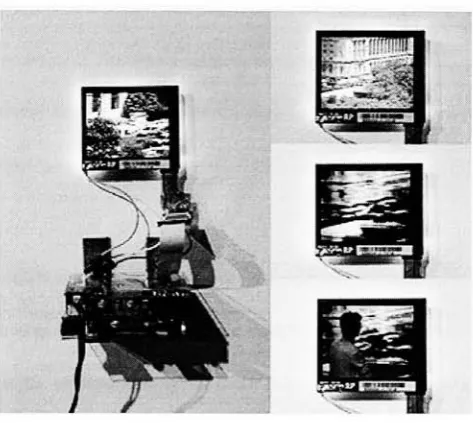
For the piece titled, Reading the New York Times, Aug 13. 2003 (Figure 6), I wrote a
program thatreads the articlesposted on theNew York Times web page. Each sentencein
the articles is parsed and its grammaris analyzed. From the grammatical structure ofthe
sentence, words that are relevant to the sentence are identified and recorded. Simultane
ously, the connections between these words are recorded. For example, ifthe program was
giventhe sentence, The dog went to school, the words dog and school wouldbe recorded as
wellasthe connection betweenthesewords. Then, I made agraph ofthis structure (Figure
7). Eachwordis representedas anode (anellipse) withuniquecolors, andevery connection
isrepresentedas alinethatconnectstheappropriatenodes. Assomewordsturnedupmore
than others and had more connections, I made the size of the ellipse larger proportional
to the number ofconnections. The ellipses themselvesdid not showthe actual words that
they represented. Instead, I provided a color coded table next to the graph (Figure 8) to
Figure 6: Reading the New York Times, Aug 13. 2003, 2003, Inkjet Print, 2003
[image:36.534.172.379.52.193.2]s
Figure 7: Detail: Reading the New York Times, Aug 13. 2003, 2003, Inkjet Print, 2003
decode what words the ellipsesrepresented.
This piece exists in the intersection between the domains oftext, pictures, and logic.
Onecould readthis piece, or experienceit through the aestheticsofpictures, or decipher its
logic. And while this piece was taking form, I noticed that the traversal of domains from
text, to pictures, tologic stimulatedthe deconstructionofthe subject, therebyrevealing its
hiddenstructures. Text hasstructures that wetake forgranted. Thestructure ofasentence
is calledgrammar. One canexpand the limits ofthis grammatical structure to encompass
[image:36.534.160.388.249.430.2]administration said appeared oflice began announced does declared submitted including future genocide abortion torms units assertion Armitage decided Secretary-John General Donald separate bills
Figure 8: Detail: Reading the New YorkTimes, Aug 13. 2003, 2003, Inkjet Print, 2003
allthe articlesin the New York Times. Whenthis structure isrepresentedinthe domain of
pictures, it can start a dialogue with another structure that comes from a remote domain other than text. Perhaps it is in this dialogue, that we are challenged to open our minds.
We are invited to participate in the aesthetics ofstructures rather than in the aesthetics of pictures. This new way oflooking has something to do with abstract thinking. It is as
thoughabstract logicpeeleda segment off of physical reality andbecame anentity in itself.
This reminds me ofthe experienceI had when I learned that ether carried TV signals.
From that time on, I could not see the sky the way I used to. I now see the sky with aurora-likeTV signals raining andflowingover us. And it is thiskind ofexperience that a new way oflookingcan bringtoyou. Perhapsthe true essence ofthe computeris its ability
to mess with your head, andperhaps this might be art.
2.4 Expansion ofInterfaces
We experience the way we do because of the bodies we have. We are stuck with the
aestheticswe have becauseofthe interfaces that are available to us. Perhaps, it is time for
us to expand our interfaces andenter uncharted territories.
As I have argued, thepeephole that is the display allows us a glimpse into the abstract
world of computers. The difficulty in presenting the logical and abstract entity of the
computer is that there is a gap between the abstract and our human interface, the eyes,
ears, and tactile senses.
Creatingabridge betweenthesetwo worldsthroughnewinterfaces isanotherpossibility
in resolvingtheconfrontationbetweenthearts andtheabstract. Thecomputer couldextend
its interface towards us, andwe could expand our interfaces towards what is in front of us.
An ideal interface may be to connect our minds directly into the computer. Perhaps then,
the physicalitythat was lost may be regained. The closest experience we have to this may
be the experience of listening to music via a headphone. We feel music originating from
insideour head, or, ifengineered correctly, from any place within our physical space. It is
in this physicalityofsound through the interface ofheadphones that Ifind hope.
The genre ofinteractive art is an attempt tobuild this bridge. Interactive art is about
giving a new user-interface to the abstract black hole ofthe computer. But surprisingly,
interactive art has always been an enigma for me. For all logical reasons, it should be
interesting or something that I would be attracted to. It deals with our senses, and our
presence. But I have never been impressed with most interactive art. I just didn't "feel
it"
, even though computers and the sensors claimed to feel me. It was more a wall than a
bridge.
This perhaps goes back to the suspicion I have towards the simulated-real, with its
obvious intent to hide its artificial nature. If something is constructed out of sensors, it
shouldbesensors and not attempt to behuman. If it is avideo camera, it should remaina
cameraandnot an eye. An infrared sensor shouldsense infraredlight andnot our presence.
What these machines ultimately would be, I am not sure. But on the other hand, when
the direct cause andeffect oftheoperations ofthe machine is so obvious, it is problematic
for me as well. What is one supposed to think ofa switch, whenflipped, that would turn
a light bulb on? Where is the art in this?
Should the interface betweenus and the world we cannot enter be invisible? Should it
be autonomous? Perhaps what really matters is what is onthe other side ofthe interface.
3 Conclusion: Art and
Authenticity
SoIfind myself withintheseconflictingimpulseswithregardstophotography, art, comput
ers, and machines. When does somethingthat is made by the handsof mantranscend into
art? I discoveredthat objectness is animportantelement formein atime wheneverything
else can besimulated. Ivalue objectness inworks of art because it cannot be disputed. Its
experience is authentic.
Perhaps then the underlying question I am interested in, in all my works, is how and
when something becomes authentic. Authenticity is what I long for in my work, but does
authenticity, without doubt, warrant art? Probably not. Authenticity exists because of our ability to doubt and to critically engage in what is in front of us. Then, ifwe were to accept these propositions, how can artists maintain integrity in their art when everything
is toutedas real or hyper-real? Perhaps wemay have to waitfor a world where theperfect
simulacram truly does notknowits origin likethereplicantnamedRachel in the filmBlade Runner8 in orderto be liberatedfromour longingforauthenticity. Andperhaps it is when
our pasts areliquidated andwe live inthe perpetual present. Humans are humans because
they were not machines. And machines are machines because they were not humans. This
difference is becoming infinitely small. And perhaps the trajectories of these two entities
GiulianaBruno, "Ramble City: Postmodernism andBladeRunner,"
October,vol. 41 (1987): 61-74.
will intersect and pass each other, leaving a slight afterimage of doubt. Then we will be
left to renegotiate what art and authenticity are. I look forward to participating in this
dialogue. Until then, the only thing I can do as an artist, is to suggest the possibility of
that doubt.
SELECTED
BIBLIOGRAPHY
Baudrilalrd, Jean. Simulations, Trans. PaulFoss, Paul Patton, and Philip Beitchman.
New York: Semiotext(e), 1983.
Benjamin, Walter. "The Work ofArt in the Age ofMechanical Reprodction,"
Illuminations, Trans. Harry Zohn, Ed. HannahArendt. New York: Harcourt Braceand
World, 1968.
Bruno, Giuliana. "Ramble City: Postmodernism andBlade Runner," October, vol. 41
(1987): 61-74.
Fried, Michael. "Art and Objecthood," Artforum, vol. 5 no. 10 (June 1967): 12-23.
Fujihata, Masaki. Art and Computer, Tokyo, Keio University, 1999.
Griffin, Tim. "Out ofthe Past," Artforum, vol. 42 no. 5 (January 2004): 58.
Maeda, John. Maeda@Media, New York, UniversePublishing, 2001.
Storr, Robert. Gerhard Richter Doubt and Beliefin Painting, New York, The Museum of
Modern Art, 2003.
Weschler, Lawrence. Seeing is Forgetting the Name of the Thing One Sees, Berkeley and
Los Angeles, California: University ofCalifornia Press, 1982.