RIT Scholar Works
Theses
Thesis/Dissertation Collections
1-1-2006
Parent perceptions of school climate and its impact
on their child's school performance
Danielle Malinowski
Follow this and additional works at:
http://scholarworks.rit.edu/theses
This Thesis is brought to you for free and open access by the Thesis/Dissertation Collections at RIT Scholar Works. It has been accepted for inclusion
in Theses by an authorized administrator of RIT Scholar Works. For more information, please contact
.
Recommended Citation
Running
Head:
STUDENT
AND
PARENT
PERCEPTIONS
Parent
Perceptions
ofSchool Climate
and itsImpact
ontheir
Child's School
Performance
Danielle Malinowski
Permission to Reproduce Thesis
PERMISSION G~NTED
Title of thesis
rareO-f
?erce.
ofj()(1J
0+
& hoot
C}l~k
(){1tl
,+(
Xmj3?-c.-r an
Tbe~r
chllt;{
's
SCYlool
fer.£nrrrrnCR
I
T.?oni
~
Mo.!J (l~
hereby grant pennission to the
Wallace Memorial library of the Rochester Institute of Technology to reproduce my
thesis in whole or in part
.
Any reproduction will not be for commercial use or profit.
Date:
q
klOlt
Signature of Author;
Danielle Malinowski
PERMISSION FROM AUTHOR REQUIRED
Title of thesis
---________________
__
__
_
prefer to be contacted each time a
request for reproduction is made
_
'can be reached at the follOwing address
:
PHONE: _ _ _ _
_
Date:
- - -
-
-
Signature of Author: _ _ _ _ _ _
_
PERMISSION DENIED
TITLE OF THESIS
__
_ _
_
_
_
_
_
_
_ _
_
_
_
_
_ _ _ _
~I
hereby deny permission to theWaliace
Memorial Library of the Rochester Institute of Technology to reproduce my thesis
in whole or in part
.
Abstract
This study
comparedthe
relationship
ofstudentand parentperceptionsof school climateto the
student's academic performanceand school problembehaviors
(disciplinary
referrals,
unexcusedabsences,
andtardiness).
A
sample ofstudents(n=531),
grades7-12,
completedthe
School Climate
Survey
(Haynes
etal,
1996). Additional information
was obtained
regarding
eachstudent's academic performance and school problembehaviors.
A randomly
selected sample of parents were sentthe
School Climate
Survey,
Parent Edition
and were askedto
voluntarily
returnthem
(n=45). Correlation
resultsfound
no significantrelationship between
parentand student perceptions of schoolclimate.
A
significantrelationship
wasfound between Parent Involvement
and academicperformance and also
between Achievement
Motivation
and academic performance andschool problem
behaviors. The Multiple
Regression
analysesthat
were conductedindicated
that
Parent
Involvement,
disciplinary
referrals,
andtardiness
best
predictedtheir
The
effectof education on studentshas
been
an area ofinterest
to
many
looking
to
find
what causes childrenin
some schoolsof similardemographics
to
excel whileothersare
failing. Researchers have
turned
to
school climate as one ofthe
factors in
these
events(Anderson,
1982).
Students'behavior in
schoolis predominantly
afunction
of
the
social and cultural characteristicsofthe
socialsystem ofthe
school(West,
1985).
School
climatehas been
an area ofinterest
that
has been
researched sincethe
early
60's.
This
researchhas
stemmedfrom
the
early
works ofbusiness
researchers whofocused
onthe
situationalcharacteristics,
that
impact individual behavior
(Anderson,
1982).
Studies
have
linked
school climateto
academic performance(Hoy
&
Sabo, 1998),
antisocialbehavior
(McEvoy
&
Welker, 2000),
victimization(Buckley, Storino,
&
Sebastaini,
2003),
and school violence(Hernandez
&
Seem,
2004). A variety
ofdifferent factors
affect
the
climate of a school whichin
turn
affectsstudents'
behaviors
and attitudes(Haynes, Emmons,
&
Ben-Avie,
1997). School
climateis
measuredby
questioning how
people who are
involved
withthe school,
perceiveit. These
perceptionsinclude
those
ofstudents,
staff,
and parents(Roach
&
Kratochwill,
2004).
Defining
School Climate
School
climatehas been found
to
be
relatedto
anumber ofdifferent
factors,
all ofwhich
play
animportant
rolein
the social,
behavioral,
andintellectual development
ofstudents
in
school.In
orderto
understandthe
different
rolethat
school climate canplay
in
the
lives
ofthe students,
teachers,
andparents,
one mustfirst
understand what schoolclimate
is.
There
is
a vastarray
ofdefinitions
ofschool climate.As
gainedfrom
an overviewthat
is
sensed when oneentersthe
building
and understoodfurther
as moretime
is
spentwithin
the
school.Haynes
et al.(1997)
statedthat
"School
climate refersto the
quality
and
consistency
ofinterpersonal
interactions
withinthe
schoolcommunity
that
influence
children's
cognitive, social,
andpsychologicaldevelopment. These interactions include
those
among
staff,
between
staff andstudents,
among
students,
andbetween home
andschool"
(p. 322). Welsh
(2000)
alsoincorporated
the
interactions of students andteachers
in his
definition;
"The
climate of a schoolincludes
the
unwrittenbeliefs,
values,
and attitudes
that
become
the
style ofinteraction between
students,
teachers,
andadministrators.
School
climate setsthe
parameters ofacceptablebehavior among
allschool
actors,
andit
assignsindividual
andinstitutional responsibility for
schoolsafety"
(p. 89).
Peterson
andSkiba
(2001)
define it in
a more emotionalway "as
the
feelings
that
students and staff
have
aboutthe
school environment over a period oftime"
(p. 167).
They
further
statethat these
feelings
aredeveloped
through the
way
in
which onefeels
about
their
personalsafety
atschool,
how
conducivethe
classroomis
to
learning,
andhow suitably
the
schoolis
ordered.Hoy
andSabo
(1998)
referto
school climate asthe
"personality"
of
the
school andlike
personalities,
school climates alsodiffer from
personto
personorschoolto
school.Throughout
the
literature
variousdefinitions
of school climate canbe
found
based
on
the
researcher's opinion asto
whathe/she
truly
believes
schoolclimaterepresents.These
beliefs, however,
mostly
comefrom
personalexperience ratherthan
from
empirical evidence
(Anderson,
1982).
Due
to this concern,
Tagiuri
(1968)
created aecology-
the
physical materials
in
the school;
milieu-the
characteristics ofthe
individuals
in
the
school;
social system-the
rules
that
governhow
peopleinteract
withinthe
school;
andculture-
the
norms and values
held
by
those
withinthe
school.Together
these
components
form
allthe
variousdefinitions
of school climate(as
citedin
Anderson,
1982).
Components
ofSchool Climate
School
climateis
composed of countless numbers of variablesthat
interact in
avariety
of waysthat
affect childdevelopment
(Esposito,
1999). These
components arecomplex and varied.
They
can extendfrom
the
noisein
the
cafeteriato the
physicalconfiguration of
the
building
to the
interactions between
students andteachers
(Freiberg,
1998).
Derived from
research on past empiricalstudies,
Haynes
et al.(1997)
found 15
factors
that
comprise ahealthy
and supportive school climate:1
.Achievement
Motivation,
whichis how
wellstudentsbelieve
that
they
canlearn
and
how
muchthey
aredisposed
to
learning.
2.
Collaborative Decision
Making,
whichis
having
staff, students,
and parents allengage
in
the
decision
making
in
the
school.3.
Equity
andFairness,
whichis
treating
everyonein
the
schoolequally,
regardlessof race or ethnicity.
4.
General School
Climate,
whichis how
wellstudents,
staff,
and parentsinteract
with each other and
feelings
oftrust
and respectexisting
withinthe
schoolcommunity.
5.
Order
andDiscipline,
whichis how
suitablethe
students'6.
Parent
Involvement,
whichis how
oftenthe
parent choosesto
participatein
school activities.
7.
School-Community
Relations,
whichis how
supportive and concernedthe
community is
with whatis
happening
withinthe
school.8.
Staff
Dedication
to
Student
Learning,
whichis
the
energy
the
teachers
putinto
making
surethat
students arelearning.
9.
Staff
Expectations,
whichis
the
expectations ofthe
staffthat their
students willexcel
academically
andcontinueonto
lead
a successfullife.
1
0.
Leadership,
whichis how
wellthe
principle guidesthe
school and generates apositive school climate.
1 1
.School
Building,
whichis how
well maintainedthe
schoolbuilding
is.
12.
Sharing
ofResources,
whichis
equalavailability
of all ofthe
school'sresources,
activities,
and equipmentfor
allstudents.13.
Caring
andSensitivity,
whichis how
muchthe
principle showsthat
he/she is
concerned about
the
staff,
students,
and parents andthinks
about whatthey
need.14. Student
Interpersonal
Relations,
whichis how
much students careabout, rely on,
and value each other.
15.
Student-Teacher
Relations,
whichis
the
amountofcare,
trust,
and respectthat the
students and
teachers
have for
each other.Everyone
withinthe
school affectsthe
climate.The
climateis
notonly
affectedby
students,
staff,
andparents,
but
alsothe
community
and all ofthe
support staffthat
workers.
Therefore,
whenthe
school climateis investigated it
is
important
to
considerallof
these
people andhow
they
affectthe
school(Freiberg,
1998).
It
is
alsoimportant
to
considerthe
school'ssurrounding community
that the
school existswithin.
Certain
community factors
might affect school climate.One factor
which seems
to
have
atremendous
effect on school climateis
poverty.If
a school existsin
an areadevastated
by
poverty
this
will affectthe
amountoffunding
the
school receivesand
the
resourcesthat
it
can make available.It
also shapesthe
characteristics of some ofthe
students who willbe attending
the
school,
the
kind
offaculty
that
will workthere
andhow
long
they
willstay,
andhow involved
the
parentsare.Also
one must considerthat
the
children who attendthe
school musttravel through the
community
to
getto
schooleach
day. This may
exposethe
studentsto risks,
whichmay
causethem to
carry
weaponsor engage
in
aggressivebehavior
(Welsh,
2000). On
the
opposite side ofthe
spectrum,
schools
that
feel
more pressurefrom
the
community
are morelikely
to
performbetter
academically
(Hoy
&
Sabo,
1998).
Importance
of
School Climate
Not only
arethere
avariety
of componentsthat
comprise schoolclimate,
but
alsoa
variety
of variablesthat
are affectedby
school climate.West
(1985)
stated,
"In
the
context of
the
schoolsocialsystem,
students cometo
perceivethe
roledefinitions,
the
norms,
expectations,
values andbeliefs
that
othershave for
them,
andthey
behave
accordingly"
(p. 454).
Numerous
studieshave been
completedto
considerthe
importance
of school climate andhow it
affects students.Some
ofthe
mainfactors
that
student
behavior
(McEvoy
&
Welker, 2000),
school violence(Hernandez
&
Seem, 2004),
victimization
(Buckley
etal,
2003),
and suspension(Haynes
etal.,
1997).
Academic
achievement and socialdevelopment.
Many
studieshave
examinedthe
impact
of schoolclimate on student's academicachievement.
In studying
middleschools,
Hoy
andSabo
(1998)
found
there
to
be
asignificant and positive
relationship
between
school climate and academic achievement.In
describing
schoolclimate,
Hoy
andSabo
used ahealth
metaphorto
capturethe
natureof
the
interactions
withinthe
school.Therefore,
when a school climateis
presumedto
be
open and
healthy,
it
meansthere
is
aharmony
among
the
different
relationships withinthe
building
that
arelinked
withbetter
academic success.Specific
elements of schoolclimate
that
were associated with academic success wereAcademic
Emphasis,
Teacher
Affiliation,
andResource Support.
Although
academic achievementis
acommonly
studied outcomevariable,
socialdevelopment,
aswell,
is
consideredto
be
aworthy
educational outcome.A
study
by
Schmitt, Sacco,
Ramey,
Ramey
andChan
(1999)
looked
at students whose parents wereunemployed and school climate as predictors of academic achievement and social
progress.
Parent
unemployment was studiedbecause
it
affectsthe
environmentin
whichthe
childis
living
whichin
turn
affectsthe
child.Their
resultsindicated
that
schoolclimate,
as ratedby
the
teachers, has
a moderate effect on student'sacademicachievementand social
development.
They
alsofound
that
childrenwhose parentswereunemployedwere not
performing
aswellin
school asthose
children whoseparentswereEsposito
(1999)
studiedthe
associationamid parent's perception of school climateand
urban, minority,
low-income
children's academic and socialdevelopment. This
populationwas utilized
due
to the
consistently low
academic achievement and poor socialskills
that
many
ofthese
childrendemonstrate.
Also,
many
ofthese
schools containthe
lowest
ratings of school climate.She found
that
overall school climate was relatedto
children's academic success and social
development. In
particular,
children's socialskills were related
to
schoolclimate,
specifically
.cooperationin Kindergarten
and 1stgrade,
and assertivenessin
second grade.A
strong
relationship
wasalsofound between
school climate and school adjustment.
One
ofthe
most significantfindings
wasthat
parents'
perception of student-teacher relations contributes
to their
perception of schoolclimate almost as much as
their
child'shistory
ofadjustment.Lastly,
it
wasfound
that
there
was not a significantdifference between
parent's andteacher's
perceptions ofschool climate.
This
finding
suggeststhat
parentsdo have
information
aboutthe
school,
indicating
that the
parentsareinvolved
withtheirchild's school.This
is
notatypical
finding
for
anurbansetting,
andmay
be
explainedby
the
sampleinvolving
all parents ofchildren who attended
Head
Start
their
preschoolyear.That
experiencemay
have
causedthem to
become
moreinvolved in
their
children's schooling.Buckley
et al.(2003)
completed astudy
that
looked
at notonly
the
relationship
between
school climate and academic achievementbut
alsobetween
schoolclimate andvictimization.
This study involved
middleschool studentsin
a ruraldistrict. Overall it
was
found
that
perception ofschool climateis
a significant predictor of academicachievement.
Those
whohad
a morepositive perception of school climatehad
ahigher
victimization.
Overall,
students who viewedtheir
school asless
safe,
less
well-maintained,
andless
supportivethan
other students experienced morevictimization.Antisocial
behavior
andpsy
chop
athology.McEvoy
andWelker
(2000)
state"both
antisocialbehavior
and academicfailure
are context
specific;
eachoccurswithin a climatein
which conditionscanbe identified
that
reasonably
predictproblematicbehavior
andcanbe
modifiedto
reduce suchbehavior"
(p. 130). It is
arguedthat
effective school climateshave
adirect
effectonhigher
academic performance and prosocialbehavior.
McEvoy
andWelker
(2000)
statethat
a number offactors
gointo creating
anegative school climate
that
increases
the
level
of violenceanddecreases
academicsuccess.
One
ofthese
factors is
tracking,
wherelow-achieving
students are placedinto
"ability
groups"that
have low
expectationsfor
their
academic success.They
alsofound
that
standardizedtesting
can place a negative stigma onthe
schoolif
they
have
low levels
of
success,
whichin
turn
creates a negativeschool climate.It is
suspectedthat
this
mightcause
students'
academic success
to
plummet evenfurther
and encourages antisocialbehavior.
Also,
teachers
in
these schools,
whichare oftenurban,
begin
to
adoptdispirited
attitudes
towards
students and parents(McEvoy
&
Welker,
2000).
Security
devices
suchas video cameras and metal
detectors
canalsonegatively
affect school climate(Peterson
&
Skiba,
2001).
Further,
schools characterizedby
low
levels
of attendanceby
studentsand
teachers,
low levels
of commitmentby
teachers,
andhigh
occurrence of studentandteacher
mobility
whichleads
to
feelings
ofestrangement,
oftenhave
low
levels
ofWelsh
(2000)
surveyedstudents at1 1 different
schools andfound
that
all ofthe
schools
differed
significantly
onmeasures of school climate.It
was alsofound
that
perceptions of school climatewere
significantly
relatedto
victimization, safety,
avoidance, offending,
and misconduct.Findings further indicate
that
school climateencompasses
the
effectsofcommunity
characteristics(poverty,
residentialstability,
andcrime
rate)
on schooldisorder.
Kupermic, Leadbeater,
andBlatt
(2001)
acknowledgedthat
positiveperceptionsof school climateare related with
fewer
emotional andbehavioral
problems,
higher
self-esteem,
and superior academic achievement.Therefore,
a positive school climateis
important
for
those
most at risk ofacademic,
emotional,
andbehavioral
problems.In
the
Kupermic
et al.study,
it
wasfound
that
less
internalizing
andexternalizing
problemswere associated with a more positive student perception of school climate.
It
was alsofound
that
a positive perception of school climate was a protectivefactor from
internalizing
andexternalizing
problemsfor
self-critical students.School
violence.Recent
pastevents,
such asthe
schoolmassacrethat
occurredin
Littleton,
Colorado
onApril
20, 1999,
have brought
school violenceto
the
attention ofthe
generalpublic.
Not
all antisocialbehavior
is
violent,
it
canalsobe
studentsharassing
others,
bullying,
orstealing
(McEvoy
&
Welker,
2000).
School
violence,
in any
form,
can createa climate of
fear
andemotionalturmoil
which creates a negative school climate and alsodisrupts
student's educationaldevelopment (Hernandez
&
Seem,
2004). As
seenin
previous studies
many
students experiencevictimization and violencein
schools.When
affects
the
educational experienceof allthe
studentsin
general(McEvoy
&
Welker,
2000).
Hernandez
andSeem
(2004)
have
identified
the
necessary
aspectsthat
comprisea safe school climate.They
statethat this
is important because
the
climate of a schoolis
exceedingly
important
in
the
educational aim ofthe
school and a negative school climateis
notconduciveto
learning.
From
past researchthey
were ableto
generatefactors
which comprise a safe school.They
arecontext,
psychosocialvariables,
and schoolbehaviors.
All
ofthese
components areclosely
related andtend
to
have
some overlap.Context
mainly focuses
onthe
atmosphereand relationships within a school and community.Psychosocial
variablesinclude:
having
a cleardefinition
of violenceto
determine if
it
exists within a
school;
having
clearbehavioral
expectations;
andhaving
high
academic expectations.As
statedearlier,
academic successleads
to
a more positive school climate(Buckley
etal.,
2003). Other
psychosocial variablesinclude:
respectfor
differences;
students
possessing
aninternal locus
ofcontrol;
celebrating
rituals andtraditions;
reinforcing
studentsfor
taking
astand;
positive peerrelations;
high levels
ofcommunication;
high
perceptions of schoolsafety;
and a sense of school connectedness.Lastly,
there
needsto
be
positive role models and a positive school contextto
influence
the
behavior
ofthe
members ofthe
school.A
safe school environmentis
animportant
part ofcreating
a positive schoolclimate,
because
an unsafe school environmentonly
leads
to
a negative schoolclimate(Hernandez
&
Seem,
2004).
Additional
factors.
certainareas.
The
studentsfelt
that
suspension
was usedto
commonly
as adisciplinary
measure.
Past
researchhas
shownthat
school climateis
moresignificantly
relatedto
student suspensioneven more so
than
student's attitudes andbehaviors
(Haynes
etal.,
1997).
Using
suspension and expulsionasbehavioral
consequencesmay in fact
unintentionally
reinforce astudent'sdisruptive diversion from
aversive conditions.In
addition,
suspending
a studentmakesit
moredifficult for
studentsto
establish abond
with school
that
is necessary for
a positive school climate(McEvoy
&
Welker,
2000).
The
students also reportedtheir
school climateis described
by
elevatedlevels
ofdistrust
anddisrespect
between
the teachers
andthe
students.The
studentsfelt
that the
teachers
did
not care abouttheir
personal problems andtherefore, do
notfeel
ableto
share
their
perceptions andfeelings
with school personnel(Haynes
etal., 1997).
This
climate
is
notfavorable for
the
mentalwell-being
of students and staffin
the
school.It
can
lead
to
higher dropout
rates and morediscipline
problems,
whichleads
to
a negativeschool climate
(Anderson,
1982).
Shortt
andThayer
(1999)
emphasizethe
importance
ofblock scheduling in
improving
schoolclimate.Block
scheduling
cutsdown
on unsupervisedtransition
periods and creates a morepeaceful atmosphere.
Through
asurvey
sentto
principalsthey
found
that
block
scheduling
was relatedto
adecline in
officedisciplinary
referrals,
fewer
fights,
improved
teacher mood,
andhigher
teacher
attendancerates.All
oftheses
factors
seemto
increase
signs of a more positive school climate.Murray (1997)
studiedthe
impact
that
schooluniformshad
on middle schoolstudents'
perceptionsofschool climate.
He found
that
students,
who were requiredto
uniforms alsoresponded
significantly higher
to
the
scales ofstudentbehavior
values,
guidance,
and parent andcommunity-school
relationships.This
finding
indicated
that
these
factors
wereimportant
in
achieving
a more positive school climate.Measurement
Scales
There is
a widevariety
ofmeasuresavailableto
determine
the
climate of a school.Some
ofthese
measuresinclude
formal
surveys(Roach &
Kratochwill,
2004),
informal
surveys
(Bulach, 2001),
andinterviews
(Ellsberry,
1999; Freiberg,
1998).
Among
these
different
measures surveys are most often usedto
assess school climate.Informal
surveys.There
aretwo
forms
ofsurveys,
formal
andinformal. An informal survey is
quick and
easy,
however,
muchtime
is
neededto
analyzethe
data
that
yields qualitativeinformation. Forms
ofinformal
surveysmay include
having
teachers
finish incomplete
sentences about
the
school,
counting
the
number oftimes
negative and positivethings
arereportedabout
the
school,
having
teachers
and students writedown
their
expectationsabout
the
school(Bulach,
2001).
Freiberg (1998)
reported astudy
that
was conducted with studentstransitioning
into
middleorhigh
school.An informal survey
was used where children were askedto
write
down
their
greatest concerns aboutmoving
ontothe
middle school orhigh
school.The
teachers
receivedthese
survey
resultsand were ableto
make proper plans of actionto
accountfor
the
concerns oftheir
newstudents,
to
help
promote a more positiveschoolclimate.
Formal
surveys presentexhaustive
information
aboutthe
school's positive andnegative assets.
Quantitative
information
is
providedthat
canbe
comparedto
measurehow
affectivea planis
to
improve
a school'sclimate(Bulach,
2001). The
variousdefinitions
that
are usedto
describe
school climate often stemfrom
the
school climatescale
that
is
being
usedto
assessthe
school climate.These
scales eachhave different
factors
that
they
measure.The majority
ofthese
scales are similar andtheir
measuresoftenoverlap.
Formal
surveys completedby
students,
teachers,
and parents arethe
mostcommon
forms
of school climate measurement(Roach
&
Kratochwill,
2004).
One
ofthe
mostwidely
usedformal
surveysis The Comprehensive Assessment
ofSchool
Environments
(CASE). The National
Association
ofSecondary
School Principals
(NASSP)
organizedthis
CASE in 1982. The CASE
school climatesurvey is
administered
to
students(grades
6-12),
teachers,
and parents.It has 55 items
that
pertainto
10
dimensions
of school climate(Roach &
Kratochwill,
2004).
The Effective School
Battery (ESB)
developed
by
Gottfredson
(1991)
measuresstudents and
teachers
perceptions of school climate.It
consistsof31
items for
students(grades
7-12)
that
pertainto
6 dimensions
of school climateand61 items for
teachers
that
also pertain
to
6 different dimensions
ofschool climate(Lehr &
Christenson,
2002).
Another commonly
usedsurvey is
the
Organizational Health
Inventory (OHI)
andOrganizational Climate Descriptive Questionnaire
(OCDQ)
both
of which weredeveloped
by Hoy
andhis
colleagues.Both
surveyshave
separateinstructions
for
usewith
elementary,
middle andhigh
school students.The
scales ofthe
different
age groupsmeasure
roughly
the
samething, but
are sensitiveto
differences
among
these
age groups.about
their
perception ofthe organizational
health
oftheir
school.The
three
different
OCDQ
measures contain34-50
items
aboutbehavior in
their
school,
depending
onthe
age
group
being
examined.These
two
scales areonly for
teachers
and administrators(Roach &
Kratochwill,
2004).
The School Climate
Survey
producedby
Haynes
et al.(1997)
is intended
to
assessdimensions
of school climate.The survey
canbe
administeredto
students(elementary
through
high
school), staff,
and parents.There
are53
items for
studentin elementary
andmiddle
school,
55
items for
studentsin high
school,
79 items for
schoolstaff,
and55
items
onthe
parent survey.For
allthe
studentsthere
are9 different dimensions
of schoolclimate,
for
staffthere
are10
dimensions,
and8 dimensions for
parents(Lehr &
Christenson,
2002).
Lastly,
there
is
the
School Level
Environment
Questionnaire
(SLEQ,
Fischer &
Fraser,
1991).
It
wasintended
to
determine
teachers'perceptions of
the
currentpsychological
dimensions
ofthe
school environment.There is
also anotherform
ofthe
SLEQ
whichis
designed
to
measureideal
views ofthe
educational environment.Each
form
consists of56 items
that
pertainto
8
dimensions
for elementary
andsecondary
school
teachers
(Lehr
&
Christenson,
2002).
Interviews.
An
additionalway
in
whichone can collectinformation
on school climateis
through
interviews.
Some
chooseto
useaninterview
format because
aninterviewer is
able
to
askfor
elaboration, explanation,
and specific examplesto
supportbeliefs. It
alsohelps in
being
ableto
observethe
body
language
ofthe
interviewee.
Through
anwere
found
withinit,
but
to
alsohighlight
the
positive qualitiesidentified
(Ellsberry,
1999).
In
astudy
examinedby Freiberg
(1998),
entrance and exitinterviews
wereconductedwith
the
studentsto
measuretheir
perceptionof school climate.Students
that
were either
entering
into
high
school orgraduating from high
school were each askedfour
questionsrelating
to their
view of school climate.Further Areas ofResearch
All
ofthe
previously
mentionedfactors
cometogether to
comprise school climate.These
components are allvery important in
determining
the
climate of aschool,
but
oneof
the
mostimportant factors
that
can affectthe
assessmentofthe
school climateis
whois perceiving it. Different
peoplefrom different
viewpoints will each seethe
schoolclimate
in
adifferent
way.These
different
perspectives canbe
groupedinto
three
mainviewpoints:
the
student,
the
teacher,
andthe
parent.It
is important
whenconsidering
school climate
to
equally
considereachperceptionpresent.Owens
(1987)
stated"though
one
may
arguethat
perceptionsthemselves
are not objective reflections of'reality'
(but
may be influenced
by
subjectivefactors),
the
pointis
that
whatever peoplein
the
organization perceive as
their
experienceis
the
reality
to
be
described"(p.
298)
(as
citedin
Welsh,
2000).
Different
studieshave looked
atdifferent
perspectives of school climate.Buckley
et al.
(2003);
Hoy
andSabo
(1997);
Kuperminc
et al.(2000);
Murray
(1997);
andWelsh
(2000)
all studiedthe
affects ofstudents'
perceptionsof school climate.
Schmitt
et al.(1999)
studiedteacher's
perceptionsof school climate.Lastly,
Esposito
(1999)
studiedWhile it is
importantfor
studiesto
focus
onthe
different
perspectives of schoolclimate,
it is
alsoimportant
to
comparethose
perspectives.Few
studieshave
comparedstudent's perceptionsofschool climatewith parent's perceptions of school climate.
Further,
nostudieshave
comparedstudents' andparents'
perceptions of school climate
with
the
students'academic achievementand school problem
behavior.
Griffith
(2000)
conductedastudy
that
comparedstudents' and
parents'
perceptionsof school climate
along different dimensions. He found
that there
wasconsensus
between
the
students' andparents'
perceptions ofschool climate and
that this
consensus was
significantly
andpositively
relatedto their
assessment ofthe
schoolclimate.
He
alsofound
that there
wassignificantly
less
parent and student consensusin
school
that
were moreracially
andethnically
diverse,
but
school size was notfound
to
be
a
factor. Parent
and student consensus onperception ofschool climate was associatedwith
better
academic achievement and greater parentinvolvement.
Griffith's
(2000)
study
comparesstudents' and
parents'
perceptions of school
climate.
It
alsolooks
athow
this
comparison relatesto the
students' academicachievement.
It
does
not,
however,
considerthe
effects ofstudent and parent perceptionsof school climate with
the
students'
schoolproblem
behaviors.
Also,
the
purpose ofGriffith's
(2000)
study
wasto
evaluatethe
effects ofgroup
consensusoverall,
notstrictly
how
student and parent perceptions of school climatewererelated.The survey
that
wasused was not
specifically
a school climatesurvey,
but
ratherasurvey derived
by
Griffith
to
assessthe
certain aspectsthat
he
wasinterested in.
Finally,
the
schooldistrict in
whichThis study
addressedthe
following
questions:Which
factors
ofparents'
perceptions of school climate can
help
to
describe
the
students'
individual differences in
academic performance and school problem
behavior? Do
the
samefactors apply
equally
across grade
level
andgender?Specifically,
the
following
relationshipsare sought:There
willbe
positiverelationsbetween
student academic performance andparents'
perceptions of: student-teacher
relations,
achievementmotivation,
and parentinvolvement. Parent
perceptions of school climate willbe negatively
relatedto the
Methodology
Participants
This study
took
placein
a ruraljunior
high
andhigh
school with531
studentparticipants,
grades7-12,
in
the
North East. In
a previousstudy
(April, 2004)
these
students completed
the
Middle School Student Climate
Survey
andthe
High School
Student Climate
Survey,
depending
ontheir
gradelevel (Haynes
etal.,
1997). The
subjects
in
this
study
consisted ofthe
parents ofthe
studentsin
8th-12th
grade who were
previously
administeredthe
School Climate Surveys.
Approximately
350 Parent School
Climate Surveys
were sentto
arandomly
selectedgroup
ofthe
participating
students'
parents.
From
this
randomly
selectedgroup,
45
out of350
parents returnedthe
survey.Thus,
this
sample consisted ofthe
45
parents andtheir
son ordaughter's previously
administered
School
Climate Surveys.
Instruments
The
students who werein
7th
and 8th
gradewere administered
the
Middle
School
Student Climate
Survey,
Revised Version.
This
survey
consists of37
items
on athree-point scale:
Agree=3,
Not
Sure=2,
andDisagree=l
.Previous
researchusing
these
scales,
conducted
by
the
Yale Child
Study
team, has
treated them
asinterval level. This
measureassesses
students'
perceptions of six
dimensions
of school climateincluding:
(a) Fairness,
(b)
Order
andDiscipline,
(c)
Parent
Involvement,
(d)
Sharing
ofResources, (e)
Student
Interpersonal
Relations,
and(f)
Student-Teacher Relations.
Pearson
correlationcoefficients were used
to
measurethe
internal
consistency,
which rangesfrom
a=The
studentsin
grades9-12
wereadministeredthe
High School Student Climate
Survey,
Revised
Version. This survey
consists of42 items
on afive-point Likert
scale:Strongly
Agree=5, Agree=4,
Not
Sure=3, Disagree=2,
Strongly
Disagreed. This
scalealso was
treated
asinterval
level. This
measure assessesstudents'
perceptions of six
dimensions
of school climateincluding
(a)
Sharing
ofResources, (b)
Order
andDiscipline, (c)
Parent
Involvement,
(d)
School
Building, (e)
Student Interpersonal
Relations,
and(f)
Student-Teacher
Relations. Pearson
correlation coefficients were usedto
measurethe
internal
consistency,
which rangesfrom
a=.67-.
90.
The randomly
selected parents were sentthe
Parent
School Climate
Survey,
Revised Version. The
responsesfor
this
survey
are coded onafive-point Likert
scale:Strongly
Agree=5, Agree=4,
Not
Sure=3,
Disagree=2,
Strongly
Disagree=l
.This
scalewasalso
treated
asinterval level. This
measure contains41
items
that
assessparents'
perceptions of
their
child's school environment on eightdifferent dimensions
of schoolclimate
including
(a)
Academic
Focus,
(b)
Achievement
Motivation, (c)
Principal
Caring
and
Sensitivity, (d)
Collaborative Decision
Making,
(e)
Parent
Involvement,
(f)
School
Building,
(g) School-Community
Relations,
and(h)
Student-Teacher Relations. Pearson
correlation coefficients were used
to
measurethe
internal
consistency,
which rangesfrom
a=
.67-.
93.
For
the
schoolperformancestatistics,
archivaldata
was collectedfrom
the
student's
files
atthe
schooldistrict. Past
grades,
disciplinary
referrals,
unexcusedProcedure
Data
was collectedfrom
the
high
school and middle school studentsin
May
of2004.
Questionnaires
weregroup
administered
in
classes ofapproximately 20-25
students.
A
member ofthe
researchteam
explainedthe
procedureto
eachteacher
that
was
to
administerthe
survey.Team
memberscontinuously
checkedin
with eachclassroom
during
the
procedureto
ensurethat
it
wasproperly
being
administered andcompleted.
Upon
completionthe
researchteam
collected all materialsfrom
eachclassroom.
To
sustainconfidentiality
eachsurvey
that
was sentto
a parenthad
their
child'sstudent
ID
number written onthem.
This
was usedto
comparethe
parentsurvey
to the
child
survey
whilemaintaining
anonymity.The
surveys were returnedin
self-addressed,
stamped envelopes.
Academic
grades,
numberoftardies,
numberof unexcusedabsences,
and numberof
disciplinary
referralswere also collectedfrom
the
school on each student whopreviously
completedthe
School Climate
Survey.
This
information
wasgainedfrom
the
school's records on each student.
For
disciplinary
referrals,
number ofabsences,
andtardies,
the
numberoftimes the
studentwasrecordedasengaging in
these
activitiesthroughout
the
school year wasdocumented. Grades
were obtainedfor
each academicclass
the
student participatedin
and could rangefrom 0-100. This information
waspaired with each
survey
completed,
by
using
the
studentsID
number sothat the
studentAnalyses
Analyses
were conductedusing
the
Statistical Package for
the
Social
Sciences,
version
1 1.0 (SPSS 1 1.0). A variety
ofdifferent
statistical processes were usedincluding:
(a)
descriptive
statistics(mean,
standarddeviation, frequency)
to
illustrate
the
sample's
characteristics;
(b)
Correlations
between
parent perceptions of school climatefactors
andacademicsuccess,
school problembehavior,
and studentperceptions'
of
school
climate;
(c)
andMultiple Regressions
to
examinethe
interactions
ofparents'
perceptions of school climate on
both
academic performance and school problembehavior. Separate
analysesby
gender and gradelevel
could notbe
conducteddue
to
the
Results
Descriptive Statistics
for School
Climate Variables
Descriptive
statistics were runfor
each school climate variablefor
eachindividual
scale.
The
parents were separatedinto
two groups,
parentsofjunior highschool studentsandparents of
high
schoolstudents,
according
to the
gradetheir
child wasin
whenthe
studentswere administered
the
School
Climate
Survey
(Haynes
etal,
1997). The
studentswere also separated
into
two
different
groups,
junior high
school(7th-8th)
andhigh
school (9l),
alsodepending
onthe
gradethe
student wasin
whenthey
wereadministered
the
School Climate
Survey
(Haynes
etal.,
1997).
Table
1
ranksthe
mean scoresfor
each ofthe
eightdimensions
of school climatefor
the
parents ofjunior high
students andthe
sixdimensions
of school climatefor
the
students
in junior high
school.The
resultsindicate
that
among
parents ofjunior highschool
students,
the
means ofthe
school climatefactors
rangedfrom
3.66-4.44,
withAchievement Motivation
being
the
highest
andAcademic
Focus
the
lowest. This
denotes,
whenlooking
at whatthe
coding
standsfor,
that
the
mean scores of eachfactor
falls between
the
higher
end of"Not
Sure"to the
higher
end of"Agree",
showing
favorable
perceptions ofthe
school's climate.Also displayed in Table 1
, arethe
ranked meanscoresfor
eachdimension
ofschool climate as perceived
by
the
junior
high
schoolstudent.The
resultsindicate
that
the
means ofthe
junior high
students rangedfrom 1.67-2.49. This
signifiesthat the
meanscores ofjunior high students on each
factor falls between
the
high
end of"Disagree"to
in between
"Not
Sure"and"Agree."
high
school climateby
the
students,
withthe
highest
rankedfactor
being
Student-Teacher
Relations
andthe
lowest factor
being
Parent
Involvement.
Table 2
ranksthe
mean scores of each ofthe
eightdimensions
of school climatefor
the
parentsofhigh
school(H.S.)
studentsandthe
sixdimensions
of school climatefor
high
schoolstudents.The
resultsrevealthat
among
parents ofhigh
schoolstudents,
the
meanscores
for
the
eightfactors
rangedfrom
3.57-4.37
on a5
pointLikert
scale.This
indicates
that
parents ofthese
high
school students mean perception of school climateranges
from "Not
Sure"to
"Average."The highest
ranked meanfactor for
parents ofhigh
school studentswasSchool
Building
andthe
lowest factor
wasCollaborative
Decision-Making.
Table 2
also showsthe
descriptive
statisticsfor
the
high
school studentswhocompleted
the
survey.These
results showthat
on a5-point Likert
scalethe
meanscoresfor
the
six school climatefactors
rangefrom
2.44-3.60,
indicating
that the
high
schoolstudents'
perceptions of
their
school climate rangedfrom
"Disagree"
to
"Not
Sure"on
the
sixfactors
measured.Student-Teacher
Relations
wasfound
to
have
the
highest
meanscore while
Parent
Involvement
wasfound
to
have
the
lowest
mean scorefor
the
sixfactors
measured.Correlations
The
resultsfor
the
correlationsbetween
parents'
perceptionsof school climate
and student achievement and problem
behaviors
are shownin Table 3. All
assumptions
were met
for
the
correlations calculated.The
resultsindicate
that
significantconelations
Overall,
two
school climatefactors
weresignificantly
relatedto
student academicperformance.
Parent
Involvement
wasrelatedto
academic performance(r
=.30
Social
Studies
to
r=.50
Math).
Achievement
Motivation
was relatedto
both
academic
performance
(r
=.36,p< .05
for Science
to
r=.49,
p
< .01for
Math)
and school problembehavior (r
=.50,
p
< .01for
Disciplinary
Referrals). It
was alsofound
that
parent'sperception of
their
child'srelationship
withtheir teacher
wasnegatively
relatedto
whether
their
child madeit
to
school ontime
(r
=32,
p
< .05).Correlations
were also calculatedbetween
parentperceptions of school climateand studentperceptions of schools climate.
No
significant results werefound
through
these
correlations.Due
to the
insignificant
results,
nofurther
analyseswere conductedwith
these
variables.The study
then
investigated
whetherparents'
perceptions of school climate could
predict academic achievement
in
additionto their
child's school problembehavior. All
hypothesized
variables,
whichconsisted of parent school climate variables and studentschool
performance,
were usedas a set ofpotential predictors.A
step-wise multipleregression was conducted
using
overall academic achievementasthe
dependent
variableand parent school climate
factors
and childproblembehaviors
asthe
independent
variables.
The
step-wise multipleregressionwas conductedwith variablesthat
had
t-values
for beta
weights withprobabilitiesless
than
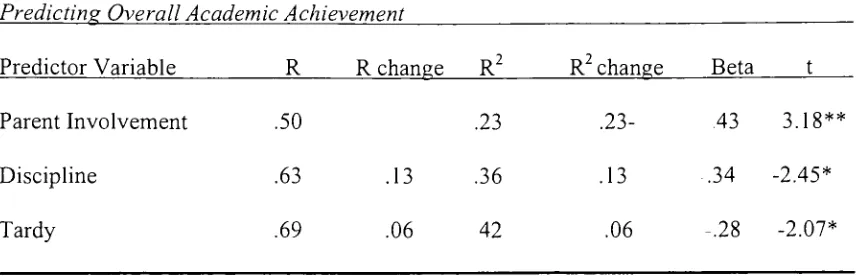
.05.Results
ofthe
step-wiseindicated
that
Parent
Involvement
(as
seenfrom
the
parent'sperception)
along
withdisciplinary
referrals andtardiness
best
predicted overall academic achievement(F3j3i
=9.18,
p
< .001).The
results ofthe
multipleregressionsaredisplayed in
table
4.
Due
to
the
returnrate,
ofParent School Climate
Surveys,
resulting in
a smallsample
size,
analysescould notbe
completedfor
gender,
racial,
socioeconomic,
or gradedifferences.
Also,
due
to
the
lack
of parentresponses,
no significant correlations werefound between
parent'sperceptionsofschool climate and student's perceptions of schoolDiscussion
The
purposeofthis
study
wasto
examinehow
specific student/parent pairs viewschool climate and
if
their
perceptions
ofit
arerelatedto
the
child's academicperformanceandproblem
behavior.
Previous
researchershave
examinedmany
ofthe
effects schoolclimatecan
have
onstudents'
emotional and academic
development;
however,
few
studieshave
investigated
the
student/parentdyad
andthe
predictability
ofparents'
perceptions.
What
madethis
study
unique,
wasthat
welooked
athow
parents'
perceptions of school climate were related
to the
overall school performance oftheir
child.
The
main outcome ofthis
study
supports previousresearch,
which reports positiverelationships
between
parentinvolvement
andtheir
child's academic achievement(Sheldon &
Epstein,
2005).
Within
regardto
correlationsbetween
studentand parent perceptions of schoolclimate,
no significant correlations werefound.
This
was mostlikely
due
to the
low
return rate of parent
School
Climate
Surveys,
whichresultedin
a small sample size.Past
research
has indicated
that
students andtheir
parentshave
similar views with regardsto
the
child's school climate.This
agreementbetween
the
parent and child waspositively
related
to their
evaluation ofthe
school climate(Griffith,
2000).
The
first
hypothesis,
that there
wouldbe
a positive relationbetween
studentacademic performance and
parents'
perceptions of student-teacher
relations,
was notupheld
by
our results.These
resultsmay have differed if
there
was alarger
sample sizeto
draw from. A
negativecorrelationhowever,
wasfound
between
parentperceptionsoftardy,
the
more negativeof a viewthat
parenthad
oftheir
child'srelationship
withtheir
teacher.
In
this study,
a positiverelationship
wasfound between
student academicperformance and
parents'
perceptions of
Achievement Motivation.
Achievement
Motivation is defined
by
Haynes
et al.(1997),
asthe
extentto
which students atthe
school
believe
that
they
canleam
and arewilling
to
leam. This
conceptis very
similarto
self-efficacy,
whichis defined
as"a
student's confidencein his
orher ability
to
overcomechallenges
to
attain specificgoals"
(Lodewyk &
Winne,
2005,
p.4).
Past
researchhas indicated
that
a student'sself-efficacy
affectshis/her
academicmotivation,
interests,
and academic achievement(Bandura
et.al,
1996). In
addition,
parents'
self-efficacy has been found
to
play
animportant
rolein
their
child'sself-efficacy
and academic achievement(Lynch,
2002).
Children's
perceptions oftheir
ownacademic abilities stem
from
their
parents'
beliefs
and expectationsregarding
their
child's academic performance
(Wagner
&
Phillips,
1992).
Bandura
et. al(1996)
has
further found
that
"Parents' sense ofefficacy
to
promotetheir
children's academicdevelopment
andthe
educational aspirationsthey
hold for
them
enhancetheir
children'sbeliefs in
their
own academicefficacy
and raisetheir
aspirations"(p. 1207).
The
findings,
whichindicate
that
higher
parentalbeliefs in
a child'sAchievement
Motivation
(self-efficacy)
andhigher
academic performances aresignificantly
related,
is
in
agreement with pastfindings. Past findings
alsoinclude,
that
boys'
academic
achievement was most affected
by
their
perception oftheir
parents'efficacy for
their
academicperformance.
On
the
otherhand,
girls1
their
perception oftheir
interactions
withtheir
parents(Lynch,
2002). A
gendercomparison
couldnotbe
completedfor
ourstudy due
to
the
limited
return rate.When
focusing
on academicachievement,
this
study found
that
parentinvolvement,
discipline
andtardiness
best
predictedthe
student's academic achievement.All
three
factors
together
accountedfor 42%
of student's academic attainment.Disciplinary
referrals alone werefound
to
accountfor 13%
andTardiness
alone wasfound
to
accountfor 6%
ofthe
student's academic achievement.These findings
supportpast research which states
that
less
internalizing
andexternalizing
problems areassociated with a more positive student perception of school climate
(Kupermick
et.al,
2001),
whichis in turn,
relatedto
higher
academic achievement(Hoy
&
Sabo,
1998).
Barriga
et. al(2002),
statedthat
behavioral
and academic problemshave
areciprocal
influence
overeach other.Academic
achievementhas been found
to
be
negatively
relatedto
avariety
ofdifferent
problembehaviors,
including
but
notlimited
to: aggression,
antisocialbehavior,
attentiondeficit/hyperactivity disorder, depression,
anxiety
and negativisticpersonality
traits.
Parent involvement
wasfound
to
accountfor 23%
ofthe
student's academicachievement.
This
wasthe
largest factor
that
wasfound
to
affectthe
students'academic
standing.
These
findings
are congruent with pastresearch,
whichindicates,
that
regardless ofeducational
background,
students whose parents attended schoolactivitieshad better
academic achievementthan those
whoseparentsdid
not attend.These
findings
are applicable across all grade
levels
(Sanders, Epstein,
&
Connors-Tadros,
1999).
Despite
these
findings,
many
families
are still notinvolved in
their
adolescents'and
is
emphasized
less
in secondary
schools(Epstein &
Hollifield, 1996;
Sanders
et.al,
1999).
Sanders
et. al(1999)
reportedthat
as students enter grades sixthrough
twelve,
there
is
adecline
in
parentinvolvement
in
the
following
four
activities:discussion
ofhomework,
discussion
ofschool,
help
withhomework,
andattending
school events andmeetings.
Often times,
teachers
believe
that
parentsdo
not wantto
become involved in
their
adolescents'
education
(Epstein &
Holifield,
1996).
This belief
canlead
to
an obstaclein
parent
involvement,
whichis
alack
ofeffective communication.Many
times the
teachers
and parents observe communicationdifferently
(Halsey, 2005;
Epstein &
Hollifield,
1996). This
communicationbarrier is
oftendue
to the
organization ofsecondary
schools.Students have
multipleteachers
andteachers
have
a muchlarger
number of students
(Sanders
et.al,
1999).
Teachers
often need assistancein
learning
to
deal
andinteract
withdifferent
parents.
Parents have
statedthat
95%
oftheir
communication withtheir
child's schoolis
one-way,
withthe
schooltelling
the
parent whatthey
should and should notdo
withtheir
child.
Many
times,
teachers
do
nottry
to
make contact witha parenttill their
childis in
trouble,
behaviorally
oreducationally
(Jones,
2001). Parents
oflow
socioeconomic statusreported
that
they
have
very
little interaction
withthe
school and whenthey
do,
these
interactions
are often negative andinforming
them
oftheir
child'smisconduct orfailure
(Nweze,
1993).
Proper
interaction
techniques
canbe
accomplishedthrough
staff-development
trainings
orparent-involvementtrainings
(Jones,
2001).
Some
parents,
particularly
those
of studentsat-risk,
may be
resistantto
because
their
home
andschoollives
aresodifferent
(Nweze,
1993).
Many
parentshave
had
negativeexperiences
themselves
with schoolthat
they
preferto
stay
away.Others
may
notbe
familiar
withAmerican
culture andmay have feelings
of alienation anddistrust
(Jones, 2001;
Sanders
et.al,
1999).
Traditional
meansthat
are usedto
involve
parents,
suchas,
openhouses,
parent/teacher
conferences,
and parent associationstypically
seemto
have only been
successful with middle class parents.
Often times, low
socioeconomic parents arehardest
to
reachdue
to the
difficulty
oftheir
lives,
in
whichthey
often worktwo
jobs
(Nweze,
1993). Jones
(2001)
suggestsmaking house
calls as away
to
reach outto these
hard
to
contact
families.
A
schoolin Sacramento
paysteachers
$25/hour
to
go outto their
students'
homes
andinteract
withtheir
families
and suggest waysthat
they
canbecome
involved in
their
child'slearning.
Past
researchhas
shownthat
in
orderfor
parentinvolvement
programsto
be
successful
in
helping
their
child prosperin
school,
they
needto
be
welldesigned
andfocused
(Jones,
2001).
Many
parents are not aware oftheir
responsibility
to
participatein
their
child's school andit
is
up
to the
schoolto
inform
andteach them
abouttheir
crucialrole
in
their
child'seducational success(Nweze,
1993).
When
designing
parentactivities,
schools must accommodateworking
parentsand provide
flexible
schedules around activities sothat
allfamilies
are ableto
participate.Research has
also shownthat
parents prefer aless formal relationship
withthe
schoolstaff,
which shouldbe
taken
into
consideration whendesigning
parent participationplansFinn
(1998)
found
that there
arethree
important
types
of engagementbetween
aparentand
their
childthat
areimportant
for
the
child's successin
school.Finn
first
mentions
the
needto
organizeand monitorthe
child'stime,
whichcanbe
accomplishedthrough
continually
checking up
onthem
andbeing
familiar
with assignmentsthat
aredue.
Next,
Finn
stressesthe
importance
of parentsdiscussing
school withtheir
childrenand
lastly,
it is
important
for
parentsto
startreading
withtheir
child athome
at ayoung
age.
A
new sociologicaltheory,
proposesthat
families,
schools,
and communities aremost successful when
their
goals anddesires for
their
childrenoverlap.This
meansthat
t