Rochester Institute of Technology
RIT Scholar Works
Theses
Thesis/Dissertation Collections
2005
A Process Capability Index for Three-Dimensional
Data with Circular or Ellipsoidal Tolerances.
Veljko Fotak
Follow this and additional works at:
http://scholarworks.rit.edu/theses
This Thesis is brought to you for free and open access by the Thesis/Dissertation Collections at RIT Scholar Works. It has been accepted for inclusion in Theses by an authorized administrator of RIT Scholar Works. For more information, please [email protected].
Recommended Citation
A
Process Capability Index for Three-Dimensional Data with
Circular or Ellipsoidal Tolerances.
Veljko Fotak
December, 2005
A
Thesis Submitted to the Faculty of the Center for Quality and
Applied Statistics in Partial Fulfillment of the Requirements for
the Degree of
MASTER OF SCIENCE in Applied Statistics.
Prof.
Joseph
G. Voelkel
(Thesis advisor)
Prof.
Daniel
R. lawrence
Prof.
Steven Lalonde
Prof.
Illegible Signature
Rochester Institute of Technology Digital Media Library
Electronic Theses, Thesis/Capstone Projects and Dissertations (ETD)
Approval Form
J/,?
If/{
/~r
t?
1<\
Student Name:
_Y_
(L.-_-T) _ _o
_ _ _
v _ _v _ _ _ _ _
---,_
Date:7//Z /05
\;~ (Degree: __ ~'_~\~=~
____________________ __
r:-College:
t:
V\ U\l
n
-<2.e
!'- 'vY\ '\J )
I
Department/Program:
A(zr
C.J
This is a Master's Thesis
><-.,
Master's Thesis/Capstone Project _ _ or Ph. D. Dissertation (Please check one.)Title:
A ProcesS
Capo. bi
);.J..
y
TnJex.
~r lTzr~~
-0;Y12~n5io~/
Qg,±o-
with
Cirw.!ctr c r
EJJiQl50ida.1
To/en::;,oc.
z.::'5.
IThe above- mentioned thesis, thesis/Capstone project or dissertation has been reviewed and accepted by the student's committee.
Signaturee Date Signed
Joseph G. Voelkel
locI'!
I/0;-(Committee Chair)
Daniel
R. lawrence
(Committee Member Co-Chair)
Steven Lalonde
(Committee Member
(Committee Member)
(Committee Member)
Review and Acceptance of ETD: I have reviewed the final electronic version of the above-me[lti(()ned document and determined that it is an accurate representation of the document reviewed' and accepted by th.e committee.
THESIS RELEASE PERMISSION FORM
ROCHESTER INSTITUTE OF TECHNOLOGY
COLLEGE OF ENGINEERING
Title of Thesis:
A Process Capability Index for Three-Dimensional Data with Circular
or Ellipsoidal Tolerances.
I, Veljko F otak, hereby grant permission to the Wallace Memorial
Library of R.I. T. to reproduce my thesis in whole or in part. Any
reproduction should not be for commercial use or profit.
Signature
Velika Fatak
TableofContents
A Process
Capability
Indexfor Three-Dimensional DatawithCircularorEllipsoidalTolerances 1
Thesis Release Permission Form 2
Table ofContents 3
TableofFigures 4
Abstract 5
Why
asingle-numerical measure 6Theproposedprocesscapability index 8
Gauge R&R inthree dimensions 1 1
Literaturereview 13
Otherprocesscapability indices 15
Calculating
thesummarymeasure ofvariability 21Ageometric interpretationoftheprocedurepresented 24
Estimating
candcalculatingthemultivariate process capability index 28Estimating
M 31Extensions
top
dimensions 32Application: analysis of color metrics 33
Applications 39
Example 1 42
Example2 51
Example3 57
Appendix 1 64
The function Rub 66
The function Invrub 68
Appendix2 69
The function Pei 71
Appendix3. Dataassumptionchecking, instrument
I,
long-termdata,
cyan 73TableofFJ2ures
Figure 1. Toleranceregionand smallest .99captureellipse 9
Figure2. Tolerance regionand proposed .99capture ellipse 10
Figure 3. Data andtoleranceregion with similarorientations 17
Figure 4. Data andtoleranceregion withdifferentorientations 18
Figure 5. Dataandtoleranceregionwith differentorientations andfittedcapture ellipsoid. 19
Figure 6.
Tolerance,
dataandfittedellipse 25Figure 7. Transformationto "U-space" 26
Figure 8. Transformationto "V-space" 27
Figure 9. Process capability
indices,
Example 1 46Figure 10.
Data,
toleranceandfitted ellipsoid,Example 1 48Figure 11. Tolerance andnatural .99captureellipsoidsforeach var. component,
Example 1 49
Figure 12. Toleranceandfitted .99capture spheresforeach var.component,Example 1.... 50
Figure 13. Process capability
index,
Example 2 53Figure 14. Data andtolerance region, instrument
A,
Example 2 55Figure 15. Toleranceregion andfitted.99 capture spheresforeachvariancecomponent,
instrument
A,
Example 2 56Figure 16. Process capability
indices,
Example 3 61Figure 17. Dataandtoleranceregion, instrument
A,
Example 3 62Figure 18.
Tolerance,
.99naturalcapture ellipsoid and.99capturefittedellipsoid, instrumentA,
Example 3 63Figure 19. Output ofthePeialgorithm 71
Figure 20. Lightnessversustime,
long-term,
cyan,instrument1 74Figure 21. Chromaversus time,
long-term,
cyan, instrument1 75Figure22. Hueversustime,
long-term,
cyan, instrument1 76Figure 23. Normal probabilityplot,
long-term,
cyan, instrumentI,
lightness 78Figure 24. Normal probabilityplot,
long-term,
cyan, instrumentI,
chroma 79Figure 25. Normal probabilityplot,
long-term,
cyan, instrumentI,
hue 80Abstract
We discuss the estimationof a process capability index for three-dimensional data.
Initially,
we focus onthe case inwhich the engineeringtoleranceassociated withthe measurements is
a sphere.
Then,
we extend the discussion to the more general case in which the engineeringtolerance is ellipsoidal. In both cases, we
develop
summary measures for repeatability andreproducibility,to beusedinthe context of a processcapability index.
Inthe sphericaltolerance case wedefine summarymeasures, where each measureis based on
the diameterof a sphere that leads to a pre-specified capture rate (we will usehere 99%). As
a process capability
index,
we propose ratios, where each ratio is the diameter of such asphere divided
by
thediameterofthetolerancesphere.In the ellipsoidal tolerance case, such summary measure will be based on the length ofthe
major axes of the ellipsoid of identical shape and orientation to the tolerance ellipsoid
providing apre-specified capture rate
(again,
we will use here 99%). As aprocess capabilityindex,
we propose ratios, where each ratio is the major axis ofsuch ellipsoid dividedby
themajor axis ofthe toleranceellipsoid.
We present two algorithms in the language R aimed at
facilitating
the estimation of oursummary measure ofvariability. The first algorithm evaluates the probability that a linear
combination ofthree(or
fewer)
independent chi-square variables willbe lessthanor equal toa given constant. The second algorithm estimates the value a linear combination of
offer an algorithm in the language R for computing the process capability index in the
context of color metrics.
Wepresent applicationsto color measurements andto R&Ranalysis of color metrics.
We show how the components of variance in these three-dimensional measurements can be
easily compared to each other and to the tolerance region, using the single-dimensional
summarymeasures of process capability.
Whyasingle-numerical measure
In the single-sample trivariate normal case, six numbers (three variances and three
covariances) are needed to describe the variability. We suggest here the use of a
single-numerical summary measure ofvariability, mainly to be used withinthe context of a process
capability
index,
to replacethosesix numbers.Whilethe use of asingle-dimensionalmeasureofvariability necessarily leadsto a partial loss
of
information,
there are various advantages ofusingsuch univariate measure:Such a summarymeasureallows foraneasy andintuitivecomparison ofthe observed
variability in relation to the defined tolerance region. An appropriate ratio of the
observed variability to the tolerance offers a meaningful estimate ofthe amount of
tolerance
"used"
Similarly,
such a summary measure offers an easy and intuitive comparison oftherelative magnitudes of the estimated components of variance
(allowing
for theidentification and comparison of major sources of variation). This measure can then
beusedto prioritize correctiveactions, ifneeded.
A univariate summary measure allows for other kinds of comparisons of variance
components,
depending
on the particular applications. In the colorimetric examplethat we provide, the univariate measure of variability offers intuitive means to
compare instruments intermsofthe observed variability.
The proposed measure of variability is easier to comprehend than the six-number
variance-covariancematrix.
Depending
on the application, other summary measures, or even direct analysis of theTheproposedprocesscapabilityindex
In the case of spherical tolerances, we propose to fit a sphere that provides a pre-specified
capture rate to the data. Our proposed process capability index can then be computed as the
ratio between the diameterofthis fitted spheroid and the diameter ofthe tolerance spheroid.
As discussed inthe Otherprocesscapability indices section,other metrics derivedfromsuch
sphereshave been proposed inthe past (mostnotably, the volumes),but most methods agree
in
fitting
a sphere providinga predetermined capture rate.In the case of ellipsoidal tolerances, as discussed in more detail in the Literature Review
section, it is common practice to base an estimation ofprocess capability on some measure
relative to the smallest ellipsoid that provides a particular capture rate - for
example,
by
comparingthe lengthofthe major axis of said ellipsoidto the length ofthemajor axis ofthe
tolerance ellipsoid. A two-dimensional representation is available in Figure 1. The smallest
ellipsoid providing a pre-determined capture rateis what would commonly be usedto derive
Figure 1. Toleranceregion and smallest.99capture ellipse.
Tolerance 99 Data Capture Data
In contrast, we recommend using a different ellipsoid - that
is,
the ellipsoid with the sameshape and orientation of the tolerance ellipsoid that provides a particular capture rate (we
Figure 2. Toleranceregion and proposed.99capture ellipse.
\
/
/
**V
V
/,/
Tolerance
99 Fitted Capture Data
We will refer to the smallest fitted ellipsoid (presented in Figure
1)
as "data capture", or"natural",
ellipsoid and to the fitted ellipsoid ofsame shape and orientation as the tolerance(as in Figure
2)
as"fittedcapture", or"fitted"
ellipsoid.
In the case of ellipsoidal tolerances, we propose the use ofthe major axis ofthe ellipsoid of
the same shape and orientation as the tolerance ellipsoid as a summary measure of
variability.
However,
forthe purposes of a processcapabilityindex,
the choice of whichaxisto use leads to invariant results. That
is,
given that the shape ofthe compared ellipsoids isidentical,
the ratio ofthe major axes is identical to the ratio ofthe minor axes-or, in the
more generalcase,to theratioofanyothercorrespondingpair of axes.
Gauge R&R inthreedimensions
We have decided to present the use ofthe proposed capability indexwithin the context ofa
process capability, or gauge repeatability andreproducibility
(R&R),
study, as such studiesnaturally leadtocomparisonsbetween toleranceregions and variance components.
The simplest R&R scenario involves one operator, using one gauge, making a series of
measurements on one single part. In the context of an R&R study, the variation of such
measurements can be summarized
by
"repeatability". "Repeatability" is definedas the lengthof an interval that captures a predetermined fraction /(we will use^=
.99) of such
measurements. Inthe case with sphericaltolerance, we estimate repeatabilityas the length of
the diameter ofthe sphere thatcaptures a predetermined fraction y ofthe reported readings
collected
by
one operator,usingone gauge, onone singlepart.In R&R studies, it may be possible to further subset repeatability into additive components
labeled "short-term repeatability", "medium-term
repeatability" and
"long
termIf we are to consider a scenario in which one of the above factors (operator or gauge)
changes, we fall under the realm of "reproducibility".
"Reproducibility"
is defined as the
length of an interval that captures a predetermined fraction y (we will use/=
.99) of such
measurements. For example, if we consider multiple operators, using one gauge, each
making a series of measurements on one single part, we obtain a variation that is
conventionally labeled as "operator reproducibility".
Alternatively,
"reproducibility" can
refer to the case in which we have one operator using multiple gauges, or
instruments,
tomake a seriesof measurements on one singlepart; inthis case,we speak of"inter-instrument
reproducibility".
In the three-dimensional case with a spherical tolerance, we estimate "operator
reproducibility"
as the length of the diameter of the sphere that captures a predetermined
fraction y ofthe reported readings collected
by
multipleoperators, using one gauge, on onesingle part. "Inter-instrument
reproducibility"
will be similarly estimated as the length ofthe
diameter ofthe sphere that captures y ofthe reported readings collected
by
one operator,using multiple gauges, on one single part
-and so on, for whatever component of
"reproducibility"
isofinterest.
In the more general case of elliptical tolerances, we extend the definitions of both
repeatability andreproducibility; that
is,
we estimaterepeatability as the length ofthe majoraxis ofthe ellipsoid of equal shape and orientation to the tolerance ellipse that captures yof
the reported readings collected
by
one operator, using one gauge, on one single part."Operator-reproducibility"
canthenbe similarly defined asthelength ofthe major axis ofthe
ellipsoid
-of equal shape and orientation to the tolerance ellipse
-that capturesyof the
reported readings collected
by
multiple operators,using onegauge, onone single part."Inter-instrument reproducibility"
can thenbe similarlyestimatedas the length ofthe major axis of
the ellipsoid
-of equal shape and orientation to the tolerance ellipse - that
captures y ofthe
reported readings collected
by
one operator, using multiple gauges, on one single part-and
soon, forwhatever component of
"reproducibility"
is ofinterest.
Those components of variance
(repeatability
and reproducibility)including
possibleinteractions (such as, an "operator - short term"
interaction)
can be estimated using thestandardMANOVAmethod of moments. Weoffersome examplesinthe
following
sections.Literaturereview
This thesis extends the work ofVoelkel
(2003),
who examined the two-dimensional R&Ranalysis inthe case whenthe specifiedtolerancewas circular.
General
theory
behindgaugeR&Rstudies canbe found in AIAG(1992),
Wheeler andLyday
(1989)
andBurdick,
BorrorandMontgomery
(2005).The application presentedhere is relatedto color metrics. Volz
(1995)
discusses multivariateanalysis of color metrics.
The process described falls under the wider category of"coverage problems", discussed
by
Guenther andTerragno (1964).
The estimation of our summary measure of variability requires the estimation of the
probability that a non-negative linear combination ofindependent chi-square variables will
be smallerthan or equal to a given constant. The same distribution of quadratic
forms,
withrelative application, has been discussed in various different contexts.
Johnson,
Kotz andBalakrishnan
(1998)
offer an extensivediscussionoftheexisting literatureon the topic.The distribution of a linear combination of j2
random variables, in particular, has been
discussed andtabulated
by
Grad and Solomon(1955),
by
Solomon(1960)
andby
Marsiglia(1960)
in the bi-and tri-variate cases. Johnson and Kotz(1968)
presented tables for 4 and 5dimensions and Solomon and Stephens
(1977)
offered tablesbased on linear combinationof6,
8 and 10 variables.The ideas proposed
by
Solomon were developed into a series ofalgorithms; in particular,Sheil and O'Muircheartaigh
(1977)
offer an algorithm (AS106)
to calculate the probabilitythata linearcombination ofA'non-central independent x~
random variables willbe less than
or equal to a constant c. Davies
(1980)
offers an algorithm (AS155)
with the samefunctionality,
but employs inversion of the characteristic function to obtain the solution,basedon a previouslypublished paper
by
the same author (Davis (1973)). Farebrother(1984)
offers an improved version (AS
204)
to the algorithm AS106,
leading
to generally fastercomputing times. The algorithms AS 155 andAS 204 are both based on a method outlined
by
Ruben (1962).Johnson,
Kotz andBalakrishnan(1998)
discussother approaches thathavebeen employed to estimate the distribution function of a linear combination of chi-square
variables.
Otherprocesscapability indices.
Voelkel
(2003)
discussessome summarymeasures ofvariabilitythathave been considered inthe past. The discussion is specific to the case in two
dimensions,
but the concepts applysimilarlyto our case.
Inparticular, the area of an ellipse of equal shape and orientation to the tolerance ellipsehas
been proposed
by
Hulting
(1992). We believe this summary measure ofvariability to haveone major
difficulty
in interpretation. While this area-based measure is mathematicallyequivalent to the circle-diameter measure, in most applications the users are more often
thinking
interms of original units ofmeasure, ratherthen in terms ofthe squared (or cubed)units associated with tolerance surfaces and volumes. The sphere-diameter measure that we
propose is expressed in the original units ofthe measurements, thus offering more intuitive
interpretations.
The length ofthe major axis ofthe natural ellipse providing a specific capture rate
(Hulting
(1992)
and Demeter(1989))
has some appeal as it is a very intuitive summary measure ofvariability. We discuss here why we consider it an ineffective summarymeasure to be used
withinthe context of aprocesscapability index.
When the defined tolerance is spherical, there is no difference between the length of the
diameter of the "natural" sphere providing a certain capture rate and the length of the diameter ofthe fitted sphere providing the same capture rate, as the two will be necessarily
equivalent. Ontheother
hand,
with an ellipsoidal tolerance,a comparison ofthelength ofthemajoraxis ofthe ellipsoidofferinga specific capture rate could, potentially, offermisleading
results.
We will illustrate the possibility ofmisleading results in two dimensions. Consider a
two-dimensional dataset with its smallest, ornatural, .99 data capture ellipsoid. Assume that the
size and shape of said ellipsoid are very similar to the size and shape of the tolerance
ellipsoid.
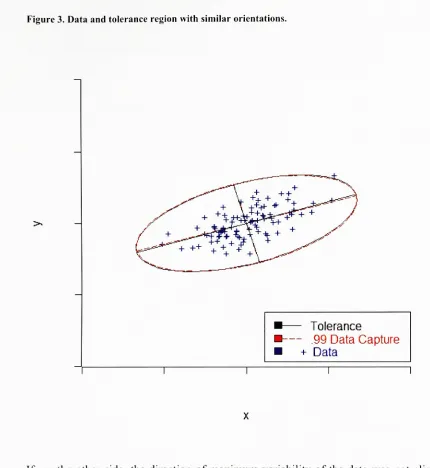
If,
for example, the direction of maximum variability of the data was perfectlyaligned with the direction of maximum variability ofthe tolerance region, as in Figure
3,
aratio ofthe major axis ofthe data and tolerance ellipses close to 1 would appear to suggest
that the observed variability is about the same size of the tolerance region,
leading
to anacceptable product, or process. The dataset depicted includes 100 data points. As expected,
given a capturerate of.99, we can observethatone pointfallsoutside of our .99datacapture
ellipsoidandoutsidethe toleranceregion.
Please note, a ratio larger than 1 would indicate that the proportion of observations
falling
withinthe tolerance is smallerthan thepredetermined capture rate (.99). A ratio smallerthan
1 wouldindicate that theproportionofobservations
falling
withinthe tolerance is largerthanthe predetermined capture rate (.99). A process capability index smaller than 1 is thus
desirable.
Figure 3. Dataandtoleranceregionwithsimilarorientations.
^
+\ S_
r*
*l^fi^
-Tolerance
-.99 Data Capture
+ Data
T
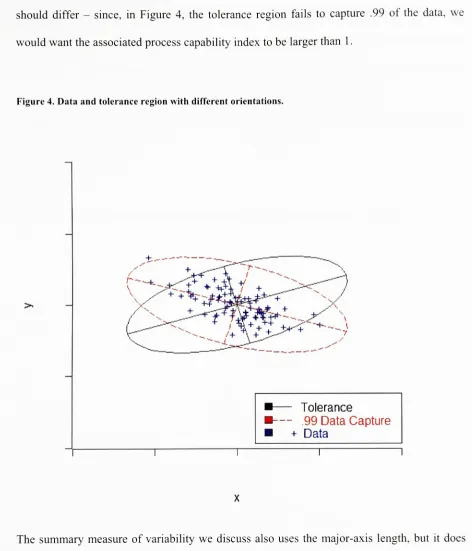
If,
on the other side, the direction of maximum variability ofthe data was not aligned withthe tolerance region, as in Figure
4,
anyratio basedon a comparison oflengths or surfaces ofthe two depicted ellipses would still be approximately
1,
but the number of observationsfalling
outside ofthe tolerance region would be considerably higher. In our example, onlyone observation falls outside ofthe .99 capture ellipsoid, but 7 observations fall outside the
tolerance region.
Clearly,
theprocess capability indices forthecases in Figure 3 and Figure 4should differ
-since, in Figure
4,
the tolerance region fails to capture .99 of thedata,
we [image:20.534.29.501.49.600.2]would want theassociated processcapability index tobe largerthan 1.
Figure 4. Dataandtoleranceregion withdifferentorientations.
+ 7^
' ----t +-fcT V
-i
\
/
X
/+
K
X
'l.
J^
-Tolerance
-.99Data Capture
+ Data
T
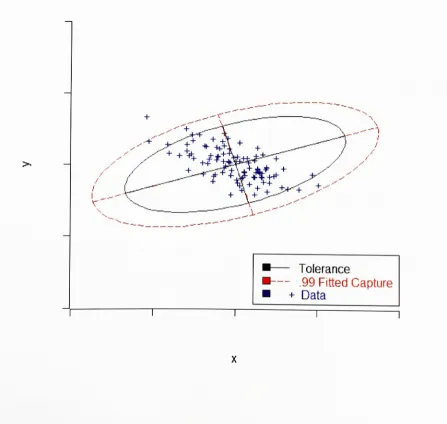
The summary measure ofvariability we discuss also uses the major-axis length, but it does
account for the differences in orientation between the data and tolerance region, thus
being
preferred in most applications. Given the same scenario as the one presented in Figure 4,
when computing a process capability
index,
we would fit the capture ellipse presented inFigure 5. The ratio ofthe length ofthe major axis of said ellipse to the length ofthe major
axis of the tolerance ellipse is approximately 1.3
-indicating, correctly, that the process
variability is indeed larger than the tolerance region. In this example, the predetermined
capture rate is .99, but the tolerance region only captures 93% of the
data;
with outmethodology, the associated process capability index is correctly estimated as
being
larger [image:21.534.26.473.303.727.2]than one.
Figure 5. Dataandtoleranceregion withdifferentorientations and fittedcapture ellipsoid.
.<T^, s
1
/
/
r
-Tolerance
-.99
Fitted Capture
+
Data
Wang
et al.(2000)
discuss three other multivariate process capability indices (we cite therelevantindices inthree-dimensionalapplications, although allthreehave beenpresented ina
more generalmultivariatesetting):
Shahriari,
Hubele and Lawrence(1995)
propose a capability index based on threecomponents: a ratio of volumes (the numerator
being
the volume definedby
theengineering tolerance region and the denominator
being
the volume of a modifiedprocess region
-the smallest region similar in shape to the engineering tolerance
region, circumscribed around aprobability contour), a measure ofthe distance ofthe
centers ofthe tolerance and dataregions and an indexvariable
indicating
whetherthemodifiedprocessregion isoris not contained withinthe tolerance regions.
Taaam,
Subbaiah andLiddy (1993)
propose a capability index based on the ratio ofthevolume ofthe toleranceregionto thevolumeof a modified process region
(which,
inthe caseofmultivariatenormal
data,
is an ellipsoidproviding a99% capturerate).Chen
(1994)
proposes a capability index to be applied, as the title of his papersuggests, to rectangulartoleranceregions. His index has no intuitive interpretation in
themultivariate case,but it isexpressedintheoriginal unitsofmeasure ofthedata.
Kotz and Johnson
(2002)
present an extensive list of publications regarding processcapability
indices,
andlisttheavailableliterature on multivariateindices.Calculating
thesummarymeasureof variabilityConsider the simplest case of one operator, using one gauge, making a series of
measurementson one singlepart, inwhichwe wantto estimate repeatability.
We assume that the variation in these measurements can be modeled
by
a multivariate(trivariate)
normaldistribution,
which, without loss of generality, we assume is centered atzero:
x~n3(o,i:s).
We also assume that the given toleranceregion is atri-dimensional ellipsoid
(or,
in a specialcase, a sphere) centered at zero. An ellipsoid can be mathematically described
by:
{x
: x'Mx= c2),
where M is a non-negative definite symmetric matrixdefining
the shape of the ellipsoid and c is a scale factor. For the tolerance ellipsoid, we set c- 1, which
reduces the equation ofthe tolerance ellipsoid to
{x
: x'Mx=l}. The tolerance region canthenbe describedas theseries of points
{x
: x'Mx <1}
.Please note that, forthe present purposes, an ellipsoidal and aspherical tolerance region are
treatedinthe same manner.
In orderto compute our summarymeasure ofvariability, we aim at
fitting
an ellipsoidwiththe same shapeandorientationas those ofthe tolerance ellipsoid, sothata certainproportion
(the "capturerate") ofthe observeddata falls withintheellipse
itself;
thatis,
we wanttofindc suchthat:
P(X'M
X<c2)
=In geometric terms, we wantto shrinkorstretch the tolerance matrix M
by
a factora so thatwefindthematrix ofthe same shape and orientationthatgives:
P(X'aMX
<l)=y
or, equivalently:P(X'aMX<l)=P X'MX <
-= PJX'MX< c2
)
= yV
a) Where c2 =l/aIn order to more easily find c, we can equate the quadratic form X'MXto a linear
combination of independent chi-square variables (as the distribution ofthe latter has been
amply discussed in the past in the context of "coverage problems", as discussed in the
Literature reviewsection ofthe present). Toaccomplish this goal, we apply a series ofthree
transformations of variables. While these three transformations could have been
accomplished in a single, albeit more complex, transformation, we present them here in a
step-by-step fashiontofacilitate understanding.
As afirststep,we set U =MI/2X .
U is a lineartransformation of a multivariate normal random variable; it is well know that U
itselfis also multivariate normal:
U~N3(0,i:u)
, whereu
= Ml/2i:xMl/2.
Because X'MX =X'Ml/2Mi/2X = U'U
, p(x'MX < c2
)=
p(u'U <c2)
Eu
is a symmetric positive definite matrix and can be decomposed as follows (Johnson andWichern
(2002,
pp. 66-67)):u
=PuDuP,;
where
Du
isadiagonalmatrixcontainingthe eigenvaluesofHu
:D.
K
o oo
zU2
00 0 I
Where
Xu_
,/lUi andXlh
aretheeigenvalues ofthematrixu
andXu_
>Xu^
>Xih
and
Pu
=[eU|
,eU2,euJcontains the corresponding orthonormal eigenvectors; we shouldnote that P.'
P..
=1.Ina secondtransformation, weset V =
P^
U.Thevariance-covariancematrix ofV is:
ln=p:eupu=p:pudup;pu=idui =
du
Thatis,V~N3(0,Du).
Wethen
finally
havetheequation:U'U = VT^P^'V = V'V.
Sincewearehere
discussing
thetri-variate case,X'MX = U'U=VV = V2
+V; +
V2
Since
V],V2
andVJ
are normal variables with variance, respectively,Xu
,XlH and/lu , we can
equate: V2
+V22 +
V^
=Xu
Y2 +/LH Y2 +Xu
732, whereYx
,Y2
andYi
are independent standardnormalrandom variables.
That
is,
we have equated X'MX to a weighted sum of independent chi-square variables,each with one degree of
freedom,
where the weights are the eigenvalues of thematrix
u
=M1/2LXMI/2 :
p(x'MX<c2
)
= P(U'U <c 2)
= P(v2 + V2 + V2 <c2)
=p(XUi
Y;
+Xu^
Y; +^
Y2 <c2)
=y
After
briefly
discussing
the geometry ofthe above transformations, we will discuss how theproposed process capability index reducesto c.
Ageometricinterpretationoftheprocedure presented
We havepresentedthe aboveas three consecutivesteps inorderto simplify understanding of
theprocedure. Thethree steps takencan be easilyexplained when looked at sequentially and
with a geometrical interpretation. Figure
6,
Figure 7 and Figure8,
on thefollowing
pages,offera graphical representation ofthe process.
Please note, we have assumed previously that our measurements follow a multivariate
normal
distribution,
centered atzero; thatis,
X ~N3
(0,
x
)
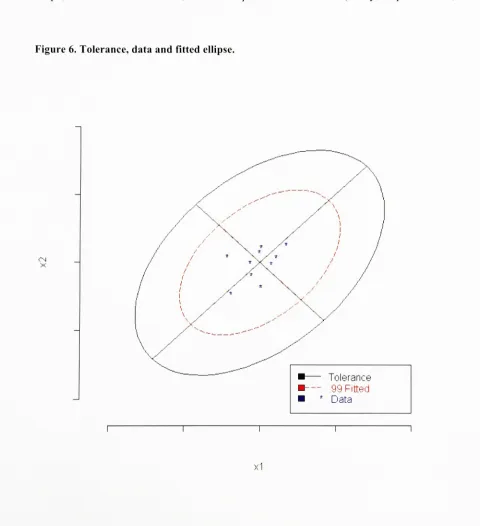
.Step
1: Please refer to Figure 6. Our starting point is the equation of the toleranceellipsoid, which we can describe
by
a sequence of points{x
: x'Mx=lj
. A second ellipsoid,with the same shape and orientation, provides a predetermined capture rate and can be
described
by
the set of random variables(X
:X'MX <c2
}.
Thetwo ellipsoids have the same [image:27.534.9.489.185.711.2]shape,orientationand centroid; the twoellipsoids differ in scale(set
by
the parameter c).Figure 6.Tolerance, dataandfitted ellipse.
CM X
-Tolerance
-99 Fitted
*
Data
x1
Step
2: Please referto Figure 7. The firsttransformation,U= M1/2X, hasthe effect of
shrinking both the tolerance and data ellipsoids along the directions of maximum variability
(axes ofthe tolerance ellipsoid). Both ellipsoids reduce to spheroids; the tolerance ellipsoid
can be described
by
a set ofpoints{u
: u'u=l},
whilethe fitted ellipsoid can be describedby
a set of random variables
(U
: U'U <c2Figure 7. Transformationto "U-space".
CM
Tcrerance 99 Fitted
Data
u1
Step
3: Please refer to Figure 8. The second transformation,V = P^U, rotates both
the tolerance and fitted regions. The resulting spheroids have their axis aligned with the
coordinate systems. Both ellipsoids reduce to spheroids; the tolerance ellipsoid can be
described
by
a set ofpoints{v
: v'v =1), while the fittedellipsoid can be describedby
aset ofrandom variables
[V
: V'V< c2Figure8. Transformationto "V-space".
>
Tolerance 99 Fitted
Data
i
v1
[image:29.534.10.468.23.715.2]Estimating
c andcalculatingthemultivariateprocess capability index.As discussed in the literature review section, various methods and algorithms have been
proposedinthepastto solve:
P\XU
Y2 +X:i
Y2
+
Xu
732
<c2)=
y,where
7,, 7,
andY}
are independent standard normalrandom variables.
In Appendix 1 we use two algorithms to solve the above equation. The first estimates
ygiven the eigenvalues
Xu
,Xu
andXu
and the parameterc2
; the second algorithms
estimates
c2
given theeigenvalues
Xu
,XU^ and/lu andtheparameter y.
The
inequality
\r\P\Xu Y2+
Xu
Y2 +Xu
Y2 <c2)=
y is overparametrized. An often usedreparametrization employed, for example, in the tables compiled
by
Marsiglia(1960),
leadsto: P(Y2+r]Y2+r2Y2 <r3) =
y
Where
'
i
=
K
IK
r2 =
\
IK
r^c2jXUi
We will continue to use the overparametrized version of the equation in the present
discussion.
Once we have M and c, we can proceed in estimating our summary measure ofvariability
and computing the capability index as follows.
Geometrically,
as discussedby
Johnson andWichem
(2002,
pp.65-66),
the three-dimensional fitted ellipsoid can be determinedby
thethree axes, whose orientation is described
by
the eigenvectors etofthe matrix M and whosehalf length inthe e(direction is equalto , where
Xt
isthe/"'
correspondingeigenvalue
ofthematrix M.
Inthe spherical case, wehave
Xx
=X2
=X3
= X. The diameterofthe spherecanbe calculated
as d=
2c/
Jx
.For the purposes of calculating the capability
index,
we calculate the diameter of thetolerance sphere:
dlol
- 2 1-[X
Theprocess capability
index,
definedas the ratiobetween the diameter ofthe "fitted" sphereandthe diameterofthe tolerancesphere, reduces to:
d
_
2c/
VI
d,o,
~
2/
VI
=c
In the ellipsoidal case, wecalculate the lengthofthe major axis ofthe ellipsoid, ofthe same
shape and orientation as the toleranceellipsoidthatprovides apre-determinedcapture rate/.
Our process capability index will then be the ratio ofthe major axis ofthis ellipsoid to the
major axis of the tolerance ellipsoid.
Clearly,
for the purposes ofdeveloping
a processcapability
index,
theratio ofthemajor axes will be equalto the ratio of e.g. the minor axes,becausethe shapesofthe ellipsoidsareidentical.
The length of the major axis of the fitted ellipsoid will be equal to
2c/^Xmin
where
Xmm
=min(/l1,
X2
,A3
)
. Please note, that the major axis ofthe ellipse isassociated withthe smallest eigenvalues ofthe matrix M
-as the length of each axis is
inversely
related tothe size ofthe eigenvalues ofM. The length ofthe major axes ofthe tolerance ellipsoid will
be equalto:
2/^jXmm
, sotheprocess capability indexis,
again, c.Theprocess capability
index,
defined asthe ratio betweenthe length ofthe majoraxis ofthe"fitted"
spheroid andthe lengthofthe major axis ofthe tolerance ellipsoid,reduces to
2c/y/C
2/V-C
The use of c as a scale factor allows for quick and intuitive comparisons.
So,
for example,ifc=0.1
, we would conclude that the amount oftolerance
"used"
by
the data-or
by
theparticular variance component studied - is 10
percent. This also allows for comparisons of
variance components.
Estimating
MIn some applications, the users may not be given a matrix M that describes the size and
orientation ofthe tolerance region.
Rather,
a set ofacceptableobservations may beprovided,from which the user has to derive an equation
describing
the tolerance region. A similarapproach was used in the field of color science to derive a series of equations
describing
tolerance regions whose size and orientation vary accordingto the position in color space of
the measured sample.
We define
t;
asthe vector oflength 3 containingthe measurements ofthei'h
observations.
Ifwe consider a set ofdata points
describing
the entire acceptable tolerance region, definetol
asthesample variance-covariance matrix associated withthis set ofdatapoints.Wethenproceed
by finding
thevalue c]calej =t-S^t,
for everyobservation /.Wedefine c]cale
,max
=
max(c2.afe,
)
. We thendefine M as:M=
1^,
.scale, max
Extensionstopdimensions
We presentour methodin the three-dimensional case, but the argument applies equally well
to thep-dimensional case.
With spherical tolerances, oursummarymeasure wouldbe the diameterofthe p-dimensional
spheroidthatleadsto apre-determinedcapture rate.
With ellipsoidal tolerances, our summary measure would be the length ofthe majoraxis of
the ellipsoid (ofequal shape and orientation to the tolerance ellipsoid) that leads to a pre
determined capture rate.
When
fitting
this ellipsoid,we would use a similar set of equations:p(x'MX<c2)=p(uV<c2)=P(J^XUpY2<c2).>
p
p
With eitherspherical or ellipsoidal tolerances, c can be interpreted as estimating the fraction
oftolerance "used"
by
the component of variance ofinterest.In practice, the main use of this is in the two-dimensional case, extending the result of
Voelkel (2003).
Application:analysisofcolor metrics
We present in the
following
section various applications ofthe proposed process capabilityindex,
in the context of color metrics. Our process capability index is presented within theframework ofthe
CIE94
(Bems(2002,
pp.72-74))
standard for color measurements. In thepresent section, we
briefly
summarize the most relevantCIE94
concepts andhowthey
reflectonthe applicationof our process capability index.
Onecommon coordinate systemfor reportingcolor
data,
andthe format inwhichthe datasetsweremade available to us, isthe CIELAB coordinate system (Bems (2002),pp. 72).
Briefly,
CIELAB can be described as a rectangular coordinate system with axes labeled L ,a and/? .
Themagnitude ofthe
L*
coordinate describestheamount of
lightness,
that of refersto theamount of redness-greenness while that of b*
refers to the amount of yellowness-blueness.
"CIE"
stands for Commission Internationale de l'Eclairages
-an international
body
of colorscientists -while
"LAB"
refersto the L\ and b*
coordinate system.
Every
measurementcanthenbe
described,
withinthe CIELABmeasurementsystem,by
a vector v =[L*
bj.
Despite the common use ofCIELAB in reporting
data,
CIE94
definescolor tolerances withina different coordinate system, defined simply as
"lightness-chroma-hue",
with axeslabeled
L\
C*ab,
H'ah.CIE94
offers an equation to estimate the size of the acceptable tolerance region for colordifferences (Berns (2002, pg. 72). While this above equation was developed to estimate the
size of a tolerance region around a particular
"standard",
we have applied a slightmodification to the formulas supplied, in order to compute color differences around the
mean. Wedefine:
A94
= ^=1 f *^* V + ACab \kcSc j AH V ab \^h^hj , where:Sc
= 1+0.045CJ,
S
=1+0.015^
kL
-kH
-kc
= 1forreference conditionsSimilarly,
with slight modifications to the standard formulas (Berns(2002,
pp.72),
Stokes(1992),
Seve(
1996)):M!=L'balch-T
*c:b4aijAbijf4d*r+(b>)f
AH h = ab ala,c,y -a'bla,ch[0-5(C,to,cAC
+ +b'ba,chb* )f2
Finally,
to obtain an estimate of our tolerance region, given a certain position in the.
b'
color space, which reflects in the
C*ab
factor,
we have to set a maximum acceptable"overall color
difference",
asmeasuredbyAf94
. Forthepurposes ofthe presentexample, wewill setA94 -
1,
a valuecommonly used in industrial application, although the exact value
will depend on the particular application studied. In an applied situation, the value of
AE94
willbe establishedby
theuser.Theregion containingacceptable observationcanthenbe describedas:
T:
'AT
V K^L^LJ ( K^* \ ab AC \kcScj f A IT* V AHab ykf/Sfj j <1Given a set of Z,*,a*and
b*
measurements, we are then able to both transform the data and
derivean equationforthe toleranceregionin
AL*
,
AC*fc
,AH*ah
space.Thesizeandorientation ofthetolerance region canbe described
by
adiagonalmatrix:M =
0 0
1
^
00 A2
1/
We should observe that the tolerance ellipsoid axes defined
by
theCIE94
standard, arealigned with the
AL*
,
AC*ab
,AH*ab
coordinate system.To estimate the scale factor c for a particular variance component, we need to estimate the
eigenvaluesofthematrix
Eu
=MI/2LXM1//2
, which inturnrequires anestimateof
x
.In our simplest scenario (one operator, using one gauge to take n measurements on a part),
we could model eachreading
Xx
=AC*ab AH*ah
)
as follows:X;
=p+>,with:
p =
(0
0ei~N3(0,LJ
We caneasily estimate
Hx
asVar(AX*
)
Cov(AC;A,AI*)
CovfA/CAT)
Cov(az.*,ac;J
Var(AC;J
Cov(AH*ab,AC:b)
Cov(AL*.AHlb)
'cov(ac;,a//;J
Var(A^;J
Once we have obtained our estimate of xas described above, we can proceed
by
finding u
=M'/22:xM1/2y- M\/2
We then calculate the eigenvalues
X,
,X, ,X, of the matrix and use the latter inestimating cin P[X
Y2
+
Xu.
Yi
+K,
Yi
^c2)=y.To find c for a given set of eigenvalues
Xu
,AUi
,AM
and a capmre rate /, we proposed analgorithm in Appendix
1,
which is an adaptation of the Ruben algorithm presentedby
Farebrother(1984).
In more complex cases, such as a typical gauge R&R study, we are interested in the
estimation of components of variance. In typical applications, we can assume that the
variation of a process can be subset into short, medium and
long
term components. Forexample,we couldassume thatwe couldmodel eachreading xijk =
\AL*ijk
ACa/,
AHabj asfollows:
xjik = u+
si
+mj
+'k' with:u=
(0
0s, ~MVN(0,Ls)
i^-MVISKO.EJ
lk
~MVN(0,L,)Please note that the total error term xis equal to the sum of the short, medium and
long
termcomponents:
Xx
=Es
+Em
+,
.Multivariate ANOVA techniques and, in particular, the so called "method of
moments"
(Montgomery
(2001,
pp512-549),
Jobson (1999),Rencher(2002))
can be employed toobtain
Es,Hm
and,
. Wecanthencalculate:tu-s
u,m=M'/2i:mM1/2
tUJ
=M1/2L,M1/2
'/2V lVfl/2
u
=Ml/-ExMWecan thenobtainthe foursets of eigenvaluesto obtain estimates ofc,csl,cml,ch.
These fourestimates would correspond to common summaries ofthemeasurement systems.
Forexample, cslwouldbe anestimateof shorttermrepeatability.
In the one-dimensional case, we can observe
that:c2
=
c],
+c2ml
+cft. Voelkel(2003)
provedthat, in the two-dimensional case,
c2
<c2
+c2ml
+cft
-the case for perfect additivity only
holds when all ofthe components of variance are oriented in the same direction (that
is,
theestimated variance-covariance matrices all have the same eigenvectors). The same concept
appliesto three ormore dimensions:
c2
<c2
+c2, +
c,2
, withtheequality
holding
only whenall components ofvariancehave thesamespatial orientation.
In the same way the method of moments applied to univariate cases can result in negative
component of variance estimates, in multivariate settings the method ofmoments can result
inestimatedmatricesthatarenot non-negative definite.
From our examples, we observed that this problem tends to most often manifest
itself,
inmultivariatesettings, whenmost ofthe variance is alignedwith onedimension. Forexample,
we encounteredthisproblem when estimatingvariance componentsin ourthird example (the
long-termcyandata).
When the estimated components of variance arenot non-negative definitematrices, we used
the Calvin-Dykstra algorithm(CalvinandDykstra (1991)). Otherpossible remedial measures
aredescribed
by
CalvinandDykstra(1991).Applications
We present here three different examples, all relative to estimation of variance (and
components ofvariance) of color metrics.
1. An estimation of
inter-instrument reproducibility and of the related components of
variance (short terms and medium
term)
and possible interactions(instrument*
medium-term), basedon measurements on awhite sample.
2. A comparison of the components of variance (short-term and medium-term) of
measurements obtained with 12 different
instruments,
based on measurements on awhite sample.
3. A comparison of the long-term and medium-term variability components of 12
instruments usedtomeasure acyantile.
The instruments used in the three examples are ofthree different kinds: handheld spheres,
benchtop
spheres andhandheld bidirectional. The instruments were labeledasfollows:Table 1. Instrumenttypes.
Instrument Type
A Handheld Sphere
B Handheld Sphere
C Handheld Sphere
D Handheld Sphere
E
Benchtop
SphereF
Benchtop
SphereG
Benchtop
SphereH
Benchtop
SphereI Handheld Bidirectional
J Handheld Bidirectional
K Handheld Bidirectional
L Handheld Bidirectional
Twopairs ofidenticalmodels wereincluded inthe experiment: Aand
B,
Kand L.The experiments were conducted under the assumption that no operator effects would be
significant. Under this assumption, no data on operators has been collected and the
assumption itselfcouldnotbe tested.
The capturerate y forthe data-fittedellipsoidshas beenset in theseexamples at .99.
The data was made available to us in the L metrics. We converted to
AL*
,
AC*lh
,AH*ab
spaceusingthe formulas discussed inthe previous section.After converting the data to
AL*
,
AC*ab
,AH*ab
space, we proceededby
verifying that the datadid meet our assumptions
-that
is,
that the data is multivariate normal and that no trendsover time are present. Our technique requires also that the mean of each univariate
distribution is zero
-given that
AX*
,
AC*,,
,AH*ab
are essentially differences from the meanvalue,
they
arenecessarilycentered at zero.We first checked for independence over time (that
is,
for a lack of time-related trends ormeasurement drift). No formal tests were employed
-rather, the data was plottedversus the
order of observationandvisually inspected fortrends.
In order to verify the normality assumption, we utilized four univariate tests
(Shapiro-Wilkins (Shapiro and Wilkins
(1965)), Kolgomorov-Smirnov,
Cramer andAndersonDarling
(Ryan and Joiner
(1976)))
to check for departures from normality in the univariate datadistributions.
Finally,
we employed the Mardia tests for Skeweness and Kurtosis (Mardia(1980))
and the Henze Zirkler T-test for normality (Henze and Zirkler(1990))
to check formultivariate departures. We used normal probability plots and chi-square
Q-Q
plots(Chambers, Cleveland,
Kleiner andTukey
(1983))
to assess univariate and multivariatenormality departures. The procedureappliedis exemplifiedforone instrument in Appendix 3.
Overall,
we were satisfied with the results of such tests and concluded that the data did notpresentproblematic departures fromourassumptions.
Example 1
The dataset used in this first example consisted of 10 measurements taken every
hour,
for 8hours,
on each of12 instruments.We assumethatwe couldmodel eachreading xijk =
\AL*jk
AC*ab
AH*ah
J
as follows:Xijk
=M-+mi +
ij
+miij
+Sk(ij)
> with:u=
(0
0m1~N3(0,LII1)
1,-^(0,2.)
mi^-N^O,^)
sk(ij>
~N3
(0,
Es
)
, where wedefine:Hx
=total varianceLs
=short-term (withinthehour)
variance componentm
=medium-term(hour-to-hour)
variance componentLj
=instrumentvariance componentEmi
=instrument-mediumterminteractioncomponent
Using
theCIE94
equations, we find that the tolerance matrix associated with a white sampleissimply asphere:
M =
1 0
0 1 0
0 0 1
We report here one ofthe metrics used in the test for significance ofvariance components,
the p-valueassociated with the F statistic for
Wilks'
multivariate test (Johnson and Wichern
(2002)). When tested at a 5% significance
level,
the instrument and the instrument-mediumterm interaction components of variance were significant, but the medium-term component
was not. In ouranalysis,we retainedthe MT componentofvariance,because thehigher-level interaction is significant; in order to obtain a meaningful estimate of
Lm
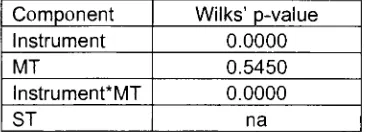
, we applied the [image:45.533.41.224.290.356.2]Calvin Dykstra algorithm).
Table 2.Significanceof variancecomponents, Example 1.
Component Wilks'
p-value
Instrument 0.0000
MT 0.5450
lnstrument*MT 0.0000
ST na
Using
the expected mean square table presented in Table 1, we obtainedthefollowing
estimates forourcomponents of variance:
2.
=^.3289
.0261.0261 .0541 -.0234
.0077 -.0234 .0257 v
^.0425
-.0010-.0010 .0006 -.0001
.0019 -.0001 .0006
mi
=^
.1225 .0096 .0005
A
.0096 .0037 .0005
.0005 .0005 .0005
J
=
f
.0054 -.0005 .0003^
.0005 .0000 .0000
v .0003 .0000 .0000
:
= 1.1585 .0179
.0179 .0498 -.0238
.0050 -.0238 .0246
Table3. EMS for Example 1.
Source df EMS
Instrument 11 L,+10Elm+80E.
MT 7
Ls+10Emi+120i:ni
lnstrument*MT 77
^s+102mi
ST 864
^s
Total 959
Once we obtained the above estimates, we could employ the algorithms presented in
Appendix 1 to calculate our process capability index for each component of variance.
Keeping
in mindthat,because M = I ,E
=M1/2tM1/2 =
t
iu,st=M|/2i:stMl/2=i:st
E =M' E M' =E
u,instrument*mt instrument*mt in:strument*mt
t,
u,mtmt mt =i\,mtm,rV2 _ = MV . M' = E. u.rnstrumentt instrumentt rnstrumentt
The estimated process capability indices foreach component of variance and forthe total are
presented in Table 4 and plotted in Figure 9.
Table 4. Process capabilityindices,Example 1.
Component
c~
c
Instrument 1.17 1.08
MT 0.04 0.19
InsfMT 0.82 0.91
ST 0.28 0.53
Total 2.29 1.51
Figure9. Process capabilityindices,Example 1.
o
Tolerance
o
Inst MT InsfMT
Component
ST Total
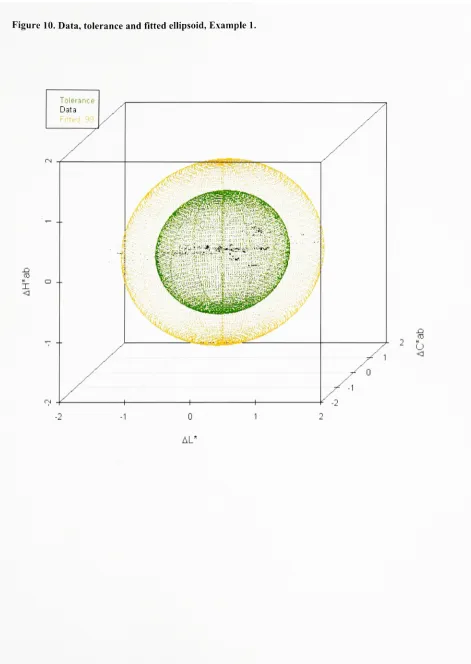
[image:48.534.9.498.35.684.2]Figure 10 depictsthe data points, the toleranceregion and the .99 capture region ofthe same
shape and orientation as the tolerance region. In this case, as the c value of 1.54
indicates,
the length ofthe major axis ofthis fitted region is approximately 1.5 times the length ofthe
majoraxis ofthe toleranceregion.
Figure 1 1 depicts the tolerance region and the natural .99 capture ellipsoids relative to each
variancecomponent.
Figure 12 depicts the tolerance region and the fitted spheres relative to each variance
component. As the c value of 1.08
indicates,
the instrument-to-instrument component ofvariance
by
itselfexceedsthe size ofthe toleranceregion.Figure10.Data,toleranceandfittedellipsoid, Example 1.
/
TO X <
^^^a^^^jgg
i
o
AL1
_Cl
"
U
[image:50.534.32.503.37.701.2]Figure 11. Toleranceand natural.99capture ellipsoidsforeachvariancecomponent,Example1.
Tolerance
99 MT
99InsfMT
99 ST
_d
CD
X <
I
0
AL*
-> *
"
O
<
f -1
Figure 12. Toleranceandfitted.99capture spheres foreachvariancecomponent,Example 1.
X
To 1era net
99 MT
99InsfMT
99 ST
-2 0
AL*
ro
o <1
Example 2
The dataset used in the first and second example consisted of 10 measurements taken every
hour,
for 8hours,
on each of12 instruments. Inthe secondexample, we conductedaseparateanalysisforeach ofthe 12instruments.
Because the sample measured is the same white tile, the tolerance matrix is the same
employedin Example 1:
M
1 0
0 1 0
0 0 1
For a given
instrument,
we assume that we could model each readingX,
=(Ai;
AC;^ A//;a
)'
asfollows:
Xu
=M-+si(j)+mj,with:p =
(0
0si(j)~MVN(0,Es)
mj~MVN(0,i:m)
We allowfor
Ls
andLm
tobeestimated separately foreachinstrument.We testedforthe significance of variance components and obtained estimates forthe sumof
square and cross product matrices associated witheach variance component. Basedonthe
p-value associated withthe F statistic for
Wilks'
multivariate test, all ofthe tested components
[image:54.533.42.226.208.301.2]of variance were significantat a5%significance level.
Table 5.EMS,Example 2.
Source df EMS
MT 7
2.+10E.,
ST 72
m
Total 79
When computing these components-of-variance estimates, we obtained s matrices as components
estimates that were not non-negative definite. We employed the Calvin-Dykstra algorithm to obtain
newestimatesforthosecomponents.
Ourresults,presented in Table 6 andFigure
13,
point to dramatic differences inperformanceacross instruments. Instruments
C, D,
K andL obtained c values larger than one,indicating
that a portion of their observations is expected to fall outside of the tolerance region. In
instruments C and D this was due to a large medium-term variance component. A similar
phenomenon was observed for instruments K and
L,
but here the short-term component ofvariance appearsconsiderably largerthanforotherinstruments aswell.
Table6. Process capabilityindices,Example2.
Instrument ST
7
c
MT Total ST
c
MT Total
A 0.0006 0.0301 0.0305 0.0237 0.1734 0.1747
B 0.0005 0.0761 0.0766 0.0233 0.2758 0.2767
C 0.0624 1.3390 1.4000 0.2499 1.1572 1.1832
D j 0.0211 3.5563 3.5777 0.1454 1.8858 1.8915
E 0.0051 0.0251 0.0302 0.0715 0.1583 0.1737
F 0.0001 0.0006 0.0007 0.0121 0.0239 0.0263
G 0.0001 0.0003 0.0003 0.0073 0.0170 0.0178
H 0.0003 0.0024 0.0026 0.0175 0.0488 0.0511
1 0.2004 0.0955 0.2946 0.4477 0.3090 0.5428
J 0.0400 0.5281 0.5643 0.1999 0.7267 0.7512
I K 1.2742 0.8451 2.1176 1.1288 0.9193 1.4552
L 1.8503 4.0083 5.8074 1.3603 2.0021 2.4098
Figure 13. Process capabilityindex,Example 2.
CO CD CN lO CD d Tolerance
mtttiW
m ST ? MT ? Totalj_n
B D E F G H
Instrument
K
[image:55.534.10.468.52.705.2]We can also use the concepts presented here to estimate the proportion of points expected to
fall within the tolerance region, for each variance component. We do this
by
solvingP[XU
y2+
Xuy2
+
Xu
v3 < l)= y for y using thefunction Rubpresentedin Appendix 1.The expected proportion of observations within tolerance relative to each variance
component foreach instrument is presented in Table 6.
Table 7. Expectedproportion of observation fallingwithintolerance, Example 2.
Instrument ST
r
MT Total
A -100.0% -100.0% -100.0%
B -100.0% -100.0% -100.0%
C -100.0% 97.4% 96.8%
D -100.0% 82.8% 82.6%
E -100.0% -100.0% -100.0%
F -100.0% -100.0% -100.0% G -100.0% -100.0% -100.0%
H -100.0% -100.0% -100.0%
1 -100.0% -100.0% -100.0%
J -100.0% -100.0% 99.9%
K 97.8% 99.5% 92.3%
L 94.2% 80.1% 71.1%
As an example, we presentthe results obtained for instrument A in Figure 14 and Figure 15.
Figure 14 presents the data points and the tolerance region. Figure 15 depicts the tolerance
region andthe fitted spheresrelativeto each variancecomponent.
Figure14.Dataandtoleranceregion,instrumentA,Example2.
[image:57.534.13.453.49.565.2]Figure 15.Toleranceregion andfitted.99capture spheresforeach variancecomponent,instrument
A, Example2.
X <
..-j^rt^^^rsy-s^ /
ro
6
<
[image:58.534.13.483.54.691.2]Example3
The datasetusedin thisexample included 12 instruments (labeled A-L), each usedto make2
measurements every
day,
for 25days,
on a cyan sample. Data for Instrument D was missingfor 3
days,
data for instrument E was missing for 5 days and data for instrument H wasmissing foroneday.
Weconducteda separate analysis foreach ofthe 12 instruments. We assumethat, fora given
instrument,
we could model eachreading X,, =\AL*
,
AC*h
AH*h
I as follows:Xu
=M-+mi(j)
+1^1111:p=
(0
0lj~N3(0,Ek)
Becasewe aremeasuring adifferent samplethan the white usedinthe firsttwo examples,we
haveto usethe
CIE94
equationstodeterminethe size and orientation ofthe toleranceregion.To obtain the equation of the tolerance matrix, we calculated a *
andb
*
and the related
parameters, obtainingtheresults presented in Table 8.
Table 8. Toleranceregionparameters, cyan,Example 3.
Parameter Value
meana*
-28.3605
mean b* -38.4245
meanC*ab 47.7573
l/S/2
1.0000
l/Sc2
3.1491
l/Sh2
1.7164
The resultingtoleranceregion can then be described
by
thematrixM
1 0 0
0 3.14 0
0 0 1.72
We tested forthe significance of variance components and obtained estimates forthe sum of
square and cross product matrices associated with each variance component. We used the
p-value associated with the F statistic for Wilks' multivariate test to determine which
components of variance were not significant; we set the level of significance at 5%. All of
the components of variance tested resulted statistically significant, except for the
Using
the expected mean squares presented in Table9,
we obtained estimates for thevariance-covariance matrices associated with each component of variance, for each
instrument.
When computing these components-of-variance estimates, we obtained some matrices as
components estimates that were not non-negative definite
(namely,
the estimates ofthelong
term variance-covariance matrices associated with instruments
B,
F,J,
K and L). Weemployedthe Calvin-Dykstraalgorithmtoobtain newestimates forthosecomponents.
Using
the algorithm presented in Appendix1,
we were then able to compute our processcapability indicesas shown in Table 10 andin Figure 16.
Table9.EMS,Example3.
Source Df*
EMS
LT 24
E.+2L,
MT 25
m
Total 49
Table 10. Process capabilityindices.Example3.
Instrument MT
2
C
LT Total MT
c
LT Total
A 0.1087 0.0000 0.1087 0.3296 0.0000 0.3296
B 0.0603 0.0797 0.1399 0.2456 0.2824 0.3741
C 0.1054 0.0000 0.1054 0.3246 0.0000 0.3246
D 3.4117 0.0000 3.4117 1.8487 0.0000 1.8487
E 0.1930 0.0522 0.2445 0.4393 0.2285 0.4945
F 0.0234 0.0185 0.0411 0.1531 0.1359 0.2028
G 0.0088 0.0450 0.0534 0.0937 0.2120 0.2312
H 0.0026 0.0286 0.0311 0.0508 0.1690 0.1763
1 0.1006 0.0212 0.1134 0.3172 0.1455 0.3367
J 0.1329 0.0852 0.2170 0.3645 0.2920 0.4659
K 0.1117 0.0903 0.2017 ] 0.3342 0.3006 0.4491
L 0.2582 0.0270 0.2683 0.5081 0.1642 0.5180
Allofthe instrumentsexceptfor instrument D
display
repeatabilitywell withintolerance.Themediumtermvariancecomponent ofD, with an associated c value of
1.8,
istheonlycomponent of variance exceedingtolerance.
Figure 16. Process capabilityindices,Example 3.
o
LO
CN
O
CM
Tolerance
IMlfl
LjueUIM
ABCDEFGH I J K L
Instrument
Figure 17 is a plot ofthe dataandtolerance region. Figure 18 depictsthe results obtainedfor
instrument A. As the LT variance component resulted non significant, the ST variance
component isequalto the totalvariance.
Figure 17. Dataandtolerance region,instrumentA,Example 3.
ro
X
-3
ro
3 f
<
0
AL1
Figure 18.Tolerance,.99natural capture ellipsoid and
.99capturefittedellipsoid, instrumentA,
Example 3.
Toleran 99 Data 99 Fitted
CO
X <
_Q
ro
u <
AL*
Appendix 1
The algorithm is an iterative search procedure, used in solving
P(XlY]"
+
X2Y2
+/l3F32
<
c2)=
y for c, given the eigenvalues/I,,
X-,
,X3
and the desired probability /, whereY,
,Y2
,73
are independent standard normal random variables. Thealgorithmis inthelanguage R.
The core of the search procedure is a function named Rub (after Ruben
(1962));
thealgorithmis basedon
AS204,
by
Farebrother(1984),
which inturns employs Ruben's(1962)
method to evaluate the probability that a linear combination of n non-central chi-square varia