R E S E A R C H A R T I C L E
Open Access
Reducing co-administration of proton
pump inhibitors and antibiotics using a
computerized order entry alert and
prospective audit and feedback
Christopher E. Kandel
1, Suzanne Gill
2, Janine McCready
3, John Matelski
4and Jeff E. Powis
3*Abstract
Background:Antibiotics and proton pump inhibitors (PPIs) are associated withClostridium difficileinfection (CDI). Both a computer order entry alert to highlight this association as well as antimicrobial stewardship directed prospective audit and feedback represent novel interventions to reduce the co-administration of antibiotics and PPIs among hospitalized patients.
Methods:Consecutive patients admitted to two General Internal Medicine wards from October 1, 2010 until March 31, 2013 at a teaching hospital in Toronto, Ontario, Canada were evaluated. The baseline observation period was followed by the first phase, which involved the creation of a computerized order entry alert that was triggered when either a PPI or an antibiotic was ordered in the presence of the other. The second phase consisted of the introduction of an antibiotic stewardship-initiated prospective audit and feedback strategy. The primary outcome was the co-administration of antibiotics and PPIs during each phase.
Results:This alert led to a significant reduction in the co-administration of antibiotics and PPIs adjusted for month and secular trends, expressed as days of therapy per 100 patient days (4.99 vs. 3.14,p< 0.001) The subsequent introduction of the antibiotic stewardship program further reduced the co-administration (3.14 vs. 1.80,p<0.001). No change was observed in adjusted monthly CDI rates per 100 patient care days between the baseline and alert cohorts (0.12 vs. 0.12,p= 0.99) or the baseline and antibiotic stewardship phases (0.12 vs. 0.13,p= 0.97).
Conclusions:Decreasing the co-administration of PPIs and antibiotics can be achieved using a simple automatic alert followed by prospective audit and feedback.
Keywords:Computerized alerts, Antibiotic stewardship, Proton pump inhibitors,Clostridium difficileinfection, Prospective audit and feedback
Background
Hospitalization represents an opportunity to assess medication appropriateness. Proton pump inhibitors (PPIs) are frequently inappropriately used and represent an ideal target for re-evaluation [1, 2]. PPIs increase the risk of Clostridium difficile infection (CDI), including both incident episodes as well as recurrences, by approxi-mately 60 % [3, 4]. This elevated risk exists irrespective of
whether the infection was acquired in a community or hospital setting [4, 5]. Antibiotics also increase the risk of nosocomial CDI, particularly when prescribed concur-rently with a PPI [6–9]. Accordingly, interventions target-ing a reduction in the co-administration of PPIs and antibiotics may be beneficial.
Automated alerts activated at the time of computer order entry (CPOE) have been used to reduce medical errors through warnings of impending drug-drug actions and unrecognized drug allergies. Similar inter-ventions have successfully altered PPI prescribing patterns in the hospital setting and changed antibiotic * Correspondence:[email protected]
3Division of Infectious Diseases, Toronto East General Hospital, 825 Coxwell
Avenue, Toronto, ON M4C 3E7, Canada
Full list of author information is available at the end of the article
prescribing patterns [10, 11]. A similar automated strat-egy may reduce concurrent PPI and antibiotic use, but this has not yet been tested. Extending the purview of antibiotic stewardship programs (ASP), which are suc-cessful in lowering antibiotic use in the acute care set-ting, to identify medications with the potential to increase the harms of antibiotics is another potential intervention to limit co-administration [12].
We evaluated the impact of a real-time automated computer physician order entry (CPOE) alert followed by an ASP-initiated prospective audit and feedback (PAF) strategy on rates of co-administration of PPI’s and antibiotics in a large teaching hospital in Ontario, Canada.
Methods Study design
We prospectively evaluated consecutive patients admit-ted to two General Internal Medicine wards from Octo-ber 1, 2010 until March 31, 2013 at a 490-bed teaching hospital in Toronto, Ontario, Canada. The baseline ob-servation interval occurred from October 1, 2010 until September 30, 2011. The first phase, from October 1, 2011 until March 31, 2012, involved the implementation of a CPOE alert that was triggered when either a PPI or an antibiotic was ordered in the presence of the other. This alert highlighted the association of concurrent PPI’s and antibiotics with the increased risk of subsequent CDI. Embedded within the alert was an educational tool that assisted with a risk-benefit analysis of whether to stop a PPI, which for example should be continued in the setting of a recent upper gastrointestinal bleed. The second phase consisted of the introduction of an ASP-initiated PAF strategy, which occurred from April 1, 2012 until March 31, 2013. PAF was triggered from Monday to Friday when an inpatient was prescribed a systemic antimicrobial agent. The aim of the ASP was to provide recommendations regarding the appropriateness of antimicrobial therapy as well as to note the concomi-tant use of a PPI. Ethics approval was granted from Toronto East General Hospital’s Research Ethics Board. Outcome measures
Inpatient orders of antibiotics and PPIs were obtained from the computer order entry system (PowerChart, Cerner Canada, Markham, Canada) and reported as days of therapy (DOT) for each individual medication per 100 inpatient days. One DOT represents the administration of a single medication on a given day irrespective of dos-ing frequency or strength. Hospital-acquired CDI was confirmed using the Ontario Ministry of Health and Long Term Care case definition with toxin detection by enzyme immunoassay or polymerase chain reaction and presented as a rate over 100 inpatient days [13]. Only
loose stool specimens were processed and repeat testing of duplicate specimens within seven days was not per-mitted. The primary outcome was co-administration of PPI’s and antibiotics. Pre-specified secondary outcomes consisted of CDI rates, PPI use, antibiotic use, and the frequency with which the alert was activated. Only the initial occurrence of the triggered alert for each patient during each hospitalization was used for analysis. Coun-tervailing measures included rates of Gastroenterology consultation and receipt of packed red blood cell trans-fusion. Transfusions are a marker of acute gastrointes-tinal bleeding while specialist consultation serves to highlight the possible need for guidance in treating con-ditions exacerbated by the abrupt cessation of PPI’s. Statistical analysis
Generalized linear models were used to analyze system-atic differences between the three intervention periods while adjusting for seasonality (monthly effects) and secular trends. In particular, logistic regression was used for the binary outcomes (co-administration, antibiotics, and PPIs), while Poisson regression was used for the count-based outcomes (rates of CDI, packed red blood cell transfusions, and Gastroenterology consultations). For each outcome, we used the Box-Pierce P-value against the null hypothesis that the errors from the justed model are uncorrelated. Further, we report the ad-justed outcome rate for each period (standardized to events per 100 patient care days), and the Wald Test P-value against the null hypothesis of ‘no systematic dif-ference’ for each pair of time periods (Baseline-Alert, Baseline-Stewardship, and Alert-Stewardship). For the demographic information collected for each cohort we used a one-way ANOVA and a two-tailed chi-square test to assess for differences between continuous and categor-ical variables, respectively. The analysis was conducted using R version 3.0.2.
Results
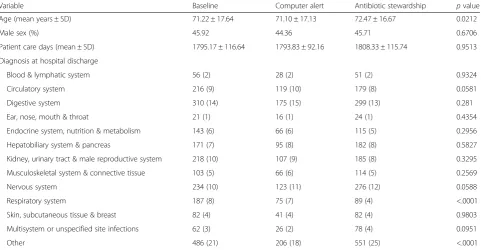
A total of 54,005 inpatient days were included (21,542 baseline, 10,763 CPOE, and 21,700 ASP). The three co-horts had similar baseline characteristics and discharge diagnoses, aside from a decrease in the proportion of patients with a respiratory illness among the ASP cohort
(Table 1). The unadjusted average monthly
the alert and ASP (3.14 vs. 1.80,p<0.001). Antibiotic ad-ministration significantly declined over each successive time period from the baseline to the alert and through the initiation of the ASP (18.98 DOT per 100 inpatient days, 14.90, and 8.90, respectively), which was mirrored by a decline in PPIs (33.52, 29.50, and 23.95, respect-ively) (Fig. 2).
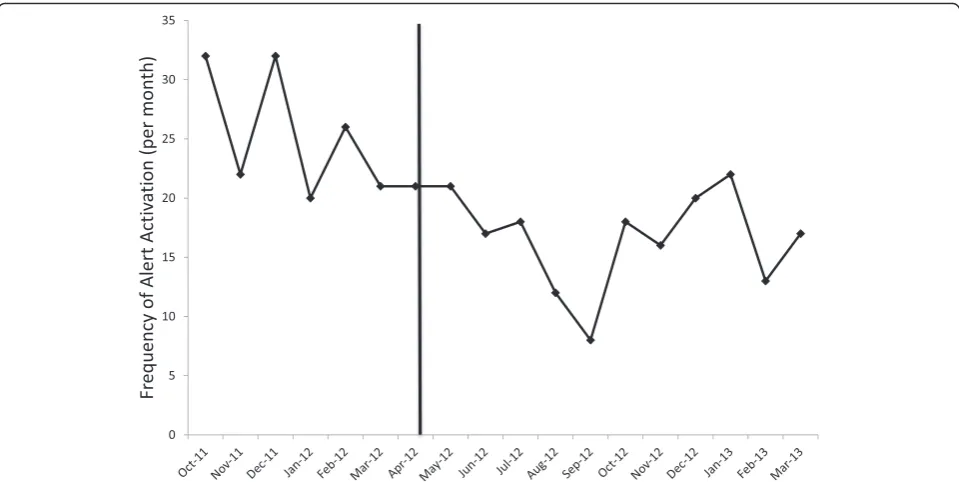
The average monthly frequency of the triggered alert was 25.5 during the alert cohort and 16.9 (p= 0.002) during the ASP cohort (Fig. 3). Adjusted monthly CDI rates per 100 inpatient days did not differ between the baseline and alert phases (0.12 vs. 0.12, p= 0.99), the baseline and ASP (0.12 vs. 0.13,p= 0.97) or between the alert and ASP (0.12 vs. 0.13, p= 0.95). Similarly, no changes in adjusted monthly packed red blood cell transfusion rates (1.30 vs. 1.36,p= 0.80) or Gastroenter-ology consultations (2.69 vs. 2.96, p= 0.42) between the baseline and alert groups and between the baseline and ASP cohorts (1.30 vs. 1.18, p= 0.71 and 2.69 vs. 2.16, p= 0.24, respectively) were observed.
Discussion
We observed a reduction in antibiotic and PPI co-ad-ministration following the initiation of both an auto-mated computer order entry alert as well as the introduction of ASP initiated PAF. The alert led to a decrease in PPIs and antibiotics that was immediate and
simple to implement. The integration of PPI
optimization to the responsibilities of an ASP afforded further reductions in co-administration beyond that re-alized from the alert and allowed for sustainability of the effect.
[image:3.595.58.540.100.350.2]Automated alerts can alter PPI prescribing patterns and may have prompted clinicians to reconsider the util-ity of PPI’s in the high-risk setting of prescribing antibi-otics [6, 10]. The alert may have engendered an additional evaluation of the risk-benefit ratio of prescrib-ing antibiotics that cumulatively led to the reduction in antibiotic use observed. Lowering overall antibiotic use has been associated with a reduced incidence of nosoco-mial CDI while it is unclear whether a similar benefit oc-curs with PPIs [14]. The decrease in co-administration was not associated with a reduction in CDI rates, how-ever the low overall event rate limited statistical power. Antibiotic classes variably affect CDI risk yet in the hos-pital setting cumulative antibiotic exposure is an inde-pendent risk factor for CDI making it imperative to target all antibiotics and not restrict the alert to only those associated with an elevated risk [15, 16]. The abrupt cessation of a PPI results in rebound acid hyper-secretion that can potentially exert a protective effect against contracting C. difficile through an increase in gastric acidity [17]. The reduction in PPIs did not result in a change in the rates of red blood cell transfusion or Gasteroenterology consultation, both of which are rela-tively crude markers of harm
Table 1Baseline demographic characteristics for each study cohort
Variable Baseline Computer alert Antibiotic stewardship pvalue
Age (mean years ± SD) 71.22 ± 17.64 71.10 ± 17.13 72.47 ± 16.67 0.0212
Male sex (%) 45.92 44.36 45.71 0.6706
Patient care days (mean ± SD) 1795.17 ± 116.64 1793.83 ± 92.16 1808.33 ± 115.74 0.9513
Diagnosis at hospital discharge
Blood & lymphatic system 56 (2) 28 (2) 51 (2) 0.9324
Circulatory system 216 (9) 119 (10) 179 (8) 0.0581
Digestive system 310 (14) 175 (15) 299 (13) 0.281
Ear, nose, mouth & throat 21 (1) 16 (1) 24 (1) 0.4354
Endocrine system, nutrition & metabolism 143 (6) 66 (6) 115 (5) 0.2956
Hepatobiliary system & pancreas 171 (7) 95 (8) 182 (8) 0.5827
Kidney, urinary tract & male reproductive system 218 (10) 107 (9) 185 (8) 0.3295
Musculoskeletal system & connective tissue 103 (5) 66 (6) 114 (5) 0.2569
Nervous system 234 (10) 123 (11) 276 (12) 0.0588
Respiratory system 187 (8) 75 (7) 89 (4) <.0001
Skin, subcutaneous tissue & breast 82 (4) 41 (4) 82 (4) 0.9803
Multisystem or unspecified site infections 62 (3) 26 (2) 78 (4) 0.0951
Other 486 (21) 206 (18) 551 (25) <.0001
Unless otherwise specified, data are no. (%) of patients
Abbreviations: SDstandard deviation
The introduction of PAF by the ASP was followed by further reduction in antibiotic and PPI co-administration compared to both the baseline and the alert cohorts. The reduction in antibiotic administration is commen-surate with the effectiveness of ASPs in the inpatient set-ting [12]. Additionally, the ASP led to a reduction in PPI administration, suggesting that it is feasible to expand the purview of ASPs beyond solely antimicrobials. The
decrease in alert frequency following the introduction of the ASP suggests a persistent effect on prescribing prac-tices and cumulative benefit through enacting culture change mediated by the ASP. Importantly, the ASP led to a sustained reduction in the co-administration of PPIs and antibiotics for an additional 12 months, obviating the loss of motivation to follow alert recommendations commonly responsible for the decreased effectiveness of Fig. 1Boxplot of unadjusted average monthly rates of antibiotics, proton pump inhibitors and their co-administration. Rates of co-administration (left panel), antibiotics (middle) and proton pump inhibitors (right) during the baseline, computer alert and antibiotic stewardship program time periods are shown. Rates are calculated as days of therapy (DOT) per 100 inpatient days whereby one DOT represents the administration of a single medication on a given day irrespective of dosing frequency or strength. The vertical lines on either side of the point estimate encapsulate the threshold beyond which data points are considered outliers (represented by dots). PPI = proton pump inhibitor
[image:4.595.62.538.87.418.2] [image:4.595.57.539.607.685.2]electronic alerts that occurs over time [18]. ASPs should evolve to encompass more than assessing antibiotic appropriateness, as they are ideally situated to provide ad-vice towards attenuating the potential harms of antibiotics, such as decreasing PPI and antibiotic co-administration.
There are some limitations that merit emphasis. Firstly, the short duration of observation may not accur-ately reflect the potential benefits observed. Although we adjusted for seasonality in our analysis, the total dur-ation of the study was short and the CDI event rate was low. The low CDI event rate also precluded analyzing risk factors for CDI, including patient-related character-istics such as age and underlying comorbidities, which may have contributed to the absence of statistically sig-nificant differences in CDI rates [19]. Secondly, the sin-gle site and pre-existing comprehensive ASP, which is activated upon the prescribing of an antibiotic for all in-patients, may affect external validity. Thirdly, robust measures of harm could not be collected and may be underappreciated, especially in light of the short study interval. Fourthly, outcomes were restricted to in-hospital events, which may underestimate the benefit of the interventions.
Conclusions
Reducing the co-administration of PPI’s and antibiotics can be achieved with an automatic computerized alert and implementation of an ASP. The computer order entry alert facilitates enhanced awareness of drug
interactions that may curtail inappropriate medication use. ASP mediated PAF implemented after the computer order alert provides an opportunity to consolidate alert-mediated changes in prescribing practices through cul-tural change allowing for sustainability and attenuating alert fatigue. Reproducing this study using a larger sample size with a longer duration of follow up will serve to test whether a reduction in PPI-antibiotic co-administration can be sustained, the independent impact of computer order alerts and ASP and whether the re-duction in co-administration lowers CDI rates.
Additional file
Additional file 1: Table S1.Raw monthly data for the primary and secondary outcomes. (XLSX 11 kb)
Abbreviations
ASP, antibiotic stewardship program; CDI,Clostridium difficileinfection; CPOE, computer order entry; DOT, days of therapy; PAF, prospective audit and feedback; PPI, proton pump inhibitor
Acknowledgements
We would like to thank Gabor Kandel for his helpful and insightful comments with earlier drafts.
Funding
A Micro-innovation Grant from the Toronto East General Hospital Department of Medicine and the University of Toronto, Faculty of Medicine supported this project. The authors independent of the supporting agencies conducted the study; collected, analyzed, and interpreted the data; and prepared, reviewed, and approved the manuscript.
[image:5.595.58.538.87.328.2]Availability of data and materials
The dataset containing the raw data supporting the conclusions of this article is included within the article as an Additional file 1: Table S1.
Authors’contributions
One author (JEP) had full access to the data in the study and takes responsibility for the integrity of the data and the accuracy of the data analysis. JM takes responsible for the integrity of the statistical analysis. JEP and SG were responsible for study design and data acquisition. JEP and SG were responsible for obtaining funding and study supervision. All authors were involved in the analysis and interpretation of the data and critical revision of the manuscript for intellectual content. All authors read and approved the final manuscript.
Competing interests
The authors declare that they have no competing interests.
Consent for publication Not applicable.
Ethics approval and consent to participate
Ethics approval was granted from Toronto East General Hospital’s Research Ethics Board.
Author details 1
Department of Medicine, University of Toronto, Toronto M5S 1A8, Canada.
2Pharmacy Department, Toronto East General Hospital, Toronto M4C 3E7,
Canada.3Division of Infectious Diseases, Toronto East General Hospital, 825
Coxwell Avenue, Toronto, ON M4C 3E7, Canada.4Department of General
Internal Medicine, Toronto General Hospital, Toronto M5G 2C4, Canada.
Received: 30 October 2015 Accepted: 27 June 2016
References
1. Reid M, Keniston A, Heller JC, Miller M, Medvedev S, Albert RK. Inappropriate prescribing of proton pump inhibitors in hospitalized patients. J Hosp Med. 2012;7:421–5.
2. Kelly OB, Dillane C, Patchett SE, Harewood GC, Murray FE. The inappropriate prescription of oral proton pump inhibitors in the hospital setting: a prospective cross-sectional study. Dig Dis Sci. 2015;60:2280–6.
3. McDonald EG, Milligan J, Frenette C, Lee TC. Continuous proton pump inhibitor therapy and the associated risk of recurrent Clostridium difficile infection. JAMA Intern Med. 2015;175:784–91.
4. Janarthanan S, Ditah I, Adler DG, Ehrinpreis MN. Clostridium difficile-associated diarrhea and proton pump inhibitor therapy: a meta-analysis. Am J Gastroenterol. 2012;107:1001–10.
5. Freedberg DE, Lamousé-Smith ES, Lightdale JR, Jin Z, Yang YX, Abrams JA. Use of acid suppression medication is associated with risk for C. difficile infection in infants and children: a population-based study. Clin Infect Dis. 2015;61(6):912–7.
6. Kwok CS, Arthur AK, Anibueze CI, Singh S, Cavallazzi R, Loke YK. Risk of Clostridium difficile infection with acid suppressing drugs and antibiotics: meta-analysis. Am J Gastroenterol. 2012;107(7):1011–9.
7. King RN, Lager SL. Incidence of Clostridium difficile infections in patients receiving antimicrobial and acid-suppression therapy. Pharmacotherapy. 2011;31(7):642–8.
8. Slimings C, Riley TV. Antibiotics and hospital-acquired Clostridium difficile infection: update of systematic review and meta-analysis. J Antimicrob Chemother. 2014;69(4):881–91.
9. Gordon D, Young LR, Reddy S, Bergman C, Young JD. Incidence of Clostridium difficile infection in patients receiving high-risk antibiotics with or without a proton pump inhibitor. J Hosp Infect. 2016;92(2):173–7.
10. Freedberg DE, Salmasian H, Abrams JA, Green RA. Orders for intravenous proton pump inhibitors after implementation of an electronic alert. JAMA Intern Med. 2015;175:452–4.
11. Lesprit P, Duong T, Girou E, Hemery F, Brun-Buisson C. Impact of a computer-generated alert system prompting review of antibiotic use in hospitals. J Antimicrob Chemother. 2009;63(5):1058–63.
12. Dellit TH, Owens RC, McGowan JE, et al. Infectious Diseases Society of America and the Society for Healthcare Epidemiology of America guidelines for developing an institutional program to enhance antimicrobial stewardship. Clin Infect Dis. 2007;44:159–77.
13. Ontario Ministry of Health and Long-Term Care. Provincial Case Definitions for Reportable Diseases. Available at: http://www.health.gov.on.ca/en/pro/ programs/publichealth/oph_standards/docs/cdi_cd.pdf. Accessed 21 September 2015.
14. Dancer SJ, Kirkpatrick P, Corcoran DS, Christison F, Farmer D, Robertson C. Approaching zero: temporal effects of a restrictive antibiotic policy on hospital-acquired Clostridium difficile, extended-spectrumβ -lactamase-producing coliforms and meticillin-resistant Staphylococcus aureus. Int J Antimicrob Agents. 2013;41:137–42.
15. Stevens V, Dumyati G, Fine LS, Fisher SG, van Wijngaarden E. Cumulative antibiotic exposures over time and the risk of Clostridium difficile infection. Clin Infect Dis. 2011;53(1):42–8.
16. Brown KA, Khanafer N, Daneman N, Fisman DN. Meta-analysis of antibiotics and the risk of community-associated Clostridium difficile infection. Antimicrob Agents Chemother. 2013;57(5):2326–32.
17. Niklasson A, Lindström L, Simrén M, Lindberg G, Björnsson E. Dyspeptic symptom development after discontinuation of a proton pump inhibitor: a double-blind placebo-controlled trial. Am J Gastroenterol. 2010;105:1531–7. 18. Ojeleye O, Avery A, Gupta V, Boyd M. The evidence for the effectiveness of safety alerts in electronic patient medication record systems at the point of pharmacy order entry: a systematic review. BMC Med Inform Decis Mak. 2013;13:69.
19. Leffler DA, Lamont JT. Clostridium difficile infection. N Engl J Med. 2015;372(16):1539–48.
• We accept pre-submission inquiries
• Our selector tool helps you to find the most relevant journal
• We provide round the clock customer support
• Convenient online submission
• Thorough peer review
• Inclusion in PubMed and all major indexing services
• Maximum visibility for your research
Submit your manuscript at www.biomedcentral.com/submit