Rochester Institute of Technology
RIT Scholar Works
Theses Thesis/Dissertation Collections
7-1-2005
The use of technical metadata in still digital imaging
by the newspaper industry
Howard Vogl
Follow this and additional works at:http://scholarworks.rit.edu/theses
Recommended Citation
The Use of Technical Metadata in Still Digital Imaging by the Newspaper Industry
By Howard Vogl
A thesis submitted in partial fulfillment of the Requirements for the degree of Master of Science in the
School of Print Media in the College of Imaging Arts and Sciences of the
Rochester Institute of Technology
July 2005
Acknowledgements
I would like to thank the faculty and staff at the Rochester Institute of Technology for their guidance and support throughout this project. Franziska Frey, primary thesis advisor; Douglas Ford Rea, secondary thesis advisor; Twyla Cummings, Graduate Coordinator; Professor Michael Kleper; Frank Cost, Associate Dean of the College of Imaging Arts and Sciences. Additionally, I would like to thank Adrienne McHargue for assistance with transcription, and Norma Fleck for handling financial arrangements.
Also, I would like to thank the newspaper professionals who freely gave their valuable time and knowledge to allow the completion of this research. Lori Craig, Steve Terrillion, and Miles Weissman from USA Today; Joan Bever, Kelly B. Hagen, and Rick Berry from the Chicago Tribune; Kevin Connor and Tim Fitzsimons from The
Washington Post; Toby Usnik and Tara House from The New York Times; Dennis Floss from the Rochester Democrat & Chronicle.
Furthermore, I am grateful to the Scripps Howard Foundation for their generous financial assistance that allowed the completion of this project.
Table of Contents
List of Tables ...iv
List of Figures ...v
Abstract...vi
Chapter 1. Description of the Problem ...1
Statement of the Problem ...1
Background and Significance...2
Interest in the Study ...3
Chapter 2. Literature Review...5
Introduction ...5
Types of Metadata ...5
Associating Metadata with Image Files...6
Capturing Technical Metadata ...17
Technical Metadata Standards...19
Technical Metadata for the Newspaper Industry...27
Chapter Summary ...29
Chapter 3. Research Questions ...30
Chapter 4. Methodology ...31
Data Collection Plan ...31
Endnotes for Chapter Four ...35
Chapter 5. Summary of Results ...36
Case Study One ...37
Case Study Two...41
Case Study Three...45
Case Study Four...49
Case Study Five ...53
Summary of Responses to Questionnaire ...57
Analysis of Matrix ...60
Endnotes for Chapter 5 ...63
Chapter 6. Conclusions and Recommendations...64
Introduction ...64
Current Use of Technical Metadata...64
Improving Digital Imaging Workflows ...65
Preserving Image Integrity ...67
Limitations of the Study...70
Recommendations for Further Research...71
Summary of Implications...72
Impact on Newspaper Staff ...73
References...75
List of Tables
Table 1. Comparison of human and machine rendered labels...13 Table 2. Elements of Dublin Core Metadata Initiative metadata fields ...20 Table 3. The quantitative result of mapping all four sections of the NISO Z39.87 data
List of Figures
Figure 1. Association of metadata with image file ...6
Figure 2. XML document ...12
Figure 3. Photoshop technical metadata fields and XML code ...16
Abstract
Newspapers are increasingly capturing images digitally. Included with these digital files is technical information about the conditions of the image and the conditions surrounding image capture. Technical metadata has the potential to be a valuable
resource in image reproduction, management, and archiving. Nevertheless, even though digital devices capture a large amount of technical metadata, the use of such data in the digital imaging workflow is not widespread.
The use of technical metadata requires a uniform set of technical metadata standards and an open encoding scheme to embed data. From their inception, image file formats, such as TIFF and JPEG, have allowed the inclusion of technical metadata tags. The Exif schema has extended the metadata inclusion capabilities of both of these formats. Additionally, XML has emerged as a standard for users to add metadata to image files. Consequently, organizations such as the World Wide Web Consortium and Adobe Systems all support XML. Moreover, organizations such as the Digital Imaging Group (DIG35) and the National Information Standards Organization (NISO) are defining standards for technical metadata inclusion.
images.
This study examined five large newspaper organizations: The Chicago Tribune, The New York Times, The Rochester Democrat & Chronicle, USA Today, and The Washington Post. Based on interviews and questionnaire responses, each organization’s use of technical metadata in the digital imaging workflow was examined through case studies. Interviews were conducted with those individuals responsible for image capture, adjustment, database management, and output. Furthermore, participants were asked to rank the importance of selected fields of technical metadata through a questionnaire.
It was found that the use of technical metadata classified by NISO as Basic Image Parameters, which includes file size, type, and compression, was universal in newspaper organizations. The use of Image Creation metadata was not widespread with the
exception of two fields that established date and time of capture and assigned each image a unique identifier. Image Performance Assessment metadata, such as test targets, was not widely used except by The Rochester Democrat & Chronicle. Change History fell victim to the short cycle time in the newspaper industry, and for the most part, a history of change was kept at various handoffs in the digital workflow through versioning.
The use of technical metadata to improve the digital workflow, to an extent, was at cross-purposes with newspapers’ need to visually examine each image to determine its usefulness. However, software designed to visually present technical metadata through a well designed graphic user interface was popular. It appeared that technical metadata had the potential to benefit newspapers when repurposing images for other media.
while the use of technical metadata in these archives was unclear, it would be prudent to include too much technical metadata, rather than too little.
The foremost concern of all organizations was preservation of the editorial integrity of the image. Newspapers defined editorial integrity as the ability to capture as much detail of an event as possible, and then present that information to their readers in a truthful, unambiguous way. Research pointed out that image reproduction quality was only one of a series of variables that determined newspaper image quality.
With the advent of digital photography, photographers are editing more in the field, and as a result they are making decisions regarding image content. The use of technical metadata has the potential to provide greater tractability of these outtakes.
Chapter 1
Description of the Problem
Statement of the Problem
Newspapers are increasingly capturing images digitally. Technical information about the conditions of the image and the conditions surrounding the image capture is often included with these digital files. This information, called technical metadata, has the potential to be a valuable resource in image reproduction, management, and
archiving. Nevertheless, even though digital devices capture a large amount of technical metadata, its use in the digital imaging workflow is not widespread. To take full
advantage of the quality and the efficiency of digital imaging, technical metadata needs to be incorporated into the digital imaging workflow.
It is evident that percentage of newspaper images will become valuable archives. Technical metadata could provide valuable historical information about the
Background and Significance
Analog and Digital Workflows
In traditional film photography, newspaper photographers chose equipment based on their needs for image quality and personal mobility. The choice of film was based on a limited number of options. Prints were made from negatives, and results were viewed without the aid of a rendering device. This system worked well in its time, but it was not without disadvantages. Analog photography was time consuming; therefore, limiting creativity in time-sensitive publications such as newspapers. Saldago (1998) comments that between travel and processing time, newspaper photographers using film spent less than half of their working day actually shooting photographs. In addition, the process used to make color separations from film was expensive. Chung (2001) observes, that in the past, color separations were made using a closed-loop system where the input and output devices were fixed using vendor-specific technology that required considerable operator skill.
recording devices has increased considerably; however, its use in image processing and archiving has not.
Digital imaging technology has been rapidly adopted because of its immediacy, its lower cost, and its creative options. However, to a great extent, the digital imaging workflow still mimics that of film. As Cost (2004) points out, the method in which new technologies are used changes slowly because their use is based on cultural habits. It is because of these cultural habits that the use of technical metadata in digital imaging has lagged behind its capture.
Interest in the Study
The researcher is interested in fully understanding the capture, management, and reproduction of digital images. The study of technical metadata assists in this purpose because it represents a common denominator in digital workflows. Therefore, this study intends to examine the capture and management of technical metadata, and how it can be used throughout the digital imaging workflow. The newspaper industry is an excellent medium for this study because newspapers capture, process, publish, and archive vast quantities of images quickly.
Chapter 2
Literature Review
Introduction
The use of metadata in digital workflows promises to revolutionize image processing and archiving. This literature review begins with a description of image file metadata categories. Next, it examines the methods by which metadata is included in these files. The review then examines the development of standards for the inclusion of technical metadata in image files. Last, it explores the role of technical metadata in the newspaper industry.
Types of Metadata
Metadata is commonly defined as the data about the data. Being more
Associating Metadata with Image Files
[image:17.612.159.410.369.526.2]There are several ways that technical metadata can be associated with an image file. Conceptually, there are two ways to associate technical metadata with an image file. The first method is embedding the data in the file; the second method is linking the data to the file. Image files including metadata consist of three parts. The first part of the file is the header, which contains essential information about the image file, as well as the location, or byte offset, of metadata tags within the file. The second part of the file is the actual image data, and the third part consists of descriptive and technical metadata. The linked file is similar in structure, except that metadata is externally attached to the file. Figure 1 shows a conceptual view of both types of image files (DIG 35, 2000, p. 5).
Figure 1. Association of metadata with image files.
Subdividing in a different way, McDowell acknowledges technical metadata that is a tag in an image file, and technical metadata that is an XML document attached to an image file. However, he adds a third form; technical metadata that exists as a separately
225 5 124 64 76 35 68 68 202 3 55 124 64 76 35 68 68 202 3 45 128 124 64 76 35 36 68 202 3 45 255 124 64 76 35 68 68 202 3 45 255 124 64 76 35 2 68 202 3 45 6
Image Data Metadata
225 5 124 64 76 35 68 68 55 124 64 76 35 68 68 202 128 124 64 76 35 36 68 20 255 124 64 76 35 68 68 2 255 124 64 76 35 2 68 202
Image Data Metadata
Separately Recorded Technical Metadata
Separately recorded technical metadata is usually analog data that is associated with an image. Technical metadata as a separate document can be as simple as
information written on the side of the negative that is relevant to producing a print. Photographers have used this form of technical metadata for many years. Kodak’s Advantix photo system is an interesting example of analog technical metadata linked to an image. In the Advantix system, technical metadata is recorded on the margin of the film negative using magnetic technology in order to improve the reproduction of prints in consumer photography. As Kodak (2000) points out “Some Advantix cameras even allow the film to communicate with the photofinisher's equipment, resulting in automatic adjustments for the best prints.”
Embedded Technical Metadata
TIFF. Another method of including technical metadata is through the use of tags in the image file. Adobe’s Tagged Image File Format (TIFF) is the foremost example of using tags in image files. The TIFF file format has a long history, and as Cost (1997) notes TIFF was first created by Microsoft as a way to store pixel-based data (p. 36). In TIFF Revision 6.0 (1992) Adobe notes “The first version of the TIFF specification was published by Aldus Corporation in the fall of 1986, after a series of meetings with various scanner manufacturers and software developers” (p. 4).
has allowed the inclusion of technical metadata. TIFF specification 6.0 standardized the TIFF file format and the inclusion of metadata with image files. Adobe (1992) claimed in TIFF Revision 6.0 that TIFF Final is an extensible image file format that is able to accept many forms of image data, is operating system independent, allows several compression schemes, and allows for the inclusion of metadata (pp. 4-5).
The TIFF file structure begins with a file header, containing information about the image, and describing the byte offset of the actual image. Additionally, the header
describes the type and location of metadata tags. As early as the 1992 TIFF specification Adobe noted, “TIFF writers are allowed to write optional fields such as Make, Model, and Date Time” (p. 26). In addition to descriptive metadata, TIFF allows the inclusion of technical metadata, including bits per sample, compression, host computer, scanner manufacturer and model, image resolution, and software used to create the image (Adobe, TIFF, 1992, pp. 28-41).
compression algorithms where scanned images are first separated into homogeneous parts and then individually compressed and transmitted together with mask information
indicating how to combine the individual parts” (p. 281). JPEG2000/Part6 has the advantage of producing a smaller file than TIFF without the loss of image quality. Like TIFF, JPEG2000/Part6 also allows the inclusion of technical metadata regarding the image creation, image capture device, and capture device settings. Importantly, Photoshop CS, released in 2003, allows the user the option of including previously captured metadata when migrating to JPEG2000.
Camera Raw camera files are specific to the camera used for image capture. Therefore, to work with Camera Raw files the image adjustment software needs to be able to read Raw files from several cameras. Adobe provides Camera Raw plug-in software that allows the user to open and adjust Raw files derived from most popular cameras. In Adobe’s plug-in, the user adjusts the Raw file and then saves it in the desired image format. Technical metadata about the scene and the camera settings serves as a reference for the photographer to make these adjustments. The adjustments made, including a log of changes, are recorded as technical metadata. The distinction between Camera Raw and JPEG file types is important; in JPEG, technical metadata describes conditions that have altered by camera software, while in Camera Raw, technical
metadata reflects information about capture conditions and camera settings that have not been altered by camera software.
Linked Technical Metadata
metadata storage specifications based on XML” (Kodak, Technology Highlights, Metadata).
The beauty of XML is its independence. W3 Schools declares, “XML does not DO anything… It was created to structure, store and to send information. It [XML] is pure information wrapped in tags” (Introduction to XML). XML has no fixed tags; instead, in XML users define their own tags. User-defined XML tags allow the exchange of data between applications and systems that are not compatible. Castro (2001) states, “XML is a language for creating other languages. You can use XML to design your own custom markup language and then use that language to format your documents” (p. 13). This makes XML the perfect language for technical metadata storage because new applications can be written for the existing technical metadata, rather than rewriting technical metadata for the existing applications.
<?xml version=“1.0” standalone=“no”?> <picture_database>
<title>Declaration of Independence</title> <scan filename=“Dec_of_Ind.jpg”/> &DOI_descript;
</picture_database> Figure 2. XML document
Figure 2 illustrates a simple XML document. Note that the root element opens with <picture_database> and closes with </picture_database>, and the <title> tag is properly nested within the root element. Since XML is case sensitive, “Declaration of Independence” is not the same as “declaration of independence”. Additionally, the JPEG image “Dec_of_Ind.jpg”/> is a value; therefore, it is enclosed in quotation marks. The line &DOI_descript; is the name of an external Document Type Definition (DTD) that refers to a source outside the document to obtain a text description of the Declaration of Independence.
To make XML cross platform developers use another language, called extensible stylesheet language (XSL), to define the XML documents content and page attributes. W3 Schools defines XSL as a language that is based on XML standards (XSL
To be useful, metadata not only needs to be read by applications, but also understood. Resource Description Framework (RDF) is a language that enables the exchange and processing of metadata by different applications. “RDF provides a common framework for expressing this information [metadata] so it can be exchanged between applications without loss of meaning” (W3C, RDF Primer). RDF defines the rules for the structure labels. Similar to sentences in English, RDF consists of a subject, a predicate, and an object. The subject describes what is being labeled, the predicate describes what the label contains, and the object describes the value of the contents (Adobe, White Paper, 2004, p. 11). Table 1 draws a comparison between a label for a photo written in English and a label written in RDF expressed in XML. Table 1 points out the core purpose of RDF—to take data that can be rendered by humans and convert it to data that can be rendered by machines.
______________________________________________________________________ Table 1. Comparison of human and machine rendered labels
English Language RDF expressed in XML
_______________________________________________________________________ Label of Photo <rdf:Description=Photo>
Subject, Sue <Subject>Sue</Subject>
Predicate, Shutter Speed <ExposureTime>ShutterSpeed</ExposureTime> Object, 1/80 second <Value>1/80 second</Value>
</rdf:Description=Photo>
[XMP] is a labeling technology that lets users embed data about a file in the file itself, not just Photoshop TIFF and JPEG images” (Controlled Vocabulary.com). Adobe (2004) describes XMP as “a framework for adding machine readable labels semantic content to application files, databases and content repositories” (White Paper, p. 9). To appreciate Adobe’s goal in adding semantic content to image files, W3C’s (2001) description of the power of the semantic web can be utilized:
The Semantic Web provides a common framework that allows data to be shared and reused across application, enterprise, and community boundaries. It is a collaborative effort led by W3C with participation from a large number of researchers and industrial partners. It is based on the Resource Description Framework (RDF), which integrates a variety of applications using XML for syntax and URLs for naming.
According to Adobe (2004) XMP consists of three components: XMP framework, XMP schemas, and XMP packet technology (White Paper, p. 10). Adobe (2004) describes XMP framework as “a formal way of rendering into a label the
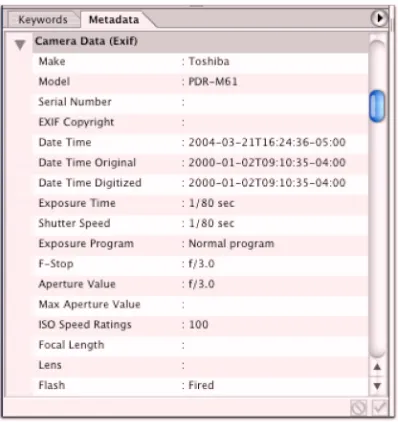
<rdf:Description rdf:about='uuid:4edc3544-7ce4-11d8-8f3a-b6c8aefec736' xmlns:exif='http://ns.adobe.com/exif/1.0/'>
<exif:ExposureTime>1/80</exif:ExposureTime> <exif:FNumber>302/100</exif:FNumber>
<exif:ExposureProgram>2</exif:ExposureProgram> <exif:ExifVersion>0210</exif:ExifVersion>
<exif:DateTimeOriginal>2000-01-02T09:10:35-04:00</exif:DateTimeOriginal> <exif:DateTimeDigitized>2000-01-02T09:10:35-04:00</exif:DateTimeDigitized> <exif:ShutterSpeedValue>633/100</exif:ShutterSpeedValue>
<exif:ApertureValue>319/100</exif:ApertureValue> <exif:FlashpixVersion>0100</exif:FlashpixVersion> <exif:PixelXDimension>1792</exif:PixelXDimension> <exif:PixelYDimension>1200</exif:PixelYDimension> <exif:FileSource>3</exif:FileSource>
<exif:Flash rdf:parseType='Resource'> <exif:Fired>True</exif:Fired>
<exif:Return>0</exif:Return> </exif:Flash>
<exif:ISOSpeedRatings> <rdf:Seq>
<rdf:li>100</rdf:li> </rdf:Seq>
[image:27.612.145.344.116.327.2]</exif:ISOSpeedRatings> </rdf:Description>
Photo Mechanic. Photoshop is not the only application that uses an XML based graphic user interface (GUI) that allows users to enter and edit metadata. Photo
Mechanic is a software package that is widely used in the newspaper industry to preview, edit, repurpose, and batch process images. Photo Mechanic allows viewers to tag
thumbnail versions of the digital image and compare two-up displays for final selection. This quick visual selection process is important in a deadline driven business like newspapers. Additionally, Photo Mechanic allows users to tag images using
International Press Telecommunications Council (IPTC) compliant descriptive metadata fields. Photo Mechanic also has the ability to extract technical metadata from images, and add it as a variable to IPTC fields. This has the advantage of including technical metadata with the image file, but only as a subset to the descriptive metadata field; therefore, this eliminates the ability of technical metadata to be used in any subsequent machine processing. Another disadvantage is that the inclusion of technical metadata is left to the user’s discretion, so there is no standard of technical metadata inclusion. Despite these disadvantages in recording technical metadata, Photo Mechanic is popular in the newspaper industry because of its excellent graphic user interface, which allows quick editing (Camera Bits, 2004).
Capturing Technical Metadata
cameras capture technical metadata through the use of the Exchangeable Image File (Exif) format. Exif is a schema to embed technical metadata in JPEG, TIFF, and Camera Raw files. The purpose of Exif is to incorporate a uniform set of metadata into a digitally captured document that can be interpreted by any device used for image rendering. According to Kodak (2002) “Exif is an international specification that lets imaging companies encode metadata information into the headers or application segments of a JPEG file.” The Japan Electronics and Information Technology Industries Association (2002) notes the versatility of Exif stating that it “specifies the formats to be used for images, sound and tags in digital still cameras and in other systems handling the image and sound files recorded by digital still cameras.” Exif specifications are widely used in the imaging industry to record technical metadata, and Exif specifications provide what is probably the most common way to include technical metadata in JPEG files. Exif is not only a still digital metadata capture standard, but it is also a metadata standard for almost all types of digital recording. The strength of the Exif specification is that the
information embedded in the image file can be read by any application supporting JPEG, TIFF, or Camera Raw files. Technical metadata including, but not limited to shutter speed, aperture, date and time of capture, and GPS location of capture is being included in the latest version of Exif specification (p. 1).
technologies “for the harvesting of technical metadata” (Günter & Dale, 2004, p. 260). The RLG sponsored initiative is exploring ways to include technical metadata into digital images in conformance with proposed National Information Standards Organization (NISO) Data Dictionary standards. Furthermore, the Automatic Exposure–Technical Metadata initiative has surveyed cultural institutions to determine the type of technical metadata that they want to be included in image files (Günter & Dale, 2004, p. 261).
The ability to capture technical metadata has been available in image file formats for over a decade; however, the use of metadata in image processing has not been
widespread. The slow incorporation of technical metadata into image processing was due to the lack of universal technical metadata standards and the absence of a common
encoding scheme. Kodak comments “for the full benefits of picture metadata to be realized across the open system, imaging applications first need a universal means to define metadata, and a means to create, access, update and save metadata associated with pictures” (Kodak, Technology Highlights, Metadata).
Technical Metadata Standards
IPTC Standards. The IPTC in conjunction with the Newspaper Association of America (NAA) has established an evolving set of metadata standards to describe what type of metadata to include in image files intended for the newspaper industry
(Controlled Vocabulary.com, The IPTC-NAA standard). The primary purpose of the IPTC standard is to include descriptive metadata that establishes image ownership, caption, and location for image retrieval from databases. IPTC descriptive metadata standards are widely used in the newspaper industry, and they are supported by major news organizations like the Associated Press.
DCMI Standards. The DCMI consists of working groups that address the
development of user specific metadata sets that can be distributed across domains. Table 2 shows the fifteen fields of metadata that are included in the initiative (DCMI, 2003). ______________________________________________________________________ Table 2. Elements of Dublin Core Metadata Initiative metadata fields
Title Contributor Reference Source
Creator Date Language
Subject Resource Type Relation to Reference
Description Format Scope of Coverage
Publisher Resource Identifier Rights Management
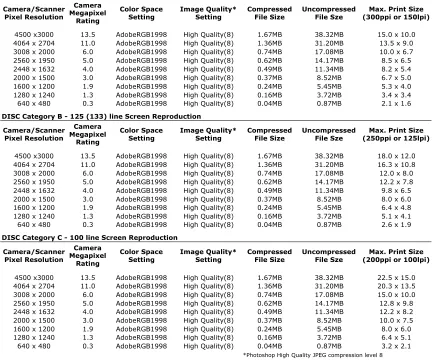
DISC Standards. One group that is addressing technical specifications of digital image capture is Digital Image Submission Criteria. DISC, a working group of
Figure 4. DISC standards for digital image capture.
Also, DISC has established thirteen fields of descriptive metadata to be included with a digital image. Furthermore, DISC has created an XMP based plug-in that allows Adobe Photoshop CS to read and write descriptive metadata fields (Idealliance, DISC XMP Custom Panels, 2004). While DISC addresses the issue of technical specifications
DISC Category A - 150 line Screen Reproduction Camera/Scanner Pixel Resolution Camera Megapixel Rating Color Space
Setting Image Quality* Setting Compressed File Size Uncompressed File Sze (300ppi or 150lpi)Max. Print Size 4500 x3000 13.5 AdobeRGB1998 High Quality(8) 1.67MB 38.32MB 15.0 x 10.0 4064 x 2704 11.0 AdobeRGB1998 High Quality(8) 1.36MB 31.20MB 13.5 x 9.0 3008 x 2000 6.0 AdobeRGB1998 High Quality(8) 0.74MB 17.08MB 10.0 x 6.7 2560 x 1950 5.0 AdobeRGB1998 High Quality(8) 0.62MB 14.17MB 8.5 x 6.5 2448 x 1632 4.0 AdobeRGB1998 High Quality(8) 0.49MB 11.34MB 8.2 x 5.4 2000 x 1500 3.0 AdobeRGB1998 High Quality(8) 0.37MB 8.52MB 6.7 x 5.0 1600 x 1200 1.9 AdobeRGB1998 High Quality(8) 0.24MB 5.45MB 5.3 x 4.0 1280 x 1240 1.3 AdobeRGB1998 High Quality(8) 0.16MB 3.72MB 3.4 x 3.4 640 x 480 0.3 AdobeRGB1998 High Quality(8) 0.04MB 0.87MB 2.1 x 1.6 DISC Category B - 125 (133) line Screen Reproduction
Camera/Scanner Pixel Resolution Camera Megapixel Rating Color Space
Setting Image Quality* Setting Compressed File Size Uncompressed File Sze (250ppi or 125lpi)Max. Print Size 4500 x3000 13.5 AdobeRGB1998 High Quality(8) 1.67MB 38.32MB 18.0 x 12.0 4064 x 2704 11.0 AdobeRGB1998 High Quality(8) 1.36MB 31.20MB 16.3 x 10.8 3008 x 2000 6.0 AdobeRGB1998 High Quality(8) 0.74MB 17.08MB 12.0 x 8.0 2560 x 1950 5.0 AdobeRGB1998 High Quality(8) 0.62MB 14.17MB 12.2 x 7.8 2448 x 1632 4.0 AdobeRGB1998 High Quality(8) 0.49MB 11.34MB 9.8 x 6.5 2000 x 1500 3.0 AdobeRGB1998 High Quality(8) 0.37MB 8.52MB 8.0 x 6.0 1600 x 1200 1.9 AdobeRGB1998 High Quality(8) 0.24MB 5.45MB 6.4 x 4.8 1280 x 1240 1.3 AdobeRGB1998 High Quality(8) 0.16MB 3.72MB 5.1 x 4.1 640 x 480 0.3 AdobeRGB1998 High Quality(8) 0.04MB 0.87MB 2.6 x 1.9 DISC Category C - 100 line Screen Reproduction
Camera/Scanner Pixel Resolution Camera Megapixel Rating Color Space
Setting Image Quality* Setting Compressed File Size Uncompressed File Sze (200ppi or 100lpi)Max. Print Size 4500 x3000 13.5 AdobeRGB1998 High Quality(8) 1.67MB 38.32MB 22.5 x 15.0 4064 x 2704 11.0 AdobeRGB1998 High Quality(8) 1.36MB 31.20MB 20.3 x 13.5 3008 x 2000 6.0 AdobeRGB1998 High Quality(8) 0.74MB 17.08MB 15.0 x 10.0 2560 x 1950 5.0 AdobeRGB1998 High Quality(8) 0.62MB 14.17MB 12.8 x 9.8 2448 x 1632 4.0 AdobeRGB1998 High Quality(8) 0.49MB 11.34MB 12.2 x 8.2 2000 x 1500 3.0 AdobeRGB1998 High Quality(8) 0.37MB 8.52MB 10.0 x 7.5 1600 x 1200 1.9 AdobeRGB1998 High Quality(8) 0.24MB 5.45MB 8.0 x 6.0 1280 x 1240 1.3 AdobeRGB1998 High Quality(8) 0.16MB 3.72MB 6.4 x 5.1 640 x 480 0.3 AdobeRGB1998 High Quality(8) 0.04MB 0.87MB 3.2 x 2.1
DIG35 Standards. Digital Imaging Group known as DIG35 has created standards
for still digital image metadata. The stated goal of DIG35 (2000) is “to define a standard
set of metadata for digital images that will improve the semantic interoperability between
devices, services, and software” (p. 1). In other words DIG35 (2000) intends to design a
set of metadata that is interchangeable, extensible and scaleable, image file format
independent, consistent, and Internet ready (p. 2). DIG35 (2000) has proposed several
categories of metadata to be captured, including basic image parameter, image creation,
content description, intellectual property rights, and fundamental attributes. Of these
categories image creation metadata addresses the issue of standards for technical
metadata. Image creation metadata includes information about capture, capture device,
software used, optical parameters, and device characterization.
NISO Standards. Murphy (2004) describes the National Standards Information
Organization (NISO) as “a non-profit association accredited by the American National
Standards Institute (ANSI), which identifies, develops, maintains, and publishes technical
standards to manage information in the digital environment” (p. 60). NISO standards
cover the areas of information-related needs, including retrieval, repurposing, storage,
metadata, and preservation. NISO (2004) comments “cultural institutions had been
focusing primarily on defining descriptive metadata for the purpose of discovery and
identification, and that comparatively little work had been done to codify technical
To create a uniform metadata standard, NISO has been working on a set of
technical metadata standards in its Data Dictionary—Technical Metadata for Still Digital Images. The purpose of the Data Dictionary (2004) is to “to define a standard set of metadata elements for digital images” (NISO, p. 8). The editors of the Data Dictionary note, “Technical metadata have been identified to ‘anchor’ meaningful attributes of image quality that can be measured objectives, such as detail, tone, color, and size” (NISO, 2004, p.8). The Data Dictionary addresses the need to establish firm categories of technical metadata for use with image files because NISO considers uniform mapping of technical metadata essential if metadata is to be automatically collected.
NISO (2004) defines four categories of technical metadata to be included with image files: basic image parameters, image creation, image performance assessment, and change history. Basic image parameters are those attributes that are considered essential to be able to read and display the image file. Image creation metadata is data surrounding the image capture and capture system used (NISO, 2004, p. 25). Describing image performance assessment, NISO (2004) comments image performance assessment “has both a present and future context: these elements serve as metrics to access the accuracy of output (today’s use), and to access the accuracy of preservation techniques,
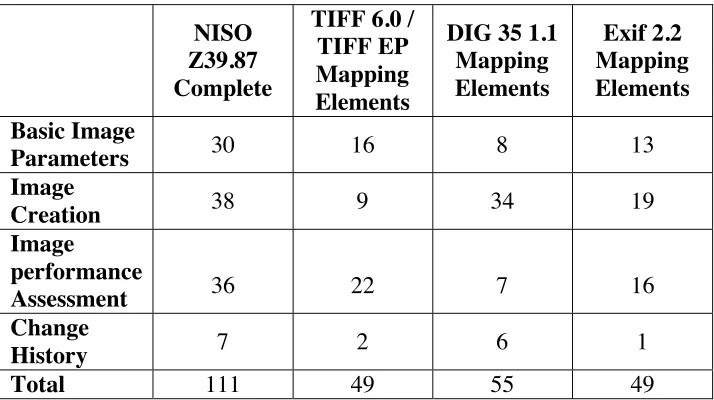
particularly migration (future use)” (p. 35). NISO (2004) points out “The metadata blocks in Change History are used to document the source, systems, and settings used in all subsequent digital-to-digital operations” (p. 55). Table 3 compares NISO mandatory technical metadata with TIFF, DIG35, and Exif 2.2.
[image:36.612.146.503.476.676.2]______________________________________________________________________ Table 3. The quantitative result of mapping all four sections of the NISO Z39.87 data dictionary to TIFF, DIG 35, and Exif
NISO Z39.87 Complete
TIFF 6.0 / TIFF EP Mapping Elements
DIG 35 1.1 Mapping Elements Exif 2.2 Mapping Elements Basic Image
Parameters 30 16 8 13
Image
Creation 38 9 34 19
Image
performance
Assessment 36 22 7 16
Change
History 7 2 6 1
Total 111 49 55 49
There are obvious differences in the type of technical metadata included in
various standards. TIFF and Exif standards lack several categories of change history, and
DIG35 captured only seven of a possible thirty-six Image Performance Assessment
fields. Even though NISO is the most extensive standard, it is important to note that
some of the NISO fields can only be included by manual intervention.
Each of the organizations serves a different purpose. The IPTC and DCMI
address the inclusion of descriptive metadata so image files can be cataloged and shared.
DISC adds the additional criteria of image capture standards based on intended
reproduction. DIG35 and NISO address the need for a uniform set of technical metadata
that can be automatically captured and parsed by image processing devices. Table 4
summarizes the inclusion of metadata by each of these organizations.
Table 4. Overview of metadata inclusion by organization
IPTC DCMI DISC DIG35 NISO ________________________________________________________________________ Descriptive Metadata (User entry) X X X
Specification of capture settings X
Technical metadata (User entry) X X
Technical Metadata for the Newspaper Industry
McDowell contends that the purpose of technical metadata is to help reproduce or enhance an image; therefore, any information not used for this purpose is not technical metadata. To illustrate his point, McDowell draws a distinction between images intended for consumer use and images intended for the graphic arts. He states that consumer photographic processes use algorithms to render a pleasing image based on an average input. However, in the graphic arts, images are often individually adjusted for a specific purpose. For example an image for advertising might contain several elements. One of these elements, the product being sold, is selectively enhanced. This advertising image, prepared for a specific purpose, requires considerable human intervention and subjective decision-making (McDowell, D., personal communication, August 19, 2004).
Likewise, a distinction can be drawn between editorial images and advertising images. McDowell illustrates his point by comparing editorial images to the advertising images in magazines. The advertising images are usually better because more subjective human intervention was used to create them. Spending more time on advertising images is justified because the primary purpose of advertising images is to generate product revenue (McDowell, D., personal communication, August 19, 2004).
therefore, the print should be treated as the original to be scanned into the collection.
To answer the question of the usefulness of technical metadata to newspapers, one
must understand that the purpose of newspaper photography is to display editorial
content. Therefore, newspapers have a vested interest in maintaining the integrity of the
image at the point of capture. As long as the editorial integrity of a newspaper image is
preserved, image reproduction quality may be decided by viewer preference. Preserving
the editorial integrity of an image means portraying the events depicted without bias.
However, there is a fine line between alterations that are considered preferential and
alterations that alter image content. In the past, several major news organizations have
unintentionally changed the editorial meaning of an image through a seemingly minor
image adjustment. Nevertheless, once the editorial integrity of a newspaper image is
ensured, the image should be pleasing to the viewer.
Viewer preference for image quality fits well with the Hunt’s preferred color
reproduction objective, which is normally associated with consumer photography. Hunt
(2004) defines preferred color reproduction “as reproduction in which the colours depart
from the equality of appearance to those of the original, either absolutely or relative to
white, in order to give a more pleasing result to the viewer” (p. 174). Importantly,
preferred color reproduction lends itself to automation because consumer expectations for
output of pleasing images are known. Given the spectrum of reproduction objectives,
newspaper images are reasonably close to preferred color reproduction; therefore, they
Chapter Summary
Metadata serves several purposes. Metadata can be administrative, assisting in the management of digital resources. It can be descriptive, identifying and categorizing a digital resource. Metadata can verify the integrity of a digital resource, and it can supply information about the conditions of image capture. Technical metadata specifically records capture device settings and the conditions surrounding the capture.
From their inception, file formats like TIFF and JPEG have been able to include technical metadata at image capture. The Exif schema has created a uniform set of technical metadata to be included with digitally captured images.
Chapter 3
Research Questions
In addition to images, digital files include a significant amount of associated
information, called technical metadata, which describes the tools, the settings, and the
conditions surrounding digital capture. Due to the time sensitive nature of newspaper
publishing, news images are increasingly being captured digitally. It is essential that
newspapers improve the efficiency of their digital workflows, while maintaining
traceability of the digital file to its source of capture. The efficient reproduction as well
as the editorial integrity of these image files is essential.
To meet these objectives using technical metadata, the first step is to determine
the fields of technical metadata that are relevant to the newspaper industry. To date, the
NISO Data Dictionary describes the most comprehensive set of technical metadata standards, listing 111 fields of technical metadata. Consequently, this research will
evaluate the technical metadata needs of the newspaper industry in two key areas based
on the NISO Data Dictionary standard. It will:
• Examine how newspapers currently use technical metadata in their digital
Chapter 4
Methodology
Data Collection Plan
Five newspaper organizations were selected for this study. The organizations
studied were USA Today, The Chicago Tribune, The Washington Post, The New York
Times, and The Rochester Democrat & Chronicle. The first four organizations were chosen because they were representative of the largest newspaper organizations in the
United States. In addition, the Rochester Institute of Technology had established ties
with each organization, which facilitated the completion of interviews within the time
allotted for research. The Rochester Democrat & Chronicle was added as an initial case
study. The plan was to access the effectiveness of the interview technique using the
initial case study, and then, make necessary adjustments for future studies. However, on
its own, the Democrat & Chronicle was considered to be important, because it was the
first major metropolitan newspaper in the United Stated to convert to an all digital image
workflow.
To obtain sufficient information to draw conclusions for both research questions,
the participants in each case study were asked a number of structured questions (See
metadata. To allow additional input, each interview provided ample time for open-ended
responses.
Additionally, a questionnaire (See Appendix C) was used to assess the perceived
importance of different types of technical metadata. Case studies were important to this
research because first hand observation of each organization’s digital workflow was an
important component of the study. Furthermore, on-the-spot questioning provided the
flexibility to account for each organization’s unique description of technical metadata.
Data Analysis
The first research question sought to understand if technical metadata would
improve the newspaper digital imaging workflow, and the type that would do so. The
second research question sought to determine the type of technical metadata essential to
preserve the integrity of newspaper digital images. Questions 1 through 3 prompted the
user to describe the scope of the organization’s digital workflow and its need for image
quality. Questions 4 through 6 asked the user to assess the importance of using technical
metadata in the capture and the adjustment of images. As may be seen in Appendix A,
questions 8 through 11 asked users specific questions about their current technical
metadata practices based on NISO standards. Questions 12 and 13 inquired about the
preservation of technical metadata as digital files were repurposed or converted to
another file format. Additionally, a series of survey questions Appendix B) was included
This study used NISO definitions to set specific boundaries to improve the quality
and the consistency of responses, since this standard, to date, represents the most
comprehensive set of technical metadata in existence. Obviously, these boundaries
limited the nature of the research, causing it to be more deductive than inductive.
However, as Miles and Huberman (1994) pointed out “better research happens when you
make your framework and associated choices of research questions, cases, samples, and
instrumentation explicit, rather than claiming inductive purity” (p. 23). Moreover, the
use of an explicit survey instrument allowed better cross-case comparison.
To assist in designing interview questions a conceptual workflow was constructed
(See Appendix D). This flowchart served the purpose of creating a visual framework that
illustrated critical handoffs in the workflow. Based on this hypothetical workflow, the
digital imaging process was divided in the following manner: Image capture, Image
Editing, Image Storage, and Image Output. The flowchart represented generic categories,
and in some organizations the actual workflow differed considerably; however, the
processes of capture, editing, storage, and output were common in all organizational
structures.
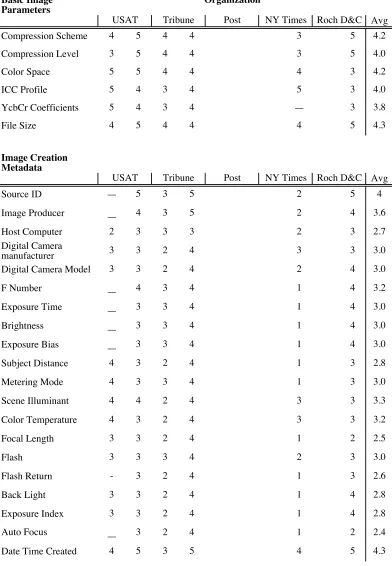
To compare the responses from different organizations, a matrix was constructed
using information gathered from the case studies (See table 5 on page 59). The purpose
of this matrix was to show both within-case and cross-case responses. Once the data was
entered into the matrix, relationships emerged, and based on these relationships, the data
cross-case analysis is necessary to be able to better generalize results, and to “deepen understanding and explanation” (p.173).
To analyze Likert scale1 data from the Case Study Questionnaire, the assumption
Endnotes Chapter Four
1
The Likert scale is a four or five step ordinal scale that asks the respondent to assign a
level of importance or agreement with a particular question. The following scale was
used in this research project.
5 = Very important 2 = Of little importance 4 = Important 1 = Unimportant
Chapter 5
Summary of Results
The purpose of this research project was to examine the use of technical metadata in the newspaper industry. Chapter Four outlined the data collection and analysis plans. Through the use of a survey instrument and in-person interviews, this research sought to answer two questions about the use of technical metadata by newspaper organizations:
• Examine how newspapers currently use technical metadata in their digital imaging workflow.
• Point out areas where technical metadata could improve the newspaper digital imaging workflow.
This chapter summarizes the results from both the interviews and the
questionnaires (Refer to Appendix B for a list of interview questions and Appendix C for the complete case study questionnaire). Each summary starts with a broad stroke
Case Study One
Introduction
USA Today the national, and international, newspaper of the Gannett Company, published at forty print sites worldwide. The total daily circulation of USA Today is in excess of two million copies. Printing at forty sites creates a two-tier distribution scheme in which USA Today headquarters in McLean, Virginia, transmits pages electronically to customer print sites, which in turn, distribute printed newspapers to end consumers. In addition to printed products, USA Today maintains a news website at www.usat.com. USA Today acquires hundreds of thousands of photos yearly from its photographers, news service providers, and through broadcast captures. Out of this huge quantity of images, it is estimated that only about five percent are saved, and even fewer are published. Steve Terrillion, Director of Prepress operations for USA Today
comments, “We might take five hundred photos of the president and only use one.”
Digital Imaging Workflow
All photos taken by USA Today staff photographers are captured digitally. Staff photographers capture images as Camera Raw files. USA Today is acutely aware that minor changes in a digital image may alter editorial content; therefore, the
sample per inch (spi) requirement was indicated, but USA Today advertising
specifications require that digital images be between 175 and 250 spi. However,
Terrillion pointed out “we won’t select or not select an image because of some attributes
of the image. It’s [about] news content.”
Photographers download digital files to workstations using Photoshop, for the
purpose of previewing and tagging images. Subsequently, these files are saved as RGB
JPEG to a MerlinOne digital asset management system. Merlin One is a suite of software
products that manages collections of images and allows text searching, using IPTC
standards-based metadata. In Merlin, a handoff occurs from photographer to photo
editor. Working strictly in RGB, photo editors sharpen images and crop for content. The
RGB file is then placed in proper position on the electronic page. In general, editors do
not adjust the color of images; that is left to the production department. Terrillion
declares that there is a clear separation in the type of image adjustment done between
departments. The editorial department adjusts images for content, and the production
department adjusts images for press.
In the production area, digital images are first converted to CMYK, and then
visually adjusted. At this time, USA Today is not using a color-managed workflow1; it is
relying on the expertise of its staff to adjust images. After the CMYK image is adjusted,
it is returned to the queue, where it replaces the original RGB image that was placed on
subsequent file processing, thus reducing onsite errors. In addition to archiving images,
USA Today archives complete pages as PDFs in various places throughout the
organization. These PDF files serve numerous purposes, such as proofs for advertisers or
reprints for customers.
Metadata—Response to Questions
Images are tagged with descriptive metadata according to IPTC descriptive
metadata standards. The organization does use some technical metadata that falls under
the NISO heading of “Basic Image Parameters”, such as file size and color space, and it
is mindful of other metadata such as degree of compression. However, none of this
metadata is used in an automated fashion. Photographers must intentionally enter “Image
Creation Metadata” by adding date, location, and the creator of the image. The Merlin
archiving system does automatically create a unique identifier for images. Interestingly,
the use of Camera Raw image files by USA Today photographers causes photographers to
use Image Creation Metadata to assist the visual adjustment of images. Miles Weissman,
Prepress Systems Administrator, commented that in the early stages of conversion to
digital photography, Image Performance Assessment tools like test targets were used due
to the limitations of the equipment, but these tools are not currently being used. Change
History is kept by saving versions of images. As Terrillion pointed out, since a detailed
change history would require considerable human intervention, versioning is probably the
best method of tracking changes in a busy newspaper environment. When asked whether
Weissman remarked that it would depend on the application that performed the conversion.
Metadata—Open-Ended Responses
Asked to speculate on the usefulness of technical metadata, Terrillion remarked that the more information there is about an image the better, but there may be limitations due to the digital overhead of carrying technical metadata in an image file. He also noted that the interplay of the large systems that USA Today uses to manage photos determined how much useful technical metadata an image could have. Additionally, Terrillion noted that news deadlines determine what a newspaper will or will not do in an image archive. He added that the inclusion of technical metadata needed to be automated by the application used to ensure that it is kept on a regular basis. A final concern was that the amount of metadata in an image file could overwhelm human users. Speculating on the potential positive aspects of technical metadata, Terrillion thought that technical metadata could be a good tool for decision makers to improve production methods and to recommend equipment expenditures.
Terrillion spoke extensively about the use of metadata for advertising images. USA Today creates thousands of ads yearly from customer-supplied images. Areas
deemed important to track, though not strictly technical metadata, are size, billing, press run date, and multimedia functionality. Terrillion declared, “An ad might have
information was considered to be an area of ongoing research. It would be desirable to
transmit a customer’s ad on a completed news page containing metadata about billing and
insertion. However, controlling customer access to metadata on a newspaper page
containing several different elements is a challenge, because each customer would have
access to the metadata contained in every advertisement.
Terrillion brought up the point that the same metadata can be interpreted differently
depending the context that it is used in. For one application certain metadata may be
considered technical according to NISO standards, while in another application it may be
considered descriptive according to standards like AdsML. AdsML is an international
standard for digital advertising exchange supported by Ifra2 and the NAA. “The AdsML
Standard is an XML-based…open standard that will manage the digital exchange of
information between all parties involved in the advertising workflow, from concept to
publication to billing” (AdsML Consortium, 2004).
Case Study Two
Introduction
The Chicago Tribune has a daily circulation of approximately 790,000
subscribers, increasing to one million for the Sunday edition. The Tribune’s primary
distribution area is metro Chicago and the surrounding fifty-mile area. The Chicago
Tribune is part of the Tribune Company which publishes several other newspapers and
magazines, most notably, the Los Angles Times. In addition to newspapers, the Tribune
in New York. The organization maintains an interactive Chicago Tribune website. In addition to its news outlets, the Tribune Company owns the Chicago Cubs baseball team.
Currently, ninety percent of the images taken by Chicago Tribune photographers are taken digitally. The Chicago Tribune publishes about two hundred images per day. Kelly Hagen, Advertising Systems and Client Relations Manager, estimated that the Tribune captured approximately twenty images for each one published. There are future plans to install a system that will report the ratio between captured and published images. Hagen added that the Tribune’s advertising department accepts about 10,000 images and digital elements yearly from customers. Additionally, the organization accepts
approximately 15,000 complete digital advertisements, all in the form of PDF files.
Digital Imaging Workflow
Tribune photographers capture images as JPEG files, except for high-end Sunday
magazine images that are captured as Camera Raw files. Associate Subject Editor, Rick Berry, commented that capturing Camera Raw files allowed greater ability to correct exposure after the shoot. All digital images are captured at a resolution of 200 pixels per inch (ppi). The Tribune does not use a color-managed workflow. Color evaluation is done on a proofing device that is calibrated to emulate the output of the press.
descriptive metadata standards, make minor tonal adjustments in Photoshop, and add
them to the Merlin database. Image sharpening and color correction are left to the
production department. Berry stressed that ethical considerations are important, and no
adjustments are made past the point of making images look good in the newspaper.
Thereafter, images are keyed to the assignment sheet in Merlin, which links the image
with previously entered descriptive metadata.
The majority of news pages are paginated by the Tribune’s CCI pagination
system3, which allows editors to place RGB images on the page for later conversion to
CMYK. When images are published from CCI, the publication data is sent to Merlin
where the high-resolution image is linked to the page. Published images are then
reclassified to prevent being purged from the system. Currently, the Tribune has 600,000
RGB images archived in Merlin. Berry noted that CMYK images used in publication are
rarely kept. If image is used again the original RGB file is adjusted and converted to
CMYK.
Metadata—Response to Questions
The Chicago Tribune uses technical metadata that falls under the NISO
classification of Basic Image Parameters, such as file size, compression, and color space.
One significant difference from other organizations’ operations is the Tribune uses
ColorMatch RGB color space because it has a gamma that approximates that of print
reproduction. Therefore, during the subsequent conversion to CMYK, darker areas of an
printing. The use of ColorMatch RGB represents a more output-centric philosophy than
that of other newspaper organizations. The Tribune also uses technical metadata
regarding image resolution to automate the conversion of print images for the web.
Berry reported that the organization saves image creation metadata, or what it
calls “exit data,” to provide feedback about image reproduction. He admitted that image
creation metadata could be useful for image adjustment technicians too; however,
technicians would need a thorough understanding of photography. For technicians, Berry
noted that “that the ultimate target… is a proofer that matches the press.” Test targets are
used to calibrate cameras and scanning devices, but the Tribune’s workflow is not ICC
color managed. Some of the organization’s photographers use a Kodak gray card as an
image performance tool. To verify neutral gray reproduction, the gray card is sometimes
reproduced and checked for neutrality; however, target verification data is not stored.
The Tribune does not keep a detailed change history, but saves versions of images. Berry
pointed out that the originally captured RGB image, which they call an “outtake,” is
always saved to removable storage media such as a CD. In the future, it is planned to
save these outtakes in the Merlin system, but it is doubtful if legacy files will be added.
In the event of migration to a new image file format, it was thought that preservation of
technical metadata would not be a priority.
Metadata—Open-Ended Responses
occasionally publishes images taken by staff photographers. Member newspapers are able to log into the Chicago Tribune’s Merlin database to search for images. Berry considers internal sharing a viable alternative to going to outside sources like the Associated Press. Obviously, in such a sharing scheme, the standardized use of descriptive metadata is important. Even though there is extensive sharing of images within the organization, there is no provision for outside access to images. The Tribune has a collection of thousands of glass plate negatives, and currently there is no plan to add these archival images to a database or share them. Upon further investigation, this researcher did find a collection of approximately 300 current and historical photographs for sale by a third party image management firm called International Published Photos Incorporated (IPPI). IPPI is an organization that provides a complete solution for organizations with large image archives to market their images and pages to retail consumers. Photographs are purchased through the Tribune’s website and customer billing is conducted by IPPI.
Case Study Three
Introduction
The Washington Post has an approximate daily circulation of 780,000 subscribers, increasing to 1.1 million on Sundays. The Washington Post is a component of the
and Kaplan Higher Education. Additionally, the Post has a longtime working relationship with Tribune’s Los Angeles Times.
The Post maintains bureaus throughout the world to cover news events. Kevin Conner, Quality Assurance Manager for the Post estimated that about 32,000 digital images are inputted yearly into the organization’s Merlin system. Although there was no exact count, Conner estimated that only about twenty percent of captured images were entered into Merlin. After capturing images, staff photographers return several selected images to the photo editor, or whoever assigned the shoot. After careful review, the editorial board decides which images to publish. The editorial department then communicates the intent of the image to the production department to ensure editorial integrity.
Digital Imaging Workflow
The Post does not use a color-managed workflow. Proofing devices are calibrated to emulate newsprint output. Staff photographers captured digital images as JPEG sRGB files; however, feature photos are occasionally captured as Camera Raw files. The minimum file requirement is 170ppi, but Connor mentioned that photographers
frequently capture images at 300ppi to enable use in other publications. The assigning editor enters information about the photo shoot into the Merlin system, and the
production department. Frequently, photographers add written instructions for the
production department that helps to preserve the creative content of the image. The
organization uses Merlin as its primary image archiving application, and editors use a
CCI pagination system in conjunction with Merlin to place RGB images on news pages.
Tim Fitzsimons, Engraving Foreman, expressed concern that photographers
sometimes altered the original image file in the Merlin database, thereby destroying the
high-resolution image. Fitzsimons also spoke of the difficulty in reaching customer
expectations when reproducing certain iridescent colors that sports teams use for their
uniforms. Summing up the organization’s digital image workflow Connor declared “we
have to be careful with the word workflow because in the traditional sense the workflow
applies to the daily publication. Period.”
Metadata—Response to Questions
Examining the Post’s use of technical metadata classified as Basic Image
Parameters, the organization uses file type, file size, compression, and color space. One
area of technical metadata the Post diligently tracks is the amount of image compression
used. Connor spoke specifically about the relationship between compression and image
quality. Staff photographers compress images to speed transmission, and at times, the
subsequent reduction in image quality is at odds with the desired reproduction quality.
Both Connor and Fitzsimons thought that Image Creation Metadata could be
useful for improving reproduction quality. Based on their interview responses, the
Fitzsimons remarked that he has created film output from digital input to establish a
common language to discuss image quality issues with photographers. Both Connor and
Fitzsimons emphasized the importance of working with staff photographers during the
conversion from analog to digital photography. A current area of discussion is the
relationship between the on-screen view of an image and its reproduction in the
newspaper. The organization does not currently use Image Performance Tools such as
test targets. Connor pointed out the difficulty of setting up test targets at important and
breaking news events. Nevertheless, Fitzsimons commented that test targets, such as a
Macbeth ColorChecker, have been used in house to calibrate output.
As with other organizations, versioning is the primary means of keeping a record
of the Change History of an image. Fitzsimons commented that there was some image
adjustment that is done prior to inputting the image into Merlin, and there was no record
of these adjustments other than the difference between the captured image and the image
entered into Merlin. The issue of preserving technical metadata when migrating to
another file format has not been discussed within the organization. Connor did not
express strong feelings about the potential usefulness of technical metadata in the future.
As far as Connor and Fitzsimons knew, Merlin did not provide complete access to
technical metadata. However, this may be incorrect because they had not had a need to
access technical metadata through the Merlin system. Fitzsimons brought up the point
that staff photographers may already be using technical metadata to some extent without
Metadata—Open-Ended Responses
The Washington Post is actively pursuing alternative channels of distribution for
its news. One alternative channel of distribution is a website titled Camera Works that is
linked to the main Washington Post website. Camera Works is a multimedia website
consisting of images taken by both staff photographers and images submitted by outside
sources. After selecting a storyline, customers are guided through an advertisement to
either a slide show or a video presentation. According to website information, published
newspaper images taken by staff photographers after 1996 can be purchased.
Another alternative channel of newspaper distribution is out of market sales.
Fitzsimons mentioned that a Post reader in a Singapore hotel could print out a complete
same day copy of the newspaper. This process involves sending a PDF file of the
complete newspaper to a third party remote location. The service provider then digitally
prints an on-demand copy of the newspaper. Typically, the digital edition is an 11 x 17”
version of the actual newspaper.
Case Study Four
Introduction
The New York Times is distributed both nationally and internationally with its
primary distribution area being New York City. The Times has a daily circulation of 1.1
million subscribers and a Sunday circulation of 1.6 million. The targeted advertising
market distinguishes the national and local versions of the newspaper. In addition to the
and the New York Times Syndication Service distributes syndicated stories to
publications nationwide. Tara House, Managing Director of Systems and Technology for
the Times, comments “That [syndicated] content tends to be written by freelance
journalists. It includes our Book Review section, our Magazine section, and our Op-Ed
section.” Additionally, the organization publishes a small (approximately eight page)
international edition that is inserted into international newspapers. Furthermore, the New
York Times Digital Group maintains a web-based publication. The New York Times
Company also owns publications such as the International Herald Tribune, The Boston
Globe, and sixteen other newspapers, as well as forty news websites.
Digital Imaging Workflow
House remarked that it was difficult to ascertain exactly how many digital images
the Times captured, but the ratio of images captured to images published was greater than
ten to one, and for important news events the ratio might be as high as one-hundred to
one. The organization’s digital workflow starts when a staff photographer is given a
photo assignment. House notes that the technique used by photographers on assignment
depends both on the subject matter and the means used to transmit the image to the
newspaper. Rather than specifying a particular capture resolution, photographers adjust
resolution based on the proposed end use of the image. Staff photographers sometimes
capture images in Camera Raw format, but all image files are converted to JPEG before