It's hip to be square; The CubeSat revolution
With the launch of the UK’s first commercial CubeSat, UKube-1, on the horizon, Malcolm Macdonald and Christopher Lowe look at what the future holds for this standardised spacecraft platform.
Just over fifty-six years ago, the Space Age began with the launch into an elliptical, low-Earth orbit of a 58cm polished metal sphere with four external radio antennas. This metal sphere was Спутник-1, which translates as Satellite-1. We know it as Sputnik-1.
The launch of a spacecraft today is perhaps not quite mundane or routine, but it is worth recalling that the scale of this achievement by the Union of Soviet Socialist Republics (CCCP or USSR), less than a lifetime ago, triggered a Cold War crisis within the United States of America (US) and her allies. This crisis led to the use of the same evocative imagery as in the aftermath of major modern-day events such as the series of coordinated suicide attacks within the US on 11 September 2001.
In its day, Sputnik-1 and the spacecraft that followed such as the first American spacecraft, Explorer-1, were the reserve of elite, well-funded national programmes. Today, despite the increased accessibility of space from those early days, this perception of the ‘typical’ spacecraft persists as a, typically bespoke, tens to hundreds of millions of pounds
development over a number of years by teams of people working in clean rooms and beyond to the highest conceivable quality standards. Yet the reality has moved on.
The CubeSat era
Towards the end of the 1990’s a number of university groups were developing student built pisatellites. Based on this experience at Stanford University, Bob Twiggs and his co-workers, including Jordi Puig-Suari at California Polytechnic State University (Cal Poly), developed and proposed to the community the concept of a CubeSat “as a collaborative effort to continue developing the pico-satellite, provide a convenient low cost launch interface and coordinate launch activities.” [1]
Key to the CubeSat standard is simplicity, standardisation and conformity. The base unit of a CubeSat is a 10 cm cube, termed ‘1U’ or ‘1 unit’. The CubeSat is traditionally scalable along a single axis in units of 1U, hence a 3U CubeSat like UKube-1 is approximately the size of a box for a whisky bottle; 30 × 10 × 10 cm. Today, this traditional single axis scalability is possible in units of less than 1U while also extending into a second, or even third, axis with the development of 6U and even 12U CubeSat concepts.
these payloads from the launcher perspective as alternative CubeSats, or mass-dummies can be sourced at short-notice and flow with relative ease.
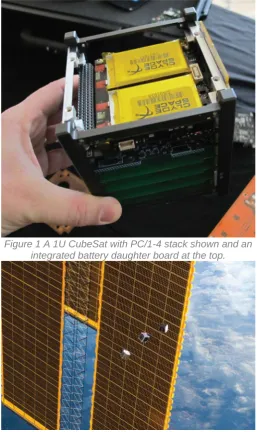
The first CubeSats were launched in June 2003 into a Sun-synchronous orbit on-board a Eurockot from Plesetsk, Russia; these CubeSats were from Denmark (two), Japan (two), Canada and the US. Since then, innumerable CubeSats have been launched including the three 1U CubeSats shown in Figure 2.
The growth in CubeSat
developments and launches has been dramatic. In 2013, over 90 CubeSats were launched [2], and between 19 – 21 November alone, 52 CubeSats were launched: 28 on-board an Orbital Sciences Minotaur rocket from NASA's Wallops Flight Facility (a then record number of spacecraft on-board a single launch vehicle); 3 from the Kibo laboratory of the International Space Station; and 21 on-board a Dnepr rocket from Yasny in Russia, setting a new record of 32 spacecraft on a single launch vehicle.
Amongst the CubeSats on-board the Minotaur rocket was TJ3Sat from ‘Thomas Jefferson High School for Science and Technology’ in Virginia, USA, the first spacecraft designed, built and flown by school pupils, and PhoneSat 2.4 from NASA which makes the claim to be “the first use of a phone as control system for a satellite.” Note however that this is not the first time a phone has been used on-board a CubeSat as the Surrey Space Centre and SSTL used a phone on-board its STRaND-1 3U CubeSat as a secondary computer to a ‘classic’ CubeSat computer.
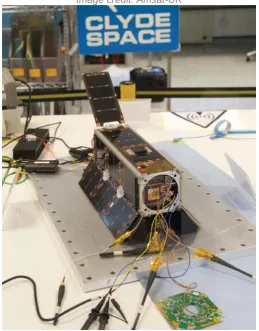
[image:2.595.267.525.72.505.2]Meanwhile on-board the Dnepr rocket were spacecraft with a UK interest, including the ‘Magic’ mini-magnetometer from Imperial College London on-board KHUSat-1 and -2, and the Funcube-1 developed by Amsat-UK. Funcube-1 has the aim of increasing interest in radio, space, physics and electronics amongst schoolchildren. It carries a transponder that transmits signals that can be picked up using a simple USB dongle receiver and small aerial. It is of note that although Funcube-1 is a UK development it is registered in the Netherlands due to the regulatory difficulties in obtaining space licensing in the UK. FUNcube-2 will fly on-board UKube-1 and is shown in Figure 3.
Figure 1 A 1U CubeSat with PC/1-4 stack shown and an integrated battery daughter board at the top.
UKube-1
It is into this mass proliferation of CubeSats that UKube-1, Figure 4, will shortly be launched on-board a Soyuz 2-1B rocket from
Baikonur Cosmodrome in Kazakhstan, alongside ten other spacecraft including
TechDemoSat-1 built by SSTL, and Russia’s first ever private spacecraft, built by Dauria
Aerospace group and fully funded by domestic Russian private capital.
Clyde Space Ltd., based in Maryhill in Glasgow’s west-end, built UKube-1 for the UK Space Agency, with multiple flight tests of low cost electronic systems and payloads on-board. In addition to FUNcube-2, payloads include: TOPCAT, the first GPS device aimed at measuring
plasmaspheric space weather; Janus, an experiment to demonstrate the feasibility of using cosmic radiation to improve the security of communications satellites, from EADS Astrium; and, a CMOS Imager
Demonstrator from the Centre for Electronic Imaging at Open University and e2v Technologies deploying next generation sensors. Other UK companies involved include Bright Ascension (software) and Steepest Ascent, now part of MathWorks, (mission interface computer).
UKube-1,Clyde Space’s first in-house platform development, emerged from a Knowledge
Transfer Partnership between Clyde Space and the Advanced Space Concepts Laboratory at the University of Strathclyde, and is seen by the UK Space Agency as a pathfinder
[image:3.595.261.519.97.321.2]mission for the Agency’s proposed national CubeSat programme, which would see a mission
Figure 3 FUNcube-2 on UKube engineering model stack. Image credit: Amsat-UK
Figure 4 UKube-1 in the cleanroom at Clyde Space during final flight readiness testing. Image credit: University of
[image:3.595.260.520.341.673.2]launched every 12 – 24 months. The UK Space Agency envisage a national CubeSat programme increasing the UK’s ability to market new space technologies while providing training and research opportunities for the next generation of engineers and scientists.
The Next Steps
In addition to the original ‘amateur’ or ‘educational’ CubeSat rationale, a spectrum has emerged to span a ‘professional’ rationale. Evidenced by CubeSat developments such as STRaND-1 from SSTL, which had significant input from the University of Surrey, and UKube-1 from Clyde Space, which has a range of academic involvement, through to CubeSats from the US Air Force, NASA, and Boeing.
The CubeSat developer’s spectrum now spans high schools to professional engineers and space agencies, with a directly related spectrum of increased (staff) costs and, it must be expected, reduced risk / increased performance. Similarly, companies such as Pumpkin, Innovative Solutions In Space (ISIS) and Clyde Space have emerged to service this complete spectrum of developers with sub-systems, launch services and even complete platform solutions.
UKube-1 is an example platform solution, while those offered by Clyde Space and ISIS for the European Union FP7 project ‘QB50’, a network of up to 50 CubeSats to study temporal and spatial variations in the lower thermosphere due for launch in 2015, are a further example. The National University of Singapore’s Centre for Quantum Technologies, rather than procure the sub-systems and integrate these in-house for perhaps one-third of the incurred cost, in October 2013 placed a 200k USD order with Clyde Space for a QB50 platform solution building on UKube-1 heritage [3]. This is a clear example of the incurred cost verses risk trade that the CubeSat spectrum now enables. Orders such as the NUS QB50 platform are clearly attractive to companies like Clyde Space and ISIS, however it remains to be seen whether this platform market will mature beyond a niche within the CubeSat ecosystem.
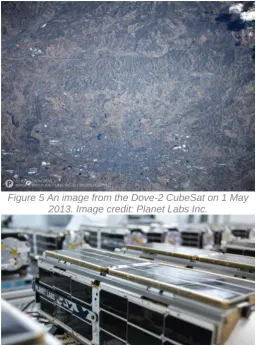
The first major CubeSat constellation, Flock 1, by the San Francisco start up Planet Labs, has already launched four 3U CubeSats. The first two of which, Dove-1 and -2, were launched on 21 and 19 April 2013; note that at that time Planet Labs was still operating in ‘stealth mode’ as Cosmogia and was not formally launched until 26 June 2013. An image from Dove-2 is shown in Figure 5.
Planet Labs, much like SpaceX before it, seek to bring the mentality of Silicon Valley to the space sector, and aims to operate the largest Earth observation constellation in the world, trading improved temporal resolution against spatial resolution. The spatial resolution of less than 5 metres (at 400 km altitude) improves or matches significantly larger platforms such as UK-DMC 2 (22 metres at 660 km altitude) and RapidEye (5 metres at 630 km). However, this resolution is less than newer spacecraft such as those of Skybox Imaging (SkySat-1 and -2) and the in-development UK-DMC-3, both providing 1m imagery.
The reduction in altitude of Flock-1 partly enables the improved
performance over the 5-year old UK-DMC-2, however this
reduction also gives a reduction in service lifetime due to increased atmospheric drag. Yet as Planet
Labs point out, this trade necessitates the more frequently upgrade of the relatively low unit cost devices, much like our approach to consumer electronics, enabling the system to benefit from the most advanced available technology at any given time.
That a start-up like Planet Labs, all be it founded by ex-NASA employees, can undertake development of 32 spacecraft with 13M USD of venture capital funding does question the likelihood of the CubeSat platform market maturing beyond a niche. However, perhaps most eye opening is the ability of Planet Labs, alongside other start-ups like Skybox Imaging, to access such significant quantities of venture capital.*
Future Developments
Whilst the vast majority of current Earth orbiting CubeSat efforts are limited to observation of Earth or some in-situ phenomenon (as in the case of QB50), technology demonstration, and science, research is underway into their use as communication platforms and navigation systems, amongst other things.
*
[image:5.595.261.518.71.417.2]Skybox Imaging have raised 91M USD to date, with the plan to launch twenty-five 100kg spacecraft providing 1m class imagery, whilst Planet Labs announced a further 52M USD in series B financing in December 2013.
Figure 5 An image from the Dove-2 CubeSat on 1 May 2013. Image credit: Planet Labs Inc.
Figure 6 A Flock-1 spacecraft, with others in the background, prior to shipping at Planet Labs. Image credit:
Meanwhile, launching CubeSats is becoming a fraught issue. The traditional CubeSat secondary payload approach is falling out of favour with some primary payloads and consequently some launch providers have discontinued the use of secondary payloads altogether. Meanwhile rockets such as the Dnepr or Minotaur are incurring organisational difficulties in coordinating so many small spacecraft, and their teams. Furthermore, in the US NASA’s CubeSat launch initiative has been so successful that it is now struggling to find launch opportunities for all the CubeSats it has spurred.
In August 2013 NASA announced its Launch Services Enabling eXploration & Technology (NEXT) programme/competition to accelerate development of Very Small Launch Vehicles (VSLVs). This programme hopes to encourage the development of a launch vehicle capable of putting three 3U CubeSats with a combined mass of 15kg into Sun-synchronous orbit with an altitude of greater than 425km, with a payment of 300kUSD per 3U CubeSat carried.
In parallel to this, the UK Space Agency, through its Space Collaborative Innovation Team Initiative (Space CITI) pilot programme, is funding the UKLaunch consortium to study the technical and economic feasibility of a UK-based small satellite launcher.
Other work is progressing to further enhance the capabilities of these small spacecraft through, for example, the addition of deployable structures and propulsion systems using, for example, ionic liquid [4] or xenon, iodine or water [5]. In fact, the potential applications for CubeSats span as wide as for traditional satellites, with interest even extending to
interplanetary travel and exploration. An annual workshop (http://icubesat.org/) on the subject plays host to enabling technologies and applications from advanced autonomous sensor systems to lunar penetrators, indicating that CubeSats of the future could be
escaping the clutch of Earth’s gravity field. However, the potential progression of CubeSats beyond the low-Earth orbit environment does raise potentially uncomfortable space debris and planetary protection issues that will need to be addressed.