MONASTIC HOSPITALITY: EXPLORATIONS
Kevin D O’Gorman and Paul Lynch Strathclyde Business School
University of Strathclyde Glasgow G4 0LD
I
NTRODUCTIONIn a theoretical model, religious retreats are placed by Lynch (2005a) within the
category of traditional commercial homes, noting that the essence of a commercial
home is the use of the home as a vehicle for generating income. Lynch (2005b:539)
describes the ‘commercial home host’ as “the principal contact whom the guest
encounters when staying in the commercial home,” and further states that “the host is
central to the product experience in commercial homes. Successful stays from a guest
perspective are dependent upon the quality of host-guest interactions” (Lynch
2005c:541). This chapter explores the provision of hospitality within Benedictine
Monastries in order to contribute to insights on the commercial home, and starts by
locating them within the context of literature on religious tourism and the umbrella
term ‘religious retreat house’.
The literature on religious tourism where ‘participants are motivated either in part or
exclusively for religious reasons’ (Rinschede, 1992: 52) has very largely overlooked
the importance of the accommodation. The focus has included: classification of
forms of religious tourism noting its close interrelationship with holiday and cultural
tourism (Murray and Graham, 1997; Rinschede, 1992); aspects of tourism
development, management and environmental protection (Murray and Graham, 1997;
Rinschede, 1992; Shackley, 1999); pilgrimage as reinforcing social boundaries and
distinctions (Eade and Sallnow, 1991 in Murray and Graham); the socially
constructed nature of religious spaces (Gatrell and Collins-Kreiner, 2006); religious
centres (Rinschede, 1992). Characteristics of ‘religious tourists’ have been explored
variously noting an affinity to social and group tourism involving travelling with
believers of a similar age (Rinschede, 1992); varying age and gender profiles by
location and religion (Murray and Graham, 1997); debate regarding the various tourist
dimensions (Murray and Graham, 1997; Nolan and Nolan, 1989) and embracing of
experiential, existential (pilgrims especially), diversionary, recreational and
experimental modes of tourism (Cohen, 1979 in Gatrell and Collins-Kreiner, 2006).
Of note is discussion concerning conflict and its management between different
socio-spatial practices of pilgrims and tourists (Gatrell and Collins-Kreiner, 2006). Largely,
such narratives convey a sense of a distant outsider’s perspective and a concern with
the macro perspective rather than an understanding of organisational microdynamics.
One should distinguish between visits to religious sites and stays in religious
accommodation. Studies of closest relevance for this paper are now considered.
Shackley (1999; 2001) discusses the case of the St. Katherine monastery in Sinai and
notes the historical and religious significances of this working site where 25 monks
live. An estimated 97,000 visitors per annum have access to a very limited portion of
the monastery. Shackley (1999: 547) reports that as a result of the number of visitors,
the monks have difficulty in maintaining their quality of life, and is pessimistic
regarding the ability to balance ‘God and mammon’. A further study by Shackley
(2004) identifies an international religious accommodation market which includes
religious retreat houses defined as: ‘… a small firm that provides catered
accommodation and spiritual input for guests (sic) in search of peace and quiet,
whether or not this is associated with a religious or monastic experience’ (228). These
retreat houses include working convents and monasteries and, based on an analysis of
Shackley’s (2004) description, show several similarities as well as differences in
comparison with the traditional commercial home (Table 1).
Table 1.
Similarities and Differences of the Religious Retreat House Described by Shackley (2004) and the Traditional Commercial Home
Features of Religious Retreat House Usually
Shared with the Traditional Commercial Home
Features of Religious Retreat House Usually
Differing from the Traditional Commercial
Home
Home dwelling Spartan accommodation
Serviced accommodation Rarely en suite
Little or no choice of food No mod cons in rooms e.g. television, hairdryer
Weak and idiosyncratic management methods Guests may be required to assist in clearing tables
Low occupancy Provide a religious or monastic experience
?Importance of setting and ambience Often loss-making
?Historic building Wide range of sizes of accommodation embraced
by the term religious retreat houses not all of a
home type.
Similarities relate to the dwelling being also a home, business motivations and
management methods, and low occupancy, whilst differences relate to the level of
product investment, the nature of the accommodation experience and the venture
often being loss-making. Noticeably the ‘differences’ may also be found, although
less commonly, in some traditional commercial homes. Shackley (2004) indicates that
the religious retreat house accommodation segment is not homogeneous embracing a
range of accommodation types that do not always include a home dimension, for
example, religious conference centres. Akin to the commercial home is the
description of retreat houses as: ‘deeply conservative product-led organisations whose
constricted operating environments mean… little opportunity for flexibility… or
innovation’ (Shackley, 2004: 229). Visitor motivations are identified as ranging from
doing nothing to engagement with religious activities. ‘Staff’ are people who deal
with guest accommodation and the outside world e.g. the abbot and designated
community members. Shackley’s description of religious retreat houses is located in
the context of a sectoral overview rather than a provider or guest insider perspective
of the accommodation experience.
In relation to stays in a Benedictine monastery, Ouellette, Kaplan and Kaplan (2005),
surveyed male visitor motivations using a preconceived conceptual framework,
Attention Restoration Theory (Kaplan, 1995), and identified four motivation
dimensions: being away, compatibility i.e. a ‘search for an environment… supportive
of dealing with difficult and perhaps even painful matters…, beauty and spirituality’
(Ouellette et al., 2005: 6). First time ‘visitors’ (sic) were identified as more likely to
have personal problems, and repeat visitors had stronger motivations in respect of
beauty and spirituality. Over 90% of the 500+ respondents were aged between 30 and
M
ETHODOLOGYThe researcher’s presence and personal perspective has to be acknowledged (Lynch,
2005b). This is relevant both to the note taking and the interviews. For a period of six
years, whilst undertaking theological studies across Europe, primarily in Spain and
Rome, in preparation for ordination into the priesthood, the primary author had the
opportunity to live frequently in a monastic environment. These experiences and the
contacts made throughout that period allowed privileged access in order to gather
information. Familiarity with the environment was achieved as well as a level of
access that would not otherwise have been available. Familiarity may mean a
tendency to overlook features of behaviours or of an environment well-known to the
researcher (Lynch, 2005c), for example, observations of blessings identified by
Bruder (1998) as a high frequency communicative practice in a monastery with
complex multi-dimensional meanings were not noted despite their frequency whereas
a first-time visitor might have captured these.
In addition, interpretation of research narratives is different according to the particular
readers. As Lynch (2005c: 543) states
“The interpretation and meaning of research accounts are also affected by the reader’s
politics of identity, gender, race, age and class, and the construction of these research
narratives in turn is influenced by the anticipated audience. Additionally, the reader’s
ontological and epistemological perspectives impact on interpretation as well as issues
of self-perception.”
The information on present day monastic hospitality summarised in this chapter is
based on empirical studies in eight monasteries in the United Kingdom and Spain, on
average for about a week, with accommodation for approximately 30 guests. Data
collection included: guest-participant observations; formal and informal interviews
monastic constitutions. The empirical data was gathered by living in the monastery
with the monks themselves, sharing their day, their life, and their work. Owing to the
primary author’s religious training and personal contacts, he had a privileged status as
a guest reflected in the way he was received and related to as a guest. Field notes
were made as soon as possible after events, using a mini recording device and then
transcribed in private later that day. Data was analysed in accordance with the
sequential structure discussed by Miles and Huberman (1994).
Lynch (2005c) proposes a conceptual framework based upon identification of 8
elements contributing to the commercial home and this is used to structure the
following findings. The elements are: setting; artefacts; discourse; politics of identity;
sequences; social control; space; product.
Contemporary Monastic Hospitality
SETTING
Some monasteries receive no more than 100 day visitors a month whereas others can
welcome in the region of a million visitors throughout the course of the year.
Monasteries are all different, and the hospitality relationship within the modern
monastery exists on many levels and locations, for example there are day visitors who
do not stay, there are people who stay in a separate guesthouse in the monastery
grounds (often women, families and groups) and those that stay in guest rooms within
the monastic cloister are only men.
Most synonymous with the commercial home is the hospitality relationship that the
monks have with the resident male guests that live within the monastic cloister,
therefore the summary of the monastic hospitality being presented is focused on that.
The guests are male and live in similar accommodation to the monks. They eat in the
monastic refectory and normally have open access to the library and to some of the
areas that are closed to other guests. These male guests also have a separate lounge,
normally a small kitchen with tea and coffee making facilities and a fridge full of
items such as homemade bread and jam, free range eggs and milk.
On the whole the rooms were well appointed, in a basic but functional style. They
normally had a single bed, bedside table and light, easy chair for reading and a desk
and another chair. Sometimes the rooms were ensuite, however most if not all of the
building existed before the contemporary trend for ensuite facilities, indeed some of
them were built before the trend for indoor plumbing! In all cases fresh linen and
towels were available, sometimes guests were responsible for the cleaning of their
own rooms on other occasion there were chambermaids. Although welcoming, the
monks gave definite suggestions of otherness, not least by wearing their monastic
habits; one guest expressed disappointment that they did not find a habit on the back
of their bedroom door that they could wear for the weekend!
DISCOURSE
Making God the ultimate host, the Rule of Benedict makes it clear that the Abbot is
the host responsible for meeting and welcoming the guests, however there are two
other different levels of hosting within the monastery. There is the guest master who
has hour-by-hour care of the guests making sure they are in and seated for communal
meals at their place and in their particular place in the church. There is also the other
guests who take responsibility for hosting newer guests, showing them where to be at
certain times and making them coffee on arrival, washing up after them and in general
helping them to relax and feel welcome. Guests asked questions of each other and
learned from their experiences, serving as mutual sounding boards to check what they
should be doing.
Guests are formally welcomed by the Abbot, although this normally takes place after
the first meal. On arrival the guests are greeted by the guest master, one of the
monks, who is often the first monk that many of the guests have ever met. The guest
masters were very welcoming but some guests felt that they were holding back. One
guest observed that a monk-host spoke in a normal voice but he felt that the monks
were not normal; the monks were perceived to be of this world but not in the world,
they were often considered to emblematic of another world. On the other hand, guest
normally the guests were not immediately at ease as they were in a strange
environment.
The monks have no real opportunities for incidental interaction with the guests, and as
the monks proceed through their daily life there is no impression given that they are
interested in interaction. However, any guest wishing to talk to a monk is welcomed
and accommodated; interaction with the monks is dependent on the guest seeking it
rather than it being offered by the host. Defined thresholds are necessary in a
monastery, especially for one with thousands of guests, in order to protect the privacy
and the peace of the monks, who could quickly become objects of attention for
garrulous guests. Silence is observed in the Church, refectory and other monastic
areas; guests are also encouraged to keep silence in the individual rooms. In some of
the monasteries the monks, with the exception of the Abbot and the guest master, are
not permitted to talk to the guests. One monastery had a sign indicating that this does
not imply rudeness but was a means of allowing the monks to carry on their daily life.
POLITICS OF IDENTITY
The monks welcome Roman Catholics, other Christians, and indeed all people who
are broadly sympathetic to the philosophy of place, and do not differentiate between
them. The guests are welcomed into the monks’ domain, however the monks live
within an ordered hierarchy and a strictly controlled culture dimension, but they know
that their guests do not normally live this way. As long as the guest behaviour does
not disturb the life of the monastic community, the Monks keep their own counsel.
On one occasion some guests went out in the evening to watch a football match in the
local town, the following morning the monks sought out these guests to find out what
the score was! The guests were embarrassed that the monks had realised they had
gone out, but quickly realised that the monks did not mind, and a greater
understanding of their hosts was realised by the guests.
In the monasteries, where substantial numbers of day visitors were received, the
monks are often confused by visitors with actors who are there to enhance the tourist
experience. One monk recalled being reprimanded by an objectionable day visitor
who complained about the monk’s lack of name badge. When the monk patiently
amazed and then genuinely moved. In most of the monasteries the services are
conducted in Latin and intoned in Gregorian Chant. During the day the monks could
often find a congregation behaving more like “an audience at a pantomime.” This
does not bother the monks: “if we reach out and touch even one person’s life, that has
made a difference, if not we are still serving God.” In the guesthouse, one guest
commented, “I don’t like it when the services are conducted in English, it sounds
better in Latin. I know it’s silly but I can’t help thinking that God hears the prayers
better when they are in Latin and there is a lot of incense.”
The resident guests rarely question the monks’ sincerity. Time and lived experience
within the cloister brings much greater understanding. One guest, who found the lack
of conversation at meals difficult at first, found each meal got easier. Every week a
monk is given the task of reading throughout the meal. In some monasteries this
reading is the only source of news and world affairs that the monks hear. During one
of the meals, a guest who had just arrived was surprised that instead of some religious
work, they were listening to an article discussing the blossoming opium trade in
Afghanistan and the effects it is having on the West.
The monks continually manage to confound the inhibitions and expectations that an
average individual may have of them, their authenticity is rarely questioned. The
monks believe they are carrying out God’s work on earth and hospitality is an integral
part of this work so it would be true to say that a visitor to a monastery is not just the
guest of the monks but a guest in God’s house. Through the behaviour and personal
integrity of the monks, everything that the guest experiences is a symbol for how
guests should be treated. The creation of a shared space for hospitality does allow the
host and guest to construct a temporary common moral universe. As an example when
a guest can be a 20 year old agnostic student and the host is a 70 year old monk, they
would normally inhabit very different moral universes. Acceptance as a guest in no
way suggests equality with the monks or membership of the monastic community.
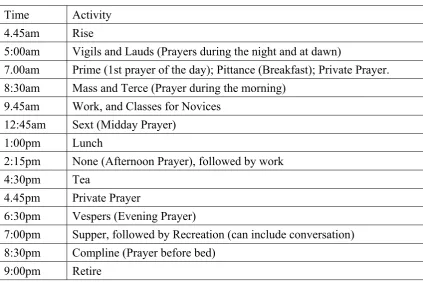
The monks’ day is centred around Mass and eight other choral services (often all in
Latin) starting as early as 4:00 in the morning and continuing at intervals throughout
[image:9.595.86.510.198.480.2]the day until about 8:30 at night; a typical monastic day is given in Table 2.
Table 2
Typical Monastic Timetable
Time Activity
4.45am Rise
5:00am Vigils and Lauds (Prayers during the night and at dawn)
7.00am Prime (1st prayer of the day); Pittance (Breakfast); Private Prayer. 8:30am Mass and Terce (Prayer during the morning)
9.45am Work, and Classes for Novices 12:45am Sext (Midday Prayer)
1:00pm Lunch
2:15pm None (Afternoon Prayer), followed by work
4:30pm Tea
4.45pm Private Prayer
6:30pm Vespers (Evening Prayer)
7:00pm Supper, followed by Recreation (can include conversation) 8:30pm Compline (Prayer before bed)
9:00pm Retire
All guests are invited to join in the religious celebrations throughout the day; often
they find that prayer in the monastic church is a very profound experience that seems
to gain greater significance at daybreak or during twilight and darkness. As one guest
commented:
“One of the things I will always remember from my visit is sitting on a church pew at 4:45 in the morning smelling sweet incense and watching the rising sun caress the stained glass windows and project jewelled colours through the smoke onto the church walls; I felt welcomed and relaxed”
Guests are neither forced nor obliged to attend the services. None of the monks
would even have noticed if they are there or not and guests were free to come and go
as they wished. Attending was considered useful because it removed guests from
actually attending guests tended to feel included and at ease and often happy during
the services, but liked knowing when it was going to end.
Within the refectory every male guest is allocated a place at table, normally with
name card placed on top of a napkin; before the meal is served there are short prayers
(often in Latin). The meals are typically simple and wholesome, giving the monks
enough calories to keep healthy so that they can continue in their daily work. The
majority of meals in the monastery are vegetarian but on feast days and Sundays, as a
celebration, meat is served. On major feast days the Monks take particular joy in the
high quality of food provided. The guest table is served immediately after the Abbot,
as required in the Rule. All the food is served on trays in serving dishes and the guest
merely helps themselves. The guest has to do nothing but eat during the meal; the
individual does not even have to wash up. Guests often perceived that normal
interaction time with the monks would be during the meals. However, despite sharing
the same space any interaction is removed by the silence. Some guests commented on
feelings of isolation and an obligation to keep their head down and eat quickly,
despite being surrounded by some 40 other people.
SOCIAL CONTROL
The life of the monastery is governed by the Rule of Benedict, adapted to the modern
age. Fifteen hundred years ago when the rule was written there were no public run
facilities for the sick or the homeless; now things are different. Various guest masters
noted that it is not uncommon for the local police to drop off people with social
problems such as drug addiction or homelessness. If they arrive at the monastery,
they are given soup and sandwiches and are invited to sleep in a lodging in the
grounds just a few minutes away from the monastic cloister and main guesthouse. It
is “simply not practical to the running of the monastery…we are not here to be saints;
we are monks, that is the path we have chosen.”
The Rule of St Benedict is clearly of the utmost importance to the running of the
monasteries, older and more solid than even the buildings. However, as with the
buildings, an element of change has been necessary to ensure the continuing survival
of the monastery and its way of life. During the Middle Ages the monasteries had
and the poor, and responsibilities for refugees. However monasteries no longer need
to look after the sick as there are state hospitals, nor should they be expected to look
after refugees or those with drug or alcohol problems, as other agencies exist for this
purpose.
Bells, not the Abbot, control everybody’s behaviour, as one monk wryly observed,
“we live in God’s house and the bell is the voice of God, it wakes us up in the
morning, calls us to prayer, meals and work and then tells us it is time to go to sleep at
the end of the day”. With the assistance of paid staff, the monks fulfil the different
jobs (cook, cellarer, guest master, gardener, bursar etc.) within the monastery for
periods of at least a year, and all the monks who are able serve each other at table on
weekly rota with the Abbot serving on Good Friday.
One guest master said “there are no ground rules here, do whatever you want, just
change the bed and clean the room when you leave.” This of course was not entirely
true. Although there were very few written rules within the monastery, guests on the
whole knew how to behave through interpretation of unwritten social rules. Guests
are not expected to help out with the daily duties although it is very much appreciated.
Roughly a quarter of the guests offer to help with daily chores but only a quarter of
that number again actually do any work.
SPACE
In the public areas of the monastery there were signs that clearly stated where visitors
were not allowed to go: parts of the church, access to buildings and gardens were
restricted. However different guests have different levels of access. Those who were
living in the monastic cloister had privileged access and it is often not clear to others
as to why they are going to particular areas and that they had keys (sometimes
electronic swipe cards with different levels of access) that allowed them to open doors
that were off limits to the day visitors. Limitations in access also meant that many
day visitors could pass through the monastery and not even see a monk.
Of course, it seems innate within human nature to be curious: the day visitors
wondered what happened in the cloister and the resident guests were intrigued as to
“I know I am just being nosey but just as I want to open all the old books in the library and try and read the Latin on the pages, I want to open all the doors and see inside too”
The guests and the monks have a shared environment, but limited shared space; they
pray together in separate parts of the church and dine together, in silence, at separate
tables in the refectory. Some guests commented that although they enjoyed joining
with the monks at meal times and at prayer, they would also like to have seen them at
their daily duties and jobs; they gained great solace and comfort from their
interactions with the monks. Another guest stated:
“I’ve been to many places travelling over the past 20 years… I’ve slept in the church of the Nativity at Christmas time but nowhere compares to these guys… there is nothing like this place they are so accommodating”.
PRODUCT
The monks make no charge for staying in the monastery, however common courtesy
should dictate that a donation would be appropriate. This is a difficult issue for some
of the guests, as the monks do not seem to care about what is left. Some monasteries
did have signs suggesting donations, always with the caveat that it was optional; deed
of covenant envelopes were always available to allow the tax to be claimed back.
Some of the guest masters seemed slightly put out by people using the monastery as a
one night stop off and treating the monk’s hospitality as bed and breakfast
accommodation; monasteries are also familiar with high profile figures using their
guesthouse in this manner.
On the whole guest masters did not keep detailed statistics of how many people had
stayed the total number of guest nights, as this information may have been interesting
but of no real relevance to them. That said the monasteries did operate at the
commercial level in other areas, for example: conference facilities; apiaries; brewing
and distilling; public commercial restaurants; stained glass window manufacturing;
printing and publishing; illumination and illustration; farming and agriculture; and
retail. The vast majority of these activities were run by a paid professional staff who
however very careful to make sure that these distinct and separate activities did not
encroach into the hospitality offered to their guests.
During the research it became clear that the monastery is extremely complex. There
were different layers of the commercial home within the monastery and differing
levels of hospitality provision. Areas of investigation included the use and division of
space for the monks and their guests, levels of accommodation including and
hospitality rules and rituals. Within the monastery the hospitality that is offered to the
guest’s physical and metaphysical needs is not a simple concept. It exists and is
offered on many levels and it is up to the guest how much they wish to engage with
the hospitality on offer.
C
ONCLUSIONSFrom the results of this investigation, the dominant themes of modern monastic
hospitality are summarised in Table 3, which is structured around the commercial
home conceptual framework created by Lynch (2005c).
Table 3
The commercial home framework applied to monastic hospitality
Theme Summary of Monastic Hospitality
Setting The hospitality relationship that the monks have with their resident (male) guests within the monastery is most synonymous with the commercial home. However other guests can include day visitors, couples and families.
Artefacts Furnished in a basic but functional manner, small number of books in the room – but open access to the library.
Discourse The discourse is primarily framed with religious and hospitality language focused on the domestic hospitality sphere, commercialism is of secondary importance.
Politics of Identity
The monks provide for both the spiritual and temporal needs of the guests. Hosting take places at various levels with different people (the Abbot, the guest master or other guests) taking the role of host depending on the circumstances. The apparent sincerity and strength of purpose of the monks is manifest and often has a profound effect on the guests.
daily life within the monastery and through the presence of the guest master who subtly marshals the guests. Interaction and full welcome in the daily life of the monastery is as much dependant on the guest seeking it as on it being offered by the monks.
Social Control Monastic hospitality is governed by the 6th Century Rule of St Benedict, adapted for the modern age. In some ways a highly regulated environment including control by the bell and significant spatial control practices influence the guests.
Space Boundaries, delimited by St Benedict 1500 years ago, are necessary for the smooth running of the monastery.
[image:14.595.85.513.69.306.2]Product The monastery as well as being the House of God, is also the monks’ home. Guests are welcome to visit or stay but not to interfere with it. Commercial activities exist within the monasteries, but the prime purpose of monastic hospitality is not commercial, hospitality is offered as part of the monastic vocation.
Table 3 draws out the key features of commercial home hospitality offered within a
monastery. The prima-facie purpose of a monastery is not to offer hospitality, it is to
house the monks in a community environment so that they can dedicate their lives and
live their vocation to the service of God. The separation if the monks from their
guests (and by definition the separation of the monks from the world in general) is not
an act of inhospitableness, rather it is mandated by the Rule and necessary for the
monastery to function. Therefore, the ritual reception of guests and the provision of
hospitality play an important role by being both the bridge and the barrier between the
monastic and secular worlds.
All the monasteries, to a greater or lesser extent, engage in commercial behaviour that
generates income for the monks. However the provision for guests to stay in the
monastic cloister is motivated by their monastic vocation. It seems then, that
monasteries do not fall easily within the category of traditional commercial homes,
not least because the essence of a monastery has very little do with the generation of
income. That does not mean that monastery need to be excluded from commercial
home literature, rather the paradigm needs to be extended and the definition
broadened to include one of the oldest and continuous forms of commercial home
hospitality, that has existed for more than 1500 years.
This chapter has added to the existing literature on religious tourism and in particular
as a bridge across the world of a religious community and the outside secular world. It
has contributed towards an initial understanding of the nature of one type of religious
accommodation where guests usually make a financial contribution towards their stay.
Whilst there are similarities between a traditional commercial home and the monastic
guesthouse, attention has been drawn to distinctive differences arising from both the
communal nature of the institutional home and the philosophical purpose and praxis.
It is suggested that further research of this fascinating but complex form of hospitality
REFERENCES
Andrade Cernadas, J.M. (1991) El Monasterio de Samos y La Hospitalidad Benedictina con el Peregrino. Studia Monastica, 33(2):247-257
Böckmann, A. (1988) Xeniteia-Philoxenia als Hilfe zur Interpretation von Regula Benedicti 53 im Zusammenhang mit Kapitel 58 und 66. Regulae Benedicti
Studia. 14/15:131-144.
Borias, A. (1974) Hospitalité Augustinienne et Bénédictine. Revue de Histoire de
Spiritualité. 50:3-16.
Bruder, K. (1998) A Pragmatics for Human Relationship with the Divine: An Examination of the Monastic Blessing Sequence, Journal of Pragmatics, 29, 463-491.
Chaumartin, H. (1946) Le Mal des Drdents et le Feu Saint-Antoine. Les Presses de I’Imprimerie Ternet-Martin, Vienne la Romaine.
Cohen, E. (1992) Pilgrimage Centers: Concentric and Excentric, Annals of Tourism
Research, 19, 1, 33-50. In Gatrell and Collins-Kreiner...
Dimock J.F. (ed) (1876) Giraldi Cambrensis Opera. Longman, Green, Longman, and Roberts, London.
Eade, J. and Sallnow, J. (Eds.) (1991) Contesting the Sacred: The Anthropology of
Christian Pilgrimages, Routledge, London. In Murray and Graham …
Gatrell, J. and Collins-Kreiner, N. (2006) Negotiated Space: Tourists, Pilgrims and the Baha’I Terraced Gardens in Haifa, Geoforum, 37, 5, 765-778.
Horn, W. and Born, E. (1979) Plan of St Gall: A study of the architecture & economy
of, & life in a paradigmatic Carolingian monastery. University of California
Press, Berkeley.
Holzherr, G. (1982) Die Behediktsregel: Eine Anleitung Zu Christlichem Leben. Benziger, Verlag.
Kaplan, S. (1995) Meditation, restoration and the management of mental fatigue,
Environment and Behavior, 15, 169-182.
Lenoir, A. (1856) Architecture Monastique. Impr. Nationale, Paris.
Lynch, P.A. (2005a) Reflections On The Home Setting In Hospitality, Journal of
Hospitality and Tourism Management, Vol. 12, No. 1, pp. 37-49.
Lynch, P.A. (2005b) The Commercial Home Enterprise and Host: A United Kingdom Perspective, International Journal of Hospitality Management, Vol. 24, No. 4, pp. 533-553.
Lynch, P.A. (2005c) Sociological Impressionism In A Hospitality Context, Annals of
Tourism Research, Vol. 32, No. 3, pp. 527-548.
Miles, M.B., and Huberman, A.M. (1994) Qualitative Data Analysis: An expanded
sourcebook. Sage, London.
Murray, M. and Graham, B. (1997) Exploring the Dialectics of Route-Based Tourism:
The Camino de Santiago, Tourism Management, 18, 8, 513-524.
Nolan, M. and Nolan, S. (1989) Christian Pilgrimage in Modern Western Europe, London NC: The University of North Carolina Press. In Rinschede….
Ouellette, P., Kaplan, R. and Kaplan, S. (2005) The Monastery as a Restorative Environment, Journal of Environmental Psychology, 25, 2, 175-188.
Regnault, L. (1990) La Vie Quotidienne de Pères du Désert en Egypte au IVe Siècle. Hachette, Paris.
Rinschede, G. (1992) Forms of Religious Tourism, Annals of Tourism Research, 19, 51-67.
Shackley, M. (2001) Managing Sacred Sites, Thomson, London.
Shackley, M. (2004) Accommodating the Spiritual Tourist: The Case of Religious Retreat Houses.In Thomas, R. (Ed.) Small Firms in Tourism: International