City, University of London Institutional Repository
Citation
:
Mitchell, John A. (1988). The derivation of a computer system to aid the internal audit planning process in large internal audit departments. (Unpublished Doctoral thesis, City University)This is the accepted version of the paper.
This version of the publication may differ from the final published
version.
Permanent repository link:
http://openaccess.city.ac.uk/18972/Link to published version
:
Copyright and reuse:
City Research Online aims to make research
outputs of City, University of London available to a wider audience.
Copyright and Moral Rights remain with the author(s) and/or copyright
holders. URLs from City Research Online may be freely distributed and
linked to.
THE DERIVATION OF A COMPUTER SYSTEM TO AID THE INTERNAL AUDIT PLANNING PROCESS
IN LARGE INTERNAL AUDIT DEPARTMENTS
John A. Hitchell
A thesis submission for the award of the degree of Doctor of Philosophy at City University
City university Business School
IMAGING SERVICES NORTH
Boston Spa, Wetherby
West Yorkshire, LS23 7BQ
www.bl.uk
THESIS CONTAINS
VIDEO
CD
DVD
CHAPTER
1
2
3
THE DERIVATION OF A COMPUTER SYSTEM TO AID THE INTERNAL AUDIT PLANNING PROCESS
IN LARGE INTERNAL AUDIT DEPARTMENTS
CONTENTS
TITLE
ACKNOWLEDGEMENTS
COPYRIGHT DECLARATION ABSTRACT
SUMMARY
CHAPTER SYNOPSIS
INTRODUCTION
The Problem Area
Purpose of the Research
Details of the Organisations Research Methodology
Limitations of the Research
LITERATURE SURVEY
Introduction Background
The Need to Plan Planning Horizons Department Size
The Planning Process Risk Analysis
Risk Indices
setting Priorities
Risk/Resource Relationship Risk v Cost
Conclusions
ISSUES RAISED BY THE PUBLISHED MATERIAL
Introduction
Risk/Resource Relationship Audit Complexity
Travel Time
other Fixed Elements
The Role of Historic Data How Important is the Formula?
LoW Risk & Audit Frequency Budgets & the Type of Audit Relative v Absolute Risk
Different Formulae for Different Areas The Problem of Linearity
Determining Frequency
CHAPTER 4 5 6 7 TITLE
MODELLING THE PLANNING PROCESS The Role of Computer Modelling The Problems of Computer Modelling The Advantages of Computer Modelling previous Work in this Area
Outcome of the Evaluation Size of the Problem
Hypotheses
The Planning Task Conclusions
THE EXPERIMENT
The Experimental Hardware The Experimental Software What is an Audit?
What is a Location? What is a System?
What is Full coverage? Measuring Success
Outline System Description System Modules
THE MAJOR DATA REQUIREMENTS The Data Files
Formula Elements Creating the Formula Determining Weights Value Base Points Annual Parameters System Parameters Conclusions
MANIPULATING THE DATA Introduction
Importance Score Calculation Frequency Calculation
Audit Budget Calculation Changing the Formula
Resource Availability Problems Re-Calculation
CHAPTER
8
9
10
TITLE PAGE
MANAGEMENT INFORMATION
Introduction 117
Planning Parameters 117
Audit Portfolio Ranked by Importance 117
Annual Plan Based on Frequency Only 118
Annual Plan Based on Frequency & Resource 119 Annual Plan Based on FreqjImp & Resource 120
Business Area Descriptions 121
Business Area Budget Totals 121
suggested Frequency Based on Score 121
strategic Audit Plan 122
Audit Project Portfolio 123
Nominal & System Budget comparison 124
'Must Do' Projects 124
control Objectives 124
Audit Locations 124
Incomplete Coverage 124
Planning Horizons 125
Conclusions 125
PREVIOUSLY UNPUBLISHED AREAS
Introduction 126
New Areas 127
Data Collection 127
Data Collection Problems 128
Data Validation 130
User Friendliness 130
Spreadsheet Limitations 131
stratification of Scores 133
Bunching of Jobs 134
Cyclical & Once Only Jobs 135
Low Scoring Jobs 136
Estimating the Planning Cycle 137
The Importance of Definitions 138
Monitoring System Interface 138
Subject v Control Objective Approach 139
Main Findings of the Research 140
FUTURE WORK
Introduction 142
Expert Systems 142
Audit Monitoring Systems 143
Audit Complexity 143
Different Formulae for Different Areas 144
CHAPTER TABLE 3.3.1 3.4.1 4.2.4 5.10.1 6.13.2 6.23.1 6.24.1 6.25.1 6.28.1 6.29.1 8.1.1 FIGURE 3.6.2 5.9.1 6.2.1 6.3.1 6.4.1 6.5.1 6.5.2 6.11. 1 6.11. 2 8.16.1 8.16.2 8.16.3 TITLE REFERENCES APPENDICES
1. System Flowcharts
2. Output from the Experimental System
3. System Operating Instructions
4. Disk Containing the Experimental
System and Data
LIST OF TABLES
TITLE
Affect of complexity on Resource Allocation
Affect of Travel Time on Resource Number of Calculations Required for Various Formulae
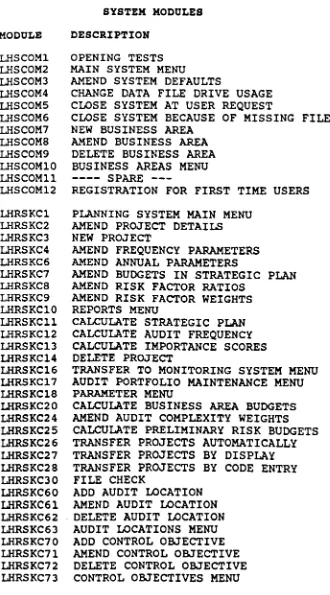
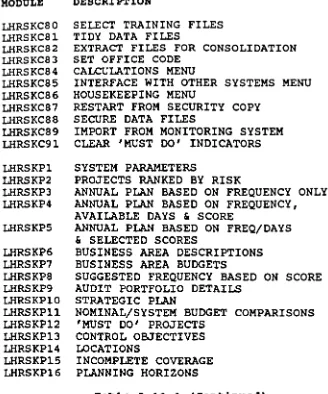
System Modules
Determining Value Weights
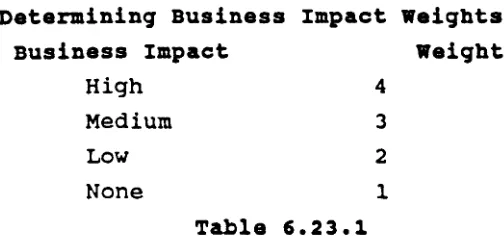
Determining Business Impact Weights Determining Temptation Weights
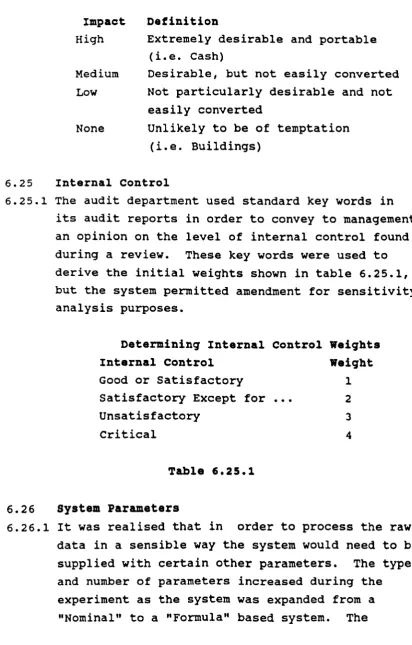
Determining Internal Control Weights Determining Audit Complexity Weights Determining Frequency Criteria
Standard Reports from the system
LIST OP PIGURES
TITLE
Planning & Monitoring Link Outline system Construction Audit Locations File structure Control Objectives File structure Business Areas File structure Audit Portfolio File structure
Data Collection Document
Score Distribution Using Final Formula Importance Score Formula
Resource Requirement by Year Resource Requirement by Division
Resource Requirement by Business Area
ACKNOWLEDGEMENTS
I would like to thank the following people for their help and support during this research:
My wife, Marion, who encouraged me through the long dark evenings and then took on the arduous task of typing the manuscript;
Prof. Andrew Chambers, Dean City University Business
School, who supervised the main bulk of the project and offered invaluable advice and guidance;
David Bird, Controller of Audit & Investigations,
British Gas Plc, who initially supported and sponsored my application to undertake the project;
Allan Legg, Auditor General, World Bank, who enabled me to continue my research in the most practical way, by requiring an operational system for his Internal Audit Division during his time as Group Chief Internal Auditor at British Telecom;
COPYRIGHT DECLARATION
I grant powers of discretion to the University Librarian to allow this thesis to be copied in whole, or in
ABSTRACT
This monograph describes an applied research project to
develop a computer system to aid the planning process
in large internal audit departments. The ultimate
outcome was a sophisticated computerised planning system
based around a formula, but with the important
additions being able to plan at both audit subject and control objective levels and take into account previous
audit coverage. The system is capable of producing a
plan for up to five years ahead for well over 1.5
million audits involving over 1000 audit staff. The
only real limitations to the system are the amount of disk storage available for the data files and the
speed of the central processing unit. The system as
derived will run on any industry standard micro computer and consists of over 80 separate modules comprising some
9,000 lines of code. The modules are linked to each
other by a menu and the user is given information at
each stage of the operation. The system is both fault
tolerant and user friendly.
The main findings from the research are: it is possible to build a computer system to aid the internal audit planning process: spread sheets do not provide the level of sophistication, or the level of user friendliness
required: risk analysis, as applied to internal
audit planning, is a misnomer and it would be more appropriate to call the output from the process an "importance score", rather than a risk index: the use of a formula to indicate the relative importance of a particular area to the auditor is practical, but it does not necessarily provide an absolute rating to that area: if more than one formula is used to deal with different aspects of the business, then there is a
danger that the auditor will be unable to rank items from one area against those of another area with any
certainty of relative, or absolute merit: the formula is not the most important part of a planning system: the collection of the data to be manipulated by the formula is one of the most important aspects of the planning
process, as it ensures that the auditor has a good
understanding of the organisation which he is responsible
for: the best time to collect the data required by the
planning system is during an actual audit, which implies a link between the historic monitoring process and the future planning process: there is no correlation
between the importance of an area, as rated by its
importance score, and the resource required to audit it; there is a relationship between the complexity of the area to be audited and the resource that is required to
do the work, but the relationship is not necessarily
linear: an "override" facility is required to ensure that items with a low importance score can be forced
SUMMARY
Introduction
This thesis describes an applied research project to develop a computer system to aid the planning process
in large internal audit departments. For the
purposes of the research a "large" internal audit
department was defined as those departments with in
excess of 150 staff; although it was expected that
smaller departments would benefit from the work. Very
few internal audit departments have this level of
staffing in a single department, although a few exceed
that total when a number of smaller, but discrete units
are aggregated together. External audit firms are much larger, but their size is spread
number of clients and i t is unusual for a
across a large
firm to
allocate more than 50 auditors to a single client. The
type of work also differs between the two audit
functions; whereas external audit is required by
statute, the existence of an internal audit department is
usually at the discretion of the firm's top
management (U.K. Local Authorities excepted) and
likewise i t can be deemed to be an unnecessary overhead unless i t provides an adequate level of performance.
The level of performance will be specified by the firm's
management and i t is usual for the head of internal audit
to submit at least an annual plan for approval by
the board, or chief executive, and to account for the
work done against that plan. This accountability may
be fairly easy to discharge if only a few staff are
involved, but i t becomes increasingly difficult as the
number of auditors increase and the Chief Internal
Auditor becomes remote from the day-to-day work. This
remoteness is increased if the audit department is
geographically dispersed and dealing with several
Background to the Research
The researcher held a senior job in a large internal audit department which required the submission of an annual plan of coverage to the Board Audit Committee, with reasons being given as to why some areas were
being audited at the expense of others and why some
units were being reviewed more, or less frequently,
than other apparently like units. During the course
of this research the author moved to another large
company, but the need for an annual plan to be approved
still remained. In both companies the cost of internal
audit was in excess of 5 million per annum and as
staffing levels were constantly under downward review
it was essential that the chief internal auditor was in
a position to justify both his plan and his department's
staffing level.
Over the last fifteen, or so, years a modest number of
books and papers have been published dealing with
the subject of so called risk analysis for internal
audit planning purposes and it was considered that
this methodology could form a useful planning aid.
Because of the large number of potential auditable
units and the large number of staff in the author's
department, i t was realised that some form of
mechanisation would be required to handle the vast
number of calculations that were likely to be involved.
A decision was therefore taken to attempt to develop a
computerised planning mechanism which would take into
account the potential audit universe and the available
staff resource.
Other Work in this Area
A literature search revealed that the majority of work
done in the area related to the derivation of
jobs based on the calculation of a "risk number" by the application of a formula. Little work had been done on determining the frequency of review, the allocation of resources, or the projection of a plan. Some of the proposed formulae were so complex that it was obvious that the sheer amount of data to be
collected in the first instance would make them
impractical in a large organisation and more
importantly, the number of calculations required made
them of little more than academic interest. Only two
examples of working computerised strategic planning
systems were found and, for reasons discussed later
were rejected as inappropriate for the two
organisations known to the author. It was therefore
decided to develop a tailored system working from first
principles.
outcome of the Research
The final outcome of the research was a sophisticated
computerised planning system based around "importance
scores", but with the important additions of taking
into consideration the area of control objectives and
previous audit coverage. The system is capable of
producing a plan for up to five years ahead for well over
1.5 million audits involving over 1000 audit staff.
The only real limitations to the system are the amount
of disk storage available for the data files and the
speed of the central processing unit. As both capacity
and speed are continually improving it is unlikely that
these factors are likely to be practical limitation for
even the largest internal audit department. The
system as derived will run on any industry standard
micro computer with either a colour or monochrome screen
and either high density floppy or hard disks. A
printer, although desirable, is not absolutely
The minimum configuration is a machine with 512K of memory and two high density floppy drives. In 1988
this equates to an outlay of only 500 for the hardware.
Software is in the form of programs written in the dBase III language and the software requirement is therefore
a copy of that system, which costs in the region of
400. The system consists of over 80 separate modules
comprising some 9,000 lines of code. The modules are
linked to each other by a menu driven system and the
user is given information at each stage of the
operation. The system is both fault tolerant and user
friendly.
Main Findings of the Research
The main findings from the research were:
a) Risk analysis, as applied to internal audit
planning, is a misnomer. It would be more appropriate to describe the process as an
analytical review across all potential jobs and
to call the output from the process an
"importance score", rather than a risk
index:
b) The use of a formula to indicate the relative
importance of a particular area to the auditor
is practical:
c) If more than one formula is used to deal
with different aspects of the business,
then there is a danger that the auditor
will be unable to rank items from one area
against those of another area with any
d) The formula is not the most important part
of a planning system;
e) The collection of the data to be manipulated by the formula is one of the most important aspects of the planning process, as i t
ensures that the auditor has a good
understanding of the organisation he is
responsible for;
f) The best time to collect the data required by
the planning system is during an actual
audit. This implies a link between the
historic monitoring process and the future planning process.
g) There is no correlation between the importance
of an area, as rated by its importance score,
and the resource required to audit it;
h) There is a relationship between the complexity
of the area to be audited and the resource
that is required to do the work, but the
relationship is not necessarily linear;
i) An "override" facility is required to ensure
that items with a low importance score can
be forced into the scheduling mechanism;
j) It is possible to build a computer system to aid the internal audit planning process;
k) The
some
system
of the
applies in a practical manner
theoretical work relating to so
Conclusion
This research has shown that a computerised planning system to help internal audit management is not only feasible, but provides a valuable tool for
justifying the work of the department. A spin off from the research was to show that the actual formula used is of less importance than the overall planning methodology. One of the most important aspects of the planning exercise was the actual data collection exercise as this increased the audit department's knowledge of the organisation and thus drew attention to anomalies in what were considered to be well understood factors and relationships. The relationship between historic data and future plans became better understood and the need for accurate record keeping became apparent when attempting to determine what audit resources would be required for a particular job in the future. The relationship between risk and resource allocation, which has been suggested in a number of papers, was found to be entirely spurious. Certain areas for future
CHAPTER SYNOPSIS
CHAPTER 1
Introduces the topic and discusses the philosophy
surrounding internal audit planning. Compares the ideal
planning process against the constraints imposed by
reality. Describes the research area and its
limitations. Concludes that although planning must be
based on a sound theoretical basis, it must also be pragmatic.
CHAPTER 2
Examines the available literature and establishes that although the authors are agreed on the need for internal audit to plan its activities, they disagree on the
methodology to be adopted. Despite this, the common
theme of using a formula based approach receives
overwhelming support. Concludes that a number of
additional questions need to be answered before a viable system can be designed.
CHAPTER 3
Discusses the additional areas identified during the
literature survey. The relationship between riSk,
resource and audit complexity is examined, together with the need to treat travel time as a separate entity.
Examines the relationship between risk and audit
frequency. Identifies the need to plan at both the
CHAPTER "
Discusses the advantages and the problems associated with
computer modelling. Evaluates previous work in this area
and concludes that a specially tailored system is
required. Details the scale of the problem and
hypothesises on ways of solving it. Describes the elements of the planning task.
CHAPTER 5
Describes the elimination process to select the
experimental hardware and software. Discusses the need
to have clear definitions of various aspects of the
planning process. sets some criteria for measuring
success and outlines the experimental system.
CHAPTER 6
Describes the data files created in order to cater for the points raised in the previous chapter and the
derivation of the formula used to calculate the
importance scores. Discusses how the various system
parameters were arrived at and details the rationale behind the selection of weights.
CHAPTER 7
Shows how the data was manipulated to produce importance scores, suggest frequencies of review and indicate
appropriate audit budgets. Discusses the problems
associated with resource availability and the need to interface with a monitoring system.
CHAPTER 8
Describes the output from the system and the generation
of the strategic and annual plans. Discusses how many
CHAPTER 9
Raises areas which have not been dealt with previously by
other authors. The problems associated with data
collection and validation are described. The limitations
of spreadsheets for planning purposes are examined. The
stratification of importance scores, dealing with non-cyclical and low scoring jobs and a method of estimating a suitable planning horizon are discussed. The need for clear definitions of various items and the requirement to interface with other systems are raised. The requirement for a planning system to be able to operate at both subject and control objective level is discussed and the main findings are summarised.
CHAPTER 10
Outlines areas for future work in the planning sphere; specifically the use of expert systems for generating the
formula, the design of monitoring systems. The problems
CHAPTER 1 INTRODUCTION
1.1 The Problem Area
1.1.1 In most organisations Internal Audit, where i t
exists, is an independent appraisal function for
the review of operations as a service to all
levels of management. It is a managerial control
which functions by measuring and evaluating
the effectiveness of internal control. Internal
control is usually defined as comprising the
whole system of controls and methods, both
financial and otherwise, which are established
by management to safeguard an organisation's
assets, ensure reliability of records, promote
operational efficiency and encourage adherence
to management policies and directions.
1.1.2 Internal Audit is a service function and is
therefore, an overhead to the organisation. In
fact, Internal Audit may be regarded as a double
overhead, as i t reviews other service functions
as part of its overall activities. As such,
it should have a clear methodology for allocating
its resources to the most important areas of
the business. This requirement arises because
of the virtually infinite variety of work
available to Internal Audit in contrast to
its limited resources and the need for i t to be
cost effective in the use of those scarce
resources.
t.l.3 If an Internal Audit Manager were able to select
his projects and allocate his resources entirely
free of other direction, he would, in theory,
perceives as business. He and potential
being of most importance to the
would then allocate his available resources on the basis of this perceived importance. The allocation would be conducted on a totally logical and objective basis, which would be based on set criteria,
or formulae, which could be applied consistently
to all the different areas of the
business.
1.1.4 In reality the Internal Audit Manager is
unlikely to have a totally free hand in
selecting the areas to be reviewed by his
department. He may be required by either
political, legal, moral, social or internal
reasons to examine areas which he would
otherwise consider to be insignificant. Only then
will he be free to allocate the remainder of his
resources to those areas which
as being of importance. This
will itself probably be made on a
he perceives
allocation
combination
of objective
will depend
and subjective criteria, which
on the Manager's knowledge, or lack
of knowledge, of each area and his personal
idiosyncrasies. The Manager will probably find
i t difficult to explain to a non-auditor why
he has chosen a particular area for review,
why he has allocated a certain amount of
resource, or indeed why he considers the need to
do some of the directed projects as a waste of
valuable resource.
1.1.5 Internal Audit planning therefore requires the
balancing of the work to be done against the
available resources. Effective and efficient audit is only likely to be achieved if operations
highlights priorities and the allocation of
resources. until recently, the establishment of priorities and the allocation of resources has
largely been a matter of intuition, judgement and local knowledge but, as with all exercises involving judgement, important factors may be
overlooked. Consequently, some Internal Audit
Departments have devised so called risk indices
which help to establish priorities on a more
formal basis.
1.1.6 These indices involve an analysis of particular
factors by formulating a set of values to
replace what has previously been determined by
intuitive judgements. Although the creation of
such indices goes some way towards justifying why
an Internal Audit Department examines some areas
at the expense of others, they seldom go beyond
the step of allocating priorities. A
comprehensive and effective planning aid should
be capable of far more than the simple allocation
of priorities. It should at least be capable of
suggesting tactical resource planning for a
single audit and ideally it should be capable of
helping with the annual and strategic planning
process. Just as importantly, i t should clearly
indicate those areas which will not be
covered: either because they are considered to
be of low importance, or because the resources
are not available.
1.1.7 These additional areas have received little
attention, due in part to the vast amount of
data collection and manipulation that is
likely to be involved and also because of the
overall complexity of the processing mechanism.
from the simple prioritisation process into the actual strategic planning and resource
allocation areas. These are the steps involved after the creation of any formula, which
although an important topic in its own right, has been dealt with elsewhere by other
researchers.
1.2 Purpose of the Research
1.2.1 The main purpose of this research was to
ascertain whether a computer system could be derived which would help in the planning
process in large Internal Audit departments. The bias towards large departments does not mean that planning is irrelevant to small
departments, but it was anticipated that if a system could be devised which would cover the former i t would, by default, be capable of
dealing with the latter. The author was also in a position to test the system in practice, due to his position in two very large departments during the course of the research. The two organisations concerned are described later, but it was anticipated that the 'portability' of the system between the organisations would be a measure of the basic applicability of the research findings to all Internal Audit departments.
1.3 Details of the organisations
1.3.1 The two organisations used for the basis of the research were very large public utilities in the energy and communications industries.
1.3.2 The first was a large British energy supplier with a 1986 turnover of some £7.3 billion, a
work force of 90,000 and an internal audit
department of 230 staff. It was organised
into 12 semi-autonomous regions, with each
region having its own internal audit
department. Control of Internal Audit for the
company was the responsibility of the Controller of Audit and Investigations and although he did not exercise direct control over
the 12 regional audit departments he had
considerable influence in the appointment process.
1.3.3 This organisation was used in the early stages of the research as its planning methodology was well advanced, although conducted manually. Due to its consistent structure however, it did not provide the scope of audit activity that was likely to be encountered in an organisation with diverse
subsidiary companies. The bulk of the work was therefore undertaken at another large company.
1.3.4 The second company was an
carrier which had a 1986
billion, a pre-tax profit
international telephony
turnover of some £8.4
historic cost profit of £1.2 billion, a workforce of 230,000 and an internal audit department of 190 staff. The
company was organised into 30 geographic
districts within the U.K and there were also a considerable number of subsidiary companies, many
of which were overseas. Internal audit was
however, centrally organised, although 6
geographic zonal offices were in existence for
ease of work. The Chief Internal Auditor had
direct line control over all the Internal Audit staff. The existence of the subsidiary companies provided scope for testing the system against a
existence of such differing aspects within the same company required a comprehensive planning system as a matter of priority if the Chief
Internal Auditor was to use his limited resources
to their maximum effect. Details of the scope of
operations is provided in a later chapter.
1.3.5 The size of the Internal Audit departments for
both these organisations was far in excess of
the average for similar organisations in the
U.K. The actual cost of running them was in
excess of £5 million in each case and the need
to provide an effective and efficient service
to management was essential. In the case of the
second organisation the Internal Audit department
was the largest single department within the Corporate Finance function.
1.3.6 Both departments were under constant evaluation
as regard to their performance, staffing levels and selection of audits. Some
departments considered that they were being
over-audited, while others made constant demands
on Internal Audit to examine areas which Audit
Management considered to be of little
importance. Neither department had an objective
and consistent methodology for arguing its case
and i t was realised that this was a weakness
which needed to be addressed. The use of risk
analysis techniques was perceived to be a
step in the rectification process, but
manual attempts at calculation foundered due
to the vast number of calculations that needed to
be done and redone, if the methodology was to used
computer was considered to be the only way in which the methodology could be used in a
practical manner.
1.4 Research Methodology
1.4.1 The research was to investigate the possibility of devising a computer system
Internal Audit planning process
departments. The research would
to aid the in large audit
specifically
concentrate on those aspects which determine what
audits should be done, when they should be
done and what manpower resource should be used.
1.4.2 The research was conducted along the following
avenues:
a) a literature search to reveal what work, if
any, had
Internal
already been done in the area of
Audit planning using computers;
b) an examination of the link, if any, between
risk, strategic planning, the allocation of
resources and project monitoring;
c) the evaluation of any systems already in
existence:
d) the specification/development of a computer
system to provide a planning tool for Internal
Audit managers.
1.5 Limitations of the aesearch
1.5.1 The research did not deal with the lower levels
of planning within the audit process. It did
how much to testing and evaluation, report writing, etc. The research stops at the
higher level of determining when a particular audit should be done and how many man-days should be allocated to it. The derived system does not remove from the manager the responsibility for planning, it simply attempts to make the
process more consistent and less time consuming than before.
1.5.2 The research also specifically excluded the
use made of computers during an audit investigation for (say) word processing,
2.1 Introduction
CHAPTER 2 LITERATURE SURVEY
2.1.1 The literature survey was conducted along a number
of avenues. First, a computerised search using
the key words of "audit/auditing", "risk",
"analysis", "plan/planning", in any combination of two or more, was conducted using the British
Library Automated Information Service (B1aise) and
the ABI Inform databases. These searches
identified 289 items containing the oppropriate key words, but subsequent study revealed that only 9 had any relevance to this research, although additional references contained within them subsequently bought the total to 17.
2.1.2 Next, the Xerox University Comprehensive
Dissertation Index (30) was searched for relevant
Doctorial work in the area, but none was found. A
similar search of the As1ib Index to Theses (31) was also negative, but a manual search of the Anbar Abstracting Journals relating to
accountancy, management and data processing did provide some useful contributions.
2.1.3 The most fruitful source by far however, was the American Instiute of certified Public Accountants
Index. This is a printed index which is published
annually and contains references to articles,
books and conference papers, published anywhere in the world, which are related to accountancy, or
finance. It is arranged in alphabetic sequence
and the sections headed "audit" and "internal audit" provided the majority of the base
manually searched back to 1972 (No useful
references were found for the period prior to 1971
and the majority were during the period 1981
-1986).
2.1.4 The interesting thing from this author's point of view was that the manual retrieval of references was far more fruitful than its electronic
counterpart. The reason for this is believed to
be that with electronic retrieval the researcher is totally in the hands of the original indexer and if the indexer has used different key words to those anticipated by the researcher, then the
search will totally miss the item. With the manual search however, the researcher can use his
intelligence to establish whether a particular item is likely to be relevant based on more
information than just the key words used during an electronic search.
2.1.5 The remainder of this chapter provides an analysis of the reference material identified by the above
searches and its relevance to this research. Some
limitations noted in the existing literature are dealt with in more depth in chapter 3.
2.2 Backqround
2.2.1 Whereas all publicly quoted companies and U.K.
local authorities must, by statute, have their
books of account audited by professional
accountants, the existence of an Internal
Audit group is solely at the discretion of
top management. Although the role of Internal
Audit will vary from company to company, it is usually defined as an "independent appraisal
used by a number of professional bodies, such as the Chartered Institute of Public Financial Accountants (CIPFA), the Institute of
Internal Auditors (IIA) and the the Chartered Association of Certified Accountants (CACA).
2.2.2 As a service function Internal Audit must
respond to the requirements of management, but certain rights of independence are often
granted in the form of a charter, which allows Internal Audit unusual rights of access to the internal records of the company and a fairly free hand in the areas it chooses to examine. Even so, it is not unusual for top management to query why some things are being done and
others are not, and in many cases the department is expected to produce an overall plan of activity for ratification by top management.
2.3 The Need to Plan
2.3.1 In many large firms a Board Audit Committee oversees the work of Internal Audit and
often expects justification for the deployment of resources. In some instances the
justification will be easy, in that the area to be audited is accepted as being crucial to the business. In other cases however, there may well be a conflict of views and the
Internal Audit department will then need to
justify its case. Such justification may
one area, rather than to another. Unless the manager is able to show that his plan is
logically devised, he will be unable to defend i t on a sensible basis and the whole requirement for Internal Audit may well be called into question.
2.3.2 This argument for a soundly based planning
process deals only with a single planning period. If however, Internal Audit is to be
of true service to management, i t should also
take a long-term view so that i t can warn
management if there are likely to be areas in
the future which should be examined, but which
may have to be neglected due to lack of resources.
The longer term strategic planning also has an
impact on the plan for the current period, in
that if it is not attempted then the annual plan
will always be a poor compromise, based on
inadequate information, fire fighting and the
idiosyncratic behaviour of the various people
involved.
2.3.3 Thus the Internal Audit department should be attempting to predict long-term as well as
short-term requirements for its services and
also where i t should best use its limited
resources to gain maximum benefit to the
organisation. How i t goes about this process
should be both logical and consistent and
capable of explanation to a third-party. This
view is supported by a number of professional
2.3.4 CIPFA's Audit Management Statement, section 3, Planning and Control (6) states that "audit planning involves the balancing the work to be done against the resources available: effective and efficient audit is more likely to be achieved if operations are planned in advance with the intentions being recorded. This planning
involves consideration of all possible areas of audit operation and evaluation of changes which have either taken place or are expected to
take place changes in both priorities and
objectives. The need to determine audit
priorities arises because of the infinite variety of work available
contrast to the limited audit
for audit in staff. The problem is, in fact, one of classical economics -that of matching limited resources with
unlimited demands. Audit is operating within a dynamic environment in which systems,
procedures, ideas and personnel are constantly changing and the audit function must therefore be capable of responding to these changes. An
audit plan provides the framework within which this flexibility can be achieved; the fact that actual performance varies because of predictable circumstances does not invalidate planning but emphasises the need to allow for contingencies within the plan."
2.3.5 That planning of the nature described above is not done on a widespread basis is described in a number of articles. Bell (1) commenting on the Chief 'Inspector of Audit's investigation into the state of internal audit in the public
finds that a survey by the Comptroller and
Auditor General had similar misgivings in the area of long term planning and concluded that "whilst internal audit is good at short term planning there are deficiencies in longer term planning . . . which could well mean that abortive work
is being undertaken and there are likely to be
gaps in coverage." Bell suggests a course
of future action to remedy the deficiencies
highlighted by the two investigations; "the agreed
plan of action ••••• should ask ••••• whether
internal control priorities have been assessed
and alternatives presented to management, and
whether all main systems of control are
reviewed at least annually by internal audit or by
the external auditor. It is up to management to
provide the resources and if i t does not, then
the auditor cannot be criticised for not providing the cover".
2.3.6 He goes further to ask "whether audit plans have
been prepared covering the short, medium and
long term plans and whether management is
aware of the plans and any limitations on the
work that can be done. This is the time when
management can be educated to its
responsibilities and the need to provide the
resources necessary to achieve the results it
requires. This is probably the chief internal
auditor's most important task".
2.3.7 He summaries his article with " ••••• the main
priority of a chief internal auditor is to
understand the requirements of his organisation,
determine what resources he can obtain, organise
2.4 2.4.1
agree a plan with management based on a
compromise between what management wants and what resources management is prepared to provide".
Planninq Horizons
In 1985 the IIA (U.K.) conducted a survey (28)
into internal auditing
The survey indicated that
in the U.K. and Eire.
63% of the companies who responded had an internal audit function and
that 72% of those who did so had had one for over
10 years, thus indicating a fair degree of
maturity of internal audit in those
organisations. Some 90% of the departments
planned beyond the current year, the planning
horizons
being:-1-2 years 35%
3-5 years 48%
> 5 years 7%
2.4.2 The majority therefore fell into the 3+ years
bracket and some 93% broke the long-term plan down into an annual plan for the year ahead.
The annual plan itself was split into various
periods as shown
below:-Quarterly 33%
Monthly 32%
Weekly 18%
2.4.3 Audit timings were expressed in man-days by
84% of the companies and the same percentage
2.4.4 From the above it can be deduced that the majority of internal audit departments in the U.K. conduct long-term planning exercises, which are then used to produce an annual plan of coverage which is used as a control mechanism for resource allocation and measurement.
2.5 Department Size
2.5.1 The survey indicated wide variations in the size of the departments with the mean number of internal auditors in an audit department being 15.82, although this included a mean of
55.91 for nationalised industries which distorted the total. The median was 4.51 staff. The mean number of support staff was 12.39,
although again the high number in private sector companies distorted the total. The median was
1.15.
2.5.3 The survey deduced that the wide variance between the mean and median indicated that many
organisations only had a small number of staff involved in internal auditing and
therefore classified the departments into small (1-3 auditors), medium (4-9) and large (>10). From the point of view of this research the classification was disappointing as this author does not consider a department of 10 auditors to be large. Indeed, the problem faced by the two organisations of which this author has first-hand knowledge was how to plan for between 190 and
230 staff. What the survey did indicate though, was the rareness of this problem. Indirectly however, the survey explained one of the
be faced by a large department. The omission of this was not deliberate, it was just beyond the comprehension of the majority of the
authors who were used to planning the work for a department of less than 15 staff.
2.6 The Planning Process
2.6.1 The ideal planning process would attempt to identify all potential audit projects for the foreseeable future, prioritise them into order of importance, schedule when they should be done, calculate the resource required to and if the resource was not available, those projects which should be excluded.
do them, suggest
It should be capable of easy amendment to cater for changes in either the number of potential
projects, or the available resource and should be logical and consistent in its application.
2.6.2 The process breaks down therefore into a number of
steps:-1) identify all potential projects; 2) rank them into priority order; 3) Schedule when they should be done; 4) allocate resource if available
otherwise
reject those projects which are not to be done.
2.6.3 Thompson (23) draws attention to the IIA
directives on planning in its "Standards for the Practice of Internal Auditing" (29). He then
describes an overall planning process
which incorporates "long range,
definitions. Although he perceives of plan as having a distinct purpose stresses the need for integration requirement for feedback for future
each level he
and the
planning purposes. He argues that long-term plans should be developed by "assessing audit risk in various areas of the organisation" with the conclusion that "areas of higher risk would be audited more often than areas of lower risk". He proposes a four stage approach: identify auditable areas; establish the criteria to be used to quantify risk; quantify the risk for each area: and determine the frequency of audit based on the level of risk.
2.6.4 The criteria to be used for evaluating risk include financial impact, competitiveness, public and regulatory relations impact, level of internal control, management concern, prior audit findings, frequency of changes in personnel or procedures and the complexity of the activity. He suggest that each factor should be weighted, with the more objective factors being given a higher weighting, but he provides no guidance as to how these weights should be calculated relative to each other. Furthermore, despite his urging that "the goal of the risk-based planning methodology is to assign to each auditable area time(s) when the audit will be done during an established planning time frame", he provides little help in
determining how the frequency should be calculated.
Boritz's "Planning for the Internal Audit -Function" (24). Boritz's book was the
forerunner of a computerised planning system developed under the sponsorship of the IIA Research Foundation. The system itself is
evaluated later, but the basic design of the
system uses an adapted Wilson and Ranson
(25) loss control mechanism as an audit
scheduling tool. The theory is expanded in
Boritz's and Broca's (26) later article on the
subject where a system developed by Silver and
Meal (27) for production planning is applied to
audit scheduling.
methodology is to
The prime aim of the
determine the correct timing
of an audit so as to minimise loss to the
organisation. The assumption made by Boritz, based
upon Wilson, is that there is a correlation
between audit activity, or the threat of audit
activity, and reduction in loss. This author
is not convinced by wilson's argument, but even
if it were to hold true in a linear fashion,
there is still a great deal of Internal Audit
work which has little to do with the regulatory
side of the business and which therefore,
falls outside the parameters of the Wilson model.
2.7 Risk Analysis
2.7.1 Risk analysis, as applied to internal auditing,
can be defined as "a mathematical model used
to allocate resources in a consistent manner
based upon predetermined attributes." The
majority of the published material supported this
definition and most authors proposed a model based
on a formula, or formulae, to produce the
2.7.2 The IIA (UK) survey (28) found that some 36% of
departments used risk analysis techniques as an audit tool, but the survey did not establish whether these techniques were used for
planning purposes, or during the actual audit.
2.7.3 Silverman (12), while agreeing with the definition is sceptical as to the need for
advanced mathematical formulae. He comments that "many of the systems written about appear to be far more intricate than necessary to accomplish the goal of stratifying the audit population
into different groups based on a perceived risk." His approach to the problem is fairly
traditional, however, with a five element
formula using sales, employees, audit history, management changes and audit visits, as the components. Like the majority of other
authors, he simply attempts to prioritise the audits and then stratifies the results into high, average and low risk bands. He adds a word of caution however; "if it (the formula) generates an audit schedule that substantially deviates from your current plan, something is wrong." Whilst this warning is sensible, i t also
indicates that Silverman is looking for a formula which emulates, or mimics, the existing subjective planning process. This raises an
interesting question. If we are looking for a formula which substantially supports the
The formula may be wrong, but then so might be our current planning constructs. Silverman also suggests that different formulae may be
required for different locations/functions within
the organisation. This immediately raises
the problem of equivalence between the
different formulae; a subject which is examined later.
2.8 Risk Indices
2.8.1 One of the earliest U.K. articles on the subject of setting priorities by the use of risk indices was written by the County
Treasurer's Staff of the Royal County of Berkshire in 1973 (2). Their paper was the first
systematic attempt to reduce judgement, or intuition to a set of rules. The formula they devised has, with various modifications, become the starting point of much subsequent work on the SUbject. They analysed the elements of risk for each audit project into various categories to which values could be assigned,
then devised a relationship between those
risk categories which they considered to
be representative of the establishment to be audited. Some of the items in the formula were quantifiable, while others were subjective. Berkshire realised that this mix could present problems in acceptance of the results. In their own analysis of the benefits and limitations of the use of an index they state " •••••
construction of the index necessitates
auditor. Another great benefit is that he
can show clearly a logical measure of
the risks involved at establishments which cannot be audited because of lack of audit time •.••. There will be criticisms of the index for the subjective nature of many of its components. But we do not think this will invalidate the index. If the index is not used a totally
subjective decision may be made: at least with the index, factors influencing the decision are down on paper and logically thought out".
2.8.2 This analysis by Berkshire raised three
important issues. First, the planning to plan process is important in itself, regardless of the plan finally devised, in that i t makes the planner think about his job and the important
factors relating to it. Second, the planner can give reasons as to why certain establishments will not be visited. Third, any criticism as to the objective value of the index cannot be
substantiated, as i t is undoubtedly superior to a totally subjective plan.
2.8.3 Datmond (12) uses the Berkshire formula as his starting point for the calculation of
index numbers. His changes are in two areas: first he categorises annual expenditure for which the departmental head is responsible into three areas of equipment and tools etc., laundry expenses and subscriptions and "other". He omits the "need for help" component and
introduces a denominator to convert the final result into manageable figures.
also introduces a "rationalisation process" to "establish uniformity" where calculations have been done by different groups and to "iron out any anomalies that may have been created by the use of the index". Having calculated the index he suggests that it is used "purely
for the regularity side of audit work" and not for such areas as "cost effectiveness and cost reduction exercises; complete review of major systems and procedures and computer audit".
2.8.4 Datmond's exclusion of important areas of
internal audit activity is puzzling,
especially the exclusion of computer audit. If the index is to be used as a planning aid as he suggests, then surely all aspects of a
department's work should be included?
2.8.5 Chambers (9) suggested a modification to the Berkshire index which involved changing the relationship of the "need for help" component
from an addition to a multiple: his argument being that in the original formula this component was only appropriate as an addition if all the other components were for quantities
which had a reasonable relationship to the
maximum value of that component. By changing that component to a multiple and reducing
its range from 0 - 5,000 to 1 3 Chamber's considered that the revised formula was useful as an aid to assessing priorities where prevention of fraud and other loss of liquid assets is the main audit objective. He then points out that "a different formula is needed to rank possible management audit areas •.••• " and proposes a
comparative evaluation of most, if not all, management audit areas". In his article, Chambers states that "an historical approach to risk is inherently inadequate" and
provides an
reQ
as an aid to undertaking a risk management audit. Although Chamber'sarticle is predominantly about the problems of auditing the risk management function it does touch upon audit
both a change to
risk indices and proposes the Berkshire formula and an additional index for discussion. The important point here is that Chambers, like Silverman, has raised the question of different
indices for different purposes, an area which is examined in more detail later.
2.8.6 Later work by Chambers (27) on formulae
construction proposes splitting the formula into three sections dealing with size, control and detection. This enables the auditor to "flex" the associated weights so that the
prioritisation process reflects the real planning process, where the areas to be
audited are selected by comparing size, control and detection and then selecting those projects where the auditor considers there to be an
imbalance. He mentions the use of a computerised system to do the calculation, but only gives the briefest details on how it would actually operate and he does not mention the problems of data collection and data entry.
2.9 settinq Priorities
2.9.2 CIPFA's Audit Panel Standards working Party in
a guidance document (6) states "In carrying
out the audit planning exercise the chief internal auditor will need to determine a
priority ranking of audits since audit resources rarely match the scope of the task •••••
Assessing priorities is a matter of personal judgement, but the auditor must be prepared to defend any decision made, bearing in mind that
internal audit coverage could be open to
criticism ••••• if it was considered that
certain areas had not been covered in the audit
cycle Priorities will have to be assessed
bearing in mind the nature of the organisation and any inherent risk areas".
2.10 Risk/Resource Relationship
2.10.1 cunnington (11) uses a formula to calculate
risk, but then uses the calculated risk to derive a frequency of audit review and the number of man days to be allocated to a
particular area each year. This is a logical
extension of the planning process based on risk and Cunnington uses the system to devise a
strategic audit programme. He claims that "the
risk index has been useful in communicating the extent of internal audit cover and that when changes in either policy, or staff, occur the effects on the planned periodical audits may be
easily calculated".
2.10.2 Cunnington's article is the first to go beyond the simple prioritisation process and to extend the scope into the frequency of review and
manpower allocation, and hence into the
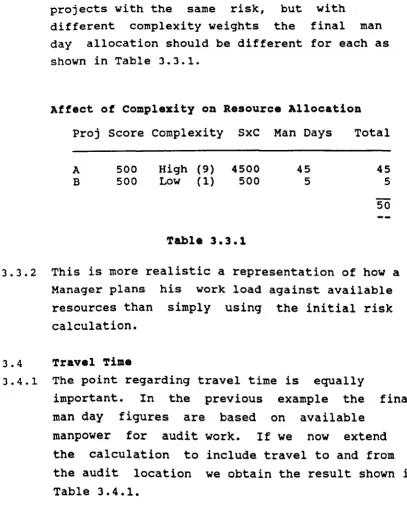
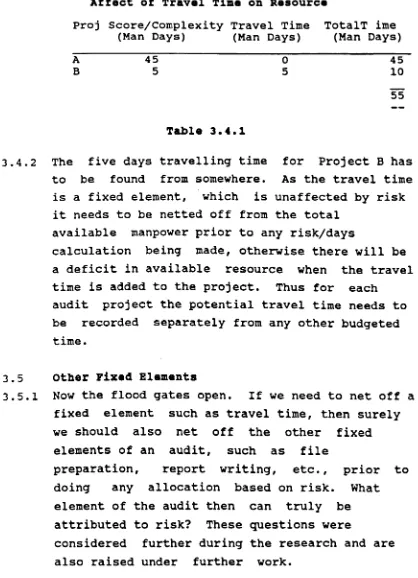
2.10.3 Should audit managers devote more of their resource to the most risky areas as cunnington suggests? At first sight the answer appears to be yes, but a moments reflection indicates that this is a dangerous assumption. Simply because an area is of higher risk does not necessarily mean that it requires more resource to audit it. Any audit has both fixed and variable components. The fixed components usually relate to the mechanics of planning the audit, file
preparation, report production and management review, whilst the variable elements include travel time and the actual audit work. The amount of audit work will depend on a great number of factors such as the depth of the
2.11
audit being undertaken, the state of the system, the availability of auditees, etc. The fact that a high risk area is to be reviewed does not mean that more resource is required to do the job, it simply means that the area should be examined. The amount of time required to do the job has to be calculated outside the risk formula.
Risk v cost
2.11.1 cirtin (10) examines the type of risks that concern auditors. He sees two main types of risk; the risk that "material errors will occur in the accounting process" and the risk that
risk values and how much should be spent on combating them. It also forms the basis of
Boritz's system. This area is tackled by
Bolzendahl (3) where his article referring to the number of auditors required in a department
raises the question of risk versus costs in a
US banking environment. Although the main thrust of his argument is for a balance between
internal and external audit costs the principal
factor of balancing cost against risk is an
important planning concept for any manager.
2.12 Conclusions
2.12.1 The majority of the published material dealt solely with the problem of prioritising audits
by the application of a formula, or formulae with
little attention being given to the
practicalities of converting the formula into an
operational and usable planning mechanism. Very
little work had been done in the area of
computerisation and only two systems appeared to
offer any help in that area. The limitations of
the published material are dealt with in
more detail in the following chapter, while
some computer systems, which were identified as
potentially providing a planning service, are
CHAPTER 3
ISSUES RAISED BY THE PUBLISHED MATERIAL
3.1 Introduction
3.1.1 The majority of the published material dealt solely with the problem of prioritising
audits by the application of a formula, or formulae, in order to establish the "risk" associated with a particular area, or
project. The risk numbers were then used to rank projects on the assumption that internal auditors would wish to examine the higher risk items, at the expense of the lower risk items when only limited resources were available. Some authors (notably Cunnington) attempted to go further by determining audit frequency and
man-day allocation, but they overlooked
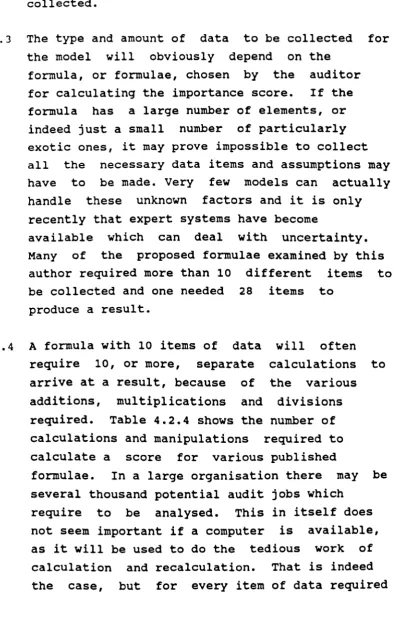
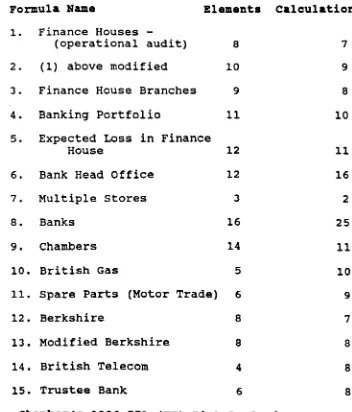
the problems associated with equating risk to resource allocation. Many of the proposed
formulae were complex (sometimes with more than 20 components) and the authors were applying them to complete business areas, or operational units, without appreciating the problem of then converting their findings into a schedule of manageable audits. Where multiple formulae were proposed the problem of equivalence between the formula was either ignored, or fudged. Some authors did mention the problems associated with extensive calculation, but only a few mentioned the possible use of computers and with one exception, those that did gave no practical guidance in the area. The exception here is of course Boritz, who during the course of this research was sponsored by The IIA