City, University of London Institutional Repository
Citation:
Morrell, D. (2010). An In-depth study into behavioural auditing - its use in giving indication of potential fraud. (Unpublished Doctoral thesis, City University London)This is the accepted version of the paper.
This version of the publication may differ from the final published
version.
Permanent repository link:
http://openaccess.city.ac.uk/8611/Link to published version:
Copyright and reuse: City Research Online aims to make research
outputs of City, University of London available to a wider audience.
Copyright and Moral Rights remain with the author(s) and/or copyright
holders. URLs from City Research Online may be freely distributed and
linked to.
City Research Online: http://openaccess.city.ac.uk/ [email protected]
Cass Business School
City University, London
AN IN-DEPTH STUDY INTO
BEHAVIOURAL AUDITING - ITS USE IN
GIVING INDICATION OF POTENTIAL
FRAUD.
DAVID MORRELL
AN IN-DEPTH STUDY INTO BEHAVIOURAL AUDITING - ITS USE
IN GIVING INDICATION OF POTENTIAL FRAUD.
Thesis submitted by:
David Morrell, BSc, FIIA, CIPFA, JP
For the degree of:
Doctor of Philosophy
to:
The Cass Business School,
London, England
Research conducted at:
The Cass Business School,
106 Bunhill Row,
LONDON
EC1Y 8TZ
ENGLAND, UK
Table of Contents
Page
List of tables viii
List of figures x
Acknowledgements xi
Abstract xii
Chapter 1 Introduction 1 to 16
1.1 1.1.1 1.1.2 1.1.3 1.1.4 Audit skills
Skill: Behavioural auditing Skill: The auditor‟s nose Skill: Audit interviewing
Skill: Body language and kinesics
1 5 6 6 7 1.2 1.2.1 1.2.2
Nature of the research
Where this research fits into the wider scope of audit My research questions
8 8 13 1.3 1.3.1 1.3.2 1.3.3 1.3.4
Need for the study Clarification
Practical benefits – sample sizes
Practical benefits – identification of fraud
Practical benefits – quantifiability and the bigger picture
14 14 14 14 15
1.4 Limitations of the study 15
1.5 Structure of the study 16
Chapter 2 Review of literature and development of research questions 17 to 60
2.1 2.1.1
Introduction
Behavioural auditing and its context within different types of audit work 17 18 2.2 2.2.1 2.2.2 2.2.3 2.2.4 2.2.5 2.2.6 Behavioural auditing Review of definitions
Propositions resulting from the review: Definitions
Propositions resulting from the review: Perceptions by auditors Propositions resulting from the review: Perceptions by auditees Propositions resulting from the review: Benefits
Propositions resulting from the review: Training available
2.3 2.3.1 2.3.2 2.3.3 2.3.4 2.3.5 2.3.6
Interviewing: Interpretation of body language for auditors Review: Basic interview skills, style of interview questions, the fraud interview
Behavioural clues in interviews
What is body language and why is it relevant to an audit interview?
Aspects of body language
Propositions resulting from the review: Communication of information and its benefits
Propositions resulting from the review: Interpretation of body language and its benefits
36 38 42 46 48 53 54
2.4 Forensic audit and associated psychology 55
2.5 Summary and conclusion 58
Chapter 3 Summary and consolidation of research propositions. Research design, methods and methodology
61 to 77
3.1 Introduction 61
3.2 3.2.1 3.2.2 3.2.3
Methodology for testing – Research questions 1 and 2 Process, stage i
Sample selection, stage i Variables, stage i
64 67 68 68 3.3 3.3.1 3.3.2 3.3.3
Methodology for testing – Research questions 3 and 4 Process, stage ii
Sample selection, stage ii Variables, stage ii
69 69 69 69
3.4 Methodology for testing – Research question 5 70
3.5 3.5.1 3.5.2 3.5.3 3.5.4
Methodology for testing – Research question 6 Process, stage iii
Sample selection, stage iii Variables – 1st session, stage iii Variables – 2nd session, stage iii
71 73 74 74 76
3.6 Summary and conclusion 76
Chapter 4 Behavioural auditing survey – quantitative analysis 78 to 96
4.1 Introduction 78
4.2 Sample selected and interviews carried out 79
4.3 Structure and index of the comparison of survey results in the chapter
4.4 4.4.1 4.4.2 4.4.3 4.4.4
What are the elements of behavioural auditing? Elements of behavioural auditing
Key elements of behavioural auditing
Elements that do not particularly relate to behavioural auditing Analysis of elements of behavioural auditing
82 84 84 84 84
4.5 Have you had previous experience of behavioural auditing? 85
4.6 What is the definition of behavioural auditing? 85
4.7 4.7.1 4.7.2
Behavioural auditing and body language Results of feedback about body language
Training in use of the assessment of an auditee‟s body language
89 89 91
4.8 Behavioural auditing and fraud identification 92
4.9 4.9.1 4.9.2
Other: Background and general General findings
Answers to general questions
93 93 94 4.10 4.10.1 4.10.2 4.10.3 4.10.4
Summary and conclusion
The “What is behavioural auditing” questions The “Practical use of body language” questions The “Background and general” questions Overall conclusion 95 95 96 96 96
Chapter 5 Behavioural auditing survey - qualitative analysis 97 to 136
5.1 Introduction 97
5.2 5.2.1 5.2.2 5.2.3 5.2.4 5.2.5
What are the elements of behavioural auditing? Behavioural auditing and understanding people
Behavioural auditing and motivational & relationship vis a vis information
Auditor‟s nose
Behavioural auditing and information/decisions, relationships vis a vis accounting and reporting
Judging people 99 100 101 102 104 104 5.3 5.3.1 5.3.2 5.3.3 5.3.4 5.3.5 5.3.6
What is a possible definition of behavioural auditing? Definition 3.1
Definition 3.2
Definitions 3.1 and 3.2 Definition 3.3
A definition other than 3.1, 3.2 or 3.3 Other considerations 106 107 107 108 109 111 111
5.5 Is behavioural auditing a stand-alone, generally applicable audit technique?
115
5.6 Recommended definitions of behavioural auditing 117
5.7
5.7.1
5.7.2
The practical use of questions relating to behavioural auditing
The interpretation of body language by auditors and which elements of body language are considered important
Was the potential scope and/or depth of planned audits altered by input received by the interpretation of body language?
119
120
128
5.8 Behavioural auditing and the identification of fraud 134
5.9 5.9.1 5.9.2 5.9.3
Summary and conclusion
The use and proposed definition of behavioural audit The use of body language as part of behavioural audit
Can the interpretation of body language assist in the potential identification of fraud?
136 136 136 136
Chapter 6 Behavioural auditing - analysis of a practical application
137 to 183
6.1 6.1.1 6.1.2 6.1.3 6.1.4 6.1.5 Introduction Script
Practicalities – scenarios Practicalities – observers
Timing and feedback information Layout 137 138 141 142 143 144 6.2 6.2.1 6.2.2 6.2.3 6.2.4 6.2.5
Findings about effectiveness
Information obtained analysed by scenario and sub-analysed by degree of effectiveness
Information obtained analysed by degree of effectiveness and sub-analysed by scenario
Information obtained analysed by audit experience of students Analysis of questions, specifically analysing facial and body movements
Effectiveness and audit experience – T.Tests
150 150 151 152 153 155 6.3 6.3.1 6.3.2 6.3.3 6.3.4 6.3.5
Findings about efficiency
Information obtained analysed by scenario and sub-analysed by degree of efficiency
Information obtained analysed by degree of efficiency and sub-analysed by scenario
Information obtained analysed by audit experience of students Analysis of questions specifically analysing facial and body movements
Efficiency and audit experience – T.Tests
6.4 6.4.1 6.4.2 6.4.3 6.4.4 6.4.5 6.4.6
Findings about honesty
Information obtained analysed by scenario and sub-analysed by degree of honesty
Information obtained analysed by degree of honesty and sub-analysed by scenario
Information obtained analysed by audit experience of students Analysis of questions specifically analysing facial and body movements
The Celtic-background question
Honesty and audit experience – T.Tests
161 161 163 164 166 167 168 6.5 6.5.1 6.5.2 6.5.3 6.5.4 6.5.5 6.5.6 6.5.7 Qualitative results
Analysis of answers given to question 1 Analysis of answers given to question 2 Analysis of answers given to question 3 Analysis of answers given to question 4 Analysis of answers given to question 5.1 Analysis of answers given to question 5.2 Analysis of answers given to question 5.3
168 169 171 172 173 175 177 178
6.6 Feedback after scenario 5 on all the scenarios, and whether a fraud investigation is now required
179
6.7 General feedback from students on the process
182
6.8 Summary and conclusion 182
Chapter 7 Overall summary, conclusion and areas for future research 184 to 190
7.1 Overall summary 184
7.2 Overall conclusion 186
7.3 Areas for future research 188
Bibliography 191
Appendices
1 Ekman, Paul, Telling Lies (1985) - a “Check-list of lies” 205
2 Source data and further detailed results from that data – used in the behavioural auditing data analysis in chapter 4
211
3 Source data and further detailed results from that data – used to consider the practical application of behavioural auditing in chapter 6
228
List of Tables
2.1 Type of audits and their subjective rating 20
2.2 Different types of audit 24
2.3 Elements in a potential definition of behavioural auditing 28
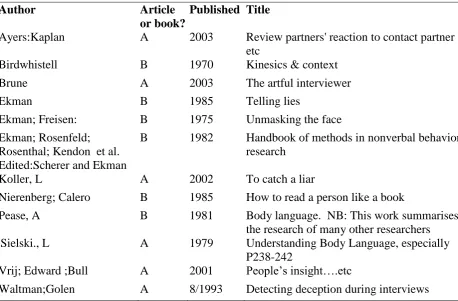
2.4 Bibliography of key publications used in summarising body 48
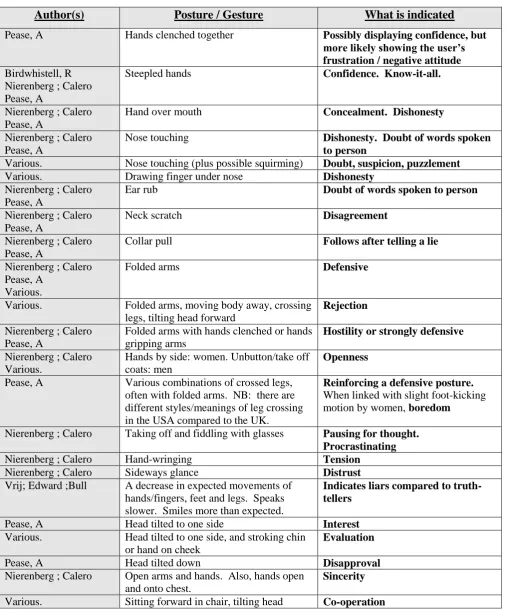
language for auditors 2.5 Postures and gestures in body language 50
2.6 Lower face movements in body language 51
2.7 Upper face movements in body language 52
2.8 Linking structural and behavioural considerations for auditors 57
3.1 Linking initial propositions to research postulations to potential tests 61
3.2 Summary of advantages and disadvantages of different possible 66
methods of sampling 3.3 Assessment of questions and answers 75
3.4 Classifications for qualitative assessments 75
4.1 Electronic questionnaire feedback – ranked importance of 83
the elements of behavioural auditing 4.2 Electronic and interview questionnaire feedback – ranked 83
importance of the elements of behavioural auditing 4.3 Do you assess an auditee‟s body language? 89
4.4 What elements do you consider when assessing an auditee‟s body 89
language? 4.5 Has the scope of your planned audit altered? 91
4.6 Have you had training in body language? 91
4.7 Body language and the identification of fraud 92
4.8 Further analysis of the electronic feedback on the disadvantages of 95
behavioural auditing 6.1 Sample sizes – feedback on scenarios 142
6.2 Effectiveness – by degree of effectiveness - data/results 150
6.5 Efficiency – by degree of efficiency – data/results 156
6.6 Efficiency – by audit experience 157
6.7 Summary of table 6.1 – sample sizes 158
6.8 Efficiency. Standard deviation; audit experience - v - no audit experience 160
6.9 Honesty – by degree of honesty – data/results 162
6.10 Celtic perception 167
6.11 Honesty. Standard deviation; audit experience - v - no audit experience 168
6.12 Number of qualitative questions answers 169
List of Figures
1.1 Axis of audit skills and styles – from the „hard‟ to the „soft‟ extremes (i) 11
1.2 Axis of audit skills and styles – from the „hard‟ to the „soft‟ extremes (ii) 12
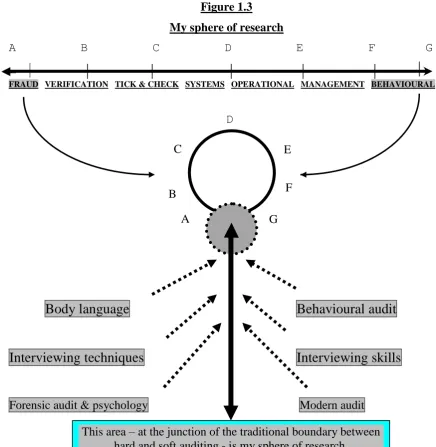
1.3 My sphere of research 13
2.1 Combining the hardness of the audit, audit skills and audit techniques 19
2.2 Behavioural auditing; interviewing skills, body language; common arena 21
2.3 Summary schematic of this research; introduction 22
2.4 Detailed schematic of this research; behavioural auditing 23
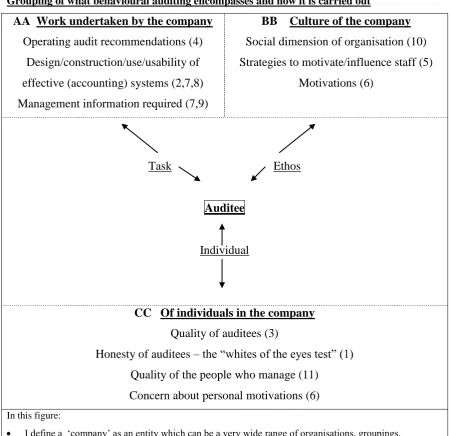
2.5 Grouping of what behavioural auditing encompasses and how it is carried out 29
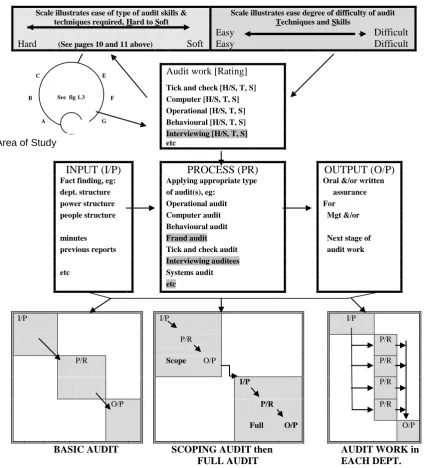
2.6 Detailed schematic; interviewing and fraud detection skills 37
2.7 Different cultural talking patterns between two people of the same culture 45
2.8 Detailed schematic; forensic audit 55
6.1 Effectiveness – by degree of effectiveness – diagrammatically 150
6.2 Effectiveness – by scenario - diagrammatically 151
6.3 Effectiveness – experience in years, scenario 1 152
6.4 Effectiveness – experience in years, scenario 4 153
6.5 to 6.8 Efficiency: body and facial movements 154
6.9 Efficiency – by degree of effectiveness – diagrammatically 156
6.10 Efficiency – by scenario - diagrammatically 157
6.11 Efficiency – experience in years, scenario 1 158
6.12 Efficiency – experience in years, scenario 4 159
6.13 to 6.16 Efficiency: body and facial movements 159
6.17 Honesty – by degree of effectiveness – diagrammatically 161
6.18 Honesty – by scenario - diagrammatically 163
6.19 to 6.22 Honesty: experience in years, scenarios 1 to 4 165
Acknowledgements
I wish to thank my dissertation supervisor, Professor Georges Selim, for his patient work
in helping me with my thesis to date, and especially for reminding me to guide the reader
logically and not to assume that readers will be able to follow my less-than-obvious
mental gymnastics.
My thanks are also given to Andrew Hill and to my wife who, respectively, acted and
directed my recorded body language scenarios, and to the Linguarama Language School in
Ditteridge, Bath, for the loan of their recording equipment and the use of their conference
Abstract
Behavioural auditing has been a subject discussed by auditors for many years but little
work appears to have been done to quantify fully what it actually is, what its precise
definition is and where it fits with other aspects of auditing.
This work has, therefore, researched in detail the literature on behavioural auditing. This
has encompassed literature written for the three different disciplines within audit - internal
audit, external audit and audit consultancy - and has examined the differences between
each discipline‟s perceptions of behavioural auditing.
The research then considered opinions of behavioural auditing by practioners within each
of the disciplines and sought their views on the definition and use of behavioural auditing.
By combining the published and practioner views, a definition of behavioural auditing has
been postulated.
It was then postulated that use of behavioural auditing may make audit work more
efficient and effective. This led to a consideration of the interpretation of body language
and its potential use by auditors. As with behavioural auditing in general, the use of body
language is discussed in audit textbooks, but it appears that little work has been done to
establish how it can be used by auditors. Therefore, one aspect of behavioural auditing -
the observation of an auditee‟s body language - was tested by inviting students to review five videos which were made to show examples of an auditee‟s differing body language.
Feedback about the potential value of behavioural auditing and specifically of the
interpretation of body language was gathered and analysed.
The results of this feedback have clearly indicated the value of this practical application of
behavioural auditing and its use in giving an indication of potential fraud. In addition, the
need to provide training to auditors on behavioural auditing and the interpretation body
Chapter 1 Introduction
1.1
Audit skills
Although auditing is not the „oldest profession‟ it is certainly one of the earliest. In Chambers; Selim; Vinten‟s (1987), the authors argued that audit was moving from being
an occupation to a profession that was meeting the attributes of a profession – systematic
body of theory, professional authority, sanction of the community, regulative code of
ethics and a professional culture (See chapter 2 - an emergent profession, my underlining).
This debate was re-visited by in de Korte; Paape; Verhoog (2003), chapter 3 of which
plots the growth of (specifically Internal) Auditing to become a profession. It
demonstrates that internal auditing has moved to become far more professional.
In the Mesopotamian civilisation, there is evidence that their financial transactions were
checked, see Echadler (2002), and that financial internal control systems existed.
The English word „auditing‟ comes from the Latin „audire‟, or „auditus‟ meaning to hear or to listen. One of the skills that a „good auditor‟ is meant to have is the competency or
soft skill to listen clearly and effectively to what auditees tell him or her. This study
concentrates on one of an auditor‟s skills, behavioural auditing and, within that, on auditors‟ interviewing and interpretation of body language skills.
Before starting to consider the different audit skills and techniques that an auditor may
possess, it is useful to outline briefly a sample of the scope of modern audit.
It is valuable to note that auditing, like many other professions, is the application of
knowledge, techniques and skills. In the body of this work I note that audit techniques can
be taught; how well they are applied is a question of skill that comes with knowledge,
experience and practice. It is also important to place this all in the arena of modern audit
and I have therefore exampled below the scope of the work carried out by modern auditors
in the early 21st century.
In the UK, internal auditing came to prevalence in the early 20th century as one of the
councillors that an independent review of the municipality‟s accounts had been carried out
properly. External auditing emerged from the verification of accounts and was initially
formed in English common law, but, progressively written into UK company law (eg: in
1900 (sec23), 1985 and 1988 - see Caparo Industries Plc - v - Dickman [1990] 2 AC 605).
Since that time, and until relatively recently, auditing has been perceived as a sub-set of
the accounting profession.
However, the scope of modern auditing practice is far more than just auditing the
accounts. It encompasses a very wide range of subjects and techniques. This is illustrated
by the width of the scope of modern audit techniques - see Institute of Internal Auditors
UK and Ireland, (2004) study texts for PIIA, and Sawyer (1974) Modern Internal
Auditing - as listed below:
Systems analysis. Checking that systems that operate within a company, department,
etc, are accurate, efficient, effective, ethical, and accord with company policy, etc.
Fraud analysis. Checking that procedures and practices are in place to assist
prevention and/or to minimise fraud.
Management analysis. Auditing and/or reviewing the effectiveness and efficiency of a company and/or a department‟s management procedures and practices. It may encompass a review of the quality of a company‟s management.
Governance considerations. Does a company meet best practice in its processes to
provide assurance to management that the company operates effective corporate
governance and controls?
Financial analysis. The traditional role of checking that the accounts of a company,
department, process, etc, are a true and fair view of what actually happened (the
trading accounts), is happening (balance sheet), and, potentially what will happen ( the
cash flow and cash forecast statements).
Moreover, in this list, a „company‟ can be a hospital, a financial services institution, a
brothel, an airline, an aeroplane, a bank, a non-profit making organisation, a university.
The wideness of range illustrates that “audit is a fact of life. It covers the entire spectrum
of public and private activities of individuals and organisations from cradle to grave.
The list above demonstrates that audit is no longer just a detailed analysis of figures that
underpins a company‟s accounts; it is more than that as it covers all aspects of the way a
company operates; the list indeed reflects the wide scope of audit today.
The role of an auditor has also changed. A typical auditor can no longer be “a man past
middle age, spare, wrinkled, intelligent, cold passive, non-committal; with eyes like a
cod-fish, polite in contact, but at the same time unresponsive, cold; calm and damnably
composed as a concrete post or a plaster-of-Paris cast; a human petrifaction with a heart
of feldspar and without charm of the friendly germ, minus bowels, passion, or a sense of
humour” – Wilson, Wood (1985:6) attributed to Hubbard, E.
Instead, and noted by the Institute of Internal Auditors - Practice Advisory 1210-1, a skilled
modern auditor needs to have:
“skills in dealing with people, understanding human relations, and maintaining satisfactory relationships with engagement clients”, and
“skills in oral ... communications”
These are also addressed in the section relating to the Behavioural Aspects of Auditing,
see Chambers (1981). I also argue that these words apply to any external auditor – they are
indeed generic to anyone working in the audit profession, whether external auditors, or
internal auditors, or audit consultants.
In this study I examine three of the skills that I will argue are required by a leading-edge
auditor, namely:
behavioural auditing;
use of behavioural skill as part of carrying out audit interviews;
use of observational skills during audit interviews, especially those skills of body language and kinesics, in order to improve the assessment of the information told to
them by an interviewee. This could be argued to be an „auditor‟s nose‟.
From the research that I have carried out, I could find no evidence to show that the use of
these different skills have been considered as a complementary whole for the benefit of the
potential benefits. However, before considering these in further detail, I note a further
complication which is inherent in defining the scope of internal audit, compared to
external audit or to audit consultancy, and whether „behavioural audit‟ and a „behavioural
approach to auditing‟ sits more comfortably with a particular one of these three.
I cite two arguments which indicate the breath of internal audit work; firstly, how the work
of internal auditors and audit consultants overlap - “Internal auditing is an independent,
objective assurance and consulting activity (my underlining) designed to add value and
improve an organisation's operations. It helps an organisation accomplish its objectives
by bringing a systematic, disciplined approach to evaluate and improve the effectiveness
of risk management, control, and governance processes” - definition of Internal Auditing,
Institute of Internal Auditors Inc. (July 1999).
Secondly, how the wide scope of internal audit may imply that external audit work is in
some ways a sub-set of that of internal auditors, namely that it could be considered that
internal auditors are different to external auditors because they do not focus only on
financial statements or financial risks: much of their work is looking at reputational,
operational or strategic risks. They also give an independent opinion on whether internal
controls – such as policies and procedures – put in place to manage these risks are actually
working as intended.
This latter argument is countered by the role of many external auditors, namely that
external chartered accountants not only provide a „legal sign-off‟ of a company‟s
accounts, but they win contracts to provide internal audit services for companies. Several
UK chartered accounting companies provide both an audit consultancy and an external
audit service.
These issues blur the differences between what used to be the scope of an audit and the
current roles provided by internal auditors and chartered accountancy companies. I have
therefore adopted the premise that all „modern auditors‟ – internal, external and audit-
consultants - need to be equipped with the full range of audit and consultancy skills
1.1.1 Skill: Behavioural auditing
There is a wide range of different types of audit work; „computer audit‟, „contract audit‟,
„fraud audit‟, „financial audit‟, „operational audit‟, etc. Similarly, different types of auditor are therefore entitled; „computer auditor‟, „contract auditor‟, „fraud auditor‟, „financial auditor‟, „operational auditor‟, etc. The phrase „behavioural aspects of audit‟ is also in use, but what is „behavioural audit‟, what is its definition, and is there such an animal as a „behavioural auditor‟?
The Oxford English Dictionary‟s definition of behavioural is “of or relating to behaviour”, ie: the way one conducts oneself.
In the 1970s, the terms „a behavioural approach to audit‟ and „behavioural aspects of audit‟ were coined - see, for example, the behavioural aspects of auditing that are
discussed by Chambers; Selim; Vinten (1987: Ch 5) Internal Auditing and by Chambers
1981. These came at the same time as the growth of modern internal auditing and can be
considered to be one of its elements - see „Behavioural patterns in Internal Audit
Relationships‟ and the „Role and Objectives of an Internal Audit, behavioural approach‟
(Institute of Internal Auditors (1972) and Morgan (1975).
However, whereas the definition of a behavioural approach to auditing is well defined in
Chambers, Morgan, Institute of Internal Auditors Inc, et al, (my underlining), no really
adequate definition of behavioural auditing could be found. This is potentially important,
as, without being able to work to a precise definition of behavioural auditing, it becomes
difficult to examine one of the skills that a competent behavioural auditor could usefully
possess - the ability to identify misinformation provided by an auditee using behavioural
skills and techniques.
I also note that in these and other publications that I have reviewed, there was no linkage
between behavioural auditing or the behavioural aspects of auditing, and its potential
application to help identify possible fraud. For example, the Institute of Internal Auditors,
UK and Ireland‟s Education Courses Training Handbook (2005) lists nineteen courses
which have behavioural issues and, of these, ten are specifically listed as including
the interviewing skills course is considered to have many „behavioural issues‟, it does not
say that fraud does not include any „behavioural issues‟.
In trying to define clearly what behavioural auditing is, a starting point considered was to
simply modify the existing definition and scope of behavioural accountingto make it into
behavioural auditing, my underlining, thus “it is that dimension of accounting auditing
concerned with human behaviour and its relationship with design, construction and use of
an efficient accounting auditing system” - Siegel / Ramanauskas – Marconi (1989: ). I
consider whether this proposed definition is adequate.
1.1.2 Skill: The auditor‟s nose
One of the more traditional roles that auditors carry out is in the investigation of fraud.
This may have evolved because auditors, who examined the financial books and accounts
of companies and discovered fraud, were the obvious people to be asked to investigate the
size and nature of that fraud. It is suggested that Hubbard‟s description above of the
auditor stereotype fits precisely the public‟s image of a fraud-investigating auditor – a
“somewhat narrow, focussed, black-and-white individual”. Successful investigating
auditors were said to have a „policeman‟s nose‟ or an „auditor‟s nose‟, implying that they
knew instinctively when an auditee was not telling them the truth.
However, fraud investigation skills appear to be much removed from the skills displayed
by a „behaviourally aware auditor‟ as specified in the Institute of Internal Auditors‟
standards and given above. Auditing for fraud “is a more intuitive process than it is
formal, analytical methodology – it is more of an art form than a science” - Bologna and
Lindquist, (1987: ) I suggest that this intuition is commonly expressed as the „auditor‟s
nose‟.
1.1.3 Skill: Audit interviewing
There is a considerable body of information about audit interviewing. It seems that most
audit reference books have a paragraph, section or chapter that considers this topic. Much
is written about how an auditor should prepare for an auditee interview. However, little
should employ during the interview. The Institute of Internal Auditors, UK and Ireland‟s
PIIA Distance Learning Course covering interviewing gives eight section headings
When and why Types of interview
The structure of interviews Planning
Conducting the interview Closing the interview
Fraud investigation interviews Body language
For the fraud investigation and body language sections, the course suggests that you have
to read the interviewee‟s body language and manage your own. It does not explain how.
Flesher, (1996: ), specifies that the elements of basic interview skills and techniques
cover planning, scheduling, opening, conducting, closing, documenting and evaluating.
He does not mention behavioural skills, per se, but does say in the introduction to
interviewing that the “Human relations skills displayed during interviews with audit
customers can often mean the difference between success and failure...”.
1.1.4 Skill: Body language and kinesics
Like auditing, both the body of knowledge and the skill-set for the interpretation of body
language have changed very considerably since 1900. Before then, for example, 19th
century psychologists produced an illustration showing stereotypical facial images of
twenty men each of which defined a type of individual; honest, courageous, fraudulent;
sly, humorous, etc, (presented by Ingrid Schoen in her City University Social Methods
Research course (2003/4)). This illustrated and emphasised the belief held at that time,
that bearded men may not be honest. However, I would argue that, in the 21st century, it is
accepted that bearded men can be open and honest in exactly the same way that
non-bearded men may be. I do note, however, that until at least until 1978, IBM had a formal
policy not to employ bearded men. I have been told that this also applied to EDS.
A considerable body of work was undertaken on body language in the 1960s / early 1970s
by Professor Birdwhistell of the University of Louisville. He showed “that more human
communications took place by the use of gestures, postures, position and distances than by
been written and much research undertaken on how to interpret an individual‟s body
language. For example Ekman; Freisen, (1975):
In an interview situation between an auditor and an auditee, “People regard facial
expressions as more trustworthy than words….. yet…. facial expressions of emotion
are not easy to control…. but… people are more practised in lying with words than with faces (and more practised with faces than with body movement). …. so …. how
can you detect the leakage of feelings the person is trying to conceal from you? with some people [e.g., the auditee] you [the auditor] probably will have little chance
to spot when they are controlling their facial expressions. They are just too good for
you to detect signs of facial management. A really good actor [or fraudster] is very
convincing” .
In researching for this thesis, no references could be found to the application of a
knowledge of body language to assist an audit interview.
1.2
Nature of this research
1.2.1 Where this research fits into the wider scope of audit
All audit work has three main phases:
i the input to the audit; fact finding about the potential area the audit work will
consider
ii carrying out the audit work; the body of the audit; the audit process
iii quantifying the results of the audit, including oral and written reports, and
information used to form the input for the next stage of the audit.
This research is centred on part of the second phase, the: carrying out the audit work; the
body of the audit; the audit process.
In the middle of the 20th century, audit, both internal and external, concentrated on the
accuracy of the financial accounts. One of the perceived roles of an auditor was to identify
fraud and other financial irregularities. Auditors were frequently disliked as they were
Since then, an auditor‟s role has altered very significantly. An auditor‟s knowledge of the way companies should and do operate at a senior level, as well as an auditor‟s skill to
examine a company, their staff and their management, has been used by the senior
management and the external stakeholders of a company. To fulfil this role, auditors have
to apply both hard and soft skills. An auditor can help to ensure that their company is as
efficient and, especially, as effective as possible. To achieve this, auditors are now
required to use far more „soft skills‟ than fifty years ago.
However, the recent impact of Sarbanes-Oxley, has, arguably, reversed this trend –
detailed financial accounting checking is required, as well as the need to check and sign
off the effectiveness of financial and associated procedures. Future research may plot this
reversal to ascertain whether it is a temporary or more permanent change. I also comment
that conclusions about the application of Sarbanes-Oxley (SOX) and its lack of prevention
of financial losses in the banking sector in 2008 may reduce future dependency on SOX.
Yet, probably, all auditors, whether operating anywhere within the sphere of hard or soft
audit, find that their time is at a premium. Any techniques that will be able to indicate how
to use their time better, and thus the assets of the company better, are arguably potentially
advantageous.
There is a debate about the exact definition of different types of auditing; for example, in
Brink‟s Modern Internal Auditing (1999:21.2), Internal auditing; appraisals operations and
controls, operational auditing is defined as “an independent review including all aspects of
an organisation; its business functions, financial control and the supporting
systems…….the auditor goes beyond a narrow range of activities and includes virtually
all aspects of the organisation in the scope of internal audit reviews. A better name for
the operational auditing might be „managerial auditing‟”.
This statement implies that there is little difference between operational and management
auditing, and Brink goes on to say that the term operational auditing has been “kept as that
was how this type of audit was first defined”. In Chambers; Selim; Vinten, (1981),
Internal Auditing, a sharper distinction is drawn – “Management audit takes the highest
operational audit area and will be less able to achieve a bird‟s eye view or group headquarters vision” (p78). This definition is illustrated by a hierarchy of audit terms:
Management audit
Operational audit
Financial audit
I note that Brink‟s publication is US based whereas the Chambers et al‟s definition is UK
based. As a practising UK based auditor, the latter definition fits more closely with my
UK experience. However, I would question whether, by including financial auditing in
the diagram, this does not mix, albeit only to a small degree, apples and pears. (Perhaps
oranges and satsumas would be more akin to the difference). I challenge the placement of
financial auditing definitions in that whereas both operational and management auditing
define a type of approach to an audit as well as the scope of that audit, financial auditing
covers the scope of work only. So, instead of financial audit, I would prefer to replace this
term with standard definitions of approaches to audit. Again, these are well defined in
Chambers et al in which three approaches are outlined, namely:
The Verifications approach - where auditors verify something they are reviewing; The Vouching, or Tick and Check, approach - which, by an intelligent scrutiny of
records, auditors can confirm that laid down procedures are complied with, and
The Systems approach - in which the auditor focuses upon the system itself. The
auditor will use both verification and vouching to assist this approach.
.
In both Chambers et al, and Brink, it is noted that there is no single type of auditing –
verification, tick and check, systems, financial, operational or management – that can be
applied in isolation. A complete management audit will need to use skills deployed as part
of an operational audit, of a financial audit, and of an audit using techniques such as the
needs indicates a progressively increasing scale of needs/complexity, so these types of
audit can be placed in a progressively more complex audit type: each requires a
combination of the other. In addition, the degree of skill required for each of these
approaches to work is different, with management audit requiring the most number of
skills, and verification the least. When placed in Chambers et al‟s diagram I get:
Audit types
Management
Operational
Financial / Systems
Tick & Check
Verification
In the above, I noted that in the definitions by Brink and Chambers et al, both mix the type
of approach to an audit as well as the scope of that audit; ie, a mix of skills and styles. As
a practising auditor, this mix does not matter provided the auditor applies the correct skill
and the correct style to the task to be completed. Indeed, for example, if an auditor
suspects that there are irregularities in the work carried out by an organisation‟s top
management, the auditor may well employ simultaneously detailed verifications skills
with management style auditing. I therefore accept that it is valid to present the above
information into a single axis which combines skills and styles:
Figure 1.1
Axis of audit skills and styles – from the „Hard‟ to the „Soft‟ extremes (i)
A B C D E F G
HARD VERIFICATION TICK & CHECK SYSTEMS OPERATIONAL MANAGEMENT SOFT
This axis, in which I have highlighted my key area of interest/research, does not include
any mention of either fraud or behavioural auditing.
As the purpose of this research is to:
explore behavioural auditing and if and how behavioural auditing can be used to assist
in fraud auditing,
and as the purpose of this section of the research is to:
explain where behavioural auditing and fraud auditing „fit into the wider scope of
audit; the bigger picture‟
and as the usual perception is that behavioural audit is all about the soft skills:
working well with people, good communications, reviewing the ethos of a company, being a supportive part of the management team, not being an aggressive policeman,
and as the usual perception is that fraud audit is all about the hard skills:
interrogating potential offenders to ascertain the truth about their activities,
ascertaining information in a secretive covert way, detailed checking of financial
information to find clues about potential fraud, acting like a nasty policeman,
all this implies that behavioural auditing and fraud auditing fit into this axis thus:
Figure 1.2
Axis of audit skills and styles – from the „Hard‟ to the „Soft‟ extremes (ii)
A B C D E F G
FRAUD VERIFICATION TICK & CHECK SYSTEMS OPERATIONAL MANAGEMENT BEHAVIOURAL
Yet in the same way that the styles and skills of management and verification audit can
and are combined, it may be valid to consider the audit work which combines fraud and
behavioural auditing. By bending the ends of the axis of audit skills and styles to form a
Figure 1.3
My sphere of research
A B C D E F G
FRAUD VERIFICATION TICK & CHECK SYSTEMS OPERATIONAL MANAGEMENT BEHAVIOURAL
D
Body language
Behavioural audit
Interviewing techniques
Interviewing skills
Forensic audit & psychology Modern audit
1.2.2 My research questions
My area of research interest is therefore summarised by my two-fold research questions:
What is behavioural auditing – its scope, content, usage - and, critically, what is its
definition? Is it a major auditing technique in its own right, or just another tool in the
auditor‟s armoury? Is it equally applicable and usable by all types of auditors?
What practical uses can behavioural auditing deliver, and, specifically, by studying the
behaviour of auditees via an auditee‟s body language, can fraud be detected?
AREA OF STUDY
C E
B F
A G
1.3
Need for the Study
The purpose of this research is to focus on the „soft‟ skills used in behavioural audit, to
clearly identify what they are, and then to explore one potentially beneficial usage of them
– in interviewing auditees, especially in a potential fraud situation.
1.3.1 Clarification
The behavioural aspects of auditing is a subject adequately documented in the more
comprehensive textbooks on auditing, especially on internal auditing, but behavioural
auditing is not well defined in those textbooks, or does it appear to have a common and/or
agreed definition.
1.3.2 Practical benefits – sample sizes
Audit, like other professions, is continually asked to justify its benefits. What is its value
to its employers and stakeholders? Like many professions, I argue that there is pressure to
deliver the professional function at less cost, in less time and to higher quality. As a
manager and then head of an internal audit function for some twenty-five years, I was
asked to define and explain very accurately the financial cost-benefits of the audit service.
The pressure to deliver the same service at a reduced cost progressively increased as time
progressed. My colleagues in external audit were under the same pressure, and now, as a
member of audit committees, I seek to minimise all audit fees whilst maintaining or
improving the quantity and quality of work that the auditors provide.
There is quantifiable evidence that, in practice, sample sizes of material to be audited may
be reduced and that that the sample is less scientifically selected – see 2.4.1 below. I argue
that the use of behavioural audit may assist the auditor to select reduced sample sizes that
statistically improve their chances of finding areas where more detailed audit work is
beneficial.
1.3.3 Practical benefits – identification of fraud
In 1957 the IIA‟s Statement of Responsibilities did not specify that an auditor was
responsible for detecting fraud, but, in 1963, Rezaee in his article in the National
Industrial Conference Board report suggested five primary objectives of audit, one of
Commission emphasised the important role that the internal auditor could play in the
prevention of management fraud. Separately, stakeholders continue to believe that the
role of an external auditor includes the prevention and/or identification of fraud. I
therefore argue that whether or not an auditor is positively looking for fraud, he or she
must always be alert to its possible existence.
Many practising auditors say that they have an „auditor‟s nose‟ when it comes to
identifying fraudsters. They can tell instinctively if an auditee is lying or not. This study
seeks to try to identify if that „auditor‟s nose‟ does exist and, if so, whether its existence,
when exercised as a combination of the application of behavioural auditing and of body
language in order to help identify fraud, is quantifiable.
1.3.4 Practical benefits – quantifiability and the bigger picture
Again, I argue that this work may assist the auditor to reduce sample sizes and improve
the chances of finding areas where more detailed work is beneficial. As a result of the
detailed work undertaken in this research, I seek to prove that behavioural auditing, and
body language-assisted interviewing techniques, will improve the effectiveness of audit
work. I also seek to prove that this improvement is quantifiable.
1.4
Limitations of the study
This study asks the auditor to combine three different skills; interviewing, application of
the understanding of body language, and interpretation of human behaviour. Each of
those three skills is a major study in its own right. There is a danger that selectively
picking those elements from each skill only to the depth which needs to be used by the
practising auditor will be perceived to result in a superficial understanding of each of the
skills. However, I argue that one of the main skills of auditors is not their detailed
knowledge of the audit function but the way they approach an audit. In the same way that
a whodunit author does not have to be a murderer to write a good book, an auditor does
not need to be a qualified lawyer to audit a company‟s legal function.
Nevertheless, this potential criticism might be valid. I counter this possible potential
they find and, using their knowledge – either personal or researched – to suggest solutions
to their client. There are caveats, at a more detailed level:
The understanding of body language becomes far more complex when studying people
of different cultures or racial backgrounds. In this study I limit the theoretical section
on body language to subjects who are British by birth and/or culture, and the practical
section on observing an interviewee who is a British subject.
The audit students and auditors who I propose to study and work with may have
limited experience of fraud in their work-place and, also, because of company
confidentiality, may not wish to share their experience of fraud(s) that have occurred
in their company.
These are discussed in areas of future research in Chapter 7.
1.5
Structure of the study
In chapter 2, I examine the available literature on behavioural auditing, and also the
application of the interpretation of body language as a tool of behavioural auditing. It
leads to postulation of research questions about an accurate and potentially acceptable
definition of behavioural auditing.
In chapter 3, I consider my research methodology to test my postulations.
Chapters 4 and 5 concentrate on the descriptive (Ch4) and qualitative (Ch5) analysis of the
results that I obtained from questioning auditors. It leads to a recommended definition of
behavioural auditing, and also to a suggested method of assessing the application of
behavioural auditing using body language techniques.
Chapter 6 analyses the results of a practical application of behavioural auditing.
Chapter 7 then summarises the conclusions from chapters 4, 5 and 6 of this research.
Chapter 2 Review of literature and development of research questions
2.1
Introduction
In this chapter, and as an introduction to the whole body of this research, I discuss the
elements of the techniques and skills that may be required to carry out different types of
audit work. My aim is to put the area of work that I am researching within the context of
different types of audit work. I also aim to prevent possible confusion and debate
regarding „hard auditing‟ compared to „soft auditing‟, and audit skills as opposed to audit
techniques.
Secondly, I go on to outline my original view of behavioural auditing and one of its
elements - the application of the understanding of body language by auditors.
I then review the literature available to support, develop, or contradict these broad
perceptions, and also identify where there appear to be gaps in the published corpus which
this research can explore. In exploring this literature, my initial approach was to
concentrate on the available text books – notably at Cass Library for the audit perspective
and at the Cass and Bath University Libraries for the body language perspective - and then
to bring this knowledge as up-to-date as possible through a detailed review of articles,
journals and internet publications, especially those that are most recent.
This process led me to suggest 20 propositions about:
behavioural auditing (9) and available training in behavioural auditing(2)
the application of the understanding of body language(5) and fraud detections skills(4)
Finally, I again note that this is in the context of my research questions, which are:
What is behavioural auditing – its scope, content, usage - and, critically, what is its
definition? Is it a major auditing technique in its own right, or just another tool in the
auditor‟s armoury? Is it equally applicable and usable by all types of auditors?
2.1.1 Behavioural auditing and its context within different types of audit work
All audit managers should consider the ability and experience of their auditors and
allocate the audit work accordingly. Different types of audit require different types and
degrees of ability, for example:
Audit technique
I would suggest that carrying out a „tick and check‟ on a sample of the auditable population is less technically complex than a full „operational audit‟. For example, on a 5 point scale where 1 is easiest and 5 is hardest, „tick and check‟ may subjectively be assessed as say 1, whereas „operational audit‟ is 5.
Hard/Soft
I would suggest that an assessment of soft or hard audits is different from that of the
technique and skills scales, since soft audits need the sensitive application of audit
skills and techniques, for example, in dealing with people: their feelings, their
ambitions, their careers, etc. On this basis, a management audit would be at the „soft end‟ of the „hard-soft‟ scale. Conversely, if one is auditing the accounts and dealing purely with numbers or invoices, then ticking and checking invoices is at the „hard end‟ of the „hard-soft‟ scale.
Skill
I would suggest that skill comes with experience coupled with training and practice.
However skilful an auditor, however, different types of audit have a maximum skill
rating. For example, computer audit may have a subjective technical rating of 3 or 4
but a maximum skill rating of 5, again measured on a 1 to 5 scale.
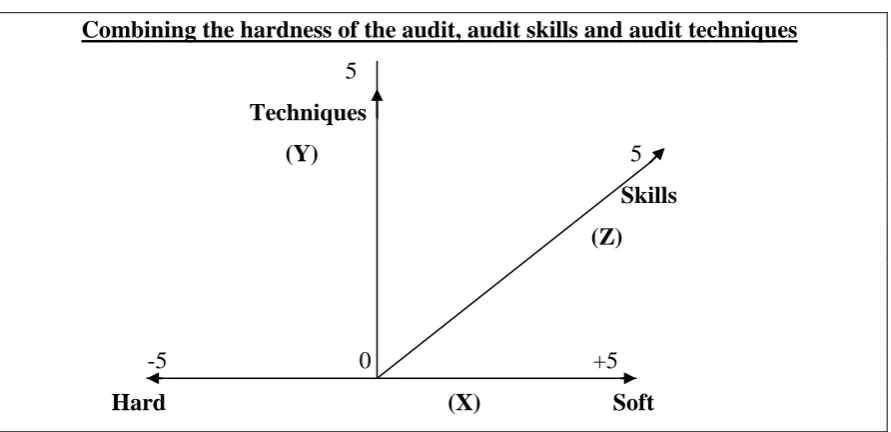
On a scale from –5 (hard) to +5 (soft), this would place „invoice checking‟ as, say, -4,
„financial audit‟ as –3 and „behavioural audit‟ as +5 (whatever behavioural audit is!). Historically, the more „traditional‟ audit styles are on the „hard side‟ of the centre (ie,
left of centre on the x axis in figure 2.0.1 below), whereas more contemporary, or,
Combining hard and soft audits, audit techniques and audit skills
[image:32.595.106.552.157.373.2] These factors can be combined graphically onto a 3D graph, thus:
Figure 2.1
Combining the hardness of the audit, audit skills and audit techniques
5
Techniques
(Y) 5
Skills
(Z)
-5 0 +5
Hard (X) Soft
It is accepted that it is not possible to plot the hardness/softness, technical level and skill
level required for any audit other than in a subjective way. The purpose of expressing
these different types of audit in this way is to give a guide to explain the area of this
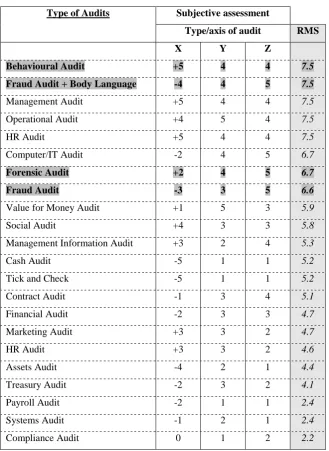
research and to put it into context. Subjectively, therefore, I would assess different types
Table 2.1
Type of audits and their subjective rating
Type of Audits Subjective assessment
Type/axis of audit RMS X Y Z
Behavioural Audit +5 4 4 7.5
Fraud Audit + Body Language -4 4 5 7.5
Management Audit +5 4 4 7.5
Operational Audit +4 5 4 7.5
HR Audit +5 4 4 7.5
Computer/IT Audit -2 4 5 6.7
Forensic Audit +2 4 5 6.7
Fraud Audit -3 3 5 6.6 Value for Money Audit +1 5 3 5.9
Social Audit +4 3 3 5.8
Management Information Audit +3 2 4 5.3
Cash Audit -5 1 1 5.2
Tick and Check -5 1 1 5.2
Contract Audit -1 3 4 5.1
Financial Audit -2 3 3 4.7
Marketing Audit +3 3 2 4.7
HR Audit +3 3 2 4.6
Assets Audit -4 2 1 4.4
Treasury Audit -2 3 2 4.1
Payroll Audit -2 1 1 2.4
Systems Audit -1 2 1 2.4
Compliance Audit 0 1 2 2.2
The table has been sorted by root mean square, RMS - (X2 + Y2 + Z2) - and sub-sorted alphabetically.
Accordingly, the types of audits that have a greater number of features at the extremes of the scale appear high in this list. Those areas of interest to this research are highlighted in grey.
The purpose of the above analysis is to show that the areas we are dealing with in this
research tend to be at the extremes of the scales. These are highlighted within table 2.1
above. In practical terms, it is unusual to combine these extremes. It is this that gives
both the challenge and the prospective rewards of this research in terms of the benefits to
This research examines behavioural auditing, interviewing techniques and body language
(and also, briefly forensic audit). It suggests that, by combining these different skills and
applying them to an early part of the fact finding process in any audit, the auditor can reap
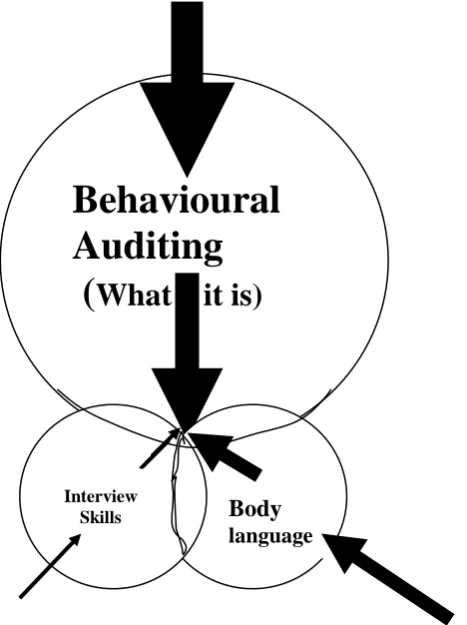
[image:34.595.237.471.253.566.2]real and measurable advantage. For me, the relative importance of these skills is:
Figure 2.2
Behavioural auditing, interviewing skills, body language: common arena
In this figure:
the size of the arrows and words indicate their relative importance within this research,
their direction reflects that they progressively drill into the central core of interest for this research.
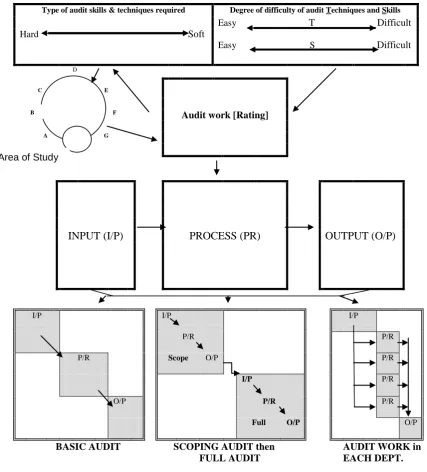
A single research-structure diagram attempts to summarise the whole research, and this is
given below in figure 2.3. This diagram is repeated throughout this research in more
detail and is used to introduce each new section. Within this chapter, the parts covered by
each section of research are highlighted in the diagram.
Behavioural
Auditing
(
What it is)
Interview
Skills Body
Figure 2.3
Summary schematic of this research ; introduction
Type of audit skills & techniques required Degree of difficulty of audit Techniques and Skills
Easy T Difficult Hard Soft
Easy S Difficult
D
C E
B F Audit work [Rating] A G
INPUT (I/P) PROCESS (PR) OUTPUT (O/P)
I/P I/P I/P
P/R P/R
P/R Scope O/P P/R
I/P P/R
O/P P/R P/R
Full O/P O/P
BASIC AUDIT SCOPING AUDIT then AUDIT WORK in FULL AUDIT EACH DEPT.
2.2
Behavioural auditing
In this section I discuss behavioural auditing, and. I seek to identify and clarify what
behavioural auditing actually is. This work is within the context of the areas highlighted
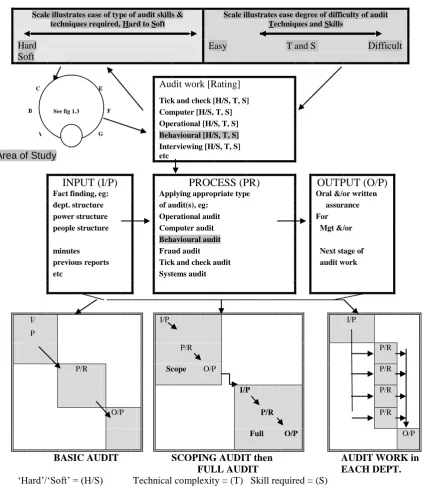
in figure 2.4 below.
Figure 2.4
Detailed schematic of this research; behavioural auditing
Scale illustrates ease of type of audit skills & techniques required, Hard to Soft
Scale illustrates ease degree of difficulty of audit Techniques and Skills
Hard
Soft
Easy T and S Difficult
C E Audit work [Rating]
Tick and check [H/S, T, S]
B F Computer [H/S, T, S]
Operational [H/S, T, S]
A G Behavioural [H/S, T, S]
Interviewing [H/S, T, S] etc
INPUT (I/P) PROCESS (PR) OUTPUT (O/P)
Fact finding, eg: Applying appropriate type Oral &/or written dept. structure of audit(s), eg: assurance power structure Operational audit For people structure Computer audit Mgt &/or
Behavioural audit
minutes Fraud audit Next stage of previous reports Tick and check audit audit work etc Systems audit
I/ P
I/P I/P
P/R P/R
P/R Scope O/P P/R
I/P P/R
O/P P/R P/R
Full O/P O/P
BASIC AUDIT SCOPING AUDIT then AUDIT WORK in FULL AUDIT EACH DEPT.
„Hard‟/„Soft‟ = (H/S) Technical complexity = (T) Skill required = (S) Quantity and quality of work = (w). Work carried out in time = (t).
Assume the auditor is auditing a department of company in which fraud is likely to exist.
2.2.1 Review of definitions See fig 1.3
In examining the definitions of audit roles in general, and behavioural auditors in
particular, it can be argued that one can define as many types of auditing and auditors as
the type and role of auditees, for example:
Table 2.2
Different types of auditor
An auditor whose work focuses on ... can be defined as an
Completeness and accuracy of goods/stock held Assets auditor
Contracts: civil, mechanical Contract auditor
Accounts, income, expenditure, finance, investment Financial auditor
Following the source and destination of money Forensic auditor
Investigation of irregularities within the accounts Fraud auditor
HR, employment, terms and conditions. Personnel HR auditor
Computers, systems, electronic processing IT or computer auditor
Processes operated by doctors and nurses Medical auditor
The whole work of a company, processor, department Operational auditor
Payment of staff Payroll auditor
How a school runs Schools auditor
etc, etc
In the 1960s and 1970s there was much emphasis on the way an auditor operated in order
to be as effective as possible. This applied to all types of auditor. One of the problems
that was identified which affected the auditor‟s would-be effectiveness was of potential
conflict between the auditor and the auditee, especially when they work in close
proximity; when the auditor knows/likes the auditee; when an auditor is both an
„independent auditor‟ and an „advisor‟; etc.
The roles of an auditor, which may cause these potential conflicts, were listed by the
Institute of Internal Auditors Inc‟s standards (1978: paragraph 260) which specified that:
“Internal Auditors should be skilled in dealing with people and in communicating effectively”;
“Internal Auditors should be skilled in oral and written communications so that they can clearly and effectively convey such matters as audit objectives, evaluations,
conclusions and recommendations”.
I believe and argue that all of these roles fall under the aegis of „behavioural auditing‟.
In Chambers (1981:114), the Behavioural Aspects of Internal Auditing are explored.
Chambers does not offer a definition of what these aspects are, but does say that “At the
root of the behavioural aspects of internal auditing are needs and relationships” (my
underlining). The script then discusses needs, the hierarchy of needs, and the relationships
an auditor has with his auditees and with his/her employer and communications in general.
In Chambers, it is noted on page 61 that “It is commonplace for internal auditors to give
at best only the most cursory attention to the nature and mechanics of individual and
group needs and relationship”. Again, no definition of the behavioural aspects of internal
auditing is given but these words imply that one definition could be that: Behavioural
aspects of internal auditing is the process of giving attention to the nature and mechanics
of individual and group needs and relationships.
I note that, although these words are, potentially, a definition of the behavioural aspects of
internal auditing, they are not a definition of what behavioural auditing actually is.
On the same page, the text also comments that internal auditing is all about people ….
“Success/failure is all about how the auditor has handled the „people dimension‟”.
Similarly, in Internal Audit by Venables and Impey (1991:70,71), no specific definition of
the behavioural aspects of internal auditing is given, but the authors comment that “The following impinge on the auditor‟s day-to-day work: Needs and relationships
(inter-personal skills), Formal and informal relationships, Effective communications”.
Internal Auditing, Sawyer, (2005), says that behaviour must be taken into account in
designing and enforcing controls ….. a reasonable control system failed because
behavioural aspects were not taken into account, and the “behavioural approach takes the
individual into account. It seeks to structure organisation so as to combine the needs of