A Relax-and-Fix with Fix-and-Optimize Heuristic Applied to
Multi-Level Lot-Sizing Problems
Claudio Fabiano Motta Toledo, M´arcio da Silva Arantes, Marcelo Yukio Bressan Hossomi University of S˜ao Paulo, Institute of Mathematics and Computer Science
Avenida trabalhador s˜ao-carlense, 400, Centro, 13566-590, S˜ao Carlos, SP, Brazil [email protected], [email protected], [email protected]
Paulo Morelato Fran¸ca
UNESP, Dept. Of Mathematics and Computing
R. Roberto Simonsen, 305, CP 266, 19060-080, Presidente Prudente, SP, Brazil [email protected]
Kerem Akartunalı
Dept. of Management Science, University of Strathclyde 40 George Street, Glasgow G1 1QE, UK
In this paper, we propose a simple but efficient heuristic that combines construction and
improve-ment heuristic ideas to solve multi-level lot-sizing problems. A relax-and-fix heuristic is firstly used
to build an initial solution, and this is further improved by applying a fix-and-optimize heuristic. We
also introduce a novel way to define the mixed-integer subproblems solved by both heuristics. The
efficiency of the approach is evaluated solving two different classes of multi-level lot-sizing problems:
the multi-level capacitated lot-sizing problem (MLCLSP) with backlogging and the two-stage glass
container production scheduling problem (TGCPSP). We present extensive computational results
including four test sets of the MULTILSB (Multi-Item Lot-Sizing with Backlogging) library, and
real-world test problems defined for the TGCPSP, where we benchmark against state-of-the-art
methods from the recent literature. The computational results show that our combined heuristic
approach is very efficient and competitive, outperforming benchmark methods for most of the test
problems.
Key words: Lot-Sizing; Heuristics; Relax-and-fix; Fix-and-optimize; Backlogging.
Mathematics Subject Classification (2000): 90C11.
1.
Introduction
Manufacturing systems have been analytically studied for more than a century to achieve better
efficiencies and outputs, since manufacturing was a key element, if not “the” key element, of
the economic advancement of developed countries. 2013 marks the centenary of the renowned
under very special conditions. Since then, numerous operations researchers in academia and practice
have built many more realistic models and proposed various sophisticated solution methods to tackle
lot-sizing/production planning problems evident in practice, where decisions such as how much to
produce or stock are constrained by various natural limitations such as capacities and setup times.
We investigate two classes of multi-level sizing problems: the multi-level capacitated
lot-sizing problem (MLCLSP) with backlogging, and the two-stage glass container production
schedul-ing problem (TGCPSP). The first set of problems, MLCLSP with backloggschedul-ing, is particularly
chal-lenging from a computational point of view, which is also apparent from a number of new lot-sizing
problems included in MIPLIB 2010 [20]. Moreover, the theoretical question of the full description
of the convex hull of the single-item problem with backlogging has remained open for decades until
the recent study of [18], which indicates the sophistication involved in these problems. Finally,
in a practical problem setting, backlogging is never prohibited as all manufacturers will sooner
or later fall short of satisfying their customer demands and backlog, and therefore the problem
with backlogging presents a more realistic case than the one without. The second set of problems,
TGCPSP, represents a real-world short-term production planning and scheduling problem with a
first mixed-integer programming (MIP) formulation proposed in [4]. The authors in [27] improved
the previous MIP formulation for the TGCPSP, proposed a hybrid genetic algorithm to solve it
and defined sets of complex test problems. TGCPSP does not allow backlogging like MLCLSP, and
takes some problem specific characteristics such as production loss costs and sequence-dependent
setup times and costs.
The lot-sizing literature can most appropriately be divided into two main areas due to the
nature of solution methods used: i. Exact methods, and ii. Heuristic methods. Although even the
capacitated single-item problem isN P-hard (see, e.g., [14]) and expectations for optimal solutions
diminish as problems become more realistic, exact methods can be very helpful to understand
the underlying difficulties in solving these problems. Such methods include valid inequalities (see,
e.g., [8, 19]), extended reformulations (see, e.g., [17, 12, 24]), Lagrangian relaxation (see, e.g.,
[10]) and Dantzig-Wolfe decomposition (see, e.g., [11]). Most of these studies are mainly focused
on simplistic (often single-item) problems, however, many of the developed methods could be
extended to realistic problem settings as well. The recent study of [3] provides more insight on the
complexities apparent in realistic lot-sizing problems, and an extensive discussion of mathematical
programming techniques used in the area can be found in [22].
Although exact methods are powerful since they provide an exposure of complicating structures
end: even with the modern fast computers and the state-of-the-art optimization packages, solving
industrial-size lot-sizing problems is a very complicated (and often an impossible) task. To
com-pensate for the computational shortcomings of exact methods and to provide real time solutions
to industrial-size problems, heuristic methods have been extensively used in this area, from very
simple frameworks to very sophisticated ones, see, e.g., [29, 30, 16, 1, 28, 6]. We also refer the
interested reader to [7] for a recent literature review on general mathematical programming
heuris-tics. Finally, we note that a number of researchers have proposed frameworks using heuristics or
meta-heuristics combined with mathematical programming techniques, since the major drawback
of heuristic methods is no guarantee of solution quality. Recent results include the ant colony
algorithm coupled with reduced MIP solutions for the MLCLSP with overtime proposed by [5],
the MIP-based and hybrid simulated annealing heuristics for the stochastic lot-sizing problem
pro-posed by [23], and finally the multi-population genetic algorithm with LP model resolution for the
MLCLSP with backlogging proposed by [28].
The method described in this paper combines two heuristics based on mathematical
program-ming. Relax-and-fix (RF), a construction heuristic that solves relaxed MIP subproblems
sequen-tially and fixes binary variables throughout the process for speeding it, has been used by a number
of researchers for sizing problems: [9] included a basic RF heuristic in their sophisticated
lot-sizing solver, whereas [26] proposed a time-oriented RF for MLCLSP with impressive results. More
recent applications of RF in the lot-sizing literature include [13] and [2], where the former
itera-tively increase the size of the problem for efficient solutions whereas the latter make use of (`, S)
inequalities for stronger formulations, outperforming solutions found by Stadtler’s heuristic [26].
Fix-and-optimize (FO), an improvement heuristic based on MIP, is firstly described in [15] to solve
the MLCLSP with lead times and overtime costs. The authors propose product, resource and
process-oriented decompositions for the problem, which define subsets of binary variables to be
op-timized. [25] extend these decomposition ideas to the multi-level lot sizing and scheduling problem,
where the neighborhood decomposition search is combined with FO.
We propose a simple and easy-to-implement solution method that also proves to be
computa-tionally effective. Contrary to the recent works of [5, 23, 28] combining complex meta-heuristics
with MIP heuristics, our method combines two very simple MIP-based heuristics: relax-and-fix with
fix-and-optimize (“RFFO”, as we will refer to in the remainder of the paper). The simplicity is
one of the key strengths of the proposed method, allowing any interested researcher or practitioner
easily implement it if needed. Moreover, we propose novel ways of building subproblems from the
fix-and-optimize heuristics, and investigate their effectiveness in practice by extensive computational
tests, including over some MIPLIB 2010 instances [20]. The method shows impressive
computa-tional performance for the majority of difficult test problems of the MCLSP with backlogging,
outperforming benchmark methods. Moreover, while many studies such as [15] and [25] explore
very specific problem structures for their methodology design, our proposed RFFO framework is
designed as generic as possible to avoid taking advantage of a specific problem structure and hence
can be extended to other problems if necessary, and in order to support this argument, we have
also applied it to TGCPSP, where RFFO was able to find competitive results when compared with
the default IBM Ilog Cplex solver and the hybrid genetic algorithm of [27].
To summarize, the proposed RFFO method has two main contributions: i) It is a simple
framework combining construction and improvement heuristics, which also returns competitive
results in extensive computational tests when compared with state-of-the-art benchmark methods
from the recent literature. ii) The rolling horizon window size is oriented not only by column (i.e.,
period in lot-sizing, which is the common practice) but also by rows (i.e., families of products) as
well as by a combination of columns and rows. Therefore, the method allows rolling windows along
with different combinations of columns and rows in the two dimensional matrix representation.
The paper is organized as follows. In the next section, we give a brief mathematical description
of the problems under investigation. In Section 3, we define in detail our proposed framework,
including a discussion of novel ways of building subproblems. Then we present numerical results
from extensive computational tests in Section 4 with comparisons to two benchmarks methods from
recent literature, showing the effectiveness of the proposed methodology. Finally, we conclude with
some future directions in Section 5.
2.
Multi-Level Lot Sizing Problems
As we discussed earlier, the RFFO approach developed in this paper is not dependent on the
problem structure so that it can be adapted to other MIP problems. In this section, we present the
MIP formulations of the two classes of multi-level lot-sizing problems. First, we describe the MIP
formulation of [28], based on the formulation of [2], for the MLCLSP with backlogging, and then
we describe the MIP formulation for the TGCPSP as presented in [27].
2.1 MLCLSP with Backlogging
In this paper, we consider MLCLSP with families of products, i.e., multiple products are grouped
environments due to capacity limitations, it is allowed for products with external demands.
Parameters:
J Total number of products.
T Total number of periods.
M Total number of machines/resources.
F Total number of families.
amj Time necessary to produce one unit of productj on machine m.
Bjt Upper bound for lot-size of productj in periodt.
bcj Backlogging cost of productj.
Cmt Total capacity of machinem in periodt.
Djt Primary demand (external) of productj in periodt.
hj Holding cost per unit of productj in one period.
pjf 1 if productj belongs to family f.
rjk Quantity of product j necessary to produce one unit of productk.
stmf Setup time for product familyf on machine m.
δ(j) Set of the immediate successors of product j.
∆ Set of the end products.
Variables:
xjt Lot-size of productj in periodt.
wf t Setup variable of familyf in periodt.
ijt Stock holding quantity of product j in periodt.
M in
J
X
j=1
T
X
t=1
(bcj·bjt+hj·ijt) (1)
Subject to:
ijt−1+bjt+xjt =ijt+bjt−1+Djt ∀j, t|j∈∆ (2)
ijt−1+xjt =ijt+
X
k∈δ(j)
rjk·xkt ∀j, t|j 6∈∆ (3)
J
X
j=1
amj·xjt+ F
X
f=1
stmf ·wf t≤Cmt ∀m, t (4)
xjt ≤wf t·Bjt ∀j, f, t|pjf = 1 (5)
xjt, ijt, bjt≥0 wf t ∈ {0,1} (6)
The inventory and backlogging costs are minimized in the objective function (1). We note that
we do not include setup costs for the sake of simplicity of the model (and consider setup times
only instead), but the proposed model can be easily modified to include them. The flow balance
constraints (2) and (3) ensure the satisfaction of external and internal demands, respectively, where
the external demand for end products can also be satisfied through backlogging. Here, we note that
we use these constraints for the sake of simplicity as well as for consistency with the formulations
of [2, 28]; however, external demands as well as backlogging can also be included in higher levels of
the echelon. The big bucket machine capacities incorporating both variable processing times and
fixed setup times in each period are defined by constraints (4), where we assume that each product
belongs to only one product family and there are product family setup times only (rather than for
each product). Constraint (5) ensures that a product j cannot be produced (i.e.,xjt = 0) if there
is no setup for its product family (i.e., wf t = 0). The upper bound for the lot-size of productj in
period t is represented by parameter Bjt, which can be defined using the following definitions of
Bjt = min
dj(1..T),Cmt−stmf amj
(7)
dj(t..T)=
T
X
u=t
Dju+
X
k∈δ(j)
rjk·dk(t..T) (8)
Note that the equation (7) bounds the lot-size either by the total demand over the horizon
(the first term on the right of the equation) or by the maximum capacity available for production
(setup time to be subtracted from the total capacity to identify the production time). Finally,
the variable domains are established by constraints (6). We note that this formulation can be
extended to incorporate other elements of a production system, such as overtime, to make it more
realistic. However, we leave it as is for the sake of easier understanding. Finally, we note that due to
backlogging allowed to the final period of the horizon, this problem is always feasible. However, as
we have observed from our own computational experiences as well as from our discussions with some
other researchers, this is a characteristic that makes these problems computationally challenging
when attempting to optimize.
2.2 Two-stage Glass Container Production Scheduling Problem
This problem originates from the glass container manufacturing, where a furnace melts the raw
material in the first stage of the production process, and molding machines are used in the second
stage to finalize the containers. In a typical glass container manufacturer, the daily capacity of
the furnace can vary from 100 ton/day to 650 ton/day. We refer the interested reader to [27] for
further technical details of the production process. In short, the TGCPSP is a two-level lot sizing
and scheduling problem with parallel machines and sequence-dependent setup costs and times.
Different than the problem discussed in the previous section, it does not allow backlogging.
Parameters
C : Melting capacity of the furnace in a period (in tonnes).
nik : Maximum number of mold cavities of machine kfor product i.
nik : Minimum number of mold cavities of machinek for producti.
pik : Amount of producti produced per mold cavity of machinek in a period (in tonnes).
cijk : Cost to set up machinek from productito productj,i6=j.
sijk : Capacity necessary to set up machine kfrom productito product j,i6=j (in tonnes).
dit : Demand for producti at the end of periodt (in tonnes).
ω : Penalty cost per tonne of furnace under-utilization.
Decision Variables
Yitk : 1 if product iis assigned to machinek in periodt; 0 otherwise.
Qt : 1 if the furnace is active in period t; 0 otherwise.
Zijtk : 1 if there is a setup changeover from producti in period t−1 to product j in period t on
machinek; 0 otherwise.
Nitk : Number of active mold cavities on machine kdedicated to productiin period t.
Iit : Inventory of producti at the end of periodt (in tonnes).
Idt : Idle capacity of the furnace in periodt (in tonnes).
M in X
i,j,t,k
cijk·Zijtk+ω·
X
t
Idt+
X
i,t
hi·Iit (9)
Subject to:
Iit−Ii,t−1+dit=
X
k
pik·Nitk−
X
k,j
sjik·Zjitk ∀(i, t) (10)
X
i,k
pik·Nitk+Idt=C·Qt ∀(t) (11)
Nitk≤nik·Yitk ∀(i, t, k) (12)
X
i
Yitk≤1 ∀(t, k) (14)
Qt=
X
i
Yitk ∀(t, k) (15)
X
i
Yitk≥
X
i
Yi(t+1)k ∀(t, k)|t < T (16)
Yjtk+Yi(t−1)k≤Zijtk+ 1 ∀(i, j, t, k) (17)
X
i,j
Zijtk ≤Qt ∀(t, k) (18)
pik·Nitk−
X
j
sjik·Zjitk ≥0 ∀(i, t, k) (19)
Iit, Idt, Qt
≥0, Nitk∈Z+,(Yitk, Zijtk)∈ {0,1} (20)
The problem aims to minimize the total cost over the planning horizon that involves inventory
and setup costs as well as penalties for the idle capacities of furnaces, as noted in (9). The glass
container demands have to be fulfilled without backlogging as ensured by (10), where the “setup
time” (i.e., the number of tonnes of products wasted from the capacity) is also taken account of.
The constraint (11) enforces the capacity limit of the furnace, and also ensures that the idle time
is captured if the furnace is used. The maximum and minimum number of active mold sections
in a given machine are enforced by (12) and (13) respectively, when a product is produced. Each
machine can produce at most one product in a time period (14), and the two-stage process is
synchronized by (15), which would activate the furnace if a product is assigned to a machine. If the
furnace is deactivated in periodt, then all associated machines will also be idle in the remainder of
the horizon as enforced by (16). Constraints (17) and (18) capture product changeovers and ensure
that they can happen only when the furnace is active. Constraint (19) enforces that the “setup
3.
Proposed Heuristic: Relax-and-Fix with Fix-and-Optimize
Here we describe the two heuristics and how they are combined to solve the multi-level lot-sizing
problems. For both heuristics, let’s consider a matrixF ×T where each entry is a binary variable
wf t. The relax-and-fix (RF) is a construction heuristic which defines an initial solution by solving
several small mixed-integer problems (MIP). This is done by fixing or relaxing most of binary
variables, enforcing only few of them to be integer and optimizing them. We call this small set of
integer variables as window in the remainder of the paper. The pseudo-code of the RF approach
proposed in this paper is summarized in Figure 1.
1: function RelaxAndFix(sol.w, windowSize, windowT ype, overlap, timeLimit) 2: window← initWindow(windowSize,windowT ype,sol.w )
3: wf ix← ∅
4: wM IP ←window 5: wLP ←sol.w−window
6: while fixed solution not reachedand elapsedT ime < timeLimitdo
7: Solve(wf ix,wM IP,wLP )
8: window← moveWindow(overlap,windowSize )
9: wf ix←wf ix∪(wM IP −window) 10: wM IP ←window
11: wLP ←wLP −window 12: end while
13: sol.w←wf ix 14: return sol.w
[image:10.612.75.548.245.452.2]15: end function
Figure 1: Pseudocode of Relax-and-Fix.
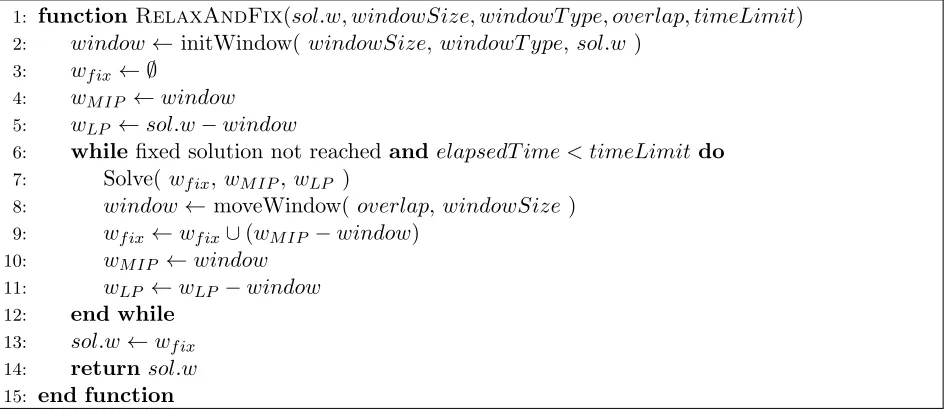
The inputs of the RF are the set of binary variables (sol.w), the number of binary variables
(windowSize) to be chosen, the selection criteria to choose variables (windowT ype), the overlap
rate of binary variables to be re-optimized (overlap) and the execution time limit (timeLimit).
Initially, all binary variables in the RF solution (sol.w) are relaxed which means they can take any
value between 0.0 and 1.0. Awindowis defined as a set that includes a fixed amount (windowSize)
of variables (line 2, Figure 1). The variables inside the window are enforced to be integer in the set
wM IP (lines 4 and 10, Figure 1), while the others are kept relaxed in wLP (lines 5 and 11, Figure
1). The resulting MIP is then solved (line 7, Figure 1). Next, a new set of variables (window)
is defined, a subset of integer variables is fixed (wf ix), and another sets of integer and relaxed
variables are optimized (lines 8 to 11, Figure 1).
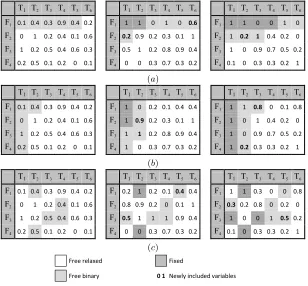
The window type (windowT ype) defines how variables are selected to compound the window, as
which the window moves along rows; column-wise, in which the window moves along columns; and
value-wise, in which the window selects the variables with relaxed values closest to 0.5. The window
movesstepvariables at each iteration, withstep=|overlap∗windowSize|(line 8, Figure 1), where
overlap∈ [0,1] is the overlap rate defined by the user. Fixing happens to all variables that leave
the window in the next iteration (line 9, Figure 1), and the same number of relaxed variables are
enforced to be integer. The algorithm continues processing in this fashion until all variables are
fixed. We note that the RF process would benefit if the problem considered, such as the MLCLSP
with backlogging, has always a feasible solution; this is a property commonly exploited by other
researchers using RF as well (see, e.g., [26, 2]).
0.1 0.4 0.3 0.9 0.4 0.2
0 1 0.2 0.4 0.1 0.6
1 0.2 0.5 0.4 0.6 0.3
0.2 0.5 0.1 0.2 0 0.1
T1 T2 T3 T4 T5 T6
F1
F2
F3
F4
1 1 0 1 0 0.6
0.2 0.9 0.2 0.3 0.1 1
0.5 1 0.2 0.8 0.9 0.4
0 0 0.3 0.7 0.3 0.2
T1 T2 T3 T4 T5 T6
F1
F2
F3
F4
1 1 0 0 1 0
1 0.2 1 0.4 0.2 0
1 0 0.9 0.7 0.5 0.2
0.1 0 0.3 0.3 0.2 1
T1 T2 T3 T4 T5 T6
F1
F2
F3
F4
(a)
0.1 0.4 0.3 0.9 0.4 0.2
0 1 0.2 0.4 0.1 0.6
1 0.2 0.5 0.4 0.6 0.3
0.2 0.5 0.1 0.2 0 0.1
T1 T2 T3 T4 T5 T6
F1
F2
F3
F4
1 0 0.2 0.1 0.4 0.4 1 0.9 0.2 0.3 0.1 1 1 1 0.2 0.8 0.9 0.4 1 0 0.3 0.7 0.3 0.2
T1 T2 T3 T4 T5 T6
F1
F2
F3
F4
1 1 0.8 0 0.1 0.8 1 0 1 0.4 0.2 0 1 0 0.9 0.7 0.5 0.2 1 0.2 0.3 0.3 0.2 1
T1 T2 T3 T4 T5 T6
F1
F2
F3
F4
(b)
0.1 0.4 0.3 0.9 0.4 0.2
0 1 0.2 0.4 0.1 0.6
1 0.2 0.5 0.4 0.6 0.3
0.2 0.5 0.1 0.2 0 0.1
T1 T2 T3 T4 T5 T6
F1
F2
F3
F4
0.2 1 0.2 0.1 0.4 0.4 0.8 0.9 0.2 0 0.1 1
0.5 1 1 1 0.9 0.4 0 0 0.3 0.7 0.3 0.2
T1 T2 T3 T4 T5 T6
F1
F2
F3
F4
1 1 0.3 0 0 0.8 0.3 0.2 0.8 0 0.2 0
1 0 0 1 0.5 0.2 0.1 0 0.3 0.3 0.2 1
T1 T2 T3 T4 T5 T6
F1
F2
F3
F4
(c)
Free relaxed Fixed
[image:11.612.153.461.253.539.2]Free binary 0 1 Newly included variables
Figure 2: Relax-and-fix different types of windows: (a) row-wise; (b) column-wise; (c) value-wise. For each window, three iterations are shown in sequence. Window size = 5, overlap rate = 60%.
Figure 2 shows examples of the three window types as well as how they proceed forwindowSize=
5 andstep= 2. Figure 2 (a) illustrates the row-wise window, where variables fromwF1,T1 towF1,T5
are first include in window to be optimized as binary variables. After finding the solution of
this MIP, variables wF1,T1 and wF2,T2 are fixed and leave the windows set, while variables wF1,T6
and wF2,T1 are enforced to be binary variables. This procedure allows re-optimizing variables
illustrated by Figure 2 (b).
When using the value-wise window, the model is first solved with all variables relaxed so that
the relaxed solution is obtained for evaluation. This is shown by the first matrix on the left side of
Figure 2 (c), wherewF1,T2,wF4,T2,wF3,T3,wF2,T4 and wF3,T4 variables are the closest to 0.5. Thus,
they are selected to be optimized as binary variables in window set. When two or more variables
have the same value, those within first columns are preferred. If the variable with same value are in
the same column, then first rows will be picked first. In the two-dimensional matrix F×T defined
for lot-sizing problems, this means to choose products in the earlier periods (first columns) and
end products (first rows). These criteria are also used to decide how to fix variables, after the MIP
problem is solved. For example, variableswF1,T2 and wF4,T2 are chosen to be fixed (middle matrix,
Figure 2 c), once they are in the first column among variables in the window set. In this step,
variables wF3,T1 and wF1,T5 are now included inwindow, andwF3,T3, wF2,T4 and wF3,T4 remain to
be re-optimized.
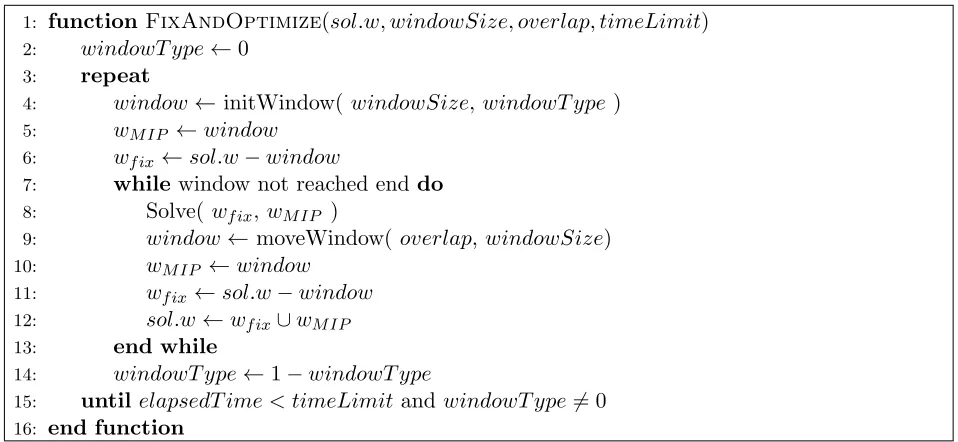
In our framework, the solution built by the RF will be used as the solution to initiate the
fix-and-optimize (FO). The steps executed by FO are very similar to RF, where several MIP problems
need to be solved. Figure 3 shows the FO pseudo-code. A rolling window, covering windowSize
number of variables inF×T matrix (sol.w), is also defined for FO and these variables are adjusted
as binary to be optimized by a solver. However all variables outside the window are kept fixed in
the FO heuristic. At each iteration, after solving the MIP subproblem, the window is moved step
variables forward withstep=|overlap∗windowSize|(line 9, Figure 3).
1: function FixAndOptimize(sol.w, windowSize, overlap, timeLimit) 2: windowT ype←0
3: repeat
4: window← initWindow(windowSize,windowT ype)
5: wM IP ←window 6: wf ix←sol.w−window
7: while window not reached enddo
8: Solve(wf ix,wM IP )
9: window← moveWindow( overlap,windowSize)
10: wM IP ←window
11: wf ix←sol.w−window 12: sol.w←wf ix∪wM IP
13: end while
14: windowT ype←1−windowT ype
15: until elapsedT ime < timeLimit andwindowT ype6= 0
[image:12.612.70.549.471.692.2]16: end function
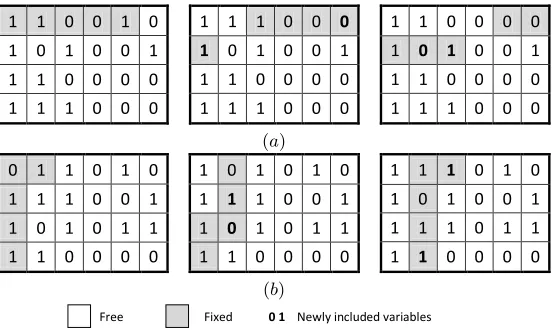
FO improves the binary values following row and column directions and hence two window types
are defined. The first window type combines the row-wise, which covers the matrix along the rows
(Figure 4 a) and column-wise, which does the same along the columns (Figure 4 b) following the
same idea defined for RF. However, FO applies both windows types during its execution adjusting
windowT ypein lines 2 and 14 (Figure 3). In this case,windowT ype= 0 means to apply row-wise and windowT ype= 1 column-wise.
1 1 0 0 1 0
1 0 1 0 0 1
1 1 0 0 0 0
1 1 1 0 0 0
1 1 1 0 0 0
1 0 1 0 0 1
1 1 0 0 0 0
1 1 1 0 0 0
1 1 0 0 0 0
1 0 1 0 0 1
1 1 0 0 0 0
1 1 1 0 0 0
(a)
0 1 1 0 1 0
1 1 1 0 0 1
1 0 1 0 1 1
1 1 0 0 0 0
1 0 1 0 1 0
1 1 1 0 0 1
1 0 1 0 1 1
1 1 0 0 0 0
1 1 1 0 1 0
1 0 1 0 0 1
1 1 1 0 1 1
1 1 0 0 0 0
(b)
[image:13.612.169.445.191.357.2]Free Fixed 0 1 Newly included variables
Figure 4: Fix-and-Optimize: (a) row-wise and (b) column-wise. Three iterations of each direction are shown with window size = 5 and overlap rate = 60%.
The second type is a square-wise window that covers the matrix along rows (Figure 5 a) and
columns (Figure 5 b) simultaneously, compounding a square through the matrix. Note that this
square overlaps in both sides with the same overlap rate, and step is rounded down to the closest
integer multiple of the square side. The square moves along rows and columns during the FO
execution according to the windowT ype value. In this case, windowT ype= 0 means moving the
square in the row direction andwindowT ype= 1 moves it in the column direction.
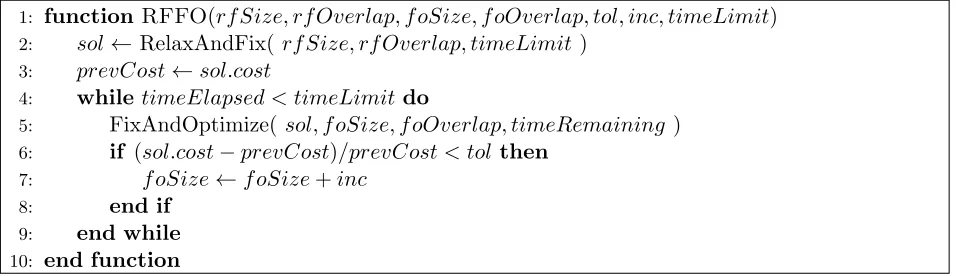
The Relax-and-Fix with Fix-and-Optimize (RFFO) heuristic proposed is summarized in Figure
6. After the RF execution is complete, FO tries to improve this initial solution until the time limit
has been reached. If the improvement achieved by a FO solution did not satisfy a given tolerance
tol, the window size is increased by incvariables, a user-defined parameter. Thereafter, the MIP
subproblems become larger as an attempt to find better solutions. When using the square window,
the increment will affect the window area, making its growth faster when small, and slower when
larger. The window area will be rounded to the closest perfect square integer so that the square
0 1 1 0 1 0
1 1 1 0 0 1
1 0 1 0 1 1
1 1 0 0 0 0
1 1 1 0 0 0
1 1 0 0 0 1
1 1 0 0 1 1
1 0 0 0 0 0
1 1 1 0 0 0
1 1 1 0 0 1
1 1 0 0 1 1
1 0 0 0 0 0
1 1 1 0 0 0
1 1 1 0 0 1
1 1 0 1 0 1
1 0 0 0 0 0
1 1 1 0 0 0
1 1 0 1 0 0
1 1 0 1 1 0
1 0 0 0 0 0
1 1 1 0 0 0
1 1 1 0 0 0
1 1 0 1 1 0
1 0 0 0 0 0
(a)
0 1 1 0 1 0
1 1 1 0 0 1
1 0 1 0 1 1
1 1 0 0 0 0
1 1 0 0 1 0
1 1 0 0 0 1
1 0 1 0 1 1
1 1 0 0 0 0
1 1 0 0 1 0
1 1 0 0 0 1
1 1 0 0 1 1
1 0 0 0 0 0
(b)
[image:14.612.171.446.69.301.2]Free Fixed 0 1 Newly included variables
Figure 5: Fix-and-Optimize with square window following: (a) row and (b) column directions. Six iterations of column direction and three of row direction are shown, both with window size = 9 and overlap rate = 70%.
4.
Computational Results
The computational tests reported here were run on a PC with Intel i7 processor, 2.6 GHz, and
8GB RAM, and all mathematical models were implemented and solved using IBM ILOG Cplex
12.2 callable library. We have implemented RFFO first to solve the MLCLSP with backlogging, and
therefore, we discuss in detail parameter tuning of the method as well as extensive results achieved
for the MLCLSP next. Then, the application of RFFO to TGCPSP will follow with computational
results obtained for instances based on parameters obtained from a glass container manufacturer.
1: function RFFO(rf Size, rf Overlap, f oSize, f oOverlap, tol, inc, timeLimit)
2: sol ← RelaxAndFix(rf Size, rf Overlap, timeLimit)
3: prevCost←sol.cost
4: while timeElapsed < timeLimit do
5: FixAndOptimize( sol, f oSize, f oOverlap, timeRemaining )
6: if (sol.cost−prevCost)/prevCost < tol then
7: f oSize←f oSize+inc
8: end if
9: end while
10: end function
[image:14.612.72.550.547.685.2]4.1 Results for MLCLSP with Backlogging
In order to evaluate the effectiveness of our method solving the MLCLSP, we compare the RFFO
framework to two state-of-the-art methods from the recent literature: Aheur [2] and LugNP [30].
The executable codes of these methods were kindly provided by the respective authors so that we
could run all methods on the same computer for a fair comparison.
We used all the four test sets (SET1 to SET4) of [21] for our computational experiments,
where for all problems multi-item and backlogging are allowed. Each of these test sets has 30
instances with 6 machines, 78 products (divided into 11 product families) and 16 periods, except
that SET2 instances have 24 periods. A product can be component for only one product in the
bill of materials (assembly structure) defined for these instances. The resource utilization factor is
1.05 for SET1 and SET2, 2.0 for SET3 and 1.25 for SET04. This factor determines how much of
the total maximum resource capacity is required to supply all the demand, which means a factor
greater than 1.0 implies that backlogging in the last period is necessary. The backlogging costs are
set to twice the inventory holding cost for SET1 and SET2, and 10 times the inventory holding
costs for SET3 and SET4. These characteristics make SET3 and SET4 harder to solve, as also
noted by [3]. Some of the hardest instances from this test are recently included in the MIPLIB
2010 library [20] as “open problems”. We make a practical remark that very high utilization factors
of SET3 and SET4 make these test instances unrealistic in practice. However, the computational
challenges they offer as well as the fact that other researchers have used them make these instances
appealing, giving us a significant opportunity to benchmark.
All three methods were executed for 100 seconds in SET1, 150 seconds in SET2 and 300 seconds
in SET3 and SET4, to remain consistent with the computational times used by [30] for LugNP,
where the Aheur and LugNP results achieved smaller duality gaps against those returned by the
branch-and-cut (B&C) algorithm embedded in Cplex.
Initially we set RFFO parameter values empirically, based on preliminary tests executed over
randomly chosen instances, where RF and FO apply value-wise and row/column-wise, respectively.
RFFO was set with an initial window size of 140 variables for RF windows and 5 for FO windows.
Overlap rate for RF was set to 80%, and for FO to 40%. FO improvement tolerance used was
set to 5%, and failing to obtain such improvement would increase the window size by 40 variables.
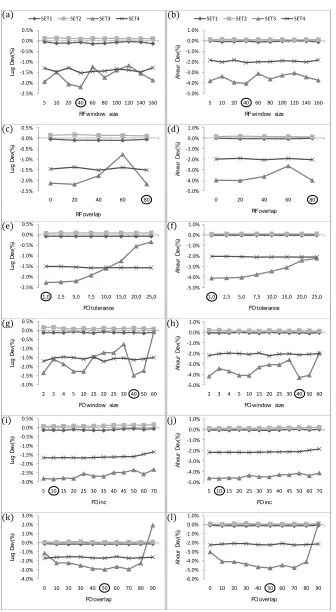
Next, the effects of changing these initial parameters were evaluated with computational tests
conducted over SET1 to SET4 of MLCLSP as shown by Figure 7. The new parameter values
achieve better results for the benchmark set of instance of MLCLSP. The average deviation for all
instances in each set is outlined and such results are compared to LugNP and Aheur. We calculate
the deviation (denoted by Dev(%)) for all instances, using the equation (21), whereSolRef refers
to the “Reference” solution, i.e., LugNP and Aheur.
Dev(%) =
SolRF F O−SolRef SolRef ·100
(21)
The effect of changing parameter values is negligible for the instances of SET1 and SET2, and
it also remains limited for the instances of SET3, whereas SET4 instances seem to be in general
quite sensitive to parameter changes. A large window for RF seems to be not as efficient as one
with 40 variables, where the results for SET4 seem to fluctuate as shown in Figures 7 (a) and (b).
The RF overlap rate of 80% seems to be slightly better than low values (Figures 7 (c) and (d)), and
increasing the preferable value of 1% for FO improvement tolerance worsens the results over SET4
(Figures 7 (e) and (f)). A large initial FO windows size with 40 variables gives some improvement
for all sets (Figures 7 (g) and (h)), with significant fluctuation for SET4 instances. Once FO fails
to improve solutions by 1%, an increment of 10 variables seems to be working best for increasing
submodels (Figures 7 (i) and (j)). Finally, the overlap rate of 50% produces slightly better average
deviations than the other values (Figures 7 (k) and (l)). We also present the improvement of
deviations after each parameter change from the initial settings in Figure 8, which indicates that
these adjustments have the biggest impact on SET4 instances.
As shown on all these cases, the RFFO performs better when RF and FO start solving MIP
sub-problems with the RF and FO window size of 40 variables. RF is able to obtain better solutions
for FO when 80% of its variables can be optimized (Overlap rate), while FO works better
re-optimizing 50% of its variables. Such behavior seems to be related to the fact that FO is an
improvement heuristic and RF is a construction heuristic, so RF needs to review past decision
more often to converge to a feasible solution. We also note that we have experimented with the
sensitivity of other parameters but seen insignificant differences in many cases. For example, RFFO
achieves average values less than 0.1% different when FO improvement tolerance is set as 5% and
10% in SET4. An exhaustive finer evaluation of these parameters and experimenting with other
test sets might potentially lead RFFO to achieve “optimal” performance. However, as noted earlier,
our main focus in this paper is to evaluate strategies regarding choices of decompositions of MIP
-4.0% -3.0% -2.0% -1.0% 0.0% 1.0% 2.0% 3.0%
0 10 20 30 40 50 60 70 80 90
Lu g D ev (% ) FO overlap -6.0% -5.0% -4.0% -3.0% -2.0% -1.0% 0.0% 1.0%
0 10 20 30 40 50 60 70 80 90
A he ur D ev (% ) FO overlap
5 10 15 20 25 30 35 40 45 50 60 70
Lu g D ev (% ) FO inc
5 10 15 20 25 30 35 40 45 50 60 70
A he ur D ev (% ) FO inc -3.0% -2.5% -2.0% -1.5% -1.0% -0.5% 0.0% 0.5%
2 3 4 5 10 15 20 25 30 40 50 60
Lu g D ev (% )
FO window size
2 3 4 5 10 15 20 25 30 40 50 60
A he ur D ev (% )
FO window size
1,0 2,5 5,0 7,5 10,0 15,0 20,0 25,0
Lu g D ev (% ) FO tolerance
1,0 2,5 5,0 7,5 10,0 15,0 20,0 25,0
A he ur D ev (% ) FO tolerance
0 20 40 60 80
Lu g D ev (% ) RF overlap
0 20 40 60 80
A he ur D ev (% ) RF overlap -2.5% -2.0% -1.5% -1.0% -0.5% 0.0% 0.5%
5 10 20 40 60 80 100 120 140 160
Lu g D ev (% )
RF window size
SET1 SET2 SET3 SET4
-5.0% -4.0% -3.0% -2.0% -1.0% 0.0% 1.0%
5 10 20 40 60 80 100 120 140 160
A he ur D ev (% )
RF window size
SET1 SET2 SET3 SET4
[image:17.612.140.476.62.674.2](a) (b) (c) (d) (e) (f) (g) (h) (i) (j) (k) (l) -2.5% -2.0% -1.5% -1.0% -0.5% 0.0% 0.5% -2.5% -2.0% -1.5% -1.0% -0.5% 0.0% 0.5% -3.0% -2.5% -2.0% -1.5% -1.0% -0.5% 0.0% 0.5% -5.0% -4.0% -3.0% -2.0% -1.0% 0.0% 1.0% -5.0% -4.0% -3.0% -2.0% -1.0% 0.0% 1.0% -5.0% -4.0% -3.0% -2.0% -1.0% 0.0% 1.0% -5.0% -4.0% -3.0% -2.0% -1.0% 0.0% 1.0%
Figure 7: Analysis of parameter values: (a,b) RF window size, (c,d) RF overlap rate, (e,f) FO
-0.07% -0.07% -0.07% -0.11% -0.13% -0.14% 0.00 0.00 0.00 0.00 0.00 0.00
-2.19% -2.19% -2.26% -2.48%
-2.85% -2.94% -1.52% -1.52% -1.50% -1.62% -1.67% -1.69%
-3.5% -3.0% -2.5% -2.0% -1.5% -1.0% -0.5% 0.0% 0.5%
RF size RF overlap FO tol. FO size FO inc FO overlap
Lu g D e v (% )
SET1 SET2 SET3 SET4
-0.03% -0.03% -0.03% -0.07% -0.10% -0.11%
0.10% 0.10% 0.09% 0.15% 0.08% 0.08%
-4.03% -4.03% -4.10%
-4.32%
-4.67% -4.78%
-2.06% -2.06% -2.04% -2.15% -2.20% -2.23%
-6% -5% -4% -3% -2% -1% 0% 1%
RF size RF overlap FO tol FO size FO inc FO overlap
A h e u r D e v (% )
[image:18.612.140.476.69.174.2]SET1 SET2 SET3 SET4
Figure 8: Successive improvements in the parameters: (a) Lug Dev(%), (b) Aheur Dev(%)
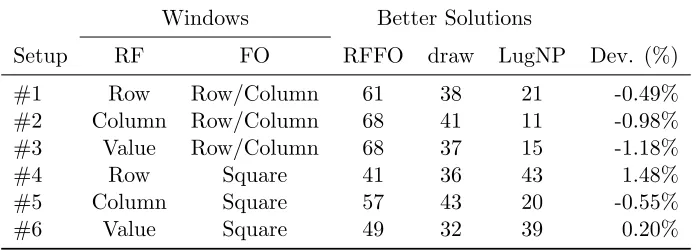
A total of six parameter setups were defined in order to determine which window type
combi-nation has better performance for MIP sub-models in RF and FO. Parameter setups #1 to #3 use
RF row-wise, column-wise and value-wise windows, respectively, combined with FO row/column
window (first type). Setups #4 to #6 use all RF windows combined now with FO square window
(second type). We executed all the six setups for all test instances, and the results were compared
to LugNP. Table 1 summarizes the results obtained by each setup, showing the number of better
solutions found by RFFO, LugNp and the draws. It is considered draw when the deviation of
solution values for some instance is less than 0.01%. The last column in Table 1 has the average
deviation of RFFO solutions against LugNP for all instances in all sets.
Table 1: Average deviation and number of better solutions in all sets for each window type combi-nation
Windows Better Solutions
Setup RF FO RFFO draw LugNP Dev. (%)
#1 Row Row/Column 61 38 21 -0.49%
#2 Column Row/Column 68 41 11 -0.98%
#3 Value Row/Column 68 37 15 -1.18%
#4 Row Square 41 36 43 1.48%
#5 Column Square 57 43 20 -0.55%
#6 Value Square 49 32 39 0.20%
The setup #3, which combined RF value-wise window and FO row/column-wise window, showed
the best performance with an average deviation of −1.18% as well as 68 wins over LugNP. The
combination of RF row-wise and column-wise with FO row/column-wise also returned improvement
from LugNP. However, the FO with square approach seems to be better only when combined with
RF column-wise. Thus, for the remainder of computational tests, we used setup #3.
Next, we present Figure 9, summarizing how the FO heuristic can improve the initial solution
[image:18.612.133.481.447.572.2]and Aheur for SET1 to SET4. RFFO was executed with the parameters values and window types
discussed earlier. RF on its own returns on average solutions with less quality compared to the
benchmark methods. However, the FO improves these initial solutions significantly for all of these
four test sets, in particular for SET3 and SET4.
5.18% 5.22%
3.27% 3.27%
-0.14% -0.11%
0.07% 0.08% -1%
0% 1% 2% 3% 4% 5% 6%
LugNP Aheur LugNP Aheur
SET1 SET2
D
ev
(%
)
RF RFFO
(a)
44.78% 41.99%
39.30% 38.56%
-2.94% -4.78% -1.69% -2.23%
-10% 0% 10% 20% 30% 40% 50%
LugNP Aheur LugNP Aheur
SET3 SET4
D
ev
(%
)
[image:19.612.137.479.150.254.2]RF RFFO (b)
Figure 9: Comparing RFFO with RF: (a) SET1 and SET2, (b) SET3 and SET4
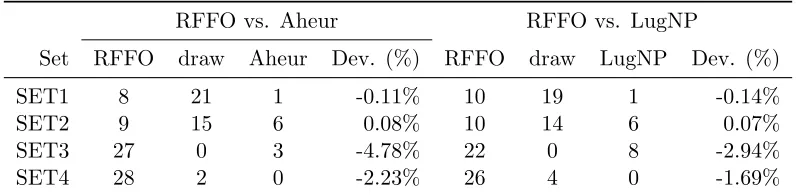
Finally, we discuss the results comparing the proposed RFFO approach against Aheur and
LugNP, as summarized in Table 2. Regarding average percentage improvement, the results for SET1
and SET2 are not necessarily improved by RFFO, where it achieved almost the same performance
as the benchmark methods with average deviations around 0.0%. This can be also seen by the
high number of draws, but RFFO was able to return better solutions than LugNp and Aheur for
both SET1 and SET2. On the other hand, RFFO outperforms the two benchmark methods in
SET3 and SET4, achieving more than 4% and 2% of average improvement, respectively. This is
quite significant, since these sets include the most challenging instances. Considering the number
of better final solution values, our proposed framework outperformed benchmark approaches for
more than 20 out of 30 instances in each of the sets SET3 and SET4.
Table 2: Number of better solutions and deviation values by set
RFFO vs. Aheur RFFO vs. LugNP
Set RFFO draw Aheur Dev. (%) RFFO draw LugNP Dev. (%)
SET1 8 21 1 -0.11% 10 19 1 -0.14%
SET2 9 15 6 0.08% 10 14 6 0.07%
SET3 27 0 3 -4.78% 22 0 8 -2.94%
SET4 28 2 0 -2.23% 26 4 0 -1.69%
Next we discuss detailed results for each data set, where tables with detailed results for all
instances are provided in the Appendix. We start with Tables 4 and 5 showing results for SET1 and
SET2 instances, respectively. We also provide the root node lower bounds with (`, S) inequalities of
[image:19.612.107.505.531.629.2]deviations are low and most of them are draws, with several deviations between 1.00% and 0.00%,
explaining the low average improvement. Compared to Aheur and LugNP, SET1 has the most
positive deviation of 0.24% and the most negative deviation (best improvement) of −0.80% from
Aheur and of−1.83% from LugNP, respectively. In SET2, it is worth to note that there are more
negative than positive values, but the high positive deviations for SET2 23, SET2 1 and SET2 7
are the main reasons for the positive average deviation reported in Table 2. Our computational
experience is that the instances in SET1 and SET2 are quite easy to solve in general, and therefore
harder to improve, most likely because the results from literature are already very good and close
to optimality. This can be verified by the results and comparisons carried on [2] and [30] to support
the performance of Aheur and LugNP against B&C.
Table 6 shows the results for SET3, where the results dominantly indicate negative deviations,
reaching−11.77% from Aheur and−9.18% from LugNP for the instances SET3 21 and SET3 16,
re-spectively. Another important remark to make is that RFFO improves Aheur and LugNP solutions
significantly (more than 5%) for 15 and 9 instances, respectively, whereas the worst performance for
RFFO is below 3.1% compared to these two benchmarks (in case of SET3 14, with 1.14% against
Aheur and 3.06% against LugNP in SET3 29). This is important since SET3 includes hardest to
solve instances in these problems.
Table 7 summarizes the results for SET4. The results are in line with the results of SET3,
indi-cating noticeable negative deviations (though slightly less significant compared to SET3). There is
no considerable positive deviation with 2 and 4 results considered draws, respectively, against Aheur
and LugNP. Negative deviations reach−8.53% against Aheur and−5.66% against LugNP, whereas
RFFO improves Aheur and LugNP solutions more than 3% for 8 and 7 instances, respectively.
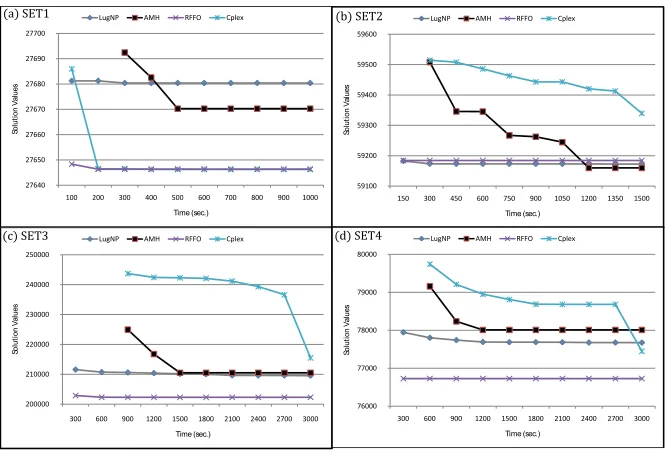
Finally, we present in Figure 10 computational performance of different methods (including
default Cplex) with extended computational times, where the average value of the best solutions
found by each method is given. All methods were executed for 10-fold time limits compared to our
original time limits, i.e., 1,000 seconds for SET1 instances (Figure 10(a)), 1,500 seconds for SET02
instances (10(b)), and 3,000 seconds for SET03 and SET04 instances (Figures 10(c) and 10(d)),
respectively.
We have omitted some initial values (e.g., Cplex and AMH first values for SET02), as they were
out of the scale of the graphs used and would have deteriorated the visualization otherwise. As
the graphs indicate, RFFO finds high quality solutions quickly and only improve these solutions
slightly during the extended times. Moreover, RFFO solutions over the extended times are only
27640 27650 27660 27670 27680 27690 27700
100 200 300 400 500 600 700 800 900 1000
So lu ti on V al ue s Time (sec.)
LugNP AMH RFFO Cplex
59100 59200 59300 59400 59500 59600
150 300 450 600 750 900 1050 1200 1350 1500
So lu ti on V al ue s Time (sec.)
LugNP AMH RFFO Cplex
200000 210000 220000 230000 240000 250000
300 600 900 1200 1500 1800 2100 2400 2700 3000
So lu ti on V al ue s Time (sec.)
LugNP AMH RFFO Cplex
76000 77000 78000 79000 80000
300 600 900 1200 1500 1800 2100 2400 2700 3000
So lu ti on V al ue s Time (sec.)
LugNP AMH RFFO Cplex
(a) SET1
(c) SET3
(b) SET2
[image:21.612.140.473.69.295.2](d) SET4
Figure 10: Computational performance of different methods with extended execution times.
1200 sec. RFFO is always better on average for all other sets showing a more stable performance
when compared with the other methods, achieving these solutions very quickly.
4.2 Results for TGCPSP
The effectiveness of our method is now evaluated solving the TGCPSP, where one of the key
differences compared to previous computational tests is that feasibility of the problems are not
guaranteed, which was ensured with the backlogging to the last period in case of MLCLSP. We
benchmark our results against those returned by the default Cplex solver and the hybrid genetic
algorithm (HGA) of [27], which is a custom-designed method specifically for TGCPSP. HGA runs
a genetic algorithm (GA) with several populations, where their individuals are hierarchically
struc-tured in trees, and integrated with simulated annealing (SA) and the so-called cavity heuristic
(CV). SA is applied over the best individual found by the GA at each generation to intensify the
search over its neighborhood. CV determines the number of mold cavities and, consequently, the
efficiency of the machine during the production process of containers. HGA ran 10 times over each
test problem within 1 hour, and the same time limit was spent by Cplex to solve each test problem
using the model described in section 2.2. More details about the algorithm and parameters used
can be found in [27].
The test problems, based on data provided by real-world glass container plants, are compounded
by 150 artificial and 150 real problems. The artificial set is generated randomly in an academic
instances with T ∈ {7,14} days, K ∈ {1,2,3,4,5} machines and N ∈ {5,10,20} products per
week. The real set corresponds to actual scenarios that happen in the glass container plants, where
the production process involvesT ∈ {14,28,56} days with a number of products around 10 to 90
per week, andK ∈ {2,3,4,5} machines per furnace. For each set of problems, the type of solution
returned by the Cplex solver within a 1 hour time limit is used to classify test problems as Optimal
(solver returns an optimal solution), Feasible (solver returns a feasible solution without guaranteed
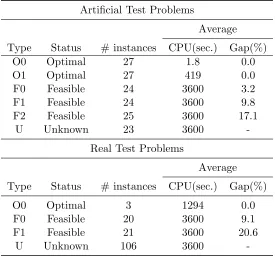
optimality), and Unknown (solver does not return a feasible solution). Table 3 indicates some
[image:22.612.169.444.254.510.2]characteristics of these test sets as well as their subsets.
Table 3: TGCPSP problem instances
Artificial Test Problems
Average
Type Status # instances CPU(sec.) Gap(%)
O0 Optimal 27 1.8 0.0
O1 Optimal 27 419 0.0
F0 Feasible 24 3600 3.2
F1 Feasible 24 3600 9.8
F2 Feasible 25 3600 17.1
U Unknown 23 3600
-Real Test Problems
Average
Type Status # instances CPU(sec.) Gap(%)
O0 Optimal 3 1294 0.0
F0 Feasible 20 3600 9.1
F1 Feasible 21 3600 20.6
U Unknown 106 3600
-We recall that for the MLCLSP problem discussed in the previous section, RFFO optimized the
setup variableswf t combining RF with value-wise window and FO with row/column-wise window,
meaning that FO first searches through rows (families f) and then through columns (periods t)
in the two-dimensional data structure of wf t. Since the setup variables Yitk of the TGCPSP are
three-dimensional, a further elaboration is necessary for the RFFO framework. This does not
pose a problem in executing RF with value-wise window, but a strategy to execute FO needs to
be adapted from the previous row/column-wise window. Based on our preliminary testing with
various options, we concluded to execute FO following first the sequence product-machine-period
and then machine-product-period as illustrated by Figure 11.
T1 T2 T3 T4 T5 T6
0 0 0 1 1 0 1 1 0 0 0 0 1 0 0 0 0 1 0 0 0 0 0 0 0 1 1 0 0 0 0 0 1 1 1 1
T1 T2 T3 T4 T5 T6
0 0 0 1 1 0 1 1 0 0 0 0 1 0 0 0 0 1 0 0 0 0 0 0 0 1 1 0 0 0
0 0 1 1 1 1
T1 T2 T3 T4 T5 T6
0 0 0 1 1 0 1 1 0 0 0 0 1 0 0 0 0 1 0 0 0 0 0 0 0 1 1 0 0 0 0 0 1 1 1 1
T1 T2 T3 T4 T5 T6
0 0 0 1 1 0 1 0 0 0 0 1 0 1 1 0 0 0 1 1 0 0 0 0 0 0 0 0 0 0 0 0 1 1 1 1
T1 T2 T3 T4 T5 T6
0 0 0 1 1 0 1 0 0 0 0 1 0 1 1 0 0 0 1 1 0 0 0 0 0 0 0 0 0 0
0 0 1 1 1 1
T1 T2 T3 T4 T5 T6
0 0 0 1 1 0 1 0 0 0 0 1 0 1 1 0 0 0 1 1 0 0 0 0 0 0 0 0 0 0 0 0 1 1 1 1
(a)
(b)
Free Fixed 0 1 Newly included variables
I1K1
I1K2
I2K1
I2K2
I3K1
I3K2
K1I1
K1I2
K1I3
K2I1
K2I2
K2I3
K1I1
K1I2
K1I3
K2I1
K2I2
K2I3
K1I1
K1I2
K1I3
K2I1
K2I2
K2I3
I1K1
I1K2
I2K1
I2K2
I3K1
I3K2
I1K1
I1K2
I2K1
I2K2
I3K1
[image:23.612.143.469.69.225.2]I3K2
Figure 11: Fix-and-Optimize: (a) machine-product-period and (b) product-machine-period. Three iterations of each direction are shown with window size = 5 and overlap rate = 60%.
for items Ii (products) and periods Ti. After to optimize on this way, the window in this
three-dimensional data-structure selects variables indexes in Figure 11(b) by items followed for machines
and periods.
We have executed RFFO for each test instance within the same time limit of 1 hour, where
we use the initial parameter settings presented in the previous section. First of all, to test the
flexibility of our approach, we executed RFFO on all the “Unknown” instances that were identified
by the default Cplex, which correspond to 15.3% and 70.7% of the artificial and real test problems,
respectively. In the same 1 hour limit, RFFO was able to find solutions for 56.5% and 20.8% of
these unknown instances, respectively, achieving failure rates of 6.67% and 56% in the overall sets
of artificial and real problems, respectively. Although the improvement over Cplex for the unknown
artificial instances is significant, the unknown real instances still present a challenge, in particular
due to their immense sizes and high number of binary variables (on average 3,329 for real problems).
In addition, the involvement of general integer variables complicate these problems significantly
and they were not specifically dealt within our RFFO framework in order to preserve the simple
structure presented earlier for mixed binary problems. Moreover, the performance might also be
affected by the fact that the accessibility of a feasible solution is less straightforward compared to
MLCLSP with backlogging, where the simple solution of zero production and backlogging total
demand to the last period is always feasible (but costly). We are currently investigating these areas
more thoroughly as needed and plan to address these challenges in our future research outcomes.
In order to evaluate the solution quality RFFO can achieve for TGCPSP, we have next executed
RFFO for all test instances that are not “Unknown”. Using the same time limit of 1 hour as Cplex
(RF F Od) and with the better parameter setting for the benchmark instances of the MLCLSP
(RF F O). Thus, the idea here is to evaluate the performance of RFFO running with the initial
values empirically obtained as well as with those parameter values customized to solve MLCLSP
instances.
In Figure 12, we compare all methods for the five subsets of artificial test problems involving 127
instances, where the gap (%) is calculated byGap(%) = (U pperBound−LowerBound)/(U pperBound)
using the best solution obtained by each method for U pperBound and the lower bound returned
by the branch & cut algorithm of Cplex for LowerBound.
0% 2% 4% 6% 8% 10% 12% 14% 16% 18%
O0 O1 F0 F1 F2
Gap
(%
)
[image:24.612.192.421.234.382.2]Articial test problems Cplex HGA RFFOd RFFO
Figure 12: GAP(%) comparisons for artificial test problems.
As Figure 12 indicates, RF F Od was able to find optimal solutions in the set of instances,
whose optimal values were returned by Cplex (O0 and O1), whereas HGA andRF F O could not
return optimal solutions for all test problems belonging to setO1 with average gaps 0.5% and 0.1%,
respectively. For the other three subsets of problems, where only feasible solutions were returned by
Cplex, all methods had similar performance with regards to solution quality, butRF F Odmanaged
to achieve consistently the lowest average gap value. This is promising, in particular considering
that HGA is a custom-designed method for these problems.
In Figure 13, we present the same evaluation for three subsets of real test problems involving 44
instances. Based on the results obtained by RF F Od for the artificial test problems, we have also
implemented a slightly modified version of RF F Od, named RF F O, where the order to optimize
variables in the FO is changed. In this case, the setup variablesYitkare optimized by FO following
first the sequence machine-product-period and then the sequence product-machine-period. Similar
to artificial instances, the three RFFO versions were able to find optimal solutions for the real
instances, for which Cplex could return their optimal values, while HGA did not manage to find the
0% 5% 10% 15% 20% 25%
O0 F0 F1
Gap
(%
)
Real test problems
[image:25.612.190.420.69.221.2]Cplex HGA RFFOd RFFO RFFO
Figure 13: GAP(%) comparisons for real test problems.
almost the same average gap value as Cplex, whereas the modified version RF F O outperforms
Cplex and HGA for the set F0 and outperforms Cplex for set F1. On the other hand, HGA
generates better solutions on average than RFFO for the set F1, but our results are competitive,
considering that HGA is specifically designed for these problems. As the experimentation with
RF F O indicated, we remark that other changes in RFFO parameters can potentially improve its
performance as it was done for the benchmark set of MLCLSP. However, as a general framework,
it works effectively. Finally, we note that RFFO is currently designed to optimize only binary
variables, but a more sophisticated RFFO framework could handle general integer variables of the
TGCPSP more efficiently, which we plan to address in near future.
5.
Conclusion
A hybrid method, RFFO, was proposed by combining two well-known heuristics, relax-and-fix
(RF) and fix-and-optimize (FO). A simple combination is proposed, where RF is used to build an
initial solution which is further improved by the FO in available computational time. The RFFO is
applied to the Multi Level Capacitated Lot-Sizing Problem (MLCLSP) with backlogging and
Two-stage Glass Container Production Scheduling Problem (TGCPSP). Using various test problems
available from the literature, the proposed method was benchmarked to state-of-the-art methods
from literature: Aheur of [2] and LugNP of [30] for MLCLSP, which are also heuristics based on
mathematical programming, and HGA of [27] for TGCPSP, which is a genetic algorithm.
In the proposed approach, both heuristics use mathematical programming to solve mixed-integer
subproblems defined by a certain amount of binary variables. These variables define a window that
moves in the solution matrix using different orientations. Also, the number of binary variables
the FO.
Different strategies to traverse the matrix optimizing the binary variables were proposed and
tested, where the best one reported combines a value-wise RF with row/column-wise FO. Thus, the
results reported indicate better initial solutions returned by RF when the optimization is focused
on relaxed variables closer to 0.5, followed by FO working better trying to optimize separately rows
and columns oriented variables. The best setup found allowed the proposed method significantly
outperform the benchmark approaches in two out of four test sets of MLCLSP. However, it was
also able to return competitive results in the other two sets. More importantly, the results indicate
a better performance of RFFO in the more complex test instances of SET3 and SET4. Similarly,
three configuration of RFFO were also able to return competitive results for the more sophisticated
problem of TGCPSP, outperforming default Cplex regularly and obtaining better or comparable
results with HGA, which is a fast and efficient custom-built method for these problems. We believe
that RFFO is overall an effective method for lot-sizing problems with varying characteristics.
As future work, we plan to conduct extensive computational testing on different combinations
of parameter values. This would give better insight into sensitivity of different sizes for the MIP’s
solved by RF and FO, as well as different overlap rate values. We are also currently investigating
combining RF and FO with other meta-heuristics. For instance, RF could be used to provide
different initial solutions if a random criteria is incorporated in the value-wise strategy. Also
the proposed FO heuristic could be applied as local search to improve better solutions found by
other meta-heuristics. Another area to investigate is the potential improvement of the method if
it exploited the specific problem structure. We plan to study this for different settings, e.g., for
overtime.
Finally, we note that the design proposed in this paper is generic and problem-independent. To
verify its robustness, we plan to extend this approach to more general MIP problems that naturally
have a sequential decision making structure, including problems with general integer variables. In
this case, it is in particular our special interest to investigate MIP problems where the RF heuristic
could fail to determine an initial solution. Thus, another construction heuristics could be applied
taking advantage from the partial solution provided by the proposed RF. We are currently
inves-tigating some crew scheduling problems with this framework.
Acknowledgements
We would like to thank Dr. Tao Wu for providing us the code of LugNP heuristics used in the
Pesquisa do Estado de S˜ao Paulo (FAPESP) projects 2010/10133-0, 2011/15534-5 and 2011/15581-3
and Conselho Nacional de Desenvolvimento Cient´ıfico e Tecnol´ogico (CNPq) projects
483474/2013-4 and 312967/201483474/2013-4-483474/2013-4.
References
[1] N. Absi, B. Detienne, and S. Dauz`ere-P´er`es. Heuristics for the multi-item capacitated lot-sizing
problem with lost sales. Computers & Operations Research, 40(1):264 – 272, 2013.
[2] K. Akartunalı and A.J. Miller. A heuristic approach for big bucket multi-level production
planning problems. European Journal of Operational Research, 193(2):396–411, 2009.
[3] K. Akartunalı and A.J. Miller. A computational analysis of lower bounds for big bucket
production planning problems. Computational Optimization and Applications, 53(3):729–753,
2012.
[4] B. Almada-Lobo, D. Klabjan, M.A. Carravilla, and J.F. Oliveira. Multiple machine continuous
setup lotsizing with sequence-dependent setups.Computational Optimization and Applications,
47(3):529–552, 2010.
[5] C. Almeder. A hybrid optimization approach for multi-level capacitated lot-sizing problems.
European Journal of Operational Research, 200:599–606, 2010.
[6] M.F. Baki, B.A. Chaouch, and W. Abdul-Kader. A heuristic solution procedure for the
dy-namic lot sizing problem with remanufacturing and product recovery.Computers & Operations
Research, 43(0):225 – 236, 2014.
[7] M.O. Ball. Heuristics based on mathematical programming. Surveys in Operations Research
and Management Science, 16(1):21 – 38, 2011.
[8] I. Barany, T. J. van Roy, and L. A. Wolsey. Uncapacitated lot sizing: The convex hull of
solutions. Mathematical Programming Study, 22:32–43, 1984.
[9] G. Belvaux and L. A. Wolsey. bc-prod: A specialized branch-and-cut system for lot-sizing
problems. Management Science, 46(5):724–738, 2000.
[10] P.J. Billington, J.O. McClain, and L.J. Thomas. Heuristics for multilevel lot-sizing with a
[11] Z. Degraeve and R. Jans. A new Dantzig-Wolfe reformulation and branch-and-price algorithm
for the capacitated lot-sizing problem with setup times. Operations Research, 55(5):909–920,
2007.
[12] G. D. Eppen and R. K. Martin. Solving multi-item capacitated lot-sizing problems using
variable redefinition. Operations Research, 35(6):832–848, 1987.
[13] A. Federgruen, J. Meissner, and M. Tzur. Progressive interval heuristics for multi-item
capac-itated lot sizing problem. Operations Research, 55(3):490–502, 2007.
[14] M. Florian, J. K. Lenstra, and H. G. Rinnooy Kan. Deterministic production planning:
Algo-rithms and complexity. Management Science, 26(7):669–679, 1980.
[15] S. Helber and F. Sahling. A fix-and-optimize approach for the multi-level capacitated lot sizing
problem. International Journal of Production Economics, 123:247–256, 2010.
[16] S. K´eb´e, N. Sbihi, and B. Penz. A lagrangean heuristic for a two-echelon storage capacitated
lot-sizing problem. Journal of Intelligent Manufacturing, 23(6):2477–2483, 2012.
[17] J. Krarup and O. Bilde. Plant location, set covering and economic lotsizes: An O(mn)
algo-rithm for structured problems. Optimierung bel Graphentheoretischen und Ganzzahligen
Prob-leme, pages 155–180. BirkhauserVerlag, 1997.
[18] S. K¨u¸c¨ukyavuz and Y. Pochet. Uncapacitated lot-sizing with backlogging: The convex hull.
Mathematical Programming, 118(1):151–175, 2009.
[19] A.J. Miller, G.L. Nemhauser, and M.W.P. Savelsbergh. On the polyhedral structure of a
multi-item production planning model with setup times. Mathematical Programming,
94(2-3):375–405, 2003.
[20] MIPLIB. A library of pure and mixed integer problems. http://miplib.zib.de/. Last
accessed on 29/12/2014, 2010.
[21] Multi-LSB. Multi-item lot-sizing problems with backlogging: A library of test
in-stances. DOI: 10.15129/252b7827-b62b-4af4-8869-64b12b1c69a1, http://dx.doi.org/10.
15129/252b7827-b62b-4af4-8869-64b12b1c69a1. Last accessed on 29/12/2014, 2014.
[22] Y. Pochet and L. A. Wolsey. Production Planning by Mixed Integer Programming. Springer,
[23] R. Ramezanian and M. Saidi-Mehrabad. Hybrid simulated annealing and mip-based heuristics
for stochastic lot-sizing and scheduling problem in capacitated multi-stage production system.
Applied Mathematical Modelling, 37(7):5134 – 5147, 2013.
[24] R.L. Rardin and L.A. Wolsey. Valid inequalities and projecting the multicommodity extended
formulation for uncapacitated fixed charge network flow problems. European Journal of
Op-erational Research, 71(1):95–109, 1993.
[25] F. Seeanner, B. Almada-Lobo, and H. Meyr. Combining the principles of variable
neighbor-hood decomposition search and the fix&optimize heuristic to solve multi-level lot-sizing and
scheduling problems. Computers & Operations Research, 40(1):303–317, January 2013.
[26] H. Stadtler. Multilevel lot sizing with setup times and multiple constrained resources:
Inter-nally rolling schedules with lot-sizing windows. Operations Research, 51:487–502, 2003.
[27] C.F.M. Toledo, M. da Silva Arantes, R.R.R. de Oliveira, and B. Almada-Lobo. Glass container
production scheduling through hybrid multi-population based evolutionary algorithm. Applied
Soft Computing, 13(3):1352 – 1364, 2013.
[28] C.F.M. Toledo, R.R.R. de Oliveira, and P.M. Fran¸ca. A hybrid multi-population genetic
algorithm applied to solve the multi-level capacitated lot sizing problem with backlogging.
Computers & Operations Research, 40(4):910 – 919, 2013.
[29] M. Van Vyve and Y. Pochet. A general heuristic for production planning problems.INFORMS
Journal on Computing, 16(3):316–327, 2004.
[30] T. Wu, L. Shi, J. Geunes, and K. Akartunalı. An optimization framework for solving
ca-pacitated multi-level lot-sizing problems with backlogging. European Journal of Operational
A.
Appendix
Table 4: Comparison for SET1 instances (time limit = 100s)
Solution values Deviation (%)
SET1 XLP Aheur LugNP RFFO Aheur LugNP
1 17,888 22,382.5 22,460.7 22,382.1 0 -0.35
2 23,534 27,584.8 27,584.8 27,584.6 0 0
3 21,227 25,187.3 25,187.3 25,246.6 0.24 0.24
4 22,232 26,334.7 26,334.7 26,334.7 0 0
5 21,446 25,145.5 25,145.5 25,145.8 0 0
6 22,974 26,667.4 26,770.8 26,667.5 0 -0.39
7 20,360 24,123.8 24,123.8 24,124.2 0 0
8 25,582 29,640.4 29,640.4 29,639.8 0 0
9 16,321 20,971.2 21,362.7 20,971.0 0 -1.83
10 17,998 22,645.8 22,647.5 22,562.8 -0.37 -0.37
11 11,080 12,955.6 12,955.6 12,955.3 0 0
12 24,721 26,831.3 26,831.3 26,831.1 0 0
13 20,782 23,127.8 23,127.8 23,128.5 0 0
14 22,264 25,035.8 25,035.8 25,036.0 0 0
15 12,401 14,118.1 14,118.1 14,117.9 0 0
16 15,122 17,540.2 17,400.1 17,400.1 -0.80 0
17 20,468 23,007.5 23,007.5 22,996.2 -0.05 -0.05
18 11,075 12,973.8 12,973.8 12,973.8 0 0
19 13,276 16,502.9 16,502.9 16,349.2 -0.93 -0.93
20 14,101 17,158.6 17,158.6 17,158.7 0 0
21 10,159 12,421.2 12,421.2 12,421.1 0 0
22 38,040 40,158.3 40,188.7 40,158.4 0 -0.08
23 29,331 30,605.7 30,605.7 30,605.5 0 0
24 28,858 32,190.4 32,145.5 32,007.2 -0.57 -0.43
25 51,371 52,989.2 52,959.9 52,960.3 -0.05 0
26 39,379 41,221.5 41,221.5 41,221.0 0 0
27 40,838 43,319.7 43,319.7 43,289.6 -0.07 -0.07
28 39,846 40,993.5 41,019.8 40,993.5 0 -0.06
29 23,155 25,492.6 25,322.3 25,322.0 -0.67 0
Table 5: Comparison for SET2 instances (time limit = 150s)
Solution values Deviation (%)
SET2 XLP Aheur LugNP RFFO Aheur LugNP
1 46,116 52,050.7 52,050.7 52,339.4 0.55 0.55
2 47,780 53,863.4 53,713.4 53,713.0 -0.28 0
3 40,551 46,894.5 47,053.2 46,893.3 0 -0.34
4 36,347 43,009.8 42,977.1 43,063.1 0.12 0.20
5 45,395 51,757.6 51,757.6 51,768.8 0.02 0.02
6 45,902 51,858.1 51,858.1 51,858.4 0 0
7 52,825 58,153.8 58,153.8 58,425.2 0.47 0.47
8 48,033 54,396.2 54,449.6 54,182.9 -0.39 -0.49
9 37,553 43,737.8 43,737.8 43,690.0 -0.11 -0.11
10 38,751 45,278.8 45,278.8 45,305.8 0.06 0.06
11 65,210 68,488.8 68,646.4 68,487.8 0 -0.23
12 62,792 66,561.9 66,474.5 66,475.4 -0.13 0
13 34,778 39,120.3 39,082.7 38,852.7 -0.68 -0.59
14 62,907 66,373.7 66,383.2 66,325.1 -0.07 -0.09
15 59,079 61,574.1 61,574.1 61,574.0 0 0
16 75,682 79,364.8 79,385.0 79,363.9 0 -0.03
17 36,809 41,298.6 41,282.4 41,192.6 -0.26 -0.22
18 77,873 81,561.8 81,562.9 81,562.5 0 0
19 54,981 58,426.1 58,426.1 58,425.4 0 0
20 119,568 122,827.6 122,827.6 122,829.0 0 0
21 22,281 24,013.2 24,014.2 24,013.3 0 0
22 51,279 52,887.1 52,887.1 52,886.8 0 0
23 29,793 32,618.2 32,708.8 33,713.9 3.36 3.07
24 65,891 68,640.6 68,575.1 68,574.8 -0.10 0
25 75,627 78,064.3 78,088.2 78,064.2 0 -0.03
26 60,952 63,275.2 63,285.6 63,273.2 0 -0.02
27 53,016 54,794.1 54,794.1 54,793.9 0 0
28 44,545 46,607.9 46,607.9 46,607.6 0 0
29 93,631 96,278.0 96,157.4 96,152.0 -0.13 0