THE OXFORD HANDBOOK OF REGULATION
Editors
Martin Cave, Robert Baldwin and Martin Lodge
CHAPTER 15
REGULATORY IMPACT ASSESSMENT
Claudio M. Radaelli and Fabrizio De Francesco University of Exeter
Abstract
This chapter brings theories and conceptual frameworks to bear on the analysis of regulatory impact analysis (RIA). First, we introduce the reader to the different notions and debates on the two sides of the Atlantic. We then provide the theoretical justifications of RIA, contrasting principal-agent explanations with pluralist and civic-republican rationales, and exploring the key issue of rationality in rulemaking. Turning to evidence, we discuss empirical papers and more conceptual studies carried out recently, and make some critical remarks. Finally, we suggested how research on RIA can be usefully organized, covering the economic, administrative, and political consequences of regulatory oversight.
REGULATORY IMPACT ASSESSMENT1
INTRODUCTION
Regulatory impact assessment (RIA) has spread throughout the globe
(Ladegaard 2005; Jacobs 2006; Kirkpatrick & Parker 2007; Kirkpatrick, Parker & Zhang 2004; Weatherill 2007; Wiener 2006). Based on systematic consultation, criteria for policy choice, and the economic analysis of how costs and benefits of proposed regulations affect a wide range of actors, RIA is a fundamental
component of the smart regulatory state advocated by international organizations (OECD 2002). The European Commission (Commission 2001) has hailed RIA as a tool for transparent and accountable governance in multi-level political
systems.
RIA (or simply Impact Assessment, IA) is a systematic and mandatory appraisal of how proposed primary and-or secondary legislation will affect certain categories of stakeholders, economic sectors, and the environment. “Systematic” means coherent and not episodic or random. “Mandatory” means that it is not a voluntary activity. Essentially, RIA is a type of administrative procedure, often used in the pre-legislative scrutiny of legislation. Its sophistication and analytic breadth vary, depending on the issues at stake and the resources available - the degree of sophistication should be proportional to the salience and expected effects of the regulation. Indeed, the expected effects analyzed via RIA may cover administrative burdens or basic compliance costs, or more complex types of costs and benefits, including environmental benefits, distributional effects, and the impact on trade. The scope of economic activities covered by RIA ranges from some types of firms to whole economic sectors, competitiveness and the overall economic impact of regulations. RIA can also be used to appraise the effects of proposed regulations on public administration (e.g., other departments, schools, hospitals, prisons, universities) and sub-national governments. Although
1The support of the Economic and Social Research Council, research grant No.
RIA is often used to estimate the impact of proposed regulation, it can be used to examine the effects of regulations that are currently in force, for example with the aim of eliminating some burdensome features of existing regulations or to choose the most effective way to simplify regulations
For political scientists, however, what matters is a set of theoretical questions about governance, the steering capacity of the core executive in the rulemaking process, and the changing nature of the regulatory state. In a recent review article on regulatory politics in Europe, Martin Lodge shows that a ‘recent interest has focused on the growth of ‘regulatory review’ mechanisms across national states (regulatory impact assessments) as well as their utilization at the EU level’ (Lodge 2008: 289).
In this chapter we review the theoretical underpinnings of this ‘recent interest’ comparing the two sides of the Atlantic. We introduce the logic of RIA and the terms of the debate in the US and Europe in Section 1. We proceed by exploring different theoretical explanations in Section 2. We draw on principal-agent models, but also show their limitations and consider alternative theories of regulation. In Section 3, we move from theory to empirical evidence, and report on the main findings and their implications. Section 4 brings together theories and empirical evidence, and introduces a framework for research. Section 5 concludes.
1. INTRODUCTION: THE POLITICAL LOGIC OF RIA ADOPTION
At the outset, a theoretical investigation of RIA needs a conceptual framework to grasp the essential design features of the rulemaking process. In turn, this invites a joint consideration of regulation theories and theories of the administrative process, to assess the broader governance implications of impact assessment as tool and the centralized review of rulemaking as process.
the US political system in mind. Within this system, the key features are delegation to regulatory agencies, Presidential oversight of rulemaking, the presence of a special type of administrative law (the reference is to the
Administrative Procedure Act, APA), and judicial review of rulemaking. These features should not be taken for granted when we try to explain the adoption of RIA in systems different from the US. In Europe for example, administrative procedure acts are less specific on rulemaking. There is more direct ministerial control on delegated rulemaking. And rulemaking has a wider connotation, covering the production of rules by parliaments as well as agencies.
With this caveats in mind, the first logic of RIA adoption is based on delegation. The main political dimension of RIA lies with power relationship between the principal and the agent. Congress delegates broad regulatory power to agencies. Federal executive agencies, however, are not insulated from
Presidential control exercised via the Office for Information and Regulatory
Affairs (OIRA) within the Office for Management and Budget (OMB). Although we will return to this constitutional issue, doctrine and practice have recognized that the executive is a unitary entity, so there is a legitimate degree of control of rulemaking to be exercised by the President. A variant of this explanation is RIA as an instrument to pursue the regulatory paradigm of the President. Thus, one can argue that RIA is introduced to foster de-regulation and stop regulatory initiatives of zealous executive agencies. Centralized review of rulemaking can also trigger action, overcome the bureaucratic inertia of ‘ossified’ agencies, and shift policy towards a pro-regulatory stance (Kagan 2001). Note that in the former case agencies are seen as excessively active, in the latter as inertial, but the logic of Presidential control is the same.
The second logic comes from democratic governance. Administrative procedure is used to change the opportunity structure in which actors (the executive, agencies, and the pressure groups, including civil society
Finally, there is a logic based on rational policy-making. The logic at work here is that RIA fosters regulations that increase the net welfare of the community
(Arrow, Kenney, Cropper, Eads & Hahn 1996). Underlying this notion is the requirement to use economic analysis systematically in rule-formulation (re-stated in all US Executive Orders starting from Reagan’s 12,291, but defined in much milder forms in European guidelines). 2 Of course, the notion of ‘rationality
of law’ or ‘legal rationality’ is more complex, referring to process as well as economic outcomes (Heydebrand 2003). And sometimes rationality is used as synonymous of independence from the political sphere, as shown by the long tradition of technocratic political and legal theory in the US, from James Landis to Stephen Breyer and Bruce Ackerman.3Academics have aired several
perplexities on instrumental rationality and the possibility of direct influence of evidence-based tools on policy choice. Scholars of RIA are puzzled by the repeated reference, in governmental guidelines on the economic analysis of proposed regulation, to rational synoptic theories of the policy process, although experience has shown the empirical and normative limitations of these theories (Jacob et al. 2008; Radaelli 2005). Perhaps this is a case of ‘triumph of hope over experience’ (Hood and Peters 2004). Or perhaps the truth is that, as Sanderson puts it, ‘in spite of the post-modernist challenges, a basic optimism about the role of scientific knowledge remains embedded in western liberal democratic political systems’ (Sanderson 2004:367).
In the US, the different rationales for RIA have spawned a lively debate among constitutional scholars, political scientists and administrative lawyers about who is in control of the rulemaking process. In Europe, what we have said about logics chimes with the discussion on the regulatory state - or regulatory capitalism (Levi-Faur 2005; Lodge 2008). The rationale for RIA in terms of executive dominance over the administration can be read across two images of
2 Note however that, following Sunstein (2004), the public can never be ‘rational’ in evaluating risks. RIA therefore has to cope with the challenge of transforming these non-rational evaluations into rational ones.
the regulatory state – i.e., political control and symbolic politics. Looking at the UK, a leading author (Moran 2003) has found that the regulatory state triggers the colonization of areas of social life that were previously insulated from political interference and managed like clubs. Thinking of the European Union (EU), it has been argued that:
The process of market-oriented regulatory reform in Europe (…) has
not meant the emergence of an a-political regulatory state solely devoted to the pursuit of efficiency and completely divorced from a more traditional conception of the state that would stress the pursuit of political power, societal values and distributional goals. (Jabko 2004: 215, emphasis in original)
However, political control can also lead to symbolic politics via rituals of verification (Power 1999). Given the increasing relational distance between principal and agents generated by de-centralization, contracting out and the creation of independent agencies, formal procedures replace trust and
administrative procedure replaces informal coordination. If political organizations produce knowledge about the expected impact of policy to increase their
legitimacy rather than efficiency (Brunsson 1989), we would expect tools like RIA to play a role in the symbolic dimension of the regulatory state.
The open governance logic is based on changes of the opportunity
structure that break down tight regulatory policy networks, blend instrumental and communicative rationality, and create the preconditions for reflexive social
learning (Sanderson 2002). The opportunity structure is tweaked to offer more pluralism (as neo-pluralist notions of the regulatory state have it) or to promote civic republican governance – we will return to these concepts in the next Section.
expert-based decisions that converges with recent theoretical work in economics (Alesina & Tabellini 2007, 2008). Regulatory legitimacy – Majone (1996) carries on – is eminently a question of rational and transparent processes. Regulators are credible if they provide reasons for their choices, support decisions with transparent economic analysis and objective risk analysis, and enable courts to review their decisions. Yet again, we find the logic of rational policy-making, this time linked to new forms of accountability and legitimacy (Vibert 2007: chapters 8 and11).
2. DELEGATION, GOVERNANCE, AND RATIONALITY
Having introduced the broad logic(s) of RIA, let us now be more specific on the causal chain leading to adoption. In this Section, we present a classic rational choice explanation about the political control of bureaucracy. We then enter some limitations and criticisms internal to this explanation, before we attend to
external critiques – looking at the neo-pluralism and civic republican models. Finally, we consider the key concept of rationality.
In rational choice theory, the regulatory process is characterized by demand and supply. In the regulatory market place, however, information asymmetries (moral hazard, adverse selection, and signaling) are more serious than in markets for goods and services. Principal-agent models - developed to explain how delegation problems are solved - shed light on the nature of RIA as a type of administrative procedure.
Delegation generates the problems of bureaucratic and coalitional drifts. The former is a direct consequence of delegation: once power has been
Noll & Weingast 1989). Coalition drift arises out of the fact that agencies may over time produce rules that do not reflect the original deal made by political principals and their most relevant constituencies for support (i.e., the pressure groups that entered the original deal) (Horn & Shepsle 1989; Macey 1992).
Positive political theorists predict that the regulatory process will be dominated by organized subgroups, leading to diffuse collective loss.
Following this theoretical template, administrative procedure is used to exchange information on the demand and the supply of regulation. The design of administrative procedure limits the participation of broader interest groups and facilitates rent-seeking, overcoming the limitations of the incentive structure. Indeed, procedures reduce the principal-agent slack and ‘enfranchise important constituents in the agency’s decision-making, assuring that agencies are
responsive to their interest’ (McCubbins, Noll & Weingast 1987: 244). Moreover, the ‘most interesting aspect of procedural controls is that they enable political leaders to assure compliance without specifying, or even necessarily knowing, what substantive outcome is most in their interest’ (McCubbins Noll & Weingast. 1987: 244). As such, administrative procedure belongs to the politics of structure (as opposed to the politics of specific policy issues), that is, how institutions with different interests compete to control, change, and exercise public authority (Moe & Wilson 1994: 4).
Overall, RIA as administrative procedure solves the principal’s problem of controlling bureaucracies. Its position within the family of control systems is perhaps unique. Whilst some instruments operate either ex ante (e.g., statutes and appointments) or ex post (e.g., judicial review of agency’s rulemaking), RIA provides on-going control. It operates whilst rules are being formulated and regulatory options are assessed.
Some questions and qualifications arise within the principal-agent theory territory – we shall move to ‘external’ critiques later on. For a start, there are multiple principals (Miller 2005). Consequently, it becomes difficult to predict who has control. Further, the intuitions about fire-alarms in regulatory policy
(McCubbins & Schwartz 1984) were put forward to make the case for
Congressional dominance, but the empirical evidence for Congressional control of executive agencies is poor and ambiguous (Kagan 2001: 2259). Even if they are put to work, Congressional fire-alarms are at best status-quo preserving, reactive, and discrete. Consequently, they cannot produce a comprehensive consideration of regulatory matters (Kagan 2001: 2260).
Political appointees can be useful to the President by identifying
preferences or by framing the policy issues (Hammond & Knott 1999). As shown by Moe and Wilson (1994), the Presidency as institution has several structural advantages over Congress, and centralized review of rulemaking has been successfully used to move the balance of power from Congress to the White House.
However, the determination of preferences of special groups can be problematic. One of the major difficulties in RIA is the identification of ‘who wants what’ at an early stage, when regulatory options are fleshed out. Models of rulemaking coalitions show the complexity of preferences constellations across principals and clients within large coalitions (Waterman & Meier 1998). And perhaps the White House or Congress do not really want to exercise control all the time – it is often efficient to let the agent figure out what the diverse
Another consideration is that the theory of delegation is too static without a theory of negotiation (Kerwin 2003:278-279). Under conditions of multiple
principals, problematic identification of preferences, and uncertainty about how the courts will ‘close’ the incomplete contract between agent and principal, negotiation plays a fundamental role.
More importantly still, the standard formulation of principal-agent theorizing about administrative procedure does not tell us how the agency responds. Here we need a model of the bureaucracy. There are professional differences within agencies – scientific/technical personnel respond to CBA less favorably than personnel trained in policy analysis (West 1988). The question is not simply one of training, but rather one of different visions of the nature of the rulemaking process. Add that the same individual behaves rationally or morally depending on the changing characteristics of the environment and the specific regulatory interaction at stake (Ayers & Braithwaite 1992). This reminds us of the ‘mixed motives’ Downsian bureaucrats of Inside Bureaucracy. Given this
heterogeneity, agencies can rely on different organizational forms, such as team, hierarchy, outside advisor, adversary, and hybrid models (McGarity 1991). This observation on internal organization and professional background hints at a possible fruitful combination of formal models of rulemaking with management theories (Hammond & Knott 1999).
Normatively speaking, the notion of control over regulatory agencies has spawned a debate among constitutional and administrative lawyers that takes us beyond rational choice theorizing. The questions, often revolving around the centralized presidential review of rulemaking rather than the existence of RIA, are ‘who has control of rulemaking’ and whether this can be justified. The
discussion has been heated4, with hints of ‘religious zeal’ (Blumstein 2001: 852).
With these remarks on the constitutional dimension in mind, we are ready to move on to the next question, i.e., what are the models of governance within
which we situate RIA? Political control of the bureaucracy (whether in the form of congressional dominance or unitary executive) is not the only option. The neo-pluralism and civic republican models provide alternatives.
In neo-pluralist theory, RIA (and more generally administrative procedure) is adopted to produce equal opportunities for pressure groups (see Arnold 1987) on environmental impact assessment). Granted that regulatory choice is about collecting information from different sources and balancing different values, RIA can be used to ensure that all the major interests affected compete in a level-playing field. Transparency and open processes of rulemaking are necessary conditions for neo-pluralist politics to operate optimally. The explanation of why the executive adopts RIA is not very clear. One must assume that elected officials want to change the opportunity structure to achieve conditions that approximate the neo-pluralist ideal-type. The government may want to do this under pressure from the median voter. As a matter of fact, Congress passed statues that increase participation in the rulemaking process, such as the
Consumer Protection Act (1972), the Occupational Safety and Health Act (1970), and the Toxic Substance Control Act (1976). The courts have also imposed requirements on agency to release data, disclose the basis of discussions with pressure groups, and carry out public hearings.
One problem with interest-group-oriented models – Kagan (2001: 2267) notes – is that group pressure results in ‘burdens and delay on agencies and thus make them reluctant to issue new rules, revisit old rules, and experiment with temporary rules’. Thus, the pluralist model may be – together with the
General Counsel of the EPA comparing formal procedures to the Japanese Kabuki theater).
The civic republican theory argues that under proper conditions, actors are able to pursue the broader community interest (Ayres & Braithwaite 1992;
Seidenfeld 1992; Sunstein 1990). This model of the regulatory state provides a direct participatory role to public interest groups, civil society organizations, and citizens. It goes beyond pluralism: weaker groups and the community as a whole are deliberately empowered. Instead of technocratic decision-making, we end up with fully political and participatory policy-making styles (Bartle 2006).
Within the civic republican theory, Croley expects RIA to provide ‘an opportunity for public-spirited dialogue and deliberation about regulatory
priorities’ (Croley 1998: 102). A civic republican RIA will therefore aim at making the community stronger. Regulatory choices will be less about measuring the costs and benefits of regulation, less about making market deals, and would look more like deliberation about major trade-offs in multiple policy sectors (Ayres & Braithwaite 1992: 17; Morgan 2003: 224).
Finally, one can turn to a governance model based on rationality and self-control of agencies, on the basis of the technocratic theories mentioned above. If rationality means efficient decisions, for example by using CBA, this still raises the question why would a government want to increase the efficiency of the regulatory process? This is where Majone’s non-majoritarian regulatory state offers an explanation, based on credibility, the separation between regulatory policy and other policy types, and procedural legitimacy.
It has been argued that the OMB cannot preserve rationality in the regulatory process by using CBA and at the same time exercise a function of political control (Shapiro, 2005). However, a classic objection is that the
President, unlike individual members of Congress, is elected by the whole nation and therefore will care about the broad costs and benefits affecting all
constituencies (Kagan 2001: 2335). Presidents also care about leadership. Their individual interests are consistent with the institutional interests of the
Presidency. On issues of structure the President will go for changes that increase the power of the Presidency over Congress, not for special interests politics (Moe & Wilson, 1994: 27).
In consequence, there may be no trade-off between political control, effectiveness, and accountability (Kagan 2001: on effectiveness see pp. 2339-2346). The personnel in charge of review is pretty much stable across political parties and administrations, thus increasing the likelihood of technical analysis, leaving to the President the political duty to provide overall direction to the agencies.
To sum up then, this rich theoretical debate shows that rational choice theories of delegation provide a useful benchmark with clearly testable
implications. The neo-pluralist and civic-republican theories have more normative appeal, although they are less clear on the propositions that can be tested
empirically and the logic of introduction of RIA. Notions of rationality enter intervening variables in the explanation.
parliamentary, not presidential (with the partial exception of France). So the question is whether there are functional equivalents to Presidential control, otherwise RIA would play a completely different role.
3. THE EFFECTS OF RIA: EMPIRICAL EVIDENCE
One critical issue here is to work on concept formation before we move on to measurement. Another is to categorize and measure changes brought about by RIA, being aware that indirect-cumulative effects of knowledge utilization over a long period of time are more important than short-term instrumental use (or lack of) (Weiss, 1979). A third caveat is to control for the null hypothesis of ‘no effects of RIA’. A fourth tricky issue – Cary Coglianese (2002) reminds us - is
counterfactual reasoning: would the change have taken place in any case without RIA?
A classic method for the evaluation of changes is the observational study. There are two types of observational study: longitudinal and cross-sectional (Coglianese, 2002). A longitudinal study compares the outcomes of
administrative procedure over time; a cross-sectional study compares regulatory outcomes in the same period between a group of countries operating under the procedure and another one that does not.
3.1 Longitudinal-quantitative studies
Economists have carried out longitudinal and quantitative empirical studies. The first group of quantitative studies deals with the accuracy of the cost and benefit estimates. Morgenstern, Pizer, and Shih (2001) assess the relationship between costs reported in RIAs and the actual economic costs. They conclude that
generally regulatory costs are overestimated, a conclusion shared by other authors. Harrington, Morgenstern, and Nelson (2000) compare the ex ante cost predictions made by OSHA and EPA in twenty-five rulemaking with ex post findings made by independent experts. They argue that cost overestimation is essentially due to the lack of consideration of ‘unanticipated use of new
recent literature review however, concludes that costs and benefits are poorly estimated in the US, but it is not clear if there are systematic biases (Hahn & Tetlock 2008). Recent studies on European countries show very limited use of sophisticated assessment tools (Nilsson et al. 2009).
Another group of quantitative studies has assessed the soundness of economic analyses through scorecards and checklists. Scorecards provide measures of the overall impact of different regulations, relying on economic performance indicators such as costs, benefits, lives or life-years saved, cost-effectiveness, etc (Hahn 2005). However scorecards – it has been argued - disregard un-quantified costs and benefits, neglect distributive impacts and do not disclose the true level of uncertainty (Heinzerling 1998; Parker 2000). Checklists are a collection of quality assurance measures (generally expressed in Y/N format). Hahn and associates have developed checklists of US RIAs (Hahn, 1999; Hahn, Burnett, Chan, Mader, & Moyle, 2000). This approach has also been used for the European Commission’s impact assessment (Lee & Kirkpatrick, 2004) (Renda, 2006; Vibert, 2004) and to compare the US with the EU system (Cecot et al. 2008). International organizations and audit offices make use of scorecards and checklists for evaluation purposes (Government
Accountability Office 2005; National Audit Office (NAO) 2004; OECD 1995). What do we know about the overall consequences of RIA (as process) on the final regulatory outcomes? Croley (2003) has considered correlations
between the following: the type of rule and the likelihood of change; the type of interest group and the likelihood of change; the type of agency and the likelihood of change; the type of agency and the likelihood of an OIRA meeting. He finds significant correlations between rule stage, type of rule significance, and written submissions, on the one hand, and the frequency with which submitted rules were changed, on the other.
trade-groups opposing the regulation predict the probability of rejection of ineffective regulation better than the cost-per-life-saved variable (Farrow 2000). This seems to corroborate the rational choice theorists’ understanding of RIA.
Recent empirical analyses have focused on the relationship between regulators and pressure groups. Interest groups seem to be able to discern which among several methods of participation is the most effective in achieving
congenial regulatory outcome (Furlong and Kerwin, 2005; Schultz Bressman & Vandenbergh 2006, followed by critical remarks made by Katzen 2007) Looking at the correlation between public comments to forty regulations and the direct influence of interest groups, Yackee (2006) concludes that regulatory agencies change their initial proposals to accommodate interest groups’ preferences. Yet another case in which rational choice understandings are supported by empirical evidence.
Overall, quantitative research provides answers to the question of
rationality and RIA. Looking at the US evidence accumulated up until now, Hahn and Tetlock conclude that the quality of economic analysis is pretty much stable across time and is always below the standards set by the guidelines. It is difficult – they add – to find evidence that economics has had a substantial impact on regulatory decisions in the US. Nevertheless, there is a marginal effect (marginal changes do count for large sums of money in major decisions) and, more difficult to prove, a deterrent effect on bad rules that we would otherwise have seen in the statute book (Hahn & Tetlock 2008).
3.2 Longitudinal-qualitative studies
– although the regulatory policy paradigm may change between one administration and the next.
The critics of the OMB see its analytical function overshadowed by
political priorities (Heinzerling 2002; McGarity 1991; Shapiro 2005; 2007); others argue that the OMB has defended principles of cost-effectiveness and risk-risk analysis that would otherwise been neglected by agencies motivated exclusively by their statutory objectives (Breyer 1993; Pildes & Sunstein 1995; Viscusi Vernon & Harrington 1995).
OMB’s control – it has been argued - goes against the constitutional architecture designed by Congress to delegate power to agencies - not to the White House (Morrison 1986). Others have added that OMB’s review alters ‘the division of power between the Congress and the President in controlling the decision making; the objectivity and neutrality of the administration; and the role of administrative procedure and courts’ (Cooper & West 1988: 864-865). Cooper and West find that OMB’s review has increased the centralization and
politicization of rulemaking, thus exasperating the negative effects on democratic governance of the politics/administration dichotomy. In the American political system – they argue - the public interest emerges out of a process of decision making, so ‘each branch must then retain sufficient power to play an influential policy role in both the legislative and administrative processes’ (Cooper and West 1988: 885).
In the opposite camp, Shane (1995) finds that centralized review of regulatory policy is consistent with the constitutional separation of powers - the issue is whether there is a specific justification for a presidential order on the rulemaking process. DeMuth and Ginsburg (1986) note that the President, in order to advance his policies, has to control administrative rulemaking of executive agencies.
agrees that centralized Presidential control has increased. Paradoxically (for those who see centralized control as synonymous of de-regulation) it has been institutionalized and even enhanced during the Clinton year. Since the early years, this feature of the system has appeared irreversible, with power shifts towards the institutional Presidency (Moe & Wilson 1994; West 2006).
Recent studies do not question that Presidential power has increased, but reveal much less pro-active coordination and more reactive and politically
oriented (as opposed to analytical) intervention than one would expect (Shapiro 2005; 2007; West 2006). This chimes with earlier findings such as that RIA has been an effective means of detecting and shaping those policies of federal executive agencies that impact on the key constituencies of the President (Cooper & West 1988). Considering a more organizational and political
framework, RIA has sometimes enabled agencies to look at rule formulation in new and sometimes often creative ways – McGarity (1991: 157, 308) concludes – but with the danger of promoting the regulatory economists’ hidden policy agendas ‘behind a false veneer of objectivity’.
The broader discussion around the politics of structure and the constitutional issues raised by the administrative state has carried on (Rosenbloom 2000). Congress has responded to the Presidency’s use of regulatory review by directing the OMB not to interfere with special-interest legislation (Moe & Wilson 1994: 39) and by securing Senate confirmation of OIRA heads, as well as more public information and precise deadlines on the review process. Since OIRA was initially authorized to run for a limited period, Congress had the opportunity to stop funding and-or ask for major concessions, but ‘it did not take on the President directly in an all-out assault’ (Moe & Wilson 1994: 39).
The justifications of centralized review have also evolved, from
rulemaking has emerged – apart from some original attempts to frame the
discussion on the European Union impact assessment system (Meuwese 2008).
3.3 Emerging topics
An emerging topic in comparative research is diffusion (De Francesco 2008). In diffusion studies one can contrast rationalistic explanations for the adoption of RIA with emulation and mimicry (Radaelli 2005: 925). Specifically on
implementation, the formal adoption of roughly similar RIA models in Europe has not been followed by the same pattern of implementation (Radaelli 2005).
Economics and law alert us that transplantation is a source of inefficiency of institutional choice (Shleifer 2005: 448; Wiener 2006). Hence the transplant of RIA in political systems that do not present functional equivalents to the US may produce completely different outcomes.
Another way of looking at the different implementation patterns of similar policy innovations is to consider the political and administrative costs and benefits (Moynihan 2005). For a politician, to adopt a general provision on how regulatory proposals should be empirically assessed has low cost and high political benefits – in terms of signals sent to international organizations and the business community. To go beyond it and write guidelines, create oversight structures, and implement the guidelines across departments and agencies is politically and economically expensive. Given that the benefits of a
well-implemented RIA program emerge only in the medium and long-term, that is after the next elections, there is an incentive to opt for symbolic adoption. Robust networks of RIA stakeholders, however, can change this perverse incentive structure and lay the foundations for institutionalization (Radaelli 2004: 743).
Another strand of research has looked at the difference between
that better regulation may promote the rise of a meta-regulatory state within the state as a counterweight to the de-centralization of regulation (Black 2007). Finally, there have been attempts to connect the analysis of RIA and more generally better regulation in Europe with the broad intellectual questions posed by the New Public Management (Radaelli & Meuwese 2008).
4. TOWARDS A RESEARCH AGENDA
On balance, the state of the art is not quite up to the expectations. Most of the studies are based on the US, and are not longitudinal. Diffusion studies and systematic, rigorous comparisons that take context and history into account are almost absent. There is much more emphasis on measurement than on theory and concept formation. Studies on Africa and Asia are emerging (Kirckpatrick et al. 2004), but there is no consolidated knowledge on how donor requirements to introduce RIA, administrative capacity, and the quality of democracy affect implementation.
This raises the challenge of working in a comparative mode, with suitable research questions on (a) the process of diffusion, (b) the role of political
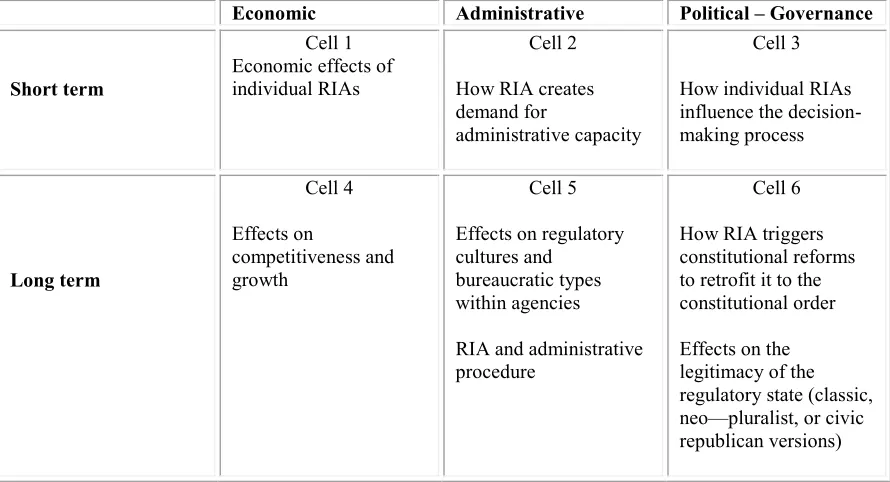
institutions, and (c) the political consequences of RIA. Research questions falling in category (a) could usefully test the hypothesis that RIA is used to increase central political control versus the hypotheses of emulation and coercion. In category (b), RIA becomes a dependent variable, and more work should be done on what specific features of the institutional context have what type of effects. As for category (c), the research questions are whether RIA (this time as
independent variable) has economic, administrative or political impacts, in the short or long-term, as shown in table 1. Cells 1 and 4 are more suitable for the economic analysis of RIA.
mark on the types of civil servants mentioned by West and McGarity. Cell 5 also reminds us of the long-term relationship between administrative procedure and RIA. We do not know much about how administrative law shapes European RIA processes and vice versa. The political effects bring us into cells 3 and 6, and to major governance-constitutional issues at the core of the academic discussion on regulatory governance and regulatory capitalism.
Table 1 – A typology of consequences brought about by RIA
Economic Administrative Political – Governance
Short term
Cell 1 Economic effects of individual RIAs
Cell 2 How RIA creates demand for
administrative capacity
Cell 3 How individual RIAs influence the decision-making process Long term Cell 4 Effects on competitiveness and growth Cell 5 Effects on regulatory cultures and
bureaucratic types within agencies RIA and administrative procedure
Cell 6 How RIA triggers constitutional reforms to retrofit it to the constitutional order Effects on the legitimacy of the regulatory state (classic, neo—pluralist, or civic republican versions)
At the macro level, the major research question is about RIA and the regulatory state. One way to address it is to go back to the different logics. Does RIA bring economic rationality to bear on regulatory choices? Does it increase executive control? Does it foster the emergence of new modes of regulatory governance, arguably a smart, democratic, open regulatory state?
where there are sharply contrasting views. An innovative way to look at
rationality-efficiency is to ask whether resources for evidence-based policy are optimized across the life-cycle. A dollar invested in RIA cannot be invested in ex-post policy evaluation – hence the opportunity cost of ex-ante analysis is given by the money that is not invested in ex-post evaluation or in any type of
assessment taking place after regulation decisions have been made. Other research questions concern the effects of a specific type of rationality at work in RIA, that is, cost-benefit analysis. In this connection, an interesting issue is about the long-term impact of RIA as comprehensive
economic rationality. One of the most powerful insights provided by McGarity is about the conflict between comprehensive and techno-bureaucratic rationality within US agencies. Agencies may deal with conflict by using team models to integrate the two types of rationality, or by using adversarial internal processes to take the benefits of a well-argued defense of different ways to look at regulatory problems and their solutions (McGarity 1991). It would be useful to use this framework in a comparative mode. Different administrative traditions, attitudes of the civil servants, decision-making styles provide classic variables to control for. It would also be interesting to know if the clash between techno-bureaucratic approaches and economic rationality is bringing about a new hybrid of rationality.
The most important issues for lawyers and political scientists revolve around political control and the overall impact on constitutional settings. Rational choice theorists rightly show that RIA is not a politically neutral device to provide more rational decision-making. We argued that principal-agent modeling should be supplemented by (a) a theory of negotiation, (b) a thorough understanding of the administrative process, and (c) public management theory to understand who wins the control game. One may reason that agencies get captured by the
regulated. Majone, instead, would reason that being perceived as fair and relatively un-biased regulatory analysis is essential. Others would argue that overall there has been a decent Congressional and judicial retrofitting of the administrative state, and the constitutional balance is overall preserved
RIA architectures, in which there has been almost no discussion cast in terms of constitutional politics - specifically, in relation to the parliamentary nature of these political systems at a time of increasing strength of the core executive.
5. CONCLUSIONS
Long time ago, Thomas McGarity (1991: 303) observed that ‘regulatory analysis is currently in a state of awkward adolescence. It has emerged from its infancy, but it has not yet matured’. It is useful to distinguish between RIA as
phenomenon and the academic literature on this topic. As a phenomenon, regulatory oversight has been diffused throughout the globe. In some countries, such as Canada, the UK, and the US RIA has been institutionalized. The recent experience of the EU, where RIAs are produced and used systematically in policy formulation, shows that the institutionalization may take less than a
decade. In other countries, there has been adoption followed by implementation problems and lack of convergence. This has led to some frustrations with the rationalistic ambitions of RIA: although academics have provided new moral and decision-making foundations for cost-benefit analysis (Adler and Posner 2006), most countries outside the US have implemented soft or warmer versions of CBA (Wiener 2006 uses the notion of ‘warm’ CBA) or stripped-down analyses of administrative burdens (Helm 2006; Jacob et al 2008; Jansen and Voermans 2006). Looking at the future, impact assessment may evolve into more complex activities of regulatory management. Thus, RIA activity may well feed into the construction of systems of regulatory budgeting and regulatory agendas (Doern 2007).
and theorists of political control like Weingast. Rational choice theorists are only one of the natural academic constituencies of RIA. The other is made up of scholars who are broadly interested in developing our understanding of
governance, and how rationality of different types affects policy-making. RIA can also offer insights on new forms of symbolic politics.
To achieve this, more theory-grounded comparative research is essential, possibly controlling for broader, long-term consequences and for the historical-institutional context. This type of analysis can usefully inform the debates on the regulatory state and constitutional change, as well as the normative appraisal of governance architectures.
References
Adler,MD and EA Posner (2006) New Foundations of Cost-Benefit Analysis, Cambridge (MA): Harvard University Press.
Alesina A, Tabellini G (2007) Bureaucrats or politicians? Part 1 - A single policy task. American Economic Review, 97(1) March: 169-179.
Alesina A, Tabellini G (2008) Bureaucrats or politicians? Part II: Multiple policy tasks. Journal of Public Economics, 92 April: 426-447.
Arrow KJ, Kenney J, Cropper ML, Eads GC, Hahn RW (1996) Benefit-Cost Analysis in Environmental, Health, and Safety Regulation: AEI Press, Washington DC.
Ayers I, Braithwaite, J. (1992). Responsive Regulation: Transcending the Deregulation Debate. Oxford University Press, Oxford.
Ayres I, Braithwaite J (1992). Responsive Regulation: Transcending the Deregulation Debate. Oxford University Press, Oxford.
Baldwin R (2005) Is better regulation smarter regulation? Public Law (Autumn) 485-511.
Bartle I (2006) Legitimising EU regulation: procedural accountability,
participation, or better consultation? In Bellamy R, Castiglione D, Shaw J (Eds.), Making European Citizens: Civic Inclusion in a Transnational Context. (pp. 133-154) Palgrave, Basingstoke.
Black J (2007) Tensions in the Regulatory State. Public Law, 58-73.
Blumstein JF (2001) Regulatory review by the executive office of the President: An overview and policy analysis of current issues. Duke Law Journal
51(December), 851-899.
Brunsson N (1989). The Organization of Hypocrisy: Talk, Decisions and Actions in Organizations. John Wiley and Sons, Chirchester and New York. Carroll P (2007) Moving from form to substance: measuring regulatory
performance in a federal state. ECPR General Conference. Pisa.
Cecot C, Hahn RW, Renda A Schrefler L (2008)An Evaluation of the Quality of Impact Assessment in the European Union with Lessons for the U.S. and the EU. Regulation and Governance, 2(4).
Coglianese C (1997) Assessing consensus: The promise and performance of negotiated rulemaking. Duke Law Journal 46, 1255-1349.
Coglianese C (2002). Empirical analysis and administrative law. University of Illinois Law Review 2002(4), 1111-1137.
Commission (2001) European governance – a white paper. European Commission, Brussels.
Cooper J, West WF (1988) Presidential power and republican government: the theory and practice of OMB review of agency rules. Journal of Politics
50(4), 864-895.
Croley SP (1998) Theories of regulation: Incorporating the administrative process. Columbia Law Review 98(1), 1.
De Francesco F (2008) Pre-requisites of adoption and patterns of diffusion: The case of regulatory impact analysis in European Union and OECD member states.Paper presented at the Political Studies Association 58th annual conference, University of Swansea, 1-3 April 2008.
DeMuth CC, Ginsburg DH (1986) White House review of agency rulemaking.
Harvard Law Review, 99(5), 1075-1088.
Doern, B (2007) Red Tape-Red Flags: Regulation in the Innovation Age,
Conference Board of Canada CIBC Scholar-in Residence Lecture. Ottawa.
Farrow S (2000) Improving Regulatory Performance: Does Executive Office Oversight Matter. Working paper available at
http://www.reg-markets.org/publications/index.php?tab=author&authorid=181.
Froud J, Boden R, Ogus A, Stubbs P (1998) Controlling the Regulators, Palgrave Macmillan, Houndmills, Basingstoke.
Furlong SR, Kerwin CM (2005) Interest group participation in rule making: A decade of change. Journal of Public Administration Research and Theory
15(3), 353-370
Government Accountability Office (2005) Highlights of a workshop on economic performance measure. Government Accountability Office, Washington DC.
Graham JD (2007) The evolving role of the US Office of Management and Budget in regulatory policy. AEI-Brookings Joint Center for Regulatory Studies. Washington DC.
Jansen WA, W. J.M. Voermans (2006), Administrative burdens in the
Hahn RW (1999) Regulatory Reform: Assessing the Government's Number.
AEI-Brookings Joint Center Working Paper No. 99-06 Washington, DC. Hahn RW (2005) In Defense of the Economic Analysis of Regulation.
AEI-Brookings Joint Center for Regulatory Studies, Washington DC. Hahn RW, Burnett JK, Chan YI, Mader EA, Moyle PR (2000) Assessing the
Quality of Regulatory Impact Analyses. AEI-Brooking Joint Center for Regulatory Studies, Washington DC.
Hahn RW, Tetlock PC (2008) Has Economic Analysis Improved Regulatory Decisions? Journal of Economic Perspectives 22(1), 67-84.
Hammond TH, Knott J (1999) Political institutions, public management, and policy choice. Journal of Public Administration Research and Theory 9(1), 33-86.
Harrington W, Morgenstern RD, Nelson P (2000) On the Accuracy of Regulatory Cost Estimates. Journal of Policy Analysis and Management 19, 2), 297-322.
Heinzerling L (1998) Regulatory Costs of Mythic Proportions. Yale Law Journal 107(7), 1981-2070.
Heinzerling L (2002) Five-hundred life-saving interventions and their misuse in the debate over regulatory reform. Risk: Health, Safety & Environment 13(Spring), 151-175.
Helm D (2006) Regulatory reform, capture, and the regulatory burden. Oxford Review of Economic Policy 22(2), 169-185.
Heydebrand W (2003) Process rationality as legal governance: A comparative perspective. International Sociology 18(2), 325-49.
Hood, C. and G.B. Peters. 2004. ‘The Middle Aging of New Public Management: Into the Age of Paradox?’, Journal of Public Administration Research and Theory, 14, 267–282.
Horn MJ, Shepsle KA (1989) Administrative process and organizational form as legislative responses to agency costs. Virginia Law Review 75, 499-509. Jabko N (2004) The political foundations of the European regulatory state. In
Jordana J. Levi-Faur D (Eds.) The Politics of Regulation - Institutions and Regulatory Reforms for the Age of Globalization (pp. 200-217). Edward Elgar Publishing Cheltenham, UK.
Jacob, K., J. Hertin, P. Hjerp, C.M. Radaelli, A.C.M. Meuwese, O. Wolf, C. Pacchi and K. Rennings. 2008. ‘Improving the Practice of Impact Assessment’, EVIA Policy Paper,
http://web.fu-berlin.de/ffu/evia/EVIA_Policy_Paper.pdf.
Jacobs S (2006) Current trends in regulatory impact analysis: the challenges of mainstreaming RIA into policy-making. Jacobs and Associates,
Washington DC.
Kagan E (2001) Presidential administration. Harvard Law Review 114, 2245-2385.
Katzen S (2007) A reality check on an empirical study: Comments on 'Inside the administrative state' Michigan Law Review 105(7), 1497-1510.
Kirkpatrick C, Parker D (2007) Regulatory Impact Assessment: Towards Better Regulation? Edward Elgar Publishing Cheltenham, UK.
Kirkpatrick C, Parker, D, Zhang, YF (2004) Regulatory impact assessment in developing and transition economies: a survey of current practice. Public money and management, 24(5), 291-296.
Ladegaard P (2005) Improving business environments through Regulatory Impact Analysis - Opportunities and challenges for developing countries.
International conference on reforming the business environment, Cairo, Egypt, December 29, available at
www.businessenvironment.org/dyn/be/docs/80/Session3.4LadegaardDoc. pdf.
Lee N, Kirkpatrick C (2004) A Pilot Study on the Quality of European
Commission Extended Impact Assessment. Impact Assessment Research Centre, Institute for Development Policy and Management, University of Manchester, 21 June.
Levi-Faur D (2005) The Global Diffusion of Regulatory Capitalism. Annals of the American Academy of Political and Social Science, 598(1), 12-32.
Lodge M (2008) Regulation, the Regulatory State and European Politics. West European Politics, 31(1), 280-301.
Macey, JR (1992) Organizational design and political control of administrative agencies. Journal of Law, Economics, and Organization, 8(1), 93-110. Majone, GD (1989) Evidence, Argument and Persuasion in the Policy Process
(1st ed.). Yale University Press, New Haven and London. Majone GD (1996) Regulating Europe. Routledge, London.
McCubbins MD, Noll, RG, Weingast BR (1987) Administrative procedures as instruments of political control. Journal of Law, Economics, and
Organization 3(2), 243-277.
McCubbins MD, Noll RG, Weingast BR (1989) Structure and process, politics and policy: administrative arrangements and the political control of agencies. Virginia Law Review 75, 2, 431-482.
McCubbins MD, Schwartz T (1984) Congressional oversight overlooked: police patrols versus fire alarms. American Journal of Political Science 28(1), 165-179.
McGarity TO (1991) Reinventing Rationality The Role of Regulatory Analysis in the Federal Bureaucracy. Cambridge University Press, Cambridge. McGarity TO (1992) Some thoughts on “deossifying” the rulemaking process.
Duke Law Journal, 41(6), 1385-462.
Meuwese ACM (2008). Impact assessment in EU law-making. Alphen aan den Rijn: KluwerLaw International.
Miller GJ (2005) The political evolution of principal-agent models. Annual Review of Political Science 8, 203-225.
Moe T, Wilson SA (1994) Presidents and the politics of structure. Law and Contemporary Problems 57(2, Spring), 1-44.
Morgan B (2003) Social Citizenship in the Shadow of Competition. Ashgate, Aldershot Hants.
Morgenstern RD, Pizer WA, Shih, JS (2001) The cost of environmental protection. Review of Economics and Statistics 83(4), 732-738.
Morrison AB (1986) OMB interference with agency rulemaking: the wrong way to write a regulation. Harvard Law Review 99(5), 1059-1074.
Moynihan DP (2005). Why and How Do State Governments Adopt and Implement "Managing for Results" Reforms? Journal of Public Administration Research and Theory 15(2), 219-243.
National Audit Office (NAO). (2004). Evaluation of Regulatory Impact
Assessments Compendium Report 2003-04 (Report by the Comptroller and Auditor General, HC 358 Session 2003-2004). London: The
Stationery Office.
Nilsson M. Jordan A, Turnpenny J, Hertin J, Nykvist B, Russel D (2009, forthcoming) 'The use and non-use of policy appraisal in public policy making: An analysis of three European countries and the European Union', Policy Sciences
OECD (1995) Recommendation on Improving the Quality of Government Regulation (Recommendation to the OECD countries). Council of the OECD, Paris.
OECD (2002) Regulatory Policies in OECD Countries: From Interventionism to Regulatory Governance. OECD: Paris.
Parker RW (2000) Grading the government. University of Chicago Law Review 70, 1345-1486.
Pildes R, Sunstein CR (1995) Reinventing the Regulatory State. University of Chicago Law Review, 62(1), 1-129.
Posner EA (2001) Controlling agencies with cost-benefit analysis: a positive political theory perspective. University of Chicago Law Review, 68, 1137-1199.
Power M (1999) The Audit Society: Rituals of Verification2nd edition. Oxford University Press, Oxford.
Radaelli CM (2004) The diffusion of regulatory impact analysis: Best-practice or lesson drawing? European Journal of Political Research 43(5), 723-747. Radaelli CM (2005) Diffusion Without Convergence: How Political Context
Shapes The Adoption Of Regulatory Impact Assessment. Journal of European Public Policy 12(5), 924-943.
Radaelli CM, Meuwese ACM (2008) Better regulation in Europe: Administration, public management, and the regulatory state.Paper presented at the European Consortium for Political Research - Joint Sessions of Workshops University of Rennes, France, 11-16 April 2008, Rennes, France.
Renda A (2006) Impact Assessment in the EU. The State of the Art and the Art of the State. Centre for European Policy Studies, Brussels.
Rosenbloom DH (2000) Retrofitting the administrative state to the constitution: Congress and the judiciary's twentieth century progress. Public
Sanderson I (2002) Evaluation, policy learning and evidence-based policy making. Public Administration 80(1), 1-22.
Sanderson, I. (2004). Getting evidence into practice: Perspectives on rationality.
Evaluation, 10(3), 366-379.
Schout A, Jordan, A. (2007). The EU’ governance ambitions and administrative capacity, Journal of European Public Policy, 15(7): 957-974..
Schultz Bressman L, Vandenbergh, M P (2006). Inside the administrative state: A critical look at the practice of presidential control. Michigan Law Review
105, 47-100.
Seidenfeld M (1992) A Civic Republican Justification for the Bureaucratic State.
Harvard Law Review, 105(7), 1511-1576.
Shane PM (1995) Political accountability in a system of checks and balances: the case of presidential review of rulemaking. Arkansas Law Review 48, 161. Shapiro S (2005) Unequal partners: Cost-benefit analysis and executive review
of regulation. Environmental Law Reporter 7, 10433-10444.
Shapiro S (2007) Assessing the benefits and costs of regulatory reforms: What questions need to be asked, AEI-Brooking Joint Center on Regulation. Shleifer A (2005) Understanding regulation. European Financial Management
11(4), 439-451.
Sunstein CR (1990) After the Rights Revolution: Reconceiving the Regulatory State. Harvard University Press, Cambridge, Massachusetts.
Sunstein CR (2004) Risk and Reason: Safety, Law and the Environment, Cambridge: Cambridge University Press.
Vibert F (2004) The EU's New System of Regulatory Impact Assessment - A Scorecard. EPF, London.
Vibert F (2007) The Rise of the Unelected. Democracy and the New Separation of Powers, Cambridge, Cambridge University Press.
Viscusi K, Vernon JM, Harrington JE (1995) Economics of Regulation and Antitrust. MIT Press, Cambridge, Massachusetts.
Waterman RH, Meier KJ (1998). Principal-agent models: An expansion? Journal of Public Administration Research and Theory 8(2), 173-202.
Weatherill S (2007) Better Regulation. Hart Publishing, Oxford. Weiss CH (1979) The many meanings of research utilization. Public
Administration Review 39 (5): 426-431.
West WF (1988) The growth of internal conflict in administrative regulation.
Public Administration Review 48(4), 773-782.
West WF (2005a) Administrative rulemaking: An old and emerging literature.
Public Administration Review 65(6), 655-668.
West WF (2005b) The institutionalization of regulatory review: Organizational stability and responsive competence at OIRA. Presidential Studies Quarterly 35(1), 76-93.
West WF (2006) Presidential Leadership and Administrative Coordination: Examining the Theory of a Unified Executive. Presidential Studies Quarterly 36(3), 433-456.
Yackee SW (2006) Sweet-talking the fourth branch: The influence of interest group comments on federal agency rulemaking. Journal of Public Administration Research and Theory, 16(1), 103-124.