City, University of London Institutional Repository
Citation: Midgley, G.R. (1992). Unity and pluralism. (Unpublished Doctoral thesis, City University London)
This is the accepted version of the paper.
This version of the publication may differ from the final published version.
Permanent repository link: http://openaccess.city.ac.uk/7893/
Link to published version:
Copyright and reuse: City Research Online aims to make research outputs of City, University of London available to a wider audience. Copyright and Moral Rights remain with the author(s) and/or copyright holders. URLs from City Research Online may be freely distributed and linked to.
UNITY AND PLURALISM
Gerald Robert Midgley
Ph.D. Thesis
City University
Department of Systems Science
TABLE OF CONTENTS
TITLE . . . 1
TABLE OF CONTENTS . . . 2
TABLES AND ILLUSTRATIONS . . . 12
~C1CN()~LEDC;E]1ENTS . . . 14
COPYRIGHT . . . 14
ABSTRACT . . . 15
CHAPTER 1: THE ~IMS OF THE THESIS . . . 16
1.1 The Structure . . . 17
1.2 Section 1: Pluralism and Critical Systems . . . 19
1.2.1 Introducing the Basic Issues .. 19
1.2.2 The 'Problem' of Pluralism . . . . 21
1.3. Section 2: Contexts of the Debate about Pluralism . . . 22
1.3.1 Unity and Pluralism . . . 23
1.3.2 Social and Ecological Contexts . . . 24
1.4 Section 3: Epistemology, Ontology and Legitimation . . . 26
1.4.10ntology . . . 26
1.4.2 The Legitimation of Systems Science . . . 27
SECTION 1: PLURALISM AND CRITICAL SYSTEMS
THINKING . . . 30
CHAPTER 2: WHY IS THE PHILOSOPHY OF SCIENCE USEFUL? . . . 31
2.1 Description or Prescription? ... 31
2.2 Conclusion . . . 34
CHAPTER 3: PERSONAL EXPERIENCES . . . 35
3.1 Studying Psychology . . . 36
3.2 Research at Portugal Prints . . . 37
3.3 Research for the Gordon Hospital . . . 43
3.4 The Microjob Research . . . 45
3.5 Conclusion . . . 49
Notes . . . 50
CHAPTER 4: PLURALISM . . . 51
4.1 Pluralism . . . 51
4.2 Paradigmatic Conflicts: Hard versus Soft . . . 53
4.3 Breaking the Stalemate . . . 54
4.4 Six Approaches to Methodology ... 55
4.5.1 Methodological Additions . . . 67
4.6 Creative Methodology Design . . . 70
4.7 An Ideal of Research Practice ... 73
4.8 Conclusion . . . 75
Notes . . . 75
CHAPTER 5: AN INTRODUCTION TO CRITICAL SYSTEMS
IDEAS . . . 81
5.1 Embryonic Critical Systems
Ideas . . . 83
5.2 Critical Systems Heuristics . . . 90
5.3 The Influence of the Idea of
Pluralism . . . 98
5.4 Pluralism and the Three
Interests Revisited . . . 103
5.5 Methodological Ideals in
Critical Systems Practice . . . 106
5.5.1 The Methodological Ideals . . . . 107
5.5.2 Meta-Methodology: Total
Systems Intervention . . . 111
5.6 Conclusion . . . 114
Notes . . . 114
CHAPTER 6: DIVERSIFICATION IN CRITICAL SYSTEMS
THINKING . . . 11 7
6.1 The Paradigm of Communicative
CHAPTER 7:
6.2 Deeper Ontological and
Epistemological Reflections .... 124
6.3 The Need for a Substantive Soft Systems Language . . . 128
6.4 Power and Ideology . . . 129
6.5 Liberate and Critique . . . 140
6.6 Liberate, Critique, Empower and Transform . . . 149
6.7 A Summary of Emergent Themes ... 151
6.8 Conclusion . . . 152
Notes . . . 153
THE 'PROBLEM' OF PLURALISM . . . 157
7.1 What is a Paradigm? . . . 157
7.2 The Idea of "Meta-Paradigm" .... 158
7.3 The Problem . . . 161
7.4 Is Pluralism a Genuinely Distinct Approach? . . . 162
7.4.1 The Subsumptive Nature of Pluralism . . . 162
7.4.2 From Subsumption to Isolationism . . . 167
7.5 Critical Systems Thinking as a Paradigm . . . 168
7.6 Conclusion . . . 169
CHAPTER 8: PLURALISM AND CRITICAL SYSTEMS
REVISITED . . . 170
8.1 Denaturing and Reconstructing .. 171
8.2 Rethinking Critical Systems Thinking as a Paradigm . . . 173
8.2.1 Summarising the Problem . . . 174
8.2.2 The Emergence of a Paradigm .. 175
8.3 Conclusion . . . 178
SECTION 2: CONTEXTS OF THE DEBATE ABOUT PLU'RALISM . . . 180
CHAPTER 9: UNITY AND PLURALISM . . . 181
9.1 The Ideal of the Unity of Science . . . 181
9.2 Manifestations of Isolationism . . . 187
9.3 Terminology . . . 190
9.4 Isolationism in Biology . . . 192
9.5 Isolationism in Physics . . . 194
9.6 Isolationism in Sociology . . . 198
9.7 Isolationism in Psychology . . . 202
9.8 Isolationism in Systems Science . . . 207
9 . 9 Isolationism and Subject Ma tter . . . 210
9.11 Reflection on the
Disciplinary and Systems
Views . . . 214
9.12 Conclusion . . . 217
Notes . . . 219
CHAPTER 10: ONTOLOGICAL COMPLEXITY . . . 223
10.1 Interdependence . . . 223
10.2 Linking Social Justice and Ecological Harmony . . . 225
10.3 Linking in Personal Freedom ... 229
10.4 Complexity and the Ideal of the Unity of Science . . . 237
10.5 Systems Science and Complexity . . . 238
10.5.1 The "People" Aspect of Complexity . . . 239
10.5.2 The "Things" Aspect of Complexity . . . 240
10.6 A New Understanding of Complexity . . . 242
10.7 Conclusion . . . 246
Notes . . . 247
CHAPTER 11: ECOLOGY AND THE POVERTY OF SYSTEMS SCIENCE . . . 248
11.2 Assumptions about History ... 251
11.3 Assumptions about Science ... 255
11.4 The History of Holism ... 257
11.5 The Present Day . . . 262
11.6 Marginalisation of Early Holistic Ideas . . . 264
11.7 The Re-Emergence of Holism .... 266
11.8 Reinterpreting Holism . . . 270
11.9 Conclusion . . . 272
Notes . . . 274
SECTION 3: EPISTEMOLOGY, ONTOLOGY AND PLURALISM ••. 276 CHAPTER 12: META-METHODOLOGICAL REFLECTIONS . . . 277
12.1 Habermas's Three Interests Revisited . . . 278
12.2 The Question of Alignment . . . 282
12.2.1 Alignment with the "Participants" Dimension .... 286
12.2.2 The Two Dimensional Alignment . . . 286
12.3 Further Avenues of Exploration . . . 287
12.3.1 Self-Reflective Reductionism . . . 288
12.3.3 Beyond Alignment . . . 295
12.4 Conclusion . . . 298
Notes . . . 299
CHAPTER 13: ECOLOGY AND THE POVERTY OF HUMANISM . . . . 301
13.1 From Humanism to the Ecological Perspective . . . 303
13.2 Boundaries, Marginalisation, Ethics and Value . . . 308
13.2.1 Marginalisation . . . 308
14.2.2 Values and Boundary Judgement s . . . 312
13.2.3 Values and Marginalisation .. 314
13.2.4 Dynamism and Complexity . . . 319
13.3 The Profane Environment . . . 321
13.4 The Question of Legitimacy . . . . 324
13.5 Knowledge-Constitutive Interests Revisited . . . 326
13.6 Conclusion . . . 329
Notes . . . 329
CHAPTER 14: TOWARDS AN ADEQUATE ONTOLOGy . . . 336
14.1 From Epistemology to On to logy . . . 337
14.2 The Limits of Ontology . . . 339
14.4 Habermasian Thought . . . 347
14.5 Implications for an Adequate Ontological Statement . . . 349
14.6 The Limits of Human Expression . . . 357
14.8 Beyond Humanism, Toward an Ecological Perspective . . . 358
14.9 Ontology and Ontological Complexi ty . . . 362
14.10 Conclusion . . . 364
Notes . . . 365
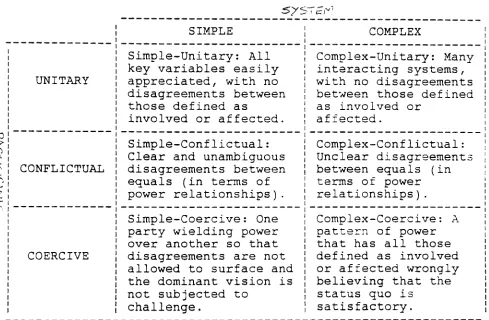
CHAPTER 15: ONTOLOGY, PLURALISM AND LEGITIMATION ... 371
15.1 Ontology and Pluralism . . . 371
15.2 Hard Systems Methods . . . 373
15.2.1 Summative Methods . . . 374
15.2.2 Formative Methods . . . 376
15.3 Soft Systems Methods . . . 377
15.3.1 Interpretive Methods . . . 378
15.3.2 Emancipatory Methods . . . 381
15.4 Exploring Subjectivity . . . 384
15.5 Underpinning our Vision of Pluralism . . . 385
15.6 Paradigmatic Assumptions . . . 386
15.7 The Legitimation of Systems
Science . . . 389
15.7 Conclusion . . . 390
Notes . . . 391
CHAPTER 16: WORK FOR THE FUTURE . . . 393
16.1 Critical Systems Thinking Rev is i ted. . . . . 396
16.2 Ontology and the Language of Research . . . 397
16.3 What is "Being Critical?" . . . 398
16.4 Emancipation . . . 399
16.5 Subjective or Communicative Ethics? . . . 400
16.6 An Ideal Model of the Research and Change Process ... 400
16.7 A Diversification of Meta-Theories . . . 401
16.8 Diversification at the Methodological Level . . . 402
16.9 What is this Thing called "Science"? . . . 402
16.10 Conclusion . . . 404
CHAPTER 17: CONCLUSIONS . . . 406
17.1 The Paradigmatic Nature of Pluralist Meta-Theories . . . 407
17.3 Social and Ecological
Contexts . . . 410
1 7 . 4 Ontology... . . . 4 11
17.5 The Legitimation of Systems
Science . . . 413
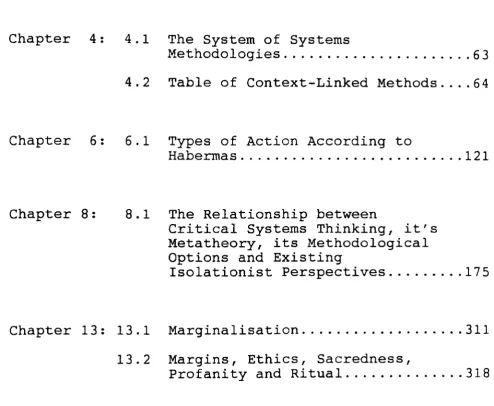
ILLUSTRATIONS
Chapter 4: 4.1 The System of Systems
Methodologies . . . 63
4.2 Table of Context-Linked Methods .... 64
Chapter 6: 6.1 Types of Action According to
Chapter 8:
Habermas . . . 121
8.1 The Relationship between
Critical Systems Thinking, it's Metatheory, its Methodological Options and Existing
Isolationist Perspectives . . . 175
Chapter 13: 13.1 Marginalisation . . . 311
13.2 Margins, Ethics, Sacredness,
[image:14.622.94.588.186.592.2]ACKNOWLEDGEMENTS
I dedicate this thesis to my father, Peter Midgley, who
died just seven months from its completion. I always
had his love and his complete support in everything I
chose to do.
I would like to thank Bob Flood for his supervision of
my work, both at City University and at the University
of Hull (where he moved after I had been studying for a
year). Thanks are also due to Mike Floyd who became my
joint supervisor when Bob left.
A number of other people have played a large part in
helping me too. Wendy Gregory has provided both
emotional support and intellectual inspiration as
partner, friend and colleague. My mother, Doreen
Midgley, has also given me a tremendously solid
emotional foundation on which to build. Tessa Kellett
has helped me transcend the usually limited boundaries
of science by inspiring me with her art and ideas. I
also spent many a night with Greg Tuck arguing
philosophy until the early morning, and those
conversations have had a great influence on me. Then
there are my new colleagues at the University of Hull,
where I have started work: in particular, my
friendships with Gary Wooliston and Mike Jackson have
been instrumental in helping me to sharpen my thoughts.
I also wish to show my appreciation to all those along
the way, too numerous to list, who made helpful
comments and gave me feedback as the work progressed.
COPYRIGHT
(C) 1992 Gerald Midgley
I grant powers of discretion to the University
Librarian to allow this thesis to be copied in whole or
in part without further reference to me. This
permission covers only single copies made for study
ABSTRACT
The central theme of this thesis is methodological
pluralism in systems science: that is, how it might be
possible to draw upon different systems methods that
are traditionally thought to be based in
incommensurable paradigms. The thesis is split into
three sections. Section One begins by reviewing ideas
about pluralism as they have been expressed in the
literature on Critical Systems Thinking. This section
also sets out the basic 'problem' pluralists have to
deal with - that the approaches drawn upon are usually
thought of as philosophically contradictory. An initial
(partial) resolution of the problem is presented.
Section Two takes a step back in order to examine why the focus upon pluralism is important. Here the social
and ecological contexts of the debate are explored. It
is discovered that many of the issues we are currently
dealing with in systems science, especially complex
global issues, can only be dealt with adequately
through a pluralist research practice. Section Three
looks at the implications of these social and
ecological arguments for a pluralist systems science,
and reexamines some of the philosophical ideas lying
behind Critical Systems Thinking. Through this
re-examination a different understanding of ontology
begins to emerge. Having developed a set of interlinked
arguments ranging from the ontological to the
practical, the thesis concludes with an assertion that
pluralism is actually necessary for the continued
CHAPTER 1: THE AIMS OF THE THESIS
The central theme of this thesis is methodo~ogical
pluralism in systems science: that is, how it might be
possible to draw upon different systems methods that
are traditionally thought to be based in incommensurate
paradigms.
In this introductory chapter, which lays out the aims
of the thesis, I have tried to use a minimum of complex
definitions and jargon in order to give a simple
framework of ideas that can be used as a reference
throughout.
It should be noted that, not only have I deliberately
written much of this thesis in the first person, but
the language is also more colloquial than is normally
the case in scientific work. Colloquialisms are usually
frowned upon because they introduce emotion into what
is 'supposed' to be a purely analytical text. My own
attitude to this is summed up in the following
who may say that they do not expect to find emotional matter within serious reflection. On the
contrary, one must feel remiss for offering so
small a reminder of human experience, or feel a
despondency in the realisation that so little will be tolerated".
1.1 The Structure
I have divided the main body of the thesis into three
sections that reflect separate, but interrelated,
arguments:
Section 1 will review ideas about pluralism as they
have been expressed in systems science, and the
Critical Systems perspective which has come to underpin
them. Within this review a pluralist framework that
contextualizes a number of different systems methods
will be presented.
This section will also set out the basic 'problem'
pluralists have to deal with - that the approaches
drawn upon are usually thought of as philosophically
contradictory. An initial (partial) resolution of the
Section 2 will take a step back in order to examine why
the focus upon pluralism is important. Here the social
and ecological contexts of the debate will be explored.
We will
dealing
global
see that many of the issues we are currently
with in systems science, especially complex
issues, can only be dealt with adequately
through a pluralist research practice.
Section 3 will look at the implications of these social
and ecological arguments for a pluralist systems
science, and will re-examine some of the philosophical
ideas lying behind Critical Systems thinking. Through
this re-examination a different understanding of
ontology will emerge.
Having developed a set of interlinked arguments ranging
from the ontological to the practical, the thesis will
conclude with an assertion that pluralism is actually
necessary for the continued legitimation of systems
science.
the contents of each of these three sections. In doing
so, five central, interlinked aims of the thesis will
be clarified.
1.2. Section 1: Pluralism and Critical Systems
Let us now move on to detail the contents of Section 1
in more depth:
1.2.1 Introducing the Basic Issues
Before even beginning to address the issue of
pluralism, i t will be necessary to answer some basic
questions about the role of the philosophy of science.
There are some who believe that science has a built in
adaptation mechanism, so that "science as it is
actually done .... is also science as i t ought to be
done" (Masterman, 1970). These writers therefore argue
that i t is only legitimate to describe the theory and
I intend to argue against this view on the grounds that
prescriptive philosophies can themselves be seen as a
necessary part of the self-correcting mechanism of
science.
This grounding will set the scene for an essentially
personal account as to how and why I came to believe
that pluralism must become a central focus for the
philosophy of science. Personal accounts such as this
will be seen to have the function of exposing writers'
inevitably limited perspectives to critical appraisal.
Having established a personal history of the key
experiences that led me to write this thesis, I will be
free to move on to a detailed review of Critical
Systems ideas.
This review will focus on the use of up-front
emancipatory ideals that encourage democratic dialogue
and seek to prevent scientific elitism. It will also
contain an explanation of how pluralism is said to
differ from other approaches to methodology, including
than one working method. I will then be able to start
on a discussion of my own first thoughts in trying to
develop this field.
1.2.2 The 'Problem' of Pluralism
The Critical Systems understanding of pluralism offers
a central innovation: i t gives us a meta-theory which
allows us to be explicit about the ways in which
different methods might most appropriately relate to
different research contexts.
However, this also presents us with a 'problem'. Some
of the Critical Systems literature seems to suggest
that such a meta-theory takes us beyond the need to see
any single philosophical paradigm (in the sense implied
by Kuhn, 1970) underpinning it. I will need to ask,
"how can this be possible?"
I will argue that pluralism must involve researchers in
the use of a philosophy that sees pluralist
meta-theories as valid and, because this is not a
meta-paradigmatic.
Once i t becomes clear that there is indeed some sort of
philosophical paradigm underpinning pluralism, it
becomes necessary to identify it. The obvious
candidate, given that the Critical Systems
understanding of pluralism is different from any other,
is Critical Systems Thinking itself.
The first aim of this thesis, then, will be to explain
why a pluralist meta-theory must be paradigmatic.
1.3. Section 2: Contexts of the Debate about Pluralism
Section 1 should leave the reader with a fairly
coherent position to work with, so in Section 2 we will
take a step back to look more generally at what might
1.3.1 Unity and Pluralism
We will begin by asking "what does methodological
restriction do to science?" This is where the title of
the thesis - Unity and Pluralism - becomes meaningful,
because one of the answers I will present is that
methodological pluralism is actually essential if we
are to pursue the ideal of the unity of science.
This is the ideal which suggests that, ultimately, the
subject matter of science should not be seen as
fragmentary. This is not to say that we should be
aiming toward a single Grand Truth, or even that we
want unification of scientific institutions. Diversity
of exploration is vitally important as a stimulant to
debate and change; but, ideally, no part of this
diversity should be excluded from the subject matter of
science.
In order to work towards the ideal of unity, systems
scientists try to dispense with disciplinary boundaries
altogether (and even traditional disciplinary
scientists accept complementarity
discipline and others).
The second aim of the thesis will be to explain why
methodological pluralism and pursuit of the ideal of
the unity of science are so intimately bound together.
1.3.2 Social and Ecological Contexts
Following this, the third aim will be to take one
further step back and examine the social and ecological
contexts of this debate.
In particular it will be suggested that, while the
purpose of systems science is often said to be dealing
with complexity, the understanding of complexity we
usually work with is rather impoverished. This
impoverishment is shown up in some of the issues that
we are currently trying to deal with - especially
issues of a global, ecological nature.
Using a practical example of the interdependence we
find between the notions of ecological harmony, social
a vision of complexity that begins to reintegrate the
objective, normative and subjective "worlds" of
understanding. Methodological pluralism will be
presented as an answer to the question of how we are to
address this newly identified complexity.
Following this,
rethink of the
systems science.
I will be in a position to suggest
conventionally
I will argue
accepted history
that the issue
a
of
of
reintegrating the objective, normative and subjective
realms has a lot in common with holistic,
pre-Aristotelian and pre-Cartesian mediaeval Christian
thinking (although there are significant differences
too, such as the latter's mysticism).
Interestingly, I believe that it will be possible to
demonstrate that the emergence,
marginalization and re-emergence of
ideas has an ecological context.
suppression,
1.4 Section 3: Epistemology, Ontology and Legitimation
If methodological pluralism is so important, both to
the project of systems science (pursuing the ideal of
the unity of science) and to our current need to deal
with an enhanced understanding of complexity, then i t
is vital that our pluralist practice be theoretically
coherent.
1.4.1 Ontology
Having identified the fact that any pluralist
perspective must be paradigmatic, we have to reveal our
paradigmatic assumptions.
Most Critical Systems thinkers have underpinned
pluralism with Jurgen Habermas's (1972) epistemological
theory of knowledge-constitutive interests (to be
described in the main body of the thesis). However, I
intend to demonstrate that this theory makes major
humanist assumptions that are inappropriate in the
I will therefore be in the position of having to
develop a new philosophical argument. A start will be
made on this project (only a start, because to pursue
all the ramifications will undoubtedly take several
years' more work). The beginnings of a new vision of
ontology will be presented that, I will suggest, shows
promising potential as a credible philosophical
underpinning for our notion of pluralism.
The fourth aim of this thesis will therefore be to make
a start on demonstrating how the Critical Systems
understanding of pluralism might be underpinned by a
credible vision of ontology.
1.4.2 The Legitimation of Systems Science
At this point we will have generated a line of argument
running from ontology, through an enhanced
understanding of complexity, into research methodology.
Thus, i t will be argued, the Critical Systems notion of
pluralism is both credible (not based on logical
to deal with some of the pressing, complex problems of
today).
It is this issue of legitimacy that we will end with.
Only a systems practice that is pluralistic can help us
pursue the ideal of the unity of science in an adequate
manner, and i t is only a pluralist systems science that
can deal with the enhanced complexity that many of the
current issues we are facing, especially global issues,
present. Pluralism is therefore essential for the
continued legitimation of systems science.
The fifth aim of the thesis, then, is to demonstrate
how pluralism might enhance the legitimacy of systems
science for the future.
1.5 Conclusion
In concluding this introduction, let us just repeat the
five central, interlinked aims of this thesis:
(2) To explain why methodological pluralism and
pursuit of the ideal of the unity of science are
so intimately bound together.
(3) To examine the social and ecological contexts
of the debate about pluralism.
(4) To make a start on demonstrating how the
Critical Systems understanding of pluralism might
be underpinned by a credible vision of ontology.
(5) To demonstrate how pluralism might enhance the
legitimacy of systems science for the future.
Along the way many other subsidiary issues will be
explored, and many will no doubt remain unexpressed,
but these are the five central, interlinked issues I
SECTION 1
CHAPTER 2: WHY IS THE PHILOSOPHY OF SCIENCE USEFUL?
As explained in Chapter 1, the central theme of this
thesis is the need for methodological pluralism in
systems science. However, in claiming that we have such
a need, and putting forward the view that it is both
possible and desirable that we should meet it, I am
already making a massive assumption: that critical
inquiry into the rights and wrongs of science is a
valid endeavour.
2.1 Description or Prescription?
I am, of course, only the latest in a long line of
people who have argued that scientists should be doing
this, or should be doing that. There are some who say
that the philosophy of science should only be
descriptive rather than prescriptive: that we should
think about what scientists are doing, but that it is
inappropriate for us to suggest changes in theory or
Masterman (1970), in a paper that is now widely seen as
providing a seminal argument in support of Kuhn (1962),
offers just such a viewpoint when she argues angrily
with the stances taken by both Feyerabend (1962) and
Popper (1963) on the grounds that they are merely
pontificating. She states that:
In
"Science as it is actually done ... is also science
as i t ought to be done. For if there is not some
self-correcting mechanism that operates within
science itself, then there is no hope that,
scientifically speaking, things will ever be set
right when they go wrong. For the one thing
working scientists are not going to do is change
their ways of thinking, in doing science, ex more
philosophico, because they have Popper and
Feyerabend pontificating at them like eighteenth-century divines".
this critique Masterman appears, if I have
understood her argument correctly, to assume that no
working scientist wishes to learn about and share in
understandings of validity that have been influenced by
people not engaged directly in the practice of science.
If this were indeed the case, one cannot help but
wonder why the writings of Popper et al are taught by
working scientists on so many undergraduate science
More importantly, however, she appears not to have
considered the possibility that arguments about what
might be right or wrong, valid or invalid, in science
are actually part of the self-correcting mechanism she
talks about.
Because I share Masterman's faith in our ability to
self-correct, or at the very least in the need to try
and self-correct, I make no apology for talking about
what systems science should be about, although I hope
that i t will become clear that what I am arguing for is
very different from the changes proposed by many
others.
Most philosophers of science have made a case for the
validity of only one narrow epistemological view, and
only one corresponding approach to inquiry (proscribing
all others). In contrast, I wish to argue, following
and building upon the seminal work of Jackson and Keys
(1984), that all methods have both legitimacies and
limitations according to the contexts they are applied
in, and that it is possible to offer a credible
methodological pluralism.
A wish to promote openness and conciliation between
working scientists using different methods lies at the
heart of this proposition, as does a desire to address
complex ecological and social issues that we cannot
hope to deal with using restricted methodologies.
2.2 Conclusion
Here I have argued that prescriptive philosophies of
science are essential for the promotion of constructive
changes in our scientific practices. This clears the
ground for the rest of this thesis which is undeniably
CHAPTER 3: PERSONAL EXPERIENCES
In documenting a research project such as this I
believe i t is essential to offer some account of the
personal experiences that led me to formulate my ideas
in the way I did. The reasons for this are summed up by
Hollway (1989) who, when introducing her own research,
said that:
"It would be impossible to present these questions fully without talking about myself: the point that
I was at in my life and aspects of its history,
the cultural and political conditions that
produced it, how these shaped my interest in
certain areas of contemporary social theory. These
factors together produced the conditions which
made possible my research questions and shaped how I addressed them".
Making personal conditions explicit in research not
only makes communicating meaning easier, but also
exposes the inevitably limited life experience of the
writer to the scrutiny of the reader.
Some sections of this thesis are concerned with the
need for critical appraisal of research in terms of
what we think of as objective truth, rightness
reader might wish to cite empirical evidence to refute
a particular claim a writer has made, s/he might wish
to argue that the writer has not addressed the 'real
issues', or s/he might wish to inquire into aspects of
the writer's life in order to understand why s/he wrote
what s/he wrote. Presenting a selective history of
personal experiences aids the conduct of this latter
form of critique.
So, let me recount what I consider to be my own
relevant experiences.
3.1 Studying Psychology
At undergraduate level, from 1979-1982, I studied
psychology, which at that time was an extraordinarily
restrictive discipline in terms of methodology. The
course I chose was especially orientated to
experimental methods which were, by and
justified through reference to the earlier
popper (e.g., 1959).
large,
To give an example of the extent of the bias, in three
years we had just one lecture on psychoanalytic theory,
and much of that was taken up invalidating it on the
grounds that it wasn't open to falsification through
use of experimental methods.
However, at the time, because I didn't know any more
than I had been taught, I simply experienced the course
as irrelevant to the concerns that had taken me into
psychology: a wish to find ways of evaluating human
services in terms of our needs and desires. It took
several years of hands-on experience in research for me
to realise just how limited the methodology I had been
taught really was.
3.2 Research at Portugal Prints
For eighteen months or so after graduation I did
independent research on various issues, such as the
future of health education in secondary schools, the
pros and cons of different therapeutic interventions
for problem drinkers, and the use of decision theory as
basically theoretical I did not have to confront the
methodology problem again for quite a while.
Following a year spent in Residential Social Work, I
returned to research in order to conduct a long-term
evaluation of Portugal Prints; an innovative,
community-based design and printing workshop for people
with mental health problems.
At this facility, approximately 20 people between the
ages of 18 and 55 participated in a co-operative. They
not only designed, printed and packaged their own line
of greeting cards, but also offered a general printing
and design service.
The "workers" (as the clients of the facility were
called) attended for up to two years, mostly part-time,
and were supported by four full-time members of staff.
Vocational counselling and basic computer literacy were
offered as well as an optional art group. Workers were
paid their expenses plus a small attendance allowance,
and also shared the profits from their work. However,
welfare benefits, which everybody received.
All in all it could be said that Portugal Prints
offered a real work environment, but without some of
the pressures open employment can bring. Further
details of the running of the facility can be found in
Reynolds (1984) and Evans (1990).
When I first had talks with the staff and workers of
Portugal Prints, we discussed what the criteria for
evaluation should be. The obvious one for any
vocational rehabilitation facility was whether or not
people were successful in finding and keeping work
after attendance.
However, there was a general consensus that the most
important thing the facility did for people was help
restore a sense of self-worth. Most of the workers had
been unemployed for several years and, often after
several breakdowns, their morale was pretty low.
Everybody seemed to be saying that, by giving people
the status of "worker", Portugal Prints helped them
look more positively at their abilities and, in the
By this time I had made some progress in thinking about
methodology, in that I had moved from the hard-line
experimental position we were taught. I had already
thought through the issue of control groups and had
decided that i t was unethical to refuse help to a group
of people if there was a reasonable suspicion that the
intervention being evaluated might be beneficial.
However, the understanding I was still taking into the
research was that evaluation criteria had to be
objectively measurable.
My immediate reaction, then, to the discovery that what
people wanted was an evaluation of how the facility
affected peoples' feelings of self-worth, was concern.
I explained that I thought it was going to be very
difficult to conduct valid research in this area, but
agreed to try to find a reliable and well validated
measure of self-esteem that we might be able to use.
NOw, in saying this I didn't quite realise just how
naive I was being. When I conducted a literature search
distinguish between a rating of high self-esteem and a
rating of the wish to be seen to have high self-esteem
(Kenny, 1956; Cowan and Tongas, 1959; Cowan et aI,
1960) .
Kenny showed that this holds true for all sorts of
standardised instruments (personality questionnaires,
rating scales and
Q
sorts), and Cowan and Tongas wereforced to conclude that Itself concept and ideal self
measures .... are so heavily saturated with social
desirability as to lose meaning independent of the
latter variable It .
Following this discovery I went back to Portugal Prints
and told them that it would be impossible to assess
self-esteem. As a compromise I agreed to use Rotter's
measure of locus of control (1966), an instrument which
assesses the degree to which a person attributes events
in their lives to the action of external forces or
internal will.
Although I suspected that social desirability would
it, so I conveniently put the possibility to the back
of my mind and told myself that i t was a well respected
instrument and that there is a wealth of evidence that
i t correlates with all sorts of other important
variables (Rotter, 1966).
Other than locus of control, all the variables I ended
up looking at were either demographic or concerned with
the assessment of mental health. Indeed, the only issue
of overlap between the needs of the workers and staff
and my methodology was an assessment of whether people
found work after attending.
The irony here was that the facility was already
monitoring this, so I had simply taken over one of
their jobs! Not surprisingly, as the research continued
over a three year period, I became severely
demoralised. I had allowed methodology to determine the
questions I could ask so that my research had become
largely irrelevant to the very people I wanted to help.
This problem has been commented on by several authors
sentence by Hollway (1989) who, after going through
similar experiences, noted that "where method has come
into conflict with questions i t has wanted to ask, it
has changed the questions and not the methods".
3.3 Research for the Gordon Hospital
My experience at Portugal Prints, drawn out over three
years, gave me plenty of time to reassess my ideas, and
I determined not to make the same mistake twice. After
finishing that project I was asked to design a
large-scale evaluation of day care for people with mental
health problems in the area covered by the Riverside
Health Authority.
I had three months in which to put together a proposal
for funding (which I was under the impression would
only be turned down in exceptional circumstances), and
I designed a study which started off with a
consideration of the needs of those receiving a service
(as described by the users themselves, their families,
I intended to use objective measures (recidivism,
employment, etc.), but I wanted to interrelate the
information from these with the views of those 'on the
ground'. This, then, was my first intuition of the
value of methodological pluralism.
To my horror,
methodological
funding was actually refused on
grounds. Not only did the committee
assessing the proposal object to the use of subjective
material, but their view was that such a study would be
totally invalid unless i t used control groups.
This was, first of all, a clinical impossibility as
there were too few referrals to the services to refuse
anyone help. The facilities would have stood half-empty
while people were asking to attend.
of control groups was unethical.
To me, such a use
However, in a
conversation I had with one member of the committee, it
was made clear that they regarded the efficacy of their
services as unproven, so i t would not be a denial of
help to refuse a service!
difficulties I had experienced were simply a result of
my own ignorance. Now, however, I realised that the
views I had inherited from my undergraduate training
were deeply entrenched in key institutions, and that
they exercised their power to keep their own research
discourse dominant while burying any potential for
alternative discourses to develop.
3.4 The Microjob Research
At this stage it became vital for me to find a setting
in which I could develop such an alternative discourse
(I had already formulated the tentative label of
"integrated systems methodology" in my head), and it
was not long before I was offered one. The
Rehabilitation Resource Centre in the Department of
Systems Science at City University secured a contract
to evaluate an innovative computer training project for
people with disabilities by the name of Microjob.
Microjob
(January
funding
was in operation for an 18 month period
1987 to June 1988), and the application for
Social Fund in October 1985) made the rationale of the
project clear:
ItMicrojob aims to assist people with disabilities
to obtain employment in the open market
particularly in the field of Information
Technology - through the provision of a range of
linked services designed to meet individual
needs It .
These linked services included vocational guidance and
assessment, a basic course in computer literacy,
in-depth training in various applications of computers,
help in finding appropriate aids and adaptations,
training in job-search skills and placement in
employment (or further education). Further details of
the basic structure and function of the service can be
found in Folkes (1988), Midgley (1988) or Midgley and
Floyd (1988).
When I set about starting this evaluation I thought
that I was a lone voice, as the only writers on
qualitative methodology that I had read were Weiss
(1972, 1973, 1977), Broskowski (1976) and Patton (1978,
While I felt that these authors were streets ahead of
other thinkers in the field, they nevertheless all
advocated formative methodology (where the researcher
and the staff of the facility being evaluated learn
from each other in a heuristic process) instead of
summative (where the researcher presents a final report
for the facility to do with as i t will). Personally, I
thought that there was room for both.
Also, in the case of Patton in particular, because his
primary intent was to build an evaluation practice that
can at all times be seen by participants to be relevant
to the task in hand, he tended to focus on consensus
amongst participants in determining the value-base of
the research. This ignores the possibility that
situations might arise where there is no significant
area of consensus, or that the consensus is seen to be
so objectionable by the researcher that s/he cannot
sanction the subjugation of her or his own perspective
to the will of the majority.
I felt very strongly that, as well as an integrated
that brought values and ideology to the forefront of
consideration.
When I conducted this research I made the decision to
register for a Masters degree. As a literature review
was a necessary part of my M.Phil. thesis, I was guided
into a new area of reading. To my immense relief there
was a whole body of literature, some of it still in
press, documenting the birth of a new approach.
This new approach was Critical Systems, which dealt
explicitly with my concerns. Ideology was indeed of
prime interest, and I also found I could lay aside my
tentatively labelled "integrated systems methodology"
in favour of the term pluralism.
As I will show in Chapter 4, the idea of pluralism
addressed my one doubt about linking methods together.
I knew that each different method somehow had· to be
aligned in a one-to-one relationship with its most
appropriate practical context, but I was unsure how
this was to be done except through pure intuition
great stride forward when they started the process of
defining ideal-type contexts that would be clearly
recognisable to most people conducting research in
organisations.
In evaluating Microjob, then, I worked from a Critical
Systems perspective. The evaluation itself has been
written up most fully in a thesis (Midgley, 1988) and a
final report (Midgley and Floyd, 1988). Aspects of it
have also been documented in several shorter papers
(Midgley, 1989a, 1990ai Midgley and Floyd, 1990). The
validity of the methodology itself has also been
discussed in a number of places (Midgley, 1988, 1989a,
1990a) .
3.5 Conclusion
So, this is what led me to Critical Systems Thinking
and the present thesis. Having successfully applied the
idea of pluralism in practice, and realising how more
limited methodological discourses have become
funding of research and the training of researchers, I
became fired with the challenge of focussing my own
research energies on developing the new paradigm.
Having documented my own rather tortuous path toward
the ideas in this thesis, I will be in a position, in
the next chapter, to look more closely at the notion of
pluralism as i t has been expressed in the Critical
Systems literature.
Notes
1. Such a summary will be "selective", not only because
the writer must obviously try to be relevant, but
because s/he will inevitably be working with an
incomplete understanding of his or her own processes of
CHAPTER 4: PLURALISM
I have already touched upon the idea of pluralism, and
the purpose of this chapter is to flesh out our
understanding of the concept.
In Chapters 5 and 6 I will move on to a discussion of
Critical Systems Thinking (the perspective into which
this understanding of pluralism has been integrated),
presenting the key ideas as they have been documented
in the literature by a variety of authors, before
entering into a critique of these in coming chapters.
Although describing pluralism first will prevent a
strictly chronological exposition (Critical Systems
ideas emerged in the literature about four years before
pluralism was first explicitly discussed ln systems
science), i t makes more sense in terms of the primary
issues that are of concern in this thesis.
4.1 Pluralism
was Reed (1985) who originally coined the term
"pluralism". Reed's initial work was then built upon
and substantially developed by the systems scientists
Jackson and Keys (1984), Jackson (1987a) and Flood
(1989a). The thoughts of these authors will be detailed
throughout this chapter.
Interestingly, the idea of pluralism arose as much in
response to a protracted philosophical debate between
hard (positivistic 1 ) and soft (interpretive) systems
thinkers as to direct observations of problems in
research practice.
Flood (1989a) claims, in my view rightly, that the
tendency for most people to characterise their own
position as the only valid one in this debate has
caused a degree of stagnation in systems thinking. As
he says, i t is essential to overcome this if
researchers are to continue to aim for a flexible and
responsive research practice that still acknowledges
the value of theory.
In many researchers taking a 'pragmatic' line in which
theory is simply thrown out of the window, leading to
all sorts of problems in practice (see later in this
chapter). Because this debate has been an important
factor in the birth of our current understanding of
pluralism, i t is worth reviewing i t in a little more
detail.
4.2 Paradigmatic Conflicts: Hard versus Soft
As Jackson (1982, 1985a, 1987b) and Flood (1989a) have
pointed out, the main philosophical debate that has
dominated the systems literature over the past decade
or more has been this conflict between authors sticking
to the more traditional hard systems methodologies in
their approaches to human problematic situations (e.g.
Hall, 1962; Jenkins, 1969a; Atthill, 1975; and
Daellenbach et ai, 1983) and those taking a soft line
(e.g. Churchman, 1968a, 1971, 1979; Ackoff, 1974, 1981;
and Checkland, 1972, 1975, 1981, 1985).
As both approaches have demonstrable practical utility,
one within the other. In 1974, for example, M'Pherson
attempted to demonstrate that soft systems thinking is
a sub-set of hard. By way of reply, Checkland (1981)
put the reverse view that hard ideas are a sub-set of
the soft methodology and can be used in "special cases"
when there is total agreement between participants on
the nature of the problematic situation. Of course
neither M'Pherson's or Checkland's views were accepted
by the other camp.
4.3 Breaking the Stalemate
Recently, however, there have been attempts to break
this stalemate by changing the goal-posts of the
debate. Instead of simply looking at hard versus soft
(and the underlying conflict between positivistic and
interpretive philosophies), some authors have chosen
instead to examine the way different practitioners
design and defend their methodologies; or, to put i t
more cynically, they have looked at peoples' 'styles of
Jackson (1987a) detailed four categories of
methodological consideration. Following Reed (1985), he
labelled these pragmatism (a supposedly atheoretical,
'mix-and-match' approach), isolationism (fixation upon
just one approach, with all others deemed invalid),
imperialism (fixation upon one main approach, but
drawing
(drawing
others in as and when necessary) and pluralism
upon methods ~n a theoretically explicit
manner according to perceived situational context).
4.4 Six Approaches to Methodology
Flood (1989a) built on these ideas and sub-divided
isolationism into methodological isolationism and
theoretical isolationism. He also split imperialism
into imperialism by annexation and imperialism by
subsumption. Thus Flood talks about six distinct
approaches to methodol ogy 2.
As these terms are all so new, it will be necessary to
explore their meanings before a critique can be entered
into. The following definitions have been reproduced
Pragmatism. "The most striking feature about the pragmatic approach is that no reference is made to
inferable underlying theory or methodological
rules. The main emphasis is on
intra-methodological partitioning; i.e. using parts and
techniques in a heuristic (trial and error)
fashion. The use of a single whole methodology is
not inconsistent, although somewhat unlikely, with
this approach. There are no explicit
considerations of either theoretical or
methodological commensurability; nevertheless,
superficially the pragmatist is assuming measures by the same standard."
Pluralism. "No two approaches contrast so starkly
as pragmatism and pluralism. In fact, the only
areas of 'overlap' are somewhat dubious anyway;
i.e. inter-methodological partitioning which the
pragmatist could (in principle) undertake, and
theoretical commensurability which is widely
contrasting even in their 'agreement'. In terms of
recognising pluralism, the key observations are
methodological incommensurability and theoretical
commensurability (at a metalevel of reasoning) at
once. Equally important, however, is inter- and
intra-theoretical partitioning, which paves the
way for context and methodology to be linked."
Theoretical Isolationism. "Reference to theory is
made, although only the tenets of one paradigm are
accepted, whilst all others are objected to; i.e.
there is theoretical incommensurability. Another
label for this is a 'world-view' approach. In this
case differing methodological approaches are
accepted, there is methodological
commensurability, but each is 'seen' only to work
from one world-viewpoint. In other words, certain
contexts demand only a subset of concepts from the
adopted paradigm. Concepts from an 'inferior'
paradigm may deal with these certain contexts, but for other contexts their 'inferiority' is shown in
the form of anomalies. In relation to pluralism
which then pairs with theoretical incommensurability."
Methodological Isolationism. "There is one very
important distinction between methodological and
theoretical isolationism, and that concerns
methodological commensurability. In this case, a
single methodology is isolated within some
paradigm, and to which users remain loyal to the
exclusion of all other methodologies. The
methodology itself may 'require' minor
modifications following reductionist analysis."
Methodological Imperialism by Annexation. "This
can be seen as an 'advanced form' of isolationism
that adds on 'bits' of other methodologies, often
in response to outstanding anomalies. In this
sense there is no final and complete
inter-methodological partitioning, however,
intra-methodological partitioning is necessary in order that annexation may be carried out."
Methodological Imperialism by Subsumption. "In
this approach a methodology is adopted that may
call upon other methodologies at a specific point
in order to act as sub-methodologies to deal with
specific matters, e.g. if the 'what' had been
decided through use of the 'mother' methodology, a
'how' methodology may then be drawn into the
process . . . . There is a great similarity and no
outright contradiction between this approach and
theoretical isolationism. The main differences are
that in theoretical isolationism different
methodologies are used in differing contexts,
whereas, subsumption means that one methodology is
used for all contexts although different
methodologies may be called upon to 'help out'."
Flood (1989a) analysed the advantages and disadvantages
of all these approaches and, in a similar manner to
Jackson (1987a), concluded that pluralism is the most
recognised as holding some potential.
The criteria both Jackson (1987a) and Flood (1989a)
used in making this judgment were firstly a belief that
openness and conciliation should be encouraged between
supporters of the positivist and interpretive
paradigms, and secondly the need for theoretical
coherence.
Flood (1989a) goes into some detail about what he sees
as the problems of the other approaches.
Pragmatism, according to him, is problematic because
its refusal to recognise the implicit nature of theory
and ideology in all actions renders it incapable of
examining its own hidden agendas. Linked with this,
pragmatists are seen to maintain and increase the power
of elites by seeking, on the whole, to "keep their
clients happy". Also, because of the restricted nature
of pragmatic analysis, adopted approaches may embody
theoretical contradictions that their practitioners can
Midgley (1989b) also notes a further difficulty faced
by pragmatists: if all learning about methodology
within the pragmatic approach is by trial and error,
and there is no common frame of reference shared by all
pragmatists, then one individual's learning with regard
to methodology cannot be communicated to other
practitioners without the likelihood of
misinterpretation.
In contrast, methodological isolationism is criticised
by Flood for its "static" nature. 'Reductionist'
analysis may bring about limited change to the single
methodology adhered to, but practice remains severely
restricted.
Theoretical isolationism, on the other hand, is
recognised by Flood to be a sustainable proposition
the only restriction he sees is that all followers of
one sole theory are by definition rooting their
practice in a single 'world view', and therefore
automatically alienate others with a different
perspective.
and described as "advanced isolationism". In Flood's
words (1989a),
"Because new approaches emerge some isolationists, feeling dissonance about their approach because of anomalies which may exist, consequently respond by
developing their own approaches. A more cynical
view is that annexationists are rapacious in their
research, tracking down the 'tidbits' and drawing
upon them, whilst discarding the (so perceived)
offal" .
Imperialism by subsumption is questioned for the way it
reshapes subsumed methodologies to fit in with the
dominating perspective - thus insights that could be
gained from the appreciation of other viewpoints are
never really taken on board.
Ultimately, Flood maintains that in terms of developing
openness and conciliation (as opposed to theoretical
coherence which is the other criterion Flood uses to
evaluate the approaches), "imperialism .... must fail on
the same reckoning as pure isolationism: i.e., complete
domination is unlikely because of paradigmatic
conflicts".
following Jackson (1987a), is identified as the most
fruitful approach in terms of developing openness and
conciliation.
Flood's (1989a) definition of pluralism is centred
neatly around the sentence: "the key observations are
methodological incommensurability and theoretical
commensurability (at a meta-level of reasoning) at
once". That is, working methods drawn from the various
paradigms are appropriate for different perceived
situations but, while this might mean that they have to
be separately defined at the methodological level, at a
'higher' theoretical level they can be seen as
complementary.
4.5 The System of Systems Methodologies
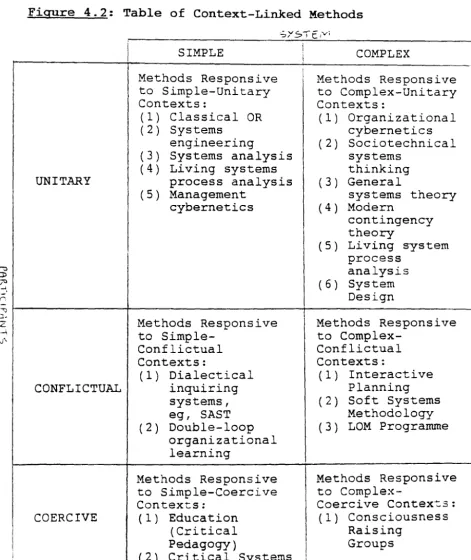
So, what does pluralism mean in practice? Jackson and
Keys (1984) developed four categories of context which
were later expanded to six by Jackson (1987b). These
authors called the resulting grid of contexts a "System
This has been described in the literature using a
number of different terminologies. In producing my own
description over the coming pages I have chosen to
adopt the terminology of Flood and Jackson (1991), with
a single, minor modification 3 .
The grid defining the six contexts of application has
two axes, and is presented here in Figure 4.1. One axis
is labelled Participants (referring to perceptions of
the relationships between participants) and the other
is System (referring to perceptions of complexity).
The Participants dimension is seen as having three
states: unitary (a perception of full agreement between
participants on definitions of terms and problematic
areas), conflictual (a perception of disagreement
between participants) and coercive (a perception of
disagreement that is masked, or potential disagreement
that is not being allowed to surface, due to power
relationships between participants).
Figure 4.1: The System of Systems Methodologies
UNITARY
C: I CONFLICTUAL -.. 1
,,' I ':::1 (.1
- I
'1\
1---COERCIVE
---SIMPLE : COMPLEX :
---:---:
Simple-Unitary: All : Complex-Unitary: Many : key variables easily : interacting systems, : appreciated, with no : with no disagreements : disagreements between : betNeen those defined :those defined as : as involved or :
involved or affected. : affected. :
1
1
---1---1
Simple-Conflictual: : Complex-Conflictual: : Clear and unambiguous : Unclear disagreements disagreements between : between equals (in equals (in terms of : terms of power I
1
1
1
I power relationships). : relationships).
Simple-Coercive: One party wielding power over another so that disagreements are not allowed to surface and the dominant vision is not subjected to
challenge.
---1
Complex-Coercive: A :
patte~n of power : that has all those : defined as involved : or affected wrongly : believing that the :
status quo is :
satisfactory. :
The six contexts in the system of systems methodologies
are arrived at by cross-referencing the two dimensions,
and these six can be labelled simple-unitary,
complex-unitary, simple-conflictual, complex-conflictual,
simple-coercive and complex-coercive. 4
[image:64.621.70.559.250.570.2]