Rochester Institute of Technology
RIT Scholar Works
Theses
Thesis/Dissertation Collections
5-27-2010
An Integer linear programming formulation for
tiling large rectangles using 4 x 6 and 5 x 7 tiles
Grant Dietert
Follow this and additional works at:
http://scholarworks.rit.edu/theses
This Thesis is brought to you for free and open access by the Thesis/Dissertation Collections at RIT Scholar Works. It has been accepted for inclusion
Recommended Citation
An Integer Linear Programming Formulation for Tiling Large
Rectangles using
4 6and
5 7Tiles
Grant Dietert
Applied & Computational Mathematics Program
Rochester Institute of Technology, Rochester NY 14623
May 27, 2010
Advisor’s Name...Dr. Darren Narayan
Committee Member 1...Dr. Anurag Agarwal
Committee Member 2...Dr. Matthew Coppenbarger
Committee Member 3...Dr. Jobby Jacob
Abstract
We consider the problem of tiling large rectangles using smaller rectangles with the prescribed dimensions
4 6 and5 7. Problem B-3 on the 1991 William Lowell Putnam Examination asked "Does there exist a
natural numberLsuch that ifmandnare integers greater thanL, then anm nrectangle may be expressed
as a union of 4 6 and 5 7 rectangles, any two intersect at most along their boundaries?" Narayan and
Schwenk showed in 2002 that all rectangles with length and width at least 34 can be partitioned into4 6
and5 7 rectangles. We investigate necessary and su¢ cient conditions for anm nrectangle to be tiled
with4 6and5 7 rectangles. Ashley et al. answered this question for all but 37 cases. We use an integer
1
Introduction
Problem B-3 on the 1991 William Lowell Putnam Examination asked: “Does there exist a natural
number L;such that if mandnare integers greater thanL, then an m nrectangle may be expressed as
a union of4 6 and 5 7 rectangles, any two of which intersect at most along their boundaries?”. The
answer is “yes” and a solution appeared in the American Mathematical Monthly (Klosinski, Alexanderson,
and Larson 1992). The published solution printed is an existential proof and shows that anym nrectangle
can be tiled provided thatL 2214:Narayan and Schwenk later reduced this bound toL= 33and showed
that this new bound is best possible.
However the above results focus primarily on su¢ cient conditions for a rectangle to be tiled. In this
paper we explore necessary and su¢ cient conditions for anm nrectangle to be tiled with4 6and5 7
rectangles. The results mentioned above show that every rectangle withm 33andn 34can be tiled and
the33 33square cannot be tiled. However there is still the question of which rectangles with one dimension
less than33can be tiled. In this paper we seek to answer this question. We use an array of methods from
combinatorics and integer linear programming to determine whether or not a rectangle can be tiled.
We extend the base of known results to include necessary conditions. The overall goal is to determine
whether or notm nrectangles with one dimension less than 33 can be tiled.
We investigate necessary and su¢ cient conditions for anm nrectangle to be tiled with4 6 and5 7
rectangles. Ashley et al. answered this question for all but 37 cases. Of these 37 cases we use an integer
linear program (ILP) to evaluate 36 of the 37 rectangles. The22 46rectangle has not yet been solved in
addition to the 36 rectangles that were evaluated using an ILP.
Table 1: The 36 rectangles evaluated using an integer linear program
We will refer to the 4 6and 5 7rectangles as “tiles”, and if a given rectangle can be expressed as a
union of4 6 and5 7tiles, any two of which intersect at most along their boundaries, we will simply say
the rectangle can be “tiled” or is "tileable". Since tiles can be rotated we do not distinguish a4 6 tile
from a6 4tile or a5 7tile from a 7 5tile. When convenient we will refer to a4 6tile as an “even”
tile and a 5 7 tile as an “odd” tile. The tiling of rectangles has been studied in (Ashley et al.), (Chung,
Gilbert, Graham, and van Lint 1982), (Golomb 1994), and (Robinson 1981). This problem is somewhat
di¤erent in that only two tiles with prescribed dimensions can be used. We note that the areas of the two
tiles are relatively prime, a necessary condition. If an integer p >1 divides each area, a tiling of a square
with side-length congruent to1 modpwould not be possible.
We show a rectangle can be tiled by decomposing it into smaller rectangles which can easily be tiled.
In searching for these smaller rectangles, it is useful to note that the areaAof a rectangle that can be tiled
satis…es the equationA= 24x+ 35y wherexandyare non-negative integers. For example, tiling a34 37
rectangle would require32even tiles and14odd tiles sincex= 32and y= 14is the unique solution of the
equation 34 37 = 1258 = 24x+ 35y where xand y are non-negative integers. The numbers of the two
types of tiles provide a starting point in the search for a possible tiling. Of course if there are no solutions
to the equationA= 24x+ 35ywherexandy are non-negative integers, then a rectangle with areaAsurely
cannot be tiled. We will also use a series of combinatorial arguments to show that rectangles can or cannot
be tiled.
2
Preliminaries and Background
Lemma 1 For natural numbersaandb ifgcd(a; b) = 1, then every integern (a 1)(b 1)can be written
as a non-negative linear combination andn= (a 1)(b 1) 1 cannot (Sylvester 1884).
Lemma 1 Is important for …nding a greatest lower bound for which all rectangles of that size or larger
In many cases we can construct a large rectangle that can be tiled by combining two small rectangles
that can be tiled. We discuss these constructions in our next two lemmas.
Lemma 2 If anm n1 rectangle and anm n2 rectangle can be tiled, then anym (an1+bn2)rectangle
can be tiled, whereaandb are non-negative integers.
Proof. We arrange the rectangles in a row of width mand a length that is a linear combination ofn1
andn2 with non-negative integer coe¢ cientsaandb.
Lemma 3 If anm1 n1 rectangle and anm2 n2 rectangle can be tiled then an(m1+m2) lcm(n1; n2)
rectangle can be tiled.
Proof. Arrange the m1 n1 andm2 n2 rectangles so that the width of the rectangle to be tiled is
m1+m2. Continue the tiling holding the width constant and extending the length. We see that the right
side edges of the two rectangles will …rst line up when the length equalslcm(n1; n2).
2.1
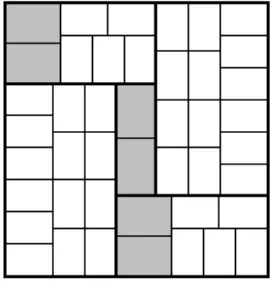
Pinwheel Tilings
Many of the rectangles formed using the constructions from Lemmas 1, 2, and 3 have "fault lines",
meaning that the rectangle has a subrectangle with the same length or width as the original rectangle.
[image:6.612.236.374.480.623.2]However a tileable rectangle may not have this form. An example of such a tiling is shown in Figure 1.
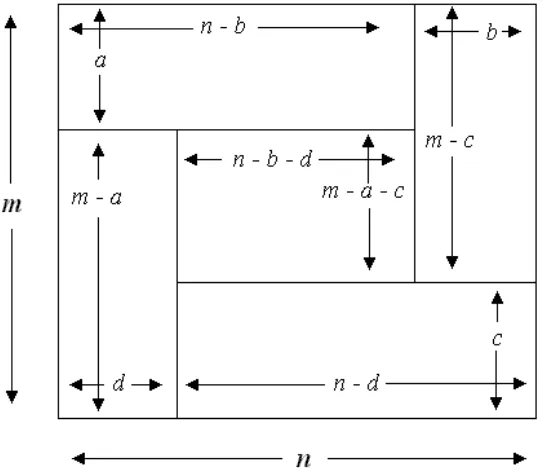
We give the general form for a pinwheel tiling in Figure 2.
Figure 2: Pinwheel constructionP(a;b;c;d)for anm nrectangle.
We denote such a “pinwheel” design by P(a;b;c;d)where a; b; canddare de…ned in Figure 2.
Lemma 4 (Pinwheel) An m n rectangle can be tiled, if there exist integers a; b; c, and d such that the
…ve rectanglesa (n b),(m c) b,c (n d),(m a) d,(m a c) (n b d)can be tiled.
Proof. The proof follows immediately from Figure 2.
3
Su¢ cient Conditions
3.1
The General Store of Rectangles
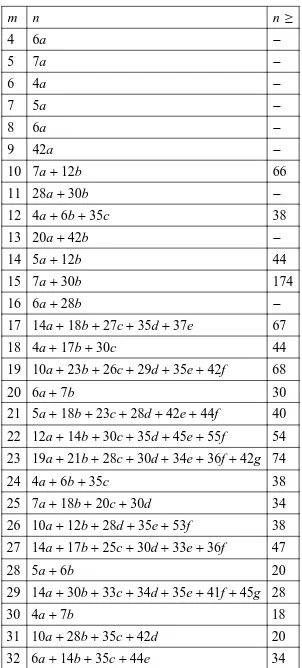
The General Store is a framework for rectangle decompositions. In this section we create a list of
tileable rectangles. In our list we will keep the width m …xed, and then give values of n for which the
equal or greater length can be tiled. If the length n is less than the value in the third column or there is
no value in the third column, the the second column gives a list of lengths that form tileable rectangles for
a; b; c; d; e; f;andg are non-negative integers.
m n n³
4 6a ?
5 7a ?
6 4a ?
7 5a ?
8 6a ?
9 42a ?
10 7a+12b 66
11 28a+30b ?
12 4a+6b+35c 38
13 20a+42b ?
14 5a+12b 44
15 7a+30b 174
16 6a+28b ?
17 14a+18b+27c+35d+37e 67 18 4a+17b+30c 44 19 10a+23b+26c+29d+35e+42f 68
20 6a+7b 30
21 5a+18b+23c+28d+42e+44f 40 22 12a+14b+30c+35d+45e+55f 54 23 19a+21b+28c+30d+34e+36f+42g 74 24 4a+6b+35c 38 25 7a+18b+20c+30d 34 26 10a+12b+28d+35e+53f 38 27 14a+17b+25c+30d+33e+36f 47
28 5a+6b 20
29 14a+30b+33c+34d+35e+41f+45g 28
30 4a+7b 18
[image:8.612.231.382.119.453.2]31 10a+28b+35c+42d 20 32 6a+14b+35c+44e 34
Table 2: The general store list
For the cases wheremis small there are few con…gurations of the tiling of anm nrectangle using4 6
and5 7 tiles. The cases where4 m 7 are trivial. The cases where8 m 16are easy to show. We
consider di¤erent combinations of4;5;6; and7 that add up tom. For each combination we investigate the
least common multiple of the resulting lengths. Since the width is small, it forces very limited con…gurations
When m 17 the con…gurations become more complicated and more possibilities for n arise. These
are discussed below. In each case, we either explicitly describe the tiling, or give a decomposition into
subrectangles that can be easily tiled. For completeness, we include the details.
3.1.1 m=17
We will show that any17 nrectangle can be tiled for anyn= 14a+18b+27c+35d+37ewherea; b; c; d; e; f;
andg are non-negative integers.
A 17 14rectangle can be tiled be joining a5 14rectangle with a 12 14rectangle.
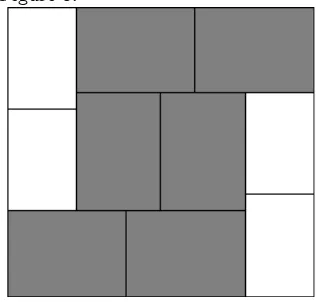
[image:9.612.238.397.240.391.2]A 17 18rectangle is shown in Figure 3.
Figure 3: A 17 x 18 rectangle with 4 x 6 tiles in white and 5 x 7 tiles in grey
A 17 27rectangle can be tiled using the pinwheelP(5; 6; 5; 6).
A 17 35rectangle can be tiled by joining a5 35and a12 35.
A 17 37rectangle can be tiled using the pinwheelP(5; 16; 5; 16).
3.1.2 m=18
We will show that any18 nrectangle can be tiled for anyn= 4a+17b+30cwherea; b;andcare non-negative
integers.. The case of18 4is trivial and the 18 17was covered in17 18.
3.1.3 m=19
We will show that any19 nrectangle can be tiled for anyn= 10a+ 23b+ 26c+ 29d+ 35e+ 42f where
a; b; c; d; e;and f are non-negative integers.. A 19 10 rectangle can be constructed by joining a 7 10
rectangle and a12 10rectangle.
A 19 23rectangle can be tiled using the pinwheelP(7; 8; 7; 8).
A 19 26rectangle can be tiled using the pinwheelP(7; 12; 7; 12).
A 19 29rectangle is can be tiled using the pinwheelP(7; 8; 7; 14).
A 19 35rectangle can be tiled by joining a7 35and a12 35.
A 19 42rectangle can be tiled by joining a9 42and a10 42.
3.1.4 m=20
The fact that any20 nrectangle can be tiled for anyn= 6a+ 7bwhereaandbare non-negative integers.
follows directly from Lemma 2:
3.1.5 m=21
We will show that any21 nrectangle can be tiled for anyn= 5a+ 18b+ 42c+ 44dwherea; b; c;anddare
non-negative integers.. For completeness we include the details. The case of a21 5is trivial.
A 21 18rectangle can be constructed by joining a4 18rectangle and a 17 18rectangle.
A 21 42rectangle can be constructed by joining a9 42rectangle and an12 42rectangle.
A 21 44rectangle can be constructed by joining a6 44rectangle and an15 44rectangle.
We will show that any 22 n rectangle can be tiled for any 12a+ 14b+ 30c+ 35d+ 45e+ 55f where
a; b; c; d; e;andf are non-negative integers..
A 22 12rectangle can be constructed by joining three6 12rectangles and a4 12rectangle.
A 22 14rectangle can be constructed by joining a12 14rectangle and a10 14rectangle.
A 22 30rectangle can be constructed by joining a4 30rectangle and a 18 30rectangle.
A 22 35rectangle can be constructed by joining a12 35rectangle and a10 35rectangle.
A22 45rectangle can be constructed by joining a12 45rectangle, a10 45rectangle and a10 21
rectangle.
A 22 55rectangle can be constructed by joining a12 55rectangle and a10 55rectangle.
3.1.7 m=23
We will show that any 23 n rectangle can be tiled for any 19a+ 21b+ 28c+ 30d+ 34e+ 36f where
a; b; c; d; e;andf are non-negative integers..
A 23 19rectangle was covered above in19 23
A 23 21rectangle can be constructed by joining a18 21and a5 21
A 23 28rectangle can be constructed by joining an18 28and a5 28
A 23 30rectangle can be constructed by joining an11 30and a12 30
A 23 34rectangle can be constructed using a pinwheel,P(7; 14; 11; 6).
A 23 36rectangle can be constructed by joining a19 36and a4 36.
3.1.8 m=24
The cases involving24 4and24 6are trivial. The24 35rectangle can be formed by joining two12 35
3.1.9 m=25
n= 7a+ 18b+ 20c+ 30d
25 7is trivial
25 18 = (17 18) + (8 18)
25 20 = (18 20) + (7 20)
25 30 = (7 30) + (18 30)
3.1.10 m=26
n= 10a+ 12b+ 28d+ 35e+ 53f
26 10 = (14 10) + (12 10)
26 12 = (14 12) + (12 12)
26 28 = (10 28) + (16 28)
26 35 = (12 35) + (14 35)
26 53 = (12 53) + (14 53)
3.1.11 m=27
n= 14a+ 17b+ 30c+ 25d+ 33e+ 36f
27 14 = (14 12) + (14 15)
27 17was covered already in17 27
27 25 = (7 25) + (20 25)
27 30 = (7 30) + (20 30)
27 33 = 2(10 19) + 2(17 14) + (5 7)
3.1.12 m=28
n= 5a+ 6b
Any 28 n rectangle can be tiled for anyn= 5a+ 6b where a;andb are non-negative integers. follows
directly from Lemma 2:
3.1.13 m=29
n= 14a+ 30b+ 33c+ 34d+ 35e+ 41f + 45g
29 14 = 14 29
29 30 = (30 8) + (30 21)
29 33 = (19 10) + (19 23) + (10 33)
29 35 = (10 35) + (19 35)
29 41 = (10 21) + (21 15) + 14 28) + (13 20) + (6 4)
29 45 = (10 45) + (19 45)
3.1.14 m=30
n= 4a+ 7b
Any 30 n rectangle can be tiled for anyn= 4a+ 7b where a;andb are non-negative integers. follows
directly from Lemma 2:
3.1.15 m=31
n= 10a+ 28b+ 35c+ 42d
31 10 = (7 10) + (24 10)
31 28 = (11 28) + (20 28)
31 42 = (12 42) + (19 42)
3.1.16 m=32
n= 6a+ 14b+ 35c+ 51d
32 6is trivial
32 14 = (12 14) + (20 14)
32 35 = (12 35) + (20 35)
32 51 = (12 51) + (20 51)
We use Lemma 1 to establish a lower bound forn. For example whenm= 10,n= 7a+12b, the application
of Lemma 1 gives us that anym nrectangle can be tiled for anyn (7 1)(12 1) = 66. Table 2 contains
rectangles that are known to be tileable either by fault-line decompositions, pinwheel formulations, or by
physical construction. As a consequence of Table 2 we can reach a de…nitive answer on whether or not a
rectangle can be tiled in all but a mere 37 cases. Complete details are given in Appendix B.
4
Necessary Conditions
4.1
Decomposition Methods
We present another method for showing that a rectangle cannot be tiled. The idea is that "impossible
- possible" = "possible". We formally state this in our next lemma.
Lemma 5 If a m n rectangle cannot be tiled, and a m n1 rectangle can be tiled, then a m (n n1)
rectangle cannot be tiled.
Proof. We prove this by contradiction. If am (n n1)rectangle could be tiled, we could join it to a
4.2
Coloring Arguments
We invoke a series of coloring arguments to show that certain rectangles can not be tiled. In each of the
cases we will either use a row coloring or a column coloring. We record the number of cells corresponding
to each color. Then we consider the same coloring imposed on the individual tiles. The sum of the color
quantities over the individual tiles must equal the color quantities of the original rectangle. We use this
method to give a series of rectangles that can not be tiled.
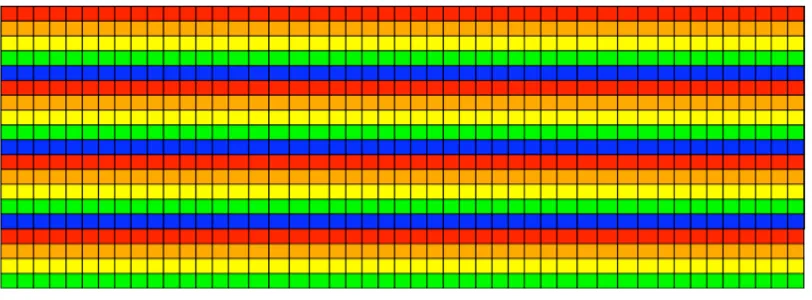
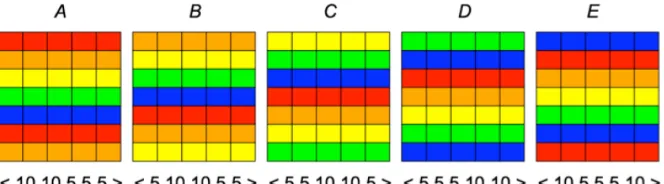
We give an example of a row-coloring that uses 5colors. Other row and column colorings were done in
a similar fashion.
The number of di¤erent tiles would have to satisfy the color constraints. That is, the number of cells of
[image:15.612.105.511.279.429.2]each color in the set of tiles must equal the number of cells of each color in the rectangle.
Figure 5: Horizontal odd tile with a 5 row coloring labeledh7;7;7;7;7i
Figure 6: Possible expressions of the vertical odd tiles
Theorem 6 The 25 31rectangle cannot be tiled using4 6 and5 7 tiles.
Proof. There is a unique way of expressing the area of this rectangle as a linear combination of the areas
using nonnegative integer coe¢ cients:25 31 = 775 = 5(35) + 25(24): This means that a tiling must use
5 odd tiles and 25 even tiles. LetH denote the number of odd tiles with their side of length 7 positioned
horizontally and let V denote the number of tiles with their side of length 7 positioned vertically. Thus
H+V = 5:
We note that if H 2 then at least2 columns will not contain an odd tile. This would be impossible
since an odd dimension column can not be …lled using only even dimension tiles. HenceH 3. We are left
with the following three cases:H = 5; V = 0;H = 4; V = 1;andH = 3; V = 2. We consider each of these
cases separately.
H = 5; V = 0. Since each odd tile covers 7of the rectangles31columns there must be a column that
intersects with more than one odd tile. Since the width of the rectangle is also odd it must be that each
column intersects with an odd number of odd tiles. Hence there must be a column that contains at least
three odd tiles. We note that for three odd tiles to overlap in a single column, the three tiles can cover
at most 13 columns. This would leave 2 tiles that must be used to cover the remaining18 tiles which is
H = 4; V = 1. Color the rows so that for0 i 24, rowi+ 1gets color 1 + (imod 5) for distinct
colors1;2;3;4;and5. There will be125cells colored for each of the colors1;2;3;4 and5. We represent the
number of cells for each color in the rectangle by the color vectorh155;155;155;155;155i. We will proceed
with a parity (odd / even) argument whereo will represent and odd number and e will represent an even
number. We convert the vectorh155;155;155;155;155itoho; o; o; o; oi.
Since each horizontal tile covers7cells of each color, we can represent its contribution by the color vector
h7;7;7;7;7i. Subtracting the contributions of the four horizontal tiles from ho; o; o; o; oi leaves the color
vectorho; o; o; o; oi. Each vertical tile will contribute10of two colors and5of three other colors. Subtracting
the contribution of one vertical tile fromho; o; o; o; oiwill leave a color vector containing two odd numbers.
Since this color vector can not be expressed using only even tiles, this case is impossible.
H = 3; V = 2. Color the rows so that for0 i 24, rowi+1gets color1+(imod 7)for distinct colors
1;2;3;4;5;6and7. There will be124cells colored for each of the colors1;2;3;4and93cells colored for each
of the colors5;6, and7. We represent the number of cells for each color in the rectangle by the color vector
h124;124;124;124;93;93;93i. We will proceed with a parity (odd / even) argument whereo will represent
and odd number ande will represent an even number. We convert the vectorh124;124;124;124;93;93;93i
tohe; e; e; e; o; o; oi. Since each vertical tile covers5cells of each color, its contribution can be represented by
the color vectorh5;5;5;5;5;5;5i. Subtracting the contributions of the two vertical tiles fromhe; e; e; e; o; o; oi
leaves the color vectorhe; e; e; e; o; o; oi.
Each horizontal tile covers7cells for each of5 di¤erent colors, and0 cells for each of the two remaining
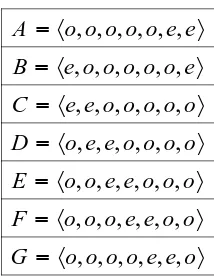
colors. For a horizontal tile there are seven possible color vectors depending on the position in which a tile
A
=
Ö
o,
o,
o,
o,
o,
e,
e
×
B
=
Ö
e,
o,
o,
o,
o,
o,
e
×
C
=
Ö
e,
e,
o,
o,
o,
o,
o
×
D
=
Ö
o,
e,
e,
o,
o,
o,
o
×
E
=
Ö
o,
o,
e,
e,
o,
o,
o
×
F
=
Ö
o,
o,
o,
e,
e,
o,
o
×
[image:18.612.252.359.37.176.2]G
=
Ö
o,
o,
o,
o,
e,
e,
o
×
Table 3: Tile rotations for seven coloring
The only con…gurations that can satisfy h_;_;_;_; o; o; oiare(A+F) =he; e; e; o; o; o; oior(B+G) =
ho; e; e; e; o; o; oi: Subtracting either of these from he; e; e; e; o; o; oi will leave one odd color in the vector.
Since this color vector can not be expressed using only even tiles, this case is impossible.
Since all of the cases are impossible, the tiling of a 25 31rectangle using4 6and 5 7 rectangles is
therefore impossible.
Theorem 7 A17 23rectangle can not be tiled using4 6 and5 7tiles.
Proof. There is a unique way of expressing the area of this rectangle as a linear combination of the
areas using nonnegative integer coe¢ cients:17 23 = 391 = 5(35) + 9(24): This means that a tiling must
use5odd tiles and9even tiles. LetH denote the number of odd tiles with their side of length7positioned
horizontally and let V denote the number of tiles with their side of length 7 positioned vertically. Thus
H+V = 5:
Color the rows so that for0 i 16, rowi+ 1gets color1 + (imod 5)for distinct colors1;2;3;4;and5.
This yields the color vectorh92;92;69;69;69i. We will proceed with a parity (odd / even) argument whereo
will represent and odd number andewill represent an even number. We convert the vectorh92;92;69;69;69i
tohe; e; o; o; oi. We note that each horizontal tile corresponds to the color vectorh7;7;7;7;7iorho; o; o; o; oi
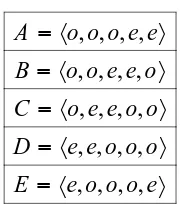
and each vertical corresponds to one of the rotations in Table 4. We …rst consider the cases where H = 5
A
=
Ö
o,
o,
o,
e,
e
×
B
=
Ö
o,
o,
e,
e,
o
×
C
=
Ö
o,
e,
e,
o,
o
×
D
=
Ö
e,
e,
o,
o,
o
×
[image:19.612.261.351.55.158.2]E
=
Ö
e,
o,
o,
o,
e
×
Table 4: Tile rotations for …ve colorings
H = 5; V = 0:Subtracting …ve copies ofh7;7;7;7;7ifrom the original color vector leavesho; o; e; e; ei,
which can not be expressed using the contributions of only even tiles. Hence this case is impossible.
H= 3; V = 2:Subtracting three copies ofh7;7;7;7;7ifrom the original color vector leavesho; o; e; e; ei.
The only tile combinations that will satisfy,ho; o;_;_;_iare(A+D) =ho; o; e; o; oi;(B+D) =ho; o; o; o; ei,
(C+E) = ho; o; o; e; oi:: Since this color vector cannot be expressed using only even tiles, this case is
impossible:
Next we color the rows so that for 0 i 16, row i+ 1 gets color 1 + (imod 7) for distinct colors
1;2;3;4;5;6 and 7. This yields the color vector h69;69;69;46;46;46;46i. We will proceed with a parity
(odd / even) argument where o will represent and odd number and e will represent an even number. We
convert the vectorh69;69;69;46;46;46;46itoho; o; o; e; e; e; ei. We note that each vertical tile corresponds
to the color vector h5;5;5;5;5;5;5ior ho; o; o; o; o; o; oiand each horizontal tile covers 7 cells for each of 5
di¤erent colors, and0cells for each of the two remaining colors. For a horizontal tile there are seven possible
color vectors depending on the position in which a tile is placed. These con…gurations are de…ned in the
table3: We consider the cases whereH = 0; H = 1;andH = 2below.
H = 0; V = 5: Subtracting …ve copies of h5;5;5;5;5;5;5i from ho; o; o; e; e; e; ei leaves a color vector
that is not all even numbers, which can not be expressed using only even tiles.
H= 1; V = 4:Subtracting four copies of h5;5;5;5;5;5;5ifromho; o; o; e; e; e; eileavesho; o; o; e; e; e; ei.
the resulting color vector.
H = 2; V = 3: Since the length and width of the rectangle are both odd, each row and each column
must intersect an odd number of odd tiles. Since there are only17rows, each column can contain at most
one vertical tile. Hence the three vertical tiles cannot intersect any of the same columns. Since each row
and each column must intersect an odd number of odd tiles and the vertical tiles, cover15columns, the two
horizontal tiles must intersect the exact same set of columns. This leaves at least one column that does not
intersect any odd tiles. Hence a tiling with this con…guration is impossible
H = 4,V = 1: We …rst note that since 4(7) + 1(5)>23there must be some column containing more
than one odd tile. We note that since the length of the rectangle is odd, each column must contain an odd
number of odd tiles. The only manner in which three odd tiles can …t into a single column of dimension17,
is to have two horizontal tiles and one vertical tile. This arrangement is guaranteed to leave a gap of7 cells
on side of the vertical tile. This gap can only be …lled with another vertical tile. Since we have only one
vertical tile, this case is impossible.
Theorem 8 A19 48rectangle can not be tiled.
Proof. There are two ways of expressing the area of this rectangle as a linear combination of the areas
using nonnegative integer coe¢ cients:19 48 = 912 = 38(24) + 0(35) = 3(24) + 24(35):The …rst combination
would mean that a tiling would only contain even tiles, which is impossible since the width is odd. Hence
we will consider the other combination of3 even tiles and24odd tiles.
We …rst consider the case where at least one of the even tiles is arranged vertically. If a column were to
intersect exactly one even tile placed vertically, this would leave 13cells to be covered by odd tiles, which
is impossible. A column can not intersect a vertical tile and a horizontal tile, since this would leave 9 cells
to be covered by odd tiles, which again is impossible. If a column intersected one vertical even tile and two
horizontal tiles, then a neighboring column of the vertical tile would have11cells to be covered by odd tiles,
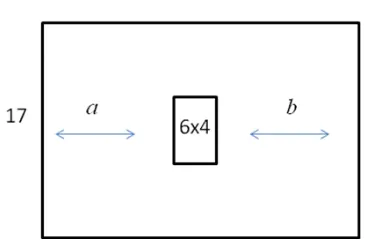
After removing the above cases, we are left with one arrangement where two of the even tiles are stacked
to form a 12 4 rectangle, and the other tile is positioned horizontally in a di¤erent set of columns. We
observe that it is impossible to place the 4 6 rectangle along a side of the rectangle surrounded by only
odd tiles. Hence the4 6rectangle must lie in the interior of the rectangle. Since the width of the rectangle
is19there must be …ve cells between the4 6tile and one vertical border and ten cells between the 4 6
and the other vertical border. Without loss of generality we will assume that the4 6tile is closer to the
bottom edge than the top. Since there are …ve cells below the even tile and ten cells above the even tile,
it must be that the tiles placed above and below the even time must be odd tiles positioned horizontally.
Note that the tile immediately above the4 6tile must be a5 7tile, which must extend beyond one of
the edges of the4 6 tile. This creates a gap of 9 cells which must be …lled using only odd tiles, which is
impossible.
We next consider the cases where all three of the even tiles are placed horizontally. Each even tile must be
…ve cells from one border and ten cells from the other border. Hence we are left with two con…gurations. In
the …rst arrangement all three even tiles occupy the exact same set of four rows. In the second arrangement
two even tiles occupy the same set of rows and the third tile occupies a di¤erent set of rows located …ve
cells away from the …rst set of rows. Both of these cases can be handled using the method from the above
paragraph. A5 7 tile must be positioned along side one of the4 6 tiles so that it overhangs, leaving a
gap of9 cells that must be …lled using only odd tiles. This completes the proof.
Theorem 9 A19 67rectangle can not be tiled.
Proof. There are two ways of expressing the area of this rectangle as a linear combination of the areas
using nonnegative integer coe¢ cients:19 67 = 1273 = 37(24) + 11(35) = 2(24) + 35(35).
We …rst consider the …rst combination of areas. We note that each column must contain at least one odd
tile. Hence H 6. Next, we color the rows so that for0 i 18, rowi+ 1 gets color 1 + (imod 5) for
distinct colors1;2;3;4;and5. This yields the color vectorh268;268;268;268;201i. We will proceed with a
We convert the vectorh268;268;268;268;201itohe; e; e; e; oi. We note that each horizontal tile corresponds
to the color vectorh7;7;7;7;7iorho; o; o; o; oiand each vertical corresponds to one of the rotations in Table
4. We consider separate cases depending on the value ofH.
H = 11; V = 0: Subtracting 11 copies of h7;7;7;7;7i from the original color vector leaves an odd
number.
H = 10; V = 1: Subtracting10copies ofh7;7;7;7;7ifrom the original color vector leaveshe; e; e; e; oi.
Subtracting any rotation from Table 4 will always leave at least one odd number in the resulting color vector.
H = 8; V = 3:Subtracting8copies ofh7;7;7;7;7ifrom the original color vector leavesX =he; e; e; e; oi.
Since the last in the …rst position is odd, any decomposition must include one of the vectors B =
ho; o; e; e; oi; C =ho; e; e; o; oi, orD=he; e; o; o; oi: This leavesX B=ho; o; e; e; ei; X C=ho; e; e; o; ei;
andX D=he; e; o; o; ei: Subtracting any vertical odd tile from any of these three vectors will not result in
a vector with total of three odd numbers, all appearing consecutively. This the subtraction of any additional
vertical odd tile will not result in a color vector with only even numbers.
H = 9; V = 2: Next color the columns so that for 0 i 66, rowi+ 1 gets color 1 + (imod 7) for
distinct colors 1;2;3;4; 5;6 and 7. This yields the color vector h171;171;171;152;152;152;152i. Each
horizontal tile corresponds to the color vector h5;5;5;5;5;5;5i and each horizontal tile corresponds to
some rotation from Table 3: Subtracting the contributions of the nine horizontal tiles we are left with
h126;126;126;107;107;107;107i. Subtracting any vector corresponding to an odd tile does not result in a
vector containing only three odd numbers all appearing in consecutive positions. Hence the subtraction of
one more tile will not result in a vector with all even numbers.
H = 7; V = 4:Since 7(7) + 4(5) = 69>67. There must be at least one column that intersects with
more than one odd tile. Since each column must contain an odd number of odd tiles, there must be a column
containing at least three odd tiles. If a column contains three vertical odd tiles then these three tiles cover
Next we consider a tiling with two even tiles and 35 odd tiles. We …rst will show that neither of the
tiles may be placed horizontally. If one or two even tiles are placed horizontally along a border then the
tiles immediately above this even tile, must be odd tiles that are placed horizontally. These tiles will overlap
along one edge of the even tiles and create a gap of four along an edge, which can not be …lled using only
odd tiles. Hence it must be that the tiles are placed in the interior. We note that if the even tiles do not
share a common row then they must be separated by …ve rows. If this is the case then19 4 4 5 = 6
rows are left to be …lled with odd tiles, which is impossible. If two even tiles appear in a4 12 stack then
there must be …ve rows one side of the stack and ten rows on the other. Without loss of generality assume
that the 5 rows are located below the stack. Then the tiles immediately above the stack must be odd tiles
placed horizontally. These tiles will extend beyond the stack in one direction creating a gap of 9. This gap
can not be …lled using only odd tiles.
We next consider the case where one or both of the even tiles are placed vertically. If the tiles do not
overlap completely we are left with a gap of 13 rows that can not be …lled using only odd tiles. Hence the
even tiles must appear in a12 4stack. Again we note that since both dimensions are odd, there must be
an odd number of odd tiles intersecting every row and every column. Since19 12 = 7and19 = 2(7) + 1(5)
there are63columns that intersect with two vertical tiles and4columns that intersect with one vertical tile.
This creates a total of4(1) + 63(2) = 130intersections. Since each vertical tile intersects5 columns, a tiling
must use130=5 = 26vertical tiles and hence9 horizontal tiles. The even stack leaves12rows each with63
cells and7rows with62cells. We note that63 = 4(7)+7(5) = 9(7)+0(5)and62 = 6(7)+4(5) = 1(7)+11(5).
Looking at the rows we see that there are 12 rows that must intersect with at least4 horizontal odd tiles
and seven rows that must intersect with at least one odd horizontal tile. This gives a total of 55=5 = 11
horizontal tiles, which contradicts the quantity obtained above.
Finally we consider the case whereH= 6andV = 5:We note that6(7) + 5(5) = 67:Hence each column
intersects exactly one odd tile. Consequently one odd tile must lie along the left or right side of the rectangle.
Without loss of generality, assume it lies on the left side. Then the columns to the immediate right of the
or we will have a gap of either5 or 7 between the second tile and the left side that can not be …lled using
only even tiles.
Theorem 10 A15 n rectangle can only be tiled ifn= 7a+ 30bwherea andbare non-negative integers.
Proof. We consider three cases based on the form of the left border of a15 nrectangle.
Case(i):The left border is made up of three5 7tiles. This results in a15 7rectangle.
Case(ii):The left border includes one4 6tile, one 5 7tile and one 6 4tile. We are then forced to
place another6 4tile adjacent to the other6 4tile. This forces a second4 6tile to be adjacent to the
…rst4 6 tile:This forces a second5 7 tile to be adjacent to the …rst5 7 tile. At each stage one of the
three tiles is forced. The right sides of the rectangle will not line up until we get tolcm(4;6;7) = 42.
Case(iii):The left border includes two4 6tiles and one7 5tile. We are forced to place another7 5
tile adjacent to the other 7 5 tile. This forces two 4 6 tiles to be adjacent to the two 4 6 tiles:This
forces a third5 7tile to be adjacent to the second5 7tile. At each stage one of the three tiles is forced.
The right sides will not line up until we get tolcm(5;6) = 30.
Theorem 11 The17 22 rectangle cannot be tiled.
Proof. The area of the17 22rectangle is374and the equation374 = 24a+ 34bhas the unique solution
a= 1andb= 10. The single4 6 tile can either be placed along a border or on the interior. We consider
these as two separate cases. If the4 6tile is placed along a border it forces a second 4x6 tile to be adjacent
to it. Hence the4 6tile must be placed on the interior, as illustrated in the …gures below. We …rst consider
the case where the even tile lies horizontally (See Figure 7). All of the remaining tiles must be odd. Hence
a +b= 16. Since 16 cannot be expressed as a linear combination of 5 and 7 with non-negative coe¢ cients
, this con…guration is impossible. Next we consider the case where the even tile lies vertically (See Figure
8). This would imply thata+b= 18. Since 18 cannot be expressed as a linear combination of 5 and 7 with
Figure 7: 17 22rectangle with4 6 orientation
Figure 8: 17 22rectangle with6 4oriantation
5
An integer linear program formulation
To assist with the computations, we designed a series of integer linear programs so that these cases could be
investigated using computational methods.
A linear program can be written as
maxcx
Ax b
where A is a matrix and b; c;and x are vectors, and each row of Ax b is a linear constraint on the
[image:25.612.218.401.225.345.2]integer linear program (ILP) requires that eachxi be an integer.
An unusual property of our formulation is that we are not concerned with the objective function, we
simply want to know if at least one feasible solution exists. Our strategy will be to show that a rectangle
cannot be tiled by showing that no feasible solution exists after passing the possible solutions through
multiple integer linear programs in series.
The4 and5color tiler for the25 31case are shown below
The4 color tiler.
maxX13 i=1xi
subject to
14x1+ 7x2+ 7x3+ 7x4+ 10x5+ 5x6+ 10x7+ 10x8+ 6x9+ 8x10+ 4x11+ 4x12+ 8x13= 217
7x1+ 14x2+ 7x3+ 7x4+ 10x5+ 10x6+ 5x7+ 10x8+ 6x9+ 8x10+ 8x11+ 4x12+ 4x13= 186
7x1+ 7x2+ 14x3+ 7x4+ 10x5+ 10x6+ 10x7+ 5x8+ 6x9+ 4x10+ 8x10+ 8x12+ 4x13= 186
7x1+ 7x2+ 7x3+ 14x4+ 5x5+ 10x6+ 10x7+ 10x8+ 6x9+ 4x10+ 4x11+ 8x12+ 8x13= 186
35 X8
i=1xi + 24 X13
i=9xi = 25 31
xi 0, integer
The5 color tiler
maxX16 i=1xi
subject to
7x1+ 10x2+ 10x3+ 5x4+ 5x5+ 5x6+ 6x7+ 6x8+ 0x9+ 6x10+ 6x11+ 4x12+ 8x13+ 4x14+ 4x15+ 4x16= 155
7x1+ 5x2+ 10x3+ 10x4+ 5x5+ 5x6+ 6x7+ 6x8+ 6x9+ 0x10+ 6x11+ 4x12+ 4x13+ 8x14+ 4x15+ 4x16= 155
7x1+ 5x2+ 5x3+ 10x4+ 10x5+ 5x6+ 6x7+ 6x8+ 6x9+ 6x10+ 0x11+ 4x12+ 4x13+ 4x14+ 8x15+ 4x16= 155
7x1+ 5x2+ 5x3+ 5x4+ 10x5+ 10x6+ 0x7+ 6x8+ 6x9+ 6x10+ 6x11+ 4x12+ 4x13+ 4x14+ 4x15+ 8x16= 155
35 X6
i=1xi + 24 X16
i=7xi = 25 31
xi 0, integer
Our integer linear programs were investigated using a software package, What’s Best by Lindo where
input could be given using anExcel spreadsheet.
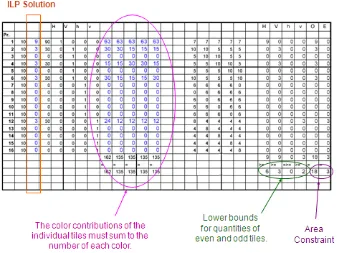
Our constraints included a color constraint, an area constraint, and then other lower bounds on the
[image:27.612.134.472.322.575.2]number of even and odd tiles. An example of our ILP for a row 5-coloring is given below.
Figure 9: Integer Linear Program for a 5 row coloring
The existing methods were insu¢ cient for determining whether or not the remaining36rectangles could
be tiled. We created additional tiling formulas in order to run each rectangle through more than one row or
column coloring. If a rectangle can be tiled then it must work under all colorings. By running each rectangle
through multiple colorings we were able to eliminate all but4of the36rectangles.
Feasible solution refers to the only possibilities left after the current tiler was used.
17 31
Feasible solutions with 7row tiler
H V h v Rejected by
10 3 0 3 5 row tiler
This is shown in a graphic organizer below. Here we can see that H represents 5 7 tiles in their
horizontal orientation,V represents 5 7 tiles in their vertical orientation, hrepresents 4 6 tiles in their
[image:28.612.92.523.354.449.2]horizontal orientation, andv represents 4 6 tiles in their vertical position.
Figure 10: 17 31rectangle passing through mutliple tilings constraining odd and even tiles.
17x31
Pass through 7row tiler on Odd
10;3
None pass through5row tiler.
the Odd (5x7) tiles. In the Diagram below you will see that the odd tiles are the only ones being constrained.
[image:29.612.90.520.87.244.2]“on Even” will be done in a similar fashion.
Figure 11: 17 31rectangle passing through multiple tilings constraining only the odd tiles.
23 32
Pass through 4row tiler on Odd
6;2
3;5
1;7
And pass through6 row tiler
6;2
3;5
And pass through7 row tiler
6;2
H V h v Rejected by
6 2 18 1 4row tiler
6 2 17 2 4row tiler
6 2 16 3 4row tiler
6 2 15 4 4row tiler
6 2 14 5 4row tiler
6 2 12 7 4row tiler
6 2 11 8 6row tiler
6 2 10 9 4row tiler
6 2 9 10 6column tiler
6 2 8 11 4row tiler
6 2 7 12 6row tiler
6 2 6 13 4row tiler
6 2 5 14 5row tiler
Figure 12: 23 32rectangle passing through multiple tilings, …rst constraining only odds, then
5.1
Applications
Tiling rectangles has several applications in the area of packaging. Rectangular truck trailers and train
cars make for prime examples. Tiling can show an optimal way to pack one of these vehicles or if the vehicle
can be packed completely full. By expanding the tiling process to a third dimension it becomes easy to see
[image:32.612.220.394.163.416.2]if there is an optimal way to load a pallet with product.
Figure 13: Semi Trailer
Figure 15: Shipping containers
Figure 16: Palletized boxes
There may also be applications to the paper industry where giant roles are cut down to make sheets
of paper. If the paper will be used for photography stock, tiling will be able to tell if there will be scraps
5.2
Conclusion
Through the combining of multiple colorings with integer linear programming, we know that32of the
36 remaining rectangles do not have an integer solution. The only cases remaining to be solved are the
23 46;23 48;23 65;and23 69rectangle. Of all the possible arrangements of the tiles the only possible
combinations are listed below for each rectangle.
23 46Rectangle
H V h v
10 12 3 9
23 48Rectangle
H V h v
12 12 9 2
12 12 2 9
23 65Rectangle
H V h v
17 12 11 9
16 13 12 8
16 13 11 9
16 13 8 12
15 14 6 14
14 15 14 6
13 16 11 9
12 17 9 11
H V h v
17 16 9 9
13 20 12 6
These particular rectangles were di¢ cult for the integer linear program because the number of Odd tiles
and Even tiles are both great. With very few possible combinations left to test, it would be possible to
eliminate further cases using larger tilers.
References
R. Ashley, A. Ayela-Uwangue, F. Cabrera, C. Callesano, D. Narayan, and A. Schwenk. Tiling with 4 6
and5 7 rectangles. preprint.
F. R. K. Chung, E. N. Gilbert, R. L. Graham and J. H. van Lint. 1982. Tiling rectangles with rectangles.
Mathematics Magazine 55, 286-291.
Solomon W. Golomb. 1994. Polyominoes (2nd. ed.). Princeton University Press.
L. F. Klosinski, G. L. Alexanderson, and L. C. Larson. 1992. The Fifty-Second William Lowell Putnam
Mathematical Competition. American Mathematical Monthly 99, 715-724.
D.A. Narayan and A.J. Schwenk. 2002. Tiling Large Rectangles. Mathematics Magazine 75(5): 372-380.
Peter J. Robinson. 1981. Fault-free rectangles tiled with rectangular polyominoes. Combinatorial
Mathe-matics 9, 372-377.
J. J. Sylvester. 1884. Question 7382. Mathematical Questions from the Educational Times 41, 21.
Y. Vitek. 1975. Bounds for a linear Diophantine problem of Frobenius, J. London Mathematics Society
Appendix A
17 31
Pass through 17 31 7row tiler on Odd 10;3
None pass through17 31 5row tiler.
17 66
Pass through 17 66 7row tiler on Odd 27;3
24;6 20;10
None pass through17 66 5row tiler.
21 26
Pass through 21 26 4row tiler on Odd 5;1
3;3
None of these pass through the21 26 5row tiler
21 31
Pass through 21 31 4row tiler on Odd 7;2
5;4 3;6
None of these pass through the21 31 6row tiler
21 34
Pass through 21 34 4row tiler on Odd 2;4
None of these pass through the21 34 6row tiler
22 27
Pass through 22 27 4row tiler Odd 6;0
4;2 2;4 0;6
and pass through22 27 5 row tiler 2;4
0;6
And pass through22 27 6row tiler 2;4
None pass through the22 27 7row tiler
Pass through 22 29 7row tiler on Odd. 10;0
9;1 7;3 4;6 3;7
None pass through22 29 6row tiler.
22 31
Feasible solutions with22 31 6 row tiler
H V h v Rejected by
10 4 8 0 22 31 5 row tiler
6 8 8 0 22 31 5 row tiler
6 8 6 2 22 31 7 row tiler
4 10 8 0 22 31 7 row tiler 2 12 7 1 22 31 5 row tiler 2 12 4 4 22 31 7 row tiler
22 32
Feasible solutions with22 32 7 row tiler
H V h v Rejected by
16 0 3 3 22 32 5 row tiler 16 0 1 5 22 32 5 row tiler 13 3 6 0 22 32 4 row tiler 12 4 4 2 22 32 5 row tiler 12 4 0 6 22 32 6 row tiler 6 10 6 0 22 32 6 row tiler
22 33
Feasible solutions with22 33 7 row tiler
H V h v Rejected by
16 2 4 0 22 33 6 row tiler 15 3 2 2 22 33 6 row tiler 9 9 4 0 22 33 6 row tiler
22 39
Pass through 22 39 4row tiler on Odd 6;0
4;2 2;4 0;6
And pass through22 39 5row tiler 2;4
0;6
None pass through the22 39 7row tiler
22 41
Pass through 4row tiler on Odd 10;0
8;2 6;4 4;6 2;8 10:0
And pass through5row tiler 6;4
4;6 2;8 0;10
And pass through6row tiler 2;8
None pass through7row tiler
22 43
Pass through 22 43 4row tiler on Odds 14;0
12;2 10;4 8;6 7;7 6;8 5;9 4;10 2;12
And pass through22 43 5row tiler 8;6
7;7 6;8 5;9 4;10 2;12
And pass through22 43 7row tiler 8;6
7;7 6;8 5;9 4;10
H V h v Rejected by
8 6 18 1 22 43 4 row tiler
8 6 15 4 22 43 6 column tiler
8 6 14 5 22 43 5 row tiler
8 6 12 7 22 43 5 row tiler
7 7 18 1 22 43 4 row tiler
7 7 15 4 22 43 4 row tiler
7 7 12 7 22 43 4 row tiler
6 8 19 0 22 43 4 row tiler
6 8 17 2 22 43 4 row tiler
6 8 16 3 22 43 5 row tiler
6 8 14 5 22 43 7 row tiler
6 8 13 6 22 43 5 row tiler
6 8 11 8 22 43 7 row tiler
6 8 10 9 22 43 5 row tiler
6 8 8 11 22 43 7 row tiler
5 9 17 2 22 43 4 row tiler
5 9 14 5 22 43 4 row tiler
5 9 11 8 22 43 4 row tiler
4 10 19 0 22 43 4 row tiler 4 10 16 3 22 43 7 row tiler 4 10 13 6 22 43 7 row tiler 4 10 10 9 22 43 7 row tiler
22 53
Pass through 22 53 4row tiler on Odds 10;0
8;2 6;4 4;6 2;8 0;10
And pass through22 53 5row tiler 6;4
4;6 2;8 0;10
And pass through22 53 6row tiler 2;8
None pass through the22 53 7row tiler
23 23
Pass through 23 23 5row tiler on Odd. 7;4
2;9 1;10
Feasible solutions with23 23 5 row tiler.
H V h v Rejected by
7 4 6 0 23 23 4row tiler 3 8 5 1 23 23 4row tiler 3 8 1 5 23 23 7row tiler 2 9 2 4 23 23 4row tiler 1 10 3 3 23 23 4row tiler
23 25
Pass through 23 25 5row tiler on Even 5;0
4;1 3;2 2;3 0;5
Pass through 23 25 7row tiler 3;2
Feasible solutions with23 25 7 row tiler.
H V h v Rejected by
8 5 3 2 23 25 5row tiler
23 32
Pass through 23 32 4row tiler on Odd 6;2
3;5 1;7
And pass through23 32 6row tiler 6;2
3;5
And pass through23 32 7row tiler 6;2
H V h v Rejected by 6 2 18 1 23 32 5row tiler 6 2 17 2 23 32 5row tiler 6 2 16 3 23 32 4row tiler 6 2 15 4 23 32 4row tiler 6 2 14 5 23 32 4row tiler 6 2 12 7 23 32 4row tiler 6 2 11 8 23 32 6row tiler 6 2 10 9 23 32 4row tiler 6 2 9 10 23 32 6column tiler 6 2 8 11 23 32 4row tiler 6 2 7 12 23 32 6row tiler 6 2 6 13 23 32 4row tiler 6 2 5 14 23 32 5row tiler 6 2 3 16 23 32 6column tiler
23 43
Pass through 23 43 4row tiler on Odd 4;3
None pass through23 43 7row tiler
23 44
Pass through 23 44 4row tiler on Odd 19;1
17;3 15;5 14;6 13;7 12;8 11;9 10;10 9;11 8;12 7;13 6;14 5;15 4;16 3;17 2;18
And pass through23 44 5row tiler 12;8
6;14 5;15 4;16 3;17 2;18
And pass through23 44 6row tiler 12;8
11;9 10;10 8;12 7;13 6;14 4;16 3;17 2;18
And pass through23 44 7row tiler 12;8
10;10 8;12 6;14
H V h v Rejected by 12 8 10 3 23 44 7row tiler
12 8 9 4 23 44 5row tiler
12 8 8 5 23 44 5row tiler
12 8 7 6 23 44 6column tiler
12 8 6 7 23 44 6column tiler
12 8 5 8 23 44 5row tiler
12 8 4 9 23 44 5row tiler
12 8 3 10 23 44 7row tiler 12 8 2 11 23 44 5row tiler 12 8 1 12 23 44 5row tiler 12 8 0 13 23 44 6row tiler 10 10 13 0 23 44 5row tiler 10 10 12 1 23 44 6column tiler 10 10 11 2 23 44 5row tiler 10 10 10 3 23 44 5row tiler 10 10 9 4 23 44 7row tiler 10 10 8 5 23 44 7row tiler 10 10 7 6 23 44 5row tiler 10 10 6 7 23 44 5row tiler 10 10 5 8 23 44 7row tiler 10 10 4 9 23 44 5row tiler 10 10 3 10 23 44 5row tiler 10 10 2 11 23 44 7row tiler 10 10 1 12 23 44 5row tiler 10 10 0 13 23 44 5row tiler 8 12 11 2 23 44 6column tiler 8 12 10 3 23 44 5row tiler
8 12 9 4 23 44 7row tiler
8 12 7 6 23 44 6 column tiler 8 12 6 7 23 44 6 row tiler 8 12 5 8 23 44 7 row tiler 8 12 4 9 23 44 6 row tiler 8 12 3 10 23 44 5 row tiler 8 12 2 11 23 44 6 row tiler 8 12 1 12 23 44 5 row tiler 8 12 0 13 23 44 5 row tiler 6 14 13 0 23 44 7 row tiler 6 14 12 1 23 44 5 row tiler 6 14 11 2 23 44 6 column tiler 6 14 10 3 23 44 5 row tiler 6 14 9 4 23 44 6 column tiler 6 14 8 5 23 44 7 row tiler 6 14 7 6 23 44 7 row tiler 6 14 6 7 23 44 7 row tiler 6 14 5 8 23 44 5 row tiler 6 14 4 9 23 44 7 row tiler 6 14 3 10 23 44 5 row tiler 6 14 2 11 23 44 5 row tiler 6 14 1 12 23 44 7 row tiler 6 14 0 13 23 44 5 row tiler
23 45
Pass through 23 45 4row tiler on Odd 7;2
5;4 0;9
And pass through23 45 5row tiler 5;4
0;9
And pass through23 45 6row tiler 5;4
H V h v Rejected by 5 4 30 0 23 45 4row tiler 5 4 27 3 23 45 4row tiler 5 4 26 4 23 45 4row tiler 5 4 24 6 23 45 4row tiler 5 4 22 8 23 45 4row tiler 5 4 21 9 23 45 4row tiler 5 4 20 10 23 45 6row tiler 5 4 18 12 23 45 4column tiler 5 4 16 14 23 45 6row tiler 5 4 15 15 23 45 5row tiler 5 4 14 16 23 45 6row tiler 5 4 12 18 23 45 4column tiler 5 4 10 20 23 45 6row tiler 5 4 8 22 23 45 6row tiler 5 4 6 24 23 45 4column tiler
23 46
Pass through 23 46 4row tiler on Odd 20;2
18;4 17;5 16;6 15;7 14;8 13;9 12;10 11;11 10;12 9;13 8;14 7;15 6;16 5;17 4;18 3;19 2;20
And pass through23 46 5row tiler 14;8
3;19 2;20
And pass through23 46 7row tiler 14;8
10;12 8;14 6;16
Feasible with23 46 7row tiler
H V h v Rejected by
14 8 11 1 23 46 4row tiler 14 8 9 3 23 46 4row tiler 14 8 6 6 23 46 5row tiler 10 12 10 2 23 46 5row tiler 10 12 8 4 23 46 5row tiler 10 12 6 6 23 46 6column tiler
10 12 3 9
8 14 11 1 23 46 4row tiler 8 14 8 4 23 46 6column tiler 6 16 7 5 23 46 5row tiler
23 48
Pass through 23 48 4row tiler on Odd 21;3
20;4 19;5 18;6 17;7 16;8 15;9 14;10 13;11 12;12 11;13 10;14 9;15 8;16 7;17 6;18 5;19 4;20 3;21 1;23
And pass through23 48 5row tiler 12;12
7;17 6;18 4;20 3;21 1;23
And pass through23 48 7row tiler 12;12
8;16 6;18
Feasible with23 48 7row tiler
H V h v Rejected by
12 12 9 2
12 12 5 6 23 48 7column tiler
12 12 2 9
8 16 8 3 23 48 7column tiler 8 16 6 5 23 48 6column tiler 6 18 11 0 23 48 5row tiler
23 50(2 5 7and 45 4 6)
None pass through the23 50 4row tiler on Odd
23 50(26 5 7and 10 4 6)
Pass through 23 50 4row tiler on Odd 23;3
22;4 21;5 20;6 19;7 18;8 17;9 16;10 15;11 14;12 13;13 12;14 11;15 10;16 9;17 8;18 7;19 6;20 5;21 4;22 2;24 0;26
10;16 6;20 5;21 4;22 2;24 0;26
And pass through23 50 7row tiler 10;16
Feasible with23 50 7row tiler
H V h v Rejected by
10 16 8 2 23 50 6 column tiler
23 52(4 5 7and 44 4 6)
None pass through the23 52 4row tiler on Odd
23 52(28 5 7and 9 4 6)
Pass through 23 52 7row tiler on Odds 28;0
26;2 25;3 22;6 18;10 15;13 8;20
And pass through23 52 4row tiler 26;2
22;6 18;10 15;13 8;20
And pass through23 52 5row tiler 8;20
Feasible with23 52 7row tiler
H V h v Rejected by
8 20 8 1 23 52 5row tiler
23 65(5 5 7and 55 4 6)
None pass the23 65 4 row tiler on Odd
23 65(29 5 7and 20 4 6)
Pass through 23 65 4row tiler on Odd 28;1
22;7 21;8 20;9 19;10 18;11 17;12 16;13 15;14 14;15 13;16 12;17 11;18 10;19 9;20 8;21 7;22 6;23 5;24 4;25 2;27 0;29
And pass through23 65 5row tiler 21;8
20;9 19;10 17;12 16;13 15;14 14;15 13;16 12;17 11;18 10;19 9;20 8;21 7;22 6;23 5;24 4;25 2;27 0;29
And pass through23 65 7row tiler 21;8
16;13 15;14 14;15 13;16 12;17 11;18 9;20
Feasible with23 65 7row tiler
H V h v Rejected by
20 9 3 17 23 65 5row tiler 19 10 19 1 23 65 4column tiler 19 10 18 2 23 65 5row tiler 19 10 17 3 23 65 6column tiler 19 10 15 5 23 65 5row tiler 19 10 14 6 23 65 7column tiler 19 10 12 8 23 65 5row tiler 19 10 11 9 23 65 7column tiler 19 10 9 11 23 65 5row tiler 17 12 15 5 23 65 5row tiler 17 12 14 6 23 65 7column tiler 17 12 13 7 23 65 7column tiler 17 12 12 8 23 65 5row tiler
17 12 11 9
17 12 10 10 23 65 7column tiler 17 12 9 11 23 65 5row tiler 17 12 8 12 23 65 6column tiler 17 12 7 13 23 65 7column tiler 17 12 6 14 23 65 5row tiler 17 12 4 16 23 65 7column tiler 16 13 18 2 23 65 5row tiler 16 13 17 3 23 65 4row tiler 16 13 16 4 23 65 5row tiler 16 13 14 6 23 65 6column tiler 16 13 13 7 23 65 5row tiler
16 13 12 8
16 13 11 9 23 65 7column tiler 16 13 10 10 23 65 5row tiler
16 13 9 11
16 13 7 13 23 65 5row tiler 16 13 5 15 23 65 7column tiler 15 14 18 2 23 65 5column tiler 15 14 16 4 23 65 7column tiler 15 14 15 5 23 65 5column tiler 15 14 14 6 23 65 5row tiler 15 14 12 8 23 65 5column tiler 15 14 11 9 23 65 5row tiler 15 14 9 11 23 65 7column tiler 15 14 8 12 23 65 5row tiler
15 14 6 14
14 15 19 1 23 65 4row tiler 14 15 16 4 23 65 5column tiler
14 15 14 6
14 15 13 7 23 65 5column tiler 14 15 12 8 23 65 5row tiler 14 15 10 10 23 65 7column tiler 13 16 20 0 23 65 4row tiler 13 16 17 3 23 65 5column tiler 13 16 14 6 23 65 5column tiler 13 16 12 8 23 65 5column tiler
13 16 11 9
13 16 10 10 23 65 5column tiler
13 16 8 12
12 17 15 5 23 65 5row tiler
12 17 9 11
11 18 16 4 23 65 5row tiler 11 18 15 5 23 65 5column tiler 11 18 13 7 23 65 5column tiler 9 20 18 2 23 65 5row tiler 9 20 12 8 23 65 5column tiler
23 67(7 5 7and 54 4 6)
None pass through the23 67 4row tiler on Odd
23 67(31 5 7and 19 4 6)
Pass through 23 67 4row tiler on Odd 29;2
21;10 20;11 19;12 18;13 17;14 16;15 15;16 14;17 13;18 12;19 11;20 10;21 9;22 8;23 7;24 6;25 5;26 4;27 3;28 1;30
And pass through23 67 5row tiler 23;8
19;12 18;13 17;14 15;16 14;17 13;18 12;19 11;20 10;21 9;22 8;23 7;24 6;25 5;26 4;27 3;28 1;30
And pass through23 67 7row tiler 23;8
13;18 12;19 11;20
Feasible with23 67 5row tiler
H V h v Rejected by
13 18 14 5 23 67 6row tiler 13 18 13 6 23 67 7row tiler 13 18 12 7 23 67 6column tiler 13 18 10 9 23 67 6column tiler 13 18 9 10 23 67 7row tiler 13 18 7 12 23 67 7row tiler 13 18 6 13 23 67 6column tiler 13 18 4 15 23 67 7row tiler 13 18 3 16 23 67 6column tiler 12 19 18 1 23 67 7column tiler 12 19 16 3 23 67 6column tiler 12 19 15 4 23 67 7row tiler 12 19 14 5 23 67 7column tiler 12 19 13 6 23 67 6column tiler 12 19 11 8 23 67 7row tiler 12 19 10 9 23 67 7row tiler 12 19 8 11 23 67 6column tiler 12 19 7 12 23 67 6column tiler 12 19 5 14 23 67 7row tiler 12 19 4 15 23 67 6column tiler 11 20 19 0 23 67 5column tiler 11 20 17 2 23 67 6column tiler 11 20 16 3 23 67 7row tiler 11 20 15 4 23 67 7row tiler 11 20 14 5 23 67 7row tiler 11 20 12 7 23 67 7row tiler 11 20 11 8 23 67 6column tiler 11 20 10 9 23 67 7row tiler 11 20 9 10 23 67 7row tiler 11 20 8 11 23 67 6column tiler 11 20 7 12 23 67 7 row tiler 11 20 6 13 23 67 7 row tiler 11 20 5 14 23 67 7 row tiler 11 20 4 15 23 67 7 row tiler 11 20 3 16 23 67 7 column tiler 11 20 1 18 23 67 7 row tiler 11 20 0 19 23 67 7 row tiler
23 69(9 5 7and 53 4 6)
None pass through the23x69 4row tiler
23x69(33 5 7and 18 4 6)
33;0 32;1 31;2 30;3 29;4 28;5 27;6 26;7 25;8 24;9 23;10 22;11 21;12 20;13 18;15 17;16 16;17 15;18 14;19 13;20 11;22
And pass through23x69 4 row tiler 30;3
29;4 28;5 27;6 26;7 25;8 24;9 23;10 22;11 21;12 20;13 18;15 17;16 16;17 15;18 14;19 13;20 11;22
And pass through23x69 5 row tiler 21;12
11;22
Feasible with23x69 5 row tiler
H V h v Rejected by
21 12 18 0 23x69 7row tiler 21 12 14 4 23x69 7column tiler 21 12 11 7 23x69 7column tiler 21 12 8 10 23x69 7column tiler 17 16 17 1 23x69 7row tiler 17 16 15 3 23x69 6column tiler 17 16 13 5 23x69 7column tiler 17 16 12 6 23x69 7column tiler 17 16 10 8 23x69 7row tiler
17 16 9 9
13 20 16 2 23x69 7row tiler 13 20 14 4 23x69 7column tiler
13 20 12 6
13 20 11 7 23x69 7row tiler 13 20 10 8 23x69 6column tiler 13 20 9 9 23x69 7row tiler 13 20 8 10 23x69 7row tiler 13 20 7 11 23x69 7row tiler 13 20 6 12 23x69 7row tiler 13 20 5 13 23x69 7row tiler 13 20 4 14 23x69 7row tiler 13 20 2 16 23x69 7row tiler 11 22 18 0 23x69 7row tiler 11 22 16 2 23x69 7row tiler 11 22 14 4 23x69 7row tiler 11 22 13 5 23x69 7row tiler 11 22 12 6 23x69 7row tiler 11 22 11 7 23x69 7row tiler 11 22 10 8 23x69 7row tiler 11 22 9 9 23x69 7row tiler 11 22 8 10 23x69 7row tiler 11 22 7 11 23x69 7row tiler 11 22 6 12 23x69 7row tiler 11 22 4 14 23x69 7row tiler 11 22 1 17 23x69 6row tiler
23 71(11 5 7and 52 4 6)
Pass23 71 4 row tiler on Odd 8;3
None pass through23 71 4column tiler
23 71(35 5 7and 17 4 6)
Pass through 23 71 4row tiler on Odd 32;3
21;14 20;15 19;16 18;17 17;18 16;19 15;20 14;21 13;22 12;23 11;24 10;25 9;26 8;27 7;28 6;29 5;30 4;31 3;32 2;33
And pass through23 71 5row tiler 19;16
15;20 14;21 13;22 11;24 10;25 9;26 8;27 7;28 6;29 5;30 4;31 3;32 2;33
And pass through23 71 7row tiler 19;16
15;20 14;21 13;22 11;24
H V h v Rejected by
19 16 15 2 23 71 7column tiler 19 16 12 5 23 71 7column tiler 19 16 11 6 23 71 7column tiler 19 16 8 9 23 71 7column tiler 15 20 12 5 23 71 7column tiler 15 20 11 6 23 71 7column tiler 15 20 9 8 23 71 7column tiler 14 21 16 1 23 71 7column tiler 14 21 10 7 23 71 7column tiler 13 22 17 0 23 71 5row tiler 13 22 14 3 23 71 7column tiler 11 24 13 4 23 71 5column tiler
23 73(37 5 7and 16 4 6)
Pass through 23 73 4row tiler on Odd 35;2
5;32 4;33 3;34 1;36
And pass through23 73 5row tiler 17;20
13;24 12;25 11;26 9;28 8;29 7;30 6;31 5;32 4;33 3;34 1;36
And pass through23 73 7row tiler 17;20
13;24
Feasible with23 73 7row tiler
H V h v Rejected by
17 20 15 1 23 73 5row tiler 17 20 11 5 23 73 5column tiler 17 20 8 8 23 73 5column tiler 13 24 14 2 23 73 5row tiler 13 24 12 4 23 73 5row tiler
23 73(13 5 7and 51 4 6)
Pass through 23 73 4row tiler on Odd 11;2
9;4 4;9
And pass through23 73 5row tiler 9;4
4;9
And pass through23 73 7row tiler 9;4
None pass through23 73 7column tiler
25 29
Pass through 25 29 4row tiler on Odd 4;3
2;5
2;5
None pass through the25 29 6row tiler
25 31
Pass through 25 31 4row tiler on Odd 3;2
None pass through25 31 7row tiler
26 27
Pass through 26 27 4row tiler on Odd 18;0
16;2 14;4 12;6 10;8 9;9 8;10 6;12 5;13 4;14 2;16 0;18
And pass through26 27 5row tiler 9;9
4;14
And pass through26 27 6row tiler 4;14
Feasible with26 27 6row tiler
H V h v Rejected by
4 14 2 1 26 27 4row tiler
26 33
Pass through 26 33 4row tiler on Odd 6;0
4;2 2;4 0;6
And pass through26 33 5row tiler 4;2
2;4 0;6
None pass through26 33 7row tiler
26 37
22;0 20;2 18;4 16;6 15;7 14;8 13;9 12;10 11;11 10;12 9;13 8;14 7;15 6;16 5;17 4;18 2;20 0;22
And pass through26 37 5row tiler 15;7
14;8 13;9 11;11 10;12 9;13 8;14 7;15 6;16 5;17 4;18 2;20 0;22
And pass through26 37 6row tiler 14;8
11;11 10;12 8;14 7;15 6;16 5;17 4;18 2;20 0;22
And pass through26 37 7row tiler 14;8
10;12 7;15 5;17
Feasible with26 37 7row tiler
H V h v Rejected by
14 8 8 0 26 37 5 row tiler 14 8 2 6 26 37 5 row tiler 11 11 2 6 26 37 5 row tiler 11 11 1 7 26 37 6 row tiler 10 12 6 2 26 37 5 row tiler 10 12 0 8 26 37 5 row tiler 7 15 8 0 26 37 4 row tiler 7 15 2 6 26 37 6 row tiler 5 17 4 4 26 37 4 row tiler 5 17 3 5 26 37 5 row tiler
27 38
Pass through 27 38 4row tiler on Odd 4;2
None pass through the27 38 6row tiler
27 41
Pass through 27 41 4row tiler on Odd 5;4
3;6
None pass through the27 41 6row tiler
27 43
Pass through 27 43 4row tiler on Odd 24;3
8;19 7;20 6;21 5;22 4;23 3;24 1;26
And pass through27 43 5row tiler 22;5
20;7 18;9 17;10 16;11 15;12 14;13 13;14 12;15 11;16 10;17 9;18 8;19 7;20 6;21 5;22 4;23 3;24 1;26
And pass through27 43 6row tiler 17;10
16;11 15;12 14;13 13;14 12;15 11;16 10;17 9;18 8;19 6;21 4;23
And pass through27 43 7row tiler 14;13
12;15 11;16 4;23
14;13
Feasible with7column tiler
H V h v Rejected by
14 13 5 4 27 43 7 row tiler 14 13 2 7 27 43 7 row tiler
27 46
Pass through 27 46 4row tiler on Odd 28;2
26;4 25;5 24;6 23;7 22;8 21;9 20;10 19;11 18;12 17;13 16;14 15;15 14;16 13;17 12;18 11;19 10;20 9;21 8;22 7;23 6;24 5;25 4;26 3;27 2;28
And pass through27 46 5row tiler 24;6
12;18 11;19 10:20 9;21 8;22 7;23 6;24 5;25 4;26 3;27 2;28
And pass through27 46 6row tiler 19;11
18;12 17;13 16;14 15;15 14;16 13;17 12;18 11;19 10;20 9;21 7;23 6;24 5;25 4;26 3;27 2;28
And pass through27 46 7row tiler 18;12
16;14 15;15
And pass through27 46 7column tiler 16;14
15;15
Feasible with7column tiler
H V h v Rejected by
10 x n possible? why yes or no
10 x 10 n area
10 x 11 n area
10 x 12 y general store
10 x 13 n area
10 x 14 y general store
10 x 15 n area
10 x 16 n area
10 x 17 n area
10 x 18 n area
10 x 19 y general store
10 x 20 n area
10 x 21 y general store
10 x 22 n area
10 x 23 n area
10 x 24 y general store
10 x 25 n area
10 x 26 y general store
10 x 27 n area
10 x 28 y general store
10 x 29 n area
10 x 30 n area
10 x 31 y general store
10 x 32 n area
10 x 33 y general store
10 x 34 n area
10 x 35 y general store 10 x 36 y general store
10 x 37 n area
10 x 38 y general store
10 x 39 n area
10 x 40 y general store
10 x 41 n area
10 x 42 y general store 10 x 43 y general store
10 x 44 n area
10 x 45 y general store
10 x 46 n area
10 x 47 y general store 10 x 48 y general store 10 x 49 y general store 10 x 50 y general store
10 x 51 n area
10 x 52 y general store
10 x 53 n area
10 x 54 y general store 10 x 55 y general store 10 x 56 y general store 10 x 57 y general store
10 x 58 n area
12 x n possible why yes or no
12 x 12 y general store
12 x 13 n area
12 x 14 y general store
12 x 15 n area
12 x 16 y general store
12 x 17 n area
12 x 18 y general store
12 x 19 n area
12 x 20 y general store
12 x 21 n area
12 x 22 y general store
12 x 23 n area
12 x 24 y general store
12 x 25 n area
12 x 26 y general store
12 x 27 n area
12 x 28 y general store
12 x 29 n area
12 x 30 y general store
12 x 31 n area
12 x 32 y general store
12 x 33 n area
12 x 34 y general store
12 x 35 y general store
12 x 36 y general store
12 x 37 n disproved - only 1 4x6 tile*
12 x 38 y general store
14 x number possible? why yes or no
14 x 14 n area
14 x 15 y general store
14 x 16 n area
14 x 17 y general store
14 x 18 n area
14 x 19 n area
14 x 20 y general store
14 x 21 n area
14 x 22 y general store
14 x 23 n area
14 x 24 y general store
14 x 25 y general store
14 x 26 n area
14 x 27 y general store
14 x 28 n area
14 x 29 y general store
14 x 30 y general store
14 x 31 n area
14 x 32 y general store
14 x 33 n area
14 x 34 y general store
14 x 35 y general store
14 x 36 y general store
14 x 37 y general store
14 x 38 n area
14 x 39 y general store
14 x 40 y general store
14 x 41 y general store
14 x 42 y general store
14 x 43 n area
17 x number possible? why yes or no
17 x 17 n area
17 x 18 y Figure 3
17 x 19 n only 1 5x7
17 x 20 n area
17 x 21 n area
17 x 22 n Theorem 11
17 x 23 n coloring argument
17 x 24 n all 4x6's can't fill odd dimension
17 x 25 n area
17 x 26 n area
17 x 27 y general store
17 x 28 y general store
17 x 29 n area
17 x 30 n area
17 x 31 n Tiler
17 x 32 y 17 x 14 + 17 x 18
17 x 33 n too few 5x7's (3) - too many columns of 17
17 x 34 n area
17 x 35 y general store
17 x 36 y general store
17 x 37 y general store
17 x 38 n too few 5x7's (2) - too many columns of 17
17 x 39 n area
17 x 40 y 10 x 40 + 7 x 40
17 x 41 y 17 x 14 and 17 x 27
17 x 42 y 17 x 28 and 17 x 14
17 x 43 n only 1 5x7
17 x 44 n proof on paper dr. narayan gave out
17 x 45 y rectangles/pinwheel?
17 x 46 y 17 x 28 + 17 x 18
17 x 47 n too few 5x7's
17 x 48 n all 4x6's can't fill odd dimension
17 x 49 y 14+35
17 x 50 y 14+36
17 x 51 y 14+37
17 x 52 n too few 5x7's
17 x 53 y pinwheel
17 x 54 y 27+27
17 x 55 y 14+14+27
17 x 56 y 14+14+14+14
17 x 57 n too few 5x7's OR only 1 4x6
17 x 58 y 17 x 40 + 17 x 18
17 x 59 y 17 x 41 + 17 x 18
17 x 60 y general store
17 x 61 n too few 5x7's
17 x 62 y general store
17 x 63 y general store
17 x 64 y general store
17 x 65 y 14+14+37
17 x 66 n Tilers
17 x 67 y pinwheel
17 x 68 y 14+27+27
17 x 69 y 14+14+14+27
17 x 70 y general store
17 x 71 y 17 x 35 and 17 x 36
17 x 72 y general store
17 x 73 y 17 x 36 and 17 x 37
17 x 74 y general store
17 x 75 y pinwheel
17 x 76 y 14+27+35
17 x 77 y 14+14+14+35
18 x number possible? why yes or no
18 x 18 n area
18 x 19 n area
18 x 20 y a=5
18 x 21 y a=1,b=1
18 x 22 n area
18 x 23 n area
18 x 24 y a=6
18 x 25 y a=2,b=1
18 x 26 n too many columns with only 5x7s
18 x 27 n area
18 x 28 y a=7
18 x 29 y a=3,b=1
18 x 30 y c=1
18 x 31 n area
18 x 32 y a=8
18 x 33 y a=4,b=1
18 x 34 y a=1,c=1
18 x 35 n too man