High-Order Wavelet Reconstruction for Multi-Scale Edge Aware Tone Mapping
Alessandro Artusia, Zhuo Sub,c, Zongwei Zhang’sb,c, Dimitris Drikakisd, Xiaonan Luob,c
aGraphics and Imaging Laboratory Department of Informatics and Applied Mathematics University of Girona. bNational Engineering Research Center of Digital Life, Guangzhou, China.
cSchool of Information Science and Technology, Sun Yat-sen University, Guangzhou, China. dFluid Mechanics and Computational Science Cranfield University.
Abstract
This paper presents a High Order Reconstruction (HOR) method for improved multi-scale edge aware tone map-ping. The study aims to contribute to the improvement of edge-aware techniques for smoothing an input image, while keeping its edges intact. The proposed HOR methods circumvent limitations of the existing state of the art meth-ods, e.g., altering the image structure due to changes in contrast; remove artefacts around edges; as well as reducing computational complexity in terms of implementation and associated computational costs. In particular, the proposed method aims at reducing the changes in the image structure by intrinsically enclosing an edge-stop mechanism whose computational cost is comparable to the state-of-the-art multi-scale edge aware techniques.
Keywords:
1. Introduction 1
High Order Reconstruction (HOR) methods, intro-2
duced by Harten et al. [1], have been used exten-3
sively for solving the hyperbolic conservation laws and 4
the Hamilton-Jacobi equations [2]. Additionally, these 5
methods have been applied to image processing (image 6
compression), denoising [3] and segmentation [4]. Due 7
to their ability to reduce oscillations around function 8
discontinuities, these methods can be potentially used 9
as an edge aware interpolation tool. Edge-aware tech-10
niques such as anisotropic di↵usion [5], bilateral
filter-11
ing [6, 7] and neighborhood filtering rely on sophisti-12
cated type of spatially varying kernels. Often, they tend 13
to either generate artificially staircasing e↵ects or
ring-14
ing e↵ects around sharp edges [8]. These artifacts can
15
be reduced using a post-processing step at the price of 16
increasing the computational cost and the number of pa-17
rameters used [9]. To have better control of the details 18
over the spatial scale, one can apply edge-aware tech-19
niques in a multi-scale fashion. However, the bilateral 20
filtering is inappropriate for multi-scale detailed decom-21
position [10]. Other edge-aware techniques that sup-22
port the multi-scale approach [10, 11, 9] also encompass 23
some flaws, e.g., they are not able to achieve a plausible 24
reproduction of all important image features [12] and 25
may change the image structure. 26
Therefore, there is a need to develop methods that are 27
reducing as much as possible any change into the image 28
structure without increasing the complexity or compu-29
tational cost. 30
In this paper, we link the edge-aware problem to the 31
typical problem of interpolation. In particular, we pro-32
pose a novel wavelet scheme that uses a robust predictor 33
operator, based on the HOR method, which intrinsically 34
encloses an edge-stop mechanism to avoid influence of 35
pixels from both sides of an edge. To have a better con-36
trol of details over the spatial scale, we employ the HOR 37
method in conjunction with a multi-scale scheme. 38
We demonstrate the usability of the proposed method to 39
solve a typical problem in the context of High Dynamic 40
Range (HDR) imaging, called tone mapping as defined 41
in Banterle et al. [13]. 42
The approach is formulated as follows; we decom-43
pose an input HDR image, making use of wavelet de-44
composition and through the use of HOR methods sep-45
arate its coarse and fine features (details). The coarse 46
and fine features are then manipulated to achieve the de-47
sired tone and details levels. Finally, the output image 48
is reconstructed. The advantage of the above approach 49
is that it does not require the introduction of any edge-50
stopping function that limits possible image-structure 51
changes. 52
To understand this concept, Figure 1 shows the dis-53
Figure 1: Comparison of the state-of-the-art multiscale edge aware based tone mapping operators and the present HOR: 1strow: output of the
various techniques. 2nd row: distortion map of the DRIM metric [12]. This map is showing the pixels that shows a distorsion with 95% of
probability to been seen by the Human Visual System (HVS). Blue pixels are areas where invisible contrast is introduced; red pixels are areas where reversal of visible contrast is noticeable and green pixels shows areas of lost of contrast. The map is showing of a reduction of more than 50% of the pixels a↵ected by loss of contrast when the the HOR method is used. Parameters used - Farbmann et al. [10] multiscale approach balanced - Fattal’s [11]↵=0.9, =0.16 and =0.8 - Paris et al. [9] r=log(2.5),↵=0.5 and =0.0 (for conveying the local e↵ect) - The Present HOR =0.7, =0.9.
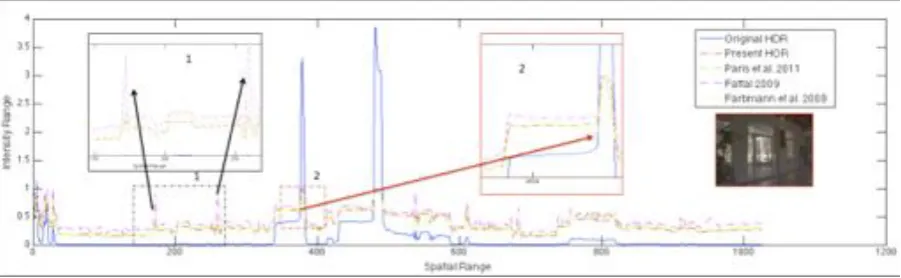
Figure 2: Intensity profile for the tone mapping operators on an HDR mage for line 300: The 1stzoomed area, clearly shows how Fattal’s [11]
method (undesirably) increases the intensity profile to the maximum value of 1. In the 2ndzoomed area (Paris et al. [9] green line), the intensity
[image:2.595.74.525.504.643.2]dent metric (DRIM) introduced by Aydin et al. [12] for 55
[10, 11, 9] and the technique proposed in this paper. The 56
original HDR image is used as reference, and the output 57
of the tone mapping operator is compared to it. A cer-58
tain amount of lost of contrast (green) is clearly visible, 59
and this may change the overall image structure [12]. 60
The map shows that using the present HOR reduces the 61
number of pixels a↵ected by loss of contrast by more
62
than 50%. 63
Moreover, the intensity profile may change as shown 64
in Figure 2. The Fattal method [11] may have an un-65
desirable increase of the intensity profile to the maxi-66
mum output value 1 (1stzoomed area). The structure of 67
the original profile may be undesirably modified (green 68
line) as shown for the method [9] (2nd enlarged area). 69
These methods may result in prohibitive computational 70
costs (see Paris et al. [9]). An efficient
implementa-71
tion [14] of the method presented by Paris et al. [9] 72
is also discussed in Section 6. 73
The proposed approach retains the same advantages 74
introduced by the traditional edge aware approaches 75
such as Paris et al. [9], and Fattal [11], namely with re-76
spect to obtaining local properties and providing robust 77
smoothing, hence avoiding the use of pixels from both 78
sides of the edge. The main contributions of this work 79
can be summarized as follows: 80
1. Establish a link between the robust smoothing 81
concept to the reconstruction problem of a non-82
smoothed function. 83
2. Achieve a complex solution of the edge-aware 84
problem, through a simple and flexible point-wise 85
manipulation by using HOR method. 86
3. Propose an edge-aware filter that produces halo 87
free results; reduces the changes in the image 88
structure as defined by the DRIM metric and its 89
computational cost is increasing linearly with re-90
spect to the number of the input pixelsN. 91
2. Related Work 92
Edge Aware Filters 93
Edge aware techniques are used to smooth an image 94
while keeping its edges intact, preventing pixels located 95
on one side of a strong edge from influencing pixels on 96
the other side. This concept can be used to separate high 97
frequency information from low frequency information 98
such as texture and details. Once this separation is pe-99
formed the high and low frequencies information can be 100
independently manipulated and re-composed. 101
In the past, techniques able to preserve edges [6, 8, 5] 102
have been applied to image manipulation [15, 16, 17, 103
11]. These techniques produce acceptable results, but 104
often introduce visible ringing e↵ects arising from the
105
Poisson equation [15] and filtering, as discussed in [10, 106
8]. Moreover, they need several parameters, that are im-107
age dependent, making their set-up difficult for
practi-108
cal applications [17]. Our approach o↵ers a solution,
109
that produces results at least as good as the above tech-110
niques, runs linearly in time with respect to the number 111
of the input pixels and is not dependent on a large num-112
ber of parameters. 113
Multi-Scale Edge Aware Filters 114
Recently, several edge-aware techniques that can be 115
used in the multi-scale framework, have been presented. 116
Typically, these methods exploit the multi-scale ap-117
proach by making use of pyramid mechanisms such as 118
Laplacian [18], Gaussian [19], and Wavelets [20]. 119
The Laplacian approach, in the context of edge-aware, 120
has been recently revised by Paris et al. [9] through the 121
use of local transformation which makes the Laplacian 122
approach suitable for edge-aware operations. Farbman 123
et al. [10] employed the weighted least square to build 124
an alternative edge preserving operator and extend it to 125
multi-scales as well. Fattal et al. [15] used the Gaus-126
sian Pyramid to compress the high dynamic range of the 127
input image, followed by the full image reconstruction 128
through the use of the Poisson solver. 129
The aforementioned techniques share with our ap-130
proach the multi-scale ’philosophy’, but are using dif-131
ferent methods such as the Laplacian [10, 9] and Gaus-132
sian [15] pyramids. Moreover, they are based on the so-133
lution of a linear system [10], a Poisson solver [15], or 134
bilateral filtering all of which generate artifacts around 135
edges [8]. Li et al. [21] proposed a multi-scale approach 136
based on wavelets where each sub-band signal is mod-137
ified using a gain map that controls the local contrast. 138
Fattal [11] presented an edge avoiding technique based 139
on a second generation wavelet. Our approach inte-140
grates within the wavelet mechanism a HOR technique 141
that does not require any edge-stop function for com-142
puting a large set of weights in the interpolation step 143
as in [11]. Consequently, using the present approach 144
there is no need for any particular precaution against 145
the strong edges and distortions of the image structure 146
are reduced. 147
3. Background 148
Fixed stencil approximation techniques, such as 149
piecewise linear and cubic interpolation, are often used 150
to reconstruct the missing points of a function. These 151
methods are working well in the case where the func-152
Figure 3: Example of the HOR scheme mechanism. (Top row) The original staircase signal. (2ndrow) The uniform grid points: (circle
red) input points, (square blue) points to be interpolated. (3rdrow)
The stencil points used by the HOR scheme. (4th and 5th rows):
Two separated stencils used to define the two interpolants by the HOR scheme.
wise smooth the fixed stencil approximation may not be 154
adequate near discontinuities. In fact, oscillations at the 155
function discontinuities are visible, 156
Essential Non-oscillatory Scheme 157
Essential Non-oscillatory Schemes (ENO) have been in-158
troduced by Harten et al. [1] to solve this problem. The 159
ENO scheme makes use of adaptive stencils, thus the 160
use of discontinuity cells is avoided. Let us consider a 161
signal function f(x) with given grid of points of evalu-162
ated values such asv[i]= f[xi]. 163
The ENO scheme reconstructs f from the point values 164
vassuming that f is piecewise polynomial. This means 165
that for each cell Ii ⌘ [xi 1,xi+1] a polynomial
inter-166
polantpi(x) is defined using the set of points defined in 167
the stencilSi. The idea is to find a stencil ofk+1 con-168
secutive points, includingxi 1andxi+1, where the signal 169
f(x) is the smoothest in this stencil when comparing it 170
with the other possible stencils. To evaluate the smooth-171
ness of f(x) we can use the Newton divide di↵erences
172 of f: 173
f[x0]⌘f(x0); f[x0,x1]⌘(xf0[x0]x1)+
f[x1] (x1 x0); ...
(1) 174
In general, the j-thdegree divided di↵erence of f(x)
175
is equivalent to 176
f[xi 1, .,xi+j 1]⌘
f[xi, .,xi+j 1] f[xi 1, .,xi+j 2]
xi+j 1 xi 1
.(2) 177
Starting from a two points stencil 178
S2(i)=xi 1,xi+1, (3) 179
the linear interpolation of the stencil S2 in a Newton 180
form is 181
p1(x)= f[xi 1]+f[xi 1,xi+1](x xi 1). (4)
182
To expand the stencil we have two possibilities, either 183
add the left neighborxi 2or the right onexi+2. In both
184
cases this will be a quadratic interpolation polynomial. 185
This will di↵er from the linear polynomial of eq. 4, by
186
the same function multiplied by two di↵erent constants.
187
These constants are the two 2-nddegrees of divided dif-188
ferences of f(x) in two di↵erent stencils defined by the
189
left and right neighbors.This procedure is continued un-190
til thek+1 points in the stencil are reached. 191
High Order Interpolation Scheme (HOR) 192
The typical problem of the ENO scheme is that it 193
can exhibit oscillatory behavior and is also fairly ex-194
pensive in its implementation [22]. As an alterna-195
tive, the weighted ENO (WENO) variant has been pro-196
posed1. WENO uses a convex combination of all the 197
corresponding interpolating polynomials on the stencil 198
to compute an approximated polynomial for each cell 199
(Figure 3). A convex combination is a linear combina-200
tion where the coefficients (weights) are all positive and
201
their sum is equal to 1. The key points of the reconstruc-202
tion scheme are (at 3rdorder accuracy): 203
1. Stencils definition: Taking a cell defined in the in-204
terval [xi 1/2,xi+1/2] (see Figure 3), the stencils are 205
defined as [22] 206
S1=(xi 3/2,xi 1/2,xi+1/2);
S2 =(xi 1/2,xi+1/2,xi+3/2) (5) 207
2. Interpolation polynomials: For each stencil the lin-208
ear interpolation polynomial is computed as 209
p1= f[xi]+ f[xi] fx[xi1](x xi);
p2= f[xi]+ f[xi+1]xf[xi](x xi) (6) 210
where the f[x] elements are the available data 211
points of the function to be reconstructed (red 212
points in Figure 3). 213
3. Convex combination: The interpolation polynomi-214
als are combined following a convex combination 215
Pi= a i 0 ai
0+ai1
p1+ a i 1 ai
0+ai1
p2 (7)
216 where 217 ai 0= Ci 0 (✏+(IS)1)2.0;
ai 1=
Ci
1 (✏+(IS)2)2.0
(8) 218
1WENO schemes have been widely used in computational fluid
Figure 4: Overview of the present approach. Firstly, a pyramid repre-sentation of the input HDR image is produced using a forward wavelet lifting scheme with integrated the HOR interpolation method pre-sented in this paper. Secondly, the coarse level of the pyramid struc-ture (blue continue arrow) and the details levels (blue dashed arrows) are manipulated. Thirdly, the modified pyramid is collapsed to recon-struct the output tone mapped image. This is done, using the backward wavelet lifting scheme with integrated the HOR interpolation model.
IS are the smoothness indicators, which are calcu-219
lated as (IS)1 = (f[xi] f[xi 1])2.0 and (IS)2 = 220
(f[xi+1] f[xi])2.0. The gradient magnitude is well
221
known to be a good estimator of edge information. 222
Based on this observation, we have used the im-223
age gradient to select the coefficients C as given
224
by [22], allowing the interpolation step to be aware 225
of edge information in order to avoid an edge-226
stopping function. 227
• @E(f)/@f >0:C0i =1/2 andCi1=1; 228
• @E(f)/@f <0:C0i =1 andCi1=1/2. 229
4. HOR Wavelet Scheme 230
In this paper we propose a robust smoothing through the 231
use of a polynomial interpolant that makes use of the 232
smoothest stencils. It is integrated in a wavelet scheme 233
(lifting scheme) to take advantage of the multi-scale 234
representation such as the capability to retain image in-235
formation at di↵erent scale. Figure 4 shows the
princi-236
ple of the present approach. Firstly, a pyramid repre-237
sentation of the original input imageI is produced us-238
ing a forward wavelet lifting WENO scheme. Secondly, 239
the coarse (blue continued arrows) and fine levels (blue 240
dashed arrow) are manipulated. Thirdly, the modified 241
multiscale representation is collapsed to the output im-242
age using the backwards wavelet lifting WENO scheme. 243
A multi-scale representation can be obtained by making 244
use of a nested series of decimationDand reconstruc-245
[image:5.595.64.293.112.257.2]tionRoperators. As aDoperator, we have used a simple 246
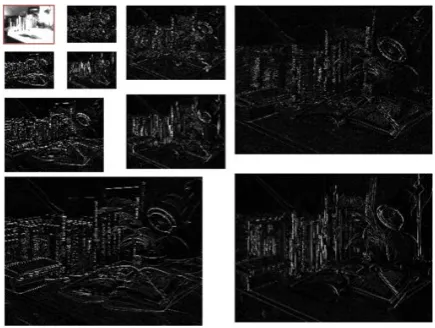
Figure 5: Pyramid image representation, after having applied the for-ward wavelet lifting WENO scheme. The coarse level is the image at the upper left corner (with red frame). The other images are repre-senting the details, at di↵erent levels, for the horizontal, diagonal and vertical directions.
splitting operation which separates the pixels of the in-247
put at levelkin two di↵erent grids based on the index
248
number (odd and even). For theRoperator the WENO 249
scheme has been employed according to which the level 250
kis reconstructed fromk+1 using eq. 9: 251
˜
Ik[x,y]=w
0[x,y](Ik+1[x 1,y]+ Ik+1[x 1,y] Ik+1[x 3,y]
[x 1,y] [x 3,y] ([x,y] [x 1,y])) +w1[x,y](Ik+1[x 1,y]+ Ik+1[x+1,y] Ik+1[x 1,y]
[x+1,y] [x 1,y] ([x,y] [x+1,y])).
(9) 252
Eq. 9 is equivalent to eq. 7 where w0 and w1 are its 253
factorial terms.The di↵erence in the indices between
254
eq. 9 and eq. 7 is due to the fact that we have inserted 255
zero pixels at k+1 level and would like to retain in-256
teger numbers in the indexing of the grid. Fattal [11] 257
presented a robust average operator, for both type of 258
wavelet approaches, red black and weighted CDF, 259
making use of an edge stop function to compute the 260
prediction weights. In our case, as described ineq.7, 261
we present a convex combination of polynomial inter-262
polants. However, these polynomial interpolants are lin-263
ear, thus we can consider the overall operator as a com-264
bination of linear interpolants. 265
At the boundaries of the input image, we have 266
adopted a standard extrapolation approach to generate 267
the missing values in the stencil . The restored ˜Iklevel 268
is later used to obtain the details of the k+1 level 269
dk+1=Ik I˜k. To preserve the overall sum of the coarse
270
elementsIk+1, and based on the fact that the operatorR 271
we have decided to use a linear interpolator as update-273
operatorU: 274
U(dk+1)[x,y]= dk+1[x 1,y]+dk+1[x+1,y]
4 ;(10)
275
and the levelk+1 of coarse elements is updated using 276
Ik+1=Ik+1+U(dk+1). 277
This process is repeated both for the rows and 278
columns of the input image. 279
Discussion An example of the behaviour of the 280
present HOR, integrated in the wavelet scheme, is 281
shown in Figure 5. The coarse,c, and ’details’ coeffi
-282
cients, d, (vertical, diagonal and horizontal) for three 283
levels are shown. Edges are detected by the wavelet 284
scheme avoiding the influence of pixels on both sides 285
at each scale. This is obtained without the introduction 286
of an edge stop function utilized for the computation of 287
the set of weights used in the interpolation step as pro-288
posed by Fattal [11] . 289
5. Tone Mapping Manipulation 290
In this subsection, we will show how to make use 291
of the proposed technique in the classical tone ma-292
nipulation problem. Tone manipulation allows to re-293
duce the intensity of the luminance range of HDR con-294
tent. This objective is achieved through compression of 295
large-scale variation and keeping the fine level informa-296
tion. The filtering approach is applied to the natural log-297
arithmic scale of the luminance, keeping the color ratio 298
unaltered as in Paris et al. [9], using a gamma correction 299
of 2.2. 300
To manipulate the tone and the details of the input HDR 301
image, we have followed a similar approach to the one 302
used by Fattal [11]. The tone is linearly manipulated 303
modifying the coarse coefficientcof the coarsest leveln
304
through a parameter , as cn. This allows us to achieve 305
the compression of the vast dynamic range available in 306
the input HDR image. A second parameter is used 307
to manipulate the details. This is obtained from the 308
progressive decreasing of the ’details’ coefficientsdk,
309
such as kdkwherekis the number of levels varying be-310
tween 1 ton. The and parameters are in the range of 311
(0.0,1.0]. 312
Since our approach shares several aspects with the tech-313
nique presented by Fattal [11], we first provide an anal-314
ysis and comparison to show how the present technique 315
performs with respect to the preservation of edges, 316
while at the same time adjusting the tone of the input 317
image. 318
Figure 6: Comparisons with state-of-the-art method Fattal’s method [11] . 1strow: Fattal [11] using wavelet Red and Black model
with↵=0.8, =0.11 and =0.68 - 2ndrow: the present approach
with =0.3 and =0.7 -2ndcolumn: Gradient of a zoomed area, it
[image:6.595.311.529.112.317.2]showing the degree of edge preservation.
Figure 7: Comparisons of di↵erent methods. 1stcolumn: Fattal [11] using wavelet Red and Black model with parameters as per web project page [26] - 2ndcolumn: The present approach with =0.7
and =0.9 - 2ndrow: Gradient of the zoomed area in the 3rdrow.
(a) Fattal [11] =0.7 - Weak (b) Fattal [11] =0.5 - Strong
Figure 8: Results from the application of Fattal’s et al. [11] tech-nique making use of the new contractive concave mapping as specified in [26].
The present technique produces results comparable 319
to this state-of-the-art operator, while o↵ering the
ad-320
vantage of not using an extra edge-stop function. The 321
technique of [11] is capable to capture more details but 322
at the cost of introducing some distortions at the edge 323
level, as shown in Figures 7 (a) (zoomed lamp area and 324
its edge map) and 6 (b) (edge map). 325
One may reduce these distortions by making use of a 326
new compression technique, as suggested in [26] (Fig-327
ure 8 ). However, artifacts may appear as shown in Fig-328
ure 8 (b) 2nd row. 329
6. Experimental Results 330
The HOR approach has been implemented in Matlab 331
and the experiments have been performed on a Mack-332
book air with Intel i7-core CPU 1.8 GHz, 64-bit ma-333
chine and 4GB of RAM. We have compared our tech-334
nique with the latest edge aware state-of-the-art multi-335
scale approaches, applied to the tone mapping problem, 336
such as[11, 9, 10]. We have used the Matlab code as 337
well as parameters provided by the authors. 338
We have chosen the set of images shown in Figure 9. 339
This set consists of 18 images with di↵erent dynamic
340
range that span from outdoor to indoor and from light to 341
dark illumination conditions. 342
Figure 9: Images used in the experiments. The numbering in Tables 1 and 2 follows the order of the images from the top to the bottom and from the left to the right.
6.1. Quality 343
To provide a fair comparison, we have selected the 344
parameters of the di↵erent techniques to convey
sim-345
ilar appearance in term of contrast, edges and details 346
preservation to all the techniques presented in this com-347
parison. 348
We may observe that the DRIM metric is measur-349
ing changes in contrast, in other words the overall ap-350
pearance of the image, and it is not able to detect if 351
small-scale details are not well preserved. On the other 352
hand, edge-aware techniques are able to preserve well 353
small-scale details. This is preserved intrinsically by the 354
mechanisms described in the previous sections as well 355
as by the results shown here that are comparable with 356
the existing state-of-the-art edge aware technique [11]. 357
Based on the fact that small-scale details are to certain 358
extent well reproduced by the edge-aware techniques, 359
our objective was to examine how these techniques are 360
able to convey the overall appearance of the input HDR 361
into the tone mapped result. In doing so, we have de-362
cided to use the DRIM metric as specified below. 363
Since the DRIM metric acceptscd/m2values, the in-364
put images need to be calibrated. In the case of the tone 365
mapped input image, we need to linearize the input sig-366
nal and then map it to the dynamic range of the display 367
where the image will be visualized. In our case, the 368
value used for the linearization step is 2.2, and the dy-369
namic range chosen is [0.5, 100] cd/m2 . In the case 370
of the HDR input image, there was no need to linearize 371
the signal, and the dynamic range has been chosen as 372
[0.015, 3000]cd/m2. 373
[image:7.595.310.530.109.287.2]Figure 10: Output and DRIM comparison with state-of-the-art edge aware approaches.1st- row output of the edge aware technique; 2ndrow
-DRIM metric [12] with probability of 75%; 3rdrow - DRIM metric [12] with probability of 95%. Parameters used - Farbmann et al. [10] multiscale
approach balanced - Fattal’s [11]↵=0.9, =0.19 and =0.5 - Paris et al. [9] r=log(2.5),↵=0.5 and =0.0 (for conveying the local e↵ect) -The Present HOR =0.7, =0.9.
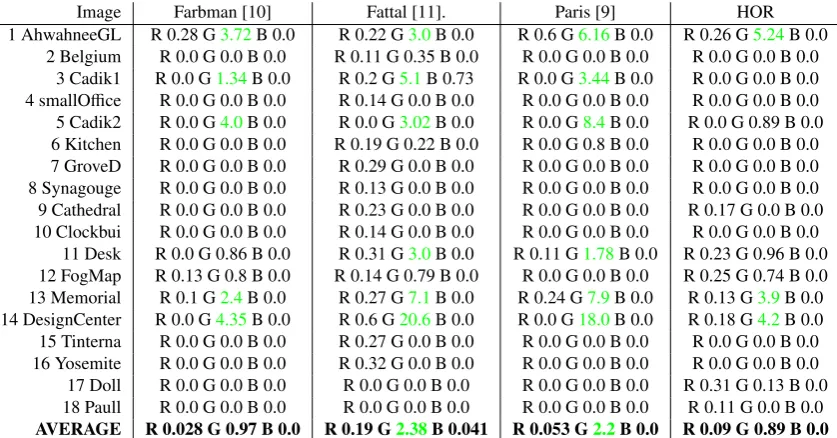
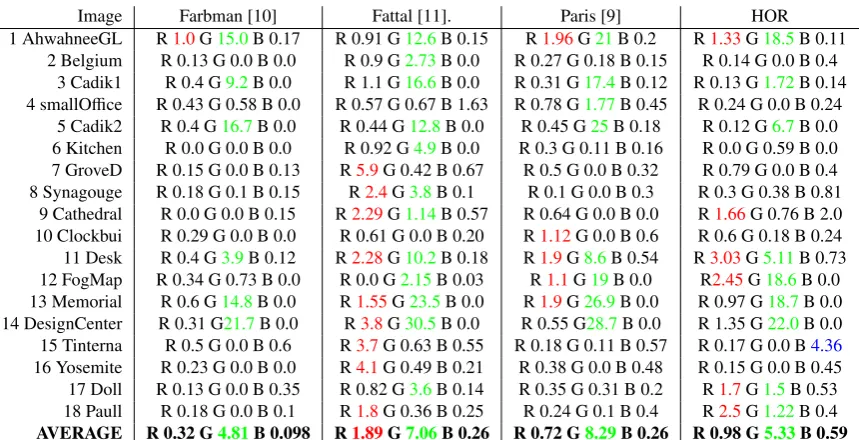
Tables 1 and 2 show the results of the DRIM metric 375
applied to the test set images. The numbers represent 376
the percentage of pixels with probability for the distor-377
tion to be perceived by the HVS. Tables 1 and 2 show 378
the results with probability 95% and 75%, respectively. 379
The colors used to depict the type of distortion are the 380
same with those used to describe the distortion -R(red) 381
reversal, -G(green) lost and -B(blue) amplification of 382
contrast. We have colored the methods that show the 383
higher probability, as well as the ones that show signifi-384
cant percentage of pixels with the specified probability. 385
In the case of probability 95%, the significant distortion 386
introduced by the state-of-the-art edge aware methods, 387
as well as by the present HOR is mostly due to the loss 388
of contrast; neither reversal nor amplification of con-389
trast are significant. The lost of contrast is attributed to 390
the fact that the edge-aware methods are using simple 391
linear scaling for compressing the large luminance dy-392
namic range. This may a↵ect the overall preservation of
393
local contrast. With probability 95% the state-of-the-art 394
methods may present high percentage of pixels a↵ected
395
by loss of contrast. This is the case of the images 1, 3, 396
5, 11,13 and 14. In most of the other cases, this number 397
is negligible. For the images 1, 13 and 14, the HOR 398
shows a slightly higher percentage value for the loss 399
of contrast. However, this value is either comparable 400
or lower than the value provided by the state-of-the-art 401
edge-aware methods.We have also tried to analyze the 402
results of the DRIM metric at lower probability such 403
as 75% and the results are shown in Table 2. As ex-404
pected, the percentage of pixels is drastically increased 405
and more images are a↵ected by a significant
percent-406
age value. In this case, reversal of contrast (red) and in 407
some cases amplification of contrast (blue) may appear. 408
In the case of loss of contrast the Fattal [11] and Paris et 409
al. [9] results show that the majority of the images are 410
a↵ected by this type of distortion. This type of
distor-411
tion also a↵ects the present HOR, but when compared
412
with the state-of-the-art edge-aware methods shows a 413
lower percentage of pixels a↵ected by this distortion.
414
Only in the case of image 18 the present HOR shows 415
higher value for the loss of contrast. However, this per-416
centage value is quite small and it is not actually per-417
ceivable by the HVS. The results are also a↵ected by
418
the reversal of contrast. In particular, several results 419
of Fattals [11] method are showing this distortion. The 420
present HOR shows reversal of contrast higher than the 421
other methods only for three images (11, 12 and 18). 422
Finally, the amplification of contrast (blue) does almost 423
not exist, and the only image that is a↵ected by using
424
the proposed HOR is the image 15. 425
DRIM Visual Analysis 426
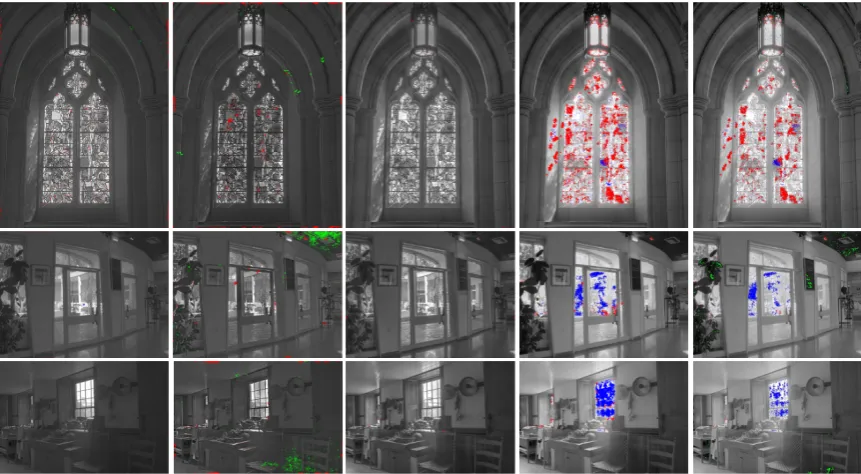
Figures 10, 11, 13 and 14 show results with the 427
corresponding DRIM distortion maps. Figure 10 and 428
Figure 11 compares the DRIM maps at probability 75% 429
Figure 11: Output and DRIM comparison with state-of-the-art edge aware approaches.1st- row output of the edge aware technique; 2ndrow
-DRIM metric [12] with probability of 75%; 3rdrow - DRIM metric [12] with probability of 95% (for both images). Parameters used - Farbmann et
Image Farbman [10] Fattal [11]. Paris [9] HOR 1 AhwahneeGL R 0.28 G3.72B 0.0 R 0.22 G3.0B 0.0 R 0.6 G6.16B 0.0 R 0.26 G5.24B 0.0
2 Belgium R 0.0 G 0.0 B 0.0 R 0.11 G 0.35 B 0.0 R 0.0 G 0.0 B 0.0 R 0.0 G 0.0 B 0.0 3 Cadik1 R 0.0 G1.34B 0.0 R 0.2 G5.1B 0.73 R 0.0 G3.44B 0.0 R 0.0 G 0.0 B 0.0 4 smallOffice R 0.0 G 0.0 B 0.0 R 0.14 G 0.0 B 0.0 R 0.0 G 0.0 B 0.0 R 0.0 G 0.0 B 0.0 5 Cadik2 R 0.0 G4.0B 0.0 R 0.0 G3.02B 0.0 R 0.0 G8.4B 0.0 R 0.0 G 0.89 B 0.0 6 Kitchen R 0.0 G 0.0 B 0.0 R 0.19 G 0.22 B 0.0 R 0.0 G 0.8 B 0.0 R 0.0 G 0.0 B 0.0 7 GroveD R 0.0 G 0.0 B 0.0 R 0.29 G 0.0 B 0.0 R 0.0 G 0.0 B 0.0 R 0.0 G 0.0 B 0.0 8 Synagouge R 0.0 G 0.0 B 0.0 R 0.13 G 0.0 B 0.0 R 0.0 G 0.0 B 0.0 R 0.0 G 0.0 B 0.0 9 Cathedral R 0.0 G 0.0 B 0.0 R 0.23 G 0.0 B 0.0 R 0.0 G 0.0 B 0.0 R 0.17 G 0.0 B 0.0 10 Clockbui R 0.0 G 0.0 B 0.0 R 0.14 G 0.0 B 0.0 R 0.0 G 0.0 B 0.0 R 0.0 G 0.0 B 0.0
[image:10.595.89.508.110.329.2]11 Desk R 0.0 G 0.86 B 0.0 R 0.31 G3.0B 0.0 R 0.11 G1.78B 0.0 R 0.23 G 0.96 B 0.0 12 FogMap R 0.13 G 0.8 B 0.0 R 0.14 G 0.79 B 0.0 R 0.0 G 0.0 B 0.0 R 0.25 G 0.74 B 0.0 13 Memorial R 0.1 G2.4B 0.0 R 0.27 G7.1B 0.0 R 0.24 G7.9B 0.0 R 0.13 G3.9B 0.0 14 DesignCenter R 0.0 G4.35B 0.0 R 0.6 G20.6B 0.0 R 0.0 G18.0B 0.0 R 0.18 G4.2B 0.0 15 Tinterna R 0.0 G 0.0 B 0.0 R 0.27 G 0.0 B 0.0 R 0.0 G 0.0 B 0.0 R 0.0 G 0.0 B 0.0 16 Yosemite R 0.0 G 0.0 B 0.0 R 0.32 G 0.0 B 0.0 R 0.0 G 0.0 B 0.0 R 0.0 G 0.0 B 0.0 17 Doll R 0.0 G 0.0 B 0.0 R 0.0 G 0.0 B 0.0 R 0.0 G 0.0 B 0.0 R 0.31 G 0.13 B 0.0 18 Paull R 0.0 G 0.0 B 0.0 R 0.0 G 0.0 B 0.0 R 0.0 G 0.0 B 0.0 R 0.11 G 0.0 B 0.0 AVERAGE R 0.028 G 0.97 B 0.0 R 0.19 G2.38B 0.041 R 0.053 G2.2B 0.0 R 0.09 G 0.89 B 0.0
Table 1:DRIM results over the set of images presented in Figure 9. We show the percentage of pixels with probability of 95% that present the distortion of reverse (R), loss (G), or amplification (B) of contrast.
The visual analysis of the results shows that in the 431
case of probability 75% the state-of-the-art methods 432
show a consistent number of distorted pixels localized 433
in large areas, when compared with the present HOR. 434
On the other hand, when the probability increases to 435
95%, the size of these areas are either reduced or are 436
almost not a↵ected by any distortion. However, in some
437
cases the state-of-the-art methods are still showing large 438
areas of lost of contrast (green) and reversal of contrast 439
(red). 440
Figures 13 and 14 are showing other results with the 441
distortion maps with probability at 95%, where the all 442
methods are showing similar behavior.. 443
Comparison with Simpler TMO’s 444
One can observe that the global operators are faster 445
and convey an overall better appearance (Artusi et 446
al. [28]). For this purpose, we have computed the 447
DRIM maps for a well known global version of two 448
TMOs published by by Reinhard et al. [27] and Drago 449
et al. [27]. The comparison is limited to the global op-450
erator showing that the quality of the results is not com-451
parable with the state-of-the-art edge aware techniques. 452
The results are shown in Figure 12 for the distortion 453
maps at probability of 95%. 454
The results reveal that the DRIM obtained for the 455
Reinhard et al. [27] and the Drago et al. [27] opera-456
tors often show larger areas of amplification of contrast; 457
see the window area in Figure 12, in comparison with 458
the results obtained by the majority of the edge-aware 459
techniques employed in this experiment. 460
Figure 12 (2nd row shows reversal of contrast, in 461
large areas of the window, for both global operators. 462
On the other hand, the edge-aware techniques have very 463
tiny areas a↵ected by reversal of contrast. Moreover,
464
we emphasize in general that global operators are not 465
designed for edge-awareness and do not encapsulate 466
mechanisms for retaining the fine details at di↵erent
467
spatial scale, as in the case of the present HOR and 468
edge-aware techniques. 469
6.2. Computational Analysis 470
Another aspect that needs to be taken into account 471
is the computational cost associated with the di↵erent
472
algorithms. Here, we have performed a computational 473
cost analysis for the proposed technique versus other 474
state-of-the-art techniques. 475
Our approach presents computational complexity and 476
associated cost comparable to the one presented in [11, 477
10] and outperforming the method of [9] . 478
Specifically, the method presented by Paris et al. [9] 479
requires 1738 sec to process an image size of 800x525, 480
420 sec for an image size of 400x262 and 190 sec. for 481
an image size of 267x174. When compared with the 482
computational cost of our method and the approaches 483
of [11, 10], the computational cost is significantly re-484
duced: 14 sec to process an image size of 800x525, 3 485
sec for an image size of 400x262, and 1 sec for an im-486
Image Farbman [10] Fattal [11]. Paris [9] HOR 1 AhwahneeGL R1.0G15.0B 0.17 R 0.91 G12.6B 0.15 R1.96G21B 0.2 R1.33G18.5B 0.11
2 Belgium R 0.13 G 0.0 B 0.0 R 0.9 G2.73B 0.0 R 0.27 G 0.18 B 0.15 R 0.14 G 0.0 B 0.4 3 Cadik1 R 0.4 G9.2B 0.0 R 1.1 G16.6B 0.0 R 0.31 G17.4B 0.12 R 0.13 G1.72B 0.14 4 smallOffice R 0.43 G 0.58 B 0.0 R 0.57 G 0.67 B 1.63 R 0.78 G1.77B 0.45 R 0.24 G 0.0 B 0.24
5 Cadik2 R 0.4 G16.7B 0.0 R 0.44 G12.8B 0.0 R 0.45 G25B 0.18 R 0.12 G6.7B 0.0 6 Kitchen R 0.0 G 0.0 B 0.0 R 0.92 G4.9B 0.0 R 0.3 G 0.11 B 0.16 R 0.0 G 0.59 B 0.0 7 GroveD R 0.15 G 0.0 B 0.13 R5.9G 0.42 B 0.67 R 0.5 G 0.0 B 0.32 R 0.79 G 0.0 B 0.4 8 Synagouge R 0.18 G 0.1 B 0.15 R2.4G3.8B 0.1 R 0.1 G 0.0 B 0.3 R 0.3 G 0.38 B 0.81
9 Cathedral R 0.0 G 0.0 B 0.15 R2.29G1.14B 0.57 R 0.64 G 0.0 B 0.0 R1.66G 0.76 B 2.0 10 Clockbui R 0.29 G 0.0 B 0.0 R 0.61 G 0.0 B 0.20 R1.12G 0.0 B 0.6 R 0.6 G 0.18 B 0.24 11 Desk R 0.4 G3.9B 0.12 R2.28G10.2B 0.18 R1.9G8.6B 0.54 R3.03G5.11B 0.73 12 FogMap R 0.34 G 0.73 B 0.0 R 0.0 G2.15B 0.03 R1.1G19B 0.0 R2.45G18.6B 0.0 13 Memorial R 0.6 G14.8B 0.0 R1.55G23.5B 0.0 R1.9G26.9B 0.0 R 0.97 G18.7B 0.0 14 DesignCenter R 0.31 G21.7B 0.0 R3.8G30.5B 0.0 R 0.55 G28.7B 0.0 R 1.35 G22.0B 0.0 15 Tinterna R 0.5 G 0.0 B 0.6 R3.7G 0.63 B 0.55 R 0.18 G 0.11 B 0.57 R 0.17 G 0.0 B4.36
[image:11.595.84.514.108.328.2]16 Yosemite R 0.23 G 0.0 B 0.0 R4.1G 0.49 B 0.21 R 0.38 G 0.0 B 0.48 R 0.15 G 0.0 B 0.45 17 Doll R 0.13 G 0.0 B 0.35 R 0.82 G3.6B 0.14 R 0.35 G 0.31 B 0.2 R1.7G1.5B 0.53 18 Paull R 0.18 G 0.0 B 0.1 R1.8G 0.36 B 0.25 R 0.24 G 0.1 B 0.4 R2.5G1.22B 0.4 AVERAGE R 0.32 G4.81B 0.098 R1.89G7.06B 0.26 R 0.72 G8.29B 0.26 R 0.98 G5.33B 0.59
Table 2:DRIM results over the set of images presented in Figure 9. We show the percentage of pixels with probability of 75% that present the distortion of reverse (R), loss (G), or amplification (B) of contrast.
Recently, Aubry et al. [14] presented a fast im-488
plementation of Paris et al. [9] technique that signif-489
icantly improves its computational performances (50 490
times faster). However, our comparison is done on the 491
Matlab implementation of the all techniques used in the 492
evaluation, as provided by the authors, without includ-493
ing any optimization. Even if we apply the 50-fold im-494
provement in the measured time of the Matlab imple-495
mentation of Paris et al. [9], the present HOR delivers 496
an excellent overall performance. 497
7. Concluding remarks 498
We have introduced a new edge preserving tech-499
nique that makes use of a HOR method, which is able 500
to preserve edges without introducing artifacts and re-501
ducing any changes in the image structure when com-502
pared to the state-of-the-art edge preserving operators. 503
The present method does not require an extra stop-edge 504
function, thus o↵ering simplicity. Futhermore, its
com-505
putational cost increases linearly in time. We have 506
demonstrated the accuracy of the present technique on a 507
variety of images and parameter settings. The use of the 508
HOR technique in other applications such as details en-509
hancement and image colorisation is also possible and 510
will be part of future work. The proposed HOR tech-511
nique will be further implemented in graphics hardware 512
with reference to video applications, allowing substan-513
tial improvements in computational performance. 514
8. Acknowledgments 515
This work was partially supported by Ministry of 516
Science and Innovation Subprogramme Ramon y Cajal 517
RYC-2011-09372, TIN2013-47276-C6-1-R from Span-518
ish government, 2014 SGR 1232 from Catalan gov-519
ernment, NSFC-Guangdong Joint Fund (U1135003, 520
Natural Science Foundation of China (NSFC) (No. 521
61320106008). 522
References 523
[1] A. Harten, B. Engquist, S. Osher, S. Chakravarthy, Uniformly
524
high order essentially non-oscillatory schemes, Journal of
Com-525
putational Physics 1987.
526
[2] C. W. Shu, Essentially non-oscillatory and weighted essentially
527
non-oscillatory schemes for hyperbolic conservation laws, Tech.
528
rep., ICASE Report No. 97-65, NASA - CR-97-206253 (1997).
529
[3] T. F. Chan, H. M. Zhou, Eno-wavelet transforms for
piece-530
wise smooth functions, SIAM Journal on Numerical Analysis
531
40 (2002) 1369–1404.
532
[4] H. Boucenna, M. Halimi, Image segmentation by the level
533
set methods using third order weno, 5th International
Confer-534
ence: Sciences of Electronic, Technologies of Information and
535
Telecommunications 2009.
536
[5] P. Perona, J. Malik, Scale-space and edge detection using
537
anisotropic di↵usion, IEEE Transactions on Pattern Analysis
538
and Machine Intelligence 12 (1990) 629–639.
539
[6] C. Tomasi, R. Manduchi, Bilateral filtering for gray and color
540
images, Proceedings of the IEEE International Conference on
541
Computer Vision (1998) 839–846.
542
[7] Z. Su, X. Luo, A. Alessandro, A novel image decomposition
543
approach and its applications., The Visual Computer 29 (10)
544
(2013) 1011–1023.
Figure 12: DRIM comparison with state-of-the-art edge aware approaches and simple TMO. DRIM metric [12] with probability of 95%. Farbman et al. [10] DRIM output is omitted because of the similarities in the results with the one obtained with the present HOR.
[8] B. C. A. Buades, J. M. Morel, The staricasing e↵ect in
neigh-546
borhood filters and its solution, IEEE Journal on Transactions
547
on Image Processing 15 (2006) 1499–1505.
548
[9] P. Silvan, S. W. Hasino↵, J. Kautz, Local laplacian filters: Edge
549
aware image processing with a laplacian pyramid, ACM
Trans-550
actions on Graphics (Proceedings of ACM SIGGRAPH 2011).
551
[10] Z. Farbman, R. Fattal, D. Lischinski, R. Szeliski,
Edge-552
preserving decompositions for multi-scale tone and detail
ma-553
nipulation, in: ACM SIGGRAPH 2008 Papers, SIGGRAPH
554
’08, ACM, 2008, pp. 67:1–67:10.
555
[11] R. Fattal, Edge-avoiding wavelets and their applications, ACM
556
Trans. Graph. 28 (3) (2009) 1–10.
557
[12] T. O. Aydin, R. Mantiuk, K. Myszkowski, H.-P. Seidel, Dynamic
558
range independent image quality assessment, ACM Trans.
559
Graph. 27 (3) (2008) 69:1–69:10.
560
[13] F. Banterle, A. Artusi, K. Debattista, A. Chalmers, Advanced
561
High Dynamic Range Imaging: Theory and Practice, AK Peters
562
(CRC Press), Natick, MA, USA, 2011.
563
[14] M. Aubry, S. Paris, S. Hasino↵, J. Kautz, F. Durand, Fast and
564
robust pyramid-based image processing, Tech. rep. (2011).
565
[15] R. Fattal, D. Lischinski, M. Werman, Gradient domain high
dy-566
namic range compression, ACM Trans. Graph. 21 (3) (2002)
567
249–256.
568
[16] J. Chen, S. Paris, F. Durand, Real-time edge-aware image
pro-569
cessing with the bilateral grid, ACM Transactions on Graphics
570
(Proceedings of ACM SIGGRAPH 2007).
571
[17] J. Tumblin, G. Turk, Lcis: A boundary hierarchy for
detail-572
preserving contrast reduction, ACM Transactions on Graphics
573
(Proceedings of ACM SIGGRAPH 1999).
574
[18] P. J. Burt, Edward, E. H. Adelson, The laplacian pyramid as a
575
compact image code, IEEE Transactions on Communications 31
576
(1983) 532–540.
577
[19] P. J. Burt, Fast filter transform for image processing, Computer
578
Graphics and Image Processing 16 (1) (1981) 20 – 51.
579
[20] A. N. Akansu, P. R. Haddad, Multiresolution Signal
Decompo-580
sition: Transforms, Subbands, and Wavelets, Academic Press,
581
1992 and 2000 (2nd Ed.).
582
[21] Y. Li, L. Sharan, E. H. Adelson, Compressing and companding
583
high dynamic range images with subband architectures, ACM
584
Trans. Graph. 24 (2005) 836–844.
585
[22] X. Liu, S. Osher, T. Chan, Weighted essentially non-oscillatory
586
schemes, Journal of Computational Physics 115 (1994) 200–
587
212.
588
[23] A. Mosedale, D. Drikakis, Assessment of very high-order of
ac-589
curacy in les models, ASME Journal of Fluids Engineering 129
590
(2007) 1497–1503.
591
[24] B. Thornber, A. Mosedale, D. Drikakis, On the implicit large
592
eddy simulations of homogeneous decaying turbulence, Journal
593
of Computational Physics 226 (2007) 1902–1929.
594
[25] D. Drikakis, M. Hahn, A. Mosedale, T. B., Large eddy
simula-595
tion using high resolution and high order methods, Philosophical
596
Transactions Royal Society A 367 (2009) 2985–2997.
597
[26] R. Fattal[link].
598
URLhttp://www.cs.huji.ac.il/ raananf/projects/eaw/
599
[27] E. Reinhard, M. Stark, P. Shirley, J. Ferwerda, Photographic
600
tone reproduction for digital images, ACM Trans. Graph. 21 (3)
601
(2002) 267–276.
602
[28] A. Artusi, O. Akyz, Ahmet, B. Roch, D. Michael, Y.
Chrysan-603
thou, A. Chalmers, Selective local tone mapping,
proceed-604
ings IEEE International Conference on Image Processing (ICIP)
605
2013.
Figure 13: Output and DRIM comparison with state-of-the-art edge aware approaches. 1stand 3rd- rows output of the edge aware techniques; 2nd
and 4throws - DRIM metric [12] with probability of 95%. Parameters used - Farbmann et al. [10] multiscale approach balanced - Fattal’s [11]↵=
0.8, =0.19 and =0.9; - Paris et al. [9] r=log(2.5),↵=0.5 and =0.0 (for conveying the local e↵ect) - The Present HOR 1strow: =0.4,
Figure 14: Output and DRIM comparison with state-of-the-art edge aware approaches. 1stand 3rd- rows output of the edge aware techniques; 2nd
and 4throws - DRIM metric [12] with probability of 95%. Parameters used - Farbmann et al. [10] multiscale approach balanced - Fattal’s [11]↵=
0.8, =0.19 and =0.9; - Paris et al. [9] r=log(2.5),↵=0.5 and =0.0 (for conveying the local e↵ect) - The Present HOR 1strow: =0.6,

![Figure 7: Comparisons of di↵erent methods. 1st column: Fattal [11]using wavelet Red and Black model with parameters as per webproject page [26] - 2nd column: The present approach with � = 0.7and � = 0.9 - 2nd row: Gradient of the zoomed area in the 3rd row.Distortions at the edges are visible.](https://thumb-us.123doks.com/thumbv2/123dok_us/1624568.115600/6.595.311.529.112.317/comparisons-wavelet-parameters-webproject-present-approach-gradient-distortions.webp)

![Figure 10: Output and DRIM comparison with state-of-the-art edge aware approaches.1st - row output of the edge aware technique; 2nd row -DRIM metric [12] with probability of 75%; 3rd row - DRIM metric [12] with probability of 95%](https://thumb-us.123doks.com/thumbv2/123dok_us/1624568.115600/8.595.82.516.109.324/figure-output-comparison-approaches-technique-probability-metric-probability.webp)
![Figure 11: Output and DRIM comparison with state-of-the-art edge aware approaches.1st - row output of the edge aware technique; 2nd row -DRIM metric [12] with probability of 75%; 3rd row - DRIM metric [12] with probability of 95% (for both images)](https://thumb-us.123doks.com/thumbv2/123dok_us/1624568.115600/9.595.82.513.153.641/figure-output-comparison-approaches-technique-probability-probability-images.webp)