City, University of London Institutional Repository
Citation
:
Maiden, N., Manning, S., Robertson, S. and Greenwood, J. (2004). Integrating
Creativity Workshops into Structured Requirements Processes. Paper presented at the
DIS’2004, 5th conference on Designing interactive systems: processes, practices, methods,
and techniques, 01-08-2004 - 04-08-2004, Cambridge , USA.
This is the accepted version of the paper.
This version of the publication may differ from the final published
version.
Permanent repository link: http://openaccess.city.ac.uk/4026/
Link to published version
:
Copyright and reuse:
City Research Online aims to make research
outputs of City, University of London available to a wider audience.
Copyright and Moral Rights remain with the author(s) and/or copyright
holders. URLs from City Research Online may be freely distributed and
linked to.
City Research Online:
http://openaccess.city.ac.uk/
[email protected]
Integrating Creativity Workshops into Structured
Requirements Processes
Neil Maiden, Sharon Manning
Centre for HCI Design, City University Northampton Square
London EC1V OHB, UK +44-20-7040-8412
[N.A.M.Maiden,
SharonM]@city.ac.uk
Suzanne Robertson
Atlantic Systems Guild 11 St Mary’s Terrace London W2 1SU, UK +44-20-7262 3395
[email protected]
John Greenwood
National Air Traffic Services Spectrum House, Gatwick, RH6 OLG
+44-1293 576812
[email protected]
ABSTRACT
Requirements engineering is a creative process in which stakeholders and designers work together to create ideas for new systems that are eventually expressed as requirements. However, many requirements engineering or software development methods do not encourage or support creative thinking, let alone integrate it with existing modeling and analysis processes. This paper describes RESCUE, a scenario-driven requirements engineering process that includes workshops that integrate creativity techniques with different types of use case and system context modelling. It reports a case study in which RESCUE creativity workshops were used to discover stakeholder and system requirements for DMAN, a future air traffic management system for managing departures from major European airports. The workshop was successful in that it provided new and important outputs for subsequent requirements processes. The paper describes the workshop structure and wider RESCUE process, important results and key lessons learned.
Categories and Subject Descriptors
D.2.1 [Requirements/Specifications] Elicitation methods (e.g., rapid prototyping, interviews, JAD), Methodologies (e.g., object-oriented, structured).
General Terms
Design, Human Factors.
Keywords
Requirements, creativity workshops, analogical reasoning, models of creativity, storyboarding
1.
SURELY REQUIREMENTS ARE
ELICITED?
Requirements engineering is a creative process in which stakeholders and designers work together to create ideas for new systems that are eventually expressed as requirements. The
importance of creative product design is expected to increase over the next decade. The Nomura Research Institute (Nomura 2001) argues that creativity will be the next key economic activity, replacing information. Creativity is indispensable for more innovative product development (Hargadon & Sutton 2000), and requirements are the key abstraction that encapsulates the results of creative thinking about the vision of an innovative product. It is a trend that requirements engineering researchers and practitioners, with their current focus on elicitation, analysis and management, have yet to grasp fully.
This failure means that current software development processes and methods do not encourage explicit creative thinking. However, these processes and methods are still needed to model, analyze, specify and sign-off stakeholder requirements discovered and invented using creative techniques, so new, more creative requirements engineering practices cannot be developed in isolation. Therefore, a further challenge is to integrate creative thinking techniques into mainstream requirements processes and methods. This is what we have sought to do in RESCUE.
This paper reports a case study – the design and running of a creativity workshop within the RESCUE process to discover new requirements and ideas for DMAN, a new socio-technical system for scheduling and managing the departures of aircraft from European major airports such as Heathrow and Charles de Gaulle. The DMAN requirements project was managed by the UK’s National Air Traffic Service (NATS) on behalf of the client, Eurocontrol. The overall specification process lasted 10 months, and the creativity workshop described took place 2 months into the project.
The remainder of this paper is in 5 sections. Section 2 describes the RESCUE process and where creativity workshops fit. Section 3 describes the creativity workshops and techniques in more detail, then section 4 presents the main results from the workshop. Section 5 reports 6 lessons learned for running creativity workshops within structured requirements processes. The paper ends with a discussion of issues about creative thinking that the work raises, and plans for future work.
2.
RESCUE AND ITS CREATIVITY
WORKSHOPS
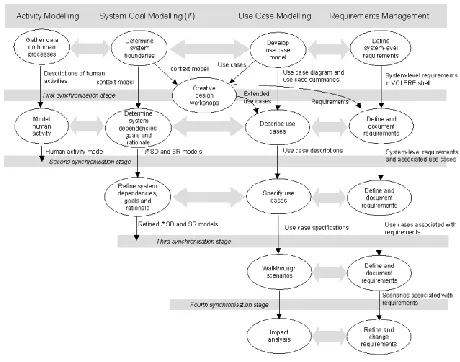
Figure 1. The RESCUE process structure
Each stream has a unique and specific purpose in the specification of a socio-technical system:
1. Human activity modelling provides an understanding of how people work, in order to baseline possible changes to it (Vicente 1999);
2. System goal modelling enables the team to model the future system boundaries, actor dependencies and most important system goals (Chung et al. 2000);
3. Use case modelling and scenario-driven walkthroughs enable the team to communicate more effectively with stakeholders and acquire complete, precise and testable requirements from them (Sutcliffe et al. 1998);
4. Requirements management enables the team to handle the outcomes of the other 3 streams effectively as well as impose quality checks on all aspects of the requirements document (Robertson & Robertson 1999).
Sub-processes during these 4 streams (shown in bubbles in Figure 1) are co-ordinated using 5 synchronisation stages that provide the project team with different perspectives with which to analyse system boundaries, goals and scenarios. These 4 streams are supplemented with 2 additional processes. Acquiring requirements from stakeholders is guided using ACRE (Maiden & Rugg 1996), a framework for selecting the right acquisition techniques in different situations. Creativity workshops are ran after the first synchronization stage to discover and surface requirements and design ideas that are essential for i* system modelling and use case description in stage 2. Inputs to the workshops from stage 1 include system context and use case models and descriptions of current work practices.
2.1
Previous Creativity Work
In spite of the need for creative thinking in the requirements process, requirements engineering research has largely ignored creativity and few processes, methods and techniques address it explicitly. Brainstorming techniques and RAD/JAD workshops (Floyd et al. 1989) make tangential reference to creative thinking. Most current brainstorming work refers back to Osborn’s text (1953) on principles and procedures of creative problem solving. The CPS method describes six stages of problem solving: mess finding, data finding, problem finding, idea finding, solution finding and acceptance finding. The model was originally
intended to help people understand and use their creative talent more effectively (Isaksen & Dorval 1993). It has been through several waves of development. To better describe how problem solving occurs, and to improve the flexibility of the model, the six stages were arranged into three groups – understanding the problem, idea generation, and planning for action. A recent CPS manual (Daupert 2002) describes activities for supporting each of model stage. Examples to support combinatorial creativity include
the matrix, which involves making lists then selecting items from each list at random and combining them to generate new ideas, and parallel worlds, which uses analogical reasoning to generate new ideas. However, there are no reported applications of the CPS model to requirements engineering.
In the requirements domain, Robertson (2002) argues that requirements analysts need to be inventors to bring about the innovative change in a product or business that gives competitive advantage. Such requirements are not often things that a stakeholder directly asked for.Nguyen et al. (2000) have observed that requirements engineering teams restructure requirements models at critical points when they re-conceptualize and solve sub-problems, and moments of sudden insight or sparked ideas trigger these points. However, elsewhere, there is little explicit reference to creativity in mainstream requirements engineering journals and conferences.
2.2
Creativity Work in RESCUE
[image:3.612.339.540.566.700.2]RESCUE incorporates creativity workshops to encourage creative thinking about requirements Workshop activities were designed based on 3 reported models of creativity from cognitive and social psychology. Firstly, we design each workshop to support the divergence and convergence of ideas described in the CPS model (Daupert 2002). As such each workshop period, which typically lasts half a day, starts from an agreed current system model, diverges, then converges towards a revised agreed model that incorporates new ideas at the end of the session. Secondly, we design each workshop period to encourage one of 3 basic types of creativity identified by Boden (1990) – exploratory, combinatorial and transformational creativity. Thirdly, we design each period to encourage 4 essential creative processes reported in Poincare (1982): preparation, incubation, illumination and verification. The incubation and illumination activities are determined by the type of creativity that we seek to encourage. Figure 2 shows how these 3 models are combined in the design of a RESCUE creativity workshop.
Figure 2. The basic structure of creative periods during a
RESCUE creativity workshop
Workshop period
Workshop period
time Diverge
Converge
Preparation Incubation Illumination Verification
Diverge Preparation Incubation Illumination Verification
Encourage exploratory, combinatorial or transformational
creativity
Encourage exploratory, combinatorial or transformational
creativity Model
Revised model
Prior to the DMAN workshop the RESCUE team had facilitated 5 creativity workshops in the air traffic and policing domains. Three one-day workshops had been ran with Eurocontrol in 2001 to discover new requirements for CORA-2, a socio-technical system to support the resolution of conflicts between aircraft on collision courses (Maiden & Gizikis 2001). Creativity techniques that were used included analogical reasoning and random idea generation. The workshops were successful and led to over 200 new CORA-2 ideas and requirements and numerous lessons learned about the effectiveness of creativity techniques and workshop organisation. In 2002, two half-day workshops were ran with PITO (the UK’s Police IT Organisation) to discover new requirements and opportunities to exploit new bio-metric technologies in policing (Pennell & Maiden 2003). Creativity techniques that were used included analogical reasoning and storyboarding. Again, the workshops were successful and generated new uses of bio-metric opportunities as well as more lessons learned for running creativity workshops.
Spaces precludes us from listing all of the lessons learned from these 5 workshops. However, three lessons stood out and influenced the design and facilitation of future workshops including the one reported in this paper. These were:
1. Two-day workshops are more likely to encourage more creative thinking. One-day workshops did not allow sufficient time for the participants to develop essential trust and collaboration (Mamykina et al. 2002), and the timetable left insufficient time for people to incubate and be illuminate ideas. Therefore, all creativity workshops were lengthened to 2 days;
2. Analogical reasoning is rewarding but difficult, and needs more facilitation because participants found it difficult to detect and exploit analogical mappings. This is not surprising – studies from cognitive science have revealed that analogical reasoning with unfamiliar classes of domain is difficult without prior learning (e.g. Gick & Holyoak 1983). Therefore, each analogical reasoning task was broken down and facilitated, with separate learning, mapping and transfer tasks, and complex analogies were decomposed into smaller and simpler analogies using atomic analogical mappings;
3. Each half-day period of a workshop has a shared and agreed input model that is the basis for preparation activities and a shared and agreed output model that is the result of verification activities. Without shared and agreed input and output models, creativity activities often became unfocused, leading to multiple and inconsistent views of the future system that were difficult to integrate with existing requirements description and modeling techniques.
3.
A CREATIVITY WORKSHOP IN DMAN
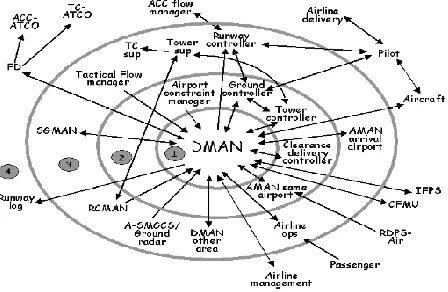
The DMAN creativity workshop took place over 2 full days in May 2003, two months into the DMAN requirements process. The DMAN team had completed RESCUE stage 1, and its deliverables provided essential inputs in the form of shared models to the workshop. These deliverables included an extended system context model that described the DMAN system and all of its adjacent actors, a use case model that also showed these actors and 18 DMAN socio-technical system use cases and use case précis that described how human and systems might work to achieve DMAN goals. Figure 2 shows one version of the context system model used during the workshop. Use case précis tended
[image:4.612.334.558.122.268.2]to be short and informal descriptions. For example, the précis for UC4 – DMAN gives start-up clearance to an aircraft – read the clearance delivery controller checks the planned start-up time from DMAN and delivers clearance if appropriate.
Figure 3. A version of the DMAN system context model
The workshop was held in a large meeting room on NATS premises in London. The 2 models and 18 use case précis provided the structure for the workshop room itself. At the beginning of the workshop each model and précis was posted on separate 1m2 pin boards placed around the workshop room that became the physical and logical space for ideas and requirements that were associated with that model and use case during the workshop. The room was divided into 2 areas – a presentation area with a LCD projector in front of a large table around which all the participants could sit – and a breakout area with comfortable chairs placed around small tables to enable group work for 4 groups containing 4 or 5 people each. A photograph of part of the environment towards the end of the workshop is shown in Figure 4.
Twenty-one participants attended the workshop. The participants represented a cross-section of roles in departure management and scheduling in the UK and France. These participants included: five representatives from the project client Eurocontrol, three systems engineers from NATS and Sofreavia, five UK air traffic controllers from NATS, five French air traffic controllers from DNA/CENA, two workshop facilitators (two of the authors of this paper) and a workshop scribe (a third author of the paper).
The workshop was facilitated to encourage a fun atmosphere so that the participants were relaxed and prepared to generate and voice ideas without fear of criticism. For example, the second day began with a balloon animal making competition, with a prize for the participant who created the best animal. During creativity periods, standard RAD/JAD facilitation techniques and rules (Andrews 1991) such as avoiding criticism of other people’s ideas and time-boxing each topic under discussion were applied.
Figure 4. The typical workshop environment
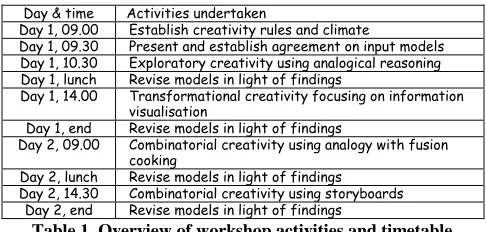
The workshop ran for 2 consecutive days, 09.00-17.00hrs each day. Each day was divided into two distinct creative periods following the structure depicted in Figure 2. The timings and activities from the workshop are shown in Table 1.
Day & time Activities undertaken
Day 1, 09.00 Establish creativity rules and climate
Day 1, 09.30 Present and establish agreement on input models Day 1, 10.30 Exploratory creativity using analogical reasoning Day 1, lunch Revise models in light of findings
Day 1, 14.00 Transformational creativity focusing on information visualisation
Day 1, end Revise models in light of findings
Day 2, 09.00 Combinatorial creativity using analogy with fusion cooking
Day 2, lunch Revise models in light of findings Day 2, 14.30 Combinatorial creativity using storyboards
Day 2, end Revise models in light of findings
Table 1. Overview of workshop activities and timetable
The agenda shows 5 distinct creative periods, each supporting the divergence then convergence of ideas, distinct preparation, incubation, illumination and verification activities, and activities to support exploratory creativity (through an analogy with railway scheduling), combinatorial creativity (through an analogy with fusion cooking, and the use of storyboards) and transformational creativity by exploring different information visualization solutions.
3.1
Exploratory Creativity with Analogies
The authors have already investigated analogical reasoning in requirements engineering. We define 2 requirement domains as analogous if the domains share a network of knowledge structures that describe goal-related behaviour in both domains (Maiden & Sutcliffe 1992). Studies showed that people can exploit such analogies to reuse requirements if they are given support to recognise, understand and transfer the analogies. In the creative workshops we provided this support but encouraged the participants to go one step further and use the transferred knowledge from the non-air traffic domain to provoke creative thinking about requirements ideas in the air traffic domain.
The facilitators encouraged analogical reasoning by, before the workshop, applying the NATURE Domain Theory (Sutcliffe et al. 1998), of which one of them was an author, to identify and elaborate an analogical match with DMAN’s aircraft scheduling and management domain. The selected analogy was with railway
timetable scheduling. Both domains are prototypical instantiations of 2 key NATURE object system models:
RESOURCE ALLOCATION: allocating resources to needs according to complex constraints to produce a plan;
AGENT MONITORING: agents monitor the movement of objects in a remote space.
Furthermore, previous studies of analogical problem solving have suggested that similarity-based reasoning is difficult (Gick & Holyoak 1983), and that people often needs syntactic similarities between the domains to recognize the analogy (Ross 1987). Therefore, in contrast to our previous use of analogies with few syntactic similarities (e.g. Indian 17th century textile design to
aircraft conflict resolution), we selected a source domain, railway scheduling, which shared more surface similarities with the DMAN domain.
Participants worked in 4 groups of 4 to illuminate the analogical ideas. To aid them, the facilitators presented a simple example of analogical creativity between the two rental domains – from a video rental store to improve services offered by an academic library. The example identified how to detect and record analogical mappings between domains, then how to use each mapping in turn to transfer knowledge from the source domain to generate new ideas in the target domain.
3.2
Combinatorial Creativity
Combinational creativity is, in simple terms, the creation of new ideas from combination and synthesis of existing ideas. As Boden (1990) describes, models of creativity fall into two broad categories, because creativity itself is of two types. The first type is combinatorial creativity, where the creative act is an unusual combination of existing concepts. Examples of combinatorial creativity are poetic imagery, free association (e.g. viewing the sun as a lamp), metaphor and analogy. Combinatorial creativity is characterised by the improbability of the combination, or in other words, the surprise encountered when such an unusual combination is presented. Association is an important mechanism for combinatorial creativity. It is the recognition of similar patterns in different domains, sometimes in the presence of noise or uncertainty. The association may be retained and reinforced either by repetition or by systematic comparison of the internal structures of the two concepts. Koestler (1964) describes association as the "biosociative act that connects previously unconnected matrices of experience".
Combinatorial creativity by association was applied during the workshop to create new ideas based on the ideas generated in earlier periods. Participants were familiarised with the combinatorial creativity process using an example from an earlier RESCUE workshop, in which the organisers invited a fusion chef to talk about combining unusual ingredients, and to demonstrate fusion cooking. In the DMAN workshop the participants worked in 4 groups of 4 to generate new DMAN ideas.
[image:5.612.53.296.317.433.2]scene of the storyboard and lines upon which to describe that scene.
3.3
Transformational Creativity
During transformational creativity people change the solution space in a way that things that were considered impossible are now possible (Boden 1990), for example by challenging pre-conceived constraints and exploring new solutions to existing problems. We encouraged transformational creativity by introducing knowledge about possible solutions in the DMAN solution space in the form of candidate visualizations for presenting information to air traffic controllers. The knowledge was delivered to the workshop participants via an expert presentation on information visualization and access to copies of the expert’s book on the same subject. Participants then worked in 4 groups of 4 with information about possible information visualizations to explore new solutions to DMAN, and sometimes changing the possible solution space along the way. Ideas resulting from the illumination activity were verified when each group reported back its visualization and related ideas to other workshop participants.
3.4
Incubation with Expert Presentations
Creative thinking requires knowledge from other sources to be successful. Creative thinkers search for new ideas by manipulating knowledge to see different problems, opportunities and solutions. Therefore we used short expert presentations to communicate the relevant domain knowledge to participants and encourage incubation of ideas whilst the participants listened. Three of the 4 workshop periods included one such presentation. In the first period, an invited expert on scheduling algorithms with experience in the railway timetabling domain gave a 40-minute presentation. In the second period, another invited expert gave a 30-minute presentation on information visualization techniques. In the third period, one of the facilitators with professional cooking experience gave a 30-minute presentation on fusion cooking that led on to a facilitated activity to explore how to combine DMAN ideas and requirements.
4.
WORKSHOP RESULTS
The workshop took place and ran to schedule. All planned activities were followed without participant disruption or disagreement. Potential conflicts about requirements and ideas that arose within each technique were handled either locally within the group or with facilitated discussion during report-back presentations.
The main workshop outcomes are summarized in Table 2. Participants used white idea cards to record new ideas not arising from specific creative activities and place them on the relevant ideas board. Forty-eight such ideas were recorded, 8 of which were specific to one of the DMAN use cases. During exploratory creativity, analogical reasoning with the railway scheduling domain led to a further 12 new ideas, in part because each working group was instructed to generate and record on yellow idea cards a maximum of 3 ideas each. During the first period of combinatorial creativity using the fusion cooking analogy, only 4 new ideas were recorded on the green idea cards, however one of the working groups combined all of the ideas generated until that point to produce 2 systems architecture models for DMAN. During the second period, the 4 working groups produced 5 DMAN storyboards for 4 of the most important DMAN use cases. During transformational creativity, 4 working groups produced 7
distinct DMAN visualizations specific to one or more DMAN use cases. Finally, participants changed the context and use case models and some of the use case précis in light of facilitated discussions and working group results. If agreed by most participants, these changes were recorded on the displayed models, then the models were updated and re-displayed by the workshop scribe between workshop periods.
Deliverable type Number
system-wide case-specific Number use General new ideas 40 8 Ideas from analogical reasoning 12 0 Ideas from combinatorial
creativity with fusion cooking analogy
6 0 Ideas from DMAN visualisations 0 7 Ideas from DMAN storyboards 0 5
Table 2. Summary of basic findings from the workshop
This section describes these results in more detail.
4.1
New Requirements and Other Ideas
Most ideas were recorded on RESCUE A6 idea cards that captured the idea description, rationale and source. A pattern emerged. Earlier ideas from round-table brainstorming at the beginning of the workshop were often non-functional requirements that would not need a creativity workshop to acquire, for example “reduce controller workload and increase overall capacity”, and “simplify departure planning” from 2 air traffic controllers. In contrast, the participants considered ideas that were recorded during the second day to be more inventive, for example “introducing more complicated scheduling capabilities over time” and “disciplining airlines if information on future aircraft departures is not available”. Furthermore, some
of the ideas were generated in response to work on system boundaries specified in the system model, for example “A central DMAN is needed for each area/region to handle flow scheduled. Needs a tactical flow manager role for the area, and an airport constraint manager role for the airport”. The workshop scribe
physically completed most of the white idea cards on behalf of participants in response to verbal comments, although some participants did write their own cards during other activities such as expert presentations.
4.2
Analogical Reasoning with Railway
Scheduling
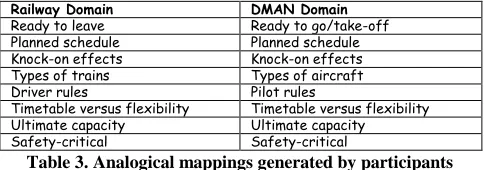
After idea incubation during the expert presentation on railway scheduling, idea illumination activities were two-fold. Firstly, the facilitators led the participants to generate the analogical mappings between actors, objects, actions, goals and constraints in the railway and DMAN scheduling domains. Some are listed in Table 3.
Railway Domain DMAN Domain
Ready to leave Ready to go/take-off Planned schedule Planned schedule Knock-on effects Knock-on effects Types of trains Types of aircraft Driver rules Pilot rules
[image:6.612.318.560.597.682.2]Timetable versus flexibility Timetable versus flexibility Ultimate capacity Ultimate capacity Safety-critical Safety-critical
Table 3. Analogical mappings generated by participants between the railway and DMAN scheduling domains
mappings. Each group worked for 40 minutes to illuminate 3 ideas each and document them using the yellow analogical idea cards. Ideas included:
Giving pilots and airlines incentives to provide accurate information to DMAN – airlines win if they co-operate with DMAN, but lose if they do not;
Schedules are built on well-established knowledge including distances, speeds, airways, taxi routes and turnaround times; DMAN can swap flights with the Central Flow Management
Unit (CFMU) slots regulated for the same sector, or departure times of aircraft belonging to the same company.
From a simple qualitative analysis, the ideas generated from the analogical mappings tended both to be more comprehensive and applicable to the DMAN system as a whole rather than specific components or elements of the system.
4.3
Combinatorial Creativity with Fusion
Cooking
Idea incubation was encouraged during the 30-minute verbal and PowerPoint presentation on fusion cooking. Again, illumination activities were two-fold. Firstly, the facilitators worked with all participants to establish the following 11 DMAN domain rules to use to combine existing ideas: main versus supplementary ingredients; adaptability in the control tower (supplementary gives choices); not to do with safety-critical; scheduling and reliable information; maintain and enhance service; airline company co-operation; communication tool between actors rather than a control tool; reducing knock-on effects; keep the airlines happy; keep the controllers happy; and
maintain workload and increase capacity for all.
[image:7.612.320.563.339.532.2]Secondly, the facilitators again divided the participants into 4 groups of 4 and instructed them to combine existing DMAN ideas and document them using the green combinatorial idea cards. Participants were encouraged to walk around and browse the current ideas on the idea boards for the system and use cases, thus exploiting the physical workshop structure. Only 4 green cards were completed. However, one of the groups combined ideas into a comprehensive DMAN system architecture shown schematically (from the workshop report) in Figure 5. The graphic shows a time line from left to right (from start-up engines to airborne and en-route fix), the system components and actors that control and manage the departure of an aircraft and which of these components and actors are connected.
Figure 5. The DMAN system architecture generated during illumination in the combinatorial creativity period.
Whilst each group was given 10 minutes to report back and verify the ideas, presentation of the DMAN system architecture lasted almost 75 minutes due to the complexity of the architecture and number of questions and other issues raised by the participants. Because of the emerging importance of the model,
the facilitators postponed the lunch break for 50 minutes to allow the workshop participants to reach consensus on the model. They tested the emerging consensus by actively seeking participant disagreements with its content, but most participants only raised questions to seek clarification of the model. This system model became the agreed basis for development of the storyboards in the afternoon session.
4.4
Combinatorial Creativity with
Storyboarding
[image:7.612.61.292.533.637.2]The facilitators again divided participants into 4 groups of 4 to construct storyboards for 6 DMAN use cases from the 18 available voted for by participants. Idea incubation was encouraged by asking each group to review the use case précis, ideas and visualizations, as well as relevant system-wide ideas, then prototype a simple storyboard before developing the full storyboard. Over 90 minutes, three of the 4 groups produced a storyboard for one use case whilst the fourth group generated storyboards for 2 use cases. Figure 6 shows the final storyboard for use case UC17 – tactical flow manager notifies DMAN of new or amended flow constraints. The storyboard combines the use case action sequence in the précis with communication with external actors (panel number 4), DMAN information visualizations (6 & 8) and controller actions, both cognitive (3) and physical (7).
Figure 6. The storyboard developed for use case UC17 - tactical flow manager notifies DMAN of new or amended flow
constraints
The combined ideas were verified by reporting each storyboard back to the other workshop participants.
4.5
Transformational Creativity with
Information Visualization
Idea incubation was encouraged during the presentation and distribution of the expert’s book on information visualization. Illumination was encouraged by again dividing participants into 4 groups of 4 and asking each group to produce candidate DMAN information visualizations on A1 sheets of paper for use cases again selected by the participants. The 4 groups produced 7 different visualizations. Figure 6 shows one of the visualizations produced for use case UC14 – DMAN schedules a switch of runway configuration or switching. The visualization includes the
DMAN PLANNING
SUPPORT
Tower Mgr
Airlines SMAN AMAN
CFMU
ATC Tower
TC / AC Control Tactical
FM
DMAN Seq. Support
A-SMGCS Env.
Data
Timeline Start Up Push Back Taxi Holding Point Airborne
Plan Seq.
En-Route Fix
physical runway layout, timelines of departing and arriving aircraft, and stickers made available from the expert to indicate the use of different predefined visualization techniques. These techniques include birds-eyes views over all displayed information (in the bottom-left of the visualization) and carousel techniques for rapid information searching (middle-right).
Figure 6. The visualization produced for use case UC14 – DMAN schedules a switch of runway configuration or
switching
4.6
Revised System and Use Case Models
During the workshop the system context and use case models and use case précis on the idea boards were changed to reflect agreed changes about DMAN’s scope and functionality. Eight changes were made to the context model shown in Figure 3, including the addition of 5 new actors (airport constraint manager, tactical flow manager, AMAN arrival airport, aircraft and passenger), one actor deleted (TC traffic manager), and changes to two actors with respect the DMAN system boundaries (A-SMGCS/ground radar, and airline operations). Similar numbers and types of changes were made to the use case model and précis.
Name UC4: DMAN gives Start Up Clearance to Aircraft
Précis If PDCS exists automatic start-up clearance given
If no PDCS is available then Clearance Delivery CONTROLLER checks planned start-up time from DMAN (DMAN only shows list of aircraft that can start) and delivers clearance if appropriate.
Actor who
initiates Clearance Delivery CONTROLLER
Pre-conditions Flight is in DMAN plan
Post-conditions Start-up clearances are delivered according to DMAN schedule
Actor who
benefits Clearance Delivery CONTROLLER Ground CONTROLLER
Runway CONTROLLER Pilot (reduced fuel burn)
Idea Cards W28: Different visualisations for different position /
role in tower
W30: Provide airport schedule to en-route controller over each exit point. Rate can be set
W31: Information from boarding card system - i.e. last
passenger boarding aircraft, sent to DMAN. Airline knows time until ready form that point. Incentives for airline - if give accurate ready information will meet slot / schedule
W32: Use of Mode-S to pass delivery via datalink to cockpit
Y7: Potential negative effects of key performance indicators
Y8: Punctuality: Scheduled flights, For passengers
Visualisation
Storyboard
Figure 7. The description of use case UC4 at the end of the workshop
Furthermore, the use of the physical ideas boards generated more structured outputs that align with use case descriptions developed later in the RESCUE process. This is best demonstrated in the example of use case UC4 –DMAN gives start-up clearance to aircraft. The original input to the workshop was a simple sentence reported in section 3. Figure 7 describes the state of the use case after the workshop, including a revised précis, related new ideas, a storyboard and a visualization all placed on the ideas board for UC4.
These outputs provided direct inputs into RESCUE stage 2 processes. The engineer charged with development of detailed use case descriptions was able to use them to determine allocation of work to different actors, action ordering, and the nature of interaction between systems and people. Use case actors and their associations were used by a second engineer who produced the i*
[image:8.612.57.299.140.353.2]using the VOLERE shell and linked to use cases using the RESCUE meta-model.
5.
LESSONS LEARNED
The workshop was an integral part of the wider RESCUE process that is currently being applied to produce the final DMAN operational requirements document. The workshop itself was a success in that it did deliver important outcomes as inputs to RESCUE stage 2 sub-processes. All of the workshop periods generated useful outcomes, but some outcomes were more significant to the DMAN concept than others. Analogical reasoning generated new ideas about how DMAN should interact with other systems. Transformational creativity generated new information visualizations but few changes to make the impossible possible. Combinatorial creativity led to 2 systems architecture models that were the most important single outcomes from the workshop. Finally, storyboards for use cases were an effective technique for combining existing ideas and models from other sources into a more coherent vision of DMAN.
From reflection on the workshop design and facilitation experience, the authors drew lessons. Six are reported here.
5.1
Diverge ideas from shared models
The use of three models representing the current specification of DMAN system boundaries, functions and work allocation provided an effective starting point for idea divergence in each creative period. It avoided problems encountered in previous workshops when participants with different understanding of system boundaries and functions were unable to collaborate or produce coherent outcomes. Use informal models such as data flow and use case diagrams that participants can understand, and display them as paper models that participants can easily annotate and change.
5.2
Physical ideas spaces provide context
Participants cannot always understand idea descriptions expressed as atomic phrases or sentences when they were not involved in the creation of the idea. The RESCUE solution – challenging participants to place the idea in an existing and shared context provided by the system models or use case précis – appears to have been effective, and the physical idea boards representing these different contexts was simple to use. One test of this was that participants on the second day were able to take ideas generated by others on the first day and work with them to combine them to generate new ideas and storyboards. We recommend that people exploit the properties of physical pin to create meaningful and maintainable context spaces for ideas.
5.3
More creative work happens later on
Most idea illumination took place during the first combinatorial creativity period of the second day based on the DMAN system architecture model. This supports earlier findings (Pennell & Maiden 2003) that suggest that creative thinking requires a period of preparation and incubation (Poincare 1982) during which the participants build up knowledge of the problem domain, trust, and a basis for collaboration (Mamykina et al. 2002). Therefore, do not expect to encourage creative thinking from the start – it takes time to happen.
5.4
Structured analogical activities work
Strong facilitation of step-wise analogical reasoning activities based on atomic analogical mappings and syntactic similarities did overcome previous problems with analogical
reasoning (Maiden & Gizikis 2001). Preparation is the key. Select the correct analogies carefully beforehand using relevant theories and domain classification schemes such as the NATURE domain theory (Sutcliffe et al. 1998). Treat analogical creativity as a learning process – rank the candidate analogies according to their degree of syntactic similarity and relevance, and introduce them to participants in a planned order.
5.5
Let ideas, not agendas, drive workshops
Ideas such as the DMAN system architecture model take on a life of their own, and facilitators must let this happen. Of course, the downside is its impact on the workshop agenda, as the use of experts and time to produce essential deliverables might be lost. However, we believe that dogmatic adherence to the agenda can inhibit creative thinking, so facilitators need to be able to redesign creativity activities in real time. Relevant expertise and resources must be available at short notice.
5.6
Capture everything, not just requirements
Although RESCUE is a requirements process, capture and document all types of information because it is important for the requirements specification. Ideas about work allocation, actor behaviour and interaction modes all enable engineers to distinguish between stakeholder and system requirements. Candidate solutions used during transformational creativity provide important inputs for later system specification processes. Information documented during workshops provides domain knowledge essential for constructing satisfaction arguments for important requirements (Hammond et al. 2001).
6.
DISCUSSION AND FUTURE WORK
The DMAN operational requirements document is due to be delivered to the client in February 2004. Already much of the basic document structure and content – models, use cases and requirements – are in place. This deliverable provides us with the chance to analyze the outcomes from the creativity workshop using the final requirement document to determine their impact. To do this, we will analyze all data recorded in the 46-page workshop report to trace its influence on elements of the specification document, then seek rationale for these trace links in interviews with the systems engineers responsible for developing the specification.
In parallel, we are using workshop data to validate and extend a descriptive model of creative requirements engineering based on models that underpin the workshop design (Daupert 2002, Boden 1990, Poincare 1982). The validation uses data from the earlier CORA-2 workshops and 3 more recent RESCUE air traffic workshops that adopt the lessons reported in this paper. In particular we are using protocol data to investigate life histories of creative ideas from conception to verification, and linking these histories to patterns of stakeholder communication and artifact use. We believe that these models have general applicability to the design of interactive systems of which air traffic management systems are an example.
support creative thinking. We aim to push stakeholders’ creative processes that are needed to explore scenario events one step further and discover innovative new requirements in the context of that event. ART-SCENE shows the normal course event sequence and generated alternative courses for each event. On request, the tool will randomly generate a list of innovative but domain-independent functions, features and ideas (combinatorial creativity) that are ordered according to relevance to the current scenario event according to domain-dependent and –independent taxonomies of these functions. Users can select each function or feature to discover more about it, including potentially analogical examples of its use elsewhere. An informal scenario sketch tool with a mark-up language can be used alongside to transform new ideas emerging from the combined events and functions into novel services, scenarios and interactions. Capturing the rationale behind these ideas is important, so graphical design rationale tools such as QuestMap from the Compendium Institute can be used. We look forward to reporting results from this work in the near future.
7.
ACKNOWLEDGMENTS
The authors wish to thank the workshop participants, and acknowledge the support of Eurocontrol, NATS and Sofreavia in the development of the paper.
8.
REFERENCES
[1] Andrews D.C., 1991, 'JAD: A Crucial Dimension for Rapid Applications Development', Journal of Systems
Management, March 1991, 23-31.
[2] Boden M.A., 1990, The Creative Mind, Abacus, London
[3] Chung L., Nixon B., Yu E. and Mylopoulos J., 2000, ‘Non-Functional Requirements in Software Engineering’, Kluwer Academic Publishers.
[4] Daupert, D. (2002) The Osborn-Parnes Creative Problem Solving manual. Available from www.ideastream.com/create.
[5] Floyd, C., Mehl, W.-M., Reisin, F.-M., Schmidt, G., & Wolf, G. (1989). Out of Scandinavia: Alternative Approaches to Software Design and System Development. Human-Computer Interaction, 4(4), 253-350.
[6] Gick M.L. & Holyoak K.J., 1983, 'Schema Induction & Analogical Transfer', Cognitive Psychology 15, 1-38.
[7] Hammond J., Rawlings R. & Hall A,. 2001, ‘Will It Work?’, Proceedings 5th IEEE International Symposium on
Requirements Engineering, IEEE Computer Society, 102-109.
[8] Hargadon A. & Sutton R.I., 2000, Building an Innovation Factory, Harvard Business Review, May-June 2000.
[9] Isaksen, G. & Dorval, K. (1993) Changing views of creative problem solving: Over 40 years of continuous improvement. ICN Newsletter. 3 (1).
[10]Koestler, A., 1964, The Act of Creation, London Hutchinson.
[11]Maiden N. & Gizikis A., 2001, ‘Where Do Requirements Come From?”, IEEE Software September/October 2001 18(4), 10-12.
[12]Maiden N.A.M., Jones S. Flynn M., 2003a, ‘Innovative Requirements Engineering Applied to ATM’, Proceedings Joint Eurocontrol/FAA ATM’2003 Conference, June 2003, Budapest.
[13]Maiden N.A.M., Jones S.V. & Flynn M., 2003b, 'Integrating RE Methods to Support Use Case Based Requirements Specification', Poster paper, Proceedings 11th International Conference on Requirements Engineering, IEEE Computer Society Press, 369-370.
[14]Mavin A. & Maiden N.A.M., 2003, ‘Determining Socio-Technical Systems Requirements: Experiences with Generating and Walking Through Scenarios’, Proceedings 11th International Conference on Requirements Engineering,
IEEE Computer Society Press, 213-222.
[15]Maiden N.A.M. & Rugg G., 1996, 'ACRE: Selecting Methods For Requirements Acquisition, Software Engineering Journal 11(3), 183-192.
[16]Maiden N.A.M. & Sutcliffe A.G., 1992, 'Exploiting Reusable Specifications Through Analogy', Communications of the ACM. 34(5), April 1992, 55-64.
[17]Mamykina L., Candy L & Edmonds E., 2002, ‘Collaborative Creativity’, Communications of the ACM 45(10), 96-99.
[18]Nomura 2001,
http://members.ozemail.com.au/~caveman/Creative/Admin/c rintro.htm
[19]Nguyen L., Carroll J.M. & Swatman P.A., 2000, “Supporting and Monitoring the Creativity of IS Personnel During the Requirements Engineering Process,” Proc. Hawaii Int’l Conf. Systems Sciences (HICSS-33), IIIEEEEEEEEE CCCooommmpppuuuttteeerrr SSSoooccciiieeetttyy. y
[20]Obsorn A.F., 1953, ‘Applied Imagination: Principles and Procedures of Creative Problem Solving’, Charles Scribener’s Sons, New York.
[21]Pennell L. & Maiden N.A.M., 2003, ‘Creating Requirements – Techniques and Experiences in the Policing Domain’, Proceedings REFSQ’2003 Workshop, June 2003, Velden Austria.
[22]Poincare H., 1982, The Foundations of Science: Science and Hypothesis, The Value of Science, Science and Method, Univ. Press of America, Washington 1982
[23]Robertson J., 2002, ‘Eureka! Why Analysts Should Invent Requirements’, IEEE Software July/August 2002, 20-22. [24]Robertson S. & Robertson J., 1999, ‘Mastering the
Requirements Process’, Addison-Wesley.
[25]Ross B.H., 1987, 'This is Like That: The Use of Earlier Problems and the Separation of Similarity Effects', Journal of Experimental Psychology: Learning, Memory and Cognition 13(4), 629-639.
[26]Sutcliffe A.G. & Maiden N.A.M., 1998, 'The Domain Theory for Requirements Engineering, IEEE Transactions on Software Engineering, 24(3), 174-196.