S. Sarkar,1 S. Langer,1 J. Schachenmayer,2, 1 and A. J. Daley1, 3
1
Department of Physics and Astronomy, University of Pittsburgh, Pittsburgh, Pennsylvania 15260, USA 2JILA, NIST, Department of Physics, University of Colorado, 440 UCB, Boulder, CO 80309, USA
3
Department of Physics and SUPA, University of Strathclyde, Glasgow G4 0NG, Scotland, U. K.
We investigate the many-body dissipative dynamics of fermionic atoms in an optical lattice in the presence of incoherent light scattering. Deriving and solving a master equation to describe this process microscopically for many particles, we observe contrasting behaviour in terms of the robustness against this type of heating for different many-body states. In particular, we find that the magnetic correlations exhibited by a two-component gas in the Mott insulating phase should be particularly robust against decoherence from light scattering, because the decoherence in the lowest band is suppressed by a larger factor than the timescales for effective superexchange interactions that drive coherent dynamics. Furthermore, the derived formalism naturally generalizes to analogous states with SU(N) symmetry. In contrast, for typical atomic and laser parameters, two-particle correlation functions describing bound dimers for strong attractive interactions exhibit superradiant effects due to the indistinguishability of off-resonant photons scattered by atoms in different internal states. This leads to rapid decay of correlations describing off-diagonal long-range order for these states. Our predictions should be directly measurable in ongoing experiments, providing a basis for characterising and controlling heating processes in quantum simulation with fermions.
PACS numbers: 37.10.Jk, 42.50.-p, 67.85.Hj
I. INTRODUCTION
In recent years, there has been remarkable progress to-wards quantitative applications of quantum simulators1–4 to the study of many-body physics in strongly inter-acting systems5,6. In the case of fermionic atoms in optical lattices, the level of microscopic understand-ing and control achieved opens the door towards the study of physics associated with the Hubbard model7, including magnetic correlations in two-component fermi gases in an optical lattice8, and going beyond this to the study of many-body physics with high degrees of SU(N) symmetry in group-II-like atoms9–13. At the same time, these experiments provide an ideal environ-ment for probing out-of-equilibrium physics14,15, both in terms of quench dynamics16–22, and also dissipative dynamics23–26. Controlled dissipative dynamics27 could be used in these systems to observe the emergence of pairing25 or counter-intuitive long-range correlations26, as well as Pauli-blocking and quantum Zeno effects in dissipative processes23,24.
A key challenge for state-of-the art experiments with multiple spin species of fermions1,2 is to realize entropies per particle low enough to observe quantum magnetism or other physics on small energy scales. This is particu-larly true of strongly interacting regimes|U| J, where
J is the tunnelling amplitude to neighbouring sites, and
Uis the on-site interaction energy, in which the dominant order is often driven by small terms28–35of the order of
J2/U. Characterization and control over heating there-fore takes on a special importance. From a theoretical point of view such dynamics are complicated, as they in-volve understanding the interplay between few-particle atomic physics, and out-of-equilibrium many-body dy-namics. However, the atomic physics of these systems is
sufficiently well understood that we can look to derive mi-croscopic models describing heating of many-particle sys-tems, either with technical noise such as fluctuations of an optical lattice potential36,37, or with incoherent light scattering for one atom38,39, up to many bosons40–44. For particles in optical lattices, incoherent light scattering gives a fundamental limit to coherence times of many-body states, and therefore minimal requirements for our understanding of out-of-equilibrium many-body dynam-ics in quantum simulators28,29,45.
be found in Ref. 60.
II. OVERVIEW
A. Summary of results for atoms in the lowest Bloch band
When we begin with atoms in the lowest Bloch band of the optical lattice, and consider the decoherence of many-body states, we observe strikingly contrasting results in different regimes. This is especially true for the case of strong interactions |U| J. While the rate of sponta-neous emissionsγ in typical current experiments can be of the order of 0.001 – 0.01J, the physics of magnetically ordered states withU >0 and bound dimers forU <0 is driven by terms that arise in second order perturbation theory as ∝ J2/U. Conservatively taking U
& 10J in this regime, we have γ & 0.01 – 0.1 J2/U. Therefore, there is a danger that these states may be particularly susceptible to decoherence at a rate that is relatively fast compared to the relevant dynamical timescales.
We find this concern to be well founded in the case of attractive interactionsU <0 with equal filling of two spin species. In that regime a gas of bound dimers exists, in which dimers tunnel in perturbation theory with am-plitude 2J2/U, and forms a superfluid with long-range order at low energy. However, this order is strongly sus-ceptible to spontaneous emissions: correlations describ-ing off-diagonal order of dimers decay at a rate not only given by 2γ (the rate of scattering for two independent particles), but instead 4γ. This arises from additional superradiant enhancement due to the indistinguishabil-ity of off-resonant photons scattered by atoms in different internal states.
This is in strong contrast to the case of magnetic or-dering for repulsive interactions U > 0, where minimis-ing interaction energy favours insulatminimis-ing states with a single atom per site, and magnetic ordering driven by a superexchange interaction of amplitude 2J2/U. We show that these states can be particularly robust, which can be intuitively understood as follows: for the typi-cal experimental case, direct spin decoherence does not occur because the lattice lasers are far detuned and pho-tons scattered by atoms in different internal states are in-distinguishable. As a result, spontaneous emission only distinguishes between different on-site particle number states, and not different spin states. This suppresses de-coherence by a factor related to the probability of doubly-occupied or undoubly-occupied lattice sites (assuming we begin with unit filling), which in higher dimensions is of or-der J2/U2. As a result, the dominant process involves transfer of particles to higher Bloch bands, which itself is suppressed by the Lamb-Dicke factorη ∼0.1. Hence, these magnetically ordered states should exhibit a partic-ular robustness against decoherence due to spontaneous emissions.
The general formalism derived here applies to higher
dimensions and can also be straight-forwardly generalised to larger numbers of internal states, including nuclear spins in group-II atoms. In particular, the results we obtain in perturbation theory showing the robustness of magnetic order can be directly generalised to the heating of group-II atoms with SU(N) magnetic order.
B. Outline of this article
This paper is organized as follows: In Sec. III we sum-marise the atomic physics of a single group-I atom or group-II atom and justify the microscopic assumptions we use as basis for describing the many-body dynamics. In Sec. IV we outline the derivation of the many-body master equation for light scattering by fermionic atoms. Sec. V presents the intuitive regime of atoms in a double-well potential, in preparation for Section VI, where we study the full many-body dynamics on a lattice. We present a summary and outlook in Sec. VII. More tech-nical details of the calculations in Sec. III and Sec. IV are organized in Appendix A and B respectively.
III. ATOMIC PHYSICS
To provide the framework for the derivation of the mas-ter equation, we summarise the relevant atomic physics for the atomic species predominantly used in experiments with ultra-cold atoms. Group-I (alkali-metal) atoms have been used widely, and recently group-II (alkaline earth-metal) atoms have been established for the realisation of systems with SU(N) symmetry11,12 . We consider spon-taneous emissions when an atom is trapped in an optical lattice created by far-detuned laser field and show that the atom returns to the same state it started from with very high probability. In addition the scattered photons are also indistinguishable, resulting in low direct spin de-coherence. In the following we provide two prototypical examples,171Yb (group-II) and6Li (group-I).
A. Group-II atoms
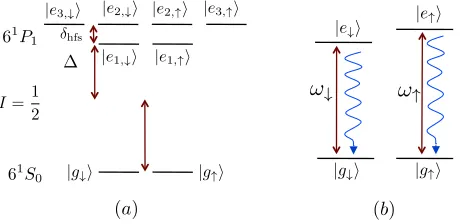
First we look at the case of group-II atoms, specifi-cally 171Yb (Fig. 1(a)). These atoms with two valence electrons have a ground state which is a spin singlet, with zero total electronic angular momentum. Hence, the ground states differ only in the z-component of the nuclear spin, I = 1/2, and we have two states in the lowest manifold. The electric field of the laser only cou-ples directly to the orbital motion of the electron, and we can define a detuning ∆ from the most closely coupled excited level, e.g.,1P
!
"!
#|e#i
|g#i |g"i
|e"i 61P1
61S0 |g#i |g"i
|e1,#i |e1,"i
|e2,"i |e3,"i
|e3,#i |e2,#i
hfs
I=1
2
[image:3.612.363.512.49.185.2](a) (b)
FIG. 1. (a) Atomic structure of 171Yb (nuclear spin I =
1/2). We use the spectroscopic notation for the sublevels and show hyperfine structure splittings of the lowest singlet levels (energies are not drawn to scale). The ground states have total electron spin of zero and states in this manifold essentially only differ in the nuclear spin componentmI. We write the two ground states as spin down and spin up states formF =−1,1 respectively. (b) Reduction of this hyperfine structure to an effective four-level system where, for very large detuning (∆δhfs,|ω↑−ω↓|), we can neglect the possibility
of a spin flip and can take the photons scattered from each spin system to be identical.
resolved, and the hyperfine coupling cannot be used to rotate the nuclear spin state during spontaneous emis-sions. Phrased in a different way, we can note that a particular choice of ground state is always coupled to a superposition of excited hyperfine states, which depends on the detuning. For large detuning this superposition is such that when the atoms return to the ground state, decay channels corresponding to a spin flip interfere de-structively and its relative rate is of the order∼(δhfs/∆)2 (see Appendix A for an explicit calculation).
In typical experimental setups where δhfs ≈ 324 MHz61,62, and far-off-resonance lattices can be detuned by tens or hundreds of nanometers (∼1014Hz), this rate of spin-flips is extremely small. In such a limit, the group-II atomic system can be regarded as an assembly of two decoupled two-level systems for the two different nuclear spin states (Fig. 1(b)). Relative shifts of the transition frequencies between the levels are small, but to account for any small difference, we define transition frequencies
ω↑ and ω↓, as shown in Fig. 1(b). For ∆ |ω↑−ω↓|,
the relative frequencies of the scattered photons cannot be resolved63, resulting in suppression of direct spin deco-herence. We explore the differences between identical and non-identical photon scattering in more detail in Sec. IV.
B. Group-I atoms
In addition to the considerations in the group-II case, group-I atoms such as6Li have nonzero electron spin in the ground state. We then need to consider the role of fine structure coupling and include excited levels in2P
1/2 and2P
3/2(as shown in Fig. 2). These have a fine struc-ture energy difference δfs between them and hyperfine
A B
C D E F
1 2
3 4 5 6
7 8 9 10 11 12 13 14 15 16 17 18
22S1/2
22P 1/2
22P3/2
hfs fs
I= 1
FIG. 2. A diagram of the atomic structure of 6Li (nuclear spinI= 1) showing the lowest hyperfine manifolds (energies not drawn to scale). The ground states in theS sublevel are labeled byA, B, . . . , F and the excited states inP sublevels are labeled by 1,2, . . . ,18. These names will be used in the text in discussing transitions between different levels.
structure energy splittings δhfs,P1/2 and δhfs,P3/2 within each manifold of states. Analogously to the group-II case, spin-flip processes that must change the nuclear spin are suppressed if the detuning is much larger than the hy-perfine structure splitting, and also spin-flip processes changing the electronic spin are suppressed when the de-tuning is much larger than δfs. An example of a spin flip between two ground states that have different elec-tron spins is |gDi → |gEi in Fig. 2. The relative rate
of spin flip processes is∝ (δfs/∆)2. An example of the flip of a nuclear spin is |gDi → |gAi, where the
rela-tive spin flip rate from a laser polarized alongz-axis is
∝ (δhfs,P1/2/∆−δhfs,P3/2/∆)
2, with constants that can be computed from the different dipole matrix elements. For a hyperfine structure splitting of δhfs = 26.1 MHz forP1/2 and 4.5 MHz forP3/2, andδfs = 10.05 GHz for the fine structure splitting64, we can again assume that the spin-flip processes are very strongly suppressed in far-detuned lattices and are negligible on experimentally relevant timescales. More details of these calculations can be found in Appendix A.
This conclusion also holds well when we consider the role of an external magnetic field, including in the Paschen-Back regime. For both 171Yb and 6Li, the spin flip rates stay negligibly small even when an exter-nal magnetic field is introduced (see Appendix A). For very high magnetic fields though the basic assumption ∆ |ω↑−ω↓|has to be carefully revisited as the frequen-cies of the spontaneously emitted photons from different spin states are different now.
IV. MASTER EQUATION FOR FERMIONIC MANY BODY SYSTEMS
[image:3.612.63.293.52.164.2]undergoing spontaneous emissions. We begin from the collective coupling of many atoms to the external radi-ation field (which we consider as the reservoir or bath), and obtain the equation of motion for the reduced atomic density operator for the motion of the atoms, ρ(traced over the bath) in the form (~≡1)
d
dtρ=−i[H, ρ] +Lρ . (1)
Here the HamiltonianH describes the coherent dynamics whereas the LiouvillianLρcorresponds to the dissipative dynamics due to spontaneous emission events46. Note that this derivation is analogous to the case of a single species of bosonic atoms treated in Ref. 41. Despite the different particle statistics and in the presence of an ad-ditional internal degree of freedom we remarkably obtain qualitatively equivalent terms and a very similar overall structure to the master equation. However, our general-ization now takes into account the effects on the internal state dynamics for multiple electronic ground states, and below we will use this to investigate in detail the inter-play between the motional dynamics and correlations in spin-ordered states. The master equation we derive is, however, very general, and can be applied directly to de-scribe fermions in a rich variety of regimes in an optical lattice65. Furthermore, while we focus here on the two-species case, we see from the structure of our calculation that both the master equation and the conclusions for spin-ordered states can be straightforwardly generalized to SU(N) spin systems10,13.
In our treatment we take an ensemble of atoms, each with a massm, and with four accessible internal states, electronic ground and excited states |giand |eifor each of two spin manifolds, giving rise to the four-level sys-tems depicted in Fig. 1(b). Initially, we will consider the limit where ω↑ = ω↓ = ωeg, denoting the
corre-sponding transition wavenumber bykeg, so that the
pho-tons emitted are indistinguishable between the different states. However, we will come back to check this assump-tion at the end of this secassump-tion. The system is driven by a laser with frequencyωL (corresponding to a
wavenum-ber kL), far detuned from the transition frequency by
an amount ∆ = ωL−ωeg. Therefore the interactions
between the atom and the laser light involve a spatially
dependent Rabi frequency Ω(x) which is proportional to the laser field strength and to the dipole moment the atom,deg. To write down the master equation in second
quantization we define the spin (s) dependent field op-eratorsψs(x) and they obey fermionic anti-commutation
relations {ψs(x), ψs†0(y)} = δs,s0δ(x−y). In order to properly account for interactions, as well as losses from short-range contributions, we use standard arguments to separate the dominant contribution to the dynamics at large distances from the short-range physics66,67. This gives rise to interaction terms which for a dilute gas at low scattering energies can be completely characterised by the s-wave scattering length, and for which losses, e.g., due to laser-assisted collisions at short distances can be accounted for via a small imaginary part of this length68. The far detuned laser drive allows adiabatic elimination of the atoms in the excited states69 and working in a frame rotating with the laser frequency we obtain a mas-ter equation of the form (see Appendix B)
d dtρ=−i
Heffρ−ρHeff†
+Jρ . (2)
Here the non-hermitian effective Hamiltonian is:
Heff =H0+Hefflight+H int
eff . (3)
This effective Hamiltonian describes in addition to the coherent dynamics and the collisional processes also the scattering processes that transfer away the ground state population (therefore not trace preserving). The first term,H0is the Hamiltonian for non-interacting atoms in an optical lattice potential originating from the ac-Stark shift70 induced by a standing wave of laser light:
H0=
X
s Z
d3xψ† s(x)
∇2 2m +
|Ω(x)|2 4∆
ψs(x). (4)
To model spontaneous emissions we couple the atoms to a radiation bath, namely the vacuum modes of the laser field. The effective Hamiltonian describing the atom-light interaction is given by:
Hefflight=
X
s,s0 Γ
Z
d3xd3yG(kegr)
Ω(y)Ω∗(x)
4∆2 ψ
†
s(x)ψ†s0(y)ψs0(y)ψs(x)
−iΓ
2
X
s Z
d3x|Ω(x)|
2
4∆2 ψ
†
s(x)ψs(x)−i
Γ 2
X
s,s0
Z
d3xd3yΩ(y)Ω∗(x)
4∆2 F(kegr)ψ
†
s(x)ψ†s0(y)ψs0(y)ψs(x), (5)
where functionsF andGare defined as
F(ξ) =3 2
(
[1−(ξˆ·ˆdeg)2]sinξ
ξ
+ [1−3(ξˆ·ˆdeg)2]
cosξ
ξ2 − sinξ
ξ3
)
G(ξ) =3 4
(
−[1−(ξˆ·ˆdeg)2]cosξ
ξ
+ [1−3(ξˆ·dˆeg)2]
sinξ
ξ2 + cosξ
ξ3
)
, (7)
and Γ is the Wigner-Weisskopf spontaneous decay rate. The first term inHefflight gives the dipole-dipole (created by photon exchange) interaction energy. The second term contains single-atom processes which absorb and then emit laser photons. The third term describes a col-lective two-atom excitation and de-excitation that can give rise to superradiance or subradiance in appropri-ate limits69,71. Now as G decays as a function of inter-atomic distance we can focus only on interaction on a small scale set by the laser wavelength. At very short distances (kegr→0) it is possible to absorb the
dipole-dipole interaction as a small modification to the colli-sional interactions,
Hint eff =
Z
d3x g(x)ψ†
↑(x)ψ†↓(x)ψ↓(x)ψ↑(x). (8)
This term contains short range low-energy two-body scattering processes in the atomic system, characterized by a single parameter, the scattering length as. The
same scattering length can be obtained using a pseudo-potential in Hint
eff which is a contact potential66,67 with
g= 4π~2as/m. Now in the presence of laser light we also
need to take into account light assisted collisional inter-actions. A red-detuned laser can give rise to optical Fes-hbach resonance resulting in modification of the scatter-ing length which will depend on the laser intensity68,72. This spatial dependence is reflected in g(x) and away from the resonance we would get back g ∼ 4π~2as/m.
Loss of atoms due to light assisted collisions can be con-tained in an intensity dependent (and thus spatially de-pendent) imaginary part to the scattering length. As the rate of such losses are much less than the scattering rate, we can work in a regime where such loss processes have not occurred and can therefore leave out the imaginary part. Higher order corrections such as three-body colli-sions have also not been considered in this Hamiltonian as we work with dilute gases.
The last term in the master equation is the recycling term:
Jρ= Γ
Z
d3xd3yΩ(y)Ω∗(x)
4∆2 F(kegr)
X
s
ψs†(y)ψs(y) !
ρ X
s
ψs†(x)ψs(x) !
, (9)
which contains Lindblad operators in the form of atomic densities (P
sψs†(x)ψs(x)). As the functionF(kegr) falls
off on the length scale of laser wavelength, a spontaneous emission process will tend to localize a particle within
this length scale, decohering the many-body state. Jρ
together withHeff also preserves the trace of the density operator.
We can obtain a multi-band Fermi-Hubbard model for the coherent part of the evolution in the master equation by expanding the field operators in a Wannier basis73,
ψs(x) = X
n,i
wn(x−xi)cn,i,s, under the assumptions of
nearest neighbor tunneling and local interaction in a deep lattice. Here, for the i-th site of the n-th Bloch band,
wn(x −xi) is the Wannier function and cn,i,s is the
fermionic annihilation operator for spins. In an isotropic 3D cubic lattice we get,
d
dtρ=−i[H, ρ] +Lρ , (10)
with the Fermi-Hubbard Hamiltonian,
H =− X
n,<i,j>,s Ji,j,s(n)c
(n)† i,s c
(n)
j,s + X
n,i,s (i,sn)c
(n)† i,s c
(n)
i,s
+ X
i,k,l,m,n
U(k,l,m,n)c(k)† i,s c
(l)† i,s0c
(m)
i,s0c (n)
i,s . (11)
HereJi,j,s(n) is the next neighbor tunneling rate
correspond-ing to the kinetic energy,U(k,l,m,n) is onsite interaction energy coming mainly from collisional interaction with small modification from dipole interactions and (i,sn) is the onsite energy offset. The Lindblad term describing the scattering of laser photons:
Lρ=− X
i,j,k,l,m,n,s,s0
γi,j,s,sk,l,m,n0 2
h c(i,sk)†c
(l)
i,s, h
c(j,sm0)†c (n)
j,s0, ρ
ii ,
(12)
and the matrix elements for different scattering processes:
γi,jk,l,m,n=Γ
Z
d3xd3yF(keg(x−y))
4∆2 Ω
∗(x)Ω(y)
wk(x−xi)wl(x−xi)wm(x−xj)wn(x−xj).
(13)
d
dtρ=−i[HF H, ρ] +L1ρ . (14)
We now only have a single band Fermi-Hubbard Hamil-tonian
HF H=−J X
<i,j>,s
c†i,scj,s+U X
i
ni,↑ni,↓, (15)
where we have omitted the band indices for the fermionic operators and the Liouvillian term is,
L1ρ=γ 2
X
i
(2niρni−niniρ−ρnini). (16)
Here γ is the effective scattering rate obtained by keep-ing only the onsite elements in Eq. (13) and the Lind-blad operators ni are number operators at each site
(ni =ni,↑+ni,↓ =ci,†↑ci,↑+c†i,↓ci,↓). It is clear at this
point that the dissipative processes do not discriminate between the different spin orientations and can only de-cohere the many-body state by treating the lattice sites with different total particle numbers differently. In a system where particle numbers for each species are con-served individually, the term in the Hamiltonian corre-sponding to an energy offset is just a constant and thus can be neglected. Even though we have derived the master equation with two component systems in mind, the generalization to any number of internal states is straightforward and we can handle SU(N) magnetism with the same formalism. For simplicity, we will mainly focus on the physics of systems with two internal states for the rest of this article.
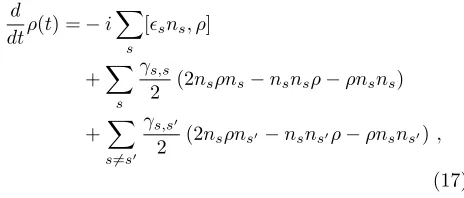
We now come back to the role of large detuning in avoiding direct spin decoherence when the transition fre-quencies differ for the two two level systems that rep-resent the different spin states, i.e., ω↑ 6= ω↓. We can
modify the above derivation of the master equation at the expense of generating additional terms and look at the dynamics in this more general case. In the following we illustrate the effect for a single particle fixed in space at x0 having only two internal degrees of freedom. The corresponding master equation is given by
d
dtρ(t) =−i X
s
[sns, ρ]
+X
s γs,s
2 (2nsρns−nsnsρ−ρnsns)
+X
s6=s0
γs,s0
2 (2nsρns0−nsns0ρ−ρnsns0), (17) where the spin dependent scattering rates are defined as follows
γs,s0 = Γs
Z
d3xΩ∗(x0)Ω(x0)
4∆s∆s0 )|w0(
x−x0)|4. (18)
1 3 1 3 1 3 O(J2/U2)
+
+
+ +
O(J2/U2)
U >0
[image:6.612.65.297.569.668.2]U <0 +
FIG. 3. Decoherence of fermions in a double-well. In the limit of strong interactions forU >0, the ground state of Fermi-Hubbard Hamiltonian with strong repulsive interactions is primarily a spin singlet (therefore symmetric spatially across the double-well). The population of doubly occupied sites is small (O(J2/U2)). Now forU <0, the initial ground state is
a coherent superposition of states with doubly occupied sites withO(J2/U2) population in the spin singlet state. Sponta-neous emission events over a significant period of time lead to decoherence of virtual double-occupations, and populate states in which the final steady-state population is evenly dis-tributed in the state with single occupancy and those with doubly occupied sites.
The general solution for the atomic density matrix can be obtained analytically and is given by
ρ(t) =
ρ↑,↑(0) ρ↑,↓(0)e−(i4+γeff)t ρ↓,↑(0)e(i4−γeff)t ρ↓,↓(0)
,
whereγeff= (γ↑,↑+γ↓,↓−γ↑,↓−γ↓,↑)/2 and4=↑− ↓ and the associated decay rates Γs can differ between
spin states. The off-diagonal elements of the density ma-trix decay in magnitude exponentially with an effective rateγeff. This direct decoherence of the wave function is an effect of the spontaneous emission processes. Now in the limit of large detuning (i.e. |ω↑−ω↓|/∆ → 0) one
can show, by taking a Taylor expansion of the function Γs/∆s∆s0 around any of the spin values, that the decay rateγeff scales as |ω↑−ω↓|/∆. Therefore, for large
de-tuning the master equation contains cross-terms of equal magnitude to the diagonal terms (γeff →0), and there is no direct decoherence in the system due to spontaneous emissions. On the technical level this means the Liou-villian part in Eq. (17) reduces to a single particle and single-site version of Eq. (16). This case of identical pho-ton scattering is the standard case for fermionic atoms both from group-I and group-II in far detuned optical lattices.
V. DECOHERENCE IN A DOUBLE WELL
0 50 100 150 200 250 time tJ
0.5 0.75 1
Sr
(0,t)
0 5 10 15 20
time tJ
0 0.2 0.4 0.6 0.8 1
Dr
(1,t)
[image:7.612.64.291.52.120.2](a) U=8J (b) U=-8J
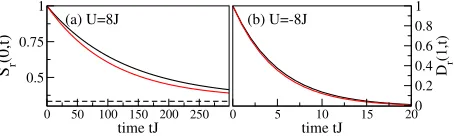
FIG. 4. Decoherent dynamics starting from the ground state of one particle of each spin species interacting strongly in a double well (M = 2) forγ = 0.1J, computed in both, our perturbative approach (red dots) and exact diagonalization (solid line): (a) Decay of the rescaled spin correlations be-tween the sites [Eq. (26)] forU = 8J. The dashed line indi-cates the steady state expectation value. (b) Time evolution of rescaled doublon correlation [Eq. (27)] forU =−8J which vanishes in the final steady state.
fermions in the repulsive case and of the correlation func-tion of the composite bosons74–76 formed in the case of strong attractive interactions. Before we present our re-sults for larger lattice systems, we give an intuitive ex-ample discussing the decoherence in a double well. For bosons, the dynamics of a related case is discussed in Ref. 43. Here we particularly focus on the dynamics of the spin degree of freedom, which we treat first by con-sidering the case of and initial ground state withU >0,
|U| J. We then return to the case of delocalised dou-blons for strong attractive interactionsU <0.
A. Repulsive interactions
We consider an optical lattice chain with a length of two, containing one spin up particle and one spin down particle. Now, in the limit of strong interaction (U J) the ground state would be a spin singlet with an admix-ture of states having both spins in one of the sites. It is instructive to work in a particular basis formed by combi-nation of Fock states given by|1i= (| ↑,↓i+| ↓,↑i)/√2,
|2i = (| ↑,↓i − | ↓,↑i)/√2, |3i = | ↑↓,0i, |4i = |0,↑↓i. We first calculate the ground state of the two site Fermi-Hubbard Hamiltonian which is nearly a spin singlet with
O(J2/U2) population in the manifold with double occu-pation at one of the sites (Fig. 3). Evolving this initial state under the master equation shows that the wave function of the system decoheres due to spontaneous emission until it reaches a steady state ( ˙ρ = 0) where population is equally distributed in all three basis states that were populated at the initial time (Fig. 3). The rate at which the spin correlation decays is proportional to that of the increase in the population of doubly occupied states (for a doubly occupied siteSz= 0). We calculate
this rate in perturbation theory inJ/U where the coher-ences between the manifolds are eliminated adiabatically to give the decay rate of the spin order. We begin by cal-culating the decay rate of population in state |1i which is being transferred to the doublet manifold spanned by
|3iand|4i. Now from the master equation,
d
dtρ1,1=− X
k=3,4
2√2JRe (iρ1,k). (19)
The coherences between state|1iand the doublet mani-fold obey
d
dtρ1,3=i √
2J(ρ3,3+ρ4,3−ρ1,1) + (iU−γ)ρ1,3, (20)
and ρ1,4 follows an analogue equation. Now the coher-ence within the doublet manifold given by
d
dtρ3,4=i √
2J(ρ1,4−ρ3,1)−4γρ3,4. (21)
Now in the limitU J, γ we can eliminate the coher-ences between state |1i and the doublet manifold first and that leads us to
d
dtρ1,1=−
4J2γ
U2+γ2
(2ρ1,1−ρ3,3−ρ4,4)
+ 4J2Re
ρ3,4+ρ4,3
γ−iU
, (22)
and
d
dtρ3,4=−4γρ3,4+
4J2γ
U2+γ2(ρ4,4−ρ1,1−ρ3,4). (23)
Now we can eliminate the coherence in Eq. (23) as it contains a term proportional to γ whereas all the other terms are suppressed by a factor ofO(J2/U2). We rewrite Eq. (22) as
d
dtρ1,1≈ −
4J2γ
U2+γ2
(2ρ1,1−ρ3,3−ρ4,4), (24)
which gives a decay rate proportional toβ= 4J2γ/(U2+
γ2). The result obtained by evolving the master equation using exact diagonalization is in agreement to this anayti-cal value as illustrated in (Fig. 4(a)). The spatial average of the spin correlation function is defined as,
S(∆x, t) = 1
M X
i
hSiz(t)Siz+∆x(t)i. (25)
Here, Sz
i is the z component of spin at lattice site i,
defined as Sz
i = (ni,↑−ni,↓)/2. By their nature, the
z component of spin and for plotting purposes we also consider the rescaled spatial average:
Sr(∆x, t) =
S(∆x, t)
S(∆x, t= 0). (26)
The physical process giving rise to the observed decay can be outlined as follows: A spontaneous emission event does not differentiate between the different spin states, but as we saw before, what it effectively detects is the occupation number at the site involved as indicated by the Lindblad operators in Eq. (16). In this sense, it dis-tinguishes states with doubly-occupied sites from states with singly occupied sites, decohering virtual popula-tion of doubly occupied states. This drives the system away from the initial spin ordered ground state which has mostly singly occupied sites with very small doubly occupied population (O(J2/U2)) and transfers popula-tion from states with singly occupied sites to states with doubly occupied sites. The resulting state is no longer an eigenstate and the Hamiltonian therefore starts re-distributing population coherently whereas spontaneous emission events continue to disrupt rebuilding of coher-ence. This interplay between the Hamiltonian and the dissipative dynamics gives rise to the resulting ence and change in spin correlation. The rate of decoher-ence depends on the effective scattering rateγas well as on the relative population in the doublet manifold which grows proportionally with its initial value. This is the reason we have a termO(J2/U2) in the expression ofβ, and this reflects the ability of the Hamiltonian to popu-late doubly-occupied sites via tunneling in the presence of an energy gap. It also shows that the spin order decays much slower than the scattering rate and can be quite ro-bust against spontaneous decay for strongly interacting systems. Alternatively one could argue that the initial state is the ground state which is an eigenstate of the Hamiltonian, and hence the first order of time-dependent perturbation theory is given solely by the action of the dissipative part on the initial state. For the correlation function of interest, we find a vanishing first order term as we don’t have direct spin decoherence. Hence the leading order term in the decay rate has to beO(J2/U2).
B. Attractive interactions
We now consider the case of attractive interactions (U < 0), again for one atom of each spin in a double-well, where we observe markedly different dynamics for strong interactions. The ground state of the Hamilto-nian now consists of states with double occupation, be-cause the attractive interactions favour the formation of a dimer. The key physical property is that the dimer is delocalised over the two sites, i.e., the ground initial state is essentially a coherent superposition (|3i+|4i)/p(2). Again, there is a small admixture of the singlet singly-occupied state, i.e., a population O(J2/U2) in
|1i. The final steady state of the master equation at long times is
the same with equal population in all these three basis states. However, the initial dynamics towards the steady state begin by rapidly removing the coherence between
|3i and |4i, markedly changing the state when we con-sider the dynamics of dimers. We can calculate the de-cay rate of the doublon correlation functions, e.g.,d†1d2 in perturbation theory like before. Defining a spatially averaged and rescaled doublon correlation function anal-ogous to the spin case
Dr(∆x, t) = 1 M
P
ihd†i(t)di+4x(t)i hd†i(t= 0)di+4x(t= 0)i
, (27)
we check the agreement between results obtained in ex-act diagonalization and perturbation theory (Fig. 4(b)). The decay rate for the doublon correlations turns out to be 4γ and is approximately independent of the sys-tem size and filling factor, as we show up to first order in time-dependent perturbation theory in Sec. VI C. In that section, we also discuss the enhancement factor, which arises from a combination of having two atoms in a given site, and also having superradiant enhancement because of the scattering of identical photons. An instructive way to check this enhancement factor is to look at the optical Bloch equations for a system of identical two-level atoms fixed on lattice sites and solve for an effective decay rate which is equivalent to calculating the rate of change in ground state population when the excited states can be adiabatically eliminated in the limit of large detuning (∆) of the driving laser field. For N atoms the atomic density operator (ρa) obeys the following equation where
the non-hermitian effective Hamiltonian H0, written in terms of Pauli matrices,
d
dtρa =−i[H 0, ρ
a] + X
k,l
Γklσ−kρaσ+l , (28)
with
H0 =
N X
k=1
−∆σkz−
Ωk
2 (σ +
k +σk−)
−2i X k,l
Γklσ+kσ−l .
(29)
Here Ωk is the Rabi frequency for the k-th atom (which
we will take to be position independent) and Γkl =
ΓF(kegrkl) where Γ is just the spontaneous decay rate of
the excited state of an atom and the functionF (Eq. 6) introduces a localising effect on the scattering element betweenk-th andl-th site (at a distancerkl) on a scale
set by the atomic transition wavelengthkeg. We can
Γeff=− 1
δt[hψ0|(e iH0†δt
e−iH0δt)|ψ0i]
≈hψ0|
X
k,l
Γklσ−kσ
+
l |ψ0i. (30)
In the single atom case, using second order time-dependent perturbation theory (the dipole coupling with the laser field is the perturbative part of the Hamilto-nian), it is easy to calculate this effective decay rate Γsingle = ΓΩ2/(4∆2). Now for two atoms we look at two limiting cases. When the atoms are separated by a distance much larger than the atomic transition wave-length, the scattering elements turn into on-site terms (Γkl → Γδk,l) and the effective rate is 2Γsingle. This is what one would expect for the total decay rate of two independent entities. In the opposite case, where the atomic distance is much smaller than the transition wave-length, all the scattering elements become independent of the distance between the atoms (Γkl →Γ) and we indeed
obtain an effective decay rate of 4Γsingle.
VI. DYNAMICS FOR MANY ATOMS
In order to further quantify the impact of sponta-neous emissions on many-body correlations we discuss the full many-body problem using approximate analytic and numerically exact solutions to the master equation derived in Sec. IV. First we discuss the effects of sponta-neous emissions on the momentum distribution of non-interacting fermions. Second we analyze the decoherence of antiferromagnetic spin order in the case of strong re-pulsive interactions, comparing time-dependent pertur-bation theory for J/U →0 to numerical data. Depend-ing on the system size we use either exact diagonaliza-tion or combine adaptive time-dependent DMRG with the quantum trajectory approach55, to capture the de-coherence and time-dependence of first order correlation functions in detail. While the first approach is exact, time-dependent DMRG is well established as a conve-nient means to model the real-time dynamics induced by stochastic processes in one-dimensional systems that remain close to equilibrium.
Our main results on the repulsive case are that the spin correlation functions are robust on experimentally rele-vant timescales and that the spin-decoherence is governed by a single decay rate which is suppressed by the number of double occupancies in the initial state. In the limit of strong attractive interactions, both the perturbation the-ory approach and the numerical simulations unveil decay rates of the doublon correlation function enhanced by a factor of four, which can be understood as a consequence of superradiance71,77,78. While the results shown in this section are obtained from one-dimensional optical lat-tices, they are direct consequences of the derived master equation and general conclusions as the robust magnetic
order and the impact of superradiance are therefore ex-pected to carry over to both higher spin-degrees of free-dom and higher dimensions.
As a first general result we calculate the rate of en-ergy increase induced by the spontaneous emissions forN
atoms. This can be obtained analytically from the mas-ter equation Eq. (2), as was done for bosons in Ref. 41, evaluating
d
dtH = Tr(L1ρH). (31)
The final result strongly resembles the result for bosons41 and is not only independent of the interaction strength but also completely determined by single parti-cle physics40:
d dthHi=
ΓΩ2 0 4∆2
k2
L
2mN (Ω = Ω0coskLx). (32)
However, as in the case of bosons, this result does not properly characterize the heating induced by sponta-neous emissions as the energy increase predominantly re-sults from excitations to higher bands which will in gen-eral not thermalize on experimental time-scales41. For Bosons this has been quantified in Ref. 44. Hence, even a qualitative analysis requires at least an analysis of first order correlation functions such as spin correlations, mo-mentum distribution functions or the single particle den-sity matrix. In the following we perform such an analysis, first for free Fermions, then for repulsive interactions and finally for attractive interactions.
A. Free Fermions
The case of free fermions is another instructive example that can be dealt with exactly. We here focus on the time dependence of the momentum distribution for N
fermions onM lattice sites
nk = X
s
c†k,sck,s, withck,s= M X
l=1 1
√ Me
−iklc
l,s. (33)
For U = 0 the Hamiltonian is diagonal in momentum space and hence the time-evolution ofnk(t) is solely given
by the action of the dissipative part which results in
d
dthnki= Tr(nkL1ρ)
=−γ 2
X
r,s
[nr,[nr, nk,s]]
=−γhnki+ N
Mγ . (34)
Therefore the steady state momentum distribution func-tionhnki → N/M for t → ∞, i.e., the momentum
B. Repulsive interactions
We now move to the richer case of repulsively inter-acting fermions with magnetic ordering. In particular, we numerically study the decay of spin correlations in the 1D Hubbard model with repulsive interactions, for which understanding and characterizing the impact of different heating mechanisms on the characteristic cor-relation functions is an important step on the way to experimentally realize quantum magnetism. In one spa-tial dimension strong correlation effects give rise to in-teresting many-body effects such as the absence of long-range order, which can be utilized to benchmark exper-iments with ultra-cold atoms against exact solutions79, and powerful numerical methods51. The one-dimensional Heisenberg model, one of the paradigm models of quan-tum magnetism80, can be obtained from Fermi-Hubbard model using perturbation theory81 in J/U, which high-lights the characteristic energy scale to observe quantum magnetism82–84. Furthermore the antiferromagnetic cor-relations persist to finite J/U and can be measured in experiments with ultra-cold fermions85. Here, investi-gate the decay of the spatially averaged spin correlation functions defined in Eq. (25) for larger lattices.
First, the perturbative result for the decay rate ob-tained for the double well in the previous section can be generalized for a chain of lengthM. By determining the initial relative population in the doublet manifold given by
ND= 1 N
X
i
d†idi (35)
where di = ci,↑ci,↓ is the doublon annihilation
opera-tor, in degenerate perturbation theory86 in J/U, where the Fermi-Hubbard Hamiltonian reduces to a Heisenberg Hamiltonian81 and systematic adiabatic elimination of coherences between the initial ground state in zeroth order and the doublet manifold gives exactly the same transfer rate. Furthermore, within the same perturba-tive approach we can directly relate our expression for the decay rate of the spin correlation, namelyβ∝γND.
Second, we will confirm the scaling predicted here nu-merically for repulsive 1D systems up toM = 32 lattice sites.
Fig 5 (a) shows the decay of the on-site contribution
S(∆x= 0, t) at an interaction strength of U = 8J and
γ= 0.1J for different system sizesM = 4,8,32, a time-step of dtJ = 0.01 and a DMRG matrix dimension of bond dimension of 8M to keep the discarded weight be-low 10−5for the largest system at the largest time consid-ered (tJ = 10). We find that for the averaged quantities finite size effects are small forM ≥6. Fig. 5(c) shows the main result, the decay rateβ extracted from a numerical fit ofa·e−βt+ const.[see Fig. 5(b) for an explicit
exam-ple] to the curves as shown in Panel (a) for combinations of U/J = 4,6,8,10,12 andγ/J = 0.2,0.1,0.05,0.025 as a function of the effective decay rate obtained from per-turbation theory, NDγ. Within the error bars obtained
from the fits, the decay rates obtained from the numerical data scale linearly with respect toNDγ and the system
size dependence is mainly given by system size effects of
ND. This corroborates our previously perturbative
re-sult, that the effective decay rate is suppressed as U/J
increases since it is proportional to the number of double occupancies in the initial state. Finally, Fig. 5(d) shows data forSr(δx, t), for distances ∆x= 0,2,4 atM = 32, U = 8Jandγ= 0.1J. We find that rescaling the data ac-cording to Eq. (26) unveils that the correlation function decays in a similar fashion independent of the distance. Therefore the alternating sign of S(∆x,0) – a neces-sary condition for antiferromagnetic correlations – is pre-served during the dynamics. To summarize, our numeri-cal study of the decay of spin correlation functions for the repulsive Fermi Hubbard model undergoing spontaneous emissions shows that changes in antiferromagnetic corre-lations are inhibited because the rate is controlled by the number of double occupancies that can be formed. The energy gap plays an important role in suppressing the coherent processes that form virtually doubly-occupied sites, and leads to a suppression of the decay of magnetic correlations somewhat analogous to the inhibition of dif-fusion seen for Bosons in Refs. 42 and 43. The rate of doubly occupied sites is an experimentally controllable parameter8,87, and the time-dependence of the spin cor-relations should be directly measurable in experiments, either using quantum gas microscopes84,88, or other tech-niques such as modulation spectroscopy or Bragg scatter-ing to detect local or longer-range spin fluctuations8,89. Note that this robustness shifts the typical rate of decay fromγ to NDγ ∼(J2/U2)γ. This compares favourably
with the energy scaleJ2/U of typical dynamics in this regime. Note that due to the suppression, the new dom-inant effect of spontaneous emissions for large enoughU
will be transfer of particles to higher Bloch bands, on timescales given by 1/(η2γ).
C. Attractive interactions
This inhibition of the decay of spin correlation func-tions is in strong contrast to the effects we observe for at-tractive interactions, as we saw in the case of the double-well above. Here we analyse the characteristic correlation functions for many bosons with strong attractive interac-tions. TakingU <0 and focusing on strong interactions at moderate to low densities, we see that the ground state of the Fermi-Hubbard model consists of bound dimers that behave as composite bosons, and condense to al-low condensation, and off-diagonal long-range order of dimers.
0 2 4 6 8
time tJ
0.2 0.21 0.22 0.23 0.24
S(
∆
x,t)
M=4 M=8 M=32
0 2 4 6 8
time tJ
0.2 0.21 0.22 0.23 0.24
S(
∆
x,t)
0 0.05
N
Dγ
0 0.05 0.1 0.15
β
0 2 4 6 8 10
time tJ
0.9 1
Sr
(
∆
x,t)
∆x=0
∆x=2
∆x=4 (a) γ=0.1J
U=8J
(b) M=32,γ=0.1J,U=8J
[image:11.612.313.565.57.239.2](c) (d) M=32,γ=0.1J,U=8J
FIG. 5. Comparison of the decay of spin correlations [see Eq. (25)] averaged over the chain obtained from exact di-agonalization using the EXPOKIT package90 for M = 4,8
and tDMRG with D = 128 for M = 32. (a) Decay of the on-site contribution S(∆x = 0, t) for different system sizes M = 4,8,32 at U = 8J andγ = 0.1J using 500 trajectories forM = 4,8 and 250 trajectories forM = 32. (b) Example fit to the data shown in panel (a) forM = 32. (c) The decay rates β extracted from numerical fits as shown in panel (b) as a function of NDγ. The dashed lines in (b) and (c) are linear fits to the data for different system sizes [M=4 (black squares) and M=32 (red triangles), which exhibit the scaling β∼NDγpredicted by perturbation theory. Panel (d) shows the rescaled Sr(∆x, t) [Eq. (26)] for M = 32, U = 8J and different ∆xwhich shows only a weak distance dependence, especially at larger times.
effective HamiltonianHDthat describes the dynamics of
bound pairs,
HD=
2J2
U X
<i,j>
d†idj−n(iD)n
(D)
j
, (36)
which contains a doublon tunneling term as well as a nearest neighbour interaction term with n(iD) = d†idi
being the on-site number operator for doublons. This model favors pair formation on alternative sites as the system can decrease its energy via virtual tunneling of doublons (U < 0). Since these pairs can be approxi-mately treated as bosons and Pauli-exclusion prohibits multiple pairs, the perturbative Hamiltonian is the one of hardcore bosons with next-nearest neighbour interac-tions. At low densities we expect a superfluid of pairs for the ground state with an algebraic decaying doublon correlation function (Eq. (27)). Here we study the de-cay of those correlations during the dissipative dynamics. Given that the initial state is the ground state which is an eigenstate of the Hamiltonian, the first order of time-dependent perturbation theory is given solely by the ac-tion of the dissipative part on the initial state. We
there-0 2 4 6 8
0 0.2 0.4 0.6 0.8 1
D r
(
∆
x,t)
∆x=2
∆x=5
0 2 4 6 8 10
0.5 1
D r
(
∆
x,t)
∆x=15
0 2 4 6 8
time tJ
0 0.5 1
Dr
(
∆
x=5,t)
γ=0.05J
γ=0.1J
0 2 4 6 8 10
time tJ
0.5 1
D r
(
∆
x=5,t)
U=-8J U=-16J
(a) M=8 (b) M=32
(c) M=32 (d) M=32
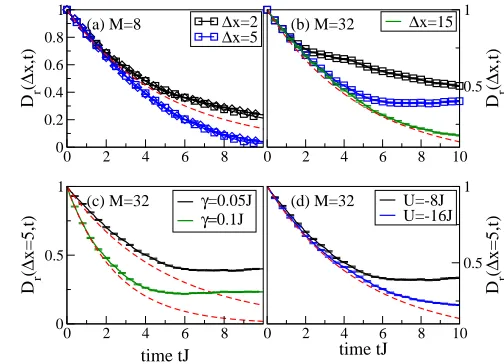
FIG. 6. Comparison of doublon correlation obtained numer-ically and in perturbation theory (dashed line) in the strong attractive interaction limit, averaged over chain and rescaled by the initial value [Eq. (27)]. (a) Time dependence of the doublon correlation at ∆x = 2,5 for system size M = 8 at U =−8J and γ = 0.05J. We see that the quantum trajec-tory results (diamonds) from tDMRG with D = 64 are in good agreement with the result obtained by doing exact di-agonalization (squares) using the EXPOKIT package90 and
that perturbation theory does not take into account the re-building of correlations destroyed by spontaneous emissions and hence underestimates the decay at short distances, but overestimates the decay at large distances. Using same line symbols in panel (b) we show the quantum trajectory results for spatial dependence forM = 32 atU =−8Jandγ= 0.05J qualitatively similar toM = 8. (c) Effects of different decay rates forM = 32 at U =−8J. (d) Dependence on interac-tion strength for M = 32, γ = 0.05J. The time for which our perturbation theory is reliable scales withU. (b) to (d) show tDMRG data using a bond dimension D=128 and the number of trajectories used in all of the calculations here is 528.
fore calculate:
d dthd
†
idji= Tr
d†idjL1ρ
=γ 2
X
k
h2nkd†idjnk−nknkd†idj−d†idjnknki, (37)
where
nk=nk,↑+nk,↓. (38)
We first calculate
nkd†idj−d†idjnk
=−c†i,↑c†i,↓cj,↓ck,↑+c†i,↑c†i,↓ck,↓cj,↑
δk,j
+c†k,↑c†i,↓cj,↓cj,↑+c†i,↑c†k,↓cj,↓cj,↑
[image:11.612.72.436.58.240.2]and reinsert this identity to perform the sum overk and obtain
d dthd
†
idji=γh−2d†idj−2di†dji=−4γhd†idji. (40)
Therefore the perturbative decay rate for the pair cor-relations is four times the scattering rate. Previous cal-culations for the Bose-Hubbard model show rates of de-cay for off-diagonal elements of the single particle density matrix for interacting bosons given41by the rateγ, so in our case the decay is thus four times larger. As noted above for a double-well, one factor of two arises as two particles form each dimer, whereas the other factor of two arises from the superradiant enhancement discussed in Sec. V B. We expect our perturbative results to be valid only on a short time-scale set by the tunnelling rate, but as we show in Fig. 6 this unexpected result persists through an numerical analysis for larger times and finite system sizes. Fig. 6 (a) shows the spatial dependence of
Dr for system size M = 8 at U =−8J andγ = 0.05J.
We directly compare exact diagonalization (squares) and tDMRG data (diamonds) with our result from first order time dependent perturbation theory, a single exponential decay with the surprisingly high scattering rate of 4γ. We find indeed that the data is well described by the pertur-bative result for up to t ≈ 2/J. For larger times the coherent dynamics neglected in the perturbation theory gives rise to two different types of behavior, depending on the spatial separation of the pairs. For small ∆xwe observe the rebuilding of the correlations between sites via tunneling after a spontaneous emission occurred and therefore the average decay is slower than predicted by perturbation theory. The rebuilding of correlations takes longer as the distance ∆x between the sites grows and therefore higher order processes can take place. Fig. 6 (b) shows a very similar result obtained forM = 32 lat-tice sites using t-DMRG with quantum trajectories at
U =−8J and γ = 0.05J. Similar to the repulsive site finite size effects in the averaged quantities are small, and the superradiance effect persists. For this system size we can showcase how at large ∆x the deviation from per-turbation theory is smaller. In Fig. 6 (c) we vary the decay rateγ forM = 32 atU =−8J, finding consistent behavior. Finally Fig. 6(d) probes the dependence on in-teraction strength forM = 32,γ= 0.05J and we can see that the time for which perturbation theory is reliable scales withU.
As explained previously, this factor of four is due to the superradiance effect since the spatial separation of the dimers is much smaller than the wavelength of light. For the spontaneous emission from a doublon, the spatial separation is limited to the dimension of a single lattice site and hence much smaller than the wavelength of the light. In such a case the atoms interact with the light in a collective and coherent fashion77,78. This causesN
l
particles on sitel to spontaneously emit photons with a rate ofN2
lγ.
This result is drastically different from exponential de-cay with rate γ which we obtain for the single particle density matrix considering only singly occupied lattice sites. Note that superradiance71does not depend on par-ticle number statistics, hence the same enhanced decay rate is predicted for bosonic pair correlations, which is consistent with the bosonic version of the perturbative re-sult stated by Eq. (40). It is, however, important that we are in a regime where the photons scattered by atoms of different states are indistinguishable - this is the key ori-gin of the superradiance in this case. Although this pro-cess changes the total scattering rate, it does not change the total rate of increase in energy. However, the change in the correlation functions should be directly measure-able in ongoing experiments, with the off-diagonal corre-lations of dimers measurable by associating two particles on a specific lattice site to molecules, and measuring the momentum distribution of molecules.
VII. SUMMARY AND OUTLOOK
We have derived a microscopic master equation for the description of spontaneous emissions in two species of fermions in an optical lattice, specialising to the regime that is typical for atomic physics of cold atoms in optical lattices, where photons scattered from separate species are essentially indistinguishable. Because the scattered photons do not distinguish between spin states, but sim-ply decohere superpositions of different local number states, magnetically ordered Mott Insulators are surpris-ingly robust, with the effects of spontaneous emissions within the lowest band being suppressed by a factor larger than the suppression of the dynamical timescale for strong repulsive interactions. The case of strong at-tractive interactions is markedly different, with a gas of dimers exhibiting a rate of decay for characteristic off-diagonal correlations that is not suppressed, and instead is further enhanced by superradiance.
start-ing point for many further intereststart-ing investigations into the many-body physics of these models. In particular, we now have a microscopic description within which to ex-plore questions of thermalisation within the lattice. One of the first next steps will be to investigate thermalization between atoms the lowest band and atoms transferred to a higher band, followed by broader investigations of whether energy introduced is thermalised on experimen-tal timescales44.
ACKNOWLEDGMENTS
We thank Dan Boyanovsky, Randy Hulet, Wolfgang Ketterle, Ken O’Hara, Hannes Pichler, Ulrich Schneider, Matthias Troyer and Peter Zoller for helpful and moti-vating discussions. This work was supported by AFOSR grant FA9550-13-1-0093. Computational resources were provided by the Center for Simulation and Modeling at the University of Pittsburgh.
Appendix A: Atomic physics considerations
Here we present a selection of examples of the neces-sary steps that lead to the results we obtained in Sec. I for the different transition rates including a complete ta-ble of the results. We start by solving the optical Bloch equations for two level and three level systems in pres-ence of a far-detuned laser field and radiation bath. In the steady state the relative probability amplitude asso-ciated with thei-th excited level is Ωi/2∆i, where Ωiand
∆i are the Rabi frequency and detuning for that level
re-spectively. Next we connect this result with the hyperfine atomic structures of group-I and group-II atomic cases. Calculating the dipole matrix elements92 enables us to write down the excited state that a particular ground state would go to in presence of a laser with a particu-lar poparticu-larization q. In general the corresponding excited state will be a superposition of different hyperfine states. The interference between the decay channels from these states give the resultant final decay rate to any of the ground states. In the following we give explicit examples for both atomic species.
For171Yb if we take the laser polarization to be along ˆ
z-axis i.e. E=Eˆe0, and apply it on |g↑i(Fig. 1(a)), the
atom, in the limit of large detuning, goes to an excited state which is a superposition of P1/2 states with same
mF (as polarization is linear) and we have
|ei ∝ "
1
3∆|e1,↑i+
√
2 3(∆ +δhfs)|
e2,↑i #
. (A1)
The prefactors come from the different dipole ma-trix elements. Expansion of |F, mFi basis into |L, mL;S, mS;I, mIibasis reveals that for very large
de-tuning |ei has the same nuclear spin as the starting
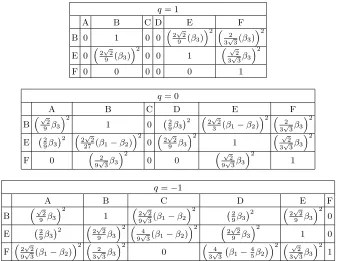
q= 0 q= 1 q=−1
|g↑i |g↓i |g↑i |g↓i |g↑i |g↓i
|g↑i 1 √
2 3
δhfs ∆
2
1 0 1
√ 2 3
δhfs ∆
[image:13.612.342.538.51.98.2]2
TABLE I. Matrix elements for the possible decay processes in Fig 1.
ground state. Therefore to conserve the nuclear spin un-der experimental timescales the relative decay rate for a spin flip is suppressed and given by∝(δhfs/∆)2. Below we give a table for different transition rates for differ-ent laser polarizations. There is an overall multiplicative factor∼(1/∆)2 for all the rates given.
Now for the 6Li atom starting at
|gDi(Fig. 2) with a
linearly polarized laser (q = 0), the excited state would again be a superposition of states inP sub levels with same nuclear spin component:
|ei ∝ −2 √
2 9∆1|e1i −
1 9∆1|e4i −
1 9∆2|e7i −
2 9√5∆2|
e10i
+√1 5∆2|
e15i, (A2)
with ∆1= ∆ and ∆2= ∆1+δfs. There are also possibil-ities of two different types of spin flips here. Considering a decay towards |gAi we see that this state is
orthogo-nal to|gDi in terms of the combination of electron and
nuclear spins, namely, in the|L, mL;S, mS;I, mIi,
|gDi ∝ |0,0i ⊗
|12,−1
2; 1,0i+α| 1 2,
1 2; 1,−1i
. (A3)
and,
|gAi ∝ |0,0i ⊗
α|1
2,− 1
2; 1,0i − | 1 2,
1 2; 1,−1i
, (A4)
whereas the spin part of the excited state inside each
P sublevel looks like that of |gDi. Therefore the
con-tributions from the hyperfine states in each P sublevel cancel each other given the detuning is large compared to hyperfine structure splitting. A different mechanism of cancellation occurs if we consider a spin flip resulting in the state
|gEi ∝ |0,0i ⊗
|12,1
2; 1,0i+β| 1 2,−
1 2; 1,1i
, (A5)
This is a matrix element for a transition to a state with different electron spin than|gDi. In this case the paths
q= 1
A B C D E F
B 0 1 0 0 2√2 9 (β3)
2 2 3√3(β3)
2
E 0 2√2 9 (β3)
2
0 0 1
√ 2 3√3β3
2
F 0 0 0 0 0 1
q= 0
A B C D E F
B
√ 2 9 β3
2
1 0 29β3
2
2√2
3 (β1−β2) 2
2 3√3β3
2
E 29β3 2
2√2
27 (β1−β2) 2
0
2√2
9 β3 2
1
√ 2 3√3β3
2
F 0 2
9√3β3 2
0 0
√ 2 9√3β3
2
1
q=−1
A B C D E F
B
√ 2 9 β3
2
1 2√2
9√3(β1−β2 2
2 9β3
2 2√2 9 β3
2
0 E 29β3
2
2√2 9 β3
2 4
9√3(β1−β2)
2
2√2 9 β3
2
1 0
F 2
√ 2
9√3(β1−β2) 2
2 3√3β3
2
0 4
3√3 β1− 4 5β2
2 √
2 3√3β3
2
[image:14.612.140.478.50.311.2]1
TABLE II. Matrix elements for the possible decay processes in Fig 2.
factor ∼ (1/∆)2 for all the rates given and we define
β1 =δhfs,P1/2/∆,β2=δhfs,P3/2/∆ and β3 =δfs/∆. The starting states are chosen from the states with positive
z-component of total angular momentum in the ground state manifold, as we can perform the same calculations for the other half symmetrically.
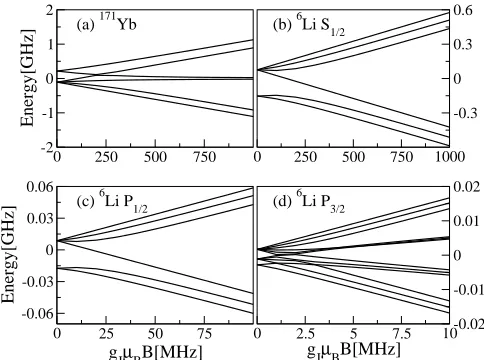
The field dependence of the energy levels used is show-cased in Fig. 7. We find that the probability of spin flip processes stay negligible across the whole range of field strengths, provided that the detuning is still much larger than the hyperfine coupling strength. Remarkably, we find that these rates do not change substantially as a function of the magnetic field. Moreover, these rates are so low in this context that we expect spin-flips to be dominated by other physical processes, such as transi-tions due to blackbody radiation.
Appendix B: Many Body Master Equation
1. N-atom Optical Bloch Equation
Here we present the detailed derivation of the master equation (Eq. (2)) for identical photon scattering. The dipole moment of the transition for each system isdeg. In
our treatment we can take these moments to be spin in-dependent as their value only depend on the radial part of the atomic wavefunction which is same for both the spin states. The interaction of the system with the elec-tromagnetic field is treated under the dipole approxima-tion. The driving laser field is described classically and
is given by:
Ecl(x, t) =E(+)cl (x, t)e
iωLt+E(−)
cl (x, t)e−
iωLt. (B1)
The system is coupled to the quantized radiation field,
E(x, t) =E(+)(x, t) +E(−)(x, t)
=X
k,λ
εkeλ,keik·xbλ,k+ h.c., (B2)
where
εk =i
r ω
k
2o(2π)3
. (B3)
The Hamiltonian describing the evolution of the system is given by (~≡1):
H=H0+HI+HF. (B4)
Here, the first term describes the atomic Hamiltonian,
H0=
Z
d3xψ†(x, t)−∇ 2
2m +ωeg X
s=↑,↓ |esihes|
ψ(x, t).
0 250 500 750 -2
-1 0 1 2
Energy[GHz]
0 250 500 750 1000 -0.3 0 0.3 0.6
0 25 50 75
g
JµBB[MHz]
-0.06 -0.03 0 0.03 0.06
Energy[GHz]
0 2.5 5 7.5 10
gJµBB[MHz]
-0.02 -0.01 0 0.01 0.02
(a) 171Yb (b) 6Li S 1/2
[image:15.612.55.297.57.237.2](c) 6Li P1/2 (d) 6Li P3/2
FIG. 7. Zeeman diagram of the different hyperfine levels shows the lifting of degeneracy obtained by numerical diago-nalization for qualitative values of magnetic field. The elec-tron and nuclear spins get decoupled in high enough B field. (a)P1sublevel in171Yb (theSsublevel is already decoupled).
(b) Splitting of theS1/2 sublevel in6Li. (c)P1/2 sublevel in 6
Li needs weaker B field to get decoupled than the previous case as the hyperfine coupling is weaker. (d) Even smaller B field is needed for the even more weakly hyperfine-coupled P3/2 sublevel in6Li.
The second term is the dipole coupling between the atoms and the electric field,
HI
=− X
s=↑,↓ Z
d3xψ†(x, t)(σ+,sdeg+ h.c.)·E(x, t)ψ(x, t)
=− X
s=↑,↓ Z
d3xψ†(x, t)(σ+,s+σ−,s)deg·E(x, t)ψ(x, t).
(B6)
The external radiation field Hamiltonian is given by,
HF = X
k,λ
ωkb†λ,kbλ,k. (B7)
Here we have fermionic field operatorψ(x, t) (see Fig. 1 (b))
ψ(x, t) =
ψe,↑(x, t) ψg,↑(x, t) ψe,↓(x, t) ψg,↓(x, t)
,
and raising and lowering operators for the different spins,
σ±,s.
The bosonic operatorsbλ,k(b†λ,k) annihilate (create) a photon in the mode (k, λ). From this Hamiltonian we
get Heisenberg equations of motions for these operators of the quantized radiation field:
d
dtbλ,k=−iωkbλ,k
+igλ,∗k
X
s=↑,↓ Z
d3xψ†(x, t)(σ+,s+σ−,s)ψ(x, t)e−ik·x,
(B8)
withgλ,k=εkeλ,k·deg.
To solve this we make use of the Born-Markov approxi-mation that emerges from the fact that the timescale set by the optical frequency is much faster than the other timescales in the problem, namely detuning, Rabi fre-quency and decay rate of the excited states. Under this approximation we can write,
ψ†(x0, τ)σ±,s(τ)ψ(x0, τ)
−→ψ†(x0, t)σ±,s(t)ψ(x0, t)e∓iωeg(t−τ). (B9)
Using this and defining
Ω±(r) = Γ 2πk3
oP Z
dkk
3F(kr)
k±keg
, (B10)
with Γ being the Wigner-Weisskopf spontaneous de-cay rate, we find a quantum-Langevin form of equa-tion of moequa-tion for an operator a acting only on the atomic degrees of freedom, by making use of rotating wave approximation and neglecting terms of the form
ψ†(x, t)σ
±,s(t)ψ(x, t)ψ†(y, t)σ±,s(t)ψ(y, t) as they
oscil-late at double the optical frequency. We end up with
d
dta=i[H0+Hcl+Hdip, a] +La , (B11)
where the coupling Hamiltonian is
Hcl=−
X
s=↑,↓ Z
d3xψ†(x, t)(σ+,sdeg·E+cl(x, t)
+σ−,sdeg·E−cl(x, t))ψ(x, t). (B12)
The term describing dipole interactions is
Hdip= Γ
Z
d3xd3yG(kegr)×
X
s=↑,↓
ψ†(y, t)σ−,s(t)ψ(y, t)
×
X
s0=↑,↓
ψ†(x, t)σ+,s0(t)ψ(x, t)
. (B13)