City, University of London Institutional Repository
Citation
:
MacFarlane, A., Robertson, S. E. and McCann, J. A. (1997). Parallel computing in information retrieval - An updated review. Journal of Documentation, 53(3), pp. 274-315. doi: 10.1108/EUM0000000007201This is the accepted version of the paper.
This version of the publication may differ from the final published
version.
Permanent repository link:
http://openaccess.city.ac.uk/4463/Link to published version
:
http://dx.doi.org/10.1108/EUM0000000007201Copyright and reuse:
City Research Online aims to make research
outputs of City, University of London available to a wider audience.
Copyright and Moral Rights remain with the author(s) and/or copyright
holders. URLs from City Research Online may be freely distributed and
linked to.
City Research Online: http://openaccess.city.ac.uk/ [email protected]
*To whom correspondence should be addressed. Email: [email protected]
PARALLEL COMPUTING IN INFORMATION RETRIEVAL
-AN UPDATED REVIEW
A. MACFARLANE*, S.E. ROBERTSON, J.A. McCANN
School of Informatics, City University,
Northampton Square, London EC1V 0HB
The progress of parallel computing in Information Retrieval (IR)
is reviewed. In particular we stress the importance of the
motivation in using parallel computing for Text Retrieval. We
analyse parallel IR systems using a classification due to
Rasmussen [1] and describe some parallel IR systems. We give a
description of the retrieval models used in parallel Information
Processing.. We describe areas of research which we believe are
needed.
1. INTRODUCTION
THE PURPOSE OF THIS REVIEW is to chart the progress of the use of parallel
computing in Information Retrieval (IR) since the last major review of the subject by
Rasmussen [1]. We also review important work in the past. We describe parallel
architectures for readers unfamiliar with the area of parallel computation. We analyse
the different approaches to parallel IR using a classification due to Rasmussen [1].
Examples of parallel IR systems are given in a case studies section. We stress the
importance of the motivation for the use of parallel computing in IR, in particular
when and when not to use parallel systems. We consider the decisions needed when
choosing an approach for parallel IR. The retrieval models used in parallel IR systems
are described. A summary and conclusion are given, together with some suggestion
2. PARALLEL ARCHITECTURES USED IN IR SYSTEMS
2.1 Parallel architecture classification
Flynn [2] describes a taxonomy for classifying parallel architectures. A number of
criticisms have been levelled at the taxonomy:
(a) There is no treatment of input/output;
(b) The instruction set used is ignored.
In the context of IR, ignoring input/output is a particular problem (see section 2.3). In
spite of these limitations the taxonomy has become the most popular method for
describing parallel architectures and continues to be widely used in the field of parallel
computing research including parallel IR. An alternative taxonomy is given by
Hockney and Jesshope [3]. The Flynn taxonomy uses the concept of streams [2] which
are a sequence of items operated on by a CPU. These streams can either be
instructions to the CPU or data to be manipulated by the instructions. We therefore
have four broad classes of architecture:
(a) SISD - Single Instruction Single Data Stream;
(b) MISD - Multiple Instruction Single Data Stream;
(c) SIMD - Single Instruction Multiple Data Stream;
(d) MIMD - Multiple Instruction Multiple Data Stream.
The first of these, SISD is the normal sequential von Neumann architecture machine
which has dominated computing since its inception. The MISD class is controversial:
some argue that it is a null class and does not usefully describe any architecture [4,5]
while others assert that systolic arrays can be placed in this class [6]. We address the
MISD class in our discussion on special parallel hardware below. We will ignore the
SISD class for the rest of the paper.
The SIMD class describes an architecture in which the same instructions operate on
different data in parallel. It is therefore widely known as data parallel computing.
Instructions are broadcast to n processors in the architecture which operate on the data
[3,7] and Thinking Machines CM-2 [6]: the DAP is described in more detail below.
The architecture has been dominant in the use of Parallel Computing in Information
Retrieval.
The MIMD class describes an architecture in which processors independently
execute different instructions on different data. The programs which run on this class
of machine are therefore a great deal more complex than one could envisage on any of
the other architectures. There is a wide variety of this class of architecture including
those in which processors share the same memory and others in which processors
have their own memory. These are known are Shared Memory and Distributed
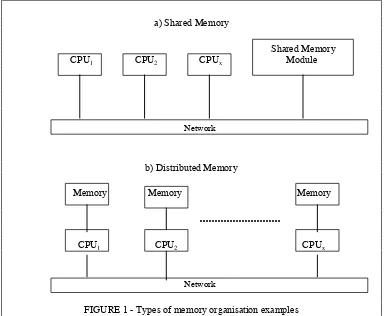
Memory architectures (see examples in figure 1). Each has its own subdivision which
we will not attempt to describe here.
With the former, interprocessor communication is done through concurrency control
mechanisms such as flags in memory, while the latter uses message passing. There is
also a hybrid architecture known as Distributed Shared Memory (DSM) where
programs see a single memory, but access is serviced by message passing. An
a) Shared Memory
Shared Memory CPU1 CPU2 CPUx Module
Network
b) Distributed Memory
Memory Memory Memory
...
CPU1 CPU2 CPUx
[image:4.566.100.484.318.634.2]Network
example of a machine with the MIMD class architecture is the Fujitsu AP1000 which
is described in section 2.2 below.
It should be noted that a further class of architecture exists which does not fit well
into Flynn's classification. Special-Purpose Hardware has been built to accommodate
IR systems [8] including associative memories, finite state machines and cellular
arrays [9]. Some of this work has been in building special purpose parallel
architectures [10] for text retrieval and we include it in the review for completeness
2.2 Parallel architectures used in IR
We now turn to specific machine architectures which have been used for parallel IR
systems. We give an example of each type of architecture from section 2.1; the DAP,
Fujitsi AP1000, and special parallel hardware. We also discuss the growing impact of
networked workstation technology. More information on various architectures can be
found in Rasmussen [1].
A. DAP (Distributed Array of Processors). The AMT (formally ICL) DAP is a SIMD
class architecture. The DAP [7] organisation is an array of 1-bit processing elements
(PEs) arranged in a 32 by 32 matrix for the 500 series and 64 by 64 for the 600 series;
1024 and 4096 PE's in total respectively. The 600 series has four times the memory
and processing power of the 500 series. Each processor is connected to its north,
south, east and west neighbour processors (known as a NEWS grid) and to the row
and column of the matrix by a bus system. Each processor has at least 32 Kbits of its
own local memory. The ICL DAP needed a mainframe as a front end, but
workstations can be used for current varieties. The architecture has a Master Control
Unit (MCU) which broadcasts instructions and data to the array to work on and also
obtains the results from the array. The DAP has very fast I/O capabilities of up to 50
Mbytes per second to overcome the I/O bottleneck (the I/O problem in parallel
computing for IR is discussed in section 2.3 below). The DAP is successfully used by
the DapText system described by Reddaway [11] and is included in the case studies
section (7.1) below. Reuters use this system for their Text Retrieval purposes.
DapText has been implemented on both the 500 and 600 series of the DAP. Other
B. Fujitsu AP1000. The Fujitsu AP1000 is a MIMD distributed memory architecture
with up to 1,024 SPARC processors or cells which are interconnected using a two
dimensional torus. Each cell can support up to 16 Mbytes of memory with a promise
in the near future of 64 Mbytes per cell. Data can be moved in and out very quickly
using a 50Mbyte per second broadcast network. To overcome the I/O bottleneck, the
HiDIOS file system is useful with a load rate in excess of 50 Mbytes per second. The
AP1000 has global reduction operations which are useful for term weighting
calculations. Work on IR using the AP1000 is currently being pursued at the
Australian National University through the PADRE system [16-22], which has
evolved through the PADDY [23,24] and FTR [25] systems. These systems are
discussed in more detail in the case studies section (7.3) below.
C. Special parallel hardware. A number of different special purpose parallel hardware
architectures have been built for pattern matching in IR. The reader is referred to
Hollaar [9] and Hurson et al [10] for more detailed information. One of the
architectures, systolic arrays, can be classed under MISD. Systolic arrays (an example
of cellular arrays) work by pattern matching characters every clock cycle in a pipeline
where the target text and query travel in opposite directions. The associate memory
architecture uses memory chips as the comparison devices, therefore patterns can be
matched in parallel in the actual memory. Finite State Automata (FSA) use transition
tables over single cell comparator chips. The argument made for the use of these
systems is that normal computing components are not very efficient at character
comparison and therefore are not particularly good for pattern matching in text
retrieval. Hence special purpose components are preferable to conventional computers
since they offer a faster throughput for queries. The authors do not agree with this
argument. Inverted files have been shown to provide very efficient query service (at
the cost of extra storage) for reasons which will become clear below. It is also very
doubtful that these specially made chips could ever compete in price with general
purpose chips: the cost of production and manufacturing CPUs is very expensive. We
therefore do not see a future for these special purpose systems in IR. This is consistent
with DeWitt & Gray's opinion that the future development of parallel systems will
D. Networked Workstation Technology. The current trend in parallel computing is to
use a group of networked workstations or PCs, rather than special purpose machines.
A great deal of interest has been generated in programming environments such as
PVM [27] and standards such as MPI [28]. One particular system discussed in this
review (MARS) uses networked workstation technology for its hardware platform
[29]. The growth of distributed parallel processing has dealt a severe blow to many
specialist parallel computer manufacturers such as Kendall Square Research, MassPar,
Thinking Machines and AMT. Kendall Square Research has gone bankrupt, while the
others are either much smaller concerns (MassPar and Thinking Machines) or have
metamorphosed into other companies (AMT to CPP). DeWitt and Gray's opinion
quoted above, on the development of parallel systems using standard components, is
reinforced by the networked workstation technology factor. The trend towards
workstation networks in parallelism will have significant impact on future parallel IR
systems.
2.3 I/O implications of different architectures
One of the main qualities of IR is that in the main it is I/O bound rather than compute
bound. This means that more time is spent on reading in data from disk than actually
doing computation. Thus a problem occurs where efficiency of the system is reduced
because the data cannot be read in fast enough to service the computation. This
problem is know as the I/O bottleneck and it is one that is shared with the area of
Parallel database systems [26]. In consequence, many of the systems mentioned above
have very impressive I/O rates to overcome this I/O bottleneck. One architecture that
is worth consideration in this respect is the Shared Nothing architecture described by
DeWitt and Gray [26]. This architecture is classed under MIMD, and has a structure
where CPUs have their own local disks to read data from. This reduces network traffic
and disk contention considerably because data sharing is reduced to questions and
answers rather than whole data sets (which can be very large in database systems).
Index maintenance costs can also be reduced. Tomasic and Garica-Molina [30,31]
make a very strong case for the use of Shared Nothing. Further work in the area is
However such is not the whole picture. There are some IR computations which are
compute bound and require considerable CPU resources. An example of this is a very
large search spaces for passage retrieval and for query modification after relevance
feedback, found within the Robertson/Sparck Jones probabilistic model [32]. In such
cases fast I/O cannot make much difference to the overall efficiency.
3. MOTIVATION FOR PARALLEL IR SYSTEMS
On the assumption that we want to do more and faster, there are two main reasons for
using parallel computing in general. The first is that the speed of a processor is
ultimately limited by the speed of light [33], when the maximum possible
miniaturisation for components on a silicon chip has been achieved. The second is
that the cost of placing silicon in smaller and smaller areas is very high in both the
design and manufacturing of processors. The second limitation occurs long before the
first and is therefore the major consideration.
A number of performance measures are used in parallel computing. We define them
informally here. Speedup is the gain in speed over sequential machines and is
calculated by dividing the time spent on computation on the sequential machine by the
time on the parallel machine. A speedup which equals the number of processors is
said to be linear, greater than the number of processors is said to be super-linear.
Efficiency gives a measure of how well a particular algorithm scales when processors
are added. It is found by dividing the speedup found by the number of processors
used. An efficiency of 1.0 is desirable, but rarely if ever achieved. The aim is to
achieve a near 1.0 efficiency result. Whilst these measures are the accepted way of
examining the performance of parallel systems, it should be noted that their usefulness
have been brought into question [34]. For more formal definition of these measures
see Rasmussen [1].
The performance of IR systems are measured by the retrieval effectiveness and
retrieval efficiency they provide [35]. Retrieval efficiency is the measure of the time
taken by an IR system to do a computation on the database, although this usually
means search it. The relative merits of the gain in retrieval efficiency by using parallel
IR systems against their sequential counterparts can be measured by the
access to documents, they also want to be presented with documents which are
relevant to their needs; this is measured by the retrieval effectiveness of the IR
system. The most commonly used measures for retrieval efficiency are recall and
precision. Recall is the measure of how many relevant documents are retrieved from
the database. Precision is the quality of the documents presented to the user i.e. how
many are of the documents retrieved are relevant. Parallel IR systems have a place in
providing retrieval efficiency for users and may well help in providing extra retrieval
effectiveness.
The use of parallel computing specifically for IR has been quite controversial. Both
Stone [36] and Salton/Buckley [37] have argued that an Inverted file algorithm
running on a sequential machine can outperform a signature file algorithm running on
a parallel machine. The discussion in both papers originate from the work done by
Stanfill and Kahle on the Seed system [38]. Since the Seed system uses surrogate
coding (a response time of 2 minutes is stated for an example query), a sequential
system using Inverted files would in theory be able to offer a much faster response
time to queries. This is because fewer comparisons and much less I/O is needed. Stone
[36] compares the performance of an Inverted file on a single CM-2 node, while
Salton and Buckley [37] use the example of a Sun 3 to produce their theoretical
results. Of the two studies Stone's goes much further. Stone put forward an alternative
parallel algorithm to be used on Inverted files in order to run the sequential Inverted
file system in a more efficient manner. Salton and Buckley [37] are rather more
negative and suggest that "the global vector matching systems developed over the past
25 years for serial computing devices appear more attractive in most existing text
processing situations". It is hard to accept or reject this statement without knowing
what they mean by most existing text processing situations, and without any analysis
as to whether the global vector matching systems could also gain from parallelism. In
response Stanfill, Thau and Waltz [39] report an 80 fold performance advantage for a
newer CM-2 against a Sun 4, which rather lessens the impact of the Salton and
Buckley [37] paper. Ultimately Stone has been proved to be correct, since two parallel
systems which use Inverted files on the CM-2 and the DAP have been commercially
Four main reasons for applying parallel computers to Information Retrieval have
been suggested [40]: these are too improve response times, search larger databases,
use superior algorithms and reduce search cost. We discuss each reason in turn below.
3.1 Response times
In situations where a large number of users need access to the system, a sequential IR
system may not be able to offer the required performance of the application. In general
when large numbers of users are logged on, the response time to the user is likely to
be greatly increased. A related point is that of throughput: throughput is the number of
queries or insertions which can pass through the system in a given time period.
Parallel computation has the potential to offer faster response times for individual
queries and a greater throughput for queries and insertions. Response time is also
dependant on database size in conjunction with multiple query service.
3.2 Very large databases
The response to user queries in very large databases (e.g. multiple Gigabyte) are
likely to degrade particularly for those which have a reasonable rate of growth. In
principle parallel systems tend to offer much better scaleup than sequential systems.
Scaleup is defined by DeWitt and Gray [26] as "the ability of an N-times larger system
to perform an N-times larger job in the same elapsed time as the original system". A
query response time on a small IR system using a small database should be the same
for a large IR system using a large database. It is important to introduce a note of
caution as this point. The authors do not believe that parallel computing can be
usefully applied at this juncture to small databases with a very few or single user base.
The emphasis in this review is very much on large scale text databases.
3.3 Superior algorithms
We stated in section 3.2 that we do not believe that parallel computing can be
usefully applied to small text databases at this point. It may be the case at some time
in the future that a given algorithm which requires more computation to complete its
task will be able to a offer superior retrieval effectiveness performance in terms of
precision and recall than previously implemented algorithms. For example there are a
cost of extra computation (which is high in the case of the P-NORM model because of
the exponentiation operations required). Some in fact argue that extra computation
will deliver much better results. Skillicorn [42] argues that regular expressions offer
more powerful query capabilities than other searches. MacLeod and Robertson [43]
suggest that generally speaking the "most effective algorithms are among the least
efficient".
There has been some debate on the merits of extra effort to achieve a better level of
retrieval effectiveness. Blair and Maron [44] evaluated a large operational full-text IR
system over a six month period, and hypothesise a general deterioration of recall on
databases of increasing size. They argue that extra effort is needed to overcome this
deterioration and keep recall at reasonable levels. (By implication, the extra effort is
assumed by these authors to be human effort at the indexing stage.) Salton [45] takes
issue with their arguments, and they reply [46]. Although recall deterioration with file
size must be regarded as unproven (and is particularly hard to prove empirically), the
possibility both that it occurs and that it may be alleviated by more complex and more
effective search algorithms is worth investigation.
A further issue arises from the very large search spaces which exist within the
Robertson/Sparck Jones Probabilistic model [32]. Because these search spaces are so
large it is unlikely that even parallel machinery will be able to explore all of it. A time
complexity of O(n3) is reported [32], where n is a text atom, for unoptimized code on
passage retrieval. The search space for query modification after relevance feedback is
so large no order value can be stated. However it may be possible to search part of
these spaces and thereby increase retrieval effectiveness (bearing the mind the caveat
on recall in the last paragraph). At present such can only be proven by empirical
3.4 Search Cost
Stanfill et al [39] assert the cost effectiveness of an IR system is the ratio of database
size to search cost i.e. the resources used to search the database. Using the
assumptions that database search is linear with the size of the database, speedup is
linear for those algorithms which keep processors busy and resource costs (such as
communication overheads) are static, Stanfill et al [39] show that cost effectiveness
asymptotically approaches a level of optimal cost effectiveness. By increasing the size
of the database for example we can move the level of optimal cost effectiveness to a
more favourable figure. It is stated that for a database of 1 Gigabyte the improvement
in cost effectiveness is 100 fold, but for a 100 Gigabyte database the improvement is
10,000. However as Hawking [23] points out a higher figure needs to be treated with
caution because hardware (the CM-2) can only use a limited number of Data Vaults,
which restricts the amount of text, let alone index information that can be stored.
Hardware factors therefore limits the relevance of this cost effectiveness metric.
4. APPROACHES TO PARALLEL IR
In this section we describe approaches to parallel information retrieval using a
classification due to Rasmussen [1], influenced by Faloutsos's classification of access
methods for text [47]. The classification does not differentiate between a particular
algorithm and storage method. It is found that they tend to be bound together quite
tightly in parallel IR systems. By algorithm we mean method of searching on the
storage method and by storage method we mean organisation of the data on disk. The
interaction between machine type and the classification is discussed in each of the
sections below. The methods discussed are pattern matching, Signatures/Surrogate
coding, Two-Phase search, Inverted Files, Clustering, Connectionist approaches and
other miscellaneous approaches.
Some issues need to be addressed with respect to each of the algorithms in the
classification. Firstly the assignment of tasks to processors will determine the level of
performance gain over sequential systems: it cannot be taken for granted that using
parallelism will automatically provide enhanced performance. The placement of tasks
will also determine the level of interprocessor communication: an unavoidable
placement is mis-handled. Data partitioning methods have a significant effect on task
assignment and the subsequent level of interprocessor communication for a particular
algorithm. Secondly there is the granularity of parallelism for algorithm. Granularity
can either be fine, coarse or mixed grain, meaning small, large or variable
computation sizes: a computation being a single unit of work which can be done by a
processor. The type of query parallelism available in an algorithm is also very
important: that is, the method of parallelism used to service user queries. Intra-query
parallelism is parallelism within queries, that is a single query is distributed amongst
processors. Inter-query parallelism is parallelism among queries, that is a number of
queries are serviced concurrently. The concepts of data partitioning, granularity and
query parallelism will be discussed with respect to each of the classes.
4.1 Pattern matching
Pattern matching is the method of searching the raw text in a given text corpus with a
string query. There are a number of methods for matching patterns efficiently
including the Knuth-Morris-Pratt and Boyer-Moore string searches [48] and variations
of these. In a system without parallelism, pattern matching normally involves the
sequential scanning of every document in the system: no index is used. Methods
include left hand truncation, variable length don't care (VLDC), a proposed
implementation of the "computing as compression theory" SP [49], proximity
searches and pre-computed patterns [42,50]. We describe below parallel methods
which have been implemented or are proposed for pattern matching algorithms.
Using an example we can describe the operation of pattern match in parallel
computing. Firstly we partition the target text among our processors. We then
broadcast the whole pattern to all processors and the pattern is applied in parallel to
each partition of the text. Results from the processors are sent back to the user for
inspection. This is a rather simplistic scenario, but it does give a flavour of the
operation. A number of issues are thrown up by this example, in particular the
operation of the algorithm on SIMD and MIMD architectures. The issue how of load
balancing is affected by the implementation of the algorithm are important. With
MIMD systems we can allow pattern matching on different processors to proceed
independently of each other. The implementation on SIMD systems is slightly more
patterns may need to advance a computed distance. Unless we keep this computed
distance in a local variable, a set of processors have to wait until others have 'caught
up' in the computed distance and our load balance is reduced together with further loss
in the efficiency within the chosen pattern matching algorithm. However with the
computed distance we are likely to finish pattern matching on some processors,
leading to a gradual reduction in processor efficiency as processors complete their
tasks: this is a problem shared with MIMD systems. An alternative method for SIMD
systems described by Pogue and Willett [12] is to broadcast individual characters to
processors one by one which match them in that order. As each match is a made the
presence of a hit is recorded, if and only if the previous character in the sequence was
matched.
More complex patterns can be applied to text corpus in the same manner as the
MIMD and Pogue & Willett algorithms. With MIMD we simply apply a utility such
as grep or fgrep to each text partition on every processor in parallel. An example is the
PADDY system [24] which provides tools for the use of a regular expression library
on each cell (processor) of a Fujitsu AP1000. Some examples of algorithms
implemented on SIMD systems which support complex patterns are left-hand
truncation and variable length don't care (VLDC). With left hand truncation we
identify patterns which have different prefixes but the same suffix, before applying the
query pattern. For VLDC, prefix and suffix patterns are recorded: the presence of a
word delimiter between the result set of prefixes and suffixes is then identified.
The SP pattern match [49] would use a completely different method. The SP
algorithm works by broadcasting each character in the query, from left to right, to each
character in the text corpus to make a true or false match. Given that it is impossible
to have a processor for every character in the database, we can assume that each
processor is given a set of characters. A tree structure is built up which records the
probabilities of matches being useful, in decreasing order (matches nearer the root will
have a higher probability of usefulness). The parallelism in the SP algorithm lies in
the broadcast of characters and the ability to create and manipulate the tree structure
for each text partition. A time complexity of O(Q) is claimed where Q is the size of
the query pattern. It should be noted that the SP theory is controversial, and there has
comment on its usability in practical situations until an empirical study has been done
using a parallel implementation of the SP search algorithm.
Hawking describes a method of parallel proximity searches on the PADRE system
[19]. A match set for each string in a query is created: this match set contains pointers
to the first character of each instance of the pattern. Using some proximity value we
merge these match sets by comparing the pointers and recording those pointers which
meet the proximity value criteria. The set creation and merges can be done in parallel
for each portion of text being searched in their respective cells. If documents are too
large to fit in a single cell's memory, the cells need to communicate in order to
complete the matching process: this inter-processor communication would reduce
efficiency.
Skillicorn [42,50] describes a method of search which he asserts can be defined in
terms of language recognition. The proposed algorithm uses a set of pre-computed
patterns. Membership of textual data to these patterns is pre-computed in order to
identify search patterns that have some common attributes. If membership of text to an
pre-computed pattern is found it is placed in segments. The text would be partitioned
across a given set of processors, the pre-computed pattern applied to the text and the
search would access only those segments which are capable of matching a query. It is
stated that where text is indexed as trees, regular expressions can be executed in
logarithmic time complexity on a parallel computer.
An important theme in the algorithms described above is the distribution of text in
one of two ways: either by text boundary (say documents) or by character (documents
may reside over several processors). If text boundaries are crossed, more
inter-processor communication is needed as inter-processors need to exchange information. We
can remove this problem by keeping documents as a whole in the processors. But this
strategy itself has two main problems: the document may be too big to fit in a
processor's main memory, and given that documents are likely to be of widely varying
sizes a problem called data skew is observed. Data skew causes some processors to
complete their computations faster than others, remaining idle until the whole
computation has finished. This can cause a loss of efficiency, in the worse case
degrading the computation to that of sequential time complexity. Hawking has defined
a useful measure of Load Imbalance LI [17] in order to understand the effects of data
capacity of the memory and hence halve the effective speed of the parallel machine. A
method to overcome the problem is to try to arrange the documents in such a way as to
reduce this LI value. A simple example of this is to place as many small documents on
the same processor as possible. Where practical we place large documents in
neighbouring processors to reduce inter-processor costs while using smaller
documents to fill up any extra memory. Breaking up the document into pages or
paragraphs could also be useful.
The interaction between machine type and the classification tends to be based on the
granularity of the computation. In the case of SIMD systems the granularity is that of a
character, which is the finest grain that can possibly be used. With MIMD systems the
granularity tends to be much coarser, but in fact is mixed granularity since documents
are of varying sizes. The method supports intra-query parallelism and may be able to
support inter-query parallelism with suitable processing, for example merging user
queries and submitting them as a batch: we do not know of any systems which have
implemented this.
The pattern matching algorithms are very search intensive, but they have a low
storage cost and allow different types of searches such as left hand truncation which
are difficult to implement in the algorithms classified below.
4.2 Signature / surrogate coding
Text signatures are document surrogates which are generated by hashing terms on
one or more bits of a fixed sized bit pattern [47]. Once these signatures have been
generated they can be distributed to processors and searched in parallel. The search is
done by applying the same hashing function to the query, as was applied to the
documents. The search is therefore a fast bit comparison between the query and
document surrogates. Pogue and Willett describe an alternative method where integer
values of the bit positions are broadcast one by one to the processors [12]. The pioneer
work described by Stanfill and Kahle on the Connection Machine has already been
briefly mentioned [38,54]. Other work includes a Bit-Sliced Signature File (BSSF)
method described by Panagopoulos and Faloutsos [55] and Frame-Sliced Partitioned
Parallel Signature Files described by Grandi et al [56]. Detailed descriptions of these
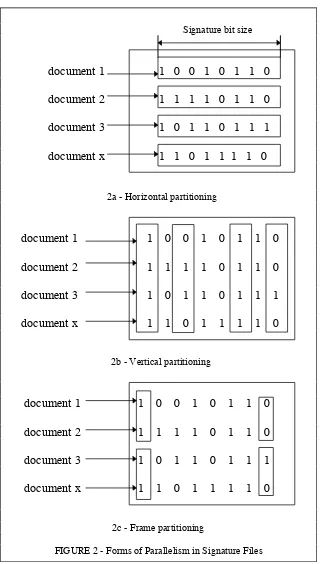
Before we describe systems which use signatures it would be useful to review
Signature files (see figure 2). Signature file can be viewed as matrices where the rows
represent document signatures and the columns represent the bit size of the signature.
We therefore have a number of partitioning methods for parallel computing on this
matrix. The first, horizontal partitioning, represents row parallelism where signatures Signature bit size
document 1 1 0 0 1 0 1 1 0
document 2 1 1 1 1 0 1 1 0
document 3 1 0 1 1 0 1 1 1
document x 1 1 0 1 1 1 1 0
2a - Horizontal partitioning
document 1 1 0 0 1 0 1 1 0
document 2 1 1 1 1 0 1 1 0
document 3 1 0 1 1 0 1 1 1
document x 1 1 0 1 1 1 1 0
2b - Vertical partitioning
document 1 1 0 0 1 0 1 1 0
document 2 1 1 1 1 0 1 1 0
document 3 1 0 1 1 0 1 1 1
document x 1 1 0 1 1 1 1 0
[image:17.566.101.421.66.630.2]2c - Frame partitioning
are compared in parallel (figure 2a). The second, vertical partitioning, represents
column parallelism where sections of the signatures are compared rather than the
whole (figure 2b). Vertical partitioning can be done by the bit or by a frame: a subset
of the column matrix (figure 2c). A hybrid policy of vertical and horizontal
partitioning can also be used. How these partitioning methods work in practice will
become clearer in the discussion below.
The Seed system described by Stanfill and Kahle [38] uses the horizontal method
(figure 2a) for partitioning the signatures. Seed uses a SIMD architecture, in this case
the Connection Machine CM-2. The program works by loading signatures into
memory, broadcasting the query signature to the processors to compare in parallel and
retrieving the results. In theory it is possible to load a document signature in every
processor, but Stanfill and Kahle assert that for a 512 bit signature "a limit of 15 to 30
words is reasonable". Therefore the system creates a number of signatures and spreads
them across a number of processors if this upper limit on term to signature size is
exceeded. Thus document sizes in the corpus have a direct effect on how many
signature comparisons can be executed in a given search. The system allows the use of
Relevance Feedback to reformulate a query. Reported results include a running time
of 50ms for a 200 term query on a 112 Megabyte database. Estimates for a 15
Gigabtye database are also given with a running time of 2 minutes for a 25 term query
and 3 minutes for a 20,000 term query. The latter estimates cast doubt on the
usefulness of the system in interactive environments when very large databases are
searched. This method of search has also been used in Tranputer machines [57]
Panagopoulos and Faloutsos [55] point out that the signature file for a very large
database using horizontal partitioning may not fit in main memory, which has
implications for their use in interactive applications: the Seed estimates given above
bear out this argument. They therefore propose a Bit-Sliced Signature File (BSSF)
which is based on vertical partitioning (figure 2b) on the bit level. The method would
work by storing the signature file matrix by columns rather than rows. Each term in a
query is hashed to a signature. The hashed positions of the query are identified and
only those relevant column slices (or bit-slices) are fetched in to main memory and
compared. A processor has a given number of bits with which to store a subset of the
slice. The algorithm would loop through these bits and compare subsets of the
used: where they do not a partial fetch policy would be used i.e. a subset of the
bit-sliced identified from the query hashing. The proposed method would work on a
SIMD architecture such as the Connection Machine CM-2. Estimates for performance
of the method include a response time of 2 seconds or less for databases up to the size
of 128 Gigabytes using a CM-2 with 64K processors.
The work described by Grandi et al [56] describes a hybrid method that combines
both horizontal and vertical partitioning which they assert is suitable for
implementation on parallel machines. The use of the Shared Nothing architecture
described by DeWitt and Gray [26] is recommended. Grandi and his colleagues point
out that the horizontal partitioning method used by Stanfill and Kahle cannot support
inter-query parallelism as all data needs to be accessed. The architecture of the system
described is divided by three dimensions: frames (which are subsets of a signature),
partitions (a horizontal fragment of frames) and blocks (a horizontal fragment of
partitions). The signature file is stored in terms of the frames, each disk containing a
subset of the frames (figure 2c). Thus frames are stored and can be searched in parallel
while other frames are being serviced. Hence the classification of the method as being
Frame-Sliced Partitioned parallel signature files. Since all frames would not be needed
by a search, the method can allow inter-query parallelism as well as intra-query
parallelism. While the method does overcome some of the limitations of those
described above, this is at the cost of a great deal of extra complexity. This complexity
in parallel systems should not be underestimated. Comparable results with the systems
in this class are not available.
From the above discussion we can assert that the signature partitioning method
interacts with both the type of machine used and the query parallelism directly
allowable. Horizontal partitioning allows only intra query parallelism directly, while
vertical partitioning and the hybrid method allow inter and intra query parallelism
directly. Inter query parallelism could be supported indirectly if batch queries were
used; although such would be problematic (see the discussion on false drops below).
The granularity of signature files can be either signature, bit-slice or frame-slice and
bit level granularity can also be used if the special hardware to work at that level is
available.
The advantage of the method is that it is rather amenable to implementation on
can reduce data skew quite considerably, although we may not be able to eliminate it
completely given that signatures files may not fit into main memory. There is also a
much lower storage overhead of about 10% compared with 50% to 300% found in
Inverted files [47]. However a serious drawback is associated with the method, the
problem of false drops. Since different terms may hash to the same signature bits,
collisions will often occur between query and document terms. A number of criticisms
of the method have been made therefore in using the signature file method in an
operational environment [37], in particular that signatures cannot support
sophisticated term weighting schemes. The subsequent effect of false drops on
precision and recall can be profound. A further serious problem is that position
information is lost, therefore proximity operations are unavailable in the class.
4.3 Two-Phase search
This method has been proposed to overcome the high search cost of pattern matching
and the low retrieval effectiveness of the signature method. The first phase of the
search compares a signature version of the query with document signatures to create a
hit list. The text arising from this hit list is then searched with the required patterns to
eliminate the false drops and produce the final document result set. Since the number
of documents pattern matched is greatly reduced, the increase in speed and
effectiveness makes the method valuable. Parallelism can be used in both phases of
the search. Two-phase searches have been implemented on SIMD machines by Pogue
et al [11-15] and on a MIMD transputer network by Cringean et al [58-62].
Panagopoulos and Faloutsos [55] also recommend the method's use when using
signature files. Any of the signature and pattern matching methods described above
could be used.
An example of the two-phase search can best be illustrated by looking at one
particular system, the transputer network program described by Cringean et al [58-62].
This system uses the process farm approach to parallelism to increase efficiency on
the more computationally intensive second phase. The horizontal partitioning method
is used for the first phase signature comparison. In this approach a single farmer
distributes work to a number of worker processes who do the search. In the first phase
the query signature is compared with document signatures (pre-loaded into memory)
are recorded. In the second phase the farmer distributes the documents in the hit list to
the workers, receiving the final document result set from them. A triple chain of
transputers was found to be the most effective topology. Data skew in the second
phase is reduced since a worker is given more work on completion of a search:
waiting for all workers to search a given set of documents would reduce the system's
efficiency drastically. However it should be noted that documents may need to pass
through several processors before reaching the target worker, because of the layout of
transputer networks. The cost in extra communication and lost computation in routing
processors affects the overall efficiency of the system. In the event this was found to
be a significant problem: Cringean et al [62] state that a substantial increase in
communication speeds would be needed for the method to achieve its full potential. A
further interesting result was that a more efficient signature search on the first phase
increased the amount of pattern matching needed in the second phase.
The granularity of two phase search is rather mixed depending on signatures
granularity in the first phase and documents in the second phase. Given that
documents are irregular structures and signatures are regular, data skew is more
prominent in the second phase of the search. The method supports intra-query
parallelism for both phases. Inter-query parallelism however, could be used in the first
phase if Frame-Sliced Partitioned Parallel Signature Files were used and for both
phases if queries where submitted as batches. The interaction between machine type
and the classification relates to the signature partitioning method for the first phase
and computation granularity for the second phase.
4.4 Inverted file
Most commercial and academic IR systems use inverted files. The reason for this is
that until now query processing has been given priority over insertions, and Inverted
files provide much faster searches than other methods such as pattern matching and
signatures. This is because the indexing eliminates the need for searches on many
irrelevant terms. However the generation and maintenance of Inverted files is very
expensive and this makes its use problematic in applications where insertions are
frequent. As stated in section 4.3 the storage requirements for Inverted files are far
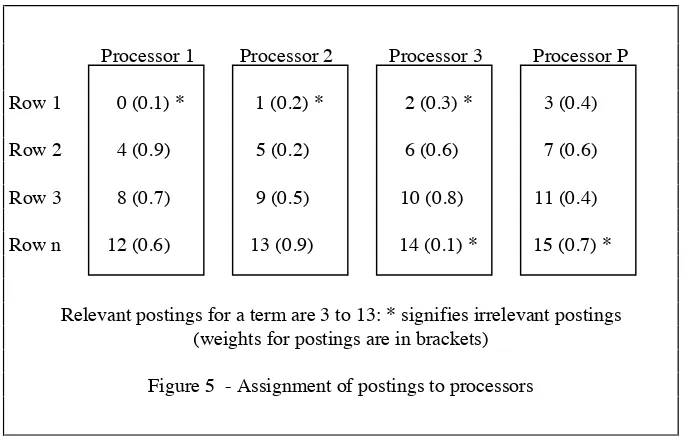
file update is addressed more fully in section 5 below. In our description of the
method below, we pay particular attention to data partitioning schemes.
The most prominent of parallel IR systems have used Inversion as their storage
technique [11,17,39,63-68]. We briefly review the structure of an Inverted file [47]: an
index or dictionary file contains a list of keywords in the collection, number of
documents in which that keyword occurs and a pointer to a document list: a postings
file or inverted list contains the document list for all the keywords and may in some
cases contain position information for each keyword in each document. There are two
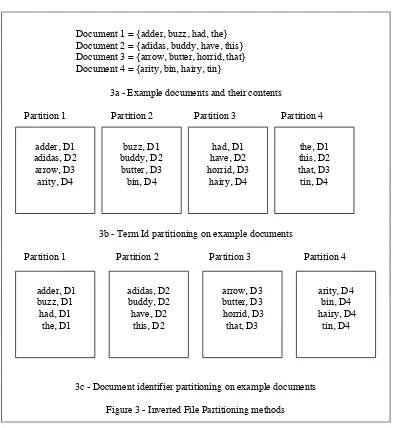
main Inverted file partitioning methods [69]: by term identifier and by document
identifier. With document identifier partitioning the terms for a single document are
placed on one disk, therefore postings for the same term are held on multiple disks.
Document 1 = {adder, buzz, had, the} Document 2 = {adidas, buddy, have, this} Document 3 = {arrow, butter, horrid, that} Document 4 = {arity, bin, hairy, tin}
3a - Example documents and their contents
Partition 1 Partition 2 Partition 3 Partition 4
3b - Term Id partitioning on example documents
Partition 1 Partition 2 Partition 3 Partition 4
[image:22.566.100.493.99.527.2]Term identifier partitioning has all postings for a given term on one disk, therefore
postings for the same document may be on multiple disks: see figure 3. Four
documents are provided as examples. Term identifier partitioning is done on the first
character of a word; partition 1='a', partition 2='b', partition 3='h' and partition 4='t'.
Each partition is placed on one disk.
Jeong and Omiecinski [69] discuss the effect partitioning in Inverted files has on the
performance of multiple disk systems. They advocate a Shared Everything approach
as opposed to a Shared Nothing in order to exploit I/O parallelism. The use of a
multiprocessor with shared memory is assumed. The two partitioning methods
described above are considered. The results produced by simulations are that term
identifier partitioning is best when the term distribution in the query is less skewed (or
more uniform) and document identifier partitioning is best when term distribution is
more skewed (or less uniform). Document identifier partitioning sacrifices more I/O
and space in order to ensure better load balancing in a more skewed query
environment. Document identifier partitioning is more expensive on I/O because
multiple disk accesses have to be made. When query term distribution is a little less
skewed the postings for a term can be retrieved faster since disk access times for terms
are more evenly distributed. When more skewed the load balancing of the machine
will be affected by large disk access times for some terms. Document identifier
partitioning avoids the latter problem by providing constant disk access times so that
large access times for terms with very large postings are masked. This advantage is
lost in a less skewed environment and the cost is greater because multiple disks have
to be consulted in document identifier partitioning (and the term accesses can be done
in parallel). Inter-query parallelism cannot be done with document identifier
partitioning: each query must take its turn on the disk queue. Term collection
information is often needed for weighting calculations: this has an implication for the
efficiency of term weighting using document identifier partitioning (see section 6.3).
Based on their simulations, Jeong and Omiecinski recommend that the Shared
Everything architecture be used in a medium sized Text Retrieval systems or as
components in a larger Shared Nothing machine.
Tomasic and Garcia-Molina [30,31] describe hybrid methods of partitioning inverted
files on distributed shared nothing systems. They assume the existence of multiple
System organisations. The Disk and System organisations are equivalent to document
identifier and term identifier partitioning methods respectively. In the I/O bus
organisation documents are distributed across I/O buses and inverted: this creates one
inverted file per I/O bus. In the Host organisation documents are distributed to CPUs
as per document identifier partitioning, but the inversion is spread across the disks
connected to the CPU. Where one I/O bus exits per CPU the I/O bus organisation is
equivalent to the Host organisation. Simulations of full-text system and an abstract
service were done using all the organisations described: in their results the Host
organisation appeared to performance well for full-text systems, while the System
organisation (or term identifier partitioning) performed better on abstracts.
As can be seen from above, we can divide parallel systems which use Inverted files
into two main camps, those who argue for or use term identifier partitioning
(Reddaway [11], Stanfill et al [39]) and those who argue for or use document
identifier partitioning (Hawking [20], Aalbersberg & Sijstermans [68], Stanfill &
Thau [63] and Hollaar [8]). There are a number of factors other than those discussed
by Jeong and Omiecinski above which determine the method of partitioning:
indexing, insertion, load balancing and subject division.
The time to build indexes in term identifier partitioning is longer than for document
identifier partitioning. The reason for this differential is simple: in document identifier
partitioning the build is kept local to the disk and no interprocessor communication is
needed to send data to a particular location. As the size of data grows in term
identifier partitioning this interprocessor communication increases, thereby increasing
the differential: but this assumes that data transfer rates across a network will remain
static. Therefore both the size of a database and the data transfer rate will determine
which method would be better with respect to building indexes. For those applications
which require fast index building, then document identifier partitioning would be
better. Depending on the factors considered below term identifier partitioning builds
could be better if users can wait a period.
The cost of inserting documents in the database would also appear to favour
document identifier partitioning for applications with a higher update rate, since only
one section of the inversion needs to be manipulated i.e. a document update is sent to
one processor rather than several thus reducing the level of interprocessor
term identifier partitioning depending on the term distribution of the document. This
would favour applications with a lesser update rate. In the worse case insertions in
term identifier partitioning degrade to those of document identifier partitioning,
although it is more likely that some processors will need to update more term
information than others reducing the overall efficiency of a single insertion. It should
be clear that both intra and inter insertion parallelism are available for the term
identifier partitioning method, whilst the document identifier partitioning method can
only utilise inter insertion parallelism.
We can see from the discussion above that load balancing on insertion is an
important issue. Load balancing on search is also affected by the partitioning method.
Document identifier partitioning allows for a much better load balance, since
computations are spread more equally across the processors as all partitions need to be
searched. All partitions may not need to be searched in term identifier partitioning.
Term identifier partitioning therefore allows both intra and inter query parallelism,
while document identifier partitioning only allows intra query parallelism. In
applications with very high query rates term identifier partitioning would be preferred.
Subject division could be useful for separating document into their various subject
areas, thereby reducing the number of irrelevant documents searched for a given
query. This has implications for the retrieval efficiency and effectiveness of the
system. Subject division would introduce the inter-query parallelism facility to
document identifier partitioning, since only a subset of subjects need be searched
allowing other queries to be serviced on disjoint subjects. However load balancing
may be adversely affected if one given subject was much larger or more popular than
others, thereby reducing overall efficiency. Subject division would not be suitable for
implementation with term identifier partitioning since it would greatly increase the
cost of maintaining the inverted file, both in space and time. We would need to
sub-divide each inverted file partition into sub-partitions which could run into hundreds of
subjects or increase the size of the postings file by recording the subject for every
posting. Some work in the area of subject division using inverted files has been done
for a selective dissemination of information (SDI) service and is described by
Kapaleaswaran and Rajaraman [70].
The granularity of Inverted files is based on the postings of the inverted list.
discount the possible use of special hardware to match at the bit level). One of the
main reasons for the success of SIMD machines in parallel IR, is that they are very
good at computing with this level of granularity. SIMD machines cannot normally
handle inter query parallelism with inverted files, but a method of using several DAPs
connected together has been put forward [11] which would overcome this limitation.
Three systems which use inverted files are described in the case studies section (7) in
more detail.
levels of vertical
partitioning (hierarchic methods only)
within-horizontal partitioning
[image:26.566.94.450.223.507.2]horizontal partitioning
4.5 Clustering
Clustering is a method of identifying similar documents, based on a given similarity
method. The documents are organised into groups or clusters, which in turn can
consist of a single centroid and document vectors belonging to that cluster [71]. There
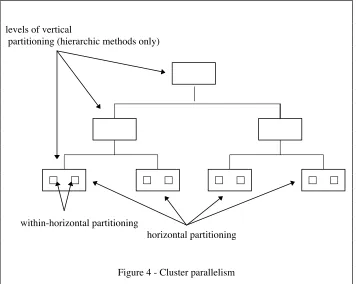
is therefore parallelism in the Clusters as well as between them: we term this
horizontal and within-horizontal partitioning. Very fine grain parallelism (e.g. at the
posting level) is also available within document vectors. A further issue is the type of
Cluster: they can be either hierarchic or non-hierarchic. Hierarchic methods introduce
a further level of parallelism: we term this vertical partitioning. Figure 4 shows the
forms of parallelism available in Clustering. It should be noted that clusters can be
overlapping and non-overlapping. We describe below parallel methods for generating
and searching in the clustering method.
The generation of clusters are computationally very intensive: orders of O(n2) to
O(n5) are not unknown. This makes their implementation on sequential machines
problematic. MacLeod and Robertson [43] describe a neural network algorithm
(called the MacLeod algorithm) for document clustering using non-hierarchic
methods. Neural networks are inherently parallel: Networks can be divided in layers
and nodes within layers which allow parallelism in two directions. Parallelism is used
in the MacLeod algorithm when a each document vector is compared with the current
set of clusters, iterating until a suitable cluster has been found or learned.
Rasmussen and Willett [72] describe parallel computing for various hierarchic
agglomerative clustering methods. Hierarchical clustering can be represented by
binary trees where nodes are clusters and the position in the binary tree represents the
similarity measure between objects. Agglomerative clustering consists of building the
tree bottom up; the alternative is diverse clustering with builds the tree top down.
There are three implementation approaches described:
a) stored matrix - N * N matrix containing pairwise distance values;
b) stored data - list of pairwise values N-1 elements;
c) sorted matrix - a distance matrix is constructed and sorted and then used to
construct the hierarchy.
They use a method called single linkage minimum variance, where single linkage is
related to minimum spanning trees. The SLINK Prim-Dijkstra and Ward algorithms
of the current row of the distance matrix. The Prim-Dijkstra is almost entirely parallel
except for storage of link information. The Ward uses the nearest neighbour method
using recomputed nearest neighbour i.e. chain of related objects; finding the nearest
neighbour is done in parallel. The parallel SLINK algorithm performed less efficiently
than its sequential counterpart, a slowdown being recorded. The parallel Prim-Dijkstra
performed much better in relation to its sequential counterpart with speedups of 3.6 to
6.0 recorded. The Ward speedups ranged from 2.9 to 4.0. They compared the results
from an IBM 3083/BX3 mainframe against the ICL DAP and conclude that
parallelism can provide significant speedups over serial systems in this type of
clustering for large datasets.
While there are clearly defined partitioning methods for clustering, the arbitrary
shapes of each of the levels will effect the search efficiency of the algorithm e.g.
clusters do not have the same number of document vectors or a hierarchy may not
have regular binary tree like structure. Organising the clusters (and hierarchies where
necessary) is therefore essential for the efficient search in this method. Frieder and
Siegelmann [73,74] formally argue that an optimal algorithm for assigning clusters to
processors is NP complete and is therefore unusable. They propose a heuristic using
genetic algorithms to address the problem. The algorithm terminates when either all
document allocations are equal or after 1000 generations. Other researchers propose
more conventional techniques.
Ozkarahan discusses search on non-hierarchic document clusters on the RAP.3
system [75]. The clusters of document vectors and a centroid representing the vectors
are distributed to a number of processors. A query vector is applied to the centroids,
which if successful applies a second search to the document vectors in that cluster.
While some regard this as useful, it is unlikely that the method would be able to
compete in speed with inverted files. In any case the insertion of documents is likely
to be prohibitively expensive. The RAP.3 system deviates from other systems in this
review as the integrated multimedia application area is addressed.
Sharma [76] describes a generic machine for parallel IR using clustering techniques
for both non-hierarchical and hierarchical methods. The hypercube topology is used
together with dedicated disks for each node in the hypercube (i.e. shared nothing). The
key is to distribute a subset of document clusters, to get the best load balance on
to be for increasing efficiency and one of increasing effectiveness. In the efficiency
algorithm closely related clusters are assigned to different sub-cubes such that no of
documents is equal in all sub-cubes. Within a sub-cube a cluster is spread across
nodes, with the centroid assigned to one node. In the effectiveness algorithm clusters
are recursively distributed across sub-cubes, each sub-cube have a smaller dimension
than its parent. A hierarchical clustering algorithm is used, mapping the hierarchy to
the hypercube. All levels of parallelism for clustering are used in these proposed
schemes. The search consists of the broadcast of a query and the application of the
query to the document database. In the efficiency algorithm the query is received at
each node and comparisons are done concurrently. Similarity values for clusters
(centriods) are collected and sorted and sent to a designated node which chooses the
highest ranked clusters; these are requested from the relevant locations. In the
effectiveness algorithm the query is received at each node and comparisons are done
concurrently, similarity values at all levels of the hierarchy being calculated. The
results are transmitted up the hierarchy and on this basis the highest ranked documents
are chosen. The simulation shows that as cluster levels increase, the efficiency scheme
response time remains static, while effectiveness scheme seems to increase
dramatically. In this case Amdahl's law (the asymptotic limit for the computation) hits
the efficiency scheme at 128 processors and the effectiveness scheme at 1024
processors.
The granularity of the clustering approach can vary; either the cluster or the vector or
even elements of a vector if an array processor such as the DAP is available. Both
inter and intra query parallelism for search are available in the method. It is difficult to
comment on the interaction between the machine type and the method, because of the
multiplicity of clustering algorithms available. The arbitrary shape of the clustering
algorithm determines the level of data skew and hence the search efficiency. Because
of the expense of generating clusters, it is unlikely to be able to compete with Inverted
4.6 Connectionist approaches
These approaches use a network model to represent information in an IR system [1].
Many are related to the 'neural network' and 'spreading activation' areas of
computation. They are inherently parallel, but extremely complex and poorly
understood. Because of this their implementation on parallel computers is difficult and
little work has been done in the area: research has concentrated on sequential
implementations as a consequence [77,78]. The MacLeod and Robertson algorithm
[43] described in section 4.5 can also be placed concurrently in this class. It should be
noted that these researchers take a very different approach to others described in this
review. Because of the complexity of these methods we do not attempt to describe
data partitioning, granularity or query parallelism for connectionist approaches.
One particular connectionist system is the PTHOMAS system described by Oddy
and Balakrishnan [79] and has been implemented on the Connection Machine. The
theoretical idea behind PTHOMAS is to represent a holistic view of the documents
and their relationships. The method uses a network structure of nodes (documents,
authors, terms) where the arcs (edges) between these entities represent a relationship
in the index and thesaurus. The network is a global graph representing the universe of
the database. The user sees a context graph which is a subset of the global graph and is
created by user action. Various component graphs may be discarded in the user
interaction with the system. The algorithm used is computationally very intensive: a
database with 10,000 document abstracts would create a network with 1 million
nodes/edges. Oddy and Balakrishnan have not addressed the issue of how to
implement these ideas/methods realistically for large collections and therefore we do
not see the PTHOMAS as being a practical proposition for the foreseeable future.
4.7 Other approaches
There are a number of different approaches to parallel information retrieval which do
not fit easily into the classes described above. We therefore describe below some other
work, both practical and theoretical. These include vector processing, hybrid
inversion, functional programming and relational database. A vector processing
system is the subject of a critique in section 7.4. Given the variety of approaches in
this section we will not attempt to describe the interaction between architecture, the