
Planning for the future while maintaining focus on spending: Review of Programme Implementation – Winter 2011 – Spring 2012 : IQ-Net Review Paper, 30(1)
53
0
0
Full text
(2) European Policies Research Centre University of Strathclyde Graham Hills Building 40 George Street Glasgow G1 1QE United Kingdom Tel: +44 (0) 141 548 3908 Fax: +44 (0) 141 548 4898 E-mail: [email protected] [email protected] [email protected]. www.eprc.strath.ac.uk/eprc/default.cfm www.eprc.strath.ac.uk/iqnet/default.cfm. June 2012 The University of Strathclyde is a charitable body, registered in Scotland, number SC01526.
(3) Planning for the future while maintaining focus on spending Review of Programme Implementation – Winter 2011 - Spring 2012. PREFACE The research for this paper was undertaken by EPRC in preparation for the 32nd IQ-Net meeting held in Tampere, Finland on 18-20 June 2012. The paper was written by Stefan Kah. The paper is the product of desk research and fieldwork visits during Spring 2012 to national and regional authorities in EU Member States (notably partners in the IQ-Net Consortium). The field research team comprised: Stefan Kah (Austria, Slovenia). . Victoria Chorafa, Dimitris Lianos (Greece). Dr Arno Van der Zwet (Belgium). . Eleonora Carnevali (Italy). Dr Marie Feřtrová (Czech Republic). . Jānis Aprāns (Latvia). Prof. Henrik Halkier, Jenny Holm Hviid. . Dr Martin Ferry (Poland). Kaisa Lähteenmäki-Smith (Finland). . Carlos Mendez (Portugal, Spain). Frederike Gross (France). . Rona Michie (United Kingdom). (Denmark). Dr Sara Davies (Germany) EPRC thanks all those respondents from national and regional authorities and other organisations who participated in the research. EPRC also gratefully acknowledges the financial support provided by participating Member States and regions, whose contributions are co-financed by technical assistance from the European Structural Funds. The author is also grateful for helpful advice and feedback on earlier drafts of this paper from the IQ-Net research team, especially John Bachtler, and for support with the formatting of the paper from Alyson Ross. The report is, however, the responsibility of the author alone. The partners in the IQ-Net network are as follows: Austria . State Government of Niederösterreich (Lower Austria), Economic and Tourism Department State Government of Steiermark (Styria), Economic Policy Department. Belgium . Enterprise Flanders Agency. Czech Republic . Ministry for Regional Development. Denmark . Danish Business Authority. IQ-Net Review Paper 30(1). i. European Policies Research Centre.
(4) Planning for the future while maintaining focus on spending Review of Programme Implementation – Winter 2011 - Spring 2012. Finland . Alliance of Länsi-Suomi (Western Finland) and the Ministry of Employment and the Economy. . Délégation interministérielle à l’aménagement du territoire et à l'attractivité régionale (DATAR, Interministerial Delegation of Territorial Development and Regional Attractiveness). France. Germany . Nordrhein-Westfalen (North Rhine-Westphalia), Ministry of Economy, SMEs and Energy, EU Affairs Unit Sachsen-Anhalt (Saxony-Anhalt), Ministry of Finance. . Management Organisation Unit of Development Programmes S.A.. . Ministry of Economic Development and Promuovi Italia SpA. . Śląskie Voivodeship (Marshal’s Office of Silesia). Greece Italy Poland. Portugal . Financial Institute for Regional Development (IFDR). Spain Slovenia . País Vasco (Basque Country), Provincial Council of Bizkaia, Department of Economy and Finance Ministry of Economic Development and Technology, EU Cohesion Policy Directorate. United Kingdom Department of Communities and Local Government Scottish Government Welsh European Funding Office. For further information about IQ-Net, and access to the full series of IQ-Net Papers, please visit the IQ-Net website at: www.eprc.strath.ac.uk/iqnet/default.cfm To cite this paper, please use the following: Kah S (2012) Planning for the future while maintaining focus on spending: Review of Programme Implementation, Winter 2011 – Spring 2012, IQ-Net Review Paper 30(1), European Policies Research Centre, University of Strathclyde, Glasgow.. Disclaimer It should be noted that the content and conclusions of this paper do not necessarily represent the views of individual members of the IQ-Net Consortium.. IQ-Net Review Paper 30(1). ii. European Policies Research Centre.
(5) Planning for the future while maintaining focus on spending Review of Programme Implementation – Winter 2011 - Spring 2012. PLANNING FOR THE FUTURE WHILE MAINTAINING FOCUS ON SPENDING REVIEW OF PROGRAMME IMPLEMENTATION WINTER 2011 – SPRING 2012 TABLE OF CONTENTS 1.. INTRODUCTION ......................................................................................... 3. 2.. THE CURRENT 2007-13 PROGRAMME PERIOD.................................................... 5 Financial progress .......................................................................................... 5 Financial implementation in the EU27 ............................................................. 5 Financial progress in IQ-Net partner programmes ............................................... 6 Spending challenges and responses ................................................................. 9 Programme management ................................................................................ 13 Implementation structures and procedures ...................................................... 13 Audits .................................................................................................... 14 Financial engineering instruments ................................................................. 16 Evaluation .............................................................................................. 19 Strategic Reports 2012 ............................................................................... 22 Programme closure .................................................................................... 23. 2.1 2.1.1 2.1.2 2.1.3 2.2 2.2.1 2.2.2 2.2.3 2.2.4 2.2.5 2.2.6 3.. PREPARATIONS FOR THE 2014-20 PROGRAMME PERIOD .................................... 25 3.1 New implementation framework ....................................................................... 25 3.1.1 Common Strategic Framework (CSF) ............................................................... 25 3.1.2 Thematic objectives and ring-fencing ............................................................. 27 3.1.3 Local Agenda ........................................................................................... 28 3.2 Preparations for the future .............................................................................. 32 3.2.1 Progress with preparations .......................................................................... 32 3.2.2 Planning tools .......................................................................................... 36 3.2.3 Responding to reduced public budgets ............................................................ 40 3.2.4 Organisational and administrative changes ...................................................... 41. 4.. CONCLUSION .......................................................................................... 45. IQ-Net Review Paper 30(1). iii. European Policies Research Centre.
(6) Planning for the future while maintaining focus on spending Review of Programme Implementation – Winter 2011 - Spring 2012. PLANNING FOR THE FUTURE WHILE MAINTAINING FOCUS ON SPENDING REVIEW OF PROGRAMME IMPLEMENTATION WINTER 2011 – SPRING 2012 MAIN FINDINGS . The rate of financial implementation has improved across the EU27, with the average payments rate now at 37.4 percent (May 2012). The absorption rate is slightly higher for ESF (40.8 percent) than ERDF (38.2 percent). The payment rate for the Cohesion Fund is 31.4 percent. Yet, there are wide variations between countries, ranging from a total absorption rate of 55.6 percent in Ireland to 19.5 percent in Romania.. . In most IQ-Net programmes, financial progress in IQ-Net programmes can be considered to be satisfactory. Commitments are usually beyond 50 percent and figures reach 100 percent in some cases.. . Most programme authorities are not expecting any issues with decommitment in the short-term, but issues with n+2(3) might arise in the future, when funding committed during the peak of the economic crisis will have to be spent.. . There have not been any major changes to implementation structures and procedures in most IQ-Net partner programmes. A notable exception is England, where the structures have been changed fundamentally.. . Domestic audit authorities and EU-level bodies continued to carry out audits, which led to interruption of payments in several cases. The main issues of concern continue to be public procurement and eligibility of expenditure.. . Good progress has been made with financial engineering instruments and there have been moves to establish new financial engineering instruments, both in the current and the future programme period.. . IQ-Net programme authorities have continued their evaluation efforts, and results will not only feed into the Strategic Reports 2012, but also into the programming process for 2014-20.. . Preparations for the Strategic Reports 2012 have started in most IQ-Net countries. Member States will build on the experiences made in 2009 to write a more concise report, often adopting a specific focus and using synergies with other regulatory requirements.. . Although preparations for closure have not started yet in many IQ-Net programmes, some have undertaken first preparatory steps.. . Looking at the 2014-20 delivery framework, the Common Strategic Framework (CSF) is welcomed by many IQ-Net programme authorities, but its role should be a soft one.. IQ-Net Review Paper 30(1). 1. European Policies Research Centre.
(7) Planning for the future while maintaining focus on spending Review of Programme Implementation – Winter 2011 - Spring 2012. . Performance reserve, conditionalities and the administrative effort remain at the centre of criticisms.. . The proposed Thematic Objectives are welcome, but there is a debate between thematic concentration and flexibility to adjust to regional needs.. . A strengthened local agenda is welcomed, but there are concerns about the managing capacities of local-level authorities. Community-led Local Development (CLLD) and Integrated Territorial Investments (ITIs) are seen as potentially useful instruments. With regard to an urban development platform, the usefulness of a forum to promote capacity building and to exchange experiences is acknowledged, but many regard existing networking opportunities are sufficient.. . Looking at preparations for 2014-20, most IQ-Net countries and regions have made considerable progress. Frequently, working groups have been set up both at the national and sub-national levels, and studies and evaluations form the basis for planning in many cases.. . Preparations are influenced by the austerity measures in several countries, and thematic concentration of funding is likely to be necessary. An important issue for many IQ-Net programme authorities is the availability of future co-financing and as a consequence there are plans to focus more on financial instruments.. . Simplification of implementation arrangements remains an important concern and regions are looking for simpler implementation structures and procedures. In several countries, a reduction in the number programmes is planned.. IQ-Net Review Paper 30(1). 2. European Policies Research Centre.
(8) Planning for the future while maintaining focus on spending Review of Programme Implementation – Winter 2011 - Spring 2012. PLANNING FOR THE FUTURE WHILE MAINTAINING FOCUS ON SPENDING REVIEW OF PROGRAMME IMPLEMENTATION WINTER 2011 – SPRING 2012 1.. INTRODUCTION. With the launch of the 2014-20 programme period in less than two years, Member States are increasingly working on the preparation of their strategic documents and implementation frameworks. At the same time, the delivery of current programmes continues to present its challenges. This is not least due to the effects of the economic crisis and the related strains on public budgets, but also due to a series of regulatory issues. Although lagging financial absorption is of concern to several Member States, the progress in financial implementation since the last IQ-Net stock-take of programme progress in Autumn 2011 1 has been substantial. Programme managers are aware that there is only about 18 months to go until the end of the current programme period. There is also the important requirement to prepare another strategic report. The aim of this paper is to review recent developments in the implementation of the 2007-13 programmes, while also looking at preparations for the 2014-20 funding period. It draws on a mix of desk research and interviews with staff working on the implementation of Structural Funds programmes in the 15 Member States where managing authorities and programme secretariats are partners in IQ-Net. The surveyed programmes collectively account for about one-third of Cohesion policy spending and encompass a mix of Convergence, Regional Competitiveness & Employment, and Phasing-In/Out regions. The desk-based research has focused on EU-level and programme documents, including financial performance and monitoring data. Interviews were conducted with managing authorities, programme secretariats and national coordination bodies. The paper is divided into two parts, focusing on the 2007-13 programme period, and proposals and preparations for 2014-20 respectively. Section 2 begins with a review of the state-of-play of the 2007-13 programmes, looking at progress with absorption in the EU27 and across the IQ-Net partner programmes. This is followed by a review of selected new developments in programme management: general implementation structures and procedures; audit activity; financial engineering instruments; and evaluation. Also, a first look is taken at the stage of preparations for the Strategic Reports 2012 and for the closure of current programmes. Section 3 turns to the 201420 programme period. It begins by gathering the views of IQ-Net partner authorities on the proposed implementation framework, with a focus on the Common Strategic Framework, thematic concentration and the move towards a reinforced Local Agenda. It then provides an overview of how IQ-Net programme authorities are preparing for the 2014-20 programme period. It looks at general progress, tools, responses to tightened public budgets and, finally, likely organisational and administrative changes. Section 4 concludes the paper with some overall observations on the recent period of programme management activity.. 1. Kah S (2011), A snapshot of the present and a glimpse of the future of Cohesion policy: Review of programme implementation – Summer-Autumn 2011, IQ-Net Review Paper, 29(1), Glasgow, pp. 18-19. IQ-Net Review Paper 30(1). 3. European Policies Research Centre.
(9) Planning for the future while maintaining focus on spending Review of Programme Implementation – Winter 2011 - Spring 2012. IQ-Net Review Paper 30(1). 4. European Policies Research Centre.
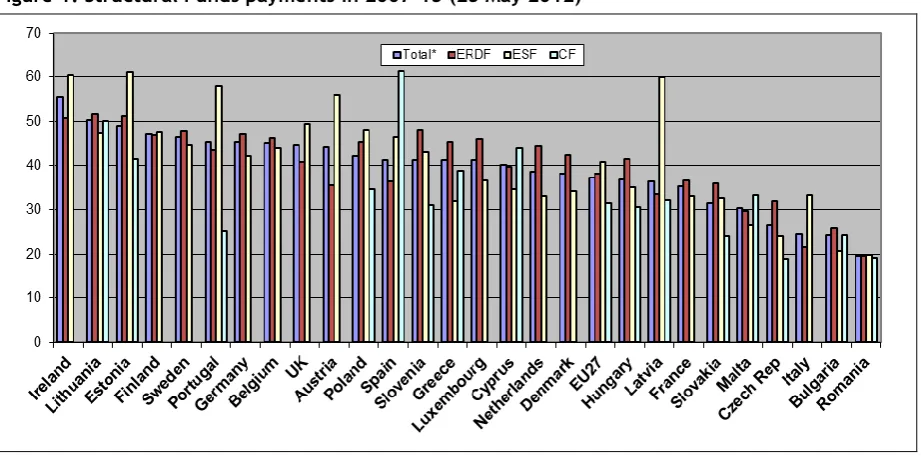
(10) Planning for the future while maintaining focus on spending Review of Programme Implementation – Winter 2011 - Spring 2012. 2.. THE CURRENT 2007-13 PROGRAMME PERIOD. 2.1. Financial progress. 2.1.1 Financial implementation in the EU27 Over the last six months, financial absorption in the EU27 made significant progress in most cases. After increases of about five percentage points every six months since 2010, payments have increased by 7.1 percentage points from 30.3 percent in November 2011 to 37.4 percent (23 May 2012). However, as Figure 1 shows, there are marked differences between Member States and Funds. In May 2012: . the highest overall payments were reported for Ireland (55.6 percent), Lithuania (50.4 percent) and Estonia (49.1 percent);. . the lowest rates continue to be found in Italy, Bulgaria and Romania, with the latter still below 20 percent;. . there have been very significant increases in some countries, e.g. in Ireland (17.3 percentage points), Luxembourg (15.7 percentage points) and Belgium (15 percentage points). Yet, in other countries the progress has been comparatively slow, e.g. 2.7 percentage points in the Czech Republic and 0.9 percentage in Latvia.. In terms of individual Funds, payments are most advanced for the ESF (40.8 percent), followed by ERDF (38.2 percent), while payments for the Cohesion Fund are behind at 31.4 percent. Particularly high rates can be found for the ESF in Estonia (61.1 percent), Ireland (60.4 percent) and Latvia (60 percent), while Cohesion Fund payments are well above average in Spain (61 percent). Figure 1: Structural Funds payments in 2007-13 (23 May 2012). Source: Commission data from 23 May 2012 Note: EU27 excludes EU cross-border cooperation and Interregional cooperation programmes.. IQ-Net Review Paper 30(1). 5. European Policies Research Centre.
(11) Planning for the future while maintaining focus on spending Review of Programme Implementation – Winter 2011 - Spring 2012. 2.1.2 Financial progress in IQ-Net partner programmes With the programme period now well into its sixth year, commitments are beyond 50 percent in all IQ-Net programmes and figures are as high as 92 percent in Vlaanderen or 98 percent in the Latvian ESF OP. Some Priorities have even been overcommitted, as, for instance, Priority 2 ‘Innovation and the knowledge-based economy’ in Sachsen-Anhalt. Yet, payments are sometimes comparatively slow in spite of high commitment figures. This is not least due to payment interruptions following audit issues (see Section 2.2.2). However, overall, financial progress in IQ-Net programmes can be considered to be satisfactory in most cases. . Austria (Niederösterreich, Steiermark). Financial progress in both Austrian programmes continues to be satisfactory, in spite of recently suspended payments. In Niederösterreich, commitments increased to 62 percent and payments to 33 percent (10 April 2012). At measure-level, commitment figures vary between 44 percent (innovative tourism) and 89 percent. (environment,. energy. efficiency. and. renewable. energy).. In. Steiermark,. commitments stand at 67 percent and payments at 31 percent (10 April 2012). Funding for environmental measures has already been fully committed. In terms of payments, the measure for R&D in businesses is lagging behind at nine percent. . Belgium (Vlaanderen). Payments increased by 4.6 percentage points to more than 41 percent and commitments increased by 1.6 percentage points to more than 92 percent (14 March 2012). While Priorities 1, 2 and 3 all report commitment rates beyond 95 percent, Priority 4 (urban development) has been slightly less successful at 75 percent. However, the picture is different in terms of payments, where the highest value is found for Priority 3 (improving the economic restructuring/spatial planning environment), which stands at 52 percent and the lowest for Priority 2 (entrepreneurship) at 24 percent.. . Czech Republic. At the national level there were only minor steps forward in terms of financial progress. The overall commitment rate increased only by 3.5 percentage point to 73 percent and payments are at 41 percent (7 March 2012). Yet, payment rates differ widely and range from 71 percent in Transport OP to 21 percent in the Integrated OP. While commitments are average for the Integrated OP (73 percent), only 15 percent of expenditure has been certified. Measures 3.1 (social integration) and 3.3 (services in employment) remain the most challenging, with which commitments still only at 14 percent (payments at 1.7 percent) and 34 percent (payments at 0.7 percent) respectively.. . Denmark. Progress with implementation is generally satisfactory in Denmark. Commitments in ESF (67 percent) are lower than ERDF (79 percent), as are payments, which stood at 25 percent for ESF and 35 percent for ERDF (30 September 2011). However, there is some regional variation in terms of payment, which ranged from 21 percent (Bornholm) to 51 percent (Nordjylland) in ERDF and from 13 percent (Syddanmark) to 48 percent (Bornholm) in ESF.. . Finland. (Länsi-Suomi).. Financial. absorption. in. Länsi-Suomi. is. progressing. well.. Commitments in ERDF (72 percent) and ESF (74 percent) are close to the national average of 76 and 74 respectively (16 April 2012). The same is the case with payments, which increased significantly over the last six months to 40 percent in ERDF and 45 percent in ESF.. IQ-Net Review Paper 30(1). 6. European Policies Research Centre.
(12) Planning for the future while maintaining focus on spending Review of Programme Implementation – Winter 2011 - Spring 2012. Yet, there are regional differences within the Länsi-Suomi programme, with Keski-Suomi and Satakunta being most advanced. . France. Overall, commitment rates for ERDF programmes under the RCE Objective for 2012 are good, standing at almost 67 percent, while payments are lagging behind at 27 percent of EU funding (1 April 2012). There is some variation at the regional level, with commitments between 56 percent (Champagne-Ardenne) and 77 percent (Rhône-Alpes) and payments between 21 percent (Nord-Pas de Calais) and 39 percent (Rhône-Alpes). Under regional ESF programmes of the RCE Objective, figures are higher for commitments (78 percent) and similar for payments (29 percent). In the Convergence regions, ERDF commitments are at 59 percent and payments at 25 percent, while ESF commitments are at 70 percent and payments lagging behind at 14 percent.. . Germany (Nordrhein-Westfalen, Sachsen-Anhalt). The ERDF OP in Nordrhein-Westfalen had committed 85 percent of funds by spring 2012 (13 April 2012). Commitment rates are stronger for Priority 2 (Innovation and the knowledge-based economy) than for Priority 1 (Strengthening the business base) or Priority 3 (Sustainable urban and regional development), standing at 101 percent for Priority 2 by early November 2011, compared to 38 percent for Priority 1 and 65 percent for Priority 3. In Sachsen-Anhalt, financial absorption is good for the ERDF OP and broadly satisfactory for the ESF OP. The ERDF commitment rate was 77 percent by February 2012, and the payment rate was 52 percent. The ESF commitment rate in February 2012 was 58 percent and the payment rate was 36 percent.. . Greece. With commitments at NSRF level above 63 percent and payments at 34 percent, financial progress is deemed to be satisfactory (31 March 2012). However, financial performance differs widely between programmes. Although regional OPs continue to perform generally better than the national average there is considerable variation at the regional level, with commitments ranging from 50 percent (Attikí) to 95 percent (Thessalía– Sterea Ellada–Epeiros) and payments between 31 percent (Attikí) and 53 percent (Thessalía– Sterea Ellada–Epeiros). In contrast, figures are lower for sectoral OPs; the Digital Convergence OP and the Reinforcement of Public Administration Efficiency OP have the lowest commitment (31 percent and 26 percent respectively) and absorption rates (22 percent and 11 percent respectively). Amongst the sectoral programmes the absorption is significant for the Competitiveness and Entrepreneurship OP which includes the State aid actions for support to the SMEs, R&D and energy saving measures. Commitments for this OP stand at 95 percent and payments at 60 percent.. . Italy (OP Research and Competitiveness). The financial progress of the Italian OP R&C is still deemed (at least partly) unsatisfactory, even though decommitment risk has been avoided. At the end of 2011, commitments were at 38 percent and payments at 25 percent. Problems are mainly linked to Priority 1 (research and knowledge economy), where commitments stand at six percent and payments at two percent. Delays derive from the implementation of new instruments: The 'Development Contracts’ launched in September. IQ-Net Review Paper 30(1). 7. European Policies Research Centre.
(13) Planning for the future while maintaining focus on spending Review of Programme Implementation – Winter 2011 - Spring 2012. 20112 still need to be fully implemented, and ‘Industrial Innovation Projects’, launched in July 2009, only showed minor financial progress over the last six months. Priority 2 (competitiveness) stands at 69 percent as regards commitments and 48 percent referring to payments. The better state of play related to Priority 2, continues to be ensured by the use of financial engineering instruments and the so-called project of 'prima fase' (first phase) or 'a cavallo' (in-between). . Latvia. Financial progress overall is deemed to be satisfactory (31 March 2012). For OP ‘Entrepreneurship and Innovations’ (ERDF) commitments are at 82 percent and payments to final beneficiaries at 49 percent. An even better commitment rate can be observed for the OP ‘Infrastructure and Services’ (85 percent), but payments are lower at 43 percent. However, the most significant progress in relation of absorption has been achieved in the implementation of the OP ‘Human Resources and Employment’ – commitments reach 98 percent of the available funding and 65 percent have been already disbursed to Final Beneficiaries. This results in an average commitment rate of 86 percent and payment rate of 44 percent.. . Poland (Śląskie). The financial performance of the Śląskie ROP is good. At end-February 2012, around 75 percent of the allocation had been contracted. Priority 2 ‘Information Society’ has the lowest level of payments (nine percent), mainly due to delays to the launch of project calls while Polish and EU regulations in this sector were reconciled. Payment levels are highest in Priorities where project calls were launched earliest. The highest payment level has been achieved in Priority 9 Health and Recreation’ – 78 percent of the allocation for the priority. The regional priorities of the ESF-funded Human Capital OP (that is Priorities 6-9) are performing reasonably well. As of March, Śląskie was second only to Mazowieckie (the capital city region) in terms of value of approved projects in the regionally-implemented Priorities of the OP. In terms of payments, Śląskie is fourth from the bottom of the regional list with around 45 percent of its allocation as certified expenditure. The best performing Priority is Priority 9 ‘Development of education and competencies in the regions’ where a number of new projects have been launched. Priority 8 ‘Regional human resources for the economy’ has substantial funding and project calls will be accelerated this year.. . Portugal. At the end of the first quarter of 2012 the spending rate of the NSRF reached 42 percent of total allocations set against a commitment rate of 82 percent. Under the Competitiveness strategic priority there is strong concentration in the area of innovation and renewal of the business model (67 percent). The Human Potential priority accounts for the largest share of implemented funds: 54 percent of the total, 27 percent of which is devoted to school infrastructure, 24 percent to adult adaptability and lifelong learning measures and 23 percent for youth dual certification. Finally, the Territorial Enhancement priority accounts for a quarter of implemented funds, the largest share of which is allocated to accessibility and mobility. However, there are significant differences between commitments and payments in many OPs.. 2. Kah S (2011), op. cit., pp. 18-19.. IQ-Net Review Paper 30(1). 8. European Policies Research Centre.
(14) Planning for the future while maintaining focus on spending Review of Programme Implementation – Winter 2011 - Spring 2012. . Slovenia. Financial performance in Slovenia continues to be in line with expectations. Until the end of 2011, overall absorption figures increased to 70 percent (commitment) and 38 percent (payment). The ERDF OP performs best, both in terms of commitments (81 percent) and payments (55 percent). Commitments are also high for the ESF OP (79 percent), but payments are lower at 40 percent. Finally, the OP supporting infrastructure, which is co-financed by both ERDF and Cohesion Fund, is slightly behind the average, and commitments are at 53 percent, while payments stand at 19 percent.. . Spain. Financial implementation is around 45 percent for all programmes in Spain and is deemed to be satisfactory, although there is a mixed picture across regions. For instance, the RCE region Rioja has already spent 80 percent, while Andalucía (the Convergence region with the highest allocation) has a spending rate of 35 percent. Within the País Vasco ERDF OP, financial implementation in the province of Bizkaia is high at around 70 percent.. . United Kingdom. Commitment levels across the UK remain at reasonably high levels. In Scotland, commitment stands at 92 percent for the Scottish programmes as a whole (31 March 2012), with the two ERDF programmes (Lowlands and Uplands Scotland and Highlands and Islands) standing at 83 percent and 99 percent respectively, and the two ESF programmes at 98 percent and 108 percent respectively. In Wales, the level of commitments has risen to a rate of 87 percent across all four programmes. The commitment rate for ESF Convergence stands at 93 percent, ESF Competitiveness at 99 percent; the rate for ERDF Convergence at 82 percent, and ERDF Competitiveness at 83 percent (29 February 2012). In England, the level of commitments varies between 54 percent (Yorkshire and Humber and South West Competitiveness ERDF programmes) and 73 percent (Cornwall and Isles of Scilly Convergence Programme). When the project pipeline is added to commitments already made (the definition of pipeline varies between programmes but is generally projects which have submitted either a full or outline application and have yet to be formally approved), the figure for all programmes is 93 percent. There is also good progress with regards to payments: payments for the Scottish programmes as a whole have risen by 23 percent to 40 percent; in Wales, payments have risen by four percent to 30 percent for the programmes as a whole; and in England payments stand at 38 percent, up nine percent.. 2.1.3 Spending challenges and responses In spite of spending challenges in many IQ-Net partner programmes over recent years, most programme authorities are not expecting any issues with decommitment in the short-term (Bizkaia, Czech Republic, Denmark, France, Italian OP R&C, Nordrhein-Westfalen, Portugal, Steiermark, Śląskie ESF, Vlaanderen). Where decommitment cannot be excluded, it will only affect minor funding (e.g. Niederösterreich). However, issues with n+2(3) might arise in the coming years, when funding committed during the peak of the economic crisis will have to be spent (Czech Republic, France, Greece). In the Czech Republic, there is a risk envisaged for the end of 2013, when both the funds for 2010 (still under the n+3 rule) and for 2011 (n+2) will have to be spent. For France, instead, a Commission recommendation estimates that there might be n+2 issues at the end of 2014.. IQ-Net Review Paper 30(1). 9. European Policies Research Centre.
(15) Planning for the future while maintaining focus on spending Review of Programme Implementation – Winter 2011 - Spring 2012. Programme authorities adopted different strategies to avoid any issues with n+2(3). The Śląskie ESF unit has made an effort to ensure high levels of contracting already at the beginning of the programming period. Niederösterreich and Steiermark hold regular coordination meetings with all intermediate bodies to identify potential spending challenges. Denmark, instead, set up an action plan to make sure that as much project expenditure as possible is registered and that information on the progress of projects is collected at an early stage. Difficulties with co-financing have been encountered in some countries (e.g. Finland, Greece). Austerity measures have impacted on central and local government budgets (Finland, Portugal). In Finland, a government decision in December 2012 means that the annual contribution of the national Finnish level to Structural Funds will be capped at €30 million. 3 The central government expects that the funding shortfall could be replaced by an equivalent increase in local-level cofinancing. Responding to this, several regional bodies signed a declaration on 22 November 2011 expressing their critical views on the government’s unilateral decision to cut EU programmes and their national co-financing share. In Greece, EU funds will be used to create so-called ‘risksharing instruments’. In April 2012, the European Parliament approved the Commission’s proposal enabling the use of still available Cohesion policy funding to back-up guarantees and loans by financial institutions such as the European Investment Bank (EIB). This measure is intended to address obstacles in raising private funding for key projects that can only be partly financed by public funds. In Slovenia instead, issues with co-financing are avoided through the creation of a budgetary reserve for Cohesion policy. In order to respond to spending challenges, many programmes have recently been revised or are in the process of revision (Czech Republic, Greece, Italian OP R&C, Nordrhein-Westfalen, Portugal, Spain, Sachsen-Anhalt, Śląskie ESF). In addition to these formal revisions, funds have been shifted within the same programme Priority in several cases (e.g. Niederösterreich, Latvia), which does not require Commission approval. At the end of 2011, the European Commission approved a series of revisions to programmes (Portugal, Czech Integrated OP, Spain). In Spain, the revisions were based on an operational evaluation completed in mid-2011. The changes aim to address absorption challenges in response to the ongoing effects of the crisis and constraints on public finances by funding reallocations and by increasing the EU co-financing rate from 70 percent to the maximum rate of 80 percent in Convergence, Phasing-in and Phasing-Out regions.4 In Greece, the first stage of revisions, i.e. amending the financial tables and increase the EU co-financing to 85 percent, has already been approved. Also in Portugal, an EU contribution of up to 85 percent is now possible (see Box 1). Many current revisions are still pending (Greece, Italian OP R&C, Nordrhein-Westfalen, SachsenAnhalt, Śląskie ESF). In Śląskie, the ESF unit is in the process of moving funding to measures that are performing best, and the managing authority is proposing another review of the OP that could result in further reallocation of funds. In Sachsen-Anhalt, the managing authority submitted a number of proposed changes to their ERDF and ESF OPs to the Commission in December 2011. Yet,. 3. Kah S (2011), op. cit., p. 14.. 4. Eligible regions are Andalucía, Castilla La Mancha, Extremadura, Galicia, Asturias, Ceuta, Melilla, Murcia, Canarias and Castilla. IQ-Net Review Paper 30(1). 10. European Policies Research Centre.
(16) Planning for the future while maintaining focus on spending Review of Programme Implementation – Winter 2011 - Spring 2012. these changes have not yet been approved. The changes aim to not only facilitate financial absorption, particularly in the ESF OP, but also to improve the programmes’ alignment with the new Land government’s political priorities (e.g. investment in energy efficiency in schools) as well as with Europe 2020. In Nordrhein-Westfalen, the ERDF managing authority has recently proposed changes to the programme. As yet, they have received comments from the Commission but there has not been a formal decision. The proposed changes to the Nordrhein-Westfalen ERDF OP would involve several funding reallocations: a shift of funds from Priority 1 (Strengthening the business base) and Priority 3 (Sustainable urban and regional development) to Priority 2 (Innovation and the knowledge-based economy); allocation of Priority 1 funding to the theme of combined heat and power systems (Kraftwärmekopplung); and allocation of funding for Nordrhein-Westfalen’s digitalisation strategy. In Greece, there are ongoing evaluations of five regional OPs and four of the country’s eight thematic OPs (see 2.2.4). The reallocation process between Priorities and thematic codes is in progress, and the monitoring committees will discuss the proposals in June 2012. Finally, in the Italian OP R&C, there are currently revisions connected to the new national Cohesion Action Plan (Piano d'Azione Coesione). The plan was approved at the end of 2011 and intends to boost the considerably delayed 2007-13 programmes. It identifies four strategic thematic foci: education; digital agenda; employment; and railways. Financial resources will not only be moved from programmes in Southern Italy, but they will also be derived from a reduction of national cofunding. In the future, it is also likely that the Cohesion Action Plan will cover innovation and competitiveness support. A number of other IQ-Net programme authorities are planning to revise their programmes in the near future (Niederösterreich, Portugal, Slovenia, Steiermark). The Slovenian managing authority plans to shift money away from Priorities with absorption problems and towards themes with strong demand, e.g. renewable energy. Also Niederösterreich and Steiermark plan to shift some funds later in 2012. The changes in Steiermark will affect those activity fields implemented by their largest intermediate body, the Styrian Business Agency SFG. Box 1: Revised Portuguese programmes The Portuguese authorities submitted a proposal for revisions to programmes to the Commission in 2011, which was approved in December 2011. Some of the following changes have already been implemented and others are still in the process: . Increasing the co-financing rate to 85 percent in Convergence Objective regions (ERDF and Cohesion Fund OPs only).. . More support for the business incentive schemes in the national OP ‘Competitiveness Factors’ and mainland regional OPs (particularly under the Convergence objective).. . Increase in resources for the Programme of Modernisation of Secondary Schools in the national OP ‘Territorial Development’.. . Increase of funding for the OP ‘Human Potential’ (ESF) by €336 million. Sources are the ERDF OP ‘Territorial Development’ (€316 million), the ERDF OP ‘Technical Assistance’ (€15 million) and the ESF OP ‘Human Potential’ (€5 million).. IQ-Net Review Paper 30(1). 11. European Policies Research Centre.
(17) Planning for the future while maintaining focus on spending Review of Programme Implementation – Winter 2011 - Spring 2012. . Extending the scope of eligibility in the OP ‘Territorial Development’ (Cohesion Fund) to include: -. projects. submitted. by. EDIA. (Enterprise. for. the. Development. of. Alqueva’s. Infrastructures) which by their nature should be eligible for funding; -. projects within TEN-T (primary roads, railroads, port infrastructures) that are not eligible for ERDF;. -. urban water cycle operations not eligible under ROPs;. -. material investments for the prevention and management of natural and technological hazards not eligible under ERDF;. -. measures relating to waste management and environmental performance improvement, rehabilitation of contaminated sites and mining areas, optimization of waste management not eligible under the ERDF; and. . the Metro do Porto project not eligible under the Norte ROP.. Extending eligibility under the mainland regional OPs (and ending under the national OP ‘Territorial Development’) to third cycle schools (including upgrading of the network of schools of the second and third cycles), sports infrastructures and innovative actions on urban development.. . Concentration of the national OP ‘Competitiveness Factors’ on eligible actions relating to administrative modernisation (ending eligibility in the mainland regional OPs).. . Reduction in Technical Assistance (mainland regional OPs under the Convergence Objective).. Looking ahead, the Portuguese government is currently preparing a ‘strategic revision’ of the NSRF to provide a stock-check of available funding and redirect resources to new projects that have a stronger focus on growth, competitiveness and employment. Due to severe budget constraints, the NSRF is seen as a key source of funding. In March 2012, the Portuguese government decided to reduce the national co-financing and to focus on key priorities, namely increasing private investment and strengthening human capital. As part of this strategic revision, commitments are being reviewed and compared to actual spending. Managing authorities are being asked to either cancel or revise projects that are not being implemented as scheduled, i.e. with more than six months delay. Themes that benefit from revisions are, for instance, energy (e.g. Nordrhein-Westfalen, SachsenAnhalt, Slovenia) and entrepreneurship and businesses (e.g. Greece, Portugal). However, a major concern for many European countries and the European Commission is youth unemployment, and in Poland, Portugal and Scotland, moves have been made to address the issue with the increased help of Structural Funds. In Scotland, there is currently a proposal under consideration to combine remaining resources from all four Scottish programmes, a maximum of £23 million, into a pot IQ-Net Review Paper 30(1). 12. European Policies Research Centre.
(18) Planning for the future while maintaining focus on spending Review of Programme Implementation – Winter 2011 - Spring 2012. dedicated to youth unemployment. In Poland, the managing authority of the ESF OP is increasing its support for unemployed youths, which could lead to new project selection criteria in the near future. In response to the ‘Youth Opportunities Initiative’ of President Barroso in December 2011, Portugal put forward a programme to address youth unemployment: ‘Impulso Joven’. Amongst other measures, this domestic initiative involves the reallocation of Cohesion policy funding.. 2.2. Programme management. 2.2.1 Implementation structures and procedures With all programmes in full swing and less than two years left of the 2007-13 programme period, there have not been any major changes to implementation structures and procedures in most IQ-Net partner countries and regions in the last six months. A notable exception is England, where the Structural Funds implementation structures have been changed fundamentally. The implementing provisions of all English ERDF OPs except London had to be changed, reflecting the fact that the managing authority CLG (Department of Communities and Local Government) took over day-to-day programme management and delivery through locally based Programme Delivery Teams (PDTs). PDTs replace the abolished Regional Development Agencies (RDAs), which had formerly acted as intermediate bodies, and incorporated staff from the RDA ERDF teams. In London, the Greater London Authority took over as Intermediate Body from the London Development Agency, and the implementing provisions for the London ERDF OP will also be amended to reflect this. Additional modifications are also planned to the OPs for Yorkshire and Humber, South West, South East and North West. Since CLG took over day-to-day management of the programmes, there has also been some administrative standardisation, including a single application process, a standard offer letter and full adoption of the standard management information system. The abolition of the RDAs also entails the disappearance of the RDAs’ Single Programme, a major source of match funding for ERDF. Hence, the managing authority CLG is planning to produce guidance for potential applicants on potential alternative sources of match funding. Other, less fundamental adjustments to implementation structures and procedures have been implemented in Bizkaia and Scotland. . In Scotland, the managing authority decided to internalise previously delegated programme management and delivery tasks as of early 2012. These were formerly managed by the Intermediate Administration Bodies (IABs) - ESEP Ltd for the Lowlands and Uplands Scotland OPs and HIPP Ltd for the Highlands and Islands OPs. Those ESEP and HIPP staff principally engaged in the delivery of the IAB contracts were transferred to Scottish Government, thus maintaining expertise in-house. Also, within Scottish Government, the managing and certifying teams for ERDF and ESF will be combined, so that one team will cover both Funds.. . In Bizkaia, there have been steps towards e-cohesion, in line with Commission proposals for the next programme period. In order to allow for paperless management of projects, the IT system has been upgraded and a content manager employed.. IQ-Net Review Paper 30(1). 13. European Policies Research Centre.
(19) Planning for the future while maintaining focus on spending Review of Programme Implementation – Winter 2011 - Spring 2012. 2.2.2 Audits Over the past six months, audits carried out by both the Member States’ domestic audit authorities and EU-level bodies continued to affect the implementation of IQ-Net programmes. In a number of Member States, Commission audits led to interruption of payments (e.g. Austria, Czech Republic, France, Latvia, Spain). In Latvia, payments from the Commission were stopped in January 2012. Yet, this is not affecting payments to beneficiaries. The Commission’s main concern was that the managing authority lacks a suitable mechanism to influence the decisions of line ministries and agencies dealing with EU funds. The Commission asked for an action plan, which was submitted by the Latvian authorities in April 2012. A decision by the Commission is still pending. In Austria, all payments have been suspended after an audit of the domestic certifying authority. The Federal Chancellery is currently drafting an action plan to respond to these issues. Also in the Czech Republic payments have been suspended, and an action plan to resolve issues with the Czech implementation system for Structural Funds has been agreed with Commission. Commission audits were also carried out at the regional level (e.g. Champagne-Ardenne in France, Niederösterreich, Steiermark, Vlaanderen). In France, an audit in July 2011 found that the Champagne-Ardenne region financed projects with more than the allowed percentage of 50 percent of public funding (including ERDF). Similar violations are occurring in other regions, and it is estimated that projects to be re-examined involve at least €150 million of public subsidies tied to ERDF, mainly concerning joint research projects. Regional administrations are now reviewing their projects for cases where the contribution of EU regional funds must be reduced to be in line with EU rules.5 In Austria, the Länder Niederösterreich and Steiermark are currently working with the Commission to resolve the critical issues. Audits by the European Court of Auditors (ECA) have been carried out in Nordrhein-Westfalen and Sachsen-Anhalt. In Nordrhein-Westfalen, the ECA audit visit related to the 2000-06 period. So far, the Nordrhein-Westfalen managing authority has only received an initial draft report, to which it responded. In Sachsen-Anhalt, there was an ECA audit of projects relating to ‘Reclamation of previous industrial and military sites and their use in creating jobs and business parks’ in June 2011, and the managing authority is still waiting for an ECA reply to their response. In February 2012, the ECA audited the activities of the Nordrhein-Westfalen certifying and audit authorities in the context of ‘Financial recoveries and financial instruments’. Also the Commission itself was audited by the European Court of Auditors (ECA). The ECA assessed whether the Commission dealt in a satisfactory way with deficiencies they identified in the Member States' management and control systems for Structural Funds. The report, published in April 2012, was mainly positive and concluded that the Commission was partially successful in correcting and improving management and control systems. However, it recommended reducing the time between identification of errors and taking actions, working with domestic audit authorities to ensure robust error rates, producing best-practice checklists for Member States and ensuring that. 5. EurActiv France (2012) France’s innovation centres victim of chaotic public finance rules, 18 April 2012. Available at: http://www.euractiv.com/innovation-enterprise/frances-innovation-centres-victim-chaoticpublic-finance-rules-news-512218 IQ-Net Review Paper 30(1). 14. European Policies Research Centre.
(20) Planning for the future while maintaining focus on spending Review of Programme Implementation – Winter 2011 - Spring 2012. financial corrections implemented before closure cover all expenditure incurred under deficient management and control systems.6 In many IQ-Net countries, domestic authorities carried out audits or sample checks (Czech Republic, Denmark, Niederösterreich, Poland, Slovenia, Steiermark, Wales). In Denmark, audits have been conducted by the National Business Agency, and in Wales by the Welsh Government. In Poland, the National Audit Office audited the Technical Assistance Priority of the ESF OP. In Steiermark, the domestic Structural Funds audit authority looks specifically at projects implemented by the Styrian Business Agency (SFG), the most important intermediate body, after some sample checks found errors. In the Czech Republic, domestic audits resulted in five OPs receiving comments from the Commission as well. In several cases, there have been challenges with administrative and on-the-spot verifications under Article 13 of the Structural Funds Implementing Regulation 7 (England, Scotland, Spain, Vlaanderen). In Vlaanderen, the background checks on beneficiaries’ credit worthiness have been considered to not be extensive enough. However, the managing authority perceives such checks not to be necessary as most of the programme’s beneficiaries are public or semi-public authorities and there are no concerns about their solvency. In Bizkaia, these checks are delaying the certification of expenditure for a small number of projects, but implementation is progressing smoothly. In England, following experiences with high error rates, a consultant was appointed to investigate Article 13 procedures in the English programmes. This resulted in a reduction of the error rate to below two percent. Also Scotland is increasing its efforts in terms of Article 13 checks in order to facilitate the coming programme closure. Looking at the results of audits, the main issues of concern continue to be public procurement and eligibility of expenditure. Examples for public procurement issues can be found in the Czech Republic, and staff costs, i.e. eligibility of expenditure, are of concern, amongst others, in Niederösterreich. This picture is confirmed by a staff working paper presented by the Commission in October 2011.8 The study looked at irregularities in Cohesion policy for 2006-09 and concluded that errors generally fell into one of four categories: public procurement; eligibility; audit trail; and revenue-generating projects. In the case of ERDF and Cohesion Fund, most errors related to public procurement (41 percent), eligibility (39 percent), audit trail (11 percent) and revenuegenerating projects (9 percent). In the case of ESF, errors most commonly fell into the categories eligibility (58 percent) and audit trail (35 percent).. 6. European Court of Auditors (2012) Structural Funds: Did the Commission Successfully Deal with Deficiencies Identified in the Member States’ Management and Control Systems?, Special Report No 3, Luxembourg. Available at: http://eca.europa.eu/portal/pls/portal/docs/1/14088739.PDF 7. According to Article 13 managing authorities have to verify that the beneficiary has the capacity to implement EU funding. It also requires managing authorities to carry out on-the-spot checks of projects on a sample basis. See Commission Regulation (EC) No 1828/2006 of 8 December 2006 setting out rules for the implementation of Council Regulation (EC) No 1083/2006. Available at: http://eur-lex.europa.eu/LexUriServ/LexUriServ.do?uri=OJ:L:2006:371:0001:0001:EN:PDF 8. European Commission (2011) Analysis of errors in Cohesion policy for the years 2006-2009. Actions taken by the Commission and the way forward. Commission Staff Working Paper, SEC(2011) 1179 final, 5 October 2011, Brussels. Available at: http://ec.europa.eu/regional_policy/sources/docoffic/working/doc/errors_analysis_2011_en.pdf IQ-Net Review Paper 30(1). 15. European Policies Research Centre.
(21) Planning for the future while maintaining focus on spending Review of Programme Implementation – Winter 2011 - Spring 2012. More generally, concerns about the increasing demands in relation to audit and control in have been expressed. This relates especially to more visits by regional and EU audit bodies; the lack of coordination and duplication the duplication of audit effort (i.e. auditing the same projects or the same issues more than once); the lack of proportionality (i.e. no differentiation according to size of projects); the disincentive effect this has on projects; and the lack of legal certainty due to changes in rules during the period. IQ-Net programme authorities would like to see fundamental changes to the audit framework.9 In this context, the Commission produced a guidance document on one of the main issues of concern, the treatment of errors. 10 The COCOF (Coordination Committee of the Funds) document from December 2011 provides guidance to Member States in relation to the error rates.. 2.2.3 Financial engineering instruments Good progress has been made over the past six months with financial engineering instruments set up by IQ-Net partner countries or regions (France, Greece, Latvia, Länsi-Suomi, Portugal, SachsenAnhalt, Śląskie).11 . Finland. In the Länsi-Suomi programme, a fund set up in 2011 (total capital of €7.5 million) has so far supported four projects in its sub-region Keski-Suomi. In total, the fund manager Finnvera will fund 18 first-time investment projects worth approximately €300,000 and four follow-up investments in Länsi-Suomi between 2011 and 2015. Although it is still too early to assess results and outcomes, some actors perceived a lack of transparency. Hence, in the future it is seen as important that Finnvera assumes a more open approach to communication, for instance in the context of the regional management committees.. . Portugal. The Financial Institute for Regional Development (IFDR) reports that the first contracts for urban projects under JESSICA have been approved.. . Latvia. The responsibility for the country’s holding fund has changed and the State Guarantees Agency has now taken over the responsibility from the European Investment Fund. The fund makes public support of €91 million available to businesses.. . France. The circular on financial instruments was finally signed in January 2012. There are efforts to use Technical Assistance to improve administrative capacity for financial instruments, and a working group has been set up to look at the regulations and needs. The main questions relate to the type of instruments, the type of actors, human resources and simplification.. . Poland. In Śląskie, the Bank of Environmental Protection has been selected as fund manager for the Urban Development Fund under JESSICA. Appraisal of applications for loans. 9. For more information see Kah S (2011), op. cit., pp. 32-33.. 10. European Commission (2011) Guidance on Treatment of Errors Disclosed in the Annual Control Reports, COCOF_11-0041-01-EN, final version of 7 December 2011. Available at: http://autorita-audit.interno.it/download/allegati1/guidance_on_treatment_of_errors-final_version.pdf 11. For more information see Michie R and Wishlade F (2011) Between Scylla and Charybdis: Navigating financial engineering instruments through Structural Funds and State aid requirements, IQ-Net Thematic Paper No. 29(2), Glasgow. IQ-Net Review Paper 30(1). 16. European Policies Research Centre.
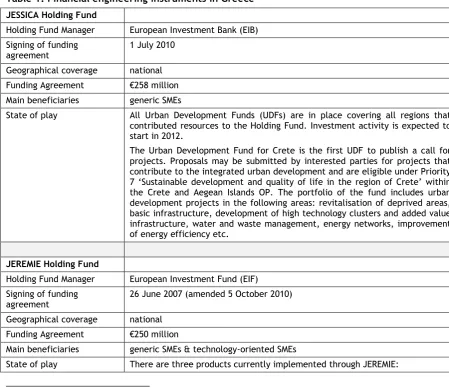
(22) Planning for the future while maintaining focus on spending Review of Programme Implementation – Winter 2011 - Spring 2012. began in December 2011, and in April 2012 an agreement was signed between the Bank of Environmental Protection and the beneficiary, the city of Tychy. The subject of the agreement is the project ‘Cultural Passage Andromeda’, which is the first JESSICA project in Śląskie and the fourth in Poland. The project will invest in the disused cinema ‘Andromeda’, transforming it into a dining and shopping centre, with space for a municipal art gallery, media centre and conference room. The investment is being made in conjunction with a project to revitalise Tychy old town and post-industrial degraded land in the area. For the realisation of this project the city will receive a loan of PLN4.5 million (€1.1 million). The value of the whole project is more than PLN11.4 million (€2.7 million). After selecting contractors, the work will take approximately 18 months. Substantial progress has also been made in the case of the three financial engineering instruments in Greece (see Table 1). Challenges include the extended consultations with many stakeholders and the complexity of the implementation system, but also the fact that the related COCOF guidelines12 were under amendment during the planning period for the instruments. Table 1: Financial engineering instruments in Greece JESSICA Holding Fund Holding Fund Manager. European Investment Bank (EIB). Signing of funding agreement. 1 July 2010. Geographical coverage. national. Funding Agreement. €258 million. Main beneficiaries. generic SMEs. State of play. All Urban Development Funds (UDFs) are in place covering all regions that contributed resources to the Holding Fund. Investment activity is expected to start in 2012. The Urban Development Fund for Crete is the first UDF to publish a call for projects. Proposals may be submitted by interested parties for projects that contribute to the integrated urban development and are eligible under Priority 7 ‘Sustainable development and quality of life in the region of Crete’ within the Crete and Aegean Islands OP. The portfolio of the fund includes urban development projects in the following areas: revitalisation of deprived areas, basic infrastructure, development of high technology clusters and added value infrastructure, water and waste management, energy networks, improvement of energy efficiency etc.. JEREMIE Holding Fund Holding Fund Manager. European Investment Fund (EIF). Signing of funding agreement. 26 June 2007 (amended 5 October 2010). Geographical coverage. national. Funding Agreement. €250 million. Main beneficiaries. generic SMEs & technology-oriented SMEs. State of play. There are three products currently implemented through JEREMIE:. 12. European Commission (2012) Revised Guidance Note on Financial Engineering Instruments under Article 44 of Council Regulation (EC) No 1083/2006, COCOF_10-0014-05-EN, revised version of 8 February 2012. Available at: http://www.oerok.gv.at/fileadmin/Bilder/3.Reiter-Regionalpolitik/2.EU-SF_in_OE_0713/2.9_Rechtsgrundlagen/6.COCOF/COCOF-10-0014-05-EN.pdf IQ-Net Review Paper 30(1). 17. European Policies Research Centre.
(23) Planning for the future while maintaining focus on spending Review of Programme Implementation – Winter 2011 - Spring 2012 (1) Funded Risk Sharing (total budget: €60 million). This product refers to loans (up to €250,000 per business) in micro and small firms (existing or recently established) which are seeking to develop and expand their activities. For this product the selected intermediaries (banks) will contribute the equivalent amount of public expenditure in order to share the risk and reduce the required collateral for the loans, while the lower than market interest rate is being considered. Two financial institutions (banks) have been selected (National Bank of Greece, ALPHA Bank) and the product is available in the market since February 2011. After amendments in the contracts between the banks and EIF the product was re-activated in September 2011. (2) Micro credits (budget: €30 million public expenditure and €30 million private funding). This product relates to loans up to €25,000 with terms corresponding to those of the FRSP. The contract with ALPHA Bank, which was selected, has been signed and the product is available in the market since November 2011. The product is addressed to enterprises of all economic activity sectors. (3) Funded Risk Sharing (FRS) for IT operations (budget: €90 million, of which 50 percent public). This is the only ‘banking’ product designed to be placed through the JEREMIE initiative. The type of product is not State guarantees, but actual cash on demand of a loan in areas of higher risk as the technology. The purpose is to co-finance business loans (investments loans) by Greek banks by 50 percent. The product is ready and available in the market since the end of February 2012 through three banks (Alpha Bank, National Bank of Greece, Emporiki Bank). Two more products (seed capital, early stage VC) have been designed; however they are not yet available in the market. Energy Savings in existing housing Holding Fund Manager. Hellenic Fund for Entrepreneurship and Development (ETEAN S.A). Signing of funding agreement. 4 August 2010. Geographical coverage. national. Funding Agreement. €241 million. Main beneficiaries. citizens with medium – low income. State of play. The instrument used is interest rate subsidies. The target sector are the houses built before 1989, located in areas with maximum cost €2,100€ per m². The majority of all 43,365 approved applications (November 2011) are recorded in the region of Kentrikí Makedonía (23 percent), followed by Attikí (16 percent), whilst in the islands (Ionian Islands, South Aegean Islands, North Aegean Islands) approvals vary from one to four percent. Based on information contained in the energy certificates, implementation of the 7,300 approved applications will lead to annual primary energy savings of 170 kWh/m², which corresponds to a 40 percent reduction of energy consumption. Total annual energy saving for 2012 is estimated at 200 million kWh based on the 12,000 mature applications (pre-approved).. In Sachsen-Anhalt, instead, uptake for the ESF Guarantee Fund (ESF-Garantie-Fonds SachsenAnhalt) has been slow so far. The fund provides guarantees on private bank loans for training. Likely reasons are the relatively high level of administration involved, i.e. compared with obtaining a normal bank loan without the ESF guarantee. In the Czech Republic and Poland, there have been moves to establish new financial engineering instruments.. IQ-Net Review Paper 30(1). 18. European Policies Research Centre.
(24) Planning for the future while maintaining focus on spending Review of Programme Implementation – Winter 2011 - Spring 2012. . In Śląskie, the managing authority has provided the ESF unit with guidelines on the use of financial engineering instruments. However, potential organisations who could manage the instrument are being discouraged by State aid issues and the level of management costs (a ceiling of four percent of total funding). Setting new indicators for financial engineering instruments is also expected to be challenging. Another challenge is that the usual ESF beneficiaries of the OP are accustomed to grant-based support.. . In the Czech Republic, there are preparations to establish a holding fund as part of the State Housing Fund. This requires amendments to the legal framework, which are currently debated by the government. The instrument will be managed by the Ministry for Regional Development, which is preparing methodological guidelines. In a next stage, an Urban Development Fund (Fond Rozvoje Měst) will be established under the holding fund. The Ministry for Regional Development as managing authority of the Integrated OP has carried out a survey amongst municipalities to gather information about absorption capacity. Results show that there is considerable interest, but take-up will depend on the available interest rates.. In some IQ-Net countries and regions there have been discussions about the implementation of financial engineering instruments in the future (France, Steiermark). In France, a number of regions are considering setting up instruments in 2014-20, and some have launched studies on the theme. DATAR is also launching a study on financial instruments to be finalised after the summer. The aim is to identify all existing instruments at regional level and related needs as well as the types of firms targeted. This will feed into the negotiations on Structural Funds and State aid. DATAR is also thinking of developing guidance on these aspects. In Steiermark, a study will be carried out on options to implement the JESSICA instrument in the future programme period. The instrument would be used to for urban revitalisation in small and medium-sized towns. In Vlaanderen, the reason for the interest in financial engineering instruments is that resources are expected to become scarcer in the future and hence other solutions need to be found in order to maintain funding streams viable. Measures could include no-interest loans and financing interventions that could create revenues. However, the plans are still at early stages. Some IQ-Net partner programme authorities continue to have reservations about the use of financial engineering instruments. Niederösterreich, for instance, does not plan to introduce such instruments in the future. Due to the relatively limited availability of funding in Austria, they would only see a nation-wide solution to feasible. A national fund could be managed, for instance, by the ERP Fund, which has experience with domestic support provided in the form of loans.. 2.2.4 Evaluation Several evaluations have recently been concluded (England, Finland, Latvia, Portugal, Śląskie ERDF, Vlaanderen, Wales), and the Annex provides an overview of all evaluation activities in IQ-Net partner countries and regions in the context of the 2007-13 programme period. In Wales, Priorities 1 and 2 of the ESF OP have been evaluated, and in Latvia, a major study on the impact of EU funds on the Latvian economy has been completed in December 2011. Finland finalised its evaluation of the ERDF management system in March 2012, while the thematic evaluations on innovation and business development are ongoing (until 2013). In Portugal, three evaluations have been concluded: the mid-term evaluation for the Madeira OP, an evaluation of vocational training for SMEs in. IQ-Net Review Paper 30(1). 19. European Policies Research Centre.
(25) Planning for the future while maintaining focus on spending Review of Programme Implementation – Winter 2011 - Spring 2012. Madeira, and an evaluation of the regulatory framework for the ESF. A closer look is worth taking at examples from England, Śląskie and Vlaanderen. . In England, the Department for Work and Pensions (DWP), managing authority for the national ESF OP, has published an evaluation of their co-financing arrangements during the first half of the 2007-13 programme period. English co-financing for ESF is provided by socalled Co-financing Organisations (CFOs), such as DWP and the Learning and Skills Council. DWP provides the required match funding using selected contracts already in place, which met EU administrative requirements – primarily the New Deal programme for the long-term unemployed and Pathways to Work programme for disabled people. CFOs are required to evaluate their CFO plans, and the report does this for DWP’s CFO Plans, by examining the contribution to relevant ESF output and result indicator targets through each DWP CFO Plan; how DWP CFO Plans sought to meet national and regional priorities; and how the ESF management structures and co-financing supported these objectives.. . In the context of the Śląskie ERDF OP, the results of an evaluation of financial support directed. to. enterprises. were. presented. in. December. 2011.. These. provided. recommendations about the most appropriate type of interventions for enterprises, mainly for the next programme period. Another evaluation, also concluded in December 2011, looked at the innovativeness of projects realised so far. The results suggested to increase advisory services; to emphasise the use of financial instruments; to allow projects to be joined under the Priority ‘Transfer of knowledge on innovation activity’; to direct investment towards enterprises in traditional sectors with a strong position in the region; and to increase regional knowledge on intellectual property management and protection. . In Vlaanderen, the mid-term evaluation report was adopted in October 2011. The study concluded that no changes are required at this stage. The programme should keep its focus and SMEs should maintain their priority status in the Programme. The prioritisation of cities remains justifiable due to their role in economic activity and relative high levels of social deprivation. Finally, the health sector has been identified as a key strategic sector by the Flemish government and therefore the Programme should explore whether this should have a more prominent role in the future programme period.. A range of evaluations are currently running (e.g. Denmark, Finland, Greece, Italian OP R&C, Nordrhein-Westfalen, Portugal, Scotland, Slovenia, Śląskie). In Keski-Suomi, a sub-region of LänsiSuomi, there is currently an evaluation of the region’s cluster-based development model. KeskiSuomi has been particularly active in developing a model for working in partnership between public authorities, companies and innovation and higher education institutions. The development of such a working model was based on the perceptions of regional actors that there are too many activities in business development and innovation sectors, which need to be coordinated better. The timing for the assessment of this working model has coincided with preparations for the next programme period of Centres of Expertise (CoE), the main regional innovation initiative implemented in Finland. In Nordrhein-Westfalen, the ERDF managing authority launched an evaluation of the competitive call procedure in January 2012. Competitive calls have been used in particular to allocate funds under Priority 2 ‘Innovation and the knowledge-based economy’. The evaluation is looking at all implementation phases, from the generation and design of the calls, through their implementation and to the payment phase. The report will be finished by the end of September IQ-Net Review Paper 30(1). 20. European Policies Research Centre.
(26) Planning for the future while maintaining focus on spending Review of Programme Implementation – Winter 2011 - Spring 2012. 2012. In Greece, there are ongoing evaluations in five regional OPs and four of eight thematic OPs, namely the OP ‘Accessibility Improvement’ (ERDF), the OP ‘Competitiveness and Entrepreneurship’ (ERDF), the OP ‘Education & Life-Long Learning’ (ESF) and the OP ‘Reinforcement of Public Administration Efficiency’. The results of these will result in revisions to the programmes (see Section 2.1.3). Other current examples include evaluations of innovation support (Finland, Italian OP R&C, Slovenia, Wales), effectiveness of communication activities (Czech Integrated OP, Scotland), unemployment support (Śląskie ESF), impact of the ESF OP (Denmark), tourism development (Slovenia), implementation barriers (Czech Integrated OP) and support to entrepreneurs and businesses (Finland ERDF, Śląskie ESF). Looking into the future, planned evaluations include themes such as territorial cooperation (Wales) and local delivery models (Scotland). In England, the managing authority CLG is planning to undertake an England-wide evaluation of the ten ERDF programmes to assess programme performance. However, the Czech Integrated OP managing authority plans to carry out fewer evaluation activities compared to previous years. However, one of the key evaluation activities will be to provide input for the Czech Strategic Report 2012. Also the Italian OP R&C plans to reduce their number of evaluations from 11 to nine; their evaluation plan is currently under revision. In several countries, evaluation activities were delayed (Czech Republic, Greece, Portugal, Spain). In Greece, the time-consuming administrative processes have delayed the contracting of the evaluators for some of the country’s thematic OPs. Portugal reports delays in gaining authorisation for procurement of evaluations due to budgetary constraints, which affected the launch of most of the country’s mid-term evaluations. In the Czech Republic, the results of the mid-term NSRF evaluation were expected for autumn 2011, but there have been delays due to capacity issues with the external consultant working on the report. Finally, in Spain, the planned evaluation on research and innovation has been delayed. This is partly due to management changes, the election of a new government, the small size of the evaluation team and the delayed launch of the programmes. Accordingly, the timeframe was extended from the end of 2011 to the summer of 2012 and the scope was altered to focus more on the OP ‘Research, Development and Innovation for and by Enterprises - Technology Fund’ and to address financial implementation problems. Nevertheless, some preliminary results were presented to the second RTDI network which took place at the end of April 2012. In the Czech Republic and Portugal, national-level evaluations will feed into the Strategic Report 2012 (see Section 2.2.5). In the Czech Republic, a meta-evaluation of all evaluations so far is being prepared by the National Coordination Authority. The aim of this evaluation is to gather knowledge about the quality of evaluation outputs and trends in the evaluation culture. The Czech evaluation market has been experiencing increased competition, resulting in prices being too low for some established and experienced evaluation companies. As a result, some evaluators refrain from participating in some tenders, which means that valuable experience in evaluation is not used. In Portugal, following the approach in 2009, a ‘global strategic evaluation’ of the NSRF is currently being launched. The objective is to assess four themes and to provide evidence of what works well and what does not. This will also contribute to the preparation of the 2014-20 programmes. The themes are connected to Europe 2020: early school leaving; innovation, research and firms; environment and energy efficiency; and social inclusion. A new tendering approach is used, which IQ-Net Review Paper 30(1). 21. European Policies Research Centre.
Figure
Related documents