scotregen
Scottish UrbanRegeneration Forum
sharing experience : shaping practice
In this issue:
• Working Together – page 1 and 3
• Football and Regeneration – the second leg – page 4 • Rural Policy Review Summary – page 6
• Arts and Assets – page 8
• Sustaining Employment – page 10
• Challenges and Opportunities for Housing Associations – page 14 • Community Development and Wellbeing – page 14
plus links, reviews, language and numbers in regeneration.
issue 42 : summer 2008
continued on page 3
Two of the SURF Award winners for 2007 are 270 miles apart, one in Glasgow’s east end and the other on the most northerly tip of mainland Scotland. Despite this, they have formed a very successful partnership. Their shared experience shows that good community regeneration practice works, regardless of the setting.
SURF is helping to ensure that their inspiring success will be highlighted at the upcoming UK Regeneration
Convention which is to be held in Scotland for the first time in September this year. SURF is supporting the convention which is currently being organised by a
committee chaired by Paul Ballantyne of the Government’s Scottish Centre for Regeneration. For more details on the plans and booking arrangements, please visit
www.regerationconvention.co.uk.
Meanwhile, for Scotregen readers, Pulteneytown Peoples Project (PPP) co-ordinator Katrina McNab outlines how two community projects, hundreds of miles apart and in very different settings, struck up a winning partnership.
Inspiration
Glasgow’s Bambury Centre was the inspiration for forming a community group in Pulteneytown. I had visited the project when I worked for Citizens Advice Bureau (CAB). I was particularly interested because I was of the opinion that Pulteneytown in Wick was an area of deprivation (although not designated as a SIP area) and I
wanted to see what the Bambury had to offer. Over coffee, the Bambury co-ordinator, David McDermott, explained how they started and got to where they were.
Having already published two Social Policy Reports highlighting local issues through Caithness CAB, I decided to hold a local public meeting to gauge interest in forming a community group. I arranged for David to come up and speak to the public about the Bambury project and the effect it had on the community. He brought some of the Bambury local directors to meet some of our directors and they were able to network and learn from each other. We commissioned the Bambury Centre to organise a community consultation for us and the co-operation blossomed from there.
Shared vision
We have continued through the last four years to work together. I arranged for six of our directors to go down to the Bambury so they could get a ‘vision’ of what we could achieve and staff visited to share insights and information. Representatives from our local housing association, Albyn Housing Society Ltd, have also visited the Bambury to see what can be achieved by a community group. We continue to share information and advice, hitting ideas off each other whenever necessary.
Katrina McNab
Pultneytown Peoples Project
katrina.mcnab(at)btconnect.com
A view from the chair
Ian Wall SURF Chair
Welcome to the Summer 2008 edition of
scotregen
, our 42nd edition.
The purpose of this quarterly journal is to use SURF’s independent position to raise discussion and debate about important developments in regeneration policy and practice. Scotregen is part of SURF’s regular output of publications, events and discussions aimed at supporting more successful and sustainable regeneration efforts in urban communities across Scotland. There are many interesting articles in this issue of Scotregen, including those on:
• Football and Regeneration • Rural Regeneration • Sustaining Employment
• Challenges and Opportunities for Housing Associations • Community Wellbeing
A recent policy development would seem to potentially have an impact on all of these regeneration concerns.
What’s the Hub, bub?
Scotregen has been interested in following the development of the Scottish Government’s ‘Hub’ initiative since early 2006. We published an article on it in Scotregen in the early summer of that year as the proposal began to emerge form the policy field of the then Scottish Executive. Readers can see this article on page three of Scotregen 34 via the SURF website.
Scotregen understands that the Hub policy has now been publicly launched at a conference at Riccarton in Edinburgh last month, where John Swinney also updated delegates on the Scottish Futures Trust. The resulting media interest seems to have been mainly on the Trust and how different, or not, it is from PPP and PFI. However, the Hub appears to have the potential for much greater impact on planning and regeneration processes and outcomes.
This is a policy that should be of considerable interest to anyone concerned with regeneration in Scotland and we plan to give it some extensive coverage in the next issue of Scotregen. At the time of writing the most relevant links on the government web site seem to be:
http://www.scotland.gov.uk/Resource/Doc/924/0034039.pdf
http://www.scotland.gov.uk/Topics/Health/care/JointFuture/HUBinpractice
Your feedback on any of the above, or anything else you think we should be looking at in future editions of Scotregen, is always welcome. Just email me at andymilne(at)scotregen.co.uk Andy Milne
SURF Chief Executive
Editorial
Listening, learning and acting
'Listening' is very popular at the moment. Commercial and social organisations, most particularly, political parties are falling over themselves (and occasionally each other) to reassure us that they are committed to listening. The difficulty with this expression of interest is that the experience of those on the ground, or more clearly at the receiving end, is that it is a one way track.
What is required is an engagement with all the parties listening and speaking. Such a dialogue is essential for SURF members whose commitment to the well being of those who have had the thin end of the stick for too long is a practical one of activity on the ground day to day and whose experience and knowledge should play the major part in determining policy.
SURF tries to assist in this by establishing the means for worthwhile dialogues, horizontally for sharing and understanding for common benefit, and vertically to try and establish the conditions through local and national government action to change and improve the institutions and structures within which we work. One of the horizontal and vertical conversations
current in SURF is the question of health and its centrality to our regeneration activity, and as a fundamental measure of success or failure. Recently Harry Burns, Chief Medical Officer for Scotland, gave a
presentation to the SURF Board, drawing upon his widespread research and experience, on the effect of conditions, common to regeneration areas, on health, and particularly on children. Some of it can be gained from his annual report for 2006 (http://www.scotland.gov.uk/publications/2007/11/15135302/3). There are immediate effects of poor child health in terms of the
considerable strain it puts on parents and carers. Even more important is the lifelong impact of poor physical or mental health in the early years of life on the potential that child might have achieved.
We must think of health and well-being holistically as not just the absence of disease, but the positive presence of physical, mental and emotional well being, the capacity to function independently of society, form satisfying relationships, feel a purpose in life, cope with adversity and have hope and resilience
The conclusions for action that need to be urgently drawn from the detailed analysis that identifies the causes will spark considerable debate but the listening and talking can only be justified if it leads to early action within our communities.
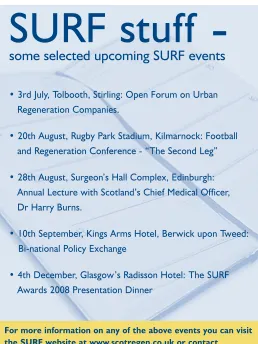
SURF Lecture - Scotland’s Chief Medical Officer, Dr Harry Burns, will deliver the SURF 2008 annual lecture on the afternoon of August 28th in Edinburgh on ‘the biological consequences of deprivation’. This event is free to all SURF member organisation contacts. Specific details and invitations will be sent to them soon.
Government Report - visit the SURF website at
Benefits of the collaboration
Directors and staff from both projects have forged a great relationship based on their shared aim – to actively support change and
improvement within the area where they live. We have been able to discuss ideas and bring these to fruition by providing a service that brings real and relevant benefits to our area. These have included a Learning Centre with Learndirect Scotland courses, childcare provision and supportive approaches to external evaluation. We send our childcare workers there on secondment to learn from their more established service.
They learned new ideas as well as reaffirming that they were doing things right. Our Bambury colleagues have also acted as a sounding board for the progression of our Community Centre vision.
Same difference
There have been many similarities despite the rural area and city community contexts. The directors who have taken forward the ambitions and dreams of the community in both cases, have been local people who live, work and have families in the area.
Despite their different experiences of place, the people from our Pulteneytown group have connected well with folks from the Bambury. There has never been any awkwardness because we all had something in common, we all cared for the areas that we lived in and share strong connections to our communities and their history and culture.
Both areas have hard-to-reach young people, often with low self esteem and confidence and little in the way of opportunities. Both have ‘territorialism’ between local young people don’t want to go out of their community for services. Both lacked services and amenities within their community, and lack of affordable, quality childcare was also an issue.
There were many differences as well – many young people who lived in Pulteneytown had not seen much outside their community. It was 21 miles to the nearest Cinema and bowling alley, 104 miles to the nearest shopping centre, McDonald’s, Theatre or ice rink and 100 miles to the nearest University campus. This tended to limit their aspirations as they had not had the opportunity to ‘experience’ these activities, and therefore did not know what was out there.
PPP were in a fortunate position in that we were involved in many sub-committees run within the community to raise concerns and be involved in the strategic development of the area by other partners. We were a partner in the Community Safety Group, and were involved in the sub group Vandalism Action Group and CCTV. All of these groups were involved with the Community Regeneration Fund Group (CRF). This was administered for the Highland Council by Caithness
Partnership, a very successful alliance that was unique to our area. Through this partnership we were able to discuss what we wanted to achieve, and use CRF funding as a lever to attract further funding to achieve our outcomes.
We have recently managed to have a CCTV system installed in the housing estate to minimise crime and maximise the ‘feeling’ of being safe. The Housing Department and the Police have carried out a detailed ‘Environmental Scanning’ of each street in the CRF area and £10,000 was used to improve the issues prioritised. By working in partnership with Albyn Housing Society Ltd we were able to then use this report to secure more than £200,000 to provide ‘street scaping’ CCTV and Community Arts (commissioned to Gorbals Art Project) to improve the aesthetics of an area, recognised as a priority in that report.
Looking forward
For any community project to have success they have to be a ‘partner’ at a ‘strategic level’ to enable these strategies to impact at a local level. Statutory agencies need to look further than sustainability and measure the outcomes that can be achieved. Sometimes their measures are too specific and they need to be able to find ways to measure the holistic approach that community groups like ours are able to take. A holistic approach gives you the capacity to tackle unemployment, community safety, education and health through a variety of measures and service delivery.
We have enjoyed working with over a hundred partners since we started. However, our collaboration with the Bambury has been without a doubt the most ‘intense’. It has involved both directors and staff forming a good working relationship with a similar project some 270 miles away. We have found inspiration when looking for ideas, support when we have felt ‘let down’ and shared knowledge which has been of huge benefit. I am sure that this long standing relationship will continue to develop through the years to come.
Katrina MacNab and Kevin O’Toole have had their work published on Community Governance and Partnerships in ‘The Theory and Practice of Local Governance and Economic Development.’ Edited by Mark Considine and Syvain Gigure published by Palgrave (ISBN 978-0-230-50060-0).
Worlds apart - working together
Continued from page 1
SURF Awards for Best Practice
in Community Regeneration 2008
Timetable
July
- Applications open
26th September
- Deadline for submissions
October
- Judges visits
4th December
- Presentation Dinner at Glasgow’s Radisson Hotel
To reserve your table at the awards dinner contact
derek(at)scotregen.co.uk
On the 14th of August 2007, a SURF and Social Enterprise Institute conference considered the positive contribution that Scotland’s professional football clubs make to place based regeneration and how that might be consolidated and promoted. Whilst last year’s event focused predominantly on the
professional clubs, the plan was always to have a follow up event to look at the contribution of voluntary football activity.
In this article, Alan Miller, of PMR Leisure, outlines how community clubs and local authorities can make the most of their shared goals.
Professional interest
Last year’s Football and Regeneration conference identified that: • professional football in Scotland can be a force for considerable
good
• football is already a significant contributor to social and place based regeneration
• football clubs have much to gain from greater involvement in the development of their communities.
It was also noted that some of the community work being taken forward by the professional game was based on ‘enlightened self interest’ or in the interests of chasing funding streams linked to government related initiatives, such as education based programmes that use sport as a carrot to attract participants. Furthermore, with only 42 professional clubs in the country and the level of community engagement being mixed, or even non existent, the impact of the professional game is limited in the context of social regeneration.
It is also worth considering what communities throughout Scotland think of their clubs when one considers the problems faced by clubs in recent years and how in times of crisis clubs turn to the
community for help. Recent years have seen Clydebank Football Club drop out of the Football League, Airdrieonians Football Club having to reinvent itself as Airdrie United, Motherwell Football Club going into administration and out again and the most recent case of Gretna Football Club being placed at the brink of extinction. If these clubs were ‘a force for good in their communities,’ why was it that they were allowed to deteriorate to the positions they each found themselves in?
In all the publicity surrounding the demise of Gretna Football Club very little, if anything, has been said about the community programmes delivered by the club that provided football
development programmes, physical activity programmes and healthy lifestyle programmes etc. free of charge to the end user in the communities of Dumfries and Galloway and Cumbria. How have these services and the associated employment opportunities been replaced at community level and why has the community not been more vociferous in its concerns about these services disappearing?
Community club
If football at a professional level is truly to fulfil its potential in making a social regeneration contribution then perhaps it could learn from the many excellent examples at community based club level. Such community clubs, e.g. Junior Football Clubs and Youth Football Clubs, can act as a hub for towns and villages throughout the country and provide opportunities for volunteering that can help in relation to skills development. Such skills could be in the area of coaching, officiating, administering and social skills that raise self esteem and improve confidence that can eventually lead to individuals into employment or enhance their current employment status.
Local authorities should be looking at opportunities to deliver local objectives around regeneration through community based clubs as part of the relationship between the two parties. The provision of facilities, for example, provides an opportunity for local authorities to attach criteria to lease arrangements that require social regeneration objectives as part of the club’s purpose and opens the doors of such facilities for wider community use. In working with some sports clubs, however, it is important to remember that they will not all welcome the ‘opportunity’ to make a contribution and some will have more limited horizons.
In considering the role of sport in social regeneration, it is also important to be aware that, in general, those most likely to participate in sport are from higher socio-economic groups.
The contribution of footb
Alan Miller Senior Consultant, PMR Leisure
Furthermore, the limited inclusivity of sport, especially amongst women in socially and economically deprived areas, raises significant questions for the nature and extent of sport’s role in strategies of social regeneration.
If football is to make a contribution to the social regeneration agenda, football stadia (and the clubs) at professional and community level need to be seen as the focal point of the community. This will involve opening up membership at community level and sharing facilities (there are too many one team clubs in Scotland where facilities lay idle for large periods of time). If football can overcome such hurdles and make a contribution then it would be in a great position to argue at national and local level that such a contribution to social
regeneration/justice, health, homelessness, education, crime reduction etc. should attract greater investment in facilities/pitches.
It is the view of PMR Leisure that football at a community level will need support if it is to make a contribution to social regeneration. Community football relies heavily on the commitment of volunteers who, in the main, will not be aware of the potential of their club(s) in this context or indeed of the fact that they are already
delivering such outcomes.
There are, however, positive examples that we can learn from with Broxburn United Sports Club in West Lothian working with their local authority to develop facilities on the site of the local junior football club creating a membership of around 650 providing opportunities for the Broxburn community to take part in sport and create a social centre where regeneration will be a natural consequence.
But football, even at community level, needs to consider whether it is in the business of delivering social services or competitive and successful clubs or whether it can, in fact, deliver both?
A GREAT SAVE
ball to social regeneration
Dunfermline Building Society’s Community Development manager, Ken Dow gives Scotregen an update on their
Soccersaver scheme which seeks to improve financial inclusion by linking savers benefits to their favourite football club.
Dunfermline Building Society, in conjunction with Soccer Savings Limited, now have 17 of Scotland’s leading football clubs on board, including both Celtic and Rangers. Around 15,000 signed-up to affinity savings accounts have been opened with a total of nearly £30m in balances.
Ken says ‘These accounts are proving so popular because they pay a competitive rate of interest for fans and an additional income flow for the clubs. This can be used for a variety of purposes, including youth development and improvements to various club facilities.’
For more details see
www.dunfermline.com/soccersaver
Ken Dow Senior Manager, Community Development, Dunfermline Building Society ken.dow(at)dunfermline.com
Football and Regeneration
– the second leg.
A place for community football?
A SURF conference
Date: Wednesday 20th August 2008, 10am-4pm.
Venue: Rugby Park Stadium, Kilmarnock
This event is a follow-up to SURF’s successful 2007 Football and Regeneration Conference, and will focus on supporting the regeneration contribution from
OECD REVIEW OF RURAL POLICY IN
Martin Hilland
Consultant,
Westport Consulting
martinhilland(at)westportconsult.net
In 2006, the then Scottish Executive invited the
Organisation for Economic Cooperation and Development (OECD) to review rural policy in Scotland. It published its report in late February 2008. In this article, regeneration consultant Martin Hilland offers his take on the report’s main findings.
The OECD ‘…brings together the governments of countries committed to democracy and the market economy … to: • Support sustainable economic growth
• Boost employment • Raise living standards • Maintain financial stability
• Assist other countries' economic development • Contribute to growth in world trade.’ (www.oecd.org)
Key Findings
On average, incomes and health indicators are significantly better in rural Scotland than in the rest of the country. While there are a large number of people without formal educational qualifications, rural Scotland has the highest levels of University level educational attainment of any OECD rural region. Unemployment is lower than in urban areas but so are average incomes. In 1998-2003, some parts of rural Scotland
(Inverness & Nairn, West Moray, Badenoch & Strathspey and Caithness & Sutherland, Ross & Cromarty) had economic growth rates comparable with the fastest growing urban rates (over 5% per year). At the other extreme, Orkney and Shetland’s economies shrunk.
Accessibility to and from urban areas is a key factor. In ‘accessible’ rural areas, the population is growing. In more remote areas, it is often ageing and falling. The following table summarises the OECD picture. A large proportion of the weaknesses they identify are related to issues such as housing, transport and education. Each of these is largely driven by national policy. None of the threats are self-limiting. All will get worse in the absence of intervention or policy change.
RURAL SCOTLAND'S STRENGTHS & WEAKNESSES
Far reaching change
The report is complimentary about the level of attention devoted to rural issues but far-reaching change is now needed, specifically: • better policy integration around a unified vision
• less concentration of subsidies on agriculture and related environmental management
• greater focus on economic and social issues and on links between the environment and (eg.) tourism.
It sees the current policy regime as disempowering and diversionary at local level:
‘The current, largely EU-driven, system of design of rural policy does not truly engage local leaders and foster creativity and innovation but rather fosters ‘subsidy mentality’… local actors adapt to top-down strategies to get resources, even if that is not exactly what is needed in their territory.’
Recommendations
The report’s core recommendation is that:
‘Scotland needs a distinct, integrated rural development policy, with a decentralised area-based delivery system…a stronger coordination of sector and territorial policies …and reinforced, place-tailored approaches’.
It identifies key priorities as:
• Addressing the shortage of rural housing and the increasing demand for space for multiple uses by directly tackling the rigidity of land use regulations
• Delivering quality education, meeting the healthcare needs of an ageing population and bringing improvements in transport • Looking beyond agriculture for economic development and
diversification
• Making the most of niche tourism, forestry, energy and support business though education, technology and business services. It also argues that there have been many successes in the Highlands and Islands and that it now appropriate to pay more attention to the problems of the South of Scotland
Implications
The report’s key priorities need new national policies,
decentralisation and the growth of local leadership. At local level, some of these issues are deeply divisive.
WEAKNESSES
Low & stagnant income levels in some remote rural areas
High cost of living
Housing scarce & expensive Transport Access to services Low skills & low productivity
Dependence on agricultural subsidies
STRENGTHS
Abundant land
Strong natural resources Culture High standards of living Stable & diverse economy
Good employment levels Strong entrepreneurship
THREATS
Depopulation Ageing Service levels Reform of CAP & EU
Structural Funds
OPPORTUNITIES
Population growth In-migration
Tourism Renewable energy
Sustainability is a good example. Renewable energy is now on the agenda and food security should soon join it. Scotland’s land, wind and water could help it address these very effectively but this requires understanding of international markets, a strong national vision and a will to act decisively. At local level, national sustainability may seem less important than the local cost. This is not only due to parochialism.
There are three reasons for this.
1) First, sustainability is not a permanent state of safety. Rather it is about having a capacity to influence and embrace change and benefit from it. It cannot promise anyone that things will get back to a stable and comfortable state. However, resisting change may be the strongest local motivator.
2) Second, success generates its own problems. For example, net in-migration or generating energy from renewable sources have consequences for housing, visual change and local culture which may generate conflict. This is probably not a bad thing.
Controversy may simply indicate that someone is trying to solve a problem.
3) Third, small is not big enough. Local responses to economic change are usually too feeble. For example, few community businesses trade more than a few miles away from their base. Where they are established to meet a local service need, they are unlikely to aim to expand their operations, even if they can generate the cash surpluses necessary to fund expansion. Valuing instability, conflict and scale is not popular. Much of the discussion around community engagement assumes that common interests dominate local affairs. This may be true as long as initiatives are small and threaten no-one. As soon as they are big and possibly effective, they threaten someone’s wealth, someone’s prejudices or the view from someone’s living room window. Anyone managing a large local initiative needs to understand conflict and leadership as well as they understand the balance sheet. Capacity development needs to mean more than meeting national standards or matching best practice. It needs to equip people to understand the strategic cards which their community has been dealt and to pursue opportunities as they emerge.
Getting Ready
To sum up the argument, rural policy change needs effective local delivery. Any initiative which is likely to be truly effective will generate controversy. Accept this and prepare for it. Below, we suggest four initiatives which would start the preparation.
Mobilising Public Assets
Rural Councils would be required to assemble a unified register of publicly owned land and buildings and develop a strategy to mobilise these behind economic and social development. A local vision would need to be developed. Once this was agreed, no change of use or change of ownership would be ruled out, if it
contributed to delivering the vision. This initiative could certainly generate opposition and there could be genuine practical
difficulties. An initial pilot project, however, could identify many of the pinch points and contribute to understanding how local consultation would work.
Local Organisation
Three kinds of local organisations need to evolve.
1) Local representative organisations. These would exercise specific powers devolved from Councils. If development controls were lighter, should such organisations exercise them? 2) Service organisations. These would provide social, care and
health services under contract to Councils and others. They could offer 2 kinds of social benefits:
• Locally based, flexible services, which otherwise might not exist • Opportunities for employment or self employment for people
suffering various forms of disadvantage.
3) Development organisations. These would carry out or support physical and economic development projects. They would have a particular interest in linking with medium and large firms and integrating the local economy with wider markets.
Governments and Councils would require a lot of these organisations in quality, energy and probity. One successful precedent is the regulatory and support regime surrounding housing associations. New associations have to go through a development process leading to registration. Thereafter they operate in an environment of regulation, operating standards, benchmarking, and internal audit. Extensive training is available for staff and board members. They are far from perfect but they have broadly achieved what they were set up to do, with few scandals or disasters.
Building Momentum
The situation requires new forms of local organisation and new forms of local, council and government co-operation. Above all, it needs a new attitude – pro-change, pro-development and looking for allies and opportunities. Attitudinal change would be one of the issues addressed in the pilot project. A group of potential leaders could be identified and developed while the policy changes were put in place. These people would come from public, private, voluntary and community worlds. Some of their training needs would vary but there would be a central core to the course – an ideology – around a pro-change agenda.
European Links
The report argues that rural Scotland is developing links with other rural areas. We suspect that this has not spread widely. Ryanair and Easyjet have opened up many European cities to Scottish people but, once there, few people go beyond tourist destinations. A regional twinning initiative would widen awareness. Specific UK or other EU regions would be identified on the basis of the opportunities they offer for learning or for business. The link would be time-limited to perhaps 3 years. Contacts would be structured and opportunities would be targeted at (e.g.) community activists, junior and middle level staff or sectoral groups (artists, cheesemakers, outdoor holiday organisers …). Secondments, intern placements and study would all be supported. All would be linked to language training.
Conclusion
The OECD view of rural Scotland is penetrating. It can contribute to significant change if government, councils and local organisation all evolve to deliver its proposals. The prize is a pro-growth consensus which welcomes local development and integration.
The full OECD paper is at
http://www.ruralgateway.org.uk/item/2167
SURF recently worked with Highland and Islands Enterprise to highlight the potential of the Growing Community Assets fund which they are managing on behalf of the BIG Lottery Fund in Scotland (see page three of the last issue of Scotregen).
Out of the Blue (OOTB), a successful arts/community regeneration organisation operating in Edinburgh OOTB was awarded funding from the Big Lottery’s Growing Community Assets in February 2007. It was the first urban city based organisation to receive this funding in Scotland. Here, Rob Hoon, Co-ordinator of OOTB, summarises the journey to date.
From its inception in 1994, OOTB has been about providing opportunities for artists and people who face barriers to creativity to meet and learn. OOTB has now established a reputation as an independent, dynamic and innovative social enterprise and is viewed as one of Scotland’s leading community, cultural and arts development organisations.
The art of regeneration
In 1996, OOTB converted a derelict former bus garage to an arts centre in New Street, a neglected part of Edinburgh’s Old Town in the Waverley valley. This became a hotbed of creative activity encompassing studio, workshop, rehearsal,
performance, exhibition and café space. This investment regenerated the area bringing, over the course of OOTB’s tenure, thousands of people into what had been seen as a deserted ‘backwater’.
In 2002, OOTB purchased the B Listed former army drill hall in Dalmeny Street, Leith and obtained change of use planning permission and listed building approval for the development of an arts centre and ‘community anchor’ for the regeneration of the area. The development of the Edinburgh waterfront of which Leith is a part is the largest physical regeneration project in terms of spend in the UK and is one of the largest in Europe. However, Leith also obviously has many people affected by poverty and lack of opportunity. The majority of the OOTB
staff team lives in the Leith Central Community Council area in which the Drill Hall is based, and are totally committed to the community and cultural development in the area. OOTB is integrating opportunities to participate in the arts into the local infrastructure, acknowledging the demographic, social and cultural history of the area they live and work in.
Having secured a resource that is rich with potential, OOTB embarked on a mission to further transform and restore the Drill Hall into an inclusive participatory arts centre. The newly built studio facilities within the Drill Hall are accessible and custom built to reflect artists’ requirements. In addition, OOTB have created a flexible rehearsal /workshop, an exhibition and performance space and a community café all housed under the fantastic steel girdered glass roofed atrium. Since it has been open, the Drill Hall has had a huge variety of activity within it from the annual Radical Book Fair, to the Gallery 37 arts training workshops with 60 young people. Participation in the Leith Festival has cemented OOTB as integral to Leith’s cultural infrastructure
OOTB is now a burgeoning social enterprise, housing over 70 artists and thirty other creative and cultural companies. Prior to OOTB’s investment in Dalmeny Street, the number of businesses based in the street numbered only five. From this starting point of regenerating a building and assisting the community to grow its business base, OOTB has now focused on resourcing the greatest asset of Leith – its people.
Enterprise, education and training
In April 2007, The Drill Hall Arts Café was established to provide training opportunities to young people from the most disadvantaged areas of Leith. The project is offering a route into training for those who have not been motivated or had the experience to take up standard catering employment. OOTB have ensured that the training has had the necessary rigour without being mundane and soul-destroying. It has provided an accessible and supportive route into work for young people who were not ready for the mainstream job market due to their lack of qualifications and other circumstances, and whom other employers were unlikely to employ.
The training encourages the gaining of skills, confidence and experience to enter employment or further education. The project has been developed in partnership with The Port of Leith Housing Association through the Training Opportunities in Leith programme (TOIL). Where appropriate, OOTB have also organised literacy and numeracy training through the CLAN project.
Lucy Robertson, OOTB’s first trainee from the Fort area of Leith, says:
“Everything that I’ve learnt here is going to help me so much in all my other jobs and life. When I first came here they all treated me with respect - like an adult and not a kid. Before I started working here I was like I’m never ever going to be good at anything, but now I’ve worked here I’ve had a really good confidence boost and it’s helped me so much and I can do things that I never ever thought I would do. I’m going to try my hardest to go somewhere in life”.
Environmental regeneration
In 2005, OOTB initiated the ‘Park Life’ project which has now involved hundreds of local people attending action planning meetings, creating an exhibition, attending events in the local park and completing a survey on their aspirations for the improvement of the park. Local people are currently working in partnership with the City of Edinburgh Council on the redesign and refurbishment of the park. This is happening
Out of the Blue – Growing
Rob Hoon Out of the Blue
rob(at)outoftheblue.org.uk
through the establishment of the over 100 strong membership of the OOTB initiated ‘Friends of Dalmeny Street Park’. The project was initiated by OOTB in response to a needs survey undertaken by the local development project and the continued discussion of the park at Community Council meetings. The park is a cherished but neglected space in amongst intensive housing. Park Life is an example of how working with artists through a creative process can animate people into learning and community involvement and has been cited as an example of good practice in community
engagement.
To this end, OOTB acknowledge the importance of the intrinsic life of the community where people get involved in various activities because they are enjoyable and meaningful to them in their own right. How these networks and alliances develop, how people become involved and develop local organisations, is the basis of social capital. OOTB recognise that working creatively using the arts is something that can help form community; it doesn’t just act within it.
Activity around this project now includes:
• Streetlife: working with partners to engage with young teenagers who use the park as a hang out space and to involve them in the production of a magazine to have their say about the park. The outreach project is a result of OOTB working with partners from Capital City Partnership,
Streetwork, and Port of Leith Housing Association and has spawned a resurgence of cross agency work with young people in the local area.
• Play Park: Working with partners from Lorne Primary School and City of Edinburgh Council to involve pupils in creatively planning and creating a new play park and the development of a programme of environmental activities.
• Community Greenspace Project: Working with funders Scottish Natural Heritage, arts specialists Lise Bratton and Graham Murray will involve a mixed age range group to design and create planters for the park and an environmental education project for young people.
• Sports facilities: Working with Leith Neighbourhood Partnership to establish improved sports facilities within the park and will work with Streetwork project to run a series of qualified coaching courses.
• Events: A series of events in the park such as the Leith Festival celebration featuring, sports, plantings, music, and poetry
The Park Life project utilises the café, exhibition, workshop and meeting space within The OOTB Drill Hall.
Cultural Regeneration
As well as attracting internationally acclaimed artists to rehearse and perform at the Drill Hall, OOTB consistently develops projects which uses the full range of artforms (music, dance, photography, video etc) to engage with people and to produce a platform for their voices to be heard.
This focus on working directly with local groups by providing education and training opportunities as well as the opportunity to have their voices heard complements the Drill Hall
programme of workshops, classes and events. OOTB is also now developing another studio base in
Portobello and has established the Drill Hall as a venue for the Edinburgh Festival and Fringe. Here again, the commitment to working with the local community to develop cultural
opportunities is a highlight of OOTB’s work. In 2005 and 2006, over 100,000 people attended the inter-cultural
Edinburgh Mela festival in Leith, programmed and produced by OOTB. OOTB aim to connect people to ongoing opportunities to participate and become an audience for a variety of artistic initiatives. Current partnerships include a visual arts project entitled ‘Parallel Lives’ with the National Gallery of Scotland and a consortium project aimed at working collectively with the arts projects based in Muirhouse, Wester Hailes, Craigmillar and South Edinburgh.
Asset Development
Historic Scotland and The Big Lottery Fund provided vital grant funding matched by finance from OOTB’s own resources to repair and renovate the external fabric of the Drill Hall. This essential work will compliment the next stage of refurbishment within the Drill Hall which will create an additional 3,000 sq feet of studio space, a community sculpture garden and another workshop space to enable vital project work to expand. OOTB addresses many local and national strategic objectives and substantial regeneration benefits flow to the local area from OOTB’s development.
The organisation has grown from an asset base of zero in 1996 to over £1.4 million in 2007. The assets of the Leith community are consequently growing!
If you want to be associated with OOTB’s work and invest in the next phase of refurbishment contact Rob Hoon on rob(at)outoftheblue.org.uk.
Community organisations have until 1st August 2008 to submit an outline proposal for the Big Lottery’s Growing Community Assets fund. Information and forms are available from www.biglotteryfund.org.uk/Scotland or by calling 0845 606 1199.
the assets of a community
photo by R
ob Hoon.
photo by R
Sustained Employment
SURF has an interest in efforts aimed at supporting genuinely gainful employment (See Scotregen 39). In this article, former Jobs Strategy Evaluation and Research Officer at Edinburgh’s Capital City Partnership, Stephen McMurray, outlines his view on some of the challenges in keeping new workers and returners in work, and some of the measures that can be taken to support them.
The national picture is that of the 2.4 million Jobseeker’s Allowance claims made each year over two-thirds are repeat claims. Over a fifth of people who leave benefits and enter work return to Jobseeker’s Allowance within 13 weeks, and 40% are back on benefits within six months.
The UK Government has set a national target of an 80% employment rate (as of March 2007, the UK employment rate was 74.1%). It is generally accepted that many people in our country live in a cycle of low skilled, low paid jobs and unemployment. Critics point to the government being more concerned with programmes which assist people getting into employment, rather than ensuring people sustain and progress in employment. Without people sustaining employment, it seems unlikely that the UK Government will meet their 80% target.
Generally, the focus on sustained employment is in relation to those people who may leave work to go on to benefits in the first few weeks/months of their employment. In addition to not meeting the 80% employment rate, there are significant reasons why society should be concerned about people not sustaining employment, for example in people (and their children) not escaping poverty, increased benefit costs, reduced income tax collected, and increased costs to employers in terms of staff turnover. Some groups are well recognised as having difficulties in sustaining employment – the long-term unemployed, the low skilled, people with health problems, lone parents, ex-offenders, and people with a history of substance abuse. Furthermore, research undertaken by the DWP showed that a major consideration for people returning to benefit is that the jobs they achieve are temporary. Those workers with low skills and a history of long-term unemployment have a high likelihood to move into entry level positions in sectors with a high turnover rate. Therefore, there is a need to consider the quality of jobs which are available and how to improve them.
Many of the UK’s employment policies now include a focus not just on work preparation and job entry, but also on job retention. For example, the DWP Commissioning Strategy is looking at a payment strategy of six months sustained employment, instead of payment on job entry.
So what are the most effective ways forward? Aftercare Strategies –
These can either be developed through existing programmes and projects, or through new programmes designed specifically for sustaining new entrants to paid employment who are identified as being at risk of not sustaining for a time period. Such programmes would need to develop an effective system of working with a range of services which could best provide the most appropriate provision for particular issues.
Contract Management –
There is scope to base job outcomes payments for providers of
employability services on sustained employment at six months, rather than just for a job entry, thus shifting more emphasis on these providers to assist their clients to sustain employment. Furthermore, an area to consider is to give additional payments to employability providers in terms of their clients sustaining employment and additionally gaining a recognised qualification to boost their skill levels and employment opportunities.
Effective Management –
A strategy to increase the sustainability of employment would benefit from effective monitoring systems which indicate the programmes which better provide sustained employment outcomes and in which industries. Effective local labour market information plays a crucial role in understanding the types of skills and experiences which are required for local job opportunities. Greater information, advice and guidance services are required to effectively link employment advice with skills advice .
Employers –
Evidently employers play a crucial role in whether a new employee manages to sustain that job. Clearly the extent an employer is willing and/or able to provide post employment support and/or is willing to work with another organisation to facilitate that support is also vital .
Financial Assistance –
Many new employees often require financial assistance in the transition to work. This can be to help to buy clothes, equipment, bridging costs in moving off benefits into work, transport and childcare costs. Access to such funds can play a crucial role in whether a job is sustained. In theory, some costs can be met through the employability service providers themselves or through Jobcentre Plus. However, it is often dependant on timing and other eligibility criteria .
Mentoring –
The sustainable employment project operated by One Plus which utilised mentoring ended in 2005. The project registered 709 clients, of which 324 moved into employment, with sustainability figures at 87% at 13 weeks and 83% at 26 weeks. Many of the clients felt that the peer mentoring was very useful when coupled with the support from the advisor.
Skills Development –
Skill development refers to a range of skills such as literacy/numeracy, IT, communication, teamwork, and interpersonal skills and in many circumstances is developed alongside confidence building. Research indicates that such development is more successful when combined with work preparation and jobsearch skills and linked to local employer requirements.
Supported Employment –
This involves a process, which includes vocational profiling, job marketing, systematic production in the workplace (where the support worker breaks the tasks down into teachable steps) and fading (where the support worker reduces their presence). There may well be an argument to significantly increase the capacity of supported employment to other vulnerable groups (above people with disabilities) who may benefit to increase sustained employment.
Voluntary Activity –
The Scottish Government and JCP are involved in a pilot project – ‘Volunteering: A Tool Towards Employability’. There are obviously benefits in volunteering for people who may have been our of the labour market for a period, in terms of developing confidence, skills and being back in a work environment.
All these are possible policy measures which need careful consideration. There is clearly a need to utilise such measures if the Government has any hope of reaching their 80% employment target and ending the cycle of low paid, low skilled jobs and unemployment cycle that blight so many lives in our country.
SNIFFER is a great acronym (almost as good as SURF). In this article, Dr Sandra Marks, explains what it is and how it’s helping to inform European regeneration research priorities.
URBAN-NET is a five-year European Research Area Network initiative launched in August 2006 and financed and promoted by the European Commission. It aims to structure and coordinate research on urban sustainability within the European Research Area, with a focus on addressing shared requirements for research and the opening of joint research programmes. The network comprises 15 research-funding or facilitating organisations in 12 European countries and UN-Habitat.
Research priorities for Scotland - engaging with stakeholders
Since late 2007, a national stakeholder consultation has been underway across Europe to prioritise areas for future urban sustainability research within the URBAN-NET initiative. This process is being coordinated in the UK by SNIFFER (Scotland & Northern Ireland Forum for
Environmental Research) and in Scotland by the Scottish Government. An important framework for discussion is the URBAN-NET discussion paper, Future Research Areas in the Field of Urban Sustainability, which summarises 15 research themes. Briefly, these are:
*
Integrated urban management through multi-sector/actor governance
*
Demographic change - opportunities and consequences for cities
*
Competitive urban futures and adaptation to globalisation
*
Shrinking cities
*
Social stability and deprived neighbourhoods
*
Migration and diversity as a challenge and an opportunity
*
Health, quality of life and public spaces
*
Proximity, access, transport and mobility
*
Urban sprawl or compact city – integrated re-use of land
*
Environmental management and social behaviour
*
Housing and urban design in highly differentiated cities
*
Climate change and ecological risk management
*
Energy efficiency and infrastructure management
*
Developing commercial locations and centralised supply areas
*
Heritage, identity, culture, tourism and branding
In February 2008, SNIFFER and the Scottish Government co-facilitated a workshop to identify future research priorities for urban sustainability research in Scotland. Around 40 stakeholders from the research, policy, practitioner and private communities contributed to a day of stimulating discussion, views and comments, focusing on the themes in the document. Participants were invited to consider how cooperation between
stakeholders could be improved, how research findings could be better implemented, and what the focus of future research should be. Finally, they were asked to vote for what they considered to be the most relevant and important of the 15 areas for Scotland, to feed into the next stage of developing a Europe-wide consensus on urban research priorities.
The top four research priorities as voted for Scotland were: • Health, quality of life and public spaces,
• Integrated urban management through multi-sector/multi-actor governance,
• Climate change and ecological risk management, and; • Social stability and deprived neighbourhoods.
These were seen as the most cross-cutting of the 15 areas, and therefore useful for encouraging interdisciplinary networking and collaboration as well as capturing the main issues most pertinent to Scotland, and will be taken forward in an URBAN-NET transnational stakeholder workshop in June 2008. The final part of the process will result in a document that will elaborate a European Strategic Urban Research Framework for use at national and regional levels to encourage collaborative research between European research funding organisations.
Cooperation between urban stakeholder groups
It was seen as particularly important to invest in and promote knowledge exchange between academia, policy makers and practitioners.
Suggestions of ways this could be achieved included:
• development of government/academic/industrial advisory groups • improved secondment opportunities
• more ‘on the ground’ experience for researchers
• better use of regional and web-based networks and forums • multi-sectoral steering groups and assessment panels
From a European perspective, common solutions are needed for common problems. In Scotland, there may be much to learn from other countries, particularly with regard to climate change, including greener infrastructures and improved housing design and delivery. Whilst what works in other countries may not necessarily work for Scotland, there may be value in comparative studies in relation to some of these areas.
Implementation of urban research
Critical reviews of relevant existing research (as already undertaken at European level by the URBAN-NET initiative) were seen as useful for identifying evidence and knowledge gaps. However, research into barriers to implementation were seen as equally important. In Scotland, improved exchange of knowledge, skills and experience between sectors was seen as key to promoting more effective implementation.
Research findings need to be translated into evidence and clear qualitative indicators if they are to influence and drive practical delivery. In Scotland, despite extensive research into health and social deprivation, it was felt there has been little improvement over the past 15 years. Conflicting evidence makes it difficult to separate cause and effect, and this remains a key area where practical solutions are needed. To help address this, research could be linked to pilot implementation projects so that researchers are involved in demonstrating their conclusions.
Focus of future research
Future research needs to include horizon-scanning as well as problem-solving, and ways need to be found to measure environmental, economic and social sustainability and balance it with competing priorities such as economic growth. Regarding climate change, scientific facts and engineering solutions are not enough on their own; we need to understand more about triggers and drivers of institutional change and how individuals and organisations behave in response to policy instruments and measures.
For more information:
Visit the project website at www.urban-net.org
Contact the project at info(at)urban-net.org to receive the bi-monthly bulletin
Visit SNIFFER’s website at www.sniffer.org.uk Visit the Scottish Government’s research at http://www.scotland.gov.uk/Topics/Research
Dr Sandra Marks Scientific Officer, Scottish Government
sandra.marks(at)scotland.gsi.gov.uk
Dr Stirling Howieson of Strathclyde University is
interested in numbers. From understanding the 'big bang' to managing your credit card repayments, numbers hold the key to everything. Here, in his regular Scotregen column, he offers some more interesting figures...
37 000 000 000 000
Environmental sustainability is like pregnancy. You are either sustainable or you are not! The UK Government tells us that it is deeply concerned about global warming but the numbers do not support this claim. Although it trumpets that it has set aside £545
million to underwrite a multiplicity of environmental initiatives, this sum is paltry when compared with the £11.4billion already committed to widen the M1 motorway; a strategy that will undermine any progress made in other spheres.
Bjon Lomborg - “the skeptical environmentalist” - has claimed that the cost of inhibiting global warming will be just over $37
trillion. He argues that it is wrong to spend such sums on preventing global warming because it has a “low return” and we should therefore ignore the environment and “leave future
generations of poor people with greater resources”. He is thus able to hide complacency on global warming behind the wasted corpses of the starving millions; the very group most at risk from floods and famine. So is $37trillion too high a cost to protect the planet from future catastrophes of biblical proportions?
A report published in March 2008 by ABC News claimed that two prominent US economists had calculated the cost of the wars in Iraq and Afghanistan to be $3.2trillion. This equates to over $40,000for the average American family of four. In other words, in order to save the planet, Lomborg baulks at the suggestion that the world - as a whole - needs to spend, each year for the next 20 years or so, the cost of the USA’s current intervention in the middle-east.
Scientists believe that by 2030 the world’s capacity to absorb solid carbon will drop to 2.7billion tonnes per annum. Presuming the world’s population will have expanded to circa 7 billion, our individual CO2ration works out at circa 1 tonne per annum, if we are to stabilise our emissions.
If, however, we do not set annual performance targets, as we move towards the target date, we will have emitted twice the absolute amount of carbon than we would have if steady linear progress had been made and thus the future target will have, in turn, to be revised downwards. The rate of progress is crucial and to achieve a less hazardous tomorrow we must be willing to start paying the price today. $37trillion shared out equally over the next 20 years works out at about £130per person per annum. Although a higher proportion of this will clearly have to be met by those living in the developed world, is the equivalent of two packets of cigarettes a month really too high a cost to save the world and allow future generations to live meaningful lives?
The Numbers Game
Dr Stirling Howieson
Strathclyde University
s.howieson(at) strath.ac.uk
54:8-9:9
There is, I think, a distinction between recording
events and observing them intelligently.
A good example is the difference between keeping a diary and being a diarist. I read Michael Palin’s diaries about being in Monty Python over Christmas and what you get is a narrative about the excitement of getting into TV, who fell out with whom and over what, all infused with Palin’s English understatement. In other words, he kept a diary in which, ‘one bloody thing happens after another’. That phrase is from Alan Bennett’s play ‘The History Boys’ and in contrast to Palin, Bennett is a diarist. When Bennett sees two middle aged women struggling over a stone wall in Yorkshire he is less interested in the description of what they are doing than the question it raises in his mind ‘Pastime or predicament?’
I think that the same point can be made in relation to political memoires/diaries. One of the best examples of this genre is provided by the English Tory MP Duff Cooper. By his own admission a flawed and often unpleasant man – a drunk, a serial womaniser, a snob (‘we went to Beccles for Sunday lunch but just beforehand the Butler rather inconsiderately blew his brains out.’) - but also at the centre of events, a decorated soldier in WW1, courageous enough to put his career in jeopardy by siding with Churchill over Munich and very astute (without our hindsight) about De Gaulle, Bevin and the establishment of Israel.
There is no self pity in his assessment of anyone, including himself.
Compare this with the recent outpourings of John Prescott, Lord Levy and Cherie Blair. They are almost devoid of insight (especially into themselves) and record with an Olympic dullness everything that passed in front of them without any sense of irony in their own reactions about being endlessly hard done by. Part of the problem is the fear that in admitting being wrong the author will lose public sympathy and
understanding. Duff Cooper shows the opposite - being flawed is what attracts us to others in many cases. Someone once described
autobiographies as, ‘works of fiction with the author as the hero’. In some cases, they are not just fiction but bad fiction.
Evaluation in Regeneration
The May 2008 Open Forum on the theme of ‘Reflect and
Regenerate’ was possibly one of the most exploratory and instructive Open Forums in the programme. The event successfully met the aims of being a timely point at which to do some reflecting on the lessons of the past Open Forum programme and on how to go forward. This was against the backdrop of a range of significant and wide-ranging changes and developments currently under way in the policy front in Scotland.
Over 50 participants heard in the opening plenary from SURF and from Ian Clark of RPS Consulting about experiences and learning points from preceding regeneration programmes. There was an emphasis on the need for evaluation-based learning to be at the heart of bodies such as Community Planning Partnerships and for all parties to ‘get better’ at partnership working. The plenary
necessarily lacked a little in interactivity, given that it was essentially a disseminating of lessons from the past programme. However, the break-out sessions proved to be highly engaging and inter-active; indeed SURF now has a challenge to ensure that the outcomes of these sessions are appropriately recorded and disseminated.
The range of outcomes from the break-out sessions is diverse and strongly based on the participants’ experiences and evidence-based skills and competences. This will be reflected in the Outcomes Paper that will be available on the SURF website (in Knowledge Centre > Event Reports > Open Forums).
Meantime, a number of the more notable learning points are that:
• Great care and understanding needed in the use of language or rhetoric around concepts of community engagement and empowerment. Empowerment, for example, is one of a range of options alongside consultation and engagement. Which concept is being employed, needs to be clearly understood and conveyed by the professionals working on behalf of official agencies.
• The economic and ‘bricks & mortar’ aspects of regeneration are vital, but so also are the social or cultural aspects. A resilient and vibrant community is better placed to take advantage of economic opportunity and to prevail in the face of economic downturns or disadvantage.
• The need for comparison and benchmarking of different
regeneration delivery vehicles remains crucial for informing policy. The ‘Oatlands model’ in Glasgow was seen as a useful comparator with the URC model.
Future Open Forum programme
Speakers and facilitators, such as Cristina Gonzalez-Longo of Architecture & Design Scotland, Alasdair Fleming of Brodies LLP and Pauline Smith of Wellhouse Community Trust, give freely of their unremunerated time for Open Forums. It’s important that other players in the regeneration field demonstrate a similar willingness to share freely their experiences and knowledge through the Open Forum facility – in the interests of cross-sector learning and upgrading the capacity of the entire regeneration community across Scotland.
The next Open Forum on 3rd July 2008 will be on Urban Regeneration Companies (URCs). This is a timely follow-up to the recently published Scottish Government review of best practice in setting up URCs.
The SURF Open Forum programme is funded by the Scottish Centre for Regeneration (now part of the Scottish Government) with the aim of facilitating independent feedback and opinion to policy makers in Scottish Regeneration and Community Planning. This funding ensures that Open Forum participation is open to all without charge. SURF always welcomes suggestions for topics or offers of
contributions for future forum events. Edward Harkins
SURF Networking Officer
edward(at) scotregen.co.uk
SURF Open Forum
Programme Update
Edward Harkins,
Networking Initiatives, SURF
.
There was an
emphasis on the need for
evaluation-based learning
to be at the heart of
bodies such as
Community Planning
Partnerships.
“
Colin Armstrong, Independent Housing & Regeneration Consultant
For many years, housing associations have made a significant contribution to community regeneration in Scotland, over and above their traditional housing role. The new policy environment presents both challenges and opportunities for associations in playing this role, issues explored in new research for the SFHA I carried out in conjunction with Nick Hopkins .
We looked at the challenges and opportunities resulting from the:
• new emphasis on local flexibility in determining regeneration priorities under Community Planning;
• increased focus on efficiency in Firm Foundations; • ongoing review of the aims and objectives of the Scottish
Government’s Wider Role Fund.
Based on interviews, focus groups and a web based survey with both housing associations and regeneration stakeholders, we concluded that:
On wider role:
• There is a huge variety of wider role work being taken forward and supported by the housing association sector, which is widely welcomed by other stakeholder;
• Housing associations feel constrained from doing more by the availability of funding and the difficulties of developing new skills and capacity;
• Housing associations need to work more closely together to share capacity and exchange skills, developing further the work and coverage of regional wider role forums.
On social enterprise:
• Housing associations have done a great deal to support social enterprise by establishing their own subsidiaries and supporting other organisations, but this is not widely recognised;
• The social enterprise sector is enthusiastic about working in partnership with housing associations;
• This, together with increased government funding for social enterprise support, suggests optimism about fruitful collaboration in future.
On community planning:
• Whilst some housing associations have engaged effectively with CPPs, many have felt excluded;
• Other stakeholders felt Communities Scotland spoke for the sector on CPP Boards, so the abolition of the agency may have left a vacuum;
• Housing associations should work together more closely locally to articulate more clearly how they could support CPPs in achieving their regeneration objectives.
At a time of unprecedented change for the sector, we hope that the report will help housing associations successfully navigate the regeneration challenges that lie ahead.
Colin Armstrong
Independent Housing and Regeneration Consultant
colin_armstrong2004 (at)yahoo.co.uk
A New Look at Housing
Associations and Community
Regeneration
A review for Scotregen readers by Ian Wall
The incidence of asthma has increased by three time for adults and six times for children over the past twenty five years. This book, written by Scotregen's
regular columnist Stirling Howieson, is based on research conducted in west Scotland on varied dwelling types and, combined with other research work, it identifies a key cause as reduced ventilation (draughts) due to work carried out to improve energy efficiency. This latter aim is of course a good thing but it needs to be seen in the round of peoples needs from their accommodation. The book
demonstrates how both energy efficiency and healthy air conditions can be achieved, providing useful material for architects but also in terms of national standards to be adopted by the Government.
This is a fairly technical read but this synthesis of original research and analysis across a wide range of topics including medical, design, building regulations, social and remediation is essential if 'medical' conditions are to be tackled effectively particularly with the
Government’s commitment to increase house building rate as a matter of urgency.
Spon Press. £36.99 ISBN-10: 0415336465
COMMUNITY DEVELOPMENT
AND WELLBEING
SURF recently invited some key figures in community development to discuss the benefits of taking this approach to the Government’s aspirations for ‘A Mentally Flourishing Scotland’. The resulting discussion included the following points:
Community Development and Wellbeing
• Community Development is closely linked to supporting ‘wellbeing’ via its effective support of engagement, involvement and empowerment with resultant improvements in inclusion and quality of life.
• Community development is also the basis of promoting genuine cultural engagement of citizens and communities rather than the more limiting roles of conventional consumerism.
Economic and Social Policy
• The wider structural factors of inequality and social justice tend to swamp most attempts to build community wellbeing.
• UK and Scottish Government policy of striving for continued and increased economic growth may present a tension in how wellbeing is valued by comparison. It may be helpful to promote more consideration of what economic growth is for and what we use its proceeds for.
Gainful employment
• Employment is a key driver in people’s sense of wellbeing, both in terms of meeting economic needs and perceptions of role and status in the community.
• There are some interesting comparisons to be made in the costs of not addressing mental health and wellbeing issues in the workplace (estimate of £1K per employee per year where this can be addressed for around £300)
People and Places
• Planning for sustainable places is an area with considerable potential in re engaging retail and residential aspects of community. This will become increasingly important and viable in creative responses to climate change and carbon consumption.
• A sense of place is closely related to concepts of trust and community cohesion. There appear to be significant opportunities under the new physical planning legislation to rebuild constructive community involvement in place making rather than simply resisting change and ‘development’.
A full list of the main points from the discussion has been
submitted to the Government’s Mental Health directorate. This is available on the SURF website at www.scotregen.co.uk. For more information on the Government’s aspirations for a ‘Mentally Flourishing Scotland’ visit www.wellscotland.info.