Multi-Population Inflationary Differential Evolution
Algorithm with Adaptive Local Restart
Marilena Di Carlo, Massimiliano Vasile,
Member, IEEE,
and Edmondo Minisci,
Member, IEEE
Abstract—In this paper a Multi-Population Inflationary Differ-ential Evolution algorithm with Adaptive Local Restart is pre-sented and extensively tested over more than fifty test functions from the CEC 2005, CEC 2011 and CEC 2014 competitions. The algorithm combines a multi-population adaptive Differen-tial Evolution with local search and local and global restart procedures. The proposed algorithm implements a simple but effective mechanism to avoid multiple detections of the same local minima. The novel mechanism allows the algorithm to decide whether to start or not a local search. The local restart of the population, which follows the local search, is, therefore, automatically adapted.
Keywords—Global optimization, differential evolution, multi-population algorithm, adaptive algorithm.
I. INTRODUCTION
D
Ifferential Evolution (DE) is a population-based global optimization technique over continuous spaces [1]. Exist-ing literature indicates that DE exhibits very good performance over a wide variety of optimization problems [2]. However, although being a very efficient optimizer, its local search ability has long been questioned, [3], and work has been done to improve its local convergence by combining DE with local optimization strategies. Furthermore, stagnation due to the collapse of the population to a fixed point or to a level set has been theoretically demonstrated [4][5]. In [4], Inflation-ary Differential Evolution Algorithm (IDEA) was introduced. IDEA is based on the hybridization of DE with the restarting procedure of Monotonic Basin Hopping (MBH) [6]. IDEA gives better results than a simple DE but its performance is dependent upon the parameters controlling both the DE and MBH heuristics [4]. In particular, the DE heuristic, for a given population size, depends on two main control parameters, the crossover probability CR, and the differential weight F, whose best settings are problem dependent, [2], [7]. Different adaptive mechanisms for adjusting the control parameters during the search process can be found in the literature [8], [9], [10]. In [11] the authors proposed an Adaptive Inflationary Differential Evolution Algorithm (AIDEA) that uses a probabilistic kernel based approach to automatically adapt the values of both CR and F. In [12] a further improvement of AIDEA, the Multi-Population Adaptive Inflationary Differential Evolution Algorithm (MP-AIDEA), was introduced, which automatically adapts the neighborhood of a local minimum, within which the search is restarted.Marilena Di Carlo, Massimiliano Vasile and Edmondo Minisci are with the Department of Mechanical and Aerospace Engineering, University of Strathclyde, Glasgow, UK (e-mail: [email protected], [email protected], [email protected]).
This paper presents a new implementation of MP-AIDEA, the Multi-Population Adaptive Inflationary Differential Evo-lution Algorithm with Adaptive Local Restart (MP-AIDEA-ALR), in which the number of local restarts is adapted and integrated with the restart neighborhood adaptation. In order to assess the performance of MP-AIDEA-ALR, the new algorithm was extensively tested over a great number of test problem from the past competitions of the Congress on Evolutionary Computation. The paper starts with a section that introduces MP-AIDEA with Adaptive Local Restart. Then the test cases and the obtained results are presented.
II. MULTI-POPULATIONINFLATIONARYDIFFERENTIAL
EVOLUTION WITHADAPTIVELOCALRESTART
The algorithm presented in this paper is a further extension of MP-AIDEA, [12]. MP-AIDEA starts with the initialization of multiple populations in the search space. For each popula-tion, a DE process is run in which each individual is associated to a different value ofCRandF. During the evolution of the populations from parents to children the values ofCRandF
over the values of CR and F, CRF, is initialized with a uniform distribution (Alg. 1, line 5-8). The values of CR
and F for each individual of each population are drawn from CRF. Each population evolves, independently of the others, by implementing the DE heuristics: the mutant vectors are generated from existing population members by applying either the DE/randor the DE/current-to-beststrategy [13]. The probability of applying one strategy or another is set to 0.5. During the advancement from parents to offspring, CR and
F are adapted in each population according to the Algorithm developed in [11].
Algorithm 1: MP-AIDEA-ALR
1: Set values fornpop,Npop,ρ¯,δglobal,q= 1
2: Set nf eval,m = 0 and km = 1 (generation number) for each populationsm∈[1, . . . , Npop]
3: Initialize population Pm,km with individuals xm,i,km
∀m∈[1, . . . , Npop] and∀i∈[1, . . . , npop]
4: Compute∆ =∥xupper−xlower∥wherexlowerandxupper are the lower and upper boundaries of the search space
5: A regular mesh CRF with (nD + 1)2 points (nD is the dimensionality of the problem) in the space CR ∈
[0.1,0.99]×F ∈[−0.5,1]is created
6: InitializeCRFwith points of the mesh:CRFj,1←CRj andCRFj,2←Fj for allj ∈[1, . . . ,(nD+ 1)2]
7: Associate to each row of CRF an element ddj = 0for
allj∈[1, . . . ,(nD+ 1)2]
8: form∈[1, . . . , Npop]do
9: SampleCRm,km andFm,km from a bi-variate distribu-tion on the two dimensional lattice defined by the rows ofCRF
10: fori∈[1, . . . , npop]do
11: xm,i,km+1 ←DE(xm,i,km,CRm,km,Fm,km)
12: nf eval,m=nf eval,m+ 1
13: UpdateCRF(see Ref.[11])
14: end for
15: km=km+ 1
16: Row sort CRFin terms ofddvalues
17: Compute ρm = max(||xm,i,km − xm,j,km||) ∀xm,i,km,xm,j,km ∈Pm,km
18: Untilρm≤ ρ¯·ρmax,m goto (9)
19: end for
20: form∈[1, . . . , Npop]do
21: xbest,m=argminxi,m∈Pmf(xi,m)
22: ifA=∅ then
23: inside= 0
24: else
25: for j ∈ [1, . . . , nLM] wherenLM is the number of
minimaxLM inA do
26: Computedj =∥xbest,m−xLM,j∥
27: ifdj< dbasin,j andNLM Det,j ≥4 then
28: inside= 1
29: break
30: else
31: inside= 0
32: end if
33: end for
34: end if
35: ifinside= 0 then
36: L.S.: Run local optimizer fromxbest,m and letxmin be the resulting local minimum
37: ifA=∅ then
38: detected= 0
39: else
40: detected= 0
41: forj∈[1, . . . , nLM] do
42: Computedmin =∥xmin−xLM,j∥
43: ifdmin≤ϵ∆then
44: xmin←xLM,j
45: dbasin,j = min (dbasin,j,∥xbest,m−xmin∥)
46: NLM Det,j =NLM Det,j + 1
47: detected= 1
48: break
49: end if
50: end for
51: end if
52: ifdetected= 0then
53: xLM,j+1=xmin,A=A∪ {xLM,j+1}
54: dbasin,j+1 = ∥xbest,m−xLM,j+1∥ is added to
the archive of basin dimensions associated to the elements inA: Dbasin=Dbasin∪ {dbasin,j+1}
55: NLM Det,j+1= 1
56: end if
57: LRm= 1
58: else
59: LRm= 0
60: end if
61: end for
62: if All populations did local search L.S. (line 35) for the 1st time or all populations did global restart G.R. (line 75) then
63: Create vectorB with Algorithm 3
64: end if
65: if(All populations did local search L.S. more than once) then
66: UpdateB (see Algorithm 3)
67: end if
68: q=q+ 1,km= 1∀m
69: form∈[1, . . . , Npop]do
70: ifLRm= 1 then
71: Sampleδlocal,m fromB to define the bubbleDm
72: L.R.: Initialize population xm,i,km for all i ∈
[1, . . . , npop]in the bubbleDm
73: else
74: Define clusters in the archive and compute baricentre
xc,m of each cluster
75: G.R.: Initialize population xm,i,km for all i ∈
[1, . . . , npop] such that ∀i, j||xm,i,km−xm,j,km|| >
δglobal
76: end if
77: end for
A. Adaptive Local Restart
In MP-AIDEA, when a population contracts below a thresh-old ρρ¯ max,m (Alg. 1, line 18), a local optimizer is run from the best individual in the population, xbest, and the resulting local minimum,xLM, is saved in an archive of local minima,
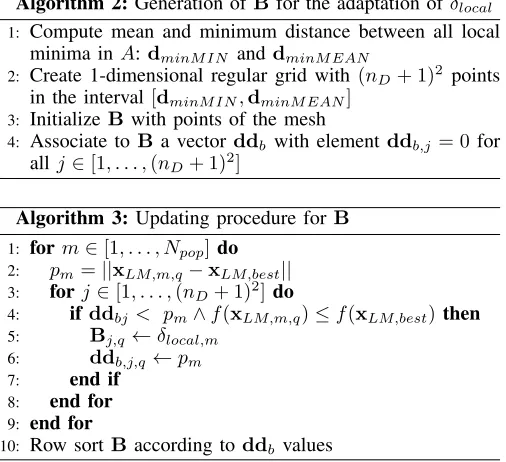
A, common to all the populations. The population m is then restarted in a hypercube with edge 2δlocal,m around the detected local minimum xLM. The dimension δlocal,m is drawn from a probability distribution defined by the vectorB. The procedure to initializeBis described in Algorithm 2 and is analogous to the one used to generate CRF: the distance between all the local minima in the archive A is computed and the vectorBis initialize with values spanning the interval between the min and the mean distance among minima (Alg. 2, line 1).
Algorithm 2: Generation ofB for the adaptation ofδlocal
1: Compute mean and minimum distance between all local minima inA:dminM IN anddminM EAN
2: Create 1-dimensional regular grid with (nD+ 1)2 points in the interval[dminM IN,dminM EAN]
3: InitializeB with points of the mesh
4: Associate toB a vectorddb with element ddb,j= 0for
allj∈[1, . . . ,(nD+ 1)2]
Algorithm 3: Updating procedure for B
1: form∈[1, . . . , Npop]do
2: pm=||xLM,m,q−xLM,best||
3: forj∈[1, . . . ,(nD+ 1)2]do
4: ifddbj < pm∧f(xLM,m,q)≤f(xLM,best)then
5: Bj,q←δlocal,m
6: ddb,j,q←pm
7: end if
8: end for
9: end for
10: Row sort Baccording toddb values
The updating procedure forB, detailed in Algorithm 3, follows the same approach used for updating CRF in [11]: the dis-tancepmbetween the local minimum identified by population
m at iterationq,xLM,m,q, and the best local minimum in A,
xLM,best, is used to updateBif f(xLM,m,q)≤f(xLM,best). In MP-AIDEA the local restart following the local search was iterated up to a user-defined number of timesnLR. The novelty in MP-AIDEA-ALR is that the parameternLRis removed and replaced by a procedure that locally restart the optimization until no new local minimum is found. The idea is that the local restart should enable a transition from the current minimum to a neighboring minimum that falls within the local restart bubble δlocal,m. If the transition repeatedly leads to the same local minima, the local restart procedure is deemed to be not effective and a global restart becomes necessary. Given a local minimum xLM,j, one can define the basin of attraction of
xLM,j for the local search operatorLS(x)as:
BA(xLM,j)j ={x:LS(x) =xLM,j} (1)
IfBAj is included in the restart bubble a transition can occur
to a new basin of attraction and a new local minimum is saved inA. However, if the restart bubble includes multiple basins of attraction, then a local restart might lead to converging to a local minimum already recorded in the archiveA. Furthermore, it is desirable to avoid having the local search operator applied to multiple points belonging to the basin of attraction of the same local minimum xLM,j. In order to avoid rediscovering the same local minima, when the local search operator is applied toxbest, the distance dbasin,j between xbest and the local minimumxLM,j,xbest converged to, is recorded and the number of timesNLM Det,j convergence to local minimum j is achieved is increased by 1. If the same local minimum is revisited more than four times, the local restart procedure is stopped and the global restart is activated. Likewise if xbest falls at a distance from local minimum j that is lower than
dbasin,j, the local restart procedure is replaced by the global restart. If differentxbestconverge to the same local minimum,
dbasin,j is the minimum distance of all thexbest fromxLM,j.
III. CASESTUDIES
The effectiveness of the new MP-AIDEA-ALR was tested on some of the functions taken from three past competitions of the Congress on Evolutionary Computation (CEC): CEC 2005 [15], CEC 2011 [16] and CEC 2014 [17]. MP-AIDEA-ALR was compared against those algorithms, competing in each of the CEC competitions, that reported their best result in a paper. The ranking method used to assess the performance of MP-AIDEA-ALR follows the rules of the CEC 2011 Competition, [18]. All algorithms are ranked on the basis of the best and mean values of the objective function criteria according to the following criteria: for each function, algorithms are ranked according to the obtained best objective value; for each function, algorithms are ranked according to the obtained mean objective value; the ranking for the best and mean objective values of a particular algorithm are added up over all the problems to get the absolute ranking. For MP-AIDEA-ALR the number of populations is Npop = 4 and the number of individuals in each population isnpop =nD, wherenD is the dimensionality of the problem. The non-adapted parameter of MP-AIDEA-ALR are set toρ¯= 0.2 andδglobal = 0.1.
A. CEC 2005 Competition
[image:3.612.51.304.232.463.2]The functions of the CEC 2005 competition were tested at dimension nD = 10, 30 and 50, with a maximum number of functions evaluation equal to nf eval,max = 10000nD and considering 25 independent runs for each function, [15]. All the functions but the noisy ones (functions 4, 17, 24 and 25) were used in this test. The obtained results are reported in Table I, which shows that, for all the considered dimensions, MP-AIDEA-ALR is ranked first. Table II reports the best objective function error values obtained by all the algorithms for functions 13 and 16 at 10 dimensions. According to the CEC 2005 specifications, the accuracy level for the detection of the global minimum is 10−2 for these functions. Note that
TABLE I: CEC 2005 Ranking.
nD= 10 nD= 30 nD= 50
1 MP-AIDEA-ALR MP-AIDEA-ALR MP-AIDEA-ALR
2 G-CMA-ES [19] G-CMA-ES G-CMA-ES
3 L-SaDE [20] L-CMA-ES L-CMA-ES
4 DMS-L-PSO [21] K-PCX flexGA
5 L-CMA-ES [22] BLX-GL50 6 BLX-GL50 [23] SPC-PNX 7 DE (Ronkonnen) [24] DE (Ronkonnen) 8 SPC-PNX [25] DE (Bui)
9 EvLiv [26] flexGA
10 EDA [27] CoEVO
11 K-PCX [28] EDA
[image:4.612.362.526.70.339.2]12 BLX-MA [29] 13 DE (Bui) [30] 14 CoEVO [31] 15 flexGA [32] 16 ES [33]
TABLE II: CEC 2005 Best Objective Function Error Values for Functions 13 and 16, nD= 10.
Algorithm Function 13 Function 16 BLX-GL50 3.70e-01 7.20e+01
BLX-MA 3.80e-01 9.00e+01 CoEVO 4.70e-01 1.20e+02 DE (Ronkonnen) 4.60e-01 1.50e+02 DE (Bui) 2.70e-01 1.00e+02 DMS-L-PSO 2.50e-01 5.20e+01 EDA 1.60e+00 1.30e+02 ES 7.90e-01 9.70e+01 EvLiv 9.90e-03 1.20e+02 flexGA 4.20e-02 1.10e+02 G-CMA-ES 4.10e-01 7.90e+01 K-PCX 3.30e-01 8.80e+01 L-CMA-ES 1.90e-01 6.10e+01 L-SaDE 1.20e-01 8.60e+01 SPC-PNX 3.50e-01 9.10e+01
MP-AIDEA-ALR 9.87e-03 0.00e+00
B. CEC 2011 Competition
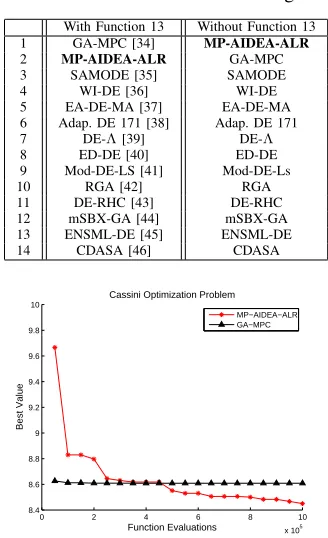
For the CEC 2011 competition the functions were tested using nf eval,max = 150000function evaluations and consid-ering25runs per function, [16]. All problems but functions 4, 8, 9 and 11 were used in this test (functions 8, 9 and 11 are characterized by equality and inequality constraints). For this competition only, the number of individuals in each population was set to npop = 30regardless of the dimensionality of the problem. The obtained results are reported in Table III. MP-AIDEA-ALR is ranked in first place if problem 13 (the Cassini 2 Spacecraft Trajectory Optimization Problem) is excluded from the ranking. Figure 1 shows the typical convergence profile of MP-AIDEA-ALR and GA-MPC, the best algorithm of the competition, on function 13 for a number of function evaluations greater than the limit prescribed by the CEC 2011 competition. It has to be noted that GA-MPC converges very rapidly to a local minimum but then seems to stagnate. On the contrary, MP-AIDEA-ALR has a slower convergence for the first 200000 function evaluations but then progressively finds better minima as the number of function evaluations increases.
C. CEC 2014 Competition
For the CEC 2014 competition the functions were tested at dimensions nD = 10, 30, 50 and 100, with maximum
TABLE III: CEC 2011 Ranking.
With Function 13 Without Function 13 1 GA-MPC [34] MP-AIDEA-ALR
2 MP-AIDEA-ALR GA-MPC
3 SAMODE [35] SAMODE
4 WI-DE [36] WI-DE
5 EA-DE-MA [37] EA-DE-MA 6 Adap. DE 171 [38] Adap. DE 171
7 DE-Λ[39] DE-Λ
8 ED-DE [40] ED-DE
9 Mod-DE-LS [41] Mod-DE-Ls
10 RGA [42] RGA
11 DE-RHC [43] DE-RHC 12 mSBX-GA [44] mSBX-GA 13 ENSML-DE [45] ENSML-DE
14 CDASA [46] CDASA
0 2 4 6 8 10
x 105 8.4
8.6 8.8 9 9.2 9.4 9.6 9.8 10
Function Evaluations
Best Value
Cassini Optimization Problem
MP−AIDEA−ALR GA−MPC
Fig. 1: F12: Cassini Optimization Problem
[image:4.612.95.258.262.403.2]number of function evaluationsnf eval,max= 10000nDand51 repeated runs per function [17]. Non-differentiable functions 6, 12, 19, 22, 26, 27, 29 and 30 were not included in this test. Results are reported in Table IV.
TABLE IV: CEC 2014 Ranking.
nD= 10 nD= 30 nD= 50 nD= 100
1 UMOEAs [47] L-SHADE UMOEAs UMOEAs
2 MP-A.-ALR UMOEAs MP-A.-ALR L-SHADE
3 L-SHADE [48] GaAPADE MVMO MP-A.-ALR
4 MVMO [49] MP-A.-ALR L-SHADE rmalshcma 5 DE-b6e6rl [50] CMLSP rmalshcma POBL-ADE 6 rmalschma [51] rmalshcma b3e3pbest b3e3pbest
7 GaAPADE [52] MVMO FERDE OptBees
8 FERDE [53] DE-b6e6rl DE-b6e6rl DE-b6e6rl
9 CMLSP [54] b3e3pbest RSDE RSDE
10 b3e3pbest [55] FERDE POBL-ADE FWA-DE
11 RSDE [56] RSDE OptBees
12 FWA-DE [57] FWA-DE FWA-DE 13 POBL-ADE [58] POBL-ADE SOO 14 OptBees [59] OptBees
15 SOO-BOBYQA [60] SOO-BOBYQA
16 FCDE [61] NRGA
17 NRGA [62] FCDE
18 SOO [60] SOO
[image:4.612.318.575.463.624.2]TABLE V: CEC 2014 Best Objective Function Error Values for Functions 9, 10, 11 and 15, nD= 10.
Algorithm Func. 9 Func. 10 Func. 11 Func. 15 b3e3pbest 2.60e+00 0.00e+00 9.50e+01 5.70e-01 CMLSP 0.00e+00 2.50e-01 3.60e+00 4.50e-01 DE-b6e6rl 2.50e+00 0.00e+00 3.60e+01 4.90e-01 FCDE 8.00e+00 3.10e-01 1.40e+02 6.50e-01 FERDE 3.00e+00 0.00e+00 3.80e-01 3.50e-01 FWA-DM 2.00e+00 9.10e-13 4.00e+01 3.20e-01 GaAPADE 1.90e+00 2.40e-02 2.40e+00 3.80e-01 L-SHADE 2.20e-03 0.00e+00 3.90e-01 2.10e-01 MVMO 9.90e-01 6.20e-02 3.40e+00 2.10e-01 NRGA 9.90e-01 3.70e+00 1.90e+01 3.70e-01 OptBees 2.00e+00 3.50e+00 1.30e+02 6.30e-01 POBL-ADE 1.00e+00 2.20e+01 3.60e+00 1.70e-01 rmalschma 9.90e-01 6.20e-02 1.90e-01 3.10e-01 RSDE 2.00e+00 3.50e+00 1.90e+01 3.60e-01 SOO 9.00e+00 1.30e+02 3.50e+02 4.40e-01 SOO-BOBYQA 9.00e+00 1.30e+02 3.50e+02 4.20e-01 UMOEAs 9.90e-01 6.20e-02 3.50e+00 3.20e-01
[image:5.612.338.539.284.444.2]MP-AIDEA-ALR 0.00e+00 0.00e+00 0.00e+00 2.00e-02
TABLE VI: CEC 2014 Ranking, nD= 30,ρ= 0.3.
Case A Case B Case C Case D
¯
ρ= 0.1 ρ¯= 0.3 ρ¯= 0.2 ρ¯= 0.2
δglobal= 0.1 δglobal= 0.1 δglobal= 0.2 δglobal= 0.3
1 L-SHADE L-SHADE L-SHADE L-SHADE
2 UMOEAs UMOEAs UMOEAs UMOEAs
3 GaAPADE MP-A.-ALR GaAPADE GaAPADE
4 MP-A.-ALR GaAPADE MP-A.-ALR MP-A.-ALR
5 CMLSP CMLSP CMLSP CMLSP
6 rmalshcma rmalschma rmalshcma rmalshcma
7 MVMO MVMO MVMO MVMO
8 DE-b6e6rl DE-b6e6rl DE-b6e6rl DE-b6e6rl 9 b3e3pbest b3e3pbest b3e3pbest b3e3pbest
10 FERDE FERDE FERDE FERDE
11 RSDE RSDE RSDE RSDE
12 FWA-DE FWA-DE FWA-DE FWA-DE
13 POBL-ADE POBL-ADE POBL-ADE POBL-ADE
14 OptBees OptBees OptBees OptBees
15 SOO-BOBYQA SOO-BOBYQA SOO-BOBYQA SOO-BOBYQA
16 NRGA NRGA NRGA NRGA
17 FCDE FCDE FCDE FCDE
18 SOO SOO SOO SOO
1) Sensitivity to ρ¯ and δglobal: This subsection is devoted to a preliminary analysis of the sensitivity of the performance of MP-AIDEA-ALR to the two parameters that are not auto-matically adapted: ρ¯andδglobal. Table VI shows the ranking obtained when varying ρ¯ and δglobal for the 30 dimension test case of the CEC2014 competition, the one in which the performance of MP-AIDEA-ALR were poorest. In particular, case B shows the ranking obtained when usingρ¯= 0.3instead of ρ¯= 0.1. Comparing the results with table IV one can see that withρ¯= 0.3MP-AIDEA-ALR performs better and moves from the fourth to the third position in the ranking. At the same time there seems to be a reduced sensitivity of MP-AIDEA-ALR to the settings ofδglobal.
D. Distance from the Best
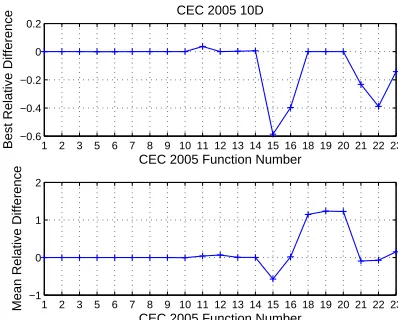
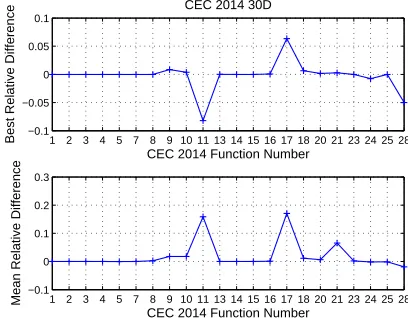
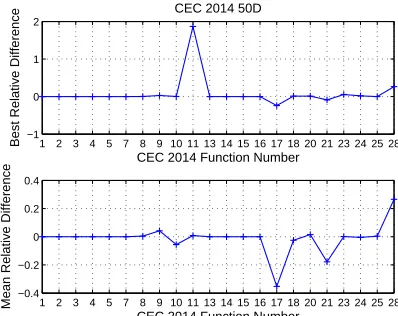
Figures from 2 to 9 show the relative difference between the result of MP-AIDEA-ALR and the result of the best performing algorithm for each of the functions used in the tests. Both the difference in best and mean value are reported in each figure.
1 2 3 5 6 7 8 9 10 11 12 13 14 15 16 18 19 20 21 22 23 −0.6
−0.4 −0.2 0 0.2
CEC 2005 Function Number
Best Relative Difference
CEC 2005 10D
1 2 3 5 6 7 8 9 10 11 12 13 14 15 16 18 19 20 21 22 23 −1
0 1 2
CEC 2005 Function Number
Mean Relative Difference
Fig. 2: Relative difference between MP-AIDEA-ALR and the best performing algorithm for each of the selected functions of the CEC2005 competition at 10D
1 2 3 5 6 7 8 9 10 11 12 13 14 15 16 18 19 20 21 22 23 −1
−0.5 0 0.5
CEC 2005 Function Number
Best Relative Difference
CEC 2005 30D
1 2 3 5 6 7 8 9 10 11 12 13 14 15 16 18 19 20 21 22 23 −1.5
−1 −0.5 0 0.5
CEC 2005 Function Number
Mean Relative Difference
Fig. 3: Relative difference between MP-AIDEA-ALR and the best performing algorithm for each of the selected functions of the CEC2005 competition at 30D
IV. CONCLUSION
1 2 3 5 6 7 8 9 10 11 12 13 14 15 16 18 19 20 21 22 23 −1
−0.5 0 0.5
CEC 2005 Function Number
Best Relative Difference
CEC 2005 50D
1 2 3 5 6 7 8 9 10 11 12 13 14 15 16 18 19 20 21 22 23 −1
−0.5 0 0.5
CEC 2005 Function Number
[image:6.612.335.539.55.214.2]Mean Relative Difference
Fig. 4: Relative difference between MP-AIDEA-ALR and the best performing algorithm for each of the selected functions of the CEC2005 competition at 50D
F1 F2 F3 F5 F6 F7 F10 F12 F13 −0.04
−0.02 0 0.02 0.04
CEC 2011 Function Number
Best Relative Difference
CEC 2011
F1 F2 F3 F5 F6 F7 F10 F12 F13 −0.5
0 0.5 1
CEC 2011 Function Number
[image:6.612.69.269.55.214.2]Mean Relative Difference
Fig. 5: Relative difference between MP-AIDEA-ALR and the best performing algorithm for each of the selected functions of the CEC2011 competition
ACKNOWLEDGMENT
This research was partially supported by a grant by Airbus Defence & Space. The authors would like to thank Mr. Stephen Kemble for his support and contribution.
REFERENCES
[1] K. V. Price, R. M. Storn, and J. A. Lampinen.Differential Evolution. A Practical Approach to Global Optimization. Natural Computing Series, Springer, 2005.
[2] D. Swagatam and P. N. Suganthan.Differential Evolution: A Survey of the State-of-the-Art. IEEE Transaction on Evolutionary Computation, Vol. 15, No.1, pp. 4-31, Febraury 2011.
[3] A. Qinq. Differential Evolution: Fundamentals and Applications in Electrical Engineering. John Wiley and Sons, 2009.
1 2 3 4 5 7 8 9 10 11 13 14 15 16 17 18 20 21 23 24 25 28 −0.05
0 0.05 0.1 0.15
CEC 2014 Function Number
Best Relative Difference
CEC 2014 10D
1 2 3 4 5 7 8 9 10 11 13 14 15 16 17 18 20 21 23 24 25 28 −0.06
−0.04 −0.02 0 0.02
CEC 2014 Function Number
[image:6.612.335.539.286.445.2]Mean Relative Difference
Fig. 6: Relative difference between MP-AIDEA-ALR and the best performing algorithm for each of the selected functions of the CEC2014 competition at 10D
1 2 3 4 5 7 8 9 10 11 13 14 15 16 17 18 20 21 23 24 25 28 −0.1
−0.05 0 0.05 0.1
CEC 2014 Function Number
Best Relative Difference
CEC 2014 30D
1 2 3 4 5 7 8 9 10 11 13 14 15 16 17 18 20 21 23 24 25 28 −0.1
0 0.1 0.2 0.3
CEC 2014 Function Number
Mean Relative Difference
Fig. 7: Relative difference between MP-AIDEA-ALR and the best performing algorithm for each of the selected functions of the CEC2014 competition at 30D
[4] M. Vasile, E. Minisci, and M. Locatelli.An Inflationary Differential Evo-lution Algorithm for Space Trajectory Optimization. IEEE Transaction on Evolutionary Computation, Vol. 15, No. , pp. 267-281, 2011.
[5] M. Locatelli, M. Vasile.(Non) convergence results for the differential evo-lution method. Optimization Letters October 2014.DOI 10.1007/s11590-014-0816-9.
[6] D.J. Wales, and J.P.K. Doye.Global Optimization by Basin-Hopping and the Lowest Energy Structures of Lennard-Jones Clusters Containing up to 110 Atoms. Journal of Physycal Chemistry, Vol. 10, No. , pp. 5111– 5116, 1997.
[7] R. Gamperle, S.D. Muller, and P. Koumoutsakos.A Parameter Study for Differential Evolution. Advances in Intelligent Systems, Fuzzy Systems, Evolutionary Computation. pp. 293-298, 2002.
[8] J. Liu and J. Lampinen.A Fuzzy Adaptive Differential Evolution Algo-rithm. Journal of Soft Computing, Vol. 9, pp. 448-462, 2005.
[image:6.612.67.272.286.446.2]1 2 3 4 5 7 8 9 10 11 13 14 15 16 17 18 20 21 23 24 25 28 −1
0 1 2
CEC 2014 Function Number
Best Relative Difference
CEC 2014 50D
1 2 3 4 5 7 8 9 10 11 13 14 15 16 17 18 20 21 23 24 25 28 −0.4
−0.2 0 0.2 0.4
CEC 2014 Function Number
[image:7.612.70.269.55.213.2]Mean Relative Difference
Fig. 8: Relative difference between MP-AIDEA-ALR and the best performing algorithm for each of the selected functions of the CEC2014 competition at 50D
1 2 3 4 5 7 8 9 10 11 13 14 15 16 17 18 20 21 23 24 25 28 −0.5
0 0.5
CEC 2014 Function Number
Best Relative Difference
CEC 2014 100D
1 2 3 4 5 7 8 9 10 11 13 14 15 16 17 18 20 21 23 24 25 28 −1
−0.5 0 0.5 1
CEC 2014 Function Number
Mean Relative Difference
Fig. 9: Relative difference between MP-AIDEA-ALR and the best performing algorithm for each of the selected functions of the CEC2014 competition at 100D
Study on Numerical Benchmark Problems. IEEE Transaction of Evolu-tionary Computation, Vol. 10, pp. 646-657. 2006.
[10] M. G. H. Omran, A. Salman and A. P. Engelbrecht. Self-adaptive Differnetial Evolution. Lecture Notes in Artificial Intelligence, pp. 192-199, 2005.
[11] E. Minisci, and M. Vasile.Adaptive Inflationary Differential Evolution. Proceedings of the IEEE Congress on Evolutionary Computation, CEC 2014, Beijing, China, July 2014.
[12] M. Di Carlo, M. Vasile and E. Minisci. Mutli-Population Adaptive Inflationary Differential Evolution. Bio-inspired Optimization Methods and their Applications, BIOMA 2014, Ljubljana, September 2014. [13] R. Storn. On the Usage of Differential Evolution for Function
Opti-mization. Biennial Conference of the North American Fuzzy Information Processing Society (NAFIPS), IEEE, pp. 519-523, Berkeley, 1996. [14] D. H. Wolpert and W; G. Macready. No Free Lunch Theorems for
Optimization. IEEE Transaction on Evolutionary Computation, Vol. 1, No. 1, pp. 67-83, April 1997.
[15] P. N. Suganthan, N. Hansen, J. J. Liang, K. Deb, Y. P. Chen, A. Auger, and S. Tiwari.Problem Definitions and Evaluation Criteria for the CEC 2005 Special Session on Real-Parameter Optimization. Technical Report, 2005.
[16] S. Das and P. N. Suganthan. Problem Definitions and Evaluation Criteria for CEC 2011 Competition on Testing Evolutionary Algorithms on Real World Optimization Problems. Technical Report, December 2010.
[17] J. J. Liang, B. Y. Qu, P. N. Suganthan. Problem Definitions and Evaluation Criteria for the CEC 2014 Special Session and Competition on Single Objective Real-Parameter Numerical Optimization. Technical Report, December 2013.
[18] P. N. Suganthan. Testing Evolutionary Algorithms on Real World Numerical Optimization Problems.
[19] A. Auger, S. Kern and N. Hansen.A Restart CMA Evolution Strategy with Increasing Population Size. Proceedings of the IEEE Congress on Evolutionary Computation, CEC 2005, pp. 1769-1776, Edinburgh, September 2005.
[20] A. K. Qin and P. N. Suganthan.Self-adaptive Differential Evolution Al-gorithm for Numerical Optimization. Proceedings of the IEEE Congress on Evolutionary Computation, CEC 2005, pp. 1785-1791, Edinburgh, September 2005.
[21] J. J. Liang and P. N. Suganthan.Dynamic Multi-Swarm Particle Swarm Optimizer with Local Search. Proceedings of the IEEE Congress on Evo-lutionary Computation, CEC 2005, pp. 522-528, Edinburgh, September 2005.
[22] A. Auger, S. Kern and N. Hansen. Performance Evaluation of an Advanced Local Search Evolutionary Algorithm. Proceedings of the IEEE Congress on Evolutionary Computation, CEC 2005, pp. 1777-1784, Edinburgh, September 2005.
[23] C. Garcia-Martinez and M. Lozano.Hybrid Real-Coded Genetic Al-gorithms with Female and Male Differentiation. Proceedings of the IEEE Congress on Evolutionary Computation, CEC 2005, pp. 896-903, Edinburgh, September 2005.
[24] J. Ronkkonen, S. Kukkonen and K. V. Price. Real-Parameter Opti-mization with Differential Evolution. Proceedings of the IEEE Congress on Evolutionary Computation, CEC 2005, pp. 506-513, Edinburgh, September 2005.
[25] P. J. Ballester, J. Stephenson, J. N. Carter, K. Gallagher.Real-Parameter Optimization Performance Study on the CEC-2005 benchmark with SPC-PNX. Proceedings of the IEEE Congress on Evolutionary Computation, CEC 2005, Edinburgh, September 2005.
[26] W. Becker, X. Yu and J. Tu. EvLib: A Parameterless Self-Adaptive Real-Valued Optimisation Library. Proceedings of the IEEE Congress on Evolutionary Computation, CEC 2005, pp. 506-515, Edinburgh, September 2005.
[27] B. Yuan and M. Gallagher.Experimental Results for the Special Session on Real-Parameter Optimization at CEC 2005: A Simple, Continuous EDA. Proceedings of the IEEE Congress on Evolutionary Computation, CEC 2005, pp. 1096-1103, Edinburgh, September 2005.
[28] A. Sinha, S. Tiwari and K. Deb. A Population-Based, Steady-State Procedure for Real-Parameter Optimization. Proceedings of the IEEE Congress on Evolutionary Computation, CEC 2005, pp.514-521, Edin-burgh, September 2005.
[29] D. Molina, F. Herrera, M. Lozano. Adaptive Local Search Param-eters for Real-Coded Memetic Algorithms. Proceedings of the IEEE Congress on Evolutionary Computation, CEC 2005,pp. 888-895, Edin-burgh, September 2005.
[30] L. T. Bui, Y. Shan, F. Qi, and H. A. Abbass.Comparing Two Versions of Differential Evolution in Real Parameter Optimization. Proceedings of the IEEE Congress on Evolutionary Computation, CEC 2005, pp. ,Edinburgh, September 2005.
[image:7.612.69.270.286.444.2][32] S. Alonso, J. Jimenez, H. Carmona, B. Galvan and G. Winter. Per-formance of a Flexible Evolutionary algorithm. Proceedings of the IEEE Congress on Evolutionary Computation, CEC 2005, pp. Edinburgh, September 2005.
[33] L. Costa.A Parameterless Evolution Strategy for Global Optimization. Proceedings of the IEEE Congress on Evolutionary Computation, CEC 2005, Edinburgh, September 2005.
[34] S. Elsayed, R. Sarker and D. Essam. GA with a New Multi-Parent Crossover for Solving IEEE-CEC2011 Competition Problems. Proceed-ing of the IEEE Congress on Evolutionary Computation, CEC 2011, pp. 1034-1040, New Orleans, June 2011.
[35] S. Elsayed, R. Sarker and D. Essam.Differential Evolution with Multiple Strategies for Solving CEC2011 Real-world Numerical Optimization Problems. Proceeding of the IEEE Congress on Evolutionary Compu-tation, CEC 2011, pp. 1034-1040, New Orleans, June 2011.
[36] U. Haider, S. Das, D. Maity, A. Abraham and P. Dasgupta.Self Adaptive Cluster Based and Weed Inspired Differential Evolution Algorithm For Real World Optimization. Proceeding of the IEEE Congress on Evolu-tionary Computation, CEC 2011, pp. 750-756, New Orleans, June 2011.
[37] H. K. Singh and T. Ray. Performance of a Hybrid EA-DE-Memetic Algorithm on CEC 2011 Real World Optimization Problems. Proceeding of the IEEE Congress on Evolutionary Computation, CEC 2011, pp. 1322-1326, New Orleans, June 2011.
[38] M. Asafuddoula, T. Ray and R. Sarker. An Adaptive Differential Evolution Algorithm and its Performance on Real World Optimization Problems. Proceeding of the IEEE Congress on Evolutionary Computa-tion, CEC 2011, pp. 1057-1062, New Orleans, June 2011.
[39] G. Reynoso-Meza, J. Sanchis, X. Blasco and J. M. Herrero.Hybrid DE Algorithm With Adaptive Crossover Operator For Solving Real-World Numerical Optimization Problems.Proceeding of the IEEE Congress on Evolutionary Computation, CEC 2011, pp. 1551-1556, New Orleans, June 2011.
[40] Y. Wang, B. Li and K. Zhang.Estimation of Distribution and Differen-tial Evolution Cooperation for Real-world Numerical Optimization Prob-lems. Proceeding of the IEEE Congress on Evolutionary Computation, CEC 2011, pp. 1315-1321, New Orleans, June 2011.
[41] M. Ankush, A. K. Das, P. Mukherjee, S. Das and P. N. Suganthan.
Modified Differential Evolution with Local Search Algorithm for Real World Optimization. Proceeding of the IEEE Congress on Evolutionary Computation, CEC 2011, pp. 1565-1572, New Orleans, June 2011.
[42] A. Saha and T. Ray. How does the good old Genetic Algorithm fare at Real World Optimization?. Proceeding of the IEEE Congress on Evolutionary Computation, CEC 2011, pp. 1049-1056, New Orleans, June 2011.
[43] A. La Torre, S. Muelas and J. Pena.Benchmarking a Hybrid DE-RHC Algorithm on Real World Problems. Proceeding of the IEEE Congress on Evolutionary Computation, CEC 2011, pp. 1027-1033, New Orleans, June 2011.
[44] S. Bandaru, R. Tulshyan and K. Deb. Modified SBX and Adaptive Mutation for Real World Single Objective Optimization. Proceeding of the IEEE Congress on Evolutionary Computation, CEC 2011, pp. 1335-1342, New Orleans, June 2011.
[45] R. Mallipeddi and P. N. Suganthan.Ensemble Differential Evolution Algorithm for CEC2011 Problems. Proceeding of the IEEE Congress on Evolutionary Computation, CEC 2011, pp. 1557-1564, New Orleans, June 2011.
[46] P. Korosec and J. Silc. The Continuous Differential Ant-Stigmergy Algorithm Applied to Real-World Optimization Problems. Proceeding of the IEEE Congress on Evolutionary Computation, CEC 2011, pp. 1327-1334, New Orleans, June 2011.
[47] S. M. Elsayed, R. A. Sarker, D. L. Essam and N. M. Hamza.Testing United Multi-Operator Evolutionary Algorithms on the CEC2014 Real-Parameter Numerical Optimization. Proceedings of the IEEE Congress on Evolutionary Computation, CEC 2014, pp. 1650-1657, Beijing, China, July 2014.
[48] R. Tanabe and A. S. Fukunaga.Improving the Search Performance of SHADE Using Linear Population Size Reduction. Proceedings of the IEEE Congress on Evolutionary Computation, CEC 2014, pp. 1658-1665, Beijing, China, July 2014.
[49] I. Erlich, J. L. Rueda and S. Wildenhues.Evaluating the Mean-Variance Mapping Optimization on the IEEE-CEC 2014 Test Suite. Proceedings of the IEEE Congress on Evolutionary Computation, CEC 2014, pp. 1625-1632, Beijing, China, July 2014.
[50] R. Polakova, J. Tvrdk and P. Bujok.Controlled Restart in Differential Evolution Applied to CEC2014 Benchmark Functions. Proceedings of the IEEE Congress on Evolutionary Computation, CEC 2014, Beijing, pp. 2230-2236, China, July 2014.
[51] D. Molina, B. Lacroix and F. Herrera. Influence of regions on the memetic algorithm for the CEC2014 Special Session on Real-Parameter Single Objective Optimisation. Proceedings of the IEEE Congress on Evolutionary Computation, CEC 2014, pp. 1633-1640, Beijing, China, July 2014.
[52] R. Mallipeddi, G. Wu, M. Lee and P. N. Suganthan.Gaussian Adapta-tion based Parameter AdaptaAdapta-tion for Differential EvoluAdapta-tion. Proceedings of the IEEE Congress on Evolutionary Computation, CEC 2014, pp. 1760-1767, Beijing, China, July 2014.
[53] B. Y. Qu, J. J. Liang, J. M. Xiao and Z. G. Shang.Memetic Differential Evolution Based on Fitness Euclidean-Distance Ratio. Proceedings of the IEEE Congress on Evolutionary Computation, CEC 2014, pp. 2266-2273, Beijing, China, July 2014.
[54] L. Chen, H. L. Liu, Z. Zheng and S. Xie.An Evolutionary Algorithm Based on Covariance Matrix Leaning and Searching Preference for Solving CEC 2014 Benchmark Problems. Proceedings of the IEEE Congress on Evolutionary Computation, CEC 2014, pp. 2672-2677, Beijing, China, July 2014.
[55] P. Bujok, J. Tvrdk and R. Polakov.Differential Evolution with Rotation-Invariant Mutation and Competing-Strategies Adaptation. Proceedings of the IEEE Congress on Evolutionary Computation, CEC 2014, Beijing, pp. 2253-2258, China, July 2014.
[56] C. J. Xu, H. Huang and S. J. Ye.A Differential Evolution with Replace-ment Strategy for Real-Parameter Numerical Optimization. Proceedings of the IEEE Congress on Evolutionary Computation, CEC 2014, pp. 1617-1624, Beijing, China, July 2014.
[57] C. Yu, L. Kelley, S. Zheng and Y. Tan. Fireworks Algorithm with Differential Mutation for Solving the CEC 2014 Competition Problems. Proceedings of the IEEE Congress on Evolutionary Computation, CEC 2014, pp. 3238-3245, Beijing, China, July 2014.
[58] Z. Hu, Y. Bao and T. Xiong.Partial Opposition-Based Adaptive Differ-ential Evolution Algorithms: Evaluation on the CEC 2014 Benchmark Set for Real-parameter Optimization. Proceedings of the IEEE Congress on Evolutionary Computation, CEC 2014, pp. 2259-2265, Beijing, China, July 2014.
[59] R. D. Maia, L. N. de Castro and W. M. Caminhas. Real-Parameter Optimization with OptBees. Proceedings of the IEEE Congress on Evolutionary Computation, CEC 2014, pp. 2649-2655, Beijing, China, July 2014.
[60] P. Preux, R. Munos and M. Valko.Bandits attack function optimization. Proceedings of the IEEE Congress on Evolutionary Computation, CEC 2014, pp. 2245-2252, Beijing, China, July 2014.
[61] Z. Li, Z. Shang, B. Y. Qu and J. J. Liang.Differential Evolution Strategy based on the Constraint of Fitness Values Classification. Proceedings of the IEEE Congress on Evolutionary Computation, CEC 2014, pp. 1454-1460, Beijing, China, July 2014.