DEPARTMENT OF ECONOMICS
U
NIVERSITY OFS
TRATHCLYDEG
LASGOWTYPE II ERRORS IN IO MULTIPLIERS
B
YTOBIAS EMONTS-HOLLEY, ANDREW ROSS AND KIM SWALES
N
O15-04
S
TRATHCLYDE
Type II Errors in IO Multipliers
Tobias Emonts-Holley
Andrew Ross
J.Kim Swales
Fraser of Allander Institute, Department of Economics,
University of Strathclyde
April 2015
This work is jointly supported by the Economic and Social Research Council and the Scottish Government [ES/J500136/1]. We also thank members of the Scottish Government’s Input Output Expert Users’ Group, in particular Grant Allan from the Fraser of Allander Institute and Stevan Croasdale and Gary Campbell from the Office of the Chief Economic Advisor for comments on earlier versions of this paper.
Key words: Input-Output, Social Accounting Matrix, multipliers, Scotland.
Abstract
This paper compares methods for calculating Input-Output (IO) Type II multipliers. These
are formulations of the standard Leontief IO model which endogenise elements of
household consumption. An analytical comparison of the two basic IO Type II multiplier
methods with the Social Accounting Matrix (SAM) multiplier approach identifies the
treatment of non-wage income generated in production as a central problem. The
multiplier values for each of the IO and SAM methods are calculated using Scottish data
for 2009. These results can be used to choose which Type II IO multiplier to adopt where
“Multiplication/ that’s the name of the game/ and each generation/ they play it the same”
Bobby Darin (1961).
1. Introduction
This paper compares methods for calculating Input-Output (IO) Type II multipliers. These
are formulations of the standard Leontief demand-driven IO model which attempt to
endogenise at least a part of household consumption. This is done essentially through a
two-step process. First, a link is made between income generated in production and
household income. Second, the endogenous change in household income then stimulates
corresponding changes in household consumption.
In this discussion the standard IO assumptions that hold in production are assumed to be
extended to the generation of household income and expenditure. These assumptions are
that there are no supply constraints and that there are fixed coefficients in the linear
production and consumption functions. This implies that all responses to changes in
demand occur through changes in output, with no changes in prices, and that these
responses are linear, with average and marginal values being identical. There are two
basic IO Type II multiplier methods that are available in the literature. We label them the
Miller and Blair (M+B) and Batey approaches. The Batey approach has two variants
identified here as Batey1 and Batey2 (B1 and B2).
2. IO Type I Multipliers
The Type I multiplier incorporates the direct and the indirect effect associated with
production for final demand. It is derived as follows:
(1) Ax+ =f x
where there are n sectors, A is the nxn matrix of technical production coefficients, f is the
nx1 vector of final demands and x is the vector of outputs.1 Subtracting Ax from both sides
(2) f =
[
I−A x]
Premultiplying both sides of (2) by [I-A]-1 produces the familiar IO equation that links
output to final demand:
(3)
[
I−A]
−1 f =xIn this case [I-A]-1 is the Type I Leontief inverse where the representative element αi,j is
the direct and indirect output in sector i associated with a unit of exogenous final demand
in sector j. Summing the elements of column j gives the Type I multiplier for sector j, MIj
. This is the total output across all sectors associated with a unit increase in exogenous
demand for the output of sector j. If there are n sectors it is given as:
(4) ,
1
n I
j i j
i
M α
=
=
∑
Note that equation (3) can be interpreted as an accounting identity, in that any initial set of
IO accounts can be manipulated in this way, so that the actual vector of outputs is
attributed to actual final demand. Moreover, if all the relevant assumptions are imposed,
then equation (3) can be used as a model in which changes in final demand drive, in a
linear and deterministic manner, changes in total output.
3. IO Type II Multiplier
In the Type I model, all household consumption expenditure on domestic goods is
included in exogenous final demand. The Type II multiplier seeks to endogenise some or
all of household consumption. This task presents two central problems, both relating to the
limited information available in the IO accounts. The first is that it is not possible to track
fully all the income that is generated in production which goes, either directly or
indirectly, to households. The second is that with the data given in the IO accounts,
To begin, although household income should be linked to all factor income that is
generated in production, the conventional IO Type II approaches tie endogenous
household consumption solely to wage income. The total wages, W, generated in
production are straightforward to calculate. They are given as:
(5) W =wx
In equation (5) w is the 1xn vector of wage coefficients, where the ith element is the wage
payment in sector i divided by the total output of that sector. In the Type II multiplier,
labour demand is therefore generated in the same way as the demand for any other
intermediate input.
The key aspect of the Type II multiplier is that the household consumption demand vector
given in the IO accounts, c, is divided into two nx1 vectors representing endogenous,cZN,
and exogenous, cXZ, household consumption expenditures. In principle, endogenous
household consumption expenditure is expenditure funded by income generated in
production, whereas exogenous household expenditure is financed through savings,
transfers (pensions, welfare payments etc). Each of the three multiplier methods, identified
by the superscript Z, does this breakdown in a different way, but in all:
(6) c=cZN +cXZ
In the Type II IO context, the ith element of the cNZ vector is equal to the appropriate
consumption coefficient,ϕN iZ, , times what is taken to be the endogenous household
income, YNZ . Therefore:
(7) cZN =ϕNZYNZ
Combining equations (2), (5),(6) and (7) and presenting in matrix form gives:
(8) B jZ Z + fZ = jZ
where BZ is an (n+2)x(n+2) matrix, and where fZand jZ are n+2 column vectors, given
as
0
0 0 , 0 0 1 0 0
Z Z
N N
Z Z
A f c
B w f
ϕ
−
= =
and Z
Z N
x
j W
Y
=
Using the familiar matrix inversion, the Type II accounting identity that corresponds to
equation (3) in the Type I formulation:
(9) I−BZ−1 fZ = jZ
The matrices and vectors A, w and c do not vary across different IO Type II methods.
However the ϕNZ vector of endogenous household coefficients does and this will also
imply variations across multiplier methods in the endogenous final household
consumption demand vector, cNZ.
As with the Type I multipliers, if βi j, is the coefficient in the ith row and jth column, the
multiplier value for sector j is the sum of the first n elements of the jth row. That is to say:
(10) ,
1
n Z
j i j
i
M β
=
=
∑
Again, this is the impact on total output of a unit change in the exogenous final demand
3.1Miller and Blair (1985)
Miller and Blair endogenise all household consumption. That is to say, cNM B+ =cand total
household income, Y, consists solely of wages, so that Y =W . The ith element of the
endogenous household consumption vector, ϕN iM B,+ , is therefore calculated as the ith
element of the total domestic household consumption vector, ci, divided by the total wage
payment, W, so that:
(11) NM B c
W
ϕ + =
The primary problem for the M+B method is that typically only around 60% of all
household income comes from wages. Moreover, perhaps more critically, some elements
of household consumption, such as pensions and some government transfers, are
conventionally treated as being exogenous, independent of income generated in current
production. This issue is fudged in the example given in Miller and Blair (1985, p. 28)
where the sum of household consumption is given as arbitrarily equal to the total wage
payment. We would expect the M+B method to overestimate the true Type II multiplier
values.
3.2 Batey (1985)
The Type II multiplier approach outlined in Batey (1985) acknowledges the existence of
exogenous household expenditure. The Batey method attempts to capture the addition to
household consumption that comes through changes in wage income alone. In the first
variant of the Batey method, which we label Batey1, the ith coefficient in the household
consumption vector is the corresponding entry in the IO accounts divided by total
household income, Y, so that:
(12) B1, i
N i
c Y
There are a number of drawbacks to this procedure. The first is the obverse of the problem
facing Miller and Blair. M+B can be criticised for assuming that all income to households
comes from wages. However, a criticism of Batey1 is that there are sources of income
generated in production, apart from wages, that enter household income either directly
from other value added or indirectly through elements of corporate income that are
subsequently distributed to households. Therefore endogenising household expenditure as
that consumption funded directly by wage income will give a multiplier that is too low. A
second problem is that the total household income is not a figure that is given in the IO
accounts. It needs to come from some other source.
A variant of the Batey approach, that we label Batey2, retains the spirit of the Batey
method but relies solely on data from the IO accounts. In this case, the vector of
household coefficients, ϕNB2, is constructed by dividing the entries in the household
consumption column in the IO accounts by total household consumption, C. This implies
that the ith element of the vector of coefficients equals:
(13) B2 i
Ni
c C
ϕ =
There are two main problems in this case. The first is that, as with Batey1, the method
does not incorporate non-wage household income generated in current production.
However, on the other hand, in calculating the consumption coefficients it ignores all the
household income not spent on domestic and imported goods and services. Therefore it
does not take into account expenditure by consumers on some taxes, savings and other
transfers. By ignoring the non-wage elements of income generation in production the
multiplier will be too small. However, in ignoring income not spent on consumption, the
multiplier will be too big.
It is clear that there is no correct way to identify the extent to which output is generated by
endogenous household expenditure using just the IO accounts, if by this we mean the
consumption financed by factor incomes resulting from current production. This remains
true even if the IO accounts are augmented by information on total household income, as
in Batey1. The reason is straightforward. IO accounts fail to identify the way in which the
flows of income earned by factors of production reach households. However, a multiplier
that endogenises household consumption based around a Social Accounting Matrix
(SAM) can track such income flows, if the same sort of assumptions concerning linearity
and exogeneity are made as imposed in IO.
The SAM multiplier is based around a Social Accounting Matrix, a set of disaggregated
economic accounts. These have the IO accounts at their core but also track the income to
and expenditures from non-production accounts, such as the household, corporate,
government, capital and external accounts (Round, 2003). In addition to production, the
SAM multiplier typically endogenises the wage, other value added, household and
corporate accounts. That is to say, government, capital and external expenditure is taken to
be exogenous. This includes government transfers.
In the SAM multiplier, total other value added, Π, is determined in exactly the same way
as wages in the Type II IO:
(14) Π =πx
where π is an nx1 vector whose ith value is the other value added in the ith sector divided
by the total output of that sector. A share of value added, ρY goes directly to households
and a share ρR goes to corporations. Subsequently a share of corporate income, rY, is
transferred to households. This means that in the SAM multiplier, corporate, R, and
household income are given as:
(15) R=ρRΠ +TR
where TR and TY are exogenous transfers to the corporate and household sector from the
government and external sectors. Finally for household expenditure the appropriate
coefficients are the Batey1 values. Combining equations (3),(5),(12),(14), (15) and (16)
and expressing this in matrix form produces:
(17)
V
f c
x x
S
f
v v
−
+ =
where the S is the (n+4)x(n+4) matrix of the form:
A 0 0 B1
N
ϕ 0
w 0 0 0 0
π 0 0 0 0
0 1
ρ
Y 0 Yr
0 0
ρ
R 0 0where fVis the 4x1 vector of exogenous income transfers and v is the 4x1 vector of factor
and institutional incomes, so that:
0
0 ,
V Y
R
W
f v
T Y
T R
Π
= =
Through the standard matrix inversion:
(18)
[
]
1V
f c x
I S
f v
− −
− =
flow of other value added through corporations to households is endogenised in the SAM
multiplier. As we have stated already, traditionally, the government, capital, and external
sector are treated as exogenous in the model (Round, 2003).2
Again if the element in the ith row and the jth column of the SAM inverse is represented
as σi j, then the SAM multiplier value for sector j , MSj , is the sum of the first n elements
of row j, given as:
(19) ,
1
n S
j i j
i
M σ
=
=
∑
Again, this measures the system-wide change in total output generated by a unit increase
in exogenous final demand for the output of sector j.
5. Analytical Comparison of Multiplier Values
If the SAM framework is accepted as the most appropriate way to endogenise household
consumption in a manner consistent with the Input-Output approach, none of the standard
IO Type II multiplier methods is correct. Equations (20) and (21) adjust the BZ and S
marices shown in equations (8) and (17) so that their structures are harmonised in order to
better identify the differences.
(20)
1
0 0
0 0 0
0 0 0
0 0 0
B N Z
Z
A
w B
ϕ
π κ
=
where B1 1, B2 Y
C
κ = κ = and M B Y
W
κ + =
, and
2 There is an argument for endogenising other elements of these disaggregated accounts. In the present
(21)
1
0 0
0 0 0
0 0 0
0 1 0
B N
Y R Y
A
w S
r
ϕ
π
ρ ρ
=
+
Each of the four rows and columns in the BZand S matrices represent receipts and
expenditures of the industries, labour, other value added and household accounts. Note
that the first three rows of these matrices are identical. They use the same A matrix and w,
π and cNB1vectors of coefficients. The two matrices differ solely in the fourth row which
identifies the sources of income entering the household account.
In the Z
B matrix one adjustment is the addition of the other value added account.
However, its impact is trivial. Although we can identify the other value added generated
in production, the destination of other value added expenditure is unknown in the IO
accounts. Therefore the other value added column, column three in BZ, only has zero
elements. The second change is more interesting. In equation (8) the different Type II
multiplier formulations are identified by their different household consumption
coefficients. However, it is straightforward to show that this can be translated to a
differences in the level of wage income transferred to households, combined with the
household consumption coefficients used in Batey1 and the SAM multipliers .
The consumption coefficient 1
,
B N i
ϕ is defined in equation (12) and 2
,
B N i
ϕ in equation (13).
Using these equations, the coefficients 2
,
B N i
ϕ can be expressed as:
(22) B2, i i B1, B2
N i N i
c c Y
C Y C
ϕ = = =ϕ κ
where B2 Y
C
where B2 Y
W
κ = .
Equations (22) and (23) show that the Miller and Blair and Batey2 household
consumption coefficients are simply scalar multiples of the Batey1 coefficients, which are
the coefficients also used in the SAM multipliers. The different Type II IO multipliers can
therefore solely be represented by differences in the relationship between the change in
wage income and the subsequent change in effective household income.
Given that, in the Scottish data, Y > >C W, the relative values of values of κZ for
Scotland are κM B+ >κB2 >κB1≡1. Note that this implies the seemingly illogical position
that in the Batey2 and M+B multiplier measures, more than 100% of the wage income is
assumed to be transferred to household income. However, as has been remarked already,
in the BZ matrix there is no transfer of other value added to household income. Therefore
some overweighting of wage income could be justified on this basis. These observations
have a number of implications. Begin with the IO Type II multipliers. For each industry,
their values can be ranked in the same order as their κZ values. That is to say, for
Scotland for any industrial sector, i, MiM B MiB2 MiB1
+ > >
. However, a comparison
between the IO Type II and the SAM multiplier values is a little more complex.
The Batey1 multiplier value is always lower than the SAM multiplier: for any sector, i,
1
S B
i i
M >M . This is apparent from a comparison of the BB1and the S matices given in
equations (20) and (21). The only difference in the two matrices is the additional elements
in the SAM matrix, S , linking household income positively to other value added.
On the other hand, the value of the Miller and Blair Type II multiplier will generally
SAM multipliers. This is because in the accounting identity (equation 9) the M+B
multiplier endogenises all household income through directly linking all household
income linearly to wage payments. But, in general, there are exogenous elements in
household income, so that TY is positive in equation (17). This means that the M+B
method typically overcompensates for not directly including the link between household
income and other value added generated in production. However, this does not mean that
M B i
M + is necessarily greater than MiS for all industries. If an industry is very capital
intensive and if a significant share of other value added is transferred to household
income, the SAM multiplier can be higher than M+B for particular individual industries.
Clearly the Batey2 multiplier takes an intermediate position, between the Batey1 and
Miller and Blair figures. Its value relative to the SAM multiplier is wholly data dependent.
The Batey2 average multiplier value and the value for individual sectors could be higher
or lower than the corresponding SAM values, depending on the the extent to which the
impact of wages on household income under- or over-compensates for the missing income
from other value added. This in itself might reflect the level of other value added income
retained in the local economy.
7. Empirical Comparison of Multiplier Values
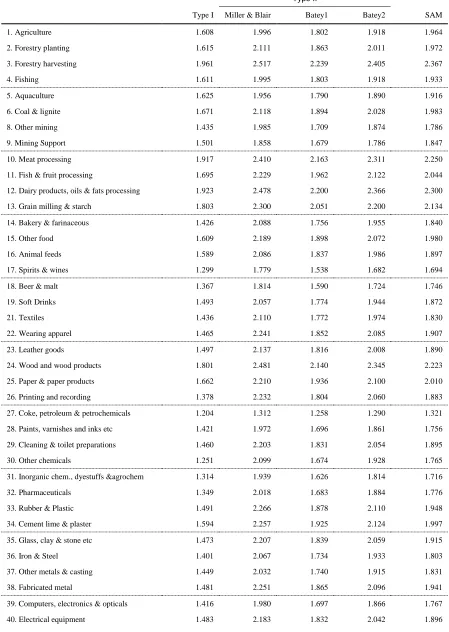
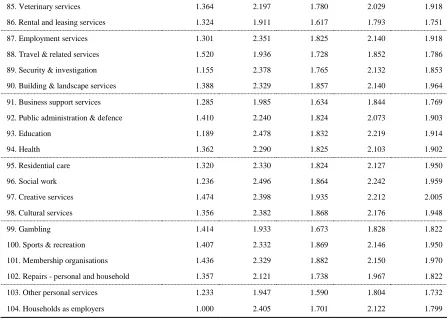
Table 1 compares the the IO Type I, Type II and SAM multiplier values across Scottish
industrial sectors for 2009. The Type II IO multipliers comprise the M+B, Batey1 and
Batey2 variants. The data used are the 2009 Scottish Industry by Industry (IxI) Table
(Scottish Government, 2013) and the 2009 Scottish SAM (Emonts-Holley et al., 2014).
The SAM is constructed around the corresponding IO accounts, so that the multiplier
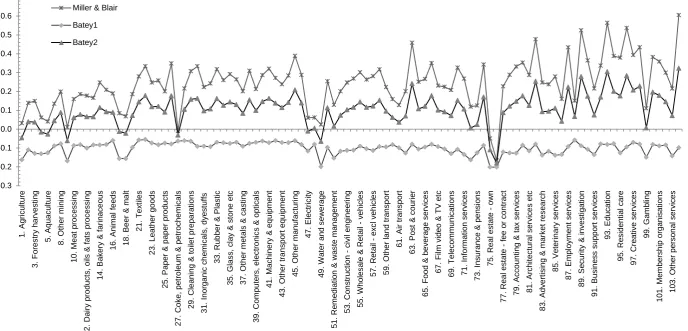
values are consistent. The deviations of the IO Type II multipliers for each sector from the
corresponding SAM multiplier value are given in Figure 1. The horizontal axis represent
the SAM multiplier value so that all the observations for each industry are measured
Table 1: IO and SAM multipliers for Scotland
Type II
Type I Miller & Blair Batey1 Batey2 SAM
1. Agriculture 1.608 1.996 1.802 1.918 1.964
2. Forestry planting 1.615 2.111 1.863 2.011 1.972
3. Forestry harvesting 1.961 2.517 2.239 2.405 2.367
4. Fishing 1.611 1.995 1.803 1.918 1.933
5. Aquaculture 1.625 1.956 1.790 1.890 1.916
6. Coal & lignite 1.671 2.118 1.894 2.028 1.983
8. Other mining 1.435 1.985 1.709 1.874 1.786
9. Mining Support 1.501 1.858 1.679 1.786 1.847
10. Meat processing 1.917 2.410 2.163 2.311 2.250
11. Fish & fruit processing 1.695 2.229 1.962 2.122 2.044
12. Dairy products, oils & fats processing 1.923 2.478 2.200 2.366 2.300
13. Grain milling & starch 1.803 2.300 2.051 2.200 2.134
14. Bakery & farinaceous 1.426 2.088 1.756 1.955 1.840
15. Other food 1.609 2.189 1.898 2.072 1.980
16. Animal feeds 1.589 2.086 1.837 1.986 1.897
17. Spirits & wines 1.299 1.779 1.538 1.682 1.694
18. Beer & malt 1.367 1.814 1.590 1.724 1.746
19. Soft Drinks 1.493 2.057 1.774 1.944 1.872
21. Textiles 1.436 2.110 1.772 1.974 1.830
22. Wearing apparel 1.465 2.241 1.852 2.085 1.907
23. Leather goods 1.497 2.137 1.816 2.008 1.890
24. Wood and wood products 1.801 2.481 2.140 2.345 2.223
25. Paper & paper products 1.662 2.210 1.936 2.100 2.010
26. Printing and recording 1.378 2.232 1.804 2.060 1.883
27. Coke, petroleum & petrochemicals 1.204 1.312 1.258 1.290 1.321
28. Paints, varnishes and inks etc 1.421 1.972 1.696 1.861 1.756
29. Cleaning & toilet preparations 1.460 2.203 1.831 2.054 1.895
30. Other chemicals 1.251 2.099 1.674 1.928 1.765
31. Inorganic chem., dyestuffs &agrochem 1.314 1.939 1.626 1.814 1.716
32. Pharmaceuticals 1.349 2.018 1.683 1.884 1.776
33. Rubber & Plastic 1.491 2.266 1.878 2.110 1.948
34. Cement lime & plaster 1.594 2.257 1.925 2.124 1.997
35. Glass, clay & stone etc 1.473 2.207 1.839 2.059 1.915
36. Iron & Steel 1.401 2.067 1.734 1.933 1.803
37. Other metals & casting 1.449 2.032 1.740 1.915 1.831
38. Fabricated metal 1.481 2.251 1.865 2.096 1.941
41. Machinery & equipment 1.519 2.304 1.911 2.146 1.983
42. Motor Vehicles 1.515 2.178 1.846 2.045 1.907
43. Other transport equipment 1.647 2.264 1.955 2.140 2.026
44. Furniture 1.574 2.284 1.928 2.141 1.999
45. Other manufacturing 1.403 2.301 1.851 2.121 1.913
46. Repair & maintenance 1.427 2.164 1.795 2.016 1.877
47. Electricity 2.053 2.405 2.229 2.335 2.345
48. Gas etc 1.260 1.544 1.401 1.487 1.482
49. Water and sewerage 1.287 1.733 1.509 1.643 1.708
50. Waste 1.493 2.195 1.843 2.054 1.941
51. Remediation & waste management 2.780 3.343 3.061 3.230 3.214
52. Construction – buildings 1.766 2.401 2.083 2.273 2.200
53. Construction - civil engineering 1.731 2.450 2.090 2.305 2.202
54. Construction – specialised 1.530 2.288 1.908 2.136 2.020
55. Wholesale & Retail – vehicles 1.335 2.116 1.725 1.959 1.815
56. Wholesale - excl vehicles 1.521 2.253 1.886 2.106 1.990
57. Retail - excl vehicles 1.352 2.139 1.745 1.981 1.858
58. Rail transport 1.764 2.582 2.172 2.418 2.265
59. Other land transport 1.400 2.033 1.716 1.906 1.810
60. Water transport 1.657 2.138 1.897 2.042 1.980
61. Air transport 1.467 1.920 1.693 1.829 1.792
62. Support services for transport 1.541 2.195 1.867 2.063 1.994
63. Post & courier 1.278 2.351 1.813 2.135 1.893
64. Accommodation 1.352 2.065 1.708 1.922 1.814
65. Food & beverage services 1.362 2.082 1.721 1.937 1.816
66. Publishing services 1.279 2.140 1.709 1.967 1.790
67. Film video & TV etc 1.454 2.100 1.777 1.970 1.869
68. Broadcasting 1.386 2.043 1.714 1.911 1.819
69. Telecommunications 1.393 2.067 1.729 1.931 1.859
70. Computer services 1.250 2.115 1.682 1.941 1.789
71. Information services 1.185 1.987 1.585 1.826 1.719
72. Financial services 1.222 1.785 1.503 1.671 1.665
73. Insurance & pensions 1.859 2.359 2.108 2.258 2.234
74. Auxiliary financial services 1.282 2.138 1.709 1.966 1.796
75. Real estate – own 1.465 1.768 1.616 1.707 1.817
76. Imputed rent 1.151 1.220 1.186 1.206 1.387
77. Real estate - fee or contract 1.503 2.198 1.850 2.059 1.971
78. Legal activities 1.241 2.069 1.655 1.903 1.781
79. Accounting & tax services 1.202 2.118 1.659 1.934 1.786
80. Head office & consulting services 1.391 2.267 1.828 2.091 1.914
81. Architectural services etc 1.437 2.239 1.838 2.078 1.953
85. Veterinary services 1.364 2.197 1.780 2.029 1.918
86. Rental and leasing services 1.324 1.911 1.617 1.793 1.751
87. Employment services 1.301 2.351 1.825 2.140 1.918
88. Travel & related services 1.520 1.936 1.728 1.852 1.786
89. Security & investigation 1.155 2.378 1.765 2.132 1.853
90. Building & landscape services 1.388 2.329 1.857 2.140 1.964
91. Business support services 1.285 1.985 1.634 1.844 1.769
92. Public administration & defence 1.410 2.240 1.824 2.073 1.903
93. Education 1.189 2.478 1.832 2.219 1.914
94. Health 1.362 2.290 1.825 2.103 1.902
95. Residential care 1.320 2.330 1.824 2.127 1.950
96. Social work 1.236 2.496 1.864 2.242 1.959
97. Creative services 1.474 2.398 1.935 2.212 2.005
98. Cultural services 1.356 2.382 1.868 2.176 1.948
99. Gambling 1.414 1.933 1.673 1.828 1.822
100. Sports & recreation 1.407 2.332 1.869 2.146 1.950
101. Membership organisations 1.436 2.329 1.882 2.150 1.970
102. Repairs - personal and household 1.357 2.121 1.738 1.967 1.822
103. Other personal services 1.233 1.947 1.590 1.804 1.732
104. Households as employers 1.000 2.405 1.701 2.122 1.799
Source: Author’s own calculations based on data in Scottish Government (2013) and
[image:18.598.102.549.73.393.2]Emonts-Holley et al. (2014).
Table 1 and Figure 1 show that the ordering of the Type II IO multiplier values derived
from their analytical properties investigated in Section 6 are replicated in the data. For
every sector, MiM B+ >MiB2 >MiB1and the SAM multiplier is always greater than the
Batey1 multiplier MiB1>MiS. There are two sectors, 75 and 76 - Real Estate and the
Imputed Rent - where the SAM multiplier has the highest value.3 In all other sectors
M B i
M + is the highest multiplier value. The Batey2 multiplier is generally above the SAM
value: in only 10 of the 104 sectors is it less. There are some very pronounced positive
spikes using the M+B and the Batey2 approach, where the value is large in comparison to
the SAM multiplier. The three most prominent examples are for sectors 89, 93 and 96,
which are Security & Investigation, Education, and Social Work respectively. These
results are driven by the relatively high share of labour in value added in these sectors.
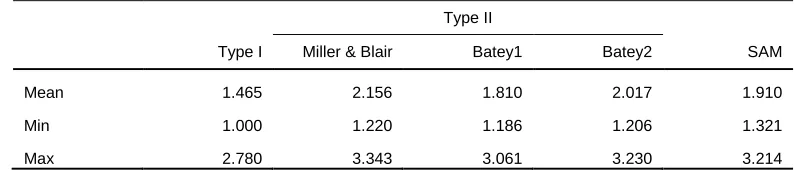
Table 2 gives the summary statistics for the range of multiplier values, showing the
maximum, minimum and mean figures. The first point to make is that if the mean values
for the Type I IO and SAM multipliers are compared, the incorporation of induced activity
increases the multiplier from 1.465 to 1.910. That is to say the additional output over and
above the direct increase in final demand is almost doubled by including the induced
household consumption effects. Second, as the evidence from Figure 1 suggests, the mean
value for the Batey1 Type II multiplier is lowest, followed by the SAM, the Batey2 and
finally the Miller and Blair values. The difference between the two extreme Type II mean
multiplier values is 0.346. The range of Type II multiplier values is almost 40% of the
[image:19.598.125.522.430.515.2]most accurate measurement of additional multiplier effect, which is the SAM value 0.910.
Table 2: IO and SAM multiplier summart statistics
Type II
Type I Miller & Blair Batey1 Batey2 SAM Mean 1.465 2.156 1.810 2.017 1.910
Min 1.000 1.220 1.186 1.206 1.321
Max 2.780 3.343 3.061 3.230 3.214
Table 2 shows that the mean SAM multiplier lies within the range of the mean IO Type II
values. The Batey1 figure is systematically lower than the SAM multiplier and the Batey2
and M+B approaches systematically higher. Batey1 is the Type II IO multiplier whose
mean value is closest to the mean SAM multiplier, though this is only marginally closer
than Batey2. The minimum and maximum multiplier values also replicate these findings.
Table 3 calculates the Root Mean Square Error and Mean Absolute Error for the Type II
multiplier values for individual sectors against the SAM multiplier figure. Again the
Miller & Blair Batey1 Batey2 RMSE 0.201 0.077 0.099
Figure 1: Differences between the SAM and the Type II multipliers -0.3 -0.2 -0.1 0.0 0.1 0.2 0.3 0.4 0.5 0.6 0.7 1. A gr ic ul tu re 3. F or es tr y har v es ti ng 5. A quac ul tur e 8. O ther m ini ng 10. M eat pr oc es s ing ai ry pr oduc ts , oi ls & f at s pr oc e s s ing 14. B ak er y & f ar inac e ous 16. A ni m al f eeds 18. B eer & m al t 21. T ex ti les 23. Lea ther goods 25. P aper & paper pr oduc ts C ok e, pet rol eum & pet roc he m ic al s 29. C leani ng & t o ilet pr epar at io ns 31. I nor gani c c h em ic al s , dy es tuf fs 33. R ub ber & P las ti c 35. G las s , c lay & s tone et c 37. O ther m et al s & c as ti ng C om put er s , e lec tr o ni c s & opt ic a ls 41. M ac hi ner y & eq ui pm ent 43. O ther t ran s por t equ ipm ent 45. O ther m anuf ac tur ing 47. E lec tr ic it y 49. Wat er and s ew er age R em edi at ion & w as te m an agem ent 53. C on s tr uc ti on c iv il e ngi n eer ing 55. Whol es al e & R et ai l - v ehi c les 57. R et ai l ex c l v eh ic le s 59. O ther l an d t rans p or t 61. A ir t rans por t 63. P os t & c our ier 65. F ood & bev er age s er v ic e s 67. F ilm v ideo & T V et c 69. T el ec om m u ni c at ions 71. I nf o rm at ion s er v ic e s 73. I ns ur anc e & pens ions 75. R ea l es tat e ow n 77. R ea l es tat e f ee or c ont rac t 79. A c c ou nt ing & t ax s er v ic es 81. A rc hi tec tur al s er v ic e s et c 83. A dv er ti s ing & m ar k et r es ear c h 85. V et er in ar y s er v ic es 87. E m pl oy m ent s er v ic e s 89. S ec ur it y & i n v es ti gat ion 91. B us ines s s uppor t s er v ic es 93. E duc at ion 95. R es ident ial c ar e 97. C reat iv e s er v ic es 99. G am bl in g 101. M em ber s hi p or gani s at ions 103. O ther per s on al s er v ic es
Miller & Blair
Batey1
8. Discussion and conclusion
There is complete agreement about the method used to calculate Input-Output Type I
multipliers. These measure the direct and indirect output effects from a unit expansion in
exogenous final demand in a particular sector. They incorporate the change in activity
associated with the production of the intermediate goods that contribute directly or
indirectly to the production of final demand.
Type II multipliers identify the direct and indirect effects. However, they also incorporate
the impact of increased household income and subsequent consumption expenditure that
accompanies any change in output. These are known as induced effects. Although this is a
very common procedure, a number of different methods have been adopted in the
literature. First, we believe that this variation is not widely recognised. This is potentially
problematic for the interpretation of Type II multipliers, their use in modelling
demand-side disturbances and the value for comparing the structural characteristics of different
economies. Second, it would be valuable to standardise the Type II procedure, which
requires choosing amongst the different formulations.
The first question is whether empirically this is a serious problem. The Scottish results
suggest that it is. The range of Type II multiplier mean values is almost 40% of the most
accurate measurement of additional multiplier effect. The second question is: which
method is preferable? If the SAM multipliers embody the most complete linking of
income generated in production and the subsequent distribution to households.for
Scotland the mean value using the Batey1 method is closest to the mean SAM value and
has the smallest mean error, even though the method systematically underestimates the
SAM multiplier values. However, this method has the disadvantage that it requires
information on household income that is typically not available from the IO accounts
themselves.
Despite some of the models coming close to SAM multipliers, it must be acknowledged
wages, and link household expenditure to these. A SAM multiplier incorporates income
from other value added into household income in a way completely consistent with the
standard demand-driven IO approach. It is therefore the only wholly satisfactory means of
Appendix 1: Variable names and symbols
Symbol Variable name
A Matrix of technical coefficients in production
B Matrix of Type II coefficients
C Total household consumption
M Multiplier value
N Endogenous (subscript)
R Total corporate income
S Matrix of SAM coefficients
T Exogenous transfers
W Total wages
X Exogenous (subscript)
Z Identifier for Type II multiplier
c Household consumption vector
f Vector of final demands
rK Share of corporate income distributed to account K
v Vector of institutional income
w Vector of production wage coefficients
x Vector of output
Π Total other value added
ij
α Elements of the Type I Leontief inverse
ij
β Elements of the Type II Leontief inverse
i
ϕ Coefficients of household consumption expenditure
ij
κ Income adjustment in the modified Type II matrix of coefficients
K
ρ Share of other value added income distributed to account K
References
Batey, P. (1985), “Input-output Models for Regional Demographic-Economic Analysis:
Some Structural Comparisons”, Environment and Planning A, vol. 17, pp. 73-99.
Batey, P. and Madden, M. (1983), “Linked Population and Economic Models: Some
Methodological Issues in Forecasting, Analysis and Policy Optimisation”, Journal of
Regional Science, vol. 23, pp. 141-164.
Batey, P. and Weeks, M.J. (1989), “The Effects of Household Disaggregation in Extended
Input-Output Models”, in R.E. Miller, K.R. Polenske and A.Rose, eds., Frontiers of
Input-Output Analysis: Commemorative Papers, Oxford University Press, New York.
Emonts-Holley, T., Ross, A., & Swales, J.K. (2014), “A Social Accounting Matrix for
Scotland”, Fraser of Allander Institute Economic Commentary, 38(1), 84-93.
Miller, R., & Blair, P. (1985), Input-Output Analysis Foundations and Extensions,
Prince-Hall.
Round, J. (2003), Social Accounting Matrices and SAM-based Multiplier Analysis.
Chapter 14 in F. Bourguignon and L.A. Pereira da Silva eds., Techniques and Tools for
Evaluating the Poverty Impact of Economic Policies, World Bank and Oxford University
Press.