• No results found

Structural Database Tables by Branch: Studies of National Accounts No. 4/La base de donnees structurelles tableaux par branche: etudes de comptabilite nationale No. 4 1984

N/A
N/A
Protected

Academic year: 2019

Share "Structural Database Tables by Branch: Studies of National Accounts No. 4/La base de donnees structurelles tableaux par branche: etudes de comptabilite nationale No. 4 1984"

Copied!
184
0
0

Loading.... (view fulltext now)

Full text

(1)

eurostat

STRUCTURAL DATA BASE

TABLES BY BRANCH 1960-1981

Studies of national accounts — No 4

LA BASE DE DONNEES STRUCTURELLES

TABLEAUX PAR BRANCHE 1960-1981

(2)

eurostat

STATISTICAL OFFICE OF THE EUROPEAN COMMUNITIES

OFFICE STATISTIQUE DES COMMUNAUTÉS EUROPÉENNES

L-2920 Luxembourg-Kirchberg — Tél. 43011, Télex: Comeur Lu 3423

(3)

Studies of national accounts — No 4

STRUCTURAL DATA BASE

TABLES BY BRANCH 1960-1981

This publication has been prepared by Marco Pecci-Boriani of the Statistical

Office of the European Communities with the help of Jean Leroy and Françoise

Lenoir.

Études de comptabilité nationale — N° 4

LA BASE DE DONNÉES STRUCTURELLES

TABLEAUX PAR BRANCHE 1960-1981

(4)

Cataloguing data can be found at the end of this publication Une fiche bibliographique figure à la fin de l'ouvrage

Luxembourg: Office des publications officielles des Communautés européennes, 1984

ISBN 92-825-4185-1
(5)

PREFACE

The Statistical Office of the European Communities regularly publishes

annual national accounts data for the Community countries broken up

into four main series : principal aggregates, data by branch, by

institutional sector and for general government. Some quarterly

estimates and five-yearly input-output tables are also published. The

data are harmonized in accordance with the European system of

integrated economic accounts, which supplies common definitions and

classifications intended to ensure a coherent quantitative description

of the economies of the member countries.

This series 'Studies in national accounts' aims to supplement the

existing system of publications through occasional methodological

studies and analyses of the data, made by the staff of the Office or

outside consultants.

The methodological studies are intended primarily for the more

specialized user. They will deal with problem areas in the existing

accounts or possible extensions to the accounts. The analyses will

concentrate on the interpretation and use of the existing statistics as

well as introducing new data on a provisional basis in fields in which

there are as yet no harmonized figures.

The aim of all the studies is to lead to an improvement in the quality

of the data and a better understanding of the ways in which they can be

used.

The series will appear on a regular basis and contain an average of

three to four studies every year. Studies will always be published in

English and French and possibly the original language of the study

where it is different from these.

(6)
(7)

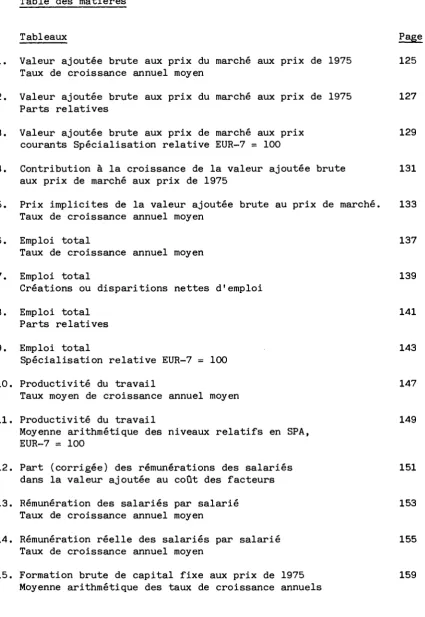
CONTENTS

PART ONE PAGE

Introduction 4

1.1. General aspects of the compilation of data 6

1.2. Particular aspects of the compilation of data

9

11

11

12

12

13

14

15

15

16

2. Guide to interpretation of the tables and graphs 17

1.2.0

1.2.1

1.2.2

1.2.3

1.2.4

1.2.5

1.2.6

1.2.7

1.2.8

1.2.9

By variable

FR of Germany

France

Italy

United Kingdom

Netherlands

Belgium

Denmark

EUR-7

List of sources

PART TWO

1. Basic data 46

(8)

Introduction

EUROSTAT regularly publishes detailed data by branch on transactions in

goods and services compiled in accordance with the European System of

Integrated Economic Accounts (1). These are produced by the National

Statistical Institutes and refer to the period beginning in 1970 ; they

contain data by branch on value added at market prices and factor cost,

compensation of employees, employment and gross fixed capital

formation. In addition, households' final consumption and gross fixed

capital formation are broken down by purpose of consumption and by

product respectively.

Many users of national accounts, and in particular the

Directorates-General of the Commission, have pointed out that the series of data

normally available do not meet the practical requirements of

quantitative economics in two particular respects : the series are not

long enough and do not cover fundamental variables such as total

output, exports and imports by branch.

Moreover, even with the official series beginning in 1970 users were

faced with difficulties arising from breaks in the series within this

period, and the completeness of the detailed series was not ensured

until the last year.

Consequently, EUROSTAT became involved in producing estimates

incorporating the data already available as part of the official ESA

data.

These estimates provide series which are as coherent and comprehensive

as possible up to the last year for which aggregated data are

available. These series start in 1970 or 1960, depending on the

importance of the variables and the availability of the data used in

the estimates.

The present publication sets out the estimates that have been made,

especially those from 1960 onwards, together with a series of

calculations and characteristic ratios describing trends in the

economies of the European countries over the last 20 years.

The methods used in constructing the series and the degree of

reliability of the estimated data are described in a special chapter.

In general, it may be said that the problem presented by breaks in the

series was resolved by means of the only method at Eurostat's disposal.

For each reconstruction exercise we collected the statistical series

covering the period 1960-1970 which are as comparable as possible with

those beginning in 1970 ; this latter year is thus the first year of

the "official" ESA series and the last year of the series used for the

estimates. The calculation involves multiplying the 1970 data in the

first series by the index numbers (1970 = 100) in the second series.

The same method was used for estimating the data for the most recent

years, for which official figures are not yet available, taking as the

base year the last year for which official data are available.

(9)

The underlying assumption is therefore difficult to accept, if it were

not the only one possible, and should prompt users to exercise great

caution with regard to the absolute data, especially the most detailed

ones. On the other hand, the figures obtained from the calculations

that can be made, a small proportion of which are presented in this

publication, are much more reliable.

The trends of the series used for backward extrapolation are not

modified by the calculation and it can reasonably be assumed that,

unlike the absolute values, these are only marginally affected by the

phenomena which cause the breaks in the time series. Where the ESA

series have been compared with those used for backward extrapolation

for a common period, the results confirm the above assumption.

The ratios between variables, too, should provide significant pointers

for the period covered by the estimates. In this case, we assumed that

the distortions introduced into the pairs of variables used from time

to time are parallel. The ratios will therefore have every chance of

being accepted for their absolute values as well as for the trends they

indicate.

Countries available :

As the data for Luxembourg, Ireland and Greece were not extrapolated

backwards, these countries are not shown in the tables published. The

reason for this is that there are virtually no statistical series,

whether official or unofficial, for the period prior to 1970. Eurostat

hopes that the recent increasingly urgent requests for the construction

of long series will lead to series beginning in the 1960s being

available for these countries too, and that estimates can then be

calculated.

The aggregate EUR-7 is therefore calculated as the sum of the flows

relating to the FR of Germany, France, Italy, the Netherlands, Belgium,

the United Kingdom and Denmark. Depending on the year and the variable,

the aggregate EUR-7 reprensents 96-97

%

of the aggregate EUR-10 for the

values relating to the totals of the aggregates.

The Community data are calculated by totalling the Member States' data

converted, for the variables expressed in monetary values, into the

common unit, the ECU. This basket-type unit of account is based on

currency market exchange rates.

(10)

Nomenclature used

Every effort was made to compile the basic data, wherever possible, at

the level of detail of the NACE-CLIO R25. In other cases, the R25

represents the basic nomenclature by reference to which the groupings

of branches are defined as a simple summation of the branches of the

R25 (see below the list of branches and groupings of the R25 and the

code numbers used specially in this publication).

Description of the publication

This volume is divided into two parts. The first part provides the key

information needed for reading the second, namely a description of the

methods used for extrapolating the data backwards, a list of

statistical sources, a list of the difficulties encountered and a

quantitative assessment of the accuracy of the estimates.

The second part is divided into two sub-sections which have a

completely different layout from each other.

Le first sub-section gives the basic data for each country, using a

nomenclature comprising nine branches or groupings of branches of the

NACE-CLIO R25, for the period 1960-1981 and for the following variables

value added at market prices (current and 1975 prices), occupied

population, gross fixed capital formation (current and 1975 prices),

exports and imports to or from the rest of the world. The choice of the

variables and the grouping of the branches were dictated by the need to

provide the maximum number of series in a compact form and at a level

of detail which does not present problems of temporal comparability of

the series.

Users who would like to have the full contents (1) of the data base

used in the preparation of this publication should apply to Eurostat,

Division Al, Economic Accounts and ask for the data base BDS. A brief

explanation of the purposes for which the data are required would be

appreciated.

The second sub-section contains comparative structural tables

describing the trends in the different variables and countries.

1.1. General aspects of the compilation of the data

(11)

As regards the particular case of the series provided by Eurostat at

the detailed level of branches, it may be said that there is a break in

the sense that for the six original members of the EEC there are ESA

series which begin in 1970 and are regularly available alongside the

old series based on the (old) SNA and not compiled any more after the

introduction of the ESA at the beginning of the 1970s.

Faced with the widespread demand for harmonized series at international

level overcoming the barrier represented by the year 1970, Eurostat

drew up estimates based on a method which is the same for all variables

and all countries. It comprises four stages :

a) collection of series which are as comparable as possible with the

series to be 'extended' ;

b) reduction of the series to a nomenclature in keeping with the

NACE-CLIO ;

c) application of the growth rate of the series based upon a particular

base year to the value of the ESA series for the same base year ;

d) calculation of the sum of the values for the branches estimated in

this way and comparison of this total with the total ESA aggregate

available from the official statistics, e.g. comparison of the sum

of the estimates of gross fixed capital formation by branch with the

official ESA figures for total gross fixed capital formation for the

economy as a whole.

The fourth stage shows the degree of reliability of the estimated data

for each year and brings out any breaks in the series used which are

not shown in the notes accompanying the series. This calculation gives

an indication of the quality of the estimate and if the error does not

exceed +/-3

%

on average and remains constant over the estimate period,

it is entirely acceptable. In cases where one of these two conditions

is not met, this will be mentioned in the notes on the countries or

variables in order to draw attention to the difficulties which have not

been solved.

There are two main types of differences between the national series

used for the estimates and the official ESA series :

- differences in the definition of the unit for which the data are

presented; it is the branch for the ESA series, whereas in many

cases it is an institutional unit in the national series used ;

(12)

The system of taxation prevalent in many Community countries in the

1960s was in fact a cascade turnover tax which in the majority of cases

was added to the value of the flow. The Community countries (with the

exception of Greece) gradually introduced VAT, on either side of 1970.

The post-VAT national accounts can be valued exclusive or inclusive of

deductible VAT, the former method being the one currently in use. There

are thus three possible methods of valuation : inclusive of turnover

tax, inclusive of VAT, exclusive of deductible VAT. The changeover from

the first to the second method is not regarded as a factor of

discontinuity, whereas the changeover from the second to the third is.

This break can somehow be eliminated if for the year of the changeover

from one system of taxation to another the series of accounts valued

both inclusive of turnover tax and exclusive of deductible VAT is

available.

As regards the choice between describing the structure of the data by

variable (for all countries) or by country (for all variables), it was

decided to describe the structure of the data on imports and exports

and on actual output for all countries to start with since the sources

are the same and the estimation process covers all branches and all

years except the base year.

(13)

1.2. Particular aspects of the compilation of the data

1.2.0. By variable

Imports and exports by branch

The series derived from the external trade data aggregated in

accordance with the NACE-CLIO comprise the source used in the

construction of the series on imports and exports by branch.

Eurostat produces two such series. The first starts in 1963 and

is derived from data originally expressed in the UN's SITC

nomenclature.The second starts in 1975 and is derived from data

expressed in the Community's NIMEXE nomenclature.

The choice of the series to be used for the estimates fell on

those of SITC origin. These have the required length but proved

to be totally incompatible with those of NIMEXE origin. Any use

of the latter for the most recent period, although desirable,

would have introduced a break in the continuity of the series.

The series were estimated on the basis of the data on FOB

exports and CIF imports contained in the 1975 input-output

tables, for the values of the flows from or to the rest of the

world and from or to the Community countries. Given the origin

of the data used in the estimates, only the data for the

goods-producing branches were reconstructed.

The size of any errors that may have been made was checked by

comparing the total derived from the sum of the branches for

which estimates were made and the corresponding aggregate shown

in the goods and services account for the national economy. In

general, the degree of error is well below the 3

%

threshold we

had set and it is constant over time. A few exceptions should

be noted.

Belgium : the error calculated for the series of imports

and exports is around 0 from 1975 onwards. For the previous

period it is fairly high and not constant over time. In the

case of exports, this period can be divided into two

sub-periods, 1963-1967 and 1968-1974, with errors of around 10 and

5 percentage points respectively. In the case of imports, the

error is completely erratic.

(14)

The data for France and Denmark are taken from these countries'

annual input-output tables and are therefore wholly comparable

with the rest of the official data.

The data for the FR of Germany were compiled by applying to the

values of actual output available for the 1975 input-output

tables the trend derived from the data on actual output

published in (1). This method provides data which are correct

as a reflection of trends but cannot be compared in terms of

level with those for the other variables. The latter are in

fact the result of the revision recently carried out by the

Federal Statistical Office, whereas the 1975 input-output

tables are part of the pre-revision data. The estimates of

output, on the other hand, are entirely consistent with the

import and export data, estimated from the same base, i.e. the

input-output tables, which means that the ratios calculated

between them can be regarded as valid.

The data for Italy, the United Kingdom, Belgium and the

Netherlands were estimated by applying to the values of actual

output used in the 1975 input-output tables the trend derived

from the data on value added at market prices. This method

would be correct if the ratio between value added at market

prices and the value of output were constant over time, but

this is not the case. In order to determine to what extent a

change in the technical coefficients gives rise to significant

distortions in the ratios calculated in Tables 21 and 22, we

calculated for 1970 the true ratios derived from the

input-output tables for that year and compared them with the ratios

calculated on the basis of the estimated actual output.

If the difference between the two does not exceed 3 percentage

points, the calculation can be regarded as substantially

correct ; if the difference is between 3 and 6 percentage

points, an asterisk is placed alongside the ratio published in

Tables 21 and 22 ; if the difference is more than 6 percentage

points, two asterisks are placed alongside the ratio in

question.

(15)

1.2.1. FR of Germany

Pre-1970 estimates (value added at current and 1975 market prices,

occupied population, gross fixed capital formation at current and

1975 prices).

The values of the above variables for the period 1960-1969 were

estimated by applying to the ESA data available for 1970 the trends

derived from the corresponding variables shown in source (1).

1.2.2. France

Constant prices

In general, the data expressed at constant prices have 1970 as base

year. The change of base to 1975 prices was made automatically by

applying to the data at current prices for the year 1975 the trends

in the values at constant 1970 prices.

Pre-1970 estimates

The base for the estimates of value added at current and 1975 market

prices is provided by source (2). As regards the data on gross fixed

capital formation, the above-mentioned source does not include that

of the non-market services branch and part of the market services

branch. For this reason the basic data have been completed with some

data extracted from the EUROSTAT publications issued before the

introduction of the ESA. A break has been detected between 1963 and

1964 from the computing of the error. This (4 %) is a little bit

out of the accepted range and one of the reason is the bad ajustment

of the old nomenclature for the fuel and power products branches.

The data on the occupied population were estimated on the basis of

the old national accounts series available to Eurostat prior to the

introduction of the ESA.

Post-1970 estimates

The INSEE has not yet produced data on value added at factor cost

and compensation of employees.

(16)

The estimates for the services of credit institutions and non-market

services were made by applying the same methodology to the data

provided by the accounts of the institutional sectors.

The data for the products of the agriculture branch were estimated

from the data given in Eurostat's Economic Accounts for Agriculture

and Forestry.

1.2.3. Italy

Constant prices

The same remarks apply as for France.

Pre-1970 series

In general, these are taken directly from the ISTAT (Italian

Statistical Office) publication (3) ; they give an evaluation for

the period 1960-1969 which is fully consistent with the series

already available from 1970 onwards.

The additional estimates made by Eurostat concern the disaggregation

of the grouping of branches producing manufactured products in

respect of value added at constant market prices and gross fixed

capital formation at constant and current prices. In all these

cases, the source of the data for the estimates is the national

accounts series available to Eurostat prior to the introduction of

the ESA. The errors are negligible in all cases at around 1

percentage point. There is a slight break between 1964 and 1965 as

regards gross fixed capital formation at constant prices.

Post-1970 series

The only estimate involves disaggregation of the grouping of

branches producing manufactured products for 1981. This was done on

the basis of the data from source (4).

1.2.4. United Kingdom

General remarks

The United Kingdom Central Statistical Office (CSO) has made

considerable efforts to supply Eurostat with data converted from its

own nomenclatures and methodologies to those of the Community. As a

result some series are closer to ESA concepts than others, and the

variables are therefore not entirely compatible with one another.

Steps have been taken to ensure that the United Kingdom's data are

more consistent with the ESA and with one another. For this reason

allowances must be made for possible statistical imperfections,

especially in the more detailed data, when interpreting the

characteristic ratios shown in Tables 11 and 17 in particular.

(17)

Value added at market prices and at factor costs (current prices)

The pre-1970 estimates were made on the basis of the data on value

added at factor cost from source (5). The data for 1980 and 1981

were estimated in two stages. In the first stage, the figures for

the branches making up the NACE-CLIO R6 were estimated on the basis

of data from source (5). The error of estimation of the six branches

is 0,9 percentage points.

In the second stage, detailed figures were estimated for the

branches producing manufactured products. For this purpose an

estimator was calculated by multiplying the indices of value added

at factor cost at 1975 prices by the indices of industrial producer

prices given in source (11). The error is above the acceptable limit

(4,9 points) and is entirely due to the index of prices, which

proved to be unsuitable.

Gross fixed capital formation at current and 1975 prices.

The data for the period 1960-1969 are taken from source (5) and are

consistent and compatible with the data for the subsequent period.

The data at 1975 prices contain a slight break in series between

1972 and 1973 owing to the change of reference year for the

valuation of the data at constant prices.

Occupied population.

The estimates for the period 1960-1969 were made on the basis of the

data from source (6).

1.2.5. Netherlands

General remarks

The national accounts series supplied by the Netherlands Central

Bureau of Statistics (CBS) contain two breaks in series, for 1969

and 1977 respectively. Fortunately, for each of these two years the

two valuations were supplied, the former consistent with the

previous period and the latter with the subsequent period. The

published data used the values for the period 1969-1977 as a

starting point for the 1960-1968 backward extrapolations and the

1978-1981 extrapolations. The data for the latter years differ

therefore from the official data resulting from the post-1977

revision and published in the usual way by EUROSTAT.

Pre-1970 estimates

There are based on the series existing prior to the introduction of

the ESA and on the data supplied by the Plaanbureau (see also source

(7) as regards the disaggregation of the data at constant prices.

(18)

Value added at market prices and at factor cost.

The values at current prices had to be estimated for all branches

for 1980 and 1981. For the values at constant prices (the 1977-1981

data refer to 1977 prices), the official data cover the whole of the

period 1970-1977 and 1977-1981, but disaggregation is limited to the

NACE-CLIO R6. Subsequent disaggregations were estimated by Eurostat.

Gross fixed capital formation.

For the data at current prices the estimates were limited to the

disaggregation for the period 1970-1981 of the total aggregate for

branches 19/27/23 of the NACE-CLIO, using source (8).

For the data at constant (based on 1977) prices, an estimate had to

be made for the whole period 1970-1981 in order to break down the

total aggregate for branches 6/30/19 of the NACE-CLIO. The result is

not satisfactory, since the error is always above the acceptable

limits.

Occupied population.

For the period 1970-1981, estimates were made for branches 19/21/23

of the NACE-CLIO, using source (9), for which the official total was

known.

1.2.6. Belgium

Pre-1970 estimates

The main basis for the estimates comprised the series supplied by

the Belgian National Statistical Institute (INS), which were

compiled in accordance with the old United Nations SNA.

The errors for the value added at constant market prices of the

chemicals and plastics branches are not acceptable, the estimates

are acceptable for 1967 to 1969 only ; for the previous period, only

the aggregate comprising their sum provides reliable information.

Gross fixed capital formation at constant prices.

The estimates for the individual industrial branches forming part of

the aggregate Consumption goods contain a fairly high average error

which varies over time.

Estimates for the period 1970-1981

The official data supplied by the INS contain, for the value data

under consideration, a number of breaks in series.

(19)

Occupied population.

The annual series do not provide detailed data for branches 19, 21,

23, 25 and 28 of the NACE-CLIO. These were estimated on the basis of

the data supplied by the INS for 1975, applying the trend calculated

from the data given in source (9).

1.2.7. Denmark

The Danish series begin only in 1966 and are supplied by Denmarks

Statistik ; they are consistent and comparable for the whole period.

The series on value added at market prices (current prices at 1975

prices) are not supplied and the valuation at factor cost is given

instead.

Consequently, when reference is made in the tables to value added at

market prices, this should be read as value added at factor cost in

the case of Denmark.

1.2.8. EUR-7

The values for the fictitious entity which we have called EUR-7 were

calculated by adding together the data for the seven countries,

which,

except for the data on employment, had previously been

converted into ECU.

The data on imports and exports were calculated as the totals of the

'seven countries' data on extra-Community imports and exports.

(20)

1.2.9. LIST OF SOURCES

(1)

Statistisches Bundesamt - Volkswirtschaftliche Gesamtrechnungen

- Fachserie 1.8. Reihe S. 5 - Revidierte Ergebnisse - 1960 bis

1981.

(2) INSEE - Rétrapolation des comptes nationaux dans le nouveau

système de comptabilité nationale française. Séries 19591970

-Les collections de 1'INSEE n° 67-68.

(3) ISTAT - Annuario di Contabilità Nazionale - Edizione 1982.

(4) Confindustria - Le prospettive dell'industria italiana nel

bienno 1981-83.

(5) C.S.O. National Income and Expenditure.

(6) Department of Employment. Employment Gazette.

(7) Plaanbureau - Central economish plan

(8) EUROSTAT - Annual investments in fixed assets

(9) EUROSTAT - Employment and unemployment.

(10) EUROSTAT - Hourly earnings - Hours of work.

(21)

2. Guide to interpretation of the tables and graphs

The table on page 20 shows the precise composition of the codes used

in the tables, with reference to the NACE-CLIO R25 nomenclature or to

the groupings comprising various basic headings of this nomenclature.

All the explanatory notes of a methodological nature published in

'National accounts - Detailed tables by branch' apply to the data

common to the two publications.

Where the sum of the items in a table does not correspond to the total

shown, the explanation can be found in the corresponding paragraph of

Section N° 1. The following points should be noted with regard to the

construction of the tables or graphs.

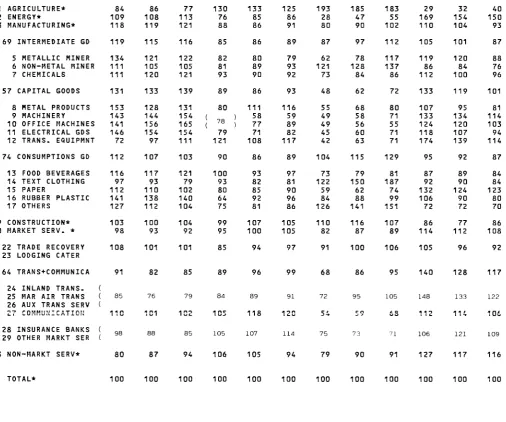
Table 3 : Gross value added at current market prices - Relative

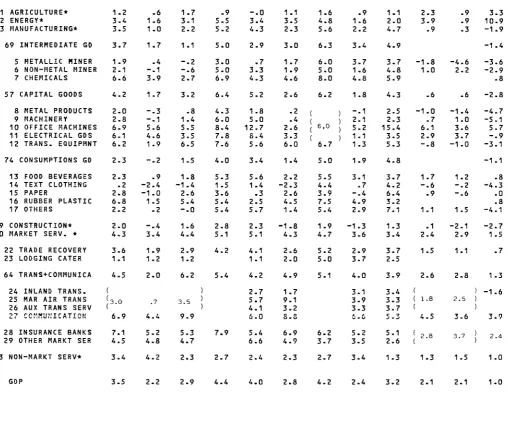
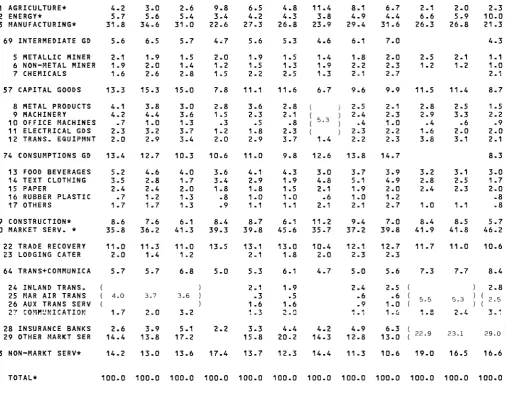
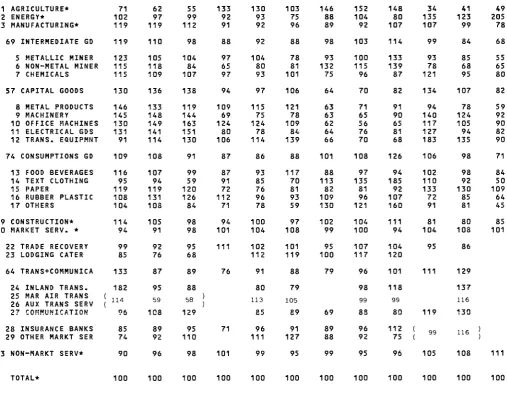
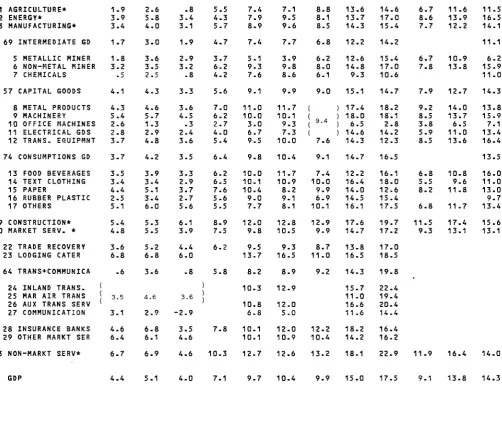
specialization EUR-7 = 100

This is the ratio between each branch's share of the

national total and its share in relation to EUR-7. An index

of more than 100 therefore indicates a specialization

compared with the European average.

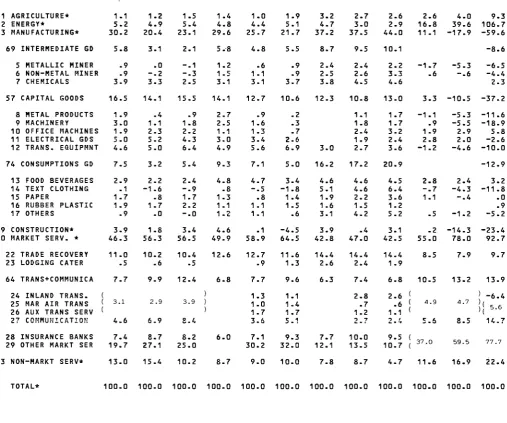
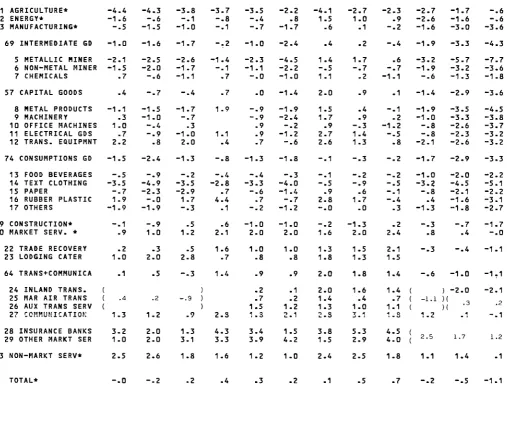
Table 4 : Contribution to the growth of value added at market prices

at 1975 prices.

For each period, the difference between the values for the

last and first years is calculated. The results of the

operation, for each branch, are divided by the total. If

the index is negative, this signifies a decrease in the

branch's absolute value.

Table 5 : Prices of gross value added at market prices - Annual

average growth rate.

The index of prices of value added at market prices is

calculated by dividing the values at current prices by the

values at 1975 prices.

(22)

Table 11 : Labour productivity - Arithmetic average of relative levels

in PPS, EUR-7 = 100.

Once labour productivity has been calculated at current

prices, the values are converted into PPS and divided by

the values of the EUR-7 aggregate.

Table 12 : Adjusted share of compensation of employees in value added

at factor cost.

Before being divided by value added at factor cost, the

data on compensation of employees are multiplied by the

ratio between the occupied population and the number of

wage and salary earners. This comes to the same thing as

assuming that for each branch the average of the earnings

of self-employed workers is equal to the average of the

earnings of employees.

Table 14 : Real per capita compensation of employees - Annual average

growth rate.

The data on compensation of employees were deflated by

dividing them by the indices of implicit prices of

households' final consumption. Employees' earnings are thus

valued in real terms.

Table 17

Investment rate.

This represents the ratio between gross fixed capital

formation and value added at market prices, both at current

prices.

Table 21 : Percentage of production exported.

It is the ratio between total exports and the actual

output.

The figure can be more than 100

%

because in some instances

exports include a large amounts of re-exports (imported

goods).

Table 22 : Import penetration.

(23)

Graphs

These show the trends in the variables presented in the tables

throughout the period for the aggregate EUR-7 and for three branches of

the economy. The terms 'Industry' and 'Services' represent the totals

of NACE-CLIO branches 6-30-53 and 68-86 respectively.

Graph 5

Coefficient of variation of labour productivity in PPS EUR-7 for

the

seven countries.

(24)

CONTENTS OF CODES USED IN THE TABLES

Table

Code

Description

NACE-CLIO

Code

1 Agricultural, forestry and fishery products 01

2 Fuel and power products 06

3 Manufactured products 30

5 Ferrous and non-ferrous ores and metals,

other than radio-active 13

6 Non-metallic minerals and mineral products 15

7 Chemical products 17

8 Metal products, except machinery and transport

equipment 19

9 Agricultural and industrial machinery 21

10 Office and data processing machines, precision

and optical instruments 23

11 Electrical goods 25

12 Transport equipment 28

13 Food, beverages, tobacco 36

14 Textiles and clothing, leather and footwear 42

15 Paper and printing products 47

16 Rubber and plastic products 49

17 Other manufactured products 48

19

Building and construction

53

20

22

23

Market services

Recovery and repair services, wholesale and

retail trade services

Lodging and catering services

68

56

(25)

24 Inland transport services

25 Maritime and air transport services

26 Auxiliary transport services

27 Communication services

28 Services of credit and insurance institutions

29 Other market services

33 Non-market services

35 General government services

36 Other non market services

69 Intermediate goods

57

74

64

Capital goods

Consumption goods

Transport and communication services

61

63

65

67

69A

74

86

81

85

89

93

13

15

17

19

21

23

25

28

42

47

49

48

(26)
(27)

PREFACE

L'Office statistique des Communautés européennes publie régulièrement

les comptes nationaux annuels des Pays membres des Communautés

euro-péennes ; ceux-ci se répartissent en quatre publications : Principaux

agrégats, tableaux par branche, tableaux par secteur, comptes des

Administratios publiques. En outre, l'Office publie quelques données

trimestrielles et des tableaux Entrées Sorties quinquennaux. Toutes ces

données sont établies selon le SEC (Système européen de Comptes

écono-miques intégrés) qui fournit des définitions et classifications communes

destinées à assurer une description quantitative cohérente des économies

des Pays membres.

La série "Etudes de Comptabilité nationale" a pour but de compléter le

système de publications existant par des études méthodologiques et des

analyses de données effectuées soit par des fonctionnaires de l'Office,

soit par des consultants extérieurs.

Les études méthodologiques sont principalement destinées aux

utilisa-teurs spécialisés. Elles traitent des problèmes de l'élaboration des

comptes tels qu'ils existent, ainsi que de problèmes de développement du

système de comptes. Les analyses concernent plutôt l'interprétation et

l'utilisation des données, ainsi que l'introduction, à titre provisoire,

de nouvelles données dans des domaines où il n'existe pas encore de

données harmonisées. Le but de toutes ces études est de conduire à

l'amélioration de la qualité des comptes nationaux et de développer

leurs possibilités d'utilisation par une meilleure compréhension de leur

élaboration.

Les études de la série seront publiées régulièrement et seront au nombre

de trois ou quatre par an. Elles seront toujours publiées au moins en

français et en anglais, mais également dans la langue originale de

l'auteur lorsque celle-ci sera autre.

(28)
(29)

TABLE DES MATIERES

PREMIERE PARTIE PAGES

Introduction 26

1.1. Etablissement des données en général 29

1.2. Etablissement des données en particulier

32

34

34

35

36

37

38

39

39

40

Guide de lecture des tableaux et des graphiques 41

1.2.0

1.2.1

1.2.2

1.2.3

1.2.4

1.2.5

1.2.6

1.2.7

1.2.8

1.2.9

Par variable

R.F.A.

France

Italie

Royaume-Uni

Pays-Bas

Belgique

Danemark

EUR-7

Liste des sources

DEUXIEME PARTIE

1. Les données de base 47

(30)

m

Introduction

L'EUROSTAT publie régulièrement le données analytiques par branche

relatives aux opérations sur biens et services élaborées suivant le

système européen de comptes économiques intégrés (1). Ceux-ci sont

établis par les Instituts nationaux de statistique et se réfèrent à la

période débutant en 1970 ; ils concernent les données par branche sur la

valeur ajoutée au prix de marché et au coût des facteurs, la

rémunération des salariés, l'emploi et la formation brute de capital

fixe. En outre, la consommation finale des ménages et la formation brute

de capital fixe sont réparties respectivement par fonction de

consommation et par produit.

De nombreux utilisateurs de la comptabilité nationale et en particulier

les Directions générales de la Commission ont fait observer que les

séries de données normalement disponibles ne sont pas en mesure de

répondre aux besoins des applications de l'économie quantitative en ce

qui concerne deux points particuliers : les séries ne sont pas

suffisamment longues et elles ne comprennent pas certaines variables

fondamentales telles que la valeur de la production, les exportations et

les importations par branche.

De plus, toujours pour les séries officielles commençant en 1970, les

utilisateurs étaient confrontés aux difficultés résultant de ruptures de

séries à l'intérieur de la période débutant en 1970 et il n'était pas

assuré que les séries fussent complètes au niveau analytique jusqu'à la

dernière année.

L'Eurostat s'est donc employé à établir des estimations intégrant les

données déjà disponibles lors de l'élaboration des données officielles

SEC.

Ces estimations fournissent des séries aussi cohérentes et complètes que

possible jusqu'à la dernière année pour laquelle des données agrégées

sont disponibles. L'année initiale est 1970 ou 1960 suivant l'importance

des variables et la disponibilité des éléments d'estimation.

La publication entend présenter les estimations qui ont été faites,

essentiellement celles à partir de 1960, ainsi qu'un certain nombre de

calculs et de rapports caractéristiques qui décrivent l'évolution des

économies des pays européens au cours des vingt dernières années.

Les méthodes utilisées pour la construction des séries et le degré de

fiabilité des données estimées font l'objet d'un chapitre particulier.

De manière générale, on peut dire que le problème posé par les ruptures

de séries a été résolu par la seule méthode possible au niveau de

1'Eurostat.

(31)

Pour chaque opération de "raccordement", on a recueilli les séries

statistiques relatives à la période 1960-1970 les plus homogènes

possibles par rapport à celles débutant en 1970 ; 1970 est donc la

première année des séries "officielles" SEC et la dernière des séries

utilisées pour l'estimation. Le calcul estimatif consiste à multiplier

les données de 1970 de la première série par les nombres indices 1970 =

100 de la seconde. La même méthode a été utilisée pour l'estimation des

données des années les plus récentes, pour lesquelles les informations

officielles ne sont pas encore disponibles, avec comme année de base la

dernière année pour laquelle on possède des données officielles.

Ce qui revient à dire que chaque terme de la série 1960-1969 a été

modifié suivant le rapport qui existait en 1970 entre les anciennes et

les nouvelles séries.

L'hypothèse de base est donc difficile à admettre, si elle n'était la

seule possible, et doit amener les utilisateurs à faire preuve de

prudence dans l'emploi des données absolues, particulièrement des

données les plus désagrégées. Les chiffres dérivant des calculs qui

peuvent être faits et dont un petit nombre est présenté dans cette

publication, sont en revanche beaucoup plus fiables.

En effet, les tendances propres aux séries utilisées pour la

rétropolation ne sont pas modifiées par le calcul et on peut

raison-nablement supposer qu'à la différence des valeurs absolues elles ne

subissent que très faiblement l'influence des phénomènes provoquant les

ruptures dans les séries historiques. Dans les cas où ont été comparées

les tendances des séries SEC et celles qui ont servi à la rétrapolation

pour une période commune, les résultats confirment cette hypothèse.

Les rapports entre variables devraient eux aussi fournir des indications

significatives pour la période estimée. Dans le présent cas, l'hypothèse

que nous avons adoptée repose sur le parallélisme des distorisions

introduits dans les couples de variables chaque fois utilisés. Les

résultats des rapports auront donc de grandes chances d'être acceptés

pour leurs valeurs absolues et non seulement pour les tendances qui en

résultent.

Pays disponibles :

(32)

El

Pour effectuer des comparaisons entre les valeurs absolues des pays,

c'est-à-dire entre les volumes relatifs, l'ECU ne semble pas être

l'unité de compte la plus appropriée pour la conversion en monnaie

commune des données nationales. En pareil cas, les indicateurs de la

publication sont calculés sur la base de données converties en SPA. Le

standard de pouvoir d'achat a été créé précisément pour permettre les

comparaisons entre les valeurs des pays compte tenu uniquement du niveau

et de la variation des prix intérieurs des biens et services.

La publication annuelle de 1'Eurostat "Comptes nationaux SEC - Agrégats"

fournit régulièrement les séries des taux de conversion entre les

monnaies des Pays membres et l'ECU ou.le SPA, ainsi que les informations

de base sur les méthodes de construction et de mise à jour des SPA.

De plus amples détails sur ce dernier point sont fournis par la

publication : "Comparaison en valeurs réelles des agrégats du SEC 1980

-Luxembourg 1983".

Nomenclature utilisée

Les données de base ont été construites en tentant de reprendre, partout

où c'était possible, le détail de la NACE/CLIO R25. Dans les autres cas,

la R25 reste le terme de comparaison par rapport auquel les

regroupements de branche sont définis comme simple sommation des

branches de la R25 (cf. ci-après la liste des branches et des

regroupements de la R25 et les codes utilisés spécialement dans cette

publication).

Description de la publication

Le volume s'articule en deux parties. La première fournit les clés de

lecture nécessaires à la compréhension de la seconde. Il s'agit de la

description des méthodes utilisées pour la rétropolation des données, de

la liste des sources statistiques, de 1'enumeration des difficultés

rencontrées et de la quantification de la précision des estimations.

La seconde partie est divisée en deux sous-sections très différentes.

(33)

Les utilisateurs désireux de rcevoir le contenu complet (1) de la base

de données à partir de laquelle cette publication a été élaborée peuvent

s'adresser à 1'Eurostat, Division Al, Comptes économiques, en demandant

la base de données BDS. Une explication (succincte) des motifs pour

lesquels les données sont demandées serait appréciée.

La seconde sous-section contient des tableaux comparatifs structuraux,

décrivant le comportement relatif des variables et des pays.

1.1. L'établissement des données en général

Les discontinuités dans les séries de comptabilité nationale sont

dues aux causes les plus diverses, mais ayant toutes trait à la

nécessité de modifier et d'améliorer la présentation des données

pour les rendre plus conformes à la réalité, sans avoir la

possibilité de construire rétrospectivement les valeurs de manière

homogène par rapport aux évaluations les plus récentes. L'option de

non-reconstruction des séries résulte parfois d'une analyse

coûts-avantages en fonction d'une affectation rationnelle des faibles

ressources disponibles ; dans d'autres cas, elle est déterminée par

une impossibilité technique due par exemple à l'introduction d'un

nouveau système d'impôts des échanges ou au dépouillement de

sources statistiques qui n'existaient pas au cours de la période

précédente. En ce qui concerne la situation particulière des séries

fournies par 1'Eurostat au niveau détaillé des branches, on peut

parler de discontinuité en ce sens que, pour les six pays membres

de la CEE depuis l'origine, il existe des séries SEC qui commencent

en 1970 et sont régulièrement disponibles à côté des anciennes

séries inspirées du SCN (système de comptabilité nationale

-ancienne version) et abandonnées après l'introduction du SEC au

début des années 70.

Face à la demande généralisée de séries harmonisées au niveau

international qui dépassent la barrière constituée par l'année

1970, 1'Eurostat a procédé à des estimations résultant d'un

processus identique pour toutes les variables et tous les pays.

Ce processus se déroule en quatre étapes :

a) collecte de séries aussi homogènes que possible par rapport aux

séries à "allonger" ;

b) réduction des séries à une nomenclature conforme à la NACE/CLIO

(34)

SI

d) calcul de la somme des valeurs des branches ainsi estimées et

comparaison de ce total avec 1'agrégat total SEC fourni par la

statistique officielle ; par exemple, comparaison de la somme

des estimations de la formation brute de capital fixe par

branche avec la donnée officielle SEC sur la formation brute

totale de capital fixe pour l'ensemble de l'économie.

Ce quatrième stade nous indique le degré de fiabilité des données ainsi

estimées pour chaque année d'estimation et permet de mettre en évidence

d'éventuelles discontinuités implicites dans les séries utilisées

n'apparaissant pas dans les indications accompagnant ces mêmes séries.

Ce calcul indique la validité de l'estimation ainsi réalisée, le

pourcentage d'erreur étant parfaitement acceptable s'il ne dépasse pas

+/- 3 % et s'il reste constant au cours de la période d'estimation. Si

l'une de ces deux conditions n'est pas remplie, il en sera fait mention

dans les commentaires particuliers se rapportant aux pays ou aux

variables afin de signaler les difficultés qui n'ont pas été résolues.

Les caractéristiques de différenciation des séries utilisées pour les

estimations par rapport aux séries SEC officielles peuvent se ramener à

deux points principaux :

- différence dans la définition de l'unité de présentation des données.

Il s'agit de la branche pour le SEC alors que c'est souvent une unité

de type institutionnel dans le cas des séries nationales utilisées ;

- différence de nomenclature utilisée. Il s'agit de la NACE/CLIO R25

suivant le SEC alors que dans les séries d'origine il s'agissait de

nomenclatures nationales ou de la CITI du SCN.

En particulier pour les données à prix constants, se pose le problème de

l'année de référence. Actuellement, les comptes se réfèrent aux prix de

1975 ; les séries d'origine étaient définies par rapport aux prix de

1970, de 1963 ou 1976.

Last but not least, l'écart provoqué, en ce qui concerne l'évaluation de

la valeur ajoutée aux prix de marché et de la formation brute de capital

fixe, par le système d'imposition indirecte sur les échanges et par les

règles de comptabilisation de ce type d'impôt ne saurait être négligé.

En effet, le système d'imposition le plus utilisé dans les années 60

était un impôt sur le chiffre d'affaires en cascade qui s'ajoutait le

plus souvent à la valeur du flux. Progressivement, les pays de la C E .

(35)

Lorsqu'il s'est agi de choisir entre la description de l'élaboration des

données par variable (pour tous les pays) ou par pays (avec toutes les

variables), on a préféré décrire l'élaboration des données sur les

importations et exportations et sur la production effective initialement

pour tous les pays puisque les sources sont identiques et que le

processus d'estimation concerne toutes les branches et toutes les

années, à part l'année de base.

(36)

1.2. Etablissement des données en particulier

1.2.0. Par variable

Importations et exportations par branche

Les séries dérivées des données du commerce extérieur agrégées

suivant la NACE/CLIO constituent la source permettant de

construire les séries des importations et des exportations par

branche.

L'Eurostat produit deux séries de données du commerce extérieur

agrégées suivant la NACE/CLIO. La première série part de 1963 et

est dérivée des données originellement exprimées dans la

nomenclature CTCI de l'ONU. La seconde part de 1975 et dérive de

données de la nomenclature NIMEXE d'origine communautaire.

Le choix des séries à utiliser pour les estimations s'est porté

sur les séries de source CTCI. Elles possèdent la longueur

voulue, mais se sont révélées absolument incompatibles avec les

séries d'origine NIMEXE. Une utilisation éventuelle de ces

dernières pour la période la plus récente, bien que souhaitable,

aurait provoqué une rupture dans la continuité des séries.

L'estimation des séries a été effectuée sur la base des données

concernant les exportations FOB et les importations CAF des

tableaux entrée-sortie de 1975, pour les valeurs des flux en

provenance ou à destination du reste du monde et en provenance ou

à destination des pays de la CEE. Vu l'origine des données

d'estimation, seules les données des branches relatives à la

production de biens ont été reconstituées.

Le contrôle de 1'importance des erreurs éventuellement commises a

été réalisé par comparaison entre le total dérivé de la somme des

branches estimées et 1'agrégat correspondant disponible dans le

compte des biens et services pour l'économie nationale. En

général, le pourcentage d'erreur est largement inférieur au seuil

initialement fixé à 3 % et est constant dans le temps. Il faut

cependant signaler certaines exceptions.

Belgique : l'erreur calculée pour les séries d'importation et

d'exportation est proche de 0 à partir de 1975. Pour la période

précédente, l'erreur est assez forte et n'est pas constante dans

le temps. En ce qui concerne les exportations, on peut déterminer

deux sous-périodes 1963-1967 et 1968-1974 avec des erreurs

respectives d'environ 10 et 5

%.

Pour les importations,

l'évolution de l'erreur est tout à fait irrégulière.

(37)

Production effective

La variable n'est pas présentée comme telle parmi les données de

base de la publication mais a été utilisée dans le calcul des

tableaux structurels pour indiquer certains rapports entre la

production nationale et le commerce extérieur.

Les données concernant la France et le Danemark proviennent des

tableaux entrées-sorties annuels de ces pays et sont donc

parfaitement comparables, du point de vue de la validité au reste

des renseignements officiellement disponibles.

Les données de la RFA ont été obtenues en appliquant aux valeurs

de la production effective disponibles pour les tableaux

entrée-sortie de 1975 l'évolution indiquée par les données sur la

production effective publiées en (1). Cette méthode fournit des

données correctes mais non comparables dans leur niveau avec

celles des autres variables. Ces dernières résultent en effet de

la révision récemment effectuée par l'Institut fédéral de

statistique alors que les T.E.S. de 1975 font partie des données

antérieures à la révision. Les estimations de la production

effective sont par contre absolument conformes aux données

d'importation et d'exportation, estimées à partir de la même base

fournie par les tableaux entrée-sortie, le calcul de leurs

rapports devant donc être considéré comme valable.

Les données afférentes à l'Italie, au Royaume-Uni, à la Belgique

et aux Pays-Bas ont été estimées en appliquant aux valeurs de la

production effective disponibles pour les tableaux T.E.S de 1975,

l'évolution indiquée par les données sur la valeur ajoutée aux

prix de marché. Cette méthode serait correcte si le rapport entre

la valeur ajoutée au prix de marché et la valeur de la production

effective était constant dans le temps, ce qui n'est pas le cas.

Pour vérifier jusqu'à quel point la modification des coefficients

techniques provoque des distorsions importantes pour les rapports

calculés dans les tableaux 21 et 22, on a calculé pour 1970 les

rapports véritables résultant des tableaux entrée-sortie pour

cette année-là et on les a comparés avec les rapports calculés à

l'aide de la production effective estimée.

Si l'écart entre les deux ne dépasse pas 3 %, le calcul peut être

considéré comme fondamentalement correct ; si l'écart se situe

entre 3 et 6

%,

un astérisque figure à côté du rapport publié

dans les tableaux 21 et 22 ; si l'écart dépasse 6

%,

deux

astérisques figurent à côté de ce rapport.

(38)

1.2.1.

R.F.Α.

SI

Estimations antérieures à 1970 (valeur ajoutée aux prix de

marché courants et de 1975, emploi total, formation brute de

capital fixe aux prix courants et de 1975).

Les valeurs des variables susmentionnées pour la période

1960-1969 ont été estimées en appliquant aux données SEC disponibles

pour 1970 les évolutions

indiquées par

les variables

corespondantes disponibles à la source (1).

1.2.2.

France

Prix constants

En général, les données exprimées à prix constants se réfèrent

aux prix de 1970. La modification de base aux prix de l'année

1975 s'est opérée automatiquement en appliquant aux données aux

prix courants de 1975 les évolutions enregistrées dans les

valeurs à prix constants de 1970.

Estimations antérieures à 1970

La base des estimations portent sur la valeur ajoutée aux prix

de marché, aux prix courants et aux prix de 1975 est fournie

par la source (2). En ce qui concerne les données sur la

formation brute de capital fixe, cette source ne couvre pas la

formation brute de capital fixe de la branche des services non

marchands et d'une partie des branches des services marchands.

Pour cette raison,

des données de source Eurostat

ante-SEC ont été rajoutées aux données de base.

Le calcul de

l'erreur nous permet de déceler une "rupture" dans la série

entre 1963 et 1964. L'erreur globale (4 %) est à la limite de

l'acceptable et une des causes pourrait être un mauvais passage

de nomenclature pour la branche des produits énergétiques. Les

données concernant l'emploi total ont été estimées sur la base

des anciennes séries de comptabilité nationale dont disposait

1"Eurostat avant l'introduction du SEC.

Estimations postérieures à 1970

L'INSEE n'a pas encore publié de données concernant la valeur

ajoutée au coût des facteurs et à la rémunération des salariés.

Les estimations présentées dans la publication se basent sur

les données de 1'INSEE relatives aux bilans des entreprises

enregistrées suivant leur activité principale.

(39)

Le produit des données sur la valeur ajoutée aux prix de marché

par branche par le premier rapport fournit les estimations de

la valeur ajoutée au coût des facteurs, alors que le produit de

ces dernières estimations par le second rapport permet

d'évaluer les rémunérations des salariés.

L'erreur calculée sur la base des totaux disponibles pour

l'économie nationale est proche de zéro pour la valeur ajoutée

au coût des facteurs, alors que pour les rémunérations des

salariés elle dépasse largement les limites acceptables.

En dépit de l'importance de l'erreur, les données peuvent être

utilisées si l'on accepte l'hypothèse selon laquelle les écarts

sont concentrés dans les secteurs qui sont mal représentés dans

les données des entreprises par rapport aux données par

branche. Il s'agit en particulier des branches des produits

énergétiques et des services marchands relatifs aux branches de

la NACE/CLIO n° 59, 65 et 74.

Les estimations pour les services des institutions de crédit et

les services non marchands ont été effectuées en appliquant la

même méthode aux données provenant des comptes des secteurs

institutionnels.

Les données de la branche Produits de l'agriculture ont été

estimées en partant des données des comptes .économiques de

l'agriculture et de la sylviculture de 1'Eurostat.

1.2.3.

Italie

Prix constants

Pour l'évaluation des données à prix constants, les indications

sont les mêmes que pour la France.

Séries antérieures à 1970

Elles ont en général été reprises directement de la publication

de l'ISTAT (Institut de statistique italien) (3) ; il s'agit

d'une rétropolation cohérente et homogène pour la période

1960-1969 des séries déjà disponibles à partir de 1970.

(40)

m

Séries postérieures à 1970

La seule opération d'estimation est constituée par la

désagré-gation du regroupement concernant les branches des produits

industriels pour l'année 1981. Elle a été effectuée à partir

des données de la source (4).

1.2.4.

Royaume—Uni

Remarques générales

L'Institut statistique du Royaume-Uni (CSO) a accompli un

travail considérable pour adapter aux systèmes communautaires,

à l'intention de 1'Eurostat, des données provenant de systèmes

de nomenclatures et de méthodologies britanniques. Dans ce

cadre ont été élaborées des séries statistiques dont la

cor-respondance avec le SEC n'est pas la même et, partant, les

diverses variables ne sont pas parfaitement compatibles entre

elles.

Des actions ont été entreprises pour assurer une meilleure

concordance des données du Royaume-Uni avec le SEC et une

meilleure compatibilité des données entre elles. C'est la

raison pour laquelle les rapports caractéristiques dérivés des

tableaux 11 et 17 en particulier doivent être interprétés

compte tenu d'éventuelles imperfections statistiques,

spé-cialement pour les données les plus désagrégées.

Valeur ajoutée aux prix de marché aux prix de 1975.

Les valeurs pour l'ensemble de la période 1960-1981 ont été

calculées en appliquant aux valeurs aux prix courants de 1975

les nombres-indices de la valeur ajoutée au coût des facteurs

aux prix de 1975. Pour la période antérieure à 1973, les mêmes

indices de source (5) ont été utilisés.

Valeur ajoutée aux prix de marché aux prix courants et au coût

des facteurs.

Les estimations antérieures à 1970 ont été effectuées en

utilisant les données sur la valeur ajoutée au coût des

facteurs de source (5). L'estimation des données pour les

années 1980 et 1981 a été réalisée en deux étapes.

Au cours de la première étape, on a estimé à l'aide de données

de source (5) les branches composant la R6 de la NACE/CLIO.

L'erreur d'estimation des six branches est de 0,9

%.

Au cours de la seconde étape, on a estimé les branches

détaillées des produits industriels. Dans ce but, on a

cons-truit un coefficient d'estimation résultant de la

multiplication des nombres-indices de la valeur ajoutée au coût

des facteurs aux prix de 1975 par les nombres-indices des prix

de la production industrielle de source (11).

(41)

Formation brute de capital fixe aux prix courants et aux prix

1975.

Les données pour la période 1960-69 sont reprises de la source

(5) et sont cohérentes et compatibles avec les données de la

période suivante. Les données aux prix de 1975 contiennent une

légère rupture de série entre 1972 et 1973 due à la

modification de 1'année de référence pour 1'évaluation des

données à prix constants.

Emploi total.

Les estimations pour la période 1960-1969 ont été effectuées

d'après les données de source (6).

1.2.5.

Pays-Bas

Remarques générales

Les séries de comptabilité nationale fournies par l'Institut

statistique des Pays-Bas (CBS) comprennent deux ruptures de

série pour 1969 et 1977. Heureusement, deux évaluations

concernant chacune de ces années ont été fournies les premières

étant en concordance avec la période précédente et les secondes

l'étant avec la période suivante. Les données publiées ont

utilisé les valeurs de la période 1969-1977. comme base de

départ pour les rétropolations 1960-1968 et les extrapolations

1978-1981. Les données afférentes aux dernières années sont

donc différentes des données officielles résultant de la

révision postérieure à 1977 et publiées normalement par

1'Eu-rostat.

Estimations antérieures à 1970

Ces estimations sont basées sur les séries existant avant

1 ' instauration du SEC et sur les données fournies par le

Plaanbureau (cf.également source 7) en ce qui concerne la

désagrégation des données à prix constants.

L'erreur se maintient dans la norme pour toutes les variables à

l'exception de la Formation brute de capital fixe aux prix

courants. Dans ce dernier cas, on a calculé une erreur variant

entre 3 et 5 % pour les estimations détaillées des branches des

produits industriels.

Estimations pour les années récentes

Figure

Table des matières
TABLE NO 1
TABLE NO 2
TABLE NO 3
+7

References

Related documents

In its reply, the Commission stated that since the creation within the Commission in 1973 of a special unit with responsibility for consumer information, a

L 321-9 - Pour toutes les demandes de licenciements collectifs portant sur les cas visés à l'article L 321-3 du présent code, l'autorité administrative

Taux d'utilisation en énergie = quotient de l'énergie produite au cours de la période coneidérée par l'énergie qu'aurait pu produire, pendant la même période, la puissance

should result in improved knowledge of the origin of Community imports of crude oil and could be useful in setting up a common supply policy. for

The Committee on Public Health and the Environment wishes to draw attention in this connection to the possibility mentioned also in page 41 of the report,

its committee to the Council and Commission of the European Communities.. The Trea~y establishing the European Economic Community excludes sea and air transport

Une première catégorie d'informations doit con- cerner la structure du revenu global, étudiée en liaison avec la catégorie socio-professionnelle du

Pour la majorité de ces pays, les accords ainsi conclus ne sont que le prolongement de liens historiques avec certains Etats membres de la Communauté.. La