Low Carbon Technology Performance vs Infrastructure Vulnerability:
Analysis through the Local and Global Properties Space
David A. Dawson,*
,†,‡Phil Purnell,
†Katy Roelich,
†,‡Jonathan Busch,
‡and Julia K. Steinberger
‡ †Institute for Resilient Infrastructure, University of Leeds, Leeds LS2 9JT, United Kingdom‡Sustainability Research Institute, University of Leeds, Leeds LS2 9JT, United Kingdom
*
S Supporting InformationABSTRACT: Renewable energy technologies, necessary for low-carbon
infrastructure networks, are being adopted to help reduce fossil fuel dependence and meet carbon mitigation targets. The evolution of these technologies has progressed based on the enhancement of technology-specific performance criteria, without explicitly considering the wider system (global) impacts. This paper presents a methodology for simultaneously assessing local (technology) and global (infrastructure) performance, allowing key technological interventions to be evaluated with respect to their effect on the vulnerability of wider infrastructure systems. We use exposure of low carbon infrastructure to critical material supply disruption (criticality) to demonstrate the methodology. A series of local performance changes are analyzed; and by extension of this approach, a method for assessing the combined criticality of multiple materials for one specific technology is proposed. Via a case study of
wind turbines at both the material (magnets) and technology (turbine generators) levels, we demonstrate that analysis of a given intervention at different levels can lead to differing conclusions regarding the effect on vulnerability. Infrastructure design decisions should take a systemic approach; without these multilevel considerations, strategic goals aimed to help meet low-carbon targets, that is, through long-term infrastructure transitions, could be significantly jeopardized.
■
INTRODUCTIONRenewable energy technologies, are being adopted for low-carbon infrastructure networks to reduce fossil fuel dependence and meet carbon mitigation targets. These technologies have evolved largely via enhancement of technology-specific performance criteria, without explicitly considering wider system impacts such as material supply risk. Evaluating changes in infrastructure systems in response to technical design interventions at the material, component or technology level is a complex problem. A framework has been suggested where specific design criteria (e.g., tensile strength, magnetic energy product, or mass) are defined as the “local properties”; while properties of the whole system (e.g., capital/operational expenditure, risk of exposure to critical materials supply, or system capacity) are defined as the“global properties”.1These terms local/global are used to enable the analysis of relationships between two or more properties at different system levels, and mirrors that used to analyze the mechanics of structural systems, where local refers to the properties of individual structural elements and global to the response of the whole structure to loading.2 To help understand the interactions between local and global properties,“translational properties”the subset of local properties that link to global propertiesmust be identified and evaluated, allowing opportunities to reduce the impact and improve the perform-ance of the system by searching the local-translation-global property space for optima.1
This paper presents a methodology for simultaneously assessing local (technology) and global (infrastructure) performance, allowing key technological interventions to be evaluated with respect to their effect on the vulnerability of wider infrastructure systems. As an example, we examine the effect of changes in permanent magnet and wind turbine generator design (local properties) on materials criticality of wind turbines (translational properties) which informs analysis of the risk of disruption to low-carbon policy objectives (global properties). Such multilevel analysis requires cross-disciplinary thinking and as a result aspects of local/global properties relationships are addressed by researchers across differentfields, particularly in materials science. Studies of material flows,3−6 material selection,7−10environmental impact of materials,11−13 and material criticality,14,15 provide valuable insight into assessing how local property design changes have wider implications for global properties. Although many of these studies make the connection between local and global properties at the material (or elemental) level, that is, through substitution,16−18 changes in quality,5,19 or environmental impacts,20−22 very few explicitly consider local property changes at the component or technology level, excluding the
Received: February 21, 2014
Revised: August 29, 2014
Accepted: October 8, 2014
Published: October 8, 2014
Article
pubs.acs.org/est License, which permits unrestricted use, distribution and reproduction in any medium,
potential for optimization at these system levels. This exclusion will result in decisions being made that, while reducing, for example, carbon emissions per unit of performance (i.e., improving the energy efficiency of electric motors, generators, and power convertors), could lock us into technologies that become prohibitively expensive or simply impossible to commission, operate, or maintain.1,17,23,24
The pursuit of local property improvements led by technological innovation has proceeded with a limited under-standing of the future implications for their use in infrastructure systems. This is illustrated when examining the use of new technologies in low-carbon infrastructure transitions. Many technologies chosen by national strategic planners to contribute to low-carbon targets have seen technological performance (local properties) increases achieved through the introduction of new materials, leading to significant increases in demand for materials such as lithium, cobalt, and rare earth metals.6,23,24 Unease regarding the risk of supply disruption for these materials, termed material criticality, has increased17,24−26 owing to concerns over competing global demand and geopolitical, economic, and environmental uncertainties regard-ing their extraction.15,27,28 Several studies have analyzed the scarcity, criticality or vulnerability of raw materials in specific geographic regions,14,25,29,30 sectors,25,31 companies,14 and infrastructure transitions15 in a general sense but they have not addressed its relationship with local (technological) design choices and global properties (although commentary on this is beginning to emerge17). Some researchers have reported the likely effect on materials criticality of simple generic substitutions of elemental choices16,17 but not analyzed how criticality might vary at different levels of the infrastructure system (e.g., materials, component, technology) as a result of more technically specific engineering interventions. Those that have assessed the material supply risk associated directly with low-carbon technologies (e.g., refs 6,23−25,31,32), offer a clear insight into the material challenges faced unless strategic action is taken to reduce primary demand in the short-medium term. Even though an intense strategic focus on recovery of critical materials is being championed, techno-economic factorsnot least the long lead time and significant financial investment required to establish recovery infrastructurewill impede its immediate realization.33,34Thus, there remains significant scope for analyzing the local-global properties space to assess technological performance enhancements against the effects on the wider global system.
■
MATERIALS AND METHODSSystems Analysis. In this study, we aim to provide a framework for assessing risks associated with local (material, component, and technology) design decisions on global (e.g., policy goal or system) properties and impacts. We study material criticality (as the translational property) as a function of technical performance (as the local property). Material criticality is considered a translational property as it relates material/technological choice to the ability to provide the desired infrastructure service and associated policy goal; in this case, low-carbon electricity. Two subcases are considered in the context of transitions between mature, emerging and state-of-the-art technologies: a material-level analysis of permanent magnet candidates for use within wind turbine generators; and a technology-level analysis of the wind turbine generators themselves. This requires us to clearly define the relationship between the following:
• the properties engineers seek to optimize during technology design; in this case the magnetic performance of materials, and the reliability and nacelle mass of wind turbine generators, also
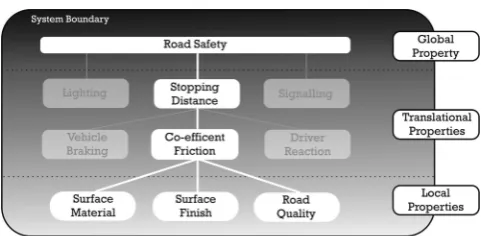
• the effect that pursuit of these optima has on the associated infrastructure system; in this case, vulnerability to the supply of critical materials (material criticality). An example of road infrastructure can be used to illustrate the conceptual framework (Figure 1). A policy priority (i.e., a
global property) in road infrastructure is user safety. Nested under this are various translational properties (e.g., road lighting, signaling, or stopping distance) that influence the global property, but do not necessarily relate directly to local property parameters upon which engineers make design decisions. Thus, these translational properties must be unpacked to reveal more technical properties (e.g., stopping distance is a function of vehicle braking, coefficient of friction of the road, and driver reaction times). This process can be continued; the coefficient of friction of the road can be unpacked into local properties over which engineers have direct control, such as road surface materials and quality. Altering any of these local and/or translational properties will ultimately affect user safety. This is a simplified example; in most systems the linkages are far more complex.
[image:2.625.324.567.178.296.2]criticality (C) has been defined by analogy with risk,15that is, the product of a variable related to the probability of an elemental material supply disruption occurring (P) and a variable related to the exposure of the transition goal to disruption in supply (E), that is,C=P·E.
The probability variablePwas calculated from the predicted frequency of supply deficits derived by considering govern-mental “roll-out” scenarios for low-carbon technologies (i.e., refs 35 and 36) compared with realistic projections of mining/ processing capacity growth based on historical production trends, and by taking into account three exacerbating factors, namely the degrees to which, for a given element
• supply is concentrated in a small number of countries; • it is produced as a byproduct of other processes, and; • mining/processing is subject to increasingly stringent
environmental regulation.
At present, allowance for demand-side impacts beyond those set out in “roll-out” scenarios or considerations of excess extraction and processing capacity are not included; both would require detailed information beyond the scope of the current method. (For further limitations of the criticality approach please refer to Roelich et al.15).P is expressed relative to the probability of disruption for a reference element considered at low risk of disruption (i.e., iron) as the absolute probability of disruption for a given element is beyond the current scope of the analysis. Thus, an element withP = 10 is 10 times more likely to suffer supply disruption than iron; changing a process from relying solely on the supply of an element withP= 100, to relying on a substitute with P = 20, would reduce the probability of materials supply disruption by a factor of 5; and so on.
The exposure variable Eis expressed as the product of two relative factors; the“price sensitivity”(the fraction of the cost of the technology represented by the price of the element under analysis) and the“goal sensitivity”(the fraction of the policy/ system goal, that is, transition to a low infrastructure, that relies upon installation of a given technology, for example, wind turbines or solar panels).15
Here, we are concerned with comparing the relative criticality of several components and/or technologies that might be selected to achieve a particular goal, which each rely on
combinations of multiple materials of different criticality in varying proportions. The approach adopted is best explained via an example. Consider two technologies (1 and 2), each of which is manufactured from varying proportions of three elementsX, YandZ, with correspondingP=PX,PY,PZ. The probability of a supply disruption is additive rather than multiplicative, since the disruption of element X can happen independently from that of Y or Z. Since the technologies contain the elements in different proportions, the exposure of each component or technology to each element is different, that is, there is no generic exposure term applicable to a given component or technology, nor to a given element. Thus, we can write
= + +
C1 P EX X1 P EY Y1 P EZ Z1
= + +
C2 P EX X2 P EY Y2 P EZ Z2
Generalizing for technologyt(eq 1):
∑
= =
Ct P E
m X Y Z m mt
, , ... (1)
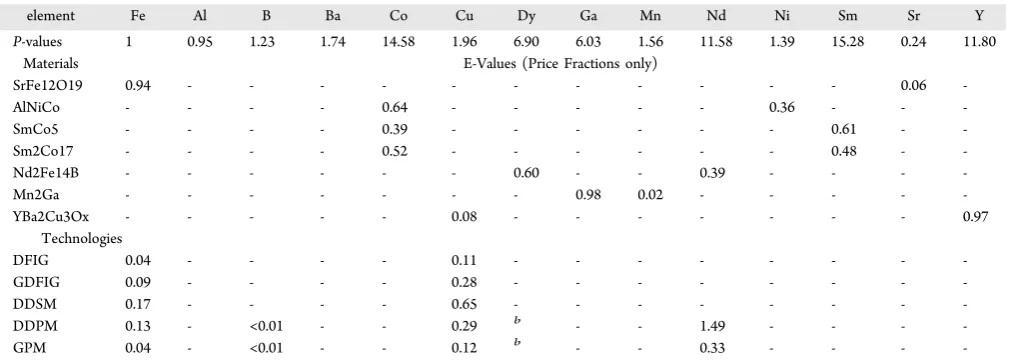
A more detailed derivation, and the underlying method of Roelich et al.,15is presented in the SI. We have derivedPfor all the elemental materials of interest in this study according to the methodology of Roelich et al.15(Table 1).
To estimate the partial exposure factors Emt, a number of
approaches can be taken. In previous work, the amount of element required per unit output divided by the total import of that material was used,1 but difficulties in obtaining reliable import data and the danger of“double counting” information used to derivePlimit this approach. It can also be argued that Emt= 1, that is, that use of any quantity of a material mobilizes
[image:3.625.61.567.83.263.2]the full criticality associated therewith. This is intuitively unsatisfactory, as a technology that uses, for example, a tonne of critical elementXis clearly “more critical” than one that only uses a kilogram thereof for the same output. Using mass fractions is defensible, but many technologies derive large increases in output from relatively small mass fraction“doping” with, for example, rare earth metals. Thus, by analogy with ref 15 we have used the price fraction of each elemental material with respect to the component or technology to derive the price sensitivity element ofE (Table 1), since this is a better Table 1. Relative Materials Supply Disruption:P Values, Used in This Study (Quasi-Static 2012 Values)a
element Fe Al B Ba Co Cu Dy Ga Mn Nd Ni Sm Sr Y
P-values 1 0.95 1.23 1.74 14.58 1.96 6.90 6.03 1.56 11.58 1.39 15.28 0.24 11.80
Materials E-Values (Price Fractions only)
SrFe12O19 0.94 - - - 0.06
-AlNiCo - - - - 0.64 - - - 0.36 - -
-SmCo5 - - - - 0.39 - - - 0.61 -
-Sm2Co17 - - - - 0.52 - - - 0.48 -
-Nd2Fe14B - - - 0.60 - - 0.39 - - -
-Mn2Ga - - - 0.98 0.02 - - - -
-YBa2Cu3Ox - - - 0.08 - - - 0.97
Technologies
DFIG 0.04 - - - - 0.11 - - -
-GDFIG 0.09 - - - - 0.28 - - -
-DDSM 0.17 - - - - 0.65 - - -
-DDPM 0.13 - <0.01 - - 0.29 b - - 1.49 - - -
-GPM 0.04 - <0.01 - - 0.12 b - - 0.33 - - -
reflection of the importance of each elemental material to the technological function. The price fraction is calculated using 2010 average price data;37being static, it does not capture rapid price changes at present.
We have not included a goal sensitivity element in the exposure term since, by definition, each of our comparable technologies contributes equally to the same goal, that is, they are potential functional alternatives for achieving a single system goal (i.e., contributing a policy-specified proportion of low-carbon electrical generation capacity). Comparison across functions (e.g., comparing the criticality of wind turbines with that of electric vehicles) can be achieved by simply reintroducing the goal sensitivity element; however this is beyond the scope here. Nor have we included the dynamic elements of P and E, as this would add significantly to the scope, but again it would be relatively simple to reintroduce.
■
CASE STUDIES AND RESULTSCharacterizing Material Level Assessment. We have
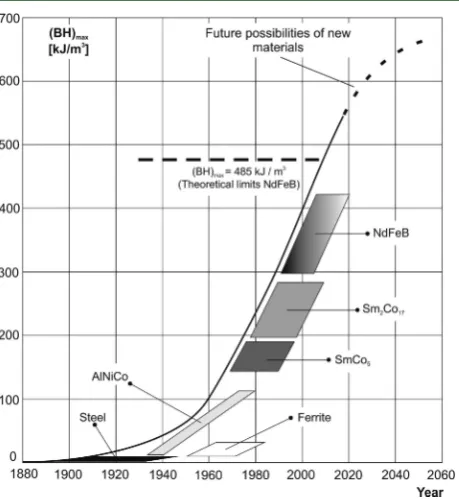
chosen the evolution of high powered permanent magnet (PM) technologies during the 20th century as an interesting example of how optimization of local properties has wider global implications. PM development has been stimulated by a desire to enhance technical performance, in the form of “maximum energy product” (BHmax), a local property related to the
magnetic energy that can be stored in a magnet (with units of kJ/m3). Development has been enabled by the introduction of
materials such as cobalt and neodymium into magnetic alloys, achieving (BH)max values up to 300% higher than during the
1960s38,39 (Figure 2) (see below for further discussion regarding the evolution of magnet composition used in this study).
Here, six candidate magnet technologies are considered in order of maturity: strontium-ferrite (Sr−Fe); aluminum− nickel-cobalt (Al−Ni−Co); samarium−cobalt (both SmCo5 and SmCo8.5); neodymium−iron-boron (Nd−Fe−B);
manga-nese−gallium (Mn−Ga); and superconducting yttrium− barium-copper (Y−Ba−Cu). The first four are mainstream technologies, while the latter two are experimental and represent potential future technology choices for wind turbines. Local properties (BHmax) and elemental composition of the magnets were taken from references,38,39,41 with the oldest composition−strontium-ferrite−used as the reference technol-ogy (Figure 2). The criticality Pm of each element was
calculated based on15and the criticality for combined materials (i.e., technologies or alloys) was calculated as per eq 1. Emt
values were calculated based on the mass fraction of the magnet chemical composition and 2010 mineral price data from ref 37 The result of the material level assessment is presented in Figure 3 (detailed data are provided in the SI). For comparison,
the criticality for an electromagnet of comparable performance in a 3 MW turbine is also shown on the graph (BHmax is undefined for an electromagnet).
Characterizing Technology Level Assessment. At the
[image:4.625.325.563.273.469.2]technology level, the choice of local properties is more complex; most engineering design seeks to optimize multiple variables. However, in this case, two key variables can be identified. First, the total mass of the generator is important and should be minimized; it determines the mechanical loads on the tower and foundations, and the ease with which the turbine can be built. It is dominated by the mass of the “active material” (i.e., that which contributes directly to electricity generation− magnets, coils etc.) plus the mass of the gearbox.42 Three gearbox technologies (in decreasing order of mass: 3-stage; single stage; and “direct drive” with no gearbox) and two magnet arrangementspermanent magnet (PM) and electro-magnetic (EM)are currently available. As designers push for larger turbines, rotor speeds necessarily decrease and larger generators are needed.42 PM technology is enabling this transition; being significantly lighter than EM systems it can help reduce both the weight of the nacelle and dynamic Figure 2. Development of permanent magnets and energy density
(BHmax) during the 20th century. Energy density is improved by
maximizing the product of B (magnetic induction) and H (magnetic
field), while minimizing the required volume of magnet material. Adapted from Weickhmann,.40
[image:4.625.67.297.448.698.2]mechanical loads, creating economic and environmental savings in the construction phase.39
Second, the unreliability of the generator is a key design parameter that should also be minimized (expressed here in terms of downtime; the fraction of time that one expects a turbine to be inoperative owing to failure and reactive/planned maintenance). Reducing gearbox complexity, or eliminating the gearbox entirely, reduces downtime owing to gearbox failure but increases downtime owing to power electronics and/or electrical component failure.43 The relative importance of generator mass and downtime will depend on the nominal output, location, etc., of the turbine. In this general study, we have assumedfor a first approximationthey are of equal importance and our local property is thus a composite variable; the product of downtime and total generator masstDmG, which a designer would seek to minimize. Material criticality remains our translational property, that is, linking technology choice to availability/reliability of the provision of low-carbon electricity to achieve policy goals. The gearbox-magnet options manifest asfive technology types, defined by Polinder et al.42In order of maturity, these are
• DFIG, an EM generator with a 3-stage gearbox; • GDFIG, an EM generator with a single-stage gearbox; • DDSM, a direct-drive EM generator;
• DDPM, a direct-drive PM generator; and
• GPM, a PM generator with a single-stage gearbox. Clearly, the associated elementalP-values for this analysis are the same as the preceding materials analysis; however, the exposure termsEmtare technology specific and therefore must be derived for each specific system from the combined price of the active material and gearbox as a proportion of the cost of the turbine (Table 1), using cost values from Polinder et al.42 Detailed data on the turbine technologies are provided in the SI.
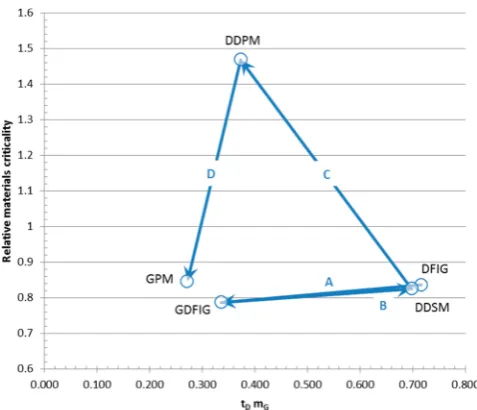
By considering published materials mix44−46and reliability43 analyses for these technologies, a plot of relative criticality (C) againsttDmGfor wind turbines with a nominal output of 3 MW was produced (Figure 4). Reliability figures for single-stage gearboxes were not available. Downtime per failure incident was thus assumed to be the same as that of a three-stage gearbox (since most of the repair time will be“overhead” call-out, detection, diagnosis, report etc.common to both gearboxes). The frequency of incidence of failure was assumed to scale according to the relative masses of the gearboxes (16:37 single: 3-stage) since the complexity−that is, number of parts−would scale similarly. The as-producedC− tDmGcurve
is not sensitive to this assumption.
Magnet Performance Vs Material Criticality. Our
material level analysis compares material criticality of several permanent magnet transitions against their magnetic perform-ance (BHmax) (Figure 3). Thefirst transition, labeled A, is that from a Sr−Fe PM to Al−Ni−Co PM and involves a significant increase in relative criticality with ∼66% increase in the local property; the addition of∼40% cobalt increased the coercive forces and energy products of PMs sufficiently to allow their
first use in many electrical applications.42 The increased criticality was a “gateway” price to pay for developing new technologies. The next transition (B) is that from Al−Ni−Co to SmCo5magnets. This introduces more cobalt, leading to a 54% increase in criticality accompanied by an increase in BHmax
(∼110% or 84 kJ/m3). Without the “gateway” aspect of
transition A, this technology choice would have to be assessed
on the cost-benefit of criticality vs technical performance. However, transition C to a Nd−Fe−B magnet through an improved Sm−Co technology (Sm−Co8.5) offers a ∼40% reduction in criticality and a 125% increase in BHmax(∼200 kJ/
m3) and thus this appears to be a good technology decision;
note that the introduction of Nd also increases BHmax
sufficiently to enable the use of PMs in wind turbines; another gateway.
Further potential transitions to experimental technologies are of mixed value. Mn−Ga magnets would appear to again offer increased performance with reduced criticality (transition D) and, if manufacturing issues can be overcome, might offer a useful alternative to the current state-of-the-art PM technology. Moving to superconducting magnets (transition E) potentially offers a step-change in magnet performance at a similar criticality to existing technology. However, this requires a change in generating technology (the introduction of complex cryogenic systems) and other factors would undoubtedly have to be considered.
The transitions described represent chronological maturity, but others might also be considered. The transition from a Al− Ni−Co magnet to a Nd−Fe−B magnet produces a significant increase in performance (>370%) at a reduction in criticality, and represents a positive technology decision. The opposite can be said for the reverse of this transition (Nd−Fe−B to Al−Ni− Co), and rolling back technological advancements (sometimes suggested as a potential mitigation strategy) might not be a definitive way to reduce system vulnerability. It must also be noted that all PM magnets appear to be 3−6 times more critical than equivalent EM magnet (see Figure 3).
[image:5.625.324.563.65.270.2]Turbine Generator Performance Vs Material Critical-ity.Next we analyze material criticality against the technology level performance propertytDmG: the product of downtime and total generator mass (Figure 4). Transition A from a DFIG drive system to a GDFIG drive system involves replacing a three-stage gearbox with a single stage gearbox. This reduces Figure 4.Technology-level analysis of wind generator technologies. Relative material criticality plotted againsttDmG (local properties) a
the gearbox mass (37 to 16 tonnes) by more than the corresponding increase in active material mass (5.2 to 11.4 tonnes) and also leads to decreased downtime owing to the reduced complexity of the gearbox. This corresponds to a small decrease in criticality owing to the increased amount of copper required for the extra active material being slightly outweighed by the decrease in nonactive iron required for the gearbox. Since both local and translational properties are improved, this transition appears to represent a reasonable design choice.
Transition B represents the switch from a single-stage gearbox wind turbine (GDFIG) to a direct drive system with an electro magnet (DDSM). The elimination of the gearbox mass is outweighed by the large amount of extra active material required (+45 tonnes); also the elimination of gearbox failures is negated by the increased downtime of electrical components and power electronic components. The increased amount of active material required to compensate for the greatly reduced angular velocity of the electrical rotor also slightly increases criticality (∼3%). Since both the local and translational properties degrade, this transition would not appear to be a logical design choice unless additional factors are of importance (for example, whether the turbine is to be synchronized to the grid in order to use the electro-mechanical inertia of the turbine to assist in load balancing).
Transition C represents a move from a DDSM turbine to a DDPM turbine, retaining the direct-drive system but replacing the electromagnets with permanent magnets. Downtime remains the same but the mass of active material is reduced to 24 tonnes, significantly improvingtDmGbut at the cost of a 80% increase in criticality owing to the requirement for neodymium; note that tDmG has not improved over that of GDFIG technology either (∼10%). Thus, this technology choice is also questionable. Transition D represents a switch from direct drive (DDPM) to a single-stage gearbox but retains the permanent magnet (GPM). The angular velocity of the electrical rotor is increased, decreasing the size of permanent magnet required. This reduces electrical/electronic component downtime and also total mass (since the reduction in active material mass is greater than the mass of the gearbox), greatly improving tdmg. There is also a 60% reduction in criticality
owing to the reduced neodymium demand. Thus, this transition would appear to represent a good design choice as both local and translational properties are improved.
The transitions A−D described once again represent an approximate chronological maturity path; other transitions may also be considered. For example, the common direct transition from arguably the most typical technology to a PM direct drive system (GDFIG to DDPM) produces a significant increase in criticality (∼90%) with a minimal performance improvement (∼10%). The transition between the optimal EM technology (GDFIG) and the optimal PM technology (GPM) is more subtle, with slightly increased technical performance (∼20%) at the cost of a 10% increase in criticality; other factors would have to be considered to justify this design choice. The converse transition could be considered a possible so-called
“substitution” response to criticality; if Nd supply becomes critical, a switch from GPM to GDFIG decreases criticality at a slight performance cost; a rather more robust substitution than the proposed replacement of neodymium with dysprosium (i.e., one rare earth with another) that is often advanced.23,39
Implications for the Future. It is instructive to consider the results of a nominally similar intervention−i.e. a move from EM to Nd-based PM systems−at both system levels. At the
material (i.e., magnet, Figure 3) level, the analysis suggests that this would increase the risk of supply disruption by a factor of 3−6 perhaps justifying current worries over widespread implementation of these systems. However, the technology-level analysis (Figure 4) tells a more complex story; the increase in criticality depends strongly on the particular technological implementation chosen and could vary between 3% and 90%; but most likely toward the lower end, that is, rather less than that suggested by the materials-level analysis. It is also interesting that some of the enhancements in performance associated with these interventions are rather modest compared to the increases in criticality; while a trade-off analysis of criticality vs technical performance is beyond the scope of this paper, it suggests that many proposed technological inter-ventions ought to be examined more closely. Of course, this preliminary analysis does not capture the full suite of local properties that drive decisions in choosing infrastructure technologies such as wind turbines, but should provide a framework for analysis. This multilevel analysis does, however, illustrate the importance of searching the local/global space for optima in order to reduce the risk of negative feedback from future infrastructure technology interventions.
Through the application of the framework developed in this study, this paper has shown how a considering functional aspects (i.e., local properties) contribute to an improved understanding of material criticality in low-carbon technologies. We have focused on evolutions within a single technology class (i.e., wind turbines); further research should begin to assess the local/global properties trade-offs between multiple low-carbon infrastructure technologies, by readmitting the goal sensitivity aspect of E. The general limitations of the criticality metrics used have been discussed elsewhere15 but some discussion specific to this work is appropriate. The relative nature ofPis useful for comparing technologies but tells us little about the absolute probability for planned installation of a given technology to be disrupted by materials supply. This will require examination of a significant number of case studies of real-life disruptions and such a database does not exist, partly because many of the disruptions have yet to pass; this is a limitation of quantitative approaches. Although Roelich et al.15 have demonstrated dynamic criticality, thePandEvalues used here are presently static, as a dynamic assessment of these two metrics is beyond the scope of this paper but not the capability of the framework.
Low-carbon infrastructure technologies (including mag-nets47,48 and wind turbines49,50) continue to evolve. New applications for PMs in low-carbon infrastructure require higher temperature operation (i.e., above 80°C) and so lighter rare earth metals (e.g., neodymium) are doped with small amounts of heavier rare earths (<5%), such as dysprosium or terbium in order to retain their magnetism.31,33,39,51There has been recent developments in dysprosium-free permanent magnets that can operate at high temperatures, however, this is at the sacrifice of magnetic performance (BHmax),
47,48
and there potential application is not yet known. In this analysis, the permanent magnet composition of Nd2Fe14B for the material level analysis
neo-dymium in the future. Our static (2012) analysis suggests that the disparity in criticality between dysprosium and neodymium is opposite and relatively small (6.9 and 11.6 respectively, i.e., Nd > Dy); this, compounded with the small technology price fraction likely to be attributed to dysprosium compared with that for neodymium means that including dysprosium in our analysis makes little difference. Should the disparity widen, for example by assuming future demand/price scenarios, the methodology can easily take this into account.
The capability for recovery of rare earth metals at end-of-life is also evolving, potentially offering mitigation against supply/ demand issues of primary resources in the long term.33,34 The success of such evolution, however, depends heavily on national policy strategies, investment, and infrastructure improvements to overcome the techno-economic challenges in the near to medium term (i.e., 5−10 years). The results of this study suggest that maintaining system diversity, that is, reducing the reliance on a single technology, component, or set of materials, might be a more appropriate response, in the short to medium term, to reducing the vulnerability to material supply issues and increasing systemic resilience.
In this study, a framework has been presented for characterizing local-property-based technology interventions at different systems levels and the resultant changes on wider, policy-relevant global properties. The graphical representation of technology performance vs system vulnerability thus developed allows infrastructure interventions or transitions to be evaluated with respect to their effect on the wider system, that is, disruptions in the supply of critical materials. In doing so, it has developed criticality indices for materials, components and technologies that rely on multiple elemental materials for their performance, by demonstrating how previously estab-lished indices developed for individual elements can be combined. As technology companies begin to develop strategies for reducing material supply risk, such a framework that links technical, performance-based design decisions to the wider system properties will be useful. Via a case study of wind turbines at both the material (i.e., magnets) and technology (i.e., turbine generators) levels, it was demonstrated that analysis of a nominally similar intervention at different system levels can lead to differing conclusions regarding the effect on vulnerability; thus analysis must be carried out at as many system levels as possible in order to reliably identify possible
“weak spots”. Infrastructure design decisions should take such a systemic approach; without these multilevel considerations, strategic technology policies devised to meet low-carbon targets, that is, through long-term infrastructure transitions, could prove counter-productive.
■
ASSOCIATED CONTENT*
S Supporting InformationAdditional details of the criticality methodology and data sources used in this assessment and a full description of terminology and notations used in this investigation are provided. This material is available free of charge via the Internet at http://pubs.acs.org/.
■
AUTHOR INFORMATION Corresponding Author*Phone: +44(0)113 343 2248; fax: +44(0)113 343 2265; e-mail: [email protected].
Author Contributions
The manuscript was written through contributions of all authors. All authors have given approval to thefinal version of the manuscript.
Notes
The authors declare no competingfinancial interest.
■
ACKNOWLEDGMENTSWe thank David McMillan, University of Strathclyde for the helpful discussions on wind turbine technology, and the four anonymous reviewers for their contribution to thefinal article. The support of the UK Engineering and Physical Sciences Research Council (grant number EP/J005576/1) is gratefully acknowledged.
■
ACRONYMSBHMAX maximum energy product: The point on the
demagnetization curve where the product of B (magnetic induction) and H (magnetic field) is a maximum, and the required volume of magnet material required is a minimum
DFIG doubly fed induction generator i.e. electromagnetic generator with a 3-stage gearbox
DDPM direct-drive permanent magnet generator; no gearbox DDSM direct-drive synchronous electromagnetic generator
(EM); no gearbox EM electromagnetic
GDFIG geared, doubly fed induction EM generator with a single-stage gearbox
GPM geared PM generator with a single-stage gearbox PM permanent magnet
SI Supporting Information
tDmG A product of the downtime and total mass of a wind turbine generator
■
REFERENCES(1) Purnell, P.; Dawson, D.; Roelich, K. E.; Steinberger, J. K.; Busch, J. Critical materials for infrastructure: Local vs global properties.Proc. ICE - Eng. Sustain.2013,166(5), 272−280.
(2) Case, J, Chilver, L; Ross, C. T. F. Strength of Material & Structures: With an Introduction to Finite Element Methods, 3rd ed.; Edward Arnold: London, 1993.
(3) Müller, D. B. Stock dynamics for forecasting material flowscase study for housing in The Netherlands.Ecol. Econ.2006,59(1), 142− 156.
(4) Elshkaki, A.; Graedel, T. E. Dynamic analysis of the global metals flows and stocks in electricity generation technologies.J. Clean. Prod. 2013,59, 260−273.
(5) Pauliuk, S.; Wang, T.; Müller, D. B. Moving toward the circular economy: The role of stocks in the Chinese steel cycle.Environ. Sci. Technol.2012,46(1), 148−54.
(6) Busch, J.; Steinberger, J. K.; Dawson, D. A.; Purnell, P.; Roelich, K. Managing critical materials with a technology-specific stocks and flows model.Environ. Sci. Technol.2014,48(2), 1298−305.
(7) Ashby, M. F.Material Selection in Mechanical Design; Oxford: UK, 1992.
(8) Ermolaeva, N.; Castro, M.; Kandachar, P. Materials selection for an automotive structure by integrating structural optimization with environmental impact assessment.Mater. Des.2004,25(8), 689−698. (9) Allwood, J.; Ashby, M. Material efficiency: A white paper.Resour. Conserv. Recycl.2011,55(3), 362−381.
(11) Ekvall, T. Cleaner production tools: LCA and beyond.J. Clean. Prod.2002,10, 403−406.
(12) Sandén, B a.; Karlström, M. Positive and negative feedback in consequential life-cycle assessment. J. Clean. Prod. 2007, 15 (15), 1469−1481.
(13) Purnell, P.; Black, L. Embodied carbon dioxide in concrete: Variation with common mix design parameters.Cem. Concr. Res.2012, 2, 10−13.
(14) Graedel, T.; Barr, R.; Chandler, C.; Chase, T.; Choi, J.; Christoffersen, L.; Friedlander, E.; Henly, C.; Jun, C.; Nassar, N. T.; Schechner, D.; Warren, S.; Yang, M. F.; Zhu, C. Methodology of metal criticality determination.Sci. Technol.2012,46(2), 1063−70.
(15) Roelich, K.; Dawson, D. A.; Purnell, P.; Knoeri, C.; Revell, R.; Busch, J.; Steinberger, JK. Assessing the dynamic material criticality of infrastructure transitions: a case of low carbon energy generation.Appl. Energy2014,123, 378−386.
(16) Graedel, T. E.; Dubreuil, A.; Gerst, M.; Hashimoto, S.; Moriguchi, Y.; Müller, D.; Pena, C.; Rauch, J.; Sinkala, T.; Sonnemann, G. Metal stocks in society.Sci. Synth.2010, 1−48.
(17) Greenfield, A.; Graedel, T. E. The omnivorous diet of modern technology.Resour. Conserv. Recycl.2013,74, 1−7.
(18) Graedel, T. E.; Harper, E. M.; Nassar, N. T.; Reck, B. K. On the materials basis of modern society.Proc. Natl. Acad. Sci. U. S. A.2013, DOI: 10.1073/pnas.1312752110.
(19) Modaresi, R.; Müller, D. B. The role of automobiles for the future of aluminum recycling. Environ. Sci. Technol. 2012, 46 (16), 8587−94.
(20) Giudice, F.; La Rosa, G.; Risitano, A. Materials selection in the life-cycle design process: A method to integrate mechanical and environmental performances in optimal choice.Mater. Des.2005,26 (1), 9−20.
(21) Allione, C.; De Giorgi, C.; Lerma, B.; Petruccelli, L. From ecodesign products guidelines to materials guidelines for a sustainable product. Qualitative and quantitative multicriteria environmental profile of a material.Energy2012,39(1), 90−99.
(22) Lim, S.-R.; Kim, Y. R.; Woo, S. H.; Park, D.; Park, J. M. System optimization for eco-design by using monetization of environmental impacts: A strategy to convert bi-objective to single-objective problems.J. Clean. Prod.2013,39, 303−311.
(23) Hoenderdaal, S.; Tercero Espinoza, L.; Marscheider-Weidemann, F.; Graus, W. Can a dysprosium shortage threaten green energy technologies?Energy2013,49, 344−355.
(24) Alonso, E.; Sherman, A. M.; Wallington, T. J.; Everson, M. P.; Field, F. R.; Roth, R.; Kirchain, R. E. Evaluating rare earth element availability: A case with revolutionary demand from clean technologies. Environ. Sci. Technol.2012,46(6), 3406−3414.
(25) Bauer, D, Diamond, D, Li, J, Sandalow, D, Telleen, P, Wanner, B.Critical Materials Stratergy. Department of Energy, 2010: 116.
(26) ECEI..Critical Raw Materials for the EU Report2010, 1−84. (27) OECD.Economic Impact of Export Restrictions on Raw Materials 2010, 1−176.
(28)Postnote. Rare Earth Metals; U. K. Parliament, 2011; pp 1−4. (29) European Commission. Annex V to the Report of the Ad-Hoc Working Group on Defining Critical Raw Materials. 2010.
(30) Morley, N.; Eatherley, D.Material Security: Ensuring Resource Availability for the UK Economy2008, 1−36.
(31) MossR. L.TzimasE.KaraH.Willis, P.; Kooroshy, J.Critical Metals in Strategic Energy Technologies Assessing Rare Metals as Supply-Chain Bottlenecks in Low-Carbon Energy Technologies, 2011
(32) Kleijn, R.; van der Voet, E.; Kramer, G. J.; van Oers, L.; van der Giesen, C. Metal requirements of low-carbon power generation.Energy 2011,36(9), 5640−5648.
(33) Rademaker, J. H.; Kleijn, R.; Yang, Y. Recycling as a strategy against rare earth element criticality: A systemic evaluation of the potential yield of NdFeB magnet recycling.Environ. Sci. Technol.2013, 47(18), 10129−10136.
(34) Dodson, J. R.; Hunt, a. J; Parker, H. L.; Yang, Y.; Clark, J. H. Elemental sustainability: Towards the total recovery of scarce metals. Chem. Eng. Process. Process Intensif.2012,51, 69−78.
(35) HM Government.The Carbon Plan: Delivering Our Low Carbon Future, 2011.
(36) IEA-RETD.Securing the Supply Chain for Wind and Solar Energy (RE-SUPPLY) Final Report, 2012.
(37) USGS. Commodity Statistics & Information; U.S. Geological Survey, 2013.
(38) Coey, J. M. D. Permanent magnets: Plugging the gap.Scr. Mater. 2012.
(39) Gutfleisch, O.; Willard, M a; Brück, E.; Chen, C. H.; Sankar, S. G.; Liu, J. P. Magnetic materials and devices for the 21st century: Stronger, lighter, and more energy efficient.Adv. Mater.2011,23(7), 821−42.
(40) Weickhmann, M.Nd-Fe-B Magnets, Properties and Applications; Vacuumschmelze GmbH & Co. KG: Hanau, Germany, 2009. http:// www.vacuumschmelze.de/de/forschung-innovation/publikationen/ anwendungen.html.
(41) Strnat, K. J. Modern permanent magnets for applications in electro-technology.Proc. IEEE1990,78(6), 923−946.
(42) Polinder, H.; van der Pijl, F. F. A.; de Vilder, G.; Tavner, P. Comparison of direct-drive and geared generator concepts for wind turbines.Energy Convers2006,44, 543−550.
(43) McMillan, D.; Ault, G. Techno-economic comparison of operational aspects for direct drive and gearbox-driven wind turbines. Energy Convers2010,25(1), 191−198.
(44) Gruber, P. W.; Medina, P a.; Keoleian, G a.; Kesler, S. E.; Everson, M. P.; Wallington, T. J. Global lithium availability.J. Ind. Ecol..2011,15(5), 760−775.
(45) Li, H.; Chen, Z.; Polinder, H. Optimization of Multibrid Permanent-Magnet Wind Generator Systems.Energy Convers2009,24 (1), 82−92.
(46) Ortbital2. Wind turbine gearbox technology.2012. http://www. orbital2.com/index.php/projects. (accessed May 31, 2012).
(47) Brown, D. N.; Wu, Z.; He, F.; Miller, D. J.; Herchenroeder, J. W., Dysprosium-free melt-spun permanent magnets.J. Phys.: Condens. Matter2014,26(6).
(48) Seo, Y.; Morimoto, S. Comparison of dysprosium security strategies in Japan for 2010−2030.Resour. Policy2014,39, 15−20.
(49) Echavarria E., Hahn B. Reliability of wind turbine technology through time.J. Sol. Energy.2008,130(3).
(50) Semken, R. S.; Polikarpova, M. Direct-drive permanent magnet generators for high-power wind turbines: Benefits and limiting factors. Renew Pow Gen 2012,6(1), 1.
(51) Kara, H.; Chapman, A.; Crichton, T.; Willis, P.; Morley, N.; Deegan, K.Lanthanide Resources and Alternatives; Oakdene Hollins, 2010