GAS PRICES
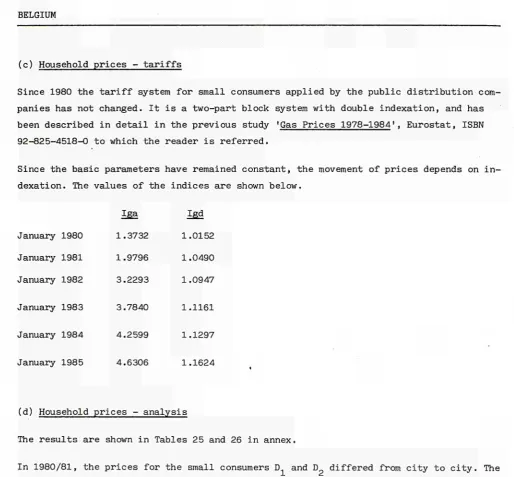
eurostat
DE EUROPÆISKE FÆLLESSKABERS STATISTISKE KONTOR STATISTISCHES AMT DER EUROPÄISCHEN GEMEINSCHAFTEN ΣΤΑΤΙΣΤΙΚΗ ΥΠΗΡΕΣΙΑ ΤΩΝ ΕΥΡΩΠΑΪΚΩΝ ΚΟΙΝΟΤΗΤΩΝ STATISTICAL OFFICE OF THE EUROPEAN COMMUNITIES OFFICE STATISTIQUE DES COMMUNAUTÉS EUROPÉENNES ISTITUTO STATISTICO DELLE COMUNITÀ EUROPEE
BUREAU VOOR DE STATISTIEK DER EUROPESE GEMEENSCHAPPEN
L-2920 Luxembourg — Tél. 43011 — Télex: Comeur Lu 3423
B-1049 Bruxelles, Bâtiment Berlaymont, Rue de la Loi 200 (Bureau de liaison) —Tél. 235.11.11
Denne publikation kan fås gennem de salgssteder, som er nævnt på omslagets tredje side
Diese Veröffentlichung ist bei den auf der dritten Umschlagseite aufgeführten Vertriebsbüros erhältlich.
Την έκδοση αυτή μπορείτε να την προμηθευτείτε από τα γραφεία πωλήσεων τα οποία 'αναφέρονται στην τρίτη σελίδα του εξωφύλλου.
This publication is obtainable from the sales offices mentioned on the inside back cover.
GAS PRICE«
This publication is also available in the following languages: DE ISBN 92-825-5374-4
FR ISBN 92-825-5376-0 IT ISBN 92-825-5377-9
Cataloguing data can be found at the end of this publication
Manuscript completed in June 1985
For all information concerning this publication, contact: F. Desgardes — Tel. Luxembourg 43011. ext. 3102
Luxembourg: Office for Official Publications of the European Communities. 1985
ISBN 92-825-5375-2
Catalogue number: CA-43-85-717-EN-C
CONTENTS
I . INTRODUCTION 7
I I . CONDITIONS AND METHODS 9 9
1. Scope and locations
2. Units of measurement of energy 10
3. Standard consumers 11 4. Definition of the price levels recorded 14
III. UNITS OF VALUE 17
1. The European currency unit (ECU) 17 2. The purchasing power standard (PPS) 18 3. Prices in 'current' and 'constant' PPS 18
4. Price series 19
IV. TAXATION 21
1. Value-added tax 21 2 . Specific taxes 22
V. GAS PRICES IN THE VARIOUS COUNTRIES 25
1. FR of Germany 27
2 . France 36 3. Italy 44 4. The Netherlands 56
5. Belgium 62 6 . G .D . of Luxembourg 68
7. United Kingdom 71
8 . Ireland 80 9 . Denmark 84
VII. STATISTICAL ANNEX , I
Tables :
Househould and industrial prices by country Ill Conversion factors for PPS, ECU and GDP price indices XXXIV
SYMBOLS AND ABBREVIATIONS
- / 0 .
1980
* +
3 m
kWh
Gwh h MJ
= 100
■■
N i l .,,...,.;,; ,.,,,. 7,f.tîv* .. ..:·' ■: .,.:·, ¡. Data less than half the unit used
No data available
; ' reference year ■■■·'■.'·"■,>. ' ;· natural gas
gasworks gas
cubic metre
kilowatthour
gigawatthour (10 kWh)
hour
megajoule
GJ gigajoule (IO3 MJ)
η number
GCV gross calorific value
NCV net calorific value
BFR Belgian franc
DKR Danish crown
DM German mark
FF French franc
HFL Dutch guilder
IRL Irish pound
LFR Luxembourg franc
LIT Italian lira
UKL Pound sterling
PPS Purchasing power standard
ECU European currency unit
EUR 9 Total of the member countries of the European Communities excluding
Greece
I. INTRODUCTION
This publication is a comprehensive update of the study Gas prices 1978-1984, published by Eurostat in 1984.
In contains the prices applying in 1985, together with data going back as far as 1980.
The text describes all recent changes in tariffs, taxation, supply and conditions of sale liable to affect price levels.
The study has been widened to include another two suppliers in the Federal Republic of Germany in order to ensure better coverage of regional variations in this country.
The trend analyses and indices have been re-based to 1980.
In all other respects, the definitions and methods remain the same as those used in pre-vious studies, so that the formation and development of gas prices can be observed over a very long time series.
This publication is available in four languages: English, French, German and Italian.
II. CONDITIONS AND METHODS
1. SCOPE AND LOCATIONS
The present study aims to show the actual price of gas paid by the consumer in the mem-ber countries of the European Economic Community.
Two types of gas are concerned:
(i) Natural gas (methane);
(ii) Gasworks gas.
Contrary to natural gas, which is a primary energy source extracted from naturally oc-curring gasfields, gasworks gas is a derived energy source manufactured from coal, pe-troleum products or from cracked, reformed or mixed natural gas.
The present study is not concerned with liquified petroleum gas (butane, propane), coke-oven gas, or blast-furnace gas.
Only piped distribution is considered.
The prices were recorded in 29 towns within the Community:
FR of Germany: Hamburg, Hannover, Weser-Ems, Dortmund, Dusseldorf, Frankfurt/Main, Stuttgart, Munich;
France: Lille, Paris, Strasbourg, Marseille, Lyon, Toulouse;
Italy: Milan, Turin, Genoa, Rome, Naples;
Netherlands: Rotterdam;
Belgium: Antwertp, Brussels, Liège;
Luxembourg: Luxembourg city;
United Kingdom: London, Leeds, Birmingham;
Ireland: Dublin;
Denmark: Copenhagen.
In Greece there is no piped gas network.
The prices are recorded at the beginning of each year based on the tariffs, contracts-, conditions and rules in force at that time.
It is concerned with the actual price paid by the gas consumer, corresponding to the in-voiced delivery price to the consumer at the beginning of each year including any even-tual rebates and subsidies. Our consumers are defined as those who purchase gas for their own use and exclude those who offer it for re-sale. We have not considered the bulk price paid by the gas distributors.
2. UNITS OF MEASUREMENT OF ENERGY
Following international resolutions adopted by the General Conference on Weights and Measures, which resulted in the 'International System of Units of Measurement' (SI), a number of Council of Ministers' Directives (71/354, 76/770 and 80/181) laid down the miles to be followed with regard specifically to units of measurement of energy.
The use of the calorie and its dérivâtes is now prohibited. Only two units of energy may be used, namely the joule and the kilowatthour. These two units are derived from the same basic definition, since 1 joule equals 1 watt/second. However, a concession was granted to the United Kingdom and Ireland, which may continue to use the therm for a transitional period.
For units of measurement are therefore still found in the current gas tariffs, i.e.:
the joule (Belgium);
the kilowatthour (FR of Germany, France); 3
the m (Italy, Netherlands, Luxembourg, Denmark);
the therm (United Kingdom, Ireland); 3
(the m is in turn defined by an energy content expressed in joules or in kWh).
With a view to a standardization and simplification, the joule (or its decimal multi-ples) was chosen by Eurostat as the common unit of measurement.
The decimal multiples of the joule are as follows:
kilojoule (kJ) = 1 000 joules;
megajoule (MJ) = 1 000 000 joules;
gigajoule (GJ) = 1 000 000 000 joules;
terajoule (TJ) = 1 000 000 000 000 joules.
The table below can be used for conversion from one unit of measurement to another:
1 gigajoule
1 gigawatt/hour
1 therm
GJ
1
3 600
0.1055
GWh Therm
0.0002777
1
0.0000293
9.4781
34 120
1
In addition, as a guide, one gigajoule of gas may be said to be approximately equivalent to 35 kg of saleable coal and 25 kg of light fuel oil or heating oil.
Finally, the unit of energy used in this study is measured on the basis of the gross calorific value (GCV), as is the practice in the gas industry and gas tariffs, i.e. the latent energy necessary for the evaporation of the water produced during the combustion of the gas, is taken into account. This method of measurement departs from that used in energy statistics and for other sources of energy, where the net calorific value (NCV), which is closer to the energy that can actually be used by the consumer, is always used.
For gas, the difference between gross and net calorific value is around 10%. The gas price shown in this study in GJ (GCV) can thus be converted into GJ (NCV) by applying a factor of 1.1.
However certain recent condensation gas heaters permit a better use of the gross calor-ific value by re-using some of the latent energy of evaporation.
3. STANDARD CONSUMERS
The survey is based on the system of standard consumers, i.e. the prices are recorded for certain levels of gas consumption and under certain conditions of supplu, chosen as being representative of the population of gas consumers. These standard levels of con-sumption remain fixed from one year to the next and for all the countries, this being one of the primary conditions for spatial and temporal comparability of prices.
A standard consumer corresponds in fact to a meter to which a tariff or contract is ap-plied. Where a consumer has two separate meters corresponding to two different tariffs, for. example one for space heating, the other for professional use one does not calculate an average but considers that there are two separate standard consumers.
consump-Five domestic standard consumers coded D to D have been taken:
Di
D3 D3b D4
Annual consumption 8.37 GJ (i.e.
16.74 GJ (i.e. 83.7 GJ (i.e. 125.6 GJ (i.e. 1 047 GJ (i.e.
2 326 kWh) 4 652 kWh) 23 260 kWh) 34 890 kWh) 290 750 kWh)
Equipment
7
> cooking and water heating
I cooking, water heating and Γ central heating
block central heating for at least 10 dwellings For the United Kingdom there is an additional standard consumer, i.e. 33.49 GJ
(9 300 kWh or 8 Gcal).
Industrial uses cover medium and large users (industries, large commercial or adminis trative buildings, etc.).
For industrial uses, apart from the annual quantity consumed, the regularity with which the user takes gas from the network is also considered. This involves the concept of modulation (or load factor).
The daily load factor is the number of days which would be required to take the entire annual consumption at the maximum daily offtake rate.
The hourly load factor is the number of hours which would be required to take the en tire annual consumption at the maximum hourly offtake rate.
These terms therefore determine the peaks or offtake ceilings reached by the consumer in the course of one day or one hour over the year.
The general formula is:
daily load factor nj Qj max Qa
hourly load factor nh Qh max Qa
where Qa = annual volume consumed, Qj max = maximum daily offtake, Qh max = maximum hourly offtake.
factor of 1 600 hours means that the maximum hourly offtake is 26 GJ (41 860 divided by
1 600) .
Taking account of these characteristics, seven standard industrial consumers, coded I
to I_, have been chosen: o
h
h
h-1
h-2
h-l
h-2
h
Annual
418.
4 186
41 860
41 860
418 600
418 600
4 186 000 60 GJ
GJ
GJ
GJ
GJ
GJ
GJ
consumption
or
or 1
or
or
or
or
or
116 300
163 000
11.63
11.63
116.3
116.3
1 163
kWh
kWh
GWh
GWh
GWh
GWh
GWh
Equipment
no load factor laid down
200
200
250
250
330
330 days
days 1
days 4
days 4
days 8
days 8 600 h
000 h
000 h
000 h
000 h
If necessary <. 200 days ·?115 days.
The other characteristics which could play a part in establishing the price will be de-termined on a case-by-case basis, always adopting the solution which is most frequent in practice, these characteristics are mentioned where applicable.
It can be seen that certain standard consumers have the same load factor for different volumes of consumption or, conversely, different load factors for the same volume of' consumption; the reason for this is to enable the effect of these conditions of supply on the level of prices to be observed. The higher the load factor (in days or hours) the more regular the offtake of gas, thus in some cases, enabling the consumer to obtain favourable prices.
Moreover, the load factor gives some idea of the use made by installations consuming gas. Thus, a very high load factor, e.g. of 8 000 hours, is obviously equivalent to an
installation functioning practically non-stop, day and night, throughout the 8 760 hours in the year.
It should be noted finally that the standard industrial consumers referred to in this
study include neither power stations nor industries using gas for non-energy purposes,
e.g. the chemical industry.
4. DEFINITION OF THE PRICE LEVELS RECORDED
All prices are shown per unit of gas sold, that is per gigajoule (GCV). The results rep-resent the unit price at the beginning of each year and take account of the relevant tariff, parameter, index, etc. applicable as from the 1 January. In the case of tar-iffs or contracts with short therm indices (month, quarter) it is the index which is in force during January which is applied. The prices include meter rental, the standing charge and the commodity rate. They do not include the initial installation charge to the consumer.
If there are several possible tariffs, it is the tariff which is most advantageous to the consumer that is taken into account, after the elimination of the tariffs which are not used in practice or which apply only to a marginal or negligible number of users.
When there are only quasi-tariffs, special contracts, or freely negotiated prices, the most commonly found price (most representative) for the given supply conditions has been recorded.
In the case of freely negotiated prices or contracts, the returns relate respectively to the bills paid during the month of January or to the prices resulting from the contracts in force during that month. Such cases are mentioned and explained in the body of our study.
There price levels are shown:
(i) the price net of tax;
(ii) the price excluding VAT but including all other taxes;
(iii) the selling price (inclusive of all taxes).
The price excluding tax is obtained directly from the tariffs or contracts.
The price excluding VAT includes, where payable, other specific taxes which is interest-ing in cases where VAT is deductible.
The price inclusive of all taxes corresponds to the sum paid by the consumer.
On the Other hand, the taxes levied before the sale of the gas, such as taxes on compa-nies, profits, wages etc., which are obviously part of the production or distribution costs, are not calculated separately. They remain an integral part of the price ex-cluding tax.
The results for each country are shown in national currencies at current prices, i.e. at
face value. ,
For the purposes of international comparison, it was necessary to use a representative common monetary unit which would create a minimum of distortion in both space and time. Accordingly, the present study uses the purchasing power standard (PPS). The comparative tables are also shown in European currency units (ECU).
III. UNITS OF VALUE
To permit comparisons between countries, prices expressed in national currencies need to be converted to a common unit. In this study two common units are used:
(i) the European currency unit (ECU);
(ii) the purchasing power standard (PPS).
1. THE EUROPEAN CURRENCY UNIT (ECU)
The ECU is a basket-type currency unit based on the market exchange rates of a certain amount of each of the Community currencies, weighted according to the gross national product and intra-Community trade of each Member State.
In 1984, this weighting was revised on the accession of Greece.
The new composition of the ECU basket is as follows:
DM 0.719 . LIT 140 FF 1.31 DKR 0.219 HFL 0.256
IRL 0.00871 BFR 3.71 UKL 0.0878 LFR 0.14 DR 1.15.
The conversion rates for the ECU against the national currencies in January of each year are given in a table in the Statistical Annex.
The definition of the ECU is such that it reflects fluctuations in exchange rates and is suitable for measuring the prices and values of international flows of goods and serv-ices. Data expressed in ECU therefore permit the comparison of prices in terms of money as changed at a bank. Such currency conversion at the market exchange rates, however, has the disadvantage that it fluctuates in time under the influence of many factors which are independent of internal price movements:
(i) capital transfers;
(ii) political decisions;
(iii) regulations;
(iv) speculation;
(v) psychological factors;
2. THE PURCHASING POWER STANDARD (PPS)
The PPS is a reference unit so calculated that its value in relation to the various na-tional currencies is proporna-tional to the purchasing power parities (PPP) between these currencies.
The purchasing power parities reflect the ratios between price levels in the different countries. The ratios between the prices expressed in national currencies are calculated for each of the products included in the uses of the GDP. If these ratios are suitably weighted, one obtains mean price ratios, the most general of which is the mean
calculat-ed for the GDP and known as the PPP at GDP level.
Such parities would be adequate to express all the data in real terms in the currency of any one of the countries considered. The method ensures that they are transitive and un-affected by the country chosen as a basis of reference. For Community calculations an-other reference unit known as the PPS is used. It is defined by applying the price ra-tios to the GDPs of the various countries expressed in national currency and adjusting the parities so that the value of the GDP of the Community as a whole in 1975 is iden-tical whether expressed in ECU or PPS. Only the proportion accounted for by each country will be different.
When prices are converted to PPS using the GDP parity, the result may be interpreted as follows:
If one gigajoule of energy costs 10 PPS in country A and 5 PPS in country B, this means that after allowance has been made for the differences between the general level of price's in the two countries, this gigajoule of energy is twice as expensive in country A as in country B.
This conclusion is independent of market exchange rates, which are influenced by factors other than the level of prices (movements of capital, speculation, interest rates, po-litical decisions, etc.).
The conversion rates for the years covered by the study are given in a table in the an-nex. They were revised when the base year was changed.
3. PRICES IN CURRENT PPS AND CONSTANT PPS
The data can also be converted into base year PPS. If price series deflated by th GDP price index for each country are expressed in base year PPS, one obtains an indication of the change in prices for the product in question in relation to the general level of prices in the country. The data so calculated can also be compared between countries, giving the same results in relative terms as will be obtained using current prices and current PPP, since the latter are extrapolated using the same indices, namely, the GDP price indices for each country and the average Community index.
Calculation using deflated PPS is thus carried out as follows:
1. the prices of the time series in current national currency are divided by one hun-dredth of the GDP price index of each of the years concerned;
2. this deflated series is converted to PPS using the conversion factor of the base year 1980.
.4. PRICE SERIES
In the light of the foregoing, the results of this survey of Community prices are given in three forms:
1. a series of current prices in the national currency for each country;
2. a series in current ECU using the conversion rates for January of the year concerned;
IV. TAXATION
In the nine countries covered by this study the sales of gas are subject to a general indirect tax i.e. value-added tax. Furthermore, in three countries specific taxes are levied on sales. The tax-inclusive prices shown in this study include all these taxes. In the tables in the annex the absolute amount for the specific taxes can be calculated from the difference between the tax-exclusive and VAT-exclusive prices, while the dif-ference between the total tax-inclusive price and VAT-exclusive price gives the amount of value-added tax in national currencies per gigajoule.
1. VALUE-ADDED TAX
During the period studied VAT was levied in each of the countries on the price net of VAT but including any specific tax in the basis of assessment. VAT is always a propor-tional tax, unlike the specific taxes.
The following table summarizes VAT rates in force during the period studied.
Value-added tax (VAT) rates on gas sales
January
FR of Germany France
Italy (domestic) Italy (non-domestic) Netherlands
Belgium Luxembourg United Kingdom
Ireland Denmark
1980
13 17 6 14 18 6 5 0 0 20,
6
25
1981
13 17.6
8 15 18 16 5 0 0 22
1982
13 17.6
8 15 18 17 5 0 0 22
(X 1983
13 18.6
8 18 18 17 5 0 0 22
of price before VAT) 1984
14 18.6
8 18 19 17 6 0 5 22
1985
14 18.6
9 9-18a
19 17 6 0
io
b22
VAT is deductible for industrial and commercial consumers registered for general tax purposes.
2. SPECIFIC TAXES
(a) Italy
Since February 1977 sales of natural gas for household uses have been subject to a con-sumption tax (imposta dì consumo), the rates of which were as follows:
until August 1979: LIT 30.00 p e r m ;
September 1979-February 1980: LIT 36.50 p e r m ;
from March 1980: LIT 30.00 per m .
For natural gas sold as such, LIT 30 per m or approximately LIT 788 per GJ (GCV).
This tax is also applied to town gas in proportion to the percentage of natural gas used in its manufacture. Therefore the rate may vary depending on the consumption of the gas. For more details see the chapter 'Italy', paragraph b.
Since November 1980 (Law No 784) domestic consumers in the south of Italy (Cassa per il Mezzogiorno zone) are exempt from this tax, which is included in the basis of VAT assess-ment.
(b) Netherlands
3
A special pollution levy is applied to gas sales up to 170 000 m /year. The rates have been as follows:
cents/m" cents/GJ
1978-81 1982 1983-85
0.03 0.05 0.054
0.85 1.42 1.53
This levy is included in the basis of VAT assessment. The basis for this levy is dealt with in greater detail in the chapter on the Netherlands.
(c) Denmark
Between 1 August 1979 and 31 December 1983 a special consumption tax was levied on piped 3
Two r a t e s were a p p l i e d :
Øre/nT DKR/GJ
1 . 8 . 1 9 7 9 - 2 9 . 6 . 1 9 8 0
30 . 6 . 1 9 8 0 - 3 1 . 1 2 . 1 9 8 3
20 1 1 . 9 4
16 9 . 5 6
V. GAS PRICES IN THE VARIOUS COUNTRIES
1. FR OF GERMANY
2. FRANCE
3. ITALY
4. NETHERLANDS
5. BELGIUM
6. G.D. OF LUXEMBOURG
7. UNITED KINGDOM
8. IRELAND
1. FR OF GERMANY
(a) Situation in the gas industry
Several hundred gas companies operate in the FR of Germany and may be classified into three categories:
(i) producers of natural gas (6 companies);
(ii) gas transporters (Ferngasgesellschaften) (9 companies);
(iii) gas distributors (499 companies).
The producers and transporters sell gas to certain large consumers and also supply the distributors.
The latter are therefore mainly retailers, although some of them also produce town gas.
In 1983 sales (natural and town gas) were as follows:
Sellers
Natural gas producers
Gas trans-porters
Distributors
Total
Buyers
Industry and power stations
6.6
25.0
26.7
58.3ã
Households
-26.7
26.7
Commerce and handi-crafts
-0
5.4
5.4
Government depts
-0
5.2
5.2
Heating stations and others
0
0
4.3
4.3
Total
6.7
25.0
68.3
100
Including 10.9% power stations.
FR OF GERMANY
At the end of 1983 the number of gas customers was as follows:
Households
of which , tariffs standard contracts
Commerce, small industries
Government departments
Industry
Others
No of customers (1 000)
7 735 (4 435) (3 300)
310 L
39 )
24
5
Standard consumers
Dl D3
h
h
Do
D4
X2
J4
-h
In addition, 682 000 households were heated by heating stations run on gas.
The majority of customers receive gas via the distributors. The producers and transport-ers supply only a small number of large consumtransport-ers directly, i.e. power stations and in-dustrial companies (some 1 600 customers).
Two additional companies, amongst the largest in the country, have been added to the gas price survey in the Federal Republic of Germany in order to improve coverage of regional differences. These are:
(i) VEW Dortmund;
(ii) Energieversorgung Weser-Ems.
The former is as gas transporter (Ferngas) supplying distributors as well as its own customers. The prices indicated in this study are those applied to its own household and industrial customers. The company supplies a total of 33 300 million kWh per year.
The latter is a distributor serving a very large area in Lower Saxony. It supplies more than 20 000 million kWh of gas per year.
Natural gas dominates the market. Town gas now represents only 1% of requirements. It is
FR OF GERMANY
The sources of natural gas are diverse, as can be seen from the following:
National production
Imports from the Netherlands Imports from the USSR
Imports from Norway Imports from Denmark
1980
30,5 37 17 15.5
-100
1981
33 32 20 15
-100
1982
31 33 20 16
-100
1983
32.5 33 20 14.5
-100
%
1984
30.7 29.9 25.1 14.1 0.2
100
Since September 1984 the Federal Republic of Germany has been receiving gas from the Danish fields in the North Sea.
(b) Taxes
Gas sales are subject to value-added tax (VAT), the rates of which have been as follows:
13% 1.7.1979 to 30.6.1983;
14% since 1.7.1983.
These rates are applied to the price net of tax. VAT is deductible for industrial and commercial users.
(e) Household prices - tariffs
In accordance with German law (Bundestarifordnung Gas) the distribution companies must offer two-part tariffs to small consumers. These tariffs must contain a standing charge for meter rental and reading and a commodity rate for all uses of gas. Very often three tariffs are offered with various combinations of standing charge and commodity rate.
These tariffs are published and apply to standard consumers D^^ and Dg (cooking and hot
FR OF GERMANY
For households the tariffs are generally of the two-part type, with a standing charge
and a commodity rate. However, variations exist as follows:
(i) a single two-part tariff with four degressive price blocks (Stuttgart);
(ii) one-part tariff, without a standing charge (for central heating D in Düsseldorf 3b
and for D^ in Dortmund);
(iii) a tariff which takes account of boiler capacity (D in Frankfurt/Main).
In common with the regulations governing electricity prices there is a ceiling price which cuts across the degressivity curve. The contracts for all household uses are an-nual, renewed by tacit agreement. The tariffs and the terms of the contracts are amended at the instigation of the distribution companies. These changes are made as the need arises and may be annual or less frequent. Normally prices are reviewed in October, be-fore the winter season.
(d) Household prices - analysis
The results are shown in Tables 1 to 4 in the annex. Some prices are not available for some of the intermediate years, owing to survey difficulties. Furthermore, two new places have been covered as from 1984 or 1985, but it was not possible to calculate prices for the previous years.
However, the information available is sufficient for a more or less complete analysis.
In 1984 there were again large discrepancies in the price increases recorded. Between January 1984 and January 1985 increases varied between 0% and 23%, depending on the town and the level of consumption. In most cases the largest consumers (for domestic heating) had to contend with the larges increases. However, there were exceptions, e.g. Hamburg.
The following table summarizes current price increases, including VAT, over a period of five years:
1985/80 in % Standard
consumers
Dl
D2
D3
D3b
D4
Hamburg
29
31
33
32
44
Hannover
68
58
77
79
80
Düsseldorf
52
50
59
67
80
Frankfurt
20
30
35
43
63
Stuttgart
46
53
73
78
79
Munich
64
55
71
73
FR OF GERMANY
During the same period the GDP implicit price index rose by around 17%, which means that in every case gas became more expensive in real terms.
In addition, regional price differences in the Federal Republic of Germany remain con-siderable as a result of the decentralization of companies and their freedom to fix tar-iffs. A further aspect of these regional differences is provided by the addition of two new places to the survey. In 1985 differences of between 30% and 45% between places were recorded. The lower the consumption level, the greater the regional price
differ-ences. The reasons are the distances over which the natural gas has to be transported and distribution costs at local level.
In 1985, out of the eight areas surveyed, the lowest prices were'found in the Weser-Ems region, and the highest prices in Stuttgart. However, it is not possible to divide the areas into firm price categories, as price increases always vary from region to region. The furthest we can go is to observe that over a long period Frankfurt/Main and Düssel-dorf often have the prices which are nearest to the average or median. DüsselDüssel-dorf has been selected as the German example for international comparison.
Another method of obtaining a reference value in the Federal Republic of Germany is to calculate the median price. In 1985 prices are as follows:
Standard consumer
Di
D2
D3
D3b
D4
DM/GJ
42.13
33.00
21.05
19.70
18.85
This median does indeed have a representative value, as the eight companies surveyed
cover the Federal Republic of Germany from North to South and supply a large proportion
of domestic customers.
Prices vary not only from region to region and year to year, but also to a considerable
FR OF GERMANY
1985 mean a unit price reduction between a consumption of 8.37 GJ/year and 1 047 GJ/year (price ratio D /Ό ) of 50-60%, depending on location.
Finally, what is the present position of natural gas vis-à-vis competitive forms of energy? Regional price differences mean that there is no single answer to this question. However, if the median price calculated above is taken as a reference, gas turns out to be much less expensive than electricity for all uses and approximately 20% cheaper than extra-ligh
purchased.
3 extra-light fuel oil for heating, inclusive of all taxes, when a quantity of 2-5 m is
(e) Industrial prices -' tariffs
Above the level of the small professional users (standard consumer I in this study) who have similar tariffs to household users, there are no published tariffs for industry in the Federal Republic of Germany. All prices result from contracts concluded freely be-tween the buyers and the sellers., the terms of which are not published.
Nevertheless, these contracts are based on simple formulae for the calculation of prices, which can be divided into two categories:
(i) two-part formulae comprising:
1. annual standing charge (Grundpreis) which depends on the capacity of the user's installation;
2. single commodity rate (Arbeitspreis - DM/kWh);
(ii) three-part formulae comprising:
1.1. annual meter rental (Meßpreis),
2. offtake charge (Leistungspreis) based on the load factor (DM/kWh),
3. single commodity rate (Arbeitspreis - DM/kWh).
All contracts are concluded for a period of one year and are renewable (if not terminat-ed by one or the other party). The terms are modifiterminat-ed by the seller when the contract is renewed.
Old fixed-price contracts no longer exist, and the conditions of present-day contracts are the same for all users with the same offtake.
FR OF GERMANY
(i) the length of interruption, which can be unlimited or up to 42 days, taking into account the capacity of the user's polyvalent installations;
(ii) the notice, which is always short (between 30 minutes and 6 hours);
(iii) the price level, which results from either the abolition of the standing charge (leaving only a commodity rate), a very large reduction on the standing charge and offtake charge, or from a reduced monthly commodity rate based on the fuel oil price quotations published by the Federal Statistical Office.
In general the price for interruptible supplies is between 15% and 30% below that for firm supplies for similar volumes of consumption.
(f) Industrial prices - analysis
The results are shown in Tables 5 to 8 in the annex.
For various reasons it was not possible to collect the prices for 1980-83 in certain cities. Furthermore, some standard consumers (I_ for example) do not exist everywhere,
b
and where a particular type of consumer is not found no price can be given. In Munich, for reasons of secrecy, only an average price has been given for large industrial con-sumers as a whole (I-, I., I,.) .
3 4 b
Also, two new regions have been surveyed, and prices are indicated as from 1984 or 1985, although it was not possible to calculate prices for previous years.
Despite these disadvantages, the main results can be analysed. 1984 again saw a number of price increases, the extent of which varied considerably. Between the beginning of 1984 and the beginning of 1985 increases of between 0% and 13%, depending on region and level of consumption, were recorded. The following table summarizes increases in current prices net of VAT over a period of 5 years:
1985/80 in % Standard consumers
h
h
Vi
X3-2
Vi
\ - 2
Hamburg
- 6
57
65
74
78
78
Hannover
86
95
91
84
-Du
sseldorf51
58
60
61
62
62
Frankfurt
49
47
47
44
48
49
Stuttgart
-64
65
68
68
'FR OF GERMANY
In general the larger consumers have had to contend with the largest increases. This means that commodity rates have increased more than standing charges. In other words, the cost of the gas itself has increased much more than the cost of transport and dis-tribution.
These increases thus reflect the development of the price of imported gas, which is linked to oil prices.
During the same period the GDP implicit price index increased by 17%. This means that gas for industrial use became more expensive in real terms.
Regional price differences in the Federal Republic of Germany also remain considerable, as a result of the companies' freedom to make their own contracts. The addition of two more survey regions provides a new aspect of regional differences, which in 1985 stand at between 23% and 45%. The differences are the smallest in the case of the largest in-dustrial consumers.
One of the causes of geographical price differences is transport distance. The lowest prices are found in the areas near to the fields (Weser-Ems), and the highest prices in the most distant places (Stuttgart).
Another factor is the volume consumed (tariff degression). In 1985, a hundred-fold in-crease in volume entails a unit price reduction of 10-19%, depending on location (price
ratio I /I2).
In addition to the volume consumed, the regularity with which the consumer takes gas from the mains network (load factor) always has an effect on the price. This can be seen by comparing the prices for standard consumers I with I and I with I in the tables in the annex. Improving load factor by a 20-25% reduction in maximum daily off-take results in unit price reductions of around 2-7% (see I and I ).
FR OF GERMANY
Standard consumer
\
T2
h
h
h
Average price
17.00
15.70
14.71
14.05
13.80
DM/GJ Median
16.28
15.33
14.33
14.09
14.09
The discrepancy between average and median proves that distribution is not symmetrical, probably because of the missing prices. Furthermore, the average and median degression curves do not have the same slopes and intersect between I and I . Given that average consumption by industrial users is between 30 000 and 40 000 GJ per year (standard con-sumer I ), the representative price net of VAT in the Federal Republic of Germany at the beginning of 1985 was around DM 14.50 per GJ (GCV) or DM 16 per GJ (NCV)).
At the same time competitive products were being offered at the following prices net of VAT:
Ordinary heavy fuel oil :
Heavy fuel oil with 1% sulphur:
Extra-light fuel oil :
DM 16/GJ NCV;
DM 17/GJ NCV;
DM 19/GJ NCV.
¿..FRANCE
(a) Situation in the gas industry
In France gasworks gas has virtually disappeared from the market, and this study there
fore covers only natural gas.
The breakdown of natural gas sales in 1984 within the country is as follows:
Customers
Household uses (individual and collective)
Industry
Public power stations (EDF)
Commercial uses and other uses
Total
Sellers
Gaz de France
35.6
36.9
0.2
12.8
85.6
Private companies and au thorities
1.2
0.5
—
0.9
2.6
Gaz du SudOuest
M
4.6
0.0
_
4.6
CEFEM4
_
4.5
0.1
_
4.6
SNEA (Ρ)5
__
1.5
1.0
_
2.5
Total
36.8
48.1
1.4
13.7
100
Represented in this study by Toulouse (except I and I ) , Lille, Paris, Lyon and Marseille.
Represented in this study by Strasbourg.
Represented in this study by Toulouse (ΙΛ and l ì .
4 b
CEFEM = Compagnie Française du Méthane.
SNEA (P) = Société Nationale Elf Aquitaine Production.
FRANCE
Household uses: heating tariffs Household uses: other tariffs
3 Collective heating
Commercial and similar uses Industry
1980 26.8 4.9 9.9 15.0 43.4 100
1981 26.6 4.5 10.0 14.4 44.6 100
1982 27,1 4.5 10.6 15.0 42.8 100
19831 27.4
4.2 10.8 15.5 42.1 100
19842
Γ 31
J
11 15 43 100
% Standard consumers
D3 Di D4
h
h
D3b D2
J2
J
4
h
Revised figures. Provi si onal figures.
Representing 1 400 000 dwellings (end of 1984).
At the end of 1984 the total number of customers was 8 443 000 broken down as follows: Households: heating tariffs: 3 600 000;
Households: other tariffs: 4 509 000; Commercial and similar uses : 318 000 ; Industry: 16 000.
Supplies of natural gas vary as regards both origin and point of entry:
National production (South-West.)
/
Imports
V
Netherlands FR of Germany USSR
Norway Algeria Others
1980 28.1 37.5 3.9 13.2 9.3 7.9 -100
1981 25.5 31.0 3.8 15.0 9.8 14.9 -100
1982 25.6 20.1 4.2 14.3 9.6 26.1 0.1 100
1983 22.2 23.6 1.8 12.4 8.5 28.1 3.4 100
% 1984 22.5 23.5 -15.7
FRANCE
(b) Taxes
Since 1 July 1982 sales of gas have been subject to VAT at the rate of 18.6% (17.6% be-fore then). VAT is deductible for industrial and commercial consumers who have not opted for flat-rate payment.
(c) Household prices - tariffs
The tariffs for 'retail' or 'semi-wholesale' sales are of the two-part type, with a standing charge and a commodity rate. Standing charges are the same throughout the coun-try. The commodity rate is standardized for the smallest domestic consumers (cooking and hot water) but there are six price zones for larger consumers (heating).
1984 saw the introduction of a range of new domestic tariffs, resulting in changes maly on the heating side. Tariff B2 'Heating' was replaced by a series of tariffs, in-cluding one which is season-linked.
These new tariffs are summarized in the following table, which gives prices net of tax valid as from 1 January 1985 in the cities covered by the survey (Paris, Lille, Lyon, Marseille, Toulouse) and situated in Zone 1 of the 'Gaz de France' tariff system.
Tariffs (Zone 1 ) , January 1985
Standard consumers
Dl D2
D3.
D3b
D4
Tariff
BO
Bl
3Gb
B2I
B2S
Standing charge FF/year
214.68
860.64
979.68
1 123.68
3 775.68
Commodity rate
c /kWh
28.36
19.50
18.80
18.32
] winter 18.29
i
/ summer 15.13FF/GJ
78.78
54.17
52.22
50.89
50.80
42.0.3
Winter consists of the five months from November to March.
FRANCE
These new tariffs are more favourable at the following annual consumption levels:
BO 1 100 - 7 300 kWh 3.96 - 26.3 GJ
Bl 7 300 - 17 000 kWh 26.3 - 61.2 GJ
3Gb 17 000 - 30 000 kWh 61.2 - 108 GJ
B2I > 30 000 kWh y 108 GJ
B2S y 300 000 kWh > 1 080 GJ
Tariff B2I can be slightly more favourable than tariff B2S around 300 000 kWh per year, depending on the seasonal breakdown of consumption. This is the case for standard
con-sumer D4 (collective heating). The table gives the price according to tariff B2S, i.e.
52.38/GJ, whilst the price according to tariff B2I would be 0.8% lower at FF 51.96/GJ.
(d) Household prices - analysis
The prices are given in Tables 9 to 11 in the annex. Between the beginning of 1980 and the beginning of 1985, the tax-inclusive prices of gas for domestic users increased by between 82% and 125%. The largest increases were for the higher levels of consumption, the effect of which is to reduce tariff degression. Gas for heating went up more than gas for cooking.
The increases were spread over the years studied, although there were two periods, in 1981 and 1984, when increases were particularly sharp. Rises between January 1984 and January 1985 ranged from 14% to 17%. This was a result of several tariff parameter modi-fications with effect from:
(i) 15 February 1984;
(ii) 5 October 1984;
(iii) 1 January 1985.
Since 4 January 1980 Gaz de France prices for domestic consumers have been standardized, and regional differences no longer exist (with the exception of Strasbourg, which is not served by Gaz de France and where a different tariff system operates).
The decentralization of natural gas supply points and inter-connections in the supply grid have ended geographical price differences.
FRANCE
Tariff degression decreased during the study period. The difference in unit price be-tween D and D fell from 60% in 1980 to 50% in 1985* This means that when the volume consumed increases a hundred-fold the price per unit of gas goes down by half.
During the period 1980-85, the French GDP implicit price index went up by 57%, i.e. much less than gas prices. This means that gas became more expensive in real terms, i.e. in constant francs. This phenomenom continued into 1984 and 1985. Despite this relative setback, natural gas remains reasonably strong in relation to competitive forms of ener-gy. The January 1985 price of natural gas for cooking is around the same per GJ NCV as for butane sold in portable cylinders.
For individual central heating it is about 5-8% cheaper per GJ, inclusive of all taxes, than domestic fuel oil. For collective central heating in the Paris area natural gas costs the same, inclusive of all taxes, as anthracite and heavy low-sulphur fuel oil
(less than 1% sulphur), whilst being at a definite advantage from the quality point of view.
Finally, natural gas remains half as expensive as electricity for all uses.
As a result, gas consumption - both total deliveries to household consumers and average consumption per customer - continues to grow.
Last year average consumption per individual household customer went up by 3.9% to 9 730 kWh (35 GJ) per year, though demand was also stimulated by the severity of the 1984/85 winter.
(e) Industrial prices - tariffs
For the cities selected for this study, tariffs differ according to the seller:
Lille, Paris, Lyon, Marseille (I -I ): Gaz de France 1 5
Toulouse (I -I ): Gaz de France;
Toulouse (I -I ): Société du Gaz du Sud-Ouest;
Strasbourg: Gaz de Strasbourg.
Gaz de France has two types of tariff:
(i) B2 tariffs, described in (c), for 'semi-wholesale' sales to standard consumers I and I2;
(ii) more complex subscription tariffs, known as S tariffs, for large industrial custom-ers with an annual consumption of more than 5 000 000 kWh, or 18 000 GJ
FRANCE
Tariff B2I is applied to small commercial and industrial consumers type I , and tariff B2S to Ig. In the latter case there is a minimum charge equivalent to 70 times the maxi mum subscribed offtake at the summer commodity rate, i.e.:
. . . -,, ν annual consumption „„_..„ minimum charge = 70 X - -τ——r—^ X 15.13 load factor
This calculation assumes that standard consumer I took five-twelfths of its total gas consumption during the winter period.
The S tariffs for large industrial customers have retained the same structure since be ing introduced in December 1979. This structure was described in detail in the previous Eurostat report on gas prices (ISBN 92-825-4518-0, qv).
However, the tariff parameters may be revised by: 1. applying index Ν to all items in the formula;
cl
2. an absolute increase in commodity rates.
The last revision took effect on 1 January 1985, as follows: Ν = 761.8; a
Absolute increase: 4.643 c/kWh.
This represents an overall indexation of: 761.8
426 1.7822
plus an increase of FF 12.897/GJ on the commodity rates.
The following table summarizes the results of the January 1985 revisions:
Standard
consumers Tariff
SR
ST
Annual sub scription
charge FF/year 42 917
42 917
Monthly standing
charge FF/GJ1 77.59
60.20
Commodity rate FF/GJ 2
1st block Remainder
36.54 35.56
36.29 35.31
Per GJ of maximum daily offtake.
FRANCE
This table applies to the Paris area; prices in other regions differ slightly depending
on transport distances, as a result of the toll system.
In addition to these regular supply tariffs, curtailable supply contracts are also of-fered; the terms of these were also described in the previous study mentioned above.
(f) Industrial prices - analysis
The prices are shown in Tables 12 to 14 in the annex.
During the period 1980-85 prices rose steadily, with two sharp increases during 1981 and 1984. This was due to the tariff index N, which is influenced by oil prices. Over the period as a whole, VAT-exclusive increases for the Paris area ranged from 108% to 129%. This higher the level of consumption, the larger the percentage increases, resulting in a levelling-out of the tariff degression curve. Thus the reduction of Gaz de France unit
prices between standard consumers I. and Ic fell from 37% in 1980 to 30% in 1985.
1 b
Between the beginning of 1984 and the beginning of 1985, increases of 8-12% were re-corded for small commercial and industrial consumers (I and I ), whilst increases for
large consumers (I„, I., I,.) were around 20%. These increases reflect the various tariff o 4 b
parameter adjustments effective as from:
(i) 15 February 1984;
(ii) 5 October 1984;
(iii) 1 January 1985.
This means that natural gas prices have just passed through a rather hectic period.
Since 4 January 1980 tariffs for commercial and similar users (I and I ) have been standardized throughout the country, with the exception of Strasbourg, which is not served by Gaz de France.
For the larger industrial users (I , I , I ), prie differences between the major cities amount to only a few per cent. The Toulouse area is the cheapest, because of its prox-imity to the Lacq gas fields.
TRANCE
A comparison of the development of gas prices since 1980 with the development of the prices of all goods and services (increase in GDP index = + 57%) shows that natural gas has become twice as expensive in constant francs in the space of five years. However, the consequences of this increases are less significant if competitive forms of energy-have suffered a similar trend.
After a period of instability, it is interesting therefore to take stock of the situa-tion by trying to compare current market prices (net of VAT) per gigajoule NCV, for ex-ample in the Paris region:
(FF/GJ (NCV))
Natural gas for commercial and similar uses (I and I ) 51-59
Natural gas for industry (I and I ) 42-46
Natural gas for large industries (I,_) 41
o
Ordinary No 2 heavy fuel oil 46-48
Heavy fuel oil <C 1% sulphur 50-52
Domestic fuel oil (bulk) 70-71
Highly-volatile coal (bulk) 34
Anthracite (bulk) 61 Natural gas seems to be quite competitive, except against ordinary coal, which is
3¿tíETALY
(a) Situation in the gas industry
The structure of the gas industry, which has a considerable influence on price forma
tion, reveals two levels:
(i) SNAM, part of the ENI group, which has a virtual monopoly (about 98%) on the trans
port and wholesale distribution of natural gas. In particular, SNAM supplies gas to 3
industries consuming over 500 000 m a year (i.e. approximately 19 000 GJ/year and
to the distribution companies .
(ii) The gas distributors, whose function is to distribute gas to small consumers. They
receive natural gas from SNAM and resell it either as it is or after processing.
These distributors are either municipal undertakings, concessionaries or local au
thorities.
SNAM applies a standard national tariff (I , I , I ) , which is negotiated with the in
dustrial association Cofindustria.
2
On the other hand each distributor issues its own tariffs according to a method worked
out by the Interministerial Price Committee (CIP).
The following table illustrates the pattern of gas sales:
SNAM direct sales
r industries
f h h·J power stations
"\ chemical synthesis
[ motor fuel
Sales via distributors
of which:.
small household consumers individual central heating collective heating
nondomestic users
1982
57
38.5 10.5
7 1 43 10
17 8
8
100
1983
55
35.3 11.7
6.6 1.1 45
9
19 9
8
100
Standard consumers
h h
h
Γ"
In exceptional cases, one or two large industrial consumers may be supplied by local distribution companies and SNAM may also supply industrial consumers whose consumption is lower than the limit stated.
ITALY
At the end of 1983 the number of consumers was broken down as follows:
Supplied by SNAM
Supplied via distributors
industry power station chemical synthesis others
distribution companies
Total small household consumers individual central heating
others1
.. Total
3 025 17 21 324 1 463 4 850 4
3
8
920 000 400 000 280 000 600 000
Collective heating, craft trades, small industry and the ter-tiary sector.
In addition, collective central heating serves 1 million families.
Natural gas dominates the market, either in its natural state or used as a raw material for town gas.
In the cities selected for this study the nature of supplies by the distribution compa-nies was as follows:
Milan: gas based on natural gas or petroleum products and natural gas distributed as such from June 84 (740 000 consumers);
Turin: natural gas resold as such (570 000 consumers);
Genoa: natural gas resold as such;
Rome: three-quarters of the urban area supplied with natural gas (580 000 consumers), one quarter supplied with gas manufactured from natural gas;
Naples: natural gas mixed with air.
These five cities account for over one third of the population supplied by the gas dis-tribution network in Italy.
The sources of natural gas are as follows:
National production Imports from:
Netherlands USSR
Libya Algeria
1980
47
24 24·
5
-100
1981
50
23 27
-100
1982
48
19 33
-100
1983
45
18 29 -8
100
1984
42.7
14.2 23.7 0.1 19.4
ITALY
Imports of liquid gas from Libya were suspended in August 1980, but a new contract was signed in March 1984 for further supplies during 1984 and 1985.
But the most significant factor is the supply of large quantities of gas from Algeria, which began to arrive by pipeline across the Mediterranean in August 1983 in accordance with the contract signed between the two countries. This has changed the pattern of sup plies, increased availability and affected price levels.
(b) Taxes
The tax system was amended by Law No 853 of 19 December 1984, which took effect on 1 January 1985. VAT rates were amended and standardized. There are, however, many exemp tions. VAT rates on the gas price net of VAT have developed as follows:
Periods
1.12.197731.12.1980
1.1.198130.9.1982
1.10.198231.12.1984
1.1.1985...
■ Household
6
8
8
9
Nondomestic
14
15 18
9 or 18
The standard rate of 18% is applied to nondomestic consumption, except for the extrac tive and manufacturing industries (including printing and publishing), which enjoy the reduced rate of 9%. For the purpose of simplification, this study assumes a rate of 18%
for standard consumers I and I0 and 9% for ï , I and I...
1 ¿. 3 4 5
I n a d d i t i o n , s i n c e F e b r u a r y 1977 s a l e s of n a t u r a l gas f o r household u s e have been s u b
j e c t t o a consumption t a x (imposta consumo), a s f o l l o w s : 3
September 1979 February 1980 = LIT 36.50/m ;
Since March 1980 = LIT 30.00/m .
3
For natural gas as such, LIT 30/m is the equivalent of approximately LIT 788/GJ GCV.
ITALY
Year
1980 1981 1982 1983 1984 1985
Milan
LIT/m3 LIT/GJ
14.50 702.8 12.17 589.8 12.31 596.6 12.54 607.8 12.58 609.7 12.55 608.3
Rome
LIT/m3 LIT/GJ
12.80 766 10.52 629 10.52 629 10.37 620 10.61 634 10.21 610
Since November 1980 (Law No 784), domestic consumers in the South of Italy ( 'Cassa per il Mezzogiorno' zone) have been exempt from this tax. The same applies to Naples.
This tax is included in the basis of VAT assessment.
(c) Household prices - tariffs
A new system of tariffs for gas consumers supplied by the public distribution companies has been set up by CIP Regulation 33/84.
There are three levels:
1. Household uses, cooking and hot water;
2. Individual heating, alone or combined with other uses;
3. Other uses.
For each level there is a two-part tariff consisting of a standing charge and a commodi-ty rate.
The method of calculating standing charges has been changed to the following:
(i) monthly flat-rate charge independent of meter size for levels 1 and 2;
(ii) price per 'flame' and per month for level 3 (the number of flames depending on the size of the meter and thus on maximum offtake).
Charges are standardized for all distributors in Italy.
ITALY
The system can be summarized as follows:
Level 1 2 3
Standing charge LIT 2 300/month LIT 4 600/month
LIT 400/month/flame
Commodity rate maximum
lower
lower than or equal to level 2
Standard consumers .
Dl D2 D3 D3b
D
4
h h
Several examples of the new domestic tariffs applicable in 1985 are summarized below for the major cities and for each of the gas types distributed in Italy:
Turin (natural gas)
1 m3 = 38.1 MJ (GCV) Level
1 2 3
Standing charge LIT/month
2 300 4 600 400 χ flames
Commodity rate LIT/m3 436.80 427.70 414.28 145 flames for D
Milan (town gas)
Level 1 2 3
1 Standing charge
LIT/month 2 300 4 600 400 χ flames
m = 20.633 MJ (GCV) Commodity rate
ITALY
Level 1 2 3
Milan (natural gas)
1 m = 38.1 MJ (PCS) Standing charge
LIT/month 2 300 4 600 400 χ flames
Commodity rate LIT/m3 450.5 425 400 80 flames for D.
Rome (town gas)
Level 1 2 3
1 Standing charge
LIT/month 2 300 4 600 400 χ flames
m3 = 16.66 MJ (PCS) Commodity rate
LIT/m3 324.97 286.04 286.04 394 flames for D.
Rome (natural gas)
1 m = 38.1 MJ (PCS) Level
1 2 3
Standing charge LIT/month
2 300 4 600 400 χ flames
ITALY
Genoa (natural gas)
1 m = 38.1 MJ (GCV) Level
1 2 3
Standing charge LIT/month
2 300 4 600 400 χ flames
Commodity rate LIT/m3 478.66 431.34 382.94 200 flames for D
(d) Household prices - analysis
The available prices are shown in Tables 15 to 18 in the annex.
Despite a number of gaps resulting from survey difficulties, a relatively full analysis of the results is possible.
Two significant events have occurred in recent months:
(i) natural gas, in its natural state, is now being distributed in the city of Milan; (ii) the new tariff system has come into effect, abolishing progressive commodity rates
and introducing a certain amount of standardization. As a result :
(i) prices have fallen significantly (by 16-23%) for Milan consumers converted to nat ural gas;
(ii) price differences between regions have been reduced;
(iii) unit prices have become more degressive, to the advantage of natural gas heating. All these changes caused various price fluctuations between the beginning of 1984 and the beginning of 1985; there were several slight increases and even a number of reduc tions, despite a 1% increase in the VAT rate. Natural gas price differences between cities have now been reduced, for example to 4% for individual central heating and 8% for collective central heating. The differences for cooking and hot water are greater (18-20%), as a result of differences in distribution costs.
ITALY
Of course there are still considerable price differences between natural gas and town gas due to production costs.
This is illustrated by the examples of Milan and Rome, where both types of gas are dis-tributed. Town gas is 27-55% dearer in Milan and 20-30% dearer in Rome. Dissuasive tar-iffs even exist for town gas, with a progressive unit price for collective heating. This phenomenom is caused by a high standing charge (number of 'flames' fixed at a very high level).
In connection with tariff degression, i.e. the reduction of the unit price as the volume consumed increases, three factors emerge:
(i) degression has become more prominent since 1980;
(ii) natural gas tariff degression is more pronounced (approximately 30% reduction be-tween D and D ) ;
(iii) town gas tariff degression is less pronounced (16-20% reduction between D and
V·
This again confirms the fact that tariffs favour the use of natural gas for space heat-ing.
A study of the development of current prices since 1980 reveals that gas is becoming more expensive more quickly than goods and services as a whole (increase of 115-195% against 90% for the GDP implicit price index). Despite this price increase in real terms, gas remains competitive against other forms of energy.
At the beginning of 1985 tax-inclusive price levels per GJ NCV were as follows:
(LIT/GJ (NCV))
Natural gas for cooking and hot water (D and D ) 16 500-22 000
Town gas for cooking and hot water (D and D ) 20 600-28 000
Natural gas for individual heating (D ) 14 800-15 700
Town gas for individual heating (Dg) 18 000-22 000
Natural gas for collective heating (D.) 14 000-15 150
3 1
Heating gas oil (quantities of 3-5 m ) 18 000-18 300
Stove oil (20 1 canisters) 20 000-20 100
This means that natural gas is half as expensive as electricity for cooking and hot water and almost 15% cheaper than gas oil for heating.
(e) Industrial prices
Á distinction must be made between the two systems of gas supply.
1. Small industrial and commercial consumers (I and I ) , who are supplied by the local
distribution companies at smallconsumer tariff level 3 (other users). The tariff system is explained in paragraph (c) above. The tariffs are of the twopart type, with a standing charge depending on the number of 'flames' and a commodity rate
(usually single, sometimes twoblock).
2. Other industrial consumers (I , I , I ) , who are supplied by SNAM and charged accord
ing to a standardized national tariff. The new SNAM tariff, introduced as from Janu ary 1984, has now entered the final application phase following a oneyear transition
3
period. This means that customers with a maximum offtake of 4 000 m per day are now being charged on the basis of actual maximum daily offtake. A detailed description of this tariff and its variants can be found in the Eurostat study on Gas prices
19781984 (ISBN 9282545180).
The basic formulae (high load factor) can be summarized as follows:
Monthly load factor charge (LIT)
Ρ χ 661.5 χ (0.6 χ SO + 0.4 PNA )
g 116 146.3
3 Basic commodity rate (LIT/m )
271.823 χ (0.7 χ ATZ + 0.3 χ BTZ )
282.813 322.164
Parameter values:
SO (Istat index of industrial workers' salaries)
PNA (Istat index of wholesale prices of nonagricultural products)
ATZ (price of normal heavy fuel oil recorded by the CIP)
BTZ (price of lowsulphur heavy fuel oil recorded by the CIP)
January 1984
118.9
151.4
304.085
334.593
January 1985
130.7
166.4
369.667
ITALY
In 1985 the factor Pg represents daily offtake or, for the standard consumers covered by this report:
3 yearly consumption (m )
load factor (days)
The above figures take account of the 1% rebate for regular payment, but not the 4% sea-sonal discount given during the summer.
In addition to this tariff for firm deliveries, there is also a system for interruptible supplies, details of which can be found in the previous study mentioned above.
All tariffs refer to a standard cubic metre (38.1 MJ GCV).
(f) Industrial prices - analysis
The available results are shown in Tables 19 to 22 in the annex. Small commercial and industrial consumers (I and I ) are supplied by the local distribution companies and are charged in the same way as domestic customers. The new tariff system introduced in 1985 has abolished progressive prices and brought about various changes. In most cases prices have changed little in comparison to 1984; some have gone up, and some have even fallen slightly.
However, in Genoa prices are rapidly catching up with those in other cities.
The most significant new factor is the introduction of natural gas, now available in its natural state in Milan at prices very close to those in other cities.
These changes have considerably reduced differences in natural gas prices between the various regions of Italy. Price differences between the major cities in 1985 amount to 12-13%.
But there are, of course, considerable differences between natural gas and town gas prices. Two typical examples are provided by Rome and Milan, where both types of gas are distributed. Town gas is 35% dearer in Milan and 60-75% dearer in Rome (1985 figures).
For the larger industrial consumers (I , I , O supplied with natural gas by SNAM, prices are standardized throughout the country (Table 19). Between 1980 and 1985 current prices net of VAT trebled. In contrast to the other countries, increases were smaller for the larger consumers.
ITALY
ered by this study of the load factor charge. This calculated according to actual maxi-mum daily offtake, in keeping with the new SNAM tariff.
Another consequence of this tariff system is that prices now differ according to load factor; as can be seen from a comparison of the prices for standard consumers I with I and I , with I . A 20-25% improvement in the load factor can now result in a 2-2.5% price reduction; the aim of this is to encourage industrial consumers to spread out their offtake more.
A further incentive is provided by a 4% discount given during the summer.
Interruptible supply contracts represent the final way of reducing demand peaks. In such cases the consumer enjoys a price discount of around 10% to compensate for the cutting-off of gas supplies during certain peak periods (with prior warning).
A comparison of the development of gas prices net of VAT with the development of the price of goods and services as a whole (increase in GDP index since 1980 = 90.7%) re-veals that gas has become more expensive in real terms. However, this setback is not as serious as it might seem, as the competitiveness of gas against other sources of energy must also be considered.
The prices net of VAT per gigajoule NCV at the beginning of 1985 were as follows:
(LIT/GJ (NCV))
Natural gas for small industries (I and I ) 11 300-13 550
Town gas for small industries (I and I ) 16 000-23 900
Natural gas for large industries (I and I ) 10 800-11 100
Natural gas for very large industries (I_) 9 500 5
Natural gas, interruptible (I ) 9 300
Ordinary heavy fuel oil 9 250
Low-sulphur heavy fuel oil 10 200
Liquid fuel oil 11 500
Heating gas oil 15 300
Semi-anthracite 9 900
ITALY
■4^ THE NETHERLANDS
(a) Situation in the gas industry
The gas industry operates on three levels:
(i) natural gas production (NAM);
(ii) transport, imports, exports and sales to very large customers connected to the
main transmission grid (Gasunie);
(iii) distribution (local firms or public enterprises at local level).
The distributors are organized in a national association (Vegin, whose functions include
negotiation of purchase prices with the supplier Gasunie and recommendation of tariffs 3
for small consumers (up to 1