Construction and validation of consumer attitudes on biosecurity
principles: A methodological perspective
Fredrick O. Aila1 Dr. David Oima1 Dr. Isaac Ochieng’2 Dr. Patrick B. Ojera1
Odhiambo Odera3*
1School of Business and Economics, Maseno University, Private Bag Maseno, Kenya
2
Department of Mathematics and Business Studies, Egerton University, Kenya 3University of Southern Queensland, Australia and
Masinde Muliro University of Science and Technology, Kenya
*Email of Corresponding author: [email protected]
Abstract
This paper presents a methodological perspective to the construction and validation of consumer attitudes on biosecurity principles. Four biosecurity principles are reviewed with regard to indigenous chicken production and consumption. Using Fishbein Multi-Attribute Model, the four principles are translated into a psychometric construct to measure consumer attitudes. A 74-item 7-point Likert scale is constructed. The study proposes a procedure to validate the construct. This includes conducting a pilot study to gather primary data, summarizing the data, testing inter-item validities, and performing factor analysis to measure construct validity among others. The study sets a methodological perspective that researchers, government agencies, international organizations and donors can use to measure consumer attitudes on biosecurity principles for indigenous chicken.
Key words: Scale Construction, Scale Validation, Consumer Attitudes, Biosecurity Principles, Indigenous Chicken.
Biosecurity Principles
Biosecurity is a relatively new word in our vocabulary and is not found in many dictionaries. Its broad meaning is the literal safety of live things, or the freedom from concern for sickness or disease (Amass & Clark, 1999). It also means security from transmission of infectious diseases, parasites and pests to a poultry production unit (Permin & Detmer, 2007). Permin & Detmer (2007) assert that the biosecurity mindset must ultimately maintain itself as tangible measures (e.g., practical issues such as locks on gates, visitors, showers, disinfection points, policies, protocols, quarantine rules etc. and also biological issues such as vaccination programmes and other preventive treatments). FAO/WB/OIE (2009) defined biosecurity as “the implementation of measures that reduce the risk of the introduction and spread of disease agents. It requires the adoption of attitudes and behaviours by people to reduce risk in all activities involving domestic, captive/exotic and wild animals and their products”. Nyaga (2007b) states that biosecurity refers to the implementation of policies and practices that prevent the introduction and spread of disease.
A biosecurity plan can be implemented to attain three strategic objectives (see CSHB, 2010). Firstly is bio-exclusion or external biosecurity that is policies developed to prevent the introduction of a new pathogen to livestock premises. Secondly is bio-management or internal biosecurity, a biosecurity strategy developed to reduce the spread of disease among chickens on premises already contaminated with a pathogen. And lastly is bio-containment, a biosecurity strategy developed to prevent the escape and spread of pathogens already present on poultry premises in order to prevent spread to another population of animals.
Permin and Detmer (2007) present four biosecurity principles which include: management of the flock, control of incoming animals, control of in- and out- going material, and control of other animals. Each of these principles is discussed in turn. Permin & Detmer (2007) note that a complete biosecurity program includes proper design, training of staff, system-wide monitoring and constant updating. Biosecurity thus entails creating microbiological barriers to prevent pathogen transmission into the flock. Dependence on antibiotics may need to be minimized. The flock should be monitored continually for early infection detection. Infected flocks should be separated from healthy ones and treated with deaths disposed in a biosecure way. The biosecurity system needs to deal with breakdowns in biosecurity. The advantage to the owner is minimized costs of stock management.
layout of the farm and the production cycle. Production sites should be isolated from other production facilities. "All in - all out" strategies with a rest period can effectively stop the infection carry over from one flock to the other. Only flocks of a single-age should be kept together. Stock should be sourced from flocks with known health status. Flocks in one pen should not have contact with flocks from other pens. Feed delivery, bird transport and egg collection should be a biosecure process. Sharing of equipment and staff between farms should be avoided. Transport crates need to be washed and disinfected after use, and appropriate personnel should conduct auditing on a regular basis (Permin & Detmer, 2007).
The third biosecurity principle is control of in- and out- going material. Cleaning and disinfection are important parts of a biosecurity programme. Litter and other contaminated material needs to be removed regularly. Live vaccines should be free from contamination. Accuracy of vaccine and drug administration and hygienic measures are extremely important to reduce local reactions, spread of infections, and the iatrogenic induction of disease (Cargill, 1999; Corbanie, 2007). Iatrogenic problems with administration of vaccines need to be prevented by further training. Feed should be manufactured in a hygienic way and kept biosecure until delivery to the birds. New litter (wood shavings and rice hulls) needs to be considered as a source of infection. They should be stored in bags and or covered and not kept on the floor or outside (Permin & Detmer, 2007).
The last biosecurity principle is control of other animals. Rodents should be controlled and wild birds excluded. The shed should be unattractive to rodents and wild birds. Only single species of poultry should be kept in each farm. Feed (and stored litter) should not be accessible to rodents or wild birds. Other animals (dogs, cats) should not be allowed into the sheds. (Permin & Detmer, 2007). The four biosecurity principles proposed by Permin and Detmer (2007) can be operationalized by performing certain activities in and around the poultry flock/house. Biosecurity measures can be instituted by ensuring poultry feeds are free of pathogens and mycotoxins (Owaga et al., 2011). Water, air, medication and litter material equally must be clean and permit no entry of pathogens. Humans, vehicles and equipment entering and/or leaving the poultry unit must be disinfected thoroughly and lastly, day old chicks from hatchery, chicks from other sources (e.g. hens) and other chickens must be from secure sources and separated by age.
Pierson (2001) documents a different set of four biosecurity principles, with the first principle being ‘isolation’. This includes locating the production facility away from all other farm operations; control of traffic on and from the farm; pest management; and control of other livestock and animals. The second principle is ‘good hygiene’ which entails house cleaning and disinfection; and attendants’ personal hygiene and apparel. The third principle is ‘flock healthcare and monitoring’. Lastly ‘good management practices’ was proposed. These principles reinforce the ones set by Permin and Detmer (2007) and highlight the isolation principle that has been alluded to by other studies (Nyaga, 2007a; Guèye, 2002).
Butcher and Yegani (2008) emphasize the different sources or methods that can introduce diseases into a farm or spread infections within or between farms. These include: humans (employees, visitors); airborne transmission, carrier birds within a flock; birds in hospital/cull pen in a poultry house; birds recently brought from an outside flock; and forced-molten hens. Others include: eggs from infected breeder flocks; backyard pet fowls, and other wild birds; pet animals, rodents, and insects; live-bird markets; contaminated feed and water; and contaminated vaccines. Their list of sources of infections reflects a violation of set biosecurity principles and can be translated into activities when implementing the principles.
deGraft-Henson (2002) indicates that the first thing to do when implementing a biosecurity programme is to identify sources/reservoirs and vectors of potential infectious disease agents and then prevent or restrict their access to the farm and flocks. In addition, there should be everyday implementation of good farming practices like providing adequate heating, cooling, and ventilation; offering good-quality feed and water; using proper medication (when needed); vaccinating for specific diseases; rapidly removing dead birds; composting or otherwise efficiently disposing of dead birds; composting or deep stacking manure and litter; and providing an overall stress-free environment.
(2007b) contends that three biosecurity principles are imperative for indigenous chicken sector. These are isolation, controlling traffic, and sanitation. Nyaga (2007b) states that the intention of bio-security measures is to ensure both bio-exclusion and bio-containment of the infectious agents to prevent infection of clean flocks and prevent spread of disease from infected premises, respectively. The study generated ten biosecurity standards suitable for the indigenous chicken sector.
East (2007) reports that a study of the 2004 outbreaks of high pathogenic avian influenza (HPAI) in Thailand found 56% of all infections were in free-range poultry maintained with minimal biosecurity. On the contrary, less than 6% of infections occurred in intensive broiler flocks that routinely employ higher levels of biosecurity. Similarly, a review of the 2000 outbreak of HPAI in Italy concluded that implementation and application of basic biosecurity measures would reduce the diffusion of infectious diseases throughout the poultry industry.
Nerlich et al. (2007) conclude that implementing biosecurity measures around entrances of big industrial poultry farm is not only effective in terms of any microbiological effect it may have, it also impresses the big supermarkets and sends out the right message. It has a symbolic and in a way, ceremonial function. Small producers regarded as the weak link in the UK poultry industry and in the disease control chain are keen on sending the message that they are not entirely the culprits. Disease outbreaks are continually reported in closed in poultry flocks. Moreover their birds are not stressed out, have a better immune system and are juicy. For communication to be optimal it must enable people on the ground to feel they are being spoken to appropriately, so that they will not be tempted to regard government leaflets as mere ‘chicken feed’ that is of little value to their ‘way of life.’
Mwanza (2009) illustrates that basic hygienic practices are varied from farmer to farmer indicating that with regard to broiler house conditions, farm observations revealed that tidiness outside the broiler house for a large majority of farmers needed improvement in terms of bush clearing and sealing of wall cracks. Earthen floors were observed to be the most common floor types for both Nairobi and Thika in Kenya while litter condition was found to be in average condition. Only a handful of surveyed farmers, for instance had footbaths.
Attitudes on biosecurity principles
Changes to consumer attitudes take time, as does creating customer awareness or creating an understanding of a product or product attributes (Crawford, 1997). An attitude towards a product is based on the knowledge about the product itself as well as its attributes (Grunert et al., 2003). Arnould et al. (2002) state that an attitude is an overall, enduring evaluation of a concept or object, such as a person, a brand or a service. They advocated for a tripartite model of attitudes including cognition, affect and conation following Triandis (1971) work.
The most accepted underlying theory of consumer attitude formation is Fishbein Multi-Attribute Model (Fishbein & Ajzen, 1975). The model has been recognized as an established framework for explaining the attitude, intention, and choice (Agarwal & Malhotra 2005) because it shows that consumer decision-making process is a multistage problem-solving operation. It uses several Likert scale questions to assess agreement or not with several statements regarding consumer attitude towards a concept (Kim, 2009).
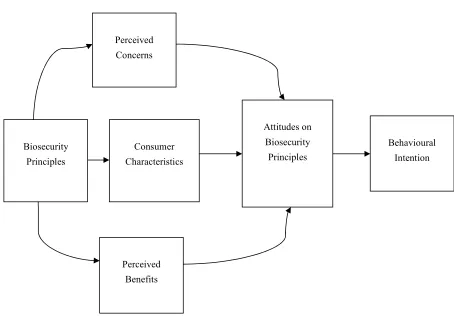
Following Kim (2009) and Costa-Font et al. (2008) studies, consumer attitudes on biosecurity principles can be conceptualized in terms of perceived concerns, perceived benefits and socioeconomic status. Perceived concerns are a cognitive construct that represents the consumers’ mindset and determines the consumers’ decision making and actions (Agarwal & Malhotra, 2005). Perceived benefits are consumers’ overall assessment of the utility of a product based on the perceptions of what is received and what is given, and the value represents a trade-off of the salient give and gets components (Zeithaml 1988). Socioeconomic constructis included in order to measure the effects of the individual difference on consumers’ purchase decision and to enhance the predictability of the behavioural intentions of preferring indigenous chicken.
The resultant construct is bound to contain a wide array of attitudes on biosecurity principles. Factor analysis addresses the problem of analysing the structure of the interrelationships (correlations) among a large number of variables by defining a set of common underlying dimensions, known as factors (Hair et al., 1998; 2010). Principal Component Analysis (PCA) is the commonly applied type of factor analysis (Akinnagbe, 2010; Chukwuone et al., 2006).
METHODOLGY
In principal component analysis, a set of original variables are transformed into a new set of uncorrelated variables called principal components. These factors are those common elements, latent, which is the basis of the variables intercollinearity (Lefter, 2004). A sufficiently large sample of subjects (300-400 subjects) can compensate for both the lower factorial saturation and for the reduced number of variables per factor (Labar, 2008; Kulcasr, 2010). With the Analysis of principal components, the variables can be measured by Likert scales, scales of interval or proportions (Labar, 2008). The new variables are linear functions of the original variables. The objective is to find out only a few components, which account for most of the variation in the original set of data. The principal
Biosecurity
Principles
Perceived
Concerns
Perceived
Benefits
Behavioural
Intention Attitudes on
Biosecurity
Principles Consumer
Characteristics
[image:4.595.71.525.151.468.2]component (Pi) is given by Kerur et al. (2010) as follows:
n nj j
j j
i
a
Z
a
Z
a
Z
a
Z
P
=
1 1+
2 2+
3 3+
....
+
Eq. 1
Where,
1
=
i
P
to n, are new uncorrelated components,aij = i = 1 to n, and j = 1 to n, the Z coefficients are factor loadings,
Zi = 1 to n, are observed variables as standardized by dividing (X-
X
) by its standard deviation( )
σ
x .Each component makes a maximum contribution in descending order to the sum of the variance of the variables. Normally, the first principal component contributes a maximum to their total variance; the second principal component contributes to the residual variance and so on. The sum of the variance of all the principal components is equal to the sum of the variance of the original variables. Sum of square of factor loadings
)
....
(
a
12j+
a
22j+
a
32j+
+
a
nj2 is called variance explained by factor . This is also known as Eigen value . The percentage contribution of in the total variance of original variables is given by,100
*
n
P
i=
λ
where,n
= number of variables Eq. 2PCA outputs include correlation matrix, initial factor matrix and rotated factor matrix. Initial factor matrix may generally fail to be meaningfully interpretable. Therefore rotated factor matrix is used for identification of factors. Varimax rotation (an orthogonal method), is the most common rotation method and will be used for rotation. This method tries to produce factors that are as simple as possible by maximizing the variance of the loadings across the items within factors. This leads to high loadings becoming higher and lower loadings declining.
According to Bissonnette (2006), the Eigen-value for a given factor reflects the variance in all the variables, which is accounted for by that factor. For the selection of factors Eigen values more than one is taken into account. Identification of and naming of any factor would be a subjective conclusion. Generally, the heavy loaded key variables would be considered as basis for identification and naming of dimension. In order to assign some meaning to factor solution a minimum level of significance for factor loading of 0.5 is taken (Kerur et al., 2010). The higher the value of factor loading of the variable on a particular factor, greater would be the association with that factor. If a factor has a low Eigen-value, then it is contributing little to the explanation of variances in the variables and may be ignored.
Construct development and validation
In cases where there is no validated scale one can follow Lee, Sandler and Shani (1997) study to develop new constructs. Caracciolo et al. (2011) and Kim (2009) on the contrary use empirically validated scales in their studies. This study does not have any validated scales thus will rely on Lee et al. (1997) and use guidelines from Kim (2009) for its construction. The study’s operational framework can guide the construct development. From the framework each the four biosecurity principles (Permin & Detmer, 2007) adjusted to fit indigenous chicken sector in Kenya (Nyaga, 2007b) can be translated into two sets of several statements each reflecting perceived concerns and perceived benefits to consumers respectively.
Pierson (2001) provides the best place to start developing attitudes on biosecurity principles construct. He developed a self-assessment tool to assess the level of biosecurity on poultry farms. The intended users were farmers and their attendants. The tool has a set of questions under each biosecurity principle and a binary True/False scale is used to score it. A further exploration of the literature (Amass & Clark, 1999; FAO/WB/OIE, 2009; Nyaga, 2007a; 2007b; CSHB, 2010; Butcher & Yegani, 2008; deGraft-Henson, 2002) will generate a more complete set of statements to be included in the construct.
The respondents will be asked to express their levels of agreement measured on Likert scales, with scores typically anchored at the extremes 1 and 7 (Caracciolo et al., 2011). For the purposes of validating the developed scale, primary data can be collected from a pilot study of 300 students in a large university. Bahia and Nantel (2000) used 300 students to validate their scales. DeVellis (1991)states that a sample of 300 respondents is sufficient to test measurement scales and the use of students for validation is not new to marketing scales. Lee et al. (1997) however, used 262 students of a large university to validate their construct.
an exploratory study (George & Maller, 2009) though Lee et al. (1997) had reliabilities between .63 and .69 and were acceptable (Bearden et al., 1993; DeVellis, 1991; Peter, 1979). The 74 item developed construct comprises Section A of the appended study instrument in Appendix 1.
Conclusion
The study has set forth four biosecurity principles and indicates how a psychometric scale can be developed to measure consumer attitudes on the principles using Fishbein Multi-Attribute Model. Using a framework operationalizing the model, the study develops a 74-item 7-point Likert scale construct to measure consumer attitudes on biosecurity principles. It then proposes a systematic procedure for validating the scale. This study is a tool that researchers, government agencies and international partners can use to validate consumer attitudes on biosecurity principles as they entrench biosecurity among the population.
References
Agarwal, J. and Malhotra, N.K. (2005) An integrated model of attitude and affect: Theoretical foundation and an
empirical investigation Journal of Business Research, 58(4): 483–493.
Akinnagbe, O.M. (2010). Constraints and strategies towards improving cassava production and processing in Enugu
North Agricultural Zone of Enugu State, Nigeria Bangladesh J. Agril.Res.35 (3) pp387-394
Amass, S.F. and Clark, K.L. (1999). Biosecurity considerations for pork production units Swine Health Prod 7(5) pp.217-228
Arnould, E.J., Price, L. and Zinkhan, G. (2002) Consumers New York: McGraw Hill Higher Education
Bahia, K. and Nantel, J. (2000).A reliable and valid measurement scale for the perceived service quality of banks,
International Journal of Bank Marketing, Vol 18 no. 2 pp84-91.
Bearden, W.O. (1999). Handbook of marketing scales: Multi-item measures for marketing and consumer behaviour research. London: Sage Publications Inc.
Bearden, W.O., Netemeyer, R.G. and Mobley, M.F. (1993), Handbook of marketing scales. Newbury Park, CA: Sage, p. 4.
Bett, H., Peters, K., Nwankwo, U. and Bokelmann, W. (2011).Estimating consumer preferences and willingness to
pay for the underutilised indigenous chicken products. Tropentag, October 5-7, 2011, Bonn accessed from http://www.tropentag.de on 2/6/12
Bissonnette V.L. (2006). Statistical tables, Department of Psychology, Berry College, Accessed on 19 February 2006 http://fsweb.berry.edu/academic/education/vbissonnette/tables/ chisqr.pdf
Bojesen, A.M., Nielsen S.S. and Bisgaard M. (2003): Prevalence and transmission of haemolytic Gallibacterium
species in chicken production systems with different biosecurity levels, Avian Pathology, 32:5, 503-510.
Butcher, G. and Yegani, M. (2008).Biosecurity for the poultry industry Veterinary Medicine-Large Animal Clinical Sciences Department, Florida Cooperative Extension Service, Institute of
Food and Agricultural Sciences, University of Florida, VM176 [Accessed 1/4/2012] from http://edis.ifas.ufl.edu
Canadian Swine Health Board (CSHB) (2010). National swine farm-level biosecurity standard. Canadian Swine Health Board, Technical Committee on Biosecurity. [Accessed 16th March 2012]
http://www.swinehealth.ca/CSHB_Biosecurity_StandardE.pdf
Caracciolo, F., Coppola, A. and Verneau, F. (2011).Validation of a psychometric scale to measure consumers’ fears of modern food technologies. International European Forum on
System Dynamics and Innovation in Food Networks, International European Forum, February 14-18, 2011,
Innsbruck-Igls, Austria.[Accessed on 1 April 2012] http://purl.umn.edu/122005.pp160-174
Chukwuone, N.A., Agwu, A.F. and Ozor, N. (2006) Constraints and strategies towards effective cost-sharing of
agricultural technology delivery in Nigeria: Perceptions of farmers and agricultural extension personnel. Journal of International Agricultural and Extension Education, Vol. 13(1) pp29-41
Churchill, G.A. Jr., and Iacobucci, D. (2004).Marketing research: Methodological foundations. Thomson/South- Western, Mason, Ohio
Corbanie, E. (2007). Development of a dry powder vaccine for mass vaccination An unpublished PhD thesis, Faculty of Pharmaceutical Sciences, Ghent University
Costa-Font, M., Gil, J.M. and Traill, W.B. (2008) Consumer acceptance, valuation of and attitudes towards
genetically modified food: Review and implications for food policy. Food Policy 33 (2008) 99–111.
Crawford, I.M. (1997). Agricultural and food Marketing Management Rome: Food and Agriculture Organization of the United Nations. [Accessed 16 March 2012]
http://www.fao.org/DOCREP/004/W3240E/W3240E00.HTML.
deGraf-Hanson, J. (2002). Biosecurity for the poultry industry Extension Service, West Virginia University DeVellis, R.F. (1991). Scale development: Theory and applications. Newbury Park, CA: Sage, p. 85.
East, I.J. (2007). Adoption of biosecurity practices in the Australian poultry industries Aust Vet J. 85:107–112.
FAO/WB/OIE. (2009). Good practices for biosecurity in the pig sector: Issues and options in developing and in transition countries. Rome, Food and Agricultural Organization of the United Nations.82 pages
Fishbein M. and Ajzen I. (1975).Belief, attitude, intention and behavior: An introduction to theory and research.
Addison-Wesley Publishing, Reading (MA)
George, D. and Mallery, P. (2009).SPSS for Windows step by step: A simple guide and reference16.0 update, 9thed. Boston: Pearson.
Grunert, K.G., Bredahl, L. and Scholderer, J. (2003) Four questions on European consumers’ attitudes towards the
use of genetic modification on food production. Innovative Food Science and Emerging Technologies, 4:435-445. Guèye, E.F. (2002). Newcastle disease in family poultry: Prospects for its control through ethnoveterinary medicine,
Livestock Research for Rural Development 14 (5). Retrieved from http://www.cipav.org.co/lrrd/lrrd14/5/guey145.htm on 21st August 2011
Hair, J.F. Jr., Black, W.C., Babin, B.J., and Anderson, R.E. (2010) Multivariate data analysis: A global perspective, 7th Edn, , Upper Saddle River, New Jersey: Pearson.
Hair, J.F.Jr., Tatham, R.L. and Anderson R.E. (1998) Multivariate data analysis Prentice-Hall
Kerur, N. M., Gaddi, G.M., and Naik, A.D. (2010).Policy framework for agribusiness sector: A case of performance
of regulated markets in Karnataka. Karnataka J. Agric. Sci., 23(3): pp447-451.
Kim, R.B. (2009). Factors influencing Chinese consumer behaviour when buying innovative food products Agric Econ – Czech, 55, 2009 (9): 436–445.
Kulcasr, E. (2010). Principal component analysis in tourism marketing Management and Marketing, Vol. 5 (2).Pp151-158
Labar, A.V. (2008) SPSS for education, Polirom: Iasi.
Lee, M. S., Sandler, D. M. and Shani, D. (1997) Attitudinal constructs towards sponsorship: Scale development
using three global sporting events. International Marketing Review, Vol. 14 no.3 pp. 159 – 169. Lefter, C. (2004) Marketing Research Infomarket Printing House, Brasov
24.
Mwanza, R. N. (2009). An assessment of good hygienic practices in the small holder broiler meat chain in Nairobi and Thika that impact on food safety A research project submitted to Larenstein University of Professional
Education in partial fulfilment of the requirement for the Degree of Master of Development Agricultural Production
Chain Management specialization in Livestock
Nerlich, B., Brown, B. and Crawford, P. (2009) Health, hygiene and biosecurity: tribal knowledge claims in the UK
poultry industry. Health, Risk and Society, autumn, 561-577
Nyaga, P. (2007a). The structure, marketing and importance of the commercial and village poultry industry: An analysis of the poultry sector in Kenya. Rome, Food and Agriculture Organization (FAO) of the United Nations Nyaga, P. (2007b). Good biosecurity practices in small scale commercial and scavenging production systems in Kenya. Rome, Food and Agriculture Organization (FAO) of the United Nations
Owaga, E., Mumbo, H., Aila, F.O. and Odera, O. (2011) Challenges and Opportunities of Kenyan Artisanal Fish
Industry; International Journal of Contemporary Business Studies Vol: 2,No: 12 pp. 32-38
Permin, A. and Detmer, A. (2007).Improvement of management and biosecurity practices in smallholder producers Rome: Food and Agricultural Organization of the United Nations.
Peter, PJ. (1979). Reliability: Psychometric, basics and marketing practices, Journal of Marketing Research, Vol. 16, pp. 6-17
Pierson, F.W. (2001). Biosecurity: Principles and practices in the commercial poultry industry. Center for Molecular Medicine and Infectious Diseases Virginia-Maryland Regional College of Veterinary Medicine Virginia
Polytechnic Institute and State University Blacksburg, Virginia 24061
Triandis, H.C. (1971). Attitude and attitude change John Wiley & Sons, New York.
Tull, D.S., and Hawkins D.I. (2004).Marketing research: Measurement and methods. Macmillan Publishing Company.
Zeithaml V.A. (1988). Consumer perceptions of price, quality, and value: A means-end model and synthesis of
evidence. Journal of Marketing, 52 (July): 2–22.
Appendix 1
Psychometric scale measuring consumer attitudes on biosecurity principles.
This section contains statements on your attitudes on biosecurity principles for indigenous chickens. Kindly indicate your level of agreement with each of the statements by marking/ticking ( ) on the number that matches your agreement. The scores are anchored on a 7 point Likert scale where 1=very strong disagreement, 4=neither disagree nor agree, and 7=very strong agreement.
No. Measurement item Level of
agreement 1. Breeding stocks are sourced from unregulated sources (local market, relatives,
friends, local hatcheries etc).
1 2 3 4 5 6 7
2. Day old chicks are not exposed to dirty environments 1 2 3 4 5 6 7 3. Day old chicks are often transported in non-disinfected carriages, crates, cartons
etc.
1 2 3 4 5 6 7
4. Brooding hens are not separated from the rest of the flock. 1 2 3 4 5 6 7
5. Clean beddings are provided for brooding hens. 1 2 3 4 5 6 7
6. There are adequate feeding troughs and watering equipment for all birds in the poultry house.
1 2 3 4 5 6 7
8. Chicken coops are kept indoors at the main house overnight. 1 2 3 4 5 6 7 9. Chicken stay in the same living house with humans. 1 2 3 4 5 6 7
10. Laying nests are provided for layer birds. 1 2 3 4 5 6 7
11. There is adequate space in the poultry houses. 1 2 3 4 5 6 7 12. Litter material is seldom removed from the poultry house. 1 2 3 4 5 6 7 13. The hens are overcrowded and ventilation is inadequate. 1 2 3 4 5 6 7 14. Fresh litter material is provided for new flocks. 1 2 3 4 5 6 7 15. The poultry general hygiene is not entirely poor. 1 2 3 4 5 6 7 16. The poultry house is not adequately sunlit, sunshine is minimal, drainage is
inadequate, cleaning is impossible, is prone to strong winds, drafts and wind chills.
1 2 3 4 5 6 7
17. No foot dips/footpaths are provided at the poultry house entrance 1 2 3 4 5 6 7 18. Attendants seldom wash hands before or after attending to the flock. 1 2 3 4 5 6 7 19. Attendants wear domestic cloths while on duty without protective head gears
and footwear.
1 2 3 4 5 6 7
20. Watering and feeding equipment are clean and disease free. 1 2 3 4 5 6 7 21. Poultry operation staff is trained on proper poultry husbandry. 1 2 3 4 5 6 7
22. Poultry scavenges for feeds and water. 1 2 3 4 5 6 7
23. Poultry are exposed to not so clean water and low quality feeds. 1 2 3 4 5 6 7
24. Feed supplementation is rarely carried out. 1 2 3 4 5 6 7
25. Most farmers raise flocks using home-grown skills. 1 2 3 4 5 6 7
No. Measurement Item Level of
agreement
26. Farmers and traders in indigenous chicken do not observe any personal hygiene. 1 2 3 4 5 6 7 27. As birds scavenge they interact with several disease carrying agents. 1 2 3 4 5 6 7 28. Wild birds’ attractants (spilled feeds, open water spots, dead carcasses) are
seldom removed from the poultry compound.
1 2 3 4 5 6 7
29. Poultry feed usually constitute a balanced diet. 1 2 3 4 5 6 7 30. There is no quality standard requirement for indigenous poultry feeds. 1 2 3 4 5 6 7 31. Feeds constituted from low quality ingredients are altogether bio-insecure. 1 2 3 4 5 6 7 32. Feeds often get contaminated at its administration by fecal matter containing
disease agents.
1 2 3 4 5 6 7
33. Many times confined indigenous birds are in very poor nutritional status towards the end of the rainy season.
1 2 3 4 5 6 7
34. As the flock scavenges, it is exposed to the atmosphere that might carry disease agents.
1 2 3 4 5 6 7
35. Vaccinated flocks tend to resist disease outbreaks. 1 2 3 4 5 6 7 36. Isolating flocks from situations that expose them to diseases is preventive in
nature.
1 2 3 4 5 6 7
37. Indigenous farmers do not vaccinate their birds routinely unless there is a concerted effort from a third party (say the Government Department or other agency).
1 2 3 4 5 6 7
38. Farmers grouped in farmer associations tend to vaccinate their flocks routinely. 1 2 3 4 5 6 7 39. Non-vaccinated flocks tend die of diseases such as Newcastle Disease (NCD). 1 2 3 4 5 6 7
40. Dead birds are fed on dogs and at times humans. 1 2 3 4 5 6 7
41. Poultry houses are located close to main houses. 1 2 3 4 5 6 7 42. Farmers do not change attires after visiting live markets, feed dealers, when they
want to attend to their flock.
1 2 3 4 5 6 7
both domestic and wild animals.
47. There exists no trade organization that organizes the trade of poultry products in Kenya.
1 2 3 4 5 6 7
48. Eggs and birds are sold at farm gate, at the local market or at targeted restaurants.
1 2 3 4 5 6 7
49. Equipment and carriages used to ferry eggs and live chicken to the market are seldom disinfected.
1 2 3 4 5 6 7
50. While on transit, the birds are either exposed to the atmosphere or are in contact with humans.
1 2 3 4 5 6 7
51. For farm-, market- or restaurant-slaughtered birds, biosecurity concern is on where and how the waste water, feathers and offals, which may lead to spreading of disease, are disposed.
1 2 3 4 5 6 7
52. The biosecurity risks at the slaughtering process are many e.g. dry defeathering scatters feathers all over the sales areas at the local markets.
1 2 3 4 5 6 7
53. For wet defeathering, the disposal of waste water, the offals, the feathers and the presence of worn out cement floors, the presence of bird cages and storage of personal effects in the cages that also held chickens poses a big biosecurity risk.
1 2 3 4 5 6 7
54. All the municipal slaughter houses where indigenous birds are sold and slaughtered have a meat inspector whenever they slaughter poultry.
1 2 3 4 5 6 7
55. Indigenous chicken sold in live markets, slaughtered at market-, restaurant-, home-backyard are seldom inspected.
1 2 3 4 5 6 7
56. There is no formal inspection carried out for eggs except grading. 1 2 3 4 5 6 7 57. There is evidence of domestic birds mixing with wild birds. 1 2 3 4 5 6 7
58. Free-range flocks are healthier and testier. 1 2 3 4 5 6 7
59. Protocols and procedures in the hatcheries if monitored regularly can assure they supply clean day old chicks free from bacterial and viral agents that may emanate from hatcheries.
1 2 3 4 5 6 7
60. Use of appropriate disinfectants in the hatchery and in the brooding house minimizes disease occurrence.
1 2 3 4 5 6 7
No. Measurement Item Level of
agreement 61. Separately brooding indigenous chicks (chicks alone or chicks together with
mother hen) for at least three weeks of their life ensures their adaptability to their new environment.
1 2 3 4 5 6 7
62. A disinfectant dip placed at the door of each house can prevent entry of diseases agents into the flock house.
1 2 3 4 5 6 7
63. Poultry houses facilitate parasite and disease control. They promote faster growth and protect the chicken from predatory birds and animals and adverse weather conditions and theft during the night as well as during the day time.
1 2 3 4 5 6 7
64. Dedicated clothes worn in the poultry house would reduce chances of entry disease into the flock houses.
1 2 3 4 5 6 7
65. Training in good husbandry practices for all poultry farmers can improve biosecurity measures markedly.
1 2 3 4 5 6 7
66. Poultry feed that is free from disease agents should be kept in a clean, dry store free from rodents and insect pests.
1 2 3 4 5 6 7
67. Supplementary feed should be given in the shade that precludes wild birds getting attracted to it and getting closer to the domestic birds.
1 2 3 4 5 6 7
68. A program of educating farmers on the role and usefulness of isolation and other biosecurity measures can be developed and implemented.
1 2 3 4 5 6 7
69. A disinfectant dip at the entrance to the flock houses keeps at bay pathogens and prevents from escaping into or out of the poultry house.
1 2 3 4 5 6 7
or dedicated clothes and shoes is a beneficial practice.
71. Use of disinfectants to decontaminate materials and equipment that has gone to the market before it is re used at the farm is prudent.
1 2 3 4 5 6 7
72. Identifying clean and dirty processes in the farm, sales and slaughtering processes so as to avoid contaminating clean areas is logical.
1 2 3 4 5 6 7
73. Dedicated clothing, which may not necessarily be new, should be provided for use exclusively in the flock houses.
1 2 3 4 5 6 7
74. The small proportion that does not get inspected may need to be identified and be brought into the inspection loop.